The Lumberjack


Students Serving The Cal Poly Humboldt Campus and Community Since 1929

Category: News

  • CSU Unions bargain with Chancellor’s Office; California Faculty Association considers going on strike

    CSU Unions bargain with Chancellor’s Office; California Faculty Association considers going on strike

    by Andres Felix Romero and Emma Wilson

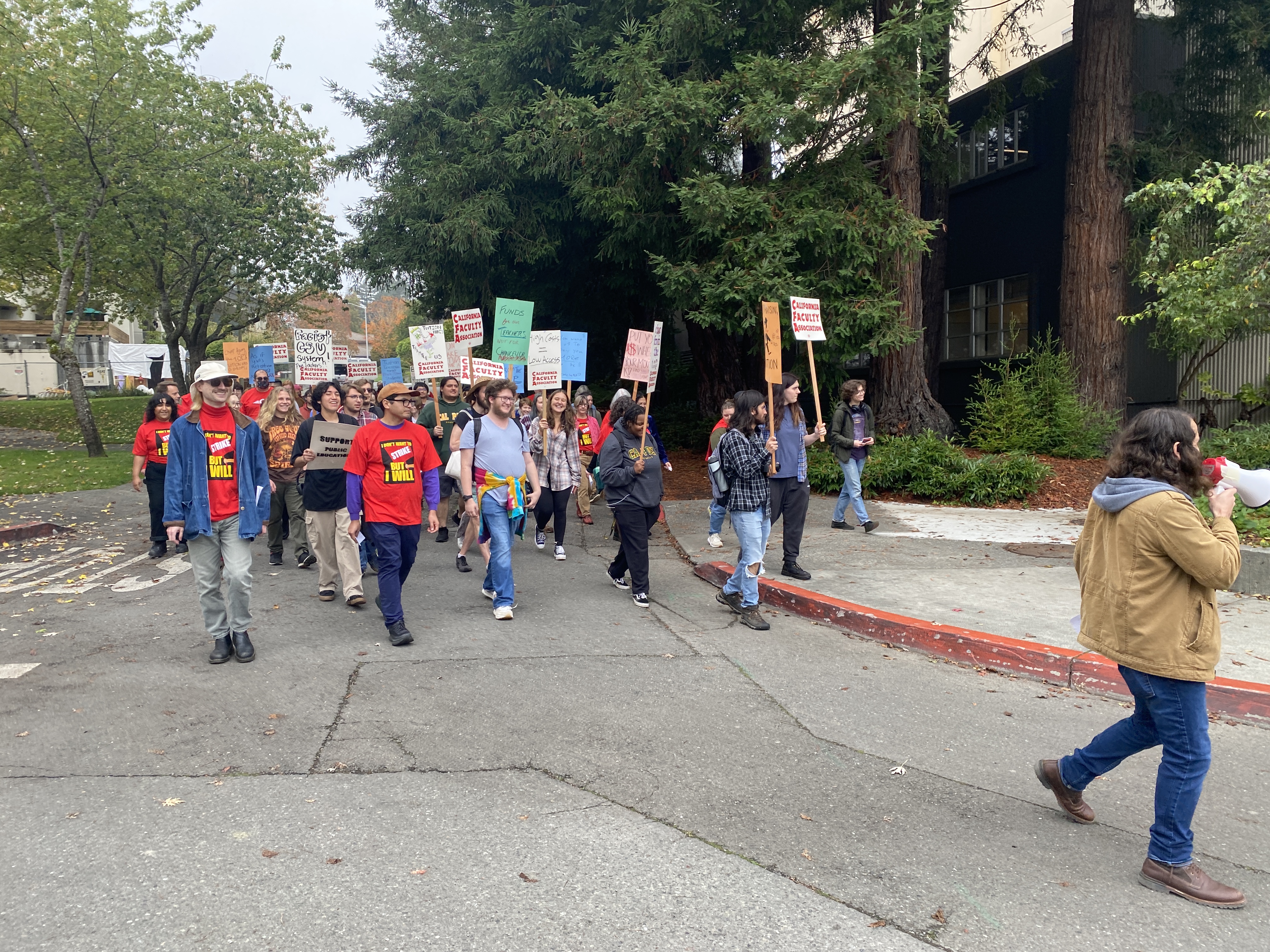
    Hundreds of miles from Humboldt county in Long Beach, dozens of people are rallying against the decisions of the Chancellor’s and the Board of Trustees that hold the fate of our communities’ future outside of the headquarters of the California State University (CSU).  

    What the CFA is fighting for

    The California Faculty Association (CFA) is one of six CSU Unions present across the 23 campuses. The CFA focuses their support on staff that work directly with students such as lecturers, coaches, and counselors. 

    The other unions are the CSU Employees Union (CSUEU) who support staff that provide essential services to students such as those in admin, the Union of American Physicians and Dentists, Teamsters Local 2010 that supports skilled trade workers such as painters and carpenters, the student union UAW 4123 and finally, the Academic Professionals of California (APC) which provides support to campus staff that work with students outside of the classroom such as financial aid and residence life.

    Currently, the unions are collectively bargaining, and they are fighting for many of the same things. The CFA is campaigning on two main fronts, better wages and financial compensation, as well as better workloads and support to faculty

    Wages

    The CFA is asking for a 12% general salary increase. Cal Poly Pomona CFA member and associate professor of Political Science Marc Scarcelli reasons that although a 12% increase may seem like a lot, it’s essential to keep wages fair as the inflation rates increased 8% since the last bargaining session between the CFA and the CSU.

    “If your wage increases don’t keep up with inflation, your wages are actually going down,” said Scarcelli, “and so if you think about it, we have to threaten the strike just to break even if we’re not actually fighting for more. We’re fighting just to break even. We [got a 3% pay raise] at a time when inflation was over 8%. What we got is effectively a pay cut.” 

    The CFA is also hoping to raise the salary floor for lecturers. Chief Steward of the Humboldt APC Chapter Tania Marin-Zeldin feels that this proposal is needed to help faculty with their standard of living.

    “To hear that some of our members have two jobs because they can’t afford to have a decent living and provide for their families, that’s the sad part,” Said Marin-Zeldin. “We shouldn’t have to have two jobs. We shouldn’t have to be barely living, paycheck to paycheck.”

    Freshman Evaluator and Union Representative of the APC Sierra Farmer hopes that having more competitive wages could help with retention of workers within the CSU system. She explains that because of what feels like unfair wages, many CSU workers, including alumni, leave because they can’t live comfortably with the wages provided.

    “We lose good employees in the Cal State system,”  Said Farmer. “We have lower wages than the UC’s and the community colleges. So we lose really good people to the other systems all the time because they don’t make a living wage.”

    Another financial goal to increase fair wages and combat inflation resulting in pay cuts, is the unions fighting for yearly step-raises within the CSU system.

    Better support for staff and faculty

    To also help with retention rates for faculty and staff, especially counselors, Professor and CFA President of the Humboldt Chapter Marisol Ruiz notes that better policies surrounding tenure and more long-term contracts can help with the feeling of stability for employees.

    “We want [counselors] to get three year contracts,” said Ruiz. “When you’re in a [year-long contract], you’re in a precarious situation. You don’t know if you’re getting your job back or not, so people sometimes don’t want to stay. We’ve had a hard time getting good counselors to stay. We need to offer them better [contracts], where they will be more likely to stay due to better conditions.”

    On top of contracts, the unions want there to be more fair workloads for faculty, as well as better ratios between students and faculty. Ruiz remarks on the importance of a healthy ratio between students and faculty.

    “We want to give [students] more attention,” said Ruiz. “We want to lower class sizes, and focus on [student’s work]. But the [CSU] just wants to cram everybody in. The more care that we have for our students, the better they will do in their classes and the more effective they will be as [learners] and we want that. ”

    Beyond workloads and wages, the unions are also wanting to ensure more gender equity on campuses by providing bathrooms and changing facilities that people can feel safe with no matter their gender. They also want better paid parental leave and more lactation stations for parents across campuses. 

    Process of Union Bargaining and Current State of Negotiations

    Every few years, each of the unions on the CSU campuses reopen their contracts with the CSU to bargain. This year’s cycle is unique as it was delayed due to COVID, and instead of bargaining in a staggered way, every union is negotiating their contracts at once. As of the writing of this article, every union aside from the CFA is still at the bargaining table. The CFA has declared an impasse with the CSU since they did not come anywhere close to an agreement, and has moved onto the fact-finding stage. Faculty Rights Chair for the CFA Humboldt Chapter and Lecturer in the Philosophy Department Loren Cannon explains the process

    “Fact finding is where [the CFA] and [the CSU] produce information and argumentation as to why our proposals are good. [The CSU] will probably try to produce information that says, ‘Oh, we just can’t afford it.’ [The CFA] will produce information that says, ‘well, actually, you can.’ We could go back to bargaining somewhere in the middle here, but if we don’t have any agreement at that point, there might be collective action.”

    If the mediation following the fact finding stage again fails, the union can then vote on to take action, such as a strike. If the CFA does decide to strike, it will likely be in early November as of the time of writing this article. Scarcelli notes that a few within the CFA are looking forward to a chance to strike.

    “In terms of willingness to strike, I talked to a lot of my colleagues and honestly, they’re not just willing, they’re eager,” said Scarcelli. “Colleagues all over the place are chomping at the bit like, ‘when do we get to strike,’ because they’re pissed. They’re just furious. You know, when our incomes are effectively going down. And then we keep seeing that they give appalling raises to university presidents and the Chancellor.” 

    CSU Response

    In a video message and written statement from interim Chancellor Jolene Koester, she affirmed that the CSU is committed to fair pay and compensation for faculty and staff. The CSU has proposed a salary step structure for faculty and staff in the CSU’s to reach 12% over three years, however the increase will be 5% in the first year. The CFA has rejected this and declared impasse following the offer. The CSU leadership say they will be challenged to meet the proposals of the CFA and other unions throughout the CSU.

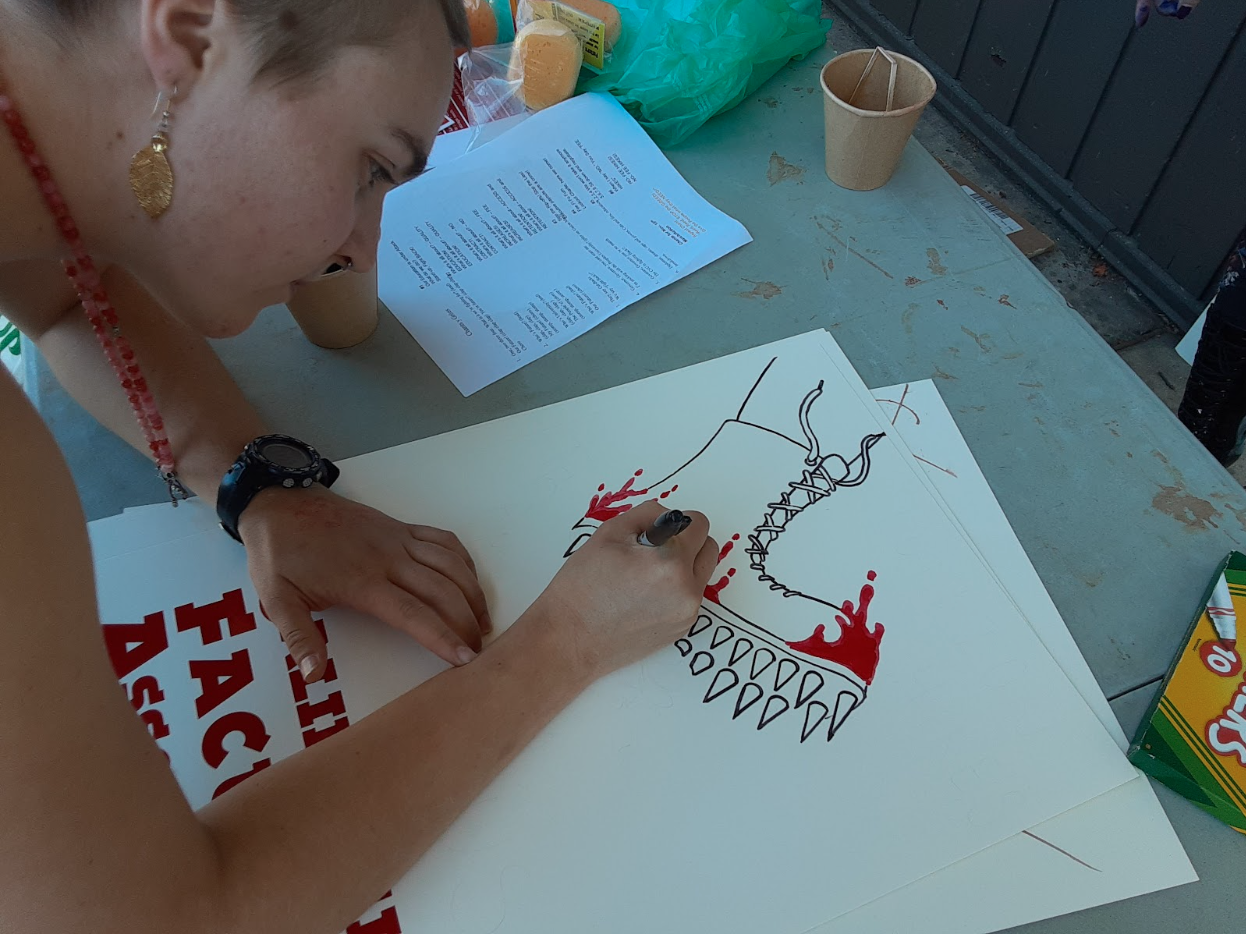
    CFA flyer

    Why Faculty are Fighting

    With the CSU rejecting some of the union’s requests, many within the union are becoming more frustrated, especially with the wages that the CSU higher-ups and presidents are making. Ruiz notes that on average, after the average CSU president’s salary and allowances for their car and housing, they generate more income than the governor of California.

    “I do not think it is acceptable for us to have a housing allowance for anybody who’s making $300,000. it’s not right, when our students are homeless and are living in cars, and we don’t even pay a living wage to lecturers,” said Ruiz. “ How [is the CSU] getting all this money for car allowances? How are you getting a housing allowance? How are [CSU presidents] being provided for? And our students are not? Your job is not as important as the governor of California, let’s put back the money where it needs to go.”

    Farmer also notes that her yearly wage barely compares to Humboldt President Jacskon’s yearly housing allowance

    Overall, the unions and their members such as Scarcelli are working towards better compensation and working environments to continue supporting students in their journey of creating a better future for themselves.

    “We do what we do because we love education,” said Scarcelli. “We love our students. It would pain me to skip classes, but I will, and I find most students are very receptive to our cause.”

  • Journalism Department remembers Sam Armanino

    Journalism Department remembers Sam Armanino

    by Alex Anderson

    Sam Armanino was a freelance videographer, editor and photographer who made his living doing what he loved. He wasn’t afraid to put himself in critical positions for his video work, which made his content stand out. A Cal Poly Humboldt journalism graduate and former Lumberjack Editor in Chief, Armanino used the skills he learned in school to chase down his dream. Armanino created content for outdoor sports such as climbing, mountain biking and skiing. He was truly living his dream, but sadly on Aug. 31 Armanino passed away from a mountain biking accident. 

    Sam Armanino was truly one of a kind, both in the sense of his creativity but most importantly in how he treated others around him. It did not matter whether he knew you his whole life or one day, Armanino made people feel comfortable, always giving his utmost respect and attention. I remember the first day that I met him, meeting at my brother’s apartment in Arcata, getting ready to go surf. He was so stoked on learning how to surf, buying a fresh longboard and questioning my brother and I for advice that we might have for him. Instantly fitting into the deep bond that I share with my brother, Armanino fit in like family instantly, being silly and pestering me with jokes while flaunting his huge infectious smile. That was Sam. 

    He dove into new adventures head on and did the same with learning about those around him. Armanino strove to pull as much as he possibly could out of life, learning more about the people he stumbled upon, their stories and what interested them. He was the embodiment of a humble soul, killing people with genuine kindness and curiosity. I interviewed Sam for a class project in Fall 2022 where he described what drove him into journalism.

    “I found journalism and I saw that as something that was really important,” Armanino said. “I really liked talking to people and connecting with people and I have always been a big fan of media. And so my initial thought was to combine recreation administration and the love of the outdoors with journalism.”

    Photo courtesy of Mark McKenna. Sam Armanino (center) standing with other photographers.

    Vicky Sama, an emeritus professor in the journalism department at Humboldt State University and Armanino’s former advanced video production professor, described how Armanino used his kind energy in and out of the classroom.

    “Sam brought positive energy to the classroom and just about everywhere he went,” Sama said. “He combined his passion for the outdoors and journalism and created a career doing what he loved most. He had such a great and young career and so much promise. I’m absolutely crushed to know he is gone.”

    Sam was the type of person that would scream louder than you for your accomplishments, a recurring theme that can be seen in many of the videos that he created. A passionate creator and cameraman, Armanino can be heard howling for joy while filming his friends. He was genuinely happy for you. I remember hearing him playfully shouting as I rode waves past him. Few people possess the infectious joy that Armanino embodied. He legitimately wanted to see the people around him succeed and be the best version of themselves, encouraging people to test their abilities. 

    Sam lived his life to the absolute fullest, chasing powder days while backcountry skiing and blistering down mountain bike trails. Dedicated to being in the outdoors, chasing the beauty of nature and doing everything he could to avoid a typical desk job. Being outside with his friends was where he belonged and he made a living pursuing his dream of capturing people doing amazing things outdoors. Armanino detailed his desire to thrive and create his own path and how pursuing his dream as a freelance videographer made him happy. 

    “I think it’s been a really good way for me to kind of avoid the stereotypical 9 to 5 world, which I just don’t think I could thrive in, that I didn’t thrive in,” Armanino said. “So I think it’s been like a really good creative way to kind of create my own path.”

    Armanino was not a typical human being that could be bound to an ordinary career, he was a special breed. His adventurous personality drove him to creating beautiful content and friendships. His friends point to Armanino’s ability to create light in life through his corny jokes, absurd noises, goofy faces and bubbly laugh. He surely has left a positive mark on this planet and will be sorely missed by many. 

    Kind words from those who knew Sam 

    Vicky Sama – Emeritus Video Production Journalism Professor

    Sam was a talented photographer and editor and he would often visit in my office where we would talk about how he could make a living doing the things he loved such as videography, skiing and mountain biking. He made it happen. He was living the dream. He was full of life. It’s so sad he’s gone.

    Mark Mckenna – Photojournalism/Video Production Professor 

    I will miss those random calls or texts for advice or just to see how I was doing. I will miss seeing the latest instagram post where he nailed it. I will miss him being able to share with current students his talent and passion for life. He was so full of light. I will try to always remember that smile filling up my classroom and his words of encouragement to his fellow students. 

    Andrea Juarez – Advising Professor for El Leñador

    Sam was a wonderful student and human being. He was kind, easy going and laid back, but no doubt, he was dedicated and serious about his craft. He was eager to learn and try new things. Sam was bold and dared to live as he believed, especially with regard to his love of the outdoors. He certainly knew how to capture beauty with his photos and videos, yet it was his spirit and zest for life that captivated those who knew him.

    Garrett Purchio – Librarian at Cal Poly Humboldt

    Sam was truly one of a kind. He was incredibly passionate about journalism and his positivity was unmatched. I thoroughly enjoyed working with Sam and I will miss him dearly. Sam, thank you for your kind spirit and generosity.  

    Javier Rojas – former LJ Managing Editor & El Leñador EIC

    Ask anyone and they will tell you that Sam was the nicest and most genuine person they ever met. He was one of a kind and will be missed by so many people. Love you Sam.

    Miranda Hutch – Class of 2016

    He had a perfect balance of drive and adventure. He had a passion for his work that cannot be learned. You just have it. And Sam had it. It’s not fair that the world won’t get to see what else he could have done with more time. 

    Katelyn Peakes – Class of 2017

    I will miss his random yelling and super sick air guitar skills… He created a career following his passions and was living life to the fullest which we could all aspire to. There was simply no way you could be in a bad mood around him. A great human being and an amazing friend… Much love Sam!

    Austin Anderson – Class of 2017

    My experiences with Sam will always act as a lens through which I see life; always looking for the good, the fun, and of course for what’s right. Sam’s energy was infectious and if you could key into his wavelength, it truly was a portal to a better place. So sad to see him go, but so proud to have been his friend.

    Carmen Pena-Gutierrez

    Thank you for being better than kind, more than genuine, and too much of a force to be described in words. Thank you, Sam. Rest easy.

    Zachary Sibek

    Sam not only met life’s biggest moments with a fearless smile, he was present in the quiet moments. Truly absorbing life and ultimately embodying an example all of us can work towards. Rest in Peace Sam. You are loved and you are missed so dearly. 

    Tessa lance

    Sam was one of my first friends at humboldt, he made me feel like I was in the right place. I’ll never forget his ridiculous smile and over the top wave whenever he skated by and am so grateful for all the beers we shared. I love you Sam.

    Anne Maher

    I will always remember Sam for his exceptional drive to live life exactly the way he wanted to. He truly loved life, and moved through it with unbounded positivity and creativity. 

  • Controversial casting choice reveals ongoing student frustration in Cal Poly Humboldt’s Theatre Department

    By Jake Hyslop

    Theater students are outraged and frustrated after Troy Lescher, an associate professor in Cal Poly Humboldt’s theater arts department, has been cast in this semester’s theater production of The Life of Galileo. The casting decision has faced fierce opposition from students within the theater program, who argue that it undermines opportunities for aspiring actors, and raises questions on inclusivity and fairness in casting. 

    By casting Lescher in the role, the students argue that the department has removed the opportunity for a student to gain valuable learning experience in a leading role. It’s the last straw in a series of decisions and experiences that the students believe have left them unprepared for the world of professional theater. 

    Lescher declined to be interviewed, but provided a statement in response to his casting. 

    “When faculty artists and student artists collaborate… students have opportunities to develop knowledge and skills in realistic ways, preparing them for the diverse production experiences they will encounter after graduation. As a member of The Life of Galileo ensemble, I look forward to applying my professional training put and experience to help strengthen student learning; promote learner success; and bring a special and relevant story to life on the university stage.” 

    Rumors of the casting spread before it was officially announced at the theater program’s “Welcome Back” event on Aug. 24th. Several disgruntled students showed up to challenge the casting decision. Miah Carter, a senior in the program, was among these students. 

    “We just wanted to, first and foremost, make sure that all the students who are in this program and attending were aware that this is not something that benefits college students,” Carter said. 

    At the event, the students asked why Lescher was cast before auditions were held. Linda Maxwell, the theater program leader, did the bulk of the responding. One reason for Lescher’s casting was the scope of the lead role. 

    Cindy Moyer, chair of the Department of Dance, Music, and Theatre, said that Lescher has spent his summer working on the part, and asking a student to put that breadth of work in half a semester isn’t feasible. 

    Maxwell and Julie Eccles-Benson, the co-director of the show, declined to be interviewed. 

    Maxwell spent a large part of the meeting blaming the students’ frustration over not being able to audition for the lead role.

    “Yeah, I’m mad,” Carter said. “Mad I’m not getting the education I’m paying for, not because I wasn’t cast as the lead in a show. Look at me. I’m a young Black woman. I was never going to be slated to play as Galileo himself.”

    Carter wasn’t surprised at the results of the encounter. 

    “We pretty much expected them to give the reaction they did and the excuses they did,” Carter said. “They didn’t really want to hear us out, which didn’t surprise me.” 

    Carter suggested that if the faculty knew The Life of Galileo was going to feature a lead role too bulky for a student, they should have chosen a different show that catered more towards student interest. 

    According to Moyer, the justification for casting a faculty member over affording the opportunity to a student boiled down to how the role of Galileo was too large a workload for a student to handle and how Lescher’s casting afforded an opportunity for collaborative learning. 

    “For Galileo, the theater faculty thought carefully and felt that this play provided an appropriate opportunity for students to learn by working side-by-side with a professional actor,” Moyer said. “It may be several years before students will get this valuable and exciting opportunity again.” 

    Ash Quintana, a theater major in his senior year, felt that the faculty had taken away students’ agency. He said that taking away the students’ choice pampers them and doesn’t prepare them for professional theater, where they’ll often have to multitask between theater and work.

    The students didn’t accept the collaborative learning rationale provided by the department. 

    “When it comes to acting, you learn more by doing than by watching somebody,” Quintana said. “If you want a student to learn, put them in that role, and have the resources to guide them to success, instead of just assuming they can’t do it on their own.” 

    Lescher’s casting is the latest in a series of controversial choices for theater program students. The program once had a season selection committee for choosing future shows, including both faculty and students, but in recent years only two students, including Carter, were on it.

    “It was pretty easy for them to dismiss what we were saying,” Carter said. “I do think they made a little bit of effort to be like ‘oh yeah, here, you’re making some good ideas,’ but it never felt like they were actually considering what we wanted to do.” 

    The season selection committee was disbanded by the fall semester of 2022. The faculty provided no reason why.  During that same semester, they emailed a survey to students, to gather their opinions on shows the faculty had already selected for consideration. Many students only recognized Into the Woods, the show slated for Spring 2024, out of four faculty-selected shows. 

    In Spring 2023, an email announced an in-person show selection meeting. Only one student attended. Carter explained that students didn’t want to bother showing up when they weren’t going to be heard or meaningfully included in any way. 

    The other big issue theater students have faced is the recent glut of “no-prep” auditions. “No-prep” auditions require no preparation going in, and often involve theater games and activities where the director(s) will cast or send callbacks to performers by judging their contributions. Out of the past five semesters since coming back in-person from the Covid-19 pandemic, four of them have been non-traditional or “no-prep.” 

    “I’ve been to a couple of those,” said Zoe Estelle Rose, a child development major. “Nonsense, they’re just nonsense auditions. They don’t prepare you for anything.” 

    When an audition announcement is made with the words “no-prep” attached, many students audibly groan. They don’t feel that actors who attend these auditions are being taught anything useful regarding professional auditions. 

    “We’re going to graduate and go off and try to audition for a real production,” Carter said. “And we’re going to fail immensely. And when they ask us where we trained, we’re going to say ‘I went to Humboldt where they did no-prep auditions and we could just show up and get casted if we were silly.’” 

    In Quintana’s advanced acting class this semester, he noted that many students asked to learn how to audition and recite monologues. 

    “The school is not teaching us how to do that,” Quintana said. “We are not going to be cast in professional shows in the real world.” 

    Moyer said that these nontraditional auditions have been the result of selected directors, but that in the future the department will address this concern and make sure the students get more professional audition exposure.

    The concerned students are speaking out because they don’t want new students to transfer to the department unaware of the issues they’re facing. Both seniors mentioned they wouldn’t have transferred to Humboldt’s theater program if they’d known that going in. 

    Maxwell has started meeting with the frustrated students to open up a dialogue for making the theater program more inclusive, and cut down on the communication divide between faculty and students going forward. 

    “I feel like I’m getting a lot of examples of what not to do in a theater program,” Quintana said. “I personally haven’t had too many opportunities to fully learn theater. I’ve been here for two-and-a-half years, and I’m not really going away with that much.” 

    Here is Lescher’s full statement: 
    Thank you, Jake, for wanting to share additional context and insight on theatre-making within the Cal Poly Humboldt Theatre Arts (TA) academic program. As a TA Major who has acted on our stage several times, you can attest to the frequency of TA Faculty serving in major creative capacities on mainstage productions. Project-based learning is one of the central components of performing arts education within the Department of Dance, Music & Theatre. When faculty artists and student artists collaborate as choreographers, composers, directors, designers, dancers, musicians, and actors, students have opportunities to develop knowledge and skills in realistic ways, preparing them for the diverse production experiences they will encounter after graduation. As a member of The Life of Galileo ensemble, I look forward to applying my professional training and experience to help strengthen student learning; promote learner success; and bring a special and relevant story to life on the university stage.

  • Cannabis festival “Cannifest” brings buds together

    Cannabis festival “Cannifest” brings buds together

    by Andrés Felix Roméro

    As the sun was setting on the Eureka Waterfront, a few people in their boat called out to the festival-goers on the shore. Through shouts across the water, they requested some weed to enjoy on their aquatic cruise. One kind gentleman was more than happy to oblige and passed along a joint to one of the boatmen who swam to shore on his boogie board. This was just one of many instances of communal actions and feelings present at the 2023 Cannifest, which ran from Sept. 9th-10th.

    For the first time since the pandemic, a cannabis-centric festival returned to Humboldt county with the three-day celebration of the plant and the culture surrounding it through Cannifest. Primarily run and organized by Joe Moran and Steve Gieder, the festival was a hit to those who love to spark, smoke, eat and other methods of enjoying weed. There was no lack of colorful and engaging sights with plenty of music, food, art, activities and of course, cannabis.

    Day 1

    For some, the Cannifest celebrations began not in Humboldt, but on Friday, Sept. 9th in San Francisco. The Roast and Toast bus tour aspect of Cannifest was helmed by the founder of Humboldt Cannabis Tours, Matt Kurth. He acted as the group’s tour guide, spouting fun facts about the surroundings, as the bus reenacted the pilgrimage many people took following the San Francisco Summer of Love in 1967.

    Photo by Andrés Felix Roméro. Snail-Nail Dab Company representative shows off his dab rig that is powered by his Bigfoot statue.

     “There’s always a group of people where mainstream society doesn’t work for them,” said Kurth. “Because Summer of Love only lasted three months and fell apart, some of the people still wanted to find a new way of living because they needed it. So, they started the Back to the Land Movement, leaving the city and going to try to find new ways of living out in the country. The first cheap land was northern Mendo and southern Humboldt, that’s why [the people] stopped there”

    The bus made stops at Santa Rosa dispensary OrganiCann and the Hopland restaurant Rock Seas. At these stops, the passengers happily shared their buds with each other. The passengers ate lunch and took dabs with fruit pairings to enhance the turpentines. Self-described gonzo journalist Cameron Hussain described the desire for community that many of the passengers and cannabis lovers carry, and the importance of accurate representation of the cannabis community.

    “We are contributing to the narrative of the culture just by being here,” said Hussain. “[The community has] been so long underground, we are hungry to connect and enjoy this plant we all love.”

    The bus made its final stop for the day at the Red Lion hotel in Eureka so that the passengers could get ready for the first true party of the weekend, the Cannifest Gala at the historic Eureka Theater. At the Gala, there was cannabis history trivia, the winners of the Cannifest competitions were announced, and the night ended with performances by local artists such as Flow J. Simpson, Eli Fowler, and Object Heavy. 

    Day 2 and 3

    Event Highlights

    The Cannifest Festival properly kicked off Saturday, Sept. 9th. Even for any seasoned festival goers, it would be difficult to experience everything the venue and 50-plus booths had to offer. The backdrop of the Eureka Waterfront was soothing to those wanting to enjoy delicious, diverse food from taco trucks and soul food booths with a calm breeze. A favorite by many was a locally owned Native women business, Frybread Love, which offered fry bread topped with lettuce, sour cream, ground beef and chili beans.

    Besides people sitting and laughing while eating, many community aspects of the event were present thanks to the constant sharing of cannabis between everyone. Everywhere you looked, there were smiling people passing smoking blunts and joints. Plenty of booths offered free dabs to anyone who came by. One gentle soul only known by Big L was rolling free blunts for any passerby to enjoy. 

    Photo by Andrés Felix Roméro. Festival-goer dressed as a stoner icon, Towlie from South Park, enjoys quality time with his class piece.

    The ability to enjoy the event was diverse. Those with a Sativa high could enjoy the music and dancing, and those with an Indica low had plenty of comfortable seats to enjoy. Katie Dalmasso attended Cannifest after just returning from Burning Man, and remarked how the festival was great to reset following the hectic desert festival.

    “What a beautiful way to decompress, coming to a cannabis festival right after [Burning Man],” said Dalmasso. “It’s kind of the same feeling [as Burning Man] but more relaxed, everyone getting together as a community and having fun and supporting each other.”

    In many aspects of cannabis culture, feelings and desires for healing are present, which was case-and-point with the arts at the event. Many who were dancing at one of the two stages looked carefree and happy in their outfits that were peak Humboldt. Festival-goers were treated to music by Hip-Hop legendary duo Dead Prez, and Grammy-award winning Reggae rapper Kabaka Pyramid. 

    Healing and Community Aspects

    Besides music, plenty of other art forms were present. There was a series of amazing murals painted with a variety of different techniques as part of an art competition centered on social justice. Other amazing mediums included dancing, paintings on large canvases, and a glassblower doing his work live. There were plenty of activities to participate in, such as massage chairs, yoga and even a mobile barber.

    Not suprining to Humboldt and Cannabis culture, the event was welcoming not just to bipeds, but to our four-legged canine friends. As diverse as the arts were in Cannifest, dogs of all breeds and sizes accompanied their owners. One individual brought his best friend Roscoe, and also found healing and solace through cannabis culture following a tumultuous childhood, was Jake “Big Jake” Lawrence, a judge for Cannifest and the founder of the non-profit MedVets.

    “My parents used to sell methamphetamine to the cops, I grew up in hell-on-earth, [what] I’ve been through makes most grown men cry,” said Big Jake. “This entire community is part of my larger family. It’s really about the community and supporting the community as a whole that helped [Cannifest] actually exist.”

    These feelings of hegemony, community, and love was the endgame of Cannifest founder and executive director, Steve Gieder.

    “I think it’s important [we have events like Cannifest] because of so many reasons,” Said Geider, “but one of them is bringing people together socially. The way that we do things like dancing, eating and partaking [in this community]. When people dance together and get loose it takes us back to being primal. It brings us back to who we really are as people and can be and can be an opportunity for people to get comfortable expressing themselves in all these different ways, and that helps us learn and grow together.”

  • The Eureka Street Art Festival

    The Eureka Street Art Festival

    by Maranda Vargas

    If you have driven through Eureka, you have probably seen at least one spectacular mural along your travels. The beyond life size artwork peeks out from historic buildings all the way to bridge pilings, overpasses, park benches and sidewalks. The Eureka Street Art Festival is a week-long event where local and international artists transform public spaces into an immersive art experience for the community. 

    The quaint coastal town of Eureka boasts a historic district known as Old Town that’s nestled by Humboldt Bay. Old Town is filled with Victorian era architecture and a variety of art galleries, unique shops, bookstores and a myriad of locally crafted fare. Art installations and murals have become part of the Old Town ambience since its designation as a California Cultural Arts District.

     In 2017, The Black Faun Gallery commissioned two large murals to be created in Old Town. The buzz and interest in the new murals had created an opportunity for further art tourism to the area. Seeing an interest from the community, Michelle Cartledge, Swan Asbury and Jenna Catsos created the Eureka Street Art Festival the very next year. 

    “We saw a desire for murals in the area and we realized that this could really benefit the community,” said Catsos. “We work to make sure that everyone who passes through Eureka can see themselves in the artwork that we present in the city.”

    The festival just completed its sixth year and has added at least 100 new murals to Eureka since its induction. Catsos says one of her passions is to help develop the next generation of mural artists locally, as well as artists of other media transferring their skills into becoming a mural artist. The festival website has information on how to apply to be an artist as well as an apprenticeship program. 

    Photo by Maranda Vargas. ‘Tortured Beauty’ by Artist Tony Diaz for the 2021 Eureka Street Art Festival.

    Local artist Tony Diaz of Ripe Mind Productions has created several murals for the festival. Diaz graduated from Humboldt State University with a degree in the Arts,  with printmaking and graphic design being his focus at that time. It wasn’t until later that he would transform his printmaking skills into a new passion of painting murals. Diaz created his first mural for the 2019 Eureka Street Art Festival. After the first mural, his interest snowballed into a career. 

    The vibrant mural titled ‘Cruising for a groovin’ featured in this year’s festival was one of Diaz’ creations. Diaz invited his fiancé and younger sister to be on his painting crew for the event. The larger than life mural took the crew a week of ten-hour days to complete. Diaz as a college student was uncertain if he was going to be successful having a career as an artist. 

    Photo by Maranda Vargas. ‘Cruising for a Groovin”painted by Artist Tony Diaz for the Eureka Street Art Festival.

    “It’s all about putting yourself out there and just really not giving up,” Diaz said. “If you really want to do it, you’re gonna find that you can make as much money if you just take the leap, and sometimes it’s great to take the leap.” 

    The Eureka Street Art Festival commissions both local and international artists to create murals throughout Eureka. The mission of the project is to create accessible art while enlivening public spaces, revitalizing the community and attracting art tourism to Eureka.

    The murals from this year’s festival have all been completed and are ready for your viewing pleasure. You can find pictures of past murals along with a map of all murals and the names of the artists on the Eureka Street Art Festival website.

  • Cal Poly Humboldt considers Clayco – a company with record of wrongful death, wage theft and malpractice – for $100 million construction contract

    Cal Poly Humboldt considers Clayco – a company with record of wrongful death, wage theft and malpractice – for $100 million construction contract

    by Andrés Felix Romero and Emma Wilson

    A giant stood on LK Wood. It was twice the height of the men around it, armed with a massive hammer and a demonic scowl. It pointed with a long, curled finger at every soul underneath its gaze, framed by a wooden wig and caterpillar eyebrows. It was a judge, and judge it did. 

    Photo by Alex Anderson | Members of the carpenters union placed a tall judge statue in front of the Cal Poly Humboldt entrance sign to protest Calyco

    “Judgment day is coming,” it said. “Shame on you. Shame, shame, shame!”

    No ogre was laying waste to Arcata. It was built as a protest by Local Carpenter’s Union 751 against Clayco, one the companies in the running to bid on the Cal Poly Health, Housing and Dining Infrastructure project, also referred to as #PLY106. The Union and their main goal is to bring the company’s legal issues and history of malpractice to the attention of the campus committee that awards infrastructure projects, and to the community in general.

    THE CONSTRUCTION PROJECT

    Construction on the Housing, Health, and Dining building is set to begin fall 2024. The new facilities include a new health center and dining hall, and will be able to house roughly 450-500 students. The facilities are planned to be operating by August 2026, or summer 2027 at the latest. The direct construction will cost at least $108.9 million and the guaranteed maximum budget is $131.9 million. The winning contractor will be announced in October of this year.

    MALPRACTICE AND WORKING CONDITIONS 

    In a legally fact-checked letter from Union Local 751 to the CSU Board of Trustees, there is a list that cites Clayco’s history of legal issues due to allegations of malpractice. Clayco has been a defendant in at least 22 cases since March 2000. Since 2010, they have had at least 17 OSHA violations brought against them, resulting in fines around $81,336. Clayco’s legal issues include an active investigation by the Federal government concerning allegations of violating worker’s rights and harassment of union members, a pending case concerning allegations of wage theft, and a wrongful death lawsuit concerning a worker’s death that was settled last year.

    OSHA Citation against Clayco documents details on Kirk Smith’s accident

    In August 2017, Kirk Smith, an employee of the subcontractor Watson Companies Inc., fell 35 feet to his death while working on the construction of an Ulta Beauty warehouse in Fresno CA. The fall was a result of a weakened roof not being fixed for employees to safely work on, as well as a lack of warnings concerning the stability of the roof. Smith left behind a wife and children, who then sued Clayco along with Ulta and Watson for wrongful death in April 2018. Clayco, along with the other defendants in the case, eventually settled with the Smith family for $5 million in 2022. Attorney Brett D. Beyler, representing Smith’s family, wrote in the court settlement document that the incident was entirely avoidable.

    “On August 9, 2017, Kirk Smith (the decedent) arrived at the Project,” Beyler wrote in the settlement document. “He was directed by Watson [Companies Inc.] foreman, Mr. Rabideau, to cut out the membrane and insulation on top of the metal decking. As Mr. Smith was cutting the membrane and insulation out with a hand knife, the weakened metal decking gave way like a trap door, causing Mr. Smith to fall nearly 40 feet to his death. This incident was entirely avoidable. Unfortunately, due to the negligence of Clayco and NDBS [National Design Build Services], Mr. Smith is no longer alive.”

    WAGE THEFT

    Decision by US District Judge John Mendez gives background info on allegations of wage theft

    Clayco is currently in an active case regarding wage theft. These allegations are brought forth by labor rights organization, The Workforce Defence League (WDL), representing laborers who worked on Amazon Fulfillment Centers in Sacramento and Tracy who say that they have not been compensated for their overtime work or use of their own tools in the construction project. 

    According to the WDL, the laborers worked 58 hours a week and were promised $20-24 an hour. They weren’t fully paid for their regular or overtime hours, and they didn’t receive their work breaks and only got one meal break. They also didn’t get compensated for the missed breaks.

    HARASSMENT OF UNION REPRESENTATIVES

    NLRB charge against Clayco for allegations of harassing Union members

    Clayco is also under current investigation by the federal government for allegations of violating workers’ rights as well as harassment of union representatives. Two separate documented charges brought against Clayco by the National Labor Relations Board were filed as recently as November 2021. They claim that the contractor unfairly fired a subcontractor from their position, and attempted to prevent the Carpenter’s Union from conducting their activities by barring them from Clayco properties and instructing Clayco employees to limit contact with Union representatives. Additionally, videos on the Local 751-run website, Claycofails.com, show alleged harassment of Union organizers. One instance alleges that a Clayco foreman followed and videotaped an organizer.

    “[Clayco] interfered with the exercise of protected rights by firing a Union signatory subcontractor when Union Agents tried to access the site,” one document read. 

    “[Clayco] interfered with the exercise of protected rights by calling the police when the Union tried to access the job site, surveilled and videotaped Union agents and ordered workers not to talk to the Union,” according to the other document.

    CLAYCO’S RESPONSE

    In an email, Clayco’s Vice President of Marketing and Communications Sarah Green forwarded a statement from Clayco’s legal team. The statement said that Clayco is the target of a campaign of Union harassment. The statement made the case that the Union has no legal right to access any Clayco properties and that the Union’s ultimate goal is to get Clayco to sign a collective bargaining agreement with them.

    “Since 2021, [Union members] have filed 11 unfair labor practice charges against Clayco with the National Labor Relations Board (NLRB),” according to the email. “8 out of these 11 charges have either been withdrawn or dismissed, and the remaining three charges will go to hearing in October [2023]. Nor does the [Union] report that the NLRB matters arise from the [Union] and/or its members attempting to forcibly enter two Clayco California projects despite having no legal bona fide right to enter those projects – resulting in them having to be removed by police.”

    Labor Counsel for Clayco, Andrew Martone, adds that no one affiliated with Clayco has brought charges against the company through the National Labor Relations Board, and that any Federal investigation against Clayco is a result of Union actions only.

    “No Clayco employee and no employee at any Clayco worksite has filed a complaint with the NLRB,” said Martone. “Charges brought are by the [Union], and they don’t represent any Clayco employee.”

    Court document provided by Clayco that has been given a red flag by Westlaw

    Green also stated that the Union has been misleading in their campaign.

    “The [Union] misleads the reader to believe OSHA citations were issued against Clayco that were in fact issued to other entities,” said Green, “and reports OSHA Citations without informing the reader that OSHA found no violations existed.”

    However, Lumberjack reporters were able to find OSHA violation documents concerning the death of Kirk Smith. Clayco shared a court statute with Lumberjack writers that documented tactics by the Union. However, the statute was labeled as “amended, repealed, superseded, or held unconstitutional in whole or part” by Westlaw, a legal research company. Unfortunately, since Lumberjack writers were unable to gain further access to Westlaw files, we are unable to say why it was labeled as such.

    UNIVERSITY INVOLVEMENT 

    Lumberjack writers reached out to Procurement Specialist, Addie Dunaway of Contracts and Procurement department of Cal Poly Humboldt, as well as Humboldt Director Planning, Design & Construction, Kassidy Banducci of the Facilities Management Department. Both expressed a desire to comment, but were limited in their ability to speak as the bidding process is still active. Any comment on Clayco’s involvement from Cal Poly Humboldt staff and admin could violate legal obligations, as well as compromising fairness to the other three potential contractors. 

    University documents confims that Clayco, Sundt, and Swinerton are three companies on the shortlist for the #PLY106 contract. A fourth potential bidder is currently unconfirmed. The Union has also sent a letter to the Board of Trustees concerning Sundt’s history of malpractice.

    Communications Specialist with the News and Information department, Grant Scott-Goforth, shared some information on the infrastructure project, though he was unable to comment on any allegations brought against potential contractors.

     “The Committee remains diligent in their work towards a fair and equitable evaluation process governed under the provisions of the law in the state of California,” according to a statement released by the University. “Cal Poly Humboldt is committed to its responsibility under California regulations for public work projects and the better good of the construction industry. Any information regarding the performance or behaviors of proposing firms will be considered against CSU policies and State regulations.”

    UNION AWARENESS

    Union Organizers from Local 751 spread awareness to the campus community about where their money may be going—especially the funds that students give to the school as part of their tuition.

    “How has a contractor with this history got this close to a major project?” said Harvey McKeon, a field representative for the Union. “Which, at the end of the day, is [funded by] public money, and it’s also by extension student’s money, and [the students] should have some sort of control and say over how that money is spent.”

    The organizers from Local 751 want to make it clear that although they are a union, their endgame isn’t to try and have a union-backed construction company be awarded the contract. Rather, they want to ensure that a company with multiple legal issues and allegations of malpractice isn’t able to gain a foothold in the community and public works projects, and to try and create a better and safer working environment for all laborers.

    “As a union, our recent track record has been to lift standards for workers whether they’re union or non-union,” McKeon said. “The reason why we are seeking to generate awareness about Clayco is because we want to draw attention to what Clayco does to workers that we don’t formally represent, but we care about their working conditions.” 

    Beyond a desire to bring Clayco’s past and current legal issues to light and try to create safer environments for workers, some organizers such as McKeon feel a personal responsibility to ensure a safe working environment for both contractors and the community at large due to their personal experience as a worker without union support. The union also wants those at Cal Poly Humboldt that awards infrastructure projects like #PLY106 and potential contractors that there must be precedence for companies rooted in ethics.

    “I’ve been in jobs before I was a labor union organizer where I didn’t have anyone looking out for me because I wasn’t in a union, and I don’t think that’s a reason why you shouldn’t have people not look out for you,” McKeon said. “We’re trying to represent [all laborers] even if they’re not currently union members. It’s like trying to plant a tree whose shade you may never sit in.”

    Editing note:

    On Sept. 6, this article was edited to clarify that Clayco’s Vice President of Marketing and Communications Sarah Green shared Clayco’s statement from legal team with a reporter via email. The statement made the case that Clayco is the target of a campaign of Union harassment and that the Union has no legal right to access any Clayco properties and that the Union’s ultimate goal is to get Clayco to sign a collective bargaining agreement with them.

    The article was also edited to remove reference to a contractor who’s bid on the project could not be confirmed.

  • California State Universities propose 6% tuition increase 

    California State Universities propose 6% tuition increase 

    By Peyton Leone and Carlina Grillo and Christina Mehr

    The California State University Board of Trustees will vote on the Multi-Year Tuition Proposal on Sept. 13. If passed, tuition at all CSU campuses would rise by 6% for five years starting fall 2024 until fall 2028.

    On Thursday Aug. 31 Cal Poly Humboldt’s Associated Students held a meeting to inform students about the tuition increase proposal. There were more than 30 people in attendance.

    Photo by Jillian Wells. Students and staff gather at the Tuition Increase Town Hall on Aug. 31.

    “The 6% increase covers all of the different levels of education,” said Amber Blakeslee, Executive Director of Finance and Budget at Cal Poly Humboldt. “So that’s undergraduate, credential and graduate student tuition. It also covers in-state tuition, out-of-state tuition, and the graduate business professional fees.”

    For example, the proposal would raise the tuition rate of an in-state full-time undergraduate degree from the current $5,742 to $7,682 in fall 2028, a 34% increase over the first five years. This does not include the fees for each campus, which vary. This semester full-time student fees at Cal Poly Humboldt totaled $2,170.

    The CSU system is funded from two main sources: tuition and state funding.

    CSU reported in a document titled the “Sustainable Financial Model Workgroup Report” that there was a nearly $1.5 billion gap between money the system received and the costs to keep the CSU system running in 2021-2022.

    The same report concluded that “even with aggressive assumptions about increases in-state general fund and tuition” would not be enough to close the gap.

    The California State Student Association, a nonprofit group representing nearly 500,000 CSU students, unanimously voted to oppose tuition increases according to AS president, Sam Parker.

    “The proposal lacks measurable outcomes, a clear termination date, and fails to articulate plans for generating other revenue sources,” CSSA said in a July 11 press release.

    According to the Multi-Year Tuition Proposal, 60% of students at the CSU system would not be affected by increases. Their attendance is covered by the Cal Grant, Pell Grant or tuition waivers.

    The proposal notes that increases will exceed the maximum Pell Grant award by over $280 by the 2028-2029 school year, and that Cal Grant may not rise to cover tuition raises into the future given.

    Photo by Jillian Wells. Peggy Metzger, Director of Financial Aid, (left) addressing questions by Nova Presley (right) at the Tuition Increase Town Hall on Aug. 31.

    “It discourages me from even wanting to continue through school,” said sophomore Sonny Buckner after the town hall meeting, noting that affording school and finding housing were affecting his time as a freshman. “…I barely even passed all my classes. It’s ridiculous that these are the things I have to put my priorities on when I came here to be a student.”


    The CSU Board of Trustees will meet from Sept. 10-13 in Long Beach, California. The board will take public comment on the proposal on Sept. 12 at 9:00 am. Public comment can be sent to trusteesecretariat@calstate.edu. before Sept. 11. Instructions on how to give live public comment virtually or in person can be found at www.calstate.edu/csu-system/board-of-trustees/Pages/information-for-bot-attendees.aspx
    Caption: Data from https://www.calstate.edu/attend/paying-for-college/tuition-increase/Pages/proposed-tuition-adjustments.aspx

  • First fall for fresh Cal Poly Humboldt Admin

    First fall for fresh Cal Poly Humboldt Admin

    by Andres Felix

    Three new individuals with years of experience in education and community service have been selected for the roles of Dean of Students, Dean for the College of Extended Education and Global Excellence, and the Vice President of Enrollment Management and Student Success. Hailing from all corners of the nation, these leaders are here to accept the challenge to provide support to the academic institution and its community from their respective roles and offices. 

    Dr. Mitch Mitchell – Dean of Students

    Fresh Dean of Students (DOS), Dr. Mitch Mitchell, began his position in Spring of 2023. He made his first major appearance in his role in the commencement ceremony. Mitchell wants to provide support to the students in any way he can to ensure their best chances of success.

    “[My focus is] anything outside of the academic environment,” said Dr. Mitchell. “What students are thinking, what they’re passionate about, what they’re feeling, what they’re doing. I help cultivate whole students that are holistic that can go out and make a difference in this world.”

    Dr. Mitchell wants to focus on supporting and expanding cultural centers on campus such as ITEPP and Umoja, as well as ensuring that this community is safe for students to be able to get their education and enjoy themselves.

    “My goal is to make Cal Poly [Humboldt] the best place to live, learn, and thrive,” said Dr. Mitchell. “It’s ok to be your authentic self and be different. You’ll find people here that are part of your community here, so this is a place for everybody.”

    Dr. Mitchell came of age with many of the odds stacked against him.

    “I grew up with a survivor mentality,” said Dr. Mitchell. “I grew up in [Washington] D.C. during a tumultuous time, the height of the crack epidemic and it was the murder capital.”

    Dr. Mitchell credits his introduction to higher education and the guidance of his fraternity brothers to smoothing out his rougher edges, and for providing a space where he felt safe to be his authentic self.

    A lover of the outdoors, Dr. Mitchell wanted to come to Humboldt due to the lovely nature in the area. When he first visited Humboldt in Spring of 2023, he fell in love with the energy of the area. He noted that it wasn’t just the redwood backdrop, but the people of Humboldt that added to his love of this community.

    “From the moment I stepped into Humboldt County, I felt the energy and people pouring into me.” said Dr. Mitchell. “When you come here and you feel the energy and you feel the love, it changes you, and you realize the difference from [other communities] is that it’s really an oasis here.”

    From his first visit to the campus in April 2023, many noted his sharp suits and outfits, many of which have the school colors. When asked about his style, Dr. Mitchell explained that dressing sharp is essentially in his DNA.

    “Fashion is an art form and a way to express yourself,” Dr. Mitchell explained. “It’s like music, it’s like painting. I will say that the [artform] is in my bloodline. My grandfathers on both sides were really some fly people. My father specifically had monogram collared shirts with his initials on them. I would say [fashion is] in me, and it’s on me.”

    Dr. Cindy Bumgarner – Dean for the College of Extended Education and Global Engagement

    Photo courtesy of Cal Poly Humboldt.

    Coming off a position as Assistant Vice Provost for the Division of Undergraduate Education at UC Berkeley, Dr. Cindy Bumgarner became the Dean for the College of Extended Education and Global Engagement (CEEGE) on July 1st. 

    Dr. Bumgarner and her office focuses on supporting international students and students who study abroad through Global Engagement by offering immigration service support and academic counselors. On the side of Extended Education, Dr. Bumgarner supports graduates in their professional career, as well as students that are returning to their degree following a hiatus. 

    “I would imagine that some [students] just had life circumstances or needed to go out and do some work,” said Dr. Bumgarner, “or had something happen in their family, and they just really want to get back and complete their degree.”

    On top of this, Dr. Bumhgarner and her office are working on developing certificates from the college such as one in IT. Although she has many tasks, she is excited to rise to the challenge. It’s this opportunity for growth and previous vacations to the Humboldt area while teaching at CSU Chico that drove Dr. Bumgarner to take up a position on this campus.

    “[Humboldt] was a spot for me to cool off [from Chico in the summers], but I got to know the community and always sort of paid attention to what was going on the campus,” Dr. Bumgarner explained. “So the idea that I could bring a bunch of knowledge and positively contribute to a campus trying to reaminge itself just really appealed to me.”

    Dr. Bumgarner is no stranger to intensity, challenge, and being under pressure. In her early college days, Dr. Bumgarner competed in Division I basketball for Indiana State University. It was this time as an athlete that she developed tenacity to prepare her for future challenges.

    “The piece I learned from sports,” said Dr. Bumgarner, “is that when you set some goals,  even if they’re not fully defined, if you know, ‘I want to help more, I want to do more, I want to contribute more,’ that can lead you in interesting ways.”

    These lessons helped her as she was working on her undergraduate degree as well.

    “In the educational process it was transformative to me,” said Dr. Bumgarner. “As a young poor kid, to realize that this undergraduate degree was going to completely change my life, and it did.”

    Dr. Chrissy Holliday – Vice President for Enrollment Management and Student Success

    Photo courtesy of Cal Poly Humboldt.

    The honor of being Cal Poly Humboldt’s newest Vice President goes to Dr. Chrissy Holliday. Although she began her term in the position in January this year, this is her first fall on the Humboldt campus. In her role as the Vice President for Enrollment Management and Student Success, she is leading the team behind admissions, and continuing to support students that choose Humboldt as their campus to study.

    “[We] make sure that our current students have the best experience they possibly can,” said Dr. Holliday, “and they successfully get to graduate and have their careers after that.”

    Currently, Dr. Holliday is focusing on the growth of the new Cal Poly, and ensuring the infrastructure is available to sustain that growth. By renovating housing and dining, she aims to improve students’ overall academic experience. Overall, Dr. Holliday wants students to feel at home on the Humboldt campus, similar to how she felt at home in the community when she arrived at Humboldt.

    “[Humboldt] feels like home,” said Dr. Holliday. “I want our students to have that same feeling. A lot of what we’re doing is looking at everything from recruitment all the way through graduation and asking, ‘how can we make this a better experience for our students?’”  

    Dr. Holliday is originally from North Carolina, just outside of Charlotte. For most of her education career, she has been steadily moving westward, working at South Carolina and then Colorado. The opportunity for challenge and growth at Humboldt pushed her to come to Arcata.

    “[Cal Poly] Humboldt is poised for growth and greatness in a very different way than most higher-ed institutions right now,” said Dr. Holliday. “It really is the opportunity to be part of something different to help strategize how we serve all students in California.”

    Besides professional reasons, Dr. Holliday also had personal reasons to take up a position at California’s newest Cal Poly.

    “This place spoke to me a lot,” Dr. Holliday said. “I came here, smelled the ocean…growing up in the South, I had spent a lot of time on the coast. I told my husband that [Humboldt] smells like home.”

    Outside of Dr. Holliday’s professional life, Dr. Holliday has a love for the horror genre. Her passion began with books through authors such as Christopher Pike and Stephen King. Her husband later helped to develop a fondness for horror films. One of Dr. Holliday’s favorite horror villains is Damien Thorne of The Omen.  

    In addition, Dr. Holliday  is also an avid fan of music and concerts. One of her favorite experiences with live shows was seeing Nirvana and the Red Hot Chili Peppers perform at the same music festival. Dr. Holliday’s personal favorite show to date was Five Finger Death Punch. Even today, Dr. Holliday tries to make time for music.

    “I’m going to one of my bucket list shows later this fall,” said Dr. Holliday. “I’m going to go see Rob Zombie and Alice Cooper!” 

  • Cal Poly Humboldt’s welcomes third athletic director in four years

    Cal Poly Humboldt’s welcomes third athletic director in four years

    by Kae Dennert

    Cal Poly Humboldt’s Athletic department has gone through multiple Athletic Directors (A.D.) in the past four years. Most recently hired is Dr. Nick Pettit, who has been officially on staff as the A.D. for two months. Pettit joined Cal Poly Humboldt’s staff after being a part of Cal Poly San Luis Obisbo’s team as their A.D. for seven years.

    Pettit is aware of the distrust in the A.D. title that student athletes hold because of how many directors have been in and out of the institution. 

    “[It’s] my first month on the job and [I’m] learning a lot about the transition here, and I think a lot of that is coming in with an open mind,” Pettit said. “I’m here to support [coaches and students] and lead them to success, overtime if you do those right things, you start to build a culture. You don’t just get trust by walking in the door.”

    As Pettit is coming from an established California Polytechnic school to one who just gained their title a year and a half ago, he has many goals to hold us to a standard of excellence that the Cal Poly name is known for.

    “I saw the way Cal Poly [San Luis Obispo] performs on a really high academic level, and that was part of the draw for me,” Pettit said. “[It is important]– for not only the institution, but the whole state in the polytechnic and STEM focus moving forward– what that can do for the institution.”

    Pettit is excited to grow athletics and campus recreation overtime with the title and have a part in developing the campus’ growth. He is focused on bettering the student athlete experience, as well as working on their average grades and graduation rates.

    “There’s a great groundwork set. There are phenomenal coaches and great student athletes,” Pettit said. “So being in a position to repeat [winning national titles] is exciting and hopefully we can make another push again this year.”

    Pettit has been in the CSU system for nineteen years. He has a good understanding of the system that Humboldt runs on, so he wants to work on knowing names and faces on our campus. 

    “It takes time to develop. You don’t just walk in and wave a magic wand and everything is championships and degrees,” Pettit said. “It takes some time to get there, coming in with a plan and executing that, you win with people.”

    Student-athletes have been reaching out asking for connections for a diversity, equity, and inclusion (D.E.I.) officer, as well as a sports psychologist. He addressed the access to these needs already existing on campus, but not being connected to athletics. He plans on forming connections between these programs so athletes have more direct access to them.

    “Typically athletic departments bring in a high level of diversity to campus and we need to be able to support that population,” Pettit said. “The resources are already here, we need to utilize them.”

    Pettit is excited for the athletic year ahead and is looking forward to getting to know the student-athletes and building a trusting bond with them.

    “I want to develop those relationships to show that I’m here to help,” Pettit said. “[I want to] build a working relationship with them to be able to support them.

  • Cal Poly Humboldt project 2,000 more students for Fall semester, yet only delivered 98

    Cal Poly Humboldt project 2,000 more students for Fall semester, yet only delivered 98

    by Brad Butterfield

    Back in March, the university projected over 2,000 more students for the Fall 2023 semester than from the Fall 2022 semester; in reality, there are only 98 more students enrolled this fall.

    On March 7th, the University Resources and Planning Committee (URPC) had an Open Forum to discuss budget recommendations and feedback. In that forum enrollment for fall was projected to increase by about 2,000 students to have around 7,449 total students. However the current data from the university’s Institutional Research, Analytics, and Reporting shows only 5,964 total enrolled students. This difference is meager compared to last fall when total enrollment was 5,866.

    Of the nearly 6,000 students in attendance, there are 959 new freshmen undergraduates and 758 transfer undergraduates. These are preliminary totals, as final enrollment data will be available after the add/drop deadlines on September 18th.

    According to the university website, “Cal Poly Humboldt would expect to see enrollment increase 50% within three years and 100% within seven years.” At current growth of enrollment rates, it appears unlikely for the university to meet this goal. 

    Citing a hectic start to the semester, Chrissy Holliday, Vice President for Enrollment Management and Student Success, could not comment on the low enrollment numbers and advised the Lumberjack to talk to university Communications Officers. 

     Although there is growth, it is attributed to the university’s transition to becoming California’s third polytechnic campus. This transition promised $433 million of one-time funding and $25 million in ongoing base support, a name change, a host of new majors and hundreds of new on-campus dorm rooms. While new majors like cannabis studies (BA) and applied fire science and management (BS) have been added for the first time this fall, additional on-campus housing has not yet been achieved. 

    “The University expects this to be its second consecutive year of fall semester growth, and that is something to celebrate. Given the fact many colleges and universities in California and across the nation continue to suffer enrollment losses,” Grant Scott-Goforth, the university’s Communications Specialist said. Cal Poly Humboldt aims to bring enrollment up to 7,000 students by Fall of next year.

    The expansion of Cal Poly Humboldt is inevitable. At least two satellite properties west of highway 101 have been purchased by the university and the ‘Craftsman’s Mall’ project promises 800 new beds in the coming years. 

    “The Student Housing Project now in construction is expected to be completed in Fall 2025, with others rolling out in the coming years,” Scott-Goforth said.

    Although there is a lack of growth in enrollment, the university is still suffering. In the spring semester of 2023, an already understaffed University Police Department had to provide shuttle service to students housed in hotel rooms miles north from campus, while student-led housing protests ignited in the quad in the early part of the semester. Growing pains were felt by students and faculty alike. It’s apparent that the university is under strain from the exponential growth it’s undertaking, however this has not caught the school off guard.

    “Leadership knew that the first application cycle as a polytechnic would be different, and that it would take some time to develop the right infrastructure to capitalize on the increased admissions interest in the institution,” Scott-Goforth said.

    All this to say, welcome home to all of the new Lumberjacks and a warm (probably overcast) welcome back to the seasoned ‘jackers of Cal Poly Humboldt.

  • Student workers ask the CSU for union rights 

    Student workers ask the CSU for union rights 

    by August Linton

    Originally published May 3, 2023

    CSU officials are now deciding whether student workers should be allowed to unionize, after students petitioned the California Public Employment Relations Board (PERB) on April 17 for the right to take a union vote. This was accompanied by around 4,300 signatures from CSU student workers.

    Daniel Chaidez is a student assistant at CPH, working for the university’s Waste Reduction Resource Awareness (WRRAP) Program. He says that the Let Us Vote campaign will hopefully give students a better foothold for bargaining with the university. 

    “It would just make things a little more equitable and bring a little more awareness to the issues that student workers are currently facing,” Chaidez said.

    Chaidez tabled on the UC Quad on April 18 along with Stephen Green, a labor relations representative for CSUEU, the CSU employees union. The CSUEU is taking an active role in supporting students working for unionization. 

     “When hiring a lot of student assistants it’s very unorganized in a lot of ways,” Chaidez said. “It feels like it’s just a way for the school to get easy labor from students.”

    “[Student Workers are] a pretty significant part of the workforce that keeps this campus running, or the system running,” Green said. “And they don’t get treated with a lot of respect. They get abused, and they have no voice at all in their working conditions.”

    Chaidez thinks that better parking infrastructure for student workers would be a good first step, either with subsidized/discounted parking passes or reserved spaces. Another concern for Chaidez is the weekly hours caps for student workers. 

    “A lot of students are cut off at 6 or 7 hours a week,” Chaidez said. “And that’s not really working for a lot of people.” 

    Many student assistants and employees are paid minimum wage, and at 6 or 7 hours a week, this forces them to supplement with second or even third jobs to make ends meet. More jobs means less time for students to study, let alone relax. 

    Some CSU student workers are even paid less than the minimum wage in their area. This is because the CSU only pays state-wide minimum wage as a state-wide organization, as reported by CalMatters.

    If the board approves this request, workers at CSU universities will have the opportunity to organize, something which is automatically given to non-student workers. 

    “It’s kinda a new thing for students to have a union on campuses,” Chaidez said. 

    Other universities and university systems have had high-profile unionization processes recently, including the University of Oregon and the UC system, according to Green. If the request to unionize at the CSU is approved and the students vote to unionize, the resulting organization would be the largest student employee union. 

    “Generally, the PERB is pretty worker-friendly,” Green said. “I think we have a pretty good case, that we’ve submitted a sufficient amount of legitimate signatures.”

    In the meantime, advocates continue to gather support, hoping to apply pressure to the PERB.

    Student workers who wish to join the unionization effort can contact the CSUEU to sign a union card, and to add their signature to the PERB petition.

    “You don’t want to assume these things, so we’re still gathering more signatures,” Green said.

  • The UPD is still understaffed and without a police chief – but not desperate

    by Brad Butterfield

    Originally printed May 3, 2023

    An expected 2,000 additional students are anticipated for the Fall ‘23 semester, threatening to strain an already understaffed police department at Cal Poly Humboldt. The UPD is currently absent a police chief and shorthanded in both dispatchers and officers. Since early March, the number of new hires onto the force has not increased—not for lack of effort. Despite working long hours to compensate for the lack of personnel, Sergeant Andy Martin remains optimistic.

     In early March a candidate for police chief, Kevin H. Williams, was interviewed by the hiring committee. Williams, a former LAPD lieutenant with a long resume as a public servant in many departments, filed a lawsuit against the City of Los Angeles in 1999. The suit claimed racial discrimination and cited that Williams suffered from pseudofolliculitis-barbae, which allegedly prevented him from shaving his beard and commonly afflicts Black men. A federal district court would later dismiss the case. Martin, who serves on the hiring committee for the department, couldn’t divulge the reasons Williams was not hired onto the UPD force. With extensive medical tests, background checks, psychological evaluation and training required in the hiring of any officer, Martin explained that it is unlikely CPH will have a police chief come the Fall ‘23 semester.

    “I would be shocked if it all happens before fall semester starts, but things happen. I’ve been surprised before, but I don’t think so,” said Martin.

    Although short staffed, the department is not rushing the hiring process. 

    “Our Vice President [Dr. Jenn Capps] puts a lot of expectations and weight behind the police chief and so, she’s made it clear – she’s not just going to hire anybody. She wants to make sure she’s hiring the right person for the job and what we need on campus,” Martin said.

    While scrupulous hiring is partly to blame for the lack of personnel on the force, it is far from the only force at play here. The very features of Humboldt county which attract many residents often work against the UPD’s effort in enticing new officers to join the force. 

    “The county tends to be a little behind the rest of the country in some aspects. You know, the night life completely shuts off at a certain hour. It’s a quiet place,” Martin said. “We don’t have the fast food chains. We don’t have what you would expect in some of the bigger cities. That can be a detriment for us sometimes because we are asking somebody to come to a more remote and isolated spot.”

    Martin further explained that being behind the ‘Redwood Curtain’ filters out many potential officers. 

    “It’s just hard to convince somebody to come work up here in a smaller department… It’s intimidating for a lot of people if they’ve never been here,” Martin said.

    Just as in March, dispatcher Jennifer Gomes is still working long hours as one of only two full time dispatchers employed by the UPD. Two potential hires for dispatcher are being considered currently, but even if both are hired, “they’ll probably still be in training as the next semester gets going,” Martin said. Additionally, one officer is currently going through the hiring process. 

    “I am optimistic that they will be here before this next semester,” said Martin.

    Evidently on the backfoot, the likely addition of two dispatchers and one officer will still leave the UPD undermanned. Lack of officers means that there is often just one officer on duty. In anticipation of the rapidly expanding new polytechnic university, the UPD will be hiring another sergeant and a couple more officers. 

    “That process is just getting started,” Martin said. “So I expect that some of them will start mid [fall] semester at some point.” 

    Regarding the massive influx of students coming to Arcata for the fall semester, Martin is confident that the department will be ready.  “Our staff is incredible. You can tell by the hours people put in and the heart that they give to this department,” Martin said before adding, “It would be a little more comfortable if we had more people though.”

  • Queer students are afraid to use TimelyMD counseling option

    by August Linton and Camille Delany

    Originally printed April 26, 2023

    Art Wardynski has lost almost all of his adult family members in the past few years, most recently his mother. He reached out to Counseling and Psychological Services (CAPS) for support, and was only offered a telehealth appointment with TimelyMD. 

    This wasn’t acceptable to him. As a queer person, Wardynski wasn’t comfortable with the fact that TimelyMD is a Texas-based company, or that they offer faith-based therapy as an option for universities. 

    “When I’m already going through such a vulnerable time in my life, I don’t want to risk being discriminated against,” Wardynski said. “They told me that my only option was to go through TimelyCare, and that is not an option for me.”

    After the death of his mother, on whose insurance he was dependent, Wardynski wasn’t sure if he had the ability to access off-campus healthcare, either. In the meantime, he’s just been trying to finish the school year.

    “I feel like I’m just chipping away at energy that I don’t even have,” Wardynski said.

    He isn’t alone in his concerns. Many queer students have voiced fears about the safety of the service, according to Landon White, Outreach Director for CPH’s Eric Rofes Multicultural Queer Resource Center (ERC).

    TimelyMD is an online mental health company which markets itself to universities as a stopgap and after-hours counseling service. CPH has contracted with the company, it says to provide students with after-hours healthcare.

    TimelyMD’s location in Texas, a state that is currently considering over 50 bills which limit the rights of transgender people, is one of the main issues that White has with Humboldt’s use of it.

    Other than the objection to university dollars going into Texas, the likelihood of being paired with a non Queer-affirming therapist is too high for many students’ comfort. Even in the relative haven of trans rights that is California, many therapists are transphobic, according to trans students. 

    “There are other telehealth organizations out there,” White said. “We need accessible mental health services that don’t come at the cost of forcing Queer and BIPOC students to play roulette.”

    The ERC advocates for the university to employ more CAPS counselors, especially those familiar with Queer and BIPOC issues. That would take competitive pay, job security, and outreach, said White. They also point out that the accessibility of telehealth is definitely a good thing, but don’t think that TimelyCare is a good option. 

    The use of online therapy services as replacement for in-person treatment by CAPS forces students into a situation that many are not comfortable with, should they need mental healthcare. 

    An open letter to the Associated Students, signed by campus groups including the Students for Quality Education (SQE), Queer Student Union, Black Student Union, and clubs such as the Mycology Club and Critical Race, Gender, and Sexuality (CRGS) Club, took a direct stance against TimelyMD. They asked AS to support the campaign against the service, something the body has not yet done.

    Student Allison Miranda also feels uncomfortable going to TimelyCare for mental health support due to her and her family’s Queer identities.

    “I need support. My tuition is paying for Timely,” Miranda said. “But I know that… LGBT+ students haven’t felt supported by them.”

    Miranda is a transfer student from College of the Redwoods, and said that she feels comparatively unsupported at Humboldt.

    “They [CR] had three different people, licensed therapists, who were trained in addiction counseling and all this stuff,” Miranda said. “Coming to HSU I expected an equivalent, if not better, experience. [Not having therapy] has impacted my studies.”

  • Dean of Students candidates vie for position

    by Andres Felix Romero

    Originally printed March 22, 2023

    Prospective Dean of Students candidates made their intentions heard through forums and Q+A sessions held on March 7 and March 8. 

    One candidate, Ryan Griswold, was recently the Dean of California Maritime Academy, leaving the position in July 2022.

    Griswold expresses a passion for working with students across institutions, especially at Cal Poly Humboldt. 

    “In terms of connections with the student population, I’m not going to say that this is different for me than a lot of institutions, because my passion for working with students really is universal. That’s not to say that the population isn’t different here,” Griswold said. “Every campus has its own demographics.”

    Griswold recounted a story about a previous institution he worked at, where he and student volunteers came together to help students around finals using what he says is his love language: food.

    “I have this tradition wherever I work, I like to find a way to incorporate food into things. We would get one of the industrial kitchens on campus, and we would bake banana bread for six, eight, or nine hours,” Griswold said. “Then we would take 200 loaves of banana bread and give it out to students at about 11 o’clock around finals.”

    Other candidate Micah Mitchell is currently the Assistant Dean of Students and Case manager for Winston Salem State University.

    Mitchell emphasized that to build that relationship, faculty must listen to student voices to understand how they are impacted by admin decisions.

    “[Myself and other leadership are] doing stuff, we’re changing stuff, and trying to support stuff,” Mitchell said. “But if I’m not knowledgeable of what [the students] are going through, it’s gonna be hard for me to effectively support you.”

    Mitchell also showed concern over the impending growth of the student population, and if campus resources can match the needs of those students. He is also conscious of overloading the current staff with the stress of supporting more students.

    “The growth is great,” Mitchell said. “But going too fast is dangerous. Do we have the institutional support to support the changes? Because if not, we’ll have this influx of students, then have an influx over the inability and strain our system. So how can we grow and sustain and maintain at the same time…we can’t expect the same staff to expand and do more work with regard to doing that. So I think it’s about…people getting the resources and figuring out how we can successfully support the growth.”

    Student and Indian Tribal and Educational Personnel Program (ITEPP) representative Mazacuauhtli Burrola wants whichever candidate that gets the job to integrate themselves into the campus community. Burrola wants to see this through the future DOS being open with their communication; by setting up methods to hear student voices such as dropboxes and a phone number to the dean of students publicly displayed on campus. 

    “You want to be our DOS, then you better move into my fricking house,” Burrola said. “You better be standing there in the quad. This is not a game. Our lives are at stake here, our futures.”

  • Students struggle with moldy dorms

    by Dezmond Remington

    Originally printed April 26, 2023

    Pink, yellow, black and blue—these aren’t the colors of the rainbow, but they are the colors of bathrooms, kitchens and showers in dorms all over campus as residents attempt to deal with the mold that almost inevitably springs up in Arcata’s damp climate. 

    Experiences vary; when Environmental Science major Elizabeth Lachman moved into her dorm in Campus Apartments last year, she noticed what looked to her like spores in her ceiling that eventually made bubbles in the plaster. 

    “The ceiling was kind of rotting,” Lachman said. “It came from a leak above me, and it took a while for the school to come out and actually fix and make repairs to it.” 

    The side of Campus Apartments that faces the library, where Lachman lived, is particularly susceptible to being moldy. The only windows that allow the sun to get into the rooms are the sliding glass doors that only offer privacy when the blinds are shut. The small amount of sun that does make it to that side is often shut out by the blinds. 

    Lachman also struggled with food molding after only a few days in her kitchen, a problem she blames on the room. 

    “In no other occurrences have I gotten groceries and they’ve gone bad so fast,” Lachman said. “Not only [did] I feel like I was breathing gross air, but I felt like I was wasting money because I kept buying food and it kept getting all moldy and gross.”

    Shower mold was also a problem for Lachman as well as many people in the dorms. Another student, Robyn Pedersen, lives in Creekview and often brawls with mold in the vents in the ceiling of the bathroom, as well as on the walls. No matter what product he uses, whether it’s the university-provided mold killer, vinegar, bleach, or any other chemical concoction, nothing gets rid of it entirely. 

    “It’s a daily task,” Pedersen said. “You get in there and you see different types of mold growing around the bathtub, so you have to get down on your hands and knees and scrub, but the stuff that grows in the tile and on the ground is a lot harder to get into, so you really got to really spray it down and get in there with a scrub brush. It takes a lot of elbow grease, but even that doesn’t get rid of it all.”

    Mold in the lockers in shower rooms is also widespread. Business major Gino Grier, who lived in Tan Oak last year, said there was a lot of gray mold growing behind the paint in every locker in the shower room on his floor. It smelled like spoiled milk and despite his best efforts, as well as the toils of everyone else on his floor, it never went away. He also had to clean out mold in his bedroom, but that went away with some vinegar. 

    Almost universally, every student that has had to deal with mold has done it alone. Despite pleas to the Housing or Maintenance departments, students are left to their own devices when it comes to dealing with mold. When Pedersen, his roommates and even residents in other dorms in Creekview complained to the school, the only help they were offered was a flyer about mold prevention that Pedersen said was completely unhelpful. 

    “It’s really disappointing,” Pedersen said, “because you really wouldn’t expect this from college living when you’re paying so much to live in these dorms.”

    Lachman had a similar experience. The only assistance she was given was a list of cleaning products that she would have to buy herself. 

    “I just felt like they didn’t really care,” Lachman said. “[They said] ‘these are the things you can do to help yourself,’ but it’s literally you investing into products to clean their room. I’m not going to get any of that money back. I just wish they would have supplied me with more help.”

    Grier feels the same—cheated. 

    “I’d prefer it if they gave a shit,” Grier said. “I wish they weren’t seeing students as dollar signs. Mold isn’t very expensive to fix in the [beginning], but once it gets bad, it’s incredibly costly. And the fact that they ignore that problem and just let it do whatever is kind of concerning.”

  • Limited university housing almost full

    Limited university housing almost full

    by Dezmond Remington

    Every morning the sun rises, every evening it sets, and about a quarter of the way through every spring semester, the housing website crashes when a couple thousand desperate students all attempt to turn in their applications for the next year. It’s a pattern that never fails, and this last go-round was no different. 

    Student Kristin Tran was one of many affected by the crash. They had to wait two hours when the application opened to get it turned in, missing class in the process to make absolutely sure it went through when it could. 

    “It was definitely really crazy and super chaotic,” Tran said. “I am registered with SDRC too, so I have accommodations, but because of the shortages, they said they’ve also had to be super selective about who gets certain accommodations now, because they simply don’t have enough room for everyone… it’s just kind of scary.”

    Nabbing a university-sponsored spot is not easy. According to Housing Assignments Coordinator Carly Strand and Executive Director for Auxiliary Operations Stephen St. Onge, it’s entirely first-come first-served, although it isn’t just one long list. Applicants are sorted into gendered lists. If they’re comfortable with co-ed housing, that is also taken into consideration. 

    As of March 22nd, 2,335 students had applied for the 2,406 beds in university housing, which includes all on-campus housing and all of the ‘bridge’ hotel housing. However, St. Onge and Strand said they were working on getting more housing, although from where specifically they couldn’t say. 

    There were 1,500 applications for university housing from returning students, who are all competing for 911 beds. They will find out on March 29 if they got a spot. They’ll find out where that spot is later in the spring. Strand advised returning students to avoid panicking about housing in the meantime. 

    Incoming freshmen will learn if they got housing in June. As of March 22nd, about 700-800 freshmen had applied for the roughly 1,500 beds on campus mainly reserved for them in Canyon, Cypress, and the Hill. The number will rise as the Fall 2023 semester draws nearer. 

    St. Onge said that in a typical year about 25% of the applications are canceled. The application is free to submit, and some applicants may end up attending a different school. However, St. Onge also said that the freshmen cancellation rate this year may be closer to about 20% because the campus’ new polytechnic status has made it more desirable.

    Setting up student housing in local motels has been tough. According to St. Onge, it takes about six to eight months to scout a location and lock down a deal with the owners. It costs the school $100 a day to house a student there, although the residents are charged about $20 a day—the lowest rate of any university-provided option aside from three-person dorm rooms.

    “The university is subsidizing housing for students because it is committed,” St. Onge said. “It is committed to providing safe and affordable housing for students.”

    Tran doesn’t feel that the university’s first-come first-served policy reflects that mission well. 

    “They want to double enrollment,” Tran said. “It’s going to get a lot worse until they deal with it and deal with the fact that their growth is kind of unsustainable right now.”

  • UPD understaffed and overworked, search for chief continues

    UPD understaffed and overworked, search for chief continues

    by Brad Butterfield

    Four officers provide 24/7 emergency response to over 6,000 students and faculty at Cal Poly Humboldt. While patrolling the campus grounds Feb. 2, Sergeant Andy Martin detailed how staffing shortages have stretched the force thin. 

    “If we stay short-handed, something has to give somewhere, and it might be the quality of our calls,” Martin said. 

    Dispatchers are working twelve hour shifts for weeks on end. Officers are forced to respond to calls without backup, on top of running a part-time shuttle service. Compounding these issues, the UPD does not have a police chief. 

    “We want to be that community-based police department. We work really hard to achieve that,” Martin said. 

    Staffing issues have not only made the job more difficult, but also needlessly more dangerous. 

    “There was a call I went on last year, where a transient was on campus with a knife, which is a felony level crime. Arcata [Police Department] couldn’t send anybody because they were caught up and I was here by myself,” Martin said.

    Another time, the sergeant responded to an alleged domestic violence dispute. Martin was the only officer on campus that day.

    “It’s very hard to detain two people by yourself,” he said. “We have agreements with the CSU that minimal standards are generally considered two officers on at all times, 24/7. But we’ve been short officers for so long. Now we have just single officers at a time.”

    The satellite properties around Humboldt County that the university now owns are also patrolled by the UPD.

    “Our expanded footprint is quickly becoming an issue,” Martin said. “I am the only officer working right now. So, if I’m here checking on this property, then I am not on campus.”

    The university’s “bridge” housing system presents a transportation problem to a university that is already struggling to meet current students’ needs. The UPD has been acting as a shuttle service for the students housed three miles north of campus in the Comfort Inn. 

    “Yesterday I transported four students myself. Someones gotta do it,” Martin said. “It goes back to staffing issues. Everybody is left scrambling. We don’t want it to be any of our students that are suffering because of it.”

    Inside the campus police station, dispatcher Jennifer Gomes sits at the helm, facing an extensive assemblage of screens. Gomes revealed the consequences of an understaffed dispatch center.

    “This is my 18th day in a row, 12 hour shifts,” Gomes said. “I love it, though. I love the unknown.”

     Gomes said that positive work culture at the station is one of the reasons she has stuck around.

     Without a police chief, UPD’s single lieutenant is forced to fill the role in the interim. The strain of absent leadership is dispersed through the entire force. 

    The UPD says they’re working to fill the position as quickly as possible, but it is a multi-stage hiring process with many potential delays. In addition to background checks, medical tests, polygraph tests, and a psychological evaluation, there is also an eclectic group of community members that candidates for chief must interview with. 

    Candidates go through the committee process, speaking with two people from the police department, along with representatives from the leadership team, athletics, resident managements, students, and the chief of the Arcata Police Department.

    “[It’s] a whole collection of people that provide feedback and opinions on how the candidate did,” said Martin.

     Ultimately, the decision is made by the University president and vice president. Candidate Kevin H. Williams recently answered questions at a search committee led forum on March 2nd. Still, it is anyone’s guess when CPH will again have a police chief.

     “The hiring of any police officer usually takes many, many months,” Martin said. “Maybe they’ll start soon. We never know.”

    Martin says that the nationwide law enforcement hiring crisis has made the UPD unrecognizable from when he first started. 

    “When I applied here eleven years ago, there was an excess of like thirty applicants, because this used to be the place to come,” he said. “The equipment was solid, you’d be working with a solid team, it was community-based policing at its finest. It was what a police department should, and could, look like.”

    There are currently only four new applicants for police officer. The required background checks, medical and psychological examinations, and polygraph testing, on top of the training itself, mean that these potential new officers are still months out from serving the Cal Poly Humboldt community. 

    “Before I get those applicants on the street, I’ll probably lose another officer,” said Martin. “Redding is offering a $50,000 signing bonus. How do you compete with that?”

  • University promises on-campus housing for returning students following backlash

    University promises on-campus housing for returning students following backlash

    by Angel Barker, August Linton, and Dezmond Remington

    A housing protest on Feb. 8 in the U.C. quad drew hundreds of frustrated students, many of whom stayed for several hours. Dozens of students used the open mic to share their thoughts with the crowd about the housing crisis, and the impact of the university’s recent announcement that returning students would not be offered the option to live on campus in the fall.

    In the end, the University relented, announcing on Feb. 10 that 600 on-campus beds in Creekview and the College Creek apartments would be reserved for returning and transfer students. In a meeting of the Associated Students Board of Directors, CPH Executive Director of Auxiliary Services Stephen St. Onge provided other updates on the University’s ongoing plans for student housing in Fall 2023.

    Students will not be penalized for leaving on-campus leases early, and will receive partial refunds if they choose to live elsewhere.

    St. Onge said that the University is working on an amenity package for those students who will be living in the ‘bridge housing’ off campus. There are no details yet on what this package will include, or when this information will be available. The housing website explains that students are collaborating with admin on this.

    Students were frustrated by the lack of concrete answers provided by St. Onge on some pressing subjects, as he avoided speaking definitively on any topic outside of specific updates on housing. 

    At the Feb. 8 protest, Ashe Kolden talked about their experience with being homeless. They moved up to Humboldt right as classes were starting in 2020 with their partner. They weren’t able to find a place to live, so for a period of a whole month they lived in a tent with their partner in a campsite in Samoa. The housing coordinator on campus wasn’t able to help them, but they were eventually able to independently find a spot they could afford. 

    “I’m really lucky to have a tent, I’m really lucky to have a camping stove, and I’m really lucky to have [been homeless] while school wasn’t in,” Kolden said. “I’m imagining students living in those situations while school is in….I’m just scared for every student here who’s going to have a similar experience that I did, because 99 beds at the inn is not enough for all the students who are about to be kicked off campus.”

    Plenty of people simply let their feelings loose about the decision, condemning the university administration. University president Tom Jackson in particular was a target, even though he was not present. One student yelled, “Tom Jackson, if you’re listening, fuck you, you’re a little bitch.” 

    Some of the comments were more hopeful. Associated Students At-Large Representative Gerardo Hernandez spoke to the crowd, saying that the Associated Students were there to help. 

    “What I say to [a fifth of CPH students being homeless] is, that’s bullshit…we’re here to advocate for you,” Hernandez said. “We’re all screwed…we need to stand together.”

    Chrissy Holliday, Vice President for Enrollment Management and Student Success, says the University’s goal is to provide roughly 1000 off-campus beds for returning students, adding an additional 650 beds. Where those beds will be located is unknown.

    The themed housing communities on campus, including Rainbow/Gender Inclusive, Sankofa House, Native American Living, and La Comunidad will maintain their number of students, including returning students, according to St. Onge.

    “There are groups from, I would say, some of the more vulnerable populations, members of the BIPOC community, LGBTQ community, foster youth,” St. Onge said. “We will save spots on campus for them to continue on campus should they desire.”

    Lower-level administrative positions have been on the front lines of the university’s response to controversy in the wake of last week’s housing announcement. 

    “I know I, myself, the folks who work in housing, our campus administration, we hear the concern, and we feel it,” Holliday said. “None of this is anything that we do lightly. We are doing everything we can to put the pieces together for our students in a way that alleviates as much of the concern and the negative impact as we can.”

    “There’s not going to be as many beds as will probably fill the need, but we are going to open some up,” St. Onge said.

  • Humboldt alum writes campus climate bill, to named after David Josiah Lawson

    by Alex Anderson and August Linton

    A bill dedicated to slain Humboldt student David Josiah Lawson is being considered by the California state legislature this year. If ratified, AB 644 would require the CSU system to collect and report back to the state discrimination data and surveys at all of their campuses. 

    It’s been nearly six years since 19-year-old Lawson was murdered at a house party down the street from campus on April 15, 2017. At approximately 2:50 a.m., a 911 call went out to the Arcata Police Department stating that someone had been stabbed at a party on Spear Ave. When police arrived, Lawson was lying on the ground with multiple stab wounds, one of which pierced his heart. Lawson was transported to the hospital and was pronounced dead at 4:07 a.m. 

    At the scene, 23-year-old Mckinleyville resident Kyle Zoellner was detained by police as a possible suspect. Zoellner’s clothes were covered in blood, which can be seen on police dash cam footage from that night. In the days following the incident, Zoellner was charged with murder and a preliminary hearing began. On May 5, 2017, after five days of preliminary hearings, the judge in the case ruled that there was not enough evidence to move forward to a jury trial and Zoellner was subsequently released. 

    Months went by following the preliminary hearing with still no new suspects. Students, advocates, and community members were outraged with the handling of the case. 

    Charmaine Lawson, Josiah’s mother, spoke at an Arcata City Council meeting on Nov. 16, 2017 where a large crowd of protestors and advocates showed support for Lawson and expressed their grievances with the city’s handling of the case. By Oct. 31, 2018, then-interim APD Police Chief, Richard Ehle, announced that APD’s investigation was ending and that all findings would be turned over to the Humboldt County District Attorney’s Office. 

    In February of 2019, under immense pressure, Humboldt District Attorney Maggie Fleming convened a criminal grand jury for the Lawson case. The grand jury came to the decision that no one would be indicted for the stabbing of Lawson. Following the decision, a member of the jury spoke anonymously through a video released by North Coast news. This anonymous juror called the grand jury process a gross failure.

    “Several voted for manslaughter, four or five voted for murder,” the anonymous juror said to the reporter. “The deputy district attorney said that we could subpoena Mr. Zoellner, the suspect, but he discouraged us from doing so.” 

    About a year following the grand jury ruling, on Feb. 20, 2020, the National Police Foundation released a report nineteen months in the making. It found that APD was unprepared to investigate the Lawson case.  

    Since Lawson’s death, Charmaine Lawson has made regular visits to Humboldt County, raising awareness about her son’s case and holding vigils for his memory in front of the Humboldt County courthouse or in the Arcata Plaza. She has been an outspoken critic of DA Maggie Fleming, and started an annual coat drive in her son’s honor. 

    Former CPH student Naomi Waters drafted the bill based on her experiences as a Humboldt student. It was introduced on February 9, and was sponsored by Representative Reginald Jones-Sawyer.

    “From my specific experience at Humboldt, being a student leader, I myself was on the receiving end of hate…in the community and also on campus,” Waters said. 

    As an activist in the community, Waters said that a case like Lawson’s was bound to happen in Humboldt. 

    “I feel like the energy and the ineptitude of the institution in the CSU as a whole allowed for the conditions that eventually led to Josiah Lawson’s death,” Waters said. “And for me, I had seen that quite plainly. So when I heard about Josiah I wasn’t surprised…my friends and I who were organizing, we kind of knew something like this would happen and we were quite vocal about it.” 

    Waters says that she left  Humboldt because of the violence against her, and transferred to UC Riverside. 

    “While there I was working with the UC Student Association, and so for me that was a seat of power that I could [use to] possibly begin working on something like this,” Waters said.

  • APD clears out homeless encampment at Arcata Transit Center

    by Andres Felix Romero

    Jacob Sroto, an Army veteran without a home, slept in a cramped encampment at the Arcata Transit Center after being kicked out of a shelter. There were other houseless people that occupied every inch of free space, except for the building’s doors nearby. While using the portable toilet, Sroto would notice rats scurrying nearby. Soon after his arrival at the transit center, he and other residents of the encampment were given notice by police officers that they were trespassing and must leave, despite the wet and cold weather conditions. 

    On the morning of Thursday, March 2, three officers of the Arcata Police Department (APD) removed an encampment of roughly a dozen houseless people outside the Arcata Transit Center. This encampment had been inhabited and growing for at least a month according to City Engineer Netra Katri, who was present at the transit center the day after the removal.

    “There was one big tent right there,” Netra said, pointing out a wall near the transit center, “and the next day it was gone.”

    The City of Arcata brought a large dumpster to toss out the belongings of the houseless individuals. Paul Geyer was present at the transit center during the removal and described the police as trying to be supportive to the individuals they were removing.

    “They were separating the stuff people might want,” Geyer said. “Guitars, cookstoves, probably a dozen propane tanks, stereos… all kinds of stuff.”

    Despite this attempt at civility, encampment residents such as Oscar Featherman felt that they had a right and protection to be on city property, especially with the winter weather warning in place.

    “They executed an eviction,” Featherman said. “You can’t evict people when it’s those kind of conditions.”

    There was about a three weeks’ notice given to the residents of the encampment. The notice cited violation of state laws on trespassing and camping. The notice also said that there have been concerns raised by resident and business owners about health and safety conditions of this location including the presence of rats, drugs, human waste, and debris.

    Over the course of the pandemic, the city of Arcata became more relaxed with houseless people living on city property. However, APD Sergeant Brian Hoffman noted that the conditions and size of the encampment prompted the removal. 

    “At that point it’s a health issue,” Hoffman said. “We tried to offer services to the people. It’s up to them if they act on those or not.”

    Present alongside trespassing notices were groups trying to offer services and support to the transit encampment residents. One group present the day of the removal attempting to offer support was the Arcata House Partnership (AHP), a grant-run program of over 30 years that seeks to advocate for and support houseless indindividuals.

    Prior to the day of the removal, AHP successfully offered services to Sroto by offering him a place in an extreme weather shelter in their housing project known as The Grove. 

    “They told me, ‘this is gonna get cleared out anyway and the weather’s gonna get real bad, you wanna come for this?,’” Sroto said. “Everyone didn’t hesitate with [the offer]. Anything’s better than staying at [the transit center].” 

    The extreme weather shelter is one of many programs run by the AHP directed at supporting the unhoused. They have other locations that offer services and advocacy for houseless individuals including bag lunches delivered by truck, mailing addresses, case managers, showers, sobriety assistance, assistance with EBT and finding shelter, gas cards and more.

    Tanya Rodriguez works for the AHP at their Grove housing project. She feels that the programs are needed for those who don’t know how to navigate the system, and because many are only one situation away from being houseless themselves.

    “Once you’re down on your luck, then you realize how easy it is to be right there,” Rodriguez said. “For many of us, it’s just one hospitalization that will suck everything you own out the door. One hospitalization, one natural disaster, one disability, one car breaking down.”

  • Associated Students to hold referendum on increased student fees

    by Dezmond Remington

    The Associated Students is holding a referendum on raising the AS fee on April 17. The AS fee is currently $58 per semester, and is paid by every student. The fee if the referendum passes will be $67.50 a semester. 

    The Associated Students funds a lot of things on campus, such as CCAT, the Womxn’s Resource Center, and Oh Snap, as well as the hardship fund that has paid for free meal swipes for students. The AS fee is their main source of funding. The proposed fee increase will raise their budget from $600,000 to $1 million dollars. The last few years, AS spending has exceeded $1 million, with the difference made up through various reserve and rollover funds. According to AS President Juan Guerrero, that option is completely exhausted. A fee increase is the best way to pay for all the services students want, allowing AS to keep the various jobs they pay for, as well as serve future students better. The proposed fee increase will make up the $400,000 difference entirely. 

    The last fee increase was in 2015, long before the current inflation. According to Guerrero, to treat students now with the same amount of care students have received in years past, AS needs more money. 

    “We’re not campus,” Guerrero said. “We’re student ran and student driven. Our impact is more substantial than campus, and we need to keep doing that…$19 isn’t a big ask if we want to ensure maximum employment and maximum opportunities.”

  • Sacred lands returned to Karuk Tribe

    Sacred lands returned to Karuk Tribe

    by Camille Delany

    On Thursday, Jan. 5 the Karuk Tribe’s Katimiîn and Ameekyáaraam Sacred Lands (KASL) Act was signed into law, reestablishing the Karuk Tribe as the steward of about 1,000 acres of public land in Humboldt and Siskiyou counties. 

    The Karuk Tribe’s ancestral lands encompass over 1.48 million acres of Northern California and Southern Oregon. Currently, 95 percent of this territory is occupied by the United States Forest Service. This has resulted in the curtailing of Karuk cultural practices and traditions. Until now, Karuk people have had to request access through a Special Use Permit to perform ceremonies on their sacred lands. Even so, their private ceremonies have been interrupted by individuals passing through the sacred areas on days of listed closure. Under the new legislation, the Karuk Tribe will have uninterrupted land access to hold their ceremonies. 

    The land returned Jan. 5 includes many sacred sites. Á’uuyich, a mountain at the confluence of the Salmon and Klamath rivers, is the center of the world for the Karuk people. The Act’s namesakes, Katimiîn and Ameekyáaraam, are also sites of celebration and worship. The historic village of Katimiîn is the site of the Tribe’s world renewal ceremony, and Ameekyáaraam is where multiple sacred dances continue to be performed as they have been for time immemorial. 

    “We never again have to fight federal and state agencies for the right to hold our sacred ceremonies without disturbance at Katimiîn and Ameekyáaraam,” Karuk Executive Director Josh Saxon said in a Jan. 6 press release. “Returning our center of the world protects our inherent responsibility to pass Karuk culture and customs down to the next generation.”

  • Wildberries employees speak on store-wide profiling

    Wildberries employees speak on store-wide profiling

    By Dezmond Remington and Jasmin Shirazian

    Colorful and bright, full of fresh produce, natural foods and community bulletins, Wildberries looks like the perfect hippie store. A store where people of all kinds can purchase their $10 a pound granola and oat milk free from judgement. They have juice and salad bars, a cafe and even a sunroom. It’s the platonic ideal of suburban crunchiness. It doesn’t look like the kind of place where customers are regularly judged on their appearance. You wouldn’t think it’s the sort of place where employees are instructed to watch certain customers and follow them around the store. It is. 

    Former employee Samuel Alatorre worked at Wildberries from Oct. 2020 to March of 2021. In his time there, he said he saw many instances of management profiling customers. Often, when someone they thought looked suspicious came into the store, a manager on the PA would use a code word and an aisle number to tell employees who to keep a specific eye on. 

    “It’s usually someone who has a backpack, if somebody looks like they’re houseless, and also usually racial profiling—I’ve seen that as well,” Alatorre said. “It’s never been outright said ‘that person looks suspicious because they’re black,’ but OTW [one to watch] aisle four if it’s someone of color.”

    One instance in particular stood out to Alatorre when a man that looked homeless tried to shop at Wildberries. He was stopped outside the store and got into an argument with a manager. When he was finally allowed inside, he was followed by several people everywhere he went. Even after paying for his items, he was still being followed until he left the store. 

    “That kind of incident right there, where you continue to follow him even after you’ve seen he hasn’t taken anything, is where it just kind of seems like it’s more of a power trip thing than anything else,” Alatorre said. “It’s more of a hate against the homeless community than anything else.”

    Alatorre said Wildberries management often felt like they were untouchable, taking any opportunity they could to exercise their authority. Head manager Aaron Gottschalk was especially prone, whom Alatorre said he saw on multiple occasions physically confront people suspected of shoplifting. 

    “He in particular sees an opportunity to be that person in a position of power and he wants to exercise it by any means,” Alatorre said. 

    Alatorre doesn’t think that using force or profiling people to prevent shoplifting is justifiable as there are other ways to stop shoplifting, such as hiring loss-prevention security. 

    “I don’t think shoplifting is right,” Alatorre said. “But I also don’t think that using force in the way he does is right either.”

    Not every Wildberries employee agrees with Alatorre. One current employee (who requested to remain anonymous) who has worked there since late August thinks the profiling is understandable. 

    “Some people know about certain customers and tell them to leave, and some customers just have this sketchy kind of energy about them and some of my managers who have been working there for 15 to 20 years seem to have a pretty good sense of who doesn’t have good intentions there and who does,” he said. “And while there is some profiling going on, I don’t think it is racial and I don’t think it’s based off of how they look.”

    However, the employee did later contradict himself, saying those people with the “sketchy energy” often looked like they were homeless or even just didn’t look like they had good intentions. 

    “I guess [justifiable] profiling would be pointing out people who they know have already stolen or following your gut instinct based on how you see a person acting,” he said. “A lot of my managers can tell the difference between a person who’s coming in there to shop and a person who’s coming in there to steal just based off of their gut instincts, and how they’ve dealt with those people before and watch them come in and watch them leave.”

    He also disagrees with other characterizations of Gottschalk as somewhat violent and vindictive. He said that Gottschalk was generally a good person, if at times a little awkward, and all-around an outstanding member of the community. Any violence is just his years of experience coming into action. 

    “I can sympathize with what he was probably feeling when he [pinned a 16-year-old girl to the ground several months ago],” the employee said. “I don’t think Aaron woke up that day and said, ‘hey, who am I going to target’ or ‘who am I going to pin to the floor,’ that’s not the type of guy he seems to be to me.”

    According to former employee Tatum Keller, shoplifting skirmishes were fairly common in their experience there. They also saw people who looked to be homeless being followed around the store, especially people of color and younger people.

    “It was probably every single day, if not every other day, someone was chased out whether they had something or not,” Keller said. “…It happened before I worked there, it happened during the time I worked there and it’s going to continue to happen still.”