The Lumberjack


Students Serving The Cal Poly Humboldt Campus and Community Since 1929

Category: News

  • Wildberries shoplifting incident triggers protest and backlash

    Wildberries shoplifting incident triggers protest and backlash

    by Dezmond Remington and Jasmin Shirazian

    Allegations of assault, worker mistreatment, and profiling have been leveled at Wildberries Marketplace in Arcata in response to a video showing an altercation between a customer and store manager Aaron Gottschalk.

    The video, posted on the r/Humboldt subreddit by an anonymous user, was originally shot on Sept. 30. It shows Gottschalk grabbing a young girl’s wrists and pulling her into shopping carts and eventually onto the ground by her backpack straps.

    A protest on Jan. 21 at Wildberries was attended by several dozen people, and former and current Wildberries employees spoke out against perceived mistreatment and profiling by Gottshalk (who declined a request for an interview).

    Tatum Keller, a former Wildberries employee, said managers including Gottschalk profiled customers they considered to be a high theft risk, asking employees to pay special attention to certain customers. 

    “It was always usually motherfuckers who were in hoodies or looked homeless… or just not white,” Keller said. “It was never a fucking white man. Anyone under the visible age of 30… any person of color they’d be like, ‘hey, watch out for this person.’”

    In a statement from Phil Ricord, the owner and president of Wildberries, Ricord said shoplifting was a serious problem at Wildberries and other stores in the area. Ricord said that Wildberries decided not to press charges, but was still placing the blame on the girl. 

    “Unfortunately, shoplifting and its prevention at times leads to unintended consequences,” Ricord said. “Had the individual involved responded to numerous verbal demands to stop no further action would have been necessary. Instead, they decided to ignore those demands and continue their exit from the store and were forcibly restrained until law enforcement arrived.”

    Ricord also said that due to the incident, store shoplifting policies have been revised to eliminate physical confrontations between the accused and the staff. 

    However, Keller was not optimistic. 

    “It was probably every single day, if not every other day, someone was chased out whether they had something or not,” said Keller. “Definitely not surprising. It happened before I worked there, it happened during the time I worked there and it’s going to continue to happen still.”

    Despite the purported changes in store policy, Ricord was also not too optimistic about how shoplifting would be handled in the future at Wildberries. 

    “Shoplifting has unpredictable and unfortunate consequences,” Ricord said in an email. “The incident, taken in its entirety is proof of that.”

  • Canceled Ferndale drag show spurs protest

    Canceled Ferndale drag show spurs protest

    by Andres Felix Romero

    Queer activists known as the Sisters of Perpetual Indulgence hosted an action they called a ‘Day of Non-Judgement’ outside the city hall in Ferndale, CA on Jan. 22 in response to the recent cancellation of a drag show fundraiser. The show was canceled by the venue ownerswho were concerned about extremist violence following anti-LGBT signage outside of a local church. The church has a history of using its signs to spread anti-LGBT hate. 

    The Day of Non-Judgement consisted of sermons, testimonies, and speeches in support of the Humboldt queer community from event goers such as local clergy, parents of queer youth, and Cal Poly Humboldt students and staff. Cal Poly Humboldt professor of psychology Benjamin Graham spoke in remembrance of Camile Nauta, a Humboldt student who recently passed away and was involved in the queer community. Graham also spoke on the significance of having the Day of Non-Judgement in Ferndale.

    “It’s a great opportunity for the community to come together and wash over the hate and fear that too many people live their lives in,” Graham said. 

    Other attendees supported the action by holding signs or flags. Phoenix Gomez held a pride-themed California state flag, and said they felt that there was work to be done due to the threats.

    “We should be allowed to have our events. We should be able to have them without being interrupted,” said Gomez. “If there’s hate by any form, there’s always going to be work to be done.”

    The Sisters’ Eureka order is also known as the Abbey of the Big Red Wood, and includes members such as Mistress of Scriptures (Secretary) Sister Gaia T of the Revolting Earth. 

    Sister Gaia T felt action was needed to support the Humboldt queer community.

    “The sisters respond to the need of our community. We were told that our community didn’t feel safe in Ferndale,” said Gaia T. “We were told that people wanted something that made them feel welcomed and loved. Part of what the sisters do is the ministry of presence, where just by entering spaces we create safe spaces for everyone around us just by being present.”

    The Day of Non-Judgement is an opportunity for the community to come together in a public space and support one another by speaking out against hate, and in support of diversity and acceptance. Sister Mary Magnalaid Me hopes that the action in response to the recent bigotry is an opportunity for change in Humboldt, especially as attitudes vary across the county.

    “Humboldt County is a very rural place and each little pocket really has its own flavor and its own local culture,” Magnalaid Me said. “My concerns are that the roots of the watermark of judgment, racism, patriarchy, homophobic, and negative sorts of perspectives, has roots in Ferndale that are in other places in Humboldt and other places in our nation and our world as well. Perhaps they’re visible here. And when things become visible, what we have are opportunities, opportunities to bring the margins together, and opportunities to galvanize people to organize for change.”

    This is not the first Day of Non-Judgement the sisters have hosted. Since the Abbey of the Big Red Wood’s debut at Humboldt State University’s 2006 Queer film festival, the sisters have been a part of the local community. They’ve hosted bingos and fundraised for local charities such as Humboldt Domestic Violence Services and Humboldt Breast Health Project, to name a few. 

    The canceled event was organized by Lost Coast Pride, and was going to be Roaring 20s themed. Already, plans are in the works for more drag events in the area. Shortly after the Day of Non-Judgement on Jan. 22, Rivera mentioned that a few venues had already offered to be a space for the show.

    The Day of Non-Judgement ended with the protestors performing their rendition of Johnny Cash’s “Ring of Fire,” with some, including Graham, providing instrumentals on their own guitar.

  • Cal Poly Humboldt promises 600 on-campus beds for returning and transfer students

    Cal Poly Humboldt promises 600 on-campus beds for returning and transfer students

    by August Linton

    University officials confirmed that 600 beds on campus would be reserved for transfers and continuing students In a Q&A posted on the CPH housing website on Feb. 10. At a meeting the same day of the Cal Poly Humboldt Associated Students Board of Directors, CPH executive director of auxiliary services Stephen St. Onge provided other updates on the University’s ongoing plans for student housing in Fall 2023. 

    The 600 housing spots will be opening up on campus on April 13 and 14, according to St. Onge. 

    “There’s not going to be as many beds as will probably fill the need, but we are going to open some up,” said St. Onge. 

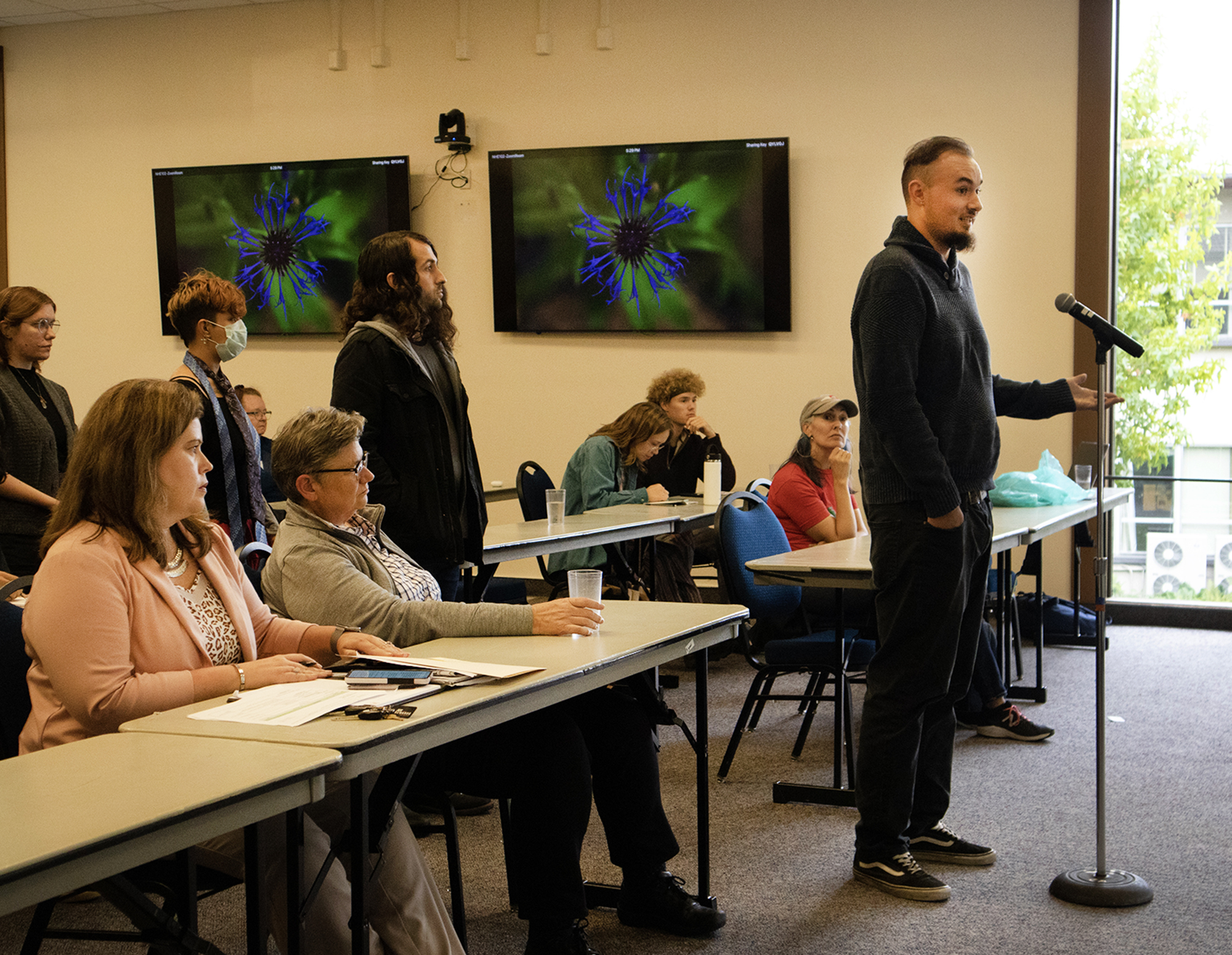
    Executive Director for Auxiliary Operations Stephen St. Onge fields questions from member of the public Johnathon Macias during the A.S meeting on Feb 10.

    Students will not be penalized for leaving on-campus leases early, and will receive partial refunds if they choose to live elsewhere.

    St. Onge said that the University is working on an amenity package for those students who will be living in the ‘bridge housing’ off campus. There are no details as of yet on what this package will include, or when this information will be available. The housing website elaborates that students are collaborating with admin on this.

    The Temporary Emergency Housing Program will continue as usual, according to St. Onge.

    Executive Director for Auxiliary Operations, Stephen St. Onge, fields questions from the Associated Students Board of Directors during the housing insecure students meeting on Feb 10.

    Students were frustrated by the lack of concrete answers provided by St. Onge on some topics, as he avoided speaking definitively on any topic outside of specific updates on housing. Lower-level administrative positions have been at the forefront of the university’s response to controversy in the wake of last week’s housing announcement.

    The AS Board of Directors discussed a resolution to increase awareness, advocacy, and support for housing-insecure students. 

    Co-author Ashley Calkins said that the main goal of the resolution is to increase the AS’ advocacy on behalf of the student body in issues of housing insecurity.

    “I think that it’s important that the administration knows where we stand on this so that we can advocate for the students,” said co-author Gerardo Hernandez, At-Large Representative. “It’s important that the students know where we stand on this.”

    Hernandez spoke about his experience as an R.A. after the housing policy was announced. He says his residents were freaking out about whether they would have to stay over the summer or even transfer to other universities.

    Associated Students At-Large Representative Gerardo Hernandez poses questions for Stephen St. Onge, the Executive Director of Auxiliary Operations at CPH.

    “I think that every student right here that has been expressing anger has every right to, and I’m pissed off too,” said Hernandez.

    The themed housing communities on campus, including Rainbow/Gender Inclusive, Sankofa House, Native American Living, and La Comunidad will maintain their number of students, including returning students, according to St. Onge.

    “There are groups from, I would say, some of the more vulnerable populations, members of the BIPOC community, LGBTQ community, foster youth,” St. Onge said. “We will save spots on campus for them to continue on campus should they desire.”

  • Possible barge housing plan confirmed by CPH

    by August Linton

    In an article released yesterday by the Lost Coast Outpost, Grant Scott-Goforth of the CPH Marketing and Communications department confirmed that the University is considering barge housing for the returning students that will not be offered on-campus housing in the Fall per the University’s new policy.

    “The idea of floating apartments or studios is one of many possibilities the University has been exploring,” Scott-Goforth said in an email with LoCo. 

    The Lumberjack attempted to confirm this story with multiple University sources, both over email and at their offices, before publishing the previous story, ‘Cal Poly Humboldt students outraged over housing crisis.’ 

    A virtual tour of one possible option is linked here, the ship in which also appeared in the apparent email leaks of the barge plan. 

    Various meme pages and CPH students have spoken out online about the barge plan, sharing memes and expressing displeasure. The favorite way of ridiculing the plan appears to be calling it a ‘prison barge.’

  • Cal Poly Humboldt students outraged over housing crisis

    Cal Poly Humboldt students outraged over housing crisis

    by August Linton and Camille Delany

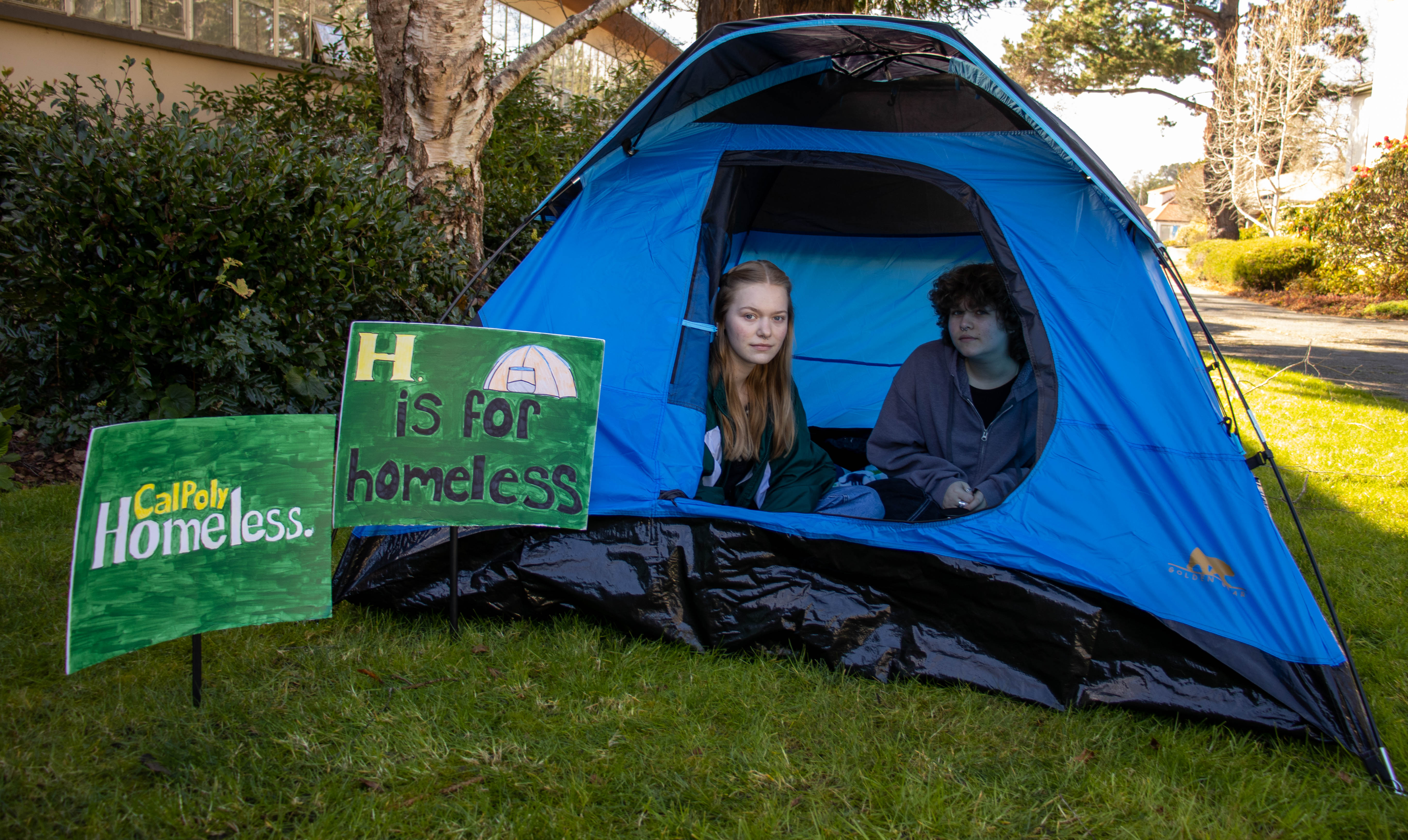
    On Feb. 4, CPH quietly updated the housing website without any notice to on-campus residents, leaving returning students to find out for themselves that they should not expect to live in the dorms or campus apartments for the remainder of their time at Humboldt. 

    On-campus housing will not be provided for any returning students. All on-campus housing will be reserved for new freshmen or transfers, starting in Fall ‘23. Should continuing students try to access housing through the university, they will be placed in temporary, off-campus housing.

    “There was absolutely no email about it,” student Valeria Reggi said. “We found out by checking the website, which they updated with no warning.”

    Due to a preexisting housing shortage that has left many students houseless, temporary options were explored in 2022 with the housing of over a hundred upperclassmen in the Comfort Inn motel. 

    A Feb. 6 email update stated that “because of the program’s success, we are excited to share that you now have the Super 8 and Motel 6 in Arcata as housing options managed by Cal Poly Humboldt.” 

    The email panicked current students, many of whom expected to return to on-campus housing in the fall. This prompted an immediate response. A post circulated on social media inviting students to gather that night to organize. At the meeting, a large crowd of students filled the Gutswurrack, voicing their concerns with over-enrollment and planning a protest scheduled for Wednesday, Feb. 8. 

    Filling every square foot of available standing room, students even packed onto the balcony. Organizer Lars Hansen spoke using a megaphone, and called on members of the crowd to voice their opinions on the new policy.

    “We wanna know what’s going to happen to our housing, what’s going to happen to our community, and what’s going to happen to Humboldt,” Hansen said.

    “I can’t fathom why you guys are accepting this many students when you can’t support them,” student Julia Kurtz said. 

    She questioned the logic of reserving the on-campus housing for freshmen and incoming transfers. 

    “If you are proud enough to put your current students in that housing, you should be proud enough to put new students in that housing,” Kurtz said. 

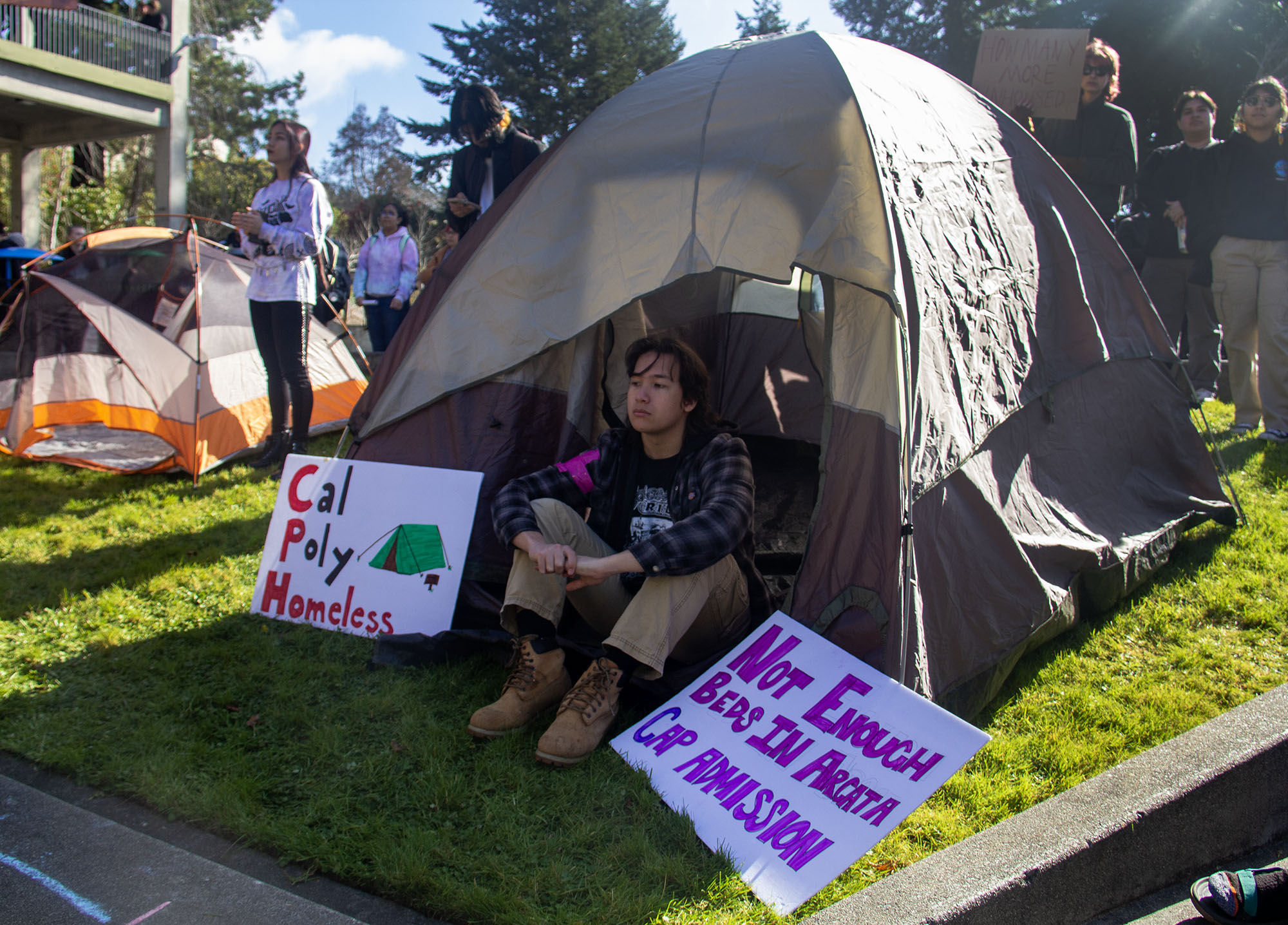
    Humboldt has a well-documented problem with student houselessness, a situation that some students said the new on-campus housing rules will make worse.  

    “I can just sleep in my car on campus, because that’s not any shittier than living in a motel, and it’s 10 to 15 times cheaper,” student Sam Mah said.

    Many are considering dropping or transferring out of Humboldt in the wake of this announcement, according to students in attendance. 

    “You have capacity that’s limited and you’re putting no limit on the flow,” Jack Williams said.

    Some raised concerns that the massive influx of students into the community without adequate on-campus housing to support them would strain relationships between students, the University, and the community. 

    “It seems like you just shift responsibility of building up infrastructure onto the community,” Alan Cooper said.

    One of the main issues brought up by students was the lack of basic amenities at proposed housing locations. The rooms at the Comfort Inn don’t have kitchens, which poses a serious problem for students on EBT and those with dietary restrictions. 

    Students with disabilities are concerned with accessibility at the temporary housing locations. They also raised the issue that those who gain access to on-campus housing through their accommodations would be outed as disabled to their peers.

    “Every single upperclassmen that has disabilities or problems with mental health, what the fuck are they going to do with us?” one student asked. 

    Photo by Cash Rion | Students from all walks of life show up for the student homelessness protest at Cal Poly Humboldt on Feb. 6.

    The University administration was represented at the meeting by the newly appointed vice president for Enrollment Management & Student Success, Dr. Chrissy Holliday, as well as Indian Tribal and Educational Personnel Program (ITEPP) coordinator Sasheen Raymond and Stephen St. Onge, Humboldt’s Executive Director of Auxiliary Services.

    Several of the students speaking purposefully gave admin a chance to respond to their comments, but often their response was lost, drowned out by the large crowd and interrupted by jeers. Holliday especially struggled to be heard over the crowd completely filling the Gutswurrack.

    They offered little reassurance or explanation of substance, but expressed their sympathy for students impacted, and their commitment to hearing student perspectives.

    “We will come and get beat up over it if we need to,” St. Onge said. 

    He explained that they were being required by the CSU to enroll more students in order to get funding. 

    “Now you need to hit this FTE [full time enrollment] and draft a plan to do it,” St. Onge commented. “We’re looking at some different options, hopefully in a week or two we’ll have some more information.”

    Recent rumors and apparent email leaks indicate that the University is considering the purchase of a barge that would moor at the Eureka docks and house 650 students. At one point during the meeting, alleged evidence of the barge plan was airdropped to attendees’ smartphones. 

    University officials did not respond when asked for comment.

    At the end of the day, the damage to morale was already done. Students felt betrayed by the administration. The school’s liberal reputation and reported recent influx of cash seemed incongruous with what many perceived as a shocking disregard for the housing policy’s impact on continuing students. At the end of the meeting, there was a call to bring the protest to the Arcata City Hall on Feb. 16.

    “I thought ‘this is a school that’s going to see me, that’s going to hear me,’” Haley Kitchman said. “I’ve lived in motels and it’s traumatizing. It’s not easy, and it’s not okay.”

  • Eagle protectors clash with PG&E over nest

    Eagle protectors clash with PG&E over nest

    Activists known as eagle protectors rallied together on Sunday, Jan. 8 in defense of a bald eagle’s nest on Northern Pomo Land in Potter Valley, California. PG&E had planned to cut down the tree that the nest is in, citing public safety as the tree sits too close to a power line. 

    This is PG&E’s second attempt to cut down this tree. Last year they were stopped by a group of activists led by eagle protector Monkey Gonzalez, who were able to defend the tree until it became legally protected due to nesting season beginning on Jan. 15. 

    The group defending the nest this year included protestors from Idle No More SF Bay, Mattole Forest Defense, and members representing the Pomo Tribe. 

    To Indigenous people, eagles and their feathers are one of the most sacred aspects of their culture.

    Isabella Zizi of Idle No More SF Bay and of the Northern Cheyanne, Arikara, (Uh-rich-ka-rah) and Muskogee Creek tribes says this connection motivated her to protect the nest.

    “For me, eagles represent power, protection,” Zizi said. “What I learned growing up was that the reason we use eagle feathers during ceremony, it’s to connect us to the creator and our ancestors that are up above and not on this earth. The eagle feather takes our prayer higher.”

    Polly Girvin, an elder of the Pomo people and retired federal Indian Law lawyer, was protecting the nest to fulfill what they feel is an obligation to the eagles, as an Indigenous person. They said they want to set an example for Indigenous youth.

    “I’m here for the eagles, but I’m also here for the preservation of, and enhancement of Indian culture. To me, they are connected,” Girvin said. “Our connection to the sacred animals, our connection to the trees, it’s all part of a familial connection.”

    PG&E’s stance differs from that of the Protectors. “The dying tree, that contains an inactive bald eagle’s nest, is a hazard and is at risk of failing and 

    striking a PG&E line in a high fire-threat area,” said PG&E spokesperson Tamar Sarkissian in an email. “PG&E will not take chances with public safety.” 

    Protesters disagree with PG&E’s claim that the nest is inactive, as bald eagles were spotted coming to and from the nest as early as Jan. 4 and as recently as Jan. 16 of this year. Zizi reported seeing the eagles and captured images of them.

    Zizi said that the protesters’ goal was again to protect the tree until January 15, when it will have legal protection. PG&E returned to the tree Wednesday Jan. 11, with law enforcement. One PG&E employee was filmed pushing past protesters and threatening legal action against them.

    Zizi described the rough conditions that activists experienced at the site, including heavy rains, winds, mud, and lack of food and water. “First day all we had was some bread, some slices of cheese,” she said. “We created a carpet using fallen twigs.”

    Despite these conditions, the protectors remained in high spirits due to their connection to the eagles, particularly for the Indigenous protesters there. The eagle protectors eventually received support with food, water, and firewood on the second day of the protest. 

    Currently, the protectors remain at the site of the nest. Despite the nesting season protections, PG&E remains a threat to the nest and its potential inhabitants. Until the tree is under legal protection, the activists are prepared to continue defending it. 

    “We will blockade the incoming PG&E trucks. I’m sure some people will even put their bodies at the base of the tree. Everyone’s spirit grabs them in a different way. But we are here to do nonviolent direct action resistance to prevent the cutting of this tree,” said Girvin.“We will endure the elements, we are here for the long haul, we will be here for the next 6 days, and these birds will not be extracted and these trees will not be cut down under our watch.”

    Girvin and Gonzalez have spoken to lawyers and Congressman Jared Huffman’s office to file lawsuits against PG&E and to raise more support for the eagle’s nest.

    “I don’t expect PG&E to have any reverence for these birds,” Girvin said. “I can’t change PG&E management to have reverence. But we do, and they are going to have to look us in the face.”

  • Attempted vehicle burglary turns into car chase on Cal Poly Humboldt campus

    By August Linton

    Cal Poly Humboldt University Police responded to a call reporting a suspicious person looking into vehicles on the University campus with a flashlight. The call went out at 3:49 a.m. on Dec. 21. The suspect was witnessed by a student breaking into the driver’s side window of a white sedan located in lot G11 on the CPH campus.

    Photo by Alex Anderson. The white sedan with a smashed driver’s side window in CPH parking lot G11 on Dec. 21.

    The suspect got into a gray Toyota 4-Runner. Police officers entered lot G11 as the suspect vehicle was attempting to pull out. Officers made contact and attempted to block the vehicle from exiting the lot. The suspect vehicle sped past the two officer vehicles and followed the suspect in a short vehicle pursuit. Officers witnessed a second person sitting in the passenger seat.

    A student witnessed the attempted burglary, and called 911. 

    “I saw it all from my dorm window. I saw him look into a truck and then walk back to the 4-runner,” the student said. “I saw him speed past the cops in the lot.”

    The suspect vehicle sped down Rossow St. and onto a walkway that runs in front of College Creek soccer field, knocking down a dividing pole and a parking meter located on 14th St. Officers discontinued the pursuit after the risk to the public was deemed too great under the circumstances, according to an email sent out by the University. The victims of the burglary have been notified and are being assisted.

  • 6.4 magnitude earthquake shakes up life in Humboldt County

    By Jake Knoeller

    A 6.4 magnitude earthquake struck the North Coast of California during the early hours of Tuesday morning. Humboldt County residents were heavily affected. Many had objects knocked off shelves, broken valuables or even major structural damage. 

    “I got the earthquake notification, but by then I had processed that things were moving around me and the lights were flickering,” said Parker Neil. “I just kind of panicked.”

    With the earthquake occurring in the middle of the night, many people were not awake and woke up with a start. Numerous aftershocks have also disturbed many in the following days.

    “I’m sleeping light because I know I have to be up in a few hours,” said Cal Poly Humboldt student Cassynova Legynd. “15 minutes later I thought I was in a dream.”

    Two deaths and 12 injuries were confirmed in the county after the earthquake. Homes and businesses were seriously damaged as well.

    Photo courtesy of Ollie Hancock. A shop window in Ferndale, CA shows products in disarray on December 20, 2022.

    The next day, the streets and buildings of Humboldt were dark and quiet compared to usual. Power was out all over the county. 

    “It’s definitely frustrating because I’m a door dasher and I was planning on working today,” said Mikhayla Kennison, a student at Cal Poly Humboldt. “It was very cold and that’s saying something because I love the cold.”

    Humboldt County was, without a doubt, not prepared for this type of outage. Many Cal Poly Humboldt students are being inconvenienced due to this. Parker Neil, a student living in College Creek, even reported being locked out of the gate leading to their dorm, due to the security system requiring electricity to function. 

    “I went up to the gate and everything was pitch dark,” said Neil. “I put my card in, no response.”

    Power has since been restored to the campus and dorms.

    Photo courtesy of Jasmin Shirazian. Furniture lies in disarray in a student’s room on December 20, 2022.

    These inconveniences are teaching some to be prepared for disasters in the future and not take safety or power for granted.

    “It just opened up my eyes,” said Legynd. “Learning how to survive in these situations is probably something that hit the hardest.”

    Cal Poly Humboldt provided hospitality to their students throughout the day on Tuesday. The J dining hall was open and served food for students until 6 p.m. while the Jolly Giant Commons building was open for students to charge electronics and stay warm inside.

    “It was really nice that campus had a place for people to get food,” said Kennison. 

    Power has since been restored to many residents of the county, but still not everybody. There are people that remain with no water and, for some, with no place to sleep due to structural damage and homes being knocked off their foundation.

  • Humboldt queer community faces increased threat, following national trends

    Humboldt queer community faces increased threat, following national trends

    by Ollie Hancock and Camille Delany

    On Oct. 28, the Humboldt County Human Rights Commission (HCHRC) issued a press release condemning “incidents of hate speech and threats of violence against the LGBTQ community.” This came in response to the disruption of a drag event in Eureka on Oct. 23 and a violently threatening anti-trans sticker placed on a public bench and photographed Oct. 27. 

    Humboldt is facing an increase in queerphobic hate events. The bubble of progressive attitudes on campus gives a false sense of security to students. Rhetoric condemning queer culture and threatening queer youth is here in Humboldt too. 

    In recent weeks, local nonprofit Queer Humboldt has seen a spike in reports of hate incidents against LGBTQ community members. The group is a resource center for Queer individuals and groups in Humboldt County. Lark Doolan, a transguy and the executive director of Queer Humboldt, described various acts of queerphobia that have been reported to Queer Humboldt.

    “Hate events happen in our county at a far more frequent rate than many of our allies realize,” Doolan said. “There were a couple of weeks in November where we learned of hateful events almost every day.”

    A nonbinary Cal Poly Humboldt staff member was verbally harassed about their gender and told they didn’t belong. Queer-affirming churches were vandalized, a local trans support group was ‘zoom bombed.’ Most notably, on Oct. 23 protesters disrupted Redwood Pride Halloween, an all-ages event featuring a drag show among other festivities. 

    So far in 2022 the Gay & Lesbian Alliance Against Defamation (GLAAD) reported 124 incidents of anti-LGBTQ protests and threats targeting specific drag events. Their analysis draws from news coverage of threats, protests and violent action against drag events nationwide.

    GLAAD’s analysis shows increasing violence as the year progresses. In October a Tulsa donut shop was firebombed after holding a drag-themed event, and on Nov. 19 a shooter killed five and injured nineteen others in a mass shooting at an LGBTQ nightclub in Colorado Springs, CO. Across the nation, LGBTQ safety is threatened by proposed legislation and violence that has intensified following Pride celebrations and during campaigning for the midterm elections. Despite being home to a vibrant queer community, Humboldt County is no exception. 

    Bellamy Devine, a trans student at Cal Poly Humboldt, said that they feel safe in certain areas and circumstances, but threatened by transphobia in others.

    “Especially when it comes to events we put on ourselves, like drag shows or themed events, people seem to have a big problem when we come together to have a little fun for once, god forbid,” Devine said. 

    “It’s spiking. It’s part of a national [movement of] villainization of trans youth and scapegoating strategies,” Doolan said. “It’s a strategy that hurts people.”

    Art Wardynski is a volunteer and Resource Director at the Eric Rofes Multicultural Queer Resource Center (ERC) on campus.

    “Lots of other queer organizations are having trouble publicizing their events, because if they publicize it, then bigoted communities will show up and protest it,” Wardynski said.

    The rhetoric claiming that LGBTQ people are dangerous to children is nothing new, Doolan said. Labelling the queer community as perverse recalls the 1970s, when Anita Bryant was campaigning to ban openly LGBTQ teachers.

    “Her argument that queer people are inherent dangers to children is the same false narrative that we are seeing today,” Doolan said. 

    Despite being home to an active and vocal queer community, Humboldt County lacks any sort of official reporting mechanism to tabulate hate crimes and speech against LGBTQ community members.

    Wardynski expressed frustration with finding infrastructural and administrative support and organizing events for queer students on campus. 

    “From a volunteer and a resource director perspective, I definitely have a lot of problems with our current campus in relation to supporting trans and queer students in general,” Wardynski said. 

    Queer people live in every stretch of Humboldt. They find love and community in this rural haven. From dive bars to bike shops and bakeries, they occupy space in Humboldt.

    “The community off-campus is largely amazing,” Doolan said. “There are so many queer people in our community, people who are really proactive about creating a welcoming space. In recent years, we have seen a shift and progress. So this backlash comes from a small, very vocal, very hateful minority with confusing messaging designed to stoke people’s fear.” 

    This vocal minority is threatening access to acceptance and culture. With intimidation, they limit queer youth from self discovery and community. 

    “We know that when youth learn about queer people it’s helpful because it prepares them to live in a world where diversity exists,” Doolan said. “And for queer youth specifically, it helps them see a future for themselves and survive their childhood.”

  • Cal Poly Humboldt lab safety under scrutiny

    by Ollie Hancock

    From admin to student, everyone on campus has responsibility for the dangers of working with hazardous waste and materials. Spills, breaks, and general accidents are expected in any lab. No one can prevent a beaker from breaking, but the university should give students and employees the tools, equipment, and training to react appropriately. Instead, departments create patchwork standards without direction from the administration. A messy lab can indicate a campus-wide issue. 

    “I know that beakers break pretty often, and spills are common too. It’s eventful in there. I don’t think they filed reports for those or anything,” said Clara Lanesskog, a Cal Poly Humboldt student in a chemistry class. “We just clean it up and go on with the day.” 

    Beyond safety oversight and training in case of accidents, students need quality lab safety education. Lanesskog has seen classroom accidents escalate due to lack of risk management. Students see lab accidents frequently and don’t know how to report them.

    “Our instructor disappears a lot,” Lanesskog said. “So if we were to spill acid or something, we don’t know where to find him unless he came back.” This was the case when Lanesskog spilled acid on her leg during a lab.

    “You’re on a time limit, so you feel rushed. There’s not enough space for you to work. Everyone is bumping into each other, trying to rush, and that is how I ended up spilling,” Lanesskog said. She didn’t submit a report.

    “My professor wasn’t there, and he’s not usually there towards the end of our lab,” Lanesskog said. “Honestly, it didn’t seem like too big of a deal to me because other people have done it too.”

    On the University of California Santa Barbara EH&SS website there are public reports of every school chemistry accident and date, including near misses where no one was injured. Their transparency shows awareness and rigor regarding preventative measures. They treat each incident seriously, regardless of scale. At Humboldt, incidents have gone unreported. Only recently has the EH&SS reevaluated how professors are trained to react to incidents. According to our standard operating procedures, any incident should be reported in 24 hours. On Humboldt’s EH&SS website, there is no obvious link to the incident report form.

    Terrilyn Stoflet worked as a hazardous materials technician at Humboldt during the pandemic. In the course of their job, they often felt unsafe.

    “I don’t think we have a very good safety culture on campus,” Stoflet said. “It just never gets talked about until something bad happens.”

    They felt the campus didn’t have enough staff or administrative support to be accountable for environmental health and safety.

     In 2019, Humboldt underwent a Health and Safety audit as part of a CSU-wide investigation. The completed audit cited 21 violations, reflecting a lack of rigor in campus safety regulations. This campus is not alone. A state audit of the CSU system found that Sonoma State and Sacramento State also cited limited resources as explanation for their violations. The story was similar across CSU campuses; the state concluded that the CSU chancellor’s office was responsible. 

    “For over two decades, the University Audit has repeatedly recommended that the CSU Chancellor’s Office increase its oversight of employee and student health and safety training and inspections of laboratory equipment and workplace hazards,” read the audit report by state auditor Elaine Howle. 

    Training programs failed to check if all employees and students who handled hazardous materials and waste were certified. There was no record of which employees worked with hazardous materials, and in the stockroom, waste wasn’t consistently labeled. No self-assessments for safety were conducted in labs, and lab techs didn’t dispose of waste in a timely manner. The list of issues goes on. No serious incidents have occurred as a result, but the audit reveals a looming threat to the campus and community. 

    Sabrina Zink is the Environmental Health & Safety Services (EH&SS) coordinator and the only admin charged with attending to these issues. Zink says she was relieved when the audit brought attention to the problems.  After the audit in 2019, EH&SS planned to meet the regulations set by the CSU. Three years later, progress is unclear.

    “Before we just had a paper reporting system,” Zink said. “We worked out a new incident reporting process so we can keep track of if it was a training issue or operator error, or an issue with oversight. And reiterated to faculty that [incidents] do need to be reported.”

     Funding made available by the polytechnic transition along with an increase in the administration’s willingness to address these issues made way for some progress in Fall 2022. More administrative staff and on-the-ground technicians have since been hired by EH&SS. However, many solutions are still waiting to be rolled out. 

    “Now we have another coordinator in the EH&SS to help with implementing all the audit findings,” Zink said. “And we’re looking for another person for occupational safety to address incident follow up.” 

    After the 2019 audit of campus health and safety, the EH&SS office made a plan to introduce new training and support to address the violations found. Then, the COVID-19 pandemic shifted the EH&SS office’s priorities to managing the spread of the virus on campus. The small team was tasked with writing the trainings, mandates, and regulations that defined campus life for two years. Corrections to every-day safety policy based on the audit were left behind in the shuffle. EH&SS struggled, lacking the bandwidth and support to solve these issues on top of managing COVID-19 concerns.

    “A few years back, before this audit, I had been screaming from the mountain tops,” Zink said. “Please, someone take this seriously.”  

    Due to the fragmented nature of campus departments, there was no consistency in the content or frequency of safety training. The audit found no record of who is certified to handle hazardous materials and waste. Zink wrote trainings that were never assigned. New trainings will roll out in the spring 2023 semester, Zink says. 

     Aside from organizational problems, the campus has inadequate facilities that made some employees feel unsafe.

    “This shed, which is at facility management’s place, it’s unsafe,” Stofelt said. “What my partners and I have had to do in that shed is so stupid, and it’s dangerous. There’s a bunch of rat excrement everywhere.” Beside the rats, the shed itself has structural hazards. A set of detachable stairs leads to racks on the second level, where lab techs carry 15-gallon drums of chemicals and hazardous waste up and down.

    Hazardous waste jugs from various departments are processed in the shed, which is also full of personal protective equipment (PPE) and supplies for HAZMAT technicians. According to Zink, the shed is already outdated for campus needs. 

    “We need something more fit for our needs, especially as we grow and potentially would be generating more hazardous waste,” Zink said. “We’re going to need more space and something that doesn’t leak during the winter.” 

    There are plans to build a new shed, but no location has been chosen.

    Safety standards and regulations vary from department to department. This inconsistent system lets minor infractions slip through the cracks. Facilities often don’t relay the message to techs when bins need disposal. In the darkroom, bins of used chemicals sat full for weeks, nearly overflowing. 

    As the campus grows with polytechnic status and an emphasis on STEM classes, these issues will only grow. The EH&SS has made some progress toward addressing the issues brought up in the audit, but there is still much work to be done.

  • Faculty union challenges TimelyMD

    by Tucker Caraway

    In the print version of this article, Dr. Loren Cannon was referred to as a psychotherapist. He should have been identified as the Cal Poly Humboldt CFA President.

    An Unfair Labor Charge has been filed against the Cal Poly Humboldt Board of Trustees on November 8th due to violations found in their contracting with Timely MD. The Public Employee Relations Board found the University in violation of government codes regarding the failure to notify Unions in contracting decisions. 

    The charge was originally filed back in October 2021 by the California Faculty Association after being made aware a contract was signed with Timely MD without their knowledge.

    “They signed this contract before meeting with CFA, the union that represents counselors, and that’s a big no-no. That’s the basis of our unfair labor practice charge,” said Loren Cannon, president of the Humboldt chapter of the California Faculty Association.

    Timely MD, also known as TimelyCare, is a Texas based counseling provider that works in conjunction with CAPS.  They provide 24/7 counseling support as well as individual counseling sessions during breaks and outside business hours. 

    “I’ve heard when you try to get an in person appointment, they refer you to TimelyCare,” said Chelsea Rios-Gomez, intern for Students for Quality Education. 

    TimelyCare has been available to Cal Poly Humboldt students since March 2022 after switching from the platform ProtoCall due to complaints of long wait times. 

    “If you’re in a mental health crisis, you don’t want to wait online. So they were looking to have something to improve that. But in doing so, they contracted with a company that isn’t just doing emergency counseling, they’re doing regular counseling, which is a union job,” Cannon said. 

    Outsourcing union jobs to out of state entities not only puts faculty at a disadvantage, but also poses a new risk to students engaging with TimelyCare. 

    “You will be finding good counselors. Not all of the counselors there are going to be bad.

    But there are some counselors, some faith based counselors, more specifically Christian counselors, who are perpetrating harm to our students,” said Rios-Gomez.

    Timely MD, while not a Christian organization,  offers faith based counseling services to Christian universities and has a working partnership with the Council for Christian Colleges and Universities. 

    “We’re outsourcing union jobs, and we’re also outsourcing responsibility for our students’ wellbeing,” Cannon said.

    Texas is a state with a reputation for anti LGBTQ+ policies and practices. Five years ago, Gavin Newsom Passed Assembly Bill 1887, which prohibits state-funded travel to Texas and 23 other states with discriminatory LGBTQ+ policies and practices. 

    “We can’t even fly to Texas for an academic conference because we’d be putting money in the Texas economy,” said Cannon. 

    Thanks to legal loopholes in state jurisdiction, students logging into TimelyCare who, for example, would want to file a Title IX lawsuit, would have to do so in Tarrant County, Texas.

    “The Council for Christian Colleges and Universities actively argues that religious colleges should be able to receive federal funding, and to be able to discriminate against LGBTQ+ students, basically saying they are not protected under title 9,” said Cannon. 

    Students for Quality Education, who work in coordination with the California Faculty Union, has been made aware of an array of discriminatory encounters on on the platform. 

    “It’s a lot of invalidating of trans identities and queerness in terms of pushing Christinaity in that way,” said Rios-Gomez.

    When it comes to addressing the needs of the Cal Poly Humboldt community, Cannon said it’s important for unions to be involved in contracting these services, so CAPS can find vetted counselors that actually understand the needs of the community they’re involved in. 

    “What is the most important thing is to value the people doing the important work on our campus,” Cannon said. 

    As of November 8th, the Board of Trustees has 20 days to respond to the complaint charges by proving they didn’t violate labor laws and union members rights. 

    “The fact that it went forward from that initial step is that the people at the PERB must think that our charge has merit, and I’m not a lawyer, but it’s pretty cut and dry without talking to us and without negotiating it,” Cannon said.

  • Passionate environmental educator Brooke Schryver dies at 25

    Passionate environmental educator Brooke Schryver dies at 25

    by August Linton

    Brooke Schryver, a beloved environmental educator, photographer, and Cal Poly Humboldt student, died on Sunday, May 29, 2022 while hiking the Lost Coast trail. She was 25 years old.

    Schryver was a bright spot in the lives of the people who knew her. She loved guiding people to share in her love of nature, and planned to work in environmental education and interpretation once she finished her degrees in Anthropology and Environmental Science & Management at CPH. 

    “She was enthused about the natural world to where her excitement was contagious,” said fellow backcountry wilderness ranger Johnathon Macias. 

    Schryver’s long-time best friend and boyfriend Andew Weisner remembers how all-encompassing her love for nature was.

    “Except for invasive plant species,” he said. “She didn’t like those very much.” 

    Macias said that Schryver’s excitement about the world and her job as a nature educator helped him get out of his shell. One of Schryver’s greatest and most well-known talents was sharing her joy with other people. 

    Yosemite National Park is where she hoped to work, interpreting and protecting the natural world and reveling in its beauty. 

    Schryver channeled her connection with the natural world into art through her photography. She loved taking pictures since she was small, shooting with a family member’s old camera. Weisner remembers that she “always had a camera in her hands.” She was known to constantly borrow anyone’s phone with a better camera than hers to take pictures. Her photos can be found on her Instagram, @b_photohappy.

    Poetry was another passion for Schryver, it helped her to process her emotions. She wrote small accompanying poems for some of her published photography.

    Schryver’s personality was strong and infectiously joyous. Many who knew her mention her long-held magpie-like habit of collecting shiny objects, and admire her willingness to voice her many strong opinions. 

    “She did everything she did without judgment,” said Weisner. 

    Schryver was an involved and vibrant member of every community she chose to be a part of. During her time at West Valley Community College, she founded their Park Management Club. She also was heavily involved in volunteer work at Humboldt and elsewhere: she went to Y.E.S. events, worked at creek cleanups, and regularly gave her time to friends in need. 

    CPH Student Emily Chao commented on Schryver’s online obituary: “Brooke was my eyes. She gave me my independence.”

    Heidi McFarland, one of Schryver’s professors at West Valley College, also commented: “After our family lost our home to the CZU fire…[she] helped us work on our property to clear trees, and sift through the rubble – of course looking for shiny things.”

    Many remember her willingness to help, always with gentleness and a smile. She was an environmental steward, an outdoor leader, and a mentor.

    Schryver’s legacy is one of powerful, pure love for nature education, and for nature itself. She wanted to make our world a better place, and dedicated both her heart and her time to that cause.

  • Festivities marked one year anniversary of entheogen decriminalization

    Festivities marked one year anniversary of entheogen decriminalization

    by Camille Delany

    Thursday, Oct. 6 marked one year since the passage of a resolution that decriminalized entheogens, or plant-based psychedelics, in the City of Arcata. Celebrations took place in Redwood Park at an event organized by Lissie Rydz of the Do Nothing Society and Danielle Daniel of Microdosing Humboldt. The sky had been overcast all morning, but as the event was underway the sun began to shine through the clouds, illuminating the colorful hammocks and blankets clustered in one corner of Redwood Park.


    Danielle Daniel, a local microdosing coach who led advocacy for decrminizalitation at the City Council meeting one year ago, reflected on a year of decriminalization in Arcata.
    “I’m just excited, and feel so blessed, and just like really relieved that everything’s fine,” Daniel said. “That was the big fear of decriminalization. Like, ‘What’s going to happen?’ ‘People will just be tripping in the streets!’ It’s like, no, it opens up access for people to heal.”
    The decriminalization process took a concerted effort from the community, the support of the Arcata City Council, and hard work on the part of organizers


    “Coming into it last year, it was really stressful. It took a lot of energy. It really drained me,” Daniel said. “It was freaking hard! And when it was decriminalized, I was so happy, but I was so drained at that time.”


    “Since then it’s just been really magical just feeling safe to be able to provide my services in educating the community about microdosing and the healing potential,” Daniel said.
    Daniel handed out free microdoses of psilocybin mushrooms (decriminalization permits the gifting, but not selling, of entheogens) in baggies that included a card with her contact information to adults over 21 with proof of ID.


    “There’s been quite a few people coming up to me that have never done [psilocybin] before and they feel safe enough to do it here,” Daniel said. “It’s very cool, witnessing that fear dissipating more and more.”


    Students mingled with members of the larger community as art supplies, snacks, and books were shared across vibrant blankets. Roslyn Gilbert, a Cal Poly Humboldt student, often attends Do Nothing events and values their atmosphere of friendly relaxation and inclusion.


    “Being a trans woman, I feel like there’s a lack of spaces in this world that are friendly to trans women without being explicitly queer,” Gilbert said. “This is a very safe place to be trans. It doesn’t feel like I have to carve out a safe area.”


    Hosting the event with Daniel was Lissie Rydz, who started the Do Nothing Society over the summer. With the Do Nothing Society, she aims to create public spaces for social relaxation in the face of growing productivity culture. The Do Nothing Society isn’t always entheogen-specific, but held Thursday’s “Microdose and Do Nothing” celebration in honor of one year of decriminalization.


    “I credit most of my growth as a person to psychedelics,” Rydz said. “So I think that it’s beautiful that [since decriminalization] there’s not all this fear and anger.”


    Rydz advocates for building community, enjoying public spaces, and making time to play. Do Nothing events are public and, when not held at Redwood Park, can often be found at houses of community members, local events, or a nice river spot.


    “It’s proof of concept by doing it,” Rydz said of decriminalization. “It’s not scary, it’s sweet!”

  • Police chief candidate views cause concern among students

    Police chief candidate views cause concern among students

    by Carlos Pedraza

    The Chief of Police Search Committee held an open forum on Wednesday, Oct. 19 for students to ask questions of Thomas Calucci, one of the police chief candidates. A Cal Poly Humboldt email stated the meeting was being held in the Library Fishbowl but was changed at the last minute to the Great Hall above the Marketplace. In total, only two students were present to ask questions.

    Calucci is a former police captain from the University of Texas at San Antonio and was a member of the Behavioral Intervention Team, an organization that provides mental health checks. While at UTSA, Calucci collaborated with school counseling faculty to provide crisis training to university police.

    Calucci wants to bring a similar program to Cal Poly Humboldt.  

    “I want social workers to ride with our police officers,” Calucci said. 

    He went on to explain how he wanted police to integrate with the community and was against the us vs. them mentality of the thin blue line.

    “I need our cops to understand at this university, we are not here to kick ass and take names, we are here to protect you all,” Calucci said.

    Still, Calucci made it clear his main goal was to protect the university from those whom he saw as outsiders. 

    “I’m fairly certain that somewhere, someone in this community has a grievance against this university,” Calucci said. “Whether it be a faculty member or other student, I’m fairly certain that person is planning revenge… I wanna be here to protect you from them, not from yourself.”  

    When Calucci was asked who “them” was, he answered, “there are people who intend to do you harm, those are the people who I don’t like.” 

    Calucci appears to understand that policing has caused problems, specifically citing police-related generational trauma. Though he is aware of it, Calucci does not consider it his role to solve this problem. 

    “I did not sign up for the things you are asking me to do,” Calucci said.

    Humboldt student Elizabeth Rubio explained how the police system has a history of racism, prejudice, and violence, and asked how Calucci would handle prejudice in his staff and himself. 

    “First thing you said is we live in a racist society and that sucks you feel that way.” Calucci said. He acknowledged that racism was present in society. “ If I could wave a magic wand and make it go away I would because of that crap,” Calucci said in response to Rubio.  

    Rubio proceed to asked if Calucci was aware of the murder of Josiah Lawson and the case surrounding the alledged murder. Calucci said he saw a sign supporting Justice for Josiah, but he did not know any specifics of the case.

    Rubio also asked about the police response to student homelessness. Calucci said police would not harass students sleeping in cars and wanted them to feel safe. He stated his main goal was to get students off the streets and find temporary housing for them. 

    Jue Smith, the other student at the forum, felt that both police chief candidates were unprepared. 

    “Neither candidate did their homework about this area or legislation that’s been passed,” Smith said.

  • Prop 27 explained

    by Tucker Caraway and Camille Delany

    Proposition 27, on the ballot this November, would legalize online and mobile sports betting outside tribal lands. Despite record spending on the campaigns for and against the proposition, widespread advertisements do not make this clear. 

    Yes on 27, funded by online gaming companies, claims that the proposition is primarily a “solution” to “California’s homelessness and mental health crises.” No on 27, funded by tribal organizations, counters those claims and asserts that the proposition puts more Californians at risk for gambling addiction and infringes on tribal sovereignty. 

    The Yes on 27 campaign ads vary widely in their messaging. “Vote yes on online sports betting, and protect tribal sovereignty, and help Californians that need help the most,” one video promoting Prop 27 states, a wide-ranging claim. 

    Cal Poly Humboldt political science professor Dr. Stephanie Burkhalter describes the Prop 27 ads as “very sophisticated.” She said that she has overheard students expressing confusion about their messaging. According to Burkhalter, “Their inclination is to support tribal sovereignty,” but the mixed messages from the advertisements don’t make it clear whether supporting or opposing the proposition is the best way to do so. 

    The situation is made more confusing for voters by the fact that there are two different initiatives on the ballot this November to legalize sports betting in California. Prop 26 would legalize sports betting only at tribal casinos and California’s four horse racetracks, and is less contentious than 27. Many tribes oppose or remain neutral on Prop 26, while Prop 27 is firmly opposed by the majority of tribes. 

    Burkhalter explained that if Prop 27 passes, not just any online gambling would be legal in California. For a company to offer online betting under Prop 27, it must pay $100 million for a license, and must partner with a tribe that holds a tribal-state gambling compact. 

    “Because [online gambling licenses] can only be offered through federally recognized tribes, the sponsors [of Prop 27] had to partner with certain tribes,” Burkhalter said. “So those tribes, while supportive, are a small minority of all the tribes in California.” 

    CPH Native American Studies (NAS) and Critical Race, Gender, & Sexualiy Studies (CRGS) professor Dr. Rain Marshall explained that each tribe has a different, confidential contract with the state of California for revenue profit sharing. If Prop 26 were to pass, it would require tribes to renegotiate these contracts, a long and arduous process that many mistrust. 

    “Negotiating a new contract is timely and costly,” Marshall said. “The tribes are probably like, ‘You know what, we’re good how we are, it took us forever to negotiate this contract with the state.’” 

    Additionally, the $100 million necessary to secure a license guarantees that the online gaming companies that will benefit from Prop 27’s passage are already large and well-funded, with many headquartered out-of-state. Prop 26 doesn’t involve the corporations that support Prop 27, which is a reason why it’s preferred by some, including certain tribes. 

    “By far Prop 26 would support native sovereignty because it doesn’t involve these corporate conglomerates,” Marshall said. But it has still failed to gain resounding support from tribes, with many still remaining neutral or saying “No” on 26.

  • Yurok Tribal Council hosts Summit on Missing and Murdered Indigenous People

    Yurok Tribal Council hosts Summit on Missing and Murdered Indigenous People

    by Andres Felix and Ollie Hancock

    On Oct. 4, The Yurok Tribal Council hosted the first inaugural Northern California Tribal Summit on Missing and Murdered Indigenous People (MMIP). Tribal leaders from across the state, as well as government and State representatives, gathered in Goudi’ni (known as Arcata, California) to discuss the pressing issue of violence against indigenous communities, with a focus on Californian Tribes. 

    “The crisis of missing and murdered Indigenous people has touched every tribal citizen in California and throughout the United States. This has gone on long enough. The time for action is now,” said Yurok Chairman Joseph L. James. “The purpose of this summit is to develop a series of mutually agreeable actions that tribal, federal, and state stakeholders can take in the short- and long-term to protect Indigenous Californians.”

    The National Crime Information Center reports 5,712 cases of missing Native women and girls since 2016. This contrasts with the U.S Department of Justice’s missing person database of just 116 cases reported. Complications in jurisdiction between state, local, federal, and tribal law enforcement make it difficult to pursue justice in these cases. According to the FBI, Native Peoples totaled 1,496 out of the total 9,575 active end-of-year missing person cases across the United States in 2020. The movement has recently moved from referring to the movement as ‘Missing and Murdered Indigenous Women’ to ‘Missing and Murdered Indigenous People.’ 

    The summit panels were open to comments from members of the audience. Ronnie Hostler attended the summit to seek justice for his missing granddaughter Khadijah Britton. Britton of the Round Valley Indian Tribes went missing in 2018. Hostler expressed he was upset with the lack of urgency from Mendocino County about his missing granddaughter. Hostler recounted how Mendocino county Sgt. Matthew Kendall told him there was nothing more he could do to solve his granddaughter’s case. 

    “I asked Matt Kendall if he was looking for any resources, and he said ‘no,’” Hostler said. “I said what about the FBI, and he said ‘they can’t do any more than what we’ve already done.’ He started telling me, ‘why don’t you go to the [Bureau of Indian Affairs]?’ Then he said a few harsh words about the Bureau of Indian Affairs.”

    Chief Greg O’Rourke of the Yurok police department describes how public law 280 impedes tribal law enforcement. 

    “[Public Law 280] takes jurisdiction away from tribal law enforcement and hands it over to the state,” O’Rourke said. “It means reservations rely on state law enforcement to provide a quality response, a timely response to the reservations when somebody is reporting a crime or a call for service.” 

    Dr. Blythe George spoke in the Primer on MMIP & Systems Change panel. The panelists broke the systemic obstacles to addressing MMIP. The panel explained how violence and assault against native women and men began with colonization, genocide, slavery, racism, and the sexual objectification of Indigenous people. 

    “With this issue, you have to realize that some days are going to be so hard, and you don’t want to come to work because it’s gonna be the day you get a call and you know the person.” George then told a story of a mentor who went missing. That experience pushed her into this field. 

    “We have to realize how heavy the work is, even on the good days when we sit here together and we can see tangible next steps,” George said. “So please take care of yourselves after today. Hug each other hard and realize that tears are a necessary part of this work, but it’s time to do something.”

  • Humboldt Alumni speak out against Homecoming in Hawaiʻi

    Humboldt Alumni speak out against Homecoming in Hawaiʻi

    by Oden Taylor and Ollie Hancock

    Humboldt’s alumni organization, Forever Humboldt, planned homecoming this fall in Lahaina, Hawaiʻi, on the island of Maui. In an email, the alumni organization shared their plans for a “fun spin” on homecoming where they would “spread the Lumberjack spirit” in Hawaii.

    Colleen Chalmers, Sabrina Gailler, and over 255 other alumni felt this plan did not reflect their values and what they had learned at the university. Chalmers and Gailler drafted an open letter in dissent, hoping the university would reconsider their plans.

    Chalmers is a Native woman who graduated from Humboldt with a degree in Journalism and Native American Studies in 2013 and now works in communications, racial equity, and homelessness policy. She felt that Forever Humboldt’s plans contradicted what she studied. She also felt the homecoming event doesn’t align with the school’s own vision, core values and beliefs, and purpose statements. 

    “The University consistently says that traditional ecological knowledge is central to solving environmental crises,” Chalmers said. “Then, [they] don’t listen to traditional ecological knowledge when it comes to choosing the   location of their next homecoming event or choosing how to engage in recruitment for new students.”

    The school cites Traditional Ecological Knowledge—TEK as a core tenant of learning across curriculums. Traditional Ecological Knowledge, decolonization, and sustainability are all terms used across the school’s stated principles. Kānaka Maoli—people indigenous to Hawaiʻi have been outspoken about the negative impacts of tourism on their place and people. Many alumni who signed the letter left comments of disapproval and disappointment.

    “The reality is that centuries of colonialism and racism have taken a toll on Kānaka Maoli, the land, and the water,” Chalmers said. “America has illegally occupied Hawai’i for 129 years. An institution like Humboldt that cares about equity and anti-racist work should care about it in all their decisions. I don’t see that in this decision to go to Hawaii during this time.”

    Their open letter has gained signatures from current and former students across nearly 70 different majors, representing graduates from 1973 through 2022. The letter was also endorsed by two nonprofits, Hawaiʻi People’s Fund and Seventh Generation Fund. Kānaka Maoli alumni Brissa Christopherson signed the letter and left a comment for admin and event planners. 

    “As a Kanaka Maoli and lifetime resident of Maui, I would highly encourage changing location for this event,” Christopherson wrote. “Our Maui community has been facing over-tourism, detrimental to natural areas and depleting limited water, in addition to the covid epidemic. Please stop perpetuating colonialist behavior with the fetishizing of our island culture.”

    The university issued a statement that they heard the concerns raised in the open letter. The university cited recruitment efforts and alumni in Hawaiʻi as reasons for the location of the event. The university intends to follow through with its plans to host homecoming in Hawaiʻi.

     “[The Univeristy] will distribute information about respectful and low-impact tourism to those who will be participating,” School representative Grant Scott-Goforth said.

  • Students frustrated with Title IX assault case handling

    by Angel Barker

    Cal Poly Humboldt’s students, organizations, and community are unhappy with the Title IX office as well as President Tom Jackson after recent speeches and handling of cases.

    Title IX is the law adopted in 1972 that stipulates, “no person in the United States shall, on the basis of sex, be excluded from participation in, be denied the benefits of, or be subjected to discrimination under any educational program or activity receiving federal financial assistance.” (From Cal Poly Humboldt’s Title IX & Discrimination, Harassment, & Retaliation Prevention website). Title IX is also intended to protect students against sexual misconduct including harassment and assault.

    Female student Jane Doe (whose name has been changed for privacy reasons) reported an assault to Humboldt’s Title IX office in June. It is now September, and from her perspective, not much has been done. At one point in the summer, her case was lost.

    “This whole summer I went through without having responses,” Doe said. “I get there are multiple things they have to deal with, but how do you tell a victim…that you flat out lost her case [and message thread],” referencing an email she received from David Hickcox apologizing for the delayed response.  Hickcox is the Coordinator of the Cal Poly Humboldt Title IX office.

    Doe says due to rumors surrounding the university’s handling of Title IX reports, she did not want to file a report.

    “I didn’t want to go in the first place because I had heard of people putting multiple complaints in and nothing being done,” Doe said. “So I went in with [the mindset of] ‘we’ll see where it goes’.”

    The Title IX office told her they could do two things for her. First, she could get the support she might need, like withdrawing from classes, and having them monitor her academic progress. The other option was to go through a formal reporting process that leads to a thorough investigation of everything that happened. This choice could have led to getting her assailant expelled from campus, through the Student Conduct office. Doe chose the support option.

    “They didn’t make me comfortable to come clean about everything so I took the safer route,” Doe said. “I chose that one because I don’t want him to know what I have against him. That kind of defeats the purpose of having a Title IX.” Doe was told that if she took the investigation route, her assailant would be made aware of her accusation.

    Doe was assaulted in a campus housing dorm room, and now she doesn’t feel safe on campus. “I get a sinking feeling in my stomach. I see him everywhere,” Doe said.

    Students also feel like the Title IX office is not timely enough and that the process takes too long.

    “I think it just takes way too long for students to get the help they need,” said Iman Jackson, a senior who was sexually assaulted at an off-campus party. 

    “It is just a long process,” Jackson said. “Maybe if they warned people that it is a long process it might be better, but if you can’t do it in a timely manner, at least have a plan.”

    Jackson does not think that the process is meaningful enough. “I feel like they kind of fall short in regards to helping men who have been sexually assualted or harrassed,” he said. “I feel like if they want to change the rhetoric of being supportive and inclusive to all, I think they probably change how their procedure goes.”

    Students have taken to social media to express grievances against the Title IX reporting process. Student commenter Lexi Holloman commented on a Humboldt Poly Confessions Instagram post that her report was lost and that she had to file more than once.

    “I contacted Title IX and they said they have been handling the reports of [assailant’s name] in the ways that they can, and so I made another report because they didn’t even have my original report,” Holloman commented.

    When asked to respond to student accusations of lost cases and lack of response, Hickcox said that he was unaware of any lost cases but “encourages them to contact [his] office.”

    In response to feedback on social media, Hickcox said, “I’m aware of the [Humboldt Confessions page] and there is this perception that we do nothing.”

    “I looked at Humboldt Confessions today and I can tell you what I saw on there today is not an accurate representation of what Title IX is doing,” Hickcox said. “It makes Title IX’s job a lot harder when people don’t believe in the process.”

    Recently, President Jackson implied in a speech that it would be better to keep Title IX reports out of the media.

    “I hate being in the news, because we have so many positive things happening on our campus,” Jackson said. He also stated that the Title IX process is designed to resolve cases “behind the doors in a meaningful amicable way.”

    This speech damaged Doe’s opinion on the president and campus’ Title IX handling.

    “I was offended. Although I had no say in the media aspect of my assaulter, it made me shy away from going to the office and tainted my self esteem walking into my appointment,” Doe said. 

    Hickcox views the President’s remarks differently.

    “I understand that people are upset because they are inferring that he is saying to not report to Title IX,” Hickcox said. “I think the President is expressing frustration that when sensitive confidential Title IX details get into the media that it lowers the credibility of the process.”

    Students and student organizations like Students for Quality Education are calling on the university to take responsibility and make a better Title IX process. The following is a comment from Students for Quality Education.

    “We as Students for Quality Education denounce the words and actions done by President Jackson. He has furthered harm toward victims and survivors on campus and is an active perpetuator of rape culture. As the leader of a public university you’d expect his comments to be more in line with 2022 rather than the 1950s and you cannot expect systems and institutions of oppression to be fixed by whispers and behind closed doors. It took little to no courage for a man in power to say such things about victims and survivors as if we are still in the past. Secrets do not fix harm. President Jackson has failed to protect students, staff and faculty. Cal Poly Humboldt and the CSU as a whole needs to reform Title IX and continue to support and build on programs focused on supporting and bringing justice for victims and survivors rather than protecting a public image and defending institutions of harm.”

  • Recent break in at the campus apartments leads to questions of safety of the Cal Poly Humboldt dorms

    Recent break in at the campus apartments leads to questions of safety of the Cal Poly Humboldt dorms

    by Alina Ferguson

    During the summer of 2022, a unit of the campus apartment complex was broken into. The police were able to find and arrest the burglar. Executive Director of Auxiliary Operations Stephen St. Onge explained that the units were unoccupied during the break in and no students were harmed. 

    “Unfortunately when the Campus Apartments are not occupied, they become a target,” St. Onge said. 

    The Campus Apartments were not originally part of the campus. According to St. Onge, the building was bought to build infrastructure. 

    “The purchase of Campus Apartments, it was going to be for temporary housing,” St. Onge said. “Then the building was gonna be taken down and then an academic building was going to be put there.”

     Due to its origins, the building is outward facing, easily accessible from the footbridge that leads to Arcata. There is no gate and the doors to the bedrooms are what people see first.  These apartments do not use a key card to get in. Instead, they use a physical key issued to each student. 

     St. Onge mentioned that there is a rather robust camera system set up in the complex, lined with over 400 cameras.

    “We spent over 1.2 million dollars on a very robust security system, every entrance to every residence building has a camera on it,” St. Onge said. “If you go to Campus Apartments, I think it’s about 400 cameras.” 

     The surveillance system on campus can track someone’s whereabouts through the whole campus. 

    “If I could pull up a camera, you could see how detailed those things are,” St. Onge said. “You’re wearing a gray sweater vest right? So we could type into the search parameters, female, brown hair, gray sweater vest and they will- boop boop boop, and you put in a time parameter, and we could walk you across campus.” 

    Other campus housings has camera systems, and College Creek has a gate system. Access to the College Creek dormitory door requires first going through a locked gate. Then, there is an additional key to get into the actual apartment. The system of electric keys makes it safer to live at the apartments. If you lose or misplace your key, you can get it deactivated, which means even if someone picks it up, it cannot be used to gain access into your apartment, unlike the physical keys used for the campus apartments. 

    Since there are plans to demolish the Campus Apartments and replace them between the years of 2028 and 2029, there are no plans to install new safety features in the worn out building. All of the safety measures for Campus Apartments are reactionary safety measures, while other dorms have preemptive safety measures. 

    Jared Van Der Loo, a student at Cal Poly Humboldt, lives at Campus Apartments with three other male students. He said the apartment gets hot and stuffy, and often they will have to leave the screen and the door open, even at night. He said he thinks adding additional measures that other campus dorms have could improve the safety of the Campus Apartments. 

    “I feel somewhat safe in the campus apartments,” Van Der Loo said. “With there being four guys I think we can look out for one another. I also think safety from mold could be improved.” 

    Another student, Ralph Valle, who lives on the third floor of the Campus Apartments, said he personally does feel safe, but as he knows there have been incidents at the school, he is very weary.

    “In my mind I have been prepared for any weirdness,” Valle said. “Almost like a PTSD thing where I am ready to jump if someone tries to get in while I’m inside.” 

  • The Depot raises prices to match the current economy

    by Alina Ferguson

    As many students have noticed, the Depot, Cal Poly Humboldt’s eatery, has undergone quite a few changes, one of the most notable being the price hikes.

    This semester, the prices seem to have become steeper than normal. For example, at the time of publishing, a deluxe meat burrito from Hey Juan is $13.50. The “deluxe” aspect is that there is guacamole and sour cream in it, as opposed to the regular burrito. 

    Depot Supervisor Matt Ritcher said that prices always go up to reflect the current market. He said most of the time, the prices are only raised about 40 cents in the Depot. However, some vendors such as Obento and Hey Juan have their own discretion on how high they can raise their prices. Currently, Hey Juan has raised their prices for burritos by $2. 

    “We try to do a 40% mark up of what we get to make a profit on,” Ritcher said. 

    The vendors are contracted out through the Compass brand. A lot of the places know they are the only ones that the school can get their products from, and will raise the prices. To maintain a relationship with these companies and brands, the school will continue to buy from them, but then they must raise the price for students as well so they do not incur a loss. 

    Not all products are subject to price raise. For some, the school sells the product at the price they purchased it at. They take into account that there are students who do not want to break the bank.

    “If we can keep people happy and coming through the door, and possibly make a little bit of money,” said Ritcher in regards to not always selling at an inflated price, sometimes to the chagrin of the Compass brand. 

    Phoebe Hughes, a senior at Cal Poly Humboldt, says she now brings lunch from home due to the price raises at the Depot. She says that she once spent $10 on a burger. 

    “Yo, that’s bullshit,” Hughes said.

    Another student, junior Katie Hennsey, said they no longer can afford the Depot, despite working three part time jobs. Sometimes they bring lunch from home, or wait to eat until they are done with the day. Sometimes, Hennsey does not leave campus until 8 pm. 

    Hennsey wishes the dining options at the Depot would introduce deals. 

    “And it doesn’t even need to be that great of a deal, it could just be 10% off on Thursdays or something,” Hennsey said.

  • Question For Facilities Management

    by Carlos Pedraza

    On Wednesday, Sept. 14th the Cal Poly Humboldt Facilities Management and Smith Group in Nelson Hall presented their physical campus plan for expanding the campus to the community. The plan is in the discovery phase. 

    The forum was led by Associate Vice President of Facilities management Mike Fisher. A full work plan was shown beginning with the forum and ending in July 2024 when the final plan will be presented. 

    During the forum, students and community members asked questions of plans. A major concern from the community was housing. Throughout, there were questions and shouts about housing. When Fisher addressed the question and made the point that the University wants to work with the town of Arcata, a man in the crowd shouted, “It’s been a problem for 40 years,” referring to the housing crisis in Humboldt county. 

    Ed Fitzgerald, a retiree who has lived in Humboldt since 1973, said, “Adding more housing on the existing infrastructure is not a good idea, we need more infrastructure.” 

    In regard to housing, Fisher said, “You find a lot of the housing inventory has been absorbed by single family homes by non-students and that’s driving difficulties.”

    Fisher went on to state that to solve the housing problem will require a community effort with the university.  

    Candance Kelsey, a Humboldt alumni and local business owner, inquired how the plan would keep money local and in the community. Fisher responded, explaining there is public bidding and other opportunities for smaller businesses to work with the university. 

    “When there are suitable candidates that can [fulfill the bid], then they’re in the running,” Fisher said.

    Staff from the Student Disability Resource Center also brought up accessibility issues on campus and maintenance of current housing. Another question asked by a student was the plan for gender neutral and inclusive bathrooms. 

    The student speaker said, “I have to go five minutes away to use the bathroom for my classes.” 

    Audience member Arlene Wynn also asked for shower facilities for gender neutral students. 

    Rosa Sheng, a presenter from Smith Group, responded, “In our work as architects, the next phase of design is the inclusive all gender design.” 

    She explained how the planning wants to add gender inclusive bathrooms and lactation rooms in the new buildings and current ones. 

    Throughout the meeting students entered and left as classes started, repeatedly asking for the hour-and-a-half long forum to be at a more appropriate time for students and those who work 9 to 5 jobs. Fisher acknowledged the comments.

    The physical campus plan website is the point of contact for students, community members, and organizations to express their concerns or views to the University.

  • The Library Makerspace gives students a place to thrive

    The Library Makerspace gives students a place to thrive

    by Ione Dellos

    The Makerspace has come a long way, starting out as a humble pop-up. It now has a dedicated room in the library, and offers expanded services so students can amplify their creativity. It’s an important space for students to create and design, where they are able to explore fabrication. The space itself also offers many wonderful hands-on activities, such as the collage station, where students can make multi-media collages from all sorts of different materials, the vinyl cutting station, or the augmented reality sandbox, where students can stick their hands in the sand.

    Cyril Oberlander may be the University Library Dean on paper, but in person, he is a very vocal supporter of Makerspace. Much like a pot of pasta you turned up too high and then left on the stove, he is bubbling over with enthusiasm for the Makerspace, and he gleefully talks about all the programs that the Makerspace offers for students. 

    “We really want to create a space for what people are interested in!” Oberlander said. “We’re going to roll out the vinyl cutter this semester, so you can do paper crafts or do vinyl for stickers or ironing. We have a guitar you can check out, and we have some other audio equipment that you can take home.”

    You can see the sparkle in his eyes as he talks, and he looks proudly around the Makerspace as he shows the crown jewels of the room. There is a beautifully shiny yellow electric guitar, a sewing machine surrounded by associated fabric squares, an audio workstation complete with a studio microphone and headphones, and two brand new 3-D printers that members of the Makerspace assembled themselves. While set-up of the printers was “pretty easy,” and only took an hour, the real beast was getting them to work as intended.

    “They were pretty difficult to calibrate and to get working,” Oberlander said. 

    There were some initial anxieties about a lack of funding for the program, but in true Makerspace spirit, they built out and shaped funding around actual use. Oberlander does not feel daunted by their request for funding being denied, and expects that the Makerspace will get more funding in the future. 

    “We have gotten funding in the past, and so we expect that we will get funding again,” Oberlander said.

    Jonathan Pena Centes, head audio expert at the Makerspace, personally appreciates the equipment they have available to check out. Growing up, he didn’t have access to a lot of the resources now found in the Makerspace, and that’s why this function is so important to him. 

    “A lot of students don’t know about this resource,” Pena Centes said. “It’s a great resource for students who don’t have access to the original materials.”

    The Makerspace’s hours are 1-7 pm, Tuesday through Friday, although hours are subject to change with their student staff working their schedules out around fall classes. It is located on the second floor of the school library, right by the exit of the stairs that lead up from the Library Café.

  • An ode to “The Laundry”

    An ode to “The Laundry”

    by Jack Hallinan

    Anyone who has paid a visit to the ceramics lab here at Cal Poly Humboldt knows that it’s not your typical classroom. The run-down warehouse looks more like an abandoned industrial space invaded by artsy 20-somethings, which, after a look at the history of the building, isn’t far from reality. However rough around the edges the lab may be, it is well loved by ceramics students and staff alike, which is why the recently proposed demolition of the building and its replacement with new housing and parking structures is a controversial topic. 

    While the new construction will provide much-needed parking and housing for Cal Poly Humboldt’s growing student body, the demolition of the art spaces is a cause for some sadness and reflection for the university’s ceramics veterans. Keith Schneider, who retired from his twenty year career as a ceramics professor at Humboldt last spring, reflected on the history of the building as well as his own personal connection to the space. 

    “Over the past 50 years, tens of thousands of students have developed their work and

    honed their skills here, made lifelong friends, and some even met their future spouses

    here in the lab,” said Schneider. 

    The lab’s long history begins with the Arcata Laundry, a commercial laundromat once located in the current ceramics lab location. Reese Bullen, who developed the ceramics program at Humboldt, was successful in purchasing the space under the condition that as a temporary lab, no major structural improvements were to be made to the building. In 1969, the ceramics department staff and students moved all of the laundry equipment out of the space themselves, and replaced it with the ceramics equipment that had previously been stuffed into an undersized room in Jenkins Hall. The ceramics lab continued to be endearingly referred to as “The Laundry,” and in the first few months of its existence as a classroom, former Arcata Laundry customers would wander into the studio with bags of dirty clothes wondering if they could still get them washed. 

    The proposed demolition of this unconventional yet beloved space is one of many small changes occurring throughout campus. The ROSE house and Bret Harte house are also set to be demolished, a decision that has received pushback from students and staff who feel that the charming, if outdated, buildings enrich the character and history of Humboldt’s campus. 

    “Someone said, the best art is made in spaces that look the least like classrooms,” Schneider said. “If you get a chance to walk through the lab, you will get a sense of what our students love about it. It’s not a classroom, it’s a funky old run-down industrial space, with remnants of the past everywhere you look.” 

    Since transitioning to a polytechnic university, Humboldt has received state financial support for the construction of several multi-million dollar projects. At least ten new buildings are listed on the school’s “Infrastructure Projects” web page, mostly including science labs and housing. Included in the prospective are plans to construct a new Campus Apartments building and parking structure where the current residence and ceramics and sculpture labs are now located. 

    According to the web page, the building complex will consist of “600-700 beds in total that will be built in relation to a new 650-stall parking structure.” While Cal Poly Humboldt students are undoubtedly in need of both housing and parking, a vital part of campus culture and art will be replaced by the facilities. Brandy Ayon, who is currently enrolled in their second class in the ceramics lab, expressed this sentiment. 

    “I will miss it. It’s bittersweet,” said Ayon. “The old-timey-ness and roughness of the building is very Humboldt. I’ll miss it, but I’m excited for the new opportunities a new space will bring.” 

    Ayon hopes that the new space will be like a blank canvas for students. It is unclear where the new studio will be located, or when it will be ready to use. The demolition of the ceramics and sculpture studios is proposed to be completed by 2026 and is expected to cost $2.5 million.  

    “A new building may come with all the latest technology, but the character and quality that students have come to love about the Laundry would be very difficult to recreate. A huge part of history will be lost when/if this building goes,” said Schneider.