The Lumberjack


Students Serving The Cal Poly Humboldt Campus and Community Since 1929

Category: News

  • Green solution to Humboldt’s parking issue

    Green solution to Humboldt’s parking issue

    by Jake Hyslop

    It’s no secret that transportation is a big issue here at Cal Poly Humboldt. With almost 6,000 students currently enrolled and only 2,137 parking spaces, parking is the least fun game of musical chairs played daily by students. Despite past assurances of more parking spaces in the future, students are left to maneuver the measly parking available until then. Some students will graduate long before additional parking is finalized. 

    Morgan King, chair of the Sustainable Transportation Committee and a Climate Action Analyst in the Office of Sustainability, has been working on programs and initiatives to provide a variety of transportation options to, from and around campus. At a time when parking is a limited commodity, King is striving to offer students equitable options. 

    “Our focus is on transportation equity,” King said. “We really need to look at how we can ensure that everyone has access to the same levels of service, regardless if they’re taking a bus, walking or riding a bike.” 

    Not only does sustainable transportation operate to provide non-single occupancy vehicle (SOV) alternatives, they also focus on making these methods of transportation as sustainable as possible. Cal Poly Humboldt has established a reputation as an eco-friendly university, releasing two Climate Action Plans (CAP) since 2017. These plans are drafted with the intent of reducing emissions across campus and achieving carbon neutrality by 2045, essentially rendering the school free of fossil fuel use and conceivably running on sustainable, clean energy. 

    Vehicle commuting accounts for 16.9% of greenhouse gas emissions at Cal Poly Humboldt, measuring at 2,323 metric tons of carbon dioxide equivalent emissions. According to the most recent CAP, SOV trips account for the largest part of commuter emissions. 

    “[Administrators] are saying that they want to be a green campus,” said Zachary Meyer, student Transportation Specialist in the Office of Sustainability. “Well, one of the biggest sources of emissions is transportation emissions.” 

    Ranging from a Ride Share program that matches up students to carpool with guaranteed preferential parking to the simple but effective Jack Pass that provides unlimited free bus rides during the semester, there are a myriad of options available to students. King urged students to take advantage of the Jack Pass in particular, as the pricing is already built into the tuition students are paying. One service to take note of is the Lumberjack Express, which launched in early October. The new bus system offers free rides to students and is designed specifically to get around campus, only stopping at campus and campus-adjacent locations. 

    A large portion of sustainable transportation focuses on biking. Options offered to students include the Bike Share program, which provides low-cost bicycle rentals for conveniently getting around campus, as well as the Bicycle Learning Center (BLC), a student-run bicycle shop located under the West Gym stairwell by the Recreation and Wellness Center. The BLC offers free bicycle maintenance and bike parts, plus it raffles away free bikes on its Instagram. Unfortunately, bike theft remains a persistent problem for cyclists on campus. 

    “The immediate thing I’d suggest is registering your bike with the UPD because they can get you a free new lock,” said Adam Wood, student co-director for the BLC. “The free lock is a much better option than the more common braided steel cable lock, which can be cut through real quick.” 

    Luckily, through a student proposal approved by the Humboldt Energy Independence Fund (HEIF) and awarded $120K in 2021, there is a secure, weatherproof bike structure currently being designed for on-campus use in the near future. 

    Some issues impeding progress include funding and outreach for visibility to students. King mentioned that students often aren’t aware of the options available to them. Often, news and events are relegated to the end of department newsletters. The annual transportation fair used to be mandatory for new students as part of orientation, but King said they’ve lost administrative support for that. 

    “It needs to be constantly communicated,” King said. “It can’t only come out of my office. We’re trying to work on that, but there’s a lot of work to be done.” 

    “I think there could definitely be more funding towards [sustainable transportation],” Meyer said. “I personally don’t know what my budget is, what I can do fiscally. I’ve switched my approach this semester to do more education and event organizing to increase awareness and outreach.” 

    Meyer and King both also noted how hard it can be to push sustainable means of transportation when cars are so central to society. 

    “We live in a car-centric paradigm where people have grown up always respecting the car,” Meyer said. “The thing in your pocket to identify yourself is your driver’s license. That’s how ingrained driving is in our culture.” 

    Because of the need for the campus to become more sustainable, King said additional parking structures are not the priority. 

    There’s no telling whether the university would be able to substantially ease parking difficulties, including the pricey permits, at any point in the future, as the school aims to reach an estimated enrollment of 11,000 students by 2028. This sentiment was echoed at a mid-October meeting for the Sustainable Transportation Committee. 

    “Building more parking is just going to make parking cost more,” said Hank Kaplan, Transportation Analyst for the CSU system.

    Major changes are being proposed for the university. One proposal considered is for a shuttle system designed to transport students from school to offsite parking located away from the campus. Another such change is to “pedestrianize” the streets, closing the core of the campus off to cars, thereby making it safer for pedestrians and more encouraging for non-SOV transportation. 

    “I’d like to see no cars in the center of campus,” Meyer said. “We have people getting hit by cars, and it’s pretty unsafe to walk and bike around that.”

    Most of these radical changes are some years off, so in the meantime, King encourages students to make use of the alternative means of transportation available to them. 

    “It costs a lot of money to own, gas up and park a car – money that many of our students do not have,” King said. “And the single occupant vehicle is a major contributor to the global climate crisis affecting us all. But riding the bus with JackPass is free! Walking is free! Riding a bike is healthy and non-polluting! Carpooling is a great way to meet new people and save on gas and parking! So, if you are only driving alone to campus, try to walk, roll or bus one day a week.”

  • CDOR hosts drag show and dialogue

    by Monica Robinson

    Individuals from diverse backgrounds and viewpoints participated in programs centered around racial, social and environmental justice during the Campus and Community Dialogue on Race. The goal is to provide spaces for reflection, examination and dialogue to promote change.

    “Brown, Bearded, and Beautiful” was the last presentation held by Production Manager and Show Host Jorge Luis, aka Val De Flores, of the Vibe Queer Bar on Friday, Oct. 27.

    The discussion entailed the creation of an LGBTQIA+ supportive community environment through drag performances and open dialogue to promote education in a predominantly white and heteronormative Humboldt.

    When Luis moved to Humboldt, it was the first time he felt a feeling of safety and belonging in a queer community.

    Luis reflected upon his “machismo” upbringing near San Diego. 

    “You know, I’ve always been a weird kid, like, that’s why I didn’t play soccer,” Luis said. “Because I wanted to wear my mom’s heels.”

    Luis’s mission is to provide a stage for people to reveal their talents, creating an environment where everyone feels significant and acknowledged. He explains how drag shows go beyond entertainment and are an opportunity to build connections in a safe space. 

    The joy Luis said he experiences when seeing the audience sing and dance during performances highlights the heartfelt solidarity within the drag culture in Humboldt County. 

    “I’m married, so it’s my way to let loose and not kill my husband,” Pearl Anderson said, an occasional attendee of the Vibe Queer Pop-Up Bar.

    The shared passion for self-expression and acceptance creates a bond that surpasses societal boundaries.

    “Drag is something that you put on to make yourself feel a little bit more competent each day,” said Luis. “Sometimes that means a wig, and sometimes it’s your dad’s cowboy hat, you know. It’s like, whatever you want to put on that day to kind of just give yourself that little push.”

  • Students honor Palestinian lives lost

    Students honor Palestinian lives lost

    by Jasmin Shirazian

    Students gathered in the University Center quad on Oct. 27 for a vigil to honor the lives that have been lost due to the war in Palestine. 

    Student and organizer of the vigil, Jamilla, who has declined to share her last name, began by thanking the crowd for joining her to remember and honor the Palestinian people. She continued speaking about the attacks that had been launched onto civilians, mentioning the resilience of the Palestinian people and expressing thankfulness for the safety of her family members that are still in Palestine. 

    Jamilla passed the microphone to her friend and colleague, who told a personal story of growing up in New Jersey as a young Jewish girl, being told to collect donations for causes that funded tree planting in Israel and feeling responsible for the loss of lives after being informed on the history of the State of Israel. The microphone was passed to various students and faculty members who had prepared speeches entailing their experiences and calling for an end to the occupation of Palestine.

    Throughout the speeches, a few were able to form a volunteer group, with students and community members offering to be involved in gathering press, spreading awareness, helping with city council matters and more. Jamilla ended the vigil with chants for peace in Palestine as classes were being let out at 1 p.m. 

    Students and community members alike attended the vigil. Kiara Farias, a Critical Race and Gender Sexualities (CRGS) major, attended the vigil to become more educated on what’s happening in Gaza and the West Bank and to show their support for Palestinians. 

    “This is a humanitarian crisis,” Farias said. “[I am] forever and always going to be against genocide and going to [support] liberation for those like Palestinian people.” 

    Michael Steeleman, also a CRGS major, attended the vigil for the same reasons as Farais. 

    “I come from a population who was forcibly removed from their land and is still continuing to deal with that trauma,” Steeleman said. “I think it’s ridiculous to still view that and have that happen in the present day.” 

    Steeleman and Farias both believe that through unity, petitions, protest and creating opportunities to show community support, vital steps can be taken to make a difference individually and collectively. 

    One of the students who volunteered to help with organizing future vigils and protests is Margarita Fedorova.

    “I’m here because I feel pain – I heard the cries of Palestinians in Gaza, for people to draw awareness and support,” Fedorova said. “I’m Ukrainian, and we have a lot more in common than people may think. As long as we keep talking about it, things can get better.” 

    Jamilla, the organizer of this vigil, has been taking several initiatives to educate the community on what is happening, such as the history of resistance through embroidery. 

    “The level of violence that we are seeing happen right now is just the most horrific, egregious thing I’ve seen broadcast on TV,” Jamilla said. “I’m grieving. I have family and friends in Gaza that have lost their homes at this point. This is the least I can do to be speaking out against that, and organizing a collective response to end this horrible violence.”

    Jamilla believes that the university needs to have a stronger stance in response to what is happening to Palestinians. 

    “A neutral stance on this is unacceptable. The university really should be… acknowledging the level of violence of what this actually is, and not just taking a neutral stance because they’re worried about creating riffs or waves,” Jamilla said. “It’s about being against genocide, and our voices matter in bringing an end to that.”

  • Many questions, few answers: Cal Poly Humboldt evicts students living in vehicles

    Many questions, few answers: Cal Poly Humboldt evicts students living in vehicles

    by Jillian Wells and Alex Anderson

    Cal Poly Humboldt served what is essentially an eviction letter to students experiencing homelessness and residing in vehicles such as vans, campers, RVs and motorhomes on-campus. To provide a comprehensive understanding of this evolving situation, we’ve compiled a timeline of key events in this ongoing story.

    Wednesday, Oct. 25 – Initial Notice

    Cal Poly Humboldt sent out a campus-wide announcement on Wednesday, Oct. 25, that sent shockwaves through the campus community. In the announcement, the university said that they have decided to enforce a previously overlooked policy, stating that students living in their vehicles on campus would have to find housing elsewhere due to “unsanitary and unsafe conditions.”

    This abrupt announcement took the community of students living in alternative housing by surprise as many of them have been living in alternative housing for multiple semesters without incident.  

    “University policy will soon be enforced without exception,” the email stated.

    The announcement didn’t highlight any specifics in regards to what the unsanitary conditions were, or how this policy would be enforced. The Marketing and Communications department for the university declined to comment on these questions.

    For many students living in alternative housing, being on campus is crucial, because it’s the only viable way they can afford to get an education. With the increasing prices of tuition and everyday living, several students stated that if they’re forced to move off campus, that will cause them to leave permanently. 

    “It’s really hard for me to be able to live any other way,” said Carrie White, a senior biology major. “If I was forced to move, I would probably have to drop out of school.”

    Students also prefer to live in their vehicles on campus because with the community they’ve built, it adds another layer of safety. 

     “We park close together because we look after each other … it feels a lot safer,” White said.

    Friday, Oct. 27 – Alternative Living Club 

    The Alternative Living Club held its first official club meeting, which was originally meant to inform others who are interested in living in alternative housing. Instead, due to the recent announcement, they had an open discussion about the RV sized elephant in the room: the university evicting them.

    The meeting was packed with students and faculty alike, who were concerned about the recent policy enforcement. The club meeting, which was led by President Maddy Montiel and Vice President Brad Butterfield, asked club goers to help support their cause by signing their petition to stop the eviction, and continuing to share their mass emails. 

    “We are now going to push for the campus to offer us resources and amenities in a way that would actually help us,” Montiel said.  

     Samuel Parker, President of Associated Students (AS), stated that AS would continue to pressure administration and figure out the root of the issue. 

    “It just came out of nowhere,” Parker said. 

    Many of the students at the meeting stated that the solutions the university provided in the email such as temporary housing were just that— temporary, and not a real solution for them. They say being on campus is the only concrete solution. 

    Tuesday, Oct. 31 – Official eviction letters have been served 

    On the afternoon of Tuesday Oct. 31, in parking lot G11, a heated meeting erupted between students and administrators after eviction letters were handed to students who have been living on campus in their vehicles. 

    Students pushed back against the decision and stated that there was no communication beforehand and that the enforcement and timing of this policy is extremely problematic for their safety and well-being. The unsigned letter of eviction stated:

    “If this vehicle remains parked on campus after noon on November 12, it may be towed at your expense. Additionally, the owners of those vehicles that require towing may be referred to the Dean of Students for disciplinary action.” 

    At the tense Tuesday meeting, students waited for Cris Koczera, Interim Director of Risk Management & Safety, Stephen St. Onge, the Executive Director for Student Engagement & Enterprise Services, and Dr. Mitch Mitchell, the Dean of Students, who presented the letters of eviction.

    At the meeting, Koczera stated that the sanitary issues are what brought the conversation up, but that ultimately they are going through with the eviction due to the violation of campus policy that has been long overlooked. Koczera added that the camping on campus was getting out of control.

     “It’s not camping, it’s homelessness,” White said, adding that this is a reflection of the administration, and instead of pushing them off campus into county resources that are already full, they should do something about it and work with the students. 

    Students also raised concerns over the technicalities of what enforcement would look like. For instance, according to Koczera, students would be able to park their vehicles all day and overnight, but sleeping in the vehicle overnight is what violates policy and could lead to citation. 

    When asked how they would determine if students were sleeping in their vehicles, Koczera said that it would be both the Parking and Transportation Services and the University Police Department observing the vehicles. If they see behavior that leads them to believe there are people occupying them, a citation could be issued.

    Students continued to press the administrators about the evidence there was of them being unsanitary. Students argued that this evidence was not proof of them being unsanitary.  Koczera stated that there had been several complaints about the students living in their vehicles on-campus, including that photos were taken of buckets with human waste, and a photo of feces on the pavement. Koczera would not say who took the photos.

    Caleb Chen, a graduate sociology student who lives in alternative housing on campus, stated that he does in fact have a bucket outside of his vehicle that’s been there since mid-August. However, it’s used for foraging and collecting rain water. 

     “There has never been human waste in this bucket,” Chen said. “I use it to transport foraged goods that I eat. It’s a before bucket for human food not an after bucket for human waste. For the school administration to send an email to the entire campus accusing a handful of students of spreading human waste around campus is straight up slanderous.” 

    Photo by Alex Anderson | Associate Vice President for Student Success Mitch Mitchell (left) and Chris Koczera (dressed in blue next to right of Mitchell) the director for risk management & safety services at Cal Poly Humboldt serve a perceived eviction letter and campus resource flyers to those living in their vehicles on campus on Oct. 31. Maddy Montiel (dressed in white) expresses concerns for the students who will be effected by the decision.

    Tuesday, Oct. 31 – Senate Meeting

    Alternatively housed student eviction notices was a topic of discussion at the university senate meeting on Oct. 31 in Nelson Hall. Faculty raised concern over the new policy and the negative effects that would be placed on students. The wording of the schoolwide email regarding the new enforcement of the university’s parking policy alarmed several faculty members who were in attendance.

    Associate Professor in the Sociology department Michihiro Clark Sugata raised concerns over the new parking enforcement policy and the school wide email that was sent out on Oct. 25. Sugata worried about the new enforcement policies and the effects that would have on the well being of the students involved. Sugata felt the students were being wrongly characterized as unsafe and unsanitary. 

    “Regardless of the fact, if it is a policy issue, policy could be changed and the central fact should fall onto what is the best interest of our students and protection of their well being,” Sugata said. “And this is where the other two rationals become incredibly problematic…the language was that this was creating unsafe and unsanitary conditions for the community as a whole. Thus, our students were being framed as dangerous and dirty. And these are classic tropes that are used to criminalize certain populations.” 

    There are several campuses in California that have taken action to help students who are living alternatively. Long Beach Community College and UC Santa Cruz have set up alternative housing options and have provided services to students living alternatively. Specifically, LBCC set up a safe parking program that connects students who shelter in automobiles to a designated location for overnight parking. 

    Cal Poly Humboldt Sociology Professor Josh Meisel referenced LBCC’s safe parking program as a potential model that Cal Poly Humboldt could explore in order to look out for the well-being of students. Meisel proposed to the senate that the issue should be agendized, and that senate members should open a dialogue to discuss what is needed to help students. 

    “These are our students, they are not to be feared and there are models out there that we could potentially explore,” Meisel said. “There’s a model program at Long Beach community college that provides a safe place for students to park and have access to facilities on campus overnight.”  

    The meeting concluded with the senate agreeing to set a time during next week’s meeting to discuss the eviction matter in depth and review what further actions will be taken. 

    Thursday, Nov. 2 – Protest 

     Citing the university’s lack of compromise and inability to reach an agreement with students, students are organizing a protest on Thursday, Nov. 2 in the G11 parking lot at 11:00 am and will run all day into the night. The homeless students living in vehicles encourage those who wish to show their support, to bring signs, set up tents if you have one, park your cars and occupy the space.

    Disclaimer: Brad Butterfield is an editor for The Lumberjack, however he did not help write or edit this article.

  • Skate park opens after 23 years of activism

    by Brad Butterfield

    Buttery coping, tight transitions, steep mini-bowl, rad manny pad – they may sound like code names for undercover pornstars, but they are in fact fitting descriptions of a project 23 years in the making. An impressive 5,000 square foot concrete wonderland of ramps, rails and ledges, now stands at 1621 Gwin Road in Mckinleyville thanks to the dedicated efforts of a handful of Humboldt county residents – and there is much more to come.

    The Mckinleyville skatepark’s initial spark came in 2000, when Humboldt resident Pat Hanson’s grandsons had the police hassle them for skating in a Safeway parking lot. 

    “My grandma got really upset because she was like, ‘where were they supposed to skate?,’” said Ciara Torres, Pat Hanson’s granddaughter. “That kind of inspired her to get a skatepark going for her grandsons.” 

    Those police ignited what would become a decades-long effort for a local skatepark that began with home baked treats.

    “She started hosting fundraising out of her house with baked cookies and we started selling shirts and stickers at local events like Pony Express, and even the kinetic sculpture race,” said Torres, who used to help her grandma in fundraising for the skatepark. 

    In 2011, Hanson passed on, but the cause that she spearheaded had gained traction and blossomed into a full-fledged community initiative. If all goes as planned, another 15,000 square feet of concrete will be poured next summer. On Oct. 7, the celebration was squarely focused on enjoying the immense achievement that was getting the first 25% of the park built, thanks to the dogged efforts of many locals who pushed through roadblocks for decades. 

    “This is huge because people in the community have been trying to get this statepark built for over 20 years,” said Lesley Frisbee Parks & Recreation Director for the Mckinleyville Community Services District (MCSD). “I’ve worked in the district and the Parks and Rec Department for 20 years, so I’ve been aware of this project for a long time.” 

    Among the many involved, and first to take the mic during the long-awaited ribbon cutting, was Charlie Caldwell, a lifelong skateboarder and director of the Humboldt Skatepark Collective. Caldwell spoke candidly about the multi-pronged effort to raise funds for the skatepark.

    “We got a quarter of our skatepark built with the money that’s all been reissued community grants,” Caldwell said. “Community grants, community fundraising, like we’re doing over there at the table right now. It’s about years of selling shirts and being out in the public and trying to raise funds.” 

    The price tag to build the planned 15,000 square foot addition to the skatepark is pegged around $1 million. Just as with the first 5,000 square feet of concrete, the completion date for the addition is dependent upon funding. Currently, the collective is hoping a grant will be awarded and the addition will be complete late next year. 

    “I have written [to] three different grants and we’re waiting to hear if the latest grant application gets awarded to complete the project, so it’s a really big deal,” said Frisbee. “It’s very exciting to have opportunities to create in our community.” 

    In the event that the grant is not awarded, fundraising will return to the grassroots precedent that Hanson started 23 years ago.

    “We’ll be doing events like this on a regular basis if we don’t get the state grant,”  said Caldwell. “You’ll see us out here probably every month all summer long doing fundraisers.”

    The difficulty in raising funds for the skatepark essentially forced the collective’s hand. Decades of fundraising meant the collective had about $200,000 in the bank. A substantial chunk of change, but not enough to complete the planned 20,000 square foot skatepark in one go. 

    “One of the things that we decided to do is figure out what we could do with the money we already had,” said Torres. “And we decided that doing it in phases would be the best approach because the community had really lost faith in supporting us and donating money because they hadn’t seen anything in 20 years. This is basically our way of showing the community that we are doing something and we need to continue to raise money for the rest of the park.” 

    If the state grant is awarded, building will commence next summer. No matter the timeline for the addition, Saturday, Oct. 7, was reserved for enjoyment of the long awaited concrete, an emotional achievement for those most closely involved. 

    “It’s definitely emotional for me because my grandmother was my best friend,” Torres said. “It’s very emotional for me to feel like this is actually real. It’s almost hard for me to even think about, because I just get too emotional.”

    The skatepark, having been made possible through donations small and big, grants and volunteers, needed to provide a tangible service to the community at large – a fact not lost on Frisbee.

    “We are in service to this community. So we have to be really responsible for how we spend the money that people give us through tax dollars,” said Frisbee. “Not just funding for these projects to be developed, but also being mindful of what it’s going to cost us to maintain perpetuity.”

    One of the many benefits to a skatepark is the eclectic and uncategorizable cast of characters it draws in. It provides a safe space for creation, growth, and adrenaline.

     “We want our community to be a place that everyone feels welcome, that businesses can thrive in. Something like a skate park brings people to the area,” said Jesse Miles, executive director for the Mckinleyville Chamber of Commerce.

    Where some activities and sports attract a narrow segment of the population, skateboarding, by its very nature, tends to attract just about every type of person at all stages of life.

    “You see all ages, and I mean all ages – guys in their 60s, like me, out here skating with little kids on their scooters. There’s skateboards, there’s bikes, there’s rollerblades or quad skates… they are all out here riding,” said Caldwell.

    Importantly, for Mckinelyville, the skatepark will be a springboard for the local economy.

    “While they’re here, they’re going to our businesses, they’re going to our restaurants, getting coffee,” said Miles. “And for the residents, it just makes it more of a reason to want to stay here because there’s opportunities for all ages.” 

    In addition to boosting the economy, providing an enriching environment for kids, adults, and seniors alike, the word on the street is that the skatepark park may also have anti-aging qualities. 

    “It keeps us young. You know, I will always be young at heart.” said Caldwell, who has been skating for over 50 years.

    The ribbon ceremony occurred at 11 am, then, the day’s festivities kicked into gear. In addition to live music, beer on tap, and food trucks, there were several contests being held throughout the afternoon. Quad-blader Noelani Araujo praised the inclusion of a quad-skate contest alongside the many skateboarding contest categories. 

    “We love this skatepark and I love the community and I think it’s nice for us all to be a part – like one with each other,”  said Araujo. “I think it’s really cool that we’re included. We’re not usually super on the front lines for this, so it’s really nice to be included.”

    In an effort to build a skatepark that the community would be proud of, the planners spoke with local skaters and canvassed local DIY parks to ensure that the money was spent wisely. These efforts did not go unnoticed by the skating community.

    “This is like a southern California park. This is a professional park. The concrete is nice and slippery, the transition is super proper, the coping is really mellow. I think everything is built really well,” said Cal Poly Humboldt student and dank skateboarder Jaikyn Russell.

    Perhaps most critically, not only was the skatepark well-built, it has also been well waxed, as confirmed by Araujo.

    “The coping is so buttery,” said Araujo.

  • Weeding out the OG’s

    by Monica Robinson

    Authentic champagne is created in France, highly acclaimed wine comes from Napa and Humboldt County stands as the central hub for premium cannabis. 

    Measure A, also known as the Humboldt Cannabis Reform Initiative (HCRI), is a voter initiative scheduled to appear on the March 5, 2024 ballot in Humboldt County. If approved by voters, this measure would introduce 38 pages of new rules and restrictions to all existing cannabis farmers operating legally in Humboldt.

    Origins of HCRI

    The HCRI spawned from a conflict between Kneeland residents and a neighboring cannabis farm concerning water resources and traffic. Mark Thurmond and Cal Poly Professor Emerita Betsy Watson took charge as proponents, collaborating with people in other areas of the county. 

    A petition circulated, highlighting the protection of the environment and small cannabis farmers, along with preventing large scale cannabis farms. After reaching 7,000 signatures, the measure qualified for the ballot. 

    Notably, the 38-page initiative was drafted by a San Francisco law firm, Shute Mihaly & Weinberger, which was submitted on March 4, 2022, and did not undergo public review or receive public input. If passed, Measure A cannot be altered or amended from its original form, requiring a ballot initiative for the next elections. 

    Current legislation

    Due to the impact of changing market dynamics and statewide legalization of cannabis, Humboldt County revamped its legal framework. The Humboldt Board of Supervisors (BOS) enacted two land use ordinances, starting with the Commercial Medical Marijuana Land Use Ordinance in 2016 and the Commercial Cannabis Land Use Ordinance in 2018. 

    Both followed public scrutiny with many stakeholders including cannabis cultivators, environmental groups, neighborhood organizations, as well as county and state officials for implementation. Further refinements were made in 2020 to enhance the framework’s efficacy. 

    “These changes have successfully reduced the overall environmental footprint of the industry and strategically relocated many [cannabis] farms to agricultural land,” said Executive Director of the Humboldt County Growers Alliance (HCGA), Natalynne Delapp. 

    Delapp explained how the county has experienced an 89% decline in cannabis farms since 2015, decreasing from 15,000 illegal grows to 775 legal permitted farms, with an estimated 1,000 illegally still operating.To obtain cultivation permits, applicants must display the serviceability of their farms’ access roads, reduce neighborhood impacts and ensure water sourcing methods are environmentally sustainable. 

    At a BOS meeting on June 27, 2023, the Director of Planning, John Ford, explained the agencies subject to review include the county Department of Public Works, Department of Environmental Health, along with state and federal agencies owning public land, California Department of Fish and Wildlife, Regional Water Quality Control Board and often surrounding tribes.

    Foggy fine print

    The initiative would modify the county’s General Plan, which serves as the primary guide for land use planning in Humboldt. Delapp said this revision would replace a significant portion of the existing county cannabis regulations, which took eight years of robust public process.

    The initiative is “unworkable and would be devastating to the [local] cannabis industry,” said Attorney Paul Hagen from the North Coast Environmental Law Office.

    A restriction of one active permit per cultivator could leave additional permits for activities void. 

    “If Measure A passes, the seed of [Humboldt] cannabis tourism will die before it has a chance to root,” said Founder of Humboldt Cannabis Tours, Matt Kurth. 

    Annual expiration of cultivation permits would make reapplication necessary. The vagueness of the renewal process creates ambiguity regarding public hearings for renewal applications. Ford explains in the Amended Analysis that conducting public hearings annually for permit renewals is inconceivable. Furthermore, renewal on any outstanding complaints would be prohibited regardless of validation. 

      The HCRI broadly defines expansion as “any increase in the number or size of structures connected to cultivation,” including environmental improvements. In relation, farms must be located on two-lane paved roads, challenging the hundreds of farms currently operating on dirt roads. According to a technical memorandum provided by LACO Technologies engineering department for the county in 2020, upgrades would range from $170,000 to $280,000 per mile.

    Cultivation of cannabis includes drying, curing, grading and trimming, requiring a ‘processing’ license which would also be prohibited. 

    Additionally, farms would be capped at 10,000 square feet, including a discretionary review for  any expansion over 3,000 square feet. 

    Out of sight, out of mind

    In an effort to explain why class II whitewater rapids rivers are being de-watered, Watson provided a map of permitted cannabis farms. She said there were 1200 active cannabis permits with an estimated 300 non-operational due to the overproduction of cannabis statewide from price drops. 

    “In 2022, the south fork of the Eel [river] ran dry, and Freshwater Creek did not have enough water for the park to have its annual swimming hole,”said Watson.“The ordinance in place now calls for 2400 more [permits], for a total of 3600.” 

    Watson added that the initiative would cap the number of permits at 1200. 

    According to the HCRI Amended Analysis by the Humboldt County Planning and Building Department on June 27, 2023, there are 1,027 active permits, with 210 of them being newly approved. Areas with prime agricultural land are concentrated with retirement, remediation and relocation permits, which were redirected from environmentally sensitive areas.

    “This is prohibition masquerading as environmentalism,” Delapp said. 

    A controversial summary, due to letters filed back and forth between HCRI’s attorney and the county’s Planning Department of the HCRI analysis, refers to geological studies, stating “the initiative’s groundwater protection measures are unnecessary because average per-acre groundwater recharge in Humboldt County is high, even during drought years.”  

    Currently, there are no environmental groups in the county endorsing the initiative or taking sides. 

    “The current ordinance is the best in the country, maybe even the world,” a confidential source from a local environmental group said.

    Lawsuit

    As of  Oct. 11, 2023, the HCGA and seven cannabis farmers filed a lawsuit at the Humboldt County Court, alleging the petition of the HCRI did not include the complete initiative text, as required by law. It also contests false and misleading information in the petition. As a result, the lawsuit seeks the removal of the initiative from the ballot to protect the integrity of the election process.

    If you are not a registered voter and want to participate, go to http://registertovote.ca.gov. The last day to register is Oct. 23, 2023.

  • Students and faculty rally against tuition hike 

    Students and faculty rally against tuition hike 

    by Jake Hyslop

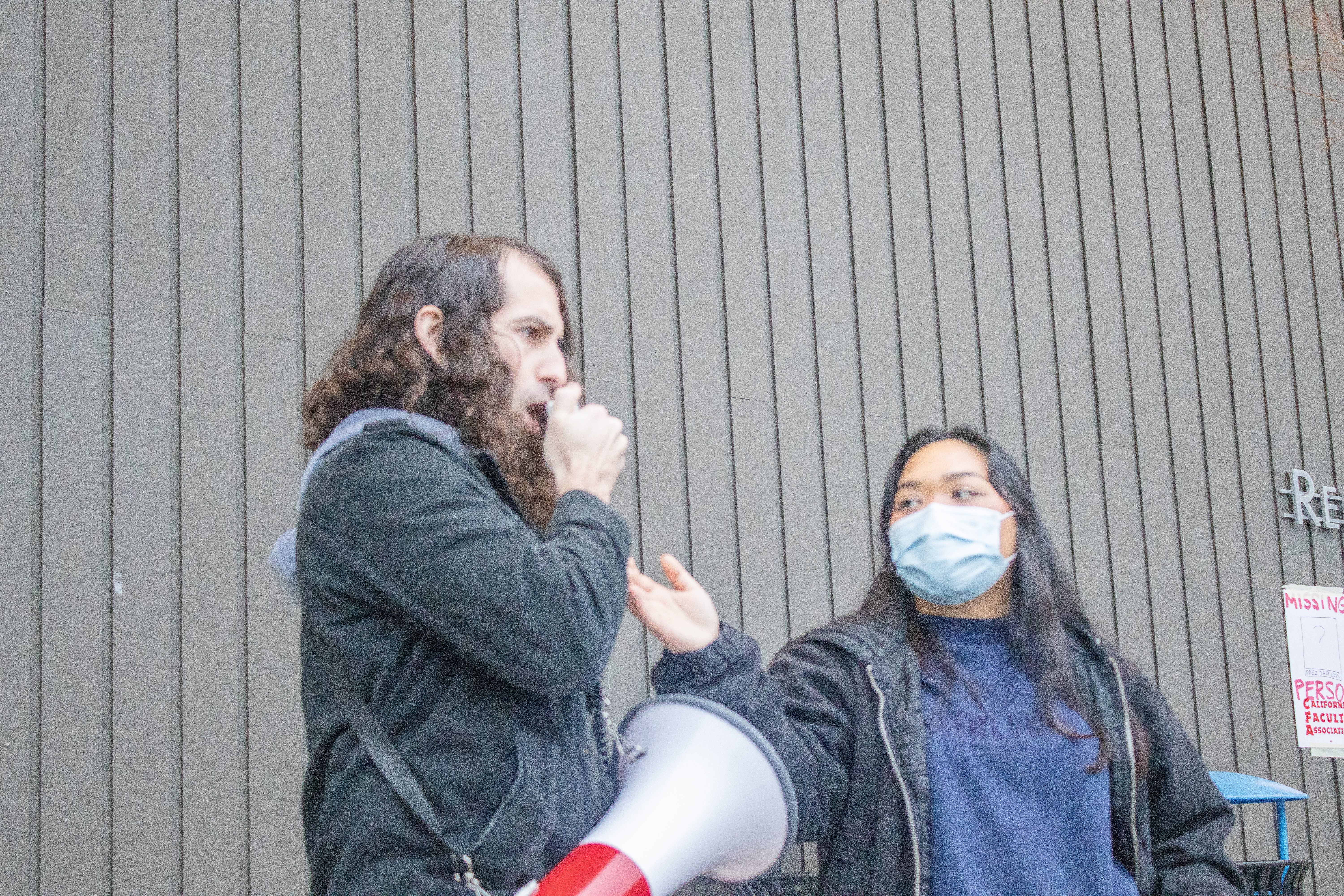
    On an otherwise unremarkable foggy Thursday morning, students and faculty alike met on the main Quad at Cal Poly Humboldt in order to protest the vote to raise tuition by the CSU Board of Trustees. Signs adorned with, “don’t make students your ATM” and “stop targeting education,” were taped to walls and held by protesters. 

    As the weather began to heat up, so too did the rally. Cries of, “chop from the top” and “education is a right,” rang out across the campus. 

    The event was organized by the Students for Quality Education (SQE) and the California Faculty Association (CFA), as well as by the Students for a Democratic Society (SDS). Other groups showed up to speak, including the Critical Race, Gender, and Sexuality (CRGS) Club and the CSU Employees Union (CSUEU). 

    The rally was held in response to the Sept. 13 vote by the Board of Trustees to raise tuition 6% every year for the next five years. CSU defended the vote by pointing to inflation increases and a relative lack of tuition rate increases; the Board of Trustees deemed it a necessity. 

    “We know [administration] can pull from their own salaries and they have reserves they can pull from,” Zoe Reed, a third-year CRGS student and intern for SQE said. “But instead, they’re putting that on us, the people who work here and are learning here, who can’t afford that.” 

    Many speakers at the protest, including Mary Mangubat, a third-year environmental studies student and SQE intern, called for the CSU to rely on the reserve money they have to account for inflation and rising costs rather than taking it out of the students’ pockets. 

    “The CSU has $8.8 billion in reserves that they do not want to touch because they said that they only pull out that money when there’s financial uncertainty in time,” Mangubat said. “What the hell are we in right now?” 

    Mangubat cited the pandemic and the student organizations struggling under the recent Associated Students budget cuts due to low enrollment numbers as criteria befitting a time of uncertainty. 

    Another common complaint was the amount of money CSU administrators were paid relative to the income and costs suffered by students and faculty. President of the CFA Humboldt Chapter Marisol Ruiz weighed in and called for the current Board of Trustees to be fired. 

    “I think it’s just terrible that we have faculty here that make as much as someone’s housing and car allowances,” Ruiz said. “We need equity, and we need people that are responsible to the people to be part of the Board of Trustees.”

    Rick Toledo, an environmental science major and one of the main organizers of the event as a representative of SDS, led many of the chants at the rally before providing a speech of his own. 

    “Think about the weight of a billion dollars,” Toledo said. “They have over 12 of those in their budget. Yet they can’t pay faculty and staff? Yet they have to use students as their ATM? I call BS.” 

    Toledo explained how the administration has sewn a narrative of discord between faculty and students, pitting them against each other to cover for themselves. He went on to say that the CSU is lying in their reasoning for not using the reserves available to them. 

    “In reality, the reserves have been built up to boost their credit so they can borrow more money for more capital investments on projects,” Toledo said. “They’re basically turning the entire thing into a hedge fund with education as the front.” 

    Some students expressed skepticism over the success of holding a rally. Gavin Martin, a theater arts student, questioned how successful a protest against administration sanctioned by administration can be. He likened it to the housing protests during the Spring 2023 semester. 

    “After the protest, we all went to look for homes individually,” Martin said. “We were supposed to be in this together.”

    Mangubat announced the rally’s list of demands for the CSU through a megaphone. The first was to end the tuition hike and take money from the reserves. The second was for the administration to stop relying on students to fund student programs. The third demand called for higher wages for faculty, staff and student workers. The fourth demand called for funding for programs that provide resources for basic needs such as housing, food and mental health resources. Sufficient funding for cultural centers for marginalized communities was the final demand. 

    ‘If we are not heard, we will continue making noise,” Toledo said. “We will continue to be loud until we are heard.”

  • Finalized census shows only 2% growth this fall, yet administration remains confident

    by Brad Butterfield

    Cal Poly Humboldt’s official census has been finalized and shows a one year increase of 118 students, or a 2% growth compared to last fall. The increase is important for the new polytechnic, which hasn’t seen consecutive growth in over seven years. The university is far below the projected 2,000 more students that were expected this fall semester. Because of the far-off prediction, over half a million dollars in Associated Student funded programs has been cut and millions dollars of funding may be withheld by the CSU for the next school year. What caused this gross over-prediction? What is the administration planning to do about it? And, maybe most critically, why does the school need to grow anyway?

    The projection for 2,000 additional students this fall arose primarily due to a record 86% surge in freshman applications. 

    “It really did look like it could be possible,” said Chrissy Holliday, Vice President for Enrollment Management and Student Success, regarding the expected inflow of students this fall. “What’s less known is how serious students are in the very beginning about an institution that’s just changed its identity,” Holliday added. 

    Cal Poly’s Humbodt’s recent transformation to become California’s third polytechnic has rendered the historical data typically used to predict enrollment, unuseful. As the school is changing, so are students’ behavior in response to it. In understanding how the university operates, it is useful to compare it to the way businesses function.

    “Think about companies that shift their identity or create something completely different that they’re putting into the marketplace, whether it’s a new brand or a new product,” said Holliday. “You never know right in the beginning exactly what reaction is going to be and then you start setting new baselines and adjusting to that.” 

    2,000 new students was both a worst and best case scenario for the university, which has promised to grow, but has not yet completed the planned infrastructure projects to support such an influx of new students. 

    “We planned for everything on the continuum. The worst possible thing would be to have growth like that and not be prepared for it right. You can imagine the chaos that would have ensued,” said Holliday.

    Cal Poly Humboldt is 2,473 students under their target for this fall, which could lead to 3.4 million dollars in funding being withheld by the CSU.

    “It’s a budget challenge we’re planning for. We knew that that was a possibility,” said Holliday.

    Additionally, the school spent over a million dollars on a contract with the Comfort Inn to house students, with hundreds of bed spaces on campus vacant. Further, the inaccurate enrollment estimation means that Associated Student funded programs have been cut by $528,717. This includes major cuts to the children’s center, government and even the university’s pool. 

    Still Cal Poly Humboldt is faring much better than most other schools in the CSU system.

    “If you look at all the CSU for this fall, headcount is actually down across the CSU and their full time enrollment, the resident ‘FTES,’ grew by about 1%, where for us that was 3.4%,” said Holliday. 

    In an effort to spread the word about the new polytechnic in northern California, the university has ramped up its advertising efforts. This includes the deployment of recruiting staff across California, digital advertising, improving communications and increasing engagement with prospective students, allowing ‘instant admissions’ for eligible students, enhancing the community college to Cal Poly Humboldt pipeline, increased presence at college fairs and streamlining the admission process.

    It appears that two statements are congruently accurate. The university will grow because it is now a polytechnic, and the school must grow because it is now a polytechnic. In fact, Governor Gavin Newsom and the state legislature approved $433 million in initial funding for polytechnic transition and $25 million per year thereafter. The pressure to grow is evident.

    “There’s definitely pressure because we put forth this polytechnic transformation, right, and said, ‘This is what we’re going to do,’” said Holliday. “There’s definitely a responsibility to follow through on what we promised.” 

    In spite of the low enrollment numbers this fall, Holliday remains confident that the school will achieve their overarching goal of 11,000 students by 2028.

    “I have zero doubt that we’re going to meet the targets that we have in the out years,” said Holliday.

    Holliday went on to explain that gradual growth will allow for changes to be done in a way that doesn’t take away the aspects of Humboldt county and campus life that separate the Lumberjack’s campus from any other. 

    “The more steady growth that we’re seeing currently gives us that time to make sure we don’t lose those things that helped make us special,” said Holliday.

  • Jewish Student Group is stronger than hate

    Jewish Student Group is stronger than hate

    by Valen Lambert and Dezmond Remington

    In the lonely strip of land that is the North Coast, Arcata is famed for being a haven for tolerance and relative diversity. Cal Poly Humboldt in particular is a shelter for people of all creeds and beliefs. However, it isn’t immune to hatred. 

    According to the University Police Department, an unidentified suspect vandalized the sukkah set up on the UC quad with an anti-semitic message at around 1:30 pm on Oct. 9. The sukkah, set up for eight days during the Jewish holiday of Sukkot, symbolizes the Jewish people’s dependence on God. No update on the suspect has been reported.

    Student response was immediate. The rabbi for the Jewish Student Group, Chabad took the sukkah down immediately when they realized what had happened. Members of the club were disappointed. President Noach Guttman, who had attended a Jewish private school his whole life, said it was his first time experiencing anti-semitic hate speech ever. 

    “I’ve only found interested people,” Guttman said. “They [say things] like, ‘Hey man, I like your yarmulke.’ I’m like, sweet… I was just disappointed that this happened the day after the largest Jewish massacre since the Holocaust [referring to the Oct. 7 bombing of Israel by Hamas]. That’s what upsets me the most.”

    Despite the act of hatred, Guttman does not have plans to return the favor.

    “I hold no hate for this person whatsoever,” Guttman said. “I truly believe they’re just misinformed… the sukkah has no connection to the state of Israel. It’s a solely Jewish structure… if they understood the gravity of Hamas murdering [about] 1,400 people, I feel like they would have the respect to not say a message like this.”

    Guttman believes that the university has done a good job at supporting the Jewish Student Group through this time, with staff reaching out to Guttman and other Jewish students. Administrators worked with the rabbi to craft the email sent out on Oct. 10. 

    “In keeping with Cal Poly Humboldt’s commitment to maintaining the safety of our campus community, the University has a zero tolerance policy for acts of hate or discrimination against anyone, no matter who you are and where you come from,” said Associate Vice President of Student Success and Dean of Students, Mitch Mitchell. “The incident is an unfortunate reminder that world events often impact our students. We are fully committed to supporting them in any way we can and I want to encourage all students who may need additional support to use the resources that are available to them on campus.”

    Despite repeated efforts to contact other members of the group, no other members would respond to requests for comment. However, Guttman said all other members of the club he’s talked to feel similarly disappointed, but appreciative of the community’s support. 

    “I’ve always been very active about my Judaism,” Guttman said. “I’m very vocal about it. And this is definitely not going to stop. If anything, it’s going to make me louder. You know, I’m still always going to wear my yarmulke. We’re still going to hold our Jewish events. We’re hoping to do a candlelight vigil within the next week or so. This is not going to [distract] us at all. We’re strong people. If anything, I’m hoping it’ll make us stronger.”

  • CFA gets the word out on the quad, announces rally

    CFA gets the word out on the quad, announces rally

    by Hank Wicklund

    At midday on Thursday Oct. 5, a student hunched over a table, drawing a spiked boot splattered with blood, the front of Art B plastered with posters behind her. Phrases like, “Don’t make students your ATM,” and “Shame on you, CSU,” stood in stark contrast with the dark wall. A clear voice rang across the quad below, calling out to passersby. The air buzzed with the day’s unusual heat, becoming charged with urgent words and the smell of free coffee, drawing the eyes and noses of students to three folding tables, specifically the people behind them. 

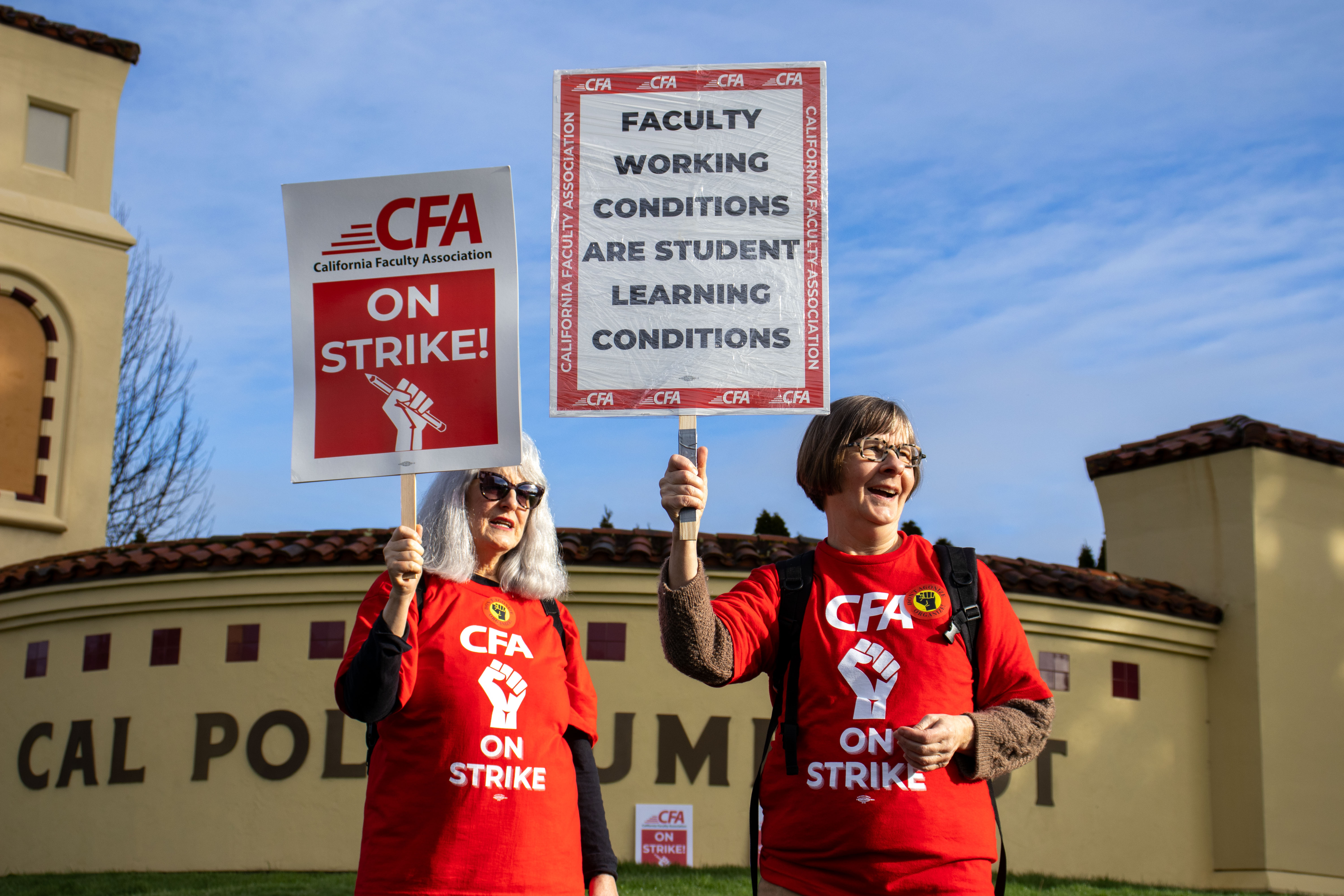
    These were organizers from the California Faculty Association – the labor union for CSU faculty –  and the Students for Quality Education, a student-led organization for education rights across the CSU system. They were there in response to the CSU Board of Trustees’ vote to raise tuition. This demonstration was also intended to promote the CFA’s upcoming rally on Oct. 19, where they plan to protest further. People were encouraged to enjoy refreshments, grab union merch and help make posters. Among the organizers present was Humboldt CFA President Marisol Ruiz.

    “We’re forgetting that this is a public university, publicly funded. It’s not a private institution and we need to stop treating it like a private institution,” said Ruiz.

    Ruiz explained that the CFA’s goals are a halt on tuition hikes as well as better pay and working conditions for faculty. This protest comes on the heels of long-standing grievances regarding what the CFA says is inequitable pay for faculty. According to Ruiz, the CSU has the money to fund education and pay its employees fairly without the need for tuition hikes, yet has strayed from the path of education as a public good. 

    A board bearing the words, “How Much Do You Owe?” was propped up against a planter in front of the tables. Students had scrawled their answers, the numbers going as high as $100,000.

    Also present behind the tables was SQE chapter head Mary Mangubat. According to Mangubat, outreach by the SQE has been quite successful this semester at getting people engaged, because the tuition hike affects not only students but the entire CSU ecosystem.

    “When they hear our admin makes a million a year, but students are in 100k debt,” said Mangubat. “They’re gonna want to be involved.”

    SQE was founded in 2008 as part of the CFA and holds weekly meetings Fridays at 4 p.m. in Nelson Hall. Mangubat described them as fighting for an equitable, accessible education that is free from discrimination and debt.

    Making a poster at one of the tables was Erika Ospenson, an environmental science and management major. Ospenson only found out about the outcome of the Board’s vote that morning from a friend in SQE and is now left with doubts about the cost of her education. She plans on attending the rally on Oct. 19 and is interested in getting more involved with SQE.

    “Something I learned today is that I will get halfway through a degree and then not know if I can actually finish it because of the tuition hikes,” said Ospenson. “I’m already barely making ends meet and [only] able to pay my rent in a rent-controlled situation.”

    The tuition hike has rattled the CSU system here and across California, but chapter president Ruiz believes that students and faculty are in this together.

    “Working conditions equal better student conditions, student conditions equal better working conditions,” Ruiz said.

  • Women on two wheels

    Women on two wheels

    by Savana Robinson

    As far as I’m aware, there are only two women on motorcycles that regularly park on the Cal Poly Humboldt campus. I am one, and the other is Marilyn Koch, a jewelry and small metals instructor at Cal Poly Humboldt. She rides a 2014 Kawasaki Ninja 250 named Trixie and has been riding for 13 years. 

    I think it’s a shame that only two women on this campus ride, mopeds aside. We’re talking highway-legal bikes. A lifelong goal of mine is to inspire other women to ride and claim their freedom. Koch is also in favor of other women riding.

    “I’m so pro-women riders because I don’t understand why it’s such a male-dominated activity,” Koch said. “This is an activity that should be void of gender. Everyone should be on a bike.”

    Koch has always had an affinity for two-wheeled machines.

    “I’ve always thought motorcycles were just really badass,” Koch said.

    Prior to riding, her taste in men was the more rebellious type, especially those with motorcycles.

    “I realized instead of looking for a guy on a bike, why couldn’t I just be that badass person myself?” Koch said.

    Koch decided to take a motorcycle safety course and get her license.  California Highway Patrol and other riding schools offer the California motorcyclists safety program all over the state. Koch spoke well of the program because it not only provides everything needed to learn, including a motorcycle, but it also gives riders the knowledge and confidence they need to ride safely.

    “I highly encourage anyone that’s even interested in riding a motorcycle to take one of those courses,” Koch said.

    Koch spoke of how the course is a great option for women especially.

    “Generally, if you’re a guy, you maybe know somebody that has a bike or you’re a little bit more interconnected with the riding circle,” Koch said. “A lot of the female riders I’ve noticed are just so disengaged from that community.”

    Koch noted that the exception to this stereotype is women who find groups such as The Litas Humboldt, who are only one part of a worldwide collective of women riders. They allow women of any riding level to join. Being part of a riding group is a great way to learn and become more comfortable riding and having fellow women to ride with can boost confidence.

    I joined The Litas Humboldt in Dec. 2022, fulfilling my dream of several years. Part of the reason I came to Cal Poly Humboldt was because of The Litas. Being part of an all-ladies collective makes my heart soar; it’s like having a bunch of sisters to ride with. Erin Taylor, cofounder of The Litas Humboldt, once referred to that experience as ‘wind sisterhood’. There’s no other feeling like it.

    Sometimes, men come up to me on my bike and say that I’m a badass. It feels good to hear it, but I can’t help but wonder if they would say that to another man. Koch shared a similar sentiment.

    “When I get on my bike and I see people sort of staring at the bike… wondering who the owner is, and then realizing that the owner is a lady, they’re always somehow mystified as though it is even cooler that it’s a lady and not a guy,” Koch said. “It tickles me, but it also disappoints me. Why is it so astonishing for a lady to have a motorcycle?”

    My dream is to have a bunch of girls on motorcycles riding to school. It would be so cool to see other motorcycles with scrunchies and pink bandanas on their mirror stems in any of the many Cal Poly Humboldt motorbike parking areas. I could talk all day about yass-ifying Harleys and other makes, but I digress, we need more women on two wheels. 

    I would greatly encourage anyone that’s thinking about getting a motorcycle to take the motorcycle safety course, and for any woman that rides to join The Litas Humboldt at thelitas.co/humboldt and on their Facebook page.

  • Associated Students cuts $500,000 out of student programs: resource centers struggle

    Associated Students cuts $500,000 out of student programs: resource centers struggle

    by Angel Barker

    This is an extended version of the story that was published Friday, September 29. This version was printed on Wednesday, October 4.

    It was a misty Friday morning in Arcata. Fewer than 20 people met in person to discuss the budget reform for funded student groups on campus. Tensions were high and budget cuts were higher.

    Faced with a deficit of more than $500,000, the Associated Students (A.S.) met to make huge cuts to student programs. There were over 20 funded program cuts that were approved.

    A $500,000 deficit heightened the tensions between A.S. and core funded student groups on campus. With thousands lower in enrollment numbers than originally projected by the university, it left a sour taste in the mouths of everyone whose budget was about to be cut by thousands of dollars.

    Associated Students Administrative Vice President (AVP) Andres Olmos facilitated the discussion for the necessary cuts of the budget. According to Olmos, because of lack of funds, they are essentially starting from the ground up with the bare minimum of only wages for student workers. That still leaves them over budget. The revenue is much less than predicted in the spring due to the high enrollment projections made by the university.

    The original revenue number was $786,000. Using A.S. reserve funds, the number would have been $865,000. According to Olmos, the financial office told A.S. to get to $750,000, meaning the total number of funds cut were $528,717 because the approved budget when the university thought enrollment would be much higher, a whole $1.2 million.

    A screenshot of the finalized budget of the funded student programs. The left column is the original budget approved in spring and the right column is where the budget is now.

    Olmos acknowledged that it was important to A.S. that student workers were able to keep their jobs, and that the main priority was keeping each budget at least at their current wages, only so students could continue to survive.

    Over 20 student groups like cultural centers, service organizations and more, saw cuts that ranged anywhere from $2,500 (Drop-In Rec Open Gym) to $186,498 (A.S. General Operations). 

    Some individual budgets were getting cut entirely because they have trust funds that they can survive on for the year; others were biting their nails to try and get more than just enough to pay student workers.

    “The money that is now allocated to us is strictly for wages,” Isabela Acosta, the Fiscal Coordinator for the Women’s Resource Center said in an interview after the A.S. meeting. “Not for supplies and hospitality or events.”

    A.S. President Samuel Parker said that the university told A.S. in the beginning of September that they would need to cut the budget. With less than a month to make the adjustments, it was difficult.

    “It was pretty difficult to have to deal with in such a tight time frame,” Parker said. “Also we have a very limited amount of people at the moment, so it is hard to get the adequate amount of communication out to everyone to let everyone know and have them chime in with their perspectives.”

    Marketing and Communications Director of News and Information Aileen Yoo said in an email statement that the budget office had informed A.S. about the budget shortfall on Aug. 30. 

    “One of the reasons for the budget deficit had to do with fee revenue estimates being lower than anticipated due to enrollment growth being more modest than initially anticipated during budget planning last spring,” Yoo said. “This led to needed adjustments to many of our budgeted operations across campus, including our main Operating Fund as well as our fee supported areas, such as AS.”

    The Eric Rofes Queer Multicultural Resource Center (ERC) approved budget for the 2023-2024 school year was $42,500. It was cut to $30,000 after Ascher Marks, the fiscal director for the ERC, and AVP Olmos talked. Olmos told Marks that the ERC employees might not be able to work over summer and winter breaks.

    “We cannot really consider that because our bills don’t stop during winter and summer break,” Marks responded. “We need to be working over the breaks because this is our job and how we make money.”

    Other organizations like the Women’s Resource Center are struggling to do anything except pay their employees.

    “We can’t buy menstrual products,” Acosta said. “Our sole responsibility as a resource center is to provide menstrual products for campus.”

    Acosta explained that due to a law passed in California in 2021, that the university should be stocking the bathrooms with menstrual products, but they have not been.

    “Our school should be [providing] menstrual products because of California Bill 367, which makes California public institutions required to have free and accessible menstrual products, and the school has not instilled this bill,” Acosta said. “So we have basically been taking out large portions of our yearly budget to provide menstrual products for campus when it is not even our responsibility to do so.”

    Yoo responded to this in an email statement.

    Photo by Kae Dennert. Ella Moore, Rose Co-Director, raises her hand during the A.S. meeting on Friday.

    “This [law] has been funded previously by the university, through Student Health & Wellbeing Services and other institutional resources, with staffing resupply support through the Office of Student Life and other university departments. The Women’s Resource Center provided additional supplies and locations and has done so since before the bill was passed. A group of those folks plus Facilities Management are now meeting to streamline the process and ensure funding and coordination of effort.”

    When asked about the backstock of menstrual products and when the center could possibly run out, she said that if they were to stock every bathroom regularly they would run out by next week. With the stock they have (about 20 boxes of pads, 100 menstrual cups and 18 boxes of tampons), she is hoping they will make it to the end of the semester. 

    Some organizations still have enough to sustain for the year, like the Waste Reduction Resource Awareness Program (WRAPP). The Program was cut by $9,200 leaving them below the A.S. recommendation of only wages, yet they remain optimistic.

    “We are so excited to have $44,000,” Ella Moore, Rose Co-Director said. “It means we are going to be able to pay our employees and [have] a little wiggle room for basic operations.”

    The Social Justice, Equity and Inclusion Center will still be open after their $16,500 cut. Frank Herrera, the Center’s Coordinator, is optimistic despite the small funds. Herrera said that the primary goal is to keep student staff, the secondary is to have high impact events. He understands that budgets change and the Center just needs to be more intentional with events.

    Aside from the difficulties cutting a budget by this much, Parker is proud and optimistic, particularly of AVP Olmos.

    “There were a lot of factors that made it pretty difficult for everyone. I am very proud of everyone for managing to pull it off.”

  • Music meets anime at Thundercat show

    Music meets anime at Thundercat show

    by Carlina Grillo

    On a typical cold and rainy night in Arcata, students gathered into the John Van Duzer Theatre where Grammy award-winning bassist, Stephen Lee Bruner, known as Thundercat, brought the heat to campus. With a mix of funk, jazz, R&B and psychedelic bass noodling – eccentric doesn’t begin to describe the night. 

    Tickets for the show sold out within two hours of going on sale to the public, and to people’s surprise, last minute tickets were sold the evening of the performance. For Thundercat’s third time back to the Van Duzer, Cal Poly Humboldt’s Center Arts expected a full house with a seated capacity of 862.

    Eager for the show, the crowd began gathering in the lobby half an hour before the doors opened at 8:30 p.m. Upon entry, people were greeted by a vivid blue light and fog in the air. Behind the haze stood a giant blown up medieval style tower with a cat head. Known as “Cats Lair,” this stage set up was a reference to the 1985 anime, “ThunderCats.”

    The concert was promoted as a seated show, but as soon as the band took the stage, some people stood in front of their seats while others raced to the front. Most people on the balcony remained seated until the very end of the night when the entire house gave Thundercat a standing ovation. The energy was high, but not enough to solicit a mosh pit. Folks mostly swayed throughout the night.

    Thundercat took the stage around 9 p.m. with his iconic six string Ibanez bass guitar, and was backed up by Dennis Hamm on the keys, with Justin Brown on drums. Between songs, Thundercat entertained the crowd with relatable banter and even attempted to kickflip a Tech Deck from the crowd. While he talked to the crowd, fans could be heard meowing around the room.

    Photo by Carlina Grillo. Thundercat playing in front of the “Cats Lair”, a giant blowup tower referencing the 1985 anime “ThunderCats”.

    It was quickly made apparent that anime has a grip on Thundercat and has influenced many aspects of his life. During the first half of the show, he asked the audience how they felt about anime. As the question was followed by loud cheers, he decided to play the song “Tokyo.”

    “I’m gonna slow this one down too,” said Thundercat. “I’m gonna sing this one real slow, so you can understand what it was to be me at 18 years old in Japan.”

    The song described Thundercat’s time in Tokyo with an ode to his lifelong love for anime.

    “I went to the dentist and he gave me a toy / it was Dragon Ball-Z, a wrist-slap bracelet / Goku fucking ruined me,” sang Thundercat. 

    Afterwards, he followed it with his song “Dragonball Durag.” He mentioned that it was his first time playing those songs back to back, and even exclaimed to Hamm, “Write that down!”

    “You don’t have to like my video games or my comic books / But baby girl, how do I look in my durag?” sang Thundercat.

    During the second half of the performance, Thundercat took a moment to honor musicians he’s proud to have worked with who have passed away. He specifically mentioned rapper Mac Miller, Japanese composer Ryuichi Sakamoto and concert promoter Meghan Stabile.

    “To know Meghan was to love her,” Thundercat said.

    Whether an anime lover or not, concert-goers left the Van Duzer feeling electric. Tobin Thornton, a freshman studying chemistry at Cal Poly Humboldt, had never been to the Van Duzer before and had zero expectations for the night. 

    “I don’t really know what I was expecting, but I had a very good time. I do feel like I got put in a microwave, but in a good way,” Thornton said before rating the show a solid nine out of ten. 

    Sam Schulman, a music lover and community member, expressed his gratitude for Thundercat coming to Arcata to share his music.

    “I was mind blown by his artistry and how good he is at playing the bass. It was so cool,” Schulman said. “I didn’t really know what to expect going into it and I know he has regular-amount-of-time songs, but he was extending a lot of them and jamming a lot. Which was really cool to see.”

    Lexi Takaki, a graduate student in the social work program, described her night as awesome, and felt very lucky to get one of the last minute tickets. 

    “Thundercat is a world renowned musician that is like none other, so it was kind of surreal to see him on stage,” Takaki said. “I feel like at a lot of shows at the Van Duzer, it can be really mellow or people are kind of awkward, and I feel like tonight everyone was really feeling it.”

  • University releases annual security report

    by Jake Hyslop

    Cal Poly Humboldt made its annual Security Report under The Jeanne Clery Disclosure of Campus Security Policy and Campus Crime Statistics Act public. The report details crime statistics that have occurred during the past three years, from 2020 to 2022. 

    The Jeanne Clery Act was signed into law in 1990. The act is a consumer protection law meant to provide transparency to the public around campus crime policy and statistics. Nicki Viso became the Clery Director in February 2022, heading up the Clery Compliance Team which is composed of representatives from many Cal Poly Humboldt departments. 

    The crimes reported are sorted into four categories based on where they happened. These include reported incidents on the general campus, on campus residencies, non-campus locations affiliated with the school, and public property near or adjacent to the campus. 

    There were no hate crimes reported during the three year stretch of 2020 to 2022 in the report. While there were no reports of murder or non-negligent and negligent manslaughter, there was a large increase in rape cases, from two incidents in 2021 to 11 in 2022. There were also increases in incidences of fondling, robbery, aggravated assault, burglary, arson, and other crimes. Some were small increases (like robbery from zero to one case) and some were larger (like weapons law violations from three to seven). 

    The Clery Compliance Team noted these increases in the report. August 2022 was the point that campus opened fully, with an increase of people on campus and returning to in-person classes as the reasons. Another change the team cited was that Comfort Inn in Arcata, currently housing students, was included and classified under “Non-campus Property.”  

    It’s important to clarify that any allegation that fits the criteria of a specific crime and occurs within the geographical locations specified by the Clery report are included. Not every crime statistic included in the report is proof that a crime definitively happened. Furthermore, crimes are recorded under the year they’re reported, even if they occurred a previous year. 

    The Clery Act Report is available on Cal Poly Humboldt’s Clery Act Compliance webpage, as well as information to help understand it.

  • Associated Students cuts $500,000 out of student programs

    Associated Students cuts $500,000 out of student programs

    by Angel Barker

    Faced with a deficit of more than $500,000, the Associated Students (A.S.) met Friday to make huge cuts to student programs. The Womxn’s Resource Center saw a large cut of $25,850, Diverse Male Scholar Initiative was reduced by $29,340 and Recreational Sports Clubs were cut by 50%, now left with $15,000. Those were three of the over 20 funded program cuts that were approved.

    It was a misty Friday morning in Arcata, specifically in Gist Hall room 218, where fewer than 20 people met in person to discuss the budget reform for funded student groups on campus. The meeting was called to session at 10:03am. Tensions were high and budget cuts were higher.

    A $500,000 deficit heightened the tensions between A.S. and core funded student groups on campus. With thousands lower in enrollment numbers than originally projected by the university, it has left a sour taste in the mouths of everyone whose budget was about to be cut by thousands of dollars.

    Associated Students Administrative Vice President (AVP) Andres Olmos facilitated the discussion for the necessary cuts of the budget. He stated that because of lack of funds, they are essentially starting from the ground up with the bare minimum of only wages for student workers, which would still leave them over budget. The revenue is much less than predicted in the spring due to the high enrollment projections made by the university.

    Olmos acknowledged that it was important to A.S. that student workers were able to keep their jobs, and that the main priority was keeping each budget at least at their current wages only so students could continue to survive.

    The approved 2023-2024 funded student programs budget sat at $1,278,717, and because of the lack of funding they needed to get to $750,000. Over 20 student groups like cultural centers, service organizations, and more, saw cuts that ranged anywhere from $2,500 to $186,498. Some individual budgets were getting cut entirely because they have trust funds that they can survive on for the year; others were biting their nails to try and get more than just enough to pay student workers.

    The original revenue number was $786,000. Using A.S. reserve funds the number would have been $865,000. The financial office told A.S. to get to $750,000, meaning the total number of funds cut were $528,717.

    The Eric Rofes Queer Multicultural Resource Center (ERC) approved budget for the 2023-2024 school year was $42,500 and was reduced today to $30,000 after exchanges between Ascher Marks, the fiscal director for the ERC and AVP Olmos.

    “We still need to work over the winter and spring break,” Marks said over Zoom.

    “Like I have stated to other organizations,” Olmos said, “you guys might have to reconsider working through winter break and summer break, so I apologize for that.” 

    “We cannot really consider that because our bills don’t stop during winter and summer break,” Marks responded. “We need to be working over the breaks because this is our job and how we make money.” In the end, the ERC’s budget was reduced by $12,500.

    Some organizations still have enough to sustain for the year, like the Waste Reduction Resource Awareness Program (WRAPP). The Program was cut by $9,200 leaving them below the A.S. recommendation of only wages, yet they remain optimistic.

    “We are so excited to have $44,000,” Ella Moore, Rose Co-Director said. “It means we are going to be able to pay our employees and [have] a little wiggle room for basic operations.”

    A more in depth story will be printed this week on Wednesday, October 4.

  • Low effort and loving it

    by Zack Mink

    Being in your I-don’t-give-a-f*ck (IDAGF) era means that you do what you need to do for yourself. For me currently, this means I’m showing up to class in the same outfits every week, or pressing snooze on my alarm and committing to wearing pajamas all day. It’s giving low effort although I’m still on top of school and work because, “that’s what really matters,” as my Grandma would say. 

    I love clothes, thrifting, design, etc., but who am I trying to impress when I’m running to The Depot during a ten minute break? I’m tired of dressing up for the one cute guy in my class who doesn’t even know my name (yet). I’m done wasting a good outfit on a day when I’m sitting in one classroom for multiple classes back to back. Being as thoughtless as I am when it comes to my daily appearance takes a lot of work though. It takes a sense of style, confidence, and a certain je-ne-sais-quoi you would only know from hitting rock-bottom, possibly even multiple times. 

    When I say hitting rock-bottom, I mean a struggle you have had in life that you learned from. Something that taught you a life lesson, brought a growth opportunity. No judgment to the people who have never been to therapy, but working to improve yourself is super important. It’s a time when you focus on loving yourself, owning your flaws, and working to improve yourself however that looks for you. It’s also hot, so if you have never been to therapy I highly recommend taking advantage of the free resources campus provides. Focusing on your personal growth brings you a third-of-the-way to thriving in your IDGAF era; the second part is being confident. Luckily… you’ve had some time now to work on yourself, learned a life lesson or two, gained some emotional maturity, and are feeling happy with how far you’ve come. 

    The turning point for me was my junior year of high school. It was the third high school I went to, so during the first week I took advantage of the fact that I was the new kid. Being my bold self, I ran for treasurer with no one even knowing my name. I didn’t win, but it was still fun to just not take it too seriously, break down my walls and be confident in who I was. Some may say that was actually the beginning of my IDGAF era.

    The missing piece to being successful in your IDGAF era is having a sense of style. Like I said, I’m an outfit repeater and wear the same exact things every week. Not to brag, but I do consistently get compliments on my eight dollar sweatshirt and the t-shirt I thrifted that has a huge hole in the armpit. Maybe it’s the low standards of Arcata, or maybe I’m just delusional, but all you need is some style to pull off being low effort and presentable.

    Once you’ve reached this point, you can truly enjoy the world around you. You have prioritized yourself, grown emotionally, and gained confidence allowing you to be successful in the other aspects of your life. You also look cute and are the mysterious person someone thinks about after seeing you walk to class. So be free my little birds, get help – because if you’ve read this far you need it, and I wish you a pleasant journey finding your successful low effort lifestyle.
    If you are in need of emotional and mental health support, please reach out to Counseling & Psychological Services at humboldtcaps@humboldt.edu or call 707.826.3146 to sign up for free mental health/counseling services through TimelyCare.

  • Cal Poly Humboldt spending $1.34 million on hotel lease while having 331 vacant beds on campus

    Cal Poly Humboldt spending $1.34 million on hotel lease while having 331 vacant beds on campus

    by Brad Butterfield

    Two-and-a-half miles north of campus stands the seven-figure “temporary solution” to Cal Poly Humboldt’s current housing crisis. However, this fall semester did not bring the thousands of additional students that had been expected, and 331 bed spaces remain vacant in the on-campus dorms. Despite the difficulties presented by living out of a hotel room, students spoke – mostly – positively about life at the Comfort Inn.

    Cal Poly Humboldt’s lease agreement with the Comfort Inn commenced on Aug. 11 and will expire May 12, 2024, for a total of 275 nights. The 49 rooms at the hotel cost the university $100 per night. By the end of the lease, the university will have paid $1,347,500 to the Comfort Inn.

    During normal hotel operations, the city of Arcata charges a ‘transient tax’ of 10% the cost of the room. With the university’s lease, the city of Arcata will not earn its normal 10% tax from the Comfort Inn for the 275 nights that students will call it home. Representatives from the city of Arcata were not immediately available for comment regarding the loss of tax revenue.

    Given the fact that 331 empty bed spaces remain vacant on campus, the Comfort Inn lease could appear like an ugly $1.3 million stain on the university’s management of funds, but perhaps that’s not fair. Enrollment was expected to jump by 2000 students this fall and the university had an obligation to plan for every scenario. Additionally, the university allowed students who were accepted this fall to defer enrollment until next spring, creating a potential housing shortage come spring. The Comfort Inn lease was kept as an insurance measure by the university. 

    “To meet the needs of our students and prepare for a possible influx of more students, the university provided the option of living in university-managed off-campus bridge housing like the Comfort Inn,” said Aileen Yoo, Director of News & Information in a statement. “It’s meant to be a temporary solution as we move forward with building additional housing facilities over the next several years.” 

    In spite of the price tag and lower-than-predicted enrollment, the university kept the Comfort Inn as a housing option, in part because they had to. They had advertised the hotel as a housing option for many students.

    “We also sought to honor the fact a number of students specifically chose to live in the Comfort Inn, even when offered the option to move back onto campus,” Yoo said. “Continuing our contract allows us to not only plan for the future, but to reduce uncertainty and disruption of housing locations for those students.”

    Importantly, all students currently housed at the Comfort Inn are there by choice. 

    “Students who are currently residing in the Comfort Inn have chosen to stay there, even when the university offered them the opportunity to move back on campus and live in residential halls,” said Yoo.

    Neither Sherie Cornish Gordon the Vice President of Administration & Finance, Donyet King the Senior Director for Housing & Residence Life, nor Steve Relyea the Executive Vice Chancellor responded to interview requests.

    The money spent is particularly concerning on the backdrop of the recent CSU tuition hike. Regardless, the students of Cal Poly Humboldt that have been caught in the crosshairs of the university’s rapid expansion, should be the number one priority. Happily, it seems that students now housed in the Comfort Inn are quite content, one might even say they are… (relatively) comfortable. 

    “It’s not a shitty place, it’s really not. People are like, ‘Oh that sucks you guys are living there,’” said Luis Castro, a student living in the Comfort Inn. “I’m like, ‘No, it’s chill. It’s our own thing.’ In my opinion it’s better than living on campus.”

     In fact, there are a number of notable benefits to life in the Comfort Inn that students are stoked on. 

    “It’s quiet. You don’t have the loudness of the community on campus,” said Dylan Harrison, another student who resides in the hotel. “We have our own community here. We have breakfast every morning. We got a pool downstairs if I want to go swimming, or go to Jacuzzi. We have our own laundry as well.”

    In addition to the jacuzzi and laundry, students housed at the Comfort Inn have cleaning services twice a week, free breakfast, and gated parking. Still, there are drawbacks to making a hotel room a home. Namely, the absence of a kitchen. Fortunately, the university has crafted a creative compromise for the students living without a kitchen.

    “They got a deal with this diner called Pepper’s and we use our meal exchanges there, or flex money,” Harrison said. “If I want a burger, instead of going and getting a burger that some student made on campus, who just wants to get paid – I could go to a diner where these people want to make burgers. And they like making burgers. And they got good burgers.”

    In addition to top notch burgers, students are relishing the first floor snacks provided by the hotel.

    “If you want to get something to eat – let’s say you want snacks on campus – then you have to go to the marketplace and pay for it. And here you just go downstairs and just get a yogurt that’s already stocked,” Castro said.

    Naturally, the perks of life at Comfort Inn must be weighed against its inconvenient undesirable location miles from campus.

     “There is a little bit of a disconnect, socially, you know, between big events that are going on [on campus]. But, I mean, the people that I have met here are pretty cool,” said Andres Arteaga, another student resident of the hotel. “Seeing as it’s my first year here, I did actually really want to be on campus. I do like the vibe on campus, but at the same time, It just feels like our own area here in this section of the town.” 

    All things considered, the situation seems decent for students living at the Comfort Inn, but it is far from an ideal college housing arrangement. Directly across the street from the Comfort Inn stands, ‘The Grove,’ a hotel recently converted to a homeless shelter. Behind that, in an undeveloped stretch of land that backs up to highway 101, a small community of homeless folks have put up shop and don’t appear to be leaving anytime soon. 

    “It’s like a 15 feet deep pool and 20 feet diameter wide and there’s tarps and there’s like, people just living over there,” Harrison said. “It’s crazy. You see it off the 101, they’re always burning fires. There’s a lot of people over there. You hear them at nighttime, [and] they’re always screaming.”

    Logistically, it appears the university has set students up for success with multiple options for transport to the campus grounds. Working in tandem with Arcata Mad River Transit, the university created a new route that runs 7am to 10pm to transport students, for free, to and from the campus. The bus does not run on Sundays, but students have the option to call the University Police Department for a ride at any time, if need be.

    “I take the bus to school,” Harrison said. “There’s three options every hour. If you miss all three buses, you’re a dumbass.”

  • Students struggle to navigate COVID-19 safety post-pandemic

    Students struggle to navigate COVID-19 safety post-pandemic

    by Zachary Mink and Griffin Mancuso

    While COVID-19 regulations have become more lenient at Cal Poly Humboldt, many students are still contracting COVID-19 and are unsure of where to find resources.

    EG.5 (Eris) is one of the newer variants of COVID-19 in the United States, known for being highly contagious. The Center for Disease Control and Prevention (CDC) predicts that Eris made up about 24.5% of COVID cases in the U.S. over the last two weeks. The second most common variant, FL.1.5.1, made up about 13.7% of cases. 

    Currently, the data on the number of student COVID-19 cases and which variant students are contracting most often is unavailable.

    Dobby Morse, a graduate student in English who lives on campus, contracted COVID-19 in mid-August. They initially tested negative and assumed they weren’t contagious despite their symptoms.

    “After like the third or fourth day, there was this burning lump in my throat and I couldn’t speak,” Morse said. “So, I went to the health center to try and get help and they tested me there. They said I had [COVID-19] and I had to go into lockdown.”

    Because they were living with a roommate, Morse stayed in a quarantine room in the Cypress dorms for six days with one bedroom, a bathroom, and a mini kitchen with a broken stove. They tested again five days after their visit to the health center and had a positive result.

    “I tried to extend my room for a couple more days, but the housing person said that I wouldn’t be contagious after 10 days,” Morse said. “But there’s internet health websites that say you can be contagious for up to 20 days.”

    According to the CDC, those with moderate or severe COVID-19 should isolate for at least ten days, but those with a severe case of COVID-19 may still be contagious and need to isolate for up to 20 days.

    Many students believe that precautions still need to be taken in regard to COVID-19.

    “I don’t think people are as aware of it or as concerned about it as they should be,” Morse said. “Because I did have one person be like, ‘Oh, you have COVID[-19]? But I’m not scared of COVID[-19],’ and kind of got in my face.”

    Emma Kral, a senior at Cal Poly Humboldt, contracted COVID-19 a week after moving into the dorms. COVID-19 left her unable to prepare for her classes, disrupting the beginning of her semester and leaving her feeling tired and unsettled. She was able to get a rapid COVID-19 test from one of the health vending machines on campus, and wants to see students and faculty taking more precautions.

    “I think masking should be a lot more common on campus,” Kral said. They also thought more ventilation in classrooms would be helpful.

    Many students aren’t aware of the vending machines on campus that carry COVID-19 rapid tests or the resources available in the Health Center. Some students said that they want to see more free masks available around campus. Most frequently, students requested that the school take an active role in addressing the rising number of COVID-19 cases among students and listen to student feedback.

    Photo by Griffin Mancuso. The Student Health Center on campus.

    According to the Cal Poly Humboldt website, students who are symptomatic can make an appointment at the Student Health Center to see a medical provider. If you are unable to get to the Student Health Center, 2-packs of rapid COVID-19 tests are available in health vending machines for $20 each.

    Free 2-packs of rapid COVID-19 tests are currently available to all students at the Student Health Center, but students can only get one pack of tests at a time.

    The Student Health Center currently does not provide COVID-19 boosters, but students can sign up for an appointment or find walk-in clinics near them on myturn.ca.gov. Locations in Arcata and Eureka that have the updated COVID-19 vaccine are Walgreens, CVS Pharmacy and Rite Aid. Safeway locations currently have a limited supply of the updated COVID-19 vaccine.

    The Lumberjack reporters made multiple attempts to contact Jennifer Saford the Executive Director of Student Health & Wellbeing Services, Mira Friedman the Lead for Health Education and Medical Clinic Support Services, Aileen Yoo the Director of News & Information, and Grant Scott-Goforth the Communications Specialist, through email and in-person, but all were unwilling to provide a comment on COVID-19 tests and resources at this time.

    Covid Vending Machine Locations:

    Nelson Hall East (across from Goodwin form)

    Gutswurrak Student Activities Center (1st floor by the Depot)

    Jolly Giant Commons (3rd floor next to housing cashier)

    College Creek Mail Room Lobby

    Creekview Dorm Lounge (must be a Creekview resident to access)

  • UPD still doesn’t have a police chief

    UPD still doesn’t have a police chief

    by Brad Butterfield

    After a spring semester that saw The University Police Department’s force spread so thin that single-officer patrols were a norm, they have recently hired two new dispatchers, promoted an officer to sergeant, and hired one new officer. While slightly better than before, the department’s staffing issues have forced many members of its small team to still work long hours with few days off. Despite the successful recent hirings, the department remains without a permanent police chief and ever-cautious in its search for a new one. The still understaffed force has had to rely on its committed team working overtime to remain functional.

    As many students will have been made aware of through the UPD’s advisory emails, it has been a hectic start to the fall semester. The last two weeks have seen an uncharacteristic barrage of criminal activity on our typically peaceful campus among the redwoods. From “Suspicious Bags Found in Wildlife & Fisheries Building” to “Trespassing Arrest at the Children’s Center” and a tragic “Collision That Injured Student” at one of the campus’s few intersections which left a student in critical condition, this has been an unusually chaotic start to the semester. 

    Throughout this spring semester, Lieutenant Peter Cress filled the role of police chief in addition to his normal duties as lieutenant. Currently, Fernando Solozano, a retired police chief from Long Beach, has stepped in as interim chief until a permanent one is finally hired. 

    Unfortunately, a timeline for the hiring of a permanent chief is difficult to nail down with so many factors at play. Even if the perfect candidate showed up on Harpst street tomorrow, they’d still need to go through a full background check, potential recertifications and additional police academy training (depending on where they transferred from). So, it will likely be exactly a while-longer before Cal Poly Humboldt has a permanent police chief.

    On top of all that, hiring a police chief for a university – especially one as unique as Cal Poly Humboldt – has a number of additional hurdles as compared to your average city police department. Most notably are the Clery Act and Title IX federal civil rights, which affect police operations on a university campus distinctly from those at a typical city police department.

    Moreover, the bureaucracy of a college campus means that a very unique skillset and experience is necessary to perform the job tactfully.

    “The CSU system has its own challenges in different ways. It’s not just a police department in a town where you can go to your mayor and say, ‘Hey, what’s going on?’ We have our presidents and we have our chancellor, so we have lots of different steps… What would be nice is if we had somebody who is familiar with the CSU system, who is eager to grow a police department, and comes in with knowledge, all those things,” Martin said before adding, “we’re not looking for a unicorn, but I mean, kind of we’re looking for somebody who can do all of that.”

    The chief of the police sets the tone for the entire department, Martin explained. They look fifteen years down the line and act as captain of the ship, adjusting course towards innovation and progress. The fact that the department has been absent a chief for so many months and remains not only functional but reliable, serves as testament to the unwavering dedication of each member of the department. Importantly, though the search for a permanent police chief remains a top priority for the department, they are not rushing the process and will not pull the trigger unless the fit is perfect.

     “Our VP [Sherie Gordon] has a very set criteria of what she wants to hire. She just doesn’t want to settle. She wants somebody who’s going to do justice to the police department and our campus,” Martin said.

    Martin’s explanation for the still vacant chief position hinted that perhaps having no police chief is better than having the wrong police chief. 

    “It’s about finding somebody who wants to be here, who is willing to put in the work,” Martin said before continuing, “Somebody who’s progressive, understands what we’re trying to do here. And we’ve struggled at finding a very qualified person that can slide into that role and help our police department grow.”

    This spring saw the lean department frequently functioning with only one officer on duty at any given time. 

    The recent new hires have eased that strain slightly but they’re currently still running some single person patrols, as they are having trouble finding qualified officers. 

    Aware of the mounting need for more personnel, the UPD have put together an incentive package and have hired a firm to recruit nationwide to find fitting candidates. A common theme in talking about the difficulties in hiring was UPD’s emphasis on hiring the right candidate. They are not interested in hiring just anybody so that they have additional boots on the ground. They’ve got to be the right boots. And of course, this is Humboldt – they’ve got to have the right vibe.

    “We are not just filling boxes and trying to put a cop in a seat just because I need a number. I’ve got people who are willing to come here,” Martin said. “We just want people who are going to be a positive addition to the police department and how they interact with our community and how they’re willing to change and how they’re willing to grow.” 

    “We are looking for the right people to be a part of that police department as we grow,” Martin emphasized. 

    Remaining a community based police force appears to be a top priority for the department when considering new hires.

    “Our community as a whole is more laid back,” Martin said. “100% we want to be able to be part of that culture.”

    The understaffed department has relied on its indomitable staff to keep the peace on campus. 

    “It’s been the staff. The staff is really the reason that we’re still moving forward and getting stuff done,” Martin said. “A lot of overtime for different people, a lot of hours are being put in and everybody’s just still getting the work done.”

    Martin put in about thirty hours of overtime last month, with this month’s overtime hours quickly racking up. Impressive as that is, dispatcher Jennifer Gomes’ work schedule borders on super-human.

    “I have, technically, one full day off this month. My normal schedule is day-shift Sunday through Wednesday,” Gomes said. “But I’m covering graves for the second half of the week right now, and then my one day off for the week is the day that I rotate back to day shift. So, I sleep all day to try to accommodate coming back to day-shift.” 

    With two new dispatch trainees set to complete their training in October, respite is on the way. The dispatch ‘family’ will be back to three days off per week with just one dispatcher role left to fill. An unsung hero of Humboldt, Gomes explained her reasoning for weathering the recent tough times at the UPD. 

    “Everybody’s pulled their weight, come together kind of as a family and just pushed through the staffing issues,” said Gomes. “Just push through the hard times here, we’re all coming out of it.”

    With millions upon millions being put toward Cal Poly Humboldt’s expansion, it seems the unstoppable force of dollar-driven change is also working overtime here in Humboldt county. Change is a comin’. 

    “As our faculty and our staff grow, there are gonna be different expectations as we modernize our campus and in the directions that we had. So, we’re also gonna have to keep up,” Martin said. “We want to maintain that same service that we’ve had, we want to be able to have these conversations. We want to be able to play pool with our students and whatever events and be accessible and always there. And that’s one of the things we look for when we’re trying to hire people.”

  • Marine biology joins Cal Poly Humboldt’s available science majors

    Marine biology joins Cal Poly Humboldt’s available science majors

    By Emma Wilson and Griffin Mancuso

    The new marine biology major provides students the opportunity to gain practical, hands-on experience in ocean and marine habitats. They will study different organisms and a diverse selection of marine ecosystems, such as salt marshlands and beaches. 

    First-year, first-time students will also be enrolled in Rising Tides, a year-long program of science and general education courses and activities specializing in the Humboldt and Trinidad bays. 

    Photo by Griffin Mancuso. A collection of microscope slides.

    Sean Craig, a professor at the university for 23 years, explains the need for marine biology professors and lecturers.

    Currently, there are only three professors teaching marine biology classes, according to Craig. 

    “We asked for a new faculty member for our new marine biology major but we didn’t get it,” Craig said. “We only got a chance to replace one of our faculty who retired and left.” 

    “Starting in the spring there will be four because we are able to replace the one who left,” Craig said. 

    According to Craig, the university always had a marine biology program, but after becoming a California polytechnic now with the transition you can now declare in marine biology as a major. 

    “The fact that [marine biology] is now a major it rings more bells and connects with more people, especially people applying to Humboldt,” said Craig.

    “Our marine biology major already borrows heavily from other marine majors, especially oceanography and fisheries,” said Craig. “I think it would be good in the future to have all us marine scientists to pull together and decide on things together to make an impact.”

    “I think there are a lot of misunderstandings of the ‘marine biology major’ because really, at least at the moment, firmly in the biology department there are only 3 faculty at the moment teaching marine biology,” said Craig. “Like saying we got the best restaurant in the world off the highway, but we don’t have a sign.” 

    Craig expresses great discernment and feelings about the lack of professors teaching marine biology. 

    “Our biggest problem, which is a long term problem, we have been clambering for years for faculty,” Craig said. “All students benefit better from support systems, tutors and writing center help. All of that is better with more numbers.” 

    It is not unusual for a professor in marine biology to have 55 students. 55 students that need those professors help to figure out what classes to take, or what to retake, especially during registration. This is frankly a lot of students for one professor. 

    “It’s a problem, we don’t have enough faculty to do a good job of advising and providing opportunities for students,” says Craig. “We are handicapped, we can’t keep up with students increasing and with the faculty decreasing.”

    “We were promised a new faculty member and we haven’t gotten that, yet,” said Craig. “We’re all going to have to work together to get exposure and make connections.”

    A really cool and fun thing that you can do as a marine bio major is go on the Coral Sea, which is a research vessel and is 91 feet long. It’s parked on the docks in Eureka in the Woodley Island Marina, and is a wonderful platform for learning. It is the only vessel of its kind in size in California that is devoted to undergraduate education. 

    “The vessel itself is in pretty good shape, but the engines not up to standards in terms of output of different particulates in the air, so there is a major problem there, and to solve that problem so many of our faculty and Associate Dean are working together to, as part of the poly tech transformation, purchase a new brand new vessel that would be better in multiple ways. Eventually I hope there will be a new version of the Coral Sea,” said Craig.

    “Now we have a major, we have a 91 foot research vessel that students can go on cruises for, we have a marine laboratory where students can learn about live animals like crabs and octopus under a dish in a microscope,” said Craig. “Thanks to Cal poly tech, we got new microscopes for the marine lab. Many before dated back to the 1950s, so the new facilities after the Cal poly transformation makes our marine biology department even better.”

    Photo by Griffin Mancuso. Several bay pipefish swimming through seaweed.

    Kaci Dodd, a junior who changed her major to marine biology this fall, aspires to work in marine conservation or scientific diving instruction. She expressed excitement about marine biology having its own program at CPH.

    “Now that they’ve added it more as a major, there’s definitely been more classes and more opportunities — which is super exciting — instead of just having biology with a marine concentration, “ Dodd said. “But I feel like what really attracts people to the marine biology program at this school is how hands-on it is with the equipment that they use and the professional element.”

    Dodd recalls her experiences learning how to use new technology and gear on the Coral Sea. 

    “One of my favorite things in the biological oceanography cruise… It was an otter trawl, “ Dodd said. “And it pretty much was a huge net that went along the water column and collected all the fish or whatever was in that water column. And so we saw a lot of fish, some squid, that was really cool.”

    Dodd also recommends that any student, marine biology major or not, should try the field techniques class taught by Daniel O’Shea.

    “It was just like, so fun — fun to be on the boat and meeting the crew that works on the boat, how to work on the boat, and be a cruise assistant,” Dodd said. “And after that class, when you pass, you’re able to actually become a cruise assistant and work on the boat with cruises and classes, like that is really cool.”

    Marine biology students, along with other majors, analyze marine organisms at the Telonicher Marine Lab, located in Trinidad and home to various marine species and preserved specimens. The lab is open to the public on weekdays, and students also travel there for class labs and research.

    Photo by Griffin Mancuso. Zoology major Kyle Bailey looking at a cross section of a flatworm.

    Kyle Bailey, a junior and zoology major who wants to pursue a career in animal husbandry, described his experience with the marine biology classes at Telonicher Marine Lab.

    “I’m taking invertebrate zoology right now… the class we’re taking is a crossroads for several different majors,” Bailey said. “I’d say the majority are marine bio, but there’s a couple of us who are just general zoology, wildlife, there’s a few others in there.”

    Bailey elaborated on what sets classes at the marine lab apart from other biology classes.

    “The main difference between the lab now and from intro zoo is looking at live specimens,” Bailey said. “It’s super cool to see how these animals would actually look living and we have the sea table to look at stuff. It’s a big difference to see what these animals would look like living as opposed to mush in a jar, which I think is a super fun experience.”

  • CSU Board votes to raise tuition by 6%

    Andres Felix Romero and Brad Butterfield

    On September 13th, the CSU board of trustees approved a tuition increase of 6%, every year, for the next five years. In effect, this will raise tuition costs by $1,940 in the 2028-2029 school semester as compared to tuition in the 2023-2024 semester. CSU cites inflation, the rising cost of living, and a lack of rising tuition rates as reasons for the compounded 6% increase over the next five years. For their part, students cite inflation, the rising cost of living, and six figure salaries for upper level administrators as reasons for their frustration with the tuition increase.

    In defending the hike in tuition, CSU states that inflation has grown by 39% over the last twelve years while tuition has only increased by 5%. CSU expects a whopping 860 million in revenue in the five years post tuition hike, with 280 million being put towards financial aid.

    Among the top priorities for the millions being brought in from the tuition include: expanding the work of the CSU’s Graduation Initiative, providing non-loan financial aid to assist students, increase in salaries for faculty and staff, and infrastructure projects.

    Crucially, the tuition increase will cease at the end of the 2028-2029 school year. Tuition will remain at those rates unless the board of trustees votes again to increase. 

    CSU states that their current budget revenues are not sufficient to sustain current operations. The six-figure salaries of many CSU employees stoke the flame of frustration for students struggling to afford their education at the current tuition cost. 

    Prior to the increase being approved, it was heavily opposed by students, staff and faculty across the CSU system. In Long Beach alone, the CSU unions CSUEU, Teamsters 2010, and the CFA protested the tuition increase alongside the student-led rights group, the Students for Quality Education (SQE) outside of the Chancellor’s office where the tuition would be eventually decided. SQE member, Jackie Barrett, laments how the higher-ups in the education system generate thousands of dollars in income, yet the CSU persists they need more funds to sustain itself and pay its workers.

    “They say that they need the tuition increases so they can pay faculty and all this stuff,” said Barrett, “But the new chancellor with all of her benefits such as housing, car allowance, after all of that she makes almost a million dollars a year. And campus presidents make anywhere from $250,000 to $500,000. [CSU] say they don’t have the money, but they definitely have the money. It’s just not in the right places.”

    Even here on Humboldt’s campus, President Jackson’s salary was raised 14% from last year making his salary $396,150 with a $50,000 housing stipend.

    Marisol Ruiz, President of the CFA Humboldt Chapter and Professor, noted the possible ramifications the tuition increase could have on the upward mobility of CSU students in the future.

    “We know what [the tuition increase] means,” said Ruiz. “The students are going to have [higher] loans and what is that going to do? That’s going to make [students] indebted, that’s going to take away freedom to be wherever [students] want to be, and to do whatever [students] want to do. [Loans] affects your freedom to move,and it affects your freedom to have better opportunities.”

  • Cal Poly Humboldt rakes in over $1 million in parking revenue

    Cal Poly Humboldt rakes in over $1 million in parking revenue

    by Brad Butterfield

    Total revenue for Cal Poly Humboldt’s parking services stands at $942,513.09 in parking permit fees and $236,564.81 in parking fines and forfeitures for the Fall 2022- Spring 2023 semesters, thus far. A grand total of 2,137 parking spaces with nearly 6,000 students enrolled this fall, makes parking on campus a carefully coordinated charade for students commuting to campus. With a negligible number of additional students enrolled this fall compared to last fall, and a thousands less than the university’s enrollment number of nearly 9,000 in 2015, parking on campus is not a new issue. Pending infrastructure projects, funded by the university’s recent transition to become California’s third polytechnic university, promise more parking spaces in the near future. However, the current parking problem persists as a daily frustration for many Lumberjacks.

    Students are fed up with the lack of parking options, particularly after spending $157.50 per semester for a parking pass.

    “It’s a mess. I feel like I’ve spent a lot of money on my parking pass to not be verified. And I’m always late to class trying to find a parking spot. So it’s kind of frustrating,” said Jada Willis, a third year psychology major.

    Likewise, third year art major Somerset Dwyer is annoyed with the daily scrimmage for a parking spot.

    “I think it’s really silly,” Dwyer said. “I have a parking pass but half the time I can’t find parking on campus and then have to pay for a meter.” 

    The lack of parking on campus directly affects students’ ability to succeed academically. 

    “My first year here, I had a parking permit and half the time if I couldn’t find parking.” Dwyer said. “I would just skip class because it was super frustrating to find it.”

    Importantly, parking on campus is not always an issue. It comes down to timing. Essentially, any weekday between 8:00am and 5:00pm, you’re unlikely to have an easy go of locating an available spot. Still, one always has the option to enjoy less pillow time and leave earlier, as computer science major Jaztin Marasigan pointed out.

    “It’s really hard to find parking within certain hours,” Marasigan said. “But if you come early, like if you can get an early class, get morning classes, you’re definitely finding a spot.

    Everybody has something here at noon. That’s when you’re gonna have difficulty parking.

    It’s a skill issue. You know what I mean? Like, okay… come early.”

    While an early departure is an option for some, it is inconvenient and undesirable for most.

    “I skipped a shower two mornings in a row just to get parking here,” said senior Tim Skaggs.

    In the near future, multiple, multi-million dollar infrastructure projects promise to bring more parking spaces to Cal Poly Humboldt. The Library Circle Student Housing, Health Center, Dining and Parking Facility (total project budget $175 million, planned opening August 2026) is slated to add 500 parking spots. The Campus Apartments Housing and Parking Facility (total project budget $110m, planned opening Summer 2027) should add 500 new parking spots.

    Assuming there are no construction delays, Cal Poly Humboldt will have 1000 new parking spots by Summer 2027. 

    It remains to be seen whether these new spaces will be enough to ease parking difficulties at Cal Poly Humboldt. With the school aiming to increase enrollment to 7,000 by the fall semester of 2024, it’s difficult to imagine that parking on campus will be an effortless endeavor anytime soon.

    Importantly, there will be some casualties along the road to more parking on-campus. The new infrastructure projects are set to be built where the ceramics and sculpture labs, Bret Harte House, Campus Apartments, Warren House and ‘Building 20’ currently stand. Regarding the planned relocations of the to-be-torn-down labs, the university states on their ‘Future Infrastructure Projects’ webpage that: “Ceramic and Sculpture Labs will need to be addressed in long term planning. The Feasibility study for this project has yet to begin. And general scope is still being developed.” 

    A statement released from the university’s director of news & information, Aileen Yoo, on Sept. 19 reads “With significant infrastructure projects such as these, plans are often fluid. Based on the completed feasibility study for this project, the Ceramics and Sculpture labs will be relocated to Jenkins Hall, which is also being remodeled.”

    The same press release details potential plans for an off-campus parking lot, or ‘surface parking’ for ‘about 1000 stalls’ in lieu of an on campus parking facility. 

    “Parking structures are extremely expensive and such an investment should only be considered when all other cost-effective and sustainable transportation options have been implemented,” Yoo said via press release.

    The off-campus location for said parking lot is still undecided, but is planned to include bike parking and a shuttle service.

    Cal Poly Humboldt’s transportation and parking services department declined to interview regarding the current parking situation and future parking options.
    Future, grandiose structures – or surface structures – yet unbuilt and/or unpaved, the reality remains that students pay $157.50 per semester for a parking pass that doesn’t ensure a parking spot. 

    “I feel like it should be kind of guaranteed parking. But, it seems like, you know, even if you pay for that you don’t really you don’t get the full benefits of the amount you’re paying for just because you don’t always get the parking that you need,” said wildlife conservation major Justin Salazar. 

    The planned infrastructure projects promise additional parking space but will also lead to the demolition of some of the school’s oldest buildings.

     “I’m taking sculpture right now, and I know that they’re tearing down the sculpture and ceramics studios to build parking lots and more buildings,” said Dwyer before adding. “That doesn’t seem like a solution either. It’s taking away lots of resources from the school and from the students. But obviously, more parking is needed.”

  • Fuck your bare feet

    Fuck your bare feet

    by Alana Hackman

    Call me a conservative, but making this statement in Arcata of all places is bound to get me into some trouble; I don’t want to see your feet. Yes, we’ve made plenty of jokes about it in the paper and it is a topic of discussion on various platforms like Yik Yak and Cal Poly Humboldt confessions, but I am someone who feels very strongly about this subject. Far enough to get a crop top stating “I support shoes” on it. 

    Let me explain a few things first: I’m not a foot hater. I wouldn’t say I’m appalled by bare feet or find them disgusting, nor do I have an issue with the anatomical structure of a bare foot alone. I do, however, have an issue with the time and place in which they are presented, which seems to be 24/7 in Arcata. No shoes, no shirt, no service? Never seen a sign like that here aside from Dead Reckoning Tavern (shoutout to y’all). I kiss the ground of the establishments that display those signs when I’m back home. In the figure-of-speech way – kissing the ground is unsanitary, which is why your raw foot skin should not be on them. 

    I will turn a blind eye to bare toes in select places. A few examples include the beach, the pool, and, hell, even the community forest. I get the whole ‘earthing’ thing making you more connected to the Earth’s energy, and how your shoes constrict your feet yea-yea-yea – but how much positive Earth rays are really flowing through the third floor of the library, or the human feces riddled streets of California? Don’t even get me started on seeing shoe-less folks in the health center. I guess I can sometimes get behind the stripped soles movement, but only if you’ve ingested a handful of psychedelics and are questioning all of your moral beliefs.

    Basically, what I’m getting to is public enclosed settings should be off limits for the flashing of phalanges. I’ve seen way too many toes mingling under group tables in the library, and don’t remind me of the woman’s toes gripping the corner of a barstool cushion at Everett’s. Have y’all ever heard of plantar’s wart or athlete’s foot? Like, seriously, I get it that everywhere has germs and gross things, but I can promise some of y’all bare feet boosters are tucking those dusty things right into bed with you every night.

    Listen, as long as you’re scrubbing those babies good before bed and when you enter a home, I guess I can’t go too far with my opinion. Just please keep them out of public places! Slap a pair of tevas or sandals on and call it a day. I’d say my support of body autonomy ends at the bare feeters of Arcata, California.