Cooperation Humboldt throws event that creates dialogue with community on the perils of capitalism
The Post Capitalism Conference gives students the opportunity to discuss issues that plague the United States’capitalist-centric mindset and the exploitation of nature and humans.
The event was created by Cooperation Humboldt and began Friday April 26 with workshops addressing how to live outside of a capitalist model.
Julian Parra studies wildlife science at Humboldt State University and questions the safety of his generation’s future.
“My professor once had us take an assignment,“ Parra said. “He asked us, ‘Would surviving the end of the world be easier, or surviving the end of capitalism?’”
Parra attended the conference held at the Kate Buchanan room to help answer his questions. Tamera McFarland co-founded Cooperation Humboldt and serves as a board member. During Friday night’s conference she acted as a moderator by introducing the special guest speakers and asking them questions.
“The takeaway from this event should be that a different way of life is possible,” McFarland said. “Prioritize human need over blind growth and profit.”
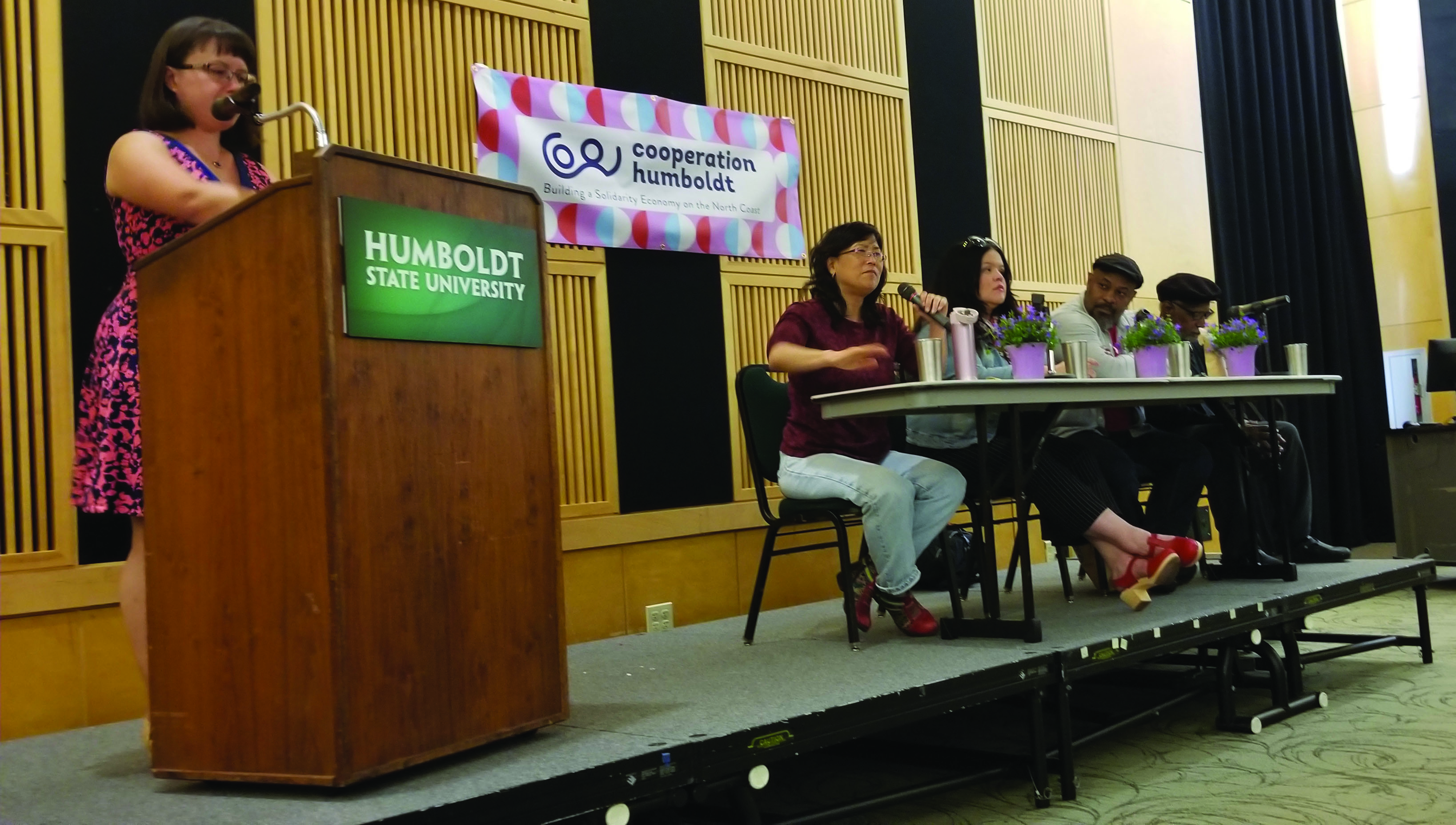
From left to right, Emily Kawano, Cutcha Risling Baldy, Kali Akuno, and Jarome Scott on stage at the night of Cooperation Humboldt. | Photo by Luis Lopez
The special guest speakers consisted of Emily Kawano of Solidarity Economy Network, Kali Akuno of Cooperation Jackson, Jarome Scott of the US Social Forum, and Cutcha Risling Baldy, professor of Native American Studies at HSU.
The group tackled many issues, from capitalism reform to giving back land that belongs to Native Americans.
Baldy criticized people like Jeff Bezos for his actions during the conference, while also criticizing his defenders.
[perfectpullquote align=”right” bordertop=”false” cite=”Oscar Mogollon” link=”” color=”” class=”” size=”16″]“We have this notion that the older generation doesn’t want to hear out the younger generation. The turnover of this group disproves that, there are older generations that don’t want to leave the world worse than they already left it.”[/perfectpullquote]
“The system is set up to say you must be good if you make a lot of money,” Baldy said. “They’re not that smart.”
Attendees of the conference were a mix of younger generation students, older faculty and community members. During the conference there were five minutes allocated to the attendees to discuss with what the guest speakers presented.
Oscar Mogollon, a psychology business major and communication minor, was grateful with the turnover of diverse age groups attending.
“We have this notion that the older generation doesn’t want to hear out the younger generation,” Mogollon said. “The turnover of this group disproves that, there are older generations that don’t want to leave the world worse than they already left it.”
Many of the attendees were passionate in speaking their mind on the topics discussed in the conference.
Baldy was happy with how the night turned out and had hope that those who attended learned something new and important.
“There’s a lot of overwhelming work that needs to be done,” Baldy said. “But if we work together, it would be a more fruitful effort.”
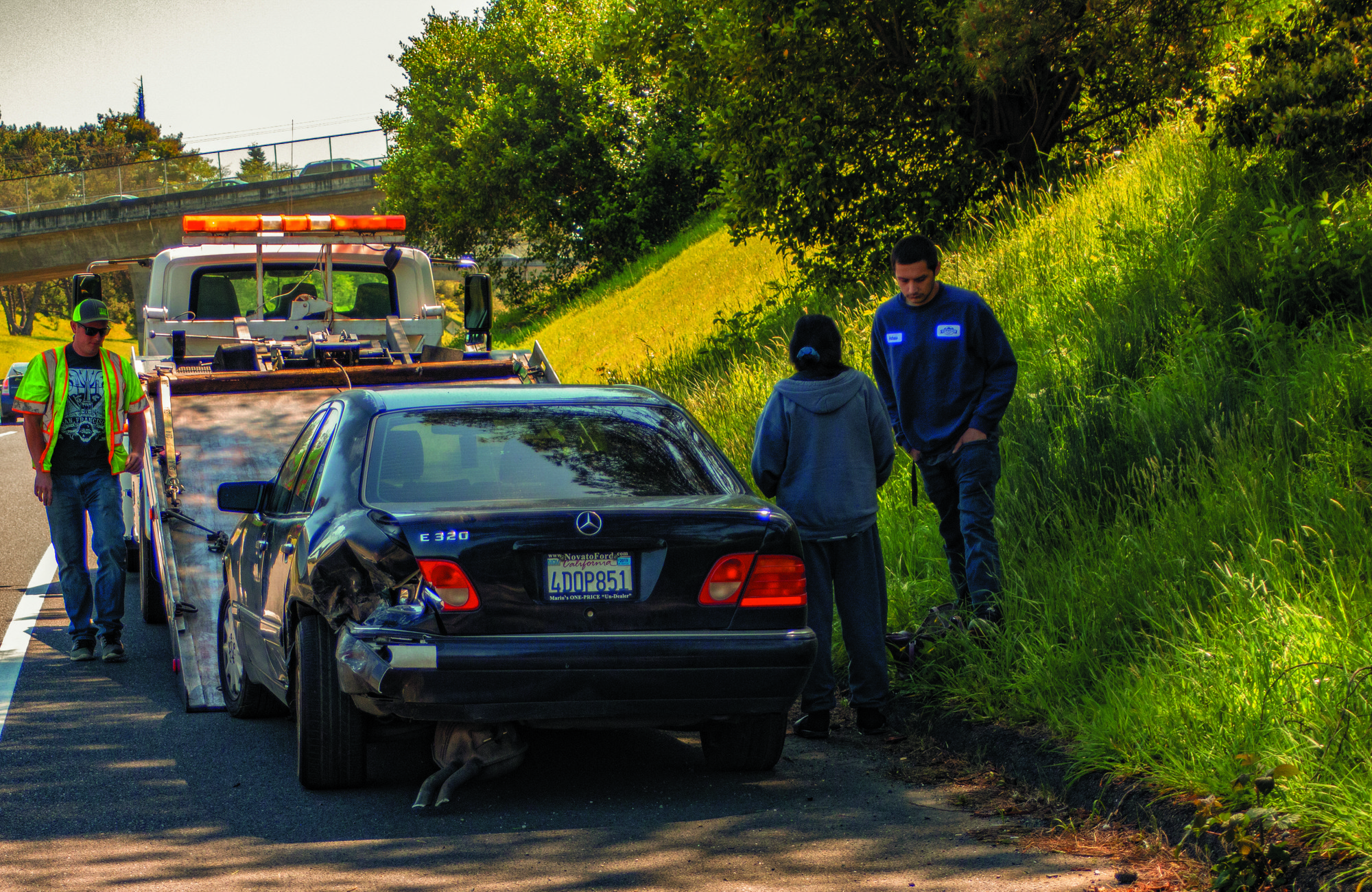
Driver Andrew Bartley, 23, got in a two car collision while driving on the 101 southbound on Apr. 30 around 2:10 PM. He was driving changing lanes with his mother Arliss Goodman when his car crashed into the front of the vehicle behind him. No one was seriously hurt in the accident.
Robert Hemsted, from J&M Towing, secures Bartley’s car after the crash on the 101 around 2:10 P.M. on Apr. 30 2019. | Photo by Nick Kemper.
At the time of the crash, there were inmates from the Humboldt County Correctional Facility doing landscaping. Inmate Shane Cornforth, 35, was weed whacking on the side of the 101 freeway and when the crash happened, he was about 6 feet away from being hit.
Inmate Shane Cornforth looks at the grey Nissan that almost took his life when it slid off road after crashing on Highway 101 on Apr. 30 2019. | Photo by Nick Kemper.
HSU Sociology Department invites Kali Akuno, Jerome Scott and Emily Kawano to post-capitalism conference
By: Nerissa Moran
Cooperation Humboldt has teamed up with the HSU Sociology Department to invite Kali Akuno, Executive Director of Cooperation Jackson, along with Jerome Scott of the US Social Forum, and Emily Kawano of the Solidarity Economy Network to sponsor the first-ever Post-Capitalism Conference in Humboldt: Building the Solidarity Economy.
What is a solidarity economy? It has been broadly defined as an economy based on cooperation rather than exploitation, and that prioritizes the welfare of people and planet over profits and blind growth.
Cooperation Humboldt is making food more accessible and our food system more local. They’re planting fruit trees and setting up little free pantries throughout the Eureka area. As part of the national Food Not Lawns effort, they’ve begun transforming front yards, growing food instead of grass.
Tamara McFarland is the co-founder of Cooperation Humboldt.
We believe that food is a fundamental human right, and our food projects aim to put that belief into practice in very tangible ways,” McFarland said.
Now the group is on track to set up several worker-owned cooperatives to further the goal of building a solidarity economy on California’s North Coast – the idea is to meet our needs in harmony with nature without exploiting anyone.
As they say in their mission statement, the group puts “people and planet over profit by prioritizing collaboration over competition and cooperation over domination.”
Cooperation Humboldt is modeled on the solidarity economy principles established by Cooperation Jackson, the pioneer in building community from the economic roots up to the political and cultural branches, and the epicenter of social and economic change in the U.S.
They are building a solidarity economy in Jackson, Mississippi, anchored by a network of cooperatives and worker-owned, democratically self-managed enterprises.
Jerome Scott of the U.S. Social Forum will be talking about the process of how we get from where we are today to a post-capitalist, solidarity economy. First, he explained that the technology has already set the basis for a new economy.
“The transition is mainly a technological revolution,” Scott said. “And that technology has set the stage for the end of capitalism. But only human beings can make the transition to socialism and within that process, race and gender play a role.”
Scott said his objective is to demystify the process. His description of the process of social change ties in directly with the building of worker cooperatives. While the technological revolution is upon us, we must use it to envision that another world is possible. Emily Kawano of the Solidarity Economy Network can explain what that world is beginning to look like inside the co-ops being built.
The conference will be held on campus April 26 and 27, with the opening plenary session taking place on Friday, April 26, at 7 pm in the Kate Buchanan Room.
This session will be followed on Saturday, April 27, by a wide array of workshops (in Siemans Hall at HSU). This will allow us to gain the specific knowledge that comes from the experience of several of the minds and organizers transforming today’s economy while protecting the environment nationwide.
The topics include ‘Solidarity Economy 101,’ ‘Introduction to Permaculture,’ ‘Democratizing Money: Public Banking,’ ‘Imagining a Post-Whiteness Society,’ ‘Humboldt County – Land of the Free,’ and many more. The full schedule will be posted on Cooperation Humboldt’s website.
“We’re so thrilled to be able to bring these experts together to share their wealth of wisdom and experience with those of us on the North Coast working to shift our economy away from exploitation and towards a more cooperative model,” McFarland said. “We know this conference will inspire those in attendance to broaden their conception of what alternative systems can be created.”
David Cobb is also a co-founder of Cooperation Humboldt.
“In addition to the conference, here in Humboldt we are incubating three worker-owned cooperatives, creating a local food forest and advancing public banking and participatory budgeting,” Cobb said.
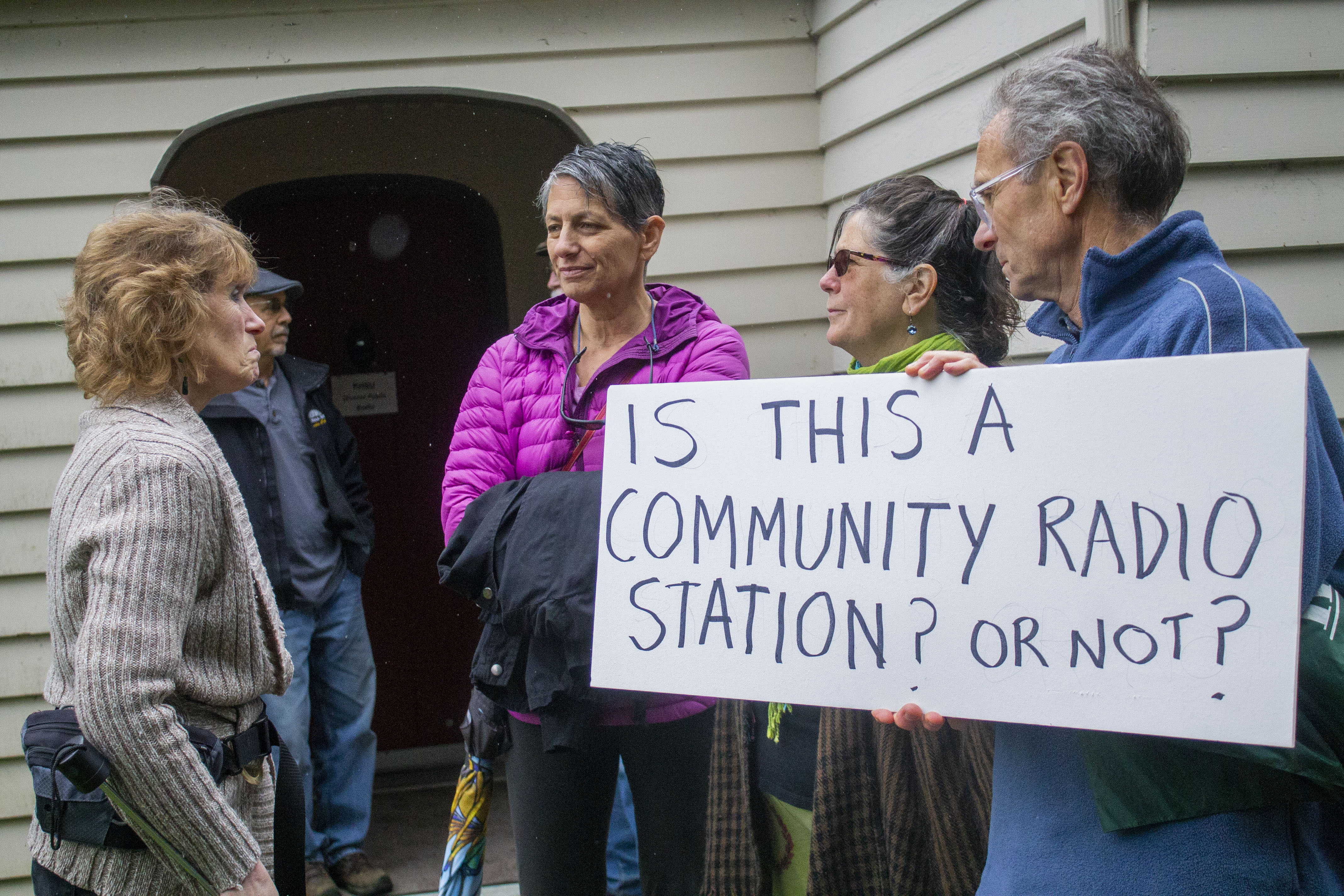
Megan Martin and Damian Jimenez are out a job, out a class and wondering if the past few weeks of their work at KHSU was all for nothing.
They are just two of the student interns that worked at the radio station before it was gutted on April 11 by the Rossbacher administration. Martin and Jimenez were working under the tutelage of staff and volunteers, some of whom had been working at the station for over 30 years.
But now, with just a few weeks left in the semester, the former interns are left wondering, “WTF am I going to do now?”
“I feel cheated out of these last couple of weeks,” Martin said. “I really felt that these last few weeks were going to be beneficial to my college career.”
Hmuboldt State University student and former KHSU employee Megan Martin hugs former station manager Lorna Bryant outside of the station on April 11, 2019. | Photo by Thomas Lal
Martin and Jimenez were enrolled in the “KHSU Experience” class this semester and had their learning experience cut short by the decision to gut the radio station. HSU President Lisa Rossbacher said that part of the decision for the drastic cuts to the radio station was to promote more student involvement at the station. However, the interns at the station were given “zero notice” about the station firings.
“I walked up to the school and saw cop cars at KHSU and that’s how I knew something weird was happening,” Martin said. “I was reading stories on the Mad River Union about how the student interns were out of luck. [Frank Whitlach] was giving interviews about us students, without ever reaching out to us.”
Trying to find someone in the administration to answer any questions about the lack of student notice has a been quite the ordeal. Frank Whitlach, associate vice president of marketing and communications, has been hard to reach and is currently on vacation.
Vice President of University Advancement, Craig Wruck, and one of the main persons in charge of the firings, has been out of his office since at least the day of the KHSU firings and “isn’t available for an interview.”
President Rossbacher commented on the KHSU firings on the day of the kerfuffle, but has not been available since then.
On the day of the firings, Whitlach sent an email to the student interns reassuring them that their “student assistant positions will continue as planned for the remainder of the semester.”
However, that “reassurance” seems to have fallen apart. As of now the future of the student interns is being discussed with the Journalism Department Chair Deidre Pike and Whitlach about what the steps moving forward will be.
One option is to pay the students out for the remainder of the semester and to figure out how they will be given course credit for their work so far.
“We were student assistants, getting paid,” Jimenez said. “I depended on that money.”
The Associated Students of HSU also played a role in the gutting of KHSU. In an email obtained by the Lumberjack, Student Representatives Maddie Halloran and Eden Lolley were co-authors of the Associated Students Draft Resolution No. 2018-19-08 “An Act of Formal Support for Increased Student Involvement in KHSU Radio Station.”
The email says that the goal of the resolution is to “encourage the KHSU station to increase student positions, student-produced content, student air time, and more.”
“Craig Wruck came to our board in the fall and said that funds from HSU students is going towards funding [KHSU] and that there isn’t a lot of students employed there,” Halloran said. “The KHSU gutting took us all by surprise.”
Danielle Orr who has volunteered at KHSU for 39 years talks with former paid intern Damien Jimenez outside of Feuerwerker House where the KHSU station has been based on the HSU campus on April 11, 2019. | Photo by Thomas Lal
Both Martin and Jimenez said that they were never spoken to about their roles at KHSU and that the whole situation lacked clear communication between those in charge and the ones now suffering from the fall out.
“The university keeps on having this top down management style that says ‘more students need to be involved in the station,’” Jimenez said. “But I don’t think they understand the value of the station to me as a student. No one ever asked me why it’s important. I could go there and get professional experience. If there is just a bunch of students there, what’s going to make it not just KRFH 2.0.”
Also missing from the AS resolution is recognition of the declining numbers of the KRFH news class. Amy Berkowitz, faculty advisor for KRFH news, said there has not been “enough bodies to support it” recently.
“I have been asked on several occasions about helping KHSU and we have said that is not necessary because we have KRFH,” Berkowitz said.
The future of the KHSU radio station is still in limbo. Currently there are zero employees or volunteers at the station and a broadcast out of Chico fills the airwaves. With the dismantling of the radio station, the football program, and the 3rd Street Art Gallery, one has to wonder what’s next?
Earth Week kicks off with a Trashion show and David Cobb as keynote speaker
A fashion show highlighting wardrobes made of trash, awards given for sustainability and a speech given by Cooperation Humboldt board member David Cobb kicked off Humboldt State’s Earth Week.
The “Earth Week Every Week” committee is a coalition of Associated Students programs and student clubs that organized the event to educate, create community and foster dialogue on issues of social and environmental justice, human and non-human rights and healthy lifestyles.
The “Trashion” show that started off the event was organized by Green Campus Team Lead Morgan Kipf.
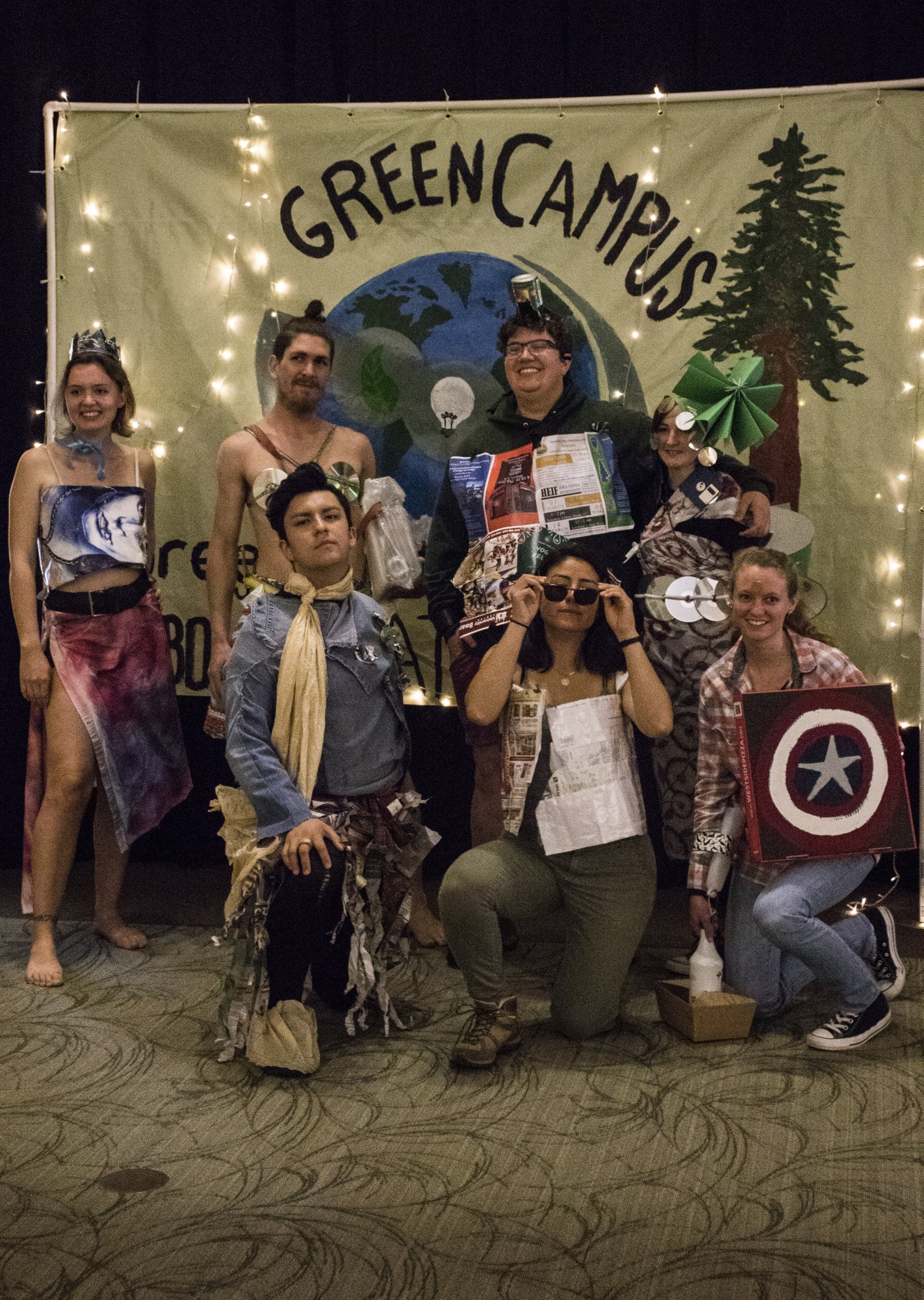
Trashion Show contestant on the stage striking a pose. | Photo by T.William Wallin
“Our main goal is to spread awareness of sustainability and encourage behavioral change on campus,” Kipf said. “We also want to help save energy and water on campus.”
The Trashion show is a fashion show competition that promotes fashion creativity, waste reduction and sustainability. There were students adorned in old sheets crocheted by their grandma, recycled posters and beer cans acting as crowns. Beads held together warped and scratched CDs worn as crop tops walked the runway of the stage as techno music blared in the background.
Kipf said the third annual Trashion show was by far the biggest it’s been and gives her hope to include community members in the future.
“This is something I’ve always been a lead in,” Kipf said. “It started off as fun and silly and hopefully it keeps on growing.”
Trashion Show contestant on the stage striking a pose with a crown made of beer cans. | Photo by T.William Wallin
It’s organizations like Green Campus that Associated Students Environmental Sustainability Officer Isabel Sanchez said helps to create Earth Week. Sanchez is the head of the Earth Week Every Week Committee and said their role in A.S. is to make sure Earth Week happens and there is a committee in charge of it.
“I helped create this event and 20 other ones,” Sanchez said. “It’s difficult but so many people in A.S. and other organizations help out. Students are there for the event and stand by me.”
David Cobb, board member of Cooperation Humboldt, was the keynote speaker during the first day of events for Earth Week on April 21. | Photo by T.WIlliam Wallin
Sanchez invited David Cobb as the keynote speaker because “he’s radical, and to build resilience you have to be radical.” Cobb is an attorney who ran for U.S. president under the Green Party, is a member of the North Coast People’s Alliance, co-founder of Move to Amend and member of Cooperation Humboldt. Sanchez participated in Cooperation Humboldt workshops in the past and met Cobb through them.
“He is an energetic community member,” Sanchez said. “The workshops are way interesting. They make you physically move and speak with one another in a nonverbal way and are very community oriented.”
Cobb’s energy never waned as he spoke to a cheering crowd of students and faculty on his reasons for an ecological and economical crisis. Cobb said the capitalist system in the U.S. is racist and sexist and needs to be deconstructed.
“If we’re serious about making Earth Day real we have to understand how we are living is destroying Mother Earth,” Cobb said. “We are in a crisis, an ecological crisis. It isn’t coming, it’s here and it’s getting worse.”
Miles Kinman, environmental studies junior, on the runway stage during Green Campus’ third annual Trashion Show. | Photo by T.WIlliam Wallin
Cobb went on to say the ecological crisis is fundamentally tied to the economic crisis. He said if capitalism is unlimited growth in a finite world then “capitalism is cancer” because cancer is the only thing in existence that has unlimited growth in our finite world. Cobb also said this is the first time he could say confidently we have enough resources to feed people and give health care, yet we aren’t doing that.
“It’s not one percent but .01 percent of psychopaths in charge of the system,” Cobb said. “The fundamental structures in which we are operating in needs to stop.”
When asked how HSU can contribute to the transition out of capitalism Cobb said by doing more of the good, like sustainability actions coming out of HSU dining services and less destroying, like the recent shut down of KHSU. Cobb then apologized to the students for the state of the world in which they inherited.
“It may not be your fault, but it’s your problem,” Cobb said.
Green Campus held their third annual Trashion show in the Kate Buchanan Room at HSU during Earth Week on April 21. | Photo by T.William Wallin
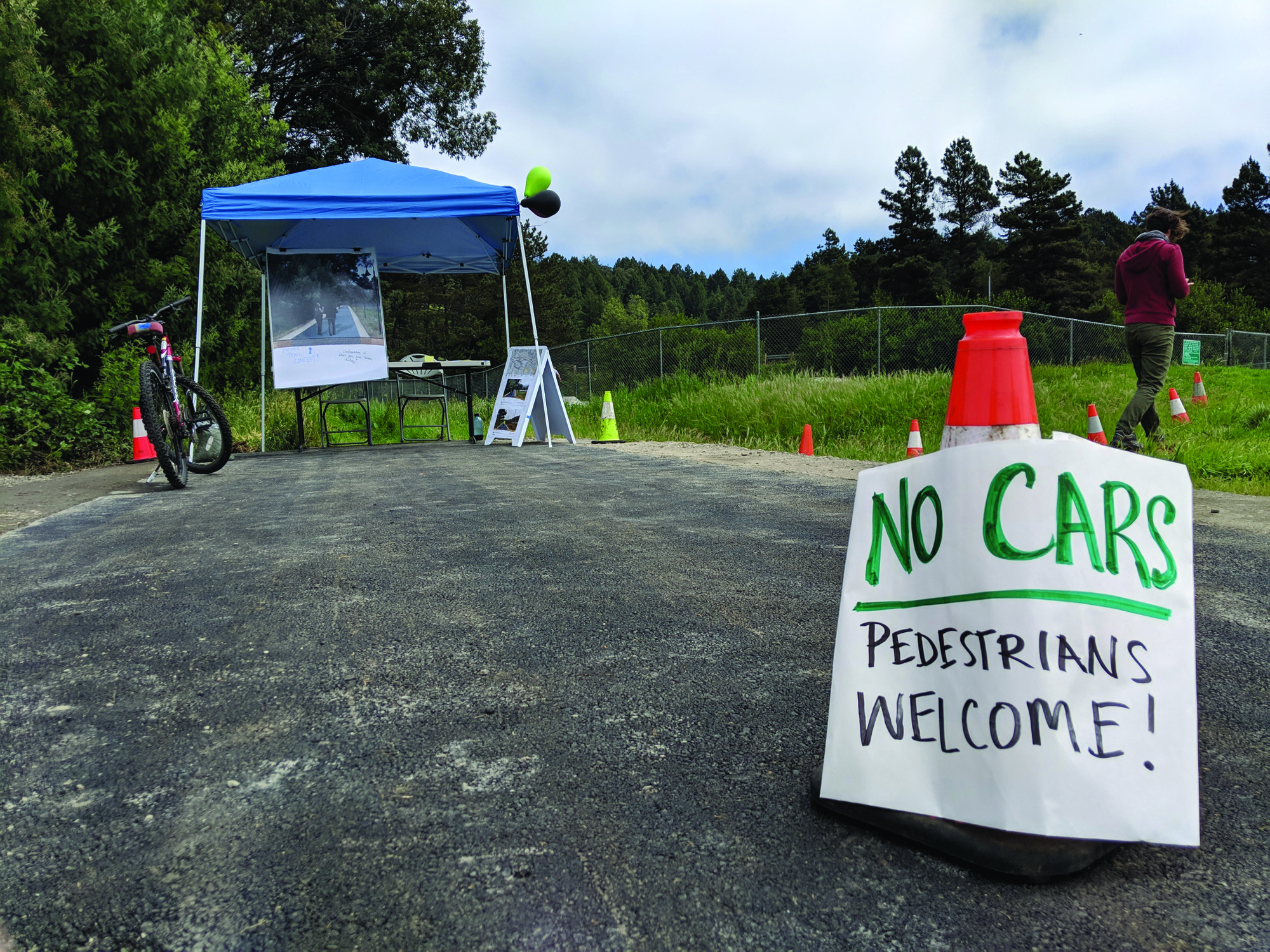
The proposed path will link with the Humboldt Bay Trail, and could eventually lead from Eureka to Blue Lake
Pedestrians, cyclists and commuters will soon have a safer time getting around as a variety of changes are coming to northern Arcata which were showcased in a pop-up demo in front of the Arcata Skatepark on Monday.
The main improvement is a proposed trail continuing the North Humboldt Bay Trail along defunct train tracks from the skate park across Highway 101 to the industrial park by Valley West.
This trail would link up with the proposed Annie & Mary trail and could eventually lead all the way from Eureka to Blue Lake.
The proposed trail would follow the train tracks, inside the red circle. | Photo by Jett Williams
Natalie Arroyo is the senior planner for the Redwood Community Action Agency (RCAA) and said they performed a walkability assessment in Valley West looking for pedestrian challenges in that area.
“West End road is a major challenge for people walking or biking with the truck traffic and the narrow nature of the road,” Arroyo said. “Valley West is cut off from most of the city, with 101 and 299 limiting pedestrian access.”
After the last trains ran in 1997 the steel rails were pulled up and scrapped. The remains of the tracks have turned into an unsanctioned trail, but it’s skinny and rough with limited lines of sight and zero handicapped accessibility. The proposed trail would be paved, leveled and accessible by wheelchair as well as cleared out for safe lines of sight.
Funding for this project came from a Caltrans grant and money from the “Friends of the Annie & Mary Trail” will be used for the portion built outside of city limits.
Arroyo said that they began applying for the project two or three years ago and they could see a trail being built within the next five years.
Delo Freitas lives near the proposed trail and liked the idea of having a safe way to get to the industrial park off of Valley West.
“I’m excited to see Arcata thinking clearly about making all the pieces of the city fit together,” Freitas said. “I’d encourage all students to go to city council meetings, as that’s where the decisions get made.”
RCAA Senior Planner Natalie Arroyo (green helmet) discusses the plans with Sarah West, as Delo Freitas studies the maps. | Photo by Jett Williams
Other plans including a bus stop in front of the skatepark, a roundabout at the Sunset and LK Wood intersection and a new bike lane layout would improve cyclist safety and were also showcased at the demo.
Emily Sinkhorn is the director of RCAA’s natural resources services division, and said the idea behind the demo was to collect community input on the multitude of proposed pedestrian safety improvements.
“We conducted a survey with over 400 responses. Many students in the area said they were excited for a bus stop and lights on the pedestrian walkways over the freeway,” Sinkhorn said. “We haven’t really heard much opposition for this trail.”
The final plan won’t be brought to the city until mid-summer, so there’s still time to make your opinion heard on these projects.
Contact RCAA on their website or go to the Trail Summit being held May 4 in the Kate Buchanan Room on campus to get involved.
Networking with local businesses is the next step to be hired
Many businesses fail because there aren’t high enough rates of customers coming in. Inertial Media helps businesses strive for the best and helps fix problems to help them grow.
This company helps businesses advertise within Humboldt County to get wider coverage. One local business they have helped is Northtown Coffee, who they made promotional videos for to bring in more customers.
Other businesses they have helped are AA Bar & Grill, Dulce Bistro, Big Blue Cafe, Surfside, Burger Shack, Lost Coast Roast, Esmeralda’s and many more.
Tex Keith, the CEO and head growth coach of Inertial Media was one of the top 10 entrepreneurs in 2018. He has a book coming out next month and was a spokesperson on the subject of failure on a TED TALKS special. Keith and his partner Antony Schreurs are very close to their clients.
“We rolled burritos at 2 a.m. for Esmeralda’s Mexican Food,” Keith said. “The guys said we have someone who didn’t show up so we went over and rolled 500 burritos.”
Not only did they generously help out Esmeralda’s but they have done far and beyond more for other businesses they have worked with.
“We once drove 17 hours for one of our clients for a tin pot because they had a bakery and this tin pot they needed wouldn’t have the dough stick to the pot,” Keith said. “Getting this pot for our client shaved off three hours of their time that they used scraping off dough from the bottom of the old pot.”
From left to right, Antony Schreurs and Tex Keith discussing important matters. | Photo courtesy De’Aundray Gooden
Inertial Media is a national company that is trying to expand to other countries. Keith was featured in Entrepreneur Magazine because he created the first brokerage in consulting.
Schreurs teaches and develops new brokers to find new clients and helps with the developments of ads. Schreurs is currently a student at HSU and used to work for a company called Deutch, who advertised for VolksWagen, where he helped in account managing.
“Me and Tex weren’t that close, we just talked in class here and there but at the time I needed a job and I heard Tex had his own company,” Schreurs said. “I just asked if he had a spot open for me and now we are partners in this company, really it’s all about networking.”
Many people who leave college don’t usually find jobs as easily as most. Schreurs said do not rely on a degree to get a job in 2019.
Antony Schreurs on left and Tex Keith on right. | Photo courtesy De’Aundray Gooden
“You are going to need a resume that needs to be impressive,” Schreurs said. “So you have to look at it that way, now without a degree, how good is your resume and if it isn’t that good then you will have to step it up.”
Dania Rodriguez, is a second year HSU student majoring in business. Rodriguez said that HSU alumni are the underdogs when it comes to business.
“Humboldt State is known for its environmentally friendly, sustainable and ethical standards when it comes to fresh new business ideas,” Rodriguez said. “Growing up in Humboldt County I’ve only ever known the community I’ve been supported by. Even if I don’t come up with a business idea and start my own company/business I know I will have the locals support to find a job after college.”
Rodriguez does plan on branching out to find some networks that will help her succeed for the future.
“I’ve attended several mixers on campus for business students interested in local jobs after college within the county, and already started making those social networks,” Rodriguez said.
Students and community members gather to remember Josiah Lawson
David Josiah Lawson was a son, student and athlete that loved football and skateboarding. His favorite snacks were Oreos, which pair well with his favorite ice cream cookies n’ cream, and he hated math. Josiah Lawson, or as his mother Charmaine calls him, DJ, was murdered on April 15, 2017.
It is a crime that is still unsolved and one that has brought some in the Humboldt community together to demand justice for him and his mother.
Dave Carter who has been going to vigils since the beginning lights candles on the Arcata Plaza in memory of David Josiah Lawson on the two year anniversary of his death on April 15. | Photo by Thomas Lal
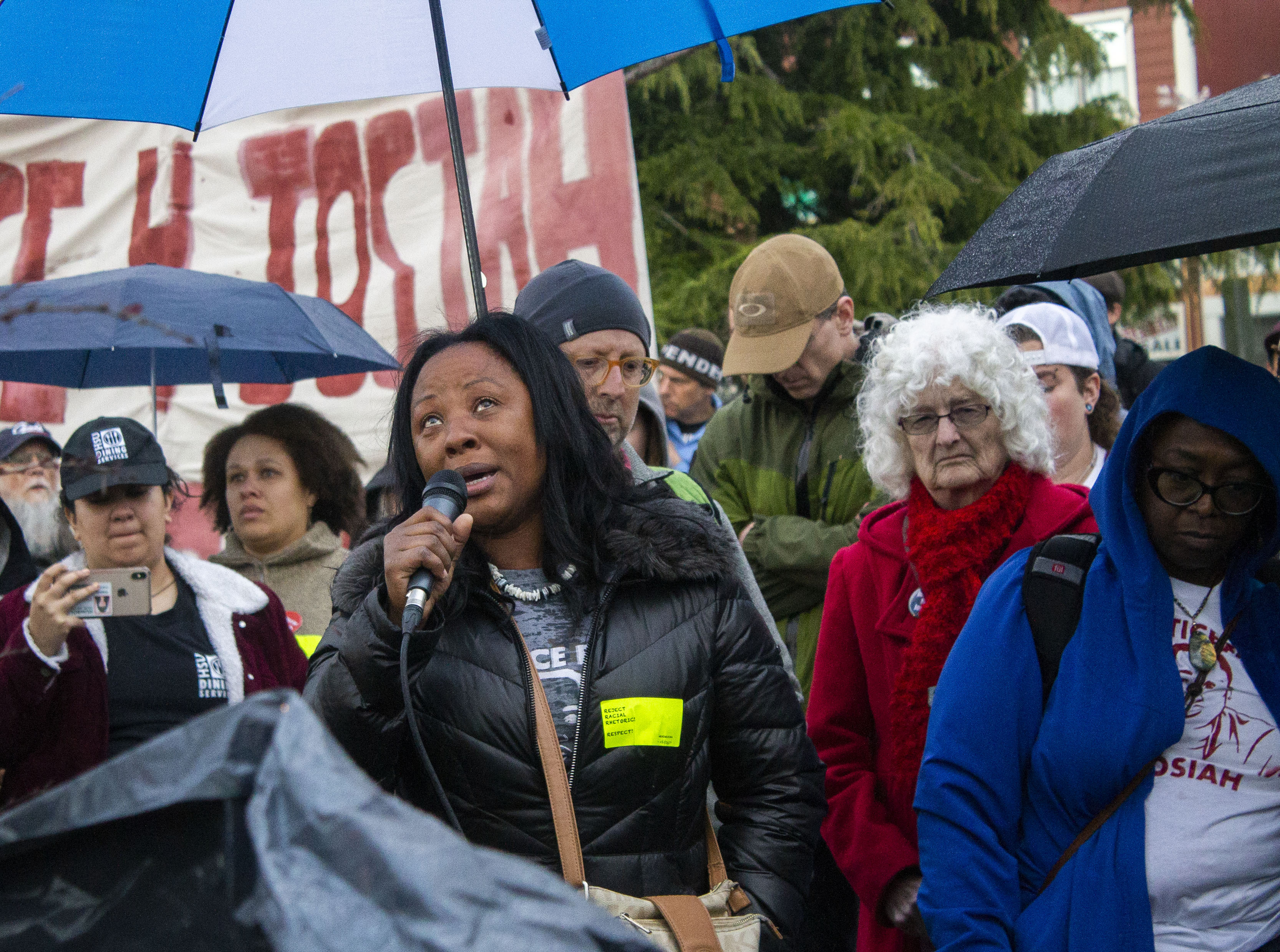
On April 15, a group of about 40 people, mostly students and members of Justice 4 Josiah (J4J), gathered at the Great Hall on HSU’s campus to commemorate the life of Josiah. Groups sat around the room chatting, laughing and sharing memories of Josiah.
Charmaine Lawson and Tay Triggs called out trivia questions about Josiah’s life. His favorite Disney movie was the Lion King, his first job was at Dollar Tree, he taught himself to play the guitar, he lived for a year abroad in Germany and absolutely loved skateboarding. There was also a raffle and the main prize was a skateboard.
“Whoever wins the board, please cherish it,” Charmaine Lawson said. “My son loved to ride.”
Charmaine Lawson holds a single rose that was given to her on the Arcata Plaza on the two year anniversary of her son’s death on April 15. | Photo by Thomas Lal
After the raffle and dancing, the students and members of J4J took to the streets and began their march to the Arcata Plaza. Two large banners were carried by students, one of which needed three people to carry it and was about 12 feet wide by 8 feet tall.
The message was painted in red, Josiah’s favorite color, and said “JUSTICE 4 JOSIAH, 2 YRS NO JUSTICE.” The other banner called for the recall of District Attorney Maggie Fleming.
“To hear her say that there is not enough evidence [to prosecute] is a load of crap,” Charmaine Lawson said about the March 13 grand jury decision not to bring charges. “[The prosecutor] presented a self-defense case and that is a load of crap. The evidence is there, but they chose to present it in a way that demanded self-defense.”
Charmaine Lawson has been fighting for justice for her son since he was murdered and led the J4J members to the Arcata Plaza. Chants of “justice for Josiah” rang out across the town and echoed off the buildings. The J4J marchers met in the Arcata Plaza with flowers, candles and about 100 people attended.
Centro del Pueblo organizer Renee Saucedo speaks from the center of the Arcata Plaza to start off the demonstration on the two year anniversary of David Josiah Lawson’s death on April 15. | Photo by Thomas Lal
Renee Saucedo, volunteer organizer with Centro del Pueblo, was the first to speak and stood on the raised flower bed in the center of the plaza where a statue of former president William McKinley once was.
“This is the people’s platform now,” Saucedo said to the crowd. “We will not stop fighting until we receive justice. This County is not capable of handling a fair and just trial.”
Colleen Robinson lives in Arcata and brought her daughter Alana to the vigil. Robinson said that it is important for her daughter to be there and that the entire Humboldt community should be more involved in demanding justice for families of murder victims.
“I think it is unbelievable that is has been two years and no one has been held accountable,” Robinson said. “It seems like none of these murderers are getting very much time.”
Suporters link arms at the request of pastor Bethany Cseh who is a long time supporter of Charmaine Lawson on the two year anniversary of David Josiah Lawson’s death on April 15. | Photo by Thomas Lal
A light mist blew in as the vigil neared its end. Two singers sang the Bob Marley classic “One Love” to soothe the ears of those gathered. The crowd started to disband shortly after the song finished.
In the distance, Arcata Police Chief Brian Ahearn stood and looked on during the event. Ahearn has attended many of the vigils and has vowed to continue to fight for justice, but he needs more witnesses to come forward.
As the mist turned to a light rain, Charmaine Lawson led a group of J4J members over to Ahearn to ask him about the outcome of the grand jury decision.
Charmaine Lawson asked Ahearn about a witness she said was used to assassinate the character of Josiah. Ahearn said he did not know who the witnesses were that came to testify and stood by the actions of the District Attorney’s office.
Charmaine Lawson and her supporters confront Arcata police chief Brian Ahearn following a demonstration on the two year anniversary of her son David Josiah Lawson’s death on the Arcata Plaza on April 15. | Photo by Thomas Lal
“You are the chief of police…how did you not know this?” Charmaine Lawson asked. “Now that you do know this are you going to have this conversation with [DA Fleming]? Do you see why the Department of Justice needs to take this case over? Do you see that there is no way that my son will get a fair trial here if we have a DA like that?”
Ahearn responded that his goal is to provide more information to the District Attorney’s office.
“That is not good enough,” Charmaine Lawson said. “That is not good enough. Two years today. It has been two years.”
Humboldt State senate condemns actions taken against community radio
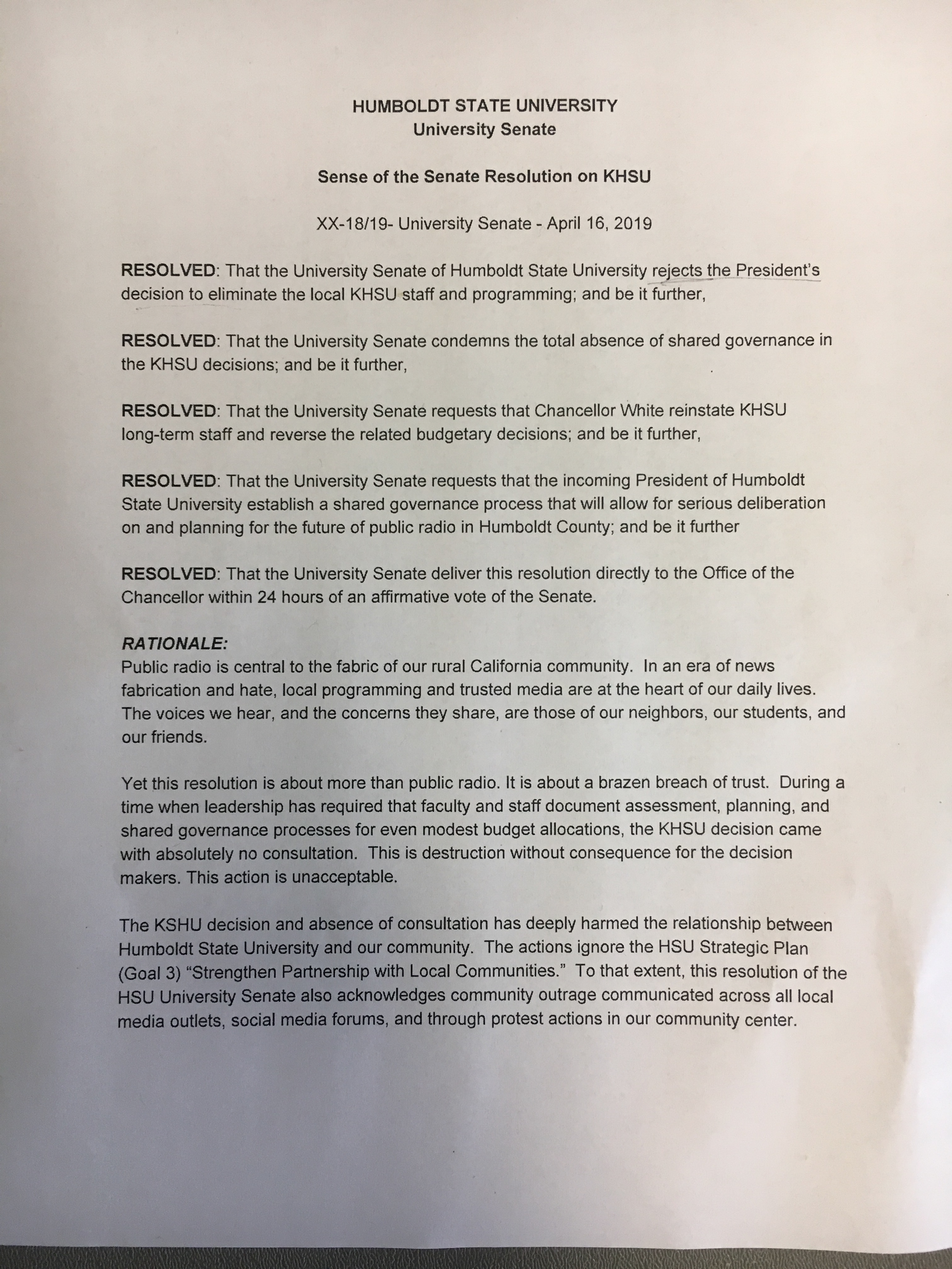
Humboldt State University Senate voted to pass a resolution condemning the actions of the Rossbacher administration to gut KHSU. The resolution passed with 75% in favor of, 7% opposed, and 18% of the senators abstaining.
Two amendments will be added that address preventing the sale of the items and library of KHSU and for the archived work to be returned to the creators. Missing from the Senate meeting were HSU President Lisa Rossbacher and Craig Wruck, Vice President of University Advancement.
The last remaining KSHU staff members resign, join a peaceful gathering of a few dozen held during weekly farmers market
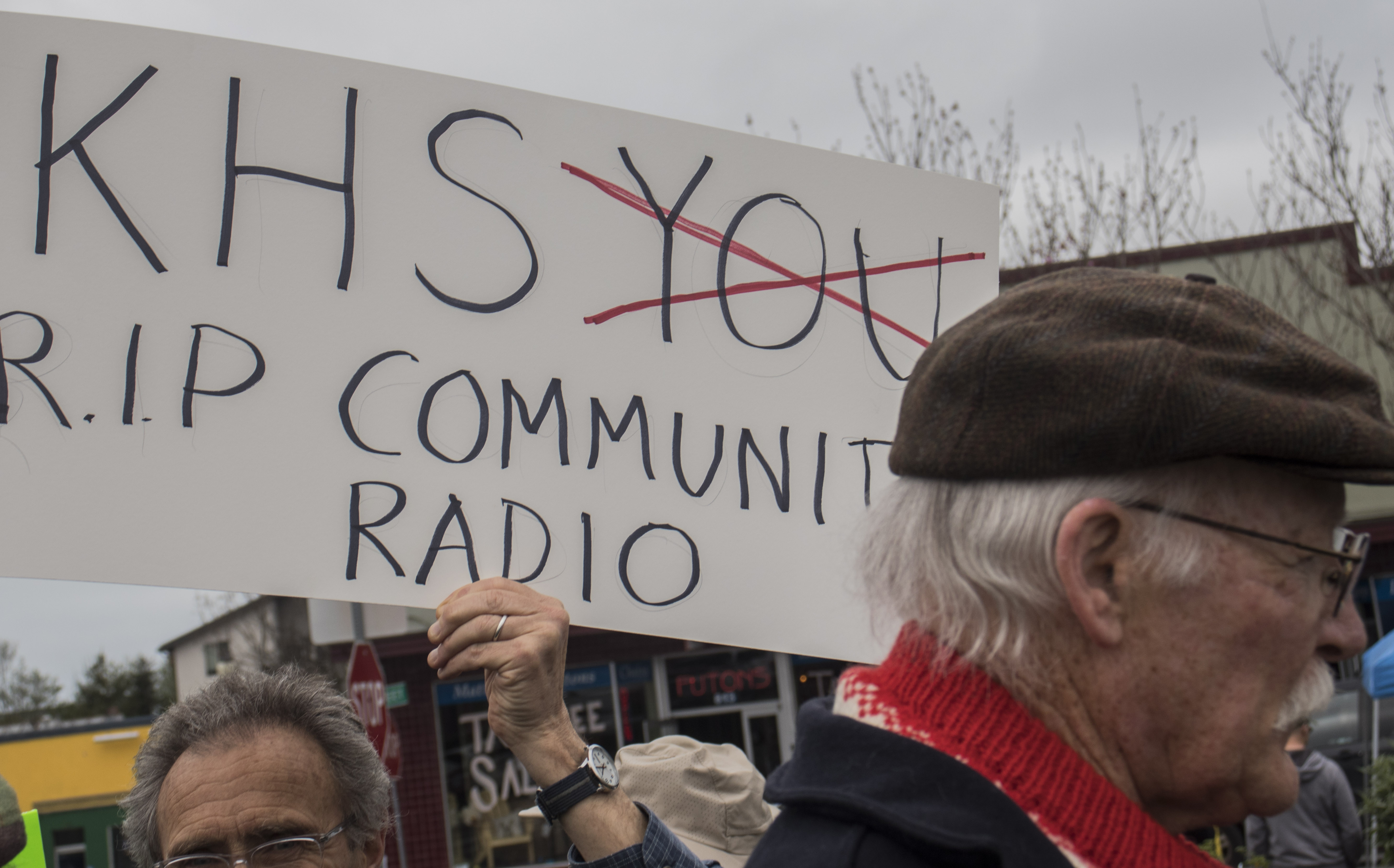
Forty-eight hours after the artery of the community was severed, a few dozen KHSU supporters took to the plaza in protest during the weekly farmers market.
Natalya Estrada resigned her position this afternoon as the last remaining paid staff member of KHSU. Estrada’s resignation came after administrators at Humboldt State University decided to fire all volunteers and terminate all but two paid positions at KHSU on April 11. David Reed was the second of the two remaining employees but resigned on Friday, April 12.
Estrada was at the protest to show support and said staying in the position would not only compromise her career in journalism but affect her overall health.
“There comes a time in life when you need to make a decision in life and I made that decision,” Estrada said. “I knew what I was going to do but I needed to know how and when.”
Local artist Lisa Enge holds a sign in support for KHSU during a peaceful protest at the weekly Arcata plaza farmer’s market on Saturday April 13. | Photo by T.William Wallin
After Reed resigned Estrada was the last staff member running the station. Estrada said when the California Report came on she put on Caroline King and cried at her desk.
“It was very lonely being the last person left,” Estrada said. “It felt like 48 hours on the 405 during rush hour traffic.”
Tom Cairns was one of the volunteers to be let go during the dismantling of KHSU, but he isn’t just any volunteer. Cairns has been with KHSU for 47 years, making him the longest running volunteer at the station.
Community member, Carrie Slack, and former host of Jazz with a Groove, Rob Enge, hold signs in support for KHSU during a peaceful protest at the weekly Arcata plaza farmer’s market on Saturday April 13. | Photo by T.William Wallin
Cairns was at the protest because he felt the way everyone was fired was wicked and shameful. Cairns felt the audit report done on KHSU was just an excuse for firing everybody and HSU administrators were planning this even before then.
“The way they handled it was bold face lies,” Cairns said. “They had checks written out already even before the meeting. They had it all planned.”
In the 47 years as a volunteer Cairns has seen KHSU have its ups and downs but “it’s always continued and was never shut off the air.” Cairns said the unfortunate thing about the station now is it has become a typical NPR station with all news and very little music.
“Basically it’s just another McDonald’s public radio station,” Cairns said.
Public citizens, Mark Mueller and Lisa Hockaday, hold signs in support for KHSU during a peaceful protest at the weekly Arcata plaza farmer’s market on Saturday April 13. | Photo by T.William Wallin
When asked what he felt the biggest loss was Cairns said the community of the station. Cairns said those that work with KHSU are very active in the larger northwest community and engaged in the arts, food, and news.
“The music, public affairs, and local programming is what made KHSU unique and a viable source for the community,” Cairns said.
A few dozen protesters gathered with signs during the Saturday farmer’s market at Arcata Plaza to show support for KHSU on April 13. | Photo by T.William Wallin
Rob Enge, former host of Jazz with a Groove, was a member and sustainer with KHSU for 25 years and agreed with Cairns. Enge said this has been a loss of a community forum where connection was made.
“This was a good place for people to put their energy,” Enge said.
Enge moved to Humboldt in 1992 and the first thing he did was get connected with the local radio station. Enge was an avid listener of KPFK in southern California and said public radio stations are an important way in getting connected with community.
“This has been an erosion of community,” Enge said. “This isn’t social media from out of the community, this is real people talking locally and when we lose that its a shame.”
Community members show support for KHSU during a peaceful protest at the weekly Arcata plaza farmer’s market on Saturday April 13. | Photo by T.William Wallin
Local artist Lisa Enge has also been a supporter of KHSU since 1992 and felt the loss of KHSU was like losing a friend. She said KHSU was a treasure in the community and it was a cruel way that it was cut.
“Cutting volunteer and staff is unconscionable, shameful really,” Lisa Enge said.
Jax Stuber (left) has been listening to KHSU everyday for the last six years and said she will miss all the music and diverse programming. | Photo by T.William Wallin
Lisa Enge said once general manager Peter Fretwell fired KHSU program director, Katie Whiteside, the love for KHSU waned. She said as an artist the radio kept her company while she worked and she didn’t feel so lonely.
“The people, DJs, and programmers became friends,” Lisa Enge said. “It’s like losing a friend, or a family member really.”
Abrupt firings at KHSU send shockwaves, not sound waves, throughout the community
In a blow to the local community, administrators at Humboldt State decided to fire all volunteers and terminate all but two paid positions at the local NPR affiliate, KHSU, on April 11. The firings, and other reorganizations, came after months of tense back and forths with the administration and the KHSU Community Advisory Board. Some in the community felt that the hostile tensions were behind and that future broadcasting was no longer in jeopardy.
“This is fraud. KHSU is community radio. You just don’t knock the community out like that.”
Joyce Houston
Last week Joyce Houston volunteered during the KHSU fund drive and donated money to the future of the station. Houston said she has volunteered and donated money to the station for the last 30 years and felt that she was scammed given the administration’s decision for the firings.
“This is fraud,” Houston said. “KHSU is community radio. You just don’t knock the community out like that.”
According to a press release from HSU, changes to station include the elimination of five staff positions, the General Manager and Chief Engineer positions and an “indefinite suspension of volunteer-run programs.”
The press release mentions the administration will look into allowing students to take on a more active role at KHSU, however there is already a student-run radio program at HSU. Amy Berkowitz, KRFH radio news faculty advisor, said she has been contacted numerous times by the administration asking for students to be more involved at KHSU but said that was not necessary because of the student run station.
“KRFH is for students, by students,” Berkowitz said. “KHSU is for the community. Our area relies on the radio for emergencies. Having this gone is a loss to the safety of our community.”
Berkowitz said that the loss of the community programs is why it is such a blow. Some of the programs that were broadcast on KHSU had been on air for over 30 years, according to Berkowitz.
“Right now, they are just rebroadcasting out of Chico,” Berkowitz said. “We can all just ask our smartphones to play NPR, but that is not why we listen to KHSU.”
Some of the programs currently cut from the air are the KHSU magazine, The Race Beat hosted by Lorna Bryant, the Thursday Night Talk with Eric Kirk, and Immigrant Voices hosted by James Floss.
Lisa Rossbacher, president of Humboldt State University, said the reasoning for the abrupt firings was because of budget reasons, a realignment of the mission between KHSU and the university, and an advisory review from the CSU chancellor’s office that she received on “Monday or Tuesday of this week.”
“People think of volunteers of not costing anything, but in fact it takes two to three hours of paid staff time to support every hour of programming that is generated by volunteers,” Rossbacher said.
When questioned on how much oversight and time that paid staff have to give to volunteers who have been part of KHSU for over 30 years, Rossbacher acknowledged she didn’t know the exact details of the matter.
“I can’t speak to the details of how that programming gets produced, but it requires staff involvement to support them,” Rossbacher said.
On the future of KHSU, Rossbacher said the university is looking for partners to collaborate with and could not speak of the details of what that collaboration would look like or who it would involve.
[perfectpullquote align=”right” bordertop=”false” cite=”Cliff Berkowitz” link=”” color=”” class=”” size=”17″]“I understand budget concerns, but one of the main jobs of being president is trying to strike a balance. Cutting a vital part of the community is foolish.”[/perfectpullquote]
“We still want to have local programming,” Rossbacher said. “We still have to cover it within our budget and so I can’t tell you right now exactly what that looks like. If any of the volunteers ask to be able to take any of the programs that they have already produced with them, we are absolutely cool with that. Some of what has appeared in the past may show up again through other media, but I don’t know exactly what the future is going to hold.”
During Rossbacher’s five-year term at HSU she has oversaw the closing of the HSU Third Street Art Gallery, the cutting of the football program, and now the massive firing and change of direction at KHSU—all integral components of the Humboldt community. When asked about the reasoning on why she made these decisions Rossbacher said it had to deal with shortfalls in money.
“My goal is to get to a balanced budget,” Rossbacher said. “There have been some difficult choices in the process of getting there. Over the last two years the university overall has managed to reduce spending by about $9 million, with another million dollars we need to find in the next year.”
Cliff Berkowitz, husband of Amy Berkowitz and fellow KRFH faculty member, felt that the abrupt firings were a betrayal of the community and noted that KHSU has been an integral part of the Humboldt community for over 50 years.
“I understand budget concerns, but one of the main jobs of being president is trying to strike a balance,” Cliff Berkowitz said. “Cutting a vital part of the community is foolish.”
Cliff Berkowitz has been teaching at HSU for 11 years and said that the announcement of the KHSU firings was a “gut punch.”
“The most telling example of how sinister this is, is evident in the letting go of the volunteers,” Cliff Berkowitz said. “Their shows and their connection to the community are the reason why the underwriters have contributed. And it is gone.”
KHSU, 90.5 FM, has been abruptly shut down this morning with little to no notice given to the employees and volunteers. Currently University Police are inside the station and only granting access to individuals with the explicit approval of Craig Wruck, Vice President for University Advancement and Executive Director of the HSU Advancement Foundation. Ryan Lee, a station volunteer and radio host since 1990, was standing in the rain outside of the station confused and upset about the abrupt closure.
Michael Fennell, who volunteered for KHSU, carries out a basket of CD’s from Feuerwerker House where the station has been on Humboldt State campus on April 11. | Photo by Thomas Lal
“The station is shut down, everybody is fired, all the volunteers have been let go,” Lee said. “All accounts for current staff have been locked. We have been denied access to Wagner House without an escort. We have no plans for programming. There may be nothing.”
Lee said that he came to the station this morning at 8 a.m. and his keycard worked at the time but when he tried hours nothing happened.
“Jeff Demark noted that [KHSU] just had a pledge drive and that everybody that pledged their money should be refunded,” Lee said. “Maybe because it was gotten under false pretenses. We all knew that there was something coming down the pipe, but nobody knew it was going to be like this.”
David Montoya, Associate Vice President of Human Resources, answered the door at the KHSU headquarters but declined to comment on the situation.
The press release reads as follows:
Humboldt State University is reorganizing and streamlining operations at its public radio station, KHSU, with the goal of preserving quality programming for the North Coast. The changes are intended to address operational challenges at KHSU, prevent further negative impact to the University’s budget, and better align HSU’s financial support with its mission and with opportunities for students. Station employees were told of the changes earlier today. Because the reorganization and budget reductions include the elimination of positions, a number of individuals will no longer be employed at HSU. The University is working to provide clear information to them, and to ensure they receive any benefits they are entitled to. The steps taken today include: Elimination of HSU’s direct payroll support, including the General Manager position and Chief Engineer position, saving the University more than $250,000 annually. Elimination of five other staff positions, generating significant savings in the portion of KHSU’s budget that comes from government support, underwriting, and listener contributions. Appointment of an Interim Station Director, to be supported through non-HSU funding. Consolidating all KHSU operations in Feuerwerker House, reducing the inefficiency of having two separate spaces. Indefinite suspension of volunteer-run programs. The University will evaluate how students can return to a more substantial on-air role at KHSU. Actively pursuing collaboration with other public radio stations and seeking CPB funding to support this effort. The decision to realign the station reflects a comprehensive assessment. Factors included the station’s increasing cost to the University; KHSU’s limited capacity for additional fundraising and underwriting; challenges identified by the CSU Office of Audit and Advisory Services; feedback from listeners and volunteers; the University’s commitment to public service; and the appropriate role of student involvement in station operations and programming. The report from the CSU Office of Audit and Advisory Services (pdf), which was recently received by HSU, includes an in-depth program review of the station that identified a number of issues with operations and administration. It was initiated at the request of HSU President Lisa Rossbacher, and she shared it yesterday with KHSU’s Community Advisory Board. In addition to issues identified in the report, there are serious budget issues at the station. KHSU is heavily subsidized by the HSU general fund, and the station’s budget deficits have continued to worsen. At the end of the 2017-18 year, HSU had to cover a budget deficit of nearly $135,000 beyond its regular subsidy, and this year’s projected budget deficit is even larger. KHSU’s budget challenge largely reflects increases in payroll costs. In addition, community support has been flat or declining, with underwriting revenue down approximately 14 percent for the year and listener support down approximately 17 percent. And while volunteers create a great deal of local programming, their efforts also come at a cost, requiring significant support by paid staff. The budget challenges at KHSU come as HSU has been working to address an overall structural deficit as well as funding declines related to an enrollment drop. The University has reduced its spending by $9 million over the last two years, and is making nearly $1 million in additional reductions for the coming year. For context, over the last year HSU has funded nearly half the cost of KHSU. Listener support provided about 22 percent, corporate underwriting 17 percent, and government grants 12 percent. HSU directly paid more than $265,000 in salary, covered at least $250,000 for space and utilities, and spent at least $80,000 receiving and processing contributions to the station. Even with the changes at KHSU, listeners will continue to have access to high-quality national programming and news. The most recent audience data reaffirm this is, by far, the station’s most popular programming.
Earlier this morning, Humboldt State issued a press release regarding their NPR affiliate KHSU. The radio station will be undergoing drastic changes including the removal of all but two staff members.
Now former volunteers and station supporters meet outside of Feuerwerker House after hearing about the elimination of jobs and volunteer positions at KHSU on April 11. | Photo by Thomas Lal
HSU press release is as follows:
Humboldt State University is reorganizing and streamlining operations at its public radio station, KHSU, with the goal of preserving quality programming for the North Coast.
The changes are intended to address operational challenges at KHSU, prevent further negative impact to the University’s budget, and better align HSU’s financial support with its mission and with opportunities for students.
Station employees were told of the changes earlier today. Because the reorganization and budget reductions include the elimination of positions, a number of individuals will no longer be employed at HSU. The University is working to provide clear information to them, and to ensure they receive any benefits they are entitled to.
The steps taken today include:
Elimination of HSU’s direct payroll support, including the General Manager position and Chief Engineer position, saving the University more than $250,000 annually.
Elimination of five other staff positions, generating significant savings in the portion of KHSU’s budget that comes from government support, underwriting, and listener contributions.
Appointment of an Interim Station Director, to be supported through non-HSU funding.
Consolidating all KHSU operations in Feuerwerker House, reducing the inefficiency of having two separate spaces.
Indefinite suspension of volunteer-run programs. The University will evaluate how students can return to a more substantial on-air role at KHSU.
Actively pursuing collaboration with other public radio stations and seeking CPB funding to support this effort.
The decision to realign the station reflects a comprehensive assessment. Factors included the station’s increasing cost to the University; KHSU’s limited capacity for additional fundraising and underwriting; challenges identified by the CSU Office of Audit and Advisory Services; feedback from listeners and volunteers; the University’s commitment to public service; and the appropriate role of student involvement in station operations and programming.
The report from the CSU Office of Audit and Advisory Services (pdf), which was recently received by HSU, includes an in-depth program review of the station that identified a number of issues with operations and administration. It was initiated at the request of HSU President Lisa Rossbacher, and she shared it yesterday with KHSU’s Community Advisory Board.
In addition to issues identified in the report, there are serious budget issues at the station. KHSU is heavily subsidized by the HSU general fund, and the station’s budget deficits have continued to worsen. At the end of the 2017-18 year, HSU had to cover a budget deficit of nearly $135,000 beyond its regular subsidy, and this year’s projected budget deficit is even larger.
KHSU’s budget challenge largely reflects increases in payroll costs. In addition, community support has been flat or declining, with underwriting revenue down approximately 14 percent for the year and listener support down approximately 17 percent. And while volunteers create a great deal of local programming, their efforts also come at a cost, requiring significant support by paid staff.
The budget challenges at KHSU come as HSU has been working to address an overall structural deficit as well as funding declines related to an enrollment drop. The University has reduced its spending by $9 million over the last two years, and is making nearly $1 million in additional reductions for the coming year.
For context, over the last year HSU has funded nearly half the cost of KHSU. Listener support provided about 22 percent, corporate underwriting 17 percent, and government grants 12 percent. HSU directly paid more than $265,000 in salary, covered at least $250,000 for space and utilities, and spent at least $80,000 receiving and processing contributions to the station.
Even with the changes at KHSU, listeners will continue to have access to high-quality national programming and news. The most recent audience data reaffirm this is, by far, the station’s most popular programming.
Member of the criminal grand jury assembled David Josiah Lawson case says ‘we have failed’
A criminal grand juror broke silence on their experience during the proceedings that lead to a non-indictment decision in the fatal stabbing of David Josiah Lawson.
Aired live on local television, North Coast News reporter Nazy Javid sat down with the anonymous juror that said the process was a “gross failure” and injustice was done. The juror’s voice was altered and body completely hidden.
“In the instructions that the deputy district attorney gave us, we could not choose to indict if we decided that it was self-defense,” the juror said.
The anonymous juror said all but one of the 18 jurors were white and 15 of the 18 voted Kyle Zoellner committed the stabbing of David Josiah Lawson.
The juror felt the deliberation process was unstructured and a lot of the jurors thought they had to prove a charge but, “we were not tasked with proving guilt or innocence, only probable cause.” During a trial vote several voted for manslaughter and “four or five voted for murder,” the juror said.
“Because someone that we, that the jury all agreed committed the stabbing, is free to walk in our community,” the juror said when asked why they felt an injustice was done.
Jury selection started February 28 and the proceedings ended March 13. The juror said deliberation lasted about six hours, which wasn’t long enough. One juror in particular, the foreperson pro-tem, insisted that the stabbing was of self-defense and was the one who signed the documents for “no-indictment.”
When asked if there was DNA evidence on the knife, the juror said experts worded it backwards saying “there was one in so many quintillion or septillion chance that the DNA was from someone other than Mr. Zoellner.”
“We have failed,” the juror said.
When North Coast News asked Humboldt County District Attorney Maggie Fleming why the case was presented by the deputy district attorney and not herself, Fleming said the DA’s office has several deputy district attorneys with the capability to effectively handle any case and all the roles of a prosecutor, including presentation of information to a grand jury. Fleming said she formally requested the Attorney General take over the case.
“It will be up to that office to decide what further action will be taken,” Fleming said.
The Lumberjack has been following this story. Please stay tune for more in depth updates.
Graduation Initiative 2025 is funding HSU’s colleges faculty search
Provost and Vice President for Academic Affairs, Alex Enyedi is committing $350,000 of his budget to support Humboldt State by hiring 20 new faculty members.
The hiring boom is funded by the Graduation Initiative 2025. This is an ambitious initiative to increase graduation rates for all CSU students while eliminating opportunity and achievement gaps. It does so by ensuring classes are available when students need them and hiring additional faculty to teach those classes.
Four colleges are hiring at Humboldt State. The College of Arts and Humanities are hiring seven faculty members. The College of Natural Resources and the College of Professional Studies will be hiring five faculty members and the HSU library will be hiring three faculty members. The faculty of each college will choose who is hired as they aim to serve the needs of their college.
The dean of the College of Natural Resources, Dale Oliver, said there will end up being two rounds of hiring. The first group of new faculty members will be starting their tenure in Fall 2019. Right now, Oliver said the hirees need to directly satisfy the needs of their college.
“We need expertise,” Oliver said. “As faculty retire the positions need to be filled. I will follow the tenure track faculty when deciding who to hire, I only need to step in if there is a lack of consensus.”
Dale Oliver, the Dean of the College of Natural Resources. | Photo by Collin Slavey
Melissa McCracken is one of four candidates applying for the environmental law and regulation teaching position in the College of Natural Resources. During the hiring process, McCracken shared her research about the politics of international watersheds.
Kevin Fingerman, a professor in the College of Natural Resources, had good things to say about McCracken’s presentation.
“Her research is complementary to the department,” Fingerman said. “Her presentation was strong. The research fits with areas of expertise required for the position.”
The cost to hire 20 new faculty members totals to $2.1 million. Some quick math: entering faculty are given a salary of $70,000 per year. Benefits are included in the job and are valued at 50 percent of salary, bringing costs per faculty member to $105,000. When we multiply $105,000 by 20 it equals $2.1 million. As more students apply to HSU, the additional faculty members will help a lot.
“When we received our allocation of $800,000, which we were required to spend, I felt that wasn’t enough,” Enyedi said. “I asked my committee to allocate another $400,000.”
Each college has been asked to use $400,000 of their own budget for the hiring effort. The $800,000 granted to the university through the Graduation Initiative 2025 brings the budget to $2 million.
The Provost’s office ended up contributing an additional $350,000 for hiring. At $2.35 million, the school will be able to afford the new faculty members.
“Refreshing and replenishing the faculty will strengthen the college,” Oliver said. “The university will run best with an annual refreshment of faculty.”
The Eric Rofes Multicultural Queer Resource Center provides a safe space for the LGBTQ+ community
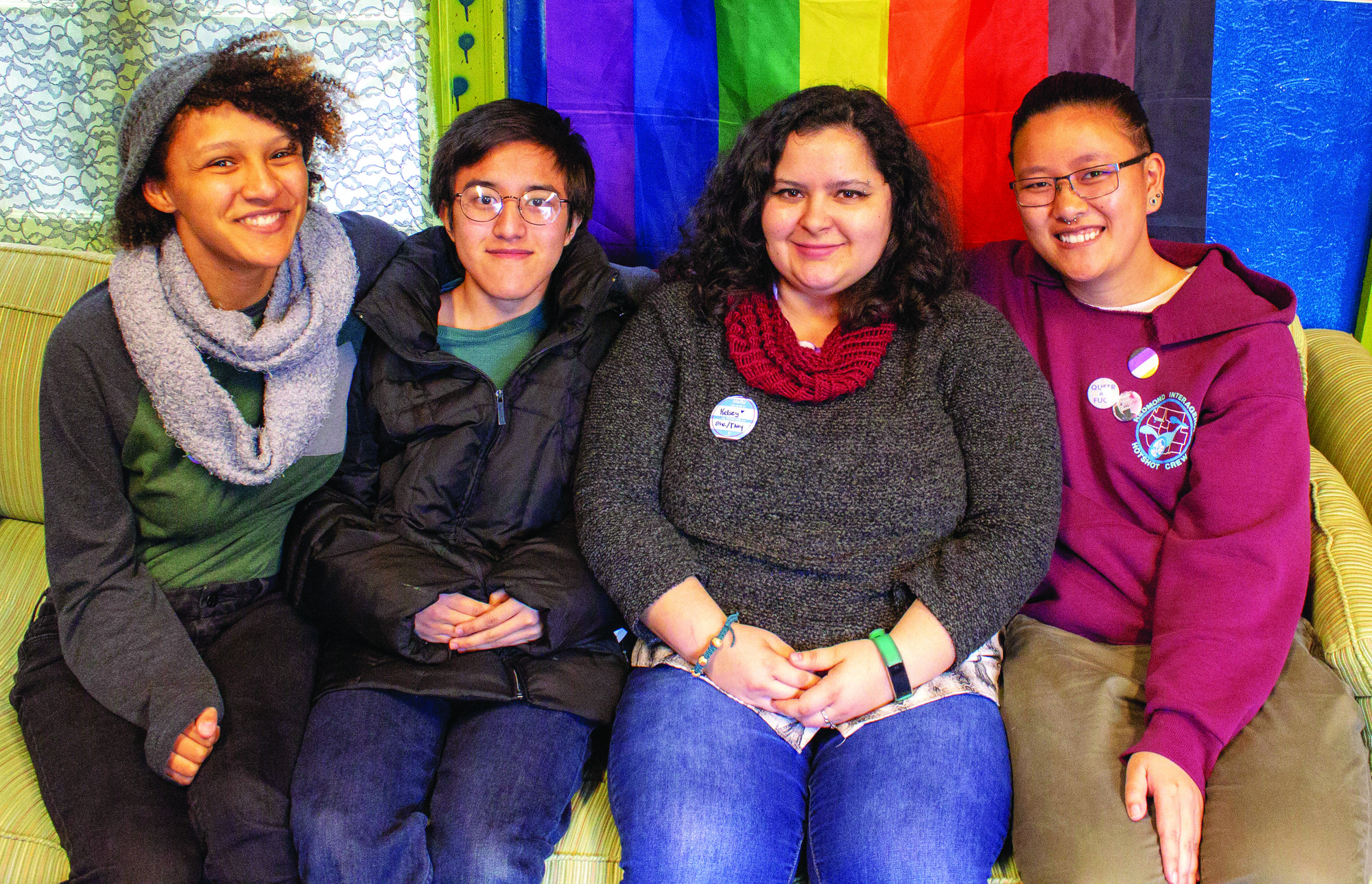
At Humboldt State the Eric Rofes Multicultural Queer Resource in the Warren House, room 53 provides a safe space, support and information for all students who are members of the LGBTQ+ communities.
A safe space is a place or environment in which a person or category of people can feel confident that they will not be exposed to discrimination, criticism, harassment or any other emotional or physical harm.
A welcome sign taken from inside the Eric Rofes Multicultural Queer Resource Center located in Warren House 53. | Photo by Maia Wood
The ERC was founded 10 years ago in honor of late HIV activist and professor Eric Rofes.
Student and ERC Event Coordinator Kelsey Young said the center got its inspiration for its name from Rofes.
“We are not just called the LGBT Center,” Young said. “We have large focus on intersectionality and inclusivity.”
The ERC is an associated student-funded organization that relies on the dedication of four students to put on the events and activities for the LGBTQ+ students on campus.
“We have this because of students,” Tai Parker, the ERC’s volunteer resource director said.
The center is running as a club with hours that are centered around the student directors’ schedules.
“We are very student driven,” Young said. “The university is slow on what LGBT needs are.”
Safe Sex Resources and other materials that are available for all students to use in the ERC. | Photo by Maia Wood
HSU doesn’t provide enough resources for LGBTQ+ students because there isn’t an accurate numerical representation in the school.
While people can label their sexuality, there is not one set scale because sexuality is a spectrum. There’s also the issue of safety. Not every student can express themselves openly because of the dangerous world we live in.
“We get many people who come to our events,” Parker said. “But we can’t force people to sign things because of safety and privacy of the participants.”
Despite limited resources, the student directors work with other programs on campus and in the community like Open Door, the health center and the multicultural centers to provide the most resources and support possible.
April 22, kicks off the start of Queer Fest (aka Q-Fest) which is a week-long festival highlighting and celebrating everything Queer. Neesh Wells, the ERC’s publicity and outreach director.
“Originally Q-Fest started as a film festival featuring different LGBTQ+ centered films,” Wells said. “This year’s focus is Taking Up Space, being queer folks and being comfortable in the spaces that we live in and building communities in those spaces.”
During this week students can participate in focused discussions and activities surrounding the topic of taking up space. There will also be art exhibits displaying work from LGBTQ+ artists.
The goal of Eric Rofes Multicultural Queer Resources Center is to create spaces for Humboldt States LGBTQ+ students and allies to be seen. The ERC hosts events and provides support groups, safe sex resources, information, a library and a safe space for all students. They are always looking for ideas for events.
“Whenever the door is open anyone is welcome to come in and we will do whatever we can to help them,” Young said.
For more information on Q-Fest, the center hours, support group resources and much more visit their website.
2014 bus crash survivor now turned activist, Santiago Calderon shares his story
In 2014, a Spring Preview bus trip filled with many prospective students travling to HSU from southern California was cut short when a Fedex truck collided into it. Five years later, bus crash survivor and activist, Santiago Calderon continues to fight and share his story to save more lives.
Santiago Calderon holds his cat Henny as they swing on his porch swing. | Photo by Dajonea Robinson
[perfectpullquote align=”right” bordertop=”false” cite=”Santiago Calderon” link=”” color=”” class=”” size=”16″]“I escaped to survive. I was pulled out by God, by some entity and landed head first on my shoulder from the charter bus window.”[/perfectpullquote]
Calderon went to Oxnard high school located in North Oxnard and graduated in 2014. He is now 22 years young and has a cat named Henny. Calderon played football for 10 years and had plans of continuing his football career in college but, the bus crash changed it all. Calderon said the crash took his life away from him.
“Football was my life, it was everything,” Calderon said. “I escaped to survive. I was pulled out by God, by some entity and landed head first on my shoulder from the charter bus window.”
[perfectpullquote align=”left” bordertop=”false” cite=”Santiago Calderon” link=”” color=”” class=”” size=”18″]“I saw death, I saw war, I saw trauma, torment… I saw hell on Earth.”[/perfectpullquote]
Calderon said he has vivid flashbacks of the collision. He said the visual of the red Fedex truck crossing the median right before impact, is screwed into his brain. Calderon described that day as the worst day of his life.
“I saw death, I saw war, I saw trauma, torment, I saw hell on Earth,” Calderon said. “That day I accepted death because I didn’t think I was going to make it. I told myself I’m not going to live in fear, to have happy thoughts before I die. I started thinking about my family. The life that I’m losing.”
Calderon said that during the collision he felt everything, and nothing at once. That he felt numb, completely numb. Calderon said that at some points he was so distraught couldn’t believe it and told himself that he was hallucinating.
“I remember asking the paramedics ‘Is this real?’and then I began to cry,” Calderon said. “Part of me died on that bus, I don’t know who I am anymore. I don’t know who I was before. I was broken, shattered in pieces and so much more after the crash.”
Satiago Calderon’s mother, Corinne Pinon looks off into the distance. | Photo by Dajonea Robinson
Corinne Pinon is Calderon’s mother. She and her family has been Calderon’s backbone since the crash and continues to deal with the after effects that stemmed from the incident. Pinon described Calderon before the accident as a great athlete, a honors student, and a happy carefree kid.
“The therapist said back then he lost his childhood that day, he was only 17,” Pinon said.
[perfectpullquote align=”right” bordertop=”false” cite=”Corinne Pinon” link=”” color=”” class=”” size=”17″]“Our family is barely holding on by a string to continue to help him. He is not a happy person. He has survivor’s guilt.”[/perfectpullquote]
Pinon said that her family is still healing and learning how to cope from the crash. She said that she’s not sure what’s the right or wrong thing is to do but her family keeps on trying.
“Our family is barely holding on by a string to continue to help him,” Pinon said. “He is not a happy person. He has survivor’s guilt. Like [Calderon] said, it’s easier if he didn’t make because living with this, even for me, his dad and his brother, is pretty unbearable.”
Pinon said Calderon is definitely a different person than he would have been if the crash didn’t happen.
Calderon suffers from mental health issues that stemmed from the crash. He was diagnosed with PTSD and bipolar disorder. He has tried therapy but is now trying PTSD groups and other programs.
Calderon went to HSU for four years and studied psychology to learn how the mind and how people function. Calderon had a psychotic break in May and had to move back home down south from Humboldt County. He described the episode as a very dark moment in his life.
Calderon said he’s not done recovering. He said the crash lead to PTSD related actions he never thought he’d make. That the crash caused chaos in his head, and the over analyzing of everything.
“I’ll go into a room and I’ll figure out how to get out alive,” Calderon said. “I’ll do everything I can to stay alive. I feel like everywhere I go I’m going to die. That’s a scary feeling, it’s something I learned to live with. Something that has given me such strength and courage.”
Calderon said that he’s in a continuous fight. When he’s low he sometimes has suicidal thoughts, and feels that it’d be easier just to stop but that is not what his God wants.
“I will not be afraid, I have no fear in my heart, I have no fear,” Calderon said. “ I went through hell on earth. I will never stop recovering. How could you be normal after something like that? You can’t. I’ll never be the same person. I lost Santi that day but a new Santi arose a stronger Santi.”
Angelica Espinoza is a close friend of Santiago Calderon. She is pictured outside of Calderon’s home on a tie swing. | Photo by Dajonea Robinson
Angelica Espinoza is a close friend of Calderon. They have a relationship that heals each other when they’re both down. Espinoza said that they reunited at a good time because they were both in a dark place struggling with depression.
“We just talked about healing, we didn’t talk about the crash,” Espinoza said. “It’s really a brotherly/sisterly bond with a lot of caring and deep conversations. We talk a lot of scripture. We’ve been finding answers through scriptures.”
Calderon received various emails from news agencies after the incident. Calderon said that he came across a message from a man named Harry who is the executive of the Truck Safety Coalition.
Calderon said that Harry’s message was different. The coalition was fighting against unjust policies that would make roads even more dangerous and, that was something Calderon wanted to be apart of.
“A truck is like a moving missile on the highway,” Calderon said. “That was a missile, the bus exploded-the charter bus exploded. What if the ruck was 22 feet longer and went 22 feet more into our bus? More people would have died.”
Corinne Pinon, Santiago Calderon, and Angelica Espinoza sit on Calderon’s family porch. | Photo by Dajonea Robinson
Every two years the coalition has a conference in Washington D.C. to fight against unjust trucking policies. The coalition educates themselves of the laws and policies that are in the works to better create ideas to stop them.
[perfectpullquote align=”left” bordertop=”false” cite=”Santiago Calderon” link=”” color=”” class=”” size=”16″]”We have to prepare for war, because we’re fighting for change. We’re fighting for policies that should never happen. We’re fighting for safety procedures that should happen.”[/perfectpullquote]
Calderon said the coalition plans on fighting a good fight. This year Calderon and his truck coalition members will be in Washington D.C. July 13 through 17 for a week of action.
“We have to prepare for war, because we’re fighting for change,” Calderon said. “We’re fighting for policies that should never happen. We’re fighting for safety procedures that should happen.”
Calderon has been apart of the coalition since 2015 and has been striving to save lives ever since.
“I don’t know where I would be if I didn’t have my truck coalition family behind me,” Calderon said. “They are my family. I would be more lost than I am. The coalition makes me feel like I never went through it. To gain such hope, such courage, we’re like any army fighting against injustices.”
Calderon does not plan on giving up and succumbing to the obstacles life throws at him. He feels as though he’s doing godly work.
Santiago Calderon sits on his porch in southern California. | Photo by Dajonea Robinson
[perfectpullquote align=”right” bordertop=”false” cite=”Santiago Calderon” link=”” color=”” class=”” size=”16″]“If I could, I would die for everyone if that meant for everyone to be good. Saving lives is everything I do.”[/perfectpullquote]
Calderon wants to be a vessel of God. He wants to let the light shine brighter than it has been before. He feels that he is the light in this world of darkness.
“If I could, I would die for everyone if that meant for everyone to be good,” Calderon said. “Saving lives is everything I do. I want to hear laughter, I want to see joy and people’s pearly whites. I want the injustices to stop. I want people to hear us and see us. I want truck services to care about truck safety and to actually listen. All we’re trying to do is save lives. That’s all we want.”
Lumberjacks score an additional $1.1 million over other CSUs
HSU senate meeting brought attention to the challenges the university will be facing over the next six years. The Graduation Initiative (GI) for 2025 has the CSU system eyeing HSU. Recent University senate meetings show HSU has some major battles to win.
Launched in 2016, GI 2025 looks to increase both student enrollment and retention by 10 percent or double what it was originally. However, HSU was recently allotted more money than other CSUs despite the under performance.
“HSU is 18 percent below target enrollment,” Vice President for Academic Affairs Alexander Enyedi said. “However, HSU received a $1.1 million increase to the base budget amount received last year.”
Recently, $436,000 from the GI 2025 funding has been directed to student employment at HSU. Following the housing crisis, faculty works on supporting students on a financial level in hopes of combating the steep housing situation.
[perfectpullquote align=”right” bordertop=”false” cite=”Armando Peña” link=”” color=”” class=”” size=”18″]“The number one reason for low retention rates is alienation. If students do not have a home, they do not want to invest in their community.”[/perfectpullquote]
Armando Peña, an ethnic studies major and double minor, was one of only four students in the senate meeting’s crowd. Peña voiced his frustration towards the lack of student involvement and his disappointment in HSU.
“The number one reason for low retention rates is alienation,” Peña said. “If students do not have a home, they do not want to invest in their community.”
Currently, HSU is battling a statistical war after a seven percent decrease in applications, enrollment and the freshman class population.
“We have a retention rate goal of 80 percent, which means 80 out of 100 students come back for next semester,” Enyedi said. “Currently, HSU is at 71 percent (71 out of 100).”
Beyond HSU, the community as a whole faces new change. Equity Arcata is a new involvement group consisting of local partnerships with a goal of racial equity.
The group’s vision is to create a community comprised of successful and racially diverse members who support one another, tag lined “Ourcata.”
The recent updates in the Josiah Lawson case catalyzed the emergence of Equity Arcata, who felt compelled to respond to the community.
Lizzie Phillips from Equity Arcata spoke about future plans to release a mobile app, which will allow the reporting of hate incidents and track unsafe patterns within the community.
“People want accountability and transparency in what’s happening,” Phillips said. “Equity Arcata wants holistic accountability and for people to feel safe.”
Although HSU faces a mountain of challenges, the upward journey has already begun. GI 2025 set a goal for universities to have a six year graduation rate of 56 percent.
HSU has already risen that statistic from 46 percent to 52 percent. With improvement on the horizon, Vice President for Academic Affairs Alexander Enyedi believes HSU can overcome the odds.
“It was a reality in 2015, but we hit our enrollment target,” Enyedi said. “I think we can reach the ostentatious goal of 7604 [students enrolled].”
Humboldt State is home to a variety of mushrooms that are sprouting as the rain comes and goes. CCAT held a series of presentations and workshops to further educate more students on mycology this week, and it came with a lot of educational fun facts about mushrooms. The most interesting being the things that can be made from mushrooms.
Casey Albarran, the internal co-director of CCAT said mushrooms can be more than just food.
“There are so many applications of mushrooms that are revolutionizing different things in the world,” Albarran said.
According to students at CCAT mushrooms can be made into bricks, buildings, leather and of course food. They can be medicinal as well. These discoveries of mushrooms have led to so many innovations with what can be made from them. There is still a lot of testing that needs to be made, though. The use of mushrooms traces back to traditional Chinese medicine, and that’s the kind of information that CCAT wanted to display to the students.
Michelle Stone, president of CCAT said that her favorite thing about mushrooms is identifying them.
“It’s kind of like a scavenger hunt without knowing what you’ll find,” Stone said.
Stone explained that with making something like leather out of mushrooms, it would support the vegan movement and revolutionize the industry making leather. She also explained that over-producing mushrooms can be a problem with all these innovations, and the goal would be to create a more sustainable form of production.
“We wouldn’t be able to just completely switch to myco-building, but it’s still an interesting idea,” Albarran said.
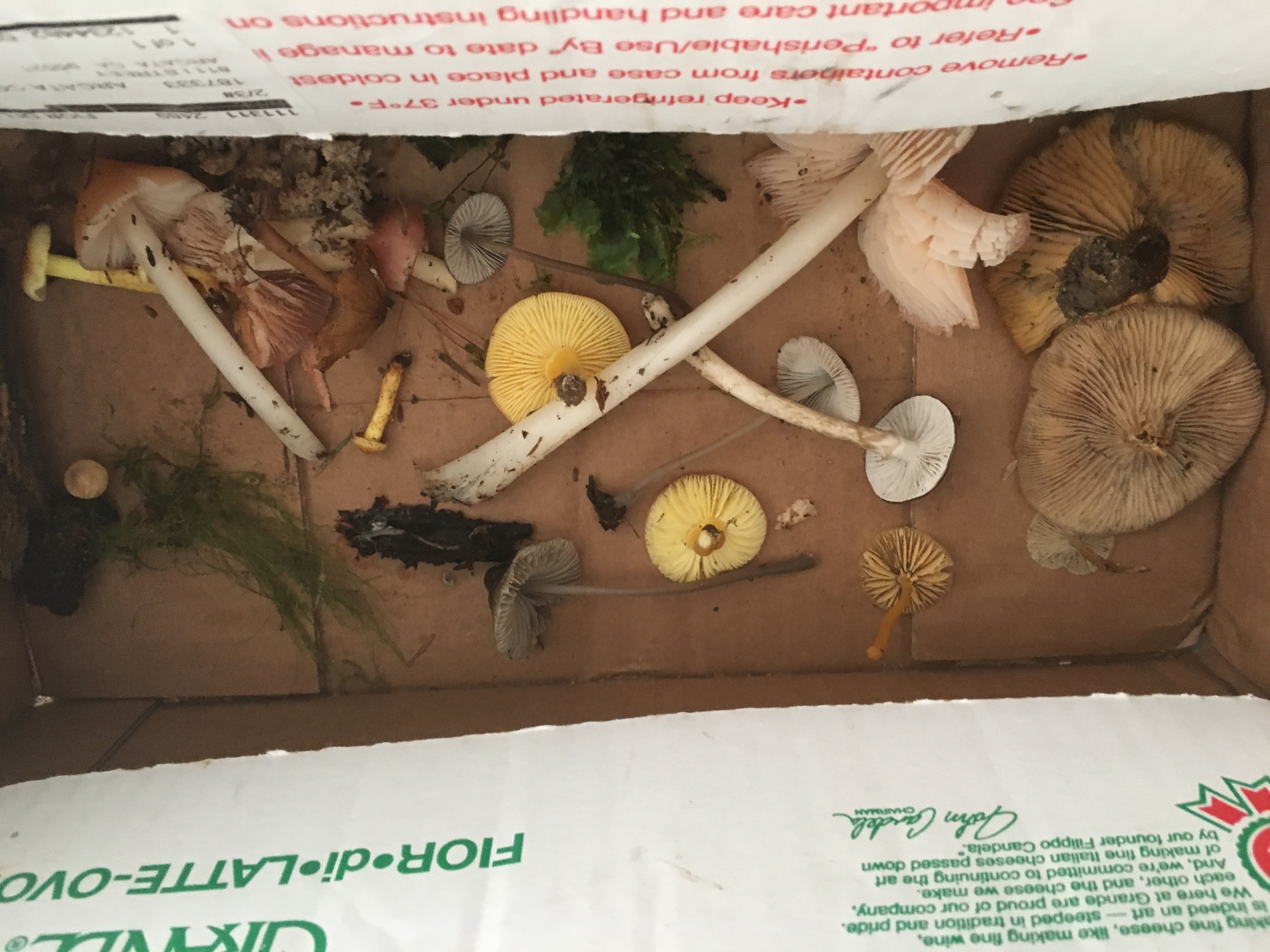
Mushroom growing locally in Humboldt County. | Photo by Amanda Schultz
One big thing about mycology is that it is incredibly complex. Just when you think you know a good amount of information there turns out to be a whole new array of facts and information.
JT Abbott, a student involved with CCAT, explained that despite his knowledge on mushrooms that there is still so much he doesn’t know.
“I love substituting my groceries by finding mushrooms, they’re a really fun addition to my forest walks,” Abbott said. “But eat them only if you are good at foraging.”
Mushrooms are notorious for their role in breaking things down in the ecosystem, and it’s myco-remediation that draws so many students to learning more about them.
Ben Nguyen is another student that is apart of CCAT.
“Nothing would be possible without them because they’re the natural digesters of Earth,” Nguyen said.
New safety escort program allow students to help other students
Humboldt State University is an open public school that hosts many strangers on a daily basis. Some students, faculty and staff feel unsafe walking alone at night on campus. To ease their worries the University Police Department has started a program that enlists student escorts to assist other students and faculty who feel unsafe walking.
You can find these escorts walking around campus wearing bright green jackets. Karyn Hoppe, the clery coordinator and live scan supervisor at UPD, said the program fulfills some of the safety needs of students, faculty and staff.
“Unfortunately in society, people in authority are not looked at in a favorable light, especially police officers in uniform,” Hoppe said. “With the peer program, people feel more comfortable being able to say things without getting in trouble. Some even feel uncomfortable being with a police officer or being seen in a patrol unit because people wonder why you’re in there.”
Students, faculty members and staff can be escorted from 5 p.m. to 1 a.m., Monday through Friday within school grounds. Student escorts are not permitted to go outside of campus to assist students. They only offer assistance from the end of the Jolly Giants building to 14th Street.
Alan Valle, a fourth year student majoring in sociology, works as an escort for the peer program. Valle said he usually gets calls anywhere from the BSS to the library.
“A lot of students I get do feel unsafe and want someone to walk with them to their destination, due to reports of strange people walking on campus they have heard of or emails they have gotten in the past.”
Miguel Altamirano, a fifth year kinesiology major, also works as a student escort for the peer program.
“It can be a little sketchy walking at night, depending on the hour, especially working on a project at midnight,” Altamirano said. “You feel like you want to rush home because you see people you don’t recognize or who don’t look like students.”
Student and Business Services building where students can find the University’s Police Department. | Photo by Delaney Duarte
Students now have the opportunity to be accompanied by another student without feeling unsafe. Paola Morgado, a second year student at HSU majoring in biology, shared her opinions and thoughts on the student escort program.
“I never feel safe walking alone on campus at night,” Morgado said. “There are some weird people roaming around on campus. I believe that the campus is finally becoming more aware of incidents happening on campus with strange activity of random people, so I think this program will help a lot of people.”
If any students, faculty or staff members feel unsafe walking from one destination to another late at night on campus, they can request a safety escort by calling the number 826-5555, or just dial x5555 from a campus blue light courtesy phone.
Cannabis advocates discuss marketing ideas and the future of weed in Humboldt
The future for Humboldt county is dope and those in the cannabis industry got together to brainstorm ways to market what some consider “the dopest dope you’ll ever smoke.”
A panel of cannabis professionals held a discussion on the future of the industry March 28 at the Humboldt Patient Resource Center’s Connection studio in Eureka. One of the panelists was Siobhan Danger Darwish, owner of Blessed Coast Farms and the first person in the state to receive a growing permit.
[perfectpullquote align=”right” bordertop=”false” cite=”Siobhan Danger Darwish” link=”” color=”” class=”” size=”17″]“We need to capitalize on the name Humboldt and the fact that we have been doing this for generations.”[/perfectpullquote]
“Who has a better story line than Humboldt county? No one, use that guys,” Darwish said. “We need to capitalize on the name Humboldt and the fact that we have been doing this for generations. We need to educate on sun-grown cannabis.”
Darwish stressed the importance of social media and its potential to reach a wide audience. She runs Instagram and YouTube accounts called Grow Sisters where she provides tutorials on how to “grow your own” and other cannabis-related DIY projects.
Dr. Whitney Ogle of HSU kinesioolgy, Brian Willkomm of HPRC, Rachel Moore of Humco Office of Economic Development, Siobhan Danger Darwish of Blessed Coast Farms and Terra Carver of Humco Growers Alliance answer questions from moderator Jess Columbo during a cannabis public education forum in Eureka on Thursday March 28. | Photo by T.WIlliam Wallin
Darwish is “a second-generation, black-market cannabis farmer” and decided to come to the legal side of the cannabis world in 2016. Darwish stressed that the future for Humboldt county cannabis farmers is collaboration.
“Let me come to your farm, I will smoke your product,” Darwish said. “I will tell my 65,000 followers what your product tastes like.”
HPRC held a public forum on cannabis education that included members of the cannabis industry on March 28. | Photo by T.William Wallin
Darwish went on to stress the importance of educating the public about sun-grown cannabis and how businesses and dispensaries should sponsor small farmers. Bryan Willkomm represented HPRC at the panelist table and has said that HPRC has been working closely with farmers since their beginning in 1999. Willkomm said that the future of cannabis in Humboldt county is “bright and beautiful,” but those in power have to step up.
“For a future regulations standpoint, we need a tasting room,” Willkomm said. “I can’t have you sample something without buying $40 of it. So, allowing farmers to have some sort of tasting or events, will really help bring more exposure to our farms and community.”
Mariellen Jurkovich became manager of HPRC in the late 90s and since 2004 the acting director. | Photo by T.William Wallin
Willkomm said he believes the future of cannabis is linked with ecotourism for Humboldt county and that cannabis can be used as an amplifier for those experiences. He went on to say that the county administrators need to focus on transportation access, with an emphasis on airport and road infrastructure to help alleviate the isolation of Humboldt county. Rachel Moore represented the Humboldt County Office Economic Development at the panelist table and stressed the importance of Project Trellis in Humboldt’s cannabis future.
[perfectpullquote align=”left” bordertop=”false” cite=”Jaleel Abdul-Ali” link=”” color=”” class=”” size=”18″]“The main way to help out in terms of legislation is to vote. We need to let people know that yes, your vote does matter.”[/perfectpullquote]
Project Trellis was implemented on March 12 as way for the county to help farmers negatively impacted by prior marijuana laws. Project Trellis will allow $340,000 in micro grants for farmers as well as $1.19 million in funds for a Humboldt county cannabis marketing scheme with a focus on markets in San Francisco, Los Angeles and San Diego.
“Part of Project Trellis is to listen and engage in dialog, so we can help inform the process,” Moore said. “The supervisors are interested in protecting the Humboldt brand. That is an important piece. We are here to be a part of the conversation.”
Professor Whitney Ogle of HSU kinesiology and Brian Willkomm of HPRC discuss marketing and research cannabis in Humboldt County with moderator Jess Columbo during a cannabis public education forum in Eureka on Thursday March 28. | Photo by T.WIlliam Wallin
Jaleel Abdul-Ali, an HSU student majoring in kinesiology, attended the event to offer insight as a patient and consumer.
“The consumer can help out in terms of advocating for the whole industry,” Abdul-Ali said. “The main way to help out in terms of legislation is to vote. We need to let people know that yes, your vote does matter.”
RCEA moves forward with 100% renewable energy by 2025
Redwood Coast Energy Authority is continuing its plan to make Humboldt County powered by 100 percent renewable energy by 2025. The board members of RCEA voted in favor to eliminate all fossil fuels and nuclear power 20 years before the state of California’s requirement for 2045.
“We are so excited you consider this resolution,” Wendy Ring of 350 Humboldt said to RCEA board members. “We are joining over 100 jurisdictions in the country.”
Ring is a member of an organization whose core mission is to keep fossil fuels in the ground and reduce the amount of carbon in the atmosphere. Ring said of RCEA’s renewable energy resolution that it’s signaling what kind of power we want to buy and allows for more community input.
“I think this is tremendously important,” Ring said. “This may be a little stone in the water but it casts a big circle.”
RCEA was created in 2003 and is a local government Joint Powers Agency. The members include representatives from the County of Humboldt, the Humboldt Bay Municipal Water District and the cities of Arcata, Blue Lake, Eureka, Fortuna, Rio Dell and Trinidad. Their purpose is to “develop and implement sustainable energy initiatives that reduce energy demand, increase energy efficiency, and advance the use of clean, efficient and renewable resources available in the region for the benefit of the Member agencies and their constituents.”
RCEA Executive Director Matthew Marshall said in 2018 the state of California established a policy for renewable energy resources and zero-carbon resources supply called the 100 Percent Clean Energy Act. The plan was to be implemented by 2045 and at their monthly meeting in January RCEA decided to adopt the act by 2025.
“RCEA will develop this strategy and enhance it every so often,” Marshall said. “We align with the county-wide effort toward a climate action plan that city members and the county are participating in.”
Pat Carr of 350 Humboldt is one of these members and is in support for 100 percent renewable energy in Humboldt County.
“RCEA has led a leadership role in recent years for local energy resources,” Carr said.
Part of RCEA’s resolution is considering the different resource mixes and local vs. non-local sources to meet the 100 percent renewable goal. Carr said we are already meeting the goal and that there is plenty of local energy in Humboldt County.
“This resolution is important for our community to think about what is clean energy,” Carr said.
RCEA board member Estelle Fennell agrees with Carr and said there are advantages to local renewable energy and we should have that as the goal.
“I want to stress I want to see as much local as possible,” Fennell said. “I can appreciate local in the resolution and as we move forward I want to see other local projects. We want local businesses and I will support that as long as there is local energy.”
A new renewable-energy project that RCEA is considering is an off-shore wind farm in Humboldt Bay. Last April RCEA entered a multi-year project with CIASO called the Redwood Coast Offshore Wind Project. There are two other potential areas in Morro Bay that could get the project if the lease isn’t granted to Humboldt Bay. This project is still in its early steps with the first study just coming out on the potential feasibility of having a wind farm 20 miles West of Eureka.
RCEA board members Dean Glaster, Michael Winkler, and Austin Allison all voted to move forward the resolution plan to have Humboldt County running on 100 percent renewable energy by 2025. | Photo by T.William Wallin
Executive Director Matthew Marshall said the other three partners are ready to move forward with the conclusion of the study. Marshall said there is a strong team of companies who do this around the world and are interested in doing it in Humboldt.
“Because it’s shallow you can do work in the bay, don’t need crane systems and operations and can tow with a boat the floating structure in an easier and safer way,” Marshall said. “If the study came back and wasn’t feasible we wouldn’t be moving forward but that isn’t what the study said.”
Not everyone is convinced, though. Community member John Shaffer has worked with renewable energy as an electrician for over 40 years and said he disagreed with the project proposal and RCEA should reconsider. Shaffer said off-shore wind farms are too costly and there hasn’t been any credible feasibility study of off-shore wind in Humboldt.
“I strongly support renewable energy,” Shaffer said. “But when so many better ideas are available I do not support uneconomic ones.”
HSU holds panel discussion about the Venezuelan crisis
When it comes to Venezuela, things are complicated. Nicolas Maduro is technically the “elected” president, but the elections were marked with widespread corruption and a physical force that arrested and jailed opposition leaders. Juan Guaidó, leader of the Venezuelan National Assembly, appointed himself as the interim president in January without receiving any votes, thus making the situation convoluted in the Latin American country.
Yes, Maduro is something akin to a dictator. However, he did win an election for the presidency and Guaidó did not. Guaidó is recognized as the legitimate president of Venezuela by numerous countries including the United States. However, the U.S. National Security Advisor, John Bolton, said in an interview that “it will make a big difference to the United States economically if we could have American oil companies invest in and produce the oil capabilities in Venezuela,” overtly hinting at what may lie as the main reason for U.S. intervention.
HSU professors Suzanna Pasztor, Nancy Pérez and Jared Larson held a panel discussion on what is happening and what should happen in Venezuela. Approximately 50 people attended the lecture which ran for two and a half hours. The three professors are all experts in a myriad of topics when it comes to Venezuela and helped to offer some insight into the complicated situation. Pasztor said that to understand some of the current problems, one must look at former Venezuelan President Hugo Chavez.
[perfectpullquote align=”right” bordertop=”false” cite=”Elena Padrón” link=”” color=”” class=”” size=”18″]“I had a fair amount of family and friends that were kidnapped. The violent crimes in the barrios was out of control. I didn’t feel safe.”[/perfectpullquote]
“We need to understand where the Chavez revolution begins and ends,” Pasztor said.
Pasztor went on to give a brief rundown of the history in the area and what some of the complicating factors are. Pasztor said that Chavez was part of the Bolivarian Revolution movement in the early 1990s and was democratically elected as president in 1998.
“Chavez wanted to follow a third way that combined capitalism and socialism,” Pasztor said.
But problems began to manifest. In 2003 Chavez fired approximately 20,000 striking oil workers and replaced them with workers more loyal to his government and policies. Although some foreign countries saw this as problematic, Venezuelans supported Chavez.
According to Pasztor, Chavez was very popular amongst the poor and working class. He used oil revenue to bring healthcare and literacy to the poor. Under Chavez’s reign, Venezuelans saw unprecedented change in their country. Infant mortality declined, unemployment and extreme poverty shrank tremendously and oil exports reached $60 billion dollars in 2011. However even this had its problems.
“Venezuela has tried to function as a state that over-relies on oil revenue, and is not self-sufficient in food by any means,” Pasztor said.
Violence was also common during this time period with the murder rate increasing by nearly double. Elena Padrón, assistant professor of psychology at HSU, grew up in Venezuela. Padrón moved to the U.S at the age of 20 and attended university at UC Berkeley. Padrón said that she was no supporter of Chavez or the Bolivarian Revolution and that violence was common in her community.
“I had a fair amount of family and friends that were kidnapped,” Padrón said. “The violent crimes in the barrios was out of control. I didn’t feel safe.”
Chavez remained president of Venezuela until his death in March 2013. The following month, current Venezuelan president Nicolas Maduro won the presidency by a slim margin. This event has essentially become to turning point for Venezuela. Two years later the opposition party to Maduro won two-thirds of the seats in the National Assembly, effectively ending the 17 year rule of the Socialist party. Since then, Maduro has not been favorable of any sort of dissenting voice.
HSU professor Jared Larson chats with students after a panel discussion about US intervention in Venezuela | Photo by Freddy Brewster
In 2017, 73 protestors were killed and the United Nations described the event as “a picture of widespread and systematic use of excessive force…against demonstrators in Venezuela.”
The protests took place because of the Venezuelan Supreme Court’s “attempt to usurp the powers of the country’s legislative branch.”
These protests sparked the movement that would produce Juan Guaidó and his claim to the presidency. Jared Larson, lecturer in the department of politics at HSU, summed up Guaidó’s claim to power by stating that Maduro never swore in as president for his second term in 2018 in front of the National Assembly, which is required in the Venezuelan Constitution.
This brings us up to the current time and the Trump administration’s appointment of Eliot Abrams as the Assistant Secretary of State for Inter-American Affairs.
[perfectpullquote align=”right” bordertop=”false” cite=”Nancy Pérez” link=”” color=”” class=”” size=”17″]”[Elliot Abrams] is now being sent to Venezuela to promote the same discourse and rhetoric as before. This is not only starting a war, but it is also starting migration.”[/perfectpullquote]
“The appointment of Elliot Abrams was probably the third dumbest thing the Trump administration could have done,” Larson said.
Abrams has a long history in Latin America. In the 1980s he worked for the Reagan administration where he oversaw the U.S. involvement in Latin America. Violence ran rapid in Latin America and Abrams justified it by saying that it was to promote democracy and human rights. One of the most horrific incidents happened in El Mozote, El Salvador where 800 civilians were murdered by U.S. backed and trained forces.
“Elliot Abrams came into this position to conceal the role of the U.S. in these crimes,” Nancy Pérez, lecturer of critical race, gender and sexuality at HSU, said. “He is now being sent to Venezuela to promote the same discourse and rhetoric as before. This is not only starting a war, but it is also starting migration.”
Abrams was convicted of lying to Congress about his role in the Iran-Contra scandal, and was questioned by Congresswoman Ilhan Omar about why he should be trusted given his past.
The discussion Monday night was to help bring some clarity to a convoluted issue and to shine a light on how the media has portrayed the issue. Ryan Call is a senior majoring in history here at HSU and attended the event to form a more complete understanding of the situation.
“The media has played a huge role in obscuring what is going on,” Call said. “I knew that someone was president and there was a crisis, but I didn’t know how it happened.”
The event brought quite a bit of historical clarity, but left the attendees reaching for their own conclusion when it comes to American intervention. Elena Padrón does not support any sort of American intervention but wants something to be done.
“What I would like to see done is to push for fair elections,” Padrón said. “I would like to see the power of the international community push for democracy.”
This website uses cookies to improve your experience. We'll assume you're ok with this, but you can opt-out if you wish. Cookie settingsACCEPT
Privacy & Cookies Policy
Privacy Overview
This website uses cookies to improve your experience while you navigate through the website. Out of these cookies, the cookies that are categorized as necessary are stored on your browser as they are essential for the working of basic functionalities of the website. We also use third-party cookies that help us analyze and understand how you use this website. These cookies will be stored in your browser only with your consent. You also have the option to opt-out of these cookies. But opting out of some of these cookies may have an effect on your browsing experience.
Necessary cookies are absolutely essential for the website to function properly. This category only includes cookies that ensures basic functionalities and security features of the website. These cookies do not store any personal information.
Any cookies that may not be particularly necessary for the website to function and is used specifically to collect user personal data via analytics, ads, other embedded contents are termed as non-necessary cookies. It is mandatory to procure user consent prior to running these cookies on your website.