Clery Act reveals numerous sexual assault cases within the last 3 years at HSU
Humboldt State University’s 2019 Clery Act Annual Security Report reveals more than three sexual assault cases at HSU in each of the past three years.
Amelia Wagoner, a victim rights advocate and kinesiology major at HSU, said the problem goes deeper than the statistics suggest.
“The amount of reported cases here and throughout the nation do not reflect campus safety,” Wagoner said. “The reporting process is traumatic and most survivors don’t want to deal with it.”
The Clery Act federally requires all higher education institutions to disclose campus crime statistics. The newest report for HSU, released in September, covers crimes from January 2016 to December 2018. All Clery Act reports for California State Universities are available on the California State University webpage.
HSU’s report notes five rapes in 2016, five in 2017 and four in 2018. HSU doesn’t have the most rape or sexual assault instances within the CSU system, but it did have one of the largest percentages compared to its relatively low student population. Sexual assault victims made up .05% of HSU students.
HSU requires students to go through a consent course before attending, and all members of clubs or sports teams attend a Title IX seminar once per year. Title IX is a federal law prohibiting discrimination on the basis of sex in federally-funded education institutions, and the seminar focuses on teaching consent culture and anti-hazing.
Geography major Allie Jones expressed concerns about the faculty behind HSU’s Title IX seminar.
“At HSU, nobody on the Title IX team is a woman,” said Jones. “I’m sure the coordinator is qualified for his job, but as a woman I’d feel more comfortable having another woman to talk to.”
For now, Wagoner urged students to play their part in improving campus safety.
“Make sure everything is okay,” Wagoner said. “If you see or hear something that doesn’t seem right, do your part to make a difference.”
Soccer and volleyball fall to Sonoma State, cross country prepares for second Oregon meet
For the Humboldt State volleyball and soccer teams, anything regarding the Sonoma State Seawolves is going to leave a bad taste in their mouth. Sonoma State dealt three different Humboldt State teams a loss over the weekend, all on the road in Rohnert Park.
Men’s soccer was the victim of a come-from-behind effort from the Seawolves, women’s soccer lost a tight game and volleyball lost in four sets. Cross country didn’t compete last week as they continue to prepare for their upcoming meet in Salem, Oregon.
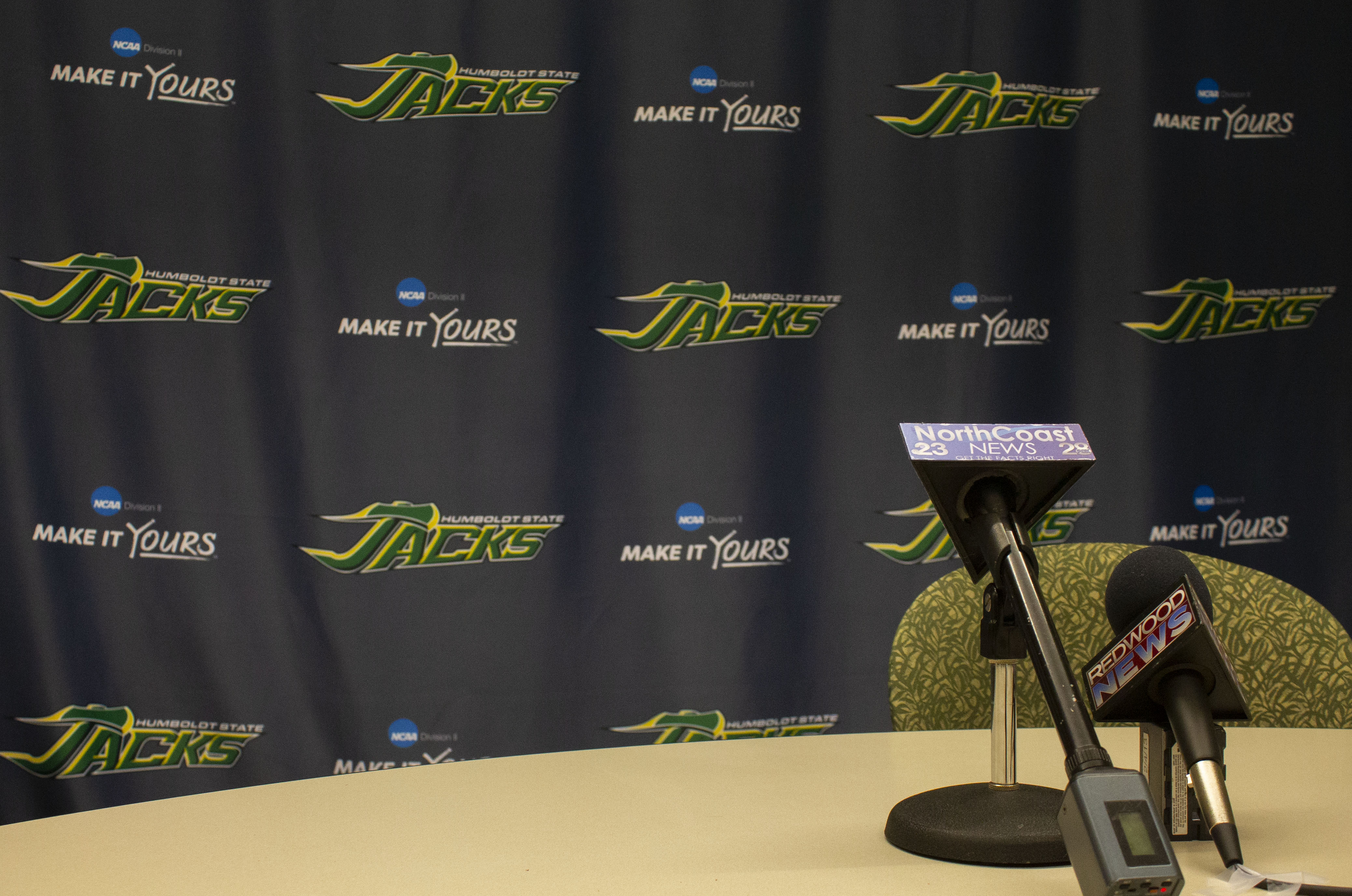
Coaches and players from HSU soccer, volleyball and cross country were at the weekly Tuesday press conference at Lumberjack Arena.
Cross Country
After a good showing at the Sundowner Invitational in Monmouth, Oregon the Jacks’ attention turns to another Oregon course at the Willamette Invitational in Salem on Oct. 5. Head Coach Jamey Harris noted that training is going to be lighter going into this week in hopes that his runners are ready for the upcoming meet this weekend. He also noted the women’s race in Salem will be a 5k instead of the standard 6k, which could lead to faster times.
Harris talked about the men being ranked tenth in the NCAA regional rankings and how it motivates his runners to be even better on race day. For junior runner Elliott Portillo the ranking is something to feel good about, but it serves as a spark to push even harder.
“It’s definitely something very validating,” Portillo said. “It means people are beginning to take notice, and we have to show them that we are deserving of the title.”
Another topic of conversation was the passing of legendary former HSU cross country and track coach Jim Hunt. Hunt coached the cross country and track teams from 1967 to 1986 and produced 64 All-Americans and 11 national champion runners. Harris was visibly emotional as he spoke about what coach Hunt meant to Humboldt State and to him.
“The impact that he [Hunt] had on this university, I can’t even put it into words,” Harris said. “I honestly don’t know what to say, because I feel like I can’t say anything that will be adequate.”
Volleyball
The HSU volleyball team played Sonoma State on Saturday as part of their three-game road trip and lost in four sets by a score of 3-1. The Jacks won the second set and tied the score at 1-1 early on, but Sonoma won the next two sets and won the match. For Head Coach Kelly Wood, she feels that this year’s team is a vast improvement over last season’s team as far as talent, but that the team needs to be more consistent throughout the entire match. She talked about needing all of her players to have a great game, not just a few.
“We’re showing good streaks within the match, but we have yet to pull together an entire, consistent match,” Wood said. “It seems like we need to get all of our cylinders firing during a match, we’ve got a couple on and a few that aren’t on.”
Women’s Soccer
For a team that is still getting their footing under them, going down to Rohnert Park and playing a nationally ranked Sonoma State team is going to be a significant challenge. The Jacks fell just short of completing that task, losing to the Seawolves 2-1 with Lindsay Stoner scoring the lone goal. Head Coach Paul Karver had a very positive attitude about the loss, despite the result.
“The Rubik’s cube is sitting in the corner, it’s two turns away and we just gotta get there,” Karver said. “There was so much heart and determination out on the field and our girls were never going to say die in that moment.”
Men’s Soccer
The Jacks lost on Friday to Sonoma State in the cruelest of fashions, losing the game 4-2 despite taking a 2-0 lead early in the game. Isiah Dairo and Gus Baxter scored early for the Jacks but by halftime they were tied 2-2 and then Sonoma State scored two more times to seal the victory for the Seawolves. Jacks’ midfielder Ethan Waters talked about how the Jacks lost focus after gaining the early lead and eventually falling short.
“We lost momentum,” Waters said. “We have to respect them a little bit more, of course we got the two-goal lead but I think overall we didn’t control the game.”
HSU officers cast an almost unanimous vote of no confidence in police chief
The Statewide University Police Association published a press release on Monday stating that officers of the Humboldt State University Police Department submitted an almost unanimous vote of no confidence in Police Chief Donn Peterson.
Nine of the ten officers in the department cast a “no confidence” vote while one abstained. Peterson has allegedly manipulated crime reports, frequently left the office to go out of state, created a hostile discriminatory work environment and violated labor laws.
In a phone interview with Peterson, he said he does not agree with the allegations. However, he enthusiastically supported the association’s examination.
“I have a profound respect for the seriousness of the allegations and the people who made them,” Peterson said. “So I want to respect that.”
Peterson said he wants to be as transparent as possible, but he hopes to continue to be the UPD Chief.
Associated Students President Yadira Cruz said she was surprised when she learned about the vote on Monday.
“I was genuinely shocked,” Cruz said. “Like what the fuck?”
After thinking about it more, Cruz said she wasn’t all that surprised. Cruz said UPD’s problems probably go beyond the chief.
HSU’s Vice President for Administration and Finance Douglas Dawes sent out a campus memo at 4:50 p.m. on Monday, Sept. 30. Dawes said he has high expectations for all employees within UPD and remains committed to helping them be effective.
“Chief Peterson and his team have enhanced outreach to students through the Chief’s Advisory Panel, created the safety escort program, and worked closely with Equity Arcata,” the memo said. “We will thoroughly investigate all of the allegations brought to our attention.”
While the Justice for Josiah movement previously worked closely with UPD, they also inspired the Chief’s Advisory Panel. On Monday the Justice for David Josiah Lawson Facebook page posted a call to action in regards to the news.
“Who is going to protect our students, because it is obvious Humboldt State does not give a damn about their safety?” the post read. “It’s time to start cleaning house President Tom Jackson, get rid of the slackers. Put OUR students first.”
The press release noted that the vote does not automatically oust Peterson. However, UPD Officer Billy Kijsriopas hopes a new chief will take Peterson’s place.
“The damage to morale and the risk to campus safety is too great,” Kijsriopas said in the memo. “It’s past time we had a new chief.”
The full press release from Statewide University Police Association:
Arcata, CA. — According to officials with the Statewide University Police Association (SUPA), its officers at the Humboldt State University Police Department have cast a vote of no confidence in the Department’s police chief, Donn Peterson. Nine of 10 officers who completed the survey voted against the Chief, while the remaining voter abstained.
SUPA conducts annual leadership surveys at each CSU campus. The most recent nearly unanimous vote of no confidence in Police Chief Donn Peterson is in line with previous year’s results. Chief Peterson took the job at HSU after leaving his former post with Florida’s Broward County Sheriff’s Department amid scandal. Peterson still regularly spends time out of state with his family in Florida.
According to HSU Officer Billy Kijsriopas, “Chief Peterson’s frequent, extended bouts of time out of state leave the department in the hands of a Lieutenant who also spends an unusual amount of time away from campus. Our officers look to the Chief for guidance and leadership, but he has fallen short of the standards they and the University community deserve.”
According to Officer Kijsriopas, absenteeism is only a fraction of the failure in leadership the Department has seen since Peterson came to HSU in January 2015. Among the Chief’s other offenses, Kijsriopas cites manipulation of crime statistics reporting, creating a hostile work environment including making racial slurs aimed at minority officers, multiple violations of the Public Safety Officer’s Procedural Bill of Rights Act and blatant violations of labor laws that include a derogatory, anti-labor letter which Peterson authored and posted publically [sic].
Says SUPA president Jeff Solomon, “Our members in the Humboldt State University Police Department have consistently reported absenteeism, mismanagement and more in departmental leadership. When you have a department united like this, clearly there is a problem.”
When asked what steps he and other HSU officers would like to see, Kijsriopas replied, “The damage to morale and the risk to campus safety is too great – it’s past time we had a new chief.”
United Nations pointed to Iran after Houthi rebels initially claim Saudi Aramco attacks
On Sept. 14, drones attacked two of Saudi Aramco’s oil plants and the United States quickly pointed fingers at Iran as the perpetrator, sending military aid to Saudi Arabia.
Iranian-backed Houthi rebels initially claimed the attack as their own, reporting that they sent missiles from Yemen, but U.S. Secretary of State and former CIA Director Mike Pompeo were adamant that Iran was to blame for the attacks on the Abqaiq and Khurais oil facilities. Pompeo commented on the incident during an episode of CBS’s “Face the Nation.”
“No reasonable person doubts precisely who conducted these strikes,” Pompeo said. “And it is the intelligence community’s determination that it is likely the case that these were launched from Iran.”
Iran drew global attention by targeting Saudi Arabia, the world’s oil exportation leader. In an interview on 60 Minutes, Crown Prince of Saudi Arabia Mohammad Bin Salman put the attack in context.
“This attack didn’t hit the heart of the Saudi energy industry, but rather the heart of the global energy industry,” Bin Salman said. “It disrupted 5.5% of the world’s energy needs; the needs of the U.S. and China and the whole world.”
Iran and Saudi Arabia both continue to try to gain influence in the Middle East, and the ongoing conflict in Yemen proves that while they may not want full-scale war, neither side fears conflict.
After meeting with President Donald Trump and his national security team, U.S. Secretary of Defense Mark Esper explained Trump’s approval of military support in response to Iran’s aggression during a press conference at the Pentagon.
CNN’s coverage of US Secretary of Defense Mark Esper and Gen. Joseph Dunford announcing the United States sending troops to Saudi Arabia.
“It is clear based on detailed exploitation conducted by Saudi, United States and other international investigative teams that the weapons used in the attack were Iranian-produced, and were not launched from Yemen as was initially claimed,” Esper said. “All indications are that Iran was responsible for the attack.”
Esper added that in response to the attacks and a Saudi call for help, the U.S. will deploy defensive forces focused on air and missile defense.
At the United Nations General Assembly, the leaders of Germany, France and the U.K. released a joint statement concurring with the U.S.
“It is clear to us that Iran bears responsibility for this attack,” the statement said. “There is no other plausible explanation. We support ongoing investigations to establish further detail.”
Trump said the U.S. also employed economic measures against Iran.
“We have just sanctioned the Iranian National Bank,” Trump said. “That is their central banking system and it’s going to be at the highest level of sanctions.”
CBS News coverage of Trump’s announcement of new Iran sanctions on national bank.
However, President of Iran Hassan Rouhani has denied Iran’s fault. Rouhani called the attack a retaliation from Yemen for unwanted outside influence.
“The people of Yemen are forced to respond to all the violations and the flood of weapons from U.S. and Europe toward Saudi Arabia and the United Arab Emirates,” Rouhani said in a televised press conference in Ankara. “They cannot show legitimate defense in the face of their country being destroyed.”
Arcata incident renews doubts of local safety and transparency
A black 18-year-old HSU student reported being slashed with a knife near 14th and G streets in Arcata on Aug. 26, according to a Humboldt State University press release sent out Friday, Sept. 27.
The incident occurred more than a month ago, but students are only just hearing about it. Associated Students President Yadira Cruz wished HSU had notified students to avoid feelings of mistrust.
“To avoid that, just send out an email as soon as it happens,” Cruz said. “Just develop that transparency.”
The press release went on to summarize the events after the student fled Arcata and returned to HSU.
“Paramedics were called, and they were taken to Mad River Community Hospital where they were treated for the injury,” the press release, written by HSU Interim Vice President of Enrollment Management Jason Meriwether, said.
Cruz said the student has reported being physically fine as of Monday.
The incident, which largely flew under the radar until reporting from Lost Coast Outpost dug it up for a story published on Thursday, Sept. 26, is now under investigation by the Arcata Police Department.
The HSU press release noted multiple media narratives and sought to clarify the situation. On the night of the incident, HSU determined that no threat to the campus existed, and did not send out a notification.
The release also noted no evidence of the incident being a hate crime, which would warrant notification.
“If there had been an imminent threat or evidence of a hate crime, the campus community would have been alerted by text and email using HSU Alert,” the release said.
Cruz, along with several HSU faculty and staff, reviewed and gave consultation for the release.
Cruz first heard about the incident from a Lost Coast Outpost reporter seeking her comment. Cruz wondered whether HSU would’ve notified students if it weren’t in the midst of an enrollment decline.
In any case, Cruz wished HSU had notified the campus, regardless of whether the incident appeared to be a hate crime.
“Saying it’s not race-related is not a valid excuse,” Cruz said.
The press release emphasized Humboldt’s close-knit community and called HSU the “Humboldt Family.” However, Cruz doubted the sincerity.
“The campus tells us they care about us only when something bad happens,” Cruz said.
Controversial books read aloud at HSU library in protest and celebration
Humboldt State University students and faculty gathered in front of the HSU library on Tuesday, Sept. 24 for a banned book reading in celebration of Banned Books Week.
Garrett Purchio, librarian for the College of Arts, Humanities and Social Sciences, worked with Marcy Burstiner from the Humboldt Center for Constitutional Rights to host one of many readings held across the country for the campaign promoted by the American Library Association.
“It’s a chance to really listen to different people’s perspectives,” Purchio said. “I think it’s always great to hear, you know, people are reading this book because of the impact it has on them, or maybe it really opened their eyes to the world.”
Harriet Burr reads For Whom The Bell Tolls by Ernest Hemingway at the banned book reading in front of Humboldt State University’s library on Sept. 24. Burr chose the book because of its value in representing the Spanish Civil War. | Photo by Michael Weber
Readers chose from a rack of more than 50 banned or challenged books, including books of diverse content—defined by the ALA to have content by or about people of color, LGBTQ+ people or people with disabilities.
Purchio said that while many people feel we are at a point in history beyond censorship, literature still faces frequent challenges.
“Every year there’s always a list of new words that are challenged for different reasons,” Purchio said. “The ALA puts out a list of the top books challenged in 2018, 2019.”
Ocean Campbell, a graduate student in social work, read David Levithan’s Two Boys Kissing. According to the ALA, the book is ranked number 11 for the most challenged and burned book in 2018 because it included LGBTQ+ content.
“I really wish that this book had existed when I was a teenager,” Campbell said. “I think it possibly could have changed my whole life.”
Campbell said the book had a powerful message and brilliant moments that resonated with her. Campbell said any young person who wants the book should be able to have it.
Harriet Burr, a librarian with a master’s degree in community economic development, read For Whom The Bell Tolls by Ernest Hemingway, a book set during the Spanish Civil War.
“How many of you learned about the Spanish Civil War in school?” Burr said. No hands raised in the audience. “Why don’t we teach this?”
Burr said people are unaware of a lot of history, in part due to purposeful obfuscation. Burr blamed former President Franklin D. Roosevelt and the Catholic Church for ignoring the Spanish Civil War.
Purchio said people ban or challenge books because they feel threatened by a work and have a desire to respond. He said the book reading celebrates the freedom to read.
Journalism professor Marcy Burstiner reads a banned book during a banned book reading in front of HSU’s library on Sept. 24. | Photo by Michael Weber
Marcy Burstiner, who is also a HSU journalism professor, added a similar sentiment.
“You can threaten the writers, but the book will go on,” Burstiner said.
According to the ALA, it launched Banned Books Week in the 1980s after a United States Supreme Court case ruling said school officials could not ban books in libraries because of their content.
Since then, the ALA has compiled lists of challenged books each year. The ALA also posts additional information on banned books on their website.
“It’s still happening,” Purchio said. “It’s important to keep this band going, because it’s good to show that even though censorship exists in the world, there’s some people who champion freedom of speech and freedom to read.”
A previous version of this article listed the author of “Two Boys Kissing”as David Campbell, but the author is David Levithan.
Die-in protest advocates for action on climate change
Motionless bodies lay in the Humboldt State University quad on Friday.
Junior wildlife major Olivia Brock joined a die-in protest put on by Extinction Rebellion with help from Earth First.
“We want to show them that if they’re gonna kill us, then they have to see us,” Brock said.
A variety of HSU students pretended to be dead on the ground, with many holding flowers in their hands and some wearing face paint.
HSU student Vanessa Argonza lying prone for a die-in climate protest in HSU’s quad on Sept. 27. | Photo by James Wilde
Signs at a die-in climate protest in HSU’s quad on Sept. 27. | Photo by James Wilde
John Powell (tie-dye), College of the Redwood agriculture student, and J.T. Abbott, HSU botany student, hugging on the ground for a die-in climate protest in HSU’s quad on Sept. 27. | Photo by James Wilde
Extinction Rebellion and Earth First advocate and protest for governmental action on climate change and environmental issues.
Junior forestry major Arvel Reeves joined the protest despite not knowing about it beforehand.
“Climate change is something I really worry about,” Reeves said. “It’s only going to get worse.”
Lily Price, HSU botany student, played a morose tune over the protesters’ bodies on a harmonium, an organ instrument that sounds similar to an accordion.
The protest came one week after a global climate strike that saw thousands of protests around the world, including one in Arcata.
Ellis Hanson, a junior wildlife biology major, wanted to help stand for the earth.
“I did this to do a demonstration,” Hanson said. “To make sure everyone remembers the crisis we’re in.”
Ellis Hanson, HSU wildlife biology junior, lying down for a die-in climate protest in HSU’s quad on Sept. 27. | Photo by James Wilde
Lily Price, HSU botany student, plays a somber song on a harmonium for a die-in climate protest in HSU’s quad on Sept. 27. | Photo by James Wilde
Protesters lying down for a die-in climate protest in HSU’s quad on Sept. 27. | Photo by James Wilde
Protestors gathering in a circle after a die-in climate protest in HSU’s quad on Sept. 27. | Photo by James Wilde
Students passing by showed mixed reactions to the protesters. Some stopped and watched. Others took photos on their phones. Others scurried along without a second glance.
Brock hoped the visual nature of the protest would draw attention.
“We want to make the people of Humboldt County see the future we’re being handed,” Brock said.
Heri Hawthorn, a local activist, helped create some of the signs and banners for the protest. Hawthorn held a sign above the protesters while they lay still.
“There’s nothing else to do except support others and curb what’s happening,” Hawthorn said.
Early on, when a University Center employee took down an unpermitted protest banner. Brock took notice.
“Don’t you care about your children?” Brock asked the employee. “The earth is dying!”
Blu, HSU environmental studies senior, lies covered up for a die-in climate protest in HSU’s quad on Sept. 27. | Photo by James Wilde
Did streetwear fashion brand Bstroy take tragedy too far?
Earlier this month at New York’s Fashion Week, streetwear brand Bstroy sparked controversy after unveiling a line of clothing inspired by school shootings.
Founders of Bstroy and Atlanta based designers Brick Owens and Dieter Grams presented hoodies riddled with bullet holes and emblazoned with names of schools where mass shooting took place: Sandy Hook, Columbine, Virginia Tech and Marjory Stoneman Douglas.
Bstroy’s Instagram page shares the brands description, a “Neo-Native Menswear Design House.” Owens and Grams have come under scrutiny and have defended their creations as a form of art and expression.
After some of the backlash, Owens took to Instagram in an attempt to explain.
“Sometimes life can be painfully ironic,” Owens wrote. “Like the irony of dying violently in a place you consider to be a safe, controlled environment, like school. We are reminded all the time of life’s fragility, shortness, and unpredictability yet we are also reminded of its infinite potential.”
Grams and Owens sent a statement to TIME, the New York Times, the Cut and the Washington Post claiming their brand simply used its platform to shed light on important issues.
“We wanted to make a comment on gun violence and the type of gun violence that needs preventative attention and what its origins are,” the statement read. “While also empowering the survivors of tragedy through storytelling in the clothes. Arts job is to wring emotion out, what we do with it after is subjective and on us.”
Fred Guttenburg’s Twitter response.
However, not everyone views the act in an artistic light. Family members of victims took to social media to share their views. Fred Guttenburg, whose daughter Jamie Guttenburg was killed by the gunman at the Marjory Stoneman Douglas shooting, went to Twitter to express his disgust.
“Under what scenario could somebody think this was a good idea?” Guttenburg wrote. “This has me so upset. If any of my followers [know] anybody involved with this clothing line, please ask them to stop it immediately.”
Shawn Sherlock, whose niece Gina Rose Montalto was also a victim at the Stoneman Douglas shooting, posted a tweet in response as well.
“My 14-year-old fashionista niece was murdered in Parkland,” Sherlock wrote. “She was a professional illustrator and aspired to be clothing designer like you. You should be ashamed of taking advantage of her death to make [money].”
Some HSU students noted that if Bstroy were to donate some of their proceeds, they could be more likely to accept the creators’ stance.
Screengrab of Sherlock’s tweet in response to Bstroy’s hoodies.
Journalism major Israel Landes said he found Owens’ explanation insincere, seeing it more as Owens defending his artistic choice and saying he thought there were ways to make it clear they were making a statement.
“If at the event, fashion show, maybe just a quick announcement, ‘Hey we’re doing this to represent whatever group, whatever victims, whoever’s being affected by these shootings,’” Landes said. “He could if he wanted to go the extra mile and say ‘Hey you know we are donating X number of the proceeds to families of the victims.’”
Mari Agaton, an art history major, agreed with the charity aspect lightening the grim connotation of the hoodies.
“Coming as an artistic statement, if the proceeds were donated to the families I could buy into it better,” Agaton said.
Owens and Grams met on MySpace while they were both living in Atlanta, and while they initially planned to have the sweaters be only for NYFW, they have stated they’re now considering putting them up for sale.
Humboldt State Alumnus Josh Ferrell talks food and travel storytelling
Join this Friday, Sept. 27, as the Anthropology and Journalism and Mass Communication departments invite Humboldt State University alumnus Josh Ferrell back to his stomping grounds to educate students on his dream-like career in a free event that is open to the university community and general public.
Ferrell graduated from HSU in 2005 with a Bachelor’s degree in journalism and mass communication. He quickly worked his way up the ranks and become a television producer for National Geographic and CNN. Some notable shows that he worked on include “No Reservations with Anthony Bourdain” and CNN’s “Parts Unknown.”
According to a press release for the event, Ferrell has traveled to more than 40 countries for his work with the late celebrity chef Anthony Bourdain (1956-2018). During the event Ferrell will discuss food and travel storytelling.
Visit the Library Fishbowl at 1 p.m. to hear Ferrell present Food and Travel Journalism: Compelling Storytelling in Digestible Portions.
“Parts Unknown” crew shooting an episode in Antarctica. Josh Ferrell is center with Anthony Bourdain to his left. | Photo courtesy Josh Ferrell
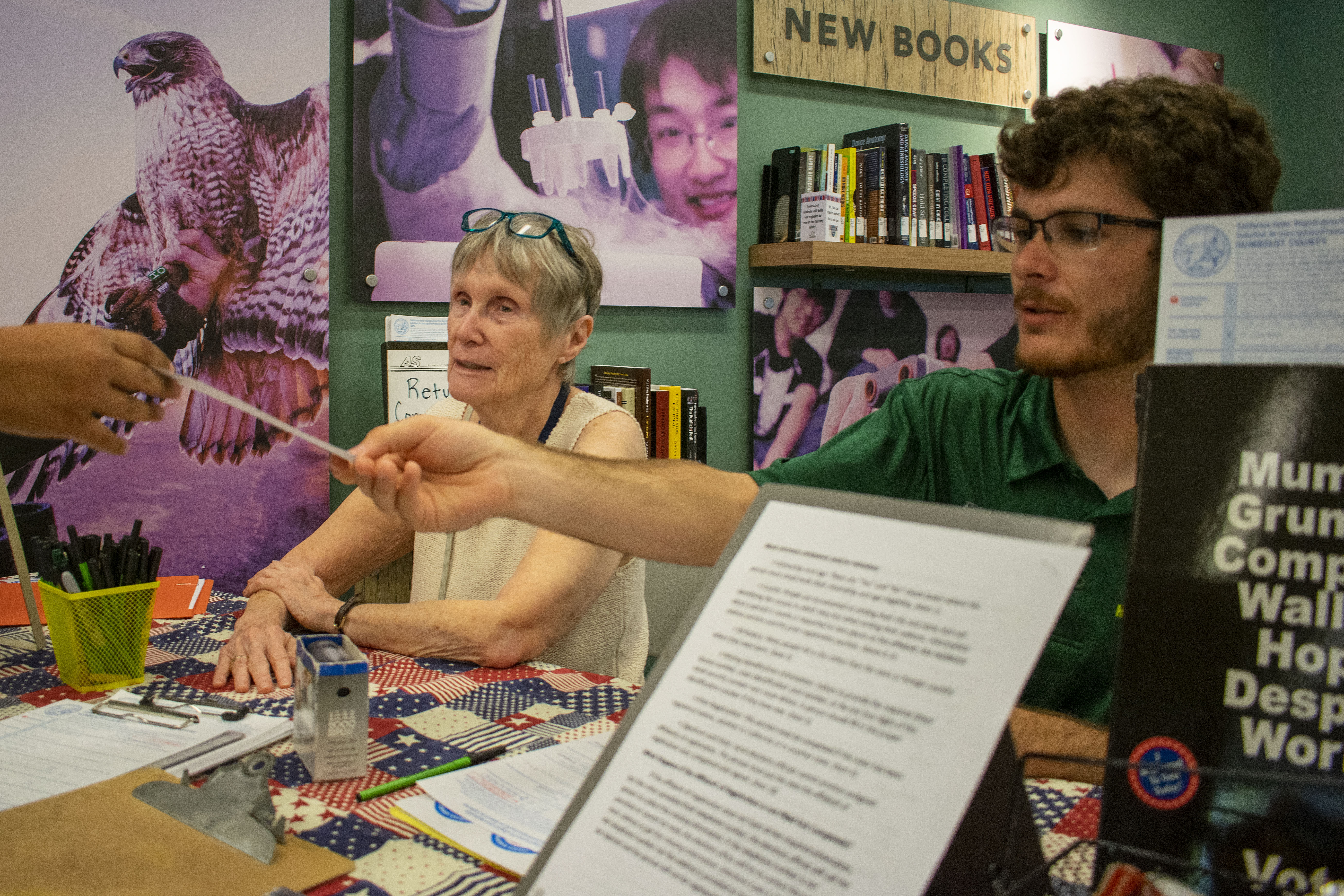
Representatives working with Humboldt’s League of Women Voters tabled at the Humboldt State University library on Tuesday for National Voter Registration Day.
With national elections just around the corner, Vincent Thomas, environmental resources engineering senior and receptionist for Associated Students, urged library visitors to register.
“Voting gives you the right to complain about what’s going on,” Thomas said. “If you don’t vote, you can’t complain.”
Beside Thomas sat Margaret Augustine, a 20-year-old Eureka resident and member of the League of Women Voters. Augustine simply wanted to provide students with information on how to vote.
“It’s non-partisan,” Augustine said. “We just get people to vote and express their opinion.”
According to National Voter Registration Day’s website, the holiday has been held on the fourth Tuesday of every September since 2012. The holiday’s goal is simple: get people to vote. According to the site, 800,000 people registered to vote on the holiday in 2018.
The U.S. Census’ website also reports that 61.3% of U.S. citizens registered to vote in 2018, and 49% actually did so.
The lowest voter turnout in 2018 came from citizens between the ages of 18 and 24, at 30.1%. Voter turnout increased with age, with the highest voter turnout from citizens between 65 and 74, at 65.6%.
Thomas emphasized that voting gives citizens a voice.
“Just getting people to register to vote so they have that option to vote if they need to is very important,” Thomas said. “We want to get as many people to have their voices heard as possible.”
At midday on Tuesday, Thomas said around a dozen individuals had registered.
“Most of the students who have come by said, ‘yeah, they’ve already got it done,’ which is pretty good,” Thomas said.
Thomas said registering only takes about five minutes. Outside of National Voter Registration Day, a prospective voter can register at their local election office or online at Vote.gov, an official website of the U.S. government that helps people figure out how to register. The nearest election office to HSU resides in Eureka at 2426 6th St.
AHS and HSU students strike to advocate for climate action
Video by James Wilde & Collin Slavey | Editing by Chelsea Wood
Anxious and irritated with the lack of governmental action against climate change, masses of young people and students from Arcata High School and Humboldt State University took to the streets surrounding the Arcata Plaza on Friday as part of the Global Climate Strike.
Inspired by the International Youth for Climate Action, the Humboldt Sunrise Movement in association with the Extinction Rebellion and students of AHS organized and executed the local school strike protesting climate change.
Students were excited to show how strong their voices could be when used in unison. Maddie Marriott, a member of Extinction Rebellion, said the organization was aimed at gathering people for peaceful protest and that is what they hoped to achieve.
Maddie Marriot stands out in the crowd of demonstrators as she walks down I Street on Sept. 20. | Photo by Collin Slavey
Locals with an interest in helping the environment and pushing the government toward action participated in the youth strike too. | Photo by Collin Slavey
Maddie Marriot and Vanessa Argonza march down I street, shouting out chants and slogans on their way to the plaza. | Photo by Collin Slavey
“We dance, yell, sing and chant to show our energy,” Marriott said. “This shows we are cheerful and hopeful and happy in the face of this threat. It is rejuvenating and these friends are empowering. Now we have to wait and see if our voice is being heard.”
Marriott ended up agreeing to hold a sign that said “Protect Rainbow Ridge, our forests and our climate.” Ecological protection is one of the main goals of the movement, but Extinction Rebellion as a national organization demands governments tell the truth about climate change and act now to prevent species loss and lower greenhouse gas emissions.
Vanessa Argonza, a Humboldt State student and member of the Extinction Rebellion, said speaking out and advocating for action is important. Change requires people to care and be passionate about an issue, while also realizing we can come together to create change.
Members of the Extinction Rebellion stand and watch the demonstrations on Sept. 20 in the Arcata Plaza. | Photo by Collin Slavey
Creative signs were a centerpiece to the demonstrations. | Photo by Collin Slavey
Maddie Marriot walks down I Street on Sept. 20 on her way to the Arcata Plaza. | Photo by Collin Slavey
Demonstrators gather in Arcata plaza, carrying with them a blow up planet earth. Hundreds of people were in attendance. | Photo by Collin Slavey
Signs help spread messages aiming to educate and advocate for action. | Photo by Collin Slavey
Vanessa Argonza leads the crowd of young people standing against climate change on Sept. 20. | Photo by Collin Slavey
“In moments of injustice you must speak out because if you do not, you are part of the problem,” Argonza said. “The youth is well aware and willing to be part of the change because it affects them. We can come together and make change. You just have to be aware of your footprint and educate yourself before you speak out.”
The protest did run into some technical issues as it spilled out into the Arcata Plaza. Unfortunately, the strike organizers failed to bring a speaker system that was loud enough for all of the attendees to hear, causing the message to fall flat. Joanne McGarry, a local supporter of the Environmental Advocacy and self-prescribed ‘gadfly’ suggested better planning in the future for a more impactful demonstration.
Jene L. McCovey delivers a powerful, emotional speech about the threats to the Earth faces. | Photo by Collin Slavey
“I am more than happy to let young people lead, they just have to lead well,” McGarry said. “Having music is important when you’re walking into the plaza, during the demonstration and as you exit the plaza. Having a speaker that is loud enough for the entire crowd to hear is unbelievably important.”
The Sunrise movement was originally created as a youth advocacy group to show support for the Green New Deal, a stimulus package proposed by politician and activist Alexandria Ocasio-Cortez in February of this year. The Sunrise Movement intends to work within ‘the system’ while actively changing the system, in pursuit of environmental and social justice through nonviolent and direct action. They are building an army of young people to stop climate change and create millions of good jobs in the process.
Tribal elder Jene L. McCovey began the rally in the plaza with a song called “Feeling Sorry for My Womenfolk,” a somber tune that spoke of hate and woe. She went on to tell stories and sing more songs to give purpose to the actions of the demonstrators.
“The stumps are really big- that is all we have left of the old forest,” McCovey said. “Clear cutters, defilers, denude the land down to the earth and they burn it. Wherever you find your trials, be that healer. Be that person that walks with people in that good way. Be the water protectors.”
Humboldt State’s Budget Committee seeks best path forward
Humboldt State University’s University Resources and Planning Committee met on Sept. 12 to begin planning a three-year university budget.
Art Education Assistant Professor and Co-Chair of URPC James Woglom said URPC hopes for a budget that will allow HSU to be its best.
“My hope is to have the best university we can be in the context of what we have,” Woglom said. “I think that is the hope of everybody involved.”
URPC exists as part of the University Senate, with 14 members, including administration, faculty and students.
URPC released an update on Sept. 16 in which it estimated a $5.4 million budget gap by the fiscal year of 2021 to 2022.
HSU Budget Director Amber Blakeslee said HSU has already made over $10 million of budget reductions in the last few years. The $5.4 million projected gap comes from the continuing decline in student enrollment.
Assistant Professor of Art Education and Co-Chair of the University Resources and Planning Committee James Woglom in the HSU library on Sept. 20. Woglom emphasized the need for imaginative thinking to create the best budget possible for HSU. | Photo by James Wilde
“If there are less students on campus there’s less tuition coming in the door,” Blakeslee said. “So it’s not that all-of-the-sudden we’re spending more. It’s that there’s less revenue coming in to support the spending that we have.”
HSU’s enrollment dropped from 7,774 to 6,763 students this year. Projections expect enrollment to continue to drop. HSU has yet to update its website, which still lists 7,774 students enrolled and advertises having over 8,000 students.
HSU issued a press release on Tuesday, Sept. 24 detailing new efforts to increase enrollment, including a focus on local recruitment, improving student analytics and decreasing costs.
However, Blakeslee said that HSU’s plans to recover enrollment numbers will take time. Until then, the budget gap must be reconciled.
Blakeslee hoped the budget cuts won’t have an impact on students, but Blakeslee acknowledged that any cuts will be difficult.
“There’s not a single thing we do on this campus that doesn’t have strong, passionate people behind it,” Blakeslee said. “If you’re talking about cutting things, you’re talking about the difference between multiple good things.”
“If there are less students on campus there’s less tuition coming in the door. So it’s not that all-of-the-sudden we’re spending more. It’s that there’s less revenue coming in to support the spending that we have.”
Amber Blakeslee
At this early stage, neither Blakeslee nor Woglom could rule out any specific cuts.
“We do need to have everything on the table in terms of our discussion so that we can make the best decision,” Woglom said.
Woglom emphasized multiple times that URPC will have to use its imagination to maintain HSU’s educational mission while cutting back financially.
“We do need to be creative within the context of the resources that we do have,” Woglom said. “If a course is not offered, how do we make sure that the curricular needs of the students is met with what we do have?”
Blakeslee said that while HSU is currently reducing expenditures, it is still trying to improve the student experience.
“There is simultaneous new investment happening, so it’s not like we’re just in a reduction mindset purely” Blakeslee said.
URPC expects to complete a plan by Dec. 6. Before then, both Blakeslee and Woglom emphasized the importance of seeking input from the HSU community.
“As much stakeholder input as we can get, the better our decisions are going to be, and the more interpersonally-invested we’re going to be,” Woglom said.
Blakeslee and Woglom said URPC will be holding public forums to discuss the budget, but no dates have been set.
Once URPC finalizes its plan in December, the plan will go to University President Tom Jackson, Jr., who will have the final say over the plan.
This article was updated Sept. 26 to include information from Humboldt State’s press release on the topic.
It’s not just Humboldt State that has a parking issue
Arcata’s Transportation Safety Committee held its monthly meeting on Tuesday, in which they opened up for public comment on city parking restrictions.
Netra Khatri, staff liaison of the committee and Arcata assistant city engineer, thanked the small crowd of about ten locals gathered in the City Council Chamber of Arcata City Hall.
“We decided to make this meeting annual three years ago, where we can take public comments and hopefully make changes from input,” Khatri said.
After discussing minutes from a previous meeting, the committee of eleven opened the meeting for public comment.
The comments varied in severity and scale, but revolved around one central theme: the city of Arcata lacks sufficient parking.
Arcata resident Vernon Price proposed a plan to allow some Arcata citizens to park their cars freely from dusk til dawn. Price said he was unhoused for 15 years, and wanted the committee to keep the homeless in their hearts and minds.
“There are people who have lost their homes, and their only tangible property is their homes—and they live in those,” Price said.
The committee noted Price’s suggestion and promised to look into designating overnight parking spaces.
Arcata resident Collin Wingfield brought to attention a parking overflow resulting from the recent construction of the 142-apartment Sunset Terrace complex located between Sunset and Foster Avenues.
Wingfield, who said he lives on Wilson St., just off of Sunset, has noticed an influx of Sunset Terrace residents parking their vehicles along Sunset Ave. and even on his street.
Even though Sunset Terrace residents are allotted one parking space in their complex, Wingfield said residents often park their cars along Sunset Ave., leaving other homes with insufficient parking.
“They will leave their cars parked for weeks at a time,” Wingfield said.
The committee sympathized with Wingfield and discussed possibly issuing parking permits for Sunset Ave. residents.
Arcata Library Branch Manager Susan Parsons brought to attention a lack of parking for library visitors. Parsons said parents with children often have to walk through a lot marked by uneven terrain and frequent drug users.
“Parking for visitors of the library is an issue of safety,” Parsons said.
In response, the committee suggested designating specific parking spots for the library or enforcing time limits on the spaces outside of the library to prevent them from filling with non-library visitors.
Tisha Farrer, an employee of the North Coast Co-Op, urged the committee to get rid of parking meters and two-hour spaces. The Co-Op, Farrrer said, reserves its lot for customers only and employees often have to park far away.
“I just want them to feel safe and have parking where they work,” Farrer said.
The committee noted Farrer’s concerns while making clear that Arcata’s parking shortage comes at a tricky time as the city tries to encourage the reduction of personal vehicular use to reduce greenhouse gas emissions.
TSC will now take the public comments and bring their recommendations to the Arcata City Council on Oct. 16. TSC meets the third Tuesday of every month at the City Council Chamber.
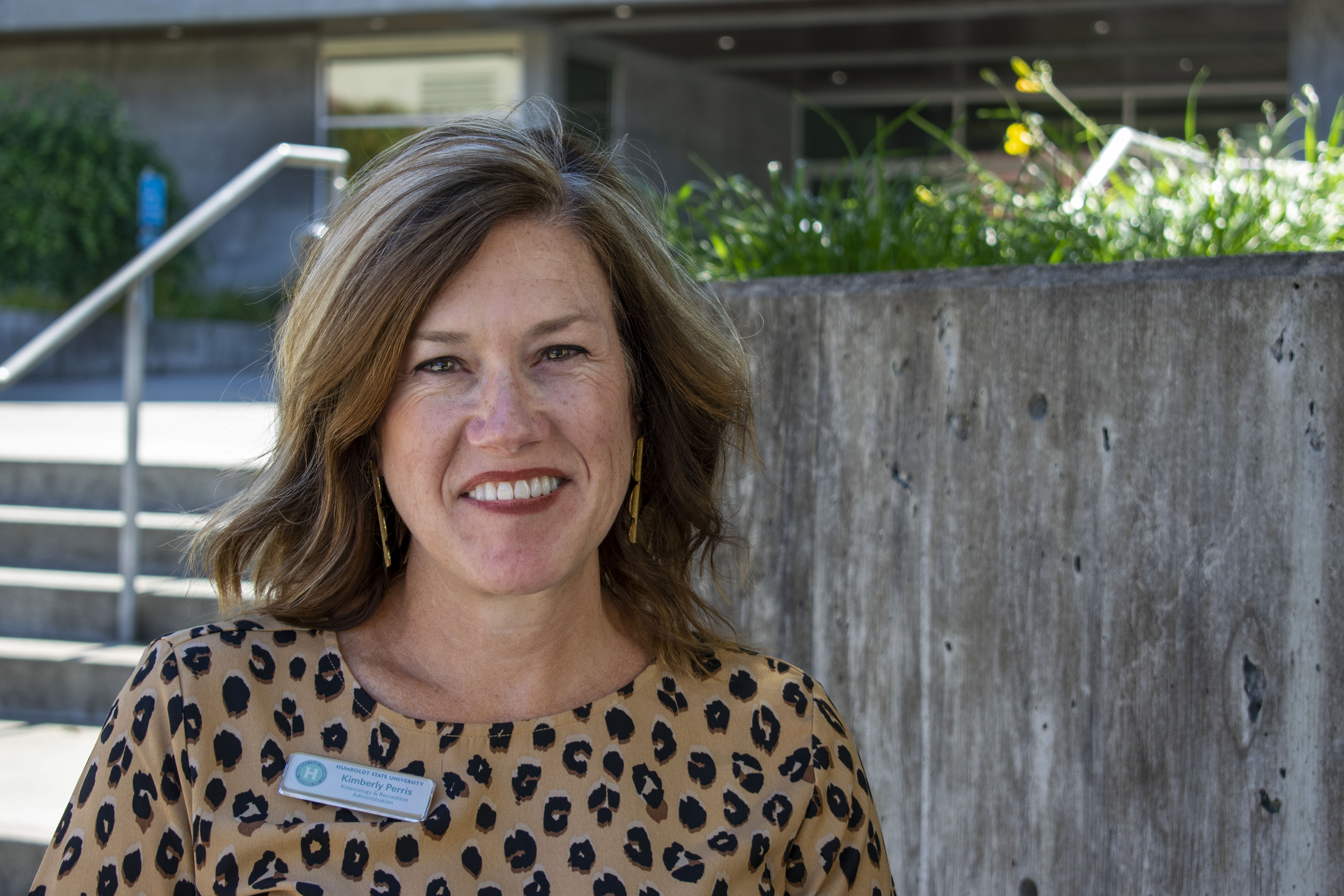
Dr. Kimberly Perris leads the reestablishment of HSU’s bachelor of science in nursing program
Four weeks into the job, Humboldt State University’s nursing program Director Kimberly Perris has started putting the pieces in place to reform HSU’s bachelor of science in nursing program.
Perris said she wants to empower local nurses to fill empty leadership roles in local health services.
“My excitement, what I’m hopeful for and why I’m grateful to be here is because I really envision a role for nurses where they can go beyond the hospital walls, work in team-based care models and just take on more autonomous roles,” Perris said.
Director of Special Projects and Executive Director of HSU’s California Center for Rural Policy Connie Stewart at HSU on Sept. 14. Stewart, an HSU graduate and former Arcata mayor, believes HSU’s BSN program will be essential for Humboldt County’s future. Photo by James Wilde.
HSU canceled its BSN program in 2011, citing a lack of funding and qualified faculty. After years of a lack of BSN-educated nurses, HSU is relaunching the BSN program with the help of a $2 million dollar grant from St. Joseph Health.
Director of Special Projects Connie Stewart leads the California Center for Rural Policy, an HSU program designed to improve rural communities. Stewart currently oversees fundraising for the BSN program, and she hinted the receiving of more than just the St. Joseph Health grant.
Stewart, a former Arcata mayor who has served the community for more than thirty years, said that Perris is perfect for the job.
“She’s got really great, fresh ideas about how to improve health care in Humboldt County,” Stewart said. “I couldn’t be more excited to be working with her.”
Stewart emphasized the importance of the BSN program not just for Humboldt County, but for HSU. HSU students and faculty, Stewart noted, need healthcare too.
“I’m grateful that we can provide the opportunity for nurses to expand on their education—I know for me it was life-changing to do that.”
Kimberly Perris
“This program has to be successful in order for HSU to thrive,” Stewart said.
Perris dabbled in health-related fields in her youth, where she said she picked up a passion for helping and educating patients.
Perris graduated with an Associate of Science in Nursing in 1991. She worked in family planning before she worked at the HSU Student Health Center from 2004 to 2016 as a nurse, a job Perris said she loved.
“I loved the education piece of it,” Perris said. “Working there is where I really decided to go back to school, and I saw a role for nurses that could be a little bit more fulfilling and autonomous and help improve access to care.”
Perris earned a Doctor of Nursing Practice Executive Leadership from the University of San Francisco in 2018. Perris said she’s driven to give other nurses the same educational opportunities she had.
“I’m grateful that we can provide the opportunity for nurses to expand on their education—I know for me it was life-changing to do that,” Perris said.
HSU’s BSN program is designed for already-registered nurses who want to further their education. Perris said this will allow nurses to become more involved with the community and work outside of hospitals.
HSU’s new BSN nursing program director, Kimberly Perris. Perris is working towards a goal of graduating 50 nurses from the BSN program by 2022. | Photo by James Wilde.
The program’s goal is to graduate 50 nurses in 2022, with 25 students entering a part-time, two-year program in 2020, and another 25 entering a full-time, one-year program in 2021.
Perris said she’s developing relationships with local health centers for BSN nurse roles. She’s also working to make the transfer process from College of the Redwood’s RN program seamless.
CR’s Director of Nursing and Health Operations Roberta Farrar echoed Perris’ hopes.
“My hopes and goals would be to see each class filled to capacity with a waitlist of those wanting to enter the program,” Farrar said in an email. “That the registered nurses who choose Humboldt State are satisfied with their education and use knowledge gained to make necessary changes in any healthcare setting they are employed.”
Both Farrar and Perris said the program won’t bring more nurses to the community, but will instead give more opportunities to nurses in the area, enticing them to stay in Humboldt.
“We have a struggling health care system right now and I think nurses are one of the missing pieces that can help to improve that… The missing links.”
Kimberly Perris
“A lot of nurses leave the area because they want to continue their education or there aren’t the kind of positions that they’re looking for,” Perris said. “So this role will provide more nurse leaders for the community and nurses to have more of a systemic look at the population.”
While Perris said she has felt overwhelmingly supported in her first few weeks, she did acknowledge the pressure of her position.
“I feel pressure because I want this to be successful,” Perris said. “And I want to make sure I have all the details in place to keep moving it forward and not let anything fall in through the cracks.”
Despite the pressure, Perris said she doesn’t have any significant fears.
“There will be likely a little series of things that don’t work, and that’s normal in a new project,” Perris said. “I’m sure there will be some hopefully-just-mini failures because this is a brand-new program, but that’s okay.”
Long-term, Perris said the BSN program will help nurses have a broader understanding of the community and its healthcare needs.
“We have a struggling health care system right now and I think nurses are one of the missing pieces that can help to improve that,” Perris said. “The missing links.”
No pee, hair or spit. One blow is all it takes to show marijuana intoxication levels with new breathalyzer.
Marijuana has been a touchy topic since Colorado and Washington made their first moves to legalize recreational use in 2012. Since then, 29 states have followed and declared marijuana legal for medicinal and/or recreational use.
Tension forms at the discrepancy between state and federal opinion on where marijuana falls legally as a drug. The lack of legal confirmation from the federal government makes it difficult for government employers, especially police officers, to execute and process circumstances surrounding marijuana intoxication. Recent developments in marijuana detection technology suggest a breathalyzer is in the works.
Current marijuana testing requires a hair, urine or blood sample. The test results detect past use up to six months and reports the current THC level in the body. This testing proves to be unreliable as past use of marijuana will distort a current reading of bodily intoxication, which is what law officials care about.
The two technology companies racing to release their version of a more accurate breathalyzer are Hound Labs and SannTek.
Hound Labs was established five years ago and is leading the race with an expected release of late 2020. The Hound Labs breathalyzer operates on a specified time basis. It can detect marijuana if it’s been used in the last three hours. The three-hour window comes from two findings; one, marijuana is only detectable for the first three hours. Afterward, THC levels drop so low and so fast that it becomes virtually undetectable. Second, the initial three hours of intoxication are the most impaired and therefore the most crucial.
The breathalyzer method proves to be more accurate and better suited for law and medical officials, as alternative testing can take hours to produce results. In addition, this method is also beneficial to the participant, as the regulated three hour time interval doesn’t hold participants liable for past usage beyond that time frame.
If this new testing method becomes normalized, the three hours prior to testing will be the most critical, but anything before those three hours is merely tangential. Ideally, someone tested for their marijuana use could not be held liable for their marijuana use prior to the that three-hour window because the breathalyzer would not be able to detect it.
The opposing company, SannTek, and their breathalyzer the SannTek 315 will operate similarly to the Hound Labs breathalyzer. SannTek 315 is still in early development so the company is not providing much information. Like Hound Labs, their product will utilize a time interval to reveal the last ingestion of marijuana and current intoxication.
Hound Labs conducted clinical testing in 2017 in cooperation with University of California, San Francisco. However, no findings have been concluded publicly due to the small sample size. SannTek 315 lacks any formal testing or trials at this time.
El Centro event welcomes and connects Latinx students and community members
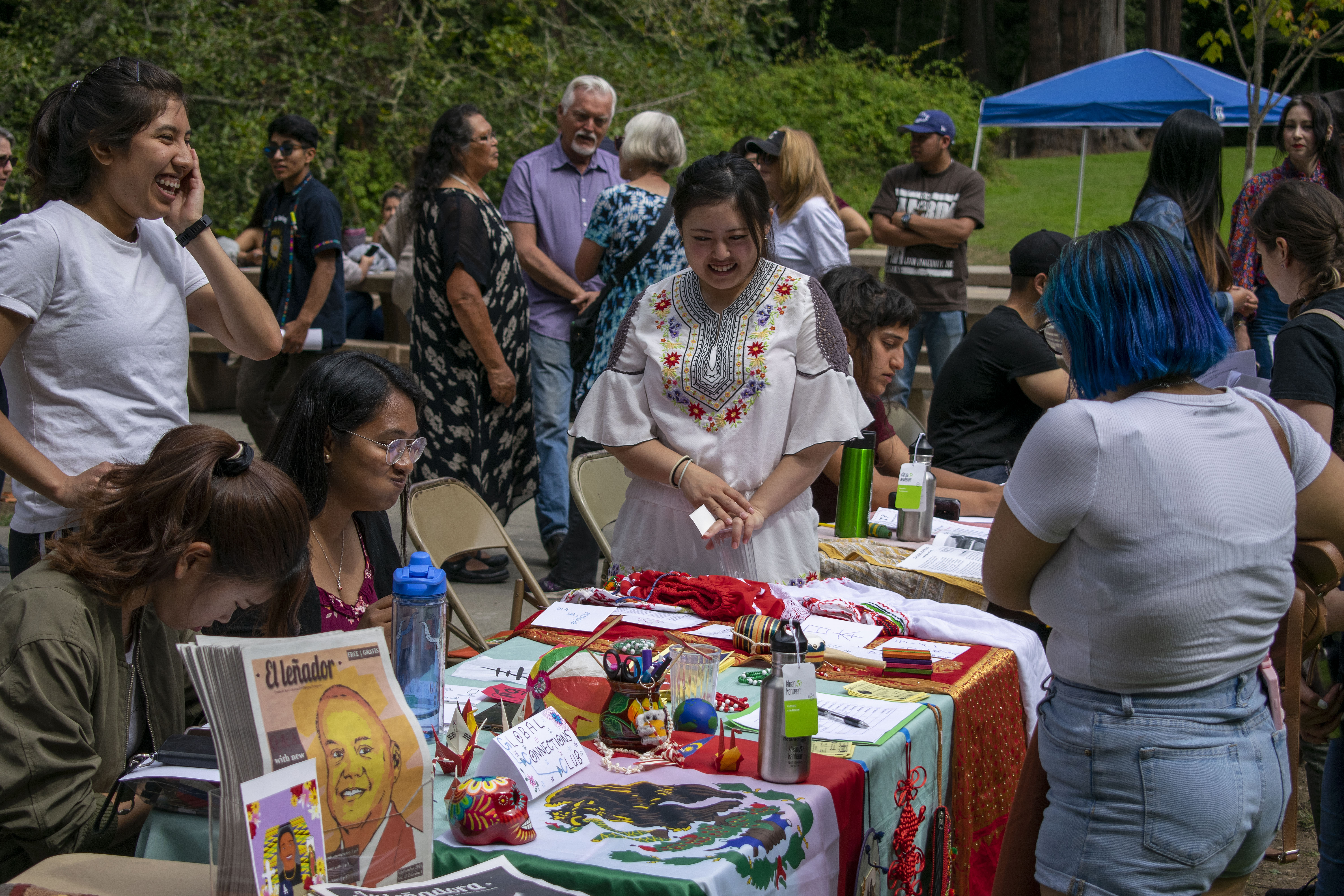
Music and cheerful chatter filled Arcata’s Redwood Park on Sunday as Humboldt State University’s El Centro Académico Cultural held its Convivio de Bienvenida, a convivial welcoming event.
Ritz Garcia, a junior and critical race, gender and sexuality studies major and liaison for El Centro, said he has loved being a part of El Centro.
“It’s made me feel like family,” Garcia said. “Like there’s somewhere I belong.”
Ritz Garcia, junior critical race, gender and sexuality studies major, at the Convivio de Bienvenida on Sept. 15. Garcia is a liasion for El Centro. | Photo by James Wilde
The gathering served as an opportunity for Latinx students, families and community members to convene and connect with one another.
Resource centers from HSU and the local community offered information on a wide range of topics that included parenting lessons, food pantries, housing insecurity, drug addiction recovery, communication with law enforcement and the expansion of diversity in the community.
Meanwhile, children played in the grass and members of Latino Outdoors led hikes into the surrounding redwoods every 30 minutes.
Daniel Gallardo, vice president of LatinoNet and coordinator for the Assisting Families to Access Change Through Resources Americorps program, hoped to connect attendees with community offerings.
“There’s a perception of Humboldt not having a lot of resources,” Gallardo said. “We’re trying to debunk that.”
Gallardo emphasized that resources for the Latinx community are available in Humboldt but can be difficult to access. Gallardo urged students to join the AFACTR program, which has a goal of preventing child abuse in Humboldt County. AFACTR awards up to $10,000 per year in services.
Jorge Matias, health educator for St. Joseph Health, pushed table visitors to check out health classes offered in Eureka and Fortuna. Matias promoted a Zumba class for physical health but also emphasized the importance of mental health.
Vice President of Latinonet and Program Leader at Americorps Daniel Gallardo at the Convivio de Bienvenida, a Convivial Welcome from HSU’s El Centro Académico Cultural on Sept. 15 at Arcata’s Redwood Park. Gallardo hopes to make resources more available for the surrounding community. | Photo by James Wilde
“We want to get rid of the stigma with mental health,” Matias said.
Before rain clouds crept in, attendees enjoyed a free lunch alongside a brief mariachi performance. A table for Adventure’s Edge offered raffle tickets for two new backpacks while another table for Equity Arcata offered information on housing, employment and education.
El Centro intentionally designed the event with inclusivity in mind. El Centro, which was previously known as the Latinx Center for Academic Excellence, changed its name to better represent those it serves.
Lunch at the Convivio de Bienvenida, a Convivial Welcome from HSU’s El Centro Académico Cultural on Sept. 15. The event, held at Arcata’s Redwood Park, had free food for all attendees. | Photo by James Wilde
“Not everybody identifies as Latinx,” Garcia said. “El Centro sounds more inviting.”
HSU’s Hispanic Serving Institutions STEM grant, a $3.9 million U.S. Department of Education gift spread over five years, from 2016 to 2021, funded the event.
Each table offered its own brand of services focused on improving the local community. Bertha de la Cruz, a representative for Food for People, sought to connect attendees with free food resources.
“There’s tons and tons of food,” de la Cruz said. “I wish I would’ve known all of this as a student.”
Devon Hernandez, academic and career adviser, helmed a table for HSU’s Academic and Career Advising Center.
Academic and Career Advisor Devon Hernandez at the Convivio de Bienvenida, a Convivial Welcome from HSU’s El Centro Académico Cultural on Sept. 15 at Arcata’s Redwood Park. | Photo by James Wilde
“We’re here to make sure students have the resources they need,” Hernandez said.
For attendees of the Convivio de Bienvenida, resources appeared abundant. More information on El Centro and their upcoming events can be found in room 205 of Nelson Hall East or on their website which is still branded as the Latinx Center for Academic Excellence.
HSU chatbot introduced to new students to answer campus questions
This fall, Humboldt State University introduced artificial intelligence chatbot HumBot to provide basic information for new students and transfers.
Director of Communications and Marketing for Enrollment Management Josh Smith led the project over the last two months until its release.
Thus far, HumBot has received more than 1000 questions and comments.
“There is a good chance that those questions may not have been asked if that avenue was not available to them at the time,” Smith said. “We get them at all hours of the day.”
Provost and Vice President of Academic Affairs Alexander Enyedi initially pushed for the development of a chatbot two years ago after hearing about a chatbot at Georgia State University. Pounce, the name for GSU’s chatbot, delivered more than 200,000 answers to incoming freshman within the first few months of its implementation in 2016.
Enyedi, with help from Smith and Associate Professor of Social Work Jen Maguire worked together to create HumBot.
“I’ve been a passionate proponent for the chatbot technology for over two years,” Enyedi said in an email.
HumBot is one chatbot among seven within California State Universities. AdmitHub, an AI chatbot service designed for students, developed all seven chatbots.
HSU created HumBot in the last two months after receiving an $80,000 grant from the Irvine Foundation.
AdmitHub handed over HumBot pre-seeded with answers to the 700 most common questions asked by first-year students. HSU then needed multiple departments to analyze the answers.
“It was started off by everybody just going in there, reading all the questions and answers, and first making sure that it was accurate, and second, trying to make it a little bit more friendly,” Smith said.
HSU staff and summer students then seeded HumBot with an additional 150 questions before it was released this fall. HumBot will continue to learn as students interact with it.
HumBot responds to fisheries transfer student Matthew Howe on Sept. 3. HumBot has answers to over 850 questions so far. | Photo courtesy Matthew Howe
“That is going to be an ongoing, multi-year, get smarter each time kind of thing,” Smith said.
Associate Professor Maguire is conducting research through the bot and Smith said she has been shaping HumBot to address issues specific to HSU. Maguire could not be reached for an interview.
“She is kind of the intellectual arm of the chatbot,” Smith said. “She and her colleagues are seeding the knowledge base of the chatbot with questions that relate to housing insecurity, food insecurity—HumBot is still learning those things, but it is our particular brand.”
Transfer fisheries student Matthew Howe used HumBot to find out where to pick up his mail. Howe admitted to being surprised by how well HumBot worked.
“I thought it worked fairly well,” Howe said. “I was expecting it to not perform at all. I was surprised at how well it did work.”
Howe said he would use HumBot again, although he doubts he would ask it anything personal.
Smith noted that questions sent to HumBot can be viewed by the project staff. HumBot is unlikely to be helpful for personal matters, although with the possibility of endangerment HumBot can notify university police.
Smith hopes HumBot can play an important role in the modernization of HSU’s accessibility.
“I would just encourage students to kind of re-look at those things that maybe they don’t know about or maybe weren’t up to par with a couple years ago,” Smith said.
For now, HumBot is only available to new students, but it is expected to roll out for second and third-year students next fall.
Humboldt County firefighters, community members and HSU students walk HSU’s Founders Hall stairs in honor of those who died at the World Trade Center on Sept. 11, 2001.
Arcata Fire Disctrict Battalion Chief Sean Campbell’s gear and water bottle sit by the base of the Founders Hall stairs on Spetember 11 as Arcata Fire Department prepares to walk 20 flights of stairs in memory of those who lost their lives at the World Trade center.
Arcata Fire Captain Luke Walker walks with his wife Sinei and their daughter Lina on Spetember 11 in remembrace of those who lost their lives at the World Trade Center.
Humboldt County firefighters, Arcata Police officers and community members walk 20 flights of stairs at Founders Hall in remembrance of those who lost their their lives at the World Trade Center on September 11.
Arcata firefighter Russell Kadle makes his way up the Founders Hall stairs with a New York hook on September 11 in honor of those who lost their lives at the World Trade Center.
Arcata Fire Disctrict Battalion Chief Sean Campbell (Center) walks up the Founders Hall stairs while others head down in remembrance of those who lost their lives at the World Trade Center on September 11.
Public Information Officer Amy Conlin and James Hamilton walk up the Founders Hall stairs on September 11 for Humboldt Bay Fire and Cal Fire Del Norte Unit repectively in remembrance of the firefighters and civillians who lost their lives at the World Trade Center.
Volunteer with Kneedland Fire Ruger West walks up the Founders Hall stairs on Spetember 11 in remembrance of those who lost their lives at the World Trade Center.
HSU president Tom Jackson cariers an oxygen tank while walking with firefighters and community members on September 11 in recognition of those who dies at the World Trade Center.
Kneeland Fire Captain Everett Buell makes his way up the Founders Hall stairs on September 11 in honor of those who lost their lives at the World Trade Center.
Arcata firefighter Luke Walker gives a brief speech about walking in remembrance on those who lost their lives at the World Trade center as firefighters from around Humboldt County and community members prepare to walk 20 flights of stairs on September 11.
Students from Arcata Christian School wave American flags as firefighters and community members walk up and down the Founders Hall stairs on September 11 in honor of those who lost their lives at the World Trade Center.
HSU to repurpose Trinity Annex building into larger Children’s Center with $8.6 million grant
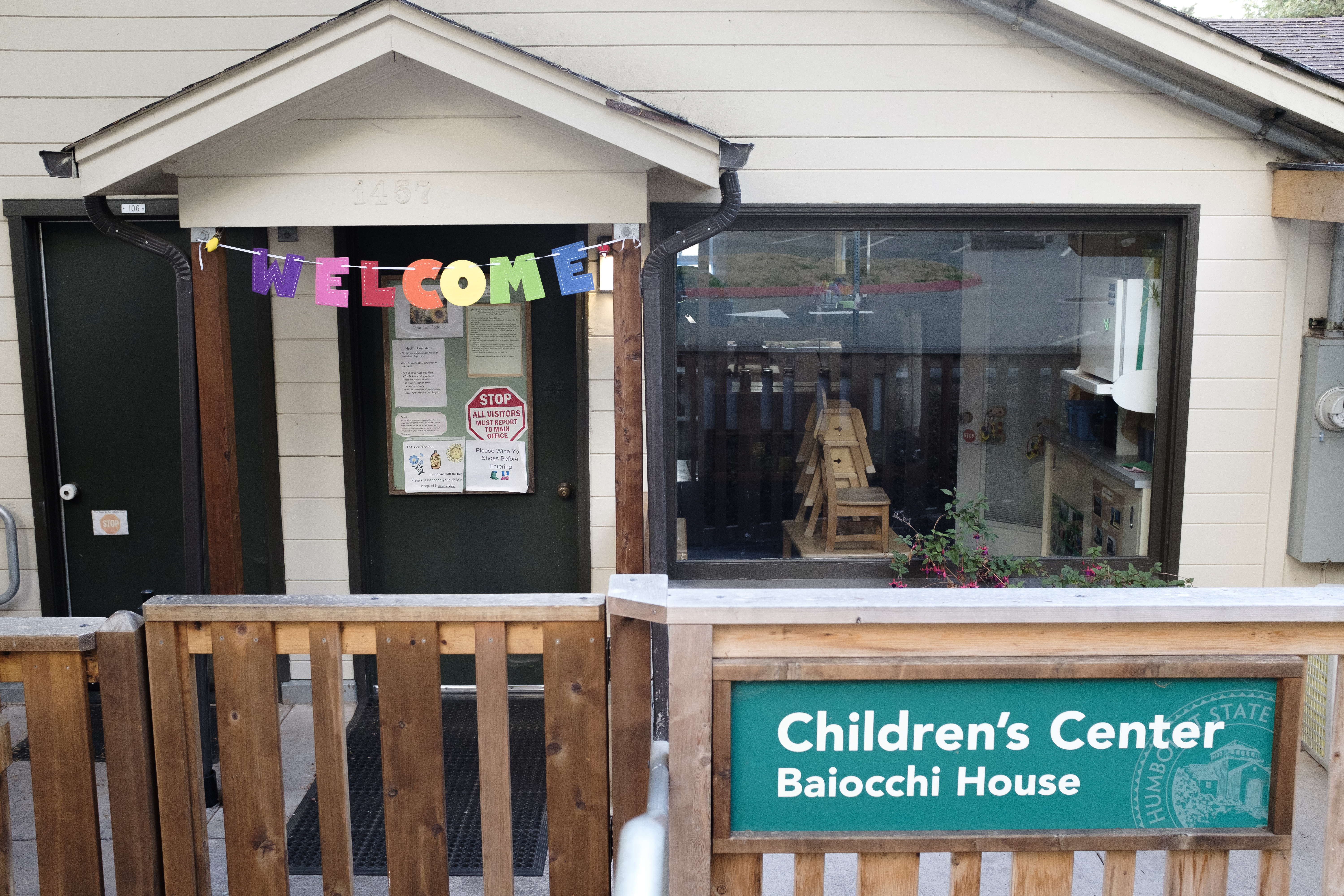
Starting this semester, Humboldt State University will begin to redesign the Trinity Annex building at the corner of 14th and B streets into an updated facility to house a new Children’s Center. The current Children’s Center facility will continue child services until it moves in 2021.
“We want folks that are going to be in the building to give feedback as to what it should look like,” HSU Associate Vice President of Student Success Steven St. Onge said.
St. Onge, who oversees the Children’s Center, said the design phase of the new building will explore increased space, updated playgrounds, manipulative toys, dynamic crawling textures and additional infant care. The education program will not change, but the physical space will be improved.
The staff responsible for the design held a recent meeting to develop ideas for the ideal facility. Staff will meet again later this semester to draft blueprints.
The Children’s Center Administration building is located above the Children’s Center. | Photo by Michael Weber
“I think we’re switching from the facility impacting the program—to the program impacting the facility,” St. Onge said. “Which I think is a good step forward.”
The redesign is funded by an $8.6 million allocation to HSU from a statewide grant for California State Universities. Betty Wilson, Children’s Center Program Director said the facility is limited by its budget.
“We are constantly searching out new funding streams to help create better experiences,” Wilson said in an email.
The Children’s Center daycare and education programs are regularly funded by Associated Students (both state and federal grants) and the university itself. This one-time grant will allow for a new facility.
“There are 86 students in the Children’s Center, about 60% are children of HSU students. The rest are a combination of faculty, staff and community members’ children.”
Steven St. Onge
The current buildings that house the Children’s Center have reached maximum capacity for the number of children.
“Right now, we’re limited by what the facility can give us,” St. Onge said. “The room size dictates how many children can be in a room, as well as the staff ratio.”
The sign-up process for the programs begins with a wait list that prioritizes current HSU students.
“There are 86 students in the Children’s Center, about 60% are children of HSU students,” St. Onge said. “The rest are a combination of faculty, staff and community members’ children.”
Infant care is the most demanding service the Children’s Center provides because they require more attention than toddlers. St. Onge said the ratio of care for infants compared to toddlers is three to one.
“It’s harder to find someone who will watch infants,” St. Onge said. That’s probably the largest wait list in that particular room.”
Bikes are parked in one of the playgrounds of The Children’s Center on Sept. 9. The playground sports multiple textures for kids to walk on. | Photo by Michael Weber
According to St. Onge, the new facility will improve operational efficiency. Currently, there are five buildings housing five different age groups. Each building has its own space, equipment and toys for its respective age group. The new facility will consolidate these spaces, improving efficiency.
St. Onge said the design phase will be tied closely to the childcare and early education programs. The Children’s Center and St. Onge did not explicitly state ways the recent grant will benefit the children and parents of the program. St. Onge said the academic aspect of the Children’s Center will remain the same.
“I think it’s exciting for the younger kids that will experience that new facility,” St. Onge said.
One main function of the Children’s Center is to provide a place for students, faculty, staff and community members to drop their kids off when they are busy at school or work.
According to Humboldt State Now, a recent survey conducted by the Campus Center for Rural Policy found that childcare improves student retention rates and work environments. Wilson said that the Early Head Start Grant allows parents to spend more time on schoolwork.
A Harbert Roofing truck parked at the Humboldt State University Annex on Sept. 9, 2019. The Annex will be refurbished into a new Children’s Center. | Photo by Michael Weber
“Family Service Coordinator Amy Pires-Moore helped to fulfill annual goals which the families create,” Wilson said. “By doing this, she is able to create a secure emotional base for the families to be able to succeed academically as some of their daily concerns can be taken care of.”
The other main function of the Children’s Center is providing care and education to the children and student workers. They are accredited by the National Association for the Education of Young Children.
The NAEYC website says, “The accreditation process provides a framework for self-study, external evaluation and improvement in the quality of teacher preparation programs.”
And yes, you can walk between Laurel Dr. and the library again
Lined with ground marks, gravel, orange fencing and machinery, the parking spots of Laurel Drive are no longer accessible to staff and students. Where a tree surrounded by brick once stood, now lies a sectioned-off zone where two workers constructed a new pathway.
Over the summer, Humboldt State staff and students received several updates about on-campus infrastructure arrangements including general maintenance, building renovations and repaved roads. Humboldt State Project Manager Michael Fisher said these updates are part of a large list of planned and required maintenance.
The pathway from the library to Laurel Drive is open as of August 20. | Photo by Michael Weber
Parts of Laurel Drive are now closed off for this construction. On the bright side, the Theatre Arts building is now open since its closure in 2018 and will hold classes this semester. The pathway from the Library to Laurel Drive is now open as well. Gist Hall is also open as of August 12 after the asbestos contamination discovered last Spring.
Starting this semester until December 2019, Laurel Drive and Library handicap parking spaces, as well as pathways, will be redone to provide a path of travel to the Theater Arts Building and Library, respectively. The new path for wheelchair access from Laurel Drive will start at new handicap spaces and lead to the elevator in the Theatre Arts Building.
Notable projects finished over the summer include Wildlife and Fisheries Building roof replacements, repaving of the Library Circle and LK Wood Boulevard left turn, six HVAC control replacements, housing maintenance, refurbished lecture halls, a new elevator in the Natural Resources Building and the near-completion of the Theatre Arts and Library seismic retrofits.
Part of Laurel Drive’s parking lot is excavated for updated handicap spots. | Photo by Michael Weber
Fisher also said portables in the Campus Events Field, which previously held the tutoring center and other facilities temporarily, are being moved out as the relocated tenants return home to the library.
One of the most visible changes to returning students is the repaved library circle and left turn lane on LK Wood Blvd. Fisher said this new turning lane, built in partnership with the City of Arcata, helps ease congestion and improve bus route times.
Less noticeable improvements are general “building system” updates in HVAC, electrical, plumbing and structural.
“Every component of our built environment has a life cycle,” Fisher said. “That includes streets, roads, sidewalks, our buildings, and our building’s infrastructure.”
Administration rehires union protected station broadcast engineer
Humboldt State University has rescinded the lay off of one KHSU employee out of the seven laid off in April.
Kevin Sanders, a full-time employee who primarily works in Information Technology Services was rehired after his union, the California State University Employees Union, pushed back against the university. Sanders was and is the National Public Radio affiliate’s only broadcast engineer.
“Kevin is employed, working mostly in the Information Technology Services area, but is available to assist with broadcast engineering for KHSU if the need arises,” HSU Communication Officer Grant Scott-Goforth said in an email.
[perfectpullquote align=”right” bordertop=”false” cite=”Steve Tillinghast” link=”” color=”” class=”” size=”18″]”Humboldt realized over the last several months that the chief engineer of KHSU is a critical employee and that the station could not operate, even in its reduced form, without him.”[/perfectpullquote]
Humboldt chapter president of CSUEU Steve Tillinghast said in a press release that HSU management did not expect the Union to care.
“Or perhaps they did not even realize that one of the employees in the group they terminated was part of a Union and that they would be held accountable,” he said. “Humboldt realized over the last several months that the chief engineer of KHSU is a critical employee and that the station could not operate, even in its reduced form, without him.”
KHSU runs with the help of Chico’s North State Public Radio station to air its programming off and on since April.
At the beginning of August HSU signed a short-term interim agreement with Capital Public Radio in Sacramento for programming assistance with KHSU Public Radio. The agreement will keep KHSU running till the end of October.
According to a press release, “the agreement allows KHSU to continue airing national and state programming as the University considers various approaches for KHSU’s future.”
HSU will be assessing ways to ensure KHSU aligns with the university’s teaching missions after an advisory audit report. The audit report, ordered by the previous HSU president Lisa Rossbacher, found the station lacking in the opportunities it was supposed to provide for students.
The report suggested that over time the station had evolved from an exclusive student training ground to primarily a community servicing station. The report said the university should assess student involvement at KHSU and determine whether or not to develop more opportunities for students through “employment, internships, academic programs and coursework.”
The advisory team did not, however, suggest laying off employees as an answer to any suggested shortcomings.
For now, the university is considering joining the discussion of a three-way regional partnership with the Chico and Sacramento stations.
This partnership could bring about certain opportunities such as a Public Service Operation Agreement, which would formalize cost-sharing for programming and management.
Structural organization was also an area of improvement listed on the KHSU audit.
HSU President Tom Jackson wants to gather input from faculty and students to learn more about their interest in KHSU before committing to anything further.
Introducing Tom Jackson Jr., Ph.D., Humboldt State’s new president
It’s not everyday you meet a university president who has the tenacious intention of changing their student body’s perspective beyond their educational experience.
Tom Jackson, Jr., Ph.D. began his incumbency as Humboldt State University’s eighth President in June 2019. In his second university president position, Jackson plans for more than just the future of the university, but also for the success of the current and future students.
“The students I want to gain are important,” Jackson said. “But the students we have now are more important. They are the ones that we want to see succeed and want to see finish now.”
With 11 professional positions under his belt, Jackson is far more than familiar with holding an administrative position at a university. From Assistant Director of Residence Life to Dean of Students, Jackson has worked at campuses across the United States, including the University of Southern California, Texas A&M University, University of Louisville and more recently as the president of Black Hills State University.
Aside from his educational work, Jackson spends his free time riding horses, scuba diving, flying planes and watching college sports. The last 21 years of his life, however, have also been spent raising his now 21-year-old son and 18-year-old daughter with his wife, Mona Jackson.
President Tom Jackson socializes at the Staff Family Picnic on August 23 in the UC Quad. | Photo by Collin Slavey
“I can’t have too many expensive hobbies,” Jackson said. “And being a pilot and plane owner is a very expensive hobby, particularly when you add in being a father of two college-aged students.”
When asked about the number one lesson that could be taken away from his previous presidency position at Black Hills State University, Jackson replied with the idea that he has based every administrative position around providing students with a positive, educational and meaningful experience.
“It’s the focus on our student body,” Jackson said. “It is really simple. The arguments all go away when we connect the importance of what we’re doing to what students are aspiring to do.”
Acknowledging the ups and downs of education as a meaningful practice creates for a positive outlook on day to day life. It is this similar thought process that Jackson hopes to bring to light as the new president of HSU. Over the past few semesters, students have been searching for support and protesting about issues that are important to not only the student body but the surrounding community as well.
“If you had a positive day and you learned something that links to your educational experience, you’ll be just fine the next day.” Jackson said. “If you wake up angry at the world, then you’re not starting off the day in the most positive state of mind.”
With the murder of David Josiah Lawson and the verdict declining to indict any person a part of his stabbing, students have felt pain and worry as they continue their education at HSU. Feeling safe on campus and in the community is important for students and their parents, and Jackson thinks so too.
“If you wake up angry at the world, then you’re not starting off the day in the most positive state of mind.”
Tom Jackson Jr., Ph.D.
“We have to be able to provide our students a controlled opportunity to figure it out for themselves,” Jackson said. “It is no different than what our parents tried to have us do… if they were that type of parent.”
In July 2018, an HSU press release stated the final decision made to cut the football program after the end of the season. Students, faculty and community members were outraged and disappointed with the decision.
“There is no secret that football is expensive,” Jackson said. “To keep a football program usually means you have a student body that is willing to pay a pretty good price to keep it here because that is where the source of funds comes from along with the donors.”
Jackson talks about the recent knowledge of head injuries in the sport of football and how it can add to the perspective of why so many universities cutting their teams may be a positive change. He asks the question, “Is keeping a football program the most responsible thing we could be doing today?”
According to Jackson, the Saturday evening excitement that comes with supporting a football team is an emotional experience that most students and community members look forward to.
Tom Jackson sitting in his new office. | Photo by Skye Kimya
“We’re missing that excitement on a Saturday that brings people together,” Jackson said. “That is what we have to revisit as a university. What is it that is going to bring us together today?”
With the loss of football, came the conversation of a potential diversity decrease that may result from losing the program. Although Jackson accepts the intention behind that conversation, he mentions his rejection to the argument.
“In its simplicity, that is saying that football was about diversity,” Jackson said. “That’s troubling because there are other ways to have diverse conversations.”
One of Jackson’s many goals for students is to be able to comfortably have diverse conversations on campus without having to go out of the way to do so.
In the coming years, he hopes to create a community where diversity is not just based upon the color of your skin, opinions on complicated subject matters or what you look like, but the person that you are.
Jackson is also focused on the improvement of HSU’s retention rate through marketing and outreach, which links to enrollment. He mentions that the cost of off-campus student housing may be the biggest limiting factor the school has involving enrollment.
“Another goal is to strengthen our relationships in the community and connect our student body to the community as one,” Jackson said. “Tied to that is branding ourselves in a different way.”
Jackson brings a different perspective to light when he talks about the way HSU portrays itself. He alludes to the idea that hearing all of the negativity and baggage prevents people from wanting to a part of the school’s community and believes showing off strengths is more attractive and promising.
“I want us to focus on the good,” Jackson said. “I want us to celebrate the good and enjoy the place that we happen to be at today.”
Two-wheeled transportation celebrated all month with a range of bike-related events
Cyclists, rejoice! May 1 officially ushered in Bike Month, an international holiday that Humboldt County takes very seriously. Events will be happening all month long and a variety of businesses have stepped up, offering discounts and special deals for those who arrive by pedal-power.
Oona Smith is a member of the Bike Month Humboldt Coalition, an informal group of bike enthusiasts and advocates that helps curate the events and deals being offered. She was tabling at the Trails Summit held last weekend in the Kate Buchanan Room, and said to many participants that “every month is bike month.”
“Our goal is to normalize biking as a convenient, fun and accessible form of transportation,” Smith said. “Not enough people use bikes for those short, one to three mile trips that are beyond a reasonable walking distance.”
One event that Smith expects to have a large turnout is Arcata’s bike-to-work day which takes place on Thursday, May 9. All you have to do to participate is ride your bike to work, but early birds or those in need of bike maintenance will want to make it out to the Arcata Co-Op from 7-9 that morning. A pop-up station will be offering free breakfast snacks and coffee for riders and free tune-ups if your ride has been acting up recently.
A similar event will be held at the Eureka Co-Op on Thursday, May 16. There will also be a rally at noon on May 6 where cyclists can congregate in the Arcata Plaza for food, fun and bike tune-ups courtesy of Revolution Bikes.
A variety of bike-friendly-businesses are offering their own special deals and discounts to celebrate this month. Highlights include Los Bagels offering free coffee and Richards’ Goat Tavern and Tea Room offering 25 percent off your tab if you mention Bike Month, both of these deals available May 5-11.
Other events like a bike film festival, kid’s bike rodeo and an array of morning “pancake” rides with a complimentary breakfast will be happening throughout the rest of the month. Details for these events can be found on the Bike Month Coalition website at bikemonthhumboldt.org.
The other major component of National Bike Month is the National Bike Challenge. Participants can register at the Bike Month Coalition website and use a tracking app like Strava to track the miles they travel by bike over the course of the month. The team or individual who logs the most miles wins a litany of discounts and prizes from local businesses.
Last year Humboldt riders were able to log over 31,000 miles in just this one month. Thanks to an especially quick start this year, Smith thinks that Humboldt cyclists can collectively track more than 35,000 miles before the end of the month.
Smith thinks that commuting by bike is not just a fun way to stay fit, but a way to de-stress on the way to work. She thinks it’s important for the future of our planet.
“Cars should be the exception, not the go-to. We can’t treat our planet that way,” Smith said. “Bikes bring a quality of life that many haven’t been exposed to. They’d be surprised at the joy and freedom of simply riding a bike.”
This website uses cookies to improve your experience. We'll assume you're ok with this, but you can opt-out if you wish. Cookie settingsACCEPT
Privacy & Cookies Policy
Privacy Overview
This website uses cookies to improve your experience while you navigate through the website. Out of these cookies, the cookies that are categorized as necessary are stored on your browser as they are essential for the working of basic functionalities of the website. We also use third-party cookies that help us analyze and understand how you use this website. These cookies will be stored in your browser only with your consent. You also have the option to opt-out of these cookies. But opting out of some of these cookies may have an effect on your browsing experience.
Necessary cookies are absolutely essential for the website to function properly. This category only includes cookies that ensures basic functionalities and security features of the website. These cookies do not store any personal information.
Any cookies that may not be particularly necessary for the website to function and is used specifically to collect user personal data via analytics, ads, other embedded contents are termed as non-necessary cookies. It is mandatory to procure user consent prior to running these cookies on your website.