Video by Kyra Skylark.
CCAT, the Campus Center for Appropriate Technology at HSU has installed a new hydroponics system at the house. The system was installed this semester and everyone at CCAT is excited to see how the project develops.

Video by Kyra Skylark.
CCAT, the Campus Center for Appropriate Technology at HSU has installed a new hydroponics system at the house. The system was installed this semester and everyone at CCAT is excited to see how the project develops.

By | Bryan Donoghue
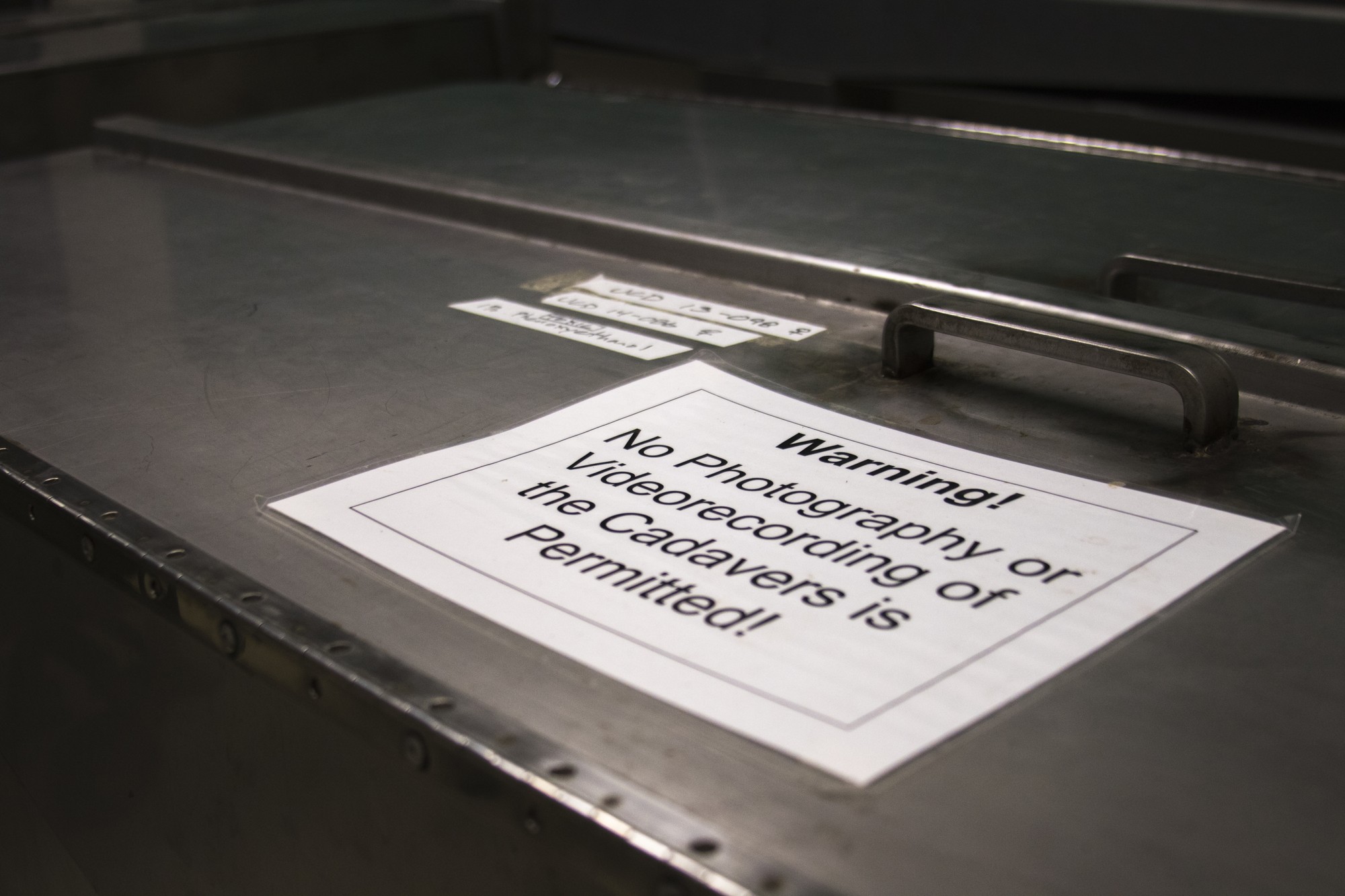
The Humboldt State University Biological Sciences department rents out four cadavers at a time from UC Davis’s Body Donation Program. John Reiss, a professor of the Anatomy Lab at Humboldt State University explains that cadavers on campus are not allowed to be photographed or shot on video. However, Reiss expresses that he’s seen some interesting things with his class.

“Most of the anatomy class here is focused on just learning the normal anatomy, but when something shows up it’s interesting,” Reiss said. “Some of the things we’ve seen are enlarged hearts, associated with congestive heart failure. The heart is extra big.”
Christopher Mardis-Ruelas is a student who believes in the right to privacy after seeing bodies be dissected. He’s seen some of the private things like an enlarged heart be presented from a donated body.
“If I was dead, I wouldn’t want people taking pictures of my dead body.” Mardis-Ruelas said.
Kimberley H. Pipe, the assistant director for the Body Donation Program at UC Davis, talked about why confidentiality is so important. She expresses it in the way of the deceased being a member of your family.

“So, think about this. Your loved one, for example let’s say you have a mom who donated to our program, and someone decides to take a picture of your dead mother and then put it up on social media and it’s out there,” Pipe said. “Your deceased mother is, images of her deceased body, are out there on the internet. It’s disrespectful.”
Videography and photography are strictly forbidden in the

Anatomy Lab. If you visit the lab to see the cadavers, make sure it’s only to pay your respects.

Back in November of last year, California passed Proposition 64 legalizing the recreational use of cannabis for adults. The legislation will fully come into effect with the the opening of recreational dispensaries within the state as of Jan. 1, 2018. Since the legislation passed, advocates for medical marijuana have been fighting to inform the public of the some of the unforeseen repercussions of Prop. 64.
The legislation has eliminated access to many patients who have been prescribed medical marijuana for serious physical and psychological issues. Most affected within the population are the war veterans who use medical marijuana.
“With Weed for Warriors it’s about access,” said Sean Kiernan, one of the three veterans who run Weed for Warriors.
The Weed for Warriors Project helps to provide veterans with safe access to free medical marijuana and works to create an open community for the vets.
“Kevin started it with the idea that, ‘Hey, cannabis works, I just tried to commit suicide and now I’m smoking cannabis and I feel alot better than the pharmaceuticals that were given to me by the VA.’” said Kiernan.
The program was founded in 2014 by Kevin Richardson, a San Jose Marine Veteran who personally benefited from using medical marijuana to aid his disabilities that arose after his service.
“We’re all combat disabled vets, the guys who run it, and what we’re trying to do is help our brothers and sisters because we’ve been through this experience,” said Kiernan.
Currently, the project is run by three veterans Kevin Richardson, Mark Carrillo and Sean Kiernan. Richardson founded the project, Carrillo ran the first WFW chapter in Sacramento and helps lead other chapter branches.
“Kevin and I are both suicide survivors and Mark is 100+ disabled vet who has various issues,” said Kiernan.
Richardson founded the project and Kiernan is the president of the organization, while Carrillo is the CO and controls the different organization chapters.
The program is run by veterans for veterans, which creates a different level of understanding and trust within the program unlike similar organizations.
“We were free to do the right thing, not the thing that a sponsor wanted us to do, not the thing that the person financing us wanted to do, but just the right thing by our brothers and sisters.
The WFW mission statement on their website states, “The Weed For Warriors Project’s sole purpose is to advocate to the Veteran Affairs Administration on behalf of all Veterans.”
“So much of the problem with the VA, (The U.S. Veterans Affairs Administration) is that vets don’t feel like they can be who they are or be honest because it’s a system that is very binary,” said Kiernan. “It’s black and white and there are a lot of vets who try to get help there and end up coming out worse.”
WFW is fighting to increase the accessibility of medicine for veterans that have run out of options and have been turned away by other resources.
Sean Kiernan, the president of Weed for Warriors, was brought into WFW by Kevin Richardson in 2015. Kiernan joined the army out of LA in 1989 and was sent to Central America, where he was an airborne infantry soldier. After getting out, Kiernan lost a comrade in a helicopter shoot down in El Salvador.
After leaving the military Kiernan attended and graduated from UC Berkeley, and went on to work on wall street.
“There was this history of functionality to an extent,” said Kiernan.
Then Kiernan lost another friend to an AK47 assault rifle where he was shot 24 times in combat. When his Kyle’s death became a political landmine during the Obama administration, Kiernan’s trauma reached a breaking point and he looked to western medicine for the solution.
“I started to going psychiatric doctors, where they put me on all of these different medicines and pharmaceuticals, which sent me over the edge,” said Kiernan.
The prescribed medicines were not working for Kiernan and he only got worse. Seeing no other option Kiernan attempted to take his own life.
“I had a suicide attempt in 2011, that I blame on all of the pharmaceuticals,” said Kiernan.
After losing his medical insurance and being unable to regain coverage after his suicide attempt, Kiernan’s father encouraged him to seek out help from the VA. Kiernan described the line at the La Jolla VA Healthcare center as similar to the uncompassionate and systematic reception at the DMV.
“I walk in, the doctor hears my story and looks at me,” said Kiernan. “I come from a very different demographic than most of these vets because I’m coming from money, from working on wall street for almost two decades; so I have many things that these guys don’t have.
But walking into the VA that day Kiernan looked like any other vet who walks into the VA for help: homeless, troubled, and personally medicated.
Kiernan started to cry as he waited in the crowd to be seen by a medical professional. A nurse seeing him breakdown took him back to the emergency room and ran some tests. She then asked him if he would like to stay for voluntary observation, to which Kiernan responded, “Why would I want to do that?”
The nurse then informed Kiernan that his other option was to stay there for 72 hours for involuntary observation.
“In that moment right there you can learn a lot about the VA,” said Kiernan.
At this time, it had been three months since Kiernan’s friend Kyle had been shot and he was an active duty soldier, who had a file, and a previous suicide attempt.
“So they decided to keep me,” said Kiernan.
While he was being held by the VA under observation he met another veteran who had smuggled THC pills into the ward. For the three days Kiernan was at the VA he was helped and medicated not by the doctors and nurses attending him, but by another veteran within the ward.
“That’s really what catapulted me from being a screwed up dysfunctional vet going through all of my issues,” said Kiernan.
Using THC helped him more than any other medication had and he received it not from a professional, but from another veteran, someone he trusted.
The WFW chapters work to provide help and understanding the same way that Kiernan received help in the ward. Each chapter has monthly meetings where the veterans can come together in an inclusive and safe space, where they are supplied with medicine from the donations of local growers and dispensaries.
“These are veterans [referring to those who attend meeting]) who are medicating with cannabis daily, have suicide attempts, have pain; we have amputees who use it instead of thirty pills,” said Kiernan.
The meetings are different within different chapters but each provides a space for the vets to support each other and in return be supported themselves.
“At those meetings it’s not even about cannabis so much, although in the states where we can we get free meds to these vets [during the meetings] to help them medicate because it gets extremely expensive, but what it’s about is comradery,” said Kiernan.
The support aspect of the project is just as vital as the access to medicine. The meetings create a space where the vets can go and meet people who have experienced some of the same challenges.
“It’s about the comradery of coming together and helping each other, of knowing you’re not alone,” said Kiernan. “It’s not only the vets that come to these meetings, it’s the spouses and its family members who learn they’re not alone as well, it becomes one big support structure thats real.”
The local chapter here in Humboldt was created two years ago by Art Gutierrez and is now being run by a WFW member Gutierrez brought in, Pete O.
“Weed for Warriors for me, has brought hope,” said Pete O.
O was homeless and was spending all of the money he was supposed to be saving on marijuana simply so that he could function. More than anything all O wanted at that time was to get a full night’s sleep uninterrupted by nightmares.
Many of the WFW members here in Humboldt are homeless and/or are living off disability, and they wouldn’t have access to medicine without O and WFW providing it for them.
“It’s amazing, some of the guys look forward to our meetings all month,” said O. “We meet at 4:20 once a month on Wednesdays and some of the same guys show up early every time, just waiting for me to get there.”

By | Bryan Donoghue
Walking down a street of their hometown, a veteran smells the essence of diesel emitted from a nearby gas station. Their brain remembers it as the same smell from when they were riding into combat. Immediately, their body goes into a fight-or-flight response and reacts as if their life is on the line. Although this is a hypothetical situation, it is all too real for numerous veterans afflicted with post-traumatic stress disorder, or PTSD.
The US National Library of Medicine’s National Institutes of Health stated that 500,000 American troops who served in wars over the past 13 years have been diagnosed with PTSD, and even more, it affects about eight million American adults annually. About 7 to 8 percent of the population will have PTSD at some point in their lives.
For the Director of the Eureka Veteran’s Center, Deborah Reeves, it’s a condition that’s occurred throughout her family.
“I personally choose to work with veterans because I have a family system that’s been impacted by military trauma for many generations.” Reeves said. “My grandfather had post traumatic stress disorder, my father has post traumatic stress disorder, my siblings have post traumatic stress disorder, my husband has post traumatic stress disorder— all from various different experiences at different times.”
Reeves devotion to helping veterans is an influence for her to educate herself on PTSD, and other topics pertaining to veteran care.
“The first thing that people need to understand if they’re looking at it from an uneducated perspective is to get educated.” Reeves said.
The sentiment is shared by Rob Hepburn, a 70-year-old Vietnam War veteran and local gardener for the Veteran Memorial Park between G street and F street in Arcata. He was in the war part of 1966, all of 1967, and part of 1968. Within his 13 months of service, he participated in the Tet Offensive, which was one of the most crucial battles of the Vietnam War.
“Most people, the only thing they get to hear about vets is what they read in the papers or on social media, so most people don’t even know a vet personally.” Hepburn said. “You get pigeon-holed by a lot of people right away, they have this stereotype of what you are.”
Education is necessary to understanding the topic of PTSD, and according to the United States Department of Veteran Affairs, there are four types of symptoms when reviewing whether someone is afflicted by the disorder.
First, an individual re-experiences the event almost like they’re re-living it. Each person with PTSD has triggers, which is when they sense something that causes them to have flashbacks and nightmares.
“Post traumatic is pretty hard to define in and of itself, it’s an experiencing type of disorder.” Reeves said. “It’s an external event that has happened that has caused lingering internal experiences.”
Flashbacks or nightmares can be triggered by anything. It all depends on the individual as PTSD varies between people.
“I’ve had flashbacks, luckily i haven’t had a flashback in a couple years, but you’re always thinking something really bad is going to happen.” Hepburn said.
Sight, smell, and sound are all components of what can trigger a person’s flashbacks. Triggers are about how external variables effect someone internally.
“I can’t stand to hear anything crying, I mean a lot of people get upset when they hear crying, but for me, I totally freak. If a cat’s meowing, I have to get away, or a dog when it barks.” Hepburn said. “Anything like that just triggers something in me. So you imagine those things happen everyday to people, but to me with PTSD, everyday is kind of a challenge to keep my cool.”
The trigger is like the body’s natural way of protecting itself, flashbacks happen as a response to a need for safety.
“It is a diagnosis that any and everyone can get by experiencing an external situation that causes them to fear for their safety or someone else’s.” Reeves said.
Secondly, people with PTSD may avoid situations that remind them of the trauma. For veterans, that could mean anything. To help himself avoid those kind of situations, Hepburn tends to his garden.
“Gardening is my meditation. I mellow out.” Hepburn said. “I have a service dog that I usually have with me, I don’t have him right now. He helps me stay mellow and grounded, just holding him and carrying him around.”
Along with gardening and his dog, Hepburn goes out into to nature as a way to help himself. He takes walks in the community forest and goes to the beach. When it comes to taking medication to help him with his condition, he decides to take as little as a possible.
“They just make me feel like a zombie.” Hepburn said.

By | Michelle N. Meyers
Threats to public and environmental health and safety continue to persist in the wake of the most destructive wildfire in California’s history.
As part of an ongoing joint response to multiple wildfires in Northern California, The U.S. Environmental Protection Agency begins what officials are referring to as the largest wildfire cleanup in California’s history.
Since Sunday, Oct. 8, at the peak of the wildfires there were 21 major wildfires that burned over 245,000 acres in total, forcing around 100,000 people to evacuate. While the damage assessment is still ongoing, so far the blazes have destroyed an estimated 8,700 structures and devastatingly taken the lives of 42 people.
The Tubbs Fire in Sonoma County alone broke the record as California’s most destructive wildfire in history. So far, the Tubbs Fire has scorched 36,807 acres, destroyed 5,300 structures, and taken 22 lives.
“It worried me, not knowing what was going to happen to my friends,” says Damian Jimenez, former Sonoma County resident and Communications Major at HSU. “Friends whose houses have been engulfed by the fires.”
“They lost a lot of family memories,” says Jimenez
In the last few weeks, cooler temperatures and higher humidity across Northern California have aided firefighters in their efforts. As of now, temperatures across the state remain warm and dry. Yet despite unfavorable conditions, all fires in Sonoma County are at least 92 percent contained according to Cal Fire.
While the dangers of a powerful active wildfire fire are beginning to pass, environmental and health concerns associated with the aftermath of a wildfire continue to threaten local communities and emergency personnel.
One of the main concerns for residents returning to a damaged or destroyed home is the presence of hazardous materials such as household hazardous waste or HHW. Household hazardous waste include, “leftover household products that can catch fire, react, or explode under certain circumstances, or that are corrosive or toxic,” said Michele Huitric, EPA Public Information Officer, in a press release. “Products such as paints, cleaners, oils, batteries, and pesticides can contain hazardous ingredients and require special handling and disposal.”
In order to ensure the safety of residents, local authorities continue to warn residents returning to what is left of their homes to beware of these possible hazards. Residents are required to read and sign a form that is intended to ensure that the homeowner acknowledges these dangers before entering the property. That form is called a Debris Removal Right-of-Entry Permit and can be found on the County of Sonoma website. In addition, the State of California has declared a state of emergency in the area.
Cleanup efforts of hazardous and non-hazardous materials are also now underway in what is being referred to as the largest wildfire cleanup in California’s history.
The EPA, in coordination with representatives from Sonoma and Napa Counties and the Federal Emergency Management Agency (FEMA) and its state and local partners began conducting surveys to identify the locations of household hazardous waste and other hazardous materials as of Oct. 25. These surveys are being conducted on residential properties in the neighborhoods of Coffey Park in Santa Rosa as well as Soda Canyon and Silverado in Napa.
Once these properties are surveyed, collection teams will begin the safe removal, transport, and disposal of hazardous and nonhazardous materials.
Wildfire cleanup efforts also include the removal of contaminated soil and stabilization of the creek bed according to the EPA.
In addition, as part of the EPA’s response effort, they are “working with California and tribal governments to track the status of more than 150 public drinking water systems, some of which have been damaged, destroyed or otherwise affected by the fires,” says Huitric.
The extensive cooperative effort is intended to reduce potential threats to public health and safety.
Officials are aiming to, “Have all that damage debris cleaned up by early 2018,” says Kathleen Hie, Cal Fire Information Officer.
“We’re in the rebuilding stages,” says Jimenez. “I think caring for one another is really important right now.”

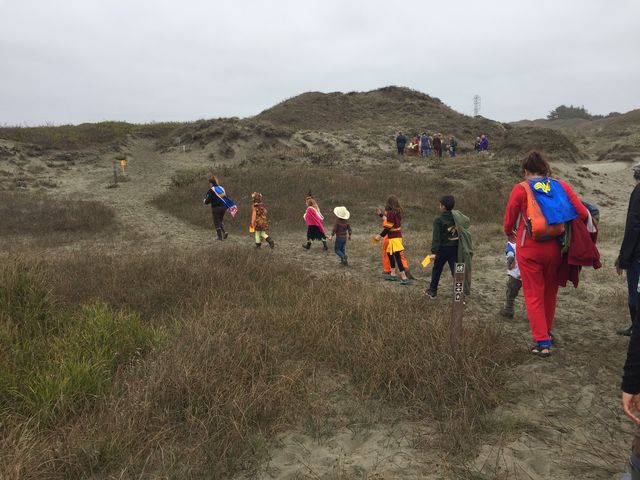
Going out to the Humboldt Dunes for Halloween is an exciting and educational adventure for many families. Friends of the Dunes have hosted Spooky Dunes for over five years. Upon arriving, the kids are shown to the crafts tables where they wait until their Spooky Dune Tour begins.

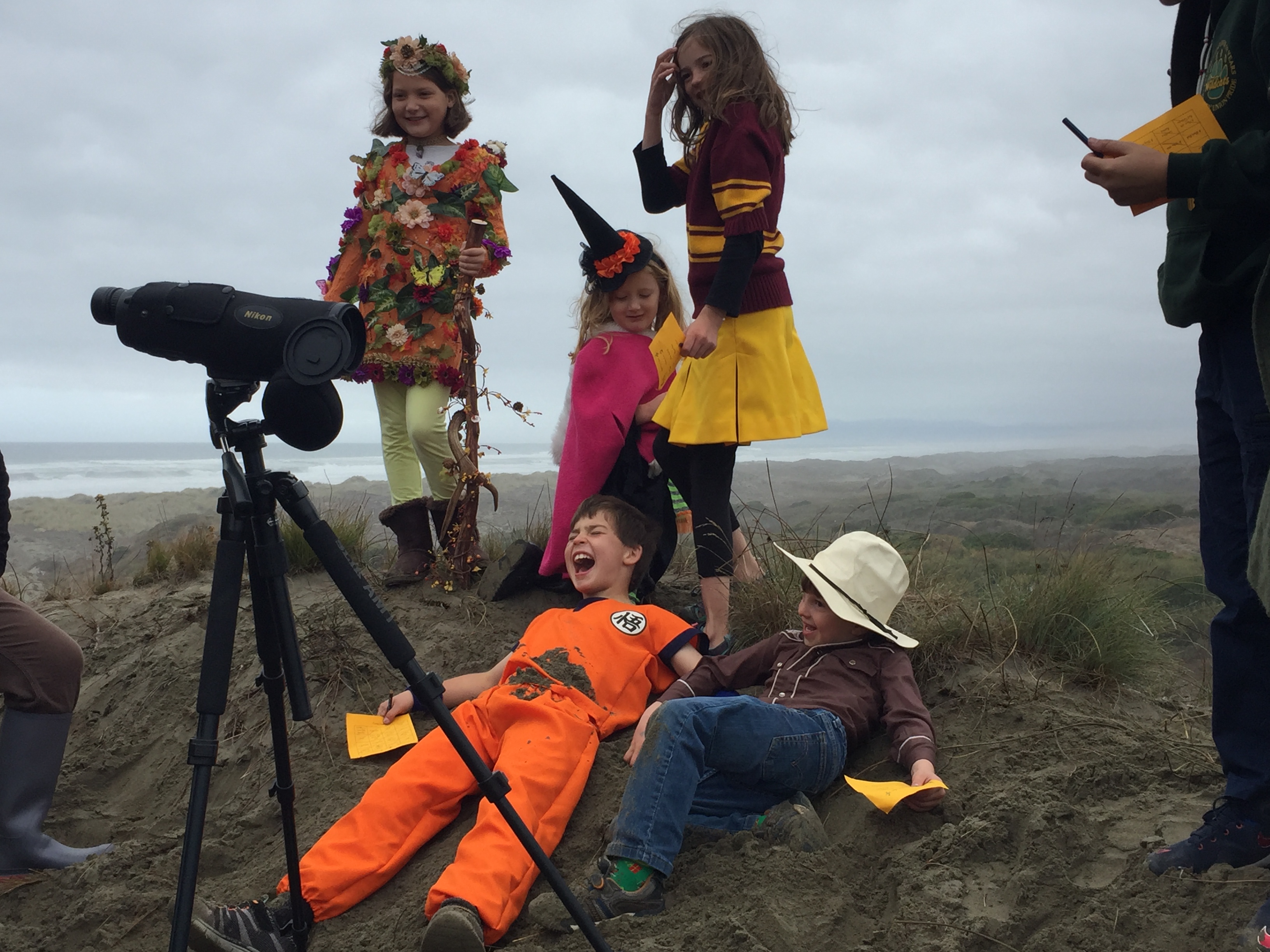
On the Spooky Dune Tour, the kids are led on a short hike around the dunes where they meet some spooky characters that teach them about the dunes. Each of the children are given a “passport” to be stamped at each station on the tour. Once the card is full at the end of the tour, they get to choose a prize upon returning to the Nature Center. The passport also has Creepy Dune Bingo on the back for the kids to fill out along the tour.
Ashley Hansen, the outreach coordinator for Friends of the Dunes, enjoys Spooky Dunes because it “helps spread the word about the dunes.” Hansen also said, “It’s a fun way to get kids outdoors learning about the dunes.”
With five stops on the tour, the kids and their parents were first lead to the Beach Pine Palace where they were met by Franny Fox and Misty the Moss Queen. Franny and Misty taught the kids about different moss, fungi and lichens that live in the dunes environment.
At the second stop, they met Dante the Wind Wizard and Ginger the Grey Fox. They gave the kids animal track booklets and were shown how to identify a few different kinds of tracks.

At the third station, they were introduced to Captain Howard, a pirate looking for his treasure. At this stop, the kids were able to use a telescope to look out over the dunes.
For the fourth spot on the tour, the kids were able to help Flora the fairy remember some of the flowers that live on the dunes. Flora and her friend Daisy the flower handed out flower identification books so that the kids could find and learn what kinds of flowers were in the area.
After leaving Daisy and Flora, we ran into the Beachgrass Monster. At the final station, the Humboldt Wallflower asked the kids to help him fight the Beachgrass Monster by pulling out beachgrass. They learned that beachgrass was an invasive plant that has to be removed from the dunes.
One of the the tour guides let the kids know that because they had helped in the effort to remove beachgrass from the dunes that they were now members of the Dune Hero’s crew.

After helping fight the Beachgrass dune monster the kids returned were led back to the nature center to collect prizes. Some walked away talking about their prize bug box or their beautiful new shell, but many were talking about something else.
“I liked the Dune Monster,” said Shannon Smith, a witch who had gone on the tour for the first time.
Shannon’s mom Jessica Smith was glad they had come, she thought that the tour was both fun and educational.
In agreement with Jessica, April Moreland was happy she brought her three children to Spooky Dunes.
“I thought it was really great, it was super educational,” said April Mooreland.

Imagine one day, your neighborhood and everyone you knew has been lost. Your world has become barren and now all that’s left is a desert. That’s what’s been happening to the coral reefs in the Pacific Ocean. The Trump administration wants to take away federal protection for 10 national monuments in the Pacific. This could lead to more commercial fishing that will further harm what’s left of the coral reefs. Scientists studying these marine monuments find that they’re the last of their kind, as they are not impacted by overfishing or pollution.
Source: New York Times, NOAA
An alien object visiting Earth left before it could even trick-or-treat. The object is less than a quarter mile long, going 15 miles per second, and cut into our solar system perpendicularly. It even approached Earth at only a distance of 15 million miles away! So far, we can tell it’s not a comet, but it’s closer to an asteroid. We can learn even more when the next interstellar object passes by Earth because of a new telescope that is in production. It will give astronomers a more in depth perception of these incredibly fast objects zooming through our solar system.
Source: Popular Science, The Guardian, Washington Post
One day you’re hanging out in the sun, and the next you’re trapped under ice. Although it does sound scary, it did happen for one plant species. On Canada’s Baffin Island, there’s a strain of ancient moss that’s being thawed out for the first time in 45,000 years. Researchers found the age of the moss using radiocarbon dating, although some of the moss had no radiocarbon left. This discovery is leading researchers to believe that the hot atmospheric temperatures could melt all the ice in the east Canadian Arctic.
Source: Science Magazine, National Geographic, Science News, NBC
Climate change is real, and it’s getting worse considering how we treat our planet. In the Paris Agreement of 2014, countries gathered together and agreed upon only letting the planet get warmer by two degrees Celsius. That’s not happening anymore, we’re reaching a goal of three degrees Celsius now. It is noted that although some greenhouse gas emissions have remained steady, like carbon dioxide, others have increased dramatically, such as methane. The UN’s environment chief, Eric Solheim, is calling for countries to take action as these conditions are unacceptable for our planets future.
Source: ABC, The Guardian, The Daily Herald

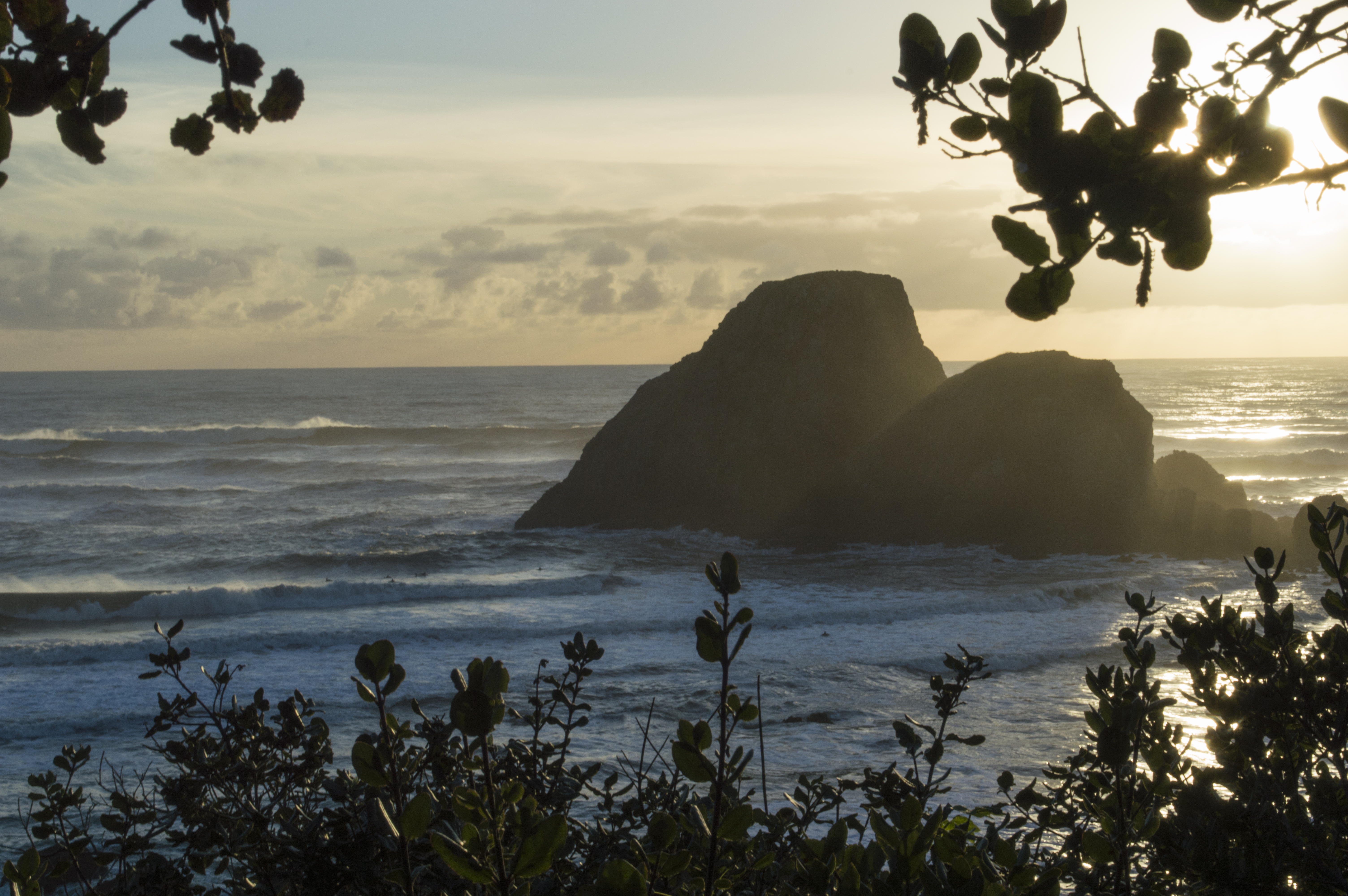
Picture Moonstone Beach. The sun is setting, creating a silhouette of Camel Rock against a watercolor sky of vibrant pinks and oranges. The ocean is at peace, beautifully calm and picturesque. Now imagine the beach in fifty years or so.
Moonstone Beach is gone.
Due to rising sea levels and changing weather patterns, the beach at Moonstone no longer exists.
Jennifer Savage, the California Policy Manager for Surfrider Foundation, was able to paint a picture of what Moonstone Beach will look like when we fast forward a couple years.
“It’s not miles and miles of wide open beach on the north side, so I’d imagine that the modeling would predict that the Camel Rock area and the Moonstone area would be the first to disappear,” said Savage. “Then Clam Beach going down toward the Mad River mouth, because it’s wider and broader, may last a little bit longer.”

A representative for the Surfrider Foundation and an avid surfer and wave lover herself, Savage works to keep the waves clean and preserve the oceans and coastlines worldwide.
“Essentially, even if we have just a few inches of sea level rise, it’s a vertical. It’s not just the oceans getting closer, it’s that they’re getting taller,” said Savage. “How that affects different places depends on the geography, the weather patterns, the ocean’s current patterns, and a lot of different things.”
The repercussions of climate change can only be predicted to a certain extent, but there are numerous studies and research constantly happening to determine how our oceans are being influenced and how the could be affected in the future.
“With Moonstone Beach, we already know that during the King tides the beach is completely covered,” said Savage. “The King tides give us a pretty good preview of what the future will look like.”
Daniel O’Shea an Oceanography professor specializing in Geological Oceanography was able to provide greater insight on the King tides.
“The King tides are a play on the words spring tides,” said O’Shea. “Every two weeks, we get what are referred to as spring tides around the new and the full moon, where the tides spring up higher.”
“Around the winter and summer solstice, we get the highest and the lowest tides of the year, and those are called the King tides,” said O’Shea.
The King tides show the physical changes to the coastline we can expect in the coming years as climate change continues to alter sea levels.
“They’re [the King tides] going to be the normal high tide in 15-30 years,” said O’Shea.
What we currently consider the extreme high tides will become our new normal, and the changes are coming faster than we can anticipate.
Kim McFarland, the Executive Director of Friends of the Dunes explains how the dunes are being impacted by climate change.
“We’re doing a climate ready study through the U.S. Fish and Wildlife services, it’s a climate change resiliency study,” said McFarland.
By measuring how the sand dunes are moving and reacting to changes in the climate, researchers can predict how the environment will change and how far back the dunes will travel.
“What they’re looking for is how the sand moves through the dunes, because during the winter time when it is wet the sand doesn’t move as much,” said McFarland. “What does happen is we have winter storms, and the storm surges are getting more frequent and more intense and that’s most likely a result of climate change.”
As the climate changes and sand is continually displaced and moved from the foredune backwards, the dunes themselves will move backwards, potentially displacing buildings and homes near the area.
As sea levels rise it’s not just the beaches and the local natural environment that will be affected, homes and businesses will be greatly impacted.
Eventually, individuals with homes and business in the Humboldt Bay will have to be relocated. Homes within the King Salmon area are often flooded during the winter high tide times, so as sea levels rise, those residing within the area and areas nearby will have to move.
“The key thing is to identify the most vulnerable places and what kind of infrastructure exists in those places and then figuring out what can be moved,” said Savage.
As we continue to impact the environment, predicting the outcomes of climate change in the ocean and along the coast is very imprecise.
“What we do know is that the sea is rising and we are not going to be able to stop it, at best we will be able to slow it down,” said Savage. “We’re not preparing for it fast enough.”

Sitting in silence with our eyes closed, we listened to Loba guiding us through the mediation, instructing us to allow the seed to tell us what it needed to communicate.
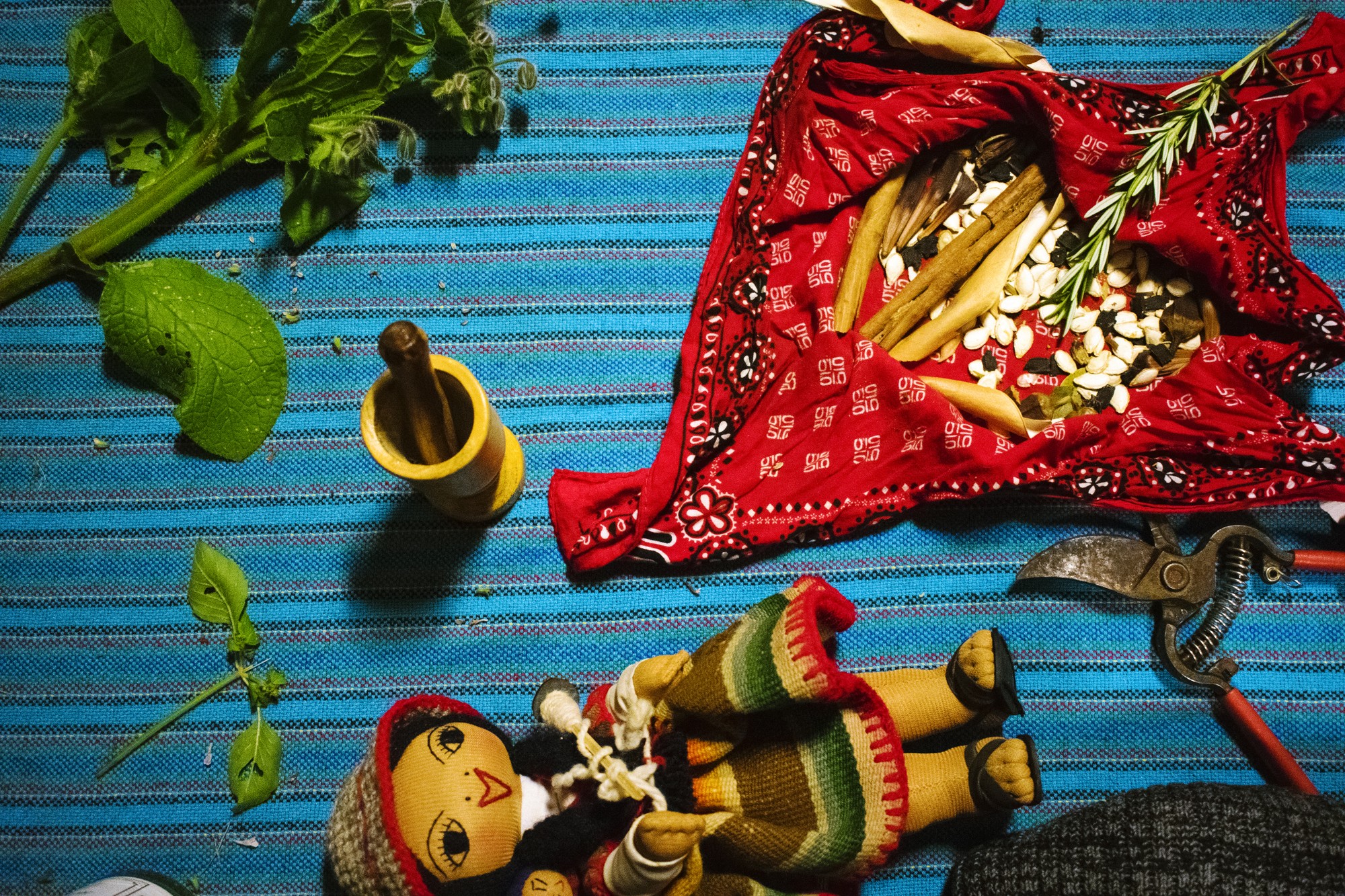
La Loba Loca, a queer herbalist visited CCAT (the Campus Center for Appropriate Technology,) this past Wednesday guiding students on an herbalist knowledge share centered around herbal Medicina Feminista.

Erick Garcia, a Sociology major, was right at home in the herbalist knowledge share.
“I’m queer and I enjoy herbalism, so it was the perfect thing for me,” said Garcia.
Loba is from Arequipa, Peru, but currently resides in LA teaching herbal medicine, conscious mooning (classes on menstruation,) the oral history surrounding the healing practices as well as many other topics and practical tools. Loba identifies as “a queer, Chocolla, Andina, South American migrant, artist, researcher, writer, handpoke tattooist, full spectrum companion/doula, aspiring midwife student, seed-saver, gardener and yerbetera,” on La Loba Loca’s website.
The knowledge Loba shares with audiences is Abuelita Knowledge, the wisdom and practices passed down through generations of women and femmes. Leading the knowledge share with a seed meditation, Loba gave each individual a seed to hold. Loba then introduced the idea of seeds as technology.
“Literally to me, seeds are the most reliable technology that we have,” said La Loba Loca.
From there everyone was led through a meditation in which we held the seed in our hands and were guided to open ourselves to anything the seedling wanted to tell us. In a room packed so that only standing room remained, everyone there simply closed their eyes and focused on the knowledge that the seeds had to share.
One attendee said that their seed was old, “not necessarily the seed itself, but the information it holds.”
Other individuals attending the workshop simply reflected on the importance and process of a singular seed, noting that we often don’t stop to appreciate the work and undertaking of one simple seed.
Loba then encouraged everyone attending to research seeds and plants important and cherished within our own heritage and cultures. Different plants used for healing and nurturing native to one’s own history that we could incorporate into our diet and/or daily life. The coca plant, specifically the coca leaf holds special significance to Loba as a grounding and energizing plant native to Peru. 
From there, Loba went into the oral history and roots of some of the healing practices of herbalism today. Discussing the power of Medicina Feminista, its origins, certain tools and practices, as well as the history of the witch trials and how that has affected women/femme interactions and healing.
“To me, feminism is the magic that happens when women and femmes have resisted the patriarchy,” said Loba.
Loba delved into the topic of women/femmes as the traditional caregivers and healers in comparison to the male and masculine dominated health fields of western medicine. In a field composed of primarily white males, Loba works to take back and teach the traditions and knowledge to healing through herbalism. Loba honored the acts of women and femmes who for centuries have healed and cared for individuals, sharing their knowledge and healing as an act of free labor.
Aliah Bueno’Strong, a Rangeland major at HSU felt a strong connection to the dialogue surrounding feminism and Loba’s
“Hearing her talk about feminism, that’s what I really resonated with the most,” said Bueno’Strong. “I’m one of those people that doesn’t believe that you have to have equality of the genders, but simply the equality for everyone. It was good to hear it come from someone else.”
Loba discussed the current inequality between the genders, allowing for discussion on historical events that influence us now, such as the witch trials.
Viewing the witch trials as an intentional act of the church and state, the patriarchy, as a way to take away women’s power. The healers, midwives, doulas, herbalists, and any woman or femme who practiced traditional non-westernized healing were persecuted. Even women who were not as versed in Medicina Feminista and Abuelita Knowledge were under suspicion.

“The witch hunts were toxic masculinity at its best,” said Loba.
The witch hunts eliminated much of the trust and communication between women, turning one another against each other to prevent their own persecution. This robbed women and femmes of spaces to share information and stories, places to come together in healing and discussion.
“They took away the bond and unity between women and femmes,” said Loba.
Loba discussed the effects of the trials in the way women and femmes bond and communicate with one another today. These historical events are still very much with us in that they affect the perception and acceptance of woman interaction and healing today.
The systematic goal of mainstream society is to prosper as individuals, to rise up alone. Herbalism and Medicina Feminista work to bring up everyone and benefit everyone collectively.
To learn more on Abuelita Knowledge you can read Loba’s article, “Reclaiming Abuelita Knowledge as a Brown Ecofeminista.” The article discusses the roots of Loba’s knowledge and works to take back the knowledge and practices that have been westernized and claimed by many white hippies as new eco-friendly practices.

“Specially all these white supremacist ideas that make people believe that conscious mooning is a white hippie thing, that giving birth to a baby under a tree is white, that gardening organically is white, that meditating is white,” Loba writes in the article.
Deconstructing common misconceptions on this passed down cherished knowledge and working to reclaim these ancestral practices is one of Loba’s main goals. Knowledge shares like the one held at CCAT is another incentive for Loba to continue educating and sharing knowledge.
One of Loba’s goals laid out on the La Loba Loca website is to create safe spaces and resources for “Spanish-speaking communities of color as well as queer and trans communities of color.”
Vanessa Cota, a Political Science major at HSU, left the knowledge share at CCAT house feeling nourished and refueled.
“It’s a space that was very needed,” said Cota.
After going over some of the oral history and recalling the origins of some of the practices, Loba moved on to share knowledge as an herbalist discussing certain plants and their beneficial properties.
Passing around borage, fennel, rosemary, lemon balm, calendula, tulsi, and a Mexican Marigold, Loba shared knowledge on each plant, explaining their healing properties and some of the ways incorporating them into our lives could beneficial.
Each plant was discussed in-depth with an open dialogue between Loba and the audience as everyone shared their experience and knowledge with the different plants.
“It takes what I’m learning about in Botany out of the confines of academia and back to the down to earth roots on how people actually interact with plants,” said Kevin Riley.
Riley, an Environmental Science and Management major, loved attending the knowledge share, both for the knowledge he gained and because of the space CCAT and those in attendance created.
“It was very positive and uplifting, we were talking about life and health together,” said Riley.
After the workshop, Riley said, “I have the biggest smile on my face I’ve had all week.”
The knowledge share concluded with a tea meditation, in which all of the attendees were given a cup of tea that had been brewing throughout the event.
A simple mixture of lemon balm and rose prompted the ending discussion on what the tea could do for our bodies and minds. With each individual in the audience feeling and focusing on the tea, we concluded the knowledge share explaining what the tea brought up for us, both physically and emotionally.
Erick Garcia was glad to have attended the event.
“A whole bunch of people ready to learn came together, if you wanted to be here you were,” said Garcia. “We came in here with love and joy and we are leaving with love and joy. Some of us don’t have that on a day to day basis, so it was nice to know that there is a community filled with that.”
Aliah Bueno’Strong is in the herbalism class on campus at CCAT, and knew a good deal of what Loba went over. Bueno’Strong had a strong appreciation for the dialogues on feminism, gender, race, and equality as well as the herbal discussions.
“I’m heterosexual, but to be in a room with a lot of people who are not necessarily like me was amazing,” said Bueno’Strong.
Loba succeeded in creating a safe space to discuss the power of plants, the history of healing and herbalist practices, the effects of the patriarchy and white supremacy, as well as many other topics that come up when a large group tells stories and shares ideas.
“I was very happy by the turnout, I left to go get food and when I came back the room was full,” said Bueno’Strong. “It shows how diverse and inclusive the school is as a whole, and our students.”
Everyone in attendance stayed until the very end, soaking up all of the knowledge Loba had to share. While each individual gained something different from the workshop, everyone left feeling different from when they entered CCAT.
“Rooted.”
“Rooted is the best word to explain it,” said Cota.

By | Bryan Donoghue
Embed from Getty Images
One of the things that makes weed worrisome is its impact on developing brains. A new study presented at the World Psychiatric Association found that teens who smoke pot are more likely to suffer from psychosis. The results show that people who used cannabis before 18 developed schizophrenia 10 years earlier than other people who didn’t smoke. For every year the teens smoked weed, symptoms of psychosis rose 21 percent annually.
Source: Scientific American, Newsweek, Vice
Embed from Getty Images
You can really use Google Earth to find anything, even discovering something ancient. Over the past decade, Google Earth has been used to identify thousands of burial sites dispersed around Saudi Arabia. Recently, archaeologists used the application to uncover around 400 stone structures called “gates” in the Arabian desert. The researchers believe it may have been built by nomadic tribes anywhere from 2,000 to 9,000 years ago.
Source: New York Times, Popular Mechanics, Forbes
Climate change isn’t just affecting sea level, but it’s also harming coffee production. Coffee needs specific temperatures to grow properly and is highly likely to have pests. To combat diminishing coffee production, researchers are cross-breeding coffee plants to create a brand new strain. With most of the coffee around the world grown close to the equator, the newest coffee strain resists climate change and is named after the countries that produce our espresso beans. Out of seven new variety hybrids, Centroamericano is the new breed of coffee bean that can best withstand rising temperatures and decreasing rainfall while still producing a large quantity of quality coffee.
Source: The Times, The Denver Post, Phys.org
Soldiers stuck in the snow will soon have some high tech underwear made of special fabric to combat the threat of sweat freezing. The light fabric uses nanowires, tiny wires of silver, to form a mesh across cotton. The silver reflects body heat back to someone’s skin helping with insulation. To help with sweat, the underwear also has hydrogel beads, a polymer that absorb up to 40 times their weight in water. This will help keep the troops warm for the winter.
Source: Science News for Students, Business Insider

Travis Farwell is a Wildlife major with an emphasis in Conservation and Management. Farwell is back at HSU after taking a semester off to participate in a three-month field study working to identifying and track birds through bird banding. Bird banding is the practice of tagging birds with a plastic or metal band in order to number them so that they can then be tracked and studied for different research projects.
The Wildlife Techniques class here at HSU helped to prepare Farwell for the work he did during the study.
“I learned a lot just from the Wildlife Techniques professor, he’s been banding for a long time,” said Farwell.
Farwell ended up processing and banding over 200 birds, so the techniques he learned in his Wildlife class really ended up benefiting him.
“We would wake up at 4-something in the morning every day and set up everything so that we could catch birds, and it was a huge, migration that goes through a specific area right on this river,” said Farwell. “We caught what I believe is a threatened species, the Willow Fly Catcher.”
During their study, they found the threatened birds nesting within a specific invasive plant that a conservation group was working to remove from the area. Because the field study was able to identify the birds as a threatened species, they were able to stop the removal of the plants to allow the habitat to remain for the birds.

Alex Jamal is also a Wildlife major with an emphasis in Conservation and Management in his second year. Jamal is in the beginning of his time here at HSU and he is excited to learn the situational protocols and how to interact and handle the animals he will work with.
Jamal has learned some of the basics that he hopes to carry with him as he moves on to harder classes, and in his future career after he graduates.
“The amount of persistence you need to put into it and the amount of efficiency and protocol that you need to take within every step of what you are doing, that is something that I hope to take into whatever field I go into, just that type of consistency,” said Jamal.
After leaving HSU, Jamal hopes to join the Peace Corps to help educate individuals on the reality of what is happening to the environment, and how that is affecting the animals.
“I would like to go out and do public education, just let people know about how severe everything is becoming and what we could do for the species that we still have here,” said Jamal.

Daisy Valencia is a General Biology major that hopes to pursue a career in Veterinary Medicine after she graduates. Valencia is currently about to start a directed study with one of her professors, John Steele, where they will be looking into gene mutations.
Valencia took professor Steele’s Introductory Biology course last semester, which spiked her curiosity on gene mutations and antibiotic resistance.
“We looked at bacterial resistance and we tested multiple water resources here in Humboldt County, like the Humboldt Bay and Allen’s Marsh, we found that there was some antibiotic resistant bacteria in the water,” said Valencia.
After learning about the antibiotic resistant bacteria, Valencia wanted to know more about antibiotic resistance.
“That got me really interested in studying antibiotic resistance, how we can harvest it from natural resources and develop antibiotics that can help us battle antibiotic resistance, which is a really big problem now,” said Valencia.

By | Bryan Donoghue
A concussion doesn’t entirely mean hitting your head hard. Concussions happen often, and there are a multitude of adverse side effects from a concussion that can disable a person biologically. In cases where a concussion needs to be thoroughly examined and diagnosed, the North Coast Concussion Program (NCCP) at Humboldt State University is there.

A statement from the program’s homepage says that the NCCP treats thousands of Humboldt and Del Norte residents every year. This not only includes local community members and Humboldt State residents, it extends to 11 regional high schools, as well as youth and adult sport leagues.
The Centers for Disease Control and Prevention state that a concussion is a, “type of traumatic brain injury, or TBI, caused by a bump, blow, or jolt to the head that can change the way your brain normally works.”
It continues to state that although concussions are not usually life threatening, their effects can be serious. Those effects are what the NCCP primarily study, and based of the needs of different concussed patients, the Student Disability Resource Center (SDRC) is willing to accommodate each student individually.
“We do work well together,” said Kevin O’Brien, the director of Student Access Services.
O’Brien explains that students are usually first seen at the health center at Humboldt State and then referred to the North Coast Concussion Program. Based off the assessment report, O’Brien and the SDRC evaluate the impact of the concussion of the student’s academic work and authorize specific accommodations based on the results.
“It’s going to vary according to the severity of the concussion, the impact of that on a student, whether it causes them headaches, visual disturbance, it depends on the issues that arise from the concussion and the length of time,” O’Brien said.
O’ Brien says generally with a concussion, the basics to help yourself are to reduce reading, bright lighting, and to increase the amount of rest you get.
“Basically you are trying to rest the brain so it can heal itself,” O’ Brien said. “So reduce cognitive activity, studying, reading, bright lights, all of those things.”
If you do have a concussion, it’s imperative to work with the SDRC advisors and your professors to construct a regimen. They collaborate to help build you back up and get you into regular study habits again.
“They are going to need an accommodation maybe as simple as us conferring with their faculty,” O’Brien said. “Working with the faculty on what the expectations might be, and how long this is going to take, and how can we best ensure that the student can make up work missed.”
Humboldt State recently hosted a guest from the University of Pittsburgh Medcial Center on Thursday, Sept. 28. Dr. Anthony Kontos spoke about research pertaining to psychological, neurocognitive, and neuro-motor aspects related to concussions. Most importantly, he advocates safety, as well as concussion prevention and treatment.
“There’s risk in all activities, And then if somebody has something, they got to do something about it. It can’t just be, ‘okay, you have a concussion,’” Kontos said.
Kontos says to seek whatever care and follow up, because that’s how we prevent the effects of an injury from becoming worse.
“We do know that if you’re an adolescent and you get hit, there’s a likelihood that your developing brain is more at risk than, say, a really young kid or an adult,” Kontos said.
According to Kontos, you shouldn’t let that affect your participation in sports. Mainly, you have to learn to play sports correctly and how to participate safely.
“That’s really the key here, doing sports as safe as possible and allowing kids to be active,” Kontos said.

By | Bryan Donoghue
Doomsday theorists may start gearing up for the coming of the end as Yellowstone National Park’s super volcano could erupt a lot earlier than predicted. A group of scientists from Arizona State University analyzed incredibly old ash from 630,000 years ago, and found that based on the timeframe from the last explosion, we may be close to another one. It won’t happen for the next few decades at minimum, but when it does explode, the ash would cover most of the United States and the Earth would go into a volcanic winter.
Source: National Geographic, New York Times, New York Post, Reddit (for doomsday theorists)
Embed from Getty Images
Forget crop circles, a mysterious hole called a polynya was spotted near Antartica by researchers earlier this week. National Geographic reports that it’s the size of the state of Maine, around 30,000 square miles. Another gigantic hole was also found near Antartica last year, though it was smaller. It is still unknown what this polynya means for Antartica’s oceans and climate.
Source: CBS, USA Today, National Geographic
Embed from Getty Images
We’re all just people, so the notion of race based on skin color is truly outdated. Researchers from University of Pennsylvania have found eight genetic variants within four regions of the human genomes that influence pigmentation. These special cells in the skin called melanosomes that act as pouches to hold pigment molecules. This essentially means some skin is just darker or lighter. Humans genetically develop colors just like other mammals through evolution. A researcher on the study says this discovery helps dispels the biological concept of race.
Source: University of Pennsylvania, Science Magazine, New York Times
Embed from Getty Images
There are worm like creatures under the sea known as bryozoans, and they might just be the medicine we need. A compound known as Bryostatin 1, which is found naturally in the bryozoan Bugula neritina, has been studied for decades as a potential drug for cancer, HIV, and Alzheimers. Its supply is severely limited, and finding a way to recreate the compound in a lab setting has been difficult. Researchers at Stanford University have been able to successfully recreate 2 grams of the compound so far, and they plan to continue research on benefits of the drug.
Source: Stanford, Science News, Chemical and Engineering Magazine

By | Kyra Skylark

Casey Goldberg, a freshman in her first semester at HSU is just getting to know the HSU community and campus. Yet, in her first few months of being here Goldberg has made strong connections.
“I hope to keep the ties that I’ve made with friends, I’ve met a lot of cool people here so far,” said Casey Goldberg.
As a Botany major Goldberg, appreciates being surround by nature on campus.
“I really like that in Botany I can go out into the forest and I know exactly what is going on inside that tree or like, I know what kind of bush that is,” said Goldberg. “It’s pretty cool.”

Kayla Grove is studying Kinesiology with an emphasis in Exercise Science and Health Promotion. From Ventura county, Grove was drawn to HSU by the beauty of the campus’s environment.
“The trees, definitely the nature, I was never exposed to that growing up so I fell in love with it as soon as I visited,” said Kayla Grove.
In her fourth year at HSU, Grove has taken many classes that have greatly influenced what she wants to do after she graduates.
“It’s all still coming together for me from each class, I’m just piecing it all together,” said Grove.
One class that she is currently taking has helped give her an idea of the kind of career she’d like to pursue.
“Right now I’m taking a Structural Kinesiology class with Justus Ortega, and we’ve been talking a lot about the forces of muscles and the biomechanics of muscles,” said Grove. “I think I’m leaning towards working with older people and that’s what he [Professor Ortega] specializes in too, so he talks about it a lot and how it relates to our field.”
While it is not always considered the most glamorous of careers within exercise science, working with older individuals is what really speaks to Grove.
“They’re facing a lot of health problems usually, specifically exercise issues, like they need more exercise in their life and they don’t know how to go about it,” said Grove. “Sometimes they will do something that is too much on their body or not enough for them.”
Grove wants to teach others to live their lives in a healthy, happy body.
“I just want to give back to the population, to use all the things I’ve learned about exercise and health promotion and educate people on it,” said Grove. “I want people to live longer healthier lives.”

Also looking for a change from the environment, as well as the social scene in Southern California, Ariel Robinson is a mathematics major. In her fourth year at HSU, Robinson has gone through many math classes and is working on understanding the smaller intricacies of some subjects.
“I would really like to be a teacher at a collegiate level so I’m hoping this stuff really sticks with me,” said Ariel Robinson.
Not only is Robinson learning mathematics, but she is also learning teaching habits from her professors. As a future teacher herself, there are certain things from her own learning that she plans to take with her and use in her own career.
“I’m really happy with the way I have been treated by a lot of my math professors, they understand that I’m coming at it from a new point of view,” said Robinson. “That’s really one of the things that I’d like to carry on, this sense of understanding that we are all just learning something new, and that we can all help each other to learn something new.”
The communication and understanding Robinson has experienced in her classes and on campus have made her happy to be an HSU student.
“A lot of people down south don’t really understand the different struggles people have to go through and are really self centered,” said Robinson. “But up here I feel like it’s more community oriented and people really care about those around them.
Robinson hopes to carry the sense of community and understanding she found at HSU wherever she goes after graduating.
“Really just the overall attitude that people have here, that differences are accepted and that anybody can have a chance, that was really the most heartwarming thing when I came up here,” said Robinson.

Transitioning into college as a freshman can be tough, especially if you are new to the surrounding area. Place-based learning communities at Humboldt State University strive to ease this transition by providing social and academic aid for incoming science students.
A new place-based learning experience is expected to take off in the fall semester of 2018 and will be available to Marine Biology and Oceanography freshmen. The Rising Tides program will be overseen by HSU Botany professor, Frank Shaughnessy.
Two communities already implemented on campus include Klamath Connection and Stars to Rocks.
Shaughnessy has been involved with Klamath Connection since its beginning in 2015 and says it served as a model for the following place-based communities on campus.
With only 14 percent of incoming HSU freshmen being local, many struggle to adapt and settle into the new environment away from home. Shaugnessy says through place-based learning, freshmen build connections before their semester even begins and learn to “survive and adapt.”
As part of a place-based learning community, students can choose to live with other freshmen in the program who share similar interests as them. Students also collaborate on a year-long linked project.
Shaughnessy says the main reasons for student success in Klamath Connection and Stars to Rocks has been the social peer support system these programs help set up.
The new Rising Tides program will focus on exploration of marine life and science in the outer coast Trinidad and compare it to that of the inner coast of Humboldt Bay through field study. The program also includes explorations of Native American life in these areas.
Currently, the program has close to 20 faculty and staff members on board and is working on developing close working relationships with the Wiyot and Yurok tribes of Humboldt County, as well as the Trinidad Rancheria.
Approximately 50 students are expected to take part in Rising Tides in the fall of 2018. The program begins with a 5-day summer immersion before the semester and introduces freshmen to fellow students, professors and faculty on campus.
Despite the programs being science-oriented, they are cross-disciplinary and implemented in students’ classes outside the science field.
Two more project-based learning communities are planned to roll out within a couple years.

By | Michelle N. Meyers
The CCAT garden’s are moving and bending in shape, forever changing with the seasons, through the helping hands that come and go. The folks at CCAT are welcoming these changes of seasons with open arms. Rows upon rows of seeds have been planted and now they wait patiently for their chance to peek through the top layer of soil to greet the moist air. Yet, it’s still just too early to see what lies within these carefully raked piles of soil. It’s fall in Humboldt, the height of the rainy season will soon be upon us, and outside the rain gently flutters across the terraced gardens, over the open grass, and trickles down the windowed walls of the CCAT greenhouse.

Inside the greenhouse, Austin Anderson, Co-Director at CCAT is hard at work, re-treating its wooden floors in order to limit wear and tear and slow weathering, so that the floors stand strong, hopefully for many seasons to come.
In regards to the greenhouse, CCAT volunteer coordinator Natalie Rynne says, “The thing that everybody is most excited about, is the hydroponic system.”
The new system is intended to reduce water usage by controlling the amount of water that goes into the plants and recycling their runoff. In addition, Rynne says crops that can’t commonly be grown in this climate can now be grown year round inside of the greenhouse.
Outside of the greenhouse, around the CCAT grounds and gardens, coordinators and volunteers are currently working on revamping these surrounding areas to prep for new, exciting projects.
“We’re trying to reclaim everything again,” said Rynne. “Clear all the weeds, mulch everything, and build up the soil.”

One of the many projects underway in the CCAT gardens is the Food Forest. Rynne says the project works to “create a forest of edible plants,“ by creating different gardening areas that all even have different names.
The folks at CCAT cook with the food grown on the grounds and would like the Food Forest to be a place where visitors can enjoy the ‘fruits’ of the Food Forest as well. Rynne also hopes that the Food Forest can be a place where people come to simply hang out and relax.
“It smells amazing up there because of the jasmine” says Rynne as she pauses to gaze at the billowing bushes of jasmine blooms.
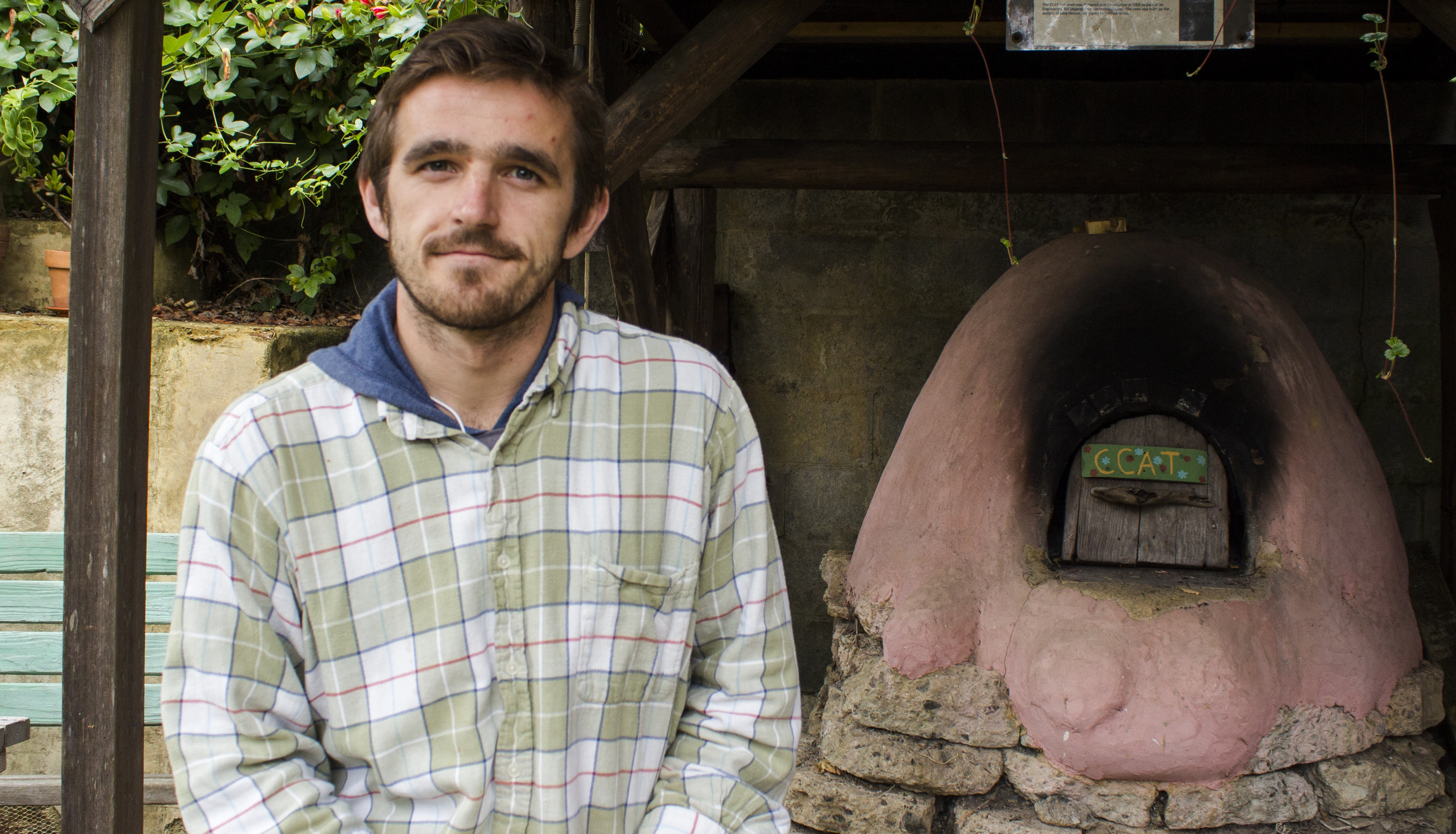
Near the jasmine bushes, the folks at CCAT have also recently constructed by hand what are called Cob structures. Everything that went into these structures was derived from all organic or reused materials, such as clay, straw, sand, newspaper and a natural plaster, used to coat the structures. This form of building has proven to be incredibly versatile, hearty and efficient.

So far they have constructed Cob benches so people have another place to sit and enjoy the scenery, Cob terraces, in order to provide homes to a variety of plants, and even a wood fire Cob oven, which allows them an opportunity to prepare meals outdoors. Due to Cob’s heat retention properties, it makes to be an incredible oven explains Rynne.
Over the years, CCAT has come a long way. They began their journey in 1978, and since then coordinators and volunteers have been hard at work, addressing issues in the local and global environmental community, hosting sustainability centered workshops and also working the property itself, installing sustainable technology such as a composting bin, solar hot panels, and wind turbines.
The Buck House itself has undergone immense change over the years. It’s seen repairs, improvements, and new sustainable innovation come and go, such as the addition of a new roof, an entire ground floor and the installation of a Graywater catchment system used to recycle used dish, shower, laundry and hand-washing water.
A new season has just begun and there’s still lots of gardening and more to be done at CCAT.
TO GET INVOLVED:
The Campus Center For Appropriate Technology is located on the Humboldt State University campus near the Redwood Community Forest.
To learn more about CCAT and to keep up to date on all of the happenings at CCAT, click here.
Head over to their Facebook page under Campus Center For Appropriate Technology
To contact CCAT
(707) 826-3551
Email: ccathsu@gmail.com
CCAT Upcoming events:
Open Mic Night
Oct. 13 at 7:00pm
Herbalism Workshop with Loba Loca
Oct. 18 at 5:00pm

By | Kyra Skylark

Margaret Peck, a Biology major with an emphasis in Ecology and Evolution, moved to Humboldt this past June. While drawn to the school’s Science department, Peck found great value in a class outside her major.
“My Native American Studies course, I want to go into land management and a lot of that is working with the tribes of an area to get them back on the land,” said Peck. “To give the land back to them and have a kind of co-management. So I’m learning a lot of techniques to better understand where they are coming from and learn more about their history. So much of their history is not actually taught to us in our education or if it is taught to us, it is not anything remotely true or factual about what actually happened to them.”
Learning history and communication skills in addition to her core science classes helps prepare Peck for possible career opportunities in the future.
“I wanna help get people on the land and I really just want to be outside, that’s where I’m happiest,” said Peck.

Darrian Francki, a second-year Forestry major with a concentration in Wildfire has changed his original goal since taking a variety of classes here at HSU.
“When I first started at HSU I was thinking more of [a career in] national parks, but now that I’ve learned more, I’m open to anything within my major,” said Darrian Francki. “Whatever comes my way.”

Cindy Luke, an Environmental Science and Management major just started her second semester.
“What brought me here was knowing that this was such a good place to be for environmental studies,” said Cindy Luke.
Focusing specifically on Environmental Education and Interpretation, Luke hopes to teach individuals of all ages the value of being outside in nature.
“Teaching all people in general, it’s important to start when they are younger, but it’s also important to know that they don’t stop learning,” said Luke.
Luke is excited to be apart of the HSU community,
“I have always loved the outdoors,” said Luke. “I was a single mom, so I went into accounting and business, payroll, because I already had an associate’s there. But I’ve always wanted to be outdoors and I’ve always wanted to share that love.”

Conrad Stielau, a Forestry major in his second year is stoked to be going to school in the redwoods.
“It’s the Harvard of Forestry colleges,” said Conrad Stielau. “I’m a Forestry nerd, I deeply care about the trees, and there’s not a better place to learn.”
Focusing on Wildland Fire Management within the Forestry concentration, Stielau is loving learning tools applicable for his future career.
“In my Fire Ecology class, we’re understanding fire regimes,” said Stielau. “Basically how fire suppression in the United States has led us to the problem that we are in now, which is why we have more expensive wildfires and more severe wildfires every year.
Stielau is enjoying all of his classes more than he anticipated.
“Natural Resource Conservation is very cool, J. Dunks the man,” said Stielau.
Stielau hopes to use what he leans at HSU to improve the current system.
“I want to fix the US Forest Service,” said Stielau. “Basically fix America’s forests. I’m a younger generation of educated people in Natural Resource Science, all the people who have been making decisions in the last hundred years are old men. They don’t understand, they don’t think the same way. They still use plastic water bottles or they still drive their car half a block to work, they just don’t understand our sustainability mission.”
Humboldt State’s commitment to environmental awareness and sustainability is what draws many students to the university, and they carry that after they graduate.
“To bring a young fresh idea to it, a person like me who gives a shit– I give a lot of shits–it’s something I care about, I’m deeply passionate about Forestry,” said Stielau.

By | Bryan Donoghue
When the disciplines of Physics, Chemistry and Geology combine it creates a greater understanding of how the sciences are interconnected. Humboldt State’s professors and faculty understand that, and continue to operate their interdisciplinary program, Stars to Rocks.
The program is modeled after Humboldt State’s successful pilot program, the Klamath Connection. Katlin Overeem, the HSI STEM lead coordinator said Stars to Rocks is for first time freshman in the Chemistry, Geology or Physics departments. Aside from showing the relations between the three majors, Overeem said Stars to Rocks teaches time management, how to take notes, and introduces students to various resources on campus like the learning center, multicultural centers, and the peer mentoring program.

“Students have the tools that they need to know how to succeed as a student at HSU,” Overeem said. “This interdisciplinary strategy creates a more cohesive approach to learning for the student.”
The ability to articulate your science is a crucial skill. Kevin Boston, a Forestry professor with Stars to Rocks is a believer in, “we learn better when we write about it.”
“I’m teaching this material in critical thinking really about how to think and reply critically to Environmental Science kind of problems in general, that was sort of the approach I was going to take for the class,” Boston said. “We learn to be better writers by being better readers.”
This is a sentiment shared among other faculty members, like Overeem. Overeem explains one of the components of the program is block scheduling, which means that their courses are already set up for them. Freshmen in the Stars to Rocks programs get to be in the same sections of their courses together, and that allows the faculty of the program to show how a variety of disciplines is needed in order to be a successful scientist. The set of courses are all GE courses.
“Even if a student decides at some point that Chemistry isn’t right for them, all the courses that we put them into will count towards another degree at HSU,” Overeem said. “The ability to properly communicate your science is a really important component of being a scientist as well. So we’re able to work with these other departments like English and Communication and build these bridges across campus between departments that don’t typically interact.”
Zane Comden, a senior Physics major at Humboldt State sees benefit in the public outreach the program is involved in, and finds it to be a great way to show how all these disciplines are interconnected.
“There’s a lot of openings in the field for public outreach and stuff like that, Especially considering that people want to know where their tax dollars are going when it comes to things like publicly funded research,” Comden said. “When it comes to sciences like that, you can’t really have Geology without Chemistry and you can’t really have Chemistry without Physics, and underneath all that you can’t really have Physics without Math.”

Aside from the interdisciplinary aspect, Boston finds the program to be a great way for students to stay on a good path.
“You would see a number of students that’d struggle in their first year. Good students get into bad habits,” Boston said. “The first year experience from high school to college, and the freedom associated with college can effect students differently. Good students in high school can struggle mightily in college.”
Boston said drugs and alcohol uses can become common in certain students, and that can contribute to performance problems.
“I think this is an interesting opportunity to address some of those issues for students and make the first year more valuable to them. It’s a very interesting pedagogical approach,” Boston said.
The program continues to be a success according to Overeem, and will continue next year. For those looking to join Humboldt State University next semester, Overeem will be communicating with Oceanography and Marine Biology professors to pilot Rising Tides, a new interdisciplinary program.

By | Bryan Donoghue
Elon Musk continues to make new announcements on rockets that will help us travel to far away places, but recently he’s getting in touch with his roots. Rather than 12-meter rockets he’s been wanting to go to Mars with, Musk is opting to launch smaller vehicles that are only about nine meters tall. These rockets can travel up to 18,000 miles per hour, making long-distances shorter. Musk said that any two points on Earth would be less than an hour apart. Buying a ticket for a seat will cost the same as full fare economy in an airplane.
Source: New York Times
Our species’ origins are close to 200,000 years old according to some investigators. Through a recent study on a boy who lived in South Africa 2,000 years ago, Homo sapiens may have emerged as a genetically distinct species as early as 350,000 years ago. Researchers retrieved a complete version of the ancient boy’s DNA from his skeleton to compare with DNA from modern people and Stone Age species. The boy’s DNA is not affected by the migrations that occurred 2,000 years ago, so evolutionary geneticist Carina Schlebusch of Uppsala University in Sweden finds it to be the best benchmark so far for gauging when Homo sapiens originated in Africa.
Source: Science News
Animals travel the world’s oceans on makeshift rafts, whether they’re synthetic or natural. The 2011 Japanese tsunami caused a mega-rafting event and objects from Japan traveled as far as 7,000 km. The tsunami transported hundreds of species to the United States and Canada. Researchers have documented animals on 635 debris objects such as docks and buoys. There were 279 living Japanese invertebrate and fish species, with about 20 species together in each piece of debris. As the world population grows, the amount of waste entering the ocean will rise. Due to this, in the future of our coasts could become a lot less diverse.
Source: Science Magazine
Cells can be reprogrammed using mixtures of DNA, RNA and proteins. The most popular method uses viruses as a delivery vehicle—although they can infect unintended cells, provoke immune responses and even turn cells cancerous. Now there’s another process known as tissue nanotransfection, which involves a chip holding an array of tiny channels that apply electric fields to individual cells. This gives the chip the ability to convert or reprogram cells into other types, which has raised hopes for regenerating damaged limbs and organs. Researchers used the chip to restored the legs of injured mice and claim the technique is developed enough to test on people.
Source: Scientific American

Years ago, the movement to move away from fossil fuels was at the forefront of the public eye. Marchers organized and protests took headlines, screaming for change citizens demanded organizations eliminate their support for unsustainable energy practices.
In the spring of 2013, a group of Humboldt State students approached Craig Wruck, the Vice President of the HSU Advancement Foundation, to discuss eliminating the university’s investments within the fossil fuel industry and other concerning sectors.
“Four years ago, the students came to us, and it was during the whole run up to the fossil fuels divestment movement,” said Craig Wruck. “Humboldt State has been very good about socially responsible investing since the foundation was reconstituted, so we never had separate investments and we had never owned separate stocks. It would have been easy for us to say, ‘Good news, we’ve already divested, we don’t own any Texaco stock, because that was literally true.”
Yes, HSU was not directly invested in fossil fuels. However, indirect mutual funds held ties to the fossil fuel industry. This is what the students wanted to change.
“Our endowments as of the end of last year totaled about 30 to 31 million, and those are contributions over the last thirty years or so. They are then invested, and they are invested in what are called institutional funds, but are actually mutual funds. That’s not unusual for an endowment of our size. We just aren’t big enough to pick individual stocks, we get better diversification and lower costs if we invest in these institutional funds.”
Sorting through the details of the institutional funds was not an easy decision at first.
“It was a real risk for the foundation board, because they’re programed to get the best return they can,” said Wruck.
It took over a year to compromise and for the board to begin the process of divesting from the mutual fund investments that had ties to fossil fuels. The Advancement Foundation and the students worked to find the best compromise environmentally and financially.
“It’s an interesting argument. Whether the best way to force change in the corporate world, in terms of utilities and energy production, is to stop investing in it,” said HSU President Lisa Rossbacher.
Rossbacher was also a member of the Foundation board, and debated the next step in divesting from fossil fuels.
“Do we stay invested and use the fact that we are shareholders to argue from within, or do we make an even more dramatic statement and divest,” said Rossbacher. “We are in the process of divesting.
The board decided, at the encouragement of the students, to look into the indirect mutual funds and their ties to fossil fuels.
“We, [the Advancement Foundation] decided to take on the more complicated work of looking into the investments that the mutual funds own and trying to figure out how to green those up,” said Wruck. “Nobody had done that before.”
According to an article written by Annette J. Penny, a HSU grad and one of the students who originally approached the foundation about divesting, they were finally able to agree on the next steps towards divesting in late 2014:
From there, things began to move faster and the Humboldt State Investment pledge was created. Below are the ten agreements stated in the pledge, provided by the 2014 press release on the HSU Investment pledge:
The Humboldt State University Advancement Foundation will:
1. Define Socially or Environmentally Concerning Sectors (“Concerning Sectors”) in a broad, bold way so as to include:
2. Continue to abstain from any direct investment in Concerning Sectors.
3. Monitor and report on the value of indirect investments in Concerning Sectors.
4. Make reasonable attempts to reduce the size of indirect investments in Concerning Sectors, provided any divestments are consistent with the Foundation’s fiduciary requirements.
5. Define Socially or Environmentally Responsible (“SER”) organizations, projects or assets initially as ones which are environmentally friendly (i.e. reduce the levels of atmospheric C02) or improve the health and well-being of our community members. Revisit definition and revise as appropriate over time.
6. Actively seek offsetting investment opportunities in SER organizations, projects or assets.
7. Invest directly in SER organizations, projects or assets provided that:
8. Monitor and report on the value of direct investments in SER assets and active investments in SER organizations or projects.
9. Monitor and report on the value of obvious indirect investments in SER organizations, projects or assets.
10. Create a SEROP Fund (with appropriate policies) and actively seek donations of funds and assets that could be used to support Humboldt’s SEROP Pledge.
Since the Humboldt Investment pledge was created, HSU has taken actions to be more sustainable and environmentally responsible.
“The Humboldt Investment pledge does a couple things,” said Wruck. “We define socially concerning sectors much more broadly than anyone else. So we have always tried to minimize our investments in alcohol, tobacco, firearms, gaming, that sort of thing. We decided to add the entire energy sector and the entire utilities sector.”
Eliminating investments in both the energy and utility sectors was a huge step for the university.
“As we debated it we realized, ‘What’s the point of divesting in fossil fuels if you still own utility stocks that have power plants that burn coal,’” said Wruck. “So we decided to just eliminate both of those sectors. That has an impact on investment return, although we are three years in now and our investment return is as good as it’s ever been.
Deciding to divest from the energy and utilities sectors was not the easiest decision, but it was the next step in the university’s commitment to environmental accountability.
“A lot of schools have said, ‘Well you know, we’d love to step away from investing in petroleum and other fossil fuels, but we’re worried about what the impact of that would have on our endowment holdings,” said Rossbacher. “Our job is to increase those resources, that then can help the university. We divested and [still] have a really strong return on investment.”
The endowments the university receives funds numerous programs on campus, in addition to providing individual scholarship funds to students.
“Endowments are created by donors who give us money, and their direction to us is that we are to invest it and distribute the investment profits, but try to maintain it as a permanent fund,” said Craig Wruck. “So we try to maintain a little bit for inflation each year and then make distributions off of that.”
There was the possibility of having a much weaker investment return after divesting.
“They (financial advisors to the foundation) advised us that we would probably suffer about a 10th of a percent loss because we were going to pay attention to these sectors,” said Wruck. “It didn’t work that way, we have had our second best year ever as of June 30th.”
Since this process began in 2013, the foundation has made significant progress in divesting from concerning sectors.
“The portfolio itself is totally divested, the equity portfolio has totally divested about a fifth of it. It’s a balance, you don’t get as good investment return if you exclude utilities and energy, so we want to protect the investment return and continue to green up the portfolio.”
Another main focus for Wruck and the Advancement Foundation is to invest more in environmentally sustainable practices and programs.
“About a year ago the board members decided to raise money for what they called a ‘Go Green fund,’ to support students working on projects that contribute to a sustainable environment, and they just met their goals,” said Rossbacher.
During the first few weeks of the semester, the Go Green fund’s reached its goal, and the fund was considered successful enough to continue.
“We are just this year launching the Go Green interns,” said Wruck. “That’s money that the foundation raised, it’s a little over $100,000, and it’s being used to employ students to do sustainability work on campus.”
The Climate Action Plan was also fully completed last year, planning out the next steps to create a more sustainable campus. A group of students have been chosen to work on the project alongside the newly formed campus-wide Sustainability Committee.
“Working through the Office of Sustainability, [the students] are getting paid for their work and their job is to implement the campus’s sustainability plan, [also known as the Climate Action Plan,]” said Wruck.
Students took the initiative, first bringing the question of divesting to the foundation in 2013. Since then, numerous actions have been taken to carry out the ideas originally
“We wouldn’t have done this if the students hadn’t brought it to our attention. We were doing good, we were doing socially responsible investing the right way, but we wouldn’t have taken this extra step had the students not encouraged us to do that,” said Wruck.
Students are the ones who prompted this change, and they did so simply because they cared about the environment and the university. In the article Annette J. Penny released back in 2014, she explains why she needed to fight to divest.
“So why did I push so hard,” wrote Penny. “Because prioritizing the people and planet over profits is always the right thing to do. Because “Green Funds” are up and coming, allowing for quick growth in fund diversity. And because I can’t stand the thought of one day telling my daughter that I didn’t do everything I could to keep the planet healthy and alive for her to enjoy like we are lucky enough to do today.”
She was right to push. Since the issue was first discussed we have begun the process of divesting, the Climate Action Plan was created, the Sustainability Committee was formed, and the target for the Go Green Fund was met.
“We can do both, we can support the green efforts that are so aligned with the values of this institution and still increase the rate of return on our investments,” said Rossbacher.

Parisa Ghaffari, Senior, Biochemistry major—
Q: Where are you from?
A: I’m Persian, and I’m from Iran. I’ve probably been here since junior high, my family moved here to Humboldt.
Q: What are you studying?
A: I like chemistry, so I decided to major in Biochemistry, because I like biology too.
Q: What are you planning to do with your degree?
A: I’m planning on working in a research lab or something. Just for now, I was thinking biomedical engineering.
Nicholas Hernandez, Senior, Physics major—
Q: Where are you from?
A: I’m from Long Beach, California. Humboldt was literally the farthest away from LA that you could get that you still get in-state tuition.
Q: What are you studying?
A: Right now, I’m doing gravitational research with C.D. Hoyle, a professor here in the Physics department. We’re researching novel tests of gravity below 50 microns. So I’m doing some research with the Physics department.
Q: What are you planning to do with your degree?
A: I’ll hopefully go to grad school, and get into the academia life.
Bryce Baker, Junior, Physics major—
Q: Where are you from?
A: I’m from Fortuna, I’m a local. I grew up here. I still live with my parents, and I’m still living out of Humboldt. I always take a bus here everyday, an hour and half bus ride. It’s a bit of a travel. The reason I chose here and not to go all the way across the country is that it’s home, it’s cheap, it’s what I wanted to do so I could do grad school and afford grad school.
Q: What are you studying?
A: I’m more looking into sustainable energy and renewable technology type of stuff. Right now, I’m working on a research project with Dr. Ruth Saunders, a teacher in the Physics department, looking at zinc oxide nano-rods and what I’m specifically doing is looking at how they grow and trying to create a proper growth model for comparing their radius of growth to their height.
Q: What are you planning to do with your degree?
A: I’m not exactly sure, I could see myself going in a lot of different directions. I know immediately after HSU though, I do plan on going to a grad school, and I do plan on looking for those opportunities. What I want to do is sustainable energy, though.

By | Bryan Donoghue
Being outside rejuvenates our bodies. Geneviève Marchand, a Kinesiology professor specializing in outdoor recreation notices that many students come here and take opportunities to get to know the community of outdoor recreation, but that there are also some students who do not. This point of curiosity led to a study, if participation in the outdoors near Humboldt State helps students feel more connected to their campus community.
“My hypothesis is that it is and that students that actually either have opportunities to go outdoors or take the time to go outdoors feel more connected to Humboldt State.” Marchand said. “I’m really interested to find if that works and if that makes a difference.”

The outdoors provide a variety of different benefits under a cluster of different weather conditions and locations. Although, being outside in nature like we have in Humboldt stays consistently beneficial in how it effects our bodies and mind.
The cooling air is helpful with refreshment, acting as a stimulant of sorts that wakes up an individual, specifically someone who has been fatigued.
“When I’ve been at the gym all day, it’s nice to just walk outside and feel the cool air and just kind of chill for a second,” said Madeline Hatch, a sophomore kinesiology major at Humboldt State.
This sentiment aligns with Marchand’s research. According to Marchand, just being outside reduces our stress levels.
“We basically just go outdoors, and somehow being that it’s nature, that open space, being in green, the sounds and the smells, it all reduces our stress levels.” Marchand said. “There’s actually evidence of it reducing your heart rate, and calming your breathing.”

It’s not just feeling exhausted physically, after spending a while studying, sometimes the brain needs a breath of fresh air to be woken up as well.
“I definitely notice that when I get bogged down with studying, if I take my reading outside, it kind of wakes me up a bit,” said Kindall Murie, a senior marine biology major.
There’s evidence that the outdoors helps plenty psychologically. According to Marchand, it reduces mental stress and gives just a better mental wellbeing overall.
The outdoor environment of Humboldt County is something to be grateful for according to Steve Bell, an assistant supervisor at the Student Recreational Center at Humboldt State.
“You have to stimulate yourself. This is a natural way to get what’s available out there.” Bell said. “So that’s what we’re doing. We’re making the most of an opportunity to be out here, by being outside today. I was just telling my daughter here that you really need to thank God for the opportunity.”
To enjoy the benefits of being outside, you have to put the effort in. Make that first step. The benefits will follow.
“I was telling my daughter, we are going to get a lot more out of this than what you put into it.” Bell said. “You don’t only reap what you sow, you reap more than you sow. We’re doing it by faith, and we’re basically sowing the seed today to reap the benefits of another time.”

According to Marchand, there’s evidence we learn best about ourselves, and potentially about how to work with other groups in outdoor settings that are challenging us.
“In the end, nature takes care of letting them know if they did a good job, or not.” Marchand said. “I think they learn about themselves, and become better and more in tune with themselves as human beings.”

By | Bryan Donoghue
Ancient feathered ostrich-like dinosaurs laid clutches of blue-green eggs just like the traits of robins from today. The eggs are thought to have camouflaged themselves in forested environments, and they were in open nests dug into the ground. Using chemical analyses, scientists were able to detect traces of two pigments, biliverdin and protoporphyrin, which are commonly found in modern bird eggs. According to David Varricchio, expert on dinosaur reproduction at Montana State University, “The discovery highlights how much our thinking has changed about dinosaur preservation and how much more we can learn about the original animal.”
Source: National Geographic
Known as the “cradle of humanity”, Africa is from where our earliest human ancestors spread across the rest of the world some 50,000 years ago. Africa is also where people—ancient and modern—are most genetically diverse. Harvard University evolutionary geneticist Pontus Skoglund and his colleagues obtained DNA from 15 ancient Africans from between 500 and 6000 years ago and found ancient genomes and evolutionary adaptations. This has been the first big effort to sequence ancient African DNA and reveal how early humans swept across the continent.
Source: Science Magazine
For a long time, scientists have been left wondering if jellyfish can fall asleep. Three Caltech graduate students found that at least one group of jellyfish, the Cassiopeia xamachana or upside-down jellyfish, does get some shut eye. To prove that jellyfish sleep, the students had to demonstrate that they fulfill three behavioral criteria. First, the animals must undergo a period of diminished activity. Second, the animals must show decreased responsiveness to stimuli while sleeping. Three, the animals must show an increased need for sleep if they are kept from it. The upside-down jellyfish fit all these criteria, and thus can be considered sleepy. In addition, the researchers also demonstrated that jellyfish get sleepy when exposed to melatonin, just as humans do.
Source: New York Times
High energetic particles called cosmic rays were found by scientists to come from outside of our Milky Way Galaxy. The ray’s journey possibly starts from a black hole in the center of a distant galaxy. Trying to identify which galaxies and seeing if there is any pattern linking them are the next steps for researchers. That research could help narrow down the processes that can accelerate cosmic rays.
Source: Science News