The Lumberjack


Students Serving The Cal Poly Humboldt Campus and Community Since 1929

Category: Science

  • The storm is here

    The storm is here

    Hurricane Maria claimed its first fatality as it passed through Guadeloupe this past Tuesday. The category 5 storm wrecked the local communities and left almost 40 percent of the island without power. Hurricane Maria is expected to only do more damage over the next couple days. Almost immediately after Hurricane Irma devastated communities in the Caribbean, Maria seems to be following a similar path towards the Virgin Islands and Puerto Rico.


    For those of us in Humboldt, situated along the Pacific, it may be easy to overlook the disasters occurring elsewhere in the world. But after a series of five hurricanes over the last few months and the recent earthquake originating near Mexico City, we have to get involved. Natural disasters that don’t hit us still affect us.


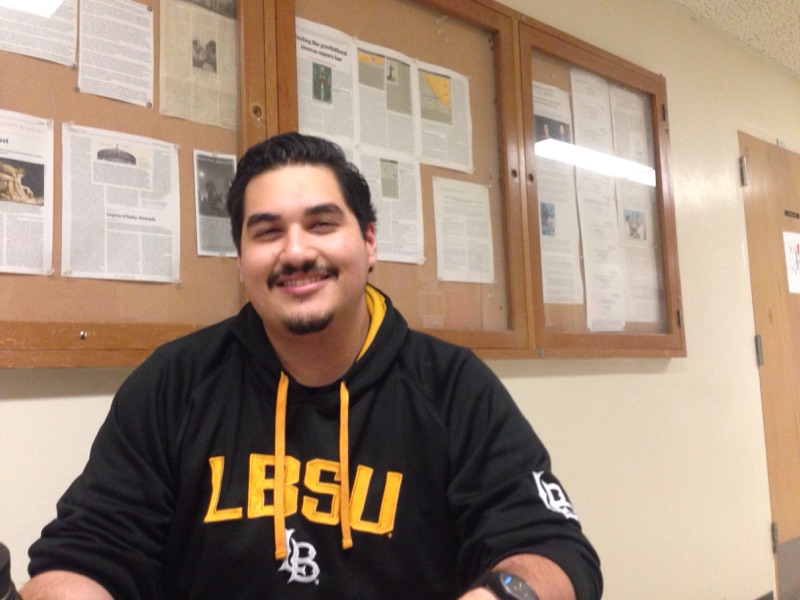
    Thomas Perez, a Business Marketing major here at Humboldt State, believes that anyone and everyone can make a beneficial impact.

    Thomas Perez: Natural Disaster
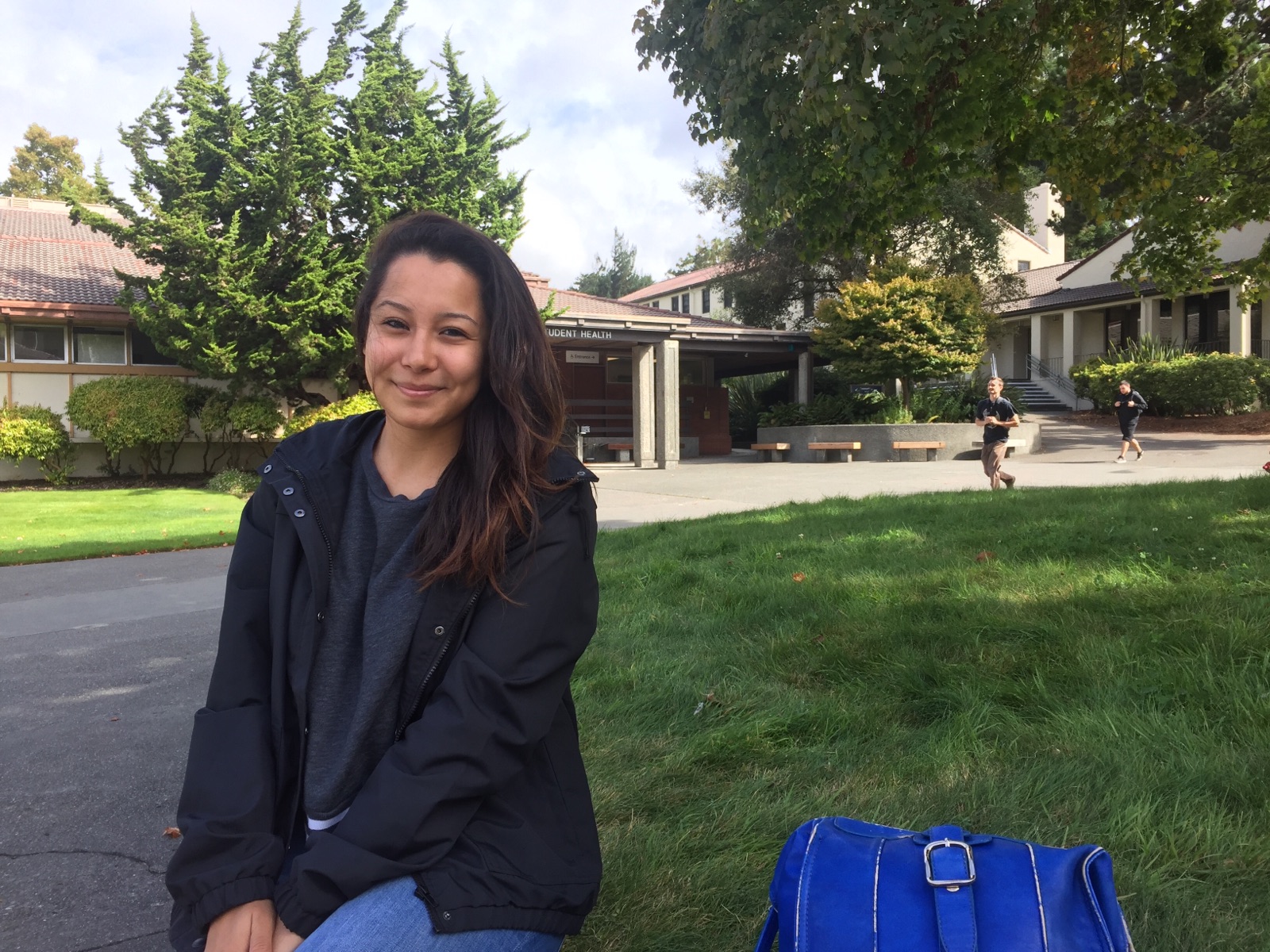
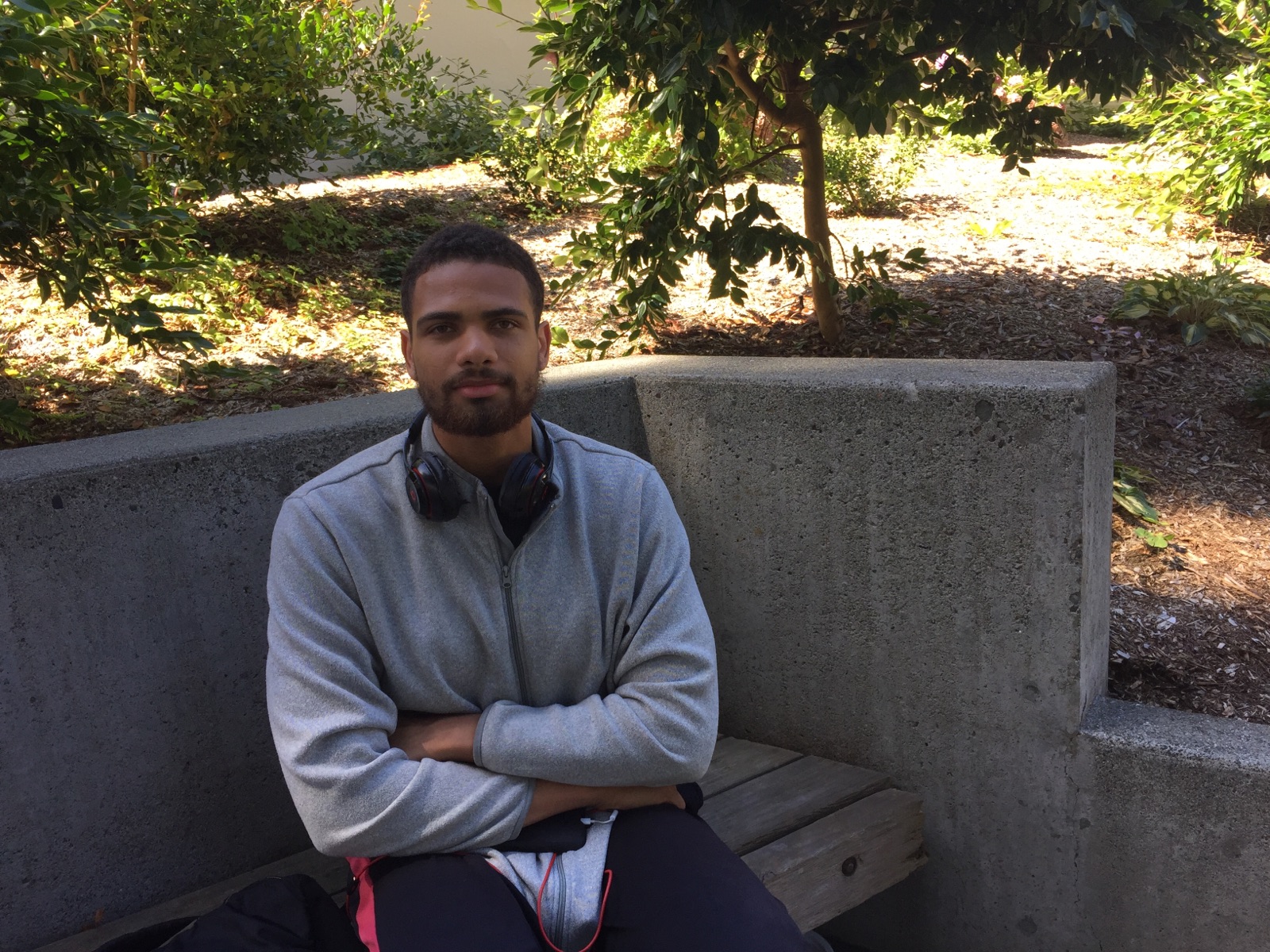
    Thomas Perez, a business marketing major, has friends in Texas that were evacuated after hurricane Harvey. Photo credit: Kyra Skylark

    “As simple as it is, donating money to relief efforts would be great,” said Thomas Perez. “If we could donate, whether it’s our time, our money, or even ourselves promoting them, I’m sure that awareness could be a great help [to areas impacted].”


    While Hurricane Harvey made its way through Texas, Perez had a personal investment to stay updated on the storm.


    “I have some long standing friends that went to the University of Texas and also to Houston, they had to be evacuated from their homes and I don’t know if they will be able to return anytime soon,” said Perez.


    Perez has been keeping in contact with his friends in Texas, so he wasn’t too worried about how they were doing physically. They were all evacuated before the worst of the storm hit and are currently safe, but Perez was able to hear first hand accounts of what was happening.


    “It’s terrible that they are going to lose so much of what they’ve had,” said Perez.


    Perez is not the only one who knows someone who was impacted by the storms.


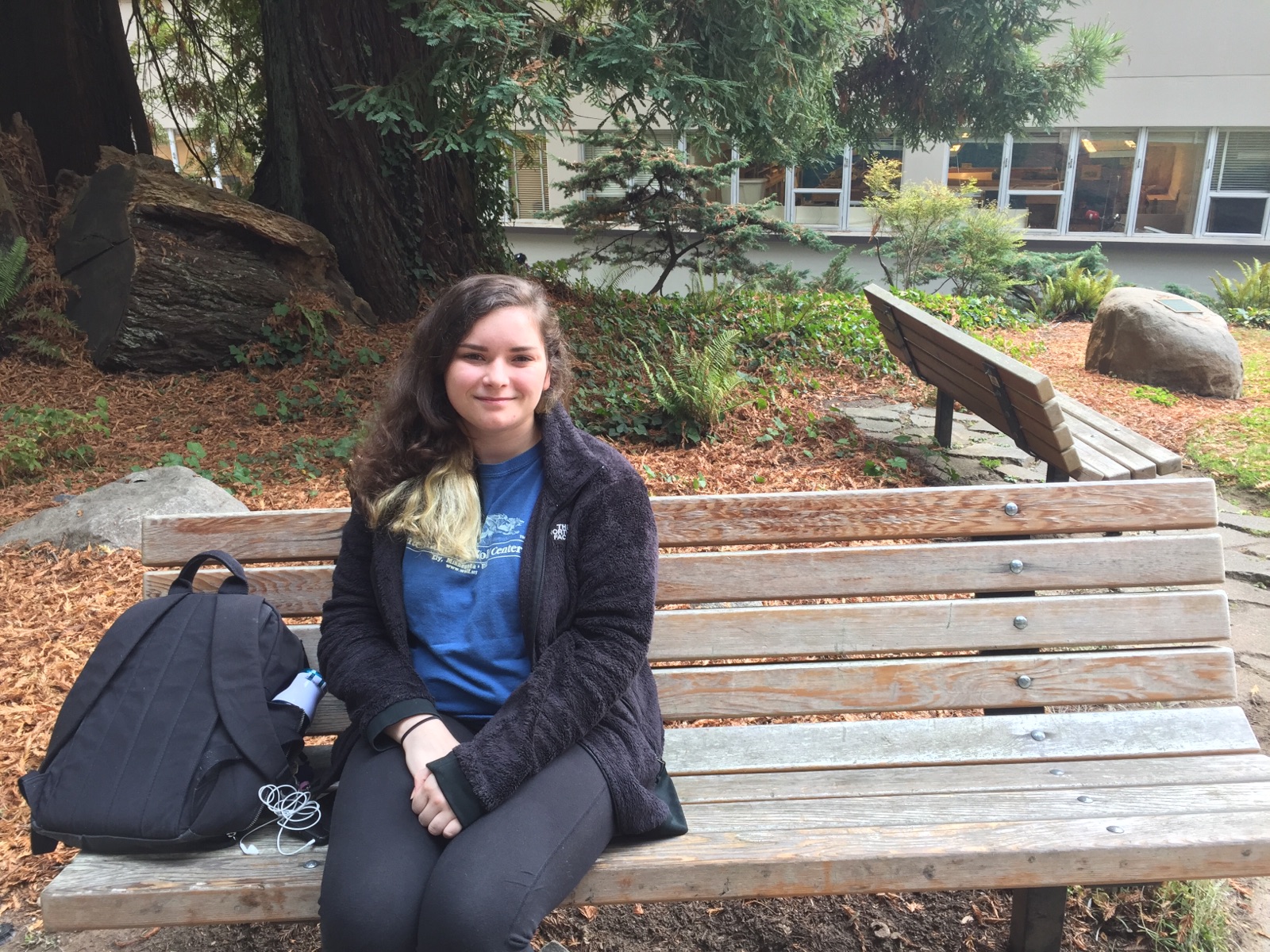
    Cassandra Wages, a freshman starting her first semester at HSU, also has family and friends hit by the hurricanes.

    Cassandra Wages: Natural Disaster
    Cassandra Wages’s aunt lost her property in Florida due to damages from hurricane Irma. Photo credit: Kyra Skylark

    “In Florida, my great-aunt has family there, and all those people had to be evacuated, and she’s losing her property that’s there,” said Wages.


    Like Perez, Wages says that donations are helpful to rehabilitate people. While not everyone can physically help the communities hit by natural disasters, donations are a simple aid.


    Kianna Rodriguez, a Communications major, strongly believes that donations are the way to help if you can’t physically set aside the time.

    Kianna Rodriguez: Natural Disaster
    Kianna Rodriguez, a communications major at HSU, believes unity in the aftermath of a disaster is essential. Photo credit: Kyra Skylark

    “As much as people want to help and want to be doing things for people that are suffering because of these natural disasters, sometimes our resources aren’t enough,” said Kianna Rodriguez.


    “One of the biggest things is staying on top of what people actually need, that’s one of the biggest things that I’ve been concerned about,” said Rodriguez. “If there is something I can do, I’m a college student I obviously can’t do a whole bunch, but donating money [could help], not necessarily clothes or blankets, cause maybe they don’t need that stuff.”

    Craig Mitchell, an Environmental Science and Management major, says that donations can help, but there are other ways to benefit recovering areas.

    Craig Mitchell: Natural Disaster
    Craig Mitchell, an Environmental Management transfer, is a member of the coast guard reserve and Mitchell was almost sent to hurricane Harvey. Photo credit: Kyra Skylark

    “I’m actually in the Coast Guard reserve and I almost got deployed to Harvey,” said Craig Mitchell. “I spent six years on active duty in the Coast Guard and I have friends that are now stationed down their.”


    Luckily, Mitchell was not deployed and was able to transfer to HSU this semester. Mitchell believes that small changes, driving less when possible, choosing sustainable products, and other everyday decisions we make, influence the devastation the storms are causing.


    “I feel like global warming has something to do with it,” said Wages.

    Hurricanes are caused by low-pressure weather systems and sustained winds of above 74 mph according to the National Oceanic and Atmospheric Administration (NOAA). An increase in the global temperature, resulting in an increase in the ocean’s temperature would influence the size and number of tropical storms in a given area. While there has not been any confirmation relating these recent natural disasters to climate change, the general belief on campus seems to be that climate change is impacting the storms.


    “It would be natural if there weren’t so many, it’s just that three to four hurricanes in one season is a little ridiculous,” said Perez. “Normally this is the time for hurricane season, but just one and not that big, it all seems a little unnatural”


    Whether or not we are influencing the intensity of the hurricanes through climate change, this is still a worldwide issue. If one area is hit by a devastating disaster it is up to us, all of us, to help them.


    “Seeing the people that are going out with boats and stuff helping families is so incredible,” said Rodriguez. “It’s been nice to see unity when it comes to these situations, because there hasn’t been in the past. Its nice to see that people are stepping up now, and even going out of their own state to travel to these places to help other people.”


    Some natural disasters can not something be planned for. We can prepare, with prepared supplies and plans for various disasters, but we never really know when, where, or how the next natural disaster will occur.


    “It’s time for everyone to step up and try help each other, even when times of crisis are happening,” said Rodriguez.


    What if a hurricane hit where someone you love lives. Or if an earthquake, like the one that just hit outside of Mexico City, shook Humboldt instead. A natural disaster is bigger than one individual’s story or one communities hardship. A hurricane does not target people for a reason, the environment doesn’t care where you’re from, what you look like, or how much money you have.


    “I have family in Texas, and it’s kind of scary knowing that someone you know, possibly might not be here any more,” said Rodriguez.


    Hurricanes have done immense damage this year, and thousands of people have been displaced because of the series of storms. Many others have lost their lives. This is not a small issue, if natural disasters are increasing in strength and frequency, the worldwide effects will only get worse.


  • Burning State

    Burning State

    By | Michelle N. Meyers

    A thick, grey haze blankets the state of California. People everywhere are being evacuated from their homes, while thousands of wildfires burn across hundreds of thousands of acres of land. Firefighters and emergency personnel from different towns, cities, states, and even countries have been fighting the California blazes for months.

    ThompsonIanFeature-1955jpg

    (Photo: Ian T.)

    This year to date, 6,744 fires that have burned a total of 731,260 acres according to Cal Fire. Currently, there are 35 wildfires burning statewide according to the Incident Information System, InciWeb. In order to battle the blazes, there have also been some 21,000 firefighters assigned to fires in 10 Western States. (NIFC)

    “We have a lot of dedicated men and women out there working to put this thing out,” says Shawn Compton, Orleans Complex Information Officer and firefighter since 1993

    ThompsonIanFeature-1714jpg

    (Photo: Ian T.)

    In addition, the NIFC states that the National Preparedness Level for wildfires has been elevated to National Preparedness Level 5 as of August 10, 2017, the highest level since august of 2013. Preparedness Levels are established by The National Multi-Agency Coordination Group (NMAC) throughout the year to ensure that firefighting resources are prepared to respond when incidents arise. According to the National Park Service, Preparedness Level 5 is a situation in which several geographic areas that are experiencing major incidents that have the potential to exhaust all resources.

    With so many fires going on this season at such high intensities, firefighters have been strapped for resources.

    “It doesn’t help right now with all the hurricanes going on either,” says Compton. “When you have no more resources nationwide, it’s really hard to find them.” The scarcity of resources makes it much harder to respond to these fires. With so much going on at one time, there are only so many resources to go around and Compton says it ultimately comes down to “what fire is more important to the other.”

    While this season proves to be a difficult one to manage, Curtis Coots, The Orleans Complex Incident Commander says that, “When it comes down to it, life and property, that’s always the focus.”

    But what’s going to stop the blazes? While manpower alone can redirect and slow down the progression of fires, it isn’t manpower that’s going to stop these high intensity fires.

    “You can put 1000 firefighters in front of a crown fire, its not going to stop it,” says Compton. “A season ending event, that’s what’s going to put the fire out.”

    ThompsonIanFeature-1965jpg

    (Photo: Ian T.)

    California Fire Map as of Sept. 13, 2017


    Spotlight On The La Tuna Fire


    Some say the La Tuna Fire may be the largest fire in Los Angeles’s history. So far, it has scorched some 7,194 acres of land, obliterated 4 homes, and prompted Gov. Jerry Brown to declare a state of emergency. Yet, as of now, The La Tuna Fire is 100 percent contained.

    On Sept. 4, 2017, while fighting the perimeter of the La Tuna Fire, Torrance Firefighters came across the Theodore Payne Foundation For Wildflowers and Native Plants in Sun Valley. When they saw it, they fell in love with its beauty and its mission, and they felt that they couldn’t let the place go up in smoke.

    After fighting fire around the parameters of the foundation, the firefighters slept on their picnic tables over the night. The next morning, Foundation Director of Horticulture Tim Becker and Foundation Executive Director Kitty Connolly were relieved to find a large fire engine in their parking lot with four firefighters standing by.

    “We were really happy that they were here,” says Connolly.

    After being evacuated several days earlier, they were on pins and needles that all would be lost in the fire, and it nearly was.

    “They stopped the fire right at the edge of our property,” says Connolly, “their skill is incredible.”

    All surrounding areas of the foundation have been burned.

    “It’s just heartbreaking to come down the canyon,” says Connolly, “it’s just black.”

  • Voices of student science

    Voices of student science

    By | Bryan Donoghue

    BDVoices_Web-1.jpg
    Samuel Vassallo, sophomore, Wildlife major Photo credit: Bryan Donoghue

    Samuel Vassallo, sophomore, Wildlife major — “I hope to work outdoors and possibly for government agencies like the U.S. Fish and Wildlife Service, or the park service, or the U.S.G.S., or any of the state agencies that are equivalent to national agencies like those. I could work for a nonprofit like the World Wildlife Foundation, or Nature Conservancy, or I could work for a company that needs to do environmental impact and see if there are any endangered species on their property, so if they could log or mine. Probably not as much into working for a private company, I would like to work for the government. I love the classes, it’s great. When I chose this major I just thought it sounded cool and looked at the course list and chose it. You had to pick a major as a freshman to be in the Klamath Connection, which was a program I was in. We show up a week early to school and meet our professors, and I just picked Wildlife because it sounded cool and when I got here I’ve been loving every minute of it, so I feel like I’m in the right major, it’s pretty lucky.”

    BDVoices_Web-2.jpg
    Romeo Javier Dominguez-Rameriz, recent graduate, Criminology major Photo credit: Bryan Donoghue

    Romeo Javier Dominguez-Rameriz, recent graduate, Criminology major — “I’m doing an extra semester to see what I want to do with my graduate program. Right now I’m looking into international relations, so I’ve been looking in to see what programs I can go into that are in Germany. Nothing set in stone or anything. Personally, I love it up here. I’m from the SoCal area, the main reason why I came here was because of the environment and everything and I pretty much enjoy the people and environment like I hoped I would. The staff from my department is pretty rock-on, so I’m most fortunate for our faculty.”

    BDVoices_Web-3.jpg
    Jade Simms, senior, Engineering major Photo credit: Bryan Donoghue

    Jade Simms, senior, Engineering major — “I’m hoping to get a job. I think it would be cool to work in river restoration, but we’ll see who wants to hire me. I think the Engineering department is a very supportive department, I’ve been given a lot of opportunities to learn what I want to learn. For future Engineering majors, do it! Don’t be afraid. I’ve talked to a lot of people, I know women especially are a little intimidated, but screw it, just do it.”

  • The enemy that sweats

    The enemy that sweats

    Breathing in the Arcata air, you can feel the humidity invading your lungs. The usually crisp forest air has been exchanged for a hot, humid mugginess.

    The weather may be nice for weekend adventures, but trekking up the stairs to Founders Hall has now become a sweaty, smelly challenge for most students. Those returning to the HSU campus are noticing the difference in the weather.

    Kristen VanGilder, a general biology major in her fourth year at HSU, has mixed sentiments on the change in the weather.

    “It’s nice that it’s been so warm, you get to go to the beach and it’s not raining, but walk into classes and you’re drenched in sweat,” said VanGilder.

    “Last year we got buckets, and then so far this year it’s just been hot, really, really hot. Recently it’s also been pretty humid.”

    Jeffrey Kane, a 2008 HSU alum and associate professor in the Forestry and Wildland Resources department, provides some insight into the intense heat and humidity.

    “It seems like there has been a change from wetter to dryer, and now we might be going into a wetter cycle again,” said Jeffrey Kane, “and that seems to be consistent with the ideas of how the climate for California is predicted to change.”

    During the three years Kane was a grad-student, Humboldt State was cold, wet and foggy most of the time. Originally arriving in Humboldt in 2005, Kane has been here during the wet seasons as well as the multi-year drought.

    “I came back in 2012, which happened to be the first year of the drought that lasted up until about last year,” said Kane. “I think last year was a pretty average year.”

    Unlike last year, the last couple months of the summer heat and humidity has been higher than in recent years. While temperatures above 80 degrees are usually rare, this past summer saw temperature frequently in the 80s and 90s.

    “What they’re predicting is increasing temperatures, and what did we have this year? We had 90 degree temperatures here in Arcata,” said Kane. “That was record breaking in some areas and very hot, uncharacteristic I would say.”

    The heat and humidity within Humboldt county is unusual for the area, but correlates with the general increase in temperatures in California and around the world. According to the National Oceanic and Atmospheric Administration, temperatures worldwide are rising.

    Kane said that the increase in temperature here in Arcata is consistent with the ideas and predictions on changing temperatures, “largely attributed to climate change, global warming, and the increase in Co2 in the atmosphere.”

    While the increase in heat has some fun outside benefits, the constant fluctuating humidity is a huge drawback.

    “Precipitation is a little more complex,” said Kane. “What they’re predicting isn’t that we’ll necessarily get less precipitation, but that well get more variable precipitation.”

    Basically the weather patterns themselves have not altered, though the general temperature and climate have changed creating repercussions for the local weather patterns.

    “It’s concerning, but I have hope that it will turn around, and we’ll get some rain,” said VanGilder.

    Rainfall is expected to increase as we enter autumn. However, the heat and humidity may also continue for longer than we have experienced before.

    “We can look forward to dryer drys and wetter wets,” said Kane.

    Jermaine Wilson, a criminology major also in his fourth year at HSU, came to Humboldt to escape the heat of LA, only to have the heat follow him here.

    “It pretty much makes you want to just lay down in bed, in cold conditions,” said Wilson. “It’s to hot to do anything else.”

    We’ll just have to wait and see if the humidity dissipates. In the mean time, drink water, take advantage of the sun, and give yourself enough time to walk to class.


  • This Week In STEM Sept. 14

    This Week In STEM Sept. 14


    Researchers at the International Monetary Fund and Georgetown University announced that more than 90 percent of all passenger vehicles in developed nations could be electric by 2040. Only two million out of more than one billion registered vehicles are electric today, with one million of those being in China. If this prediction proves true, it could reduce oil use by 21 million barrels a day and cut carbon dioxide emissions by 3.2 billion tons a year. That’s equivalent to 60 percent of total U.S. emissions today.

    Source: National Geographic

    Embed from Getty Images As many as one in three parasite species may face extinction in the next century. Researchers from University of California, Berkeley found that global warming will raise the planet’s temperature causing many species to lose territory in which they can survive. Parasites make up the majority of biomass in many ecosystems, and can outweigh predators sharing the environment by 20 to 1. The extinction of parasites may affect entire food webs, which would drastically affect human health in turn. Colin J. Carlson, the lead author of the study, said that parasites control the amount of diseases in wildlife, which indirectly helps humans as well. The estimated extinction of as many as one third of all parasite species would have dire effects.

    Source: New York Times

    Embed from Getty Images An oil tanker sank off the shore of Athens, Greece on Sunday, coating the entire bay in crude oil. Greek officials are calling it an environmental disaster as it’s turning the bay black and affecting the local wildlife. The spill is polluting the waters in a 1.5 km stretch around the island Salamis and will likely take four months to clean. Residents are outraged, coastal businesses have closed and fishermen have been advised to avoid the area. The captain and chief engineer of the oil tanker have been charged with negligence and released on bail. It’s still not clear exactly why the tanker sank.

    Source: BBC

    Beryllium hydride is now the largest molecule a quantum computer has simulated, generating new hope for future drug discoveries. According to Ryan Babbush, the researcher who led the hydrogen molecule simulation for Google, the accomplishment “represents solid progress towards an incredibly important goal.” For practical purposes, however, beryllium hydride is still a tiny molecule, so there is still much research to be done. Many scientists believe that revealing new drugs and materials will be the first significant application of future quantum computers, which are being developed at universities and companies around the world.

    Source: Science Magazine


  • Smoke on the water

    Smoke on the water

    The worst of the smoke is over and Humboldt can breathe a little easier.

    “We just put out a public service announcement. The Humboldt Bay Air Basin is in good condition over this weekend,” Chrystal Ales, a representative for the North Coast Air Quality Management District said.

    “Monday’s forecast indicate that smoke conditions will be improving. This weekend is predicted to have cleaner air.”


    The cleaner air is welcome, as the smoky conditions have made many students sick.


    IMG_1099.JPG
    “I’ve been pretty sick the last couple of days, and I don’t know how much the fires been contained. I know it’s all up and down the West Coast, its bad. I’m sure they’re doing all they can but I wish they would maybe try and figure out how to help with the ash because it’s really been bothering me for the last 4-5 days.”
    -Michelle St


    IMG_1100.jpg
    “I think that the wildfire itself is terrible and I don’t like the forest burning, but as far as the smoke goes, I don’t really mind the smoky air or anything. You know, some people talk about the terrible air quality and all that, but I honestly haven’t really noticed or anything. The sun and the moon look pretty cool.”
    -Peter Blickensderfer


    IMG_1098.JPG
    “I know it [the smoke] definitely had an effect on how hot it was on that one weekend where it reached up to 90 I think, which is ridiculous. Actually, it kind of hurt to be outside. One of my roommates is getting headaches, but it might have just been sickness, I’m not sure. I’m not used to this sort of thing, I’m used to volcano smog or fog. Not an actual blanketing of smoke, which is ridiculous to be in, and kind of scary.”
    -Kairos Pacheco


  • Conserve the Birds

    Conserve the Birds

    By | Michelle N. Meyers

    The Migratory Birds of the Americas Conservation Act was enacted by the Senate and House of Representatives on July 12, 2017. U.S. Senators Ben Cardin and Rob Portman introduced the bill as a reauthorization to The Neotropical Migratory Bird Conservation Act. The bill is intended to promote long-term conservation of Neotropical migratory birds and their habitats through a grants program, and so far, it is the only federal U.S grant program available throughout the Americas dedicated to the conservation of migratory birds.

    This slideshow requires JavaScript.

    Projects part of MBACA benefit most of the 386 bird species that breed in the continental United States or Canada and spend the winter in Mexico, Central America, the Caribbean, or South America. In addition, MBACA works to protect over 4.2 mill. acres of bird habitat, spanning across thirty six countries, according to The U.S. Fish and Wildlife Service.

    The North Coast of California happens to be one of richest areas in the country in terms of avian diversity, between some 300 and 350 species of birds can be found from just offshore, all the way to the first inland ridge-line. Humboldt Bay in particular is a vital stop for birds migrating along the Pacific Flyway which is a route used by millions of birds for migration to wintering and breeding grounds. The Bay’s coastal mudflats support some of the highest densities of shorebirds in California, housing 60% of all migrating Black Brant, 23% of all migrating and overwintering Western Sandpiper, 44% of all migrating and overwintering Dublin, and 3.5% of all Long Billed Curlews, just to name a few, but there are several other species of birds protected under the act that migrate to and through Humboldt County.

    MMBirds_Web-5.jpg
    Great Blue Heron with Mallard Ducks at Klopp Lake. Photo credit: Ian Thompson

    The Humboldt Bay Wildlife Refuge, located within the Pacific Flyway, serves as a key migratory stopover and/or wintering area for several species of waterfowl and shorebirds. “The purpose of establishing the refuge was to provide habitat for those birds for their Wintering stopover.” said Kurt Roblek of the Humboldt Bay Wildlife Refuge. “Let’s say for example… Aleutian Cackling Goose, we provide Wintering grounds for that species…whose numbers were very low before the bird was listed.”

    While he was not aware of Migratory Birds of the Americas Conservation Act itself, he says that-

    “We do have projects that will have direct benefits to those species. Such as our White Slough Restoration Project, where we are creating salt marsh habitat along the edges of Humboldt Bay.”

    • How exactly are you creating these habitats?

    “We are actually taking fill material and we are increasing the elevation behind the levees, so when the levees breach, that land will be high enough that it will be salt marsh.”

    • So what happens when it breaches?

    “So once it’s breached… In a few years, through passive and active restoration of that habitat, we will create something that used to exist, but didnt… we’ll bring it back.” Says Robleck. “Pre-human, or pre-white man- In the past, there was salt marsh”

    MMBirds_Web-4.jpg
    Looking out towards Arcata Bay at sunset from the marsh. Photo credit: Ian Thompson

    *

    George Ziminsky of the Arcata Marsh Interpretive Center, board member for the Friends of the Arcata Marsh, and graduate of HSU felt similarly about the necessity of our coastal habitats, stating that “Most migrating birds need mudflats for the invertebrates they eat.” Yet, a lot of the other habitats along the Pacific Flyway migratory birds rely on have been compromised, such as “Down in San Francisco Bay, places have been dyked and filled in so what was normally habitat for food for them, just had soil brought in and dumped on top of it.” He stated that over at the Arcata Marsh they are doing what they can to “create a more diverse habitat” and “restore what was taken away.” He also expressed that the city actually has been very involved in their efforts to restore the salt marshes.

    “A Lot of the areas west of I Street was being used for agricultural land, 15 to 20 years ago, and the City of Arcata has removed part of the levee and took out the tide gate.”

    As of now, The Arcata Marsh, includes around 307 acres of mixed habitat and serves as a solid foraging place for birds on their winter stopover. “The shorebird numbers are in the hundred of thousands in the winter” says Ziminsky

    *

    Jim Clark The Redwood Region Audubon Conservation Director and 4 time president, who graduated from HSU some 40 years ago, states that The MBACA is “the key conservation act that dictates everything from development to hunting,”

    Yet when it comes to avian conservation, “A Lot of it is advocacy,” says Clark. “So we look at the act as backups to those principles. We largely are reactionary, we try to be proactive.” He feels that public awareness, “Going beyond just birdwatching, but understanding a need to protect migratory birds.” plays a vital role in habitat and species conservation. His hope is that one day people will see “that little yellowish’ bird with the black top, Wilson’s Warbler, actually migrates 1000’s of miles. I think that would be an outstanding thing if all the people saw it, better understood what it has to go through to have a life.”

    “About 5 years ago we had seeds of varied thrush, and you wonder why this happens” says Clark

    “If you don’t protect the birds, there won’t be any birders, because there won’t be any birds to watch, to put it bluntly.”

    • How can the public get involved in bird conservation?

    “Be aware of what they can do on an individual basis for birds”

    He recommends “putting reflective strips on windows so you don’t get bird strikes.” In addition, he advises that we also not leave garbage out on the street because it’s attracting crows and ravens, which have now become quite a nuisance. He says that “40 years ago when I was going to HSU I had to get in a car and go over the first ridge inland to see one or two ravens. And now their thick because they’ve learned that where humans live, there’s stuff to eat.”

    In regards to what he has done to keep birds coming to his home, he says “in our yard we have planted red alders, it’s a native tree, and they get infected with little leaf hoppers which the warblers love to eat, sparrows love them too, they need them during nesting season.” In addition he states that he’s “planted native grass instead of the typical lawn.”

    We can also do our part by “Carrying out invasive, non native plants, encouraging native plants that provide food for birds at the right time of the year.” On the same note, “rat ladders” as he calls them, in reference to Ivy in particular, he states, “let’s rats go up into the trees and eat birds eggs” says Clark “The rats love Ivy, they love Pampas grass, and they love Himalayan Blackberries. All 3 of those plants are non native invasive plants.” Yet the birds aren’t the only ones affected by the fuzzy creatures according to Clark, “When you consider rats it’s also a public health issue.”

    • What issues do you see having the greatest effect on the community now or in the near future?

    “I think we’re going to be looking in the future to sea level rise and how that is going to affect the natural environment and how we’re going to live with that natural environment when we have to change our urban planning to accommodate that sea level rise, and it’s already happening.”

  • Humboldt State, we are still in

    Humboldt State, we are still in

    On June 1, President Trump announced his intent to withdraw the U.S. from the Paris Climate Agreement. Individuals all across the U.S. were left to determine how to respond to such an impactful decision.

    Humboldt State President Lisa Rossbacher considered the potential impacts of the decision on the university.

    “One of my immediate reactions was how inconsistent that decision was with the values we have as a university,” said Rossbacher. “The values of Humboldt State and our commitment to environmental responsibility and sustainability, just realizing that disconnect between that decision and who we are as an institution.”

    Four days after Trump’s announcement, a coalition of mayors, governors, college and university leaders, as well as smaller businesses and investors, banded together and released a statement expressing their support for the climate action goals in the Paris Agreement.

    According to press release by “We Are Still In” the community will work to “…remain actively engaged with the international community as part of the global effort to hold warming to well below 2℃ and to accelerate the transition to a clean energy economy that will benefit our security, prosperity, and health.”

    Since its creation, Humboldt State has joined the “We Are Still In” community as one of the universities working to reduce our carbon emissions and decrease our environmental impact.

    President Rossbacher added Humboldt State University to the statement list soon after its inception. She began hearing about the We Are Still In community statement soon after President Trump’s announcement.

    Pres.R2.jpg
    President Lisa Rossbacher

    “I immediately started hearing rumblings about the combination of businesses, governments and universities forming a coalition to say, We Are Still In,” said Rossbacher. “It was probably through a publication called the Chronicle of Higher Education, that I saw something about how colleges and universities were starting to individually sign on to this. I found a link online and I went for it.”

    Rossbacher added the university to the list without a second thought, easily deciding that Humboldt State should belong to such a community.

    “The California State University system is incredibly supportive of sustainability and environmental responsibility,” said Rossbacher. “I didn’t hesitate for a second. I didn’t feel like I had to ask permission.”

    Of those listed on the statement, some believe Humboldt State University is doing more to improve their energy efficiency and sustainability than other universities listed.

    Brian Rossignol, a transfer student here at HSU, provides his perspective on our school’s environmental impact.

    “I went to San Diego State, City College, Grossmont, and Cuyamaca College, and this school by far is the most environmentally conscious campus, by far,” said Rossignol. “It’s not even close.”

    The Climate Action Plan proposes numerous advancements and adjustments meant to reduce the school’s environmental impact and reduce the HSU’s emissions.

    To view the complete Climate Action Plan go here:

    https://www2.humboldt.edu/sustainability/sites/default/files/climateActionPlan.pdf

    Another project that Humboldt State is currently involved in that aligns with the goals in the We Are Still In statement is the school’s collaboration with the Blue Lake Rancheria.

    “It’s got a solar microgrid and there are also biofuel backups. So that if the Blue Lake Rancheria were to be completely cut off from any other any energy source, the combination of alternative sources that they have would completely power, the facilities there,” said Rossbacher. “More importantly it’s a red cross emergency site and so it could be incredibly important if we had some regional disaster, like an earthquake.

    Students at Humboldt State are going outside into the community to work with the Schatz Research Center on the Blue Lake Rancheria collaboration.

    “The Schatz Research Center is doing a lot of amazing things that move us forward in renewable energy sources and away from fossil fuels, and of course there are opportunities for students to become involved in those projects,” said Rossbacher.
    The Humboldt State students are all informed of the school’s commitment to social and environmental awareness. Daniel Erb, a student in his fourth year at HSU has been able to watch the progress the school is making.

    “I think that HSU has definitely been doing a great job working toward reducing their carbon emissions and just overall environmental productivity has been really great,” said Erb. “Overall I think the environmental impact that HSU has been going for has really been landsliding, which is great.”

    With all of the new policies and plans the school is creating and implementing, those on campus should expect to see changes over the next few years.

    “I’ve talked to president Rossbacher about it and everything and she seems really into it,” said Erb. “So, hopefully everyone on the HSU campus can get into it.”

    “Hopefully,” said Erb.


  • We are still in

    We are still in

    Mayor, governors, college and university leaders, businesses and investors are coming together to declare that they will still support the Paris Climate Agreement to combat climate change. President Trump’s announcement to withdraw the U.S. from the Paris Climate Agreement was met with widespread criticism, and local and state governments are taking responsibility to decrease greenhouse gas emissions in response. Susan Ornelas, the mayor of the City of Arcata, gives her thoughts on this growing international community known as We Are Still In. BDSusanOrnelas.jpeg

    Q: When did you first hear of We Are Still In? Was there an envelope in the mail?

    A: No, I came across it on Facebook or the internet. I just saw that, and saw that mayors were signing on and I thought while looking at the Paris Accord, “Well the city of Arcata has internal documents that direct us to do these things already!” So it wasn’t a big decision to have to make, it was kind of like, “we’re in!” We’re already in, and I just thought about the citizens and that they would like to see the city of Arcata on this list. So I just contacted the city manager and Mark Andre (Director of Environmental Services) and said, “yeah, lets sign up, let’s get our name in there.”

    Q: How was it implemented? How did you get your name signed on?

    A: Well we just wrote a letter based on, we have kind of a legislative platform that if things come up that fit the platform that we already approved, the mayor could just send a letter. So I just sent a letter saying the City of Arcata is still in on the accord, and like I said, and internally I knew that our policies were already working towards these things so wasn’t too difficult to do.

    Q: What has the city and university done to contribute to the “We Are Still In” agreement?

    A: The city and the university are working well together right now which is a contribution in itself. We have a lot of good coordination and the university has made some strides I feel like. The city has made strides like years ago and we’re still making further strides into zero waste and understanding that…The university did the whole sustainability analysis of themselves…that whole effort of reducing waste, more sustainable systems, less carbon use, you know. I think as a society many of us are trying to reduce our carbon use. Transportation is one of the biggest challenges for this county.

    Q: Like moving to the autonomous car?

    A: Yeah that will help, although you really have to look at where you’re getting your electricity and is that a good source. Is that a carbon free source, is that non-polluting as much as possible. It’s good that solar has gotten as inexpensive as it has.

    Q: Is that probably going to become the norm at some point?

    A: “Yeah, and then do you know about the Community Choice Energy Program? That’s another thing the city of Arcata is involved in. The whole county is actually involved in this…. So the Community Choice Energy Program is that Humboldt County now runs or purchases its own energy. It’s still run through PG&E but it’s called Community Choice Energy…. But this also goes in with the whole Paris Climate Accord because the county now is choosing more renewable sources of energy and investing in local solar arrays and things like that. So that’s what called a Joint Powers Agreement, a J.P.A., which means the county and the cities have joined together and we all sit on a board, and we’re overseeing this Redwood Coast Energy authority purchasing now energy for the county, and we’re getting it a little cheaper, and we’re emphasizing renewables. So that’s another way that we’re working to sort of you know weave ourselves out of carbon. And then another thing that I would say that the City of Arcata does is we study some carbon sequestation in like marsh lands because that’s another good source of carbon sink. So the City of Arcata is investing in marsh lands now, working with the university, with students doing studies and things of carbon sequestration in marsh lands. That’s another thing that we’re interested in that we work towards. We see the value of them. I mean there used to be people would just drain marsh lands and farmed it, but we see the value in them for bird habitats for ecosystem diversity and…

    Q: Kind of like estuaries?

    A: Yeah kind of like estuaries. You know a marsh land, yeah.

    Q: In your opinion why do you think We Are Still In holds such significance for our community?

    A: Well you know I think because Arcatans really take pride in their environmental stances and they wanted to feel like they supported this. They didn’t want to just give this up after the whole country had, you know, promised to join and then we pulled out, and I think there’s something powerful about all these mayors getting together because the mayors are closer to the people and they’re joining forces and saying whatever is going on at this level we’re still doing this. We still believe that we want to make sure we leave something for our children and things like that. So I think the mayors are speaking more for the people and that’s also kind of heart warming but also powerful stance. I think people liked that too. I think it’s important and people want to feel that we’re not going backwards, you know, I think that would be depressing for people. There’s ways we’re feeling like were watching our society and we are going backwards. But with this particular thing with the mayors coming forward and you know, saying “no, we’re still in”, that at least didn’t go backwards for people.

  • Compassionate Bonds — New HSU Chem Prof Goes Above and Beyond

    Compassionate Bonds — New HSU Chem Prof Goes Above and Beyond

    By Bryan Donoghue

    For many students at Humboldt State University, any chemistry class is on a list of the hardest courses a student can take. Humboldt State has taken on a new temporary chemistry professor whom students are dubbing “passionate,” “exuberant,” “enthusiastic,” and “caring.” Walking into his office, some may mistake him for a student. He’s listening to Selena Gomez, One Direction and country music. But it’s his demeanor, not his music preference, that makes Puminan Punthasee so approachable.

    punthasee
    Puminan Punthasee | Photo Credit: Humboldt State University Chemistry Department

    “I’m not afraid to approach Pete, which I sometimes am with other professors,” said Kathryn Buzanski, 29-year-old student and Marine Corps veteran. “With Pete, I can email him, I can approach him, talk to him face-to-face, and have no worries.”

    Punthasee’s approachability follows into his relationships with colleagues in the chemistry department. Joshua R. Smith, chair of the Department of Chemistry, recalls that the first time he met Punthasee. He found him to be funny and deeply empathetic. But it was his passion for teaching that struck Smith the most in the hiring process.

    “He clearly had a passion for teaching, based on what he wrote in his application, and he clearly got that across during the interview as well,” Smith said.

    This enthusiasm and commitment Punthasee brings to teaching chemistry blossomed long before Humboldt State. Dating back to his high school years in Thailand, Punthasee had to take science courses every semester in high school. Thailand’s education system requires six science courses in order to graduate.

    “I wasn’t really a smart kid, I was slow, and couldn’t grab anything that the teacher taught us,” Punthasee said. “My grades were okay but weren’t as high as I wanted them to be.”

    Before graduating high school, Punthasee discovered his passion for learning, as he found a role model at his tutoring school.

    “This chemistry teacher at my tutoring school made chemistry understandable,” Punthasee said. “And that was the starting point that made me realize that if I could understand chemistry, maybe there’s some other stuff that I can understand as well.”

    Following high school, Punthasee graduated from the University of Thailand, and continued to expand his horizons by enrolling in University of Missouri’s Ph.D. program for chemistry.

    “I was in a Ph.D. program at the University of Missouri, and I hated the program,” Punthasee said. “It’s the nature of the Ph.D. program that makes you do a bunch of research, but I don’t like doing the research, so I found myself looking at the clock every five minutes.”

    Although he isn’t passionate about research, Punthasee found his calling as a teacher. He’s won three awards for being a teaching assistant through his graduate program. He’s been awarded with the Number One T.A. Choice award twice, and has also accepted the Green Chalk award for being an excellent teaching assistant.

    “I bet you that no science teacher does things like I do, not in this state,” Punthasee said. “Only two people follow my “Pete” style. Me, and my role model in Thailand.”

    His efforts to reach out to students outside of the classroom further solidifies their appreciation for Punthasee as well. As a professor, he will send three emails each day on average, all for varying, but positive reasons.

    “Pete really likes to send out encouraging emails,” said chemistry student Kate Panebianco.

    Brooke Holdren, a 20-year-old science and art major at Humboldt State, also expressed how much the emails help her.

    “I’ve gotten both general and personal encouragement emails. He’s really taking the time out to say specifically, ‘You’ve done this really well today’,” Holdren said.

    “He sends the most emails out of any teacher I’ve ever had. It’s really great and encouraging, sometimes a bit over the top, but that just shows how involved he is in comparison to the other teachers I’ve had.”

    What makes Punthasee such a well-liked professor boils down to how relatable he is. He’s just like any regular college student, and he likes to keep things simple because simplicity is easier to understand.

    “It’s just human nature,” he said. “We don’t like complicated stuff, we like fun stuff.”

    Attributing his best quality to being a “tremendously freaking hard worker,” Punthasee said his talent lies in his ability to simplify and socialize.


    Buzanski explained this in a way that many of Punthasee’s students can empathize with. “He does want to be our friend, but more importantly, he wants to be our friend while we know he’s our teacher,” she said.

  • This week in science (April 26 – May 3)

    This week in science (April 26 – May 3)

    By Bryan Donoghue

    Graphic | Joe DeVoogd

    Technology – Bioprinted Cartilage

    Researchers at Sahlgrenska Academy in Sweden have managed to generate cartilage tissue by bioprinting stem cells using a 3D bioprinter. Researchers found a procedure that ensured cell survival from printing so they could multiply. This allowed researchers to develop a protocol that causes the cells to differentiate to form cartilage. The bioprinted tissue is not only able to repair cartilage damage, but can be used to treat osteoarthritis, a condition where joint cartilage degenerates and breaks down.
    Source: medicalxpress.com


    Graphic | Joe DeVoogd

    Technology – Artificial Womb

    A team of researchers at the Children’s Hospital of Philadelphia in Philadelphia, Pennsylvania have engineered a fluid-filled “biobag” that allows premature lambs to develop in an artificial womb. Alan Flake, a pediatric surgeon and the head of the research team said his goal is to help premature infants with this artificial womb. It may be a while before it’s implemented in hospitals. Flake estimates that human testing is at least three years off.

    Source: sciencemag.org


    Graphic | Joe DeVoogd


    Space – Cassini to go through Saturn’s Rings

    The Cassini spacecraft, which has been circling Saturn for the past 13 years, skimmed over the planet’s largest moon, Titan, last Saturday. Titan’s gravity will pull Cassini into the narrow gap between Saturn and its innermost ring, a place where no man made satellite has gone before. The spacecraft will enter that gap about once a week until Sept. 15, when it will crash into Saturn and be destroyed.

    Source: nytimes.com


    Graphic | Joe DeVoogd

    Paleontology – Ancient Humans in California

    An archeological research team headed by study leader and paleontologist at the San Diego Natural History Museum, Tom Deméré, said they’ve found signs of ancient humans in California between 120,000 and 140,000 years ago. This is more than one hundred thousand years before humans were thought to exist in the Americas. If the research team’s findings are correct, their findings at the Cerutti mastodon site could rewrite the history of humankind.

    Source: nationalgeographic.com

  • Restoring the Largest Old Growth Forest in the World

    Restoring the Largest Old Growth Forest in the World

    By Kelly Bessem

    Portions of the Prairie Creek Watershed, one hour north of Arcata, are still being restored 50 years after being clearcut. Proposed restoration plans by the National Park Service (NPS) will make this region into the largest remaining old growth redwood forest in the world. This will be done by connecting 14,000 acres of old growth redwood patches. This designation is currently held by the 10,000 acre Rockefeller forest in Humboldt Redwoods State Park.

    Map showing future Prairie Creek Watershed restoration plans that will connect old growth redwood forest. Map | National Park System

    The Berry Glen cut area that’s next in line is will see an estimated 45,000 cubic yards of total mud and gravel removed from the stream channel. That’s equal to approximately 18,750 average US cars. All of this sediment washed down from the hillsides there post clearcutting in 1964.

    Berry Glen played a pivotal role in the original formation of a Redwood National and State Park. According to NPS, this startling clear cut in full view from Highway 101 spurred enough criticism from travelers to warrant the finalization of protections there.

    Removing mud and gravel that chokes stream channels, such as Berry Glen, allows the ecosystem to breathe new life. Thinning the even-age stands of second growth so that light can reach the forest floor is also part of the restoration process. Keith Benson, an NPS biologist of the Orick, California area, explained that freeing watersheds in this way allows restoration to cascade through the whole ecosystem of an area.

    “The food chain cascades out from small stream creatures,” Benson said. “Restoration resets what the area has evolved to in the past, complex redwood forests. Then species composition can restore itself.”

    Benson likened a restored redwood forest to a Costco warehouse for species in the region, versus a uniform second-growth forest to a 7-Eleven convenience store.

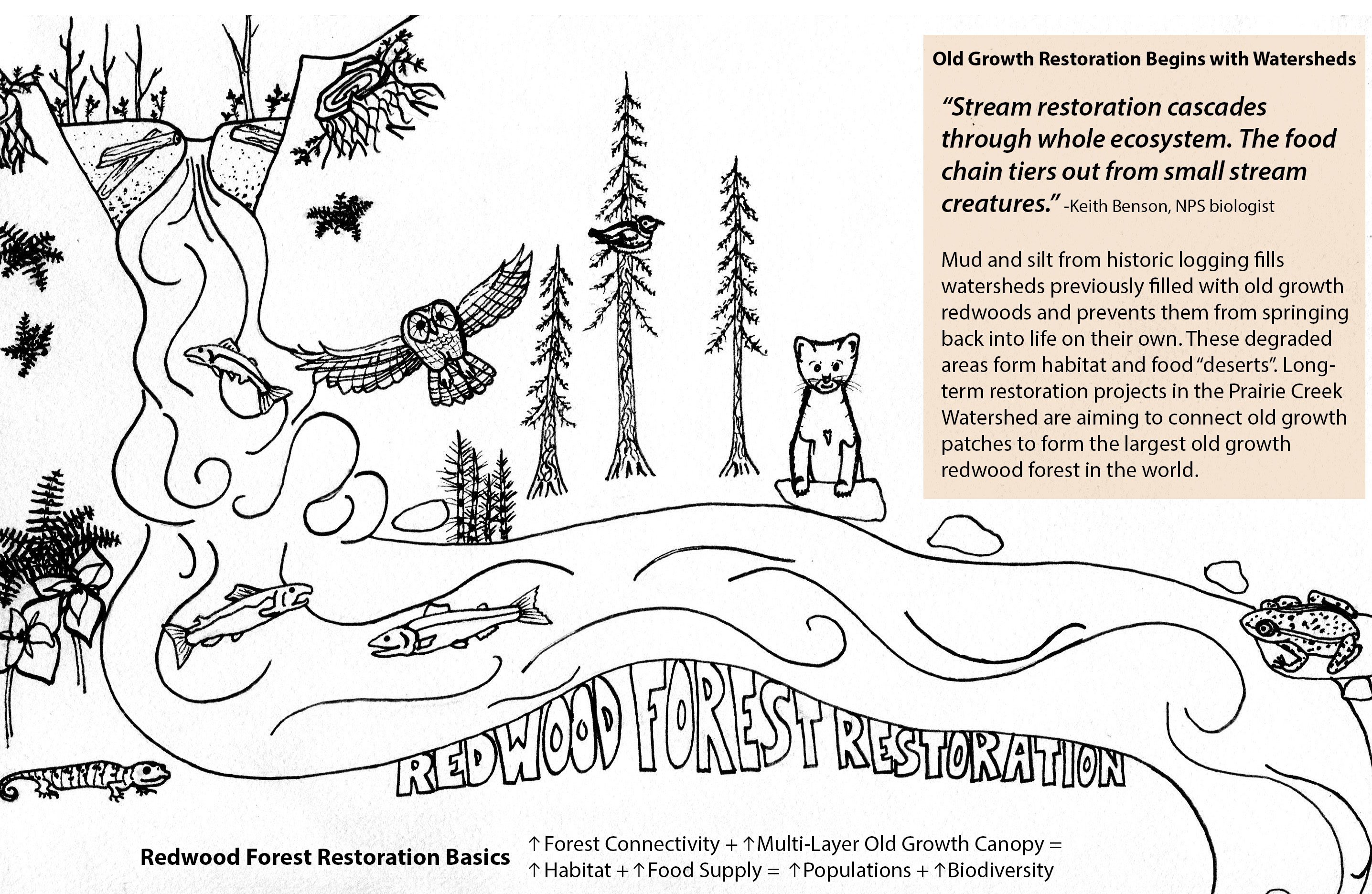
    The basics of the ecology behind redwood forest restoration can be understood with a simple equation:

    ↑ Forest Connectivity + ↑ Multi-Layer Old Growth Canopy = ↑ Habitat + ↑ Food Supply = ↑ Higher Populations + ↑ Diversity

    Forest connectivity provides protection for prey while simultaneously providing more hunting abundance for predators. It also allows for easier gene-sharing among species as traveling between areas becomes safer. Increased gene variety creates more resilient species as better traits surface among diverse populations. Having Multi-layer old growth canopy instead of one uniform layer for trees lets in sunlight and increases a forest’s 3D space. This increases the availability of Habitat and Food Supply, resulting in Higher Populations and Diversity since both predators and prey have what they need in the ecosystem to thrive.

  • March for Science 2017

    March for Science 2017

  • HSU engineers victorious in competition

    HSU engineers victorious in competition

    By Claire Roth

    Earth’s crust rumbles with tremendous force as Mount Lassen, the southernmost active volcano in the Cascade Range, erupts. The volcano spews ash and lava fragments into the air as far as the eye can see. A blanket of grey now covers the surrounding landscape, threatening the municipal and surface water supplies and leaving affected communities in need of an obtainable water treatment system.

    This was the hypothetical scenario a team of students from the HSU environmental resources engineering department was faced with upon entering the American Society of Civil Engineers Mid-Pacific Student Conference, held from April 20 to April 22 at California State University, Chico. In the months following a local preliminary competition in February, the team worked together to create a water filtration system that would be able to make a given sample of water, meant to imitate the polluted water in the given hypothetical event, drinkable again.

    Though competing teams were given specific guidelines for the competition, much of the methodology and design came from the members themselves.

    1
    The HSU environmental resources engineering team in front of their water filter | Photo courtesy of Raymond Rios

    “We know what’s in the wastewater, they tell us everything that’s in it,” said team member Raymond Rios. “We have to build a filter using the supply list that they provide, so we can’t use anything that’s not on the list. We’re graded on a bunch of criteria, like the cost of the filter, the time to build the filter, presentation, poster. And then they analyze our water in the lab and we get graded off of that as well.”

    Prior to last weekend, HSU was in a three-way tie for the most wins in the competition with University of California, Berkeley and University of Nevada, Reno. The team members agreed that they would bring home the trophy once again, determined to keep their winning streak going from last year’s victory in the competition.

    Keeping up last year’s success meant that everyone had a job to do.

    “Everybody has a job. I’m one of the builders, they’re some of the loaders, they actually load the filter with the wastewater,” Rios said, gesturing to two other team members. “There’s people who present the PowerPoint, there’s people who present the poster. There’s nobody that’s just sitting off to the side; everybody has a purpose.”

    The wastewater the team was given at the competition is nothing you would want to drink, consisting of water, Miracle-Gro Potting Mix, charcoal briquettes, iodized salt, vegetable oil, distilled vinegar, and blue food dye. This mix just boosted the excitement of the challenge for the team members in terms of which materials they would use to combat the pollutants.

    “That’s the fun part, we get to choose,” said team member Tony Mitchell III. “You have a nice list of materials that you can pick from. The objective is to get the lowest cost, that’s one of the main reasons we won last year.”

    The team came in first in several categories of the competition, including first overall in the water treatment competition, first in water quality, first in the design report, and second in construction of the filter.

    “Teamwork, as well as communication, really helped the HSU team win. We practiced, tested and prepared,” Mitchell said. “So once we got to the competition, each member did their part and we came away with the win.”

  • This week in science (April 19 – April 26)

    This week in science (April 19 – April 26)

    By Claire Roth

    Wildlife – Ants, fungus, and Radiohead

    Screen Shot 2017-04-27 at 8.51.04 AM
    Graphic Illustration by Claire Roth

    Though the subjects of ants, fungus, and the rock band Radiohead are all normally unrelated, the discovery of a new ant species created a connecting thread between all three. The species was found in the Venezuelan Amazon by a team of scientists from the Smithsonian Institution’s Ant Lab in Washington, D.C. It was named Sericomyrmex radioheadi in recognition of Radiohead’s recent environmental advocacy, including raising awareness of climate science and joining environmental movements such as Friends of the Earth, an international network of environmental organizations. Its namesake aside, the ant itself is an impressive gardener. Sericomyrmex radioheadi grows its own food in a fungus garden and females are thought to possibly produce a natural parasite and microbial weed deterrent with a crystalline substance on their backs.

    Source(s): Phys.org, Rolling Stone

    Wildlife – A taste for plastic

    A taste for plastic
    Graphic Illustration by Claire Roth

    An ally has appeared in the environmental war waged on plastic bags, and in an unlikely way. A caterpillar called the wax worm, most commonly used as fishing bait, poses a significant threat to the wellbeing of bee colonies. After wax moths lay their eggs inside of hives, the larvae grow on the walls of wax inside the hive and become pests to the bees. In the process of removing the wax worms from the beehive, Federica Bertocchini, a beekeeper and member of a research team deposited the retrieved wax worms in a plastic shopping bag. Curiously, small holes began to appear. In a controlled experiment conducted at a later time, the research team found that wax worms placed inside of a plastic shopping bag created holes in just under an hour. This was a result of the wax worm’s ability to break the chemical bonds found in the plastic bag. Their ability to do this stems from their ability to break the chemical bonds of the beeswax that they grow on, which has a similar chemical structure to that of plastic. Researchers from the Institute of Biomedicine and Biotechnology of Cantabria in Spain and from the University of Cambridge’s Department of Biochemistry aim to pinpoint the wax worm’s chemical bond-breaking ability and possibly scale it up for use in plastic waste reduction.

    Source: Phys.org

    Medicine – Mice, spice, and weed

    Mice, Spice and weed
    Graphic Illustration by Claire Roth

    An experiment conducted by researchers from the University of Connecticut has raised questions about the interactions between the brain and the immune system. In the experiment, mice were fed chili pepper in order to observe how the chemical responsible for spiciness in peppers, capsaicin, reacted with a receptor called TRPV1 in the mice’s gastrointestinal tracts. TRPV1’s interaction with capsaicin resulted in cells making anandamide. Anandamide caused the mice’s immune systems and stomachs to calm down and become less inflamed, even curing type 1 diabetes in some mice. Anandamide is also similar to cannabinoids found in marijuana, and the brain’s receptors for anandamide are what cause the high feeling when reacting with cannabinoids. The question researchers asked was why anandamide receptors could be found in both the brain and the immune system, when they are not particularly necessary for bodily functions. The research team hopes to use the observed effects of ingested marijuana and hot peppers in order to develop ways to combat varieties of intestinal, pancreatic, and digestive disorders.

    Source: Medical Xpress

    Wildlife – Naked mole-plant

    Naked Mole Rat
    Graphic Illustration by Claire Roth

    It’s not easy being a small, naked mammal near the bottom of the food chain. Life consists of burrowing underground to escape snakes, coprophagia (eating one’s own feces), and looking like a cross between an earthworm and a rat. This is perhaps why the naked mole-rat has developed such a specific and strange set of skills that allow it to survive. Colonies of naked mole-rats are eusocial, meaning they have the highest classification of a social structure. They live the longest out of all rodents, typically surviving for around 30 years in the wild, and have one queen per colony. Naked mole-rats also can thrive in oxygen-deficient environments and are cancer and pain resistant. Scientists from several universities recently discovered another strange ability of the naked mole-rat: the ability to use fructose, a sugar found in fruits, to power their brain cells when oxygen is not available for use. When deprived of oxygen for too long, brain cells will begin to run out of energy and die, posing a serious problem to the underground-dwelling naked mole-rat. However, the brain cells of naked mole-rats create energy anaerobically by burning fructose. This is a process that has beforehand only been observed in plant life.

    Source(s): Science News, Wikipedia

  • A Joint a Day Causes Fish to Decay

    A Joint a Day Causes Fish to Decay

    Water diversion for illegal grow operations has significant environmental impact

    Fish need water, and so does marijuana, but people may not realize we’re approaching a point where it’s between one or the other. Many illegal grow operations divert water from streams, which is the most common environmental crime committed, according to Sergeant Kerry Ireland of the Humboldt County Sheriff’s Office.

    BD02
    Time lapse photography of the Mad River taken from Google Earth. This Google Earth image was taken in 2004. | Photo by Bryan Donoghue (using Google Earth)
    BD03
    Google Earth image of the Mad River in 2014. Notice the drastic difference in water level. | Photo by Bryan Donoghue (using Google Earth)

    Ireland is in charge of the Special Services Division of the Humboldt County Sheriff’s Office. He said that there are currently no investigations going on having to do with environmental crimes, but they have seized 135 thousand plants from over 100 marijuana grows, and issued 51 search warrants in 2016.

    “That’s just a drop in the bucket for the number of marijuana plants that are in Humboldt County,” Ireland said. “There’s also at least 20 thousand cultivation sites in Humboldt.”

    The adverse effects of marijuana cultivation are presently more than just an environmental crime, it’s harming our wildlife too.

    Darren Ward is a fisheries biology associate professor and researcher of freshwater ecology at Humboldt State.

    “There’s a real direct reason we should care,” Ward said. “There’s endangered salmon and steelhead that live in those streams. There are cases where they’ve been documented to die when stream flows are reduced because of water withdrawals.”

    According to the Environmental Protection Agency, when stream flows are reduced, they are categorized as a low-flow. Summer low-flows are particularly extreme because higher heats cause water to evaporate a quicker rate.

    Marijuana plant discovered at an illegal grow site near Shelter Cove. The land was torn, with plastic littering the ground. | Photo from Eureka Sheriff’s Department

    “If for no other reason, it’s important to care about that because it’s a violation of federal law,” Ward said.

    Sergeant Ireland works with the California Department of Fish and Wildlife conducting investigations on environmental regulations that are broken. If there is a water violation, he contacts the State Water Resources Control Board, where they assist each other by investigating independently and then sharing their findings. Ireland finds that more marijuana grows continue to appear, and now they’re widespread throughout all of Humboldt County.

    “It is everywhere,” Ireland said. “It’s literally in all parts of the county.”

    Plenty of research is in progress to map how widespread grows are. Redwood Creek is a major contributing stream flowing into the Eel River. It is also one of the areas where major property subdivisions and land-use changes have taken place in the last 50 years, according to geography alumna Cristina Bauss.

    Bauss took a look at the heavily impacted watershed of Redwood Creek in her bachelor’s thesis. Coincidentally, Redwood Creek was one of four watersheds studied by Senior Environmental Scientist Supervisor Scott Bauer associated with the California Department of Fish and Wildlife. Bauss used Google Earth imagery from 2014, whereas the Bauer used imagery from 2012. Bauss duplicated Bauer’s study to examine the difference in greenhouse capacity and found an 18 percent increase in two years. That’s an exceptional amount of land being used for marijuana.

    CristinaBaussMap
    Simplified map of marijuana cultivation sites in the Redwood Creek watershed. Light-gray circles represent clusters of greenhouses, by number; outdoor growing sites are mapped individually. Sites outside the boundaries of the watershed are on parcels that straddle two watersheds, and were recorded because they may draw water from Redwood Creek and/or its tributaries. | Map Cristina Bauss. Sources: USGS Earth Explorer, County of Humboldt, CAL FIRE.

    The trend in growing greenhouse capacity is a growing concern. Ward voices concern as to what will happen come next season.

    “When next summer rolls around, and the flows start to drop and the temperature starts to come up,” Ward said. “If there’s an additional water withdrawal in the stream, that’s when it’s going to be really hard on the fish.”

    Ward said that historically, when people weren’t withdrawing water, then those streams were still connected and the salmon and steelhead could move to a lower spot in the stream to avoid overheating. Currently, due to water withdrawals, these pools aren’t connected anymore so there’s not as much area to swim for cover.

    Andrew Stubblefield, a hydrology and watershed management professor at Humboldt State University finds that the salmon and steelhead are facing a crisis, but marijuana is not the most significant contributor to water deprivation in Humboldt’s watersheds.

    Stubblefield explained that thousands of giant trees drive the water use of a watershed, and a small change in the amount of water those trees get would create a dramatic difference in summer low-flows for these watersheds by shrinking water levels further.

    “It’s not really going to be affected by a tiny greenhouse with a bunch of plants in it,” Stubblefield said. “I’m not saying there’s no effect of the marijuana industry, but forest management is also a big part of the issue with water right now.”

    Stubblefield finds that water diversion for marijuana grows can still have consequences. “When the rivers get down to the summer low-flow, particularly during our drought years, there’s enough left in those rivers to be like the amount you run in your shower; it’s a tiny amount,” Stubblefield said. “So it’s very vulnerable to having that remaining amount be pumped out.”

    Not all Humboldt growers contribute to low-flow. One of Humboldt’s self-proclaimed “mom-and-pop” growers for 38 years, who goes by the alias Terry Giaci, uses sustainable practices and eco-friendly methods of cultivation that do not contribute to low-flow.

    She moved up to Humboldt County in 1980 from San Francisco as a horticulture student because a friend she had met in SF wanted her to come up and help with the crop he was growing. With no cellphones, and only a citizen’s band radio to talk with others, she worked her way up Southern Humboldt by herself and became integrated as an active member of the community, supporting local restoration projects.

    “We’re the back-to-the-land people who grew marijuana to live this life,” Giaci said.

    “If you grew weed, you didn’t live in town. We lived in the hills. There were the town people, and the hill people. We were people that cared about the land, the land got a chance to heal.”

    On Giaci’s property, water flows from three springs through pipes and spring boxes. Giaci also has assistance from a hydrologist she knows personally. Access to water is steady, and since the streams are on her property, Giaci doesn’t illegally siphon water. Giaci also uses all natural organic materials; this infers materials that are not petroleum based or are made from petrochemicals.

    “It’s the difference between chicken shit, and nitrous oxide that’s created in a chemical plant,” Giaci said.

    According to Giaci, you have to be aware of who you’re buying from.

    “There are people, especially now, who just don’t care. They’re just in it to make money,” Giaci said. “They think they’re cool, and that they’re great growers, but they spray all kinds of crap on the plant.”

    Giaci explains that the greedy growers are stealing all the water, and trying to become to majority of the population, and they might succeed.

    “Greed is on the rise here, people are coming here now thinking they can get rich,” Giaci said. “Humboldt County is going to be in a huge transition mode. There are now a lot of people, what they call the ‘green rush’, who are coming up here and paying exorbitant prices for pieces of land.”

    Humboldt State hydrology professor, Andrew Stubblefield, finds that marijuana contributes to water diversion but the issue is much larger than weed.

    “The issue is larger than the marijuana. That’s part of it but it’s something else. I think it’s climate change, I think it’s forest management.” Stubblefield said. “I think of the coho and steelhead that are using those habitats in the summer. Those are the fish that are already struggling to survive, and having the river run dry is like their final coup de grace.”

  • Mary Jane in the brain

    Mary Jane in the brain

    What goes on inside your brain when you’re high

    By| Carlos Olloqui

    Things melt, time loses all meaning. Your body begins to tingle from head to toe. Everything you touch feels electric. Music seems to play note by note. Pressure builds on your cheekbones, your eyes squint up, your brain begins to tickle, and a bliss takes over. Yup, you’re stoned.

    Marijuana, also known by its scientific name, Cannabis, is no longer a stoner drug earmarked for hippies. One in eight adults in the United States said they smoke marijuana, according to a Gallup poll conducted in 2016. That means about 13 percent of Americans enjoy getting high.

    Olloqui.IMG_0105
    THC crystals on a flowering marijuana plant.

    But what exactly does it mean to get high? What goes on inside of your body after a couple of hits of that sweet Mary Jane? Well, the marijuana plant produces chemical compounds called cannabinoids. The two most popular ones being delta-9-tetrahydrocannabinol (THC) and cannabidiol (CBD). According to Thorsten Rudroff, an assistant professor at Colorado State University who studies cannabis use, THC is the most psychoactive compound which is what gives you that high feeling.

    When you ingest THC, in any form, it quickly infiltrates your bloodstream and travels to your brain. Your brain is made up of neurons. Neurons are specialized cells that like to keep their distance from each other. In order to bridge this gap, chemicals called neurotransmitters deliver chemical messages by traveling from neuron to neurons and attaching onto receptors. There’s a special kind of neurotransmitter called an endocannabinoid.

    According to the website Greatist, the cannabinoids in marijuana mirror those naturally produced by your own body, which latch onto the existing cannabinoid receptors in your brain. Cannabinoid receptors are activated by anandamide, a neurotransmitter that our body already produces, according to AsapSCIENCE. THC mimics the actions of anandamide.

    Olloqui.IMG_1284
    Highest tree in the yard.

    Once neurons fire, they undergo a refractory period, which prevents them from overworking and allows your brain to function calmly. However, cannabinoids interrupt this neuron nap time and cause them to run wild. This means that your neurons keep firing, your current thoughts become more meaningful and intense than ever, as if you could actually see them. You brain gets stuck on a certain specific idea until a new idea takes the spotlight and you go off on a tangent.

    According to Leaf Science, these cannabinoids also affect the levels of happiness chemical, dopamine and norepinephrine, which often lead to a sense of euphoria and relaxation.

    While this information may seem to put weed up on this high (no pun intended) and grand pedestal, it does come with its downs. Marijuana can affect our memory and learning, coordination, cause anxiety, and limit our cognitive function. Not to mention the cottonmouth, bloodshot eyes, and coma inducing munchies you get after lighting up.

    So, next time you feel like interacting with Mary Jane, make sure you think about your cerebrum. That is if you aren’t already too stoned to even think.

  • This week in weed

    This week in weed

    By Domanique Crawford

    Budding flavors

    bubs
    Graphic by Joe DeVoogd


    Blueberry Yum Yum, Strawberry Kush, Pineapple Express, and Girl Scout cookies. What’s your favorite flavor? The University of British Columbia researched 30 different molecules that give cannabis plants their flavor. These molecules are called terpene synthases genes and they create the pungent smells and tastes behind cannabis. The study likens terpene synthases genes to the genes found in grapevines that give wine its taste.

    Title: Marijuana meets yoga

    bra
    Graphic by Joe DeVoogd

    Grab your yoga pants, your pipe, and a pal! Certified yoga guru, Dee Dussault, combines the ancient methodologies of yoga with marijuana. According to her website, combining marijuana and yoga is an enhanced practice for relaxation, well-being, and the cultivation of inner peace. In her new book titled “Ganja Yoga”, Dussault breaks down the techniques for the everyday yogi.


    Memory on marijuana

    Scan 95
    Graphic by Joe Devoogd

    Wait, what just happened? Marijuana affects both your long term and short term memory. According to a 2008 study conducted by the American Medical Association, the main culprit is tetrahydrocannabinol (THC). Research found that THC affects your ability to make short-term memories that would eventually become long-term memories. THC reduces the hippocampal and amygdala volumes, affecting brain activity. THC clings to cannabinoid receptors in the brain, which can change your normal brain functions. According to a 25-year-long study published by JAMA Internal Medicine, long-term use can be harmful to verbal recollection over time.


    Lobbying for marijuana research

    Twis
    Graphic by Joe DeVoogd


    Doors may begin to open for marijuana research with the passing of new legislation that moves cannabis from being listed as a Schedule I substance to being listed as a Schedule III substance. Due to marijuana’s current Schedule I substance status, researchers are restricted in exploring the clinical benefits or concerns behind marijuana use. The bill was proposed to the house last week by House of Representatives members Matt Gaetz (R-Fl.) and Darren Soto (D-Fl.).

  • Butane ban from Arcata

    Butane ban from Arcata

    The process to make butane hash oil can result in explosions and chemical fires.

    Butane hash oil, also known as wax, honey oil, shatter, and dab, is made by butane extraction. This process is used to create butane hash oil containing large amounts of THC, the intoxicant in marijuana, by blasting marijuana with butane.

    Butane is odorless and can be easily ignited, and is typically used as camp fuel, propellant, and lighter fluid. Many explosions occur as a result of handling chemicals in an unsafe, non-lab environment such as a house.

    Arcata joined a growing list of cities regulating butane products due to concerns over dangers from its use in producing butane hash oil.

    In an effort to deter people from exploding their homes, garages and other residential areas, Arcata City Council approved an ordinance that regulates the sale and possession of butane.

    City Attorney Nancy Diamond attended the Arcata City Council meeting held on Jan. 4 when the ordinance was approved.

    “Because butane is highly volatile and it is being used in an unregulated context,” Diamond said. “It is causing a particular hazard to the public and first responders.”

    The typical consumer container of butane is 300 ml as opposed to a typical refillable lighter which contains about 5.5 ml.

    Arcata City Councilmember Michael Winkler approved the ordinance due to his concern for an increase in public safety and the overall hazard associated with butane use for extraction of THC.

    Since the ordinance having gone into effect on Feb. 4, there have been two fires where there have been leads to the use of butane, according to Arcata Fire District Chief Justin McDonald.

    On Jan. 8, there was one incident which according to the report was most likely drug related, according to Arcata Fire Chief Justin McDonald.

    In Manila on Jan. 14, inside a trailer, a butane hash oil explosion occurred due the extraction process that blew the doors and the windows out of the building.

    “It absolutely ripped the trailer park apart,” McDonald said. “When our crews got there, the exterior walls were blown 15 to 20 feet out.”

    Not many drug related fires can compare to those of butane fires, according to McDonald. Grow house fires, where someone converts a single family residence into a grow operation, don’t grow as rapidly as a butane explosion, according to McDonald.

    “The fire starts off slow and then builds versus the butane goes, boom, it’s big,” McDonald said.

    In 2016, two people were injured after they ignited their cigarette in their car after making butane hash oil in their car, according to McDonald.

    McDonald has been seeing the evolution of these types of incidents, which he calls catastrophic, while being in the Arcata Fire District for 23 years.

    “The ones [fires] that I have been to, the windows and doors have been blown out of the buildings and if people are in there quite often they are pretty severely burned,” McDonald said. “Hair burned off or singed and skin burned off and hanging from their arms.”

    The most recent explosion in Manila in Midway Court was the most devastating butane related incident that McDonald has seen.

    “There were butane bottles zinging through the air because they were still exploding,” McDonald said. “There were enough butane canisters that sustained and kept burning.”

    Arcata has had a history of butane hash oil explosions with six occurring within the last four years. Eureka has also had its number of incidents and has had regulations on butane since Nov. 2016.

    In Nov. 2016, California voters approved the legalization of recreational marijuana use.  Now adults over the age of 21 can partake in using, possessing and sharing cannabis, as well as growing it at home.

    Under California law, it’s legal for medical marijuana patients to purchase butane hash oil, but the process of making the oil is illegal.

    A law recently signed, called AB 2679, which will go into effect in 2018, provides a framework for legitimate marijuana manufacturers and allows the extraction process to occur under certain conditions.

    AB 2679 addresses the problem of law enforcement now not being able to shut down facilities that have obtained permits by the city for manufacturing. This law clarifies specific requirements both for a legal form of butane extraction and for extraction using solvents that don’t allow fumes to escape during the process.

    Labs often use solvents to extract the psychoactive ingredient THC from dry marijuana. The process produces a gooey residue that contains a highly concentrated dose of THC and is widely popular at medical marijuana dispensaries.

    “I am not against the licensed process of butane extraction, but it has to be done with the proper permits,” Winkler said. “The city of Arcata will issue permits for manufacturing butane extraction that is legal and safe.”

    Patients, pot identification card-holders, caregivers, collectives and cooperatives will not face state criminal sanctions if they follow the new rules.

    Up until this new law, all forms of butane extraction in California were illegal. The process of creating butane hash oil is legal in places like Colorado.

    The city’s ordinance prohibits retailers from selling more than 600 ml of butane to a buyer in one month. One can of butane contains 320 ml. The law would make it illegal for any person who is not a vendor to have more than 600 ml of butane at any given time.

    Store retailers are required to track the sale of butane canisters and and record the buyer’s name and address and keep this record on file for two years. This is for the city to be aware of their own butane sales and to keep track of an individual’s butane purchases.

    Along with this, butane cans must be placed in glass cases within the store where purchasers would not have access without an employee’s assistance.

    Butane cans are now stored in inaccessible glass cases, where purchasers cannot access without employee assistance.

    “Stores would sell cases of butane, twelve at a time,” Winkler said. “Now there is a monthly limit and stricter rules on how many can be bought at one time.”

    These prohibitions are similar among the various butane sales regulation ordinances adopted across the state to date, according to the ordinance.

    Violators of the ordinance would be charged with a misdemeanor or an infraction.

  • This week in science (April 5 – April 12)

    This week in science (April 5 – April 12)

    By Claire Roth

    Technology – Samsung steps up

    Bixby
    Graphic Illustration by Claire Roth

    In the age of technological personal helpers, such as the voice-controlled Alexa and the iPhone-dwelling Siri, the electronic appliance and smart technology company Samsung has stepped up to the plate with their own virtual assistant: Bixby.

    According to Samsung’s website, Bixby learns through actions. The major difference between Bixby and initial virtual assistants is Samsung’s referral to Bixby as an agent, not an assistant. Bixby helps to fast-track tasks having to do with commands that aren’t readily available in devices, such as sending photos to a contact without opening up multiple apps to do it.

    Bixby also learns the phone user’s cellular routine, such as what time they check the weather in the morning or at what time a daily reminder occurs. This self-education allows Bixby to have apps ready for the user without the user exerting extra effort.

    Sources: The Verge, Samsung

    Wildlife – Penguins vs. Volcanoes

    Screen Shot 2017-04-11 at 6.50.21 PM
    Graphic Illustration by Claire Roth

    The British Antarctic Survey led a team of scientists from all over the world on an Antarctic expedition to study a population of gentoo penguins that has been at odds with survival for thousands of years. Through the study of ancient samples of gentoo guano (seabird feces) and volcanic ash in sediment core samples, the researchers concluded that the population of gentoo penguins had been all but obliterated by volcanic activity several times over the last 7,000 years. The volcano to blame resides on nearby Deception Island. The sediment cores produced data telling the research team when the volcano erupted and how that eruption affected the gentoo population being studied in Antarctica.

    Source: Phys.org


  • The hunt for bacteria is on

    The hunt for bacteria is on

    By Onaja Waki

    Antibiotics photo 2
    An inside and close-up look at the cells tested on samples. Photo: Onaja Waki

    Resistance to antibiotics is becoming stronger. In other words, our current antibiotics are not working as efficiently as they used to. To tackle this potential public health issue, various universities around the globe, including HSU, are participating in the Small World Initiative program.

    According to the Small World Initiative website, the program aims to encourage students to pursue careers in science by conducting their own field and laboratory research through beginning college courses. Collectively, students contribute to the antibiotic resistance crisis and help complete the program’s mission, listed as, “crowdsourcing antibiotic discovery.”

    This past fall semester and current spring semester, HSU biology majors in the microbiology option are required to work on this research project headed by microbiology and genetics professor Mark Wilson. Wilson’s biology 105 class requires students to search for bacteria in different environments around Arcata, such as in fungi or soil. The class’s findings will be sampled and tested and could possibly lead to new antibiotics.

    “What we are doing is trying to isolate bacteria that we find then test it against strains that can stop the growth,” Wilson said. “We have began to look for bacteria in places like the redwood forest and the Arcata Marsh, because traditionally these places have not been searched. With doing so, we are hoping to find new organisms in our samples.”

    This research project is approached in two ways. The first approach is to wait and observe to see if the bacteria stops growing when a given strain is tested against it. The second approach is to use the results from a separate biogeographical project.

    “What biogeography means is how animals and plants are spread around the world,” said Wilson. “What this does is help to make decisions on if we should be looking for bacteria in other places in order to make antibiotics.”

    Sophomore Tonie Alexander is currently in Wilson’s biology class and finds it useful to do the hands-on work and enjoys being apart of a large-scale research project.

    “At first I was skeptical about how finding bacteria could be fun and interesting,” Alexander said. “But when I found out what we were really doing it for I found myself more than interested. It’s tedious work and it takes patience when testing our samples.”

    Freshman microbiology emphasis major Nyla Hodge has yet to take Wilson’s class, but has heard a lot from peers about what the class requires.

    “As of right now, I’m taking botany,” Hodge said. “But for next semester, I’m going to take biology 105, I just hope the labs aren’t hard. I know a few people who took the class already and they did a lot of field work. So I know I’ll have some real work to do.”

    Wilson believes that this project is good for his “scientists-in-training” students and can also be an enjoyable experience.

    “We started doing this because it was better for the students and I’m having fun doing it with them,” Wilson said.

  • Joshua Tree National Park looks to grow

    Joshua Tree National Park looks to grow

    By Tyler Boydstun

    Joshua Tree National Park is known for its breathtaking rock piles, rugged landscape, and its unique inhabitant the Joshua tree. However, the park has experienced a surge of visitation increasing by a half million visitors every year for the past three years creating crowding and overpopulation inside the boundaries of the national park. For some, the increase in visitors are a welcome sight providing an economic boost and funding to the park. For others, the overpopulation inside the park threatens the majestic beauty and solitude this desert landscape has to offer.

    According to the National Park Service’s website, the annual visitation in Joshua Tree has increased from one and a half million in 2014 to more than two million in 2015. Making 2015 the first time Joshua Tree National Park had ever received more than two million visitors in a single year. Before 1990, Joshua Tree National Park had never received more than one million visitors in a single year.

    “For the last 5 years the park has made a concerted effort to market the park both through the press and online through social media. Those efforts started coming to maturity about 3 years ago,” said George Land, a Public Information Officer and Community Outreach Ranger. “Also, 2016 was the Centennial of the National Park Service and there is no doubt the increased awareness of the park service in general contributed to the number of people visiting.”

    Joshua Tree National Park has received added attention over the past few years, raising the amount of visitors in the park each day. Certain times of the year are more popular due to weather. According to their Facebook page, Joshua Tree National Park is busiest during mid-week, with Saturday having the least traffic flow in the park. Summer months are usually greeted with high temperatures and low crowds, while the wintertime brings cold weather, including freezing temperatures and slightly fewer crowds. Fall and spring in the park are beautiful times to visit, as wildflowers may be in bloom and the temperature mild and enjoyable. However, these are the main reasons visitation increases during these times.

    “Visitation is going to be high the next six weeks,” said Susan Luster, a ranger at the west entrance to the park. “It’s likely due to the time of year and weather.”

    Tanner Huibregtse, a 22-year-old college student, visited Joshua Tree National Park during his school’s spring break with some friends.

    “We knew we were heading there during the busiest time of year (spring) so my friends and I decided the best time to go was on a Monday morning when everyone would be leaving from the weekend,” said Huibregtse. “We arrived at the park around 11a.m. and there were more people than I had ever seen in Joshua Tree before. Getting a campsite was difficult. It took us circling all the campsites to find some people leaving at the right time that we pulled up.”

    Huibregtse hiked Ryan Mountain trail during his visit to Joshua Tree National Park.

    “Pulling our car into Ryan Mountain trailhead, there was only one spot available to park,” said Huibregtse. “When my friends and I started hiking up the trail, we passed almost 20 people.”

    “Capacity issues including heavy traffic, full campgrounds, and illegal parking have all been problems associated with an increase in annual visitation,” said Land.

    With so many visitors entering the park each day, hiking trails and trailheads are becoming congested. According to Land, Joshua Tree National Park has a number of projects planned to take action and against the increasing visitation inside the park.

    “We hope the projects will offset some of our capacity issues,” said Land. “The number of visitors to Joshua Tree National Park for 2016 was just over 2.5 million. We consider it a good thing that people are coming out and discovering Joshua Tree National Park. We just need to get the staff and resources to handle the upsurge in visitation.”

    An official at the 29 Palms Visitor Center said the increase in visitation could also be a result from Los Angeles finding a national park in their backyard. With the drive between Los Angeles and Joshua Tree National Park being less than three hours, it creates a national park accessible to one of the busiest cities in the country

    Newton B. Drury, a National Park Service Director from 1940-1951, described the parks system as an opportunity for growth.

    “It means that America presents to its citizens an opportunity to grow mentally and spiritually, as well as physically,” Drury said. “The National Park System and the work of the National Park Service constitute one of the Federal Government’s important contributions to that opportunity. Together they make it possible for all Americans to enjoy unspoiled the great scenic places of the Nation…. The National Park System also provides, through areas that are significant in history and prehistory, a physical as well as spiritual linking of present-day Americans with the past of their country.”

    It was Drury’s vision that the National Park System would provide an opportunity for people to discover the beauty of the outdoors. Drury believed by experiencing these parks, people could grow from both a mental and physical state. But Drury also believed in the parks acting as a connection for people to spiritually and physically link themselves to their countries history.

    With an increasing amount of visitors entertaining the park each year, it means more and more money towards economics associated with the park. An economic analysis of Joshua Tree National Park posted in 2013 to the nps.org website said, “of an estimated $63 million dollars spent by visitors to Joshua Tree National Park, most was for lodging 30 percent followed by food and beverages 27 percent, gas and oil 12 percent, admissions and fees 10 percent and souvenirs and other expenses 10 percent.”

    This means benefits to the surrounding areas and more funding for the park itself. However, with the amount of benefits associated with increased visitation there are equal if not more downsides to the mass of people visiting the park.

    “Because there is not enough space for parking people are pulling off to the sides in non-designated spaces resulting in resource damage,” said an official at the 29 Palms Visitor Center. “Overcrowding in the park can cause a negative visitor experience.”

    When asked what people visiting Joshua Tree National Park can do to help improve the overcrowding issue, Land mentioned a number of strategies that will help improve the experience of everyone inside the park.

    “By and large, people can help by not parking illegally, staying on prescribed trails and refraining from any type of graffiti, vandalism or other malicious damage to the park,” said Land.

    A supporter of the parks system, President Franklin D. Roosevelt, said on the nps.org website, “There is nothing so American as our national parks…. The fundamental idea behind the parks…is that the country belongs to the people… for the enrichment of the lives of all of us.”

    Tips for visiting a crowded Joshua Tree National Park:

    Avoid Hidden Valley and Ryan Campgrounds, these are the first two campsites when entering the park from the west entrance and are often the most popular among hikers and climbers, as there is a lot of climbing is in this area of the park. Try camping at Jumbo Rocks, Belle, Cottonwood, White Tank or even Indian Cove for more site availabilities. Visit the campsites in the morning when campers are most likely to be leaving from the night before.

    When trying to avoid people while inside the park, get out of your car. Most people traveling in the park are doing so by their vehicle. Park your car at a trailhead or designated parking area and walk. Walking is a great way to experience any park and get off the busy road with all the other tourists. Joshua Tree National Park has an immense system of trails meant to get you exploring the park. Barker Dam is a great one-mile loop that takes you through some of the history of the park, including a water tank built by early cattle ranchers.

    Avoid visiting the park during peak seasons and hours. Spring is the busiest time of year with the wildflower bloom. Summer is least crowded due to extreme heat. Winter brings snow to the high desert and low crowds but when temperatures rise in the fall, crowds turn moderate.

  • This week in science (March 29 – April 5)

    This week in science (March 29 – April 5)

    By Claire Roth

    Astronomy – Electric sands

    Scientists at the Georgia Institute of Technology conducted experiments to come to the conclusion that the windy conditions of Saturn’s largest moon, Titan, have the ability to electrically charge the sands covering the moon’s surface. As the grains of sand are blown about by Titan’s winds, they move across the moon’s uneven surface in a motion called saltation. They make contact and rub against each other in such a way that a static charge is created, strong enough to hold the grains of sand together for extended periods of time. The reason the experiments were conducted in the first place was in an attempt to come up with an answer for why the 300-foot-tall sand dunes on Titan were leaning opposite the direction the wind was blowing in. The research suggested that the electrically charged sands were being pulled toward the direction the dunes were leaning, with the wind too weak to push them the other way.

    Source: Science Daily

    Medicine – Printing human skin

    Graphic Illustration by Claire Roth

    The gruesome and scarring process of skin grafting, where a portion of healthy skin is removed from one part of the body in order to cover an injured part of the body, may be a thing of the past. Scientists from the Universidad Carlos III de Madrid, the Center for Energy, Environmental and Technological Research, the Hospital General Universitario Gregorio Marañón, and the BioDan Group were recently successful in creating a prototype for a 3D bioprinter that has the ability to print viable human skin. A 3D bioprinter is a machine that has the ability to print cells, complete with the desired cell function, structure and longevity. Like real human skin, 3D bioprinted skin includes layers that protect against the outside environment and help the body to maintain functionality. The 3D bioprinter uses substances called bioinks, made up of biological components, to create the skin and keep it as lifelike as possible. This 3D printed skin could be used for cosmetic tests as well, possibly helping to eliminate the controversial practice of testing new products on animals.

    Source: The Huffington Post