The Humboldt Office of Sustainability reports good news for HSU’s Climate Action Plan
Humboldt State University’s 2019 Climate Action Plan Progress Report revealed positive impacts for the Climate Action Plan.
Morgan King, HSU’s Climate Action Analyst, explained how the Climate Action Plan divides campus emissions into three scopes, each categorized by how much control HSU has over reducing them.
“We’re striving towards reducing our scopes one and two,” King said. “Scope one, the majority of that is natural gas so what we need to do is start weaning ourselves off natural gas.”
“We’ve completed almost half of our strategies. But the most expensive ones that also have the greatest impact are the ones that we’re still lagging a little bit behind on.”
Morgan king, HSU’s climate action analyst
Scope one emissions are from burning natural gas on campus and the fuels fleet vehicles use. Scope two emissions are from electricity use. Scope three emissions are from commuting, business air travel and solid waste management.
The report said we are on track to meet the 2020 emissions reduction goal. The Climate Action Plan set a course for the campus to reduce greenhouse gas emissions to 1990 levels by 2020, to 80% below 1990 levels by 2040, and to become carbon neutral by 2050.
To accomplish these emissions goals, the CAP includes 55 strategies that lay out the short and long-term goals necessary to achieve these goals. According to the progress report, 45% of the strategies have been completed.
“We’ve completed almost half of our strategies,” King said. “But the most expensive ones that also have the greatest impact are the ones that we’re still lagging a little bit behind on.”
There are three projects in the works for 2020. First is a faculty learning program intended to teach professors how to incorporate sustainability in their lesson plans. Second, over spring break, King is co-facilitating a student leadership institute in climate resilience. King is also developing a sustainability minor to enable students to better understand the methods behind creating a sustainable environment.
“Within our initial climate action plan we saw it was critical to have an engaged campus population that are making decisions and engaged in actions to improve sustainability for the campus,” King said. “That’s potentially as important as changing out all the lights.”
How planting trees can serve as one branch of a climate action plan
In the face of climate change, all scales of society, from government to corporations to individuals, are looking for ways to emit less and sink more carbon. The internet latched onto the tree-planting solution, but it’s important the right trees are planted in the right place at the right time.
The climate crisis is the dominant issue of this decade. According to Robert H. Socolow and Stephen W. Pacala, who wrote the article “A Plan to Keep Carbon in Check” in 2006, the world must avoid emitting about 200 billion tons of carbon over the next 50 years.
To make the problem manageable, Socolow and Pacala turned the required reduction into one-billion-ton “wedges.” The paper contained strategies that could be scaled up by 2050 to reduce carbon emissions by one million tons per year. For example, a wedge would be achieved if the number of miles traveled by the world’s cars was cut in half or if global deforestation was halted within 50 years.
Tree planting has become one of the most popular solutions in popular culture. Ecosia and Team Trees are two internet campaigns working to plant millions of trees.
A consistent goal in climate science is net zero emissions. In other words, the volume of greenhouse gasses going into the atmosphere needs to equal the volume coming out. With a record 37 billion tons of carbon dioxide emitted in 2018, that’s a daunting task. To achieve this goal, society needs to emit less carbon and increase nature’s carbon sinking, or the natural process of turning carbon dioxide gas into solid matter.
Top minds of the world are putting their heads together to come up with solutions, ranging from modernized public transportation to alternative energy technology to lifestyle changes toward less consumption. Beyond that, policy makers and scientists are working closely with everyday people to educate, inspire and solve the crisis.
Locally, Humboldt State University, the City of Arcata and Humboldt County have prepared climate action plans. In the spring of 2019, five public workshops were hosted by the county to get ideas from community members on an action plan. The primary goal of these plans is to reduce emissions to pre-1990 levels by 2030.
2030 is the nearest milestone in climate policy. According to the Intergovernmental Panel on Climate Change Special Report on Global Warming, global emissions will need to fall 45% from 2010 levels by then to be on track for the net zero emissions goal for 2050. This ideal timeline would limit global warming to the best-case 1.5 degree Celsius increase in average temperature, a goal which still brings with it real climate change.
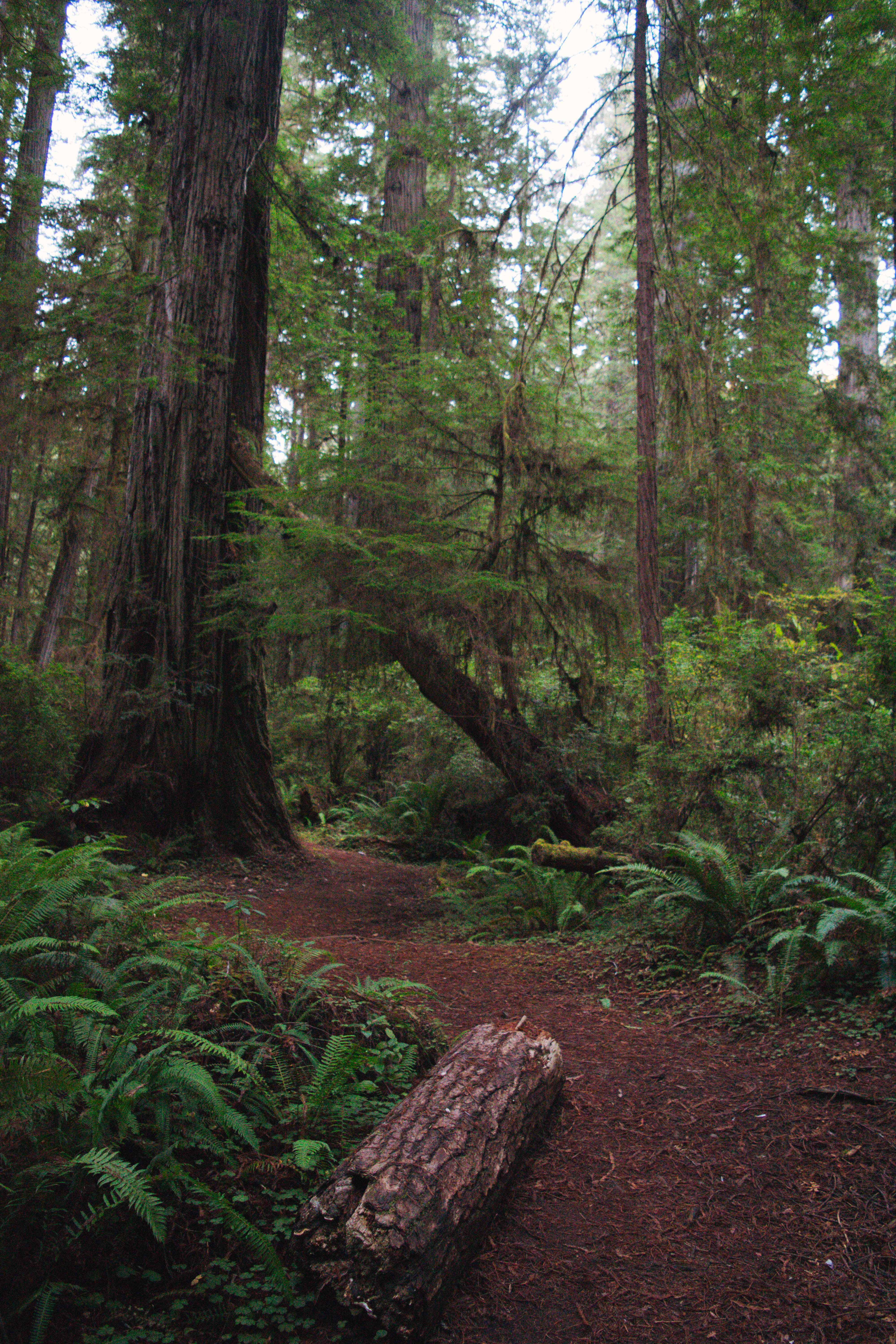
Trees in Patrick’s Point State Park in Trinidad, CA on March 16, 2017. | Photo by Collin Slavey
Tree planting has become one of the most popular solutions in popular culture. Ecosia and Team Trees are two internet campaigns working to plant millions of trees. A number of science-based YouTubers have published videos explaining the project, including SmarterEveryDay, Mr.Beast and Aspect Science.
Trees are a valuable ally in the battle against climate change because they sequester carbon. A tree’s bark is made out of carbon. During photosynthesis, plants turn sunlight, water and carbon dioxide into glucose. The glucose molecule, along with other essential nutrients, turns into plant matter like leaves, branches and roots, effectively storing carbon in a solid state.
For this ordeal to be successful, it’s essential the people planting trees understand the silvics of those trees. Silvics is the study of the life history and characteristics of forest trees, and without understanding it, the newly-planted trees are more likely to die.
With the Earth at a critical time in its life history, the top minds of the world are opting for some deep breaths, planning and deliberate, well-informed environmental action.
New study links smoking cannabis with testicular cancer
Those attending Humboldt State University who smoke marijuana regularly may want to rethink their habit.
Marijuana is the most widely used drug in the United States, and a large part of its popularity as a recreational narcotic comes from the perception that it has very few, if any, long-term health effects. There are, in fact, several positives that are associated with the drug, such as help with depression or anxiety, easing of muscle soreness and a reducing of the number of seizures experienced by people with epilepsy.
“When you combust any plant, you’re creating significantly more carcinogens.”
Dr. Jeffrey Chen
However, despite its positive effects, a recent study conducted by the Journal of the American Medical Association has identified a link between marijuana use in people with male reproductive organs and an increased risk of testicular cancer. The study explained that burning marijuana (which is necessary to smoke it), like burning any plant, triggers the release of carcinogens, which, in this case, may lead to testicular germ cell tumor.
The study also analyzed potential connections between recreational marijuana use and lung cancer, oral cancer and head and neck cancer. However, JAMA did not find any connections to any of those cancers.
The meta-analysis in the data collected by JAMA is specific to white men, leaving out a large part of the global population. Many of their findings also date back as far as 1973.
There also isn’t a direct causality from marijuana to cancer over a wide range of the population. The American Association for Cancer Research has identified many of the victims of cancer as having used marijuana heavily. However, there is still no evidence of other variables, who else might be at risk or other drugs that might increase or minimize said risk.
These studies so far are limited in the information they provide, and should not be taken as the final word on any and all links between cannabis and cancer. However, it does contribute to the ongoing discussion of the health effects of the drug, and those who do use it may want to sit up a little straighter and take some notice.
Composting can be one of the most beneficial ways to handle waste
Learn the steps to compost.
Every Wednesday, the trash bin, filled with whatever waste was tossed during the week, goes to the curb to be picked up by Recology and shipped off to a landfill.
Forty percent of the waste that ends up in landfills is food waste, according to Recology. This can include raw scraps from food preparation, old sandwiches left to rot and unwanted leftovers. When food scraps end up in a landfill, the material is not just waste, it’s being wasted.
“The average American generates 4.4 pounds of garbage a day,” the Recology site says. “Don’t let your food scraps go to waste.”
Illustration by Collin Slavey
It’s a big deal if food waste gets tossed into landfills. Besides taking up space in our already overwhelmed landfills, food waste doesn’t decompose properly in such settings. For example, an apple that falls above ground breaks down into useful nutrients like nitrogen, which enriches the soil. Underground the apple isn’t able to break down.
Buried in a landfill, the apple is in an anaerobic environment, meaning that it is starved of oxygen. Anaerobic decomposition creates some nasty byproducts. The most malicious of these byproducts are methane and liquid leachate. Both of these are pollutants with consequences.
“Fortunately, avoiding these pollutants is simple. Just compost it,” international waste management firm ToWaSo said. “Food and yard waste can be reused and turned into nutrient rich compost. Composting exposes the green waste to oxygen, allowing it to decompose as it would in nature.”
Humboldt State does compost food waste. According to an email from TallChief Comet, the director of sustainability, energy and grounds keeping with Facilities Management, HSU compost is managed in two ways. The Waste Reduction and Resource Awareness Program manages the composting bins on campus, while food waste is diverted from dining services.
“The on-campus composting process is handled by WRRAP and is using the material from the public compost bins scattered around campus,” Comet said in an email. “This material goes into an Earthtub composting vessel, located at Facilities Management and processes about 10,000 lbs (5 tons) of material per year.”
“The average American generates 4.4 pounds of garbage a day. Don’t let your food scraps go to waste.”
Recology
“The food-waste diverted from all the dining locations on campus is collected by FM waste and recycling staff into a large pre-composting container,” Comet said. “About every three weeks it is transported by Recology (a local waste hauler) to a vermicomposting facility in Dows Prairie run by The Local Worm Guy.”
“The best effort students can make is to not generate waste in any form to begin with,” Comet said. “For compostable waste they can achieve this by not purchasing more than they will use/consume during the anticipated period.”
But composting may very well be appropriate. Composting may seem like an intimidating, tedious and smelly thing to do, but with a bit of practice it becomes second nature. Working with local resources like the Campus Center for Appropriate Technologies can help prepare a student for their own compost bin.
Jacob Gellatly, an active member of CCAT, recommended that students learn about composting.
“Before a student starts composting they should learn a few things,” Gellatly said. “It is critical to get educated on the process of composting. Learn the recipe.”
Dennis K. Walker Greenhouse provides a haven for a diversity of plant species
A sky full of grey clouds smothers the sun and with a chilling breeze even the most layered person shivers down to their toes. One step into the Dennis K. Walker Greenhouse transports you away from the cold into a world of warm, enticing, vivacious plants.
There are six rooms in the greenhouse: temperate, tropical, desert, fern, aquatic and the subtropical dome. Each room has an appropriate climate and a resident community of plants. Greenhouse manager Brianne Lee, along with student assistants Dabid Garcia and Courtney Harris, maintain the greenhouse at Humboldt State.
The entrance to the primary green room at Dennis K. Walker. | Photo by Deija Zavala
Leaves of a gum palm, otherwise known as a dioon spinulosm, in the subtropical dome. | Photo by Deija Zavala
Inside the Subtropical Dome at the Dennis K. Walker Greenhouse at Humboldt State University. | Photo by Deija Zavala
Anthurium scherzerianum, known as flaming flamingo, is generally native to Central America, but can be found in the Tropical Room at the greenhouse. | Photo by Deija Zavala
Spike Moss, selaginella biformis, in the Fern Room at the Dennis K. Walker Greenhouse. | Photo by Deija Zavala
Artocarpus heterophyllus, known commonly as jackfruit, in the Tropical Room. | Photo by Deija Zavala
“Essentially, the greenhouse is a living museum,” Harris said. “It’s something that we are trying to preserve here and not kill with love.”
The large botanical collection contains more than 1,000 species of plants belonging to 187 families. According to the Department of Biological Sciences website, students and faculty studying botany and biology use the greenhouse and its plant life to research and learn.
Harris, a botany major, said the greenhouse is a magical place, especially since there are only two student positions. After transfering from the College of the Redwoods in 2017 Harris was hired as an assistant.
“It feels like a unique experience being that this is such a cool staple and an important part of the botany program,” Harris said.
The job of a greenhouse assistant consists of maintaining the facility and its residents residents, which means sweeping the rooms, hand watering plants, managing pests and propagating plants.
“Essentially, the greenhouse is a living museum. It’s something that we are trying to preserve here and not kill with love.”
Courtney Harris
Garcia, a rangeland resource science major, said that there’s a lot of care and research that goes into the plants, but the goal is to make sure the plants are happy and thriving.
“Every species needs their own little formula of fertilizer,” Garcia said. “Some require more nitrogen than phosphorus and some others more potassium. We have to do our own research and sometimes that research isn’t available, so we’ll give the plant fertilizer and see how the plant reacts to it. A lot of our plants are really rare in the wild.”
The trio look out for signs indicating whether something might be wrong, such as droopy leaves and discoloration. The team also checks soil moisture levels, but all plants indicate issues to caretakers in unique ways.
Greenhouse Assistant Courtney Harris inspects a Bird of Paradise, strelitzia reginae, plant. Part of Harris’ job is to help plants pollinate. | Photo by Deija Zavala
Brooke Sharp, a child development major, explores the Fern Room at the Dennis K. Walker Greenhouse. | Photo by Deija Zavala
Inside the subtropical dome, flowers in bloom adorn many of the residents. | Photo by Deija Zavala
The Twin Spined Cactus, known scientifically as mammillaria geminispina, in the Desert Room. | Photo by Deija Zavala
Greenhouse assistants Dabid Garcia and Courtney Harris pose in the sub-tropical dome at the Dennis K. Walker Greenhouse. | Photo by Deija Zavala
“The biggest challenge is understanding how each plant reacts and responds to the care that we give it, and adjusting our behavior accordingly,” Harris said. “It requires a tremendous amount of teamwork and communication between us.”
Harris added that some plants don’t like attention while others, if left alone, will wilt and die.
Mihai Tomescu teaches plant morphology, plant anatomy, paleobotany and general botany. The trio’s work supports Tomescu in the botany department, as well as supporting the biological sciences. Faculty often use plant specimens during lectures and labs.
“Plants don’t move, and yet they are exposed to pretty much the same challenges that we are exposed to in terms of surviving. There’s all sorts of stressors. They have to procure their food and because of that, just like other types of organisms, have to have some type of behavior.”
Mihai Tomescu
Tomescu said his area of expertise and research is plant structure, including topics like how plants are put together, how they grow, how they look and how their features evolve over generations. Some of his methods include digging deep into geologic time.
“I know how they grow at the cellular level,” Tomescu said. “So coming from that perspective, I realized that one of the most fascinating things about plants that people don’t realize is that compared to us animals, and compared to what we think of in our culture about aliens, is that plants are more alien to us than the craziest aliens that human imagination has come up with.”
In his classes, Tomescu has his students visit the greenhouse three to four times a semester for assignments and brings live samples for labs when examining roots, leaves, stems, cells and other internal parts of plants.
“If you have a big botany program that emphasizes organismal biology, the diversity of plant groups and so on, then it makes sense to have something like this,” Tomescu said. “How else are you to teach your students about the diversity of plants if you can’t show it to them alive.”
Some people may question the general interest in plants because at the surface they seem not to do anything. But Tomescu said that if you are able to slow down and get pass the green blur of a forest of plants, you’ll come to find some interesting organisms.
“Plants don’t move, and yet they are exposed to pretty much the same challenges that we are exposed to in terms of surviving,” Tomescu said. “There’s all sorts of stressors. They have to procure their food and because of that, just like other types of organisms, have to have some type of behavior.”
Courtney Harris pets the cone of a dioon spinulosm in the subtropical dome. Harris was enthralled by the cone’s soft texture. | Photo by Deija Zavala
Some plants, like this one, keep pollen outside their flower ready to be blown off by wind gusts. | Photo by Deija Zavala
Because the Dennis K. Walker Greenhouse doesn’t have the aid of natural pollinators like birds and wind, assistants sometimes take pollen carefully from one plant to another. | Photo by Deija Zavala
Plant behavior is what a plant does, including how it grows. According to Tomescu, plants have control of their growth, from the depth of their roots to the direction of their leaves.
“The plant makes a lot of choices because growing in one direction or another means spending energy,” Tomescu said. “It’s very calculated — not consciously calculated– but basically plants sense their environment very well.”
In the broader sense, he said that plants make him think. Tomescu hopes more people will become interested in plants since they are so different compared to other life forms.
“It’s kind of exhilarating to realize that we live next to these super weird organisms,” Tomescu said. “It maintains this fascination that there are these organisms that do the business of living in a very different way from us.”
The Dennis K. Walker Greenhouse is available to instructors and students in the Department of Biological Sciences, and access is limited by the availability of instructors or greenhouse staff.
It is open to the public by appointment or when greenhouse staff are available. If you are interested in making an appointment contact Brianne Lee at 707-826-3678 or schedule a visit via email at bms561@humboldt.edu.
Students at HSU participated in the iNaturalist-sponsored Mycoblitz to contribute to the North American Mycoflora project
Humboldt State University’s Mycology Club is collecting samples of mushrooms and sending them to Purdue University for DNA testing.
In association with iNaturalist, the Humboldt Bay Mycological Society and the North American Mycoflora Project, the Mycology Club is helping a national team of scientists record the location and species of as many fungi as possible.
The North American Mycoflora Project will allow the scientific community to compile and use a huge amount of knowledge and data about the identity and location of macrofungi in the United States.
“The sheer quantity of data getting piled in will give [scientists] a better idea of where species grow in the world. Sometimes people find species in a place where they were thought to be gone thousands of years ago.”
Lucas Burton
Mycology Club members Lucas Burton and Caleb Von Rossum spent a cold Monday afternoon documenting their mushroom samples in the bottom of the Campus Center for Appropriate Technologies. Burton and Von Rossum recorded their amateur identifications of the mushroom and the date and location where it was found on a little slip of paper that would travel with their specimen.
“We are using iNaturalist,” Burton said. “We upload a photo and GPS location, and people from all over the world can come together and help us positively ID it.”
iNaturalist is a popular tool for biologists and botanists who want to take advantage of citizen science for data collection. Von Rossum mentioned a lot of people in the club record their mushroom finds on iNaturalist, but Burton and Von Rossum were taking it to the next level by mailing in their samples.
“The sheer quantity of data getting piled in will give [scientists] a better idea of where species grow in the world,” Burton said. “Sometimes people find species in a place where they were thought to be gone thousands of years ago.”
Mycology Club President Austen Thibault worked with the Humboldt Bay Mycological Society to get the Mycology Club participating in the Mycoblitz, the official iNaturalist mushroom-recording event.
“Contributing to the Mycoblitz, you could easily be one of really just a few thousands of DNA specimens ever taken in the history of the globe. And for the rare specimens, your name will be saved with the specimen forevermore.”
Austen Thibault
The Mycoblitz was a national week long mushroom foraging event which challenged citizen scientists to record the location of as many mushrooms as they could. Participants rummaged through undergrowth for mushrooms and submitted pictures of their finds on iNaturalist. Locally, the Mycology Club was encouraged by the Humboldt Bay Mycological Society to participate.
The Mycological Society offered a thorough training on iNaturalist and mushroom identification to prepare participants for the Mycoblitz challenge. The data and specimens that were gathered will be sent to Purdue University for DNA testing so they can be incorporated into the North American Mycoflora Project.
“Contributing to the Mycoblitz, you could easily be one of really just a few thousands of DNA specimens ever taken in the history of the globe,” Thibault said. “And for the rare specimens, your name will be saved with the specimen forevermore.”
The Mycology Club meets every other Wednesday in the Campus Center for Appropriate Technologies at 5:00 p.m.
Geography Department renamed to GESA to better reflect the discipline
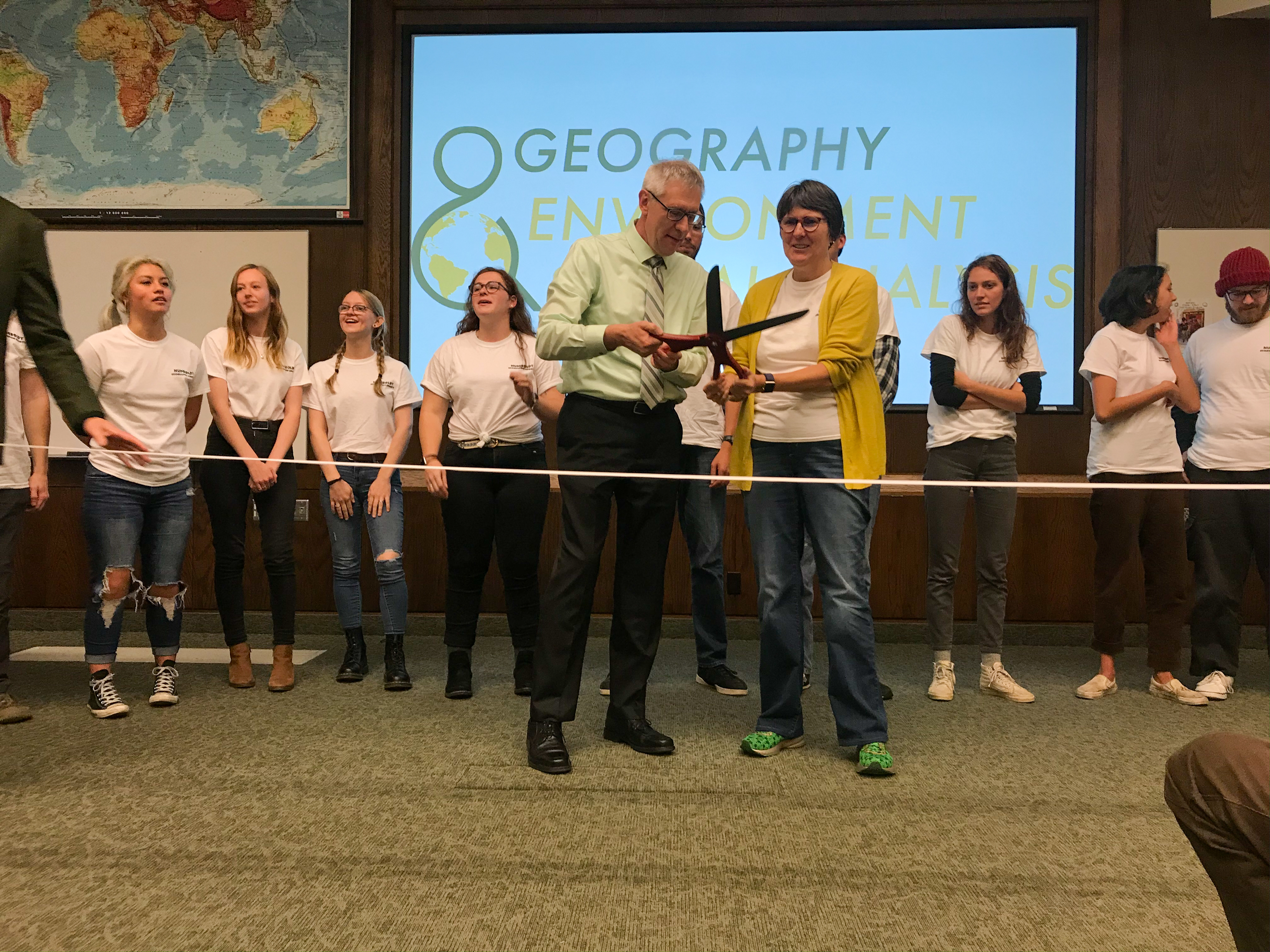
The Humboldt State geography department was officially renamed the HSU Department of Geography, Environment and Spatial Analysis, or GESA for short. Along with the name change, the GESA department will begin to publish a scientific journal called Humboldt Geographic.
More than 100 people showed up to the name-change celebration. The evening brought with it a number of presentations from professors within the department including department chair Matthew Derrick. Messages of praise came from the Provost and Vice President for Academic Affairs Alex Enydi as well as the Dean of HSU’s College of Arts, Humanities, and Social Sciences Lisa Bond-Maupin.
“I am grateful to work with students, staff and faculty every day,” Bond-Maupin said. “I am struck by the idea of boundaries. What I am recognizing about this department is it’s about transcending boundaries. I’m struck by that.”
One of the boundaries the GESA department is transcending is the barrier between the department and the greater academic community. To achieve this, Derrick has been promoting GESA’s scientific journal, “Humboldt Geographic.”
“In any kind of education, I say there needs to be some sort of artifact,” Derrick said. “This idea is reunification, where you take ideas and values and they come into some physical form… It is the culmination of where we are right now, and hopefully next year we’ll do it better.”
Humboldt Geographic is a collaborative, student edited and student published scientific journal. It will include coverage of projects within the department as well as alumni updates and stories about the department’s yearly trips abroad. Although each edition should be finished by the end of the semester, the journal will be on the news stands at the beginning of the spring semester.
Changing the name of the department to Geography, Environment and Spatial Analysis reflects the dynamic nature of the discipline. Geography is the study of the physical features of the earth and its atmosphere, and Spatial Analysis is a type of geographical analysis which seeks to explain patterns of human behavior by layering data-filled maps over one another. The way this science can be used is restrained only by the imagination of the geographer.
The Humboldt Geographic Society is chock full of imaginative students. The president of HGS, Summer Owen, talked about the direction of the new geography department.
“As students, we’re not just studying where things are,” Owen said. “We’re studying why things are that way; why people are there, why those lines exist. Through politics, through landscape, mountain ranges, rivers, oceans, the barriers.”
After the announcement, Derrick asked the student members of HGS to the front of the room for a group picture before everyone began to socialize. The festivities continued into the night fueled by champagne and finger food.
Enyedi seemed to enjoy himself and was grateful for the invite from the department.
“President Jackson said we’re gonna have a lot of parties,” Enyedi said. “Partying and celebrating is what we should do. We need to focus on the great things that our students do, that our faculty do, that we do as a community. I’m proud to be part of this community. So thank you for inviting me to [the] party.”
Waste Reduction & Resource Awareness Program hosts environmental event and educates community
The Humboldt State Zero Waste Conference, hosted by the campus’ Waste Reduction Resource Awareness Program, taught students and community members how to reduce the amount of waste they produce in their daily lives. The week ended in a city proclamation that Nov. 15 would forever be Zero Waste Day.
“WRAPP is all about serving students and providing students resources to make lifestyle changes,” Program Manager Amanda McDonald said. “It’s a slow and gradual process where it’s not like you can get rid of every plastic thing in your house at once, but you have to be committed to doing this over time.”
A week of influential guest speakers, engaging activities and exciting happenings kept students active and engaged in reducing waste. These included a moving speech by Tedd Ward, the authority on Del Norte solid waste, Tinkertime on the quad and the extravagant Green Campus Trashion Show.
The clothing industry is so detrimental. Fast fashion, in my opinion, is one of the worst industries for the environment. It not only deteriorates sense of commitment, but it also withholds your own sense of style. It’s good to upcycle clothes for a new purpose instead of sending them straight to the landfill.
The Zero Waste Conference began with a banquet which set the tone for the rest of the week. A keynote speech by Alec Cooley shared the story about the origins of the Humboldt Campus Recycling Program, following closely by the Trashion Show.
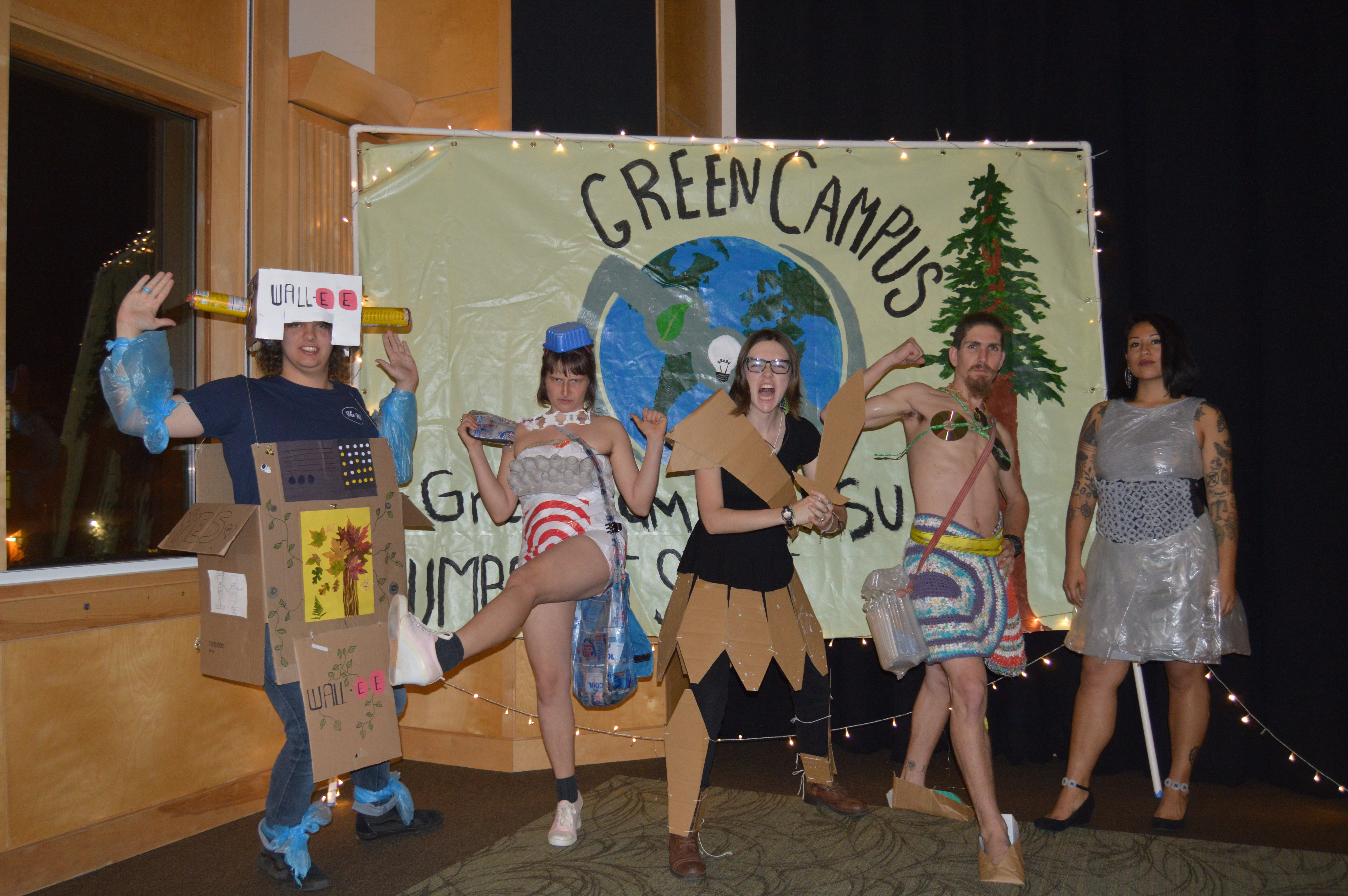
Eight students built magnificent costumes out of household waste. There was a Rob-box, sword wielding cardboard centurion, and the CD bikini-rocking Julian Palmisano. They each strut their stuff across the stage to show off what they made.
“I think my grandma would be proud,” Palmisano said. “I did it for fun. It’s kind of a joke, really, and it’s a way to bring attention to the unprecedented degree of waste that is in this world.”
In pursuit of constructive solutions, the following day was Tinker Time. WRRAP, CCAT and Green Campus showed students how to reduce their waste by upcycling recyclable items. Upcycling is the “reuse” part of the reduce, reuse, recycle phrase.
During Tinker Time, WRRAP showed students how to upcycle their clothes into mason jar coozies and grocery bags. The Campus Center for Appropriate Technologies upcycled wood waste and oyster shells into wind chimes. At the coozie table, WRAPP Compost Site Intern Krissi Fiebig taught students how to cut up old clothes and sew them together for a more beneficial use.
“The clothing industry is so detrimental,” Fiebig said. “Fast fashion, in my opinion, is one of the worst industries for the environment. It not only deteriorates sense of commitment, but it also withholds your own sense of style. It’s good to upcycle clothes for a new purpose instead of sending them straight to the landfill.”
In 1964 the first plastic bag was made, and it was the beginning of this. One half of all of all plastic produced has been produced in the last thirteen years. Recycling is ineffective… It was not our decision which led to this. It was fractional distillation and oil refining.
Finally, Ted Ward’s speech was a somber reminder of the modern state of the world. He said he felt as though he had failed as a waste manager. He reminisced about the day the first plastic bag was created and commented on how we ought to rename our modern era the “Plastocene,” cynically addressing the volume of plastic waste we produce.
“We should coin this era the Plastocene instead of the Holocene because that is our legacy,” Ward said. “In 1964 the first plastic bag was made, and it was the beginning of this. One half of all of all plastic produced has been produced in the last thirteen years. Recycling is ineffective… It was not our decision which led to this. It was fractional distillation and oil refining.”
The Zero Waste Conference finished up with Humboldt officially declaring Nov. 15 Zero Waste Day. The official proclamation reflects Humboldt County, the City of Arcata and our local community’s progress towards zero waste.
“Now be it resolved that the Humboldt County Board of Supervisors joins Humboldt cities and business groups to recognize November 15, 2019 as Zero Waste Day,” the proclamation said. “A day each year we acknowledge the County’s waste reduction progress and urge residents to recommit efforts toward Zero Waste.”
Forage for free food locally while learning about your environment
If you’ve ever dreamed of living off the grid and growing your own food, foraging is the next best thing to fulfill that desire.
Foraging is a fun and rewarding way to immerse yourself in your local environment. Here in Humboldt County, there are plenty of opportunities for outdoor food morsel scouring. You can find dozens of wild plants that are both useful and edible, from anise, dandelions and yarrow to cattails.
If you know what you’re looking for, urban food foraging is quite simple. Some yards in Arcata have fruit trees that are tempting to take from, but be sure to ask for permission before picking.
If you don’t know where to start looking, you can use the Falling Fruit website or app. This site features a global map with geotagged locations of edible and useful items within your area. When you identify something new, you can mark it on the map to help others locate your foraging find.
If you want to look for wild herbs, fruits and vegetables beyond the cityscape, take a stroll to a park or the community forest and chances are you’ll find something forage-worthy, whether it’s morel mushrooms, blackberries or ginkgo.
If you aren’t well-versed in fungi identification, there are options in the wild for food finding beyond the typical mushroom hunting. It’s best to steer clear of gathering mushrooms unless you are with an expert or have definitive knowledge of a particular type you are searching for.
Foraging is a helpful way to inform yourself about natural food cycles. We often forget about the different produce seasons as grocery stores usually supply all types of seasonal produce year-round, but foraging for your own food helps you learn when produce is ready for harvesting.
Explore beyond the city streets and forested land for scrumptious surprises from the sea.
If you’re foraging for sea life, ensure you’re legally licensed to do so. You can forage for loads of coastal edibles like seaweed, snails and goose barnacles, but many items require a fishing license to take as well as prior knowledge of eligible sizes and harvesting limits.
Make sure to have the proper equipment for specific foraging needs. When coastal foraging, it’s necessary to have have measuring equipment for the sea life you’re searching for to verify your finds are within size regulations. Bring a bucket for your finds and a knife or prying tools like a spudger to scrape off treats like limpets or sea snails. Gloves and knee pads are useful, but not necessary as long as you’re cautious on slippery terrain.
Be aware of red tides and other contaminants that may affect coastal harvests. Humboldt and Mendocino County undergo an annual mussel quarantine form May 1 to Oct. 31 which prohibits mussel gathering to protect people from shellfish poisoning due to oceanic toxins. Avoid this concern by foraging for univalve organisms which don’t filter throughout their body and have singular shells, like periwinkles or black tegula snails.
Foraging for insects can also be an exciting addition to your food gathering excursions. There are hundreds of species of edible insects including crickets, weaver ants and silkworms.
Identifying edible insects can be tricky if you aren’t completely sure of what to search for. The most advisable way to consume insects would be through home cultivation of a species like mealworms or crickets.
Don’t ever consume something that you aren’t 100% sure is safe to eat, whether it’s a fungus, plant or creature. Be sure to know how to properly identify items before your search.
In addition, prepare foraged food properly. Make sure to wash findings thoroughly and cook it correctly so as to not have an upset stomach.
Remember, do not forage on private land, or at state and national parks. It’s illegal to take items including rocks, wood, berries and nuts from these parks as they’re protected by state and federal conservation regulations.
WRAPP hosts full week of speakers, activities and essential waste-reduction knowledge
This week kicked off Humboldt State’s Waste Reduction & Resource Awareness Program’s Zero Waste Conference. The banquet was the first event of the conference and was held in the Kate Buchanan Room Tuesday evening.
The banquet began with keynote speaker and former HSU student Alec Cooley, who recounted the history of the Humboldt State Campus Recycling, which he helped found. The evening climaxed with the Trashion Show which displayed upcycled waste products artfully crafted into snazzy fashion statements.
Tuesday’s event was just the beginning of an action packed conference. The 4th Annual Zero Waste Conference includes events like Tinker Time, a workshopping and tabling event at the UC quad, two clothing swaps and a whole slough of keynote speakers.
“This is the direction of the future that we’re moving towards, it’s zero waste,” WRRAP Student Director Amanda McDonald said. “It’s becoming more and more evident that we cannot keep mass producing waste and being wasteful with how we consume. It’s not going to sustain us into the future.”
Full list of WRAPP’s Zero Waste Conference 2019 Event:
Zero Waste Conference 2019 schedule of events:
Tuesday | November 12 Zero Waste Presentation: Big Oil and Plastics, 5-6 p.m., Founders Hall Room 125. Tedd Ward, Director of the Del Norte Solid Waste Management Authority, will discuss the social, economic, and environmental drivers moving communities toward zero waste, the role manufacturer’s responsibility must take to curb plastic pollution, and the action we can all take to avoid the waste we don’t want.
Zero Waste Banquet, Keynote and Trashion Show 6-8 p.m., Kate Buchanan Room. Join us for a free zero waste meal. Vegetarian and vegan options will be available. Keynote presentation by HSUAlum and waste reduction expert Alec Cooley. Stay to watch the Trashion Show, hosted by Green Campus.
Wednesday | November 13 Clothing Swap, 10 a.m. – 2 p.m. Kate Buchanan Room. All clothes are free. Although encouraged, you do not need to bring clothes to take clothes!
Tinker Time, 10 a.m. – 2 p.m., UC Quad. A series of hands-on, interactive, DIY, and zero waste activities all day on the UC Quad, hosted by The Sanctuary, the BLC, CCAT, Botany Club, and more!
Sustainable Travel Workshop, 3:30-4:15 p.m., Library Room 209 – Fishbowl. Join students from REC 435 Sustainable Tourism class in a discussion on best practices for minimizing your footprint when travelling locally, nationally, and internationally.
Oh SNAP! Zero Waste Cooking Class, 6-7:30 p.m., Rec & Wellness Center Room 122. Learn techniques and recipes to make delicious zero waste meals!
The Climate Crisis and Solutions: A frank discussion on what each of us can do, 5:30-6:30 p.m., Founders Hall Room 118. Dr. Kate Lancaster is a trained Climate Reality Leader through Al Gore’s Climate Reality Leadership Project. Dr. Lancaster will share her Climate Reality presentation, offering a clear picture of what is happening to the planet and the actions we can all take to change course.
Thursday | November 14 Zero Waste Heroes Workshop, 10-11 a.m., Library Room 209-Fishbowl. Tired of being a part of the problem? Join the WRRAP team to learn about simple, low-cost and fun practices with big waste reduction implications. This workshop is part of the Leadership Conference, taking place between 10 a.m. – 3 p.m. today in the Library.
Clothing Swap, 12-4 p.m., Recreation and Wellness Center Room 126. All clothes are free. Although encouraged, you do not need to bring clothes to take clothes!
Zero Waste Thinkshop, 1-2 p.m., CCAT. Take a deep dive into zero waste philosophy, discuss with practitioners and gain DIY skills to reduce your personal impact.
The Amazing World of Fungi: Mycoremediation, Biomaterials, & Mushroom Cultivation, 5 – 6 p.m., Founders Hall Room 206. Levon Durr is Owner of Fungaia Farm, a company that offers mushroom cultivation kits, workshops, and ecological restoration services. In this exciting presentation, Levon will discuss the critical role mushrooms can play in neutralizing toxins, restoring ecosystems, creating zero waste packaging, and building human health.
Calculating the Air Quality & Climate Impacts of Using Forest Residues to Generate Electricity, 5:30 – 7 p.m., Founders Hall Room 118. Dr. Kevin Fingerman and Senior Research Engineer Jerome Carman will present their research on the net environmental impacts of using residues from forest management activities for bioenergy. This talk is part of the Sustainable Futures Speaker Series, sponsored by the Schatz Center and the College of Arts, Humanities & Social Sciences.
Ocean Night, 6 – 9 p.m., Arcata Theater Lounge, 1036 G Street, Arcata. Come to the ATL to see films about the ocean, plastic pollution, impacts to marine biodiversity and surfing. All ages, $5 suggested donation. Sponsored by Humboldt Surfrider. More info about films at the Arcata Theater Lounge website.
Jewelry-Making from Bike Parts, 10 a.m. – 2 p.m., Bicycle Learning Center. Turn scrap bike parts into coasters and jewelry with the BLC instructors. Bring your bike to get help with maintenance and repairs.
Zero Waste Bike Ride, 3 – 4:30 p.m., Harry Griffith Hall Zagster Bike Station/ HGH Room 113. Join the BLC and Office of Sustainability on an all-abilities group ride to check out zero waste activities and businesses. No bike? No problem! Show up to get a FREE promo code to use a Zagster bike!
Assistant Professor Gordon Ulmer, Ph.D draws from his real world research experience to inspire students
As human hands built roads hundreds of miles long, erected cities covering hundreds of square miles and developed rich, diverse cultures, the experience of human beings has changed and morphed. The evolution of our experiences is researched and studied by the scientific discipline called anthropology.
The world in which humans live seems regular. It’s easy to believe our towns and cities are areas humans have always been, but that’s not the case. Our roads, transportation, electricity generation and super markets are easily taken for granted.
For generations, humans have worked hard to turn the world into the convenient form it is today.
Understanding the scope and scale of humanity is a vast task that requires cooperation between anthropologists and a great number of other scientific and social disciplines.
In an effort to explore questions about how humans interact with their landscape, Humboldt State Anthropology Professor Gordon Ulmer has committed his academic life to the study of environmental anthropology.
Anthropologists are generalists. We’re like ecologists. We borrow and we pull and draw upon all kinds of other fields. That’s part of what makes anthropology, I think, one of the best disciplines.
Gordon Ulmer
“I look at the relationship between precarity and pollution,” Ulmer said. “[It’s] people’s insecurities and instability in life, contingent labor and how that relates to living and working in a polluted waterscape. The anthropological discipline is about human’s variation, bio-cultural variation across all times and all places.”
Ulmer typically works with communities who live near polluted water. He investigates coastal areas, rivers and surface waters which are contaminated with everything from sewage to gold mining byproducts. His primary research takes place in the Peruvian Amazon and Costa Rica beaches where he researches how humans contribute to and interact with polluted waters.
Ulmer’s duty, like most scientists, is to answer questions. The questions that he’s asking, however, are not questions that any one discipline can answer.
More recently, Ulmer has worked with biologists in Costa Rica as he learns at what extent locals are impacted by polluted runoff on their beaches. Ulmer uses methods ranging from on-the-ground surveys to biological analyses of water samples to answer that question. His use of an array of methods equips him and his colleagues to do good science.
“Anthropologists are generalists,” Ulmer said. “We’re like ecologists. We borrow and we pull and draw upon all kinds of other fields. That’s part of what makes anthropology, I think, one of the best disciplines. We can collaborate with and also build upon the work of other people.”
Ulmer is teaching this mindset to his students. At HSU, Ulmer teaches a number of cultural anthropology classes that, according to his students, are really awesome.
Sophie Maga and Rhiannon Cattaneo are both enrolled in one of Ulmer’s classes: Living in the Anthropocene. Maga shared why she thought Ulmer is such a benefit to HSU’s anthropology department.
Sophie Maga and Rhiannon Cattaneo are both cultural anthropologists enrolled in Ulmer’s class “Living in the Anthropocene.” | Photo by Collin Slavey
“I think it’s Gordon’s content in general,” Maga said. “He’s one of the first professors here really diving deep into the Anthropocene and environmental crises and structures that we really need to be looking at that anthropology has lacked.”
Maga and Cattaneo both said that Ulmer has brought something new to the anthropology department. His teaching methods encourage students to think critically about class readings to prepare them for in-depth conversations.
“He’s very socratic,” Cattaneo said. “His class is very discussion based. It forces you to use the class time to really think about and process the readings you do.“
Preparing his students to think and process knowledge is preparing his students to be anthropologists. According to Ulmer, by encouraging deep critical thought, he is equipping his students to contribute to anthropology’s task of understanding the scope and scale of humanity. His students appreciate it.
“For me, he is a symbol of hope because I see him as an advocate for the next generation of students,” Cattaneo said. “The way he’s approaching [teaching] is very democratic, open and informed, so I think he’s having a very positive impact.”
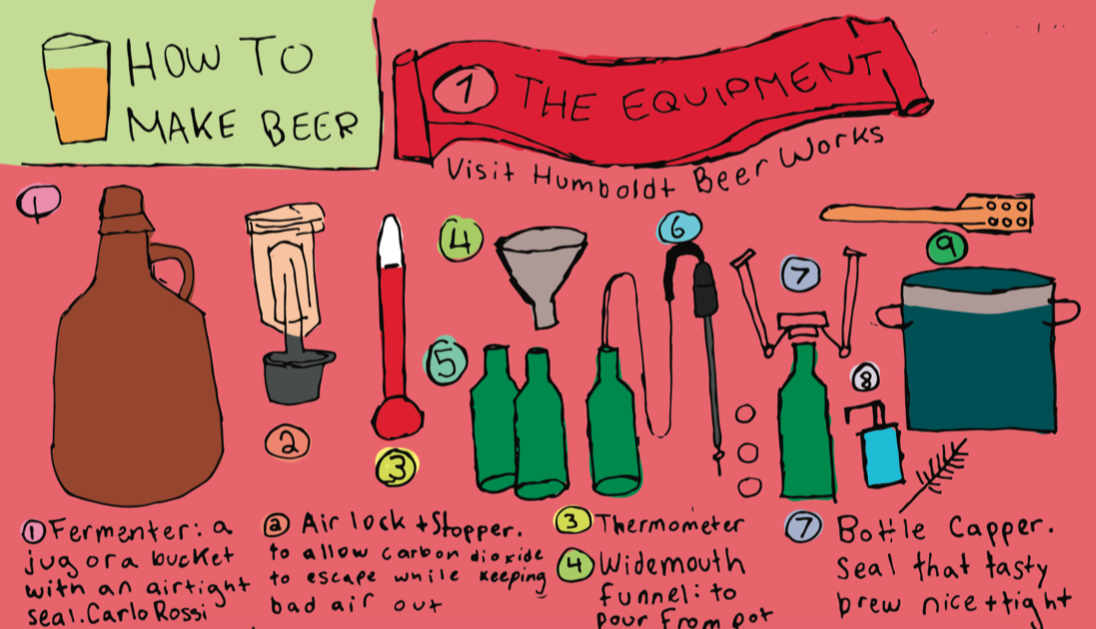
Crowded in a warmly lit apartment, I sat huddled over a great big steaming silver pot with my friends, Seamus Begley and Sam Kirby, as we waited in anticipation to brew another batch of beer.
Since the brewing process takes a few hours, we started early in the evening. Begley had gathered the four basic ingredients: malted barley, hops, yeast and water.
According to the the Youtube channel It’s Okay to Be Smart, the basic beer is any alcoholic beverage made from fermented cereal grains, usually preserved and flavored with hops. It was a good guide to start, but Begley and Kirby recommend reading books to master the process.
To begin, we mixed up a batch of wheat and barley, threw it into a giant tea-bag like grain pouch and set it to steep. This is mash. We were activating enzymes in the grain, which turn the grain starches into fermentable sugars. Within a piece of grain, enzymes are proteins which, when activated, accelerate the deconstruction of starch. A starch is a complex molecule which, when divided into its component bits, becomes a sugar called glucose. The glucose will turn into alcohol later.
The product of the steeped (not boiled) mash is a tea-like liquid called wort. Wort is essentially sugar water which will be the home and food for yeast. It also tastes delicious. We rinsed the grain sack to collect any residual glucose, drained the thing into our cooking pot and set it aside. We were left with a pot full of wort.
Wort, immediately after rinsing the grain pouch, was not as concentrated as we would like it. Ideally a wort is super saturated with sugar, meaning there is a really high ratio of sugar to water. Concentrating the sugars will make the wort tastier and nutritious for the yeast. To achieve this concentration, boil the wort between 15 to 90 minutes. Excess water evaporates and leaves behind concentrated sugar water. Boiling also provides an essential service to the beer making process, sanitation.
Sanitation is an essential part of brewing. The grain itself is covered in different bacteria and other yeast that eat sugar, but their byproducts taint the flavor of beer. We sanitized everything from the pots to the bottles to the stirring sticks with a chemical called Starsun, but diluted bleach works as well. Beyond that, boiling the wort kills off these other organisms. Sanitize, sanitize, sanitize.
During the boil, we add hops. If you drink beer, you’ve probably heard of hops, and if you drink IPA’s, you’ve definitely tasted hops. They’re the bitter, flowery, citrusy flavors in beer. Hops contribute to the flavor of beer, the shelf life of beer and the scent of beer. We had many options to choose from, but this particular batch of hops was grown by Begley’s grandmother.
Next, the beer needs cooled as quickly as possible so we could add the yeast without killing them. Yeast is a critical ingredient because it is a fermenter. Fermentation is the process when yeast converts to glucose in the wort to ethyl alcohol and carbon dioxide gas — giving the beer both its alcohol content and its carbonation. When the yeast are first added to the wort, Begley took a sample and measured its specific gravity using a hydrometer. The tool told Begley the density of sugar in the water, and how much alcohol would be created by yeast.
The yeast and wort mixture is then poured into a sanitized fermenter or carboy. An airlock is attached to the top of the fermenter to allow CO2 to escape from the bottle. The fermenter is then stored in a dark spot where the temperature is desirable for the yeast to do its thing. We left it there for a couple of weeks before bottling.
Once the fermentation was completely finished, we prepared to bottle. We poured the beer into a second sanitized jug, added a small amount of sugar and yeast for carbonation, and then siphoned the final beer mixture into bottles. The siphon is important because we didn’t want too much air in our beer. Finally, we crimped a sanitized cap on the bottles and let them sit for a couple more weeks.
After that tediously long wait, we popped them open and enjoyed the sweet, sweet product of our labor. It was definitely worth it.
With the recent Public Safety Power Shutoffs, blackouts may be a big push toward renewable energy
Public Safety Power Shutoff, blackouts could aid the push toward renewable energy. Solar micro-grids, local offshore wind farms or more well maintained power lines could be the answer to back-to-back outages.
Pacific Gas and Electric Company’s PSPS events are triggered by environmental conditions that threaten parts of their power grid. For example, a third consecutive power shutoff was originally scheduled for Tuesday morning, but changing weather patterns pushed back the timing. On Tuesday at 5:22 p.m. the county was removed from the PSPS affected counties list.
PG&E’s PSPS events are triggered by environmental conditions that threaten parts of their power grid.
“Due to diminished weather conditions, Humboldt County is no longer in the scope for a Public Safety Power Shutoff tonight and power will remain on,” said Humboldt OES in an email alert. “There are still communities without power but PG&E advises they hope to have those areas re-energized tonight.”
The nature of the power grid in Northern California renders Arcata and Eureka subject to power outages if other areas of the grid are at risk. The energy used in Northern Humboldt is imported through transmission lines to the Eureka Humboldt Bay Generating Plant, where it’s amplified for local use. If energy stops flowing through the lines to Humboldt, there is no source of energy and therefore, no electricity.
Terra-Gen, a Manhattan-based wind power company, has proposed a wind generation project for the Monument and Bear River Ridges that could provide nearly half of Humboldt’s energy. A panel discussion on the project will be held Nov. 6 at 5:30 p.m. in Founders Hall 118.
“Anticipated project features include a significant contribution to North Coast renewable energy generation and to California’s clean energy mandate,” the panel flyer says.
According to Terra-Gen, benefits of the project could include the creation of local green jobs and Humboldt Bay development. However, some local community members see the project as more consequential than not.
As California’s dry and windy seasons become the new normal, power shutoffs will likely become common occurrence.
The proposed area of development, Monument and Bear River Ridges, sit on Wiyot territory. According to the Wiyot Tribe and the California Department of Fish and Wildlife, the Monument and Bear River Ridges aren’t appropriate for wind development. The turbines could harm or destroy some of the rare and protected species that call the area home.
“Concerns raised include impacts on bat and bird deaths; tree removal; effects on sites with cultural and ecological significance to Native American Tribes; erosion and sedimentation from sub-river drilling and road expansion; visual impacts; light and noise pollution; and traffic congestion,” the flyer says.
The upcoming panel lists some of these concerns as additional talking points, but it is unclear if the company or the county have come to a conclusion on how to proceed with this particular option of alternative energy.
Alternatively, PG&E maintains that shutoffs are necessary to prevent dangerous wildfires like the Camp Fire of 2018. Any at-risk transmission line can be shut off. As California’s dry and windy seasons become the new normal, power shutoffs will likely become common occurrence. However, some individuals are taking advantage of the winds, rather than suffering from them.
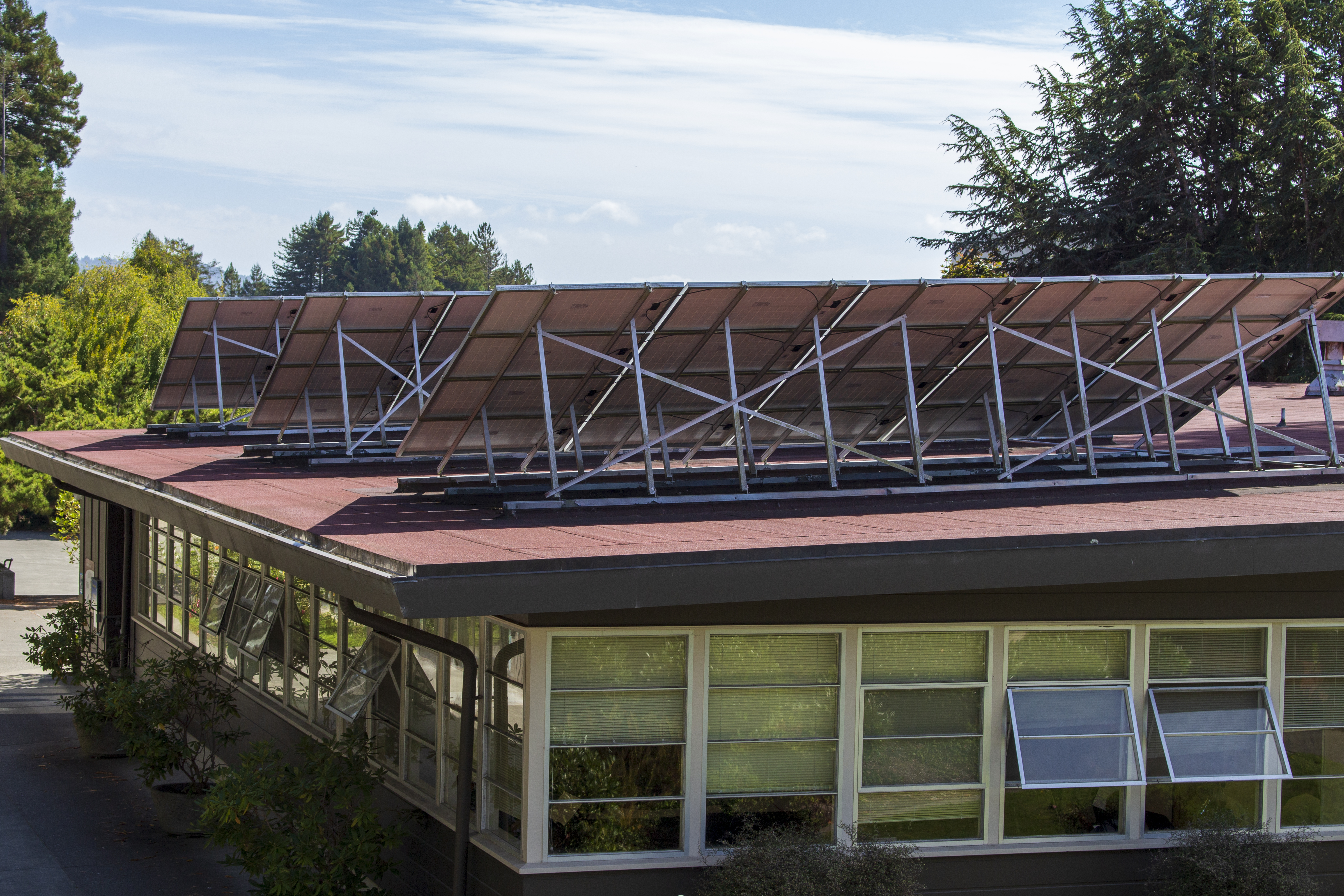
Blue Lake Rancheria has tested local energy generation since 2011. The Rancheria has yet to be seriously impacted by the power shutoffs because they have solar electricity and battery storage, forming a microgrid.
Their microgrid works as a system of solar panels which power the Casino and other buildings during the day while also charging up a bank of Tesla batteries for the night. The grid can be connected or disconnected from PG&E’s grid as needed, making them sustainable without any power from the utility.
The primary barrier to building offshore wind turbines and micro grids or improving PG&E’s transmission lines is cost. Alternative energy projects cost significantly more upfront that traditional fossil fuels. The economic costs of the recent power shutoffs, however, may be enough to kickstart real conversations about alternatives.
Students learn how agriculture and water intersect, and how water can be impacted from outside sources
Agriculture is the foundation of modern society. California’s Central Valley keeps millions of people fed from its acres of cultivation, but that much land, and work, requires a lot of water.
Matthew Lotakoon, the president of the Water Resources Club at Humboldt State University, worked as a youth leader with the Tulare County Farm Bureau. The program provided local students with agricultural work in Tulare County and sometimes across the state of California. Lotakoon said his big take away was that agriculture is the economic backbone of the state.
“No other industry in California matches agriculture’s economic productivity,” Lotakoon said. “There is a complex environmental solution to maintain biodiversity and economic livelihood.”
Lotakoon said that the landscape of the Central Valley changed throughout its history. Most of the Central Valley has been soaked with water flowing off the Sierra Nevada mountain range. Since then, the agriculture industry has worked to serve the need for reliable food, a need that has been persistent and dominant.
“No other industry in California matches agriculture’s economic productivity. There is a complex environmental solution to maintain biodiversity and economic livelihood.”
Matthew Lotakoon
“Historically, the Central Valley has been very productive,” Lotakoon said. “Most of the Central Valley was riparian areas, lots of swamps and reoccurring wetlands. Vast herds of elk and pronghorn lived on the landscape. And now, little towns like Porterville and Tulare have appeared and agriculture fields are everywhere.”
To support a growing population of people, cities and roads were built on land that had previously been underwater, or at least waterlogged. The fertile ground was ideal for the agriculture industry. A decision was made in the 19th century to develop the Central Valley into a bread basket. A thirsty bread basket.
“For the limited amount of water we have, we have to consider how to use it to preserve biodiversity while farmers are trying to maintain their livelihood,” Lotakoon said. “The farmers are good people, it is water policy in the Central Valley that is the challenge. Once partisan politics gets involved, it gets very messy.”
Sustainable agriculture practices are the North Coast’s solution for feeding people in an appropriate way. To farm sustainably, resources including water, land and feed are used responsibly to prevent them from being depleted. The goal is to produce food forever. But farmers have to be conscious of where they get their water from, to avoid polluted crops.
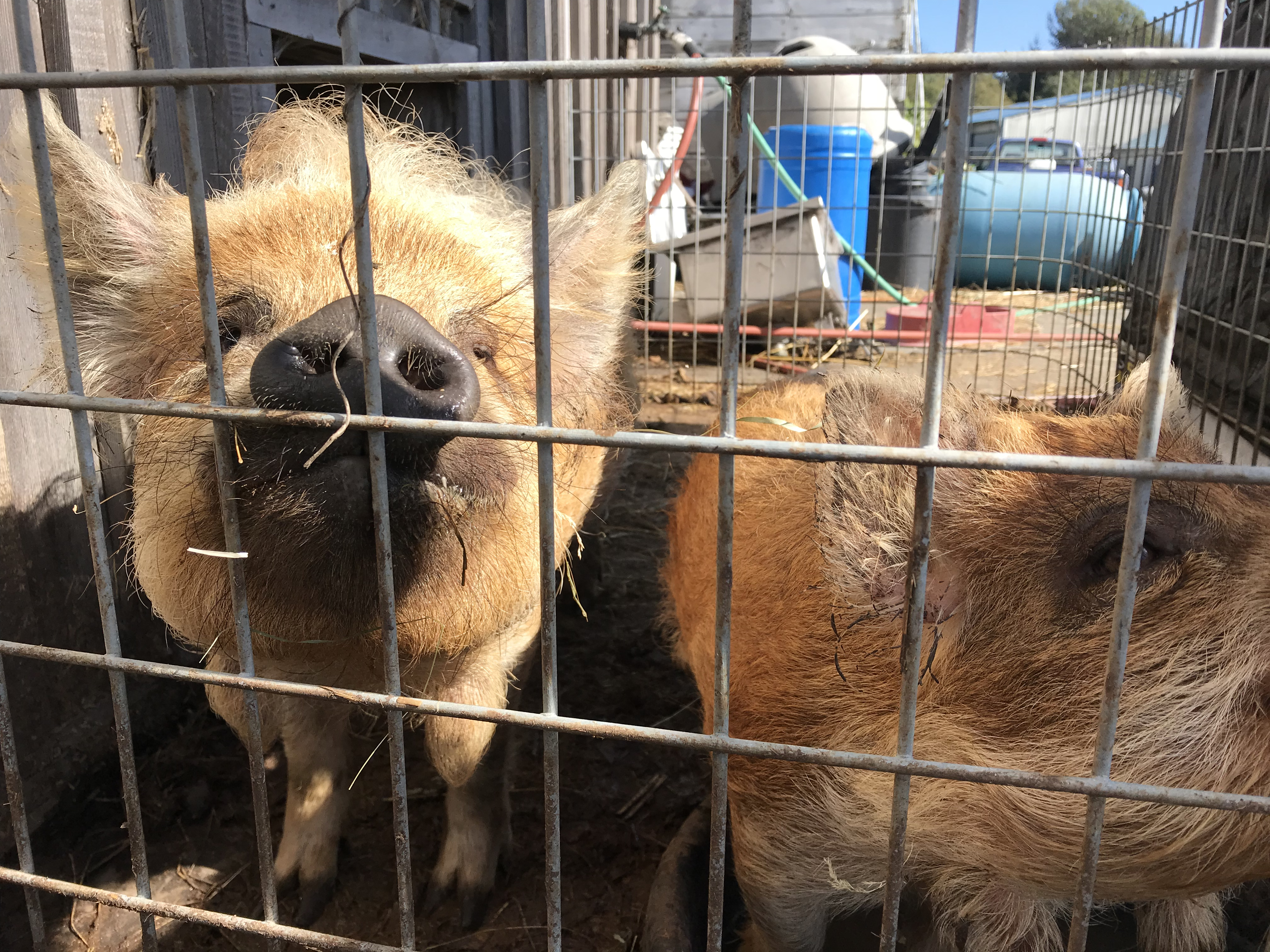
Shail Pec-Crouse feeds her kunekune pigs. Pec-Crouse owns and manages a farm which practices sustainable farming, meaning she will be able to farm how she does today, forever. | Photo by August Davidson
Shail Pec-Crouse owns Tule Fog Farm, a sustainable animal farm in the bottoms of Arcata. Her 22-acre property is home to pigs, sheep, turkeys and cows raised in a way that won’t damage the land they live on. Her operation is not very resource-intensive, although she did say working on the farm is a full-time job.
At the moment, Pec-Crouse’s farm is hooked up to the municipal water system. It is an expensive alternative, but considering the local Sun Valley Floral Farm uses the herbicide RoundUp on nearby fields to prepare them for growing flowers, it is a safe alternative.
“The field will be green one day,” Pec-Crouse said. “And orange the next.”
It isn’t unreasonable to believe the toxic herbicides infiltrate the soil and work down into the groundwater. Infiltrationis when soil absorbs water that falls on its surface. The water fills in crevices and pores between soil particles to create something of an underground lake called an aquifer. Depending on the chemical, infiltrating water can carry toxins into the aquifer.
Watershed professor Joe Seney said groundwater contamination is a big management challenge. The use of herbicides, industrial waste, poorly constructed septic systems and urban runoff often pollute groundwater. Pollution poisons drinking water, destroys local ecosystems and can cause land to be infertile.
Emma Flewell is studying environmental policy and planning at Humboldt State and worked with Ahtna Facilities Services to clean up a former Naval petroleum reserve in Bakersfield. The oil field contaminated a nearby aquifer and will take decades to clean up. The groundwater in the aquifer was used as tap water by a nearby neighborhood until people started getting sick.
“The farmers are good people, it is water policy in the Central Valley that is the challenge. Once partisan politics gets involved, it gets very messy.”
Matthew Lotakoon
“There are a lot of aquifers that have the potential to be used for municipal water, but it’s sad because some of them are polluted,” Flewell said. “Being in environmental science and management, cleanup jobs are common. There have to be people who clean up the messes we make.”
Flewell said there should have been legislation long ago to prevent aquifer pollution. She said it would be less expensive to not pollute in the first place than pay for the cleanup. Since the process to restore toxic sites takes years, the work needs to start as soon as possible.
The Tule Fog Farm is an example of how a polluted landscape can be restored to be productive again. The farm is a remediation site, which means the ground the farm is on was once polluted but has since been restored. It takes knowledge and technology to restore land, and it should be an inspiration for future remediation.
Lotakoon said consultation and collaboration with farmers is important moving forward. He stressed nobody is evil and it’s important to accommodate people and consider cultural differences and mannerisms.
“Farmers are decent people trying their best to do good,” Lotakoon said.
Dry vegetation and high winds were a major factor in PG&E shutoff
The morning of Oct. 8, Humboldt County residents were notified that Pacific Gas & Electric may shut off power county-wide. HSU students and faculty began rapidly preparing for the possible outages, but some wondered what forced the utility giant to turn off the power.
Leading up to the blackout, rumors spread as people speculated why PG&E decided shutting off power was the best option, and others wondered how long the outage could last. It seemed there was a lack of communication, as only some local professionals seemed to know the details.
On the night of Oct. 9, HSU Facilities and Management employee Brian Wheeler was responsible for filling up HSU’s generator. The diesel generator was the only thing standing between powerless students and the cold, dark night.
Wheeler said he had heard about an algorithm PG&E made to inform them when to shut off the power. This was confirmed by Megan McFarland, a spokesperson for the company. McFarland said no single factor drives a Public Safety Power Shutoff since each situation is unique.
PG&E carefully reviews many criteria when determining if power should be turned off for safety. These factors generally include, but are not limited to:
A Red Flag Warning declared by the National Weather Service.
Low humidity levels, generally 20% and below.
Forecasted sustained winds above 25 mph and wind gusts in excess of approximately 45 mph, depending on location and site-specific conditions such as temperature, terrain and local climate.
Condition of dry fuel on the ground and live vegetation (moisture content).
On-the-ground, real-time observations from PG&E’s Wildfire Safety Operations Center and observations from PG&E field crews.
To get a better grasp on the situation and its factors, The Lumberjack contacted the Woodley Island National Oceanic and Aeronautic Administration. Meteorologist Jeff Tonkin understood the specifics and why PG&E could be forced to make such a decision, but believed that Humboldt County wasn’t initially a part of the plan for a reason.
“PG&E shuts down based on wind speed if it is projected to cause a disruption or a failure,” Tonkin said. “Locally in Eureka, the power wasn’t shut down because of local high winds. We’re just collateral damage.”
Tonkin said NOAA had meetings with PG&E meteorologists in the past, but PG&E doesn’t consult NOAA for weather information. While getting in contact with one of PG&E’s scientists would likely be key to understanding why the power was shutoff officially, Deanna Contreras, another PG&E spokesperson, answered the call instead.
Contreras said, for this particular shutoff, the weather patterns were somewhat unique and widespread. Many forecasters compared the conditions to the devastating conditions from October 2017.
In response to the rapidly changing environmental conditions in our state, beginning with this year’s wildfire season, PG&E expanded its Public Safety Power Shutoff program to include all electric lines that pass through high fire-threat areas – both distribution and transmission.
Cotreras said there weren’t any PG&E meteorologists available but had plenty of details about PG&E’s weather system.
“Beyond PSPS information, weather geeks will find a lot to love about the new weather page,” Contreras said. “With PG&E’s weather map at your fingertips you’ll be able to check humidity, precipitation, temperatures, wind speeds and wind gusts across 70,000 square miles of Northern and Central California.”
Contreras said the page offers a seven-day regional forecast. PG&E’s Wildfire Safety Operations Center team monitors all these conditions and evaluates whether to proactively turn off electric power lines, in the interest of public safety, if extreme fire danger conditions are forecasted.
McFarland said a lot of PG&E employees live and work in regions that are affected by the shutoff and that she understands how frustrating it is to have the power turned off. She said the decision was not made lightly.
“We want customers to know that although you may not live or work in a high fire-threat area,” McFarland said, “Your power may be shut off if the line serving your community relies upon a line that runs through an area experiencing extreme fire danger conditions.”
Humboldt is experiencing the fastest rate of water elevation on the West Coast
Humboldt Bay is ground zero for sea level rise. In the last 100 years, the sea level rose 18 inches. This the most rapid rate of sea level rise on the West Coast.
Humboldt County Environmental planner Aldaron Laird has 30 years of experience and spent ten years mapping and analyzing Humboldt Bay through a series of vulnerability assessments to help prepare our community for the inevitable impacts of sea level rise.
“All the damage is going to occur with two and three feet of sea level rise,” Laird said. “It doesn’t really matter when that’s going to occur. We basically have to prepare for that now.”
Laird reported that the rate of rise will continue to increase. A two or three foot increase in the average elevation of high water will breach the miles of diked shoreline as early as 2030.
“All the damage is going to occur with two and three feet of sea level rise. It doesn’t really matter when that’s going to occur. We basically have to prepare for that now.”
Aldaron Laird, Humboldt County Environmental Planner
“When we go from two feet to three feet of water elevation change, it’s the tipping point in Humboldt Bay,” Laird said. “The 23 diked hydro logic units that we have on the Bay, all of them will be over topped when we go from 2 to 3 feet. So everything behind that will be impacted.”
The land behind the dikes is privately owned agriculture, residential areas, business parks and industrial assets, not to mention municipal water lines, PG&E gas lines, waste-water treatment lines and electrical transmission towers. The threat is legitimate and significant.
“The major urban areas that are most at risk are King Salmon and Fields Landing,” Laird said. “They are at risk straight from sea level rise. Half a meter to a meter, and those areas will be underwater. They aren’t behind dikes.”
Linda Gill is the manager of Gill’s by the Bay, a restaurant located on the King Salmon waterfront. Gill said she hadn’t thought too much about the threat her restaurant faced as sea levels continue to rise.
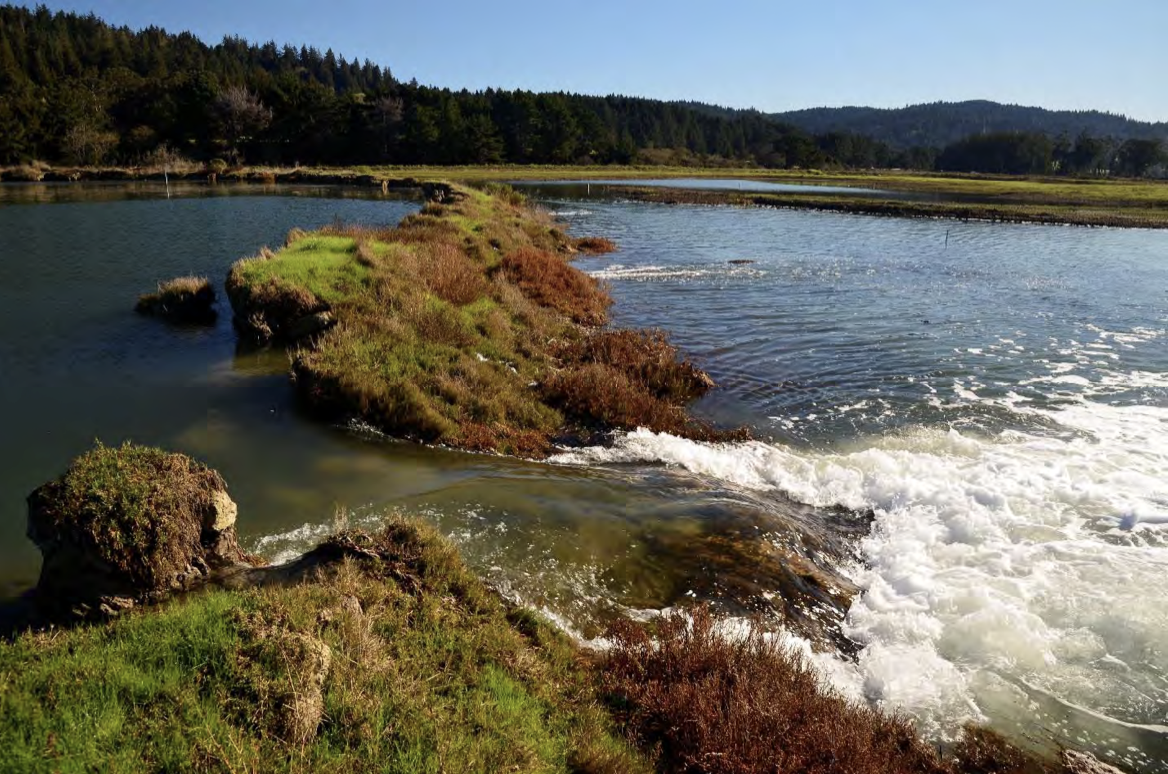
Projected Inundation Area (Stillwater) on Humboldt Bay
for Mean Monthly Maximum Tide with 6.6 feet (2.0 meters) of Sea Level Rise. | Photo from Humboldt Bay Area Sea Level Rise Vulnerability Assessment
“Right now we are just going with the flow,” she said in a phone interview.
Wave energy had been diverted by the north and south jetties to an area called Booner Point, the site of an old PG&E nuclear power plant. There are still nuclear fuel rods stored there.
“They decommissioned it, and they stored all the nuclear fuel rods 115 feet back from the bluff on their property with all that wave energy focused on that bluff,” Laird said. “It’s experiencing the highest rate of erosion anywhere on Humboldt Bay, and those nuclear fuel rods are going to be there forever. It’s probably the stupidest place on Humboldt Bay to locate a nuclear fuel storage site.”
Jennifer Kalt, the director of Humboldt Baykeeper, said the county needs to be prioritizing protection rather than considering potential hazards.
“Instead of fighting, local governments and state agencies need to work together to make a plan,” Kalt said.
“Instead of fighting, local governments and state agencies need to work together to make a plan.”
Jennifer Kalt, Director of Humboldt Baykeeper
Kalt said the planning process seems to have reached a stalemate as local and state jurisdictions fail to agree on a comprehensive plan. The unique issue about Humboldt Bay is that the California Coastal Commission has first and final say on improvements to the shoreline.
“So we have this conundrum on Humboldt Bay that I think the Coastal Commission has really never faced anywhere else in California,” Laird said. “The entire shoreline of Humboldt Bay is in state jurisdiction. If the county said they wanted to rebuild all the dikes, they couldn’t. They would have to ask the Coastal Commission and the Coastal Commission could say no.”
Laird has submitted the final sea level vulnerability assessments. Now the individual actors need to come together in unison to take action and move beyond the planning phase and into the action phase.
“Anything that can be moved should be moved,” Laird said. “Anything that can be hardened, redone or redesigned so that it can accommodate being submerged in saltwater should happen.”
Vitamin D and zinc can help the immune system battle the common cold and the flu
In addition to getting your annual flu shot, there are other things to do to protect yourself from the flu virus.
The flu spreads most commonly through the air, which is why sneezing and coughing, in a hygienic way, help to prevent the sickness from spreading. A study published in the journal of Clinical Microbiology and Infection has concluded that the flu virus can stay on unwashed human hands for up to 30 minutes.
“It was possible to recover infectious influenza A (H3N2) and A (H1N1) 2009 viruses for a period of time extending up to 30 min,” Yves Thomas, the lead researcher, wrote.
The likelihood of contracting the flu virus rises significantly with hand-to-face contact, allowing the virus access to mucous membranes.
As always, eating fruits and vegetables and moderate exercise will give you the best odds to beat sickness, but once you start feeling the symptoms, what can you do?
Vitamin C, in conjunction with other vitamins and minerals such as zinc and vitamin D, can be used to strengthen the immune system for a small period of time, but over long stretches proved no more effective than placebo.
Harri Hemilä, Ph.D. tested 1-2 grams/day of Vitamin C and found that the likelihood of catching a cold dropped.
“The duration of colds was reduced by 8% (3% to 12%),” Hemilä wrote. “The severity of colds was also reduced by regular vitamin C administration.”
Athletes can especially benefit from regular vitamin C supplementation. The vitamin C acts as an antioxidant for athletes as it works to potentially reverse oxidative damage that occurs with exercising. The article states that vitamin C may be useful for those exposed to brief periods of severe physical exercise.
Mariangelea Rondanelli and other researchers investigated the effects three compounds have on colds. Vitamin C, zinc and vitamin D seem to be the holy trinity of risk reduction for cold and flu. Once symptoms occur, these have been shown to lessen the severity and length of sickness.
“Considering zinc, the supplementation may shorten the duration of colds by approximately 33%,” Rondanelli wrote. “Common cold patients may be instructed to try zinc within 24 hours of onset of symptoms. As for vitamin D, the supplementation protected against the common cold overall, considering baseline levels and age.”
Of course, not everyone has the same reaction to dosages, and it’s possible these might not help everyone fight sickness. A change in diet can increase zinc levels easily. Eating an extra serving of nuts or seeds at breakfast is more inviting and customizable compared to buying zinc lozenges, packets or pills.
Vitamin D can be obtained through the sun, but here in Arcata that option leaves just as the worst of the flu season hits. A small supplement of vitamin D may help with more than just immune issues, and many Americans are vitamin D deficient without even realizing it.
Beyond that, one would have to eat a lot of oranges to match the one to two grams of daily vitamin C that was tested in the study, but an increased intake of any amount wouldn’t be wasted. EmergenC, Airborne and other supplements will deliver a dense dose of the vitamin. Hemilä said patients should try out an increase in vitamin C.
“Nevertheless, given the consistent effect of vitamin C on the duration and severity of colds in the regular supplementation studies, and the low cost and safety,” Hemilä wrote. “It may be worthwhile for common cold patients to test on an individual basis whether therapeutic vitamin C is beneficial for them.”
Bing! Flight attendants, please prepare for take-off
We are now departing from the Humboldt State University library.
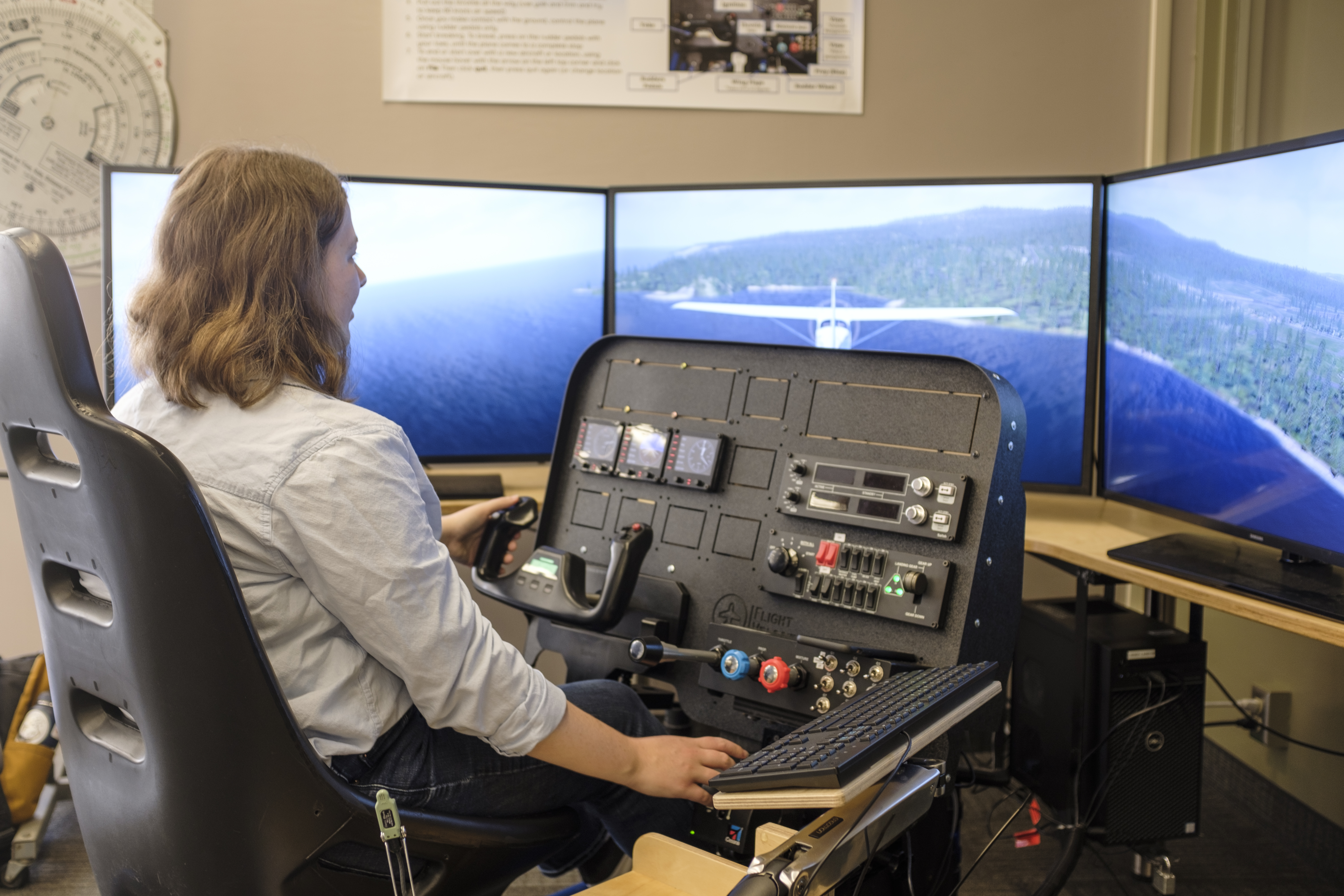
Since fall 2018, Humboldt State University’s PC Gaming Club planned, fundraised and constructed a flight simulator for anyone to use. Students, faculty, staff and community members can learn how to fly an airplane by practicing in the simulator on the third floor of the library.
“The amazing thing about simulations is that it’s designed to simulate real life,” Sarah Livingstone, president of the PC Gaming Club, said. “You are still having the same neural connections and the same wavelengths in your brain to replicate that. So then when you do step inside a real airplane, you are doing all the exact same things; you know how to do everything correctly.”
The control wheel or “yoke,” juts out from the instrument panel of the flight simulator. | Photo by Michael Weber
The simulator features all the levers, buttons, instruments, windows and pedals that one would see in a real-life cockpit. Library pilots can choose their airplane model, airport location, flight conditions and other variables within the software, Microsoft Flight Simulator X.
Step-by-step instructions are posted nearby so that anyone may start the simulation solo. Livingstone said the club wants to hire a trained student to teach the public to operate the simulator and hire a flight instructor to allow anyone to obtain a real pilot license.
“We’re looking into working with extended education to bring forward this flat ground school program that would help students get their pilot’s license at HSU.”
Sarah Livingstone
“We’re looking into working with extended education to bring forward this flat ground school program that would help students get their pilot’s license at HSU,” Livingstone said.
Just like getting a license to drive a car, the two requirements for a pilot’s license—as defined by the Federal Aviation Administration—are to pass a written test and record 40 hours of flight practice with a professional.
David Marshall, the advisor to the PC Gaming Club, said a pilot-in-training may save a significant amount of money for the 40 hours of practice by using a simulator rather than a real, gasoline-consuming airplane.
A nearby supplemental book for pleasure reading rests on the flight simulator desk at the Humboldt State University Library on Sept. 23. | Photo by Michael Weber
“The cheapest airplane is right around $100 an hour. On top of that, you get another $30 an hour for your instructor,” Marshall said. “So every hour, an airplane costs $130. In the simulator, if somebody else builds it for you, it’s just an instructor and it’s $30 an hour to put book time.”
The club is searching for more funding to provide a classroom to study the written test and a professional instructor for the simulator.
Livingstone said they are looking into purchasing the final flight instruments, headphones, a new cover for the chair and a pillow for younger pilots-in-training to access the simulator.
The project started one year ago when Marshall said he required the club to create a project with a positive, meaningful and educational experience.
“I suggested gently that gaming is really simulation,” Marshall said. “And there’s a lot of stuff we can do in simulation.”
The club then raised $10,000 for the furniture, chairs, equipment, computer and software by writing grants, fundraising and working with community members that provided some equipment and furniture.
Livingstone said the simulator caught the attention of HSU President Tom Jackson, Jr. and Provost Alex Enyedi, who are both aviators. Livingstone encountered unexpected enthusiasm when she met with Jackson.
“It was supposed to only be a 40-minute meeting, but it ended up being an hour and a half,” Livingstone said. “He was having so much fun.”
The hands of industry and development have clawed at wilderness since pioneers began pushing westward. Oil has tempted landowners for decades, but the Arctic National Wildlife Reserve denied the resource to industry interests in order to preserve its unique, ancient landscape.
That landscape is threatened. In the perpetual words of writer and wilderness activist Robert Marshall, “And so the path of empire proceeded to substitute for the undisturbed seclusion of nature the conquering accomplishments of man.”
“[The Oil and Gas] Leasing Program will help meet the long-term energy needs of the nation, support job creation and economic growth of rural Alaskan communities,” The Department of the Interior, acting through the Bureau of Land Management, announced on September 12. “The [Tax Cuts and Jobs] Act directs the Secretary of the Interior, through the Bureau of Land Management (BLM), to establish two area-wide leasing sales, not less than 400,000 acres each, along the Coastal Plain of the Arctic National Wildlife Refuge.”
The legal authority for the Oil and Gas Program is found in Public Law 115-97, otherwise known as the Tax Cuts and Jobs Act. Written into Title II, section 20001(page 184) are simple yet powerful exemptions for the oil industry’s special interests. For example, “Section 1003 of the Alaska National Interest Lands Conservation Act (16 U.S.C. 3143) shall not apply to the Coastal Plain.”
The intent of the Tax Cuts and Jobs Act is clearly to honeypot Alaska into opening up the refuge to industrial interests. The Act sets aside standards in the Mineral Leasing Act as the Federal Government plans on claiming royalties at a rate of 16.67%, when standard royalties are 10%.
While the Mineral Leasing Act Section 35 gives 37.5% of money made from sales, bonuses, royalties and rentals of public lands to the State, the Tax Cuts and Jobs Act declares 50% of the money made will go to the State Treasury.
The Trump Administration declared $1.8 billion dollars of oil could be mined, essentially promising Alaska $900 million in revenue. The latest federal report suggests the potential income is half of that, approximately $905 million in revenue for the government and significantly less for Alaska.
The pristine wilderness within the Alaskan Arctic Wildlife Refuge. | Photo by Greg Wiler, U.S. Fish and Wildlife Service
The projections continue to fall as independent studies conclude significantly lower revenue opportunities based on other local lease sales. How low can you go? Alaska’s governor is prepared to open up the wildlife refuge no matter the cost.
“Forty years after Congress selected the Arctic Coastal Plain for potential energy development, the Trump Administration is making good on that decades old potential,” Alaska Governor Mike Dunleavy said. “I join with all Alaska Governors since 1980 in assuring the nation and the world that we develop our natural resources responsibly. I look forward to the lease sale scheduled for later this year.”
In 1929, a 28-year-old forester named Robert Marshall visited the landscape which would eventually become Alaska’s Arctic National Wildlife Refuge on summer vacation. He chose that area because it was the most remote section of Alaska.
Marshall published an essay titledThe Problem of the Wildernesswhere he describes the extraordinary benefits of the wilderness, considers the drawbacks of preserving wild lands and calls wilderness allies to action in the face of society’s aggressive advance into nature.
“Within the next few years the fate of the wilderness must be decided,” Marshall wrote. “This is a problem to be settled by deliberate rationality and not by personal prejudice. Fundamentally, the question is one of balancing the total happiness which will be obtainable if the few undesecrated areas are perpetuated against that which will prevail if they are destroyed.”
Alaska Governor Mike Dunlevy is prepared to open up the wildlife refuge no matter the cost.
The U.S. Fish and Wildlife Service manages the network of protected lands in the United State’s National Wildlife Refuge System. The mission of the National Wildlife Refuge System is “to administer a national network of lands and waters for the conservation, management and, where appropriate, restoration of the fish, wildlife and plant resources and their habitats within the United States for the benefit of present and future generations of Americans.”
The Arctic National Wildlife Refuge has been referred to as “The American Serengeti” for its rich biodiversity and untouched landscape. The ANWR is home to a caribou herd nearly 170,000 strong and other beasts including polar and grizzly bears, snow hares, mink and beavers. None of the revenue from Oil and Gas sales will go toward reserve restoration efforts.
The Coastal Plain is “Iizhik Gwats’an Gwandaii Goodlit,” the sacred place where life begins, to the native Gwich’in people. Both the Gwich’in and Inupuat people have depended on caribou and the land for food, clothing and resources to support their way of life. Gwich’in Elder Jonathon Soloman acknowledged his people’s connection to the land.
“It is our belief that the future of the Gwich’in and the future of the Caribou are the same.” Solomon said. “Harm to the Porcupine Caribou Herd is harm to the Gwich’in culture and millennia-old way of life.”
It seems, despite the 89 year difference, Robert Marshall’s word still ring true.
“There is just one hope of repulsing the tyrannical ambition of civilization to conquer every niche on the whole earth,” Marshall wrote. “That hope is the organization of spirited people who will fight for the freedom of the wilderness.”
CCAT plans to keep pigs on campus to reduce food waste
Humboldt State University’s Campus Center for Appropriate Technology plans to house two pigs on campus as soon as next week.
CCAT will loan the pigs from the Tule Fog Farm in Arcata for the duration of the fall semester. CCAT plans to feed the pigs food waste from HSU’s J dining hall.
Jacob Gellatly, environmental resources engineering major and former CCAT Co-Director, helped lead the project from concept to reality.
“We want to show how animals can be raised in a residential environment, and how you can use urban byproducts such as food waste to raise animals in an urban setting,” Gellatly said.
EnvironmentalRresource Engineering majors Jacob Gellatly (right) and Kong Vang (left) prepare a log on Sept. 6 to be used for the roof of a pig pen. | Photo by James Wilde
The plan to house the pigs began last fall when students in the CCAT Student Club vocalized interest in keeping animals on campus. CCAT contacted Shail Pec-Crouse from the Tule Fog Farm in Arcata. Pec-Crouse recommended pigs as the most viable animal.
“The easiest animal for us to raise would be pigs,” Gellatly said. “The reasoning for that is—a big thing is predators. So it’s a lot harder for something to come and get a hold of a pig as opposed to a chicken.”
As part of their plan, CCAT realized they could feed the pigs food waste from the J. While CCAT couldn’t feed the pigs food thrown away by customers of the J, CCAT could feed the pigs pre-consumer waste, such as food trimmings or spoiled foods not suitable for people.
“Another goal with the project was how can we divert food waste on campus,” Gellatly said. “And with that we can feed almost, and in some cases, their entire diet from food waste that’s at the school here.”
Once CCAT decided to loan the pigs from the Tule Fog Farm it needed approval from HSU’s Associated Students, Institutional Animal Care and Use Committee, Facilities Management, Risk Management and an environmental health and safety specialist.
The pig pen-in-progress on Sept. 6. CCAT plans to house two pigs in the pen for the duration of the fall semester. | Photo by James Wilde
Humboldt State’s IACUC reviews the use of animals on campus to ensure the animals are treated humanely under the requirements of federal and state law. College of Natural Resources Associate Dean Rick Zechman, who chairs IACUC, said the IACUC proactively reviews and inspects over 100 animal-involved projects on campus each year.
“There’s varying kinds of emotional feelings about the use of animals, and that’s respected and honored in the system of review,” Zechman said. “And that’s why the Animal Welfare Act was developed, to prevent mistreatment of animals. And I think, you know, in our committee, that’s sort of our first principle.”
While Zechman could not comment on the details of CCAT’s proposal, which is still pending, CCAT has worked over the last year to assuage concerns raised by various HSU faculty.
CCAT started by building a pig pen out of reclaimed wood from a local logging operation in Fieldbrook. CCAT has since integrated plans for a roof to prevent flooding of the pen and security to prevent people from getting harmed by the pigs.
In the long run, Gellatly hopes the project might convince the University to keep animals around for good.
“Big picture, I would like the school to see this and see, with what we’re having to deal with—getting rid of all this food—we could be raising meat for the school and have locally-produced meat with a byproduct of our current dining system,” Gellatly said.
Environmental Rresource Engineering majors Jacob Gellatly (right) and Kong Vang (left) working with a log for the pen. | Photo by James Wilde
CCAT’s plan to house pigs has only recently become known to the wider HSU campus. Saraí Escalante, psychology graduate student and president of HSU’s Vegan Club, sees the value of reducing food waste but wonders about the sustainability of the project.
“I think the underlying problem is that we see them as a convenience, as objects, so we see them as a tool to help us fix a problem or make our problems or our lives easier,” Escalante said. “And from a sustainability point of view, you still waste a lot of water in all of the slaughter process and the cleaning up of the meat. In that way, it wouldn’t be sustainable.”
Escalante said she’s considering starting a fundraiser to purchase the pigs and send them to a sanctuary instead of a slaughterhouse. However, Escalante said she plans to talk with CCAT to exchange thoughts, as she does like the idea of reducing food waste on campus.
Gellatly, for his part, noted that the current plan as registered with Tule Fog Farm and IACUC is for CCAT to house the pigs only for the rest of the semester.
“I think it’s, in theory, possible for them to buy the animals from the farmer if that’s something they’re inclined to do,” Gellatly said. “But, as far as our scope goes with the IACUC, once the project’s done, we’re taking the animals back to the farm and that’s where it ends for us.”
The project’s beginnings are dependent on approval from IACUC, but the pigs could arrive at CCAT as early as the week of Sept. 8 through 14.
A few ways to get to sleep easier according to science
Being relaxed, refreshed and clear-minded are common themes for getting to sleep. Going to sleep and waking up at the same time each day is touted as the most effective way to ensure good sleep. Beyond that, here are seven other great strategies for passing out.
1. Sleep in a colder room: To initiate sleep, your body has to cool down a couple of degrees. A colder room will get you there faster.
2. Take a hot shower or bath before bed: When you’re exposed to hot temperature, blood vessels on your skin’s surface swell to release heat. This will help you cool down.
4. Don’t nap too late in the day: A late-day nap can make it harder to fall asleep at night, since your brain’s already had some rest and may want to stay up.
5. Relax before bed: Relaxing before bed will prepare your brain for bedtime. Doing a relaxing activity such as reading or yoga for an hour or so before bed will prepare you for sleep.
6. Avoid bright screens at night: Screens emit blue light, a wavelength of light which tricks our brain into thinking it’s daytime. Putting the phone away an hour or two before you go to sleep will make it easier to fall asleep.
We all have our own methods for falling asleep. Personally, I like to lay on my belly and cover myself in pillows, but I’m weird like that. I asked students on campus what their methods were for falling asleep. Here is what they said:
Stephanie Rodriguez and Krystal Padilla both have pre-sleep rituals that prepare them to crash.
“I feel like de-stressing,” Rodriguez said. “Taking a shower, doing a face mask, smoking a bowl. You have to turn off your brain before actually going to sleep. I hate going to bed actually thinking about stuff.”
“I have these Christmas lights in my bedroom and I turn those on, I smoke a blunt, I listen to music,” Padilla said. “I’m just relaxing, I feel refreshed and I just brush my hair. It helps me go to sleep.”
Gigo Derderian and Seamus Begley have straightforward methods for getting to sleep. Allowing sleep to wash over them, they lay in bed either meditating through discomfort or rolling around until maximum coziness is achieved.
“One thing I do is I lie down and try to stay as still as possible,” Derderian said. “Even if I feel an itch or something I just ignore it. I will kinda start with my toes and work my way up. I try to make sure I’m comfortable and relaxed in every point in my body. By the time I get to the top, I’ll already be dozing off.”
“Whenever I’m going to sleep, I’ll lay down and I just need to get really comfortable,” Begley said. “I’m always rolling around for the first five minutes and then I find a spot where I’m like ‘yeah, that’s it,’ and then I’m just out.”
School demands a lot from students. We can be pushed to a limit as project deadlines approach. The stress we face is definitely real, but we shouldn’t let that get in the way of some shut-eye. Sleep is just as important as eating and exercising when it comes to health. Get some.
Some coastal redwoods are growing faster than expected and scientists aren’t certain why
Many redwoods in Northern California are growing at unexpected—even record-breaking—rates. While redwoods only remain in a tiny portion of the world, they appear to be in good health.
“People talk about saving the redwoods,” Humboldt State University Professor of Forest Ecology Steve Sillett said. “The redwoods, as long as we don’t cut them down, are doing just fine. The question is, can they help save us?”
The answer is complicated.
“The Redwoods and Climate Change Initiative found that one Del Norte County redwood put on 2,811 pounds in 2014, a record-breaking annual growth.”
The RCCI, a research partnership studying redwood health since 2013, found surprising growth in redwoods located away from dry forest fringes or recent fires.
By estimating tree weight based on the tree’s measured width, height and volume, the RCCI found one Del Norte County redwood put on 2,811 pounds in 2014, a record-breaking annual growth.
The cause of the increased growth is uncertain. Sillett, who sat in his lab beside tree rings which he used to measure age and growth, said climate change may or may not play a role in the increased growth. Sillett said the Clean Air Act of 1970 may have cleaned the air enough to allow more sunlight on the trees.
“What happened is, the air cleared,” Sillett said. “And with clear air, you get more light, and so it could very well be that this increase in growth rate that we see very strikingly in some of these trees, starting in the late 60s and early 70s to present, is just because of increasing air quality.”
Beyond climate and air quality, Sillett said multiple factors likely contribute to increased growth. Sillett also said the growth won’t necessarily last.
“I think that there’s very much a limit to what redwoods or any vegetation can achieve,” Sillett said.
A redwood tree ring in HSU Professor Stephen Sillett’s lab Aug. 28. | Photo by James Wilde
A sudden spread of redwood forest also seems unlikely, Lucy Kerhoulas, an assistant professor of forest physiology, said. Kerhoulas said redwoods already have to work hard to reproduce via seed. Climate change might make reproduction even more difficult.
“Successful seedling germination and establishment might be really challenging under a warming and drying climate,” Kerhoulas said.
In other words, redwoods are doing well, but they’re not about to reclaim their lost forests.
Sillett emphasized that many living redwoods are maintaining their normal growth despite less successful reproduction.
“It’s not the case that they’re responding uniformly,” Sillett said. “But what we do see is that in the prime parts of their range, which is, say, north of San Francisco and relatively close to the coast, the rates of wood production are higher than they were in the not-too-distant past.”
Redwoods store large amounts of carbon, especially in their prime ranges, but Sillett said that won’t offset the carbon dioxide produced by humans.
“There’s not enough land in the world to plant with redwood forest,” Sillett said, “that would allow them to save us from what we’re doing to the atmosphere’s chemistry.”
Climate change affects the lives of birds, butterflies and bees
Pollinators matter! Right under our noses a huge community of ants, butterflies and bees are hard at work to make sure the world gets fed. The climate crisis is turning up the heat on these poor guys, and our many-legged friends are at risk. Here’s some information on how pollinators are still doing their best to help us out.
A solitary silver bee perches on a yellow flower to drink nectar. Notice the yellow pollen on its legs which it will bring to the next flower it drinks from. | Photo by Rand Rudland
Flowering plants and pollinators have a unique relationship with one another. Ecologists and biologists pay attention to special events in these organisms’ lives which mark growth and development. The science of studying life events is called phenology.
Ideally a pollinator will hatch from its egg or develop from its pupa and leave the hive around the same time its flower of choice blooms. The timing of these life events is important because if a bug emerges too early or late, it may miss a plant’s flowering completely. No flower equals no food, and that’s no good.
After emerging, the pollinator goes searching for nectar. The sweet liquid is energy-packed food for bugs. When a pollinator lands on a flower, it picks up pollen. As it continues to look for nectar, the pollen is shaken off and sticks to other flower’s pistils, the female organ of the plant. Pollen travels down a shaft to fertilize the ovary, which begins to go through mitosis and eventually produces fruit.
Tayloranne Finch and Melanie Honda are two farmers working on the Bayside Park Farm in Sunny Brae who get to interact with pollinators every day. Without pollinators, their farm would be a bunch of fruitless bushes.
Finch said the farm was working with the City of Arcata to build a permanent solution, a perennial native pollinator garden. The garden would have year-round plants that local pollinators prefer, supporting the local habitat organically.
Tayloranne Finch, left, and Melanie Honda, right, are farmers at Bayside Park Farm. They spent a sunny afternoon pollinating corn by walking through the rows, swaying their arms back and forth. Every week is a volunteer friday at Bayside Park Farm on Old Arcata Road in Arcata, CA 95521. | Photo by Collin Slavey
“We’re installing plants that will be there forever. It makes it easier for pollinators to establish themselves on the farm and it is mutually beneficial for us,” Finch said.
In the paper they investigate how temperature affects the phenology of the silky beach pea (Lathyrus littoralis) and its main pollinator, the ground-nesting solitary silver bee (Habropoda miserabilis).
“Temperature best predicted both flowering and bee activity, although soil moisture influenced the timing as well,” the paper said.
Their findings imply that in the face of the climate crisis, an average increase in temperature may cause the silky beach pea and the solitary silver bee to fall out of sync.
“Comparison of linear regression slopes of phenology against temperature suggests that bee nesting time is more sensitive to differences in seasonal maximum temperatures, and may advance more rapidly than flowering with temperature increases,” the paper said.
A bumblebee looking for lunch landed on this flower to get a drink of nectar. The bee will help pollinate nearby flowers as it continues on its flight. | Photo by Collin Slavey
Olliff-Yang and Mesler said that it’s important to understand what factors influence flowering and pollinator activity. Their investigation into the bee and the pea is just an example of a broader issue in the world.
Building habitat is invaluable to local animal communities, as shelter, food and water are critical needs for every living organism. The most simple thing to do is to plant native plants in the front yard, as this will attract local pollinators.
Local nurseries like Mad River Gardens will be more than happy to teach you about native plants and how you can attract and support our flying friends. As active members of the ecosystem, we all need to do our part.
This website uses cookies to improve your experience. We'll assume you're ok with this, but you can opt-out if you wish. Cookie settingsACCEPT
Privacy & Cookies Policy
Privacy Overview
This website uses cookies to improve your experience while you navigate through the website. Out of these cookies, the cookies that are categorized as necessary are stored on your browser as they are essential for the working of basic functionalities of the website. We also use third-party cookies that help us analyze and understand how you use this website. These cookies will be stored in your browser only with your consent. You also have the option to opt-out of these cookies. But opting out of some of these cookies may have an effect on your browsing experience.
Necessary cookies are absolutely essential for the website to function properly. This category only includes cookies that ensures basic functionalities and security features of the website. These cookies do not store any personal information.
Any cookies that may not be particularly necessary for the website to function and is used specifically to collect user personal data via analytics, ads, other embedded contents are termed as non-necessary cookies. It is mandatory to procure user consent prior to running these cookies on your website.