Ever seen a classmate who seems to be in two places at once?
They could be a track star, master of teleportation, hologram – or more simply, a twin.
The chances of being an identical twin are three or four in 1000, but what are the odds of both twins going to the same college, or more specifically, a small university tucked away in the redwood forest of Northern California?
Without a school-wide survey asking about twins, it’s hard to say, but there are at least a few pairs of identical twins right here on campus.
Marley and Wiley Thrift are a pair of sophomore computer science majors who grew up in Humboldt, and didn’t think much about going to the same college.
“Both of our parents work here, it was an easy choice to go to Humboldt,” Wiley Thrift said. “Our dad works in computer science, so that’s kind of where we got the inspiration from.”
According to Wiley, the difference between being twins in highschool and college is mostly the size of campus and the larger population. It doesn’t always come up in conversation at first, so there will always be confusion.
“If I see somebody that Marley knows on campus and they wave to me, I usually just wave back but I don’t know the person,” Wiley Thrift said. “If they try to talk to me, I’ll say ‘I’m not Marley,’ and it’s a little awkward, but it’s kind of funny too because I know it’s happened before, and I know what’s happening.”
Hunter and Tanner Circe are seniors majoring in environmental studies who also grew up in Humboldt and went to highschool in Mckinleyville.
“It’s easy to have a built-in roommate… because neither of us really had the desire to live with other people,” Tanner Circe said. “It just kind of made sense.”
“We also rent from our parents in Arcata, so It’s a convenient reason to go to Cal Poly [Humboldt],” Hunter Circe said.
The Circes have a similar experience to the Thrifts, describing the same situation of people approaching the wrong twin.
“It’s like talking to a lot more strangers because he knows them,” Hunter Circe said. “This is our experience, it’s not unique [to us].”
“You’re walking by and people will just look, and you know you’re getting the look like, ‘Oh, they’re twins,’” Tanner Circe said.
In many ways, the media has portrayed twins to be a certain way and check certain boxes. This causes a constant flow of stereotypical questions from peers.
“I’m tired of, ‘Is one of you evil? Do you feel each other’s pain?’ It’s just so silly to me,” Hunter Circe said. “People like to put us in like ‘box A’ and ‘box B’. Like, ‘he’s the artsy one,’ or ‘he’s the sporty one…’ Why does there have to be ‘the one?’”
“We’re siblings who look the same,” Tanner Circe said. “Its’ unique but… a little bit mystified on TV and stuff.”
At the end of the day, twins are just like any other siblings, but the same age.
“I think it’s a lot more similar to normal siblings than people realize,” Tanner Circe said. “[People think] it’s this mystical thing, but really, I think it’s just from growing up together.”
For all these siblings, the future is still unwritten. 18 days is the longest time the Thrifts have spent apart, but they plan on extending that time next semester, with many miles in between.
Both Marley Thrift and Tanner Circe have plans to travel abroad while their twins stay in California.
“Being a twin’s great, you should try it,” Marley Thrift said.
Can I be in love with someone I’m not dating? This situationship has got me fucked up.
How do I answer this without coming off like a complete bitch? Your situationship is not real. That’s not to say your feelings aren’t real, or that the love doesn’t exist – but a situationship is not a real thing. The creation of the label “situationship” has opened the doors for this generation to participate in an unwinnable battle: The IDGAF wars. I like you, so let’s find out which one of us can care the least to keep the other person interested without fully committing?
What is a situationship? To me, it’s one person caring more than the other. One person giving more than the other. One person receiving more than the other — you get it. A situationship will never fulfill you in the ways you’re looking for. Rather, this infatuation will leave you feeling more hollow. One person will always have more power than the other.
That’s not to say I don’t understand where you’re coming from; you caught feelings for the wrong person. It happens to the best of us. At the core of it, we are all just creatures looking for love, security, comfort, happiness; we want to feel desired and safe. There is no safety in a situationship. In fact, more often than not, they all have a three month shelf life. Seriously, name one situationship where things stayed good after that three month mark — if that existed, it would evolve into a relationship.
“We accept the love we think we deserve.”
Everyone, their mother and their mother’s single best friend knows this phrase. It’s true though! We often don’t love ourselves enough to believe we deserve better, and so we stay in the situation(ships) we know because it’s the space we’ve decided to fill. You deserve to take up space with someone who will appreciate how you light up the room.
The Humboldt County Office of Education is hosting Zoom sessions for high school and College of the Redwoods students, parents and anyone interested in learning more about HSU programs.
These events are usually held in person every year but due to the COVID-19 pandemic, they are now happening online on Wednesdays from 12–12:45 pm.
Jim Ritter is the HCOE College Connect Coordinator and the main host of the sessions.
“College Chats are meant to be casual, and give students an opportunity to learn about subjects on the university level,” Ritter said.
Ritter explained how College Chats can help students start to build relationships with HSU professors whom they might have a class with someday.
“I think it is important for high school students to get accurate information about what they can expect in college,” Ritter said. “A really good way to do that is for the students to speak directly to professors and lecturers who teach in different majors. College Chats are perfect for helping this happen.”
Even though these events are usually held in person each year, there are still positives that have come out of the situation. It has allowed students and parents from all over the community to join the meetings. The first event held on February 3 focused on kinesiology and was attended by students from Hoopa, Academy of the Redwoods, Arcata and Six Rivers High School.
Every week there is a new HSU faculty member joining as a guest based on different majors. For the first session Justus Ortega, kinesiology department chair, joined to talk about his subject of teaching.
“[College Chats] allow students and the department to discuss solutions to some of the hardest and most pressing issues that people face today including racism, social injustice and food security,” Ortega said.
Jana Ashbrook is an Early Assessment Program Coordinator at HSU and the co-host of the events. She loves helping the students and cheering them on by sharing tips.
“It seems the more time and experiences students get exploring and researching different careers and college majors, the more confident they feel in their college decision,” Ashbrook said.
After experiencing the first session, Ortega has learned that the events are valuable for both students and parents to not only learn about different majors offered but also build relationships throughout the HSU community.
“This event opened my eyes to each individual’s needs and concerns, and allows me to work with other faculty in our department, as well as other campus resources, to develop strategies that support each individual’s needs to achieve success and happiness at HSU,” Ortega said.
Spring Semester 2021 College Chat schedule, Wednesdays from noon–12:45 p.m. on Zoom:
• February 10 — HSU Psychology
• February 17 — NO CHAT, President’s Week
• February 24 — College of the Redwoods Nursing and Dental Programs. (This chat will run 1 hour from noon-1 p.m.)
Where we were, what went wrong & how we build a brighter future
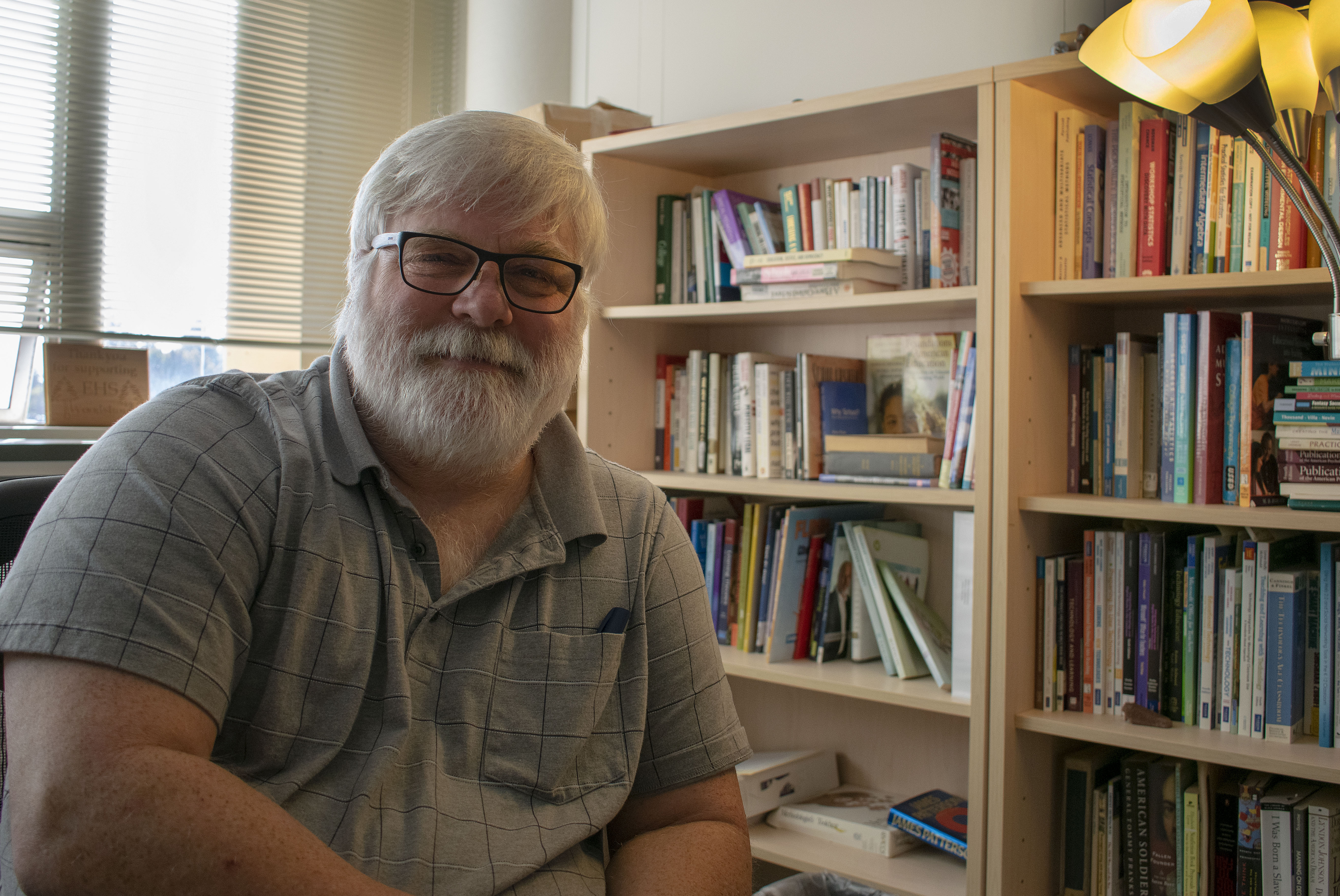
This is a letter to the editor from Humboldt State University Education Department Chair Eric Van Duzer, Ph.D. It has been edited only for minor punctuation and grammar style preferences.
As I reflect back on nearly 30 years at Humboldt State University, first as a student and then for the past 20 years as a faculty member, I wanted to share some of the thoughts that I have about HSU’s current situation and where the campus might go from here.
As a student I experienced a remarkable education where faculty were fully invested in my intellectual and personal development. There were so many opportunities to explore areas of interest and develop new ones. I have spent many hours trying to encapsulate the nature of the schooling I experienced in a way that would really represent the experience.
The best analogy I have been able to come up with was that HSU offered a graduate education to undergraduates. The small classes typical of graduate school encouraged faculty to fully invest in their student’s growth. The university, set so far from the oversight of CSU headquarters in Long Beach, offered a great deal of flexibility to shape our experiences.
This would be impossible today. In those days HSU had the third smallest class sizes in the 23 campuses of CSU. But more than that, it had a unique faculty ethos that reflected nearly 100 years as a student-focused institution that exalted excellence in teaching above all else.
I was the first student CEO of the Institute of Industrial Technology, a self-supporting club that allowed us to use the skills and knowledge we were developing to grow in business acumen, engage in manufacturing and light construction on campus as well as conduct experiments for local agencies. In its second year, Bill Wilkinson used the institute to earn enough profit making desks for campus offices that it paid for several pieces of expensive equipment for the department.
This would be impossible today. In those days HSU had the third smallest class sizes in the 23 campuses of CSU. But more than that, it had a unique faculty ethos that reflected nearly 100 years as a student-focused institution that exalted excellence in teaching above all else.
Faculty came to campus because this is where they wanted to spend their career. Unlike most universities where faculty play academic hopscotch building their resume through research reputations and earning ever-higher salaries as they bounce from college to college, HSU faculty built their reputations on teaching. These were inherently local reputations, not very valuable if one wanted to move on, but rather a reflection of the values and attitudes associated with a culture of excellence in the service of students’ intellectual growth.
As anyone who has worked with university budgets will tell you, graduate education is expensive. That is why through the first 100 years, the administration and other services were done on a shoestring. It was common for a variety of upper administrative positions to be filled by faculty who served temporarily. Staff was thin and overworked and processes were slow and inconsistent.
What happened? In the early 2000s the CSU was facing the onslaught of a Generation X student bulge. Chancellor Charles Reed decided the best strategy to deal with this situation was to homogenize campuses so that if a student could not get into Sacramento State because it was impacted, they could simply go to another campus and get a similar experience.
Yet, the campus, with significant leadership from the faculty, focused its significant resources on classroom instruction, and through that dedication, produced exceptional graduates who were deeply committed to HSU when they graduated.
I remember an administrator in the early years telling me that he had been in a restaurant on the East Coast and overheard a group of students talking at a nearby table. He was so impressed with their sophistication and the values they held he found out where they came from and immediately applied for a job at HSU.
He was the first person hired under then-president Rollin Richmond to manage our enrollments in the early 2000s. The diversity on our campus is a credit to him and Richmond, who reached out across the state to bring in students from urban areas. Sadly he became disillusioned and left. So did most of the faculty leaders.
What happened? In the early 2000s the CSU was facing the onslaught of a Generation X student bulge. Chancellor Charles Reed decided the best strategy to deal with this situation was to homogenize campuses so that if a student could not get into Sacramento State because it was impacted, they could simply go to another campus and get a similar experience.
Shortly thereafter the upper administration received inflated titles and significant raises in an apparent effort to reduce resistance. Then the attack on the faculty began.
Naturally, faculty on campuses such as HSU who were proud of their traditions and niche identities resisted. Fiercely. At one point, three campus presidents, including Rollin Richmond, suffered through votes of no confidence by their faculty as they implemented this strategy.
To achieve the required changes in the face of faculty resistance, campuses, including Humboldt, began shifting to a corporate structure of top down management. Faculty who had held a privileged position in campus life were systematically reduced to workers with only a symbolic voice in campus decisions. The administration turned its focus inward towards improving the functioning of the bureaucracy. They eliminated administrators such as Rick Vrem, an ethical provost, who refused to implement changes that hurt the traditional focus on instruction.
Vrem was replaced with a provost who had no such compunction. Shortly thereafter the upper administration received inflated titles and significant raises in an apparent effort to reduce resistance. Then the attack on the faculty began. Nearly 80 faculty positions were eliminated over several years and during the same time period, a similar number of new staff positions were created and filled to support administrative functions.
Over the majority of the intervening 15 years, budget reductions for academic programs have been the norm: reductions in staff, program availability and courses. This year it was a 6% cut, last year another and many like it before. The funds have been shifted to an ever-expanding variety of administrative initiatives.
Now we sound more like a parks and recreation office than a university. Come for the redwoods, the beaches, the bike riding—that is wonderful and I love it, but it is not why people pick a university.
We spend nearly 68% of our budget on administration and campus facilities. Despite the results of a study commissioned by Rollin Richmond’s administration that showed the two most important factors that cause a student to come to HSU are quality of education and availability of the program they are interested in, both have been repeatedly attacked, sliced and diminished.
It is surprising that no one seems to notice that every time we cut academic programs, fewer students want to come here. And when fewer students come here, the budget suffers and HSU responds by cutting academic programs even more severely—a cycle the faculty in 2004 described as a “death spiral.”
As we address our current crisis and try to figure out what we need to become in order to grow back to a sustainable enrollment, we might want to engage in some soulful reflection. What would cause a 20-year-old to come to a place five hours from major centers of civilization and spend four years with us? What do we have to offer them that is so valuable, so different from what they can get at any of the other CSU campuses which are closer, cheaper and offer a great deal more college life in the community?
We stopped selling the small classes and close academic relationships with faculty when the hypocrisy became too much to bear as campus priorities shifted. Now we sound more like a parks and recreation office than a university. Come for the redwoods, the beaches, the bike riding—that is wonderful and I love it, but it is not why people pick a university.
When I arrived here as a faculty member in 2000 we had one staff member, John Filce, doing institutional research. He was wonderful and badly overworked. I am sure he still is. Now we have nine staff members listed in the directory in the Office of Institutional Effectiveness, including a vice president. I am sure their work is valuable, but to pay for it we had to cut 64 class sections.
Today, we are an organization of inflexible rules and their keepers.
We have proliferated the bureaucracy, which is unfortunately necessary to achieve top-down control of a professional organization. Had our leadership studied industrial technology with me, they would know what companies in the 1970s learned: that this form of management is ineffective and inefficient in a professional organization.
To achieve control requires monitoring, which in turn requires more staff. For a top-down organization, where the vast majority of employees serve at the will of their manager, fear prevents innovation and compliance is key. Before the shift to this model, administrators were problem solvers. In fact, the standing joke in those days was that everything was an exception. Faculty, staff and administrators had the flexibility to serve the needs of students even when it required bending the rules.
Today, we are an organization of inflexible rules and their keepers. It has greatly diminished the effectiveness of the organization and its ability to make decisions that best serve our students. The resulting bureaucratic culture has seen a proliferation of forms, rule books and rigid adherence to often dysfunctional orders.
This is no way to run a university. Perhaps a grocery store, but not an organization of 500 highly educated experts with thousands of years of collective experience. Top-down decision-making, particularly when the president and upper administrators are drawn from institutions that do not share the culture and values of the campus, is inherently poor compared to what would be possible if faculty once again had a meaningful voice in campus affairs.
No student has ever come to HSU because we have a wonderful registrar’s office or because the president’s office is fully staffed. These only matter when they impact the quality of the education a student receives.
The proof of this is apparent everywhere at HSU. When Rollin Richmond came, he had no interest in what made HSU special. Like a white suburban principal coming to a school in Watts, he thought he knew what needed to be done to remake the university into his vision of a modern institution. That ignorance has cost us immeasurably. Today we face the consequences. The failure to fundamentally change direction of subsequent presidents has simply deepened the mess. We now have a new president, perhaps we can find a new vision.
In my view there are two key concerns that need to be addressed from a rational and values-driven perspective. First, an effective budget model that allows funding to follow enrollment is essential to support growing programs while shifting resources to where they will best serve student needs and interests. This can refocus the campus on providing the service/product students come here for—classroom instruction—and it is essential.
There are so many amazing faculty and academic staff here. They are people with a heart for their students, struggling in a system that constrains and conflicts with their efforts. Let their voices guide the future and we may yet have one worth celebrating.
No student has ever come to HSU because we have a wonderful registrar’s office or because the president’s office is fully staffed. These only matter when they impact the quality of the education a student receives.
Second, we have to decide how we are going to rebuild the excellence we once were known for in our student’s academic programs. The day Rollin Richmond refused to give the Outstanding Faculty Award to a physics professor (selected by the faculty based on his ability to delight and inspire students) because that professor had not published, is the day we snuffed out the soul of the old HSU campus.
Now we need to find out what animates us in ways that provide an experience worth the isolation, cost and struggles required to live in this remote community. Redwoods are not enough; we need a reinvestment in education.
I am retiring from HSU at the end of this May. I am sad to see what has happened to my university. There are so many amazing faculty and academic staff here. They are people with a heart for their students, struggling in a system that constrains and conflicts with their efforts. Let their voices guide the future and we may yet have one worth celebrating.
On-campus food pantry provides for students in need
With the J dining hall closed and grocery stores inducing anxiety, some students are relying on Humboldt State’s OhSNAP! pantry for food.
OhSNAP! will remain open for the rest of the semester, serving students Wednesdays from 10 a.m. to noon and Thursdays from 1 to 3 p.m. on the bottom floor of the Jolly Giant Commons. OhSNAP! can also deliver food directly to you if you can’t make it to campus (email mira@humboldt.edu for more information).
HSU, like all colleges, prepares for tough times and serious measures
Humboldt State University is preparing for an enrollment drop of around 20% for the fall and a budget cut of around $20 million by the 2022 fiscal year, according to a joint press release from HSU and College of the Redwoods.
Before the COVID-19 pandemic, HSU projected an enrollment drop for total students of around 14% for the fall and had proposed a budget cut of around $5.4 million by the 2022 fiscal year.
Given the uncertainty of the next year, HSU is planning for an even larger enrollment decline and budget cut. HSU currently projects new student enrollment to drop by 30%. The specifics of what the budget cuts will mean are still being worked out.
“Many options are being looked at, including combinations of a hiring chill, spending freeze, operational changes, incentives for retirements, travel reductions, and more,” the press release said.
In a Zoom interview, HSU Vice President of Enrollment Management Jason Meriwether said a worst case scenario projection might be only 500 new students and 500 transfer students admitted to HSU in the fall.
These numbers, to be clear, are projections. No one knows exactly how the next year will play out. Meriwether hoped HSU could keep enrollment and retention as high as possible.
“The sad part is, I don’t know,” Meriwether said. “There’s no benchmark. There’s nothing to project against. We could be doing all this and, you know, 1400 students show up—which would be wonderful.”
HSU is not alone. As noted in Meriwether’s Tuesday enrollment management report to the HSU Senate, colleges everywhere are facing enrollment drops amid the pandemic. The report cited articles from Forbes and the Associated Press along with some early data suggesting one out of every six college-bound students won’t attend college in the fall.
With education expected to shift to a more local focus, Meriwether pointed out that HSU already shifted to local recruitment in the last year with measures like the Humboldt First Scholarship.
Compared to an average of about 32 local students attending HSU per year in the last three years, HSU currently has 208 local students confirmed to attend HSU in the fall with the Humboldt First Scholarship.
“The good news is we’re not starting local recruitment today because there’s a problem,” Meriwether said. “That’s the best part of all this—is that we already have a really solid foundation that we built in the community over the last eight or nine months.”
The enrollment management report includes a graph of enrollment scenarios, with red lines for lower enrollment scenarios and a blue line for a growth scenario. Meriwether hoped for HSU to remain close to the blue line.
“Essentially, pray we get as close to the blue line as possible,” he said.
Meriwether pointed out that, since COVID-19 has hit everywhere, current students might not have much reason to transfer. If classes are still online in the fall at HSU, they will presumably be online everywhere.
“Let’s say a student says, ‘OK, well, you know, I want to transfer because I didn’t want this experience,’” he said. “OK. Well, the question will be, ‘What school are you going to transfer to?’ Because every school is stuck in this scenario right now.”
Nevertheless, the pandemic will likely temporarily derail HSU’s efforts to improve enrollment.
“Long term, you know, prior to COVID-19, prior to this hit, we had a plan of getting to an FTE of 7600 students [full-time students] in about four years,” he said. “So now, what if the COVID-19 environment says, well, gosh, it can make us take eight years to get there.”
Meriwether was optimistic that eventually, HSU would get through this.
“I believe that we will bounce back, and I believe we will bounce back strong if the hit is really bad,” he said. “This is a marathon. Enrollment is a marathon.”
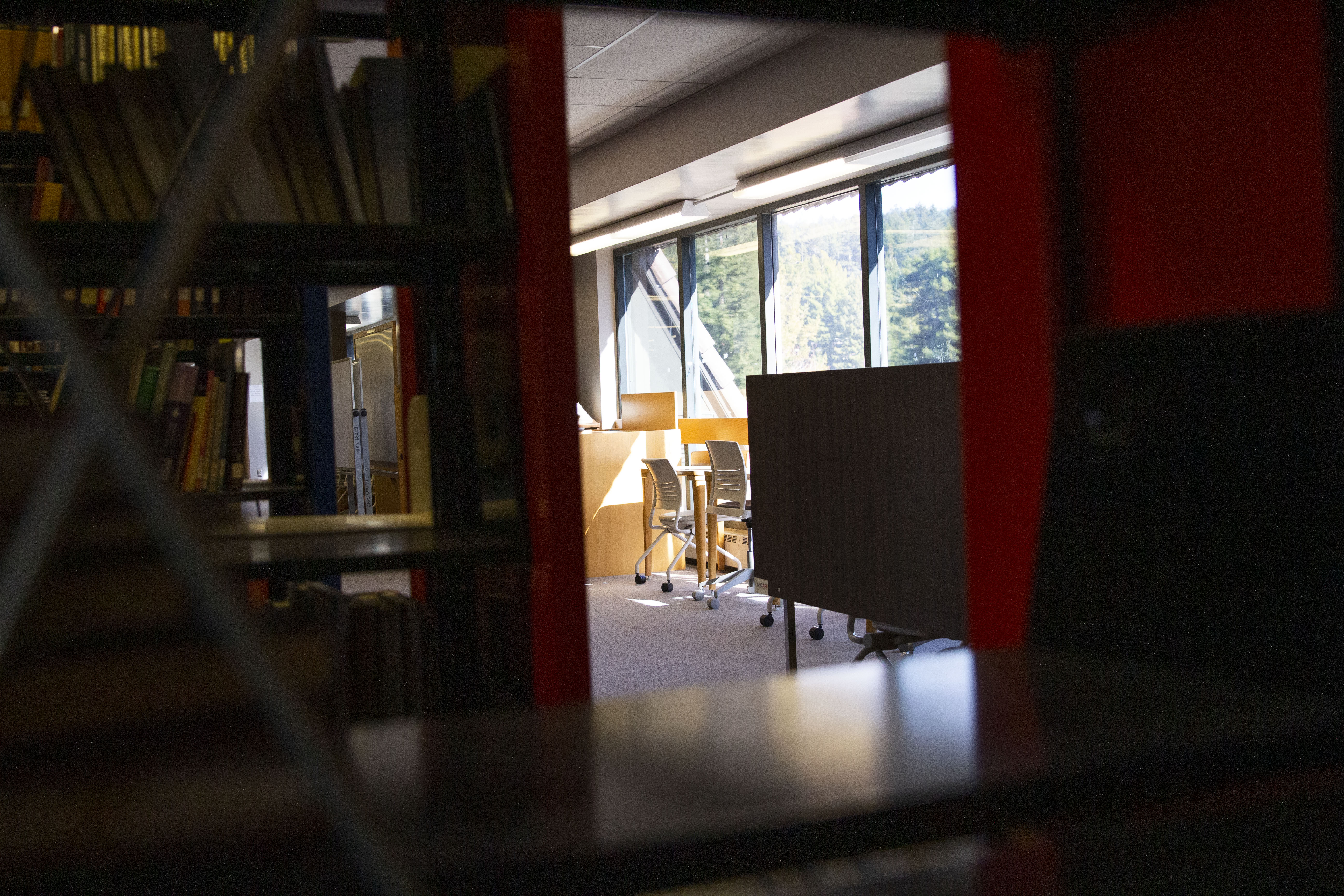
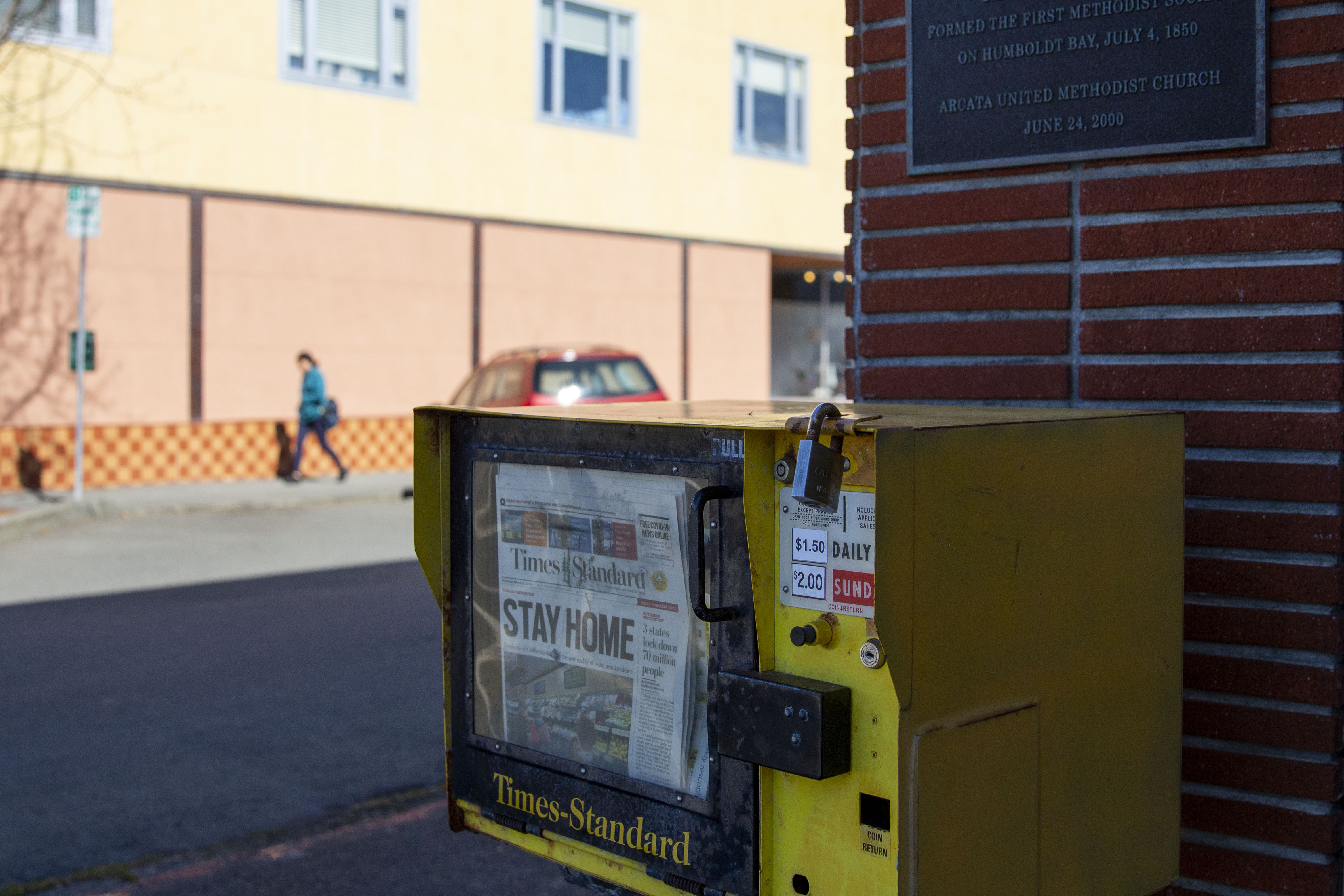
Photographer and Sports Editor Thomas Lal captured these scenes from around Arcata on March 21 at the end of spring break at the beginning of Humboldt County’s shelter in place order.
The storefronts on the Arcata Plaza look out on mostly empty streets.An employee sits at a computer while a sign advertises that the business is still open during the first week of a shelter in place order.The shelves in the Arcata Safeway.The Humboldt State Library.A lone person walks through the mostly empty parking lots at Humboldt State University.The Humboldt State Library.The Humboldt State Library.A single person works at the Humboldt State Library.A carton of eggs sits on the shelves at the Arcata Safeway.A lone person stands just off of the Arcata Plaza.An employee puts up a sign in the door of the Jitter Bean on the Arcata Plaza.
More Humboldt State students are electing to stick around, but there’s still work to be done
Corrections: a previous version of this story incorrectly quoted Casey Park as saying “We’re absent as an institution.” The quote should have said “We were absent as an institution.” The story also wrongly included “interim” in Jason Meriwether’s title.
Humboldt State revealed more students were staying on its campus rather than taking off for other schools or ventures in a Jan. 31 press release.
Tracy Smith, the director of the HSU Retention through Academic Mentoring Program, said she was proud of the work she and her peer mentors have accomplished over the years.
“I think Humboldt sincerely believes that whether students decide to stay at Humboldt or not is really a product of our entire campus community and off-campus community,” Smith said. “RAMP really is designed to support incoming students and them finding a place where they feel a connection.”
“85 percent of new first-year students said if they were given the option to choose a college again, they ‘probably’ or ‘definitely’ would attend HSU again.”
National Survey of Student Engagement, spring 2019
A study done in conjunction with HSU by the National Survey of Student Engagement in spring 2019 provided some data on student perceptions of HSU.
“85 percent of new first-year students said if they were given the option to choose a college again, they ‘probably’ or ‘definitely’ would attend HSU again,” the study said. “And 89 percent of first-year students said their overall experience was ‘good’ or ‘excellent’, compared to an overall CSU system rate of 84 percent.”
Jason Meriwether, Ph.D., vice president for Enrollment Management, said a few things have contributed to the increased retention rates, including Enrollment Management staff and related faculty streamlining the registration process and connecting students with support services—all in an attempt to create a sense of belonging for students.
“It’s the experience but it’s also the listening and packaging it into one,” Meriwether said. “So, all of that is about looking at the students and giving them what they’re asking for first, and using the resources that we have to create an experience for the student.”
Meriwether said his staff’s hard work has paid off by meeting student needs.
“We have to be aligned with what students are expressing that they need and putting ourselves in a position to support students,” Meriwether said.
“There wasn’t attention given to the most affected and traumatized students. And those are the students who went back to where we recruit from and said ‘Humboldt is not a place for me,’ and ‘Humboldt is not a place for you.’”
Casey Park, HSU alumna
He noted a growing trend at HSU of transfer students outnumbering first-time freshmen. HSU has needed to move around campus resources to accommodate the influx of transfer students.
“It’s about being nimble and seeing where the student population is going and meeting those needs,” Meriwether said.
Meriwether added that in recent months, the Student Disability Resource Center and cultural centers have received major face-lifts, which, in turn, have opened up more doors for students.
Casey Park, an HSU alumna, was glad for the rising number of retained students, but said the campus administration’s past actions around retention shouldn’t be ignored as a new wave of measures are enacted. Park is an Associated Students coordinator, but gave her perspective only as an alumna.
“We are still going to need to reconcile the years where we were neglectful of students,” Park said. “It’s going to take a lot of really good decisions to hold ourselves accountable for that and kind of be like, ‘We were absent as an institution.’”
Park said the HSU administration’s inaction regarding the Josiah Lawson case and other events affected previous student perceptions of HSU.
“There wasn’t attention given to the most affected and traumatized students,” Park said. “And those are the students who went back to where we recruit from and said ‘Humboldt is not a place for me,’ and ‘Humboldt is not a place for you.’”
I wasn’t prepared for the school year to end so abruptly
I’m no good at saying goodbye. Give me no time to prepare, and I think I’m even worse. Amidst the COVID-19 pandemic and the sudden end of the rest of my in-person senior year in college, I’ve had to say goodbye to several friends and colleagues with little warning.
This abrupt ending has thrown me off. I hate to whine, but I wasn’t ready to part ways with so many people. It takes time to reflect on others and consider what I want to say when I might never see them again.
No goodbye is easy, and no goodbye ever feels adequate. But it takes a while for the reality of a goodbye to settle in. The natural buildup of expectation over the course of the last semester of college, which Dan Chiasson wrote about for The New Yorker, helps to ease the transition between college life and post-college life.
Of course, not getting to say a proper goodbye is small potatoes compared to more serious issues people are facing right now, like losing jobs, homes or loved ones. Those things are awful, but they don’t make the little things suck any less.
Of course, not getting to say a proper goodbye is small potatoes compared to more serious issues people are facing right now, like losing jobs, homes or loved ones. Those things are awful, but they don’t make the little things suck any less.
In day-to-day life, it’s easy to let the specifics of what you appreciate about someone go unnoticed. Saying goodbye, for me, requires a bit of excavation into those little things. With some time, I can at least have a couple words to say. Even if what I say is inadequate, something is better than nothing. A couple words can signal a greater appreciation I might be trying to articulate.
In my most recent goodbyes, I’ve tried to give thanks to the person for whatever they’ve done that has made them worth a goodbye in the first place. I try to let them know what I think of them. Then I probably wish them luck. And finally, I might just say “bye,” which is too small a word to encompass all the emotion in a parting of ways.
There’s nothing wrong with any of that. It just hasn’t felt adequate. And it hasn’t helped that we’re supposed to be avoiding getting too close to anyone. Hugs or anything like them are off the table.
Maybe all I’m really getting at is that saying goodbye is one hell of a difficult task, and doing so right now almost feels cruel. Being a true digital age child, I browsed the internet for tips on saying goodbye and got some vague ideas and a suggestion to give the person a memento—which, again, doesn’t seem smart right now.
But no matter how much you prepare, goodbyes are always going to hurt.
If you’ve made it this far, congratulations, you get my cliché takeways: if you have the chance, make your goodbyes worthwhile. Take time. And if you don’t have to say goodbye to someone yet, treasure them, and let them know how much you appreciate them as a friend or colleague or whatever else.
You never know when the world might be struck by a pandemic and you have to say goodbye without warning. Be grateful and appreciative and let those that matter know it. Oh, and wash your hands and stay the hell home as much as possible.
Students react to in-person class cancellations due to global pandemic
As spring break arrived and the COVID-19 pandemic continued its tear across the globe, many Humboldt State University students wondered what to do as HSU canceled face-to-face instruction until at least April 17. Some students stuck around while others went home. The pandemic, directly or not, has affected all students.
“I feel like it’s a very serious outbreak and people need to take it seriously. I do think it’s getting blown out of proportion in some ways and people are panicking before they need to, but it’s just something I’m kind of trying to roll with, essentially.”
Ashley Bailey, molecular biology major
Ashley Bailey, a junior molecular biology major, planned to travel home. She admitted feeling stressed.
“I feel like it’s a very serious outbreak and people need to take it seriously,” Bailey said. “I do think it’s getting blown out of proportion in some ways and people are panicking before they need to, but it’s just something I’m kind of trying to roll with, essentially.”
Kiera Price, a junior journalism major, also said she would travel home. She thought both academic and national leaders should be more vigilant.
“I feel like instead of limiting social interaction, they should do more to prepare for it,” Price said. “Like, for example, the fact that there isn’t more of a stricter way to limit survivors from coming in.”
Price recognized there isn’t a lot to be done, but still expressed a longing for something more.
Tim Arceneaux, a senior English major, looked forward to staying in Humboldt. With a sigh, Arceneaux said he understood the measures taken by HSU.
“I think the precautions that the University is taking here and all around the country make sense, but at the same time, I find them to be really frustrating,” Arceneaux said. “I hope that this issue will bring the global community together and allow people to realize the importance of universal healthcare.”
Journalism major Kiera Price on March 13. | Photo by Gabe Kim
Film major Norbert Rodriguez on March 13. | Photo by Gabe Kim
English major Tim Arceneaux on March 13. | Photo by Gabe Kim
Arceneaux said there was one key thing HSU could do to mitigate the spread of the novel coronavirus.
“They could try to alert students more about the health resources on campus,” Arceneaux said. “Because I feel like at this point, it’s almost an inevitability that someone is going to contract the coronavirus, and I’m not sure exactly what health resources are going to be available to students that contract the disease.”
Norbert Rodriguez, a junior film major, had planned to travel to Southern California to visit family, but decided to stick around once the coronavirus broke out. He said he thought HSU took too long to respond to the pandemic compared to other universities.
“At the moment, there aren’t any test kits [in Humboldt], so there’s really no way of knowing that there are any confirmed cases,” Rodriguez said. “I feel like it should’ve been a bit more proactive.”
Editor’s note: St. Joseph and Redwood Memorial Hospitals have set up screening tents for patients with COVID-19 symptoms.
Classes will be taught in alternative modes starting March 26 to April 17.
The campus will remain open and all student services will be available.
Humboldt State University will suspend face-to-face instruction and move to alternative modes of instruction on March 26. This will follow the regularly scheduled Spring Break and an extended three-day faculty preparation and development period (March 23-25) during which instruction is canceled. Based on the parameters set forth by the CSU system, this suspension of face-to-face instruction is temporary and currently scheduled to remain in place through April 17.
The schedule and agendas for three days (March 23-25) of mandatory faculty preparation and development is forthcoming. Lecturer faculty will receive a stipend for participation.
The schedule and agendas for three days (March 23-25) of mandatory faculty preparation and development is forthcoming. Lecturer faculty will receive a stipend for participation.
Alternative modes of instruction will include use of Canvas, Zoom, and other instructional technologies. For more information on preparing to use alternative modes of instruction please see the Keep Teaching website.
Students: Please look for email and Canvas-based communications from your instructors about plans for individual courses. Please also see the FAQ page on the HSU COVID-19 web page: https://covid19.humboldt.edu/faqs for general information.
The decision is intended to mitigate spread of coronavirus (COVID-19), and is based on current guidelines from the CSU system, Office of the Governor, as well as local and state health officials. It was made following consultation and meetings of the academic department Chairs, Deans, Provost and Chair of the University Senate.
The decision was not made lightly. The goal of these changes is to minimize the need to gather in large groups or spend prolonged time in close proximity in spaces such as classrooms.
The University remains open. Residence halls, dining, student support services, health, counseling, disability services and other related offices remain fully available in support of all students. Students who need computers, Wi-Fi, or other technological support can continue to use the Library and computer lab spaces on campus. A social distancing policy is likely to be in place on campus following Spring Break. More information on HSU’s social distancing policy is forthcoming. All staff are expected to report to work. Student employees should return to their normal work as scheduled following Spring Break unless alternative arrangements are made with their supervisors.
There is currently no community spread of COVID-19 in Humboldt County. There have been no cases of COVID-19 on campus. Because information about the virus is changing rapidly, please check your humboldt.edu email and HSU’s COVID-19 websitefrequently during the break for announcements from HSU and California State University system.
Wash your hands frequently and avoid touching your face and eyes, nose, mouth.
Routinely clean your home, particularly high touch surfaces like doorknobs.
Consider limiting attendance at optional large gatherings because this is where colds, flu, and other respiratory viral infections are spread.
It’s important to remember to treat each other with care, respect, and empathy as the virus continues to disrupt daily life.
Please know that support and health and wellbeing services are available on campus. Students who would like to talk with a counselor can contact Counseling & Psychological Services in Student Health & Counseling at 707.826.3236 anytime. Staff or faculty seeking additional support may call the Employee Assistance Program at 707.443.7358.
Humboldt State University acknowledges its important role in the North Coast in bringing thought-leaders, visitors, artists, musicians, and entertainers to campus and the local community. In an effort to mitigate the possible spread of COVID-19, HSU continues to assess the impact of hosting large events on campus.
There is no one response that works for all events. HSU understands that each event is different.
HSU leadership, consistent with CSU guidelines and guidance from local health officials, continues to assess events and their relationship to HSU’s core mission. This ongoing assessment looks at event outcomes and whether postponement or other alternative modalities (such as virtual) can be used, participants’ ability to travel, participants’ relationship to high-risk areas or populations, local health standards, size of the event, fiscal and opportunity costs related to the event, and any other unique campus contexts that warrant consideration.
Subject to change, effective Saturday, March 14 until Friday, April 17 all on-campus large events (greater than 150 attendees) are suspended. Event planners will be asked to cancel, postpone, or use an alternative modality (virtual). Events after April 17 will continue to be assessed on a case-by-case basis, with additional information and campus decisions made as more information becomes available.
All HSU-sponsored athletic events are scheduled to continue. However, based on strong guidance from CCAA, events will now be “fan-less,” meaning there should be no fans at the events and only essential personnel are permitted for the event.
The campus continues to assess the most appropriate guidelines for smaller events, and will communicate new guidelines when available.
This is a difficult decision, but the University asks the community and event planners to support these efforts in trying to reduce the spread of COVID-19.
Please consider staying in Humboldt during Spring Break.
First-generation students must look outside family for support
Usually, students talk with parents, siblings or friends who have attended college in the past to gather information and paint a picture about college classes, professors and the overall college experience. For first-generation students like myself, that’s not an option.
Being a first-generation student means you are the first person in your family to go to college. Your family members have no prior knowledge about college, the application and selection process, or what’s going to happen in the months prior to attending.
First-generation students feel the pressure of learning to balance living on your own, being successful in college and working a job all at the same time. For Destiny Aguilera, a second-year theatre major, the help they needed was provided by a high school instructor.
College is a time of self discovery.
“My greatest struggle has definitely been finding myself,” Aguilera said. “College is a time for learning, experimenting and growing as a person. As a first-generation student, it is also a time to work multiple jobs and try to support oneself as best as possible, with as little help from family as they can provide.”
The pressure to be successful and independent to avoid burdening parents financially heightens the expectations of the college experience.
“Having that pressure of taking care of oneself added to the mix makes it difficult to take time to breathe and learn more about who I am and who I want to be,” Aguilera said. “That being said, it’s not impossible. Just within recent months I’ve been able to discover that I identify as nonbinary and use they/them pronouns. I have college and allies to thank for that.”
College is a time of self discovery.
Natyvidad Landeros, a third-year biology major, got help with applying to colleges through a high school class created to help students prepare for college.
“I took it junior and senior year,” Landeros said. “They helped me with the process of applying. If it wasn’t for them I don’t know if I would have got into college.”
Javier Hernandez, a political science major at HSU, also prioritized resources outside his family to pick the school that fit his needs.
“I joined these college programs which helped other first-generation students like me to guide me through the process,” Hernandez said. “To take me to other college campuses and learn about the recruitment process and all the details that I needed to know applying to colleges.”
College is a time of change and immense amount of pressure. This pre-college experience is only heightened for first-generation students who have to navigate blindly and on their own. High school classes or staff, friends and independent interests can be helpful guides.
Learning to forage for sustenance is a convenient and exciting way to spend a day. In Humboldt County you can find your next snack or meal on the coast or in the forest—if you know what to look for.
One easy item you can forage for is sea lettuce, an edible green algae scientifically known as Ulva lactuca. Sea lettuce looks similar to garden-grown lettuce, as it has ruffly, thin leaves that bunch together, forming a head.
This vibrant green algae is found along coastlines worldwide, typically in tidal zones on rocks and docks. Ollie Relfe, a British blogger and self-professed nutrition expert, says sea lettuce offers antioxidant qualities and is a great source of vitamins A, C and E, to name a few.
Sea lettuce thrives in areas with high levels of nutrients or pollutants, which makes harvesting for consumption depend on water quality. A bushel of sea lettuce from a remote beach is surely more pristine than a bushel harvested from the mouth of a boat harbor.
According to Capital Regional District, a Canadian governmental sustainability organization, sea lettuce is a valuable food source to numerous creatures. Grazing sea animals, including snails, amphipods and sea urchins, all rely on seaweeds like Ulva lactuca to provide nutrients. Too much sea lettuce can inhibit the growth of other seaweeds, especially when large, floating blooms block sunlight from reaching other oceanic plants below the surface.
As sea lettuce decomposes, it releases hydrogen sulfide, a chemical compound which smells like rotten eggs. The United States Occupational Safety and Health Administration says this toxic gas can be harmful to humans and animals alike, and can even be deadly in high amounts.
When foraging for anything, it’s important to take only as much as you need. Harvesting sea lettuce is no different. However, foraging for sea lettuce can help reduce its decomposition and subsequent toxic contamination.
It’s important to verify the safety of any body of water you plan on foraging in. You can do so by checking local biotoxin warnings. During hotter months, steer clear of consuming coastal collections due to potential red tide contamination.
You don’t need a fishing license to recreationally collect seaweed in California. The daily limit is 10 pounds of wet seaweed, and you must carry a scale with you to ensure you’re within regulation standards.
To collect sea lettuce, one needs a sharp knife and a bucket. Only harvest bushels that are large enough to leave some behind after collecting. Be sure to leave a good amount to ensure you don’t affect the holdfast of a sea lettuce head so the algae can grow back next time.
Before heading out to the coast to collect sea lettuce, check local regulations and make sure you aren’t harvesting on protected land.
Ask Evergreen is a weekly advice column by the students of the Lumberjack.
Each week we answer anonymous questions sent in by readers about anything and everything.
Dear Evergreen,
I’m about to graduate and I’m feeling lost. I love this area, but the job market is garbage. I feel if I stay up here I’ll be stagnant. Should I err on the side of caution or dream big?
Dear Cautious Collegian,
Congratulations on nearly completing your college career! With one hurdle out of the way you now have the task of facing the world head on, whether you like it or not. It’s normal to feel the pit of existential dread sink into you around this time in your young adult life. Remember you’re not alone, and we’re all kind of misguided.
You’re a step ahead of the rest by having this contemplation. It’s good to realize your options to sort out which path choice will bring you the most. Consider the monetary gain as well as the emotional gain you may receive from either decision. Remember, money isn’t happiness, but it does solve a lot of problems.
If you stay in the area you will definitely save yourself money on the cost of living. This area is also quite beneficial to some in terms of emotional wellbeing because of the vibrant environment we have here. If that’s the case for you, you should add another tick to the Humboldt side.
While staying in the Humboldt area could save you money, the job market is fairly bleak compared to the income you might get from a job in any city south of Mendocino County.
It doesn’t hurt to apply to jobs all over. Definitely go big with what you want to do. A high-paying position in a field that you genuinely enjoy isn’t something to pass up on, but these dream positions aren’t always plentiful, especially if you’re applying in competitive areas.
The Humboldt area isn’t all too competitive, depending on the career you’re pursuing. With that in mind, consider how you can upsell yourself in this area compared to another place. Your skills are more likely to standout in an area like this which can make it easier for you to fight for a higher wage, if a potential employer can afford it.
Whichever decision you make, follow your intuition and don’t be afraid to take a risk.
You’ve got this!
Sincerely,
Evergreen
If you have any questions you’d like to send in, email us at contactthejack@gmail.com. We won’t publish any names and you don’t need to use one.
Take it from a two-time Humboldt State University drop out: do not give up. One of the greatest disservices college will do for you is force you to choose a major at an age you’re not even positive what your dating preferences are yet. At an age when you’ve had under a quarter of a century of life experience and maybe two jobs, if any, having to choose a major that will dictate your career for the rest of your life is downright unfair.
So if you find yourself at the age of 21 or 22 still working through college courses, on your third major switch or not decalred, do not freak out.
“Education is a journey, not a race,” is an adage students should familiarize themselves with sooner than later.
Some will graduate high school, jump right into choosing an academic focus with no problems and move on in four to five years. They will achieve exactly what they expected, and this is perfectly okay. On the other end of the spectrum, it is perfectly okay to take six to eight years for students to find out what they excel at or are passionate about before finally achieving the grades that reflect that passion.
I had to fail out of HSU twice to land myself at Citrus College in Glendora with the blank slate I needed to discover what I was good at. I had tried choosing business administration as a major. I had switched to communications and, for multiple outlying and personal reasons, still found myself moving home to Southern California in 2013 as a declared failure.
Four years later, I am returning to HSU with two associate transfer degrees in communications and journalism and a passion. I have peers and colleagues who are way farther ahead on their academic journey than I am. But with my return, I bring recognition, expertise and a work ethic that took four extra years than the average student to develop. I am back, and I come with pride for the extra time and work I had to put in to get here at the ripe age of 26.
My advice to other students struggling to find their way is to ask for help, utilize school resources and above all, know when you may need to take a break and do some soul searching. When you’re ready, jump back into college and let your studies help you find your way.
Question: What do you think of Assembly Bill 19? Could it ever be implemented at a four-year university?
Trent Diederic, a senior majoring in Finance says AB 19 could get more people in college, but they would still struggle financially. Photo credit: Lora Neshovska
“It could be counterproductive. The people who are already on the fence about college would have to keep paying after that first year. At a four-year university, it would be very expensive. Housing and food would still be difficult to find.” – Trent Diedrich, 22, Finance, Senior
Senior Sarah Grover says it is pointless to make only the first year free. Students would still have expenses in the following years. Photo credit: Lora Neshovska
“If people can live closer to home and still have that ‘freshman experience,’ it could be good encouragement, but freshmen are the largest group to drop out. It makes no sense for just the first year to be free. After that, you still have to work to survive.” – Sarah Grover, 21, International Studies, Senior
A Business major, Zac Alfers says community college is definitely the less expensive route, so AB 19 would get more people in school. Photo credit: Lora Neshovska
“I wish I went to community college, it’s the less expensive route. Money puts people off about college. It would get more people in school. I can’t see it happening at four-year university though, they like their money too much.” – Zac Alfers, 23, Business, Senior
Stephanie Souter, HSU senior says having more education equality would better the country as a whole. Photo credit: Lora Neshovska
“Even if it was free, there is still a lot of hard work and dedication that goes into school. But then again, if more people were educated, that would bring up our entire country.” – Stephanie Souter, 21, Psychology, Junior
Assembly Member Miguel Santiago urged Governor Jerry Brown to sign a Assembly Bill 19 (AB 19) on Thursday, Sept. 27, in Los Angeles. AB 19 would give free tuition to community college students.
AB 19 would allow the California Community Colleges to waive fees for first-time students, and full-time community college students for one year. The bill would boost enrollment and graduation rates, expand access to financial aid and decrease student debt. Additionally, AB 19 would support California’s businesses by addressing the shortage of college-educated workers that are needed to sustain the workforce.
Francisco Rodriguez, Chancellor of the Los Angeles Community College District (LACCD), started the press conference saying they want to change the narrative of public education, an often misunderstood and forgotten branch of higher education.
“The two-year system of California Community Colleges and others around the country have received unprecedented attention because of the role that community colleges play to fuel the economic engine of this country and of California,” Rodriguez said.
According to Rodriguez, the LACCD serves some of the poorest students in the nation. 85 percent of LACCD students are non-white, and half of the students live at or near the poverty line.
“In Los Angeles, where we have a plethora of educational options, we have amongst the lowest rate of participation for adults in higher education,” Rodriguez said.
Rodriguez quoted a recent study from the Public Policy State of California report, “California needs 1.1 million [graduates] with bachelor’s degrees by 2030 to keep up with economic demand. More college graduates means very clearly, higher incomes better economic mobility, more tax revenue and less demand for social services.”
“The idea of tuition-free community college programs has been spreading across the nation,” Rodriguez said. “California is leading the nation with the idea of universal access to higher education.”
Santiago said education should not be a privilege for the few who can afford it, education is a right that should be free.
“When you leave our education system and you have the tools to compete in the 21st century, you shouldn’t have to be in debt for a decade or two, just because you got a quality education,” Santiago said.
Santiago said that the bill would not be a giveaway. It would be an investment in the students, and that students will benefit from being full-time students. Almost 12 community colleges have signed on to support the bill.
“California has the 6th largest economy in the world. There is no reason why we should not prepare the 21st-century workforce,” Santiago said. “When we’re already behind a million degrees that are much needed to get our economy moving forward and to get it stronger.”
TRiO is a federally funded outreach and student services program aimed to provide services for students with a disadvantaged background.
Upward Bound is one of eight national programs within TRiO. The program is designed for first-generation college students who exhibit the potential and interest to strive in college. As members of this program, students benefit from resources such as financial aid assistance and academic counseling.
Upward Bound has been serving the Humboldt and Trinity school districts since 1965. Within these counties, the program is affiliated with six local high schools: Hoopa Valley, Arcata, South Fork, Southern Trinity, Hayfork, and Trinity.
Arcata High senior, Tatyanna Keeling said Upward Bound has been particularly helpful with financial aid counseling, as well as deadline reminders and reinforcement.
This year, Upward Bound received a five-year $1.25 million extension grant. Each five-year renewal, new advancements are developed into the program to ensure quality improvement, as well as operational funding.
With the funding, Upward Bound began their new summer “Bridge Year” program. This feature strives to provide participating high school seniors with an immersive college experience.
Upward Bound Director at HSU, Jen Dyke said the summer is the best time to get students committed to following through with their college plans and there is no better way than to allow participants to become “real college students.”
For the duration of the five-week summer program, students live in the Cypress Residence Hall and get a head start on college courses, all provided by TRiO.
For the remainder of the school year, students have access to college and career counseling, as well as academic and financial tutoring. The program also organizes and engages students in local social and cultural events, as well as college campus touring.
Shayna McCullough, a 21-year-old senior majoring in Social Work is an alum from Upward Bound. She said Upward Bound instilled pride in her. As a first-generation student, she has found a lot of emotional support and inspiration in fellow colleagues who also participate in Upward Bound.
Upward Bound is just one of the three TRiO programs at HSU. Other federal-funded programs, including Talent Search and Student Support Services, which all aim to ease the transition of disadvantaged students from high school to college.
With the start of the new semester upon us, students like senior Environmental Science major Kelcey Hein, strive for continued success during their time here at HSU without any added stress.
“This year I want to enjoy the classes and appreciate what knowledge comes out of them without stressing out more than I have to,” said Hein.
One way she plans to stress less is through her study methods. According to Hein, she only uses a quality pen and notebook because it is more motivating for her to have clean and fluid notes that she knows she’ll review and refer back to later.
Quality notes are one tip HSU Alum Mary Osteen would give for student success, though that’s not the only one.
Osteen, who graduated in 2004 with a degree in Political Science, said that it’s important for students to get to know and build a relationship with their professors.
“Don’t remain a name on a paper, go the distance to build a relationship with each professor because education, to be deeply meaningful, is personal.” said Osteen.
A statement recent Psychology graduate Dezi Villagomez would agree with.
Villagomez said it truly pays off to go to your professor’s office hours, even though it may be a little terrifying.
Dezi Villagomez after graduation
“They are here to help you and your needs,” Villagomez said, “go to them for advice, homework questions, or even academic and career advice.”
Though professors aren’t the only resources on campus for students, Villagomez was one of many students who took use of the school libraries services.
The libraries services include research help, checking out books, using computers and printers, reserving a study room and different skills workshops among others.
It’s library resources like this that can help keep students focused on their classes and study sessions. Whether you are studying with a group or by yourself, our alums advise to not procrastinate, study a little everyday and not wait until Sunday.
Humboldt County has a reputation for accepting the widespread use of cannabis. While Humboldt State gives a stern warning to students that weed is not allowed in the dorms upon orientation, it is still present. One freshman smokes almost everyday and believes that one of the hardest parts of getting high discreetly is that weed can be very potent.
“Depending on your CA it can be pretty hard sometimes, the smell can give you away,” they said. “It depends on what you’re smoking. If its wax, it doesn’t necessarily smell as bad as if you are smoking actual bud.”
For this particular student, the fear of being caught has subsided since the beginning of the year.
“At first there was a nervousness, but then you realize that everyone smokes and everyone is used it so you’re not worried about being caught,” they said.
Being caught comes with severe punishment. The Humboldt State housing handbook outlines the potential outcomes of being caught while in possession or under the influence of any drug or controlled substance.
According to the housing handbook, “Outcomes may include educational administrative sanctions, a student’s removal from Housing, and referral to Student Affairs, and possible legal charges (including arrest and fines).”
These harsh penalties cause some people living in campus housing to not risk smoking in their rooms. One resident in campus apartments admits to smoking, but never in their room.
“I have never been caught,” they said. “I honestly never smoke in the dorms, always outside.”
These types of measures are necessary to not get caught with a very strict and observant CA.
They believe that the school does not care about students smoking.
“No [they don’t care] but, they are still a school, and have to function as such,” they said. “Smoking weed openly in dorms would discredit the school I believe.”
In Creekview, there is only one CA per building. One resident has only ever met their CA three times. To stop from being caught smoking in their dorm, the Creekview resident has their smoke detector covered and window open.
“It is very very easy to smoke in Creekview,” they said, “It is also very easy to hide, we don’t really have to do it, but we do it as a precaution.”
Marijuana is a known occurrence in Humboldt County and while the school preaches that it does not allow marijuana on campus, it is readily available and people smoke it openly in the dorms.
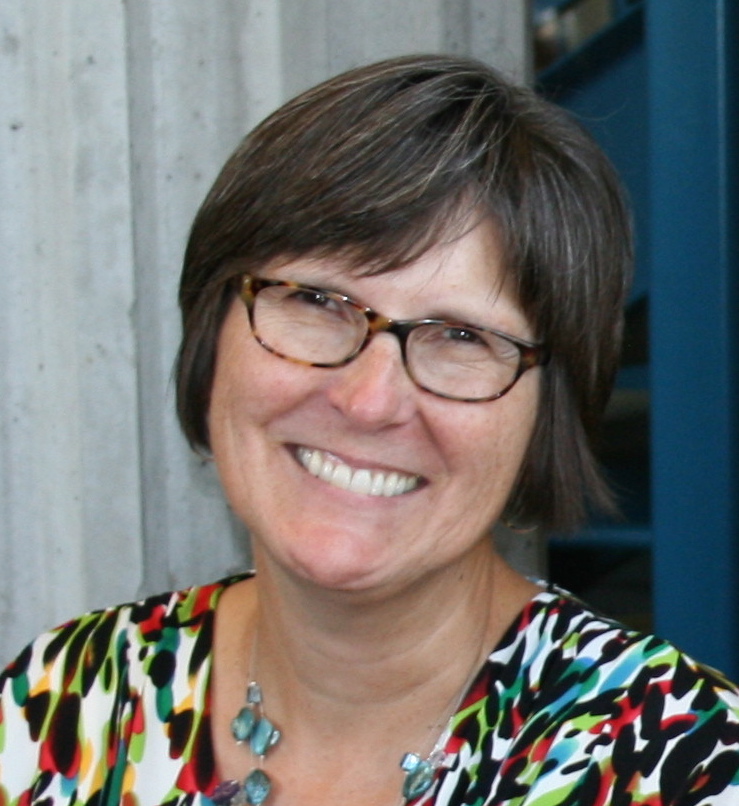
HSU will soon welcome its new dean of the College of the Arts, Humanities and Social Science, Lisa Bond-Maupin. Bond-Maupin is starting as the new position in July. She is coming from the University of Arkansas.
Q: Where are you from?
A: I grew up mostly on the coast of California and Baja California. We lived in Ensenada BC ( Baja California), Inglewood, Chula Vista, San Diego, Santa Cruz, and Ferndale, California. Much of that time we lived on a sailboat my father built. We sold the boat and moved to dry land when I was in high school. I attended Ferndale High School until my senior year when my parents bought a farm in Missouri and we moved to the Ozarks. I loved Humboldt County as a young person. And I still do.
Q: Where are you currently working now?
A: I became the Founding Dean of a brand new college of Social Sciences and Communication at the University of Arkansas Little Rock three years ago. I have had the privilege of working with students, staff, and faculty to build this college and establish a college identity and community. That is what I am doing now and until my last day here at the end of May.
Q: What made you interested in applying for the dean position at HSU?
A: Humboldt State University has had a clear and consistent identity and set of commitments as long as I can remember. I knew of HSU’s reputation for leading in environmental sustainability before it was something people were really talking about. I was aware of HSU’s commitment to social justice. I have always been intrigued by HSU’s uniqueness.
Q: What can you bring to HSU as the new dean of the College of the Arts, Humanities and Social Sciences?
A: I look forward to using my experience to support faculty in the achievement of their professional goals as I learn more about their passions. I know that HSU is different in significant ways and my knowledge will grow as I learn from my colleagues there. I am ready to partner to explore meaningful and sustainable approaches to growing programs and deploying resources at HSU. I am committed to student success.
Q: What are you looking forward to most?
A: I am looking forward to making new friends and being part of the community of scholars at Humboldt State University. I look forward to collaborating, celebrating, and laughing together. I look forward to contributing to a sustainable and strong future for our programs, college, and university.
Step One: Cook the rice. For this recipe to work you need day old rice. While you could go buy the rice from a chinese food restaraunt and leave it in your fridge overnight, it’s more fun to cook it yourself. Bring 2 ¼ cups water to a boil with some salt and pepper and olive oil. Once at a boil, pour in your rice, quickly stir, and then cover for 20 minutes. Once your rice is cooked let it cool then lay it out on a tray to dry out overnight.
Step Two: Cut everything. Before you can start cooking your are going to want to get everything cut and prepared. Take your onion and cut it into small half inch by half inch slices. They don’t have to be uniform but roughly the same size so they cook evenly. Then take your garlic cloves, crush them with the side of your knife, and then mince them until they’re in very small pieces. Open your can of spam and dice the spam into little cubes. You’re also going to want to crack your 4 eggs and beat them until they’re mostly yellow, as if you were making an omelet.
Step Three: Start cooking all the other things. Melt your butter down in a large pot on medium to low heat, once melted throw in your garlic, stir until browned, but not burnt. Then in the same pot throw in your chopped onion and stir it around. Once the onions are browned you’re going to throw in the spam and cook until every piece has a nice golden brown edge.
Step Four: Time for the rice. Dump in your rice that has been sitting overnight and mix everything together. Now take the soy sauce and start adding till you get a light brown color, constantly stirring so make sure every piece of rice gets coated. Add salt and pepper to taste, and if you think it needs more soy sauce, add it. Once done, you’re going to push everything to one side of the pot and put your beaten eggs on the side that is empty. Cook them just like scrambled eggs, constantly moving the eggs until golden and fluffy. Then mix it all together.
Step Five: Enjoy. You could be done here as it is, but the way I was originally taught to make it, would be to add one small mixed bag of peas and carrots and cover it until the peas and carrots thawed.
The 2018 Trump administration budget is an utter catastrophe for college students. If you thought a 5 percent tuition fee increase was worrisome, well, look out. The cuts to the Department of Education alone will have you rethinking the decision to attend college altogether. While the White House is holding up the promise to increase defense funding, the budget slashes programs that help college students. When you analyze the full impact of these cuts, things aren’t looking pretty for the low-income students. The budget slashes funds for the Federal Pell Grant, also known as FAFSA, by $3.9 billion. FASFA is the largest federal grant program according to the National Center for Education Statistics. The FAFSA program helps students and families making less than $40,000 a year. Because the FAFSA is a grant, students don’t have to repay the money or incur student loan debt. Students count on the FAFSA to not only help with educational costs but also for their livelihood. For some, the Pell grant can mean anything from affording school supplies or food, to housing. Without the aid of FAFSA low-income students aren’t left with many options to fund their education and seek a better life. If you were hoping to find help through the other programs within the educational system, unfortunately, the cuts don’t stop with FAFSA. In the Trump budget, the Department of Education stands to lose a total of $9 billion. The reductions concentrate on all of the programs intended to support low-income students. The budget eliminates the Federal Supplemental Educational Opportunity Grant Program – another federally funded grant programs meant to help low-income students. The budget also reduces funding for the Federal Work-Study Program allocation and various college scholarship programs for both STEM and humanities majors. These aren’t even the cuts that are going to cut funding to primary education. College students with children are most impacted by the proposed cuts to federally funded after-school programs. The cut eliminates $1.2 billion from the budget allotted to the 21st century Community Learning Centers program which is responsible for before-and-after school programs. On top of all of these cuts, the passing will mean that Secretary of Education Betsy DeVos will succeed in getting taxpayers to fund charter schools and private school vouchers. The budget adds a $168 million for charter schools and puts away $250 million for “new private school choice program.” If this Trump budget proposal is an initial outline for what could be, students and future generations should worry about the affordability of higher education. Without education, the low-income are left to rot in the bottom of the barrel. America was and is made great by the ability for those without money to become educated and seek the same life as those born into privilege. Taking away the only way many low-income students are able to attain education is paramount to erasing the American dream and replacing it with chains.
This website uses cookies to improve your experience. We'll assume you're ok with this, but you can opt-out if you wish. Cookie settingsACCEPT
Privacy & Cookies Policy
Privacy Overview
This website uses cookies to improve your experience while you navigate through the website. Out of these cookies, the cookies that are categorized as necessary are stored on your browser as they are essential for the working of basic functionalities of the website. We also use third-party cookies that help us analyze and understand how you use this website. These cookies will be stored in your browser only with your consent. You also have the option to opt-out of these cookies. But opting out of some of these cookies may have an effect on your browsing experience.
Necessary cookies are absolutely essential for the website to function properly. This category only includes cookies that ensures basic functionalities and security features of the website. These cookies do not store any personal information.
Any cookies that may not be particularly necessary for the website to function and is used specifically to collect user personal data via analytics, ads, other embedded contents are termed as non-necessary cookies. It is mandatory to procure user consent prior to running these cookies on your website.