Cast and crew of “Dreamers: Aquí y Allá” shed light on complexities of immigration
The story starts in the blue and red lights that bathe a replica-sized model of a wall. Not just any wall, but The Wall, the most southern one that separates country from country, family from family and the hopes of migrants for better opportunities and life.
In that obscurity, bodies shift and take steps until they’re center stage and in full view. They face you, you face them and under the spotlight, the stories of immigrants and Deferred Action for Childhood Arrival recipients begins.
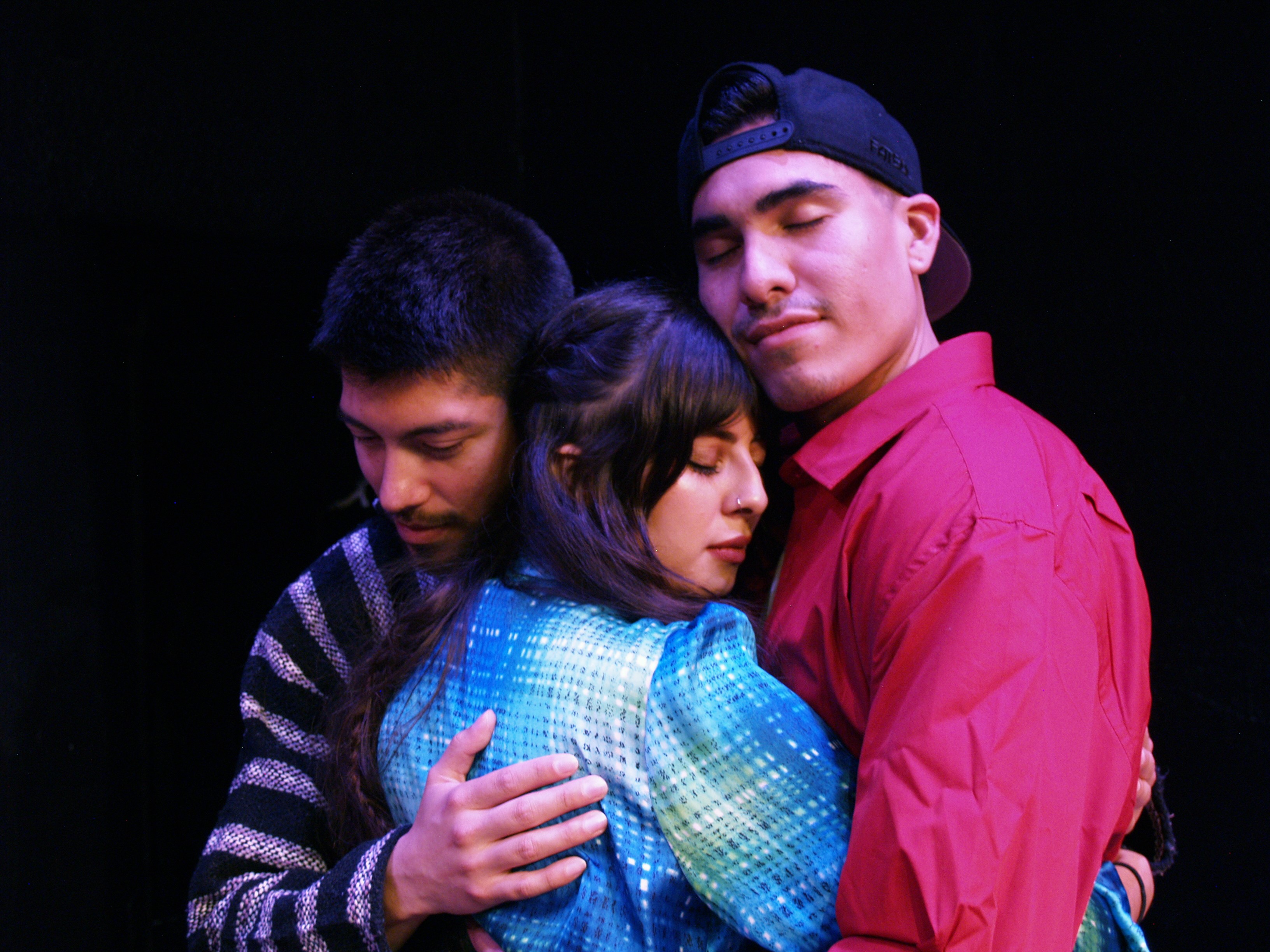
“Some of these scenes will break your heart because they show so much humanity,” Co-Director Andrea Carrillo said. “Humanity is such a great big theme within this story. You can’t help but connect and feel compassion for these individuals.”
The Humboldt State University Theater Arts, Film and Dance Department presents “Dreamers: Aquí y Allá.” The script was written by Andrea Caban, her students, and a collaboration from source material provided by Armando Vazquez-Ramos and the California-Mexican Studies Center.
Andrew “AJ” Hempstead, who plays Danny, Papa and Ximena’s dad, folds his arms across his chest during a scene of “Dreamers: Aquí y Allá” in Gist Hall Theater at Humboldt State University. | Photo by Jose Herrera
Actors on stage during the final dress rehearsal of “Dreamers: Aquí y Allá” in Gist Hall Theatre. | Photo by Jose Herrera
Students in the California-Mexico Dreamers Study Abroad Program, DACA recipients and immigrant community members gave testimonials and interviews for the script.
Troy Lescher, co-director and HSU associate professor, came upon the script in spring 2018 when Caban emailed the script to all 18 California State Universities in hopes they would produce the show.
“I was blown away by the humanity of the story,” Lescher said. “As soon as I read it I said to myself, ‘We have to do this show at HSU.’ I mean, because of our social justice mission, commitment to minority voices on stage, how timely this issue is and this play had HSU written all over it.”
The play follows the memories and lived experiences of immigrants and DACA recipients who then obtained advance parole, which gave them opportunity to travel to Mexico and reconnect with their culture and families.
Carrillo said that they go through time jumps and include the audience as they break the fourth wall in various scenes from start to finish.
Alejandro Torres as Francisco, Wendy Carranza as Ximena and Victor Parra as Mateo raise their fists. | Photo courtesy of Michael Thomas
However, circumstances prevented the play from happening until fall 2019. Lescher reached out to theater arts graduate students Carrillo and Amy Beltrán via email. They said that they were overjoyed about directing the play.
“For me the biggest thing was to evoke empathy within the community because a lot of the community, as well as in Humboldt County, can be either on the middle ground or can be very conservative,” Carillo said. “These are human beings with their own experiences, their own love, their own families, and that was a big thing for me to show that to them.”
But just as the directors were compelled to tell this story, so too were the actors.
Business marketing major and theater arts minor Victor Parra, who plays Mateo, said he knew it was important for him to get involved when he heard about the script.
“As an actor and artist this is the kind of stuff that catches my attention,” Parra said. “This is the kind of work that I want to do personally.”
Parra said it’s important to remember that the play is a cumulation of many stories, real stories, and that these are real people who struggle everyday. These were stories close to him because he experienced similar struggles back home.
“We have to keep working to give spaces for minority voices to be heard, especially voices that aren’t heard very often.”
Troy Lescher Co-director
“I brought a lot of personal past into this and it was my own decision,” Parra said. “Nobody asked it of me, but because I relate to this.”
Parra plays Mateo, who in the play fears being deported and leaving his child and mother behind. He said that is what happened to him when one of his parents was deported not too long ago, and he brought those feelings into the production.
“I envision my own family,” Parra said. “That’s what I just had to bring to the table because it’s so important. We need to say this. We need for our voices to be heard and something needs to happen.”
Lescher knew that he wanted to encourage and open the production to more students, so he reached out to El Centro Académico Cultural Coordinator Fernando Paz, Interim Executive Director of the Office of Diversity, Equity and Inclusion Edelmira Reynoso and Multicultural Center Coordinator Frank Herrera.
The result was that out of 11 cast members, six of them were non-theater majors and four of them performed for the first time.
“This story hits differently,” Carrillo said. “It resonates differently with people. It’s such an immediate connection with a lot of Latinx people and people of color. It made sense that we had so many new faces in the theater.”
Lescher said that the challenges DACA recipients struggle with is a big part of the conversation, because their voices are often unheard or aren’t highlighted in the news.
“We have to keep working to give spaces for minority voices to be heard, especially voices that aren’t heard very often,” Lescher said.
HSU administration cannot tell student media what to publish
Press at any capacity in the United States is protected by the First Amendment against federal censorship of speech. The government cannot make editorial decisions, retractions or content suggestions. Student press publications in California are protected not just by the First Amendment, but also by the California Student Free Expression Law of 1977, or California Education Code 48907.
When a government entity such as a state university interferes with the press by policing publications on what is appropriate to publish, it inhibits the independence of the press.
Recently, Humboldt State University administration sent out a school-wide email regarding material printed in a student parody newspaper, called The Dumberjack, found in an insert in the Nov. 20 issue of The Lumberjack.
The public announcement accused the students in the parody news class that produced The Dumberjack of reinforcing rape culture and gender-based discrimination through a photo that depicted a “sexist ‘riddle’” which was displayed on a sign in a window of an all-female room at the College Creek Apartments.
The school administration held The Dumberjack staff responsible for a joke on a sign they did not create nor stage. A student-journalist outside of the parody news class observed and documented campus culture with this photograph. The parody news class simply featured it in the paper and in no way amplified any perceived gender-based discrimination with the story that ran alongside the photo.
Parody facilitates the palatability of relevant information through comedy.
No one in The Dumberjack class or on The Lumberjack staff supports gender-based discrimination or wants to reinforce rape culture. But journalism, of any kind, is not public relations. The publication of a photo of a sign on campus does not represent endorsement of what the sign says. Journalism draws attention to troublesome realities by documenting them and showing them to the public. When a publication reveals a sign that a university finds offensive, the university’s focus ought to be on the sign, not on the journalists who documented it.
Administration officials invited the class to have a conversation to “discuss the impact and implications of the cover photo.” The meeting was intended to be an open dialogue surrounding the development of “critical lenses.”
Instead, on Thursday, Dec. 5, the class became the site of a direct act of administration intimidation.
Two school officials—only one of whom had been momentarily invited—came to the class and lectured journalism students on how to make editorial decisions. Chair of the Sexual Assault Prevention Committee Kim Berry and Dean of Students Eboni Turnbow, both of whom are government employees, reprimanded a class of students educated in journalism ethics.
The administration is demonstrating unprofessional behavior of questionable legality by attempting to contain this incident and filter what student press can and cannot print. The administration cannot tell student media what to publish.
Parody writers take real world situations and use a critical lens to highlight a topic in a juxtaposed way. These satirical pieces can sometimes be offensive, but the key is that the subject matter is still being discussed.
The goal of parody is to create a dialogue on topics that are either overshadowed or too controversial to be discussed openly. Parody facilitates the palatability of relevant information through comedy.
The First Amendment protects speech, including satire and parody. Satire and parody are used as impressionistic language that aim to create commentary on sensitive issues through the use of humor, absurdity and exaggeration. Utilizing these writing tactics serves as a more approachable way of tackling uncomfortable yet prominent issues.
Journalists aim to relay information in the most accurate and concise manner as possible. Censorship defeats that purpose. The government censoring the media is illegal and obstructs the transparency of journalism. It creates bias and subjectivity, as journalists become fearful of backlash for what they print.
When censorship appeases a specific group of people, it’s a domino effect. Censoring one thing for a single group leads to censoring all material to please everyone. That defeats the purpose of journalism as an independent eye intended to expose overlooked issues.
In today’s political climate, journalists are constantly under fire. The fourth estate, journalism, is as vital to uphold as the fifth estate, non-traditional media like parody news. When federal figures undermine the editorial freedom of a publication, even a parody news publication, a slippery slope follows in which government infringes upon the freedom of the press.
Mental health grant seeks to address adverse childhood experiences in Humboldt
A new $5 million grant from the U.S. Department of Education will be placing Masters of Social Work students at Humboldt State University in Eureka City Schools and Del Norte County schools as stipend workers.
“The grants themselves are funding positions at Eureka City Schools and also the Del Norte Unified School District,” Director of Field Education at HSU’s Department of Social Work Yvonne Doble said. “It’s actually a full time benefited position that’s being brought on at the school side to support our students.”
Announced Nov. 20, the funds will come from the U.S. Department of Education Mental Health Service Professional Development Program.
Nearly $1 million of the grant will be going to Humboldt State to help support the students and get them prepared for applying for the Pupil Personnel Services Credential, which is necessary for social work students to be hired by schools.
“A large portion of that is coming specifically for the stipends for the students,” Doble said. “We plan to offer a class for stipend recipients, where they will receive faculty guidance and support regarding school social work practice.”
The grant will be placing Masters of Social Work students at HSU in varying levels of schools throughout Del Norte and Humboldt Counties.
“It looks like we are going to have eight students this next fall, maybe more, and that will move up to 13 to 15 students by year four of the grant,” Doble said.
“Our region, for a number of reasons, has California’s highest ACEs rates in Humboldt and Del Norte County,” Jack Bareilles, the Northern Humboldt Union High School District grants administrator and an author of the grant, said. “You’re looking at approximately a third of all kids are being raised in families with four or more of the ten ACEs. So there is just a real need for that here, and I believe that’s one of the reasons we got funded.”
A graph taken from the HSU California Center for Rural Policy Sept. 2017 report on adverse childhood experiences.
ACEs can include things like alcohol and drug use or violence in the home, housing insecurity and food insecurity.
“Locally, there is a real need for support for students and support for families,” Bareilles said. “Social workers are uniquely qualified to provide, and that being said, we actually have a real shortage of social workers in the schools. It’s just something that we haven’t had before.”
Bareilles said the shortage comes from the lack of PPS credentials for students, and also because social workers, which are different from counselors and school psychiatrists, are mainly used in larger cities. Now, the PPS credential will be offered at HSU.
“Kids and schools and families will be helped, and when push comes to shove, that is the most important thing.”
Jack Bareilles
“The role of school social workers is to really help address social and emotional needs of our students,” Doble said. “It’s not just about academic counseling. It’s about providing resources to children and families. It’s about providing opportunities to developers, opportunities to repair harm that’s occurred.”
Bareilles said doing social work in school systems differs greatly from social work in other categories because the public schools operate under different processes than normal organizations.
“Having these interns work two days a week for a whole year working in a high school or middle school or elementary school, they will emerge from their MSW program with a real sense of, ‘Oh this is how schools work,’” Bareilles said. “So whether or not they are employed as a school social worker or some other child-serving social worker, they will really have a better ability of connecting the dots and getting kids what they need.”
Bareilles said the grant is a huge win for mental health support in Humboldt County and will help provide many troubled youths with the resources and personnel that they need.
“Kids and schools and families will be helped, and when push comes to shove, that is the most important thing,” Bareilles said.
The students behind the sign comparing Humboldt to genitalia discuss their curated material
Humboldt State University has been abuzz in the last few weeks with speculation about a photo of a joke written on a sign by women. This photo, taken by myself, was printed in a parody newspaper, The Dumberjack. The Dumberjack, while produced as parody of The Lumberjack, is created as part of a separate class.
The stated intention behind the sign was to poke fun at the Humboldt County climate by relating the rainy weather to female genitalia. Six girls, Caroline Voorhees, Marian Porter, Rashell Martell, Sabrina Ott, Shannon Coburn and Whitney Burns, live in a College Creek apartment together. The original creator of the sign was Caroline Voorhees, but all of the girls have their own take on the sign’s meaning.
Question: What are your feelings toward the sign?
Marian Porter: “I personally thought it was funny. There definitely were no negative intentions for the sign. Before Caroline puts out a new sign, we all give our consent to what is being represented to our dorm.”
“I guess I am sort of happy the school takes things seriously, but they should focus on other things because there are other things more important than a dorm sign.”
Rashell Martell
Caroline Voorhees: “I felt bad that I might have hurt someone’s feelings and hurt their day. Being the person who wrote the sign, I never would have thought about it as being non-consensual. I wouldn’t want to hurt someone’s feelings or make them feel like I was making light on their bad situation. That wasn’t what I was trying to do, I was trying to talk about sex culture and have fun.”
Whitney Burns: “I also think anyone can read anything and take it in a wrong way which shouldn’t stop people from making jokes.”
Rashell Martell: “I was actually the one to find out our sign was the one being talked about in the email and I mentioned it to everyone in our group chat. More or less I found it funny. Even though I didn’t make the sign, I gave consent for the sign to be put out. I guess I am sort of happy the school takes things seriously, but they should focus on other things because there are other things more important than a dorm sign.”
Shannon Coburn: “I didn’t think anything of it and I thought we had so many worse signs. I could see how you can take it that way if you wanted to, but it was weird that they focused their time on a sign and not things that are actually happening on campus.”
Sabrina Ott: “It seems like they blew things out of proportions and it doesn’t seem like something people are focusing so much on. I also felt really bad for the newspaper. We were more worried that the newspaper took fault for something we did.”
Question: Did you think the sign meant what HSU administration decided it meant?
Caroline Voorhees: “When you are in a frame of mind to read something negatively you will. Whoever misinterpreted my joke must have been having a bad day, or had a friend that had a bad encounter, and that wasn’t the purpose of the sign. I feel bad for those people who are going through something in their life in order for them to think that statement was negative, because it was a positive statement.”
Question: How did you personally come up with the joke?
Caroline Voorhees: “It started off as just a joke living in Humboldt where it is raining all the time, but the other part came about because I did a paper on sex positivity and culture about sex and how it is not talked about often. It is definitely shamed, for women especially. So I tried to incorporate that with the weather and being sex positive and how you should enjoy yourself before you have sex with someone and how everyone should be happy all the time.”
A message from the whole dorm: “We do take people’s opinions and complaints seriously and we are sorry that we hurt anyone’s feelings, but that is not going to change our sense of humor and we will try to be more mindful in the future.”
AS Administrative Vice President will take over for the spring semester
Associated Students President Yadira Cruz resigned during the AS Board of Directors meeting on Dec. 3, citing personal reasons.
“It was a difficult decision I had to make, but it was the best option academically and personally,” Cruz said a few days later.
Cruz, who fought back tears when interviewed, said the AS Board, composed entirely of Humboldt State students, offered her consolation despite some of them seeming shocked by the decision.
“They were super supportive. Some people teared up, and a few of them apologized, but I didn’t want them to apologize because politics is politics, and it’s challenging,” Cruz said. “They thought they weren’t there for me, but they were always there.”
The AS codes provide that the AS Administrative Vice President takes over if the president resigns. In this case, Lizbeth Cano, a sophomore business administration major, will take the reins for the rest of the school year.
“It’s going to be big shoes to fill in because I got to see how Yadira got everyone involved and was able to always get people to really get their opinion,” Cano said. “One thing I’ll take from her is to make sure to get the whole room involved.”
“I think I’ll always feel a little bit of guilt, because I knew this was a year-long position.”
Yadira Cruz
Cruz was announced as the 2019-2020 academic year AS president last April. A senior criminology and justice studies major, Cruz said she ran despite her lack of political experience to try to do something with her frustration about a lack of support for student needs.
While Cruz said she’s happy with her decision to resign and with her time as president, she acknowledged a feeling of guilt.
“I think I’ll always feel a little bit of guilt, because I knew this was a year-long position,” Cruz said.
As a takeaway message, Cruz urged fellow students to make sure to take care of themselves.
“The transition will help AS become stronger, I think, moving forward.”
Yadira Cruz
“A lot of these students are working and involved and there’s a lot of things that they carry,” Cruz said. “And I think I’m just speaking as first-gen, as a student of color attending here. There’s a lot of things just added to it all, to the whole balance for schedules. But I think my point is just to take care of themselves as well—to find time.”
Cano agreed and supported Cruz in her decision.
“I think it’s time she prioritized herself,” Cano said.
Both Cruz and Cano said they still hoped for more students to get involved on campus with AS or elsewhere.
“Definitely using all of our different hats and letting people know that this is important and this is something that really matters and that they can have a say in it without it being troubling or problematic,” Cano said. “Because I think a lot of people can think that it’s too much work.”
Cruz responded to the implication of her resignation on the image of an AS position being a lot of work by saying that how much people do in AS depends on the individual and their goals. Cano agreed and added on Cruz’s point.
“I think it also has to be kept in mind that the position that’s being resigned is the president position—meaning the top position,” Cano said. “So definitely getting involved as a representative or maybe as an executive like a VP—it can be a different flow. It can really be a learning process.”
As Cano transitions into the the presidential role, Cruz said she thinks AS can learn and grow following her departure.
“The transition will help AS become stronger, I think, moving forward,” Cruz said.
Logging sports club invites competition for an axe amount of fun
On Nov. 16, the Humboldt State Logging sports club held its annual Logtoberfest. This year they got to compete against schools including University of California, Berkeley, University of Nevada, Reno and Shasta College.
In previous years, Logtoberfest was more of a practice session for HSU logging sports. This year HSU decided to make their event an open invitational and welcomed other university logging sports teams.
Sounds of axes chopping and chainsaws revving echoed as those involved gathered around to show off their woodcutting skills. But the event was about more than just cutting wood. Logging athletes and their familiarity with each event provided entertainment while still ensuring safety.
Vice President of the club and HSU forestry major Sophia Ackerman was in her third year competing in Logtoberfest. She was happy to see the arrival of the traveling schools and the growth of her logging team.
“Our team has gotten bigger,” Ackerman said. “Logtoberfest in the past has been more like practice scrimmages against ourselves to get ready for competitions really early in the season.”
Ackerman spoke highly about one event in particular: the obstacle pole. This event required an individual to carry an active chainsaw up a tilted log and cut off a portion of it.
Another event called the horizontal chop involved a person positioning their feet on a log as they land multiple strikes until it breaks. Feet are exposed, but an important safety feature includes metallic footwear and chain-mail shin guards, so that in the event a contestant misses their intended target, no one is seriously injured.
“Because it is extremely dangerous, if you glance out you can chop your leg. You gotta be comfortable with chopping and really good with the axe.”
Jace Hunt
Ackerman participated in the horizontal chop event and wasted no time chopping the log against her Shasta College opponent. Upon completion, Ackerman sat and took a break as she watched and cheered on her opponent to finish strong. Sportsmanship among the logging athletes has allowed them to forma bond of endless support for each other.
Wildlife conservation major Jace Hunt competed in an event called the vertical chop, and after multiple swings from his axe, Hunt delivered a final blow to the log sending wood chips flying in every direction.
Despite constant sawdust and wood chips flying everywhere, maintaining an uninterrupted line of sight was a goal the athletes thrived for. However, there were some participants that saw the flying chips as a motivational obstacle.
Not only does swinging an axe demand physique but it demands discipline to assure that team members avoid inflicting bodily harm. Although this is Hunt’s second Logtoberfest, he did not compete in last year’s axe-wielding events.
“You have to be on the team for a full year before you can do the vertical chop,” Hunt said. “Because it is extremely dangerous, if you glance out you can chop your leg. You gotta be comfortable with chopping and really good with the axe.”
Students from various majors hone their argumentative skills
With winter break fast approaching and students preparing for finals, Humboldt State University’s debate team is pushing through with consistent practice sessions and preparing for scheduled competitions that start as soon as the spring semester begins.
Responding to a topic may seem like an easy task, but compiling synchronized responses with a teammate can be overwhelming, especially when the goal is to not contradict each others’ claims.
“Try publicly speaking about controversial issues, not knowing whether or not you will be speaking for or against your own values until 15 minutes before you have to do so.”
Kimberley Nguyen
Kimberley Nguyen, a philosophy major, is in her third semester with the debate team. She stresses over the challenging lack of preparation time before debates.
“Public speaking on its own is a difficult task,” Nguyen said. “Try publicly speaking about controversial issues, not knowing whether or not you will be speaking for or against your own values until 15 minutes before you have to do so.”
HSU’s debate team is currently practicing the British parliamentary debate method as they prepare for spring. This consists of team members pairing up, debating sides and creating counter arguments.
During one of their practice sessions, assistant coach Olivia Gainer presented the teams with the topic. The topic surrounded the opening monologue of “All the World’s a Stage” from William Shakespeare’s play, “As You Like It.” The four teams proceeded to exit the room to prepare and come back later with their responses.
“The team dynamic is definitely important and affects the way each round goes, it helps balance arguments off each other,” Gainer said. “Right now I’m looking at how well the team dynamic is and will give my input on their performance.”
Research and compiling a strong argument is a must. With evenings being the only time frame to practice their tactics, the debate team optimizes their time wisely to alleviate obstacles in later competitions.
HSU’s debate team is open to all and brands itself as a competitive sport. Exercising one’s mind to develop well constructed argument is as crucial as athletes utilizing their plays to put points on the scoreboard.
Theater Arts Department presents a production that transcends borders
The room is dark, the audience silent. On stage, right before your eyes, a story begins to unfold. Actors stride onto the set, and within seconds, they transport their audience into a world that deals with fears of family separation, job loss and deportation.
But that world is reality, as the actors break the fourth wall and address issues for immigrants and Deferred Action for Childhood Arrivals recipients.
“I read the script and I thought, ‘Wow, this needs to be told,’” Co-Director Andrea Carrillo said. “I know that there’s a good portion of undocumented people living in Humboldt County as well. It’s a great way to show the community that we see you, we hear you and we want to do what we can to share your experiences and your voices on stage.”
Humboldt State University’s Theater Arts Department will premiere a production of “Dreamers: Aquí y Allá” this weekend and next. The show features testimonials and interviews from students in the California-Mexico Dreamers Study Abroad Program, DACA recipients and community members.
“I’d say for people who have heard the story and don’t necessarily connect with the politics, I’d say, stay open minded about it. You never know what you might experience or learn. You might surprise yourself as an individual.”
Andrea Carrillo
The production is co-directed by theater art graduate students Amy Beltrán and Carrillo along with Assistant Professor Troy Lescher. “Aquí y Allá,” first produced at California State University, Long Beach, was written by Andrea Caban and presented as a collaboration between Caban, her students, material provided by Professor Armando Vazquez-Ramos and the California-Mexico Studies Center.
“This is a story that needs to be heard. You need to be here and sit with it and listen intently and openly as well,” Carrillo said. “I’d say for people who have heard the story and don’t necessarily connect with the politics, I’d say, stay open minded about it. You never know what you might experience or learn. You might surprise yourself as an individual.”
“Aquí y Allá” opens Dec. 6 in Gist Hall Theatre and continues Dec. 7, 12, 13 and 14 at 7:30 p.m. There will be a matinee at 2 p.m. on Dec. 15. Tickets are $10 for general admission and $8 for student and seniors. For tickets, visit the Center Arts website or call 707-826-3928.
After the show on Dec. 6, representatives from HSU’s Scholars Without Borders and Centro Del Pueblo will present on DACA initiatives. Following the shows from Dec. 12 through 14, Professor Vazques-Ramos will present a 30-minute lecture called “Dreamers 2020: What’s Next?” followed by a Q&A.
Georgetown study shows HSU graduates receive lowest pay over 40 years
Humboldt State University has the lowest earnings for graduates out of all 23 California State Universities, according to a recent Georgetown study.
The study said the average HSU student makes $752,000 within 40 years after graduating, which makes HSU the lowest earning CSU on the list. The average for other CSUs was around $1 million. For comparison, Chico State students reportedly made $1,018,000, while CSU Los Angeles students averaged $1,019,000.
The study measured the value of a college degree in net present value. According to the study, NPV is how much a sum of money in the future is valued today. According to Telegram.com, “this metric includes costs, future earnings and the length of time it would take to invest and earn a certain amount of money over a fixed horizon.”
“I believe it’s very important to think about the fact that the 30, 40, 50 years of a person’s working life are a lot more satisfying if it’s a job you enjoy and allows you to do the things you are passionate about.”
Alison Holmes
This fixed horizon is split into increments of 10, 15, 20, 30 and 40 years. This number is calculated by subtracting the amount of money a person can make at a minimum-wage job over that same time period, as well as taking into account student loans. This number contrasts against working a job that doesn’t require a degree. The result is the return on one’s investment.
Alison Holmes, associate professor in the Department of International Studies at HSU and a participant in the development of the career curriculum for the arts and humanities, believes the study isn’t taking enough into account.
“The frame of this research is clearly about size of income over the years after graduation,” Holmes said. “And while I would never say that is unimportant, I believe it’s very important to think about the fact that the 30, 40, 50 years of a person’s working life are a lot more satisfying if it’s a job you enjoy and allows you to do the things you are passionate about.”
Gina Kelble, an HSU freshman who sees herself going into environmental law, expects to make a decent living.
“I’ll probably end up going to [University of Colorado] Denver or CU Boulder for grad school,” Kelble said. “I have connections back at home through past internships, so those will be stronger than my Humboldt ones.”
Kelble is confident in her ability to get into grad school and dodge the bullet of making the average income of an HSU graduate.
“The study also makes the point that it’s about knowing yourself or, put another way and as I say to students, choices have consequences,” Holmes said. “There is nothing wrong with wanting money, if that’s lots and lots of money or just basic financial security. But you need to be clear that jobs have a pay scale. As a society we can work to get better pay for people, but for now, it is important to think about jobs with a very clear understanding of the pros and the cons of that choice.”
Holmes said that while money is a necessity, it stands among many others things that should be taken into account.
“As long as we send students into the world prepared to do what they want to do and always striving to fulfill their amazing potential, I am not going to spend too much time worrying about a study based on a scale based on the size of a paycheck,” Holmes said.
Dennis K. Walker Greenhouse provides a haven for a diversity of plant species
A sky full of grey clouds smothers the sun and with a chilling breeze even the most layered person shivers down to their toes. One step into the Dennis K. Walker Greenhouse transports you away from the cold into a world of warm, enticing, vivacious plants.
There are six rooms in the greenhouse: temperate, tropical, desert, fern, aquatic and the subtropical dome. Each room has an appropriate climate and a resident community of plants. Greenhouse manager Brianne Lee, along with student assistants Dabid Garcia and Courtney Harris, maintain the greenhouse at Humboldt State.
The entrance to the primary green room at Dennis K. Walker. | Photo by Deija Zavala
Leaves of a gum palm, otherwise known as a dioon spinulosm, in the subtropical dome. | Photo by Deija Zavala
Inside the Subtropical Dome at the Dennis K. Walker Greenhouse at Humboldt State University. | Photo by Deija Zavala
Anthurium scherzerianum, known as flaming flamingo, is generally native to Central America, but can be found in the Tropical Room at the greenhouse. | Photo by Deija Zavala
Spike Moss, selaginella biformis, in the Fern Room at the Dennis K. Walker Greenhouse. | Photo by Deija Zavala
Artocarpus heterophyllus, known commonly as jackfruit, in the Tropical Room. | Photo by Deija Zavala
“Essentially, the greenhouse is a living museum,” Harris said. “It’s something that we are trying to preserve here and not kill with love.”
The large botanical collection contains more than 1,000 species of plants belonging to 187 families. According to the Department of Biological Sciences website, students and faculty studying botany and biology use the greenhouse and its plant life to research and learn.
Harris, a botany major, said the greenhouse is a magical place, especially since there are only two student positions. After transfering from the College of the Redwoods in 2017 Harris was hired as an assistant.
“It feels like a unique experience being that this is such a cool staple and an important part of the botany program,” Harris said.
The job of a greenhouse assistant consists of maintaining the facility and its residents residents, which means sweeping the rooms, hand watering plants, managing pests and propagating plants.
“Essentially, the greenhouse is a living museum. It’s something that we are trying to preserve here and not kill with love.”
Courtney Harris
Garcia, a rangeland resource science major, said that there’s a lot of care and research that goes into the plants, but the goal is to make sure the plants are happy and thriving.
“Every species needs their own little formula of fertilizer,” Garcia said. “Some require more nitrogen than phosphorus and some others more potassium. We have to do our own research and sometimes that research isn’t available, so we’ll give the plant fertilizer and see how the plant reacts to it. A lot of our plants are really rare in the wild.”
The trio look out for signs indicating whether something might be wrong, such as droopy leaves and discoloration. The team also checks soil moisture levels, but all plants indicate issues to caretakers in unique ways.
Greenhouse Assistant Courtney Harris inspects a Bird of Paradise, strelitzia reginae, plant. Part of Harris’ job is to help plants pollinate. | Photo by Deija Zavala
Brooke Sharp, a child development major, explores the Fern Room at the Dennis K. Walker Greenhouse. | Photo by Deija Zavala
Inside the subtropical dome, flowers in bloom adorn many of the residents. | Photo by Deija Zavala
The Twin Spined Cactus, known scientifically as mammillaria geminispina, in the Desert Room. | Photo by Deija Zavala
Greenhouse assistants Dabid Garcia and Courtney Harris pose in the sub-tropical dome at the Dennis K. Walker Greenhouse. | Photo by Deija Zavala
“The biggest challenge is understanding how each plant reacts and responds to the care that we give it, and adjusting our behavior accordingly,” Harris said. “It requires a tremendous amount of teamwork and communication between us.”
Harris added that some plants don’t like attention while others, if left alone, will wilt and die.
Mihai Tomescu teaches plant morphology, plant anatomy, paleobotany and general botany. The trio’s work supports Tomescu in the botany department, as well as supporting the biological sciences. Faculty often use plant specimens during lectures and labs.
“Plants don’t move, and yet they are exposed to pretty much the same challenges that we are exposed to in terms of surviving. There’s all sorts of stressors. They have to procure their food and because of that, just like other types of organisms, have to have some type of behavior.”
Mihai Tomescu
Tomescu said his area of expertise and research is plant structure, including topics like how plants are put together, how they grow, how they look and how their features evolve over generations. Some of his methods include digging deep into geologic time.
“I know how they grow at the cellular level,” Tomescu said. “So coming from that perspective, I realized that one of the most fascinating things about plants that people don’t realize is that compared to us animals, and compared to what we think of in our culture about aliens, is that plants are more alien to us than the craziest aliens that human imagination has come up with.”
In his classes, Tomescu has his students visit the greenhouse three to four times a semester for assignments and brings live samples for labs when examining roots, leaves, stems, cells and other internal parts of plants.
“If you have a big botany program that emphasizes organismal biology, the diversity of plant groups and so on, then it makes sense to have something like this,” Tomescu said. “How else are you to teach your students about the diversity of plants if you can’t show it to them alive.”
Some people may question the general interest in plants because at the surface they seem not to do anything. But Tomescu said that if you are able to slow down and get pass the green blur of a forest of plants, you’ll come to find some interesting organisms.
“Plants don’t move, and yet they are exposed to pretty much the same challenges that we are exposed to in terms of surviving,” Tomescu said. “There’s all sorts of stressors. They have to procure their food and because of that, just like other types of organisms, have to have some type of behavior.”
Courtney Harris pets the cone of a dioon spinulosm in the subtropical dome. Harris was enthralled by the cone’s soft texture. | Photo by Deija Zavala
Some plants, like this one, keep pollen outside their flower ready to be blown off by wind gusts. | Photo by Deija Zavala
Because the Dennis K. Walker Greenhouse doesn’t have the aid of natural pollinators like birds and wind, assistants sometimes take pollen carefully from one plant to another. | Photo by Deija Zavala
Plant behavior is what a plant does, including how it grows. According to Tomescu, plants have control of their growth, from the depth of their roots to the direction of their leaves.
“The plant makes a lot of choices because growing in one direction or another means spending energy,” Tomescu said. “It’s very calculated — not consciously calculated– but basically plants sense their environment very well.”
In the broader sense, he said that plants make him think. Tomescu hopes more people will become interested in plants since they are so different compared to other life forms.
“It’s kind of exhilarating to realize that we live next to these super weird organisms,” Tomescu said. “It maintains this fascination that there are these organisms that do the business of living in a very different way from us.”
The Dennis K. Walker Greenhouse is available to instructors and students in the Department of Biological Sciences, and access is limited by the availability of instructors or greenhouse staff.
It is open to the public by appointment or when greenhouse staff are available. If you are interested in making an appointment contact Brianne Lee at 707-826-3678 or schedule a visit via email at bms561@humboldt.edu.
Supreme Court set to determine future of over 700,000 people
The Supreme Court of the United States heard oral arguments on Nov. 12 that will determine the future of more than 700,000 immigrants brought to the United States by their parents as children.
The Court’s decision isn’t expected until sometime next year, possibly as early January or as late as the summer. The majority decision will likely depend on Chief Justice John Roberts’ decision, as the remaining four liberal justices and four conservative justices are expected to vote in support of and in opposition to DACA, respectively.
Eighty minutes of oral arguments sustained a packed courtroom on the legality of the rescission of the Deferred Action for Childhood Arrivals policy. Three to four million immigrants that live in the United States arrived illegally as children. DACA protects about 700,000 of those immigrants from deportation and makes them eligible for work permits.
The DACA program, which requires that recipients renew their status every two years, is currently only accepting renewals, not new applications.
Seiri Aragon, a 27-year-old DACA recipient, advises first generation, low-income students for Academic Talent Search at Sonoma State University. Aragon, who was born in Oaxaca de Juárez, México and came to the United States in 1997 at age five, said in a phone interview that she has no choice but to pay close attention to the news surrounding DACA.
“It’s kind of hard not to pay attention,” Aragon said. “Because it’s a real, big part of my life, and so anything that could jeopardize my life here definitely should be of some importance to me.”
Seiri Aragon’s first grade school photo. After Aragon moved to the U.S., she began her first grade year in Petaluma, Calif.
Seiri Aragon, a 27-year-old DACA recipient moved to the United States at five-years-old. | Photo by Deija Zavala
Aragon went to high school in Petaluma before completing undergraduate programs at Santa Rosa Junior College and SSU. She then went to the University of Texas to complete a master’s program.
Aragon signed up for DACA when it first came to be in 2012. While Aragon has doubts about the logistics of how a mass deportation could take place in the event of DACA’s rescission, she acknowledges that individual DACA recipients could easily be targeted and deported.
“For a really long time I thought that because we were kids, we would be given a chance,” Aragon said. “But I feel like both Republicans and Democrats in government pretty much just use students like me, kids like me or folks like me as pawns in their political game. As soon as you realize that, you just get so discouraged that at some point you’re just like, ‘Well, if they want to throw me out, they’ll throw me out.’”
Solicitor General Noel Francisco argued in support of DACA’s rescission in the courtroom. Francisco said DACA “maintained in perpetuity a program that actively facilitated violations of the law by hundreds of thousands of individuals.”
“For a really long time I thought that because we were kids, we would be given a chance.”
Seiri Aragon
Francisco suggested that an executive action ordering the government not to enforce the law had questionable legality. Francisco also reminded the Court that DACA was never intended to be permanent.
“DACA was always meant to be a temporary stopgap measure that could be rescinded at any time, which is why it was only granted in two-year increments,” Francisco said. “So I don’t think anybody could have reasonably assumed that DACA was going to remain in effect in perpetuity.”
Francisco argued that a ruling on DACA’s actual legality would be unnecessary. Instead, Francisco believed that President Donald Trump’s attempted rescission of DACA in 2017 was legal and should be allowed to go forward—thus eliminating any need to rule on DACA itself.
Attorney Theodore Olson argued against the rescission of DACA. Olson said such an impactful rescission necessitated a review by the Court.
“The decision overturned a five-year enforcement policy of deferred action that had enabled DACA recipients under other unchallenged laws and regulations to apply for employment authorization, seek driver’s licenses and other benefits,” Olson said.
While Justice Neil Gorusch acknowledged what he called “sympathetic facts,” Gorsuch and Justice Brett Kavanaugh questioned Olson’s stance.
“What’s the legal limiting principle you’d have this Court adopt?” Gorsuch asked.
Olson returned to his initial point on the significance of DACA.
“All we’re saying is that it should be subject to review in the context of the big picture,” Olson said.
When asked if Olson believed that the executive had the power to rescind DACA, Olson said “yes.” Thus, Olson’s argument rested on doubts of the explanation behind the rescission.
President Barack Obama put DACA in place in 2012 as an executive action after Congress failed to pass the Development, Relief and Education for Alien Minors Act. The DREAM Act offered a path to citizenship for some immigrants brought to the United States as children.
With DACA, Obama intended to give Congress time to come up with permanent immigration legislation. No such legislation has come to fruition, and in 2017, President Donald Trump attempted to rescind DACA.
The Trump administration has called DACA illegal and unconstitutional, but lower courts have disagreed. In June, the Supreme Court agreed to hear the case to determine if the rescission of DACA was legal.
About 11 million total undocumented immigrants lived in the United States in 2017, according to the Pew Research Center, and about 100 undocumented students currently attend Humboldt State University, according to an August press release.
HSU released a statement Nov. 21 detailing its commitment to DACA and undocumented students. The release noted HSU’s resources available for undocumented students, including a clinic scheduled for Dec. 6 and 7 in which the Coalition for Humane Immigrant Rights will cover the DACA renewal fee for the first 20 renewals.
“We would like to firmly reassert our commitment to being an inclusive campus which provides access and support for all students, staff, and faculty members within our HSU community,” the release said.
The future for DACA recipients if the policy is rescinded is uncertain. The Department of Homeland Security website has a list of frequently asked questions regarding DACA’s rescission.
“Current law does not grant any legal status for the class of individuals who are current recipients of DACA,” the site says. “Recipients of DACA are currently unlawfully present in the U.S. with their removal deferred. When their period of deferred action expires or is terminated, their removal will no longer be deferred and they will no longer be eligible for lawful employment.”
The site says that once a DACA recipient’s status expires, their case will not be “proactively” provided to Immigrations and Customs Enforcement unless they receive a notice to appear in immigrations court. According to the site, this policy may change at any time without notice.
In an analysis conducted following Trump’s move to rescind DACA in 2017, the bipartisan political organization FWD.us estimated that removing DACA recipients from the workforce would cost $460 billion in gross domestic product over a decade.
When asked what she will do if DACA gets rescinded, Aragon paused.
“I don’t know,” Aragon said. “I really don’t know. I’m just looking out for allies at this point.”
Aragon said that while having DACA is a privilege compared to other undocumented immigrants, she, like Olson, pointed out that a large part of the program is providing basic citizen privileges like being able to file taxes or apply for driver’s licenses.
“The privilege is to bring equity to essentially what we are, which is American,” Aragon said.
For the next few months, DACA recipients across the United States, including Aragon, will await the word of the nine justices. Aragon said she hopes for DACA’s reinstatement, at the very least.
“I feel like I’m asking for crumbs,” Aragon said. “Because at this point, I’m so disappointed that I’m like, ‘Can you just, one, not take away the program, and two, maybe reopen it to people who qualify?’ That’s it, that’s all I want.”
It’s the most wonderful time of the year. For some, anyway.
Despite the enthusiastic spirit and excitement, the holiday season can be challenging for people to get through. For many folks during the holidays, the time and costs of traveling, balancing end of year responsibilities and potential conflicts with relatives all trigger a degree of stress, drama and anxiety.
The advertised illusion of the holidays as a joyful and easygoing time of the year discredit the holiday blues. Holiday stress ignites emotions completely opposite to for many people. The emotions are real and ought not to be ignored or made to seem unimportant.
The joy and ease of the holiday season may not match up with your personal feelings, and that can easily be seen as a betrayal of the holiday spirit.
Visiting places and people you rarely see, or attending parties and partaking in festivities can be overwhelming. The holiday season may be an extended break from school or even work, but it adds the responsibilities you generally don’t have the rest of the year. Many people are expected to be present and into holiday festivities with family, but sometimes it’s necessary to set up boundaries.
Remember what makes you happy. One example may be curling up in some blankets with a cup of hot chocolate and a good book. Whatever kind of downtime works for for you, take advantage of any time off to give yourself that much needed break.
Ben Zawilski
Telling yourself that holiday stress is uncommon or invalid isn’t helpful. Even though it is a season of generosity and giving, make sure to be generous and give yourself the time and care that you need. And set boundaries with loved ones if necessary.
The holiday season should be enjoyable for all, including you. Even even if the celebrations and responsibilities consume your time and energy, they shouldn’t interrupt your happiness and peace of mind.
Find the root to the chaos and what you can do to avoid or overcome it. If a family member is giving you grief, or a gathering takes up too much energy, ask yourself if you should be there. Pleasing everyone is not always the best move, especially if it is overwhelming or too much to handle.
Remember what makes you happy. One example may be curling up in some blankets with a cup of hot chocolate and a good book. Whatever kind of downtime works for for you, take advantage of any time off to give yourself that much needed break.
And remember, a visit to see friends and family doesn’t have to push your physical and mental health to the back burner. The holidays aren’t designed to bring anyone misery. We have the potential to make it both a time to celebrate with others and a time to take care of ourselves.
HSU cross country runner Daniel Tull places 56th out of 267 competitors at the Division II National Championships in Sacramento
Humboldt State’s Daniel Tull’s long hair, iconic mustache and yellow headband made him easily identifiable in the field of over 250 runners who descended on the Arcade Creek Cross Country Course in Sacramento, CA for the 2019 NCAA Division II Cross Country Championships.
Tull was the only Lumberjack to feature in the 10K race, having been granted an at-large berth the week before due to his individual results over the season. He ran a strong finish to his season, placing 56th out of 267 competitors.
In the early stages of the race, Tull ran in the midfield at a quick pace, rolling through the first mile in 4:45. For the next two miles, he worked his way up the field, picking up positions regularly as he made his way into the top 100 runners by the halfway point.
Humboldt State’s Daniel Tull starts the national Division II cross country meet towards the back of the pack while wearing his signature yellow headband. | Photo by Thomas Lal
Daniel Tull talks with Head Coach Jamey Harris at the NCAA Division II Cross Country Championship. | Photo by Thomas Lal
HSU senior Daniel Tull runs with his competitors during the opening stages of the NCAA Division II Cross Country Championship at Arcade Creek Cross Country Course in Sacramento on Nov. 23. | Photo by Thomas Lal
Teammates and family members who made the trip to Sacramento to cheer him on dashed around the course encouraging him throughout the race. As the pack eased into a rhythm, Tull averaged 4:56 per mile to cross the 5K mark at 15:21.
“The first mile was pretty fast,” Tull said. “I was just placed too far back. I went too relaxed in the beginning, and then in the middle I kind of settled down.”
After his difficult start, Tull began to make more moves, storming his way through the field with a little more than two kilometers left to go. From there, Tull said that he felt comfortable to push as he noticed the guys around him slowing down. In that last stretch, he passed 40 runners to surge into his finishing position of 56th, only 16 places outside of All-American honors.
“With a mile and a quarter to go, I was like ‘Oh, it’s only 2K, I’ll send it,’” Tull said. “‘I’ll just start passing people one at a time.’ Everybody else was slowing down or staying at the same pace, so I started picking it up.”
Head Coach Jamey Harris was pleased with how Tull ran through his hard start and made progress through the latter stages of the race.
“Obviously the race went out fast,” Harris said. “He went through a rough patch in the middle. But he really turned it on and passed about 50 guys in the last couple of miles, so I thought it was a really solid performance. I think on his best day he was capable of getting that All-American certificate, but I was really pleased with the way he raced and the way he kind of fought through the bad patch and finished strong.”
Humboldt State senior Daniel Tull works his way through a turn at the NCAA Division II Cross Country Championship in Sacramento on Nov. 23. | Photo by Thomas Lal
Daniel Tull reflects for a moment after placing 56th in his final collegiate cross country race at the NCAA Division II Cross Country Championship. | Photo by Thomas Lal
In addition to his teammates, Tull’s father, Mel, came to the race to cheer his son on. Mel Tull said that the first time he realized how serious his son was about running came during his second year of high school.
“I never really knew how into it he was,” Mel Tull said. “Then I went to a cross country meet and he came over the mountain and he was running third. And I realized well, he apparently knows what he’s doing.”
After the race, Daniel Tull reflected on how special it was to end his collegiate cross country career at the national meet.
“I’m glad I finally made it here,” Daniel Tull said. “It was a goal of mine for a long time. The race was pretty massive. It feels cool to be part of something like this. Most races are fun and I like them and it’s good energy, but this is different energy for sure.”
Martin Wong’s lost art reemerges to bring awareness to a new generation
Designer street style brand Supreme’s new collection highlights the life and art of Martin Wong.
Wong, who embodied creativity, empathy and empowerment, lost his battle against an AIDS diagnosis in August of 1999, but his artwork continues to inspire and act as socio-political commentary after his death.
Wong attended Humboldt State University in 1964, enrolling himself in every available art class before focusing his studies in ceramics. After graduating, Wong left the comfortable walls of university-life to influence the art scene and bring widespread awareness to minority groups often overshadowed by society.
Wong’s family, friends and supporters partnered together on a collaborative collection with Supreme showcasing Wong’s lost works.
“Tell My Troubles to the Eight Ball (Eureka)” 1978-81 | Courtesy of the Estate of Martin Wong and P·P·O·W, New York
Example from the Fall/Winter 2019 Supreme clothing line featuring Martin Wong’s work.
Example of the Fall/Winter 2019 Supreme clothing line featuring Martin Wong’s work.
Example of the Fall/Winter 2019 Supreme clothing line featuring Martin Wong’s work.
Anneliis Beadnell, Senior Director and Director of Estates at P.P.O.W Gallery, a contemporary art gallery in New York that represents Wong and his work, explains Wong’s appeal to Supreme.
“Over a year ago the artistKAWS, who is a good collector and friend of P.P.O.W, approached us to see if the Estate of Martin Wong would be interested in supporting a collaboration between Martin Wong’s work and Supreme,” Beadnell said. “The Estate was supportive, Martin’s circle of friends were encouraging and the collaboration felt right on many levels.”
The collaboration, as well as the overwhelming support towards the partnership of artist and brand, reinforces the importance of Wong’s legacy, advocacy and support represented through his artwork.
“Since Martin was interested in cultures that lived on the fringe of society, or outside the realm of the ‘art world,’ we felt that this collaboration would be successful in bringing his imagery into a new demographic.”
Anneliis Beadnell
“Through Supreme’s platform, a new generation who may not have had access to the works through visiting galleries or museums, will have a new way to enter into his work,” Beadnell said. “Since Martin was interested in cultures that lived on the fringe of society, or outside the realm of the ‘art world,’ we felt that this collaboration would be successful in bringing his imagery into a new demographic.”
Like most of Wong’s art, the graphics showcase political and sometimes controversial subjects. Elements of poverty, misfortune and ruin bring attention to the unfair and inhumane treatment of minority groups. Encapsulating inclusion and representation was Wong’s strong suit.
The ability to take those underrepresented into the spotlight ripples throughout his work. Idolizing the “unprofessional” and disrespected street artists allowed for new perspectives to emerge not only in Wong’s works, but in the art world in general.
“In his lifetime, Martin gathered one of the largest graffiti collections in the world,” Beadnell said. “Martin turned to his friendship with the graffiti [artists] for collaboration and inspiration in his own works, which often took them as the subjects of various paintings.”
According to Beadnell, Wong also created several paintings with skateboarders as the primary subjects, like “Sweet ‘Enuff,” a 1987 painting which is in the collection of the de Young Museum in San Francisco.
Capturing moments ignored by mainstream society gifted Wong the ability to cast a new light on the struggles and discrepancies in subcultures, raising widespread awareness in the art world.
“Big Heat” 1988. | Courtesy of the Estate of Martin Wong and P·P·O·W, New York
“Sharp Paints A Picture” 1997-98. | Courtesy of the Estate of Martin Wong and P·P·O·W, New York
Iglesia Pentacostal 1986. | Courtesy of the Estate of Martin Wong and P·P·O·W, New York
Amigos 19xx. | Courtesy of the Estate of Martin Wong and P·P·O·W, New York
“Malicious Mischief” 1997-98. | Courtesy of the Estate of Martin Wong and P·P·O·W, New York
This type of socio-political activism is still growing today, but there is a need for inclusion of identity and culture regardless of differences. Beadnell emphasized this and said the goal of the collaboration with Supreme was to reinforce those ideals with younger generations.
“Wanting to extend his demographic outside of the ‘art world’ speaks to wanting to continue his legacy of influence and inspiration as an artist,” Beadnell said. “There is a strong youth culture that follows Supreme and the collaboration with Martin’s work may open a door for those that purchase the items and want to learn about Martin Wong’s contribution to our visual history and culture.”
Wong’s work revolutionized the stigmas that dismissed groups from society, specifically focusing on the disadvantaged and underrepresented. From sexual orientation and economic standing to uncontrollable impairments, capturing the essence of groups often labeled insignificant or unworthy earned Wong his title of an activist and a visionary.
“Being that Martin was a gay Asian American, we hope this level of visibility will inspire others, that may have shared histories and identities, to look to Martin as a point of inspiration.”
Anneliis Beadnell
“Martin’s paintings connect to the denizens of the Loisaida, the crumbling tenement bricks and urban landscapes, the places where creative subculture thrived and since has been erased by gentrification,” Beadnell said. “The iconography that emerged through Martin’s depiction of the Lower East Side, of closed storefronts, firemen, ASL symbols, constellations and flaming eight balls became graphic points of interest for the line.”
The re-emergence of previously destroyed creative outlets allows the newer generation access to the extinguished memories and documentation of the past. The revamped accessibility stems with the hope of generating more activism for the future.
December 1 is World AIDS Day, recognizing and bringing awareness to the pandemic caused by HIV and mourning those who have died from the disease.
“Being that Martin was a gay Asian American, we hope this level of visibility will inspire others, that may have shared histories and identities, to look to Martin as a point of inspiration,” Beadnell said.
Students at HSU participated in the iNaturalist-sponsored Mycoblitz to contribute to the North American Mycoflora project
Humboldt State University’s Mycology Club is collecting samples of mushrooms and sending them to Purdue University for DNA testing.
In association with iNaturalist, the Humboldt Bay Mycological Society and the North American Mycoflora Project, the Mycology Club is helping a national team of scientists record the location and species of as many fungi as possible.
The North American Mycoflora Project will allow the scientific community to compile and use a huge amount of knowledge and data about the identity and location of macrofungi in the United States.
“The sheer quantity of data getting piled in will give [scientists] a better idea of where species grow in the world. Sometimes people find species in a place where they were thought to be gone thousands of years ago.”
Lucas Burton
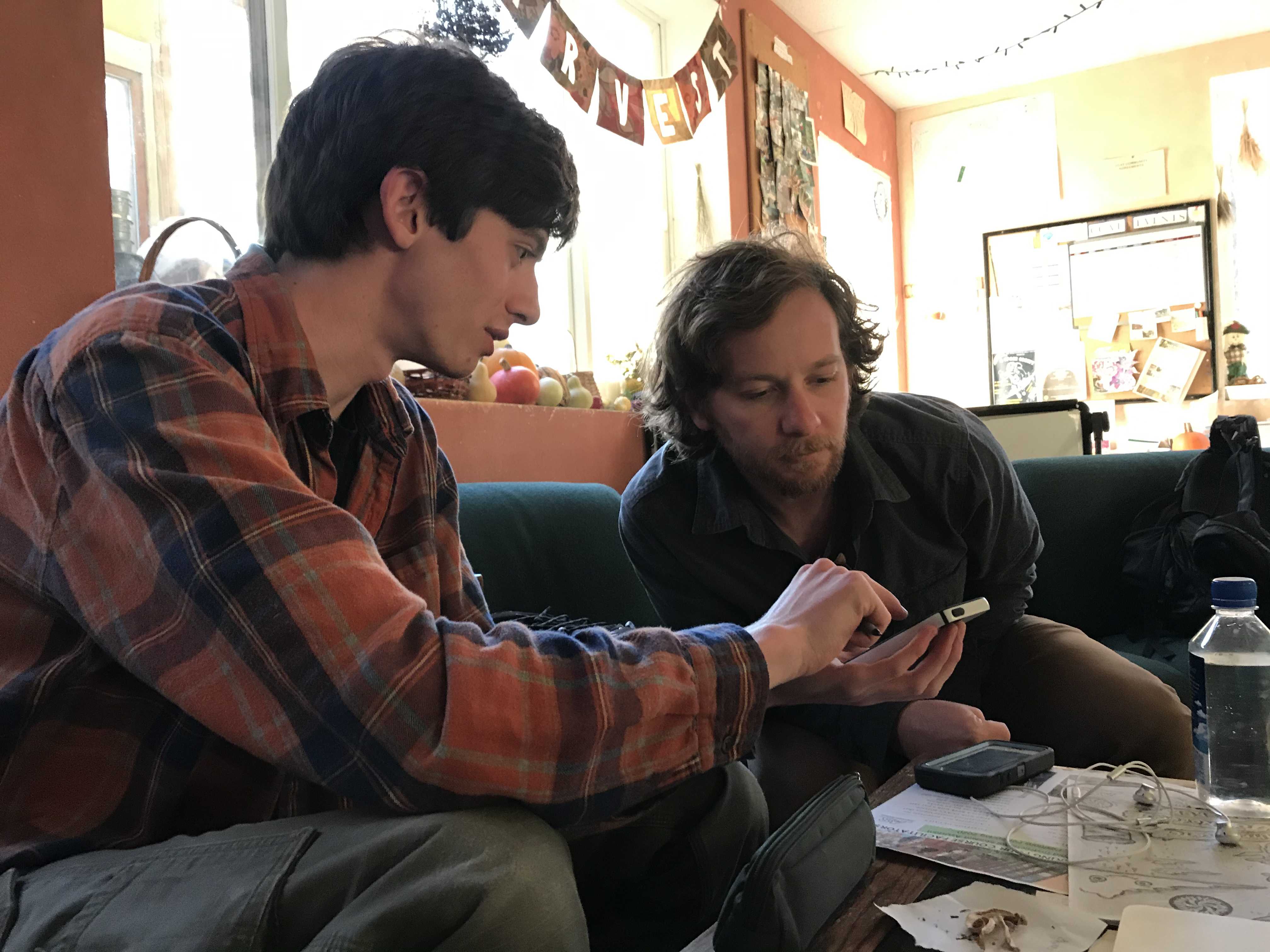
Mycology Club members Lucas Burton and Caleb Von Rossum spent a cold Monday afternoon documenting their mushroom samples in the bottom of the Campus Center for Appropriate Technologies. Burton and Von Rossum recorded their amateur identifications of the mushroom and the date and location where it was found on a little slip of paper that would travel with their specimen.
“We are using iNaturalist,” Burton said. “We upload a photo and GPS location, and people from all over the world can come together and help us positively ID it.”
iNaturalist is a popular tool for biologists and botanists who want to take advantage of citizen science for data collection. Von Rossum mentioned a lot of people in the club record their mushroom finds on iNaturalist, but Burton and Von Rossum were taking it to the next level by mailing in their samples.
“The sheer quantity of data getting piled in will give [scientists] a better idea of where species grow in the world,” Burton said. “Sometimes people find species in a place where they were thought to be gone thousands of years ago.”
Mycology Club President Austen Thibault worked with the Humboldt Bay Mycological Society to get the Mycology Club participating in the Mycoblitz, the official iNaturalist mushroom-recording event.
“Contributing to the Mycoblitz, you could easily be one of really just a few thousands of DNA specimens ever taken in the history of the globe. And for the rare specimens, your name will be saved with the specimen forevermore.”
Austen Thibault
The Mycoblitz was a national week long mushroom foraging event which challenged citizen scientists to record the location of as many mushrooms as they could. Participants rummaged through undergrowth for mushrooms and submitted pictures of their finds on iNaturalist. Locally, the Mycology Club was encouraged by the Humboldt Bay Mycological Society to participate.
The Mycological Society offered a thorough training on iNaturalist and mushroom identification to prepare participants for the Mycoblitz challenge. The data and specimens that were gathered will be sent to Purdue University for DNA testing so they can be incorporated into the North American Mycoflora Project.
“Contributing to the Mycoblitz, you could easily be one of really just a few thousands of DNA specimens ever taken in the history of the globe,” Thibault said. “And for the rare specimens, your name will be saved with the specimen forevermore.”
The Mycology Club meets every other Wednesday in the Campus Center for Appropriate Technologies at 5:00 p.m.
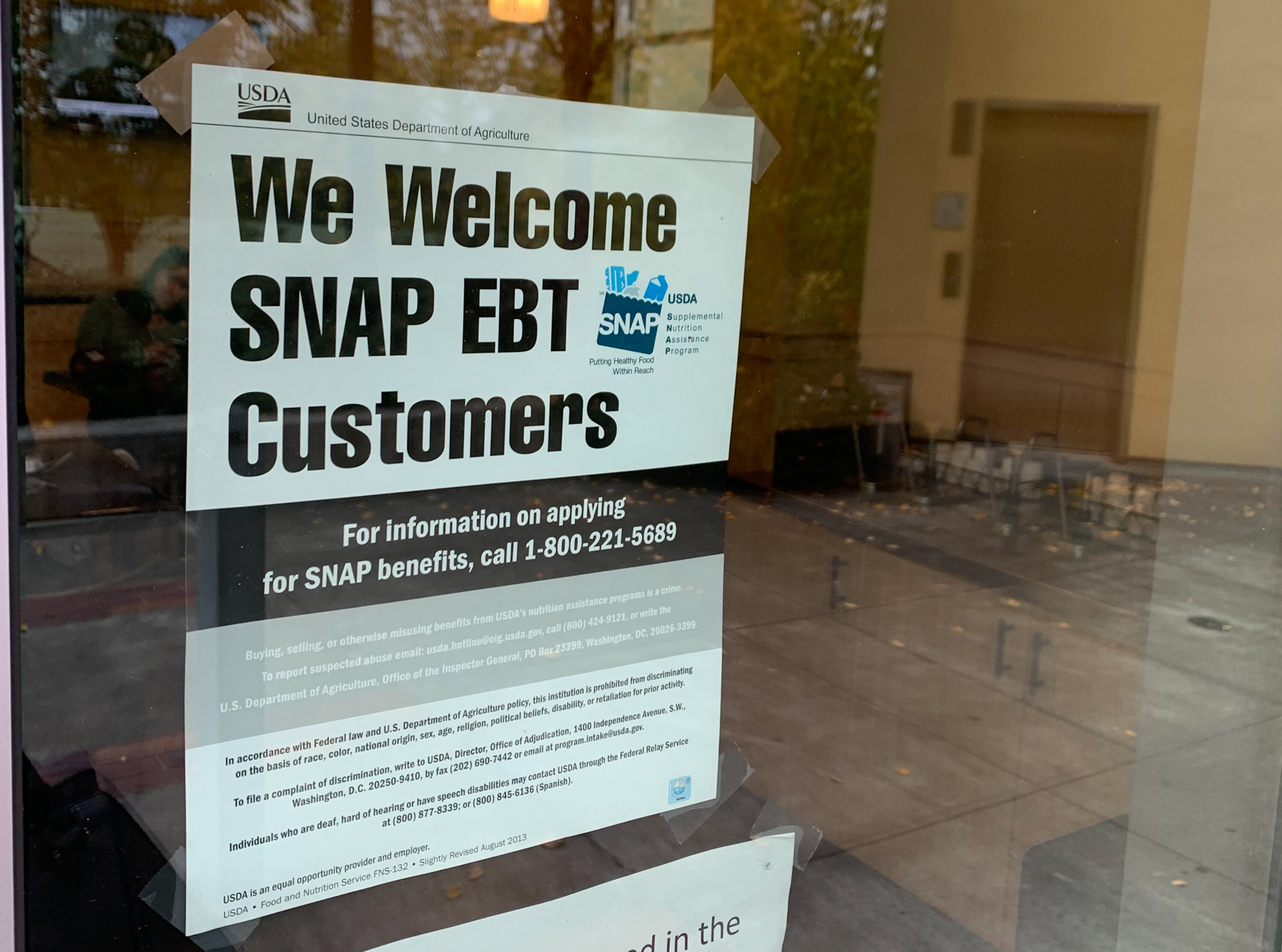
According to Iran Ortiz, a 5th year student and Oh SNAP! employee, options on campus are limited to where students can spend their food stamps.
“The only place on campus that accepts food stamps, or CalFresh benefits, is the Marketplace,” Ortiz said.
CalFresh, previously called food stamps and federally known as the Supplemental Nutrition Assistance Program, is a U.S. Department of Agriculture run program that provides eligible households with an EBT card that works like a debit card.
According to CalFresh’s website, EBT cards can be used at most grocery stores and farmers markets, but benefits are meant to be supplemental and not intended to meet a family’s entire food need.
The process to sign up for CalFresh can be tricky if doing it by yourself. But Oh SNAP! is student-driven with a mission is to increase HSU students access to food and they can help with the process of signing up for EBT.
“Although we are not eligibility workers, so we can not determine benefits or how much you get, we can help you out throughout the whole process of CalFresh. We’ve been trained by CalFresh workers to know the whole process and all of that.”
Iran Ortiz
Ortiz explains how her and other Oh SNAP! employees can help students sign up.
“The process for students is different because they abide by student eligibility requirements,” Ortiz said. “Although we are not eligibility workers, so we can not determine benefits or how much you get, we can help you out throughout the whole process of CalFresh. We’ve been trained by CalFresh workers to know the whole process and all of that.”
Sara Olsen is a third year with previous experience with Oh SNAP! who remembers some of the requirements of signing up for EBT benefits through Oh SNAP!
“The people who help, volunteer and work for Oh SNAP! are very helpful and will give you paperwork to fill out,” Olsen said. “Which they will then fax in office if you’re ready.”
Olsen explains that after submitted the paperwork, CalFresh will call and set up a phone interview. After deemed eligible for the program, an EBT card is sent in the mail.
Alexandre Sicaud is the manager of the College Creek Marketplace and doesn’t know the exact reasoning behind the Marketplace being the only place to accept EBT on campus.
“We used to only have one EBT scanner, then we upgraded to two,” said Sicaud. “But as for why we’re the only place on campus, it might have to do with the fact that we’re the largest grocery operation.”
CalFresh benefits are provided to help pay for groceries. In fact, hot foods can not be purchased with an EBT card in an effort to promote healthy and nutritious alternatives.
If you need help filling out CalFresh paperwork, head to the Oh SNAP! office located in the Recreation Wellness Center, room 122.
Only four students attended the first University Resources and Planning Committee’s public budget forum, according to Associated Students President Yadira Cruz.
Around 50 faculty, staff and community members were in attendance as well, according to Art Education Assistant Professor and URPC Co-Chair James Woglom.
Woglom said the URPC’s presentation, which can be found online at budget.humboldt.edu, focused on the URPC’s work toward creating a scalable budget model, or a budget that can be altered periodically to represent changing values.
“It ends up bringing more people into the process of decision-making, and thus hopefully reflecting more people’s feeling of what we want this organism to do,” Woglom said of the URPC’s new model.
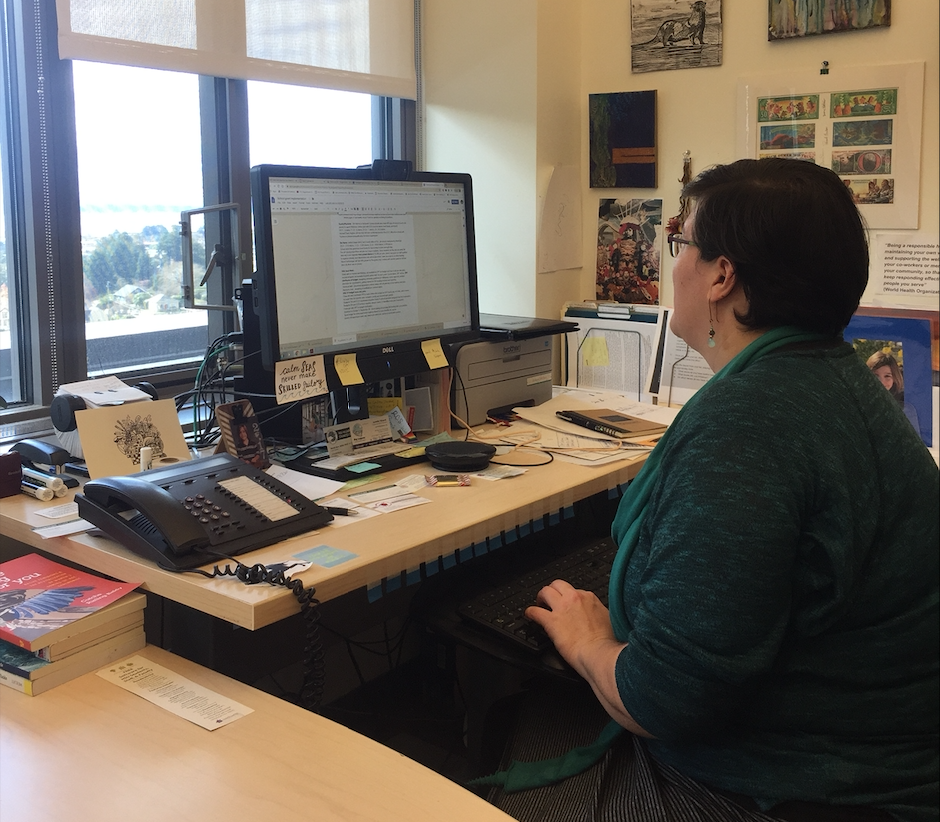
James Woglom, art education assistant professor and University Resources and Planning Committee co-chair, checking his laptop in the Humboldt State Univeristy library on Nov. 14. Woglom said the URPC has created a new scalable budget model that allows for more flexibilty and input from the HSU community. | Photo by James Wilde
URPC has been meeting over the course of the semester to form a three-year budget for Humboldt State. Woglom said the first step for deciding where to allocate funds is to clarify which values HSU should prioritize.
Besides the forum, the URPC is taking feedback online through an online submission form, a Google survey designed to scale which campus values are most important and a pie chart budget simulator that allows proposals of how HSU should divide funds. Woglom said he’d also be happy to take suggestions through direct emails.
While Cruz said she appreciated the existence of the online feedback forms, she said they can be obscure due to budgetary jargon.
“Although it’s available, it might not be accessible in that way,” Cruz said.
The Google survey, which is not yet released, lists a series of California State University values and asks the respondent to rate how much they agree with each one.
“It’s not saying that we want to devalue any of them, but it’s trying to get a quantitative sense of where the University’s priorities are in terms of allocation of resources based across a series of ideas,” Woglom said. “And then hopefully with that quantification we can make decisions based on where we can make things happen.”
The URPC’s current projections show a $5.4 million budget gap by the 2021-2022 school year, which reflects the impact of reduced tuition due to declining enrollment. According to the presentation, every 100 students generate about $560,000 in tuition.
The University Resources and Planning Committee pointed to declining tuition numbers as the cause of HSU’s current projected $5.4 million budget gap.
Joseph Reed, a political science and economics double major and a student representative on the URPC, said the key challenge has been ramping down the budget with the declining student body.
“It’s kind of been hard to keep this budget for about 8,000 students when we don’t have 8,000 students anymore,” Reed said.
Cruz said the budget should focus on the students HSU has now, and not the students it had in the past.
“Being in that cutting mindset is potentially jarring for morale. I mean, you’re coming from a space where you’re like, ‘Alright, what do we have to not do this year?’”
James Woglom
“I think every campus goes through these sorts of financial challenges, but I think how we move forward is centering students,” Cruz said.
Reed said the URPC has no plans to cut whole departments. Instead, Reed said cuts are more likely to be smaller and broader across the board.
“Every department is being affected, but each one has its own budget, so each one has its own certain amount that it’s being reduced by,” Reed said.
Over the past three years, URPC reduced the budget by $11.5 million. However, Woglom emphasized a difference between past and future cuts due to the new scalable budget model.
“[In the past] we’ve cut what we’ve determined to be at the fringe of the project of the University—so maybe not in direct agreement with the strategic plan of the University or the general values of the University,” Woglom said. “Being in that cutting mindset is potentially jarring for morale. I mean, you’re coming from a space where you’re like, ‘Alright, what do we have to not do this year?’”
The University Resources and Planning Committee showed three possible enrollment and budget scenarios in its Nov. 7 public forum presentation.
With the new model, Woglom said HSU can start with a specific budget number and then distribute it to the things HSU values most. Woglom said the budget can be continually changed, which allows HSU to scale back up or down if monetary realities change.
“We don’t want to make hurried and necessary decisions every year,” Woglom said.
The URPC uses Financial Information Reporting Management System codes, which are used in higher education to categorize expenses by their function, to compare HSU’s spending to other CSUs.
FIRMS codes break down HSU’s spending into five categories: instruction ($56.6 million in the current budget), institutional support ($21.6 million), operations and maintenance of plant ($16.3 million), academic support ($15.6 million) and student services ($12 million). Each of these categories represent a FIRMS program, and the budget determines what percent of the total amount of funding goes to each category.
Using these categories, the URPC also compares HSU’s spending to other CSUs. According to the presentation, spending at HSU in comparison to similar-sized campuses for the 2017-2018 school year was 17% higher at HSU for instruction, 24% higher for academic support, 3% higher for student services, 10% higher for institutional support and 1% higher for operations and maintenance of plant.
The presentation also showed three possible scenarios for the future of enrollment and its effects on the budget. The best case scenario, called the growth scenario, shows a leveling off of the enrollment decline and a budget gap in the $4 million range by the 2021-2022 school year.
The current scenario, upon which URPC’s projections are based, shows a continued decline that leads to the budget gap of $5.4 million. The worst-case scenario shows further decline and a budget gap of up to $7 million by the 2021-2022 school year.
The URPC’s current budget plans are based on the middle scenario of a $5.4 million gap.
Woglom said the URPC still has to figure out how to allocate its funding to keep current programs intact.
Budget projections from the University Resources and Planning Committee’s Nov. 7 public forum presentation show a $5.4 million budget gap by the 2021-2022 school year.
“It raises interesting questions about where you can move within that,” Woglom said.
Just one day after the URPC’s public forum, HSU released a campus announcement detailing the process for filling staff vacancies during the current enrollment decline and budget deficit. The announcement said that while current staff positions will not be eliminated, positions deemed “non-critical” by the vice president of the relevant division won’t be backfilled when a person leaves that position.
Woglom confirmed that announcement.
“The intention of the University at this point is to work to determine where attrition will happen and backfill positions in that manner,” Woglom said.
This backfiring process does not apply to faculty, according to the announcement.
The URPC’s next and final public forum is scheduled for Dec. 3 at 11:30 a.m. in the Goodwin Forum, during which the public can review the URPC’s draft plan before it is sent to the University president for review. Woglom urges everyone to give their input.
“Any ideas that people have that they’d like to share with us, the better our decision-making process can be,” Woglom said.
“I think [student input is] a challenge in itself,” Cruz said. “But I think that just because it’s challenging doesn’t mean it shouldn’t be pursued.”
Yadira Cruz
Reed and Cruz said they don’t think two public forums are enough to gather sufficient student input.
“I think overall we should be making a stronger effort to connect with students and get their overall opinions,” Reed said.
Reed suggested that the URPC should seek to get input not just from some students, but from the majority of students. Cruz agreed.
“I think that’s a challenge in itself,” Cruz said. “But I think that just because it’s challenging doesn’t mean it shouldn’t be pursued.”
Humboldt State Special Collections offers the opportunity for community members to preserve their history
On Saturday the HSU library played host to Humboldt History Digitization Day, an event that gave students, staff and community members the opportunity to take photographs and documents and save digital copies for free.
Digital copies are a great way to save backups of personal documents and photos from deterioration. The cost of a photo scanner can get into the hundreds of dollars, and not everyone has an understanding of photoshop and other programs that can be used to crop and edit the digital copies.
During this event, archivers were available to directly assist in the use of the scanner and photoshop courtesy of the libraries Special Collections division.
Special Collections Instruction Librarian Louis Knecht was available to assist the public in digitizing their documents, as well as share some insight on the impact of archiving Humboldt history.
Knecht saw the event as an opportunity to expand peoples’ digital literacy, as well as a way to archive history.
“If you have any kind of family photos, or documents, that aren’t in digital form, digitize them. That’s your family history, you don’t want to lose that, that’s precious stuff.”
Erin Sullivan
“HSU is a center of technology in what is a relatively rural environment that is Humboldt County,” said Knecht.
Erin Sullivan, an English professor at HSU, stopped by with a thick binder of her family history and was excited to start preserving the past. She had four generations of photographs, from Irish immigrants on her father’s side, to the pioneers on her mother’s side that were living on the plains.
“If you have any kind of family photos, or documents, that aren’t in digital form, digitize them,” Sullivan said. “That’s your family history, you don’t want to lose that, that’s precious stuff.”
She wasn’t afraid to learn the process, and was happy to share her appreciation of the assistance she was given.
“I have never used any fancy digital equipment,” said. Sullivan. “I scan things for teaching purposes, but not high quality scanning.”
Humboldt has benefitted from archiving history in the past, such as recording the protests of the Gasquet-Orleans road, whose inception began in the early 60s.
“I think it takes away HSU as just relevant to students, staff and faculty,” said Knecht. “It opens the door to more community engagement.”
The latest Public Safety Power Shutoff by Pacific Gas and Electric is not expected to hit Humboldt County, as of Tuesday afternoon.
PG&E announced Sunday it was monitoring the weather for a possible PSPS event beginning Wednesday, but it has not included Humboldt County in any of its expected shutoff zones. The latest press release on Tuesday said the PSPS will affect 16 counties across northern California. Six counties initially expected to be impacted were removed from their list.
PG&E said the PSPS is once again caused by high winds through dry areas, leading to a high risk of fire.
“Weather forecasts continue to be dynamic with significant variation across different portions of PG&E’s service area,” the Tuesday release said. “As an example, some parts of PG&E’s territory are under a Red Flag Warning issued by the National Weather Service, while other locations are subject to a Winter Storm Advisory.”
PG&E estimated the PSPS, which ranges from Mendocino to Butte to Sonoma Counties, will affect 181,000 customers. PG&E estimated that each customer account serves three residents, so the PSPS may affect over 540,000 residents.
PG&E said it expects the winds to subside by Thursday morning, and that it hopes to restore power to most customers by the end of Thursday.
“High winds are currently expected to subside Thursday mid-morning,” the Tuesday release said. “PG&E will then inspect the de-energized lines to ensure they were not damaged during the wind event. PG&E will safely restore power in stages as quickly as possible, with the goal of restoring most customers by end of day Thursday, based on the current weather conditions.”
Forage for free food locally while learning about your environment
If you’ve ever dreamed of living off the grid and growing your own food, foraging is the next best thing to fulfill that desire.
Foraging is a fun and rewarding way to immerse yourself in your local environment. Here in Humboldt County, there are plenty of opportunities for outdoor food morsel scouring. You can find dozens of wild plants that are both useful and edible, from anise, dandelions and yarrow to cattails.
If you know what you’re looking for, urban food foraging is quite simple. Some yards in Arcata have fruit trees that are tempting to take from, but be sure to ask for permission before picking.
If you don’t know where to start looking, you can use the Falling Fruit website or app. This site features a global map with geotagged locations of edible and useful items within your area. When you identify something new, you can mark it on the map to help others locate your foraging find.
If you want to look for wild herbs, fruits and vegetables beyond the cityscape, take a stroll to a park or the community forest and chances are you’ll find something forage-worthy, whether it’s morel mushrooms, blackberries or ginkgo.
If you aren’t well-versed in fungi identification, there are options in the wild for food finding beyond the typical mushroom hunting. It’s best to steer clear of gathering mushrooms unless you are with an expert or have definitive knowledge of a particular type you are searching for.
Foraging is a helpful way to inform yourself about natural food cycles. We often forget about the different produce seasons as grocery stores usually supply all types of seasonal produce year-round, but foraging for your own food helps you learn when produce is ready for harvesting.
Explore beyond the city streets and forested land for scrumptious surprises from the sea.
If you’re foraging for sea life, ensure you’re legally licensed to do so. You can forage for loads of coastal edibles like seaweed, snails and goose barnacles, but many items require a fishing license to take as well as prior knowledge of eligible sizes and harvesting limits.
Make sure to have the proper equipment for specific foraging needs. When coastal foraging, it’s necessary to have have measuring equipment for the sea life you’re searching for to verify your finds are within size regulations. Bring a bucket for your finds and a knife or prying tools like a spudger to scrape off treats like limpets or sea snails. Gloves and knee pads are useful, but not necessary as long as you’re cautious on slippery terrain.
Be aware of red tides and other contaminants that may affect coastal harvests. Humboldt and Mendocino County undergo an annual mussel quarantine form May 1 to Oct. 31 which prohibits mussel gathering to protect people from shellfish poisoning due to oceanic toxins. Avoid this concern by foraging for univalve organisms which don’t filter throughout their body and have singular shells, like periwinkles or black tegula snails.
Foraging for insects can also be an exciting addition to your food gathering excursions. There are hundreds of species of edible insects including crickets, weaver ants and silkworms.
Identifying edible insects can be tricky if you aren’t completely sure of what to search for. The most advisable way to consume insects would be through home cultivation of a species like mealworms or crickets.
Don’t ever consume something that you aren’t 100% sure is safe to eat, whether it’s a fungus, plant or creature. Be sure to know how to properly identify items before your search.
In addition, prepare foraged food properly. Make sure to wash findings thoroughly and cook it correctly so as to not have an upset stomach.
Remember, do not forage on private land, or at state and national parks. It’s illegal to take items including rocks, wood, berries and nuts from these parks as they’re protected by state and federal conservation regulations.
HSU opts for local scholarships over new residence hall
Humboldt State University originally had plans to build a new residence hall, but with enrollment declining, Vice President of Enrollment Management Jason Meriwether decided to invest in scholarships for students living on campus instead.
“With enrollment down, we are not in a position to build a new building anytime soon using the traditional path,” Meriwether said in an email. “So, instead of sitting on the money, I wanted to reinvest the funds in our students.”
Over the last five years, HSU housing has been saving to put a 10% down payment on a new residence hall, according to Meriwether.
Instead, Meriwether reallocated the savings to the $1,000 a year, four-year scholarships for all HSU students that live on campus, beginning fall 2020. Announced Nov. 3, the scholarship is one part of HSU’s plans to improve enrollment and retention.
In the last month, HSU has announced three different scholarships. Two of them will be funded by donors, while the housing scholarships will be funded with the housing reserves.
“Within the limits and scope of how we may use housing dollars, the best and most strategic and student-first option was to create these scholarships,” Meriwether said.
This is an update for our article “Road to Recruitment and Retention.” For the original story, click here.
A panel at Humboldt State University’s Sustainable Speakers Series weigh the pros and cons of the Humboldt Wind Energy Project
As the global concern to act against climate change increases, Humboldt County is in a position to capitalize on an opportunity to establish a significant renewable resource.
On Thursday, the Humboldt County Planning Commission votes on the wind energy farm developed by Terra-Gen. Terra-Gen, a Manhattan-based energy company, has proposed a wind farm to be built near Bear River, on Monument Ridge, above the city of Scotia.
The Terra-Gen wind farm carries controversy for numerous reasons. The project will help achieve carbon emission-reduction goals and provide two million dollars in annual tax revenue for the county, but will impact wildlife, forest ecosystems and the Wiyot prayer site Tsakiyuwit.
Arne Jacobson, director for Shatz Energy Research Center, said the proposed turbines will produce about 100 times less CO2 than burning fossil fuels.
“From a climate change perspective, wind looks pretty good,” Jacobson said. “Whatever perspective we have on this particular project, I think one question we should be asking ourselves is what we want to do with that opportunity, because I think it’s there and I think we have the local ethic and the local talent to make that happen.”
Lori Biondini, director of Redwood Coast Energy Authority, said the Terra-Gen wind project could be part of a solution to address RCEA’s goal of 100% renewable electricity in Humboldt County by 2025.
“The Terra-Gen project is part of one scenario to reach our goals,” Biondini. “If it doesn’t get built, then we will come up with another scenario.”
RCEA administers the community choice energy program, a program which allows communities to decide where their electricity comes from. It prioritizes local energy generation and generally more clean energy.
“I think that one of the promises of community choice energy is that we get to make choices that are good to our entire community.” Biondini said. “Not further marginalize those that might not otherwise have had a seat at the table.”
A crowd waits for Sustainable Speakers panel to begin. | Photo by Michael Weber
Adam Canter, a botanist and representative of the Wiyot tribal council, defended the preservation of the land and disapproved of the Terra-Gen project. Canter cites ethnobotanical resources and culturally significant sites as reasons not to move forward with this project.
“When we first heard about this project, there was this big pit that just kind of fell into our stomachs,” Canter said. “We thought when Shell came 10 years ago that no other company would come back and try to build a project here. But we were wrong.”
Canter pointed out the cultural resource report for the site bound in a green, four-inch binder.
“The representation of cultural diversity on this ridge is pretty magnificent,” Canter said. “We’re seeing evidence of Athabaskan peoples and the Wiyot-Algonquin peoples and really it should be listed on the National Register of Historic Places.”
According to Canter, the area is also a high prayer site; a place where a large expanse of Wiyot ancestral territory is visible. Like the turbines obscuring the view, the Wiyot cultural heritage could be obscured too.
Tom Wheeler, director for the Environmental Protection Information Center, said the proposed site is a questionable area to build a wind farm.
“The representation of cultural diversity on this ridge is pretty magnificent. We’re seeing evidence of Athabaskan peoples and the Wiyot-Algonquin peoples and really it should be listed on the National Register of Historic Places.”
Adam Canter
According to guidelines set by the California Energy Commission and the California Department of Fish and Wildlife, the proposed site is “pristine.” Wheeler said the site has several rare and endangered species, including the rare Horay bat.
Wheeler is still hopeful to keep the project, and said there is technology that can reduce some of the wildlife impacts. This, however, is only one mitigation measure to the several unavoidable cultural, environmental and wildlife impacts of the project.
“I want this to be a better project and it’s not there,” Wheeler said. “At least not yet.”
On Thursday, the final vote by Humboldt County’s Planning Commission will weigh impacts to Native American culture and environmental quality to the people’s interest in local, reliable energy.
Aside from the benefit of reducing carbon emissions, allowing Terra-Gen to build the wind farm also comes with an economic and infrastructure benefit.
Senior Director in Wind Development for Terra-Gen Nathan Vajdos said the company would be the second-largest taxpayer in the county, and could fund $14 million to Humboldt’s reliability network upgrades, with $1.3 million to the Humboldt substation.
“As we charge our iPhones, we fill up our cars with gas, we’re having impacts.” Vajdos said. “Whether this project is built or not, we are having an impact in this room.”
Officer John Packer recounts racist remarks from UPD Chief Donn Peterson
In August, nine of 10 University Police Department officers made votes of “no confidence” in Chief Donn Peterson. Now, UPD Sergeant John Packer has released a statement detailing some of the racist remarks made by Peterson to Packer.
In one instance, Packer was in an evaluation meeting with Peterson and UPD Lieutenant Melissa Hanson. Hanson told Packer that she and him weren’t friends and never would be. Packer didn’t know what that had to do with the evaluation, but he agreed.
Then Peterson escalated the situation, according to Packer.
“It went right from the first statement of me saying ‘I agree’ to him saying, ‘You know, John, you’re obligated to work as a slave unto his master,’” Packer said. “’And I’m like, in my head, ‘What the heck?’”
Packer said the next morning, Peterson made another comment to him while walking in the hallway.
“He says to me, ‘Hey John, I can say that because we both read the Bible,’” Packer said. “And now I’m speechless. So now you’re justifying what you said last night?”
John Packer shows his Sergeant’s badge. Packer has been a police officer for 26 years. 16 of which have been with UPD. | Photo by Deija Zavala
Earlier this month, Packer, who is the only African American officer on Peterson’s staff, wrote a statement distributed by the Statewide University Police Association detailing Peterson’s remarks.
However, Packer said before he released his statement, Peterson purposefully moved him to graveyard shift. According to Packer, sergeants have priority pick of shifts, but on Aug. 28 Packer was moved to graveyard under the guise of a Personal Improvement Plan.
Packer told the Lumberjack that the PIP listed two reasons for the shift change: compliance with university procedures and documentation, and maintaining a professional and equitable relationship with all members of the UPD team.
According to Packer, Peterson wrote on the paperwork that he suspected Packer’s “inability to perform” in the first reason was closely tied to the indifference Packer demonstrated in the second.
Packer, an HSU graduate, has lived in Humboldt for nearly 40 years. He served with the Arcata Police Department for 10 years before coming to UPD. He has been with UPD for 16 years.
After serving under seven police chiefs during his 26 years as an officer, Packer said that although he has faced racist comments from people in the workplace and some he has arrested, he has never faced such consistent racism from a superior.
Packer’s statement was released in response to statements made by Peterson in interviews with the North Coast Journal and the Times Standard. According to Packer, Peterson’s claims of misinterpretation of his statements are insulting and do not excuse his actions.
Although he has faced racist comments from people in the workplace and some he has arrested, Packer said he has never faced such consistent racism from a superior.
Packer said six to nine months after the first incident, Peterson, while frustrated, made another comment.
“He said, ‘John, you’re like dealing with the North versus the South,’” Packer said. “And I’m like, okay, I have no idea what you mean by that. I’m not going to get into that.”
Packer wrote that such remarks have only become worse over time.
“Chief Peterson has become more emboldened over the past four years, and moved from making private remarks in our meetings, to demonstrating obvious displays of racism and contempt towards me in whatever audience is available,” Packer wrote.
SUPA’s press release came almost a month after the nearly unanimous vote of no confidence, and Packer’s statement came soon after.
In the statement, UPD Officer Billy Kijsriopas accused Peterson of frequent absenteeism, manipulation of crime statistics and the creation of a hostile work environment that included racial slurs.
The statement also noted that Peterson left his previous job with Florida’s Broward County Sheriff’s Department “amid scandal.”
“Chief Peterson has become more emboldened over the past four years, and moved from making private remarks in our meetings, to demonstrating obvious displays of racism and contempt towards me in whatever audience is available.”
UPD Sergeant John Packer
According to a 2015 article from a Florida news channel, Peterson was involved in a scandal in which multiple department officials used impounded vehicles to avoid toll fees. The Broward Sheriff’s Office was eventually assigned to investigate itself and no arrests appear to have been made.
Peterson denied the recent UPD allegations last month over the phone, but said he supported the investigation as he wanted to strive for transparency.
Peterson declined to comment for this story, and instead referred The Lumberjack to HSU Director of News and Information Aileen Yoo, who then forwarded an email from Vice President for Administration and Finance Douglas Dawes.
In the email, Dawes said HSU has retained the Office of Independent Review, an independent law enforcement firm, to investigate the allegations.
“Out of respect for the process, which could take several months, I have asked Chief Peterson not to comment further until the investigation has concluded,” Dawes said.
SUPA President Jeffrey Solomon said over the phone that it wouldn’t be fair for him to comment on the investigation either, as he called it a local matter. However, Solomon acknowledged what he called “an overwhelming amount of information” that has come forward.
“I have no reason not to believe those officers and their allegations,” Solomon said.
The SUPA Facebook page shared articles from the Times Standard and Lost Coast Outpost on Friday, Nov. 8, about the vote of no confidence and the retention of the OIR.
A Humboldt State University University Police Department vehicle on Nov. 10. UPD Chief Donn Peterson is curently under investigation for the use of racist slurs, frequent absenteeism and the manipulation of crime statistics. | Photo by James Wilde
Despite the events of the last two months, Packer said the UPD office environment does not feel awkward or uncomfortable, as the department already made a vote of no confidence before Packer shared his experiences.
“It’s not awkward right now amongst the officers and dispatchers because we already knew that we had a consensus before I released my statement,” Packer said.
Packer returned to the office, and normal day shifts, after several days off on Nov. 7. It was Packer’s first time since the release of his statement.
Thus far, Packer said no words have been exchanged between him and Peterson.
“I got a nod, and you know, that’s fine,” Packer said. “But no conversations so far. Nothing negative happened.”
Packer said Peterson has always been very professional in public. However, Packer said he has begun to be critiqued through department emails.
“Included in that email will be, you know, ‘We still have divisiveness in the department and you’re still at the center of that and I need you to own the fact that you’re the center of that,’” Packer said.
Packer said Peterson has also berated him to other officers behind his back.
Packer said interviews with the OIR are coming up in a few weeks, and he hopes the investigation will examine and validate the allegations and bring them to HSU.
“They will put together a packet for the University—I assume that will go to the vice president,” Packer said. “These are the things that are inherently prohibiting this police department from functioning professionally.”
Full Statement from Sgt. John Packer:
My name is John Packer and I have served under seven Chiefs during my 26 years as a police officer in this community and currently serve as a sergeant at the University Police Department (UPD). I am the senior police officer in the department and have served under Chief Donn Peterson for approximately five years. I am the only American of African descent serving at University Police Department under Chief Peterson.
I am compelled to share my experiences after reading Chief Peterson’s statements in the October 11, 2019 online issue of the North Coast Journal and the October 14, 2019 online issue of the Times Standard. Chief Peterson claimed that “Anyone who knows me knows I don’t talk politics or religion in a professional setting or during work.”
Chief Peterson’s claim is not true. Chief Peterson claimed that “The racist remarks never happened in the way the officers say.” Chief Peterson’s claim is not true.
I firmly believe that the color of one’s skin, as with all immutable characteristics, is not a predictor of behavior or intelligence or ability, etc. While I have experienced incidents of racism and bigotry during my life, it has been my practice to disregard the ignorance expressed by the person and not carry an angry sentiment with me. I do however clearly remember the times when I have been targeted by racist and bigoted intolerance related to my race and beliefs.
I clearly remember being at a scheduled evaluation meeting with Chief Peterson and Lt Hansen. During that meeting in the Chief’s office, Chief Peterson was extremely upset to the point of using profanity directed at me. The Chief’s frustration and anger stemmed from his opinion that I did not respect Lt Hansen, that I created division at the Department and that I fail as a leader because I am not a “follower.” At the end of the meeting, Lt Hansen stated to me, “We’re not friends and we never will be, admit it.” I agreed with her statement. Chief Peterson followed with, “John you know you’re obligated to work as a slave unto his master.”
At the beginning of my next shift Chief Peterson approached me in the hallway outside the dispatch center and stated, in reference to the slavery comment he made in our meeting, “John I can say that because we both read the Bible.” I was speechless and walked away without responding to the Chief.
Over time Chief Peterson has made additional derogatory statements to me such as, “John you’re like dealing with the North verses the South,” and he excuses himself with follow up statements such as, “I’m just trying to find analogies that work with you.”
Chief Peterson has become more emboldened over the past four years, and moved from making private remarks in our meetings, to demonstrating obvious displays of racism and contempt towards me in whatever audience is available. What once only occurred behind closed doors, has now progressed to belittling statements in department meetings, and to outright derogatory statements at sergeant’s meetings.
Any claim that Chief Peterson’s analogies, historical quotes, nuances or his intent were misinterpreted by me or other officers is insulting and does not excuse the impact or justify Chief Peterson’s actions.
John Packer
Full Statement from Vice President for Administration and Finance Douglas Dawes:
As communicated to the campus community in October, the University has retained the OIR Group (Office of Independent Review) to review the allegations and complaints against Chief Peterson.
The OIR is an independent and respected law enforcement assessment firm. The University has been working with the OIR by providing information the firm needs to conduct a thorough and rigorous investigation. Out of respect for the process, which could take several months, I have asked Chief Peterson not to comment further until the investigation has concluded.
This website uses cookies to improve your experience. We'll assume you're ok with this, but you can opt-out if you wish. Cookie settingsACCEPT
Privacy & Cookies Policy
Privacy Overview
This website uses cookies to improve your experience while you navigate through the website. Out of these cookies, the cookies that are categorized as necessary are stored on your browser as they are essential for the working of basic functionalities of the website. We also use third-party cookies that help us analyze and understand how you use this website. These cookies will be stored in your browser only with your consent. You also have the option to opt-out of these cookies. But opting out of some of these cookies may have an effect on your browsing experience.
Necessary cookies are absolutely essential for the website to function properly. This category only includes cookies that ensures basic functionalities and security features of the website. These cookies do not store any personal information.
Any cookies that may not be particularly necessary for the website to function and is used specifically to collect user personal data via analytics, ads, other embedded contents are termed as non-necessary cookies. It is mandatory to procure user consent prior to running these cookies on your website.