HSU graduates form stoner metal band with a new ‘garage prog’ sound
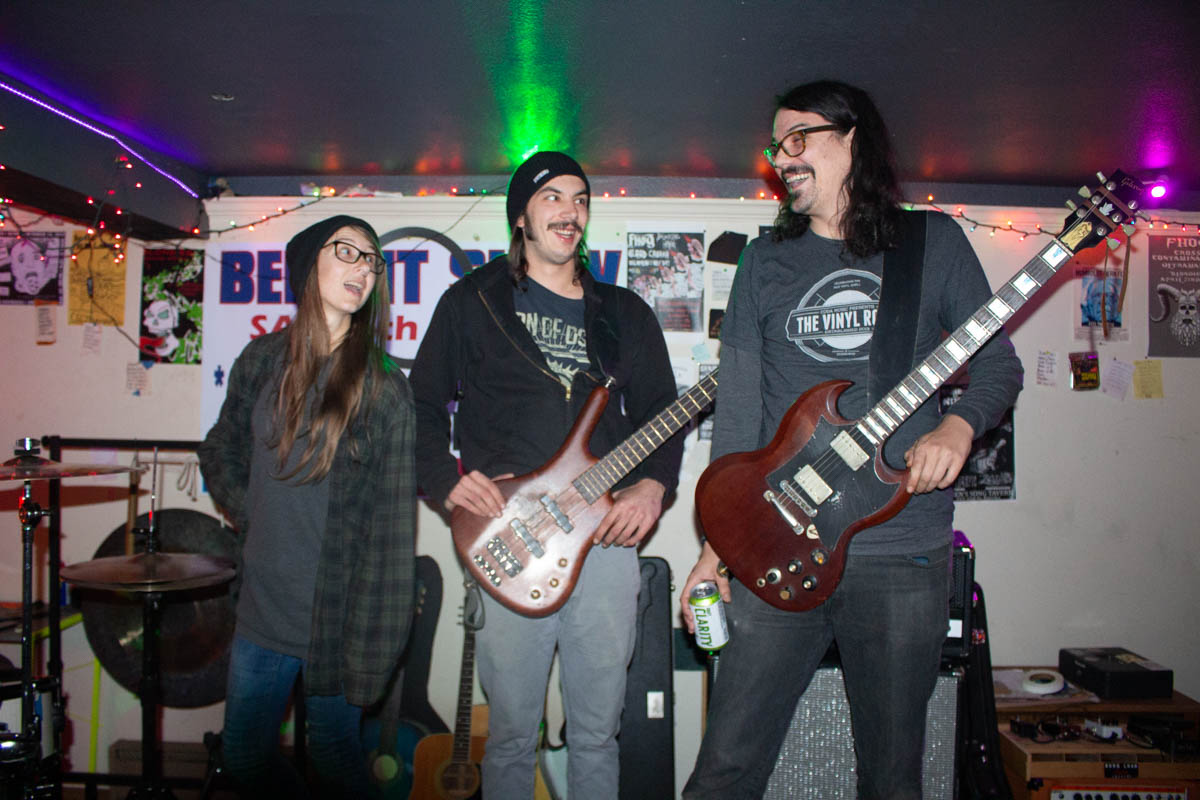
Tom Norman, Kaito Figeira and Russell Stroud make up the three piece instrumental rock band, Ultramafic. The inspiration for the name, which refers to a heavy igneous rock found in Earth’s mantle, stemmed from Norman and Figeira’s majors of art and geology.
“We both graduated and we were like, let’s make an artsy-geological rock band,” Norman said. “Do something with our degrees a little bit.”
In 2015, Norman and Figeira started the band. Norman plays the guitar, Figeira’s on the drums and Stroud plays the electric bass. Figeira and Norman have been in a relationship for eight years and share a home in Arcata that doubles as a space for band practice.
Ultramafic performing a private song in their eclectic basement which doubles as jam room on Oct. 19. | Photo by Jerame Saunders
After recording a small demo for fun, Norman and Figeira showed some friends. Under the impression the demo was from a band, they were asked to perform at a show in three weeks. Norman and Figeria agreed, but lacked a bass player. Russell Stroud was the man for the job.
“Three weeks and a few blood blisters later we got our first gig,” Stroud said.
Ever since, the band has acted as a cohesive unit. Producing music they call “garage prog,” it fits into the stoner and metal music categories. The added garage aspect represents their distorted, psychedelic sound accompanied by heavy, slow blues rhythms. The progressive nature of their rock is influenced by 70s and 80s progressive rock musicians such as Frank Zappa, Rush and Yes!
“Most of our songs are five or six small songs crammed together, but there’s a flow through it and some themes,” Norman said. “We have kind of a lot of Pink Floyd and Black Sabbath comparisons.”
Initially, the band struggled to find the right shows to play with artists that share similar music styles. But their success began in 2015; when the band found Humboldt they felt at home, becoming an immediate influence on Humboldt’s musical community.
“We are small, but bands you would never expect to come through town, come here and play,” Figeira said. “It’s a really cool scene and it brings a lot of interesting people to this area.”
Connections in the musical scene secured Ultramafic a six show tour across three states: Montana, Oregon and Washington.
“Music is life man,” Stroud said. “I can’t live without music in my life. It needs to be there everyday and playing it is even better. Getting to be apart of the collective that is creating music and getting to be one of the people that not only has put in time to play, but is decent at it too.”
The band released their newest album ‘Pyroclastic Flow’ on Oct. 31 and performed at the Siren’s Song on Nov. 2 with WitchRipper and Thundercloud.
Humboldt State women’s basketball beats Seattle Pacific 70-54 in the West Region Crossover Classic
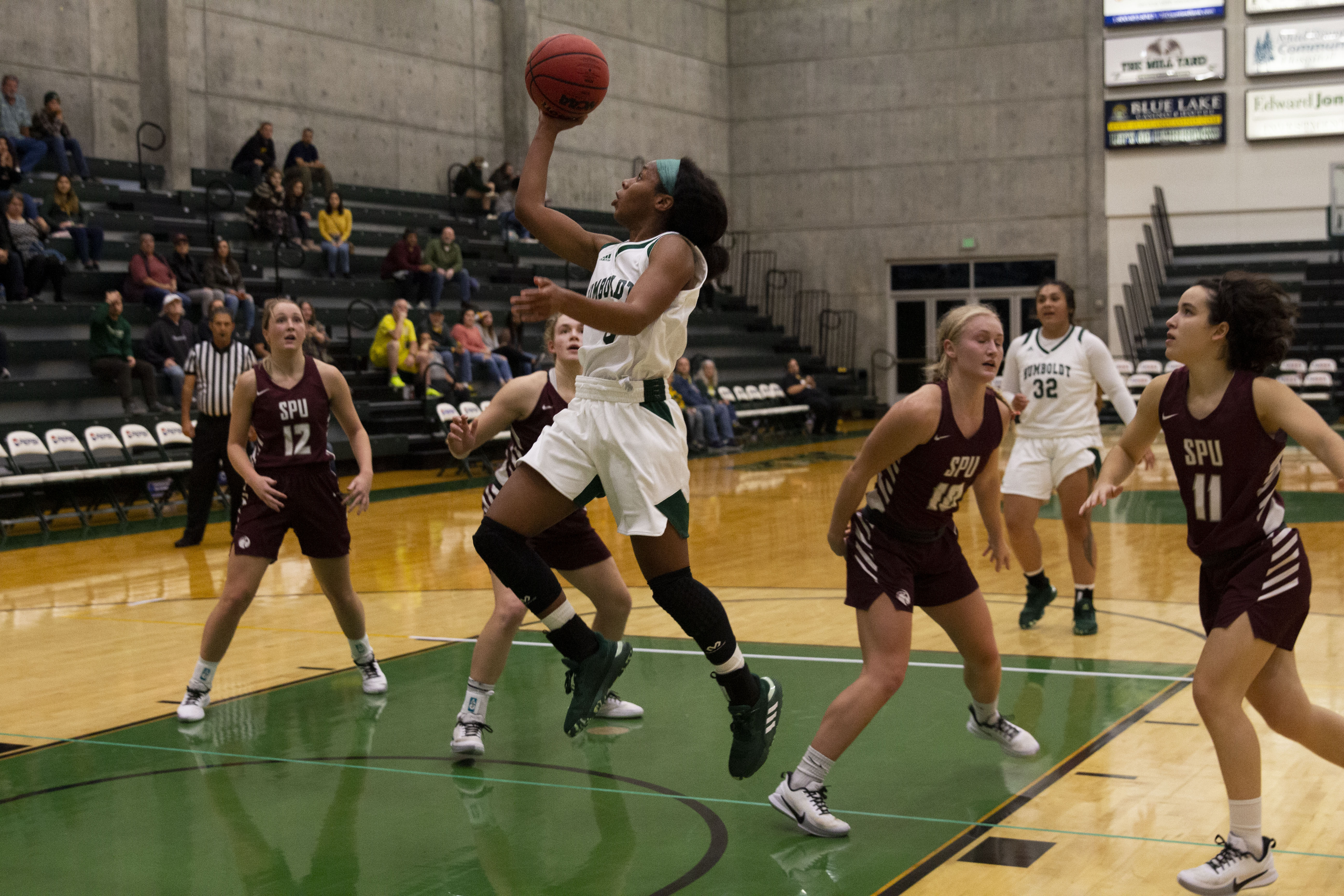
Alexia Thrower dominated the court in the Friday night win over the Seattle Pacific Falcons. Thrower, an HSU forward, put up 18 points, nailing half of her three-point attempts.
A force in the paint, Thrower tallied up nine rebounds, just one away from having a double-double to start the tournament. On the other side of the court, she had a pair of steals and a pair of blocks.
“With the bread and butter of the team gone, somebody had to take initiative,” Thrower said. “We knew if we are going to win this game it’s with our defense.”
HSU’s Alexia Thrower jumps up to shoot a lay up during the Jacks match against Seattle Pacific at Lumberjack Arena on Nov. 8. | Photo by Thomas Lal
The Jacks’ defense was disruptive early on but due to offensive struggles the Falcons took the lead in the first quarter, 18-10.
“We had no offensive flow in the first quarter,” Michelle Bento-Jackson, the HSU women’s basketball coach, said. “Molly single handedly carried our offense for a bit.”
Forward Molly Dixon had a plus-minus of 19 when on the court, and made her presence known with 12 points and a pair of steals. The offense started to pick up in the second quarter after Sandin Kidder dropped a three on the Falcons off the bench.
Senior guard for Humboldt State Molly Dixon makes a break down the court during the first half of the Jacks’ game against Seattle Pacific on Nov. 8 at Lumberjack Arena. | Photo by Thomas Lal
The Jacks went on a 17-2 run in the second quarter, ending the half with the lead at 32-29.
Tyra Turner, Humboldt State’s star point guard, went down with an apparent ankle injury halfway into the 3rd quarter after playing in all of the game prior. Gabrielle Carbajal took over for an injured Turner and landed four of her five three-point shots, finishing with 12 points.
The Jacks came out hot in the second half, establishing their lead further. Six HSU players drained a three-pointer in their day one victory. With five of the threes coming in the third quarter. Two of which came from Thrower, after a three-point play in the paint moments before.
Humboldt State guard Gabrielle Carbajal drives the play forward during the second half of the Jacks game against Seattle Pacific for the West Region Crossover Classic on Nov. 8 at Lumberjack Arena. | Photo by Thomas Lal
One of Thrower’s three-pointers came as the shot clock winded down; successfully throwing the ball up for a bank shot.
“I just tossed it up,” Thrower said. “It wasn’t the prettiest shot but I’m glad it went in.”
The Jacks pulled away ending the third quarter 58-36.
Keeping the lead was HSU’s primary focus in the fourth quarter. The Falcons boosted their shooting percentage since the first half, but the Jacks finished off the Falcons 70-54, playing aggressive in the final minutes of the game.
The Jacks have quite a few fresh faces on the roster, but Bento-Jackson believes the new players will keep up.
“We had positive contributions from a lot of different folks tonight,” Bento-Jackson said. “The bright lights don’t faze them. I think they love it, actually.”
Assistant Professor Gordon Ulmer, Ph.D draws from his real world research experience to inspire students
As human hands built roads hundreds of miles long, erected cities covering hundreds of square miles and developed rich, diverse cultures, the experience of human beings has changed and morphed. The evolution of our experiences is researched and studied by the scientific discipline called anthropology.
The world in which humans live seems regular. It’s easy to believe our towns and cities are areas humans have always been, but that’s not the case. Our roads, transportation, electricity generation and super markets are easily taken for granted.
For generations, humans have worked hard to turn the world into the convenient form it is today.
Understanding the scope and scale of humanity is a vast task that requires cooperation between anthropologists and a great number of other scientific and social disciplines.
In an effort to explore questions about how humans interact with their landscape, Humboldt State Anthropology Professor Gordon Ulmer has committed his academic life to the study of environmental anthropology.
Anthropologists are generalists. We’re like ecologists. We borrow and we pull and draw upon all kinds of other fields. That’s part of what makes anthropology, I think, one of the best disciplines.
Gordon Ulmer
“I look at the relationship between precarity and pollution,” Ulmer said. “[It’s] people’s insecurities and instability in life, contingent labor and how that relates to living and working in a polluted waterscape. The anthropological discipline is about human’s variation, bio-cultural variation across all times and all places.”
Ulmer typically works with communities who live near polluted water. He investigates coastal areas, rivers and surface waters which are contaminated with everything from sewage to gold mining byproducts. His primary research takes place in the Peruvian Amazon and Costa Rica beaches where he researches how humans contribute to and interact with polluted waters.
Ulmer’s duty, like most scientists, is to answer questions. The questions that he’s asking, however, are not questions that any one discipline can answer.
More recently, Ulmer has worked with biologists in Costa Rica as he learns at what extent locals are impacted by polluted runoff on their beaches. Ulmer uses methods ranging from on-the-ground surveys to biological analyses of water samples to answer that question. His use of an array of methods equips him and his colleagues to do good science.
“Anthropologists are generalists,” Ulmer said. “We’re like ecologists. We borrow and we pull and draw upon all kinds of other fields. That’s part of what makes anthropology, I think, one of the best disciplines. We can collaborate with and also build upon the work of other people.”
Ulmer is teaching this mindset to his students. At HSU, Ulmer teaches a number of cultural anthropology classes that, according to his students, are really awesome.
Sophie Maga and Rhiannon Cattaneo are both enrolled in one of Ulmer’s classes: Living in the Anthropocene. Maga shared why she thought Ulmer is such a benefit to HSU’s anthropology department.
Sophie Maga and Rhiannon Cattaneo are both cultural anthropologists enrolled in Ulmer’s class “Living in the Anthropocene.” | Photo by Collin Slavey
“I think it’s Gordon’s content in general,” Maga said. “He’s one of the first professors here really diving deep into the Anthropocene and environmental crises and structures that we really need to be looking at that anthropology has lacked.”
Maga and Cattaneo both said that Ulmer has brought something new to the anthropology department. His teaching methods encourage students to think critically about class readings to prepare them for in-depth conversations.
“He’s very socratic,” Cattaneo said. “His class is very discussion based. It forces you to use the class time to really think about and process the readings you do.“
Preparing his students to think and process knowledge is preparing his students to be anthropologists. According to Ulmer, by encouraging deep critical thought, he is equipping his students to contribute to anthropology’s task of understanding the scope and scale of humanity. His students appreciate it.
“For me, he is a symbol of hope because I see him as an advocate for the next generation of students,” Cattaneo said. “The way he’s approaching [teaching] is very democratic, open and informed, so I think he’s having a very positive impact.”
A back and forth battle sends the Raiders home in sorrow
With the start of the season just around the corner, Jacks point guard Amari Green is confident that the Jacks will provide excellent results in their season opener against a good Point Loma team in San Diego on Friday.
“We’re ready, we go to San Diego on Thursday and we’ll be playing against two very good teams,” Green said. “We have the right pieces and are tight-knit as a group and as long as we stay together we are going to take it all the way.”
After dealing with a power outage during their first exhibition game and switching arenas to coincide with the HSU volleyball team, HSU men’s basketball returned to Lumberjack Arena for an exhibition game against the Southern Oregon University Raiders on Tuesday night.
As the tip-off signaled the start of the first half, the Jacks wasted no time gaining possession of the ball and building an early 12 point lead over the Raiders. Missed shots from the Raiders hindered any early progress and helped the Jacks employ effective passing strategies.
Humboldt State forward Raysean Scott Jr goes up for a layup through a crowd of Southern Oregon players in Lumberjack Arena on Nov. 5.
Jacks players were quick and efficient, but as time progressed in the first half it didn’t take long for the Raiders to overcome its faltered plays and establish a tie. Jacks forward Raysean Scott Jr made his presence known as he maneuvered around the Raiders and found the basket.
Raysean was a recipient of fouls from the Raiders, and at the free-throw line his teammates and opponents were aligned and ready to pounce on the ball at any given moment. He made five of his seven free-throws, which was enough to put points on the board.
Both teams became physically involved and the battle for possession of the ball became intense. Fouls were arising and it was crucial that the Jacks avoided any potential mishaps.
“They were calling ticky-tack fouls, so we tried to keep our hands up so [the refs] could see we weren’t fouled,” Jacks guard Leland Green said.
Despite the game becoming physical, both teams managed to keep their composure by limiting their mistakes and avoiding technical fouls. After the first half Green said their offense improved when the Raiders attempted to outscore the Jacks.
“I think we all played good,” Green said. “We let up the pressure, and as the game went on we realized we needed to apply more pressure.”
Humboldt State forward Raysean Scott Jr jumps for the shot in Lumberjack Arena on Nov. 5.
Players made their way back to the court for the second half which saw an influx of team chemistry with the Jacks. Activity from Jacks guard Isaiah Pope was at an all-time high as he delivered additional points on the board, giving his team an advantage over the Raiders.
Raysean was substituted earlier in the second half, and his return to the court towards the end became a powder keg to an already highly active crowd which almost blew the roof off Lumberjack Arena.
A staggered Raiders team dwindled in the final seconds of the game, and Raysean still delivered a blow to their morale with his slam dunk, making the final score 89-74. After the game, head coach Steve Kinder shared some inspiring words that he hopes to carry into the next games.
“Through those wars and battles you try to stay composed and poised throughout the game,” Kinder said. “Whether things are going well, you can’t get too high and when things are going poorly you can’t get too low.”
Scholarships mark first steps toward tackling enrollment decline
Humboldt State University’s battle against declining enrollment continues.
In the last month, HSU announced three four-year, $1,000-a-year scholarships for local students (‘Humboldt First’), for Fortuna High graduates and for students living on campus.
“‘Humboldt First’ reflects a direct investment in our local service area,” Interim Vice President of Enrollment Management Jason Meriwether said. “As part of our strategy to grow enrollment, we need to dramatically increase the number of students from our local area. In fact, our goal is to triple the number of local students in the next four years.”
The Humboldt First scholarship will be provided to all new HSU students graduating from high schools in Humboldt, Del Norte, Mendocino and Trinity counties. The Dan and Cindy Phillips Fortuna Scholarship will be available to all Fortuna High graduates, even those transferring from the College of the Redwoods. HSU’s scholarship for on-campus residents will be awarded to students as long as they live on campus, up to four years.
All three scholarships begin in Fall 2020.
Meriwether said HSU is in the process of implementing multiple strategies to recruit local students, including educating locals about the programs offered at HSU and introducing ceremonies for Humboldt-area high school students who qualify to attend HSU.
“We sincerely want to compete for students who want to leave Humboldt or don’t want to go to college,” Meriwether said. “So we are working harder to make sure they know that HSU is a real option for them.”
Interim Vice President of Enrollment Jason Meriwether in his office on Oct. 25. Meriwether said the Humboldt First scholarship is one effort among many by HSU to attract more local students. | Photo by James Wilde
Paul Hilton, an HSU political science major, journalism minor and McKinleyville High School graduate, said he liked the sound of the scholarship.
“Contrary to what maybe a lot of people think, there is a want—there is a desire—to go straight to HSU from some of the local schools,” Hilton said.
Hilton went to College of the Redwoods after graduating high school to avoid the higher costs of HSU. Hilton said he probably would’ve gone straight to HSU had the scholarship existed previously.
However, Hilton acknowledged that many local students don’t want to go to HSU regardless of cost.
“I think a lot of it just has to do with opportunities,” Hilton said. “A lot of locals dislike growing up here, and a large part of that is because of a lack of opportunities. But there are a lot of locals, myself included, who love Humboldt but still hate the lack of opportunities.”
After CR, Hilton nearly attended Southern Oregon University, where he thought he saw more certainty in finding a future career path. Yet, in the end, he opted for HSU.
“I came here because of proximity,” Hilton said. “Some people might just call that laziness, but because of the costs and everything I just decided that it would be easiest for me to stay here.”
Hilton attributed HSU’s enrollment decline mainly to a lack of opportunities in the area, but he also noted a lack of support for minorities.
“I think the main common factor between years and semesters has been opportunity in the area,” Hilton said. “But now it’s even more and maybe even a little overlapped by the lack of sense of security for minorities.”
Meriwether said he believes HSU does offer opportunities, but the university doesn’t do enough to let people know they exist.
“I think local students think they know Humboldt, but I don’t think we’ve done the job we need to do of reintroducing them to Humboldt,” Meriwether said.
Eureka High School Principal Jennifer Johnson shared Meriwether’s excitement for the new scholarships. Johnson said she has already seen four to five times the usual number of EHS students going to HSU’s preview day. Johnson said only one EHS student went to HSU in 2018. For context, EHS has 1,230 enrolled students this year.
“We have to also re-recruit our current students. We can’t just take for granted that they’re going to be here. We also have to give them a positive campus experience.”
Jason Meriwether
“We only had one last year,” Johnson said over the phone. “I think it was a real wake-up call for HSU administration when they actually ran the numbers on our school.”
Johnson said local students that want to stay in Humboldt often opt for CR instead of HSU due to the costs—although Johnson said she thinks many students and parents just don’t understand how cheap HSU can be with financial aid.
As for the local students that want to leave Humboldt, Johnson echoed Meriwether by saying that HSU is not like the rest of Humboldt.
“I tell them, ‘Move to Arcata, it’s a whole different world,’” Johnson said.
Meriwether said HSU is currently restructuring its recruitment strategies to include more social media targeting along with more visits to schools. Meriwether also pointed to recent recruitment improvements such as an increase in available tour times and the elimination of tour fees.
Meriwether added that HSU has to not only improve recruitment, but also retention.
“We have to also re-recruit our current students,” Meriwether said. “We can’t just take for granted that they’re going to be here. We also have to give them a positive campus experience.”
Ultimately, Meriwether hopes HSU can begin telling a new story for itself that will attract and retain more students.
“History is important,” Meriwether said. “But we also have to share that there’s a different approach to leadership, there’s a different approach to response and if things happen on campus it’s because we are trying to create a student-first experience. That’s what it’s all about.”
Three-game losing streak snapped by Jacks’ offense
The Humboldt State men’s soccer team defeated San Francisco State 3-1 on Saturday. It was another strong offensive outing for a Humboldt State team that has found the back of the net often this season.
The Lumberjacks impressed in the second half with goals from Isaiah Dairo, Marco Silveira and Dalton Rice. The victory snapped a three-game losing streak, bringing their overall record to 7-8, and two more games to play in the regular season.
The first half of the game was tightly contested, with both teams taking most of the time to feel out the opposing defense. The Gators’ midfield play provided a challenge for the Jacks’ offensive players as they were unable to break through the center of the field.
However, Humboldt State was able to find their rhythm as they quickly moved the ball upfield to create more space between SF State’s defenders and cut to the net. As a result, the Jacks outshot the Gators 6-4.
Humboldt State midfielder Nicolas Falco keeps the ball away from an attempted tackle by SF State’s Ramiro Palencia at the College Creek Field on Nov. 3.
Despite the Jacks’ progressive play, the Gators were able to get a shot over the head of HSU goalkeeper Tab Heinz. With just over three minutes left in the half, the Gators grabbed a 1-0 lead just before halftime.
Coming out of halftime, the already physical match ramped up as the Jacks looked to make a comeback. Just a couple of minutes into the half, Humboldt State thought they tied up the game as Dairo chipped the ball in from short-range. But, a whistle from the line ref called the play offsides.
This setback didn’t appear to have a lasting effect on the Jacks, as Dairo once again found the back of the net, putting the ball over the Gators’ goalkeeper from the penalty box. Th Jacks tied the game 1-1. The goal was Dairo’s 10th of the season as he leads the Jacks in scoring.
“They give me a lot of support and they give me a lot of energy to keep going,” Dairo said. “That’s something that made me want to stand back up and keep pushing this game. It’s up to you if you want to mentally and physically stand up and my team definitely helped me through that challenge.”
The Jacks went on to score shortly after Dairo returned to play. Silveira netted his third goal of the season by firing the ball from the right-wing and banking it in off of a Gators defender.
Humboldt State forward Marco Silvera and San Francisco State defender Damiano Sbicca battle for possession at College Creek Field on Nov. 3.
The sudden change in direction took both the defenders and the goalkeeper by surprise and sent the home crowd into a frenzy. Just seven minutes later, Humboldt State followed with another goal off of a second chance rebound as Rice rocketed the ball past the off-balance goalkeeper.
At the end of the game, Head Coach Fred Jungemann talked about how pleased he was with his team’s performance. He was particularly pleased with how the Jacks limited their defensive errors and were able to stay strong in their own zone.
“Today we really focused on minimizing our mistakes and managing the game a little bit better,” Jungemann said. “I think it showed in the result as well in only giving up only one goal.”
‘Who Killed Josiah’ examines the consequences of a divided community and the effect David Josiah Lawson’s death had on his family
In Humboldt County there are some people that don’t know about David Josiah Lawson, but others will remember his name and story for the rest of their lives.
When Karen Foshay, an executive producer for KCET – a television station in Southern California, heard about Lawson’s murder she felt she had to follow the story. Foshay produced the 29-minute episode “Who Killed Josiah?” for KCET’s news documentary series SOCAL Connected.
After three months of working on the news documentary, “Who Killed Josiah” premiered on KCET’s website, kcet.org, and YouTube on Oct. 22 and will air on KCET-HD and KCETLINK on Nov. 12, 13, 14 and 16.
Foshay’s husband attended Humboldt State University as an undergrad. In January, when she and her husband were passing through Humboldt, she found herself on the scene covering a national news story when two local girls went missing from their backyard.
“Along the way I meet a photojournalist who told me about an LA student who was killed up here,” Foshay said. “I looked into it and I was really interested. Not the death itself, but what this death did for the area.”
“We couldn’t paint the community as racist. We had to be fair and give their voices and experiences justice.”
Karen Foshay
The episode follows the murder of David Josiah Lawson, a 19-year-old Humboldt State University student, who was stabbed at an off-campus party on April 15, 2017. The show examines the consequences of a divided community and the effect Lawson’s death had on his family.
Foshay said that part of the reason she pursued Lawson’s story is because he moved to Humboldt from Perris, a city in Riverside County. She added that she understands many students move to Humboldt from Southern California. When she and her crew were investigating, they had to consider HSU’s policies, recruiting methods and how the institution approached the death of a student.
When the crew collected more information, they weren’t able to separate Lawson’s story from the area.
“The scenery and landscape is the backdrop,” Foshay said. “Rugged, scary, and drop dead gorgeous which frames the mystery of the story.”
The crew filmed at familiar places in Humboldt, such as HSU’s campus, Eureka and Moonstone Beach. The crew also interviewed recognizable local faces, such as Lawson’s mother Charmaine Lawson, photojournalist Mark McKenna and former KHSU Office Manager Lorna Byrant.
Photo courtesy of Karen Foshay
Toward the end of their investigation, Foshay said that she and her crew obtained four hours worth of dash cam footage that captured dramatic moments of the night of the murder, as well as a call a police officer made to Charmaine breaking the news of her son’s death.
“You have to keep asking questions and digging,” Foshay said.
“Who Killed Josiah?” depicts an emotional and complex story that provides a variety of perspectives from Lawson’s family and the community at large.
Foshay said that she wanted to respect the strong feelings on both sides.
“We couldn’t paint the community as racist,” Foshay said. “We had to be fair and give their voices and experiences justice.”
Humboldt State women’s soccer beat San Francisco State in overtime
After experiencing a rough patch in last weekend’s Southern California matches, the Jacks focused on rejuvenating their strategies against San Francisco State.
In the first half, SF State fought hard for ball possession, creating shot opportunities that were met with resistance from Jacks’ goalkeeper Katelin Talbert.
Midfielder Lindsey Stoner broke through and took a shot on goal, but a slide save by San Francisco player Illiana Gallegos deflected the effort. Shortly after, the Jacks were presented with a second shot attempt by midfielder Sabine Postma, but the crossbar above the net deflected the ball.
The pressure put on SF’s offense forced them to shoot the ball during untimely situations. Although HSU had fewer shots during the first half, the up-close-and-personal tactics from the Jacks created an uneasy atmosphere that made it difficult for SF to focus.
Lindsay Stoner battles the SF State defender at the edge of the penalty area. | Photo by Liam Warner
The first period concluded with an impressive show of speed as both teams made a final push to add a point on the board. The second period saw a shift in strategy for SF as they began the period with an immediate shot on goal, which was quickly met with a save by Talbert.
The Jacks found themselves in another overtime scenario, and the team gathered around Head Coach Paul Karver to discuss their strategy. After the time-out, Stoner was back on possession and broke through for a scoring chance. She was thwarted, but moments later would return with the help of Pikake Hix to score the game-winning goal.
After the excitement settled down and players cleared the field, Talbert spoke on the team’s ability to remain calm and play steady.
“When they play the ball back to me the other team doesn’t press as hard,” Talbert said. “It helps since our players are already on edge and need some time to focus.”
Lindsay Stoner reflected on her teams’ effective offense strategies, which helped the Jacks secure a much-needed overtime win over SF.
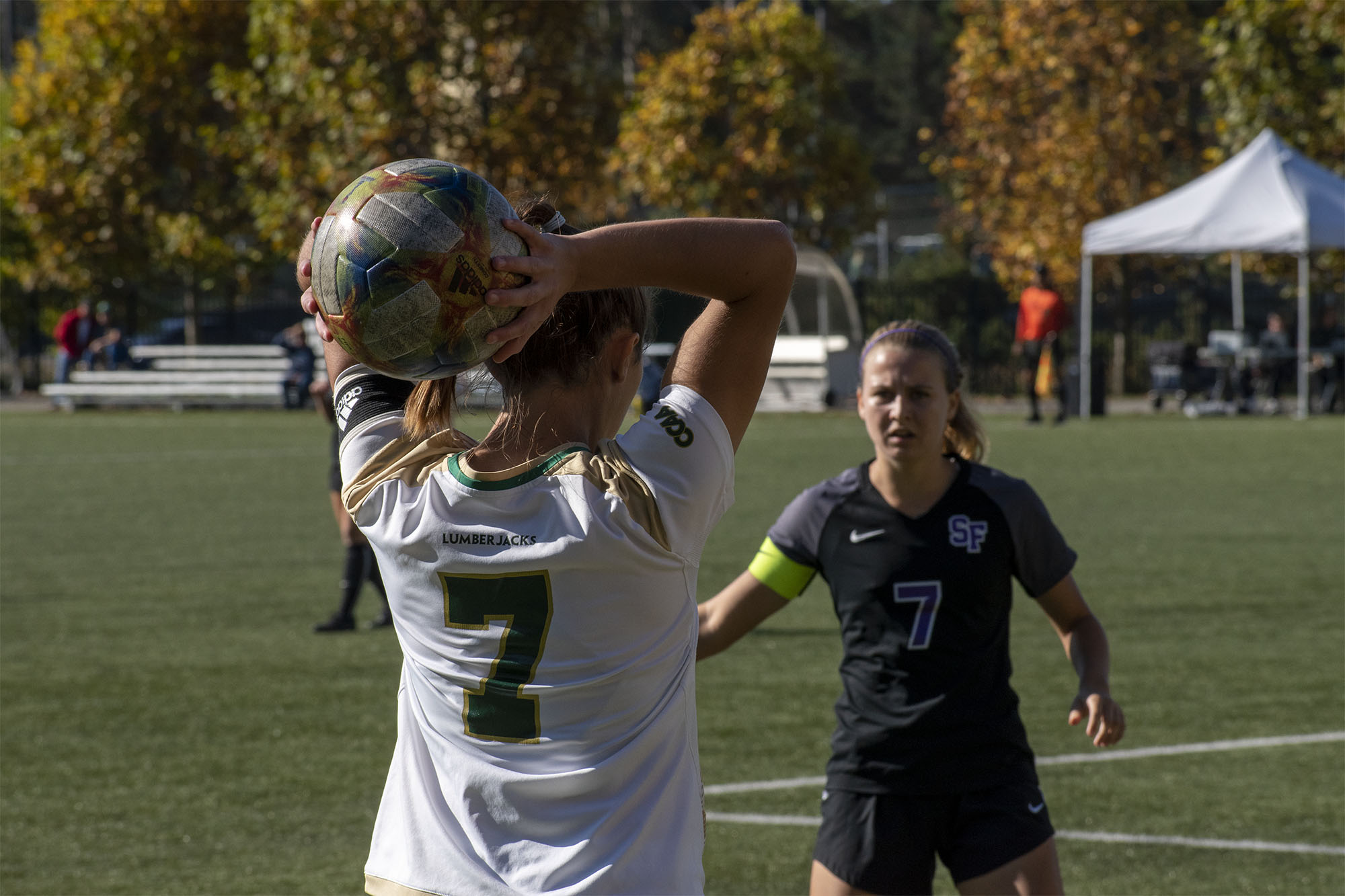
#7 Rose Harman shields the SF State defender from the ball. | Photo by Liam Warner
Pikake Hix chases after the ball during the game against SF State. | Photo by Liam Warner
Kelsey Bess tries to draw the foul from #5 Kelsie Bozart. | Photo by Liam Warner
“We made them nervous,” Stoner said. “We kept attacking them and kept them on their toes because we knew we needed this goal and we were inspired to win it.”
Stoner produced six shots against SF and stayed consistent with keeping the rhythm going.
The focus for now is the upcoming weekend as HSU squares off against Dominguez Hills and Cal State Los Angeles. Karver expects the opponents to be resilient towards the Jacks as their quest to secure points continues.
“These are teams with two very polarizing styles of play, not the prettiest of football since there will be a lot of fouls and awkward emotion afterwards,” Karver said. “We got the points we needed today, and now we gotta get six more next weekend, but it’s one game at a time, and we’re really excited to have the opportunity.”
Two games remain and the Jacks look forward to getting more points before the end of the season. This weekend the Jacks will host Dominguez Hills and Cal-State LA for afternoon games at College Creek Field.
Lindsay Stoner brings the ball up the field with an SF State player trailing. | Photo by Liam Warner
Jacks’ midfielder Kelsey Bess is fouled from behind by an SF State player. | Photo by Liam Warner
Kelsey Bess goes stride-for-stride with #19 Katelyn Patterson of SF State. | Photo by Liam Warner
Kelsey Bess corrals the ball at her feet during the game against SF State. | Photo by Liam Warner
#4 Kendal Spencer holds off SF State defender #7 Kylie Schneider. | Photo by Liam Warner
#22 Pikake Hix celebrates with her teammates after the overtime victory. | Photo by Liam Warner
A strong performance from transfer players creates a positive outlook for upcoming season
Despite Humboldt County awaiting a blackout on Saturday, Jacks’ basketball made sure to keep the energy high on Friday night.
The blackout forced Humboldt State Athletics to move its volleyball game to the same time as the scheduled basketball game, which meant the Jacks had to play in the East Gym.
During the last few months, HSU men’s basketball added three Division I transfers to its arsenal. Compton, CA natives Raysean Scott Jr. (Florida Gulf Coast University), Leland Green (University of Hawaii) and Rob Lewis’ (Texas Southern University) combined efforts impact the game in a way the Jacks have missed for a while.
Strategies issued by Head Coach Steve Kinder and Assistant Coach Rich Mendoza helped the Jacks focus on teamwork while capitalizing on opportunities to push points past Simpson.
It’s not surprising for me, I knew from the recruitment trail last spring that we were onto some very talented players.
Steve Kinder
“It’s not surprising for me, I knew from the recruitment trail last spring that we were onto some very talented players,” Kinder said. “The players were remarkable and created a memorable environment for those in attendance.”
The Jacks started off strong as guard Isaiah Pope found the net seconds after the first whistle. It wasn’t long before Simpson gave up their first foul and Jacks’ forward Raysean Scott Jr. capitalized on a free throw opportunity.
Simpson began executing defensive plays against the Jacks as they attempted to find their place on the scoreboard, but it was met with resistance as the Jacks responded with chemistry between Scott Jr. and point guard Amari Green.
Humboldt State point guard Amari Green strings for a play at the top of the key during the men’s basketball exhibition game against Simpson on October 25.
The second half for the Jacks resulted in an increase of player activity and passing chemistry. HSU took another lead over Simpson as the battle for possession continued. The Jacks finished strong and concluded the exhibition game with a final score of 88-70.
Kinder reflected on the importance of the East Gym and the impact it had on his coaching career with HSU basketball.
“That East Gym experience today goes back to the good old days,” Kinder said. “It was the first time we have [played] there since the 2007 season, and to be back in there was quite a moment.”
Despite the sudden change of venues, Kinder and his team were not impacted as the East Gym is a consistent training place.
“We’ve held practices in there all year, so we felt like it was a road game for us,” Kinder said.
Men’s basketball will hold one more exhibition game at Lumberjack Arena on November 5 against Southern Oregon University before hitting the road for an away game against Point Loma on November 8.
Although areas of Humboldt County have the “all clear” for power restoration, another PSPS may be scheduled for Tuesday morning
Parts of Humboldt have been given the “all clear” to begin line inspections and restorations for the current Public Safety Power Shutoff.
“PG&E notified Humboldt County Office of Emergency Services (OES) that portions of Humboldt County have been given the “All clear” for the weather event and will begin the restoration process as soon as conditions allow,” the latest update from the Humboldt County Office of Emergency Services said.
However, PG&E has also notified the county that another PSPS event may affect Humboldt as early as Tuesday morning.
“PG&E also notified OES that another weather event is scheduled for Tuesday 10-29-19 at 6 a.m. which will also result in a possible Public Safety Power Shutoff (PSPS),” the update said.
OES says it expects “a small window of time” between the two shutoffs, and urges residents to use the time to once again prepare to have no power.
“As always, this information from PG&E is subject to change,” the update said. “Updates will be provided as soon as they become available.”
“These delays in the power shut off are in part because PG&E is trying to limit the time that customers are impacted,” the update said.
PG&E increased the number of accounts within the scope of its latest Public Safety Power Shutoff today from 850,000 to 940,000. Since many accounts provide power to multiple customers, PG&E estimates that over two million people are within the PSPS scope.
PG&E expects to give the “all clear” for the windy weather event by 4 p.m. Sunday for Humboldt. However, the update clarifies that that is not when power will be restored.
“The weather “All clear” time is the time when PG&E personnel can begin inspecting the lines,” the update said. “It can take up to 48 daylight hours from the weather “All clear” time until power is restored because any damage found during the inspection will need to be repaired prior to power restoration.”
In a PG&E press conference at their headquarters in San Francisco, PSPS Incident Commander Mark Quinlan emphasized that the restoration will take different amounts of time for different areas as PG&E works to patrol 31,000 miles of lines.
“The restoration time is a sequence as well,” Quinlan said. “It doesn’t mean that every customer is going to be out for 48 hours. It means that we’re going to begin restoration activities at the times that I mentioned, and we believe we will incrementally restore everyone all the way up and not have anyone out past 48 hours.”
Alison Holmes, Ph.D. spent her sabbatical researching whether California acts as its own nation
California has the means to be its own nation. It’s big, it’s wealthy and it’s been disrupting the status quo by acting internationally.
“California has been acting outside the box,” Humboldt State University Associate Professor and International Studies program leader Alison Holmes said. “They’ve been going and doing stuff with China, Mexico and Canada. It’s like, ‘Wait, you’re not supposed to do that. That’s not what international relations theory says, it’s not what the U.S. Constitution says, it’s not what all kinds of other rules suggest.’ So how are they doing that?”
Holmes spent her sabbatical last school year researching California and talking with state officials and those the state has dealt with.
In August, Holmes presented her research to the Center for California Studies at Sacramento State University in a presentation called, “California as a Nation-State: Innovative or Inevitable?”
In her research, Holmes found that cities and industries within California may act internationally, but the state itself doesn’t typically act as its own nation.
“We do things internationally but we don’t do them in a coordinated fashion,” Holmes said.
Holmes grew up in Oklahoma, but she moved to the United Kingdom after volunteering in Belfast during college. Holmes lived in the United Kingdom for 25 years, where, among other things, she worked for and advised the Liberal Democrats and worked as the Deputy Head of Corporate Communication Strategy for the BBC.
In 2005, Holmes completed her doctorate in London and then became a speechwriter for Ambassador Robert Tuttle.
“When I worked for the ambassador, I became very interested in international relations and diplomacy,” Holmes said.
California likes to think that it’s an innovator. We’re really big and proud about how we do stuff. And actually we’re not at the front of that innovation edge; a lot of other places in the world have been doing this for a long time.”
Alison Holmes, Ph.D.
When Holmes moved to California, she saw a perfect opportunity for research.
“California makes an excellent case-study, because it is the fifth largest economy in the world,” Holmes said. “But it is a sub-national unit of a huge, hegemonic, vast, largest-nation power.
Holmes said California’s international actions are part of a larger globalization trend.
“What a lot of international relations theory will tell you is that globalization has meant a bunch of people who aren’t nation-states have started to do things on the international stage,” Holmes said.
With this in mind, Holmes said that while California might be innovative for the United States, it isn’t elsewhere.
“California likes to think that it’s an innovator,” Holmes said. “We’re really big and proud about how we do stuff. And actually we’re not at the front of that innovation edge; a lot of other places in the world have been doing this for a long time.”
Holmes also said non-state entities acting internationally brings up questions about the very nature of sovereignty.
“When does a sovereign not have sovereignty?” Holmes said. “At what point do state relations at the international level become a foreign policy? My point here is that our traditional ideas of sovereignty are ill-equipped to describe what we see in the real world.”
Holmes says there are three future goals for California: the establishment of an agency focused on international policy, the honoring of tribal relations and the inclusion of tribes in international policy, and the coordination of city and county international efforts with state efforts.
Holmes ended her research presentation with an urge to take advantage of California’s diversity across all of its communities.
“That is the only way to create a robust local-global citizenship and to turn California’s state-nation vision of unity from diversity into a reality,” Holmes said.
Locally, Holmes said Humboldt is more global than it might think. Holmes urged Humboldt residents to connect local actions with outside, global forces.
“I worry that Humboldt is a little too proud of being the Lost Coast or being behind the Redwood Curtain,” Holmes said. “Privileging what they perceive to be the local over the global, to the point of seeking to disconnect from rather than engage with the world outside.”
Holmes said ignoring global events has consequences.
“If you don’t understand these things, you’re not really paying attention to what’s happening, how you can take advantage of that, how you can be a part of that and how it doesn’t have to roll over you like a steamroller,” Holmes said. “Because otherwise it will.”
However, Holmes cautioned that connecting local issues with the rest of the globe doesn’t mean people should start blaming external forces for all local problems.
“Trying to understand it is not the same as trying to find somebody else to blame,” Holmes said.
Holmes suggested that freshmen coming to HSU would likely benefit from learning intercultural communication strategies that international studies students use.
“There is culture shock,” Holmes said of new HSU students. “There is intercultural communication issues between the different groups of people who turn up here.”
While HSU politics professor and international relations teacher Noah Zerbe said Holmes’ work goes beyond the scope of his expertise, he did agree with the importance of paying attention to the rest of the globe.
“Stuff that happens globally affects us everywhere,” Zerbe said. “It affects us here as well.”
California’s prowess has led some to believe that California should secede from the United States.
Marcus Ruiz Evans, president of Yes California, the largest organization dedicated to California’s secession, said he believes California would be better off on its own.
“The basic idea is that California is held back financially because it’s part of America,” Ruiz Evans said over the phone.
“The basic idea is that California is held back financially because it’s part of America.”
Marcus Ruiz Evans
Ruiz Evans said Yes California and the #CalExit movement started back in 2011. Since then, it has seen significant growth, especially following the election of Donald Trump.
However, Ruiz Evans said that the movement’s growth led to a divide in its supporters that left the movement momentarily stagnant.
“With success came civil divorce,” Ruiz Evans said.
Nevertheless, Ruiz Evans said he firmly believes California should secede. Ruiz Evans said that California, on its own, wouldn’t have to fight with the president or the rest of the country, wouldn’t have to fight with federal immigration laws and would save billions of dollars.
Ruiz Evans also said California is held back politically and financially, and that he believes a split is only logical.
“We think it’s inevitable,” Ruiz Evans said.
Yet, when asked, Holmes put a damper on such enthusiasm.
“I am not sure ‘doing it alone’ is ever a great idea,” Holmes said. “I think while California is rich by many standards, if they had to pay for all the things that the federal government currently does, our situation would change rapidly. California could go that route, but revolutions rarely end well or the way the instigators intended. Be careful what you wish for.”
Cross country prepares for CCAA championships at home, losing streak continues for volleyball and soccer has a mixed weekend
Tuesday’s press conference at Lumberjack Arena featured comments from the cross country, volleyball and soccer teams this week.
Cross Country
The HSU cross country teams are preparing for one of the most significant home meets in recent history. The Jacks host the CCAA conference championships Saturday morning at the Baywood Golf and Country Club in Arcata. The Jacks have an advantage in knowing the course after hosting the Humboldt Invitational in September. However, the stakes will be a bit higher as the Jack runners will be running for the chance to go to the NCAA regional meet on November 9. Senior runner Daniel Tull talked about the excitement of hosting such a big event for HSU.
“It’s really exciting for me,” Tull said. “I know a lot of runners personally that compete at different CCAA schools, so it’s cool to have them come up and show them what we’ve got here.”
Volleyball
The HSU volleyball team continues to produce frustrating results despite putting a good effort out there for each match. Last Friday, the Jacks traveled down to Los Angeles to take on Cal State LA and they were swept in straight sets, losing the match 3-0. The short journey over to Carson to take on Cal State Dominguez Hills didn’t result any better. Despite taking a set, the Jacks ended up losing the match 3-1, falling to 5-11 on the season. The good news for the Jacks is that they don’t have to deal with the rigors of travel for a while as they head into a five-game homestand. Head Coach Kelly Wood during the press conference talked about the relief of being able to play at home, noting that her athletes can focus on schoolwork and get back into their normal routine.
The next match for volleyball is Thursday at 7pm vs. Cal State San Marcos at Lumberjack Arena.
Women’s Soccer
The Jacks were at home last weekend taking on Cal State East Bay and Cal State Monterey Bay. Friday’s match against East Bay was a frustrating one for the Jacks, as East Bay scored twice, but in the 82nd minute Pikake Hix was able to score a spectacular goal from distance to make it 2-1. Sunday’s match against Monterey Bay was a back and forth battle that would see the match go into overtime tied 0-0. Just one minute into overtime Kendal Spencer slipped the ball past the diving goalkeeper to win the game for the Jacks, 1-0. For Spencer, this goal held a special significance apart from winning the game, as she had just returned from being held out of playing with a concussion.
“I couldn’t go to practice or anything,” Spencer said. “So then coming back I was so fired up to make a contribution.”
Both men’s and women’s soccer will head to Southern California to take on Cal Poly Pamona and Cal State San Bernardino this weekend.
Men’s Soccer
The Jacks had a mixed weekend taking on East Bay and Monterey Bay at College Creek Field. Offense was on full display against East Bay on Friday, and the jacks won 4-2 behind a two-goal effort from Isiah Dairo. Sunday was a different story and the Jacks lost 2-1 to Monterey Bay despite Gus Baxter converting on a penalty kick. Head Choch Fred Jungemann was happy with the team played over the weekend, and said that the team played well on Sunday against Monterey Bay, but couldn’t put the ball in the net.
Indigenous Peoples’ Week provided an opportunity for the community to not only recognize native culture but learn about it
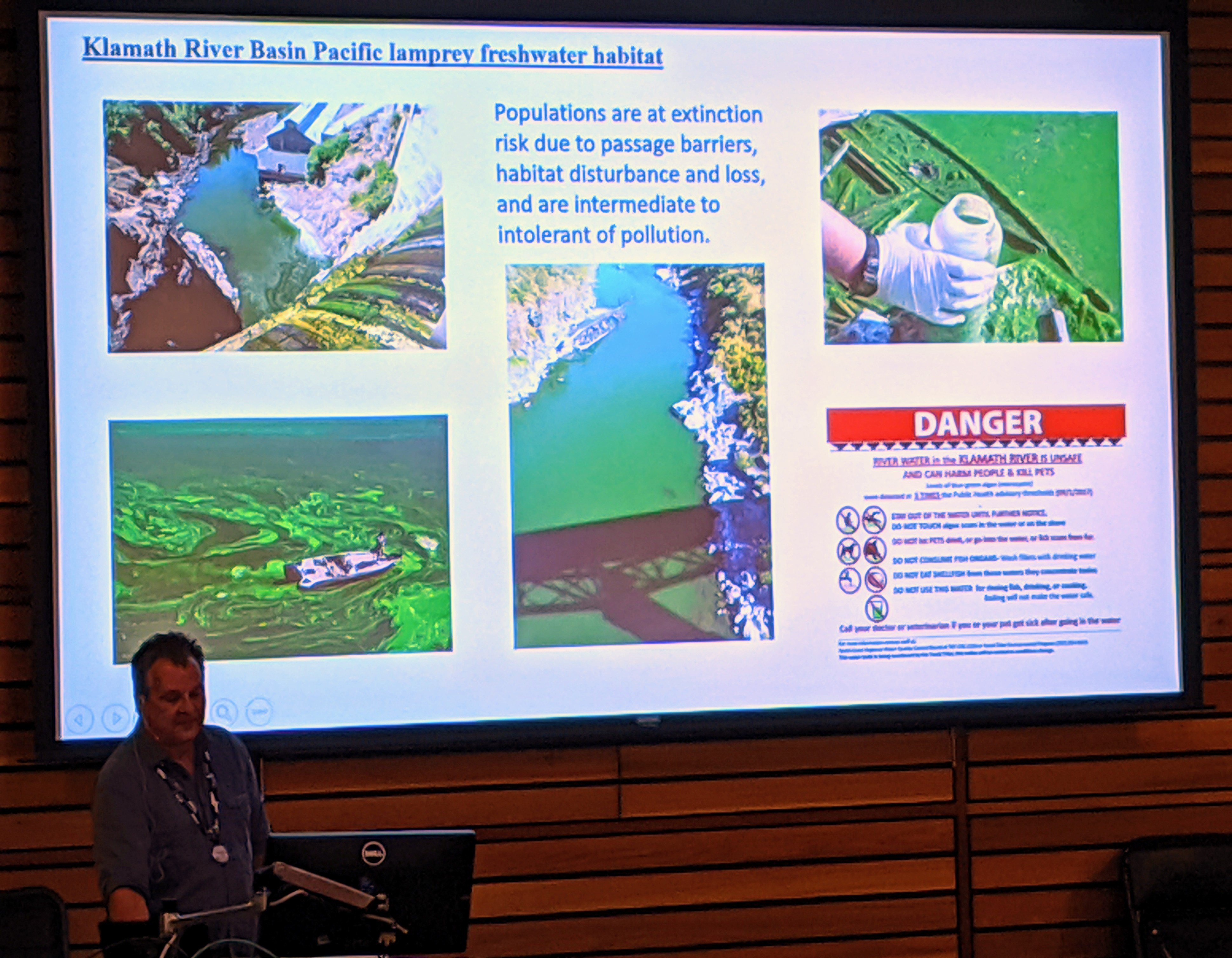
Last Thursday Yurok Tribe member Keith Parker, a Humboldt State alumnus and fisheries and molecular biologist, gave a presentation on campus about the Klamath River, his work on Lamprey eels and the local ecosystem.
As a tribal scientist, Parker gets to use his traditional knowledge from his Yurok heritage combined with his master’s degree from HSU to conduct field and lab work. The Klamath River is significant to the Yurok Tribe, as Yurok translates to “downriver people.”
“I have a spiritual and innate connection to the land,” Parker said. “It’s not just a study subject for me, it’s not just empirical data. I have skin in the game, literally.”
“I have a cultural connection. I live off that river, my kids eat off that river, we eat the salmon, the sturgeon, the lamprey, the elk, the deer and we harvest the roots.”
Keith Parker
Parker feels that his upbringing along with his academics makes him a better and more effective scientist. It is more than just conducting research for him, as he continues to learn and then teach others about a topic he feels passion for.
“I have a cultural connection,” Parker said. “I live off that river, my kids eat off that river, we eat the salmon, the sturgeon, the lamprey, the elk, the deer and we harvest the roots.”
The river has a rich history in native lore, being home to other tribes including the Karok and Modoc long before the earliest settlers came west. But in more recent years, the river has taken a decline in health.
Some of the causes can be attributed to the damming of the river, preventing the water from flowing properly and allowing harmful algae to grow. Specifically cyanobacteria, commonly known as blue-green algae.
The North Coast Regional Water Quality Control Board and the Humboldt County Department of Health & Human Services send out broadcast warnings, cautioning people to avoid swimming in areas that contain the algae.
In July 2018, the Humboldt County Department of Health & Human Services issued a news release stating, “The presence of cyanobacteria has been previously confirmed in some water bodies within Humboldt, Mendocino and Lake counties including the South Fork Eel River, Van Duzen River, Trinity River, Clear Lake and Lake Pillsbury. It is difficult to test and monitor the many lakes and miles of our local rivers. Most blooms in California contain harmless green algae, but it is important to stay safe and avoid contact.” “It isn’t just a loss of biodiversity when you see a river system like that slowly dying, it’s a loss of cultural heritage as well.”
Another effect of the damming is that the salmon find it much harder to swim to and from the ocean, which slowly harms the surrounding wildlife.
“It isn’t just a loss of biodiversity when you see a river system like that slowly dying, it’s a loss of cultural heritage as well.”
Keith Parker
“Those fish leave as juveniles and they go out to the ocean and they come back later on in life much larger in size,” Parker said. “They then spawn and die, all those marine-derived nutrients that are in their flesh are absorbed into those forests.”
Yurok culture is linked to the river in many ways, including using it for transportation and trade. The Yurok tribe would trade items downstream, from the ocean, as they looked to collect larger deer and elk from deeper in the mountains.
“A lot of our people, even now, they’re breaking out in rashes from putting their hands in the water and taking the fish out,” Parker said. “The females of the tribe often weave baskets from roots they harvest from the water’s edge as well, and part of the method is sucking on the roots to soften them up so they can weave baskets and more. They are being affected as well.”
The Lamprey eels used to thrive, and were something that the natives could smoke and preserve as their food throughout the winter. They used handmade eel hooks, which the men make by hand and include carvings that are personal to each individual.
“When the women harvest those roots from this nasty river edge, when they’re making them they keep them in their mouth and they soften them up with their saliva while they’re making their basket, and they’re getting poisoned,” Parker said. “It isn’t just a loss of biodiversity when you see a river system like that slowly dying, it’s a loss of cultural heritage as well.”
Humboldt Eagles shut down Humboldt State Lumberjacks in a double header on Oct. 13. The Eagles won with scores of 2-1 in the first game and 2-3 in the second.
During the first pitch of the game, Ryin Alexander opened the 1st inning with a double and found himself reaching 2nd base. Other batters approached the plate and managed to send teammates around all bases, but the Eagles managed to secure three outs against the Jacks. However, Alexander ran for home plate putting the Jacks on the scoreboard.
At the bottom of the 1st, Jack’s pitcher Chris Friedley stepped up to the mound, and despite walking a player and giving up a base hit, he kept his composure and pulled three outs from the Eagles. The Jacks were able to keep a 1-0 lead over the Eagles during a heated exchange of base hits and outs.
Stolen bases were a frequent occurrence between the Jacks and Eagles. Despite their efforts to get players around the diamond, the pitching stalemate remained in effect. The exchange of outs was broken around the bottom of the 6th inning.
Hitter Nick Mavrolas strikes out during the Jacks’ second game of the day against the Humboldt Eagles, at the Arcata Ballpark on Oct. 13. | Photo by Skye Kimya
Eagles put a run on the scoreboard tying the game with the Jacks. Both teams now had a common goal for the next inning, scoring first. At the top of the 7th, a base hit by outfielder Lorenzo Hernandez gave the Jacks an upper hand but were routed by outs. It was then the bottom of the 7th and the Eagles were up to bat, but they faced similar challenges with one base hit and two outs.
Up to bat was catcher Parker Johnson and under dire circumstances closed the inning with a walk-off which gave the Eagles a 2-1 win over the Jacks. With game 2 underway, the Jack’s and Eagles faced off in one more showdown.
Martin Gordillo and Alejandro Caravalho helped the Jacks find an early lead on the scoreboard with an RBI. The Jacks had a 2-0 lead heading into the 4th inning, but tides turned when it was time for the Eagles to bat. With two players on base, the Eagles left fielder Miles Standysh hit a solid ball and secured a tie game.
Another battle for a tie-breaker ensued but the Jack’s dropped their second game against the Eagles with a final score of 2-3.
HSU club baseball doesn’t start until Spring 2020. Even though the season is months away, this is an opportunity for players to figure out effective playmaking and overcome obstacles that the team could potentially face in the upcoming season.
Jacks lose sixth straight game, this time against San Francisco State University
The Jacks lost their sixth consecutive game Saturday night. With the 1-3 loss, Humboldt State moves to 1-6 in conference play which leaves them second to last in the CCAA standings as they approach the halfway point of conference competition.
Summer Hansen led the team with 12 kills for the night while Lenox Loving found herself in the double digits again with 10. Odelia Ryan pulled out 30 digs during the match, followed by Loving who had 22.
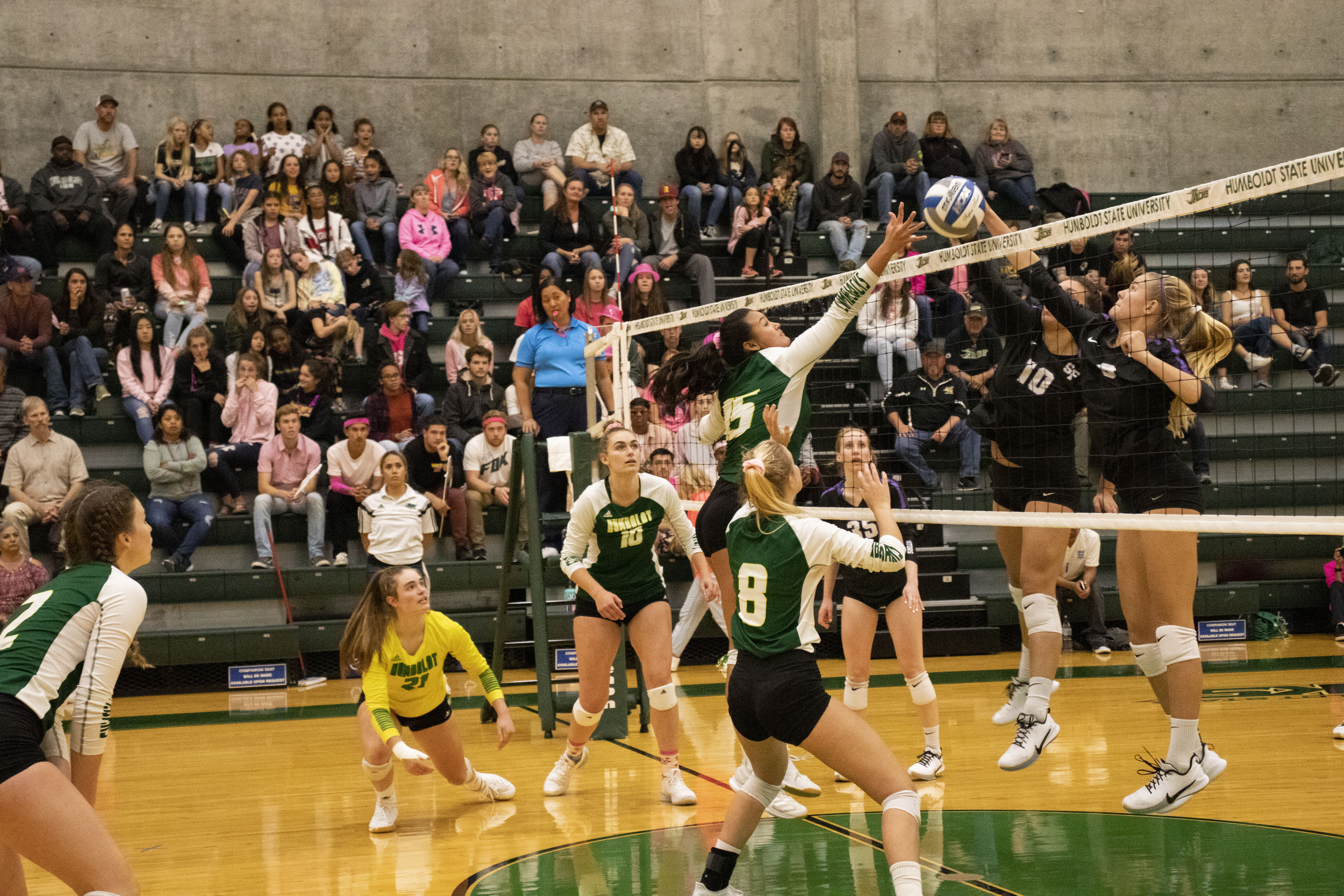
Riley Tishlarich sets the ball for her teammates during the Jacks’ match against San Francisco State on Oct. 12 at Lumberjack Arena. | Photo by Thomas Lal
Humboldt State put themselves behind early on in the first set, giving up six straight points to the visitors allowing the score to stretch out to 12-7.
Throughout the remainder of the set, the Jacks never managed to string together consecutive points. San Francisco took the opening set with a score of 25-13 as Humboldt did not respond fast enough to their defense.
Not much changed for the Jacks as they started slow in the second set and conceded the first four points. Humboldt found their offensive groove result in an impressive eight-point run and the Jacks took the second set 25-21.
Outside hitter Lexi Riggs jumps into the air to put the ball back over the net during Humboldt State’s match against San Francisco State on Oct. 12 at Lumberjack Arena. | Photo by Thomas Lal
Humboldt changed things up and came out swinging hard at the start of the third set. The Jacks were able to hold their lead for much of the set. It wasn’t long before the Gators tied it up at 20-20.
What followed was a blistering back and forth that saw the score at 24-23 in favor of the visitors with 25 points needed to take the set. In a moment that stunned the Humboldt State athletes and fans alike, outside hitter Lexi Riggs hit the ball over the net and was initially awarded a kill before the referee reversed the decision, calling the ball out of bounds and allowing San Francisco to take 2-1 lead over a now frustrated Jacks team.
The home crowd reacts to an overturned call that led to the Jacks losing the second set during their match against San Francisco State on Oct. 12 at Lumberjack Arena. | Photo by Thomas Lal
The fourth and final set of the night saw an agitated Humboldt team consistently outplayed as the Gators capitalized on the home squad’s frustration to a much higher degree. In a quick series of plays, San Francisco built themselves an 11 point buffer that almost entirely neutralized any momentum that Humboldt may have established in the previous set. The Jacks only managed a few scoring runs, and the Gators finished off the set 25-14 and took their first win on the road for the season.
After the game, Head Coach Kelly Wood was frustrated with her team’s performance, indicating that there wasn’t enough grit in their play during the match.
“Overall, our team does not have enough of a competitive spirit,” Wood said. “We don’t play with toughness. We’re too nice out there on the court. Great group of girls, but we get out there, and we are just allowing teams to manhandle us basically, and I’m very frustrated right now with our performance.”
For these three athletes, weightlifting is more than just exercise, it’s a lifestyle
While many people are still sleeping or barely getting ready at 8 a.m. on a Saturday morning, powerlifter Lecsi Prince opens the doors of Arcata Health Sport and walks towards the weightlifting cage.
Prince warms up in the open-air weightlifting area and slides four 45 pound plates, two 25 pound plates and two 10 pound plates onto a bar. She pauses in front of the bar now loaded with 295 pounds. Prince clears her mind, sucks in a deep breath, bounces on her toes, quickly leans in and heaves the weight up onto her shoulders. Keeping her legs stable and her toes pointed out, Prince dips down slowly and up again. After three reps, Prince sets the bar down and exhales.
Kinseology major Lecsi Prince prepares for her morning workout at HealthSport at 8 a.m. Prince is a powerlifter and has osteoarthritis with a dream of changing the lives of people through exercise. | Photo by Jose Herrera
Twenty-three-year-old Humboldt State University student and kinesiology major Prince has four years of powerlifting experience. At 14, doctors diagnosed her with rheumatoid arthritis, a chronic autoimmune disease that affects the joints. It didn’t stop her from playing tennis in high school, and it doesn’t stop her now.
“I’ll have arthritis flares that will make it hard for me to even hold the bars,” Prince said. “So I’ve hit points where I go to the gym into a bench day and I can’t even wrap my fingers around the bar.”
When her joints are in too much pain and she’s unsure whether to take painkillers, Prince said she decides to not train for a day. Instead, she finds other activities that benefit her health; sometimes she hikes and other times she goes to the sauna as a means of heat therapy.
“On those days, it’s all a mental game,” Prince said. “My thoughts are that I’m so frustrated and I can’t do anything. It’s this draining helplessness. I’m not able to lift, but I can do something else healthy.”
Like Prince, Olympic weightlifter Luis Ruiz and women’s strength and conditioning coach Sierra Lathe are no strangers to overcoming their bodies’ barriers.
The three weightlifters have conditions and injuries they constantly work through to improve their form and records. Ruiz deals with recurring pinched nerves and Lathe has pre-existing injuries she sustained while playing sports in high school. Their injuries become more prevalent if they are not as cautious.
Sierra Lathe, the stength and conditioning coach for womens and mens crew teams, snatches 95 lbs while in the Student Recreation Center at Humboldt State University. Lathe graduated HSU in spring 2019 and now finds herself as a coach teaching athletes how to perform and train well. | Photo by Jose Herrera
Twenty-two-year-old Lathe works as a staff member for the Student Recreation Center at HSU. She graduated spring 2019 with a major in psychology and minor in child development. Lathe has a combined eight years of powerlifting and Olympic weightlifting experience.
As a former HSU athlete, Lathe now finds herself on the other side as the strength and conditioning coach for the men’s and women’s club crew teams.
“I still lift, but not as much because I don’t have time,” Lathe said. “Coaching is a whole other ball game. It’s definitely more fun teaching people how to do it now because I’ve done it for so long.”
She explains that Olympic lifting is more precise movements that use different parts of powerlifting together while powerlifting is “getting real big and strong” through three main exercises: squatting, deadlifting and benching. This is something Ruiz knows all too well.
Ruiz, 24, competes in national Olympic weightlifting competitions such as the USA Weightlifting Nationals, USA Weightlifting American Open and University Nationals. Ruiz placed second at the 2019 University National & placed fifth at the Under 25 championship in March. He can back squat 615 pounds and can do Olympic weightlifting movements like the snatch with 319 pounds and the clean and jerk with 405 pounds.
He says the pinched nerves are something that his body deals with on its own.
“I won’t be able to do everything that I need to and I definitely can tell in my body,” Ruiz said. “Part of it is that doing this for five years, ten years, or however long you do it, it definitely will take a toll on your body.”
Injury and pain is something Ruiz knew would be part of the bodybuilding process, but if given the opportunity, Ruiz wouldn’t change a thing.
“My mom thinks it’s a dangerous sport and she wishes that I wouldn’t put my body through what I do put it through,” Ruiz said. “But they’ve never told me that I needed something else to do. They understand that this is how I stay active and happens to be something I’m good at and so I compete in it.”
Prince and Lathe said they experience different issues as women athletes.
Sierra Lathe, the stength and conditioning coach for womens and mens crew teams, holds 110 lbs over her head while in the Student Recreation Center at HSU. | Photo by Jose Herrera
Lecsi Prince places knee wraps on themselves in preparation for 300lb squat. | Photo by Jose Herrera
Kinesiology major Lecsi Prince lifts and readies to squat 210lbs out in the cage at HealthSport during her early morning workout. Prince has osteoarthitis but continues to exercise because it’s their lifestyle. | Photo by Jose Herrera
“You have all these expectations as a woman,” Lathe said. “If you’re too strong, it’s too much. And if you’re too nice, it’s not enough. So, being able to be an athlete for so long feels pretty good.”
Lathe said people, generally men, stare when she trains, but that she’s used to it as a woman in sports.
“Especially if you’re someone who knows what you are doing,” Lathe said. “You’re either judged or not taken very seriously even though you know what you’re talking about.”
There are also moments where men approach Lathe about random things, sometimes assuming she needs help or to make comments that aren’t appropriate for a conversation with a stranger.
But looking past those moments, Lathe says there’s a lot of community and support in the gym environment, especially from women. And Ruiz says that although weightlifting is an individual act, there’s a lot of teamwork behind the scenes from the coaching and competitive aspect of training partners.
“I think it’s super important to have people that you train with because it pushes you to have friendly competitions within training,” Ruiz said. “To have someone who’s in your same level and train with you, I feel like you benefit more because of the little competition that you guys have.”
If anything, I’d give up free time outside of school and my job to be able to train than to have a social experience. Because the gym at this point has become where I met a lot of my friends.
Luis Ruiz, Olympic Powerlifter
Lathe and Prince share the same sentiment as Ruiz and agree that the people you train with and spend time working with to achieve similar goals become your greatest allies.
“If anything, I’d give up free time outside of school and my job to be able to train than to have a social experience,” Ruiz said. “Because the gym at this point has become where I met a lot of my friends.”
HSU Athletics strength and conditioning coach and kinesiology lecturer Drew Peterson works with a variety of students with different skill levels who come through the Student Recreation Center.
Peterson said that Prince, Ruiz and Lathe achieve great feats of strength and he believes physical strength is the key to activity and fitness.
“Anybody can get stronger and change your physique and increase your physical capacity,” Peterson said. “It just takes getting in here and doing a good job being consistent and staying on a structured program.”
Weightlifting comes with a set of drawbacks just like any other sport, but it remains a therapeutic process for Prince, Ruiz and Lathe. And the next day the three of them do what any average weightlifter does to get better – train again.
“I have a different perspective than most because my body does limit me,” Prince says. “For me it’s more of a therapy. It’s more of that I can push my body to this and nothing else in the world matters other than me just in the moment doing what I love.”
Playing collegiate sports and taking a full-time schedule is the equivalent of having two full-time jobs
During an online-only episode of “The Shop,” California Governor Gavin Newsom signed Senate Bill 206, or the Fair Pay to Play Act on Sept. 30.
Along with several other former college athletes, Newsom believes college athletes, especially Division I athletes, deserve compensation for their hard work and dedication to the game that makes their “bosses” rich.
“Colleges reap billions from student athletes but block them from earning a single dollar,” Newsom tweeted. “That’s a bankrupt model.”
Despite Humboldt State being a NCAA Division II program, we still agree that our athletes deserve some type of compensation based on the amount of revenue our athletic program brings in.
“The Shop” is a HBO talk show owned under the digital sports media company Uninterpreted. During the episode, Newsom was accompanied by NBA star LeBron James and they both shared the news on Twitter by posting a video snippet.
In a world that is so divided, sports can bring people together. Whether an athlete plays for a professional team or a college team, the support and compassion they receive from fans remains loyal.
In professional sports, athletes sign contracts with a team or an organization. When they sign, they are agreeing to the specific payment details they were offered or that they negotiated with their organization. For collegiate sports, college athletes are offered a scholarship breakdown and have the decision of accepting it or not.
However, anyone who is up to date with our budget crisis around campus knows that our athletic program probably receives close to no money to provide to our athletes. Especially considering that we still have athletes attending HSU out of pocket to participate in an intercollegiate sports.
HSU may not seem like a great example when pushing the idea that college athletes deserve compensation, but the Fair Pay to Play Act doesn’t allow athletes to be paid by their university, it just gives them the leeway to find sponsorship and make money off their hard work.
When we consider professional athletes, endorsement deals are contracted regularly. These deals allow companies to use athletes’ names, numbers and any other marketing facet that’s agreed upon, in exchange for money paid to the athlete. College athletes do not receive endorsement offers, but they still partake in similar marketing techniques that bring in revenue for their college and coaches.
The counterargument to this case states that college athletes are provided a scholarship that pays their tuition and resources that help them get through the academic portion of school.
Although this is true, many fail to realize the dedication and time commitment it takes to be a successful student-athlete. Being a student-athlete is essentially equivalent to holding two full-time jobs: studying and playing. This doesn’t leave time for a job off-campus to provide a steady source of income.
The fact that colleges and head coaches make money off their players’ successes is ludicrous, especially when the players themselves aren’t receiving any portion of that revenue. It is this exact argument that Newsom brought to light.
The proposed bill allows college athletes to receive a portion of the revenue that their college receives and sign endorsement deals like the pro athletes they aspire to be. Although the NCAA fought against the signing of this bill, Newsom stuck to his belief. He proposed providing the NCAA with a grace period to narrow down rules and regulations in hopes of making the transition smooth and effective. Therefore, the bill does not play any effect on college sports in California until Jan. 1, 2023.
While students enjoy the time off of classes, outages act as wake up for emergency preparedness
Humboldt State University students are coping with the mass power outages that hit Humboldt just after midnight.
Kinesiology freshman Malik Bobino, who sat in the afternoon sun by the library circle, spent the day hiking. Nevertheless, Bobino said the outage was stressful.
“It’s just dead,” Bobino said of campus. “It’s like Mad Max.”
Bobino said that campus Wi-Fi is largely off, although he has been able to get signals in a few small areas.
Zoology freshman Jeanette Carini said she has mostly lounged around in the dorms.
“I slept a lot because there wasn’t much to do,” Carini said.
The view of Humboldt State University from 14th Street. | File photo by Lauren Shea
While Carini spent time catching up on lost sleep, Wildlife freshman Max Manson said the time off school is relieving.
“It’s nice not having classes today,” Manson said.
However, Manson also confirmed that, aside from the door keycard locks, all power to the dorms it shut off. Hot water is not available in the dorms, as electric water heaters are off as well.
Manson and Carini both noted that food has been hard to come by, as the lines to the J stretch out the doors and down the stairs.
As the PG&E outage affecting over 800,000 California customers enters its first official night, no definite date is set for the return of electricity.
HSU student Max Blaettler said they slept in until 3 p.m. and went to the J at 4 p.m., where they enjoyed a free barbecue dinner.
“It was alright,” Blaettler said. “And it was free.”
As the PG&E outage affecting over 800,000 California customers enters its first official night, no definite date is set for the return of electricity.
However, reporting by Lost Coast Outpost has suggested that power could return as early as tomorrow, if high winds die down and PG&E finds no damage to transmission lines.
At HSU, students said they have already learned prepare better for next time.
“Next time we’ll stock up,” Manson said.
“Definitely have supplies,” Bobino said. “Like back-up chargers.”
Humboldt State’s Lenox Loving establishes herself as a top volleyball player
Watching the Humboldt State volleyball team this season, it’s impossible not to notice the Jacks’ breakout performer Lenox Loving.
Standing at 5’9″, the sophomore from Fair Oaks, California isn’t the tallest player on her team in a sport that is often dominated by height. Loving makes up for that with pure athleticism and an unrelenting work effort noted by her teammates and coaches. In her second season at the collegiate level, Loving has found a regular home in the Jacks’ rotation and seems poised to solidify her place as one of the team’s top scorers.
While fans of Humboldt State volleyball may find it difficult to imagine the women’s team without the offensive powerhouse of Loving, her decision to play the game in college wasn’t made easily. Her interest in the sport initially came from watching her sister play in tournaments, which made her want to try it out for herself.
With Loving in the center, the Humboldt State volleyball team encourages each other after being scored on in their match against Cal State Bernardino at Lumberjack Arena on Sept. 21. | Photo by Thomas Lal
Loving waits to recieve a serve from Cal State San Bernardino while on the back row during their Sept. 21 match at Lumberjack Arena. | Photo by Thomas Lal
Loving takes a moment to prepare for a serve during the second set of the Jacks’ match against Cal State San Bernardino at Lumberjack Arena on Sept. 21. | Photo by Thomas Lal
“I also did soccer and track growing up,” Loving said. “So I didn’t know what sport I wanted to play in college. It wasn’t really until my sophomore year in high school that I really decided that I wanted to play in college.”
Loving began establishing herself in a hitting role during her junior and senior year with Zara Budenbender, her coach at Bella Vista High School. Budenbender coached Loving from the time that she made varsity as a freshman and knew her from coaching Loving’s sister. Budenbender believes that Loving’s ability to adapt to the game situation and be effective from all areas of the court is what put her ahead in a highly competitive club volleyball environment.
“Her senior year we also worked more on her hitting out of the back row,” Budenbender said. “So she was an attack front row or back row. She was just someone who was consistently putting the ball in the court and putting it away. So not just hitting it in, but with force that other teams couldn’t return.”
“She’s a skilled player already. But she’s making big strides because of a combination of being very coachable and having a good skill set and great athletic ability.”
Kelly Wood, Head Coach for HSU’s Volleyball Team
Despite a freshman season for Loving which saw her with only 54 kills, she bounced back and worked hard over the summer and the weeks leading into the preseason. At the time of writing this article, Loving had 104 kills in just 29 sets played. Much of her work in the spring and summer revolved around playing doubles outdoors. Head Coach Kelly Wood feels that this is one area in particular that has proven to be a strength for Loving and allowed her to elevate her game.
“She’s a skilled player already,” Wood said. “But she’s making big strides because of a combination of being very coachable and having a good skill set and great athletic ability.”
Loving acknowledges that her opening season for Humboldt State was not the most successful. But she doesn’t seem overly concerned in hindsight now that she has more experience at the collegiate level.
“I think last season just being a freshman,” Loving said. “I played like a typical freshman. I was just really nervous and I didn’t get a lot of exposure, so I wasn’t really confident in my play.”
First-year struggles behind her, Loving has emerged this year as one of the key pieces for Jacks’ volleyball success in the early stages of the season. Even with the attention directed at her individual effort, Loving often refers to the team as a whole when it comes to finding ways to score. This has not gone unnoticed by teammates who share this sentiment and have nothing but good things to say about Loving.
Lenox Loving passes a ball to her teammates during a scrimmage at practice on Sept. 25 at Lumberjack Arena. | Photo by Thomas Lal
Junior Lexi Riggs has played with Loving the last two seasons and sees having her on the team as a benefit both in performance and in personality.
“I think her athleticism is a huge advantage for our team,” Riggs said. “She just has a really good attitude and presence on the court. You never are down playing next to Lenox. She always is positive, good energy and she is just super athletic.”
This sentiment is echoed by Loving’s teammate and roommate Juliana Bertolucci, who points to the difficult nature of the outside hitter position and how well Loving can handle the ball in tough situations.
“She does well at bettering the ball,” Bertolucci said. “If there is someone that makes maybe not that great of a set or if there’s not that great of a pass she’s always ready to help out, and she’s always ready to make a better decision on the ball.”
For Riggs, Loving’s athletic success this season is just one more reason why she’s special to the team.
“I think she’s just such a great person,” Riggs said. “Everyone who knows Lenox knows she’s an awesome person and I think she’s a great athlete too. I mean, I can’t say enough. I love Lenox, she’s awesome. And we all do, It makes me super proud watching Lenox out there doing as great as she is.”
Lenox Loving waits for play to continue during a scrimmage at practice on Sept. 25 at Lumberjack Arena. | Photo by Thomas Lal
Lenox Loving (center) stands with her teammates while listening to head coach Kelly Wood during practice on Sept. 25 at Lumberjack Arena. | Photo by Thomas Lal
Lenox Loving jumps up to spike a ball for a set play during a scrimmage at practice on September 25 at Lumberjack Arena. | Photo by Thomas Lal
For her coach and teammates, Loving’s current performance is one more step in what is possible for the sophomore with two full years of competition still ahead of her. With opponents beginning to try and lock her down more frequently, Wood remains confident that she will be able to grow even further as a player.
“I’m so optimistic and hopeful to see what she’s able to do in these next couple of years,” Wood said. “Right now just all of a sudden, her confidence has appeared because she’s having the success she’s having, early on in our season.”
With the team as such a big part of her life on and off the court, Loving attributes much of her personal achievement to the whole group showing how confidence in her teammates has allowed her to achieve such high point production on an individual level.
“I wouldn’t have as many kills if weren’t for our defense and our setters,” Loving said. “Everyone on our team is so encouraging and I know that when I’m hitting, I feel confident that my back row can cover me. I’m confident that my setter is going to set me the sets that I need. It’s really nice having a team that I can just rely on so much and that has helped me succeed.”
Humboldt County residents prepare for a power outage
A power outage will hit Humboldt County as soon as midnight, and may last as long as five days according to the Humboldt County Sheriff’s Office of Emergency Services.
PG&E notified OES today that parts of Humboldt County may see power shutoffs as a result of transmission line shutoffs in California’s Central Valley, due to high winds raising the risk of wildfires.
OES Public Information Officer Meriah Miracle said Humboldt County residents should prepare for an outage.
“Humboldt County should expect power outages as soon as midnight,” Miracle said. “PG&E has not given a time frame yet, but it could be as long as five days.”
Miracle added that PG&E is currently looking into using the local King Salmon power plant to offset any shutoffs. At 4 p.m., Miracle expected an update from PG&E over the following couple hours.
According to a Humboldt County press release, OES is working with response partners and has notified local health services.
“Humboldt County should expect power outages as soon as midnight. PG&E has not given a time frame yet, but it could be as long as five days.”
Meriah Miracle, Office of Emergency Services Public Information Officer
Humboldt State University has posted a statement on their website promising further information when available, including whether classes will be cancelled. The statement urged students to charge phones and critical electronics.
Miracle said residents should follow normal emergency preparedness procedures.
“OES is urging residents to prepare just like they would for any other events,” Miracle said.
For more information, multiple press released are posted below.
A message sent out to some PG&E customers today:
Dear Valued Customer,
To protect public safety, PG&E may turn off your power overnight. Power will remain off until weather conditions improve and it is safe to restore service. To view a list of your impacted locations visit pgepsps.com. Here is what you need to know:
Please have your emergency plan ready.
If you have a backup generator, please do a safety check and make sure you have enough fuel to last a few days. Generator safety tips can be found here. Power will remain off until weather conditions improve and it is safe to restore service. We will continue to monitor conditions and will contact you with further updates. In most cases, we would expect to be able to restore power within 24 to 48 hours after weather has passed. Depending on weather conditions or if any repairs are needed, outages (weather event plus restoration time) could last longer than 48 hours. For planning purposes, we suggest preparing for multiple-day outages. If you see a downed power line, assume it is energized and extremely dangerous and report it immediately by calling 911.
For more information, including regular updates, visit pge.com or call 1-800-743-5002. Thank you,
Pacific Gas and Electric Company
From the Humboldt County website:
Humboldt County Sheriff’s Office of Emergency Services (Sheriff’s OES) is preparing for the potential shutdown of PG&E power to areas of Humboldt County. On Tuesday, Oct. 8, PG&E notified the county that it may activate Public Safety Power Shutoff (PSPS) protocols in neighboring counties due to extreme weather. Transmission lines that power Humboldt County could be affected as a result of a shutdown in another county. The shutdown could impact parts of Humboldt County within the next 24 hours.
Humboldt County is ready to respond to the effects of the power outage; however, the decision to turn off the power and the speed at which it is restored is managed solely by PG&E. The utility is working on a solution to generate power locally at its King Salmon power plant that would help offset the effects of any shutoff.
Sheriff’s OES has taken steps in preparation for a potential power shutdown after being notified by PG&E of their new PSPS program earlier this year. OES is currently operating the Emergency Operations Center (EOC) and is actively coordinating with our operational area response partners and monitoring the situation.
Sheriff’s OES has notified community partners including hospitals, skilled nursing facilities, Humboldt Senior Resource Center, PACE, Open Door Community Health Centers and other critical service providers in the county. Adult Protective Services staff are working on contingency plans to protect the most vulnerable. Local emergency services including 911 dispatch have backup power and should remain active in the event of a power shutoff.
Learn more about PG&E’s Public Safety Power Shutoffs and sign up for PSPS alerts at prepareforpowerdown.com or call 1-877-9000-PGE. PG&E is monitoring weather patterns and will provide updates to customers and Humboldt County when information is available.
Sign up for Humboldt ALERT at humboldtgov.org/alerts to receive safety information and be informed of imminent threats to personal safety or property, tailored to an address of your choosing. To receive updated information from PG&E, update your contact information at prepareforpowerdown.com. Talk to your medical provider about a power outage plan for medical devices powered by electricity and refrigerated medicines. Plan for batteries and other alternatives to meet your needs when the power goes out. Many medications are still usable for two to three days at room temperature, including insulin, which can keep for 28 to 30 days. However, if you are in doubt, please be sure to check with your medical provider. Review the supplies that are available in case of a power outage. Have flashlights with extra batteries for every household member. Have enough nonperishable food and water. Use a thermometer in the refrigerator and freezer so you can know the temperature when the power is restored. Throw out food if the temperature is 40 degrees or higher. Keep mobile phones and other electric equipment charged and gas tanks full. Know how to manually open electric garage doors and gates.
HSU’s CAPS is working to combat mental health concerns among HSU students
Rates of attempted suicide in Humboldt County stand far above national and state averages, according to Humboldt State University Health Center Director Brian Mistler, Ph.D.
“Suicide attempt rates in Humboldt County are nearly twice the national and California averages,” Mistler said in an email response facilitated by HSU Communication Specialist Grant Scott-Goforth. “And HSU students face greater systemic barriers to access health care than in other more affluent and less isolated parts of the country.”
An estimated 40% of HSU students felt elevated levels of depression according to a 2016-2017 Healthy Minds Study led by Daniel Eisenberg, Ph.D of the Healthy Minds Network, which performs web-based mental health surveys on college students.
Eisenberg has been leading an analysis of student mental health at all 23 California State Universities. In the 2016-2017 analysis of HSU, an estimated 42% of students had elevated levels of anxiety, while an estimated 4% of students attempted suicide in the last year.
Mistler tied Humboldt County’s lack of expert services to mental health.
“…HSU students face greater systemic barriers to access health care than in other more affluent and less isolated parts of the country.”
Brian Mistler, Humboldt State University Health Center Director
“Mental health is a critical basic need and it’s tied to others like having enough food, shelter and physical health care and safety,” Mistler said in the email. “Psychological needs become more important as chronic resource insecurity increases.”
Mistler clarified that HSU’s relatively high rates of mental health conditions do not appear to be caused by Humboldt itself.
“From what we know today, the increased needs among students appear to be present on the first day,” Mistler said in the email. “That is, it’s not caused by being here.”
Mistler added that many HSU students may arrive with a history of limited health care access.
“It’s also true that many students arrive at HSU having not had access to their fair share of health and counseling services in the past,” Mistler said in the email. “It’s clear from all the data that HSU’s team of health experts do a phenomenal job of helping those students who choose to seek help.”
Counseling and Psychological Services Staff Psychologist and Outreach Coordinator Dr. Elizabeth McCallion in a CAPS office on Oct. 1. McCallion said most students who visit CAPS report positive experiences. | Photo by James Wilde
HSU Counseling and Psychological Services Staff Psychologist and Outreach Coordinator Dr. Elizabeth McCallion is one of the experts working to help students.
McCallion hopes to mitigate the stigma around mental health.
“Mental health support doesn’t just have to be for when you’re having severe symptoms,” McCallion said. “It can be a way of just generally taking care of yourself. Kind of like preventative health care.”
McCallion said CAPS is working to meet students where they are, including through library SkillShops and outreach by Multicultural Specialist Cedric Aaron.
McCallion praised HSU’s mental health services but did acknowledge a lack of services in the surrounding community.
“I think in terms of the counseling center, the counseling center does a wonderful job with that support,” McCallion said. “In terms of our community, there is a need for additional mental health care. But that’s not just mental health, that’s health care in general because of where we live.”
Both McCallion and Mistler emphasized that those students who do use HSU’s services see verifiable benefits.
“Dozens of studies confirm that medical and counseling services reduce the risk for students of catastrophic outcomes, help with anxiety and depression, and increase the chances of students graduating,” Mistler said in the email. “If there’s a message here, it’s to encourage people to use the available resources.”
Mistler noted that HSU’s outreach efforts have produced an increase in student visits to counseling services of about 5% each year.
Mistler also pointed out that students that receive counseling show improved retention rates and a higher likelihood of graduating.
Mistler and Eisenberg plan to prepare a CSU-wide analysis of mental health in spring 2020, which they hope will provide more information on the state of student mental health.
Per the CAPS website: You can reach a CAPS therapist by phone at all hours at (707) 826-3236. In emergency situations, you should call Humboldt County Mental Health at (707) 445-7715 or dial 911.
You may also reach the National Suicide Prevention Lifeline at 1-800-273-8255.
Humboldt State capitalizes on strong offense and outstanding defense to defeat Warriors
Coming into Sunday’s match, the men’s soccer team had dropped an agonizing match to Chico State, setting the stage for a dominant game against the visiting Stanislaus State Warriors.
Humboldt showed up strong for the home crowd, exhibiting their goal-scoring prowess by netting three. Meanwhile, Stanislaus was unable to make a mark on the scoresheet. With 24 goals on the season, the Jacks now average three goals a game and play with the defense to back up the scoring.
The first half of the match saw fairly even play between the two teams, with both sides rushing forward to test the defenses. The Jacks’ defense allowed six shots in the first half but goalkeeper Robert Quintero stood tall in net, making three saves early on to hold the Warriors scoreless. On the offensive end of things, the Jacks failed to capitalize on a few free and seemed unable to sustain pressure in Stanislaus’ defensive zone putting just 5 shots on the board with all sailing wide of the mark.
Freshman midfielder Nicolas Falco leaps into his waiting teammates as he celebrates his first goal in CCAA competetion for Humboldt State against Stanislaus to make the score 2-0 during their match on Oct. 6 at College Creek Field. | Photo by Thomas Lal
Humboldt State midfielder/forward Angel Rodriguez (14) and mid fielder Israel Gonzalez (10) go to work on a set play from the corner kick during their match against Stanislaus on Oct. 6 at College Creek Field. | Photo by Thomas Lal
HSU midfielder Dylan Tovani throws the ball in during the team’s match against Stanislaus on Oct. 6 at College Creek Field as the home crowd watches on. | Photo by Thomas Lal
The second half of the contest saw a much more aggressive start from Humboldt State, who were immediately making deep runs into the Stanislaus side of the pitch. It wasn’t just the offense who came out looking assertive however, with Quintero coming out of the net to make a perfectly-timed tackle in the middle of the Warrior’s attack. With confidence in the defense’s ability, Jacks’ forward, Isaiah Dairo, found the back of the goal just 10 minutes into the half to score his team-leading sixth goal of the season and put Humboldt up 1-0.
The scoring would not stop there. Freshman midfielder, Nicolas Falco, buried the first goal of his college career into the top of the Warrior’s net only 15 minutes later. Following his goal, Falco made a beeline to the Jacks’ sideline jumping into a sea of his teammates all clearly ecstatic to him get on the board.
With a 2-0 score in their favor, Humboldt State eased back just a bit on the offensive front, focusing on making safe plays in the interest of protecting the lead. Even with a more defensive approach for the final stages of the game, Jacks’ midfielder/forward Devin Hauenstein chipped the ball over Stanislaus goalkeeper Justin Motzkus to score the home team’s third and final goal of the match.
Humboldt State forward/midfielder Devin Hauenstein gestures to the hear the crowd cheer louder after scoring the Jacks’ third and final goal of their 3-0 shutout against Stanislaus on Oct. 6 at College Creek Field. | Photo by Thomas Lal
Humboldt State forward/midfielder Devin Hauenstein watches as his shot that cleared Stanislaus goalkeeper Justin Motzkus’ head goes into the goal during the second half to score the final goal of the day for the Jacks in a 3-0 shutout on Oct. 6 at College Creek Field.
Humboldt State sophomore Devin Hauenstein is fouled by Stanislaus defenseman Carlos Amaya during their match on Oct. 6 at College Creek Field. | Photo by Thomas Lal
Forward Isaiah Dairo challenges Stanislaus goalkeeper Justin Motzkus during the second half as Motzkus tries to clear the ball during their match on Oct. 6 at College Creek Field. | Photo by Thomas Lal
Humboldt State forward Isaiah Dairo squares up to the net before scoring the Jacks’ first goal of the game on the way to a 3-0 shutout against Stanislaus during their match on Oct. 6 at College Creek Field. | Photo by Thomas Lal
Following his shutout performance for the Jacks, Quintero was very positive, noting that it was a strong overall performance from the team which led to their success.
“The last few games we really stepped up defensively,” Quintero said. “Today we just put it all together. Everyone stepped up, we had each other’s back on the defensive end. No goals, so that’s always good to get a shutout.”
Head Coach Fred Jungemann was also impressed with Quintero’s performance in goal and the confidence that it brought to the whole defensive line.
“Rob’s a senior leader for us and he’s a big part of what we’re doing,” Jungemann said. “When he plays like he did today, he gives the defense so much confidence and self-belief. He’s a big part of everything we’re doing back there, and I’m really happy for them to get the shutout the way they played and, obviously, Rob was a big part of that.”
Humboldt State forward/midfielder Devin Hauenstein battles for the ball with Stanislaus defenseman Adolfo Maldonado during their match on Oct. 6 at College Creek Field. | | Photo by Thomas Lal
With the win on Sunday, the Jacks moved to 5-3 this season and were able to put Friday’s loss behind them in resounding fashion. Jungemann was happy to have picked up the second game but still saw room for improvement from the weekend as a whole.
“I don’t think we can ever get past losing some points,” Jungemann said. “But certainly winning points today will give us a good taste in our mouths and hopefully give us something to build towards for next weekend.”
This website uses cookies to improve your experience. We'll assume you're ok with this, but you can opt-out if you wish. Cookie settingsACCEPT
Privacy & Cookies Policy
Privacy Overview
This website uses cookies to improve your experience while you navigate through the website. Out of these cookies, the cookies that are categorized as necessary are stored on your browser as they are essential for the working of basic functionalities of the website. We also use third-party cookies that help us analyze and understand how you use this website. These cookies will be stored in your browser only with your consent. You also have the option to opt-out of these cookies. But opting out of some of these cookies may have an effect on your browsing experience.
Necessary cookies are absolutely essential for the website to function properly. This category only includes cookies that ensures basic functionalities and security features of the website. These cookies do not store any personal information.
Any cookies that may not be particularly necessary for the website to function and is used specifically to collect user personal data via analytics, ads, other embedded contents are termed as non-necessary cookies. It is mandatory to procure user consent prior to running these cookies on your website.