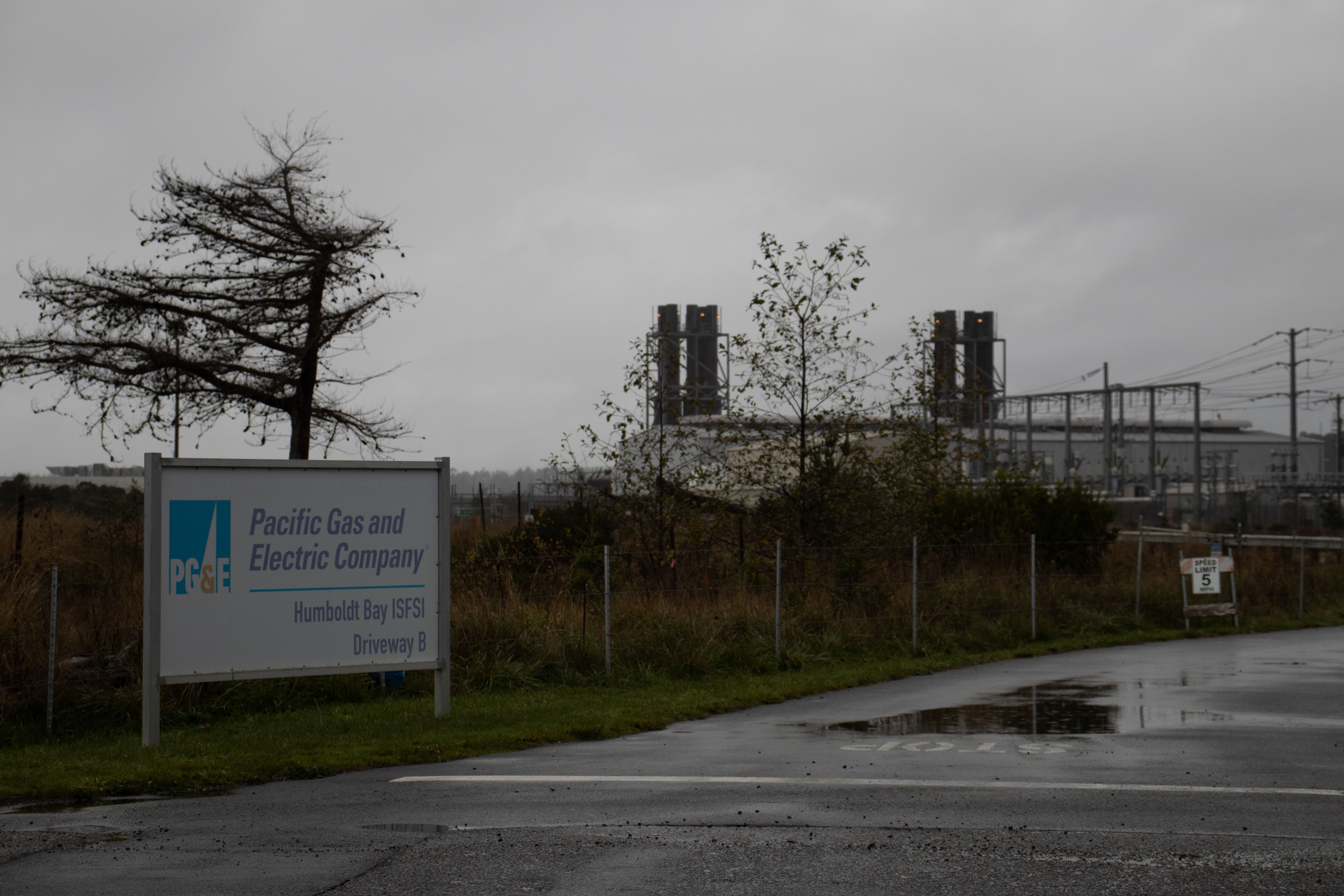
The latest Public Safety Power Shutoff by Pacific Gas and Electric is not expected to hit Humboldt County, as of Tuesday afternoon.
PG&E announced Sunday it was monitoring the weather for a possible PSPS event beginning Wednesday, but it has not included Humboldt County in any of its expected shutoff zones. The latest press release on Tuesday said the PSPS will affect 16 counties across northern California. Six counties initially expected to be impacted were removed from their list.
PG&E said the PSPS is once again caused by high winds through dry areas, leading to a high risk of fire.
“Weather forecasts continue to be dynamic with significant variation across different portions of PG&E’s service area,” the Tuesday release said. “As an example, some parts of PG&E’s territory are under a Red Flag Warning issued by the National Weather Service, while other locations are subject to a Winter Storm Advisory.”
PG&E estimated the PSPS, which ranges from Mendocino to Butte to Sonoma Counties, will affect 181,000 customers. PG&E estimated that each customer account serves three residents, so the PSPS may affect over 540,000 residents.
PG&E said it expects the winds to subside by Thursday morning, and that it hopes to restore power to most customers by the end of Thursday.
“High winds are currently expected to subside Thursday mid-morning,” the Tuesday release said. “PG&E will then inspect the de-energized lines to ensure they were not damaged during the wind event. PG&E will safely restore power in stages as quickly as possible, with the goal of restoring most customers by end of day Thursday, based on the current weather conditions.”
Abandoned towns and villages pave the way for an informative adventure
Humboldt County offers many unique features, including an abundance of ghost towns. A road trip through the green beauty of the northern county makes way for hidden spots.
Gary Speck is an author and journalist that specializes in the study of ghost towns. Speck has written for Western and Eastern Treasures Magazine since his first column in 1978. Additionally, Speck is the author of two books on the study, definition and classification of ghost towns. Speck believes studying the remnants of past communities is valuable work.
An abandoned building found in Samoa, California. | Photo courtesy Syshana Hocker
“It is vitally important to remember that each one of these thousands of communities were once filled with people,” Speck said. “Just like us, they had high hopes, dreams and aspirations for the future.”
Leaving southbound from Arcata, the first ghost town is in Samoa. Locals believe a haunting presence lives in the Eagle House, and the town’s atmosphere is eerie and abandoned buildings are prevalent. However, the town is still slightly active.
Speck elaborates on the exact defining factors of a ghost town.
“A ghost town is a town or community that at one time had a commercial or population center and is either wholly abandoned or faded greatly from its peak,” Speck said. “Now, just a shadow of its former self.”
“It is vitally important to remember that each one of these thousands of communities were once filled with people. Just like us, they had high hopes, dreams and aspirations for the future.”
Gary Speck
Don Hofacker, a curator at the Humboldt Bay Maritime Museum, shares a story of when Samoa was a booming, prosperous town for importing goods into the county. One captain had his vessel stationed in Samoa’s port. The Eagle House was a brothel at the time and the captain went for a late night visit.
According to Hofacker, the ship’s captain was supposed to wake up at four in the morning to set sail, but he was mysteriously murdered in his sleep. Hofacker says the captain can be heard around four in the morning leaving the Eagle House and searching for his ship to this day.
Further south, the next ghost town is Rohnerville, located outside Fortuna. In the case of Rohnerville, new buildings have been built on top of the previously labeled ghost town and the area is slowly becoming more populous.
One of the few abandoned houses that line the street of Bridgeville, California. | Photo courtesy Syshana Hocker
Next is the town of Bridgeville. Named after the now abandoned bridge standing over the Van Duzen River, the town is tucked off Highway 36. Like many others along the Redwood Coast, Bridgeville began as a stopover for miners and loggers in the late 1800s.
Though abandoned buildings make up almost half of the town’s infrastructure, a handful of residents still occupy the area.
Bridgeville gained notoriety in 2002 when it became the first town in history to be auctioned on eBay. The town was purchased for $700,000, only to be sold again in 2006 for $1.25 million. According to a BBC News article from that year, the latter price included three cows, eight houses and a post office.
“When the economic mainstay of the town collapsed, many times the towns were abandoned and those dreams were dashed,” Speck said. “It didn’t matter if you were a Scandinavian lumberjack, a Czech miner or an English storekeeper. Each person in these places held an important piece of the whole picture.”
Forage for free food locally while learning about your environment
If you’ve ever dreamed of living off the grid and growing your own food, foraging is the next best thing to fulfill that desire.
Foraging is a fun and rewarding way to immerse yourself in your local environment. Here in Humboldt County, there are plenty of opportunities for outdoor food morsel scouring. You can find dozens of wild plants that are both useful and edible, from anise, dandelions and yarrow to cattails.
If you know what you’re looking for, urban food foraging is quite simple. Some yards in Arcata have fruit trees that are tempting to take from, but be sure to ask for permission before picking.
If you don’t know where to start looking, you can use the Falling Fruit website or app. This site features a global map with geotagged locations of edible and useful items within your area. When you identify something new, you can mark it on the map to help others locate your foraging find.
If you want to look for wild herbs, fruits and vegetables beyond the cityscape, take a stroll to a park or the community forest and chances are you’ll find something forage-worthy, whether it’s morel mushrooms, blackberries or ginkgo.
If you aren’t well-versed in fungi identification, there are options in the wild for food finding beyond the typical mushroom hunting. It’s best to steer clear of gathering mushrooms unless you are with an expert or have definitive knowledge of a particular type you are searching for.
Foraging is a helpful way to inform yourself about natural food cycles. We often forget about the different produce seasons as grocery stores usually supply all types of seasonal produce year-round, but foraging for your own food helps you learn when produce is ready for harvesting.
Explore beyond the city streets and forested land for scrumptious surprises from the sea.
If you’re foraging for sea life, ensure you’re legally licensed to do so. You can forage for loads of coastal edibles like seaweed, snails and goose barnacles, but many items require a fishing license to take as well as prior knowledge of eligible sizes and harvesting limits.
Make sure to have the proper equipment for specific foraging needs. When coastal foraging, it’s necessary to have have measuring equipment for the sea life you’re searching for to verify your finds are within size regulations. Bring a bucket for your finds and a knife or prying tools like a spudger to scrape off treats like limpets or sea snails. Gloves and knee pads are useful, but not necessary as long as you’re cautious on slippery terrain.
Be aware of red tides and other contaminants that may affect coastal harvests. Humboldt and Mendocino County undergo an annual mussel quarantine form May 1 to Oct. 31 which prohibits mussel gathering to protect people from shellfish poisoning due to oceanic toxins. Avoid this concern by foraging for univalve organisms which don’t filter throughout their body and have singular shells, like periwinkles or black tegula snails.
Foraging for insects can also be an exciting addition to your food gathering excursions. There are hundreds of species of edible insects including crickets, weaver ants and silkworms.
Identifying edible insects can be tricky if you aren’t completely sure of what to search for. The most advisable way to consume insects would be through home cultivation of a species like mealworms or crickets.
Don’t ever consume something that you aren’t 100% sure is safe to eat, whether it’s a fungus, plant or creature. Be sure to know how to properly identify items before your search.
In addition, prepare foraged food properly. Make sure to wash findings thoroughly and cook it correctly so as to not have an upset stomach.
Remember, do not forage on private land, or at state and national parks. It’s illegal to take items including rocks, wood, berries and nuts from these parks as they’re protected by state and federal conservation regulations.
HSU graduates form stoner metal band with a new ‘garage prog’ sound
Tom Norman, Kaito Figeira and Russell Stroud make up the three piece instrumental rock band, Ultramafic. The inspiration for the name, which refers to a heavy igneous rock found in Earth’s mantle, stemmed from Norman and Figeira’s majors of art and geology.
“We both graduated and we were like, let’s make an artsy-geological rock band,” Norman said. “Do something with our degrees a little bit.”
In 2015, Norman and Figeira started the band. Norman plays the guitar, Figeira’s on the drums and Stroud plays the electric bass. Figeira and Norman have been in a relationship for eight years and share a home in Arcata that doubles as a space for band practice.
Ultramafic performing a private song in their eclectic basement which doubles as jam room on Oct. 19. | Photo by Jerame Saunders
After recording a small demo for fun, Norman and Figeira showed some friends. Under the impression the demo was from a band, they were asked to perform at a show in three weeks. Norman and Figeria agreed, but lacked a bass player. Russell Stroud was the man for the job.
“Three weeks and a few blood blisters later we got our first gig,” Stroud said.
Ever since, the band has acted as a cohesive unit. Producing music they call “garage prog,” it fits into the stoner and metal music categories. The added garage aspect represents their distorted, psychedelic sound accompanied by heavy, slow blues rhythms. The progressive nature of their rock is influenced by 70s and 80s progressive rock musicians such as Frank Zappa, Rush and Yes!
“Most of our songs are five or six small songs crammed together, but there’s a flow through it and some themes,” Norman said. “We have kind of a lot of Pink Floyd and Black Sabbath comparisons.”
Initially, the band struggled to find the right shows to play with artists that share similar music styles. But their success began in 2015; when the band found Humboldt they felt at home, becoming an immediate influence on Humboldt’s musical community.
“We are small, but bands you would never expect to come through town, come here and play,” Figeira said. “It’s a really cool scene and it brings a lot of interesting people to this area.”
Connections in the musical scene secured Ultramafic a six show tour across three states: Montana, Oregon and Washington.
“Music is life man,” Stroud said. “I can’t live without music in my life. It needs to be there everyday and playing it is even better. Getting to be apart of the collective that is creating music and getting to be one of the people that not only has put in time to play, but is decent at it too.”
The band released their newest album ‘Pyroclastic Flow’ on Oct. 31 and performed at the Siren’s Song on Nov. 2 with WitchRipper and Thundercloud.
Fern Canyon provides a beautiful, classic Humboldt scene with a stunning beach as a bonus
Hello and welcome back to the #ExploreHumboldt column, where we take an in-depth look at nearby natural areas that Humboldt State students should make a point of visiting. This week, we’re looking at one of the most heavily-photographed locations in Humboldt County: Fern Canyon.
Seriously, if you search “#HumboldtCounty” on Instagram it’s roughly 30 percent Fern Canyon photos, the rest being a mix of close-up weed shots and photos of the beach.
Fern Canyon is in Prairie Creek State Park and is part of a much larger network of coastal trails. You could spend multiple days getting lost in the 75 miles of trails or camping at the 75 sites. There’s also a 19-mile mountain bike loop for those who are interested.
The towering walls of Fern Canyon are so picturesque, they were actually used in several parts of Steven Spielberg’s classic “Jurassic Park” franchise. | Photo by Jett Williams
Fern Canyon is exactly what it sounds like, a big natural canyon with 50-foot walls completely coated in five different types of ferns. Fern Canyon trail runs through the base of the canyon, but the trail is really more of a suggestion. Once you’re in the canyon, hiking seems almost irrelevant and you’ll want to stop plenty of times to soak in the views.
The cool coastal air combined with the sound of the stream running through the canyon’s floor makes this an amazing spot for quiet relaxation and reflection. This stream also makes it very hard to navigate the canyon floor without getting your feet wet, so wear waterproof shoes if you’ve got them. Direct sunlight only reaches the canyon for a few hours each day, so bring an extra layer to avoid getting cold in the later hours of the day.
To reach Fern Canyon you’ll need a car. The turn off 101 is two miles north of Orick and a 40-minute drive from Arcata. After the turn onto Davison Road, continue for three and a half miles until you reach the state park entrance. Be aware that it’s $8 per vehicle, and they DO NOT accept credit cards. The closest ATM is Orick, so plan accordingly.
The final miles of dirt road to reach the trailhead are littered with potholes, and a stream crossing in the last mile is where less capable vehicles will have to park. Luckily, it’s a short hike from there to the trailhead, but anything with decent clearance can make it through.
Fern Canyon, like Strawberry Rock, is a very popular destination without a whole lot of square footage. This means that unless you arrive very early or very late, you will not be alone. When I visited, the parking lot was almost full. However, the park is expansive and visitors can explore at their own pace, so while Fern Canyon is never empty, I never felt crowded or like I needed more space.
Roosevelt Elk are a common sight to see in this state park, but keep your wits about you. Elk can become aggressive in an instant if they’re provoked. Keep a safe distance and use the zoom on your camera. | Photo by Jett Williams
After you’ve finished exploring the canyon, walk through the parking lot, past the bathrooms and out onto the expansive beach. Miles of flat sand stretch out in either direction, providing a stark contrast to the confined canyon walls. If you’re lucky, you might come across a herd of wild Roosevelt Elk in the coastal grass fields just inland of the beachfront.
These creatures have a six-week mating season from August to October and are aggressively protective of their young. Never directly approach or get too close to the Elk, as they can turn confrontational in a heartbeat.
Detailed maps are available at the entrance booth or online at the park’s website. Ambitious explorers can link the Fern Canyon loop into other optional trails, and turn a short excursion into a full day hike. Either way, get out there and don’t forget to #ExploreHumboldt.
A back and forth battle sends the Raiders home in sorrow
With the start of the season just around the corner, Jacks point guard Amari Green is confident that the Jacks will provide excellent results in their season opener against a good Point Loma team in San Diego on Friday.
“We’re ready, we go to San Diego on Thursday and we’ll be playing against two very good teams,” Green said. “We have the right pieces and are tight-knit as a group and as long as we stay together we are going to take it all the way.”
After dealing with a power outage during their first exhibition game and switching arenas to coincide with the HSU volleyball team, HSU men’s basketball returned to Lumberjack Arena for an exhibition game against the Southern Oregon University Raiders on Tuesday night.
As the tip-off signaled the start of the first half, the Jacks wasted no time gaining possession of the ball and building an early 12 point lead over the Raiders. Missed shots from the Raiders hindered any early progress and helped the Jacks employ effective passing strategies.
Humboldt State forward Raysean Scott Jr goes up for a layup through a crowd of Southern Oregon players in Lumberjack Arena on Nov. 5.
Jacks players were quick and efficient, but as time progressed in the first half it didn’t take long for the Raiders to overcome its faltered plays and establish a tie. Jacks forward Raysean Scott Jr made his presence known as he maneuvered around the Raiders and found the basket.
Raysean was a recipient of fouls from the Raiders, and at the free-throw line his teammates and opponents were aligned and ready to pounce on the ball at any given moment. He made five of his seven free-throws, which was enough to put points on the board.
Both teams became physically involved and the battle for possession of the ball became intense. Fouls were arising and it was crucial that the Jacks avoided any potential mishaps.
“They were calling ticky-tack fouls, so we tried to keep our hands up so [the refs] could see we weren’t fouled,” Jacks guard Leland Green said.
Despite the game becoming physical, both teams managed to keep their composure by limiting their mistakes and avoiding technical fouls. After the first half Green said their offense improved when the Raiders attempted to outscore the Jacks.
“I think we all played good,” Green said. “We let up the pressure, and as the game went on we realized we needed to apply more pressure.”
Humboldt State forward Raysean Scott Jr jumps for the shot in Lumberjack Arena on Nov. 5.
Players made their way back to the court for the second half which saw an influx of team chemistry with the Jacks. Activity from Jacks guard Isaiah Pope was at an all-time high as he delivered additional points on the board, giving his team an advantage over the Raiders.
Raysean was substituted earlier in the second half, and his return to the court towards the end became a powder keg to an already highly active crowd which almost blew the roof off Lumberjack Arena.
A staggered Raiders team dwindled in the final seconds of the game, and Raysean still delivered a blow to their morale with his slam dunk, making the final score 89-74. After the game, head coach Steve Kinder shared some inspiring words that he hopes to carry into the next games.
“Through those wars and battles you try to stay composed and poised throughout the game,” Kinder said. “Whether things are going well, you can’t get too high and when things are going poorly you can’t get too low.”
Three-game losing streak snapped by Jacks’ offense
The Humboldt State men’s soccer team defeated San Francisco State 3-1 on Saturday. It was another strong offensive outing for a Humboldt State team that has found the back of the net often this season.
The Lumberjacks impressed in the second half with goals from Isaiah Dairo, Marco Silveira and Dalton Rice. The victory snapped a three-game losing streak, bringing their overall record to 7-8, and two more games to play in the regular season.
The first half of the game was tightly contested, with both teams taking most of the time to feel out the opposing defense. The Gators’ midfield play provided a challenge for the Jacks’ offensive players as they were unable to break through the center of the field.
However, Humboldt State was able to find their rhythm as they quickly moved the ball upfield to create more space between SF State’s defenders and cut to the net. As a result, the Jacks outshot the Gators 6-4.
Humboldt State midfielder Nicolas Falco keeps the ball away from an attempted tackle by SF State’s Ramiro Palencia at the College Creek Field on Nov. 3.
Despite the Jacks’ progressive play, the Gators were able to get a shot over the head of HSU goalkeeper Tab Heinz. With just over three minutes left in the half, the Gators grabbed a 1-0 lead just before halftime.
Coming out of halftime, the already physical match ramped up as the Jacks looked to make a comeback. Just a couple of minutes into the half, Humboldt State thought they tied up the game as Dairo chipped the ball in from short-range. But, a whistle from the line ref called the play offsides.
This setback didn’t appear to have a lasting effect on the Jacks, as Dairo once again found the back of the net, putting the ball over the Gators’ goalkeeper from the penalty box. Th Jacks tied the game 1-1. The goal was Dairo’s 10th of the season as he leads the Jacks in scoring.
“They give me a lot of support and they give me a lot of energy to keep going,” Dairo said. “That’s something that made me want to stand back up and keep pushing this game. It’s up to you if you want to mentally and physically stand up and my team definitely helped me through that challenge.”
The Jacks went on to score shortly after Dairo returned to play. Silveira netted his third goal of the season by firing the ball from the right-wing and banking it in off of a Gators defender.
Humboldt State forward Marco Silvera and San Francisco State defender Damiano Sbicca battle for possession at College Creek Field on Nov. 3.
The sudden change in direction took both the defenders and the goalkeeper by surprise and sent the home crowd into a frenzy. Just seven minutes later, Humboldt State followed with another goal off of a second chance rebound as Rice rocketed the ball past the off-balance goalkeeper.
At the end of the game, Head Coach Fred Jungemann talked about how pleased he was with his team’s performance. He was particularly pleased with how the Jacks limited their defensive errors and were able to stay strong in their own zone.
“Today we really focused on minimizing our mistakes and managing the game a little bit better,” Jungemann said. “I think it showed in the result as well in only giving up only one goal.”
‘Who Killed Josiah’ examines the consequences of a divided community and the effect David Josiah Lawson’s death had on his family
In Humboldt County there are some people that don’t know about David Josiah Lawson, but others will remember his name and story for the rest of their lives.
When Karen Foshay, an executive producer for KCET – a television station in Southern California, heard about Lawson’s murder she felt she had to follow the story. Foshay produced the 29-minute episode “Who Killed Josiah?” for KCET’s news documentary series SOCAL Connected.
After three months of working on the news documentary, “Who Killed Josiah” premiered on KCET’s website, kcet.org, and YouTube on Oct. 22 and will air on KCET-HD and KCETLINK on Nov. 12, 13, 14 and 16.
Foshay’s husband attended Humboldt State University as an undergrad. In January, when she and her husband were passing through Humboldt, she found herself on the scene covering a national news story when two local girls went missing from their backyard.
“Along the way I meet a photojournalist who told me about an LA student who was killed up here,” Foshay said. “I looked into it and I was really interested. Not the death itself, but what this death did for the area.”
“We couldn’t paint the community as racist. We had to be fair and give their voices and experiences justice.”
Karen Foshay
The episode follows the murder of David Josiah Lawson, a 19-year-old Humboldt State University student, who was stabbed at an off-campus party on April 15, 2017. The show examines the consequences of a divided community and the effect Lawson’s death had on his family.
Foshay said that part of the reason she pursued Lawson’s story is because he moved to Humboldt from Perris, a city in Riverside County. She added that she understands many students move to Humboldt from Southern California. When she and her crew were investigating, they had to consider HSU’s policies, recruiting methods and how the institution approached the death of a student.
When the crew collected more information, they weren’t able to separate Lawson’s story from the area.
“The scenery and landscape is the backdrop,” Foshay said. “Rugged, scary, and drop dead gorgeous which frames the mystery of the story.”
The crew filmed at familiar places in Humboldt, such as HSU’s campus, Eureka and Moonstone Beach. The crew also interviewed recognizable local faces, such as Lawson’s mother Charmaine Lawson, photojournalist Mark McKenna and former KHSU Office Manager Lorna Byrant.
Photo courtesy of Karen Foshay
Toward the end of their investigation, Foshay said that she and her crew obtained four hours worth of dash cam footage that captured dramatic moments of the night of the murder, as well as a call a police officer made to Charmaine breaking the news of her son’s death.
“You have to keep asking questions and digging,” Foshay said.
“Who Killed Josiah?” depicts an emotional and complex story that provides a variety of perspectives from Lawson’s family and the community at large.
Foshay said that she wanted to respect the strong feelings on both sides.
“We couldn’t paint the community as racist,” Foshay said. “We had to be fair and give their voices and experiences justice.”
A week of open dialogue to learn about cultures within the Humboldt community
This week, Humboldt State kicks off its annual Campus & Community Dialogue on Race workshops. Starting Nov. 4 and lasting through to Nov. 8, the theme is Dismantling & Deconstructing To Build.
Lectures and workshops offer an opportunity for people to come together and have an open dialogue to learn about subcultures within the community. The workshops are open to all students, faculty and locals.
Programs cover topics such as intersectionality, racial justice, mental health, election activism and more. A wide variety of workshops are offered throughout the week and provide plenty of opportunities to participate. Workshops include an Intro to Social Justice Seminar, an overview of Critical Muslim Studies and a Dia De Los Muertos celebration that includes food and movies.
Several guest are scheduled to speak in the Kate Buchanan Room, University Center 225, during this event. Assistant Professor of Anthropology at Stockton University Nazia Kazi, Ph.D. speaks on Tuesday, Nov. 5. Director of the Center for Diversity & Inclusion at Sacramento State University John Johnson, Ph.D. speaks Thursday at 5 p.m. Professor and Associate Dean of the College of Integrative Sciences and Arts at Arizona State University Asao Inoue, Ph.D is scheduled to speak Nov. 8 at 10 a.m.
The CDOR started in 1998 as a recognition of America as a diverse society. Their mission statement fleshes out the intent of the multi-day event.
“The vision of Campus & Community Dialogue on Race is to achieve racial, social, and environmental justice,” the statement says. “The program’s mission is to promote and facilitate social and environmental change by engaging a diverse range of individuals, communities, and viewpoints to explore the impact of racism and its intersections with all forms of oppression.”
Hold PG&E accountable for its reckless and unprofessional behavior
During the most recent Public Safety Power Shutoffs, the Pacific Gas & Electric Company’s communication with its customers was awful.
The first time the utility shutoff power in Humboldt County was on Oct. 9. The county had less than 12 hours of notice for residents to prepare for a possible four-day outage. Humboldt was the only county in California to lose all power and initially wasn’t even on the list of affected counties.
After the outage, Michael Lewis, PG&E’s senior vice president of electric operations, said that Humboldt County shouldn’t have lost power in the first place. Although extreme weather and fire risk were at play in other counties’ outages, Humboldt went dark because of scheduled maintenance on one of the transmission lines coming into the county.
On Saturday, Oct. 26, reports from PG&E said only about 2,000 customers in Humboldt would be affected. Several hours later, PG&E corrected itself and acknowledged that all Humboldt residents would be hit with the outage.
During the most recent PSPS, the utility released news that another outage would likely hit Humboldt early Tuesday morning. Additional updates said that while many residents would regain power, it was possible that residents still without it may continue to be in the dark through to Tuesday’s outage.
When Tuesday morning came and went, locals wondered when the outage would hit. Those who regained power the day previous still had it, and conflicting reports from PG&E, the Redwood Coast Energy Authority and the Humboldt County Office of Emergency Services led to mass uncertainty about when –and if– the power would go out again.
For those PG&E customers who tuned in to one of the company’s many streamed press conferences, they were forced to wade through jargon including “operational event,” “incident commander,” and the terribly-named “Public Safety Power Shutoffs.”
Late Monday night, the Redwood Coast Energy Authority posted on Facebook that PG&E said that power in Northern Humboldt wouldn’t go out until 9 p.m. That same night, OES made its own Facebook post stating that PG&E said power was still planned to go out early in the morning.
On Tuesday morning, OES continued to stand by what it had learned from PG&E.
PG&E’s own updates from Tuesday morning listed the outage time for Northern Humboldt as 9 p.m., and as the day went on, that seemed to be likely.
Humboldt State University had no better idea of when the power would go out, as it noted in its update on Tuesday morning.
“HSU is seeking clarity from PG&E regarding the timing of a possible power shutdown,” HSU’s update said. “There has been conflicting information from the company, and in local news reports, over the last 24 hours.”
PG&E later updated its estimated timing to 7 p.m., and then, around 5 p.m., it called off any PSPS for Humboldt at all. On Facebook, OES said PG&E had given it inaccurate information.
“PG&E has provided the Humboldt County Office of Emergency Services (OES) inaccurate information regarding times of de-energization in our County,” OES said.
Communication is everything. PG&E changing times of planned outages makes sense, especially since the outages are primarily based around weather patterns. But failing to provide accurate information to emergency services and county officials is ludicrous. The company’s communication strategies are unacceptable.
As a community and state we need to hold PG&E accountable and remove ourselves from its firm corporate grip. These blackouts should be the push California needs to turn toward alternative energy and municipal utility boards, ridding the state of monopolized power once and for all.
For the second outage to affect Humboldt in less than a month, students and staff were better prepared for the darkness and the subsequent time off
After Humboldt County’s first Public Safety Power Shutoff, students and staff at Humboldt State University were better prepared when the latest outage hit the county the night of Saturday, Oct. 26.
Marine biology sophomore Tyler Nagle spent his Sunday at a beach in Trinidad with friends.
“I went to the beach, got a campfire going, roasted some s’mores and looked at the stars,” Nagle said.
While Nagle said he’s learned how to prepare for these outages, he did have concerns about the outages’ impact on classes.
“I definitely think this has taken a hit on my learning,” Nagle said. “But I hope these will be more few and far in between.”
Vice President for Administration and Finance and HSU Emergency Operations Center Director Douglas Dawes said it’s too early to make any calls about how the outages will affect the semester’s class schedule, but he said HSU will be in touch with its academic accreditor.
Otherwise, Dawes said he’s proud of the way the campus has handled the outages.
“There have been some hiccups, but we’re getting through it,” Dawes said.
Dawes said one generator failed over the weekend, but Facilities Management quickly moved around generators to keep providing power to the most essential buildings on campus including the Jolly Giant Commons, Student Recreations Center and residence halls.
“They’ve been champions,” Dawes said. “Our facilities team has been keeping everything together.”
Daniel Valencia, a sophomore kinesiology major, normally works at The Depot. During the outage, Valencia helped out at The J. When not working, Valencia said he enjoyed his hobbies.
“I picked up skating more,” Valencia said. “And I’ve been looking into hobbies like reading and painting.”
Zane Eddy, a master’s student in the environmental science and management program, came from an undergraduate program at the University of Oregon. Eddy said he was surprised by the outages.
“It’s really odd having these power outages,” Eddy said.
Eddy spent his free time going to Clam Beach and picking chanterelle mushrooms. Eddy said he believes the outages will make people understand their dependence on others for power.
“We’re part of a larger system and we’re part of a larger environment,” Eddy said.
While preparing for the outages on Friday, Interim Vice President of Enrollment Management Jason Meriwether echoed Dawes and said he was proud of how HSU handled the first outage.
“That was a positive thing that we responded to the power outage in that way,” Meriwether said. “Now, in my opinion, that’s how it should always be and that’s how it will be. But I think students were happy to know we took that approach.”
Dawes said HSU served 4,400 meals on Sunday. While he admitted that HSU incurred some significant costs in diesel and food, he said a percentage of those costs can be covered by disaster funds.
On Tuesday, HSU uploaded a response page for students wondering why classes are cancelled during the outage. The page noted concerns over safety, non-functioning technology and a focus on personal wellbeing. The page also explained why it takes time to reopen campus even once power is restored.
“It takes a great deal of time to safely re-open the campus, including powering down and disconnecting generators, resetting locks, and ensuring fire suppression systems are working,” HSU’s post said.
As of Tuesday afternoon, HSU classes are set to resume on Thursday, Oct. 31.
In the future, Dawes said HSU will likely look toward generating more of its own power.
“Having more generation for the campus would be a huge help,” Dawes said. “So we’ll be looking into doing that.”
For now, Dawes wanted to thank staff, faculty and students for restoring his faith and hope in humanity.
“We’ve got really good students that want to provide for others,” Dawes said. “And staff that really care about providing for students as well.”
With the recent Public Safety Power Shutoffs, blackouts may be a big push toward renewable energy
Public Safety Power Shutoff, blackouts could aid the push toward renewable energy. Solar micro-grids, local offshore wind farms or more well maintained power lines could be the answer to back-to-back outages.
Pacific Gas and Electric Company’s PSPS events are triggered by environmental conditions that threaten parts of their power grid. For example, a third consecutive power shutoff was originally scheduled for Tuesday morning, but changing weather patterns pushed back the timing. On Tuesday at 5:22 p.m. the county was removed from the PSPS affected counties list.
PG&E’s PSPS events are triggered by environmental conditions that threaten parts of their power grid.
“Due to diminished weather conditions, Humboldt County is no longer in the scope for a Public Safety Power Shutoff tonight and power will remain on,” said Humboldt OES in an email alert. “There are still communities without power but PG&E advises they hope to have those areas re-energized tonight.”
The nature of the power grid in Northern California renders Arcata and Eureka subject to power outages if other areas of the grid are at risk. The energy used in Northern Humboldt is imported through transmission lines to the Eureka Humboldt Bay Generating Plant, where it’s amplified for local use. If energy stops flowing through the lines to Humboldt, there is no source of energy and therefore, no electricity.
Terra-Gen, a Manhattan-based wind power company, has proposed a wind generation project for the Monument and Bear River Ridges that could provide nearly half of Humboldt’s energy. A panel discussion on the project will be held Nov. 6 at 5:30 p.m. in Founders Hall 118.
“Anticipated project features include a significant contribution to North Coast renewable energy generation and to California’s clean energy mandate,” the panel flyer says.
According to Terra-Gen, benefits of the project could include the creation of local green jobs and Humboldt Bay development. However, some local community members see the project as more consequential than not.
As California’s dry and windy seasons become the new normal, power shutoffs will likely become common occurrence.
The proposed area of development, Monument and Bear River Ridges, sit on Wiyot territory. According to the Wiyot Tribe and the California Department of Fish and Wildlife, the Monument and Bear River Ridges aren’t appropriate for wind development. The turbines could harm or destroy some of the rare and protected species that call the area home.
“Concerns raised include impacts on bat and bird deaths; tree removal; effects on sites with cultural and ecological significance to Native American Tribes; erosion and sedimentation from sub-river drilling and road expansion; visual impacts; light and noise pollution; and traffic congestion,” the flyer says.
The upcoming panel lists some of these concerns as additional talking points, but it is unclear if the company or the county have come to a conclusion on how to proceed with this particular option of alternative energy.
Alternatively, PG&E maintains that shutoffs are necessary to prevent dangerous wildfires like the Camp Fire of 2018. Any at-risk transmission line can be shut off. As California’s dry and windy seasons become the new normal, power shutoffs will likely become common occurrence. However, some individuals are taking advantage of the winds, rather than suffering from them.
Blue Lake Rancheria has tested local energy generation since 2011. The Rancheria has yet to be seriously impacted by the power shutoffs because they have solar electricity and battery storage, forming a microgrid.
Their microgrid works as a system of solar panels which power the Casino and other buildings during the day while also charging up a bank of Tesla batteries for the night. The grid can be connected or disconnected from PG&E’s grid as needed, making them sustainable without any power from the utility.
The primary barrier to building offshore wind turbines and micro grids or improving PG&E’s transmission lines is cost. Alternative energy projects cost significantly more upfront that traditional fossil fuels. The economic costs of the recent power shutoffs, however, may be enough to kickstart real conversations about alternatives.
Some areas of Humboldt County still don’t have power, however power will potentially be restored by tonight
UPDATE 10/29/19 5:25 p.m. : According to the Humboldt County Office of Emergency Services alerts, “PG&E has advised that Humboldt County is no longer in teh scope for a Public Safety Power Shutoff tonight and power will remain on.”
They also said at this time the National Weather Service does not see more weather patterns that would cause another PSPS event in the near future.
UPDATE 10/29/19 4:24 p.m. : PG&E has now stated Humboldt County will be affected by a third power outage on Oct. 29 at 7 p.m. rather than the previously reported 9 p.m.
UPDATE 10/2/19 10:00 p.m. : According to a PG&E press release Humboldt county is expected to lose power on Oct. 29 at 9 p.m. This is the most current information as of Oct. 28 at 10 p.m.
Pacific Gas and Electric Company announced in a press release they will shut power off for a third PSPS event scheduled for Oct. 29.
The utility said the next weather event responsible for the third PSPS may begin Tuesday at 6 a.m. According to the Humboldt Office of Emergency Services, power will likely be turned off before that time, although the exact time of the shutoff remains unclear.
The third PSPS event is expected to last until the afternoon of Wednesday, Oct. 30.
Power was restored at Humboldt State University mid-morning Monday, but the campus remains closed through the duration of Tuesday. There is no update for Wednesday classes as of 5:20 p.m.
PG&E has reported it could take up to 48 hours to assess the damage from the Oct. 26 PSPS, but said it is attempting to restore power to customers before the next shutoff. According to the utility company, it is possible not all customers will have their power restored before it goes off again.
Amidst the shutoff, the Student Recreation Center is open temporarily till midnight. HSU is inviting students, staff, faculty and their families to eat for free at the J until campus reopens. Parking permits are not required during the shutdown.
This story is ongoing and timing is subject to change due to changing weather patterns.
Largest intentional blackout in California history keeps millions without power while the state burns
Over two million people across Northern California were without power on Sunday. Pacific Gas & Electric is working to restore power, but the company has scheduled another Public Power Safety Shutoff, this time for Tuesday morning.
Despite the shutoffs, fires are burning across the state. The Kincade Fire, a 66,000 acre fire in northern Sonoma County, was only 5% contained as of Monday at 3 p.m. Located just northwest of Santa Rosa, the Kincade Fire has forced more than 180,000 people to evacuate, including the towns of Windsor and Healdsburg.
There are no casualties or missing persons reported as of yet, but 80,000 structures are at risk. Firefighters from as far south as Pasadena and as far north as Oregon have reported to the scene to try and stop the fire from pushing west across Highway 101.
PG&E’s shutoff is an unprecedented intentional blackout, and is the largest intentional blackout in history, according to theLos Angeles Times. The utility’s goal is to prevent high winds—which have reached upwards of 100 miles per hour in some parts of Sonoma County—from sparking wildfires.
In a PG&E press conference on Saturday, CEO and President of the utility company—but not the entire corporation—Andy Vesey said the company’s goal is safety.
“Right now we have a big, historic event coming at us,” Vesey said. “We have two and a half million customers being impacted. There’s a real threat to public safety and that’s why we’re doing this.”
Yet, across the nation, media outlets are questioning PG&E’s shutoffs.
Articles from Time, The Nation and ProPublicahave claimed that PG&E’s shutoffs may not actually reduce wildfire risk. The shutoffs could prevent debris from sparking fires from electrical wires, but that is not the only cause of wildfires. Abraham Lustgarten for ProPublicapoints to cigarettes, barbecues, generators (which are used extensively during shutoffs) and cars as other common fire starters.
“The blackouts solved nothing, of course,” Lustgarten wrote. “De-energizing the electrical grid is a bludgeon: imprecise, with enormous potential for collateral damage as people deal with a darkened world. It doesn’t even eliminate fire risk.”
To Lustgarten’s point, a structure fire on the east side of the Arcata Plaza erupted Sunday afternoon, likely caused by a generator at the Big Blue Cafe, according to reporting by the Times Standard. While firefighters contained the blaze and no injuries were reported, initial estimates for the damages are as high as $2 million.
“It’s more than just climate change. It’s about the failure of capitalism to address climate change. It’s about decades of mismanagement. It’s a story about greed.”
Gavin Newsom, California Governor
In some instances, it seems the shut offs weren’t implemented in time to prevent electrical lines from sparking fires. PG&E admitted that it registered a failed jumper cable at one of its transmission towers near the possible ignition point of the Kincade Fire right before the fire began. The area of the fire was set for a Public Safety Power Shutoff, but it didn’t begin until 28 minutes after the fire started.
The outages have pressed some government officials to speak out against the corporation and its tactics. California Governor Gavin Newsom called out PG&E for greed and mismanagement in a press conference on Thursday.
“It’s more than just climate change,” Newsom said. “It’s about the failure of capitalism to address climate change. It’s about decades of mismanagement. It’s a story about greed.”
Vermont Senator and presidential candidate Bernie Sanders tweeted that it was time to think about public ownership of utilities.
Amidst the outages, PG&E’s stock has plummeted to all-time lows. On Saturday, Governor Newsom encouraged Warren Buffet’s Berkshire Hathaway to buy PG&E.
In the Saturday press conference, Vesey declined to entertain questions about PG&E’s tainted image. Vesey said those discussions can come later as they will focus on the public’s safety for now.
“No matter how much we focus on the past, it will not help us at all today or tomorrow,” Vesey said. “We take lessons learned, we take actions, we put in our programs and we work responsibly.”
For now, California is under a statewide declaration of emergency by Governor Newsom, who has promised to hold PG&E accountable.
“We will hold them to an account that they’ve never been held to in the past,” Newsom said in a press conference. “We will do everything in our power to restructure PG&E so it is a completely different entity when they get out of bankruptcy by June 30th of next year.”
Athletes from across California traveled to Arcata to compete in the Division II cross country conference championships
On Saturday morning hundreds of runners prepared to toe the line for a California Collegiate Athletic Association cross country conference meet. Despite the impending power outage, the best of California’s Division II runners descended on the Baywood Golf & Country Club as Humboldt State hosted their first conference championship.
The women’s race was six-kilometers long, contested by 12 teams and the men’s race was eight kilometers long as ten teams aimed for the top spot.
Humboldt State’s Rosa Granados leads a small pack of runners during the CCAA conference meet at Baywood Golf & Country Club on Oct. 26. | Photo by Thomas Lal
Humboldt State junior Maddie McGarry works her way up the biggest hill on the course at the Baywood Golf & Country Club for the CCAA conference race on Oct. 26. | Photo by Thomas Lal
Humboldt State’s Cessair McKinney leads the way for the Jacks in the early stages of the women’s race while competing for position with runners from around the CCAA. | Photo by Thomas Lal
HSU’s Cessair McKinney runs past spectators on a downhill portion of the course at Baywood Golf & Country Club for the CCAA conference race on Oct. 26. | Photo by Thomas Lal
The Humboldt State women’s cross country team begins their CCAA conference race at Baywood Golf & Country Club on Oct. 26. | Photo by Thomas Lal
Humboldt State freshman Lucy Atkinson embraces teammate Liz Cano after they both completed the CCAA conference race at Baywood Golf & Country Club on Oct. 26. | Photo by Thomas Lal
The women’s race set off at 9 a.m. Humboldt State’s Cessair McKinney took an early lead for the Jacks but slowly slipped behind teammate Rosa Granados who ended as Humboldt’s top finishing runner in 16th, with a time of 22:49. McKinney finished the race in 30th with a time of 23:16.
The women’s race was six-kilometers long, contested by 12 teams and the men’s race was eight kilometers long as ten teams aimed for the top spot.
Another standout in the women’s race was the Jacks’ Yuliana Garibay who was able to work her way up the highly competitive field to cross the line in 40th, just behind teammates Rosie Melville and Saedy Williamson.
HSU Coach Jamey Harris was impressed with Granados’ run Saturday, mentioning that as one of the highlights of the meet for him.
“Rosa was a little bit of a pleasant surprise,” Harris said. “I thought top 15 was possible for her but I thought that was going to take a really, really good day and she had a really good day. Almost got top 15.”
Chico State claimed top honors in the women’s race by placing eight of their runners in the top 15 to finish with 23 points compared to second-place Cal State East Bay who finished with 81 points. The HSU women’s team placed seventh overall with 152 points beating Cal State Los Angeles and Cal State Bernardino.
A thirty-minute gap between events allowed the men to warm-up before starting their race. While the athletes were ready to get things underway, complications with the starting gun resulted in several false starts.
Humboldt State’s Evan LeDesma races alongside Cal State East Bay’s Bryan Llopis as they head down one of the slight downhills on the course during the men’s CCAA conference race at Baywood Golf & Country Club on Oct. 26. | Photo by Thomas Lal
When things finally got moving, the race was packed up for much of the first two kilometers. Humboldt’s Daniel Tull has been the team’s leader since the start of the season and continued to stick with the front pack through the early and middle stages of the competition, even taking the lead for a brief time. As the race continued, Chico once again held control in the championship race.
Tull led the Jacks in tenth followed by the Jacks’ Elliot Portillo in 43rd, and the rest of his teammates took sixth as a team. Tull was the only Jack to finish in the top 15 Saturday, but that did not stop him from pointing out that he could have finished stronger had he not led early on in the race.
“I was feeling really strong and I was with the front group for the first 6K or 7K,” Tull said. “I kind of moved up from fourth or fifth to first. The guys that I passed made a really strong move that I couldn’t really cover, so I kind of faded. Once I lost my momentum I kind of paid for that. I’m still happy with it, that’s my best race yet. But I know I could have done better.”
Portillo felt that the team’s performance was where things were expected to be, but he thinks there could be better performances up ahead for himself and his teammates.
Members of the Jacks’ Event Team which largely consisted of Humboldt State track athletes sway as they chant ‘Humboldt’ before the start of the Oct. 26 men’s CCAA conference race. | Photo by Thomas Lal
Humboldt State’s Daniel Tull laces up his spikes before the start of his last CCAA conference meet at Baywood Golf & Country Club on Oct. 26. | Photo by Thomas Lal
HSU’s Elliott Portillo comes down the chute to the finish line at the end of the CCAA men’s conference race at Baywood Golf & County Club on Oct. 26. | Photo by Thomas Lal
HSU’s Daniel Tull battles with the leading pack of runners during the Oct. 26 men’s CCAA conference race. | Photo by Thomas Lal
Humboldt State’s Joe Shanahan runs with the tight pack at the start of the men’s CCAA conference race on Oct. 26. | Photo by Thomas Lal
Runners complete their warm up before the start of the men’s CCAA conference race at Baywood Golf & Country Club on Oct. 26. | Photo by Thomas Lal
Humboldt State’s Michael Gengo outkicks CSUMB’s Jullian Dorantes-Lara by two tenths of a second at the end of the men’s Oct. 26 CCAA conference race. | Photo by Thomas Lal
“I got out pretty quick, kind of found myself slipping into a back pack,” Portillo said. “As the race strung out, some moves were made. And then definitely within the last 400 yards, my body kind of shut down on me and it was just a struggle to finish. I think as a team we had a few guys that had bad days, that didn’t quite do what they wanted. We still finished about where we were expected to so that’s a healthy sign.”
Although areas of Humboldt County have the “all clear” for power restoration, another PSPS may be scheduled for Tuesday morning
Parts of Humboldt have been given the “all clear” to begin line inspections and restorations for the current Public Safety Power Shutoff.
“PG&E notified Humboldt County Office of Emergency Services (OES) that portions of Humboldt County have been given the “All clear” for the weather event and will begin the restoration process as soon as conditions allow,” the latest update from the Humboldt County Office of Emergency Services said.
However, PG&E has also notified the county that another PSPS event may affect Humboldt as early as Tuesday morning.
“PG&E also notified OES that another weather event is scheduled for Tuesday 10-29-19 at 6 a.m. which will also result in a possible Public Safety Power Shutoff (PSPS),” the update said.
OES says it expects “a small window of time” between the two shutoffs, and urges residents to use the time to once again prepare to have no power.
“As always, this information from PG&E is subject to change,” the update said. “Updates will be provided as soon as they become available.”
“These delays in the power shut off are in part because PG&E is trying to limit the time that customers are impacted,” the update said.
PG&E increased the number of accounts within the scope of its latest Public Safety Power Shutoff today from 850,000 to 940,000. Since many accounts provide power to multiple customers, PG&E estimates that over two million people are within the PSPS scope.
PG&E expects to give the “all clear” for the windy weather event by 4 p.m. Sunday for Humboldt. However, the update clarifies that that is not when power will be restored.
“The weather “All clear” time is the time when PG&E personnel can begin inspecting the lines,” the update said. “It can take up to 48 daylight hours from the weather “All clear” time until power is restored because any damage found during the inspection will need to be repaired prior to power restoration.”
In a PG&E press conference at their headquarters in San Francisco, PSPS Incident Commander Mark Quinlan emphasized that the restoration will take different amounts of time for different areas as PG&E works to patrol 31,000 miles of lines.
“The restoration time is a sequence as well,” Quinlan said. “It doesn’t mean that every customer is going to be out for 48 hours. It means that we’re going to begin restoration activities at the times that I mentioned, and we believe we will incrementally restore everyone all the way up and not have anyone out past 48 hours.”
Our first PSPS was a wakeup call, now it’s time to go into the next blackout more ready than ever
In early October, Humboldt County residents trailed around the block at gas stations hoping to fill up their tanks and stripped local grocery stores of food, water and battery operated lights. The Public Safety Power Shutoff made us realize how often we take electricity for granted, and how we use power for most of our daily activities. Simple tasks like cooking, cleaning, eating, working and watching television all require some form of electricity.
Some locals were fortunate enough to have gas-operated stoves to make and warm food, but most of the LJ staff didn’t. Many of us rent apartments or live on campus and have electric stoves, so something as simple as warming a can of beans was nearly impossible.
With the lights out, it felt like we time traveled back to the 1800s. The usual ways of entertainment were off the table, and when we went shopping in preparation most of us didn’t consider buying board games or downloading movies to a laptop. When it came down to sitting in a dark room with nothing to do we made a pact that the next time we would be better prepared.
Having a bag prepped for extreme situations could be lifesaving, and with a little forward thinking, your bag could be ready in minutes.
Here some items we think you should grab from the store or make sure you have before the power outage:
Flashlights and batteries. An obvious choice, but oil or battery-operated lanterns work great, too.
Candles and matches/lighters. This is Humboldt, so we wouldn’t be surprised if most people had a lighter on hand or nearby, but if you don’t you should look into easy means of lighting candles (or that oil lamp) to have some light once the sun goes down.
Cash and gasoline. When the electricity is down, systems are down. This generally means that stores –if open– can’t take cards because they have no way of charging them. This can also include gas stations. We recommend filling up and taking out some cash just in case you need to buy something or drive during the blackout.
Water. You need a minimum of one gallon of water per day per person. We recommend having even more and making an effort to conserve. During the initial PSPS, the City of Arcata urged residents to minimize sewer use and conserve water to the best of their ability. That’s a good rule of thumb, and especially smart if the power outage last longer than before.
Ice. You’ll need lots of ice if you’re interested in trying to save any of the food that was already in your fridge or freezer. We also recommend moving expensive perishables to the freezer and using gallon baggies filled with water as makeshift ice packs to help keep food cold. A cooler filled with ice is also a great option. If you have the money and the storage space, buying a cooler for emergencies like these and any future camping trips could really come in handy.
First Aid kit. You may already have one hanging around. If so, check the the kit to make sure it’s well-stocked and move it to a central place in your home. Communicate the new location with any family or roommates so it’s accessible for any who may need it.
Canned goods. Think of foods you wouldn’t mind eating cold. There’s no need to buy something that will make you gag when you’re trying to stay fed.
Fruit. Apples, bananas and oranges are just a few options. Fruit doesn’t need to be refrigerated and it can help keep your blood sugar up as well as making sure you have some daily fiber, potassium and vitamin C.
Non-perishable snacks. Crackers and chips make an easy snacks but they don’t replace an actual meal. If you have means of warming up water, we recommend grabbing some potato flakes and pasta to keep that stomach from grumbling.
A French press and some pre-ground coffee. If you’re a coffee drinker then we would highly recommend grinding some coffee today. Your future self will thank you. Thankfully a French press doesn’t require electricity, but it does require hot water. If you have an electric stove, instant coffee may be your best bet to get that caffeine fix.
Beef jerky and granola bars. For all you meat eaters, jerky is a great way to keep your protein levels up if you despise cold beans. Granola bars are also great. They’re convenient and versatile, and depending on the bar, they can be a good source of fiber and protein.
Applesauce, puddings and fruit cups. Your pick. But if the power’s out for a while you might get sick of Saltines and canned corn. To keep your mood up, give yourself a treat with a chocolate pudding, or enjoy a sweet, but semi-healthy snack with an applesauce or fruit cup.
Playing cards and boardgames. Whether it’s just you or a group, a deck of cards could most definitely come in handy. Playing cards or boardgames is a great way to pass the time. We recommend a regular deck of cards to start before moving into heavier, emotional games like Uno or Monopoly that could take a toll on your relationships.
Sleeping bags and blankets. It may not be the coldest time of the year, but if you’re used to having your electric heat on, then you’re in for a wake up call. Sleeping bags and blankets, as well as sweats, long socks, hoodies and beanies will help you stay warm while your heater can’t. It’s also good practice if you’re looking for ways to lower that pesky PG&E bill.
An emergency radio. If you’re lucky, you’ll never need to use one, but having a weather radio on hand can be lifesaving. Radios can help you find hot coffee, hot food, shelter or even a place to charge your phone. Some weather radios even double-up as lights and backup chargers.
Portable chargers. These are a great investment. We recommend having one fully charged at all times. If anything happens you can make sure your phone doesn’t lose its battery. If cell towers are active or have backup generators during a blackout, having enough phone battery to call family or friends to keep them updated or ask for updates can be essential.
While all of these items are helpful and important, it’s vital to try and stay calm when the outage hits. Extreme situations can cause mass chaos, and it often becomes more dangerous and stressful than it needs to be. Check our website for updates, sign up for Humboldt County alerts to stay in the know and remember to only call 9-1-1 in emergency situations.
The upcoming blackout is expected to affect 36 counties across Northern California and last longer than before
The extreme weather at the heart of the upcoming Public Safety Power Shutoff is expected to begin Saturday early evening and last until midday Monday, according to Pacific Gas and Electric.
Despite original calculations that included only 32 counties and 640,000 PG&E customers, new information from the utility estimates the shutdown could impact 850,000 customers and possibly affect 36 counties across Northern California.
PG&E Corporate Spokesperson Deanna Contreras confirmed the updated calculations in a phone interview.
“This time there are some distribution lines that are in the PSPS scope,” Contreras said. “Whereas last time the PSPS was in transmission lines coming from outside of Humboldt that provide power here.”
Contreras emphasized that she wanted customers to understand the reasoning behind the shut-offs.
“I want people to understand why we’re doing this,” Contreras said. “It’s not just because it’s windy. I want people to understand that this is because there are serious wildfire risks during these weather events.”
Contreras’ tone matched that of the latest PG&E press release.
“The weather event could be the most powerful in California in decades,” PG&E’s statement said. “With widespread dry Northeast winds between 45-60 miles per hour and peak gusts of 60-70 mph in the higher elevations.”
According to Contreras, PG&E is working to minimize the shutoffs and is already working on a restoration plan for when the weather subsides. Contreras said the utility giant has requested help from other energy companies to speed inspections and repairs.
“These crews are expected to be staged and briefed on the restoration plan by Sunday evening,” Contreras said. “If weather progresses as expected, restoration could begin in some portions of the affected area as early as Monday afternoon.”
In response to the likely shutdown, Humboldt State will close campus from 9 a.m. Saturday through the end of Monday, Oct. 28, and encourages faculty and staff to grab belongings from offices and classrooms before buildings lock for the weekend.
During the outage HSU Dining Services will offer free meals at the J after 5 p.m. Saturday through Monday evening for staff and students that bring their HSU identification. To help prepare residents for the PSPS, Humboldt County Office of Emergency Services also posted a list of nine power outage tips to its Facebook.
“Have food for 2-3 days on hand that doesn’t require refrigeration and can be cooked on a camp stove or outdoor grill,” OES said in its post. “Remember though, never use a camp stove indoors.”
The PG&E press release is copied below:
Pacific Gas and Electric Company (PG&E) today said it continues to monitor a potentially powerful and widespread dry, hot and windy weather event expected to begin impacting the service area Saturday between 6 and 10 p.m. and lasting until midday Monday.
PG&E will need to turn off power for safety several hours before the potentially damaging winds arrive. It’s important to note that as this weather system sweeps from north to south over a period of two days, PG&E customers across Northern and Central Californiawill feel the effects of hot, dry winds at different times, which means outage times will vary, as well.
The potential Public Safety Power Shutoff (PSPS) is expected to affect approximately 850,000 customers and may impact portions of 36 counties across portions of Humboldt, the Sierra foothills, Western Sacramento Valley, North Bay, and across the greater Bay area, Monterey Bay and northern Central Coast on Saturday, Oct. 26. Customers in the southern-most portion of PG&E’s service area in Kern County could have power shut off for safety on Sunday, Oct. 27.
Predictive data models indicate the weather event could be the most powerful in California in decades, with widespread dry Northeast winds between 45-60 miles per hour (mph) and peak gusts of 60-70 mph in the higher elevations.
Winds of this magnitude pose a higher risk of damage and sparks on the electric system and rapid wildfire spread. The fire risk is even higher because vegetation on the ground has been dried out by recent wind events.
Given the forecast and conditions, PG&E is advising its customers of the potential for a widespread PSPS lasting several days, intended to prevent a catastrophic wildfire. As this intense weather event approaches the service area in the next 24 hours, PG&E’s forecasts will offer sharper detail, noting that the scope may continue to change on the number of customers who will be affected.
Once again, PG&E did not initially include all of Humboldt in its outage prediction. But according to OES, all of Humboldt County will be affected.
Due to possible extreme weather conditions and fire risk, all of Humboldt County is expected to lose power when Pacific Gas and Electric implements a Public Safety Power Shutoff early Saturday afternoon.
“The latest information from PG&E is that all of Humboldt County is now in scope for this PSPS power outage,” a Humboldt County Office of Emergency Services Facebook post said on Thursday evening.
PG&E began notifying specific customers of the possible outage on Thursday evening and will continue to do so. The utility also told OES that their online address look-up tool wasn’t up to date as of Thursday night, but will be updated soon.
According to a post from the Humboldt County Government’s website, the outage is expected to last longer than the previous, which was only 28-hours, and residents should prepare to be without electricity for up to four days. The county also said the length of the outage and estimated time power could return is completely up to PG&E.
OES also made a post with nine tips for preparing for the outage. The list is copied below.
Are you prepared in the event the PSPS affects Humboldt County? There is still time to gather supplies and take steps to be ready if the power shuts off.
Here are some tips to help you get prepared.
1. Have food for 2-3 days on hand that doesn’t require refrigeration and can be cooked on a camp stove or outdoor grill. Remember though, never use a camp stove indoors.
2. Have 1 gallon of water, per day, per person for drinking and cleaning.
3. Have flashlights, battery operated lanterns or candles in a convenient location. Remember, if you are using candles, never leave them unattended, within reach of children, and keep them away from flammable items.
4. Keep your refrigerated items cold by freezing water bottles. When the power goes out, transfer the frozen bottles around items in your fridge to help keep them cold. You can also transfer items to the freezer once the power is out to keep them cold. Remember to only open your fridge when absolutely necessary and make it quick. Don’t open your fridge to check to see if it’s cold.
5. If you are getting close to needing a refill on prescriptions, do it soon.
6. Fuel up your vehicle.
7. Have cash on hand. When we lose power retailers may lose the ability to run debit and credit cards.
8. Remember to check on your neighbors. We are all in this together and we strengthen our community by pulling together.
9. Sign up for Humboldt Alert, Humboldt county’s emergency notification system. We will send out notification alerting you to any emergency that may affect you, not just a PSPS event. Click our link at the top of our Facebook page or visit Humboldtgov.org/alerts to sign up today.
For more information on preparedness, visit Ready.gov.
Due to an expected severe wind event anticipated to occur around 10 pm Saturday night, Pacific Gas & Electric (PG&E) notified the county this afternoon that it will de-energize some power lines in Humboldt County as part of the utility’s Public Safety Power Shutoff (PSPS) program. At this time, PG&E expects that 2,188 customer connections in Humboldt County will be affected. Electricity is expected to be turned off for those PG&E customers Saturday evening, possibly several hours before the wind increases.
This PSPS event is expected to last longer than the roughly 24-hour event earlier this month, which means residents who are affected may have electricity shut off for a longer period of time. The Humboldt County Sheriff’s Office of Emergency Services (Sheriff’s OES) will provide updated information from the utility as it becomes available.
The length of the outage and estimated time of restoral [sic] is entirely up to PG&E. For information about PSPS or to sign up for alerts, go to http://www.prepareforpowerdown.com or call 1-877-9000-PGE.
PG&E expects to issue maps later today that show the anticipated affected areas. The Humboldt County Sheriff’s Office of Emergency Services (Sheriff’s OES) will provide those maps and any information regarding affected areas as it becomes available. If the shutoff is isolated in Humboldt County, or includes distribution lines in our area, ground inspection may take longer than the aerial inspection completed after the Oct. 9th shutoff before restoration can begin.
The overall PSPS is expected to affect 32 California counties and approximately 640,000 customer connections. As conditions may continue to change and the scope of this event may be expanded, the county recommends that all county residents be prepared for an extended power outage beginning Saturday night.
Dry vegetation and high winds were a major factor in PG&E shutoff
The morning of Oct. 8, Humboldt County residents were notified that Pacific Gas & Electric may shut off power county-wide. HSU students and faculty began rapidly preparing for the possible outages, but some wondered what forced the utility giant to turn off the power.
Leading up to the blackout, rumors spread as people speculated why PG&E decided shutting off power was the best option, and others wondered how long the outage could last. It seemed there was a lack of communication, as only some local professionals seemed to know the details.
On the night of Oct. 9, HSU Facilities and Management employee Brian Wheeler was responsible for filling up HSU’s generator. The diesel generator was the only thing standing between powerless students and the cold, dark night.
Wheeler said he had heard about an algorithm PG&E made to inform them when to shut off the power. This was confirmed by Megan McFarland, a spokesperson for the company. McFarland said no single factor drives a Public Safety Power Shutoff since each situation is unique.
PG&E carefully reviews many criteria when determining if power should be turned off for safety. These factors generally include, but are not limited to:
A Red Flag Warning declared by the National Weather Service.
Low humidity levels, generally 20% and below.
Forecasted sustained winds above 25 mph and wind gusts in excess of approximately 45 mph, depending on location and site-specific conditions such as temperature, terrain and local climate.
Condition of dry fuel on the ground and live vegetation (moisture content).
On-the-ground, real-time observations from PG&E’s Wildfire Safety Operations Center and observations from PG&E field crews.
To get a better grasp on the situation and its factors, The Lumberjack contacted the Woodley Island National Oceanic and Aeronautic Administration. Meteorologist Jeff Tonkin understood the specifics and why PG&E could be forced to make such a decision, but believed that Humboldt County wasn’t initially a part of the plan for a reason.
“PG&E shuts down based on wind speed if it is projected to cause a disruption or a failure,” Tonkin said. “Locally in Eureka, the power wasn’t shut down because of local high winds. We’re just collateral damage.”
Tonkin said NOAA had meetings with PG&E meteorologists in the past, but PG&E doesn’t consult NOAA for weather information. While getting in contact with one of PG&E’s scientists would likely be key to understanding why the power was shutoff officially, Deanna Contreras, another PG&E spokesperson, answered the call instead.
Contreras said, for this particular shutoff, the weather patterns were somewhat unique and widespread. Many forecasters compared the conditions to the devastating conditions from October 2017.
In response to the rapidly changing environmental conditions in our state, beginning with this year’s wildfire season, PG&E expanded its Public Safety Power Shutoff program to include all electric lines that pass through high fire-threat areas – both distribution and transmission.
Cotreras said there weren’t any PG&E meteorologists available but had plenty of details about PG&E’s weather system.
“Beyond PSPS information, weather geeks will find a lot to love about the new weather page,” Contreras said. “With PG&E’s weather map at your fingertips you’ll be able to check humidity, precipitation, temperatures, wind speeds and wind gusts across 70,000 square miles of Northern and Central California.”
Contreras said the page offers a seven-day regional forecast. PG&E’s Wildfire Safety Operations Center team monitors all these conditions and evaluates whether to proactively turn off electric power lines, in the interest of public safety, if extreme fire danger conditions are forecasted.
McFarland said a lot of PG&E employees live and work in regions that are affected by the shutoff and that she understands how frustrating it is to have the power turned off. She said the decision was not made lightly.
“We want customers to know that although you may not live or work in a high fire-threat area,” McFarland said, “Your power may be shut off if the line serving your community relies upon a line that runs through an area experiencing extreme fire danger conditions.”
PG&E cut power to more than 700,000 homes and businesses across Northern California, including Humboldt County, beginning early the morning of Oct. 9.
State officials have criticized PG&E, including Governor Gavin Newsom.
“This is not, from my perspective, a climate story as much as a story about greed and mismanagement over the course of decades,” Newsom said in a press conference on Thursday.
Humboldt County residents had less than 24 hours of notice, as PG&E’s initial warnings did not include Humboldt as an affected county.
PG&E sent warnings out to customers for some time about possible outages, but few were prepared for such a sudden total power shut down.
The shutoff came as a new last-resort tactic by PG&E called a “Public Safety Power Shutoff.”
The California Public Utilities Commission issued a resolution in May, supporting PSPS tactics to prevent wildfires like the Camp Fire, a wildfire that tore through Butte County, Calif. in November of last year.
“Clearly something needs to be done. There are lines breaking and they’re causing fires.”
Jeffrey Kane
The Camp Fire burned over 153 thousand acres, destroyed over 18,000 homes and killed 85 people, making it the deadliest and most destructive wildfire in California history.
California state investigators determined poorly-maintained electrical lines as the cause of the fire. PG&E was thus made responsible for the fire, and faced potential liabilities of $30 billion dollars. In January, PG&E filed for bankruptcy.
PG&E and U.S. District Judge William Alsup have since gone back and forth over the details of PG&E’s restructuring plans to repair the aging electrical lines. According to PG&E Spokesperson Megan McFarland, the utility has been working on a variety of operations.
“Our ongoing and expanded efforts include further enhancing vegetation management around power lines, conducting accelerated safety inspections of electric infrastructure in high fire-threat areas, and hardening our electric system,” McFarland said in an email.
Businesses around Humboldt reported tens of thousands of dollars in losses in sales and spoiled foods.
Humboldt State University Associate Professor of Fire Ecology and Fuels Management Jeffrey Kane said PG&E and the rest of the state are going to have to learn to manage vegetation to reduce the risk of wildfires.
“Clearly something needs to be done,” Kane said. “There are lines breaking and they’re causing fires.”
While Kane did not know the details of PG&E’s lines and practices, he said keeping vegetation away from transmission lines will require continual maintenance.
In the long-term, one model for PG&E’s future might come from San Diego Gas & Electric, as suggested by reporting in the Los Angeles Times. After a 2007 fire, SDG&E spent over $1 billion burying and insulating lines. SDG&E also sectioned off areas into separate micro-grids, so that shut offs could be more targeted and less widespread.
However, both of those practices will take time and money. Until then, PG&E will implement outages like the one triggered last week by a National Weather Service Red Flag Warning of high winds and low humidity.
The outage hit over 700,000 customers across California. In Humboldt, a late notice meant residents had only about 12 hours to prepare for what was predicted to be a three-to-five day outage.
While the outage only lasted about 24 hours in Humboldt, the outage caused widespread closures and the activation of the Humboldt County Emergency Operations Center.
Businesses around Humboldt reported tens of thousands of dollars in losses in sales and spoiled foods.
A news release from the Eureka Police Department noted a 26% increase in dispatches during the outage, but attributed the increase to nearly 40 false alarms. The five traffic collisions and three burglaries both fell within normal ranges, according to the release.
Office of Emergency Services Administrative Officer Sean Quincey said he was proud of the way the county responded and supported one another through the outage, which he said is essential in any emergency in Humboldt.
“Humboldt County is isolated,” Quincey said over the phone. “It’ll take time to get resources up here. Until then we need to support each other, and I was happy to see that happened.”
Arcata City Manager Karen Diemer shared a similar outlook over the phone.
“Humboldt County is isolated. It’ll take time to get resources up here. Until then we need to support each other…”
Sean Quincey
“I saw a lot of residents helping other residents and making sure that their neighbors were safe,” Diemer said. “So the resiliency of our community is strong.”
Unlike Humboldt, Quincey said some communities farther south received 48 hours notice—which, ideally, Humboldt will have in the future. McFarland echoed that statement.
“Our goal, dependent on weather, is to send customer alerts at 48 hours, 24 hours and just prior to shutting off power,” McFarland said.
Just before the outage, there were efforts at the Humboldt Bay Generating Plant to provide electricity for at least part of Humboldt County. But McFarland said HBGS doesn’t have the capabilities to operate when disconnected from the grid.
However, McFarland suggested that HBGS may be able to provide energy to Humboldt in future emergencies.
“PG&E does have an engineering study underway to evaluate what plant modifications would be required to add that capability,” McFarland said. “Including changes that may be required to the existing air permit to allow HBGS to operate over the range necessary when disconnected from the grid.”
The outage ultimately served as a wake-up call for the county.
“We’ve learned that this is something that we need to be more prepared for,” Quincey said.
In a press conference held at the PG&E headquarters in San Francisco on Oct. 10, PG&E CEO Bill Johnson apologized for the outage and for failures in their website, maps and call centers.
“To put it simply, we were not adequately prepared to support the operational event.”
Bill Johnson, PG&E CEO
“To put it simply, we were not adequately prepared to support the operational event,” Johnson said.
As for the future of PSPS events, Johnson said PG&E is working to prevent outages from becoming the new normal. However, Johnson made the statement with a caveat.
“Given the risk to public safety, there’s a desire to have zero spark during conditions like the ones we had over the last several days,” Johnson said. “We will very likely have to make this kind of decision again in the future.”
Corrections: A previous version of this article listed the Camp Fire’s acreage in the millions, not the thousands.
This website uses cookies to improve your experience. We'll assume you're ok with this, but you can opt-out if you wish. Cookie settingsACCEPT
Privacy & Cookies Policy
Privacy Overview
This website uses cookies to improve your experience while you navigate through the website. Out of these cookies, the cookies that are categorized as necessary are stored on your browser as they are essential for the working of basic functionalities of the website. We also use third-party cookies that help us analyze and understand how you use this website. These cookies will be stored in your browser only with your consent. You also have the option to opt-out of these cookies. But opting out of some of these cookies may have an effect on your browsing experience.
Necessary cookies are absolutely essential for the website to function properly. This category only includes cookies that ensures basic functionalities and security features of the website. These cookies do not store any personal information.
Any cookies that may not be particularly necessary for the website to function and is used specifically to collect user personal data via analytics, ads, other embedded contents are termed as non-necessary cookies. It is mandatory to procure user consent prior to running these cookies on your website.