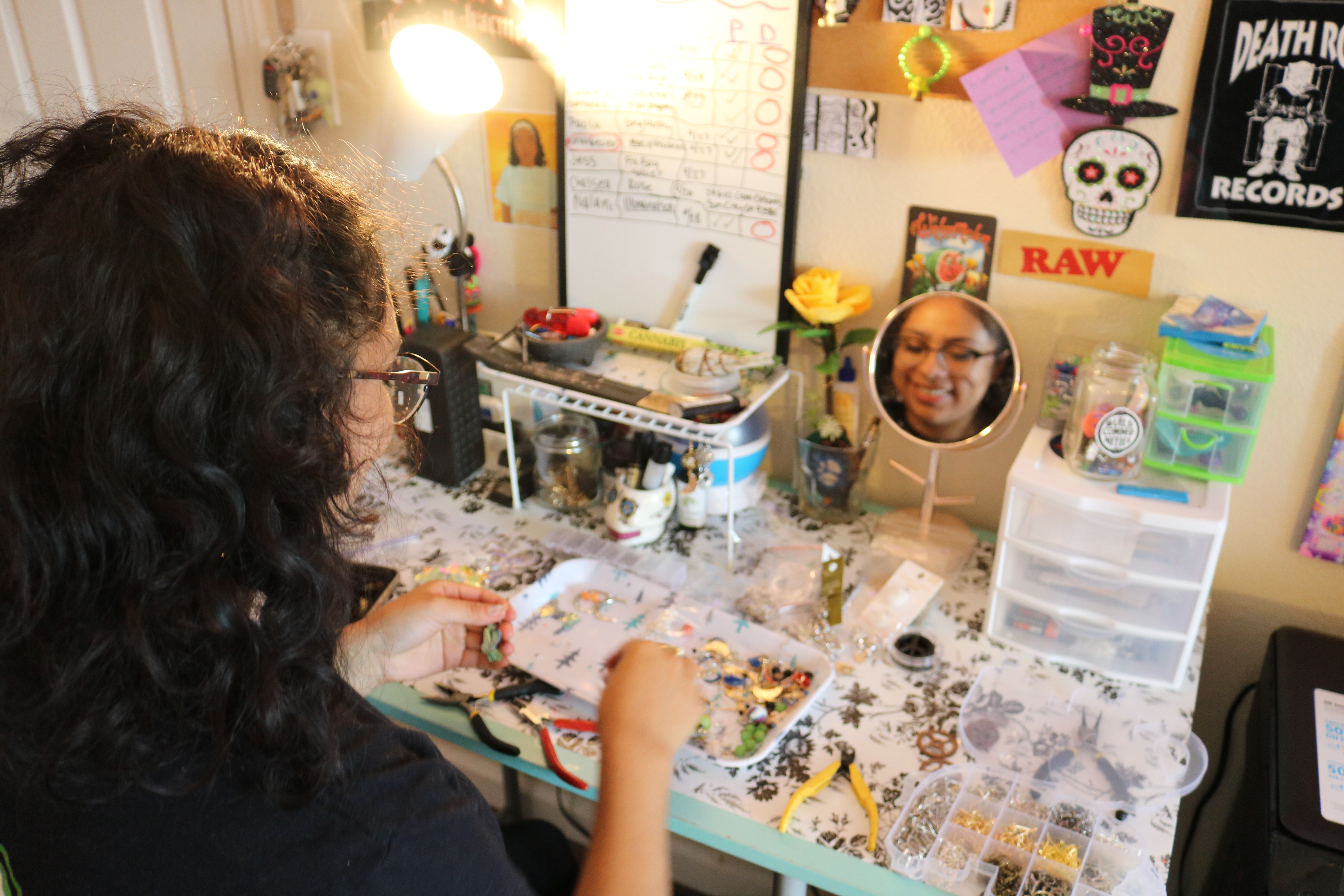
The students behind the sign comparing Humboldt to genitalia discuss their curated material
Humboldt State University has been abuzz in the last few weeks with speculation about a photo of a joke written on a sign by women. This photo, taken by myself, was printed in a parody newspaper, The Dumberjack. The Dumberjack, while produced as parody of The Lumberjack, is created as part of a separate class.
The stated intention behind the sign was to poke fun at the Humboldt County climate by relating the rainy weather to female genitalia. Six girls, Caroline Voorhees, Marian Porter, Rashell Martell, Sabrina Ott, Shannon Coburn and Whitney Burns, live in a College Creek apartment together. The original creator of the sign was Caroline Voorhees, but all of the girls have their own take on the sign’s meaning.
Question: What are your feelings toward the sign?
Marian Porter: “I personally thought it was funny. There definitely were no negative intentions for the sign. Before Caroline puts out a new sign, we all give our consent to what is being represented to our dorm.”
“I guess I am sort of happy the school takes things seriously, but they should focus on other things because there are other things more important than a dorm sign.”
Rashell Martell
Caroline Voorhees: “I felt bad that I might have hurt someone’s feelings and hurt their day. Being the person who wrote the sign, I never would have thought about it as being non-consensual. I wouldn’t want to hurt someone’s feelings or make them feel like I was making light on their bad situation. That wasn’t what I was trying to do, I was trying to talk about sex culture and have fun.”
Whitney Burns: “I also think anyone can read anything and take it in a wrong way which shouldn’t stop people from making jokes.”
Rashell Martell: “I was actually the one to find out our sign was the one being talked about in the email and I mentioned it to everyone in our group chat. More or less I found it funny. Even though I didn’t make the sign, I gave consent for the sign to be put out. I guess I am sort of happy the school takes things seriously, but they should focus on other things because there are other things more important than a dorm sign.”
Shannon Coburn: “I didn’t think anything of it and I thought we had so many worse signs. I could see how you can take it that way if you wanted to, but it was weird that they focused their time on a sign and not things that are actually happening on campus.”
Sabrina Ott: “It seems like they blew things out of proportions and it doesn’t seem like something people are focusing so much on. I also felt really bad for the newspaper. We were more worried that the newspaper took fault for something we did.”
Question: Did you think the sign meant what HSU administration decided it meant?
Caroline Voorhees: “When you are in a frame of mind to read something negatively you will. Whoever misinterpreted my joke must have been having a bad day, or had a friend that had a bad encounter, and that wasn’t the purpose of the sign. I feel bad for those people who are going through something in their life in order for them to think that statement was negative, because it was a positive statement.”
Question: How did you personally come up with the joke?
Caroline Voorhees: “It started off as just a joke living in Humboldt where it is raining all the time, but the other part came about because I did a paper on sex positivity and culture about sex and how it is not talked about often. It is definitely shamed, for women especially. So I tried to incorporate that with the weather and being sex positive and how you should enjoy yourself before you have sex with someone and how everyone should be happy all the time.”
A message from the whole dorm: “We do take people’s opinions and complaints seriously and we are sorry that we hurt anyone’s feelings, but that is not going to change our sense of humor and we will try to be more mindful in the future.”
AS Administrative Vice President will take over for the spring semester
Associated Students President Yadira Cruz resigned during the AS Board of Directors meeting on Dec. 3, citing personal reasons.
“It was a difficult decision I had to make, but it was the best option academically and personally,” Cruz said a few days later.
Cruz, who fought back tears when interviewed, said the AS Board, composed entirely of Humboldt State students, offered her consolation despite some of them seeming shocked by the decision.
“They were super supportive. Some people teared up, and a few of them apologized, but I didn’t want them to apologize because politics is politics, and it’s challenging,” Cruz said. “They thought they weren’t there for me, but they were always there.”
The AS codes provide that the AS Administrative Vice President takes over if the president resigns. In this case, Lizbeth Cano, a sophomore business administration major, will take the reins for the rest of the school year.
“It’s going to be big shoes to fill in because I got to see how Yadira got everyone involved and was able to always get people to really get their opinion,” Cano said. “One thing I’ll take from her is to make sure to get the whole room involved.”
“I think I’ll always feel a little bit of guilt, because I knew this was a year-long position.”
Yadira Cruz
Cruz was announced as the 2019-2020 academic year AS president last April. A senior criminology and justice studies major, Cruz said she ran despite her lack of political experience to try to do something with her frustration about a lack of support for student needs.
While Cruz said she’s happy with her decision to resign and with her time as president, she acknowledged a feeling of guilt.
“I think I’ll always feel a little bit of guilt, because I knew this was a year-long position,” Cruz said.
As a takeaway message, Cruz urged fellow students to make sure to take care of themselves.
“The transition will help AS become stronger, I think, moving forward.”
Yadira Cruz
“A lot of these students are working and involved and there’s a lot of things that they carry,” Cruz said. “And I think I’m just speaking as first-gen, as a student of color attending here. There’s a lot of things just added to it all, to the whole balance for schedules. But I think my point is just to take care of themselves as well—to find time.”
Cano agreed and supported Cruz in her decision.
“I think it’s time she prioritized herself,” Cano said.
Both Cruz and Cano said they still hoped for more students to get involved on campus with AS or elsewhere.
“Definitely using all of our different hats and letting people know that this is important and this is something that really matters and that they can have a say in it without it being troubling or problematic,” Cano said. “Because I think a lot of people can think that it’s too much work.”
Cruz responded to the implication of her resignation on the image of an AS position being a lot of work by saying that how much people do in AS depends on the individual and their goals. Cano agreed and added on Cruz’s point.
“I think it also has to be kept in mind that the position that’s being resigned is the president position—meaning the top position,” Cano said. “So definitely getting involved as a representative or maybe as an executive like a VP—it can be a different flow. It can really be a learning process.”
As Cano transitions into the the presidential role, Cruz said she thinks AS can learn and grow following her departure.
“The transition will help AS become stronger, I think, moving forward,” Cruz said.
Logging sports club invites competition for an axe amount of fun
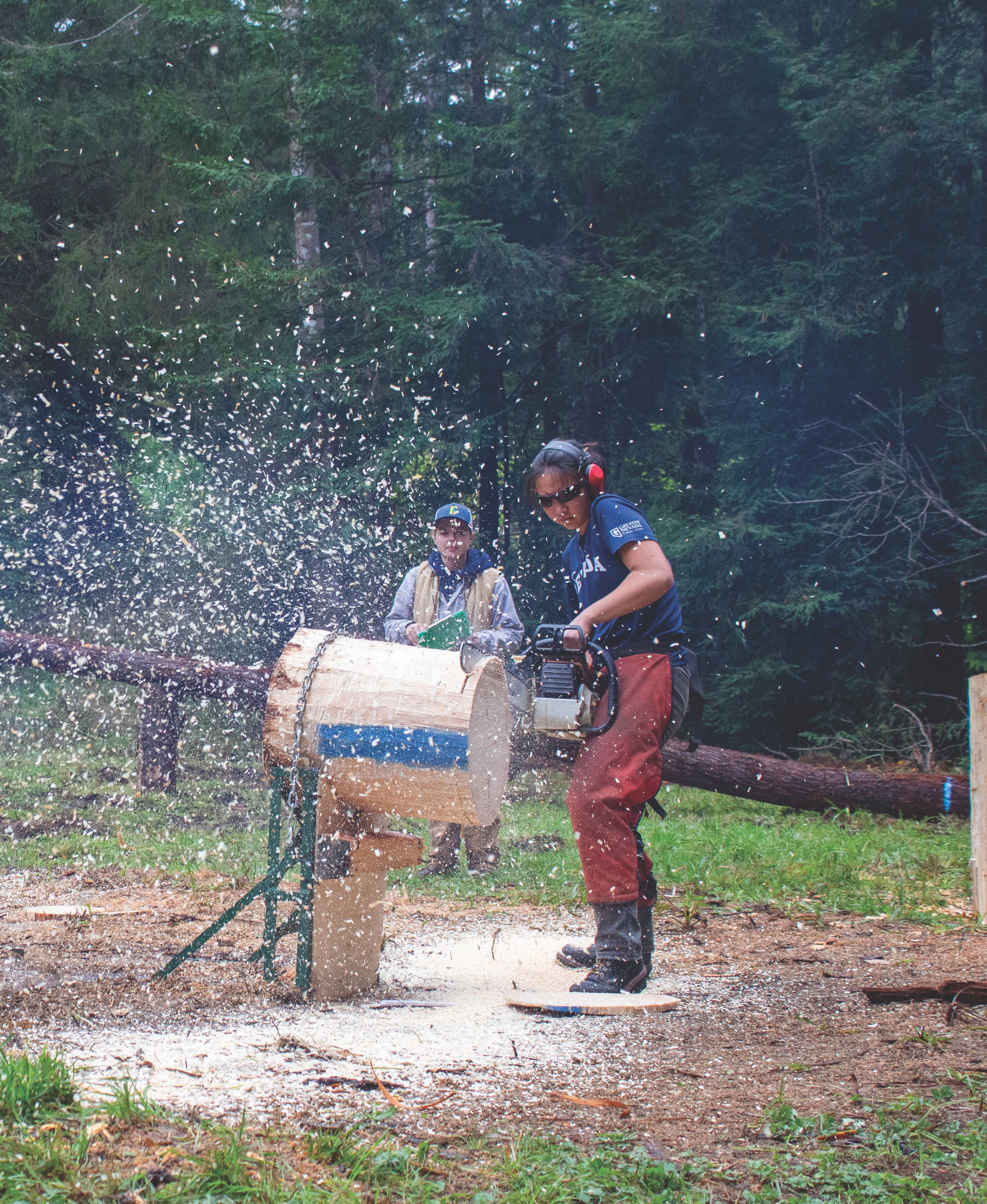
On Nov. 16, the Humboldt State Logging sports club held its annual Logtoberfest. This year they got to compete against schools including University of California, Berkeley, University of Nevada, Reno and Shasta College.
In previous years, Logtoberfest was more of a practice session for HSU logging sports. This year HSU decided to make their event an open invitational and welcomed other university logging sports teams.
Sounds of axes chopping and chainsaws revving echoed as those involved gathered around to show off their woodcutting skills. But the event was about more than just cutting wood. Logging athletes and their familiarity with each event provided entertainment while still ensuring safety.
Vice President of the club and HSU forestry major Sophia Ackerman was in her third year competing in Logtoberfest. She was happy to see the arrival of the traveling schools and the growth of her logging team.
“Our team has gotten bigger,” Ackerman said. “Logtoberfest in the past has been more like practice scrimmages against ourselves to get ready for competitions really early in the season.”
Ackerman spoke highly about one event in particular: the obstacle pole. This event required an individual to carry an active chainsaw up a tilted log and cut off a portion of it.
Another event called the horizontal chop involved a person positioning their feet on a log as they land multiple strikes until it breaks. Feet are exposed, but an important safety feature includes metallic footwear and chain-mail shin guards, so that in the event a contestant misses their intended target, no one is seriously injured.
“Because it is extremely dangerous, if you glance out you can chop your leg. You gotta be comfortable with chopping and really good with the axe.”
Jace Hunt
Ackerman participated in the horizontal chop event and wasted no time chopping the log against her Shasta College opponent. Upon completion, Ackerman sat and took a break as she watched and cheered on her opponent to finish strong. Sportsmanship among the logging athletes has allowed them to forma bond of endless support for each other.
Wildlife conservation major Jace Hunt competed in an event called the vertical chop, and after multiple swings from his axe, Hunt delivered a final blow to the log sending wood chips flying in every direction.
Despite constant sawdust and wood chips flying everywhere, maintaining an uninterrupted line of sight was a goal the athletes thrived for. However, there were some participants that saw the flying chips as a motivational obstacle.
Not only does swinging an axe demand physique but it demands discipline to assure that team members avoid inflicting bodily harm. Although this is Hunt’s second Logtoberfest, he did not compete in last year’s axe-wielding events.
“You have to be on the team for a full year before you can do the vertical chop,” Hunt said. “Because it is extremely dangerous, if you glance out you can chop your leg. You gotta be comfortable with chopping and really good with the axe.”
Students from various majors hone their argumentative skills
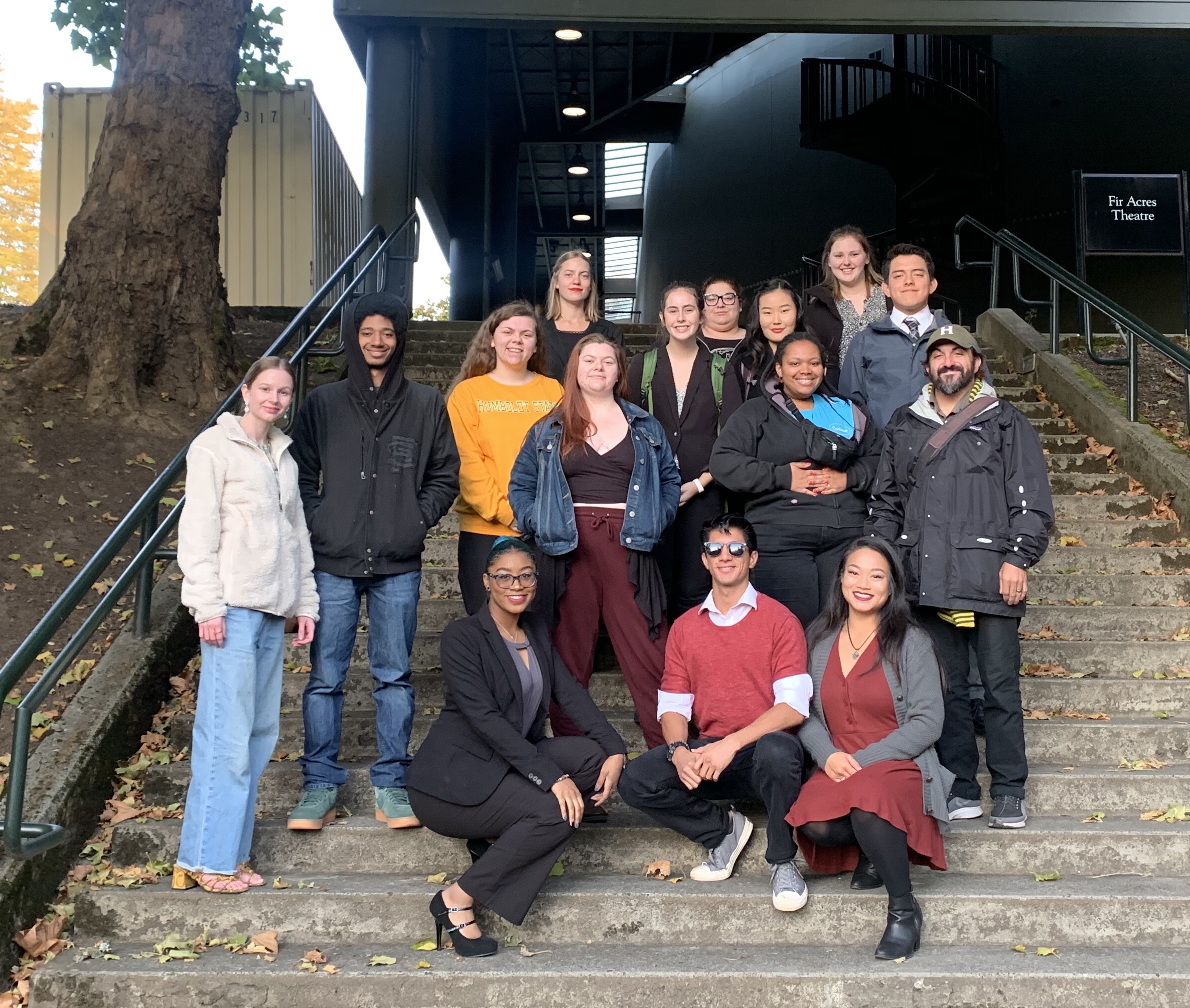
With winter break fast approaching and students preparing for finals, Humboldt State University’s debate team is pushing through with consistent practice sessions and preparing for scheduled competitions that start as soon as the spring semester begins.
Responding to a topic may seem like an easy task, but compiling synchronized responses with a teammate can be overwhelming, especially when the goal is to not contradict each others’ claims.
“Try publicly speaking about controversial issues, not knowing whether or not you will be speaking for or against your own values until 15 minutes before you have to do so.”
Kimberley Nguyen
Kimberley Nguyen, a philosophy major, is in her third semester with the debate team. She stresses over the challenging lack of preparation time before debates.
“Public speaking on its own is a difficult task,” Nguyen said. “Try publicly speaking about controversial issues, not knowing whether or not you will be speaking for or against your own values until 15 minutes before you have to do so.”
HSU’s debate team is currently practicing the British parliamentary debate method as they prepare for spring. This consists of team members pairing up, debating sides and creating counter arguments.
During one of their practice sessions, assistant coach Olivia Gainer presented the teams with the topic. The topic surrounded the opening monologue of “All the World’s a Stage” from William Shakespeare’s play, “As You Like It.” The four teams proceeded to exit the room to prepare and come back later with their responses.
“The team dynamic is definitely important and affects the way each round goes, it helps balance arguments off each other,” Gainer said. “Right now I’m looking at how well the team dynamic is and will give my input on their performance.”
Research and compiling a strong argument is a must. With evenings being the only time frame to practice their tactics, the debate team optimizes their time wisely to alleviate obstacles in later competitions.
HSU’s debate team is open to all and brands itself as a competitive sport. Exercising one’s mind to develop well constructed argument is as crucial as athletes utilizing their plays to put points on the scoreboard.
Theater Arts Department presents a production that transcends borders
The room is dark, the audience silent. On stage, right before your eyes, a story begins to unfold. Actors stride onto the set, and within seconds, they transport their audience into a world that deals with fears of family separation, job loss and deportation.
But that world is reality, as the actors break the fourth wall and address issues for immigrants and Deferred Action for Childhood Arrivals recipients.
“I read the script and I thought, ‘Wow, this needs to be told,’” Co-Director Andrea Carrillo said. “I know that there’s a good portion of undocumented people living in Humboldt County as well. It’s a great way to show the community that we see you, we hear you and we want to do what we can to share your experiences and your voices on stage.”
Humboldt State University’s Theater Arts Department will premiere a production of “Dreamers: Aquí y Allá” this weekend and next. The show features testimonials and interviews from students in the California-Mexico Dreamers Study Abroad Program, DACA recipients and community members.
“I’d say for people who have heard the story and don’t necessarily connect with the politics, I’d say, stay open minded about it. You never know what you might experience or learn. You might surprise yourself as an individual.”
Andrea Carrillo
The production is co-directed by theater art graduate students Amy Beltrán and Carrillo along with Assistant Professor Troy Lescher. “Aquí y Allá,” first produced at California State University, Long Beach, was written by Andrea Caban and presented as a collaboration between Caban, her students, material provided by Professor Armando Vazquez-Ramos and the California-Mexico Studies Center.
“This is a story that needs to be heard. You need to be here and sit with it and listen intently and openly as well,” Carrillo said. “I’d say for people who have heard the story and don’t necessarily connect with the politics, I’d say, stay open minded about it. You never know what you might experience or learn. You might surprise yourself as an individual.”
“Aquí y Allá” opens Dec. 6 in Gist Hall Theatre and continues Dec. 7, 12, 13 and 14 at 7:30 p.m. There will be a matinee at 2 p.m. on Dec. 15. Tickets are $10 for general admission and $8 for student and seniors. For tickets, visit the Center Arts website or call 707-826-3928.
After the show on Dec. 6, representatives from HSU’s Scholars Without Borders and Centro Del Pueblo will present on DACA initiatives. Following the shows from Dec. 12 through 14, Professor Vazques-Ramos will present a 30-minute lecture called “Dreamers 2020: What’s Next?” followed by a Q&A.
Georgetown study shows HSU graduates receive lowest pay over 40 years
Humboldt State University has the lowest earnings for graduates out of all 23 California State Universities, according to a recent Georgetown study.
The study said the average HSU student makes $752,000 within 40 years after graduating, which makes HSU the lowest earning CSU on the list. The average for other CSUs was around $1 million. For comparison, Chico State students reportedly made $1,018,000, while CSU Los Angeles students averaged $1,019,000.
The study measured the value of a college degree in net present value. According to the study, NPV is how much a sum of money in the future is valued today. According to Telegram.com, “this metric includes costs, future earnings and the length of time it would take to invest and earn a certain amount of money over a fixed horizon.”
“I believe it’s very important to think about the fact that the 30, 40, 50 years of a person’s working life are a lot more satisfying if it’s a job you enjoy and allows you to do the things you are passionate about.”
Alison Holmes
This fixed horizon is split into increments of 10, 15, 20, 30 and 40 years. This number is calculated by subtracting the amount of money a person can make at a minimum-wage job over that same time period, as well as taking into account student loans. This number contrasts against working a job that doesn’t require a degree. The result is the return on one’s investment.
Alison Holmes, associate professor in the Department of International Studies at HSU and a participant in the development of the career curriculum for the arts and humanities, believes the study isn’t taking enough into account.
“The frame of this research is clearly about size of income over the years after graduation,” Holmes said. “And while I would never say that is unimportant, I believe it’s very important to think about the fact that the 30, 40, 50 years of a person’s working life are a lot more satisfying if it’s a job you enjoy and allows you to do the things you are passionate about.”
Gina Kelble, an HSU freshman who sees herself going into environmental law, expects to make a decent living.
“I’ll probably end up going to [University of Colorado] Denver or CU Boulder for grad school,” Kelble said. “I have connections back at home through past internships, so those will be stronger than my Humboldt ones.”
Kelble is confident in her ability to get into grad school and dodge the bullet of making the average income of an HSU graduate.
“The study also makes the point that it’s about knowing yourself or, put another way and as I say to students, choices have consequences,” Holmes said. “There is nothing wrong with wanting money, if that’s lots and lots of money or just basic financial security. But you need to be clear that jobs have a pay scale. As a society we can work to get better pay for people, but for now, it is important to think about jobs with a very clear understanding of the pros and the cons of that choice.”
Holmes said that while money is a necessity, it stands among many others things that should be taken into account.
“As long as we send students into the world prepared to do what they want to do and always striving to fulfill their amazing potential, I am not going to spend too much time worrying about a study based on a scale based on the size of a paycheck,” Holmes said.
Dennis K. Walker Greenhouse provides a haven for a diversity of plant species
A sky full of grey clouds smothers the sun and with a chilling breeze even the most layered person shivers down to their toes. One step into the Dennis K. Walker Greenhouse transports you away from the cold into a world of warm, enticing, vivacious plants.
There are six rooms in the greenhouse: temperate, tropical, desert, fern, aquatic and the subtropical dome. Each room has an appropriate climate and a resident community of plants. Greenhouse manager Brianne Lee, along with student assistants Dabid Garcia and Courtney Harris, maintain the greenhouse at Humboldt State.
The entrance to the primary green room at Dennis K. Walker. | Photo by Deija Zavala
Leaves of a gum palm, otherwise known as a dioon spinulosm, in the subtropical dome. | Photo by Deija Zavala
Inside the Subtropical Dome at the Dennis K. Walker Greenhouse at Humboldt State University. | Photo by Deija Zavala
Anthurium scherzerianum, known as flaming flamingo, is generally native to Central America, but can be found in the Tropical Room at the greenhouse. | Photo by Deija Zavala
Spike Moss, selaginella biformis, in the Fern Room at the Dennis K. Walker Greenhouse. | Photo by Deija Zavala
Artocarpus heterophyllus, known commonly as jackfruit, in the Tropical Room. | Photo by Deija Zavala
“Essentially, the greenhouse is a living museum,” Harris said. “It’s something that we are trying to preserve here and not kill with love.”
The large botanical collection contains more than 1,000 species of plants belonging to 187 families. According to the Department of Biological Sciences website, students and faculty studying botany and biology use the greenhouse and its plant life to research and learn.
Harris, a botany major, said the greenhouse is a magical place, especially since there are only two student positions. After transfering from the College of the Redwoods in 2017 Harris was hired as an assistant.
“It feels like a unique experience being that this is such a cool staple and an important part of the botany program,” Harris said.
The job of a greenhouse assistant consists of maintaining the facility and its residents residents, which means sweeping the rooms, hand watering plants, managing pests and propagating plants.
“Essentially, the greenhouse is a living museum. It’s something that we are trying to preserve here and not kill with love.”
Courtney Harris
Garcia, a rangeland resource science major, said that there’s a lot of care and research that goes into the plants, but the goal is to make sure the plants are happy and thriving.
“Every species needs their own little formula of fertilizer,” Garcia said. “Some require more nitrogen than phosphorus and some others more potassium. We have to do our own research and sometimes that research isn’t available, so we’ll give the plant fertilizer and see how the plant reacts to it. A lot of our plants are really rare in the wild.”
The trio look out for signs indicating whether something might be wrong, such as droopy leaves and discoloration. The team also checks soil moisture levels, but all plants indicate issues to caretakers in unique ways.
Greenhouse Assistant Courtney Harris inspects a Bird of Paradise, strelitzia reginae, plant. Part of Harris’ job is to help plants pollinate. | Photo by Deija Zavala
Brooke Sharp, a child development major, explores the Fern Room at the Dennis K. Walker Greenhouse. | Photo by Deija Zavala
Inside the subtropical dome, flowers in bloom adorn many of the residents. | Photo by Deija Zavala
The Twin Spined Cactus, known scientifically as mammillaria geminispina, in the Desert Room. | Photo by Deija Zavala
Greenhouse assistants Dabid Garcia and Courtney Harris pose in the sub-tropical dome at the Dennis K. Walker Greenhouse. | Photo by Deija Zavala
“The biggest challenge is understanding how each plant reacts and responds to the care that we give it, and adjusting our behavior accordingly,” Harris said. “It requires a tremendous amount of teamwork and communication between us.”
Harris added that some plants don’t like attention while others, if left alone, will wilt and die.
Mihai Tomescu teaches plant morphology, plant anatomy, paleobotany and general botany. The trio’s work supports Tomescu in the botany department, as well as supporting the biological sciences. Faculty often use plant specimens during lectures and labs.
“Plants don’t move, and yet they are exposed to pretty much the same challenges that we are exposed to in terms of surviving. There’s all sorts of stressors. They have to procure their food and because of that, just like other types of organisms, have to have some type of behavior.”
Mihai Tomescu
Tomescu said his area of expertise and research is plant structure, including topics like how plants are put together, how they grow, how they look and how their features evolve over generations. Some of his methods include digging deep into geologic time.
“I know how they grow at the cellular level,” Tomescu said. “So coming from that perspective, I realized that one of the most fascinating things about plants that people don’t realize is that compared to us animals, and compared to what we think of in our culture about aliens, is that plants are more alien to us than the craziest aliens that human imagination has come up with.”
In his classes, Tomescu has his students visit the greenhouse three to four times a semester for assignments and brings live samples for labs when examining roots, leaves, stems, cells and other internal parts of plants.
“If you have a big botany program that emphasizes organismal biology, the diversity of plant groups and so on, then it makes sense to have something like this,” Tomescu said. “How else are you to teach your students about the diversity of plants if you can’t show it to them alive.”
Some people may question the general interest in plants because at the surface they seem not to do anything. But Tomescu said that if you are able to slow down and get pass the green blur of a forest of plants, you’ll come to find some interesting organisms.
“Plants don’t move, and yet they are exposed to pretty much the same challenges that we are exposed to in terms of surviving,” Tomescu said. “There’s all sorts of stressors. They have to procure their food and because of that, just like other types of organisms, have to have some type of behavior.”
Courtney Harris pets the cone of a dioon spinulosm in the subtropical dome. Harris was enthralled by the cone’s soft texture. | Photo by Deija Zavala
Some plants, like this one, keep pollen outside their flower ready to be blown off by wind gusts. | Photo by Deija Zavala
Because the Dennis K. Walker Greenhouse doesn’t have the aid of natural pollinators like birds and wind, assistants sometimes take pollen carefully from one plant to another. | Photo by Deija Zavala
Plant behavior is what a plant does, including how it grows. According to Tomescu, plants have control of their growth, from the depth of their roots to the direction of their leaves.
“The plant makes a lot of choices because growing in one direction or another means spending energy,” Tomescu said. “It’s very calculated — not consciously calculated– but basically plants sense their environment very well.”
In the broader sense, he said that plants make him think. Tomescu hopes more people will become interested in plants since they are so different compared to other life forms.
“It’s kind of exhilarating to realize that we live next to these super weird organisms,” Tomescu said. “It maintains this fascination that there are these organisms that do the business of living in a very different way from us.”
The Dennis K. Walker Greenhouse is available to instructors and students in the Department of Biological Sciences, and access is limited by the availability of instructors or greenhouse staff.
It is open to the public by appointment or when greenhouse staff are available. If you are interested in making an appointment contact Brianne Lee at 707-826-3678 or schedule a visit via email at bms561@humboldt.edu.
Martin Wong’s lost art reemerges to bring awareness to a new generation
Designer street style brand Supreme’s new collection highlights the life and art of Martin Wong.
Wong, who embodied creativity, empathy and empowerment, lost his battle against an AIDS diagnosis in August of 1999, but his artwork continues to inspire and act as socio-political commentary after his death.
Wong attended Humboldt State University in 1964, enrolling himself in every available art class before focusing his studies in ceramics. After graduating, Wong left the comfortable walls of university-life to influence the art scene and bring widespread awareness to minority groups often overshadowed by society.
Wong’s family, friends and supporters partnered together on a collaborative collection with Supreme showcasing Wong’s lost works.
“Tell My Troubles to the Eight Ball (Eureka)” 1978-81 | Courtesy of the Estate of Martin Wong and P·P·O·W, New York
Example from the Fall/Winter 2019 Supreme clothing line featuring Martin Wong’s work.
Example of the Fall/Winter 2019 Supreme clothing line featuring Martin Wong’s work.
Example of the Fall/Winter 2019 Supreme clothing line featuring Martin Wong’s work.
Anneliis Beadnell, Senior Director and Director of Estates at P.P.O.W Gallery, a contemporary art gallery in New York that represents Wong and his work, explains Wong’s appeal to Supreme.
“Over a year ago the artistKAWS, who is a good collector and friend of P.P.O.W, approached us to see if the Estate of Martin Wong would be interested in supporting a collaboration between Martin Wong’s work and Supreme,” Beadnell said. “The Estate was supportive, Martin’s circle of friends were encouraging and the collaboration felt right on many levels.”
The collaboration, as well as the overwhelming support towards the partnership of artist and brand, reinforces the importance of Wong’s legacy, advocacy and support represented through his artwork.
“Since Martin was interested in cultures that lived on the fringe of society, or outside the realm of the ‘art world,’ we felt that this collaboration would be successful in bringing his imagery into a new demographic.”
Anneliis Beadnell
“Through Supreme’s platform, a new generation who may not have had access to the works through visiting galleries or museums, will have a new way to enter into his work,” Beadnell said. “Since Martin was interested in cultures that lived on the fringe of society, or outside the realm of the ‘art world,’ we felt that this collaboration would be successful in bringing his imagery into a new demographic.”
Like most of Wong’s art, the graphics showcase political and sometimes controversial subjects. Elements of poverty, misfortune and ruin bring attention to the unfair and inhumane treatment of minority groups. Encapsulating inclusion and representation was Wong’s strong suit.
The ability to take those underrepresented into the spotlight ripples throughout his work. Idolizing the “unprofessional” and disrespected street artists allowed for new perspectives to emerge not only in Wong’s works, but in the art world in general.
“In his lifetime, Martin gathered one of the largest graffiti collections in the world,” Beadnell said. “Martin turned to his friendship with the graffiti [artists] for collaboration and inspiration in his own works, which often took them as the subjects of various paintings.”
According to Beadnell, Wong also created several paintings with skateboarders as the primary subjects, like “Sweet ‘Enuff,” a 1987 painting which is in the collection of the de Young Museum in San Francisco.
Capturing moments ignored by mainstream society gifted Wong the ability to cast a new light on the struggles and discrepancies in subcultures, raising widespread awareness in the art world.
“Big Heat” 1988. | Courtesy of the Estate of Martin Wong and P·P·O·W, New York
“Sharp Paints A Picture” 1997-98. | Courtesy of the Estate of Martin Wong and P·P·O·W, New York
Iglesia Pentacostal 1986. | Courtesy of the Estate of Martin Wong and P·P·O·W, New York
Amigos 19xx. | Courtesy of the Estate of Martin Wong and P·P·O·W, New York
“Malicious Mischief” 1997-98. | Courtesy of the Estate of Martin Wong and P·P·O·W, New York
This type of socio-political activism is still growing today, but there is a need for inclusion of identity and culture regardless of differences. Beadnell emphasized this and said the goal of the collaboration with Supreme was to reinforce those ideals with younger generations.
“Wanting to extend his demographic outside of the ‘art world’ speaks to wanting to continue his legacy of influence and inspiration as an artist,” Beadnell said. “There is a strong youth culture that follows Supreme and the collaboration with Martin’s work may open a door for those that purchase the items and want to learn about Martin Wong’s contribution to our visual history and culture.”
Wong’s work revolutionized the stigmas that dismissed groups from society, specifically focusing on the disadvantaged and underrepresented. From sexual orientation and economic standing to uncontrollable impairments, capturing the essence of groups often labeled insignificant or unworthy earned Wong his title of an activist and a visionary.
“Being that Martin was a gay Asian American, we hope this level of visibility will inspire others, that may have shared histories and identities, to look to Martin as a point of inspiration.”
Anneliis Beadnell
“Martin’s paintings connect to the denizens of the Loisaida, the crumbling tenement bricks and urban landscapes, the places where creative subculture thrived and since has been erased by gentrification,” Beadnell said. “The iconography that emerged through Martin’s depiction of the Lower East Side, of closed storefronts, firemen, ASL symbols, constellations and flaming eight balls became graphic points of interest for the line.”
The re-emergence of previously destroyed creative outlets allows the newer generation access to the extinguished memories and documentation of the past. The revamped accessibility stems with the hope of generating more activism for the future.
December 1 is World AIDS Day, recognizing and bringing awareness to the pandemic caused by HIV and mourning those who have died from the disease.
“Being that Martin was a gay Asian American, we hope this level of visibility will inspire others, that may have shared histories and identities, to look to Martin as a point of inspiration,” Beadnell said.
HSU’s Dining Services employees don’t receive a free meal while on shift
While many food service employees receive heavily discounted meals or one free meal per shift, dining services student employees at Humboldt State University get the same meal discounts as anyone who pays with J-points: 25% off.
Abigail Rosales, junior communications major and a floor manager at The Depot, said employees frequently complain about the minimal discount.
“It would be nice to know that our job and our work is valued,” Rosales said. “Because if we’re just getting the same discount as people who already live on campus, then there’s not really an incentive food-wise. Obviously we’re getting paid, but it’s always a nice bonus if you get any benefits while working here.”
Rosales previously worked at the fast-casual restaurant chain, The Habit Burger Grill. Employees received a free burger and fries every shift, and got 50% off everything else.
Rosales said a free or more discounted meal per shift would likely make for a better workplace.
“I think if we did get that, a lot of us would be a little less grumpy,” Rosales said. “Because sometimes we’re tired or hungry, and sometimes we just don’t have money on us, so we get irritated.”
Abigail Rosales, a junior communications major, standing in The Depot at Humboldt State University on Nov. 8. Rosales, a floor manager at The Depot, said student dining employees often feel irritated with the lack of an extra discount, but never feel like they can do anything about it.
William Weinberg, a forestry senior and College of Natural Resources representative and vice chair, said over the phone that he’d be interested in seeing HSU try a pilot program giving free meals to student employees.
“I think it would be cool if it did happen, or if they ran a pilot to see if it would work,” Weinberg said. “Would the costs of that free meal maybe make up for more work ethic, more happier workers?”
Rosales said many student employees bring their own food or have to clock out from work early to go home and eat before their next class to avoid paying for a meal. But according to Rosales, even a cheap meal would be helpful.
“Even just like the fries and a corn dog,” Rosales said. “I think those are the two cheapest things. If we just get that, that’ll probably be enough for a lot of people.”
Director of Dining Services Ron Rudebock pointed to money as the primary issue behind the lack of an extra discount for student employees.
Rudebock, who has been the director of dining services for 15 years, said declining enrollment has reduced dining services income, while increases in minimum wage and insurance prices, alongside efforts to provide more organic and local food options, have increased costs.
“It’s unfortunate, because we’re trying to keep our food costs lower while our costs are going up,” Rudebock said. “So how do you balance those two?”
Dining services at HSU are not run by the university, but instead by the University Center. The UC is a nonprofit auxiliary corporation that works with HSU, but is not owned or operated by the school. The UC operates on-campus entities like dining services, the library, Center Arts and Center Activities.
While student fees provide money for some of the services, Rudebock said dining services runs entirely on the income from student food purchases.
In fact, Rudebock said dining services has to pay HSU rent for their facilities along with utilities, garbage, internet and so on.
“It’s a separate business,” Rudebock said. “And we actually pay the university money.”
All California State University Dining Services are run by auxiliary corporations, according to CSU Public Affairs Manager Hazel Kelly. We have reached out to all CSUs to determine which CSU dining services provide free meals to student employees.
Thus far, only five CSU’s have responded.
Student employees at CSU Bakersfield and CSU Monterey receive free meals during shifts, and according to a representative for Sonoma State, SSU student employees get free meals for shifts longer than four hours and free snacks for shifts shorter than that. San Francisco State gives its student employees a free meal if they work a shift longer than five hours, and CSU Chico gives students meals for $2.50 for shifts longer than four hours. In addition, Chico gives student employees 10% off all food items purchased on campus.
Director of Dining Services Ron Rudebock in his office on Nov. 8. Rudebock said dining services has hit tough times lately due to declining enrollment and increased expenses. | Photo by James Wilde
Any profit that dining services makes goes back into its operations, according to Rudebock. Rudebock pointed to The J’s more than 25-year-old dishwasher as one example of an upcoming expense. Rudebock said the dishwasher will cost around $250,000 to get replaced.
“We need the reserves to be able to pay for everything so we can stay in business,” Rudebock said. “But we don’t have a set of stockholders. We don’t have—you know, like a corporation has a set of stockholders that have got to make money. We don’t have a magic investor.”
Rudebock said the UC lost around $100,000 in each of the last two power outages, during which The J offered free meals to students, faculty and staff. Rudebock said HSU may only partially reimburse dining services for those costs.
In regard to free meals, Rudebock said that dining services doesn’t have any plans to provide a larger discount for student employees. However, Rudebock said the issue is not off the table. HSU could suggest larger discounts for student employees to the UC, and while the UC does not have to follow HSU’s suggestions, Rudebock said it wants to work with the university.
“We need the reserves to be able to pay for everything so we can stay in business. But we don’t have a set of stockholders. We don’t have—you know, like a corporation has a set of stockholders that have got to make money. We don’t have a magic investor.”
Ron Rudebock
HSU Director of News and Information Aileen Yoo said via email that HSU hasn’t suggested the UC adopt free meals due to the impacts it could have on prices.
“We understand that offering free or more heavily discounted meals for student employees would be a financial burden for the UC and likely mean a price increase for all HSU students who may not necessarily have the means to cover those additional expenses,” Yoo said.
At the moment, HSU dining services employs about 350 students and 26 full-time employees, which, according to Rudebock, is the highest proportion of students to full-time employees in the CSU system.
Aileen Dominguez, a senior political science major who works as a student assistant at The Depot, said she sometimes wishes there were more full-time employees because when she started the position she felt she was never properly trained.
“I was just kind of put in with my coworkers who actually just said, ‘Oh, this is what we do, or this is how we do it—or this is how the girl before taught me how to do it,’” Dominguez said.
Dominguez said this has led to confusion and she’s not always sure how to train new employees.
Aileen Dominguez, a political science senior, studying in the library on Nov. 10. Dominguez works as a student assistant at The Depot. Dominguez suggested that a bigger discount for dining service employees might increase sales. | Photo by James Wilde
“I’ll say, ‘This is what you do, I think. At least, this is how I’ve seen the other girls do it,’” Dominguez said.
As for meal discounts, Dominguez echoed Rosales.
“I think we all talk about it,” Dominguez said. “But they probably don’t have enough money to feed us all.”
Dominguez said she only eats at The Depot when she has to—typically on Thursdays, when she is on campus all day. She said that employees frequently go to Oh Snap or elsewhere instead of buying food on campus.
Dominguez suggested that a larger discount might actually help bring in more business, but she doubts that one will be offered.
“I just feel it’s unfair that we kind of have to choose,” Dominguez said. “Like, ‘I don’t want to eat this right now, because I have to buy other things,’ or say, ‘I’m just gonna go eat a cup of noodles at home because this burrito isn’t worth it.’”
Rosales made a similar statement.
“On our end, we kind of pick and choose if we want to pay for something,” Rosales said. “If we’re really that hungry to pay for it or if we’ll just deal with it and not.”
This story will be updated if and when other responses for comments are received.
Forage for free food locally while learning about your environment
If you’ve ever dreamed of living off the grid and growing your own food, foraging is the next best thing to fulfill that desire.
Foraging is a fun and rewarding way to immerse yourself in your local environment. Here in Humboldt County, there are plenty of opportunities for outdoor food morsel scouring. You can find dozens of wild plants that are both useful and edible, from anise, dandelions and yarrow to cattails.
If you know what you’re looking for, urban food foraging is quite simple. Some yards in Arcata have fruit trees that are tempting to take from, but be sure to ask for permission before picking.
If you don’t know where to start looking, you can use the Falling Fruit website or app. This site features a global map with geotagged locations of edible and useful items within your area. When you identify something new, you can mark it on the map to help others locate your foraging find.
If you want to look for wild herbs, fruits and vegetables beyond the cityscape, take a stroll to a park or the community forest and chances are you’ll find something forage-worthy, whether it’s morel mushrooms, blackberries or ginkgo.
If you aren’t well-versed in fungi identification, there are options in the wild for food finding beyond the typical mushroom hunting. It’s best to steer clear of gathering mushrooms unless you are with an expert or have definitive knowledge of a particular type you are searching for.
Foraging is a helpful way to inform yourself about natural food cycles. We often forget about the different produce seasons as grocery stores usually supply all types of seasonal produce year-round, but foraging for your own food helps you learn when produce is ready for harvesting.
Explore beyond the city streets and forested land for scrumptious surprises from the sea.
If you’re foraging for sea life, ensure you’re legally licensed to do so. You can forage for loads of coastal edibles like seaweed, snails and goose barnacles, but many items require a fishing license to take as well as prior knowledge of eligible sizes and harvesting limits.
Make sure to have the proper equipment for specific foraging needs. When coastal foraging, it’s necessary to have have measuring equipment for the sea life you’re searching for to verify your finds are within size regulations. Bring a bucket for your finds and a knife or prying tools like a spudger to scrape off treats like limpets or sea snails. Gloves and knee pads are useful, but not necessary as long as you’re cautious on slippery terrain.
Be aware of red tides and other contaminants that may affect coastal harvests. Humboldt and Mendocino County undergo an annual mussel quarantine form May 1 to Oct. 31 which prohibits mussel gathering to protect people from shellfish poisoning due to oceanic toxins. Avoid this concern by foraging for univalve organisms which don’t filter throughout their body and have singular shells, like periwinkles or black tegula snails.
Foraging for insects can also be an exciting addition to your food gathering excursions. There are hundreds of species of edible insects including crickets, weaver ants and silkworms.
Identifying edible insects can be tricky if you aren’t completely sure of what to search for. The most advisable way to consume insects would be through home cultivation of a species like mealworms or crickets.
Don’t ever consume something that you aren’t 100% sure is safe to eat, whether it’s a fungus, plant or creature. Be sure to know how to properly identify items before your search.
In addition, prepare foraged food properly. Make sure to wash findings thoroughly and cook it correctly so as to not have an upset stomach.
Remember, do not forage on private land, or at state and national parks. It’s illegal to take items including rocks, wood, berries and nuts from these parks as they’re protected by state and federal conservation regulations.
Although areas of Humboldt County have the “all clear” for power restoration, another PSPS may be scheduled for Tuesday morning
Parts of Humboldt have been given the “all clear” to begin line inspections and restorations for the current Public Safety Power Shutoff.
“PG&E notified Humboldt County Office of Emergency Services (OES) that portions of Humboldt County have been given the “All clear” for the weather event and will begin the restoration process as soon as conditions allow,” the latest update from the Humboldt County Office of Emergency Services said.
However, PG&E has also notified the county that another PSPS event may affect Humboldt as early as Tuesday morning.
“PG&E also notified OES that another weather event is scheduled for Tuesday 10-29-19 at 6 a.m. which will also result in a possible Public Safety Power Shutoff (PSPS),” the update said.
OES says it expects “a small window of time” between the two shutoffs, and urges residents to use the time to once again prepare to have no power.
“As always, this information from PG&E is subject to change,” the update said. “Updates will be provided as soon as they become available.”
“These delays in the power shut off are in part because PG&E is trying to limit the time that customers are impacted,” the update said.
PG&E increased the number of accounts within the scope of its latest Public Safety Power Shutoff today from 850,000 to 940,000. Since many accounts provide power to multiple customers, PG&E estimates that over two million people are within the PSPS scope.
PG&E expects to give the “all clear” for the windy weather event by 4 p.m. Sunday for Humboldt. However, the update clarifies that that is not when power will be restored.
“The weather “All clear” time is the time when PG&E personnel can begin inspecting the lines,” the update said. “It can take up to 48 daylight hours from the weather “All clear” time until power is restored because any damage found during the inspection will need to be repaired prior to power restoration.”
In a PG&E press conference at their headquarters in San Francisco, PSPS Incident Commander Mark Quinlan emphasized that the restoration will take different amounts of time for different areas as PG&E works to patrol 31,000 miles of lines.
“The restoration time is a sequence as well,” Quinlan said. “It doesn’t mean that every customer is going to be out for 48 hours. It means that we’re going to begin restoration activities at the times that I mentioned, and we believe we will incrementally restore everyone all the way up and not have anyone out past 48 hours.”
Alison Holmes, Ph.D. spent her sabbatical researching whether California acts as its own nation
California has the means to be its own nation. It’s big, it’s wealthy and it’s been disrupting the status quo by acting internationally.
“California has been acting outside the box,” Humboldt State University Associate Professor and International Studies program leader Alison Holmes said. “They’ve been going and doing stuff with China, Mexico and Canada. It’s like, ‘Wait, you’re not supposed to do that. That’s not what international relations theory says, it’s not what the U.S. Constitution says, it’s not what all kinds of other rules suggest.’ So how are they doing that?”
Holmes spent her sabbatical last school year researching California and talking with state officials and those the state has dealt with.
In August, Holmes presented her research to the Center for California Studies at Sacramento State University in a presentation called, “California as a Nation-State: Innovative or Inevitable?”
In her research, Holmes found that cities and industries within California may act internationally, but the state itself doesn’t typically act as its own nation.
“We do things internationally but we don’t do them in a coordinated fashion,” Holmes said.
Holmes grew up in Oklahoma, but she moved to the United Kingdom after volunteering in Belfast during college. Holmes lived in the United Kingdom for 25 years, where, among other things, she worked for and advised the Liberal Democrats and worked as the Deputy Head of Corporate Communication Strategy for the BBC.
In 2005, Holmes completed her doctorate in London and then became a speechwriter for Ambassador Robert Tuttle.
“When I worked for the ambassador, I became very interested in international relations and diplomacy,” Holmes said.
California likes to think that it’s an innovator. We’re really big and proud about how we do stuff. And actually we’re not at the front of that innovation edge; a lot of other places in the world have been doing this for a long time.”
Alison Holmes, Ph.D.
When Holmes moved to California, she saw a perfect opportunity for research.
“California makes an excellent case-study, because it is the fifth largest economy in the world,” Holmes said. “But it is a sub-national unit of a huge, hegemonic, vast, largest-nation power.
Holmes said California’s international actions are part of a larger globalization trend.
“What a lot of international relations theory will tell you is that globalization has meant a bunch of people who aren’t nation-states have started to do things on the international stage,” Holmes said.
With this in mind, Holmes said that while California might be innovative for the United States, it isn’t elsewhere.
“California likes to think that it’s an innovator,” Holmes said. “We’re really big and proud about how we do stuff. And actually we’re not at the front of that innovation edge; a lot of other places in the world have been doing this for a long time.”
Holmes also said non-state entities acting internationally brings up questions about the very nature of sovereignty.
“When does a sovereign not have sovereignty?” Holmes said. “At what point do state relations at the international level become a foreign policy? My point here is that our traditional ideas of sovereignty are ill-equipped to describe what we see in the real world.”
Holmes says there are three future goals for California: the establishment of an agency focused on international policy, the honoring of tribal relations and the inclusion of tribes in international policy, and the coordination of city and county international efforts with state efforts.
Holmes ended her research presentation with an urge to take advantage of California’s diversity across all of its communities.
“That is the only way to create a robust local-global citizenship and to turn California’s state-nation vision of unity from diversity into a reality,” Holmes said.
Locally, Holmes said Humboldt is more global than it might think. Holmes urged Humboldt residents to connect local actions with outside, global forces.
“I worry that Humboldt is a little too proud of being the Lost Coast or being behind the Redwood Curtain,” Holmes said. “Privileging what they perceive to be the local over the global, to the point of seeking to disconnect from rather than engage with the world outside.”
Holmes said ignoring global events has consequences.
“If you don’t understand these things, you’re not really paying attention to what’s happening, how you can take advantage of that, how you can be a part of that and how it doesn’t have to roll over you like a steamroller,” Holmes said. “Because otherwise it will.”
However, Holmes cautioned that connecting local issues with the rest of the globe doesn’t mean people should start blaming external forces for all local problems.
“Trying to understand it is not the same as trying to find somebody else to blame,” Holmes said.
Holmes suggested that freshmen coming to HSU would likely benefit from learning intercultural communication strategies that international studies students use.
“There is culture shock,” Holmes said of new HSU students. “There is intercultural communication issues between the different groups of people who turn up here.”
While HSU politics professor and international relations teacher Noah Zerbe said Holmes’ work goes beyond the scope of his expertise, he did agree with the importance of paying attention to the rest of the globe.
“Stuff that happens globally affects us everywhere,” Zerbe said. “It affects us here as well.”
California’s prowess has led some to believe that California should secede from the United States.
Marcus Ruiz Evans, president of Yes California, the largest organization dedicated to California’s secession, said he believes California would be better off on its own.
“The basic idea is that California is held back financially because it’s part of America,” Ruiz Evans said over the phone.
“The basic idea is that California is held back financially because it’s part of America.”
Marcus Ruiz Evans
Ruiz Evans said Yes California and the #CalExit movement started back in 2011. Since then, it has seen significant growth, especially following the election of Donald Trump.
However, Ruiz Evans said that the movement’s growth led to a divide in its supporters that left the movement momentarily stagnant.
“With success came civil divorce,” Ruiz Evans said.
Nevertheless, Ruiz Evans said he firmly believes California should secede. Ruiz Evans said that California, on its own, wouldn’t have to fight with the president or the rest of the country, wouldn’t have to fight with federal immigration laws and would save billions of dollars.
Ruiz Evans also said California is held back politically and financially, and that he believes a split is only logical.
“We think it’s inevitable,” Ruiz Evans said.
Yet, when asked, Holmes put a damper on such enthusiasm.
“I am not sure ‘doing it alone’ is ever a great idea,” Holmes said. “I think while California is rich by many standards, if they had to pay for all the things that the federal government currently does, our situation would change rapidly. California could go that route, but revolutions rarely end well or the way the instigators intended. Be careful what you wish for.”
Cross country prepares for CCAA championships at home, losing streak continues for volleyball and soccer has a mixed weekend
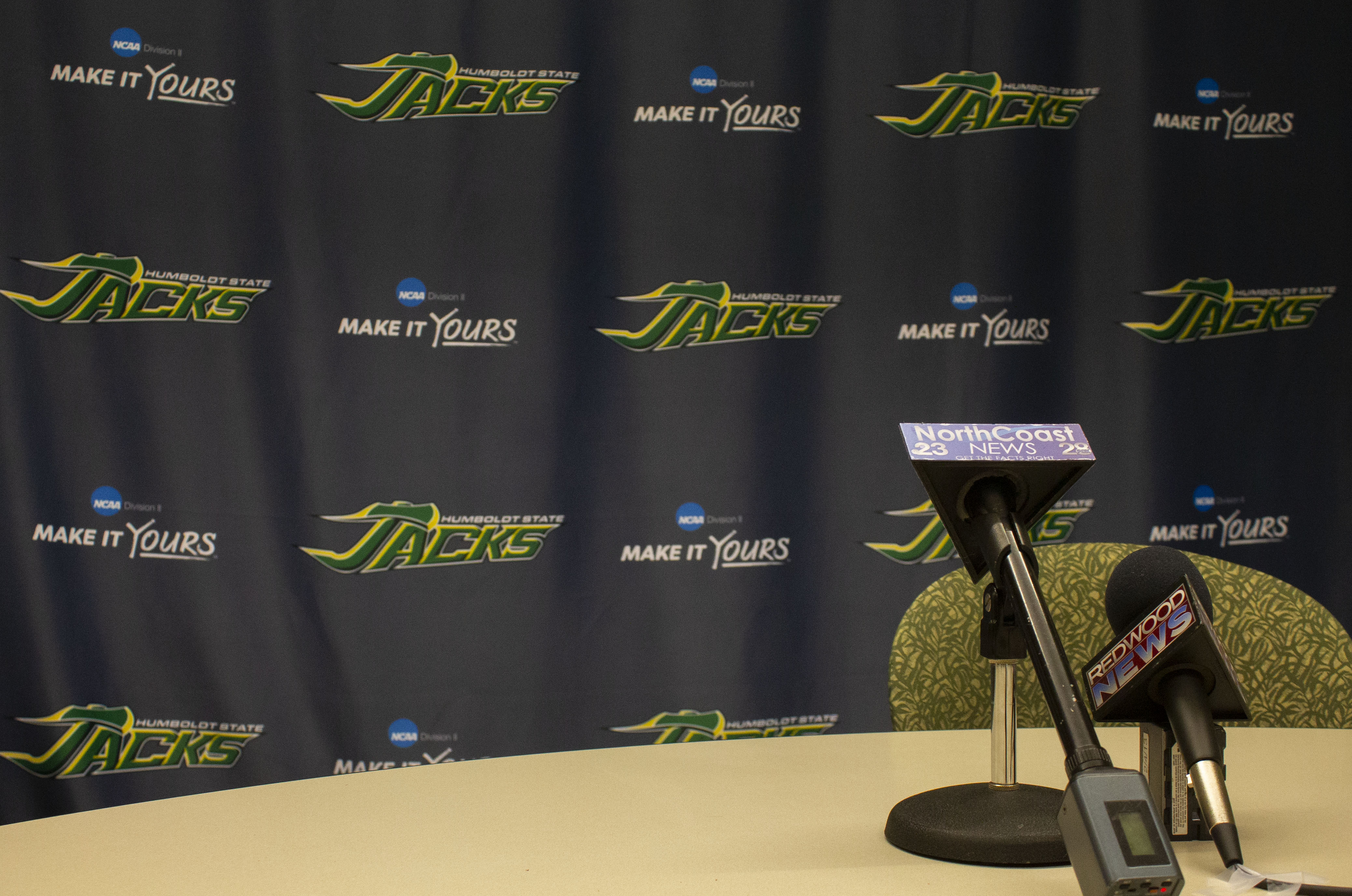
Tuesday’s press conference at Lumberjack Arena featured comments from the cross country, volleyball and soccer teams this week.
Cross Country
The HSU cross country teams are preparing for one of the most significant home meets in recent history. The Jacks host the CCAA conference championships Saturday morning at the Baywood Golf and Country Club in Arcata. The Jacks have an advantage in knowing the course after hosting the Humboldt Invitational in September. However, the stakes will be a bit higher as the Jack runners will be running for the chance to go to the NCAA regional meet on November 9. Senior runner Daniel Tull talked about the excitement of hosting such a big event for HSU.
“It’s really exciting for me,” Tull said. “I know a lot of runners personally that compete at different CCAA schools, so it’s cool to have them come up and show them what we’ve got here.”
Volleyball
The HSU volleyball team continues to produce frustrating results despite putting a good effort out there for each match. Last Friday, the Jacks traveled down to Los Angeles to take on Cal State LA and they were swept in straight sets, losing the match 3-0. The short journey over to Carson to take on Cal State Dominguez Hills didn’t result any better. Despite taking a set, the Jacks ended up losing the match 3-1, falling to 5-11 on the season. The good news for the Jacks is that they don’t have to deal with the rigors of travel for a while as they head into a five-game homestand. Head Coach Kelly Wood during the press conference talked about the relief of being able to play at home, noting that her athletes can focus on schoolwork and get back into their normal routine.
The next match for volleyball is Thursday at 7pm vs. Cal State San Marcos at Lumberjack Arena.
Women’s Soccer
The Jacks were at home last weekend taking on Cal State East Bay and Cal State Monterey Bay. Friday’s match against East Bay was a frustrating one for the Jacks, as East Bay scored twice, but in the 82nd minute Pikake Hix was able to score a spectacular goal from distance to make it 2-1. Sunday’s match against Monterey Bay was a back and forth battle that would see the match go into overtime tied 0-0. Just one minute into overtime Kendal Spencer slipped the ball past the diving goalkeeper to win the game for the Jacks, 1-0. For Spencer, this goal held a special significance apart from winning the game, as she had just returned from being held out of playing with a concussion.
“I couldn’t go to practice or anything,” Spencer said. “So then coming back I was so fired up to make a contribution.”
Both men’s and women’s soccer will head to Southern California to take on Cal Poly Pamona and Cal State San Bernardino this weekend.
Men’s Soccer
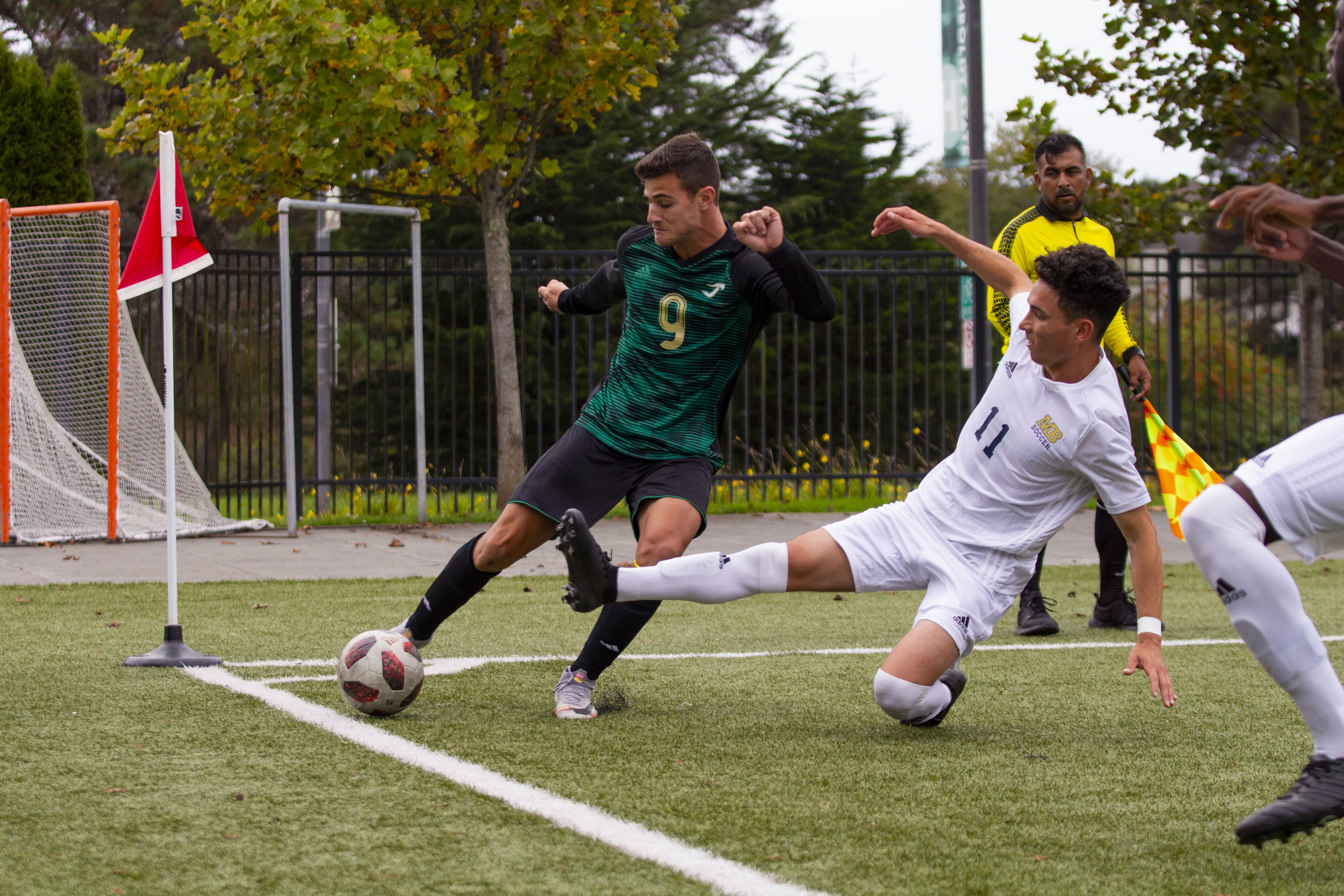
The Jacks had a mixed weekend taking on East Bay and Monterey Bay at College Creek Field. Offense was on full display against East Bay on Friday, and the jacks won 4-2 behind a two-goal effort from Isiah Dairo. Sunday was a different story and the Jacks lost 2-1 to Monterey Bay despite Gus Baxter converting on a penalty kick. Head Choch Fred Jungemann was happy with the team played over the weekend, and said that the team played well on Sunday against Monterey Bay, but couldn’t put the ball in the net.
Men’s soccer struggles against Cal State Monterey Bay
The Humboldt State men’s soccer team lost to Cal State Monterey Bay on Sunday, dropping the match 1-2. Despite the loss, the Jacks outshot Monterey 16-6 and held a majority of the possession throughout the second half. Humboldt is now 2-5 in conference play, which puts them at No. 11 in the California Collegiate Athletic Association standings.
The first half snuck away from the Jacks as CSUMB scored a goal on junior goalkeeper Tab Heinz just under seven minutes into the match.
Humboldt was unable to respond as Monterey consistently pressured with a high defensive line and controlled offensive possession. Despite being able to make offensive pushes in the first 25 minutes, the Jacks were unable to establish themselves in the attacking area for a significant amount of time. It wasn’t long before Monterey scored again, keeping their lead with a new score of 2-0.
Humboldt State forward Isaiah Dairo battles for the ball while pressing into the offensive zone during the Jacks’ match against Cal State Monterey Bay on Oct. 20 at College Creek Field. | Photo by Thomas Lal
On the offensive side, Isaiah Dairo provided the spark needed to the Jacks on the board. Throughout the match Dairo constantly drove the play along the right wing as well as in Monterey’s goal box.
Senior defender Gus Baxter stepped up to take the kick for the Jacks and didn’t hesitate, striking it past CSUMB’s goalkeeper Daniel Lomeli to score his fifth goal of the season. With the score now 2-1, the Jacks’ offense seemed reinvigorated and pushed Monterey hard until the end of the half.
In the second half, Humboldt’s offense outshot CSUMB 13-2 and took four corner kicks but didn’t have any luck finding the back of the net. Monterey managed the clock very well, playing a possession focused game and continuing to challenge the Jacks.
Humboldt State midfielder Dylan Tovani looks to cross the ball during the first half of the Jacks’ game against Cal State Monterey Bay on Oct. 20 at College Creek Field. | Photo by Thomas Lal
The pacing of the half was slow as both teams committed nine fouls, but neither of them were able to capitalize on the reoccurring opportunity. This was a trend throughout the match as Monterey committed 22 fouls in total and Humboldt committed 12.
Humboldt State defender Martin Calderon was confident in the defensive side of the Jacks’ game even after the loss.
“The last few games have been pretty solid on the back,” Calderon said. “I think it’s just been the little mistakes that have cost us the games. Last game we gave up two headers, this game it was just a deflection that we kind of messed up and the other teams don’t let those goals go.”
Head Coach Fred Jungemann was disappointed to not come out of the match with a win but saw positives from the Jacks’ offensive opportunities that they were able to generate.
“I think even before the penalty kick our guys kind of regrouped and managed the game really well,” Jungemann said. “The last 75 minutes of the game we dominated, played the game we wanted to play. We created chances, just couldn’t hit the back of the net.”
Humboldt State goalkeeper Tab Heinz jumps into the air in an effort to stop what would end up being the game winning goal during the first half of the Jacks’ game against Cal State Monterey Bay at College Creek FIeld. | Photo by Thomas Lal
Jacks lose sixth straight game, this time against San Francisco State University
The Jacks lost their sixth consecutive game Saturday night. With the 1-3 loss, Humboldt State moves to 1-6 in conference play which leaves them second to last in the CCAA standings as they approach the halfway point of conference competition.
Summer Hansen led the team with 12 kills for the night while Lenox Loving found herself in the double digits again with 10. Odelia Ryan pulled out 30 digs during the match, followed by Loving who had 22.
Riley Tishlarich sets the ball for her teammates during the Jacks’ match against San Francisco State on Oct. 12 at Lumberjack Arena. | Photo by Thomas Lal
Humboldt State put themselves behind early on in the first set, giving up six straight points to the visitors allowing the score to stretch out to 12-7.
Throughout the remainder of the set, the Jacks never managed to string together consecutive points. San Francisco took the opening set with a score of 25-13 as Humboldt did not respond fast enough to their defense.
Not much changed for the Jacks as they started slow in the second set and conceded the first four points. Humboldt found their offensive groove result in an impressive eight-point run and the Jacks took the second set 25-21.
Outside hitter Lexi Riggs jumps into the air to put the ball back over the net during Humboldt State’s match against San Francisco State on Oct. 12 at Lumberjack Arena. | Photo by Thomas Lal
Humboldt changed things up and came out swinging hard at the start of the third set. The Jacks were able to hold their lead for much of the set. It wasn’t long before the Gators tied it up at 20-20.
What followed was a blistering back and forth that saw the score at 24-23 in favor of the visitors with 25 points needed to take the set. In a moment that stunned the Humboldt State athletes and fans alike, outside hitter Lexi Riggs hit the ball over the net and was initially awarded a kill before the referee reversed the decision, calling the ball out of bounds and allowing San Francisco to take 2-1 lead over a now frustrated Jacks team.
The home crowd reacts to an overturned call that led to the Jacks losing the second set during their match against San Francisco State on Oct. 12 at Lumberjack Arena. | Photo by Thomas Lal
The fourth and final set of the night saw an agitated Humboldt team consistently outplayed as the Gators capitalized on the home squad’s frustration to a much higher degree. In a quick series of plays, San Francisco built themselves an 11 point buffer that almost entirely neutralized any momentum that Humboldt may have established in the previous set. The Jacks only managed a few scoring runs, and the Gators finished off the set 25-14 and took their first win on the road for the season.
After the game, Head Coach Kelly Wood was frustrated with her team’s performance, indicating that there wasn’t enough grit in their play during the match.
“Overall, our team does not have enough of a competitive spirit,” Wood said. “We don’t play with toughness. We’re too nice out there on the court. Great group of girls, but we get out there, and we are just allowing teams to manhandle us basically, and I’m very frustrated right now with our performance.”
While students enjoy the time off of classes, outages act as wake up for emergency preparedness
Humboldt State University students are coping with the mass power outages that hit Humboldt just after midnight.
Kinesiology freshman Malik Bobino, who sat in the afternoon sun by the library circle, spent the day hiking. Nevertheless, Bobino said the outage was stressful.
“It’s just dead,” Bobino said of campus. “It’s like Mad Max.”
Bobino said that campus Wi-Fi is largely off, although he has been able to get signals in a few small areas.
Zoology freshman Jeanette Carini said she has mostly lounged around in the dorms.
“I slept a lot because there wasn’t much to do,” Carini said.
The view of Humboldt State University from 14th Street. | File photo by Lauren Shea
While Carini spent time catching up on lost sleep, Wildlife freshman Max Manson said the time off school is relieving.
“It’s nice not having classes today,” Manson said.
However, Manson also confirmed that, aside from the door keycard locks, all power to the dorms it shut off. Hot water is not available in the dorms, as electric water heaters are off as well.
Manson and Carini both noted that food has been hard to come by, as the lines to the J stretch out the doors and down the stairs.
As the PG&E outage affecting over 800,000 California customers enters its first official night, no definite date is set for the return of electricity.
HSU student Max Blaettler said they slept in until 3 p.m. and went to the J at 4 p.m., where they enjoyed a free barbecue dinner.
“It was alright,” Blaettler said. “And it was free.”
As the PG&E outage affecting over 800,000 California customers enters its first official night, no definite date is set for the return of electricity.
However, reporting by Lost Coast Outpost has suggested that power could return as early as tomorrow, if high winds die down and PG&E finds no damage to transmission lines.
At HSU, students said they have already learned prepare better for next time.
“Next time we’ll stock up,” Manson said.
“Definitely have supplies,” Bobino said. “Like back-up chargers.”
Humboldt State’s Lenox Loving establishes herself as a top volleyball player
Watching the Humboldt State volleyball team this season, it’s impossible not to notice the Jacks’ breakout performer Lenox Loving.
Standing at 5’9″, the sophomore from Fair Oaks, California isn’t the tallest player on her team in a sport that is often dominated by height. Loving makes up for that with pure athleticism and an unrelenting work effort noted by her teammates and coaches. In her second season at the collegiate level, Loving has found a regular home in the Jacks’ rotation and seems poised to solidify her place as one of the team’s top scorers.
While fans of Humboldt State volleyball may find it difficult to imagine the women’s team without the offensive powerhouse of Loving, her decision to play the game in college wasn’t made easily. Her interest in the sport initially came from watching her sister play in tournaments, which made her want to try it out for herself.
With Loving in the center, the Humboldt State volleyball team encourages each other after being scored on in their match against Cal State Bernardino at Lumberjack Arena on Sept. 21. | Photo by Thomas Lal
Loving waits to recieve a serve from Cal State San Bernardino while on the back row during their Sept. 21 match at Lumberjack Arena. | Photo by Thomas Lal
Loving takes a moment to prepare for a serve during the second set of the Jacks’ match against Cal State San Bernardino at Lumberjack Arena on Sept. 21. | Photo by Thomas Lal
“I also did soccer and track growing up,” Loving said. “So I didn’t know what sport I wanted to play in college. It wasn’t really until my sophomore year in high school that I really decided that I wanted to play in college.”
Loving began establishing herself in a hitting role during her junior and senior year with Zara Budenbender, her coach at Bella Vista High School. Budenbender coached Loving from the time that she made varsity as a freshman and knew her from coaching Loving’s sister. Budenbender believes that Loving’s ability to adapt to the game situation and be effective from all areas of the court is what put her ahead in a highly competitive club volleyball environment.
“Her senior year we also worked more on her hitting out of the back row,” Budenbender said. “So she was an attack front row or back row. She was just someone who was consistently putting the ball in the court and putting it away. So not just hitting it in, but with force that other teams couldn’t return.”
“She’s a skilled player already. But she’s making big strides because of a combination of being very coachable and having a good skill set and great athletic ability.”
Kelly Wood, Head Coach for HSU’s Volleyball Team
Despite a freshman season for Loving which saw her with only 54 kills, she bounced back and worked hard over the summer and the weeks leading into the preseason. At the time of writing this article, Loving had 104 kills in just 29 sets played. Much of her work in the spring and summer revolved around playing doubles outdoors. Head Coach Kelly Wood feels that this is one area in particular that has proven to be a strength for Loving and allowed her to elevate her game.
“She’s a skilled player already,” Wood said. “But she’s making big strides because of a combination of being very coachable and having a good skill set and great athletic ability.”
Loving acknowledges that her opening season for Humboldt State was not the most successful. But she doesn’t seem overly concerned in hindsight now that she has more experience at the collegiate level.
“I think last season just being a freshman,” Loving said. “I played like a typical freshman. I was just really nervous and I didn’t get a lot of exposure, so I wasn’t really confident in my play.”
First-year struggles behind her, Loving has emerged this year as one of the key pieces for Jacks’ volleyball success in the early stages of the season. Even with the attention directed at her individual effort, Loving often refers to the team as a whole when it comes to finding ways to score. This has not gone unnoticed by teammates who share this sentiment and have nothing but good things to say about Loving.
Lenox Loving passes a ball to her teammates during a scrimmage at practice on Sept. 25 at Lumberjack Arena. | Photo by Thomas Lal
Junior Lexi Riggs has played with Loving the last two seasons and sees having her on the team as a benefit both in performance and in personality.
“I think her athleticism is a huge advantage for our team,” Riggs said. “She just has a really good attitude and presence on the court. You never are down playing next to Lenox. She always is positive, good energy and she is just super athletic.”
This sentiment is echoed by Loving’s teammate and roommate Juliana Bertolucci, who points to the difficult nature of the outside hitter position and how well Loving can handle the ball in tough situations.
“She does well at bettering the ball,” Bertolucci said. “If there is someone that makes maybe not that great of a set or if there’s not that great of a pass she’s always ready to help out, and she’s always ready to make a better decision on the ball.”
For Riggs, Loving’s athletic success this season is just one more reason why she’s special to the team.
“I think she’s just such a great person,” Riggs said. “Everyone who knows Lenox knows she’s an awesome person and I think she’s a great athlete too. I mean, I can’t say enough. I love Lenox, she’s awesome. And we all do, It makes me super proud watching Lenox out there doing as great as she is.”
Lenox Loving waits for play to continue during a scrimmage at practice on Sept. 25 at Lumberjack Arena. | Photo by Thomas Lal
Lenox Loving (center) stands with her teammates while listening to head coach Kelly Wood during practice on Sept. 25 at Lumberjack Arena. | Photo by Thomas Lal
Lenox Loving jumps up to spike a ball for a set play during a scrimmage at practice on September 25 at Lumberjack Arena. | Photo by Thomas Lal
For her coach and teammates, Loving’s current performance is one more step in what is possible for the sophomore with two full years of competition still ahead of her. With opponents beginning to try and lock her down more frequently, Wood remains confident that she will be able to grow even further as a player.
“I’m so optimistic and hopeful to see what she’s able to do in these next couple of years,” Wood said. “Right now just all of a sudden, her confidence has appeared because she’s having the success she’s having, early on in our season.”
With the team as such a big part of her life on and off the court, Loving attributes much of her personal achievement to the whole group showing how confidence in her teammates has allowed her to achieve such high point production on an individual level.
“I wouldn’t have as many kills if weren’t for our defense and our setters,” Loving said. “Everyone on our team is so encouraging and I know that when I’m hitting, I feel confident that my back row can cover me. I’m confident that my setter is going to set me the sets that I need. It’s really nice having a team that I can just rely on so much and that has helped me succeed.”
In spite of the successful campaign to phase out single-use water bottles, Humboldt State has yet to remove plastic bottled beverages from campus
Almost 10 years have come and gone since Humboldt State University took back the tap and did away with single-use water bottles on campus.
Overall HSU is known to lead the way in sustainability across the California State University system. In spite of being further ahead in the sustainability game than most campuses, HSU still offers a variety of beverages for sale packaged in single-use plastic.
HSU Dining Services Director Ron Rudebock said they have gotten a fair number of comments over the last couple of years regarding plastic products and on phasing out plastics completely.
“We have been working with vendors to obtain their products in a reusable or compostable or recyclable package and vendors are changing their package materials,” Rudebock said.
Four of the five campus responsibilities listed under the policy have set deadlines.
The first is the elimination of single-use plastic water bottles by Jan. 1, 2023. HSU met this requirement in 2011. The second is the elimination of plastic straws no later than Jan. 1, 2019. HSU eliminated plastic straws during the fall 2017 semester.
The third responsibility listed, also set for January of this year, was the elimination of single-use plastic carryout bags. HSU stopped using plastic bags back in March 2014. The fourth deadline, and last with a time requirement, was the elimination of single-use polystyrene (e.g. STYROFOAM™) food service items no later than Jan. 1, 2021. HSU eliminated Styrofoam to-go containers over 10 years ago and the campus is working to eliminate it in any pre-packaged items.
The final goal of replacing single-use plastic items with materials that are reusable, locally compostable and/or recyclable doesn’t list a specific deadline.
A variety of some of the single-use plastic bottled beverages offered. According to Rudebock, much of the decision to continue to sell single-use plastic drinks is because of consumer choice. | Photo by Megan Bender
Rudebock said this specific change is a challenge. The Depot, the College Creek Marketplace, the Cupboard and vending machines still offer plastic bottled beverages on campus.
“We would like to see a faster adaption but with this guideline having no deadline and with the current collapse in the recycling market I do not see this becoming feasible in the next year,” Rudebock said.
Dining services has made some efforts in providing more glass or aluminum options. The J, for example, has a beverage cooler that is all aluminum and glass, has eliminated single use plastic containers and has single-use packaging that is compostable or recyclable.
However, other locations haven’t been able to make the same change as effectively because of the demand for products that happen to also be in plastic bottles.
“We’ve been working with a lot of our vendors and pushing, trying to get more either glass or aluminum containers.” he said.
Rudebock said Dining Services also goes out of their way to order aluminum and glass alternatives whenever possible from specific companies and brands like Coke or Pepsi.
“It kind of comes down to consumer’s choice,” he said. “Consumers can help by purchasing products that are in reusable, compostable or recyclable packaging and not requesting products that are not in reusable, compostable or recyclable packaging.”
Students have pushed back against the university in the past, questioning its dedication to environmental responsibility over their business ties with PepsiCo.
As reported in the Lumberjack and the North Coast Journal, in 2017 HSU made efforts to meet student’s demands to closer align with its dedication to social, economic and environmental issues by re-evaluating a 40-year-long partnership with PepsiCo.
Under the contract PepsiCo funded HSU with around $58,000 worth of athletic scholarships in exchange for pouring rights. Pouring rights allowed PepsiCo to reserve 80% of HSU shelf space for their products.
Students also made the argument the set up was not fair to local businesses.
In spite of being in a budget deficit and the loss of scholarship funding, HSU did not renew the pouring rights contract and let it expire at the end of June 2017.
HSU was the first California public university and third national public university to phase out water bottles.
The University Center and Dining Services stepped into to help with some of the lost resources.
Rudebock said they managed to fund a majority of the lost scholarship money but leaves the decision of how the scholarships are dispersed up to the school. This way the UC and Dining Services are not directly funding athletics or any specific department.
The university still does business with PepsiCo but under different rebate-based agreements. Dining services also stopped carrying Aquafina water bottles, a brand owned by PepsiCo as a result of the nationally recognized Take Back the Tap campaign.
Under the Waste Reduction & Resource Awareness Program, students began efforts to Take Back the Tap at HSU starting in 2009. The student lead group and Dining Services worked to phase out the sale of single-use water bottles in 2011 as is the primary focus of the campaign.
As a result, HSU became the first California public university and third national public university to phase out water bottles. Dining Services initially explored an alternative by offering boxed water.
“At first we thought they were upset with the plastic water bottles, but they said ‘No no, just the water,’” Rudebock said. “It was more about the idea of selling packaged water.”
Before HSU removed water bottles on campus, TBTT calculated that HSU’s annual bottled water demand “required approximately 43 barrels of oil per academic year” and in turn was “releasing 35,000 pounds of carbon dioxide into the atmosphere.”
HSU now owns two Hydration Stations and has 16 water fill stations on campus.
Environmental Science & Management Professor James Graham and his geospatial students created an interactive map of HSU that includes where to find water fill stations on-campus as well as other resources.
The locations of all water stations on HSU’s campus according to the Sustainability project. These locations include the two Hydration Stations.
Sustainability Director Morgan King said Facilities Management worked with students help create the map.
“We worked with [Graham’s] students to develop layers for sustainability attributes,” King said. “Including water filling station locations, bike parking locations, recycling and compost bin locations.”
Anyone can access the map by visiting HSU’s sustainability website. The map key is listed in a drop down menu that offers different types of resources on campus. Under the sustainability option, users can check the box of the information they’re looking for.
Rudebock said Dining Services remains attentive to the needs of the students and the possibility of selling less plastic-bottled products.
“Every journey begins with a step,” Rudebock said. “The less plastic containers that students buy helps change the need for that product.”
The California State University system’s single-use plastic policy passed in December 2018 includes four policy changes that have deadlines, but the fifth and final goal of the policy doesn’t list a deadline.
Eliminate single-use plastic water bottles by January 1, 2023. HSU has already met this requirement as of 2011.
Eliminate plastic straws no later than January 1, 2019. HSU eliminated plastic straws during the fall 2017 semester.
Eliminate single-use plastic carryout bags no later than January 1, 2019. HSU eliminated plastic bags in March 2014.
Eliminate single-use polystyrene (e.g. STYROFOAM™) food service items no later than January 1, 2021. HSU eliminated Styrofoam to-go containers over 10 years ago and are working to eliminate it in any pre-packaged item
Replace single-use plastic items with materials that are reusable, locally compostable and/or recyclable.
To find out more about HSU’s Zero-Waste Initiatives, WRRAP and TBTT visit the WRRAP homepage.
Bridging the cultural gap between the campus and community
Douglas Smith drove up to Humboldt State for the first time in 2013 as a transfer student with big eyes for a small school.
Smith was seeking same the small school feeling that he got while attending College of the Canyons, away from his home in Los Angeles. At first, Smith experienced anxiety about being one the few people of color in Arcata, but he found a way to adapt and thrive in time.
Today, he’s the director for the African American Center for Academic Excellence, and is four months into his new role. Smith holds his own college experiences as reference when approaching the job.
“My big benefit to coming to Humboldt State was that I had these opportunities for cultural exchange with different kinds of people,” Smith said.
Smith believes the center should be a place that highlights the black experience and culture, a space where students and community can freely speak and learn. Smith hopes the center will strengthen the campus community and bridge the gap between the campus and locals.
Smith emphasized intercultural exchange as an important part of learning. One way the center achieves this is through Talking Drum, a safe space that gives students the agency to converse over the issues that matter to them.
HSU sophomore Brooklyn Reed is the new facilitator for Talking Drum. She met Smith tabling in the quad and offered some of her ideas on how the center’s discussions could be run.
“I talked to him about how to facilitate it, about what I wanted it to look like, how I wanted to build community,” Reed said. “He was just very, super supportive. Just yes, like, ‘let’s do this!’”
Reed wants to run the discussions the way she learned back home in Los Angeles. She also wants the chief of police to attend some meetings so that the center can hold the police accountable if they disagree with their conduct.
Smith’s approach to working with Reed speaks to how he wants to take a step back when it comes to campus dialogue. For his first couple of months, Smith said he spent the majority of his time listening to student feedback.
“I’m trying to come in with this idea of like, ‘Okay, I have some ideas for things,’” Smith said. “But I really want to learn and listen to what students’ needs are, and identify those needs before I go in and start making decisions here and there.”
In Talking Drum, students have a safe space that gives them the agency to converse over the issues that matter to them. | Photo by Michael Weber
This approach allows the Dean of Students Office to be informed by what the center is doing, versus managing from the top down. Letting students take control of the dialogue means that they will be directly influencing the Dean of Students.
“I have been wanting every [discussion] to be student-led, student-driven, and have that peer to peer connection,” Smith said.
Smith promotes the free exchange of ideas because he believes dialogue and cultural exchange is important to becoming part of the community.
One of Smith’s most profound influences on the way he approaches intercultural exchange occurred in his senior semester spent abroad in Santiago, Chile. When he landed, Smith recognized the feeling of being alone and started to familiarize himself with the local area.
“My experience in Humboldt County and at HSU as the ‘other,’ and learning how to move from a perpetual state of survival mindset to adapting and thriving prepared me in so many ways for my time abroad,” Smith said.
Smith’s directive for the center is a culmination of his experiences learning about other people.
“Having that cultural exchange and different kinds of people allowed me to have more diverse viewpoints,” Smith said. “I’m an extrovert. Inside, I might feel anxiety about me, but I’ve always kind of pushed myself to engage with people.”
HSU’s CAPS is working to combat mental health concerns among HSU students
Rates of attempted suicide in Humboldt County stand far above national and state averages, according to Humboldt State University Health Center Director Brian Mistler, Ph.D.
“Suicide attempt rates in Humboldt County are nearly twice the national and California averages,” Mistler said in an email response facilitated by HSU Communication Specialist Grant Scott-Goforth. “And HSU students face greater systemic barriers to access health care than in other more affluent and less isolated parts of the country.”
An estimated 40% of HSU students felt elevated levels of depression according to a 2016-2017 Healthy Minds Study led by Daniel Eisenberg, Ph.D of the Healthy Minds Network, which performs web-based mental health surveys on college students.
Eisenberg has been leading an analysis of student mental health at all 23 California State Universities. In the 2016-2017 analysis of HSU, an estimated 42% of students had elevated levels of anxiety, while an estimated 4% of students attempted suicide in the last year.
Mistler tied Humboldt County’s lack of expert services to mental health.
“…HSU students face greater systemic barriers to access health care than in other more affluent and less isolated parts of the country.”
Brian Mistler, Humboldt State University Health Center Director
“Mental health is a critical basic need and it’s tied to others like having enough food, shelter and physical health care and safety,” Mistler said in the email. “Psychological needs become more important as chronic resource insecurity increases.”
Mistler clarified that HSU’s relatively high rates of mental health conditions do not appear to be caused by Humboldt itself.
“From what we know today, the increased needs among students appear to be present on the first day,” Mistler said in the email. “That is, it’s not caused by being here.”
Mistler added that many HSU students may arrive with a history of limited health care access.
“It’s also true that many students arrive at HSU having not had access to their fair share of health and counseling services in the past,” Mistler said in the email. “It’s clear from all the data that HSU’s team of health experts do a phenomenal job of helping those students who choose to seek help.”
Counseling and Psychological Services Staff Psychologist and Outreach Coordinator Dr. Elizabeth McCallion in a CAPS office on Oct. 1. McCallion said most students who visit CAPS report positive experiences. | Photo by James Wilde
HSU Counseling and Psychological Services Staff Psychologist and Outreach Coordinator Dr. Elizabeth McCallion is one of the experts working to help students.
McCallion hopes to mitigate the stigma around mental health.
“Mental health support doesn’t just have to be for when you’re having severe symptoms,” McCallion said. “It can be a way of just generally taking care of yourself. Kind of like preventative health care.”
McCallion said CAPS is working to meet students where they are, including through library SkillShops and outreach by Multicultural Specialist Cedric Aaron.
McCallion praised HSU’s mental health services but did acknowledge a lack of services in the surrounding community.
“I think in terms of the counseling center, the counseling center does a wonderful job with that support,” McCallion said. “In terms of our community, there is a need for additional mental health care. But that’s not just mental health, that’s health care in general because of where we live.”
Both McCallion and Mistler emphasized that those students who do use HSU’s services see verifiable benefits.
“Dozens of studies confirm that medical and counseling services reduce the risk for students of catastrophic outcomes, help with anxiety and depression, and increase the chances of students graduating,” Mistler said in the email. “If there’s a message here, it’s to encourage people to use the available resources.”
Mistler noted that HSU’s outreach efforts have produced an increase in student visits to counseling services of about 5% each year.
Mistler also pointed out that students that receive counseling show improved retention rates and a higher likelihood of graduating.
Mistler and Eisenberg plan to prepare a CSU-wide analysis of mental health in spring 2020, which they hope will provide more information on the state of student mental health.
Per the CAPS website: You can reach a CAPS therapist by phone at all hours at (707) 826-3236. In emergency situations, you should call Humboldt County Mental Health at (707) 445-7715 or dial 911.
You may also reach the National Suicide Prevention Lifeline at 1-800-273-8255.
Clery Act reveals numerous sexual assault cases within the last 3 years at HSU
Humboldt State University’s 2019 Clery Act Annual Security Report reveals more than three sexual assault cases at HSU in each of the past three years.
Amelia Wagoner, a victim rights advocate and kinesiology major at HSU, said the problem goes deeper than the statistics suggest.
“The amount of reported cases here and throughout the nation do not reflect campus safety,” Wagoner said. “The reporting process is traumatic and most survivors don’t want to deal with it.”
The Clery Act federally requires all higher education institutions to disclose campus crime statistics. The newest report for HSU, released in September, covers crimes from January 2016 to December 2018. All Clery Act reports for California State Universities are available on the California State University webpage.
HSU’s report notes five rapes in 2016, five in 2017 and four in 2018. HSU doesn’t have the most rape or sexual assault instances within the CSU system, but it did have one of the largest percentages compared to its relatively low student population. Sexual assault victims made up .05% of HSU students.
HSU requires students to go through a consent course before attending, and all members of clubs or sports teams attend a Title IX seminar once per year. Title IX is a federal law prohibiting discrimination on the basis of sex in federally-funded education institutions, and the seminar focuses on teaching consent culture and anti-hazing.
Geography major Allie Jones expressed concerns about the faculty behind HSU’s Title IX seminar.
“At HSU, nobody on the Title IX team is a woman,” said Jones. “I’m sure the coordinator is qualified for his job, but as a woman I’d feel more comfortable having another woman to talk to.”
For now, Wagoner urged students to play their part in improving campus safety.
“Make sure everything is okay,” Wagoner said. “If you see or hear something that doesn’t seem right, do your part to make a difference.”
Life may seem black and white, but enter this creativity zone to be illuminated in fluorescent colors
Carolina Gonzalez, a marketing major at Humboldt State University, is a self-taught artist who dabbles in painting, drawing and jewelry making.
Gonzalez enjoys painting with acrylics and oils, drawing with paint pens and ink, as well as crafting unique earrings with charms and beads.
Some of Carolina Gonzalez’s work in her room/studio. | Photo by Chelsea Wood
She describes her art style as “daydream dripping” because many of her designs are colorfully psychedelic.
Her Latinx culture and Mexican background strongly influence her artwork. Natural elements influence her creativity and she credits moving to Northern California for sparking even more inspiration.
She’s always dreaming up new designs for earrings and paintings and often works up ideas for new artwork through sketches and graphic design.
This website uses cookies to improve your experience. We'll assume you're ok with this, but you can opt-out if you wish. Cookie settingsACCEPT
Privacy & Cookies Policy
Privacy Overview
This website uses cookies to improve your experience while you navigate through the website. Out of these cookies, the cookies that are categorized as necessary are stored on your browser as they are essential for the working of basic functionalities of the website. We also use third-party cookies that help us analyze and understand how you use this website. These cookies will be stored in your browser only with your consent. You also have the option to opt-out of these cookies. But opting out of some of these cookies may have an effect on your browsing experience.
Necessary cookies are absolutely essential for the website to function properly. This category only includes cookies that ensures basic functionalities and security features of the website. These cookies do not store any personal information.
Any cookies that may not be particularly necessary for the website to function and is used specifically to collect user personal data via analytics, ads, other embedded contents are termed as non-necessary cookies. It is mandatory to procure user consent prior to running these cookies on your website.