Arcata incident renews doubts of local safety and transparency
A black 18-year-old HSU student reported being slashed with a knife near 14th and G streets in Arcata on Aug. 26, according to a Humboldt State University press release sent out Friday, Sept. 27.
The incident occurred more than a month ago, but students are only just hearing about it. Associated Students President Yadira Cruz wished HSU had notified students to avoid feelings of mistrust.
“To avoid that, just send out an email as soon as it happens,” Cruz said. “Just develop that transparency.”
The press release went on to summarize the events after the student fled Arcata and returned to HSU.
“Paramedics were called, and they were taken to Mad River Community Hospital where they were treated for the injury,” the press release, written by HSU Interim Vice President of Enrollment Management Jason Meriwether, said.
Cruz said the student has reported being physically fine as of Monday.
The incident, which largely flew under the radar until reporting from Lost Coast Outpost dug it up for a story published on Thursday, Sept. 26, is now under investigation by the Arcata Police Department.
The HSU press release noted multiple media narratives and sought to clarify the situation. On the night of the incident, HSU determined that no threat to the campus existed, and did not send out a notification.
The release also noted no evidence of the incident being a hate crime, which would warrant notification.
“If there had been an imminent threat or evidence of a hate crime, the campus community would have been alerted by text and email using HSU Alert,” the release said.
Cruz, along with several HSU faculty and staff, reviewed and gave consultation for the release.
Cruz first heard about the incident from a Lost Coast Outpost reporter seeking her comment. Cruz wondered whether HSU would’ve notified students if it weren’t in the midst of an enrollment decline.
In any case, Cruz wished HSU had notified the campus, regardless of whether the incident appeared to be a hate crime.
“Saying it’s not race-related is not a valid excuse,” Cruz said.
The press release emphasized Humboldt’s close-knit community and called HSU the “Humboldt Family.” However, Cruz doubted the sincerity.
“The campus tells us they care about us only when something bad happens,” Cruz said.
Die-in protest advocates for action on climate change
Motionless bodies lay in the Humboldt State University quad on Friday.
Junior wildlife major Olivia Brock joined a die-in protest put on by Extinction Rebellion with help from Earth First.
“We want to show them that if they’re gonna kill us, then they have to see us,” Brock said.
A variety of HSU students pretended to be dead on the ground, with many holding flowers in their hands and some wearing face paint.
HSU student Vanessa Argonza lying prone for a die-in climate protest in HSU’s quad on Sept. 27. | Photo by James Wilde
Signs at a die-in climate protest in HSU’s quad on Sept. 27. | Photo by James Wilde
John Powell (tie-dye), College of the Redwood agriculture student, and J.T. Abbott, HSU botany student, hugging on the ground for a die-in climate protest in HSU’s quad on Sept. 27. | Photo by James Wilde
Extinction Rebellion and Earth First advocate and protest for governmental action on climate change and environmental issues.
Junior forestry major Arvel Reeves joined the protest despite not knowing about it beforehand.
“Climate change is something I really worry about,” Reeves said. “It’s only going to get worse.”
Lily Price, HSU botany student, played a morose tune over the protesters’ bodies on a harmonium, an organ instrument that sounds similar to an accordion.
The protest came one week after a global climate strike that saw thousands of protests around the world, including one in Arcata.
Ellis Hanson, a junior wildlife biology major, wanted to help stand for the earth.
“I did this to do a demonstration,” Hanson said. “To make sure everyone remembers the crisis we’re in.”
Ellis Hanson, HSU wildlife biology junior, lying down for a die-in climate protest in HSU’s quad on Sept. 27. | Photo by James Wilde
Lily Price, HSU botany student, plays a somber song on a harmonium for a die-in climate protest in HSU’s quad on Sept. 27. | Photo by James Wilde
Protesters lying down for a die-in climate protest in HSU’s quad on Sept. 27. | Photo by James Wilde
Protestors gathering in a circle after a die-in climate protest in HSU’s quad on Sept. 27. | Photo by James Wilde
Students passing by showed mixed reactions to the protesters. Some stopped and watched. Others took photos on their phones. Others scurried along without a second glance.
Brock hoped the visual nature of the protest would draw attention.
“We want to make the people of Humboldt County see the future we’re being handed,” Brock said.
Heri Hawthorn, a local activist, helped create some of the signs and banners for the protest. Hawthorn held a sign above the protesters while they lay still.
“There’s nothing else to do except support others and curb what’s happening,” Hawthorn said.
Early on, when a University Center employee took down an unpermitted protest banner. Brock took notice.
“Don’t you care about your children?” Brock asked the employee. “The earth is dying!”
Blu, HSU environmental studies senior, lies covered up for a die-in climate protest in HSU’s quad on Sept. 27. | Photo by James Wilde
Art is more than just another form of expression, it’s a lifeline
Taylor Bruzza is a studio art major at Humboldt State University whose love for creating art can be traced back to when she was first able to hold a pencil. Bruzza enjoys painting, making jewelry and drawing. She uses a wide range of mediums including ink, watercolors and colored pencils, but she predominately dabbles with acrylic paints. She takes inspiration from nature as she often creates art pieces involving biological and hyper-realistic forms.
Women’s and men’s soccer win big, cross country performs well in Oregon and volleyball faces some tough competition at home
This past week was successful for Humboldt State Athletics. The women’s soccer team soundly defeated the visiting William Jessup Warriors 4-0 in the friendly confines of College Creek Field. Men’s soccer traveled to Redding and kept their goal scoring barrage going with a 5-1 win over Simpson University. Cross Country traveled to Monmouth, Oregon and reached excellent individual numbers with both the men’s and women’s teams finishing in fourth place. Volleyball started their CCAA conference schedule at home in Lumberjack Arena, winning the first match and then losing the next two to some very tough competition.
Tuesday’s press conference at Lumberjack Arena featured comments from all of the head coaches and selected athletes from each sport.
Women’s Soccer
The Jacks played their home opener on Saturday and played effectively against the visiting William Jessup Warriors. The tone was set early in the match when senior midfielder Lindsay Stoner scored just three minutes in. From there, the Jacks never relinquished control of the game.
Even though, to the untrained eye, there was not much fault in the game for the Jacks, Head Coach Paul Karver noticed that after scoring the first goal his players were losing a bit of focus.
“We had a conversation at halftime about we need to play our style, and we need to have a real identity and we need to get back to that,” Karver said. “And that was a challenge because everyone is trying to do more and get on the scoreboard.”
Men’s Soccer
Right now, the Jacks seem like an offensive force that is going to be very hard to stop. In the last two games the Jacks have outscored their opponents 10-2 and overall this season they are already averaging almost four goals per game. Head Coach Fred Jungemann was happy with the results of his team thus far. He feels that his team is ready for the tough CCAA conference which begins on Friday as the Jacks take on Sonoma State in Rohnert Park.
“Certainly the preseason has helped and brought us to a level of confidence,” Jungemann said. “We’re going to this game on Friday with a self-belief that we can step on the field and compete with anybody we play against whether we score five goals or not.”
Cross Country
In addition to both cross country teams finishing in fourth place, the Jacks had some standout performances. For the men, it was Daniel Tull who finished second in the race and earned himself an all CCAA award for the second time this season. For the women it was Cessair McKinney who had the standout performance for the Jacks, finishing seventh and earning herself student-athlete of the week.
The men’s team also earned an 8th place NCAA regional ranking based on their recent performances and for freshman runner Finn Tyvoll the ranking is a validation of the team’s success.
“It’s fantastic because it shows how much work we’re putting in,” Tyvoll said. “It’s worth it because of the grind and putting Humboldt on the map.”
Volleyball
The Jacks volleyball team went 1-2 on their opening homestand at Lumberjack Arena last week. They won their home opener 3-1 against Cal State Monterey Bay in front of a packed crowd. The next night, the Jacks lost 1-3 to the nationally ranked Cal Poly Pamona Bronco’s. A significant challenge was presented to the Jacks on Saturday as the No. 1 team in the nation, Cal State San Bernardino, played at Lumberjack Arena and swept the Jacks 3-0.
Despite the daunting task, Head Coach Kelly Wood was not phased by the level of competition that CSU San Bernardino presented.
“Overall we went into it very loose, understanding that the pressure is always on the team that’s expected to win,” Wood said. “I think we could have competed harder than we did and maybe we could have played a little better and taken a few more points off of them, but there’s always room for improvement.”
AHS and HSU students strike to advocate for climate action
Video by James Wilde & Collin Slavey | Editing by Chelsea Wood
Anxious and irritated with the lack of governmental action against climate change, masses of young people and students from Arcata High School and Humboldt State University took to the streets surrounding the Arcata Plaza on Friday as part of the Global Climate Strike.
Inspired by the International Youth for Climate Action, the Humboldt Sunrise Movement in association with the Extinction Rebellion and students of AHS organized and executed the local school strike protesting climate change.
Students were excited to show how strong their voices could be when used in unison. Maddie Marriott, a member of Extinction Rebellion, said the organization was aimed at gathering people for peaceful protest and that is what they hoped to achieve.
Maddie Marriot stands out in the crowd of demonstrators as she walks down I Street on Sept. 20. | Photo by Collin Slavey
Locals with an interest in helping the environment and pushing the government toward action participated in the youth strike too. | Photo by Collin Slavey
Maddie Marriot and Vanessa Argonza march down I street, shouting out chants and slogans on their way to the plaza. | Photo by Collin Slavey
“We dance, yell, sing and chant to show our energy,” Marriott said. “This shows we are cheerful and hopeful and happy in the face of this threat. It is rejuvenating and these friends are empowering. Now we have to wait and see if our voice is being heard.”
Marriott ended up agreeing to hold a sign that said “Protect Rainbow Ridge, our forests and our climate.” Ecological protection is one of the main goals of the movement, but Extinction Rebellion as a national organization demands governments tell the truth about climate change and act now to prevent species loss and lower greenhouse gas emissions.
Vanessa Argonza, a Humboldt State student and member of the Extinction Rebellion, said speaking out and advocating for action is important. Change requires people to care and be passionate about an issue, while also realizing we can come together to create change.
Members of the Extinction Rebellion stand and watch the demonstrations on Sept. 20 in the Arcata Plaza. | Photo by Collin Slavey
Creative signs were a centerpiece to the demonstrations. | Photo by Collin Slavey
Maddie Marriot walks down I Street on Sept. 20 on her way to the Arcata Plaza. | Photo by Collin Slavey
Demonstrators gather in Arcata plaza, carrying with them a blow up planet earth. Hundreds of people were in attendance. | Photo by Collin Slavey
Signs help spread messages aiming to educate and advocate for action. | Photo by Collin Slavey
Vanessa Argonza leads the crowd of young people standing against climate change on Sept. 20. | Photo by Collin Slavey
“In moments of injustice you must speak out because if you do not, you are part of the problem,” Argonza said. “The youth is well aware and willing to be part of the change because it affects them. We can come together and make change. You just have to be aware of your footprint and educate yourself before you speak out.”
The protest did run into some technical issues as it spilled out into the Arcata Plaza. Unfortunately, the strike organizers failed to bring a speaker system that was loud enough for all of the attendees to hear, causing the message to fall flat. Joanne McGarry, a local supporter of the Environmental Advocacy and self-prescribed ‘gadfly’ suggested better planning in the future for a more impactful demonstration.
Jene L. McCovey delivers a powerful, emotional speech about the threats to the Earth faces. | Photo by Collin Slavey
“I am more than happy to let young people lead, they just have to lead well,” McGarry said. “Having music is important when you’re walking into the plaza, during the demonstration and as you exit the plaza. Having a speaker that is loud enough for the entire crowd to hear is unbelievably important.”
The Sunrise movement was originally created as a youth advocacy group to show support for the Green New Deal, a stimulus package proposed by politician and activist Alexandria Ocasio-Cortez in February of this year. The Sunrise Movement intends to work within ‘the system’ while actively changing the system, in pursuit of environmental and social justice through nonviolent and direct action. They are building an army of young people to stop climate change and create millions of good jobs in the process.
Tribal elder Jene L. McCovey began the rally in the plaza with a song called “Feeling Sorry for My Womenfolk,” a somber tune that spoke of hate and woe. She went on to tell stories and sing more songs to give purpose to the actions of the demonstrators.
“The stumps are really big- that is all we have left of the old forest,” McCovey said. “Clear cutters, defilers, denude the land down to the earth and they burn it. Wherever you find your trials, be that healer. Be that person that walks with people in that good way. Be the water protectors.”
HSU Volleyball hopes to rest up after losing to CSUSB 40-19
The Humboldt State volleyball team saw their current homestand end Saturday night with a loss to the number-one-ranked team in the nation, Cal State San Bernardino.
Outside hitter Summer Hansen knocks the ball across the net towards the opposition during Humboldt State’s match against CSUSB on Sept. 21 at Lumberjack Arena. | Photo by Thomas Lal
The Jacks lost all three sets and were out-killed 40-19 by the Coyotes on a night where they struggled to find a way to crack CSUSB’s tall front line. Humboldt’s scoring leader for the night was sophomore Lenox Loving, who managed to put up eight kills. Loving was followed by Lexi Riggs and Summer Hansen who had four kills apiece.
The Coyotes established the tempo of the match early on in the first set, scoring quickly and often. The Jacks were outworked on several occasions and were only able to score 10 points to CSUSB’s 25. Another contributing factor was a handful of unforced errors when it came to passing the ball, which resulted in giving up several scoring opportunities for the Jacks.
Outside hitter Lenox Loving delivers a ball across the net during Humboldt State’s match against Cal State San Bernardino on Sept. 21 at Lumberjack Arena. | Photo by Thomas Lal
Coach Kelly Wood made some rotation adjustments throughout the second set. She hoped to help the team find a way past the Coyote’s tough defense. The changes had some success as the Jacks improved to 13 points but CSUSB still took the set with 25 points.
In the final set of the evening, Humboldt State slightly improved as they moved up to 15 points, but CSUSB still took it with 25 points. The Jacks seemed determined to put up a fight, capitalizing on more scoring opportunities and maintaining a roughly five-point gap through the middle stages of the set before falling back.
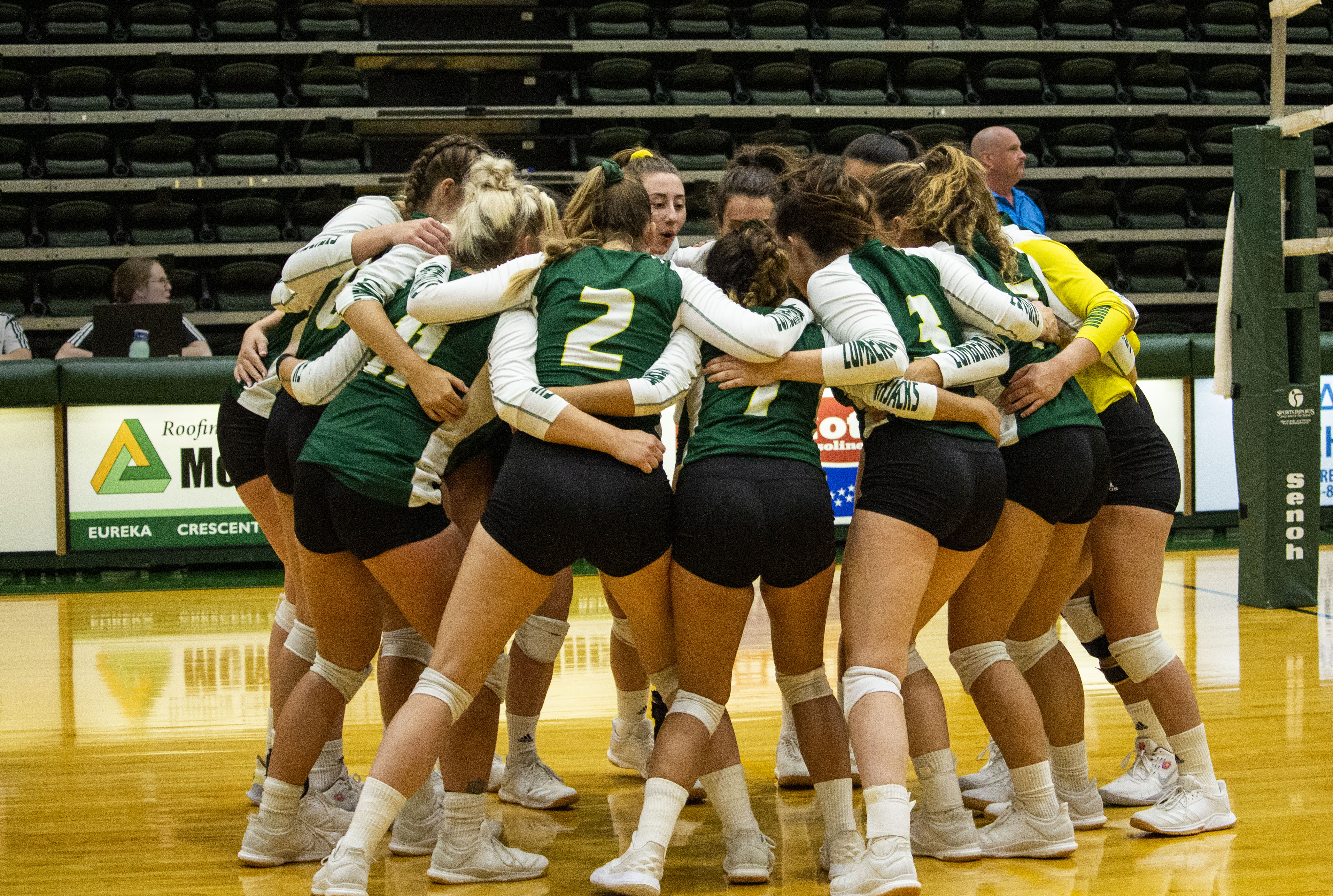
The Humboldt State volleyball team encourage each other after being scored on in their match against Cal State Bernardino at Lumberjack Arena on Sept. 21. | Photo by Thomas Lal
Redshirt sophomore Carla Crespo recorded five digs for the Jacks. Crespo was disappointed that the Jacks didn’t perform better but made it clear that the team was strong enough to rebound from the loss.
“I think our team is a really resilient team,” Crespo said. “We do whatever we can to try to support each other, we’re pretty close-knit. It can be hard when there’s a really good team, but I think we do a good job at playing together. We win together and we lose together.”
Volleyball head coach Kelly wood talks with her players during a short time-out during Humboldt State’s match against Cal State San Bernardino on Sept. 21 at Lumberjack Arena. | Photo by Thomas Lal
After the match Head Coach Kelly Wood felt that her team had been somewhat worn down by the Coyotes defense and she was slightly disappointed at the lack of change to effectively adapt to the pace of the game.
“We were getting blocked a lot,” Wood said. “They were big, and they were a presence at the net. Our girls were kind of scratching their heads a little bit trying to figure out how to put balls away against them. It tends to wear on you a little bit when you’re getting blocked over and over, but I just want to see them stay aggressive, keep swinging high and mixing up shots here and there.”
Outside hitter Lenox Love serves the ball during the third and final set during Humboldt State’s match against CSUSB on Sept. 21 at Lumberjack Arena. | Photo by Thomas Lal
After a lengthy stint of games that saw the Jacks compete in four matches over seven days, Coach Wood hopes to use the week in between their next game to allow athletes to recover.
“We haven’t had an opportunity to heal or just get through soreness because we’ve been on such a marathon of matches,” Wood said. “I’m excited for the girls to get some rest and come back strong next week.”
Volleyball bounced back, women’s soccer took a loss and cross country preps for an upcoming meet in Oregon
As Humboldt State sports fans wait for Jacks games to return to College Creek Field and Lumberjack Arena, the volleyball and soccer teams competed along the West Coast and beyond. Volleyball suffered an initial setback at the West Region Showcase in San Francisco, but bounced back with two wins. Women’s soccer managed a loss and a draw in Portland and men’s soccer traveled to Billings, Montana and won both of their games. Cross Country did not compete last week, but they are training for their upcoming meet in Monmouth, OR.
The weekly HSU Athletics press conference at Lumberjack Arena featured comments from the coaches and chosen players from each sport.
Volleyball
The Jacks traveled home from San Francisco with a 2-2 record. Thursday brought a doubleheader loss to both San Francisco State and Cal State Dominguez Hills, both by a score of 3 sets to 1. Friday and Saturday proved to be much better, as the Jacks swept Fresno Pacific and Dominican 3 sets to 0.
Outside Hitter Lenox Loving scored 60 kills in the four matches, earning her HSU student-athlete of the week honors. She talked about how the team chemistry and energy have improved over last season, with the benefit of the team returning ten players from last year’s squad.
“Even when we lost everyone was working hard,” Loving said. “I think it’s just that the team chemistry is so much better this year, and everyone has the same attitude of working hard and getting the job done.”
Cross Country
The Jacks weren’t in competition this week; however, they were still hard at work as they prepare for their upcoming competition at the Sundowner Invitational in Monmouth this weekend. Head Coach Jamey Harris talked about the team’s preparation and what to expect with the course in Monmouth.
“We’ve been training hard out in the marsh and in the forest trying to make ourselves better,” Harris said.
He also talked about the course that the Jacks are going to race this Friday, saying it is milder than the home course in Arcata and he expects times to be faster.
“It’s almost all grass, so it’s similar to our home meet,” Harris said. “It’s not nearly as hilly, but most of it is not entirely flat.”
Men’s Soccer
The long days of air travel paid off for the Jacks in Montana, as they swept their road trip and won both games convincingly. On Friday they beat MSU-Billings 2-0, and things only progressed as they put the University of Mary away with ease in a 5-1 win on Sunday. The Jacks made history in the second game as Isaiah Dairo scored just 10 seconds into the match, which broke a team record for the fastest goal in a game. Dairo took us through the process of the goal that started at the opening whistle and how he noticed the defenders playing farther away from their own goal.
“From the start, we had seen that they were playing a high line,” Dairo said. “My teammate Dalton Rice plays a fantastic ball, and it took maybe two touches at most.”
Women’s Soccer
The Jacks are still searching for their first win. Their trip Portland included a 3-1 loss to Concordia and a 0-0 tie in double overtime to Saint Martin’s. Head Coach Paul Karver talked about the need to finish their chances, as the team only had two goals on 63 shot attempts over the two games. He also discussed the pressure on the team as they search for their first win.
“It’s a big old gorilla on the back and the girls feel the weight,” Karver said. “It’s just that in that final moment we’re not making the right decision.”
Asian, Desi and Pacific Islander Collective holds annual Mid-Autumn Moon Festival
The Mid-Autumn Moon Festival is an annual Chinese celebration dating back to the Zhou dynasty. At Humboldt State, the Asian, Desi and Pacific Islander Collective observed the traditional holiday with a free event on campus. Students and members of the community were invited to enjoy food and conversation with others in the Kate Buchanan Room.
Students and community memebrs work on Chinese calligraphy druing the Mid-Autumn Moon Festival put on by ADPIC in the Kate Buchanan Room on September 13. | Photo by Thomas Lal
Attendees were provided utensils to paint Chinese characters throughout the event and of course, enjoy mooncakes to properly celebrate the creation of their art. Mooncakes are a wheat based pastry seen as an essential part of the festival in Chinese culture.
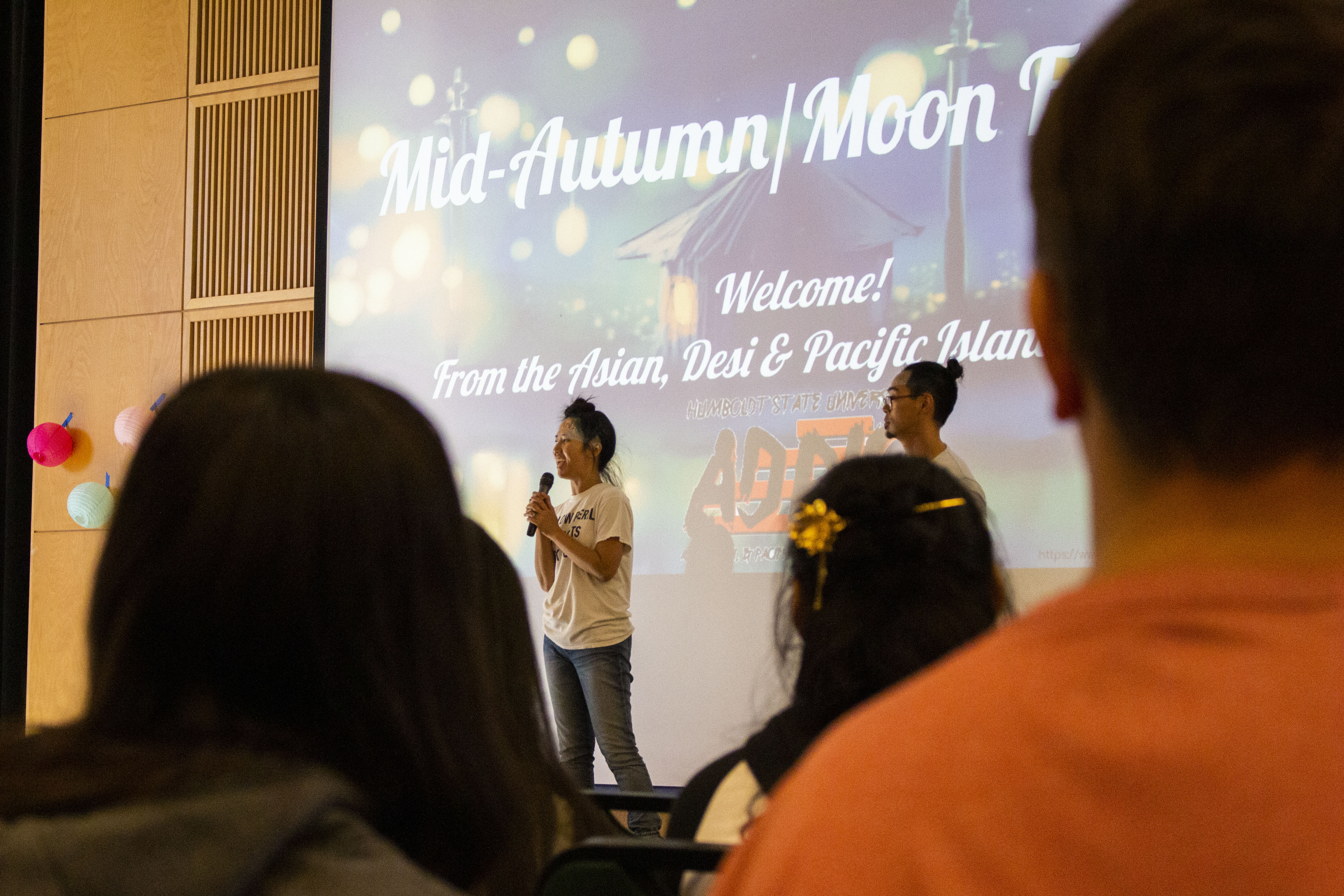
A short presentation from the ADPIC officers helped show the meaning of the event. They talked about how the Mid-Autumn Moon Festival is traditionally a time to spend with family or in absence, think of family members.
Jonathan Haeteurn performs a breakdance routine at the Mid-Autumn Moon Festival on September 13 in the Kate Buchanan Room. | Photo by Thomas Lal
After this, ADPIC member Jonathan Haeteurn and fellow Humboldt Rockers’ member Romel Robinson entertained the crown by break dancing. The dance may not have been expected from the event, but it was very well received with Haeteurn and Robinson being applauded throughout the performance.
“I want students, like me, to feel like they’re welcome. I’m from Kansas City. I get out here and there’s no one here that looks like me, I feel like I don’t belong. I feel like I’m always having to bring my chair to the table.”
Tammy Phrakonkham
Maria Castillo took her friend Afua Mensah to the event after hearing about it earlier that day. Mensah was happy that she had decided to join Castillo for her first Mid-Autumn Festival and said that she might be interested in attending more ADPIC events in the future.
Students and community members write Chinese calligraphy during the Mid-Autumn Moon Festival put on by ADPIC in the Kate Buchanan Room on September 13. | Photo by Thomas Lal
“I really enjoyed it,” Mensah said. “I’ve never had a mooncake before so I’m like, ‘this is pretty good!’”
The event was marked as the first event for ADPIC since becoming an Associated Students program. ADPIC President Tammy Phrakonkham was happy with the turnout from the campus and community, especially considering the lack of attendance at the events earlier in the week. She also believed that the amount of people that came out proved that there should be more support for the program from the school.
“I want students, like me, to feel like they’re welcome,” Phrakonkham said. “I’m from Kansas City. I get out here and there’s no one here that looks like me, I feel like I don’t belong. I feel like I’m always having to bring my chair to the table.”
Students and coummunity members enjoy a meal courtesy of ADPIC featuring mooncakes at the Mid-Autumn Moon Festival on Seotember 13 in the Kate Buchanan Room. | Photo by Thomas Lal
The ADPIC program passed around a petition supporting the goal of eventually having an ADPIC center on campus strictly dedicated to the progress and success of the program. In addition to aiming for a center space, the program recently procured a garden plot from the Campus Center for Appropriate Technology with the hopes of adding workshops for students to make different cultural cuisines.
“For five years prior, we were a club,” Phrakonkham said. “We have always been trying to fight to have our own center because a lot of the students felt like we weren’t represented here. When you think of Asians you aggregate that they’re all smart, they’re all rich or whatever. But half of us are South Asians or Southeast Asians. We’re also first generations and children of refugees.”
No pee, hair or spit. One blow is all it takes to show marijuana intoxication levels with new breathalyzer.
Marijuana has been a touchy topic since Colorado and Washington made their first moves to legalize recreational use in 2012. Since then, 29 states have followed and declared marijuana legal for medicinal and/or recreational use.
Tension forms at the discrepancy between state and federal opinion on where marijuana falls legally as a drug. The lack of legal confirmation from the federal government makes it difficult for government employers, especially police officers, to execute and process circumstances surrounding marijuana intoxication. Recent developments in marijuana detection technology suggest a breathalyzer is in the works.
Current marijuana testing requires a hair, urine or blood sample. The test results detect past use up to six months and reports the current THC level in the body. This testing proves to be unreliable as past use of marijuana will distort a current reading of bodily intoxication, which is what law officials care about.
The two technology companies racing to release their version of a more accurate breathalyzer are Hound Labs and SannTek.
Hound Labs was established five years ago and is leading the race with an expected release of late 2020. The Hound Labs breathalyzer operates on a specified time basis. It can detect marijuana if it’s been used in the last three hours. The three-hour window comes from two findings; one, marijuana is only detectable for the first three hours. Afterward, THC levels drop so low and so fast that it becomes virtually undetectable. Second, the initial three hours of intoxication are the most impaired and therefore the most crucial.
The breathalyzer method proves to be more accurate and better suited for law and medical officials, as alternative testing can take hours to produce results. In addition, this method is also beneficial to the participant, as the regulated three hour time interval doesn’t hold participants liable for past usage beyond that time frame.
If this new testing method becomes normalized, the three hours prior to testing will be the most critical, but anything before those three hours is merely tangential. Ideally, someone tested for their marijuana use could not be held liable for their marijuana use prior to the that three-hour window because the breathalyzer would not be able to detect it.
The opposing company, SannTek, and their breathalyzer the SannTek 315 will operate similarly to the Hound Labs breathalyzer. SannTek 315 is still in early development so the company is not providing much information. Like Hound Labs, their product will utilize a time interval to reveal the last ingestion of marijuana and current intoxication.
Hound Labs conducted clinical testing in 2017 in cooperation with University of California, San Francisco. However, no findings have been concluded publicly due to the small sample size. SannTek 315 lacks any formal testing or trials at this time.
HSU chatbot introduced to new students to answer campus questions
This fall, Humboldt State University introduced artificial intelligence chatbot HumBot to provide basic information for new students and transfers.
Director of Communications and Marketing for Enrollment Management Josh Smith led the project over the last two months until its release.
Thus far, HumBot has received more than 1000 questions and comments.
“There is a good chance that those questions may not have been asked if that avenue was not available to them at the time,” Smith said. “We get them at all hours of the day.”
Provost and Vice President of Academic Affairs Alexander Enyedi initially pushed for the development of a chatbot two years ago after hearing about a chatbot at Georgia State University. Pounce, the name for GSU’s chatbot, delivered more than 200,000 answers to incoming freshman within the first few months of its implementation in 2016.
Enyedi, with help from Smith and Associate Professor of Social Work Jen Maguire worked together to create HumBot.
“I’ve been a passionate proponent for the chatbot technology for over two years,” Enyedi said in an email.
HumBot is one chatbot among seven within California State Universities. AdmitHub, an AI chatbot service designed for students, developed all seven chatbots.
HSU created HumBot in the last two months after receiving an $80,000 grant from the Irvine Foundation.
AdmitHub handed over HumBot pre-seeded with answers to the 700 most common questions asked by first-year students. HSU then needed multiple departments to analyze the answers.
“It was started off by everybody just going in there, reading all the questions and answers, and first making sure that it was accurate, and second, trying to make it a little bit more friendly,” Smith said.
HSU staff and summer students then seeded HumBot with an additional 150 questions before it was released this fall. HumBot will continue to learn as students interact with it.
HumBot responds to fisheries transfer student Matthew Howe on Sept. 3. HumBot has answers to over 850 questions so far. | Photo courtesy Matthew Howe
“That is going to be an ongoing, multi-year, get smarter each time kind of thing,” Smith said.
Associate Professor Maguire is conducting research through the bot and Smith said she has been shaping HumBot to address issues specific to HSU. Maguire could not be reached for an interview.
“She is kind of the intellectual arm of the chatbot,” Smith said. “She and her colleagues are seeding the knowledge base of the chatbot with questions that relate to housing insecurity, food insecurity—HumBot is still learning those things, but it is our particular brand.”
Transfer fisheries student Matthew Howe used HumBot to find out where to pick up his mail. Howe admitted to being surprised by how well HumBot worked.
“I thought it worked fairly well,” Howe said. “I was expecting it to not perform at all. I was surprised at how well it did work.”
Howe said he would use HumBot again, although he doubts he would ask it anything personal.
Smith noted that questions sent to HumBot can be viewed by the project staff. HumBot is unlikely to be helpful for personal matters, although with the possibility of endangerment HumBot can notify university police.
Smith hopes HumBot can play an important role in the modernization of HSU’s accessibility.
“I would just encourage students to kind of re-look at those things that maybe they don’t know about or maybe weren’t up to par with a couple years ago,” Smith said.
For now, HumBot is only available to new students, but it is expected to roll out for second and third-year students next fall.
Cross country dominated at home, volleyball won two of three games and soccer had mixed results
The Humboldt State men’s and women’s cross country teams stood out at the Baywood Golf and Country Club on Sept. 6, while women’s soccer lost on the road and men’s soccer started the season with a 1-1 record. The volleyball team won two out of their three games at the Toro Classic in Carson, CA.
The HSU cross country team performed well in front of the home crowd as they walked away with sweeping wins in men’s and women’s competition. Senior Daniel Tull took first place for the Lumberjack men, and freshman Hannah Hartwell nabbed first place for the HSU women.
The HSU volleyball team lost their first match in Carson against Cal St. Dominguez Hills (3-0), but were able to bounce back with sequential wins against Academy of Art (3-0) and Notre Dame De Namur (3-2).
Women’s soccer went 0-1-1 on their Bay Area road trip, losing to Academy of Art (2-0) and tying against Notre Dame De Namur (1-1). Men’s soccer was able to go 1-1 on their San Rafael road trip, pulling off a comeback win against Dominican (4-3) in overtime and falling to Holy Names (3-2).
At the Sept. 10 HSU Athletics press conference, each coach and player from their respective sport spoke on their team’s performance and looked ahead to upcoming matches.
Cross Country
Head Coach Jamey Harris was ecstatic about his team’s performance in front of the home crowd at Baywood, and it helped that the Jacks had a supportive home crowd behind them. Harris noted the fact that HSU President Tom Jackson was in attendance, along with several members of the local running community.
“I couldn’t have asked for the season to start any better,” Harris said. “This was sort of an early-season meet just to see where we are at as we go into more specific training.”
Harris also talked about how important it was to the team that the community came out to support and noted how it works both ways, with the team also wanting to contribute back to the community.
“It shows our runners that the community cares and that the campus cares,” Harris said. “It helps them see the value in investing their time in the community, and it becomes a great cooperative relationship that way.”
The cross country team has a little more than a week to train and prepare before they make their way up to Monmouth, Oregon for the Sundowner Invitational on Sept. 20.
Volleyball
Head Coach Kelly Wood was happy about the Jacks bouncing back after losing the first match against Dominguez Hills. Wood talked about the unforced errors that the team made, but also acknowledged that the season had just started.
“We absolutely looked like a team playing its very first match of the season against Dominguez Hills that first night,” Wood said. “We made 36 hitting errors. That’s an insane amount of hitting errors, and that’s a recipe for disaster.”
Despite a rough first match, the Jacks were able to steal wins against their next two opponents at the Toro Classic. According to junior outside hitter Lexi Riggs who had the second-most kills during the classic with 37, the group raised their energy level for those next two matches.
“Everybody stepped up,” Riggs said. “Every single person on the team stepped up and got themselves going. I think what turned it around for us was the energy.”
The volleyball team will travel to the West Region Showcase in San Francisco for matches Sept. 12-14.
Men’s Soccer
The Jacks had a mixed weekend against Dominican and Holy Names, but the win against Dominican was a season opener that many on the team won’t forget anytime soon.
Going into the 53rd minute, the Jacks trailed 3-1. They were able to score twice and force overtime, and then defender Gus Baxter drew a foul in the penalty box and buried the game-winning goal to complete the comeback.
Baxter gave credit to his teammates for putting him in the position to draw the game-winning penalty. He gave credit to Dalton Rice for his two clutch goals, one in the first and one in the second half of the game.
“There were a couple of good passes around the box and then all of a sudden the ball is at my feet,” Baxter said. “I shoot, and it hits the guys hand. I took a deep breath, stepped up to it and buried it.”
The Jacks will get on a plane early Thursday morning and head to Billings, Montana this weekend where they will play Montana State University at Billings and the University of Mary.
Women’s Soccer
The Jacks weren’t able to get a win on their road trip, but they did get the tie in a hard-fought game against Notre Dame De Namur. Despite the results, Head Coach Paul Karver was able to see early-season improvements in the team.
“I think we saw a lot of the hard work that was put in over the offseason,” Karver said. “Going 2-0 would be super fun, but in a weird way, I’ll take where we’re at. The lessons we learned were really important, and that is what the preseason is all about.”
The Jacks will travel up to Karver’s hometown of Portland, Oregon this weekend for matches against Concordia and Saint Martin’s.
The last remaining KSHU staff members resign, join a peaceful gathering of a few dozen held during weekly farmers market
Forty-eight hours after the artery of the community was severed, a few dozen KHSU supporters took to the plaza in protest during the weekly farmers market.
Natalya Estrada resigned her position this afternoon as the last remaining paid staff member of KHSU. Estrada’s resignation came after administrators at Humboldt State University decided to fire all volunteers and terminate all but two paid positions at KHSU on April 11. David Reed was the second of the two remaining employees but resigned on Friday, April 12.
Estrada was at the protest to show support and said staying in the position would not only compromise her career in journalism but affect her overall health.
“There comes a time in life when you need to make a decision in life and I made that decision,” Estrada said. “I knew what I was going to do but I needed to know how and when.”
Local artist Lisa Enge holds a sign in support for KHSU during a peaceful protest at the weekly Arcata plaza farmer’s market on Saturday April 13. | Photo by T.William Wallin
After Reed resigned Estrada was the last staff member running the station. Estrada said when the California Report came on she put on Caroline King and cried at her desk.
“It was very lonely being the last person left,” Estrada said. “It felt like 48 hours on the 405 during rush hour traffic.”
Tom Cairns was one of the volunteers to be let go during the dismantling of KHSU, but he isn’t just any volunteer. Cairns has been with KHSU for 47 years, making him the longest running volunteer at the station.
Community member, Carrie Slack, and former host of Jazz with a Groove, Rob Enge, hold signs in support for KHSU during a peaceful protest at the weekly Arcata plaza farmer’s market on Saturday April 13. | Photo by T.William Wallin
Cairns was at the protest because he felt the way everyone was fired was wicked and shameful. Cairns felt the audit report done on KHSU was just an excuse for firing everybody and HSU administrators were planning this even before then.
“The way they handled it was bold face lies,” Cairns said. “They had checks written out already even before the meeting. They had it all planned.”
In the 47 years as a volunteer Cairns has seen KHSU have its ups and downs but “it’s always continued and was never shut off the air.” Cairns said the unfortunate thing about the station now is it has become a typical NPR station with all news and very little music.
“Basically it’s just another McDonald’s public radio station,” Cairns said.
Public citizens, Mark Mueller and Lisa Hockaday, hold signs in support for KHSU during a peaceful protest at the weekly Arcata plaza farmer’s market on Saturday April 13. | Photo by T.William Wallin
When asked what he felt the biggest loss was Cairns said the community of the station. Cairns said those that work with KHSU are very active in the larger northwest community and engaged in the arts, food, and news.
“The music, public affairs, and local programming is what made KHSU unique and a viable source for the community,” Cairns said.
A few dozen protesters gathered with signs during the Saturday farmer’s market at Arcata Plaza to show support for KHSU on April 13. | Photo by T.William Wallin
Rob Enge, former host of Jazz with a Groove, was a member and sustainer with KHSU for 25 years and agreed with Cairns. Enge said this has been a loss of a community forum where connection was made.
“This was a good place for people to put their energy,” Enge said.
Enge moved to Humboldt in 1992 and the first thing he did was get connected with the local radio station. Enge was an avid listener of KPFK in southern California and said public radio stations are an important way in getting connected with community.
“This has been an erosion of community,” Enge said. “This isn’t social media from out of the community, this is real people talking locally and when we lose that its a shame.”
Community members show support for KHSU during a peaceful protest at the weekly Arcata plaza farmer’s market on Saturday April 13. | Photo by T.William Wallin
Local artist Lisa Enge has also been a supporter of KHSU since 1992 and felt the loss of KHSU was like losing a friend. She said KHSU was a treasure in the community and it was a cruel way that it was cut.
“Cutting volunteer and staff is unconscionable, shameful really,” Lisa Enge said.
Jax Stuber (left) has been listening to KHSU everyday for the last six years and said she will miss all the music and diverse programming. | Photo by T.William Wallin
Lisa Enge said once general manager Peter Fretwell fired KHSU program director, Katie Whiteside, the love for KHSU waned. She said as an artist the radio kept her company while she worked and she didn’t feel so lonely.
“The people, DJs, and programmers became friends,” Lisa Enge said. “It’s like losing a friend, or a family member really.”
Threes don’t fall for the Jacks as they drop first game of the season.
Lumberjacks forward Isa Conde scored 26 in a comeback effort by the Jacks versus the Concordia (Ore.) Cavaliers but fell just short in the game’s final seconds.
The Jacks (2-1) fell to the Cavs (4-1) 72-71 at Lumberjack Arena on Nov. 20 but were able to mount a comeback after trailing by 18 early in the game. Isa Conde began to find her groove thanks to some trips to the free throw line and the buckets began to fall.
“We shouldn’t be in these situations,” Conde said. “We should be the ones forcing teams to fight back and we just need to work on our starts.”
Defense has been an issue for the Jacks as they are allowing 71.6 points per game but this team lives and dies by the three and they fell on their own blade against the Cavs.
The Lumberjacks shot over 10 percent worse from three-point land against Concordia than their season average of 32 percent. To make matters worse, the Jacks couldn’t pull down any boards and were outrebounded by 15.
Down 23-6 in the first quarter, the Jacks began to chip away at the lead. They found their way back into the game as they began to force some turnovers. Down by just four with 2:16 left, Conde drove to the bucket and got the and-one to bring the Jacks within just a point. Conde led all players with 16 points the first two quarters and her team trailed by only three at halftime.
“I thought Isa just played her tail off on both ends of the floor tonight,” Jacks head coach Michelle Bento-Jackson said. “She’s trying her best to lead us in all areas and not just scoring but keeping us together and being vocal.”
The Cavs were able to get out to an eight-point lead in the third quarter but the Jacks remained poised and kept making plays to keep the game close.
Lumberjacks junior forward Alexia Thrower puts the post-move on the Cavaliers defender during the Jacks 72-71 loss to the Cavs on Nov. 20 at Lumberjack Arena. | Photo by Lauren Shea
Jacks newcomer Alexia Thrower has been a revelation for the Jacks. She’s already recorded two double-doubles in the first three games of the season with averages of 17 points and 9.6 boards per game.
“We came in and played stronger in the second half, “Thrower said. “It was enough to give us a kick start.”
The fourth quarter was not to be missed. The Jacks fought their way back to make the game competitive but they wanted a win. Every time the Jacks came close, the Cavs hit another shot to extend their lead.
Down 68-65 in the game’s final minutes, Jacks junior guard Tyra Turner was able to get by her defender to make the layup plus a foul. Turner knocked down the free throw and tied the game at 68.
With the Cavs in the penalty, Alexia Thrower was sent to the line for two. She knocked down both to give the Jacks their first lead since the first minute of the game.
With just 11 seconds left, Cavs guard Kizzah Maltezo was fouled by the Jacks Jovanah Arrington. Maltezo made both to put the Cavs up one. With a chance to win the game, Turner missed a 3-pointer as time expired, handing the Jacks their first loss of the season.
“Im glad that our team had the resilience to fight back,” Conde said. “But at the same time it would be cool to have came out victorious.”
Getting your hands dirty never felt so gratifying, but for volunteers at Humboldt State University’s Campus Center for Appropriate Technology, otherwise known as CCAT, the satisfaction of hand-to-earth action persists each Friday, Chelsea Wood reports.
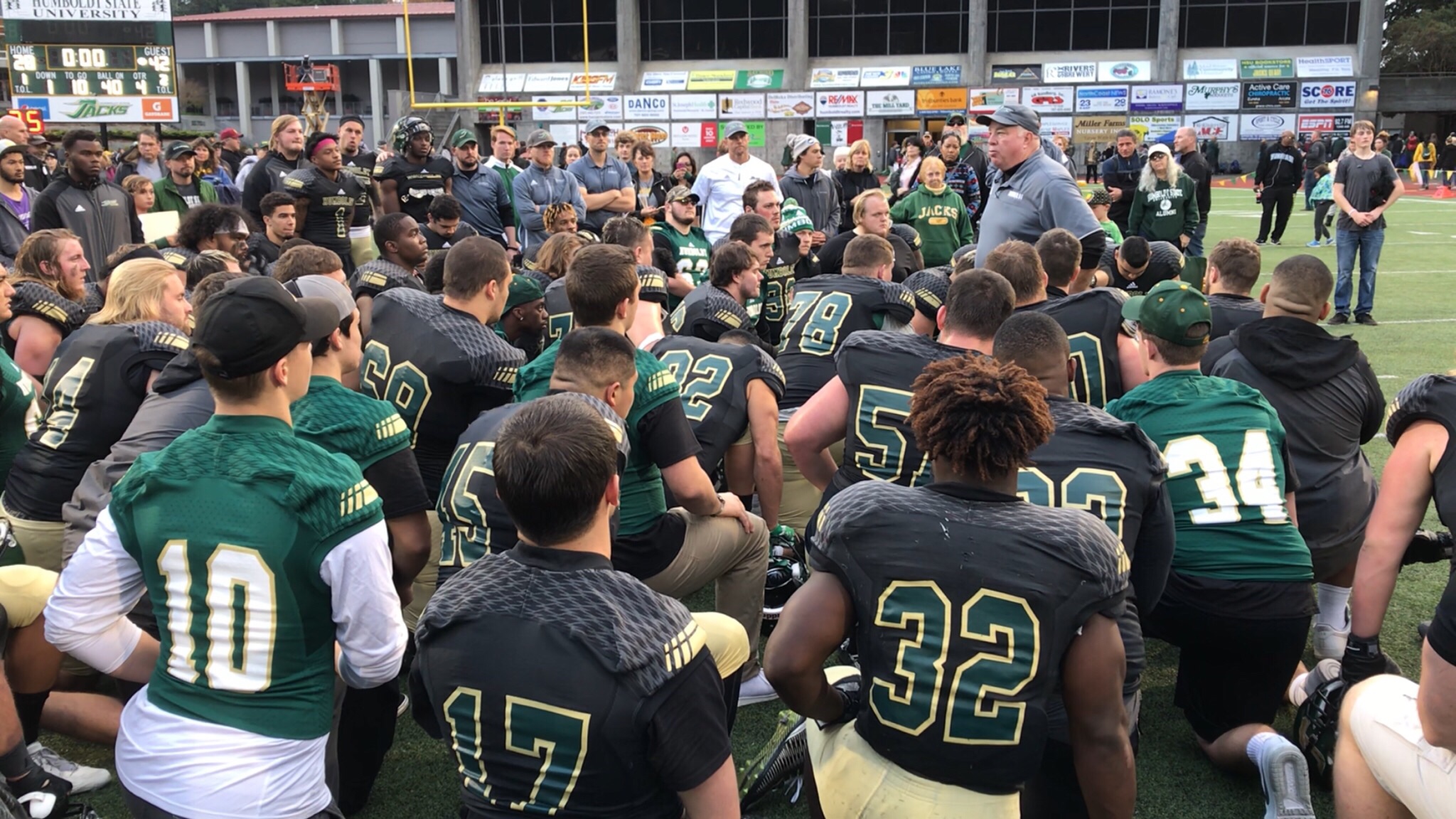
The Azusa Pacific field goal that beat the Lumberjacks on Nov. 3 sailed through the uprights. At this moment it dawned on me that this was the final play of HSU football. The empty feeling in my gut is all too familiar.
Born and raised in San Diego, I could never tell local Jacks fans how to feel or how they should feel. However, after over 30 years of cheering for the San Diego Chargers, I have a pretty good idea.
Year after year, heartache after heartache, I remained loyal to the Chargers. When they went 1-15 after using the second pick in the draft on University of Washington Cougars quarterback Ryan Leaf (the biggest flop in professional sports history), I stuck with it. When management fired head coach Marty Schottenheimer after going 14-2, I stayed true to my team. Get rid of L.T? Why not? There was no quit in me.
Then, Chargers owner Dean Spanos made the decision to move the Chargers to Los Angeles in Jan. 2017 because he felt it couldn’t compete with the rest of the league financially at his old stadium in San Diego. Loyalty was never on the menu for ownership and I no longer have a team.
The same can be said for HSU administration. People are pointing the finger at HSU president Lisa Rossbacher and rightfully so. This is the second football program to be eliminated under Rossbacher’s watch.
Many locals will be getting their wish. Rossbacher’s announced retirement begins at the end of the Spring 2019 semester. One must wonder if future university presidencies are in her future and which team will be on the chopping block next.
After playing the blame game, the reality of the loss begins to set in. For me, it was the fact that my home team that I had literally bled for was going to leave my city for our rival city to the North. Watching them be successful in Los Angeles this season has been hard to watch to say the least.
There’s no more cheering for Lumberjacks football even if you wanted to. The game against Azusa was the last game to ever be played at the Redwood Bowl. That is the reality.
Never again will locals be able to come down early on a Saturday to tailgate before a big game. There won’t be any more Lumberjacks moving on to the NFL, like Jacks All-American offensive lineman Alex Cappa in this year’s draft. At least not in the near future.
The people with the most to lose in this situation are the players. Many of whom moved up to Humboldt County away from their comfort zones just to play the game of football. For some, HSU was the only offer received. For others this university was their choice.
Even though HSU won’t fully admit to having a diversity problem, many students would agree that there is one. Losing Jacks football will have a negative effect on the diversity that HSU tries so much to promote.
90 years of Jacks football apparently means nothing to HSU administration.
The program is over and the lights at the Redwood Bowl are off. It’s a slap in the face and the feeling will never go away.
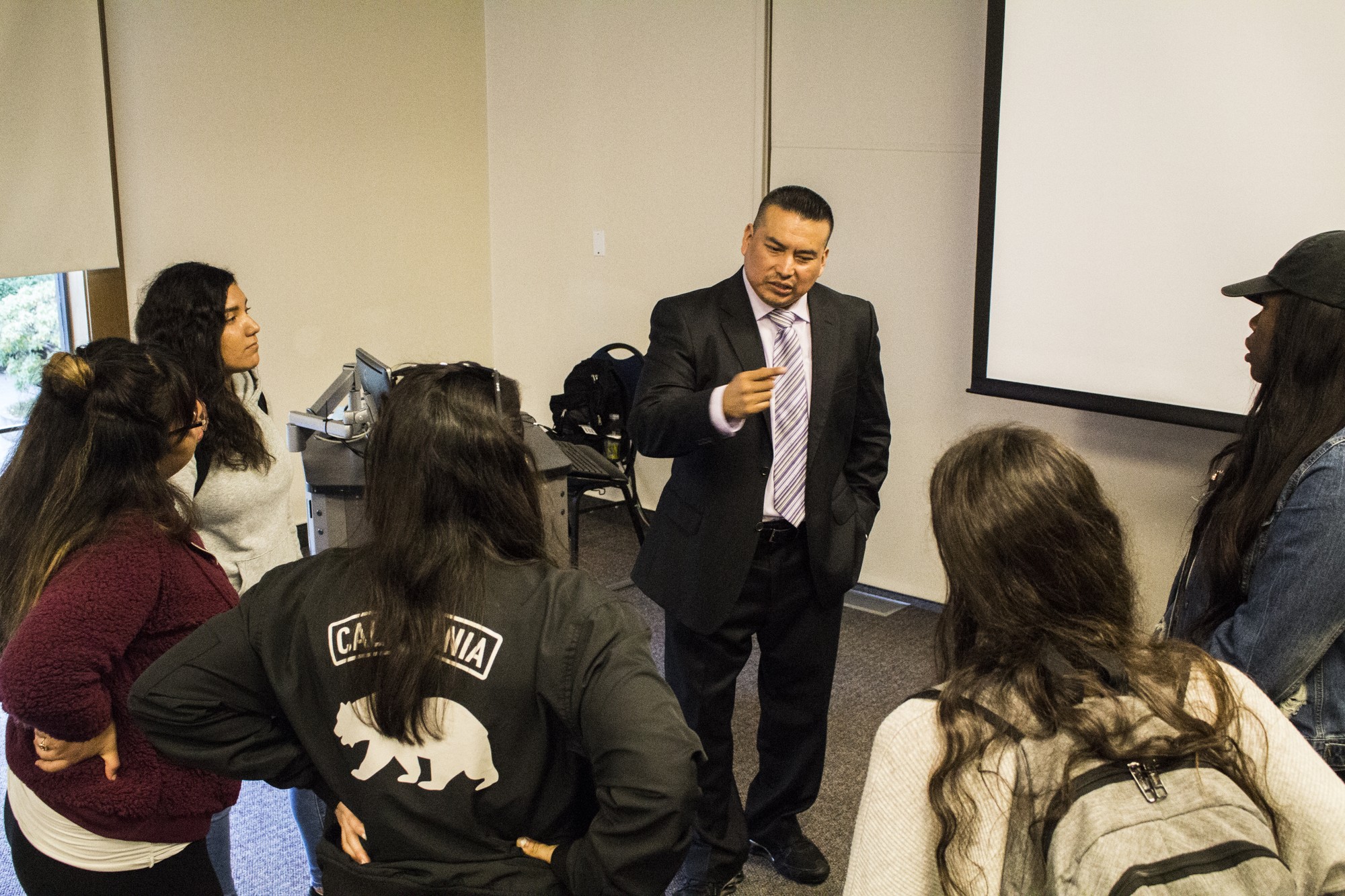
Eliberto “Eddie” Ramos barely escaped the street-gang violence of his east Los Angeles neighborhood only to return and work in the criminal justice system.
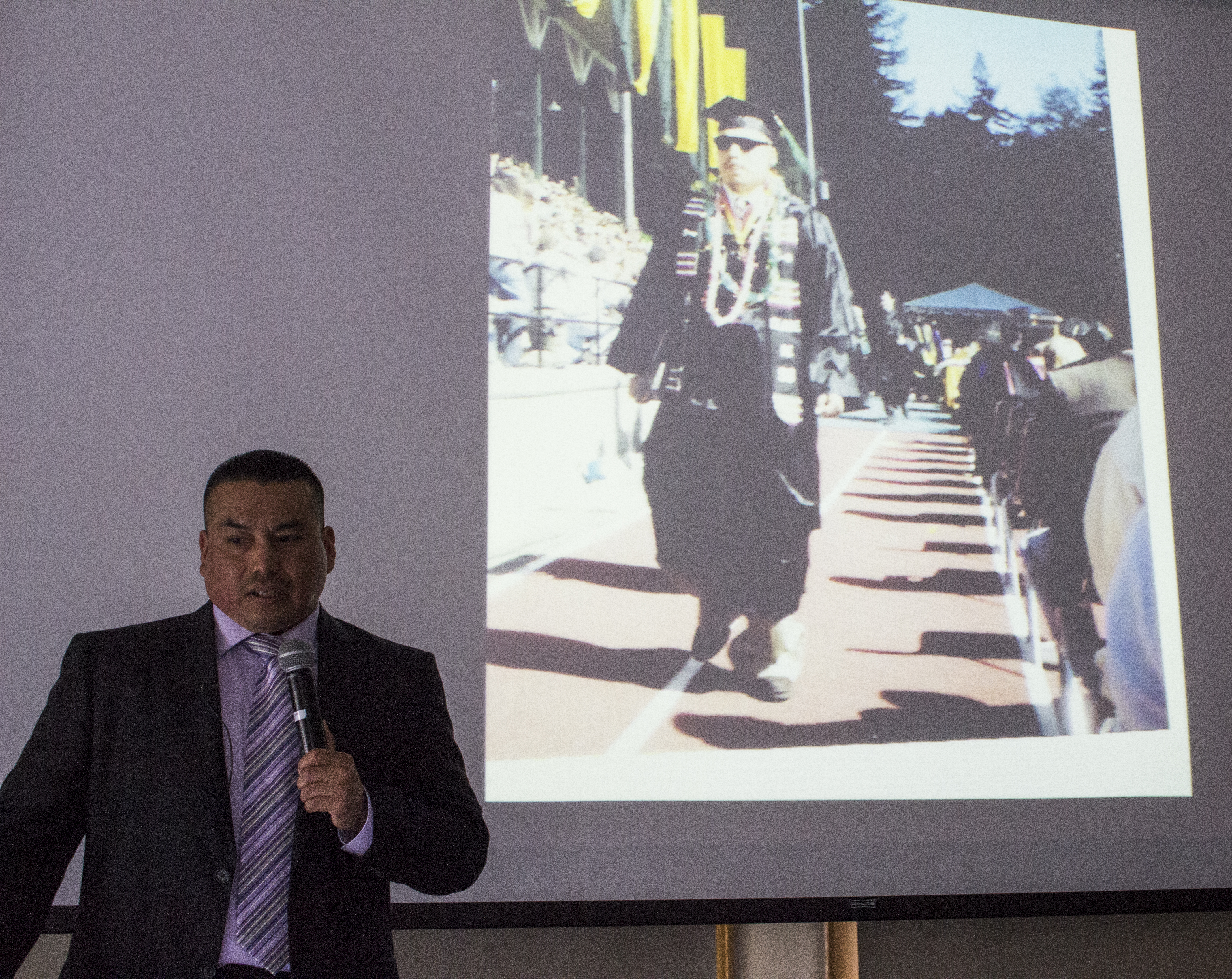
Ramos, a psychiatric social worker for Los Angeles County, earned his BA in sociology at Humboldt State University in 1999. Ramos went on to earn his Master’s in Social Work from the University of Southern California.
On Nov. 1 Ramos was presented the 2018 Distinguished Alumni Award at HSU. He later gave a presentation on his journey from growing up in the gang culture to becoming an advocate for inmates with mental health and substance abuse issues.
“For me it’s a great experience seeing the two sides of where I came from,” Ramos said. “And now I’m working with the law in order to help the system.”
Ramos grew up in East LA and participated in the gang culture at an early age. He said the culture had been around for 60 years by the time he was born and his whole family was involved. Ramos said it’s hard to wake-up and leave it behind when everyone around you is living it.
“At that age you’ve already lost so many people you ask yourself ‘whats left for me’,” Ramos said.
Ramos caught a break from the street violence and crime when a counselor suggested he go to Pyles Boys Camp at the age of 14. The camp, which is nestled among the redwoods in Sequoia National Park, is a program to motivate at-risk or disadvantaged youth. Ramos credits the camp as paving the way for him attending HSU.
“At the boys camp I had a place to learn how to get along with other people,” Ramos said.
Retired sociology professor, Jerry Krause, said he had Ramos as a teacher’s assistant in his prison and society class. The field experience for the class was to travel to Pelican Bay State Prison. Krause said he had Ramos lecture the class sometimes because he could vividly describe the environment that inmates would be coming from.
“He was so attentive and would always sit in the front row,” Krause said. “You could see his eyes light up.”
Retired HSU sociology professors, Jerry Krause and Betsy Watson, pose with Eliberto “Eddie” Ramos after he was presented the 2018 Disinguished Alumni Award on Nov. 4. Ramos escaped the gang culture and now works in criminal justice in LA county. | Photo by Tony Wallin
Krause said the key in changing life trajectories is with peer relationships. He said it takes people like Ramos to help people with similar situations and backgrounds. Krause said what helps is he has noticed more students are coming from urban areas to Humboldt and studying behavioral science.
“Since I have retired it has become much more diverse in Humboldt,” Krause said.
Retired sociology professor, Betsy Watson, was the department chair of the sociology program when Ramos was a student. She had Ramos in a couple of classes and said he had great intuition and could read people very well. She first noticed him when she thought she saw two “gang bangers” walking pass her, only to find out they were students and one was Ramos.
“I tried to convince him he was as smart as he was,” Watson said.
Watson said the department was most relieved when Ramos would return back for the fall semester. They were relieved he was alive. She said they knew what kind of environment he was returning back to and couldn’t imagine what the parents were having to go through in the neighborhood. Watson said since Ramos was a student at HSU a lot more students have been enrolling with backgrounds where they are exposed to danger. She said the diversity is important.
“Once you study the culture of someone else you learn your culture so much more,” Watson said.
HSU alumni, Eliberto “Eddie” Ramos, gives a presentation on his journey from gang culture to being an inmate advocate on Nov 1. | Photo by Tony Wallin
Ramos said the future of rehabilitation lies in therapeutic programs. He said the most successful are peer support programs where people can connect with each other because of shared similar experiences and backgrounds.
Ramos works on alternative sentencing and rehabilitation plans for adult offenders. He said he works as the bridge between the courts, the community, and the clients within the Los Angeles criminal justice system.
“Find your purpose,” Ramos said. “It may take 10 or 20 years to find but it’s out there.”
Loss of football program also means loss of diversity, opportunity
Lumberjacks football has been a staple of Humboldt for over 90 years. But this season will be the last for the foreseeable future and this community is losing more than just a team.
Football brings more to the table than just sports. Student-athletes chose this school to pursue their education and to chase their dream of playing college football.
Terminating Jacks football will be the conclusion of a program that has been a part of Humboldt since 1924, not long after HSU’s founding. The program has seen some standout stars and big-time players along the way. Lumberjacks 2017 All-American offensive lineman Alex Cappa was selected 94th overall by the Tampa Bay Buccaneers in this year’s NFL draft.
HSU says they do their due diligence to remain somewhat ethnically balanced while bringing in students from all over California. This practice is misleading as the university’s surrounding areas have many racial undertones. The football team is one part of the school that was true to HSU’s message of inclusivity.
Where there were once young men of all races working diligently towards the same goal, there will no longer be. The locker room that once brought men together will be empty.
HSU will honor scholarships for eligible players through the 2018-19 academic year, and coaches and staff will also help players contact other programs. At the end of the season, players will get a full release, which means they could choose to play at another institution.
President Lisa Rossbacher called it an unfortunate but necessary step in addressing the University’s structural deficit and protecting the school’s core academic mission. In her “mission” she has neglected a big part of what is supposed to make this university great.
The closing statement of our mission states: “We help individuals prepare to be responsible members of diversesocieties.”
Less than four percent of HSU’s student population is African American and less than two percent of faculty are African American. Where is the diversity? Where is the care for the individual student?
HSU has experienced lower enrollment over the last two years. Fall enrollment has dropped by more than 400 students. This dip has had a measurable impact on the budget and the loss of football will expectedly lead to an additional decline in enrollment, which in turn will bring less people of color.
While getting rid of the football program could possibly be the right decision fiscally, the loss will be felt by many. People may not have ever met, had it not been for the football team. Familiar faces will change into strangers faces. What once brought a sense of camaraderie to this campus will now no longer exist.
HSU hopes that contributors and boosters will continue to support HSU athletics but the $200,000 or more increase in contributions last year was for football. Loss of the football program will have a long-term ripple effect. Where and what gets hit the hardest remains to be seen.
Early this afternoon, Humboldt State University announced that after this 2018 season the football program will be cut.
“This [decision] is due to ongoing financial challenges within athletics and at the university as a whole,” Humboldt State University President Lisa Rossbacher said. “We cannot allow the budget deficit in athletics to continue or to deepen further.”
This April, Rossbacher announced the two-year budget plan in reducing costs by at least $9 million and many hoped that the football program would not be a part of this cut. However, according to the HSU Athletic Department, the net cost of about $1 million annually became too expensive for the University to support and subsidize indefinitely.
“It is the only realistic path for us to take,” Rossbacher said.
Redshirt Sophomore Kyle Martorella called home as soon as he received the news. He said he was very surprised and upset after hearing the program would be cut.
“I can really only see myself playing at Humboldt so it sucks,” Martorella said. “I thought we were guaranteed another five years and that was what the money was raised for.”
Since December 2017, HSU boosters, alumni and community members put forth their utmost effort in reaching a goal of $500,000 that would have ensured another solid year of football at the Redwood Bowl. During that time Rossbacher announced if $500,000 was collected by January of each year, for the next five years, the University would match it with another $500,000 to keep the program.
Although SaveHSUAthletics confirmed nearly $511,000 in pledges last fall, only $329,000 in cash donations were collected in June, according to Rossbacher.
However, SaveHSUAthletics Co-Founder and HSU alum Jim Redd shared that in fact, a total of $410,000 was collected.
“I know that a payment of $80,000 was scheduled to come in, and received on July 15th,” said Redd.
The total amount of donations that were collected will be used for this last football season at HSU and all of the scholarships awarded will be honored to eligible players through the 2018-2019 academic year.
“We are going to be very supportive of the current players and coaches this year,” Redd said. “The support is going to drop way off for HSU athletics as a whole.”
Although several boosters donate to other HSU athletic programs as well, Redd and his fellow boosters believe cutting the program was all a part of Athletic Director Duncan Robins’ plan and because of that, many supporters no longer want to give money to HSU athletics at all.
“There are a lot of donors upset and wanting their money back,” said Redd. “I just feel like Robins was hired to get rid of the program. It took him seven months longer than he would have liked but he succeeded.”
HSU’s athletic department said it plans on providing as much support as needed for current players, whether they choose to complete their academic years at HSU or to transfer to another school and continue playing football.
HSU junior and 2018 captain Isaiah Hall said he plans on “riding out” with a strong team for this last HSU football season and hopes to ensure his team that this decision should not interrupt what they have accomplished for the success of this season so far.
“I always had a feeling that this was bound to happen,” Hall said. “When [Rossbacher] was on the podium talking about keeping the program, her words felt untruthful.”
After this season, Hall is eligible to play two more collegiate years of football and after speaking with his family he plans to have a successful season and transfer to play at another university come spring.
As for new recruits, Chris Quirarte from Buhach Colony High School and Braden Gordon from Independence High School, new beginnings have already come to an end. Both of the newly announced Jacks from Southern California said they were not sure what to think about the news and immediately contacted family for support.
“I am stuck on whether I want to redshirt or play this year,” Quirarte said. “The decision changes my outlook on the season a little but I am not trying to pull the trigger on my decision too early.”
Last year, HSU athletics held a deficit of about $750,000 in which the university covered; and three years ago that deficit was at $250,000. The rate of cost increases in the athletics department at HSU has been roughly double of the university costs in whole.
Rossbacher said she still plans on maintaining a Division II athletics program at HSU and in order to remain eligible for NCAA Division II competition, the University is required to have 10 sports. According to the HSU Athletic Department To remain in the California Collegiate Athletic Association, HSU’s primary conference, the 10 sports are required to be chosen from a specified list, and football is not included on that list.
After this 2018 football season, HSU will sponsor 11 sports: men’s and women’s basketball, men’s and women’s soccer, men’s and women’s cross country, men’s and women’s track & field, crew, softball and volleyball.
“At this point we just have to come together as a team,” Martorella said. “We still have 10 games like any other season and we can still win a ring like any other season.”
I, Skye Kimya, believe I was detained on Feb. 14 over a $40 on-campus parking ticket because of the color of my skin.
Around 8 a.m. that morning, I walked out of a building on the northeast side of campus to find two parking officers giving me a ticket for where my car was parked.
After getting into a small verbal altercation with these parking officers, I realized it wasn’t worth the argument. I asked them to give me the ticket and let me go about my day.
The parking officers were not happy with me driving off while they were still giving me my ticket, and before I knew it, Humboldt State police Chief Donn G. Peterson was pulling me over in an undercover vehicle.
Within minutes, another University Police Department vehicle arrived to the scene. I was interrogated for approximately 10 minutes by two officers on each side of my car about the incident that had just occurred. After the officers spoke with each other for a few minutes, another cop car pulled up, and UPD officer Delmar Tompkins made his way to my driver side.
“Please step out of your vehicle and put your hands behind your back,” Tompkins said.
“Excuse me? I don’t understand,” I said.
I was told I was being detained under suspicion of assault with law enforcement. After questioning this accusation, I was told I was a threat at that time and needed to be detained for the safety of the officers because they did not know the full story yet.
Confused and scared, I got out of the car, did what Tompkins asked me to do and began to cry like a baby as he placed me in the back of his cop car.
Imagine being detained and told you are a threat, under suspicion of assault, by a white officer twice your size. Imagine feeling confused and alone. Imagine questioning what could possibly happen next.
When you grow up trying to understand the purpose behind discrimination, you begin to notice how common it is and wonder if it will ever go away.
At times, you lose hope for your children’s generation. Yet other times, you want to become the greatest activist that has ever walked this planet, in order to actually make things right for those future generations.
Students at HSU don’t feel at home. We don’t feel as though there are people by our side, and we don’t see the amount of people of color around campus that the HSU pamphlets and website photos presented to us when we were deciding which university to attend.
According to HSU’s “fast facts,” the incoming class of fall 2016 consisted of 549 Hispanic/Latino students, 51 African American students, 31 Asian students, 11 American Indian students and four Pacific Islander students.
Additionally, the entire fall 2016 student body consisted of 2,869 Hispanic/Latino students, 271 African American students, 279 Asian students, 89 American Indian students and 20 Pacific Islander students.
With a student body total of 8,503, you can imagine what it is like to see only 270 other faces similar to yours on one side, and only 88 other faces similar to yours on the other side.
Hispanic and Latino students made up almost 35 percent of the entire student body that same year. Seems like a reasonable amount, right?
HSU actually receives funds from the U.S Department of Education ever since they became a Hispanic-Serving Institution at the start of the fall 2013 semester.
To become a Hispanic-Serving Institution, the university has to have an undergraduate full-time equivalent enrollment of at least 25 percent Hispanic students, and HSU was at 26.6 percent for the fall 2013 semester.
HSU continues to flaunt a great amount of diversity that it does not have. These incoming students, like many of us who were once in their shoes, attend HSU and slowly begin to witness and experience how diverse this campus and community is truly NOT.
Just the other day, the NAACP Eureka Branch called out HSU and asked them to stop recruiting students from minority-majority neighborhoods until changes are made around campus and within the community.
A majority of the students of color who have attended HSU for at least two academic years have experienced some type of discrimination, whether it was verbal, physical or emotional.
In 2013, Tompkins had a civil lawsuit filed against him by a Fieldbrook man who alleged he was the victim of a brutal assault back in January 2012. It turns out the Fieldbrook man wasn’t lying and the Cal State University system paid him $135,000 to keep him quiet.
As students of color at this university, how are we supposed to feel safe if our own UPD officers don’t do things the right way and have our back?
Cases like the murders of HSU African American students Corey Clark (2001) and David Josiah Lawson (2017) are still unsolved to this day, and we as students have not seen enough action taken by our president, UPD and even the Arcata Police Department.
Students of color do not feel safe, nor protected here. The NAACP Eureka Branch is right and something has to change before HSU tries to drag more students of color to this campus.
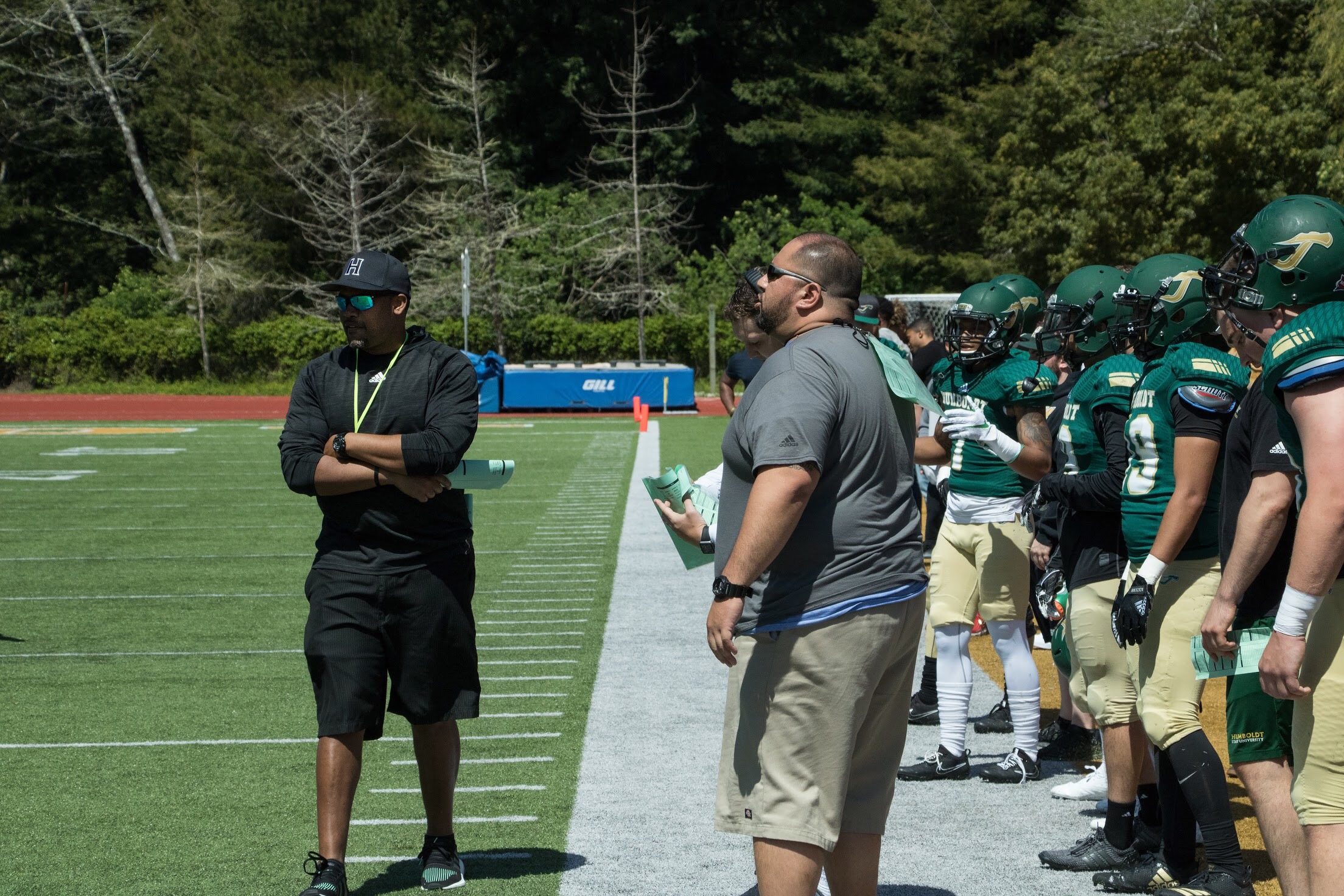
Failure is not an option for coach Mason Mitchell. He plans on pushing the football program in the right direction with the continuous support of the community and the Humboldt State University student body.
“It is more than just being able to put something on your resume,” Mitchell said. “I am here to help push this program in the right direction, and help continue its success.”
Mitchell was hired as the defensive line coach on March 22 by interim head coach Damaro Wheeler. He was previously at American River College in Sacramento, where he helped more than 45 defensive linemen move onto the four-year level within a five year time period.
As of the 2018 spring semester, the Lumberjacks have hired three new coaches and six others have volunteered to help coach throughout spring ball, and possibly the fall season.
These volunteer coaches have been out on the field at 6 a.m. several times a week to help conduct spring practices. They have also been in the football offices daily to help with logistics for the success of the program.
The work that they have already put in has shadowed the commitment from the community in fall of 2017 in keeping the program alive and successful.
Lucas Govan has volunteered with the Lumberjacks since fall 2017, and is an HSU alum.
“The comradery that comes with [HSU Football] is special,” Govan said. “There is no place really like it.”
As a former Jacks player, he mentions how neither the players nor coaches would be where they are, and as successful as they are, if it weren’t for the support from the community and student body.
The Lumberjacks hold a very reliable stance with their community, alumni and student body, given that they have helped sell out the Redwood Bowl and raised $500,000 during a time of need.
“I was a lead in trying to raise the money,” HSU alum and booster Jim Redd said, “but there were about 250 donors that came up with the $500,000.”
It is the 250 donors who made it possible for these young men to get back in the Redwood Bowl this spring, as well as allowing the new coaches to step in and pick things right back up in preparation for a successful fall 2018 season.
After a successful inter-squad spring game, The Lumberjacks will take a quick summer vacation before they begin to prepare for their first season game in Wichita Falls, Texas against Midwestern State University on Sep. 1.
“We want everyone to continue to come out and support us,” Mitchell said, “But with that, we want them all to understand how important their support is for us.”
The Mathematical Contest in Modeling (MCM) is an international multi-day mathematics competition that has been held annually by the Consortium for Mathematics and its Applications within the U.S. since 1985.
The competition focuses on real world mathematical modeling problems, and the groups of students participating only have a weekend to complete their chosen problem and create the solution paper as their finished product.
Jessica Solomon is an environmental science major with a minor in oceanography at Humboldt State who is working to go to grad school for atmosphere science.
“It’s training you to communicate what you’re visualizing in your head, and that was probably the biggest challenge,” Solomon said. “How do we do this model? How do we all get on the same page and be able to communicate it on a paper without our biases being too much attached to it?”
Solomon worked on the ICM problem E which focused on how climate change influences regional instability.
“Learning to work with people that you’ve never even communicated with before, on a project that involves a lot of complex decision-making, was a really good learning experience,” Solomon said.
This year, there were six problems: three MCM questions and three International Congress of Mathematicians (ICM) questions. The MCM questions have more of a math base, while the ICM questions are created to be more data-based or interdisciplinary. The various types of questions are meant to make the competition more accessible for a larger variety of students, including non-mathematics majors.
“Maybe someone else has more of a math background, someone else has a coding background and someone else really loves writing the paper,” Larripa said.
Kamila Larripa, a mathematics professor here at HSU, was the advisor for the HSU groups participating in the MCM competition.
“It’s a really beautiful, organic collaboration where you’re seeing people having a chance to do the things they like the best or contribute their own unique gifts,” Larripa said.
Mathematics professor here at HSU, Kamila Larripa, was the adviser for the HSU groups participating in the MCM competition. Larripa in front of the sculpture at Mathematical Research Institute of Oberwolfach, in Oberwolfach Germany. Photo courtesy of Kamila Larripa.
At HSU, six groups of three and one group of two competed in the competition, making this the largest group of competitors the school has ever had. The students worked on their chosen problem during the second week of February from Thursday afternoon until Monday night.
All of the HSU teams received successful participant in the contest, meaning they placed in the top 54 percent for problems 1-C, and top 47 percent for problems D-F, out of a total of 10,339 foreign teams and 331 U.S. teams.
This year’s competition had the largest proportion of female competitors from HSU.
“There has been a trend where women are more likely to do this contest than some of the others that are more individually-based,” Larripa said. “So, Stanford has sent some researchers to visit and shadow a team here as part of a larger research project they’re doing that I believe is looking at gender in these math contests.”
Stanford is conducting a study on what draws women to the MCM competition. The study is being conducted by YouCubed with Jo Boaler, the director of YouCubed and professor of mathematics education at Stanford.
Jack Dieckmann is the director of research at YouCubed at Stanford and was a researcher who visited HSU to shadow one of the MCM groups.
“We wanted to understand the features of this contest in comparison to others that makes it so gender-equitable,” Jack Dieckmann said.
Amanda Hemingway, a pure math major at HSU who is graduating this semester, Briana Ramirez, a HSU mathematics major with a minor in statistics, and Jaime Sanchez, an applied mathematics major at HSU, worked on MCM problem C regarding energy production with the purpose of creating an applicable energy profile. Hemingway, Ramirez and Sanchez made up the team the Stanford group shadowed and observed for the duration of the competition.
“We are conducting a study across different U.S. universities in order to explain why, over the past 20 years of this competition, women have been not only participating in this contest, but also achieving higher results,” Dieckmann said.
The MCM competition is swiftly becoming a contest filled with female competitors. However, in many other mathematics contests, such as the William Lowell Putnam Mathematical Competition, women participate rates are low.
“We’ve both taken the Putnam before, we didn’t do well in that. It was awful — miserable,” Hemingway said.
While both Hemingway and Ramirez hated the Putnam, they enjoyed the MCM. Ramirez plans to compete the MCM again next year. Now that she is more familiar with the competition, she plans to compete by herself.
“Overall, we all came out realizing it was really nice applying all of the information we’ve learned,” Ramirez said. “It wasn’t just one class’s information going into it like a test. It was like, I learned this from stats and this from logic, so let’s put it all together. It was really nice applying it not in a classroom or test setting.”
The Stanford researchers reached out to 14 different universities and only ended up sending teams to two of them, one being HSU.
“We chose this university for a site visit over many other places because this university, especially professor Larripa, has really shown a lot of commitment for what it could mean for all of the students, especially the women competitors, in terms of mentoring, preparing and helping them to be successful,” Dieckmann said. “I see her coming around and bringing snacks and just giving as much support as possible — as much positive energy as she can towards this.”
Many of the HSU students participating in the MCM competition said they decided to compete, because Larripa encouraged them to do so for the learning experience.
“My personal experience at the school has lended to women being very involved in math and science, even when you look at the math club,” Hemingway said. “I am the vice president of the math club, and most of the people who attend the math club are female.”
Hemingway and Ramirez presented their work on problem C at the Northern California Undergraduate Mathematics Conference over spring break. All of the groups that competed presented their findings at an HSU mathematics department seminar on April 12. They also created posters for their solutions that were featured at IdeaFest.
Jessica Solomon, a HSU environmental science major with emphasis in Climate and Energy with a minor in oceanography, and Amanda Donaldson, a HSU Forestry major with an emphasis in Hydrology, work on the Mathematical Contest in Modeling ICM problem E on how climate change influences regional instability. Photo credit courtesy of Humboldt State University.
“I wanted to force myself to learn and improve on communicating and working with different types of people,” Solomon said. “Never in life will I be given an assignment and told to write an entire academic paper and solve this massive complex problem in a weekend. But it’s nice know that I can do it — that I have the skills to do it.”
While the competition was hard the competitors learned valuable lessons in collaboration and real world mathematical modeling.
“It was encouraging. I’m excited to graduate now,” Hemingway said.
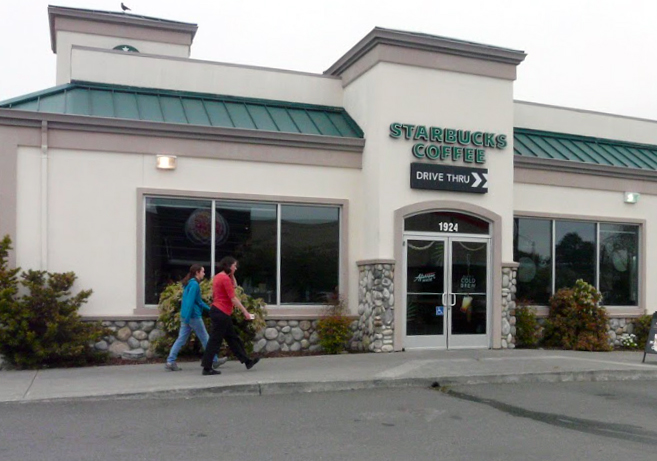
More than 8,000 Starbucks coffee shops will be closed on May 29 to train employees on “implicit bias,” as opposed to explicit racism, and “promote conscious inclusion,” according to their press release on April 17.
The racial bias training, scheduled for nearly 175,000 Starbucks employees, is a grand publicity stunt that will prove to be futile in the short run. When the smoke clears, and it’ll clear fast, Starbucks will be business as usual, and racism in the U.S. will be the same as it ever was.
In fairness, Starbucks CEO Kevin Johnson wasted no time in personally addressing the issue in light of the incident. Johnson ultimately put himself in the hot seat, rather than refer to a spokesperson.
President of Humboldt State University, Lisa Rossbacher, could learn something from Johnson.
Rashon Nelson and Donte Robinson were arrested at a Starbucks coffee shop in Philadelphia on April 12. The reported scenario allegedly goes like this: two black men walk into a Starbucks for a business meeting involving an ongoing real estate deal with investor Andrew Yaffe. While waiting for Yaffe to arrive, Nelson asked to use the restroom, but was denied by the manager, who is white. The manager asked if they wanted to order drinks, but they said no. The manager then called the police for assistance to remove Nelson and Robinson from the cafe for trespassing, which was promptly granted.
If you’ve been following the local news about David Josiah Lawson and Humboldt State University’s budget cuts, Rossbacher was absent during rallies and community events of critical importance this semester, including the budget cuts walkout on March 21 and the one-year vigil of Lawson’s murder on April 15.
Starbucks can implement strategies and enforce new policies, but racism will prevail in the long run. This is the America we have lived in for a long time, which is apparently accentuated in the days of the Trump administration. We can write dozens of editorials protesting racism, but in the grand scheme of things, racism is too deeply rooted in the U.S. to overcome as a nation. It’s only a matter of time before the next person of color gets arrested at a bourgeois, corporate establishment and receive the highly-ratable spotlight by the mainstream media.
At the very least, the CEO is ensuring his company is responsible for addressing the issue without delay, and Johnson himself is making the attempts to be present and accountable.
Rossbacher’s absence reduces her credibility amongst students, regardless of deans or the provost speaking on her behalf. Not just credibility, for her sake, but trust in the institution as a whole, especially for people of color. As we wrap up the spring semester, we urge Rossbacher to be more present in the future.
The Lumberjacks softball team concluded their four-game series with No. 3 ranked Chico State University on April 21 by taking a pair of losses to complete Chico’s sweep.
Video by Bailey Tennery.
The Jacks were shut out in the first game (9-0) in only five innings because of the mercy rule. The game must end if a team is losing by eight or more runs after the fifth inning.
The second game was more of a slugfest, however, as that ended 16-13.
Jacks head coach Shelli Sarchett remained optimistic, despite the team’s troubles.
“This whole weekend I saw a difference in this team and how they reacted to things. They played with a lot of energy,” Sarchett said. “If we’re gonna lose, that’s how I want it to happen.”
The visiting Wildcats recorded nine runs on 13 hits in the first game. The damage was spread throughout the game, as they tallied three runs in the second, third and fourth innings.
The win moved Chico State’s winning streak to 18, while the Jack’s losing streak was extended to four games.
Chico State starting pitcher Haley Gilham (21-2, 1.25 ERA) was locked in all game, as she limited HSU to just three hits over five innings of shutout ball. Jacks starter Jasmine Hill took the loss as she allowed six runs on seven hits to go with five walks.
When Chico’s Gilham was not on the mound, the Lumberjacks thrived at the plate. The Lumberjacks jumped on Chico State starting pitcher Naomi Monahan (15-1, 2.41 ERA) for three runs in the first.
The damage came from an RBI double from Hanna Holland, a run-scoring single courtesy of Micaela Harris and a wild pitch.
Chico State responded with a vengeance in the top half of the second, as they scored seven runs on six hits to take an 8-3 advantage. The Jacks kept fighting though, as they plated a run in the second before a six-run third inning put them in the driver’s seat.
The Jacks’ lead was short lived as a run-scoring error, and a Wendy Cardinali three-run homer in the next inning, put the Wildcats back on top.
Jacks first basemen Rylie Carlier continued her power surge with a team-leading eighth home run in the fifth inning.
Humboldt State softball team played Chico State Wildcats on April 21. Game played at the Lumberjacks home field. HSU’s Winona Vigil (15) running to first base. Final score 9-1. Chico won. Photo by Bailey Tennery.
HSU’s 1-2-3 hitters in the lineup each finished the game with three hits, and Winona Vigil and Harris each drove in three runs each.
When talking about her approach at the plate, Harris had a simple answer.
“I just tried to attack the first pitch, and be aggressive,” Harris said.
The series sweep moves the Lumberjacks’ CCAA record to 14-16 and 19-25 overall, which puts them in seventh place in the CCAA standings.
HSU will host Sonoma State University next weekend at HSU Softball Field. The series begins April 27 at 1 p.m.
This website uses cookies to improve your experience. We'll assume you're ok with this, but you can opt-out if you wish. Cookie settingsACCEPT
Privacy & Cookies Policy
Privacy Overview
This website uses cookies to improve your experience while you navigate through the website. Out of these cookies, the cookies that are categorized as necessary are stored on your browser as they are essential for the working of basic functionalities of the website. We also use third-party cookies that help us analyze and understand how you use this website. These cookies will be stored in your browser only with your consent. You also have the option to opt-out of these cookies. But opting out of some of these cookies may have an effect on your browsing experience.
Necessary cookies are absolutely essential for the website to function properly. This category only includes cookies that ensures basic functionalities and security features of the website. These cookies do not store any personal information.
Any cookies that may not be particularly necessary for the website to function and is used specifically to collect user personal data via analytics, ads, other embedded contents are termed as non-necessary cookies. It is mandatory to procure user consent prior to running these cookies on your website.