The California housing crisis can be summed up with one question: to build or not to build? The status quo has always favored single-family homeowners. The recent win for NIMBY (Not in My Back Yard) over UC Berkeley has brought light to the biggest problem California college students are going to face for the foreseeable future: the lack of affordable housing.
California Governor Gavin Newsom passed a stack of bills focused on fixing the California housing crisis. The biggest bill was Senate Bill Number 9, which allows a four housing unit on a single-family lot. This prioritizes affordable housing for future generations and moves away from the outdated practice of single-family zoning.
NIMBYs are local homeowners against affordable housing in their neighborhoods. They argue that their home values will drop and they will lose the peacefulness of single-family-owned housing communities if affordable housing structures were built in the area.
The California Supreme Court sided with NIMBY in a court case against UC Berkeley, going against California’s push towards affordable housing. This forced the school to cut admissions by 2,500 students for the 2022 fall semester. NIMBY won because they argued that UC Berkeley was accepting more students than they could house.
College students all over California are beginning to feel the effects of the housing crisis. Demand is rising while the options are dwindling. There is a lack of options and if this does not change other colleges will soon be forced to cut their enrollment.
NIMBYs recent win highlights the division between single-family housing communities and the growing need for affordable housing. College towns are at the epicenter of this issue. College campuses will never be able to house their entire student population. Students rely on the surrounding community to find housing.
The NIMBY movement is fighting against this change, wanting to preserve a way of life that does not exist anymore. The single-family home is not possible anymore in a changing climate and ever-growing homeless population. NIMBYs are clinging to their current comfortability instead of adapting to the needs of the next generation.
Cal Poly Humboldt Students will soon feel the effects of this landmark decision. The influx of new students is a great thing for the university’s status but the campus will soon face tough decisions if they do not adapt to the changing times and work with the community to build more affordable housing in the surrounding area.
A giant problem this semester has been the lack of parking on campus. Students must park farther and farther away from their housing because of the increase of students and stagnation of parking spaces. I had to spend months trying to find an apartment off-campus this past semester. There are already tell-tale signs of the strain the student body is putting on the schools’ resources. If UC Berkeley is a sign of things to come we must adapt before it is too late.
The college experience is something you hear about before you get the chance to step foot on campus. Whether it’s beer talk with dad or sorority rushing advice with mom, we all get a little taste of the dining hall food and frat parties from the people closest to us before our own orientation day, but they usually skim over one major detail: sex. Blame it on your nearing 20s or the newfound freedom of living hours away from your parents, but sex is definitely a part of the college experience. Whether you participate in it or not, with sex comes sex toys.
Graphic by Sierra Cosper
Cal Poly Humboldt’s Peer Health Educators (PHE Humboldt) are here to promote sexual and mental health on campus. The program is funded through the Student Health Center and works to provide student-to-student education surrounding sexual and mental health. The peer educators apply their and others’ experiences to create interactive health promotions such as workshops or guest speakers. The program also focuses on sexual wellness within yourself as well as with partners. The educators encourage the use of sex toys and even have some silicone dildos on display in their office located in the Recreation and Wellness Center in room 127.
The current Peer Health Educators are Sierra Cosper, Selena Aguilera, and Emily Black. All have been with PHE for over two years now. Cosper explained how they feel there is still a stigma around sex toys and sex education as they experienced it first hand as a peer health educator. Cosper also noted that discussion about sex toys and the use of sex toys sometimes intimidates those who identify as male and is more taboo in their daily discussions compared to women.
“Sometimes when I talk to them [men] about the job I’m doing they’ve said ‘oh why would I come in here to know anything,’” said Cosper. “ There’s this idea with men and sex toys that they can’t be better than their penis.”
Black also added they have a tendency to leave out the part about sex toys when explaining their job role to new people they have met to avoid assumptions. She also mentioned how she lacked exposure to toys and sexual wellness before coming to CPH and participating in PHE events.
The group recommended the local storefront Good Relations in Eureka for those interested in dipping their toes into the world of sex toys for a wide selection of toys in discrete packaging as well as informative and helpful staff.
“If you’re too embarrassed to go, you gotta remember they’re choosing to work there, they want people to come,” said Aguilera.
“And then come,” joked Cosper.
“They want you to be as healthy and comfortable about it as possible,” said Aguilera.
The group also advised beginners to use toys by themselves before introducing them to a partner as it can cause some miscommunication sometimes. Although, all agreed using toys doesn’t have to be solitary and using them with others is an experience as well.
Graphic by Sierra Cosper
“It puts a lot of pressure on relationships sometimes, like ‘I’m not good enough’ feelings cause you’re using this toy, but they’re actually just really fun,” said Cosper. “You can’t expect your partner to get you off every time also.”
“It’s supposed to enhance your experience not take anything away from it,” added Aguilera.
Black, Cosper, and Aguilera also encourage proper care of sex toys to avoid sexually transmitted diseases or infections. They recommended a lot of toys are able to be boiled but toys usually come with care instructions on how to clean and properly care for them, also mentioning to steer clear of toys made of porous material and the use of silicone lubes on silicone toys to avoid degradation over time.
“Something people forget to do sometimes is clean communal toys, which are more popular in queer communities,” said Cosper. “The communal strap-on, you should be using condoms on it between each person. Same with vibrators to avoid any risks of spreading.”
The PHE educators all agreed they encourage more open discussions about sex toys to break the fears and taboos surrounding them, which is exactly what they’re doing within their roles on campus.
Black encourages students to participate in their tabling events to enter a safe space for open conversations about sexual health and wellness.
“Everyone gets embarrassed, but liking what you like is sexy,” said Aguilera. “Not being afraid to show what you like is nothing to be ashamed about, you know.”
Join the Peer Health Educators at their annual Sexland event on April 23, a sex-positive, kink-based, informative event including sex toy giveaways and much more.
A group of formerly incarcerated students picked up their ultra-wide pizza slabs and towering salad mounds from the counter at the Arcata Pizza Deli. They dragged two tables together, commandeering chairs from the surrounding tables and gathered for the feast. Each of the Project Rebound members were hungry for conversation with the famous award-winning Chicano poet, memoirist and member of the family Jimmy Santiago Baca.
One of them asks him across the table as he takes a sip of his drink, “So, what’s the pale white monster that’s coming up to get you, Jimmy?”
They were asking about an excerpt he read from a story where he steps out over frigid ice as it splinters beneath his weight to prove his love for his wife, Stacy.
“Ah when you’re a kid you look deep in the water under the ice, you imagine all sorts of things,” Baca says.
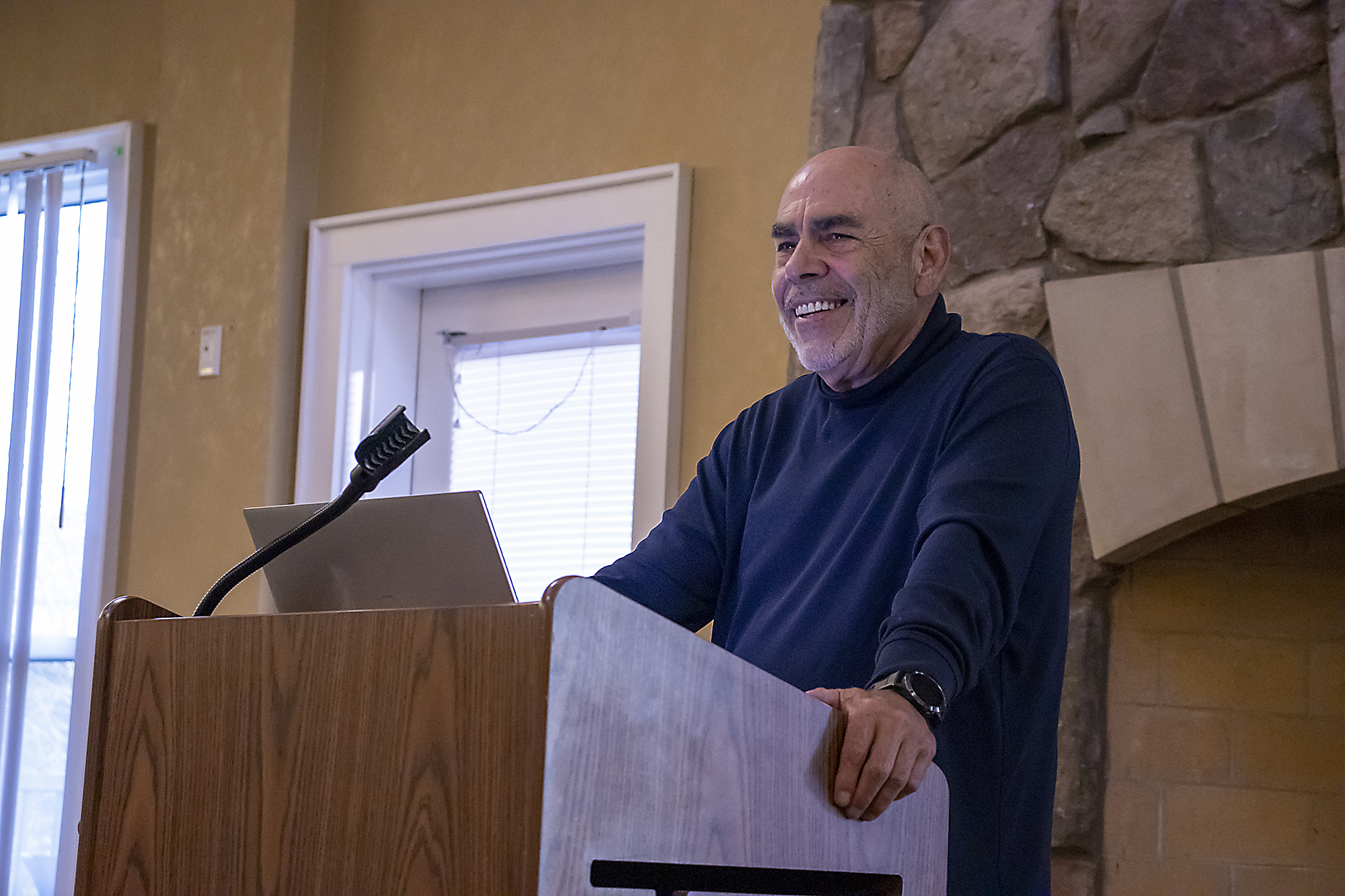
Photo by Abraham Navarro | Jimmy Santiago Baca, Chicano Poet, speaks to Cal Poly Humboldt Project Rebound in the Great Hall on March 23.
Baca has a deep raspy voice, and he lights up when he talks to the student. He has a shaved head, furrowed brow with welcoming brown eyes and a warm complexion. Although he’s bundled up against the Humboldt evening chill in a black turtleneck and a blue down jacket, he feels cozy and right at home amongst the formerly incarcerated and system-impacted students from Cal Poly Humboldt’s chapter of Project Rebound.
Earlier in the evening in the Great Hall above the College Creek Marketplace he read exclusive excerpts from some of his unpublished work and other poems and stories of his during the Project Rebound’s third annual Reentry Forum.
Project Rebound is a program for formerly incarcerated and system impacted students at Cal Poly Humboldt. According to their website they aim to empower individuals convicted of a crime in a county, state, or federal jurisdiction who have clearly expressed their desire and readiness to earn a degree at Humboldt.
Baca has been to previous reentry forums, even attending via Zoom during the pandemic restrictions to show his support for Project Rebound and getting to know the members like Tammy Phrakonkham, 30, a Cal Poly Humboldt Project Rebound member and a returning graduate student majoring in geology in the fall.
When Phrakonkham heard Baca read his stories and share his wisdom, she felt as though her experiences being formerly incarcerated were validated. Her family comes from Laos as refugees to the United States. Growing up in impoverished conditions, she remembers her brothers and uncles all working in gangs, and she followed suit. Phrakonkham was incarcerated for stealing cars and trafficking ecstasy.
“It was all I knew,” she said. “When I listen to Jimmy, I feel like I’m not the only one.”
Despite years of isolation due to the pandemic, Baca was happy to make an appearance in Humboldt to visit his friends at Project Rebound, the first event he said he has been to since COVID-19 caused the shift to online events.
“You all have become like my adopted family,” he said to them. “If it wasn’t Project Rebound I wouldn’t have even gotten on that flight!”
Baca was adamant that poetry was for the people, those who suffer and work, play, cry, feel, live and die; poetry was not something that could be hoarded by the wealthy, kept from the poor. It was created by the people and it should be given back to the people. By sharing his work with Project Rebound, Baca feels like he has done that, and he has made a family out of them in the process.
On March 14, face mask requirements were lifted on Humboldt’s campus as a way to transition back to normal operations. This has created polarizing views towards how students and staff going maskless might affect the local community. Some students have chosen to ditch the masks while others still embrace them.
Photo by Eddie Carpenter | Dillon Harp still wears his mask in solidarity with his peers.
Local musician Dillon Harp expressed how one’s personal choice can affect the community as a whole.
“As an African-American and knowing that my family has elders in it…the mask is just really there to protect others,” Harp said. “Obviously the mask can let particles in like more so than let particles out…Wearing your mask is really just about kind of looking out for the community for me. I ain’t really unmasking anytime soon. If we can all come together a little and see some of the basic logic behind protecting each other, our elderly family members- I think we can all help out and just keep the mask on a little longer.”
Carlos Ochoa-Silvas, a rangeland resource major, expressed how masks gave him skin problems.
“Wear a mask if you have symptoms of anything or if you feel like you’re not a hundred-percent,” Ochoa-Silvas said. “When I heard about it, I was mostly excited just because I didn’t like wearing the mask. I kept breaking out underneath and it was really irritating my skin.”
Political science major Lake McLeod believes that Humboldt’s recent transition could not come at a better time than this.
“Personally, I agreed with it. I think that eventually, we do have to kind of return to some kind of sense of normalcy,” McLeod said. “You know after two years of being masked…and the cases are down, so I feel like at this point we should learn to live with COVID like we do [with] the flu.”
English and CRGS major Mireille Roman thinks of wearing a mask as an act of solidarity.
“I would say that because it’s not a mandate now, it’s kind of become a personal choice to what you want to do with it,” Roman said. “But your personal choice still impacts people at the end of the day. I think the best way that my professor put it was like ‘I’m going to stand in solidarity with people who can’t take off their masks.’ Because there’s people who [are saying] ‘I’m perfectly healthy. I’m vaccinated. I’m good.’ Yeah, but just because you’re fine doesn’t mean that other people are going to be in a position to do so as well… but I think it really dictates the environment of a classroom when the professor chooses to wear a mask or not. Until the numbers are better and just nationally we’re more responsive to this, I’m probably going to keep wearing my mask.”
Between March 15 and March 22, Humboldt County Public Health reported 72 new COVID-19 cases with 2 new hospitalizations.
Growing up as a Black person who attended a predominately white school in his hometown of Palmdale, California, Doug Smith learned early on how to code-switch, or alter his behavior to fit white societal norms. Still, his peers expected him to act a certain way because he was Black.
“People had perceptions of what it was like to be Black; they have their own ideas,” Smith said. “I remember one time a new Eminem song had come out and some white dudes in my P.E. class knew the lyrics and I didn’t know the lyrics, and they’re like, ‘Oh, so we’re Blacker than you are.’”
Smith’s formative lived experiences with code-switching and microaggressions – subtle statements or actions that are discriminatory against members of marginalized groups – made him very cognizant of other peoples’ perceptions of him early on.
“That was really my first understanding of code-switching,” Smith said. “I would totally present differently because I was really conscious of how people were perceiving me.”
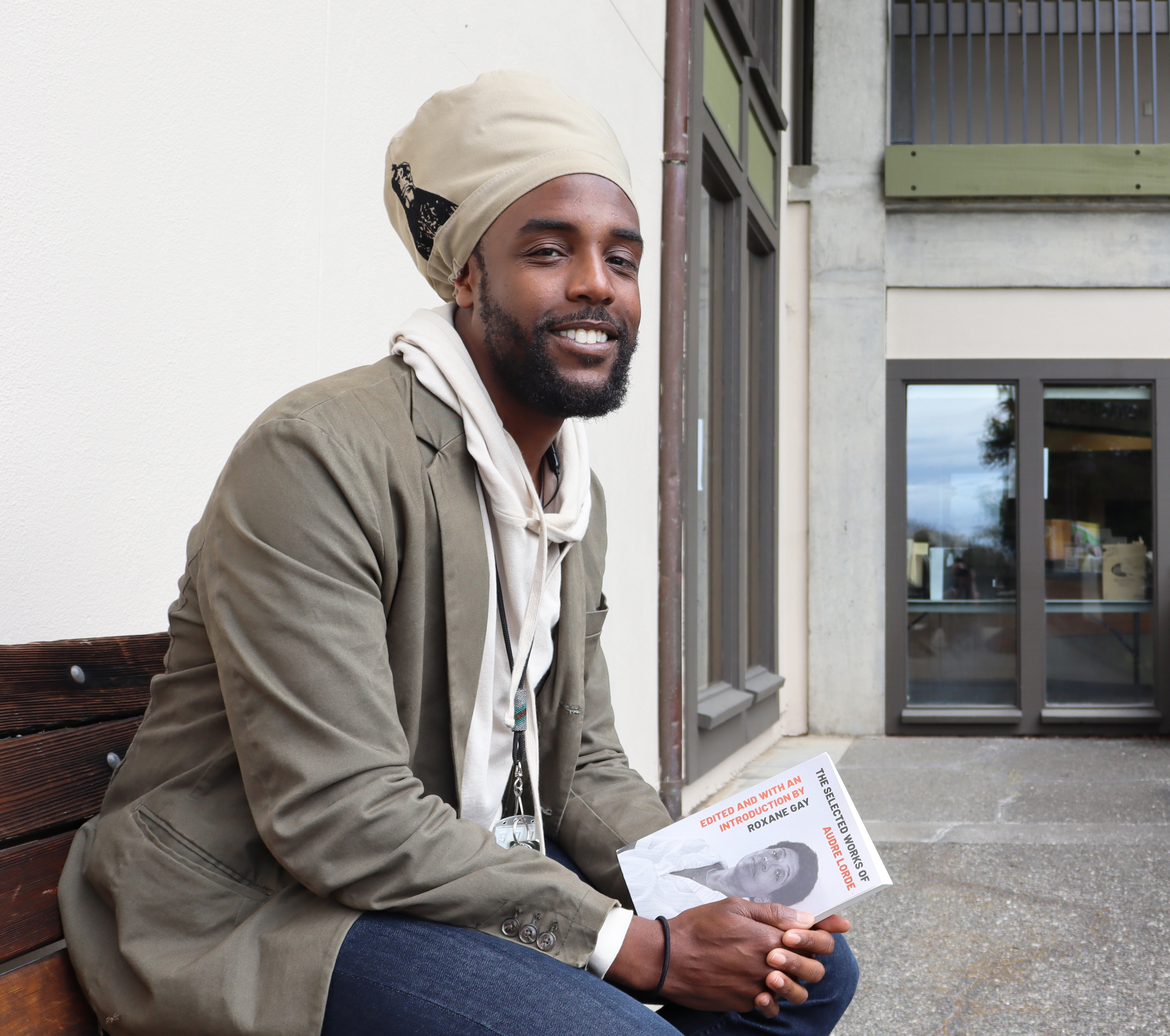
As a Cal Poly Humboldt international studies alumnus, staff member and graduate student majoring in English, Smith has been involved in the campus community since 2013. Today, he is the coordinator at the Umoja Center for Pan African Student Excellence at Cal Poly Humboldt, a position that he has held since July 2019.
“It’s such a rare opportunity for Blackness to be centered,” Smith said. “So I really want Black students to be able to make it theirs.”
Smith’s vision for the Umoja Center going forward is to foster Black student development, including but not limited to publishing their writing, and foster Black liberation by curating spaces that are made for and by Black people. Amplifying Black voices that often get silenced or ignored is key.
“[I’m] always visible because I’m a Black person, because you stand out,” Smith said. “But then at the same time, I think that oftentimes my voice isn’t always audible or isn’t always heard.”
Although the Umoja Center is first and foremost a space for Black students, faculty and staff, it’s open to everyone on campus.
“I think it’s so cool that we have an educational, Black-centric space [at] a university that really has an opportunity to educate our campus and local community,” Smith said.
To learn more, visit the Umoja Center in Room 206 at Nelson Hall East, follow @umojahumboldt on Instagram, or go to umoja.humboldt.edu. To get involved, attend an event listed on the website or volunteer with the Umoja Center on Fridays from 11 p.m. to 3 p.m. at Bayside Park Farm on Old Arcata Road.
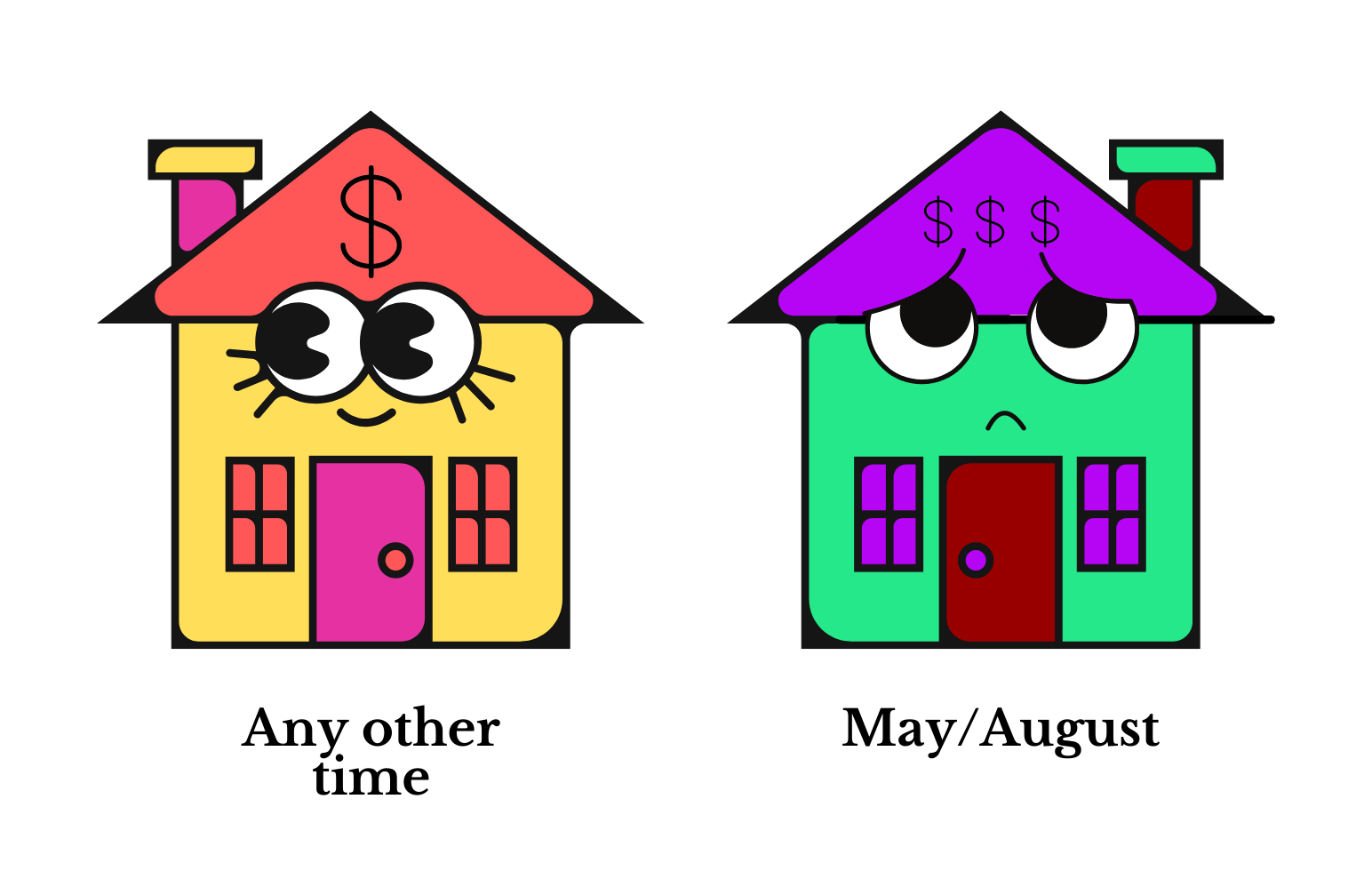
As May is fast approaching, so is the dreaded inflation of renting in Humboldt. During the year you can get a hotel room or rent an Airbnb for a couple of bucks. On spring graduation weekend, hotel rates double and even triple in price.
It’s not something uncommon in Humboldt but usually, high prices make it hard to find a place to rent. It’s an opportunistic extortion to get college students to overpay for rundown places. Housing is first-come, first-serve but to take advantage of people who don’t have money is gross.
For some people, this is the first and only time they can make the trip to Arcata, and it’s to see their family member graduate which is an incredible opportunity that shouldn’t be missed. Just checking the hotels near campus the usual cost of a hotel room for two people is at most $150 at any point during the year. But when you look at the same exact hotels during the week of graduation is $600 for two people a night.
At Cal Poly Humboldt, about 78% of full-time undergraduates receive some kind of need-based financial aid. That’s 78% of people whose families might not have the ability to see them walk across the stage and be handed their diplomas. Hotels and Airbnb hosts take advantage of people who want to support their loved ones.
Forget peoples’ families for a second. What about the people who are graduating and haven’t lived in the area for some time because of the pandemic, who are trying to find a place to stay so they can be there for their own graduation? It’s not just the issue of finding a place to stay. The prices of buying a cap and gown are so high for something you will only wear once and not for a long time. I guess you could say the same thing about a wedding dress, but even those are absurd.
Maybe I’m just someone who likes to count pennies and is a bit of a pessimist, but the price of graduating is excessive. We’ve already shoveled a bunch of money into the burning money pit of college so it would be lovely to be able to step away from the flames and not have to worry.
If you’re anything like me, there’s no way you can afford to pay for college on your own: you’ve probably got student debt. While you’re still taking classes, it feels like you don’t have to worry about it because graduation could be years away. It’s always looming on the horizon, far enough away that it seems like you’ll probably have it under control by the time you’ve actually got to deal with it.
I am in my last semester as an undergraduate, so that horizon is closing in real quick for me and it’s scary as hell. My current debt is just shy of $20,000, which is slightly lower than the national average, but still by far more money than I than I’ve ever made at a job.
Ideally college would help with that, but considering the job market, that’s no guarantee.That leaves me and many others with crushing debt in the position of having both a huge amount of uncertainty about what we’re going to do after college and a huge amount of certainty that whatever it is won’t be sufficient to not be living on the bare minimum.
I appreciate my education. I plan on continuing it into graduate school, but this system feels as if it’s built more to place you into a position of permanent debt than to provide an education to people.
Even if you’re lucky and don’t end up missing payments, you’re still paying about 10% of your income, and if you aren’t then you can rack up extra fees and put yourself even further back. On top of that are the countless other ways that you end up gouged for money while still enrolled like expensive but mandatory meal plans or fees for services that, depending on the current level of COVID lockdown, may not even be available to the students using them.
According to educationdata.org, the average monthly payment for someone with a mid-paying job and in the same category of debt as myself is $393 over the course of six years, which is currently more than I even get per paycheck at work.
These debts are what keeps people from buying homes or starting any kind of family. Ideally this whole thing should be free and improve peoples’ lives instead of operating off of a profit motive at all. But that’s a fight that seems like it will take way longer than any of us will be able to see through to the end.
As students, we need to press for more scholarships and grants for students. Ones that don’t incur years of debt, and push back harder against tuition hikes that force students to either abandon their education or take out more loans. Otherwise, college becomes the exclusive domain of people who already have money, even more so than it already is.
In the Van Druzer theater on Thursday, March 3 for the first time since the start of the pandemic student films were shown to a live audience. Around 40 people came to the showing of Cal Poly student films. Several of the films were made in the fall of 2020 there showing being delayed by the COVID pandemic.
The short films ranged from psychedelic, documentary, serious, and funny; some of the films were a combination. The audience made sounds of laughter, shock and sadness reacting to each film with emotion equal to the film itself.
A film director who was in the audience was Kylie Holub, a senior film major. Holub directed and wrote the film “Abstraction” in the fall of 2020. They film . During the pandemic Houlb said “ just keeping our crew really lean and realing thinking about how to tell stories with minimum actors.”
The narrative film “Abstraction” is the story of a beach treasure hunter finding an alien artifact and the fallout of her discovery. The unknown and aliens being major inspiration for the film.
Holub said “ you see a lot of people with metal detectors, we know very little about the ocean and aliens are fun to play around with.”
Another director was alumnus Valerie Rose Campbell created the experimental film “Recipe for Young Mothers.”. Campbell goes through the recipe of banana bread while she narrates the experience of a young mother and her attempts to reclaim her life from an abusive relationship and societal expectations of a mother.
The COVID pandemic heavily impacted the creation of the film Campbell said “ everything got done digitally and that was really hard.”
The film is inspired by Campbell’s own experience in the local family system. “ How it felt so unjust for my kids and family.” said Campbell describing her own life experiences.
There will be another film showcase in the fall of 2022 showing films created in the spring.
Like the blossoms of our early spring, genuine and vulnerable artistic collaboration is blooming at Cal Poly Humboldt.
The Toyon Multilingual Literary Magazine’s ‘SANA, SANA: Hope and Healing for Latinx Communities in Times of Precarity’ was a contest that asked for submissions of poetry, with the intention of having the winning entries set to music.
The poem selected to be interpreted into a choral work by the award-winning composer Carlos Cordero was Alannah Guevara’s ‘Fresh Fruit.’ It is a deeply affecting rumination on vulnerability and intergenerational trauma, filled with haunting and tender images of bruised fruit and parental care.
Guevara says that she wrote the poem thinking of her father, who passed over ten years ago. She’s a native of California’s Central Valley, where many Latinx people have settled and work on the area’s vast orchards. Guevara is half Mexican; she sees in her family and in her community an unwillingness to discuss the painful past, and an unending hope for the future.
“I have really vivid memories of going to an orchard in the town I grew up in… It all melded together, these words that I had and these memories,” said Guevara. “Here in Southern California, who’s working in those orchards is Latinx people, Mexican people. And it got me thinking about my familial trauma, my generational trauma, the things that my dad left me to deal with.”
Graphic by August Linton
Guevara is about to become a parent herself. In ‘Fresh Fruit,’ she feels the protection and hope that her parents struggled to give her, and also the intense desire to protect and uplift her own child.
The final choral piece is deeply beautiful, modern, and connected to the emotional core of Guevara’s poem. Cordero was a fantastic composer for the ‘SANA SANA’ project, both as a stunningly talented musician and also as a member of the Latinx community.
Cordero’s Friday talk, hosted by CPH’s El Centro Académico Cultural, focused heavily on his personal struggle towards vulnerability, and how that has affected his compositions and musical career.
Cordero’s writing process is a very visual one, although his medium is entirely auditory. He works with charts of inter-connected words and line graphs of emotional intensity to visualize his compositions in a more visceral way.
“[Vulnerability] isn’t always going to come back to you immediately, but it’s coming to build or to open that door for people who want to connect with you,” Cordero said. “I’ve learned in art that I open up the door, I don’t make you come in. All I can do is present myself.”
He recounted a story of opening up about his family’s experience of losing his younger sister to members of a choir he was working with. They came to him with stories of their miscarriages, of their losses, and that allowed the whole group to access an emotional connection that was not visible before.
Cordero is originally from Maracaibo, Venezuela, and now lives in Austin, Texas. He says he, like Guevara, has struggled with an unwillingness to have hard conversations with his family about the traumas they’ve experienced.
His piece ‘¡Ayúdame!’ was written as a “Venezuelan plea for life.” Members of the choir cry out “ayúdame, escúchame” (help me, listen to me) in Cordero’s attempt to communicate the suffering and disillusionment of the Venezuelan people.
However, ‘¡Ayúdame!’ also represents the importance of being vulnerable, both by asking for help and by letting other people support you.
Cordero spoke about the expectation within Latinx families and communities that people be strong, that they don’t show their struggles. As he struggled with the trauma of being Venezuelan in the midst of an ongoing humanitarian crisis, Cordero realized that he sorely needed help, that people need to ask for help.
“[In ‘Fresh Fruit,’] Alannah showed me that the struggle is OK. It says to our kids, to our generation, to our families: we want to show that everything is ok but we can also share in their struggles,” said Cordero.
The Cal Poly Humboldt University singers will perform ‘Fresh Fruit’ on Sunday, April 24th, alongside other musicians performing other works from the ‘SANA SANA’ project.
Here’s how getting stared at on the beach usually happens for me: I’ll be minding my business at the beach, neither having a good time or a bad time, just a time. I get the familiar feeling that I’m being stared at, and after a quick look around, there it is, an ogling pair of eyes looking me over. Just because I’m wearing a bikini to the beach does not mean that I am inviting any sort of negative attention. I am wearing this bikini to the beach because I thought it was cute when I bought it. Now, I am no longer having a time, but a bad time, all because some man couldn’t keep his eyes anywhere else but my body.
I shouldn’t have to flip off and swear at men just to get them to leave me alone at the beach. I will not fight for scraps of respect but expect it paid in full. My body and gender don’t make me less than, and they don’t make me an object either.
Not counting the fact that ogling random strangers is incredibly rude, you never know what’s going on in someone’s mind. This could be their first time wearing a bikini on the beach in a long time, or they could simply be wearing it because they bought it and want to get their money’s worth. They could have insecurities about their body that can be exaggerated by excessive staring, or maybe they just don’t like getting stared at (like most sane individuals).
Despite being attracted to women, I can comfortably go to the beach without ogling women with no effort on my part. Believe it or not, not staring at women on the beach is incredibly easy! As a gay woman who grew up with gym locker rooms and camp changing rooms, I snapped my eyes away every time my friends would get changed, and I was terrified to even go in a Victoria’s Secret for the longest time. I know I have a different relationship with how I view women than your typical straight man with male pattern baldness. Also, as someone who possesses a body that gets stared at frequently, I know what it’s like to be stared at. I don’t like to do it to other people.
When spring break rolls around this semester, straight men, find it in your hearts to not obviously stare at every woman wearing a bikini at the beach (eyes on the road, please). There is a whole world of gender identity behind the pair of boobs you’re ogling, and every feminine-presenting person isn’t necessarily feeling feminine on the inside. If you find that you just have to choose objectifying women over all other activities, then do the women in your life a favor and don’t hit the beaches this spring.
Everyone has an impact on someone’s perspective of the world. Almost anything we do or say affects someone in some way. The same holds true for the things we post on social media. We are all influenced by the people around us. When the subject of our virtual discourse is something as poignant as international conflict, our sympathies can be weaponized without us even knowing it.
Roughly half of Americans regularly get their news from social media, according to a 2021 study from the Pew Research Center. The information we share online can challenge our belief system but oftentimes reinforces it. Al Tompkins, a journalist with the Poynter Institute, says that truth gets little consideration when the content we share aligns with our worldview.
“We tend to support those things that agree with your position on anything,” Tompkins said. “Whether it’s the designated hitter in baseball or invading Ukraine, we tend to repeat and share things that we agree with.”
The internet has changed the way information is spread through society. It’s easier than ever to produce fake information.
“The other piece of it is this,” Tompkins said. “Disinformation is a very powerful weapon. The Russians know it but, let’s face it, the Americans know it too. The American government, particularly through the CIA, has done lots of disinformation over the years. You would expect that they do, it’s kind of part of what they do.”
Understanding that misleading content is built into our news feed requires us to take a critical look at what we share before we share it. Tompkins’ approach asks four questions:
What do I know?
What do I need to know?
How does that source know what that source claims to know?
And is there any other way to look at this other than the way that source is telling me?
Vicky Sama saw the real-time effects of media coverage and propaganda in the several wars she covered during her career at CNN. Sama is now the department chair for Cal Poly Humboldt’s journalism and mass communications program.
“So there’s two parts of war, usually,” Sama said. “You have the war, the actual war with fighting and then you have the information war, the propaganda war, and that is an essential part of what happens in war as well.”
When we see things happening live, there isn’t an editing process that we can rely on to verify what we see. Live television, live broadcasting, and live streaming allow for that to happen. Now that consumers are a part of the distribution process, Sama argues they also need to be part of the editing process.
“If everybody’s going to start considering themselves a journalist just because they have a cell phone, then they need to start doing the work of a journalist and start verifying the information before they put it out there as well,” Sama said.
However, verifying everything we see is seldom an intuitive process. Kirby Moss, a Cal Poly Humboldt professor in the journalism department, teaches a range of media analysis classes. Moss said that the fundamental way to verify information is to look for other sources reporting on the subject.
“I tell students, if you find some information that you’re researching on, try to cross-check it with at least three sources if you can,” Moss said. “And then they find out sometimes like, ‘Well I went to one source but the other source says something else, the other says something else,’ and so then they begin to question that message.”
It takes familiarity to be confident that the information you get is credible. That is not to say that there aren’t tools we can use to check the things we share. Vicky Sama is working on adding a media literacy course for freshmen to the department catalog. In the meantime, JMC 309: Analyzing Mass Media Messages will be open for registration near the end of the semester. Online courses on media literacy are also available to everyone through the Poynter Institute.
[DISCLAIMER: The Lumberjack rarely uses journalism department faculty as sources for stories. However, an exception was made for this story due to the expertise our professors have on this particular subject. Vicky Sama and Kirby Moss do not exercise editorial oversight on the content The Lumberjack publishes.]
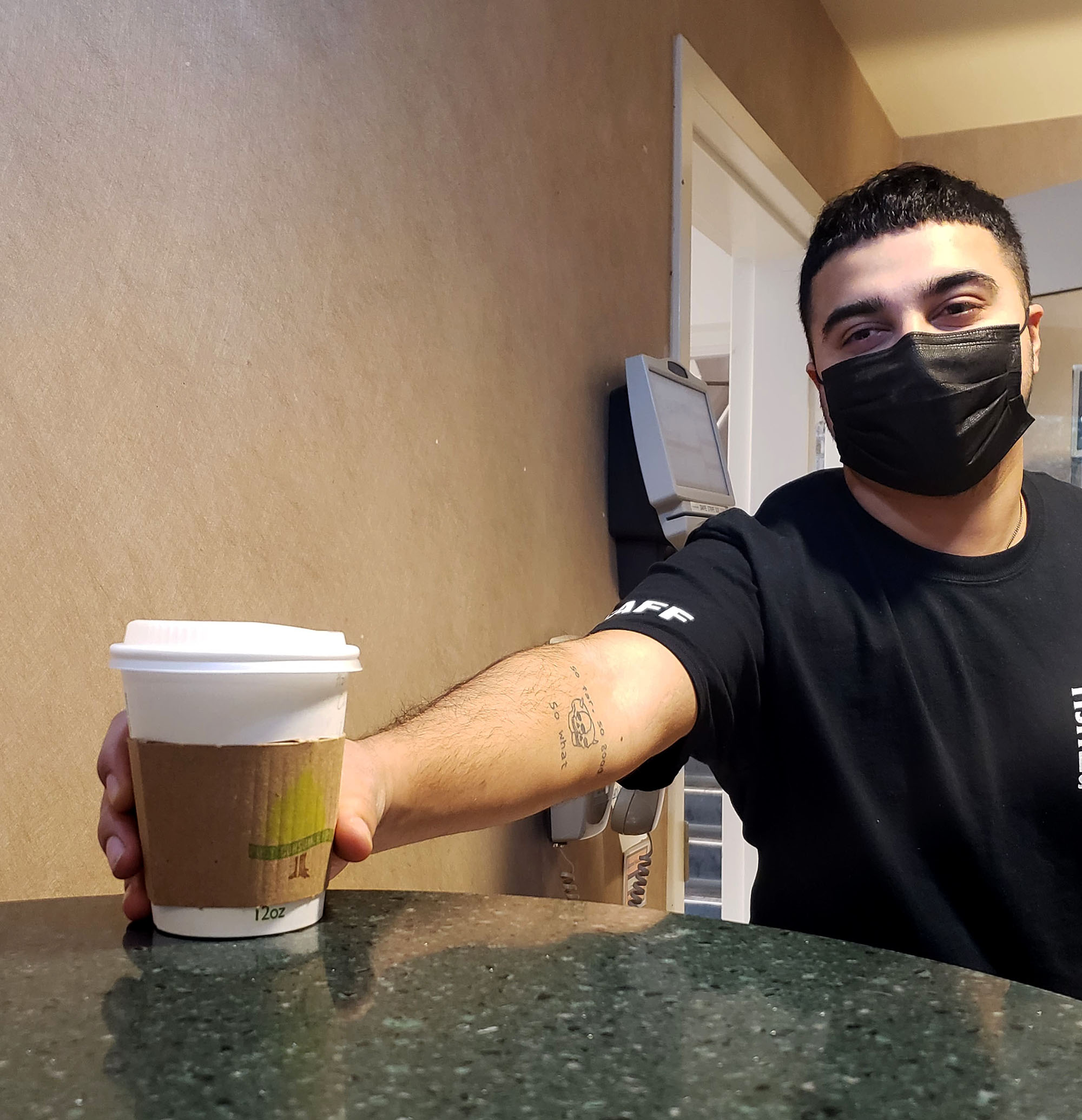
The Library Cafe lifted its shutters for the first time in several years on Friday, Feb. 26. The cafe serves delicious coffee blends from Muddy Waters Coffee Co. as well as pastries, veggie wraps, drinks, and more.
Recent biology graduate Kate Mendoza was just hired by the private company Chartwells Higher Ed to work at the newly reopened cafe.
“Chartwells is really awesome,” Mendoza said. “Honestly, they work really well with students from what I’ve seen.”
Mendoza’s go-to drink is the cappuccino.
“I usually like to do the cappuccino,” Mendoza said. “It’s just espresso, steamed milk, and a lot of foam. I think the foam is my favorite part.”
Mendoza’s coworker Ahmad Shah, a senior majoring in communication, recommended the hazelnut mocha.
“I like a hazelnut mocha,” Shah said. “Sometimes coffee is a little bit bitter. The sweetness helps balance the bitterness of the espresso.”
Communication senior and Learning Center academic peer coach Kas Colwell ordered a vanilla latte with two espresso shots from the Library Cafe on March 3.
“I’m so glad y’all are open again,” Colwell said to Mendoza while ordering. “It’s exponentially improved my quality of life.”
After getting her drink, Colwell sat down at a nearby table in the dining area. As a library employee, she appreciates how easy it is to get to the cafe.
“It’s the convenience because I literally work in the library, so it’s on my regular route,” Colwell said. “I don’t have to go walking somewhere else to get coffee.”
The Library Cafe is available to all Cal Poly Humboldt students and faculty and is currently open on weekdays from 7:30 a.m. to 5 p.m.
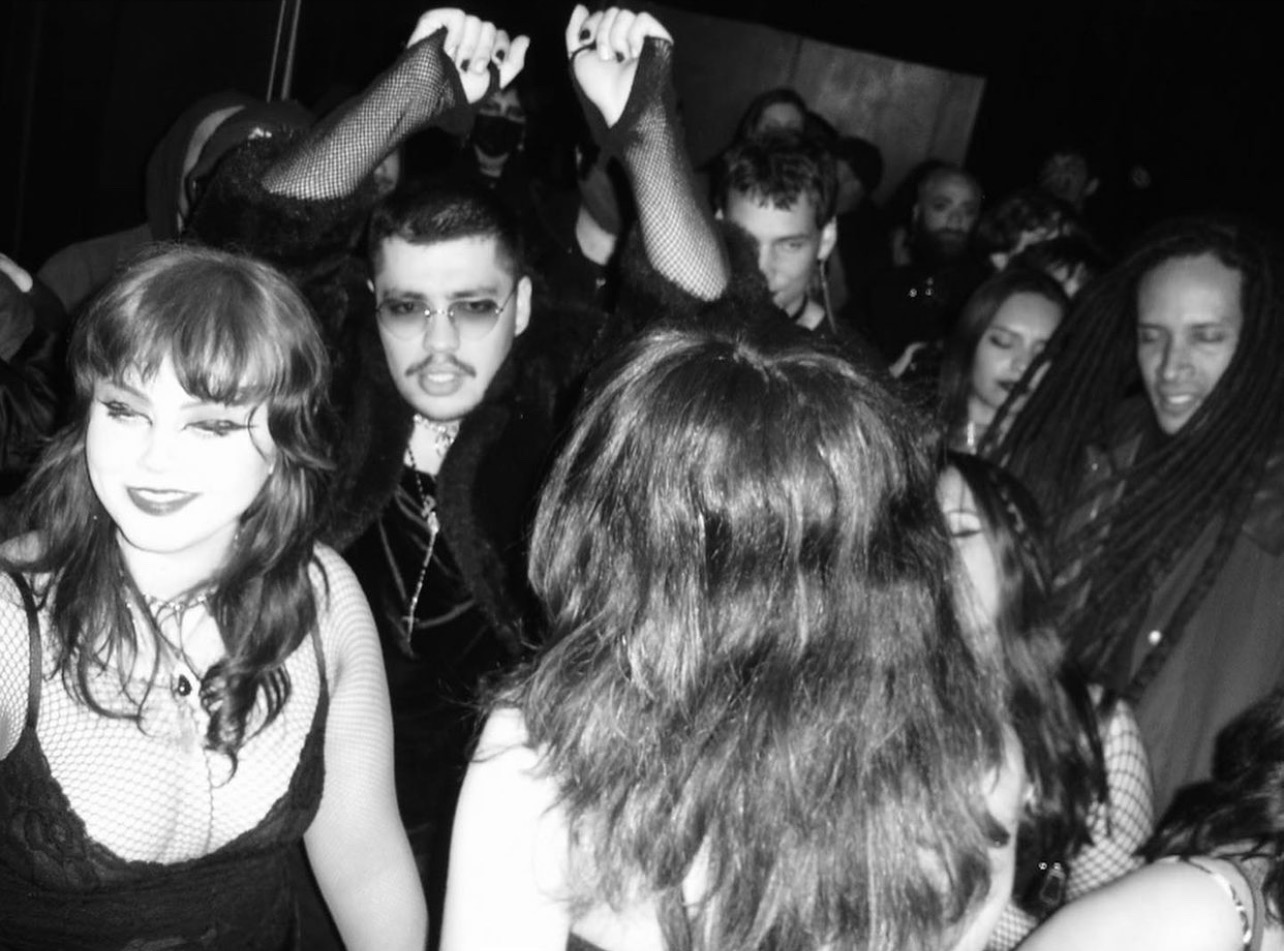
Photo by Lexi Rangel | (left to right) Lalo Rivera, Gigi Salazar, Chris Servi, and Josie Licavoli pose for a photo at Goth Night at Richard’s Goat on Feb 25.
On Friday, Feb. 25, Richards’ Goat Tavern & Tea Room hosted its first ever Goth Night, created by recent Cal Poly Humboldt graduate Jamie Cocking. The event was a tribute to the Goth subculture, which originated in the United Kingdom in the early 1980s. The subculture is open ended, yet is heavily saturated with darker tone aesthetics and music.
“I think goth subculture is all about expressing yourself in your truest form,” Cocking said. “Since I’ve lived here and have turned 21, I haven’t found any clubs or events with the music that I love to dance to, so I just decided to do it myself.”
Being a small town, Arcata is not well-known for its nightlife. However, contributions to the scene, such as Goth Night, keep it going.
“I just wanted to create a space where people could dress up as much as they wanted and not feel like they are sticking out like a sore thumb,” Cocking said. “Because for me, I mean everyday is Halloween.”
Richards Goat will be hosting another Goth Night on April 9.
My entire existence is a tightrope balancing act between two facets of myself, that are constantly told they cannot exist together. Yet these facets can not be divided from me nor from one another. I am queer. I’m a person of faith. I am a trans and bisexual Christian.
As Lent rolls in, I often find myself having to reflect upon these two identities. I take this time of the year to re-orientate myself back to my spiritual core. It is a beautiful process that reminds me of my humanity and the love I receive everyday from my Creator, but it is a side that I often feel compelled to hide, just as I am often compelled to hide my queer side from the greater Christian community.
It is a fine line. I’m constantly aware of my fellow queer peers’ religious trauma, something I’d never want to make them relive. It hurts, though, to know that my faith comes with so many automatic assumptions of my character.
Some have ideas that I’m conservative in my politics or that I don’t affirm my own queer identity. I am neither of those, and neither are many other queer people of faith. So, I stay silent. Yet in this very silence I only continue to feed into the false narrative that all religious persons or persons of faith are non-affirming of queer identities, bigoted, or close minded.
Growing up, I was extremely lucky to live in both a queer affirming and religious household. I was raised predominantly in a Christian denomination that had already begun to take the steps towards full LGBT+ inclusion by the time I was born.
It is a huge privilege, one I constantly try to stay aware of. I also believe it is a statement of hope. I am living proof that one can grow up as Christian, as a religious person, and still fully affirm their own queer existence. It is because of this very truth that I continue to live knowing these two identities are not mutually exclusive.
I don’t wish to proselytize or to convert any person to my own faith, nor to any religion in general. There is truth, validity and importance to be found in both agnosticism and atheism. All I wish is to break the narrative that all people of faith are non-affirming.
This perception erases the amazing work that queer people of faith all around the world are doing to create rightful places for us in these sacred spaces. More frightfully, it gives more power to those of faith who may wish to silence us, oppress us or destroy us both within these religious spaces and out of them.
I want to extend my love and validation to any fellow LGBT+ people out there who also desire to stay in or are currently part of any certain religion, whether you be Christian, Jewish, Muslim or belong to any other faith. There are people out there just like you, and there are resources out there that can allow you to flourish fully and wholly as you are.
This Lent, as many like me take this moment to pause and self-reflect on ourselves, I hope to show through my actions and pure existence that religion and spiritual expression are as much a right to LGBT+ people as they are to others.
Madison Parry started playing basketball when she was 6. Now, she’s a freshman on the Cal Poly Humboldt’s women’s basketball team. Throughout this season that lifetime of practice has become apparent with her contribution to the ‘Jacks.
Parry leads the team with 363 points total for the 2021-22 season and started in 23 games. She said that Family, friends, and her teammates are all factors that keep her motivated to continue pushing herself and playing her best.
“[The coaches] challenge me every day with practices and games,” Parry said. “They always motivate me to be the best version of myself.”
The practices involve competition that makes it fun for Parry and gives the athletes a reason to push themselves.
After all the practice Parry finds her joy in the crowd when she plays home games. She said that her favorite part of the games is the atmosphere.
“When playing in the Lumberjack arena, It’s really amazing,” Parry said.
Parry said she appreciates the energy and motivation that having a crowd full of Cal Poly Humboldt students brings and while they don’t have that at away games, Parry believes that the away games bring the team together more.
“A highlight from this season would probably be the Chico game,” Parry said. The Chico game resulted in a Humboldt win after the game had 3 overtimes. Parry scored 20 points in the game against Chico.
For the remainder of the season, Parry hoped to finish strong with more wins. “We’re not gonna make the tournament,” Parry said. “But if we win these games we can change other team’s rankings.”
The Basketball season came to an end for the ‘Jacks on Feb. 26 where they fell to the Cal State San Marcos Cougars 47-75.
This year’s keynote speaker, Mary Akpovi, who was born in Nigeria but has lived most of her life in California, inspired us to be both local and global citizens. While Akpovi has spent most of her career in public accounting, her true passion, in recent years, has been charity work. Having been involved with several charity organizations here in the United States and abroad, she has a lot of wisdom to offer.
Photo courtesy of Mary Akpovi
In California, Akpovi was previously a board member for the Exceptional Children Foundation, an organization that provides services to children and adults with learning and developmental challenges. She also worked with Hope of the Valley Rescue Mission, an organization that assists people experiencing homelessness.
Her international work has been centered in Sierra Leone, Uganda, and Kenya. She has been instrumental in opening vocational training centers in these countries and continues to support several vocational schools, primarily in tailoring, catering and salon care.
When asked where her passion for charity work comes from, she said it was the support she received in her own life, from her father, her religion, and from others. Now, she is paying it forward by mentoring, and it is at the heart of everything she does. In her opinion, it is one of the best investments a person can make. She hopes participants got the overall message that everyone has potential. That potential can be fostered by encouraging one another, being intentional, and “staying in your lane,” a phrase that Akpovi holds close to her heart.
by Rachel Hood
Movement and Identity
In light of forced displacements, violence, and complex geo-political issues, Dr Tani Sebro (PSCI) explored the cultural performances that have served the critical function of Myanmar’s refugee population in her session “Aesthetic Nationalism: The Dance of War and Exile along the Thai-Myanmar border.”
In the context of conflict and exile, music, dance, and the performing arts play a pivotal role in creating a sense of national and community, according to Sebro. As a cultural ethnographer who also underwent training in the traditional performance arts called Jaad Thai, Sebro was able to experience how dance and performing arts made life possible outside the contemporary nation-state system for exiled people. In essence, physically synchronized rhythmic movement promotes a strong sense of unity within all cultures, religions, and nations. It also holds potential for expressing ethnic identity for refugees, especially for the Tai living in a time of danger.
by Johnny Mendoza
IEW Highlights Black Voices
On Feb. 14, Professor Maxwell Schnurer kicked off International Education Week with a presentation about the music and activism of Fela Aníkúlápó Kuti, a Nigerian Pan-Africanist and musician.
During his life, Kuti reinvented African culture as a revolutionary act to subvert colonialism and reassert his autonomy as a Black person. “I never thought about it, being African as such,” Kuti said in an interview from the 1970s. “It didn’t mean anything to me until much later in my life.”
Schnurer deconstructed the sociology of colonialism to provide a framework for cultural appropriation, a phenomenon that exploits indigenous Black cultures in particular. Colonialism is a kind of discourse that perpetuates a narrative of European superiority.
“You’re born out of the womb into a world of discourse,” Schnurer said. “Your grandparents, your aunts and uncles had language on this planet, before you arrived.”
Umoja Center for Pan-African Academic Excellence Coordinator and International Studies alumnus Doug Smith also spoke, sharing his ongoing master’s research about Pan-African identity.
“For many people of color, the use of English as a language, as a means of communication, is very tied into their history and engagement with colonialism and settler colonialism,” Smith said.
by Emma Roberts and Lex Valtenbergs
Levels of Connection
International Education Week helps inform us about the issues that connect us wherever we are in the world; two presentations made this point very clear.
COVID-19 is perhaps the most immediate example of how globalization affects our daily lives. Economics professor Beth Wilson brought this idea closer to home by looking at the impact of the pandemic on education.
Wilson’s information-packed presentation examined the different ways that the pandemic has affected the lives of one billion students worldwide, particularly in developing countries with little access to technology. Short term decisions made by local authorities will have long term economic consequences Wilson argued that “COVID-19 is the biggest education disruption in history.”
To finish out the week and bringing the world back to Humboldt, alum Viridiana Preciado discussed the work done by the Sovereign Bodies Institute, an organization that helps locate missing and murdered Indigenous women.
Preciado’s presentation highlighted the injustices that indigenous communities face on a daily basis and talked about the work SBI has done locally with the Yurok tribe and offered ways people can support this effort. She concluded her presentation by pointing out that she got her job after meeting the CEO of her organization at an IEW session two years ago.
“I just followed my heart and introduced myself after the session. I told her I really wanted to help make a difference and here I am,” said Preciado.
by Laura Gurney
Following the Flow: Coffee and Gold
We are very fortunate here at Cal Poly Humboldt to have professors who are passionate about the work they have done, and who want to share their knowledge and experience. International Education Week offers faculty from across the university the opportunity to showcase their work.
Gordon Ulmer and Noah Zerbe traced the “social life” of two very different commodities economically and culturally.
Together, they explored the impact of global markets for gold and food (and specifically for coffee) on local communities around the world. Each of these common goods ties together different social, cultural, political, and economic ideas. They also asked us to think about our own responsibility in that global exchange.
“Starting my day with a cup of coffee connects us, connects me, connects all of us to these broader economic, political, cultural, environmental questions,” Zerbe said.
by Abby Reina-Guerra
Only 1% of College Students Study Abroad – Stand Out from the Crowd
Despite COVID-19 and lockdowns, Cal Poly Humboldt is beginning to plan for study abroad again. Five different sessions during International Education Week helped students prepare for their trips. Videos are available on the IEW website (iew.humboldt.edu/schedule) where you can hear from students about their own experiences; from budget planning and cell phone plans to what it was like to be a student of color in a strange place.
Professors Matthew Dean and Joseph Diémé also hosted a session to talk about their Leon, Spain and Nantes, France programs scheduled to take place this summer. They discussed the appeal of faculty-led programs, including the ease of transferring credits and even the possibility of gaining a minor. More information can be found on the Humboldt Study Abroad website, which also includes information about other programs through the CSU or third-party providers. All programs are available to any student at Humboldt regardless of major.
Photos Courtesy of Danika McGeever on her trip abroad to South Korea.Photos Courtesy of Danika McGeever on her trip abroad to South Korea.
A final look at study abroad was presented by Jonathan Maiullo of College of the Redwoods, who discussed the importance of recognizing the impact you have in the communities where you travel. He stressed the importance of “responsible storytelling” as a way to share your experiences with others while respecting the culture you visit. If you are thinking study abroad is not for you because of cost, there are a number of scholarships with deadlines coming soon.
Kicking off on Valentine’s Day, it seemed natural for anthropologist Mary Scoggin to speak of love in the context of China.She discussed the many different ways in which we understand and express our affection, and how even our most cherished emotion is rooted in our own cultural history.
Educating the next generation is deeply rooted in culture. Vincent Biondo, Department Chair of Religious Studies at Cal Poly Humboldt, talked about Islam and citizenship education in Europe. Biondo addressed the question of how Europe should respond to diversity and incoming migrant communities, specifically Muslims. Biondo argued that Europe should invest in schools that teach pro-social values.
“There’s a lot of evidence that shows that people solidify their prejudices by the time they’re in middle school,” Biondo said.
In other words, if one educates students at a younger age about diversity, communities would become more accepting.
On the other end of the spectrum, Kerri Malloy of San Jose State discussed a workshop he was asked to help host in 2019 on promoting and protecting civil and human rights. That year the seminar was exclusively designed for members of the US civil service like ICE and FBI agents. Perhaps more importantly, it took place at the Auschwitz concentration camp as organizers felt there was no better place to talk about the erosion of human and civil rights.
As Malloy showed multiple pictures of the camp, he asked his audience to consider these images not simply as foreign, but to think of places here in California that are also places of violence.
As he repeatedly observed, “These places were built to last – they have a permanence – they mark the landscape forever.”
by Haley Rodden and Cataleena Tchieng
Work Around the World
International careers offer an extraordinary experience for anyone to branch out of their comfort zone and explore the world. Through your experience abroad you can gain a stronger understanding of other types of cultures, peoples, environments, and governments depending on the work you choose. People who work in an international setting are often pushed to confront extraordinary new elements that open any number of lifetime options.
Careers extend from working on a campus to help students to build their own international experience. Nora Montoya of Cal Poly Humboldt’s Academic and Career Advising Center took time to work for the Peace Corps, and Ryan Gliha worked for the State Department. He has since spent his career helping build strong relationships between the United States and other nations around the world. Now, as the diplomat in residence for California, Gliha is helping students join the foreign service.
Even while still in college there are ways to build a strong international profile. For example, the State Department has remote internships around the world and every government department hosts internships that could help you build your career.
“International work is an opportunity like no other,” Gliha said. “It will change your life”.
For support or more information contact ACAC and Nora Montoya (nora.montoya@humboldt.edu), John Keller, Peace Corps (Jkeller2@peacecorps.gov) or Ryan Gliha, State Dept (DIRnorthwest@state.gov).
by Leslie Ortiz
About International Studies
Photo courtesy of the International Studies dept.
International studies is an interdisciplinary major that examines the drivers of globalization. The goal is to better understand the forces that shape the world so we can make changes in that world. Students study other languages and are required to study abroad as part of their own exploration of the interconnections between people and places local and global.
International Education Week, now in its 23rd year at Humboldt, is a 1-unit colloquium crossed-listed by six majors and open to the community, but required for international majors. This year, IEW brought together faculty and staff from across Humboldt, California and the world via Zoom to present 30 hours of programming to well over 700 attendees.
Students in this year’s international capstone class acted as hosts for each session and wrote this report of the week’s events. We are honored to be guest reporters for The Lumberjack and hope this helps you feel less distanced in a time of COVID-19. We are rooted in this community but still reaching for the world.
If you have any questions about IEW or international studies, my door is always open.
International Education Week would like to thank its sponsors and all of our presenters. The full schedule and videos of sessions from 2022 (and 2021) can be found online: https://iew.humboldt.edu/.
International Studies Capstone Class Spring 2022 Laura Gurney, Rachel Hood, Johnny Medoza, Leslie Ortiz, Abby Reina Guerra, Debora Rios, Emma Roberts, Haley Rodden, Cataleena Tchieng, Lex Valtenbergs
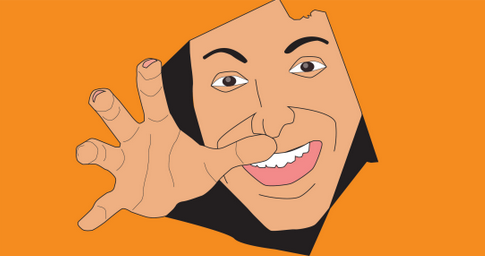
Today, I was sitting at the bus stop with a significantly more male friend of mine when a man I had never seen before approached us and asked when the next northbound bus was coming. My friend didn’t know, but I pulled up the bus schedule on my phone and informed the stranger that he had another three minutes to wait.
“Thank you,” the man said with a smile. “You know, I thought you were a huge bitch at first, but you’re actually really nice.”
I am not a woman, but by accident of my birth, I am often perceived as such. I have experienced the casual misogyny and willingness of strange men to just say things that probably didn’t need to be said since at least the age of ten, when a man first leaned out of a car window and shouted the specifics of what he would like to do to me, and while he’s at it, to the small dog I was walking, in my general direction.
I speak with experience when I say that men on the street will really say the most bizarre things and go about their day, while the person they shouted at just has to live with the garbage that they spewed without a second thought.
What really gets me about this man specifically was his sincerity. He truly believed that he was paying me a compliment, and likely went about the rest of his day believing he’d had a pleasant talk at the bus stop.
It is important to note that I had never seen this man before in my life. What was it that convinced him so thoroughly that I, a stranger at the bus stop minding my own business, was indeed a massive bitch? Was it my short, butchy hairstyle? My Captain Marvel t-shirt? The fact that my friend and I had just been discussing sexism in women’s sports when he got here? If so, why was I the only bitch? Shouldn’t the person agreeing with me be a bitch as well, if that was the case? While I know that when a man is a bitch he is weak and when a woman is a bitch she is a rabid animal, wouldn’t he be a bitch (masculine, derogatory) for cowing to my radical feminist notion that women should not be forced to expose more skin than they are comfortable with, even though he had brought that point up in the first place? Although, the man only told me, not him, that I was really nice and not a huge bitch. Perhaps he meant to suggest through omission that my friend was the huge bitch here?
I wish I had said, “Oh no, I actually am a massive bitch. You were right the first time.”
I am a feminist and a lesbian, and if this man’s general vibe was an accurate reflection of who he is, then I imagine both of those words are threats to him. Yet, if I had declared myself a bitch, would he have realized that maybe calling a stranger a bitch for no clear reason is a super weird thing to do? Or would he have laughed at my attempt to assert myself, before going home and complaining online that biologically, women can’t be funny?
I refer to myself using all kinds of things people have hurled at me —dyke, bitch, man-hater and the like— and have reached the point where I embrace them. I’m a bitchy man-hating dyke on purpose, and I’m proud of it.
I can certainly reclaim this for myself, but would this man on the street even register that I was subverting the patriarchy by refusing his words their intent? Would he care? Is this even about me?
Unfortunately, I was too stunned by the fact that a person would just walk up to a stranger, congratulate them on not being as bitchy as anticipated, and think they did something to express all this in the three minutes before his bus got here. I could only say, “…okay?” in a voice I hope adequately expressed how much he was embarrassing himself, and resumed talking with my friend where we had left the conversation.To all the men who are thinking of saying something to a stranger in public, I say only this— don’t. In fact, don’t say anything to anyone, no matter where you are. Just don’t talk. To anyone. Please shut up forever, thank you.
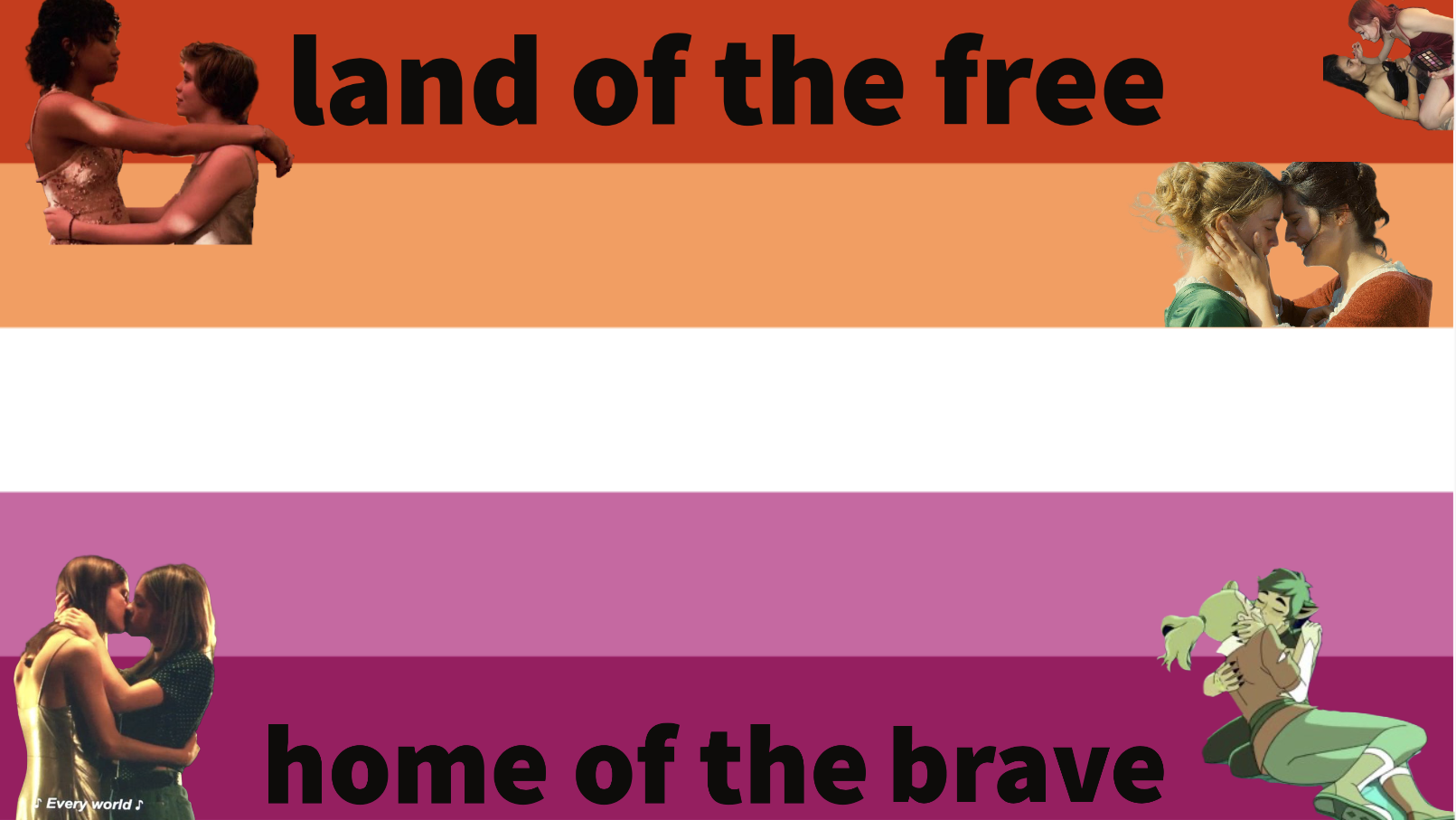
To me, being a lesbian feels warm, like sunshine. It’s a part of you, more than just who you end up with at the end of the night. It’s in the way you get dressed in the morning, putting on what you want to wear instead of dressing for the male gaze. Maybe it’s wearing something that you would never have worn before, for fear that you wouldn’t be hot or sexy enough in it. It’s when you put a Princess Bubblegum and Marceline sticker on your laptop and start doing your eyeliner in ways that you would never have thought of before. It’s a breath of fresh air, to finally exist for yourself and no one else, free from the constraints of what once weighed you down.
It can be looking up an “Am I Gay” quiz when you were fourteen and then promptly ignoring the results, or never looking at Victoria’s Secret when you pass it in the mall. It’s also learning to move past these things when you are older and wiser, laughing at the memories with friends who had similar experiences. Lesbianism is an act of resistance, to say no more to the patriarchal systems that run your life and live wholly and unapologetically without men. While it can be challenging, as it seems like you have to fight the heteronormative appropriation of your sexuality left and right, it is very important to resist these inaccurate deceptions of lesbianism. Think of ads, no matter where you’ve seen them, of two women posing suggestively to sell a product or yet another overly sexual lesbian indie film (cough “Blue is the Warmest Color” cough). Doing that can be as easy as waking up every morning, just existing as your authentic lesbian self. Being a lesbian feels like dancing like nobody’s watching, celebrating all the little lesbian traits inscribed on your body.
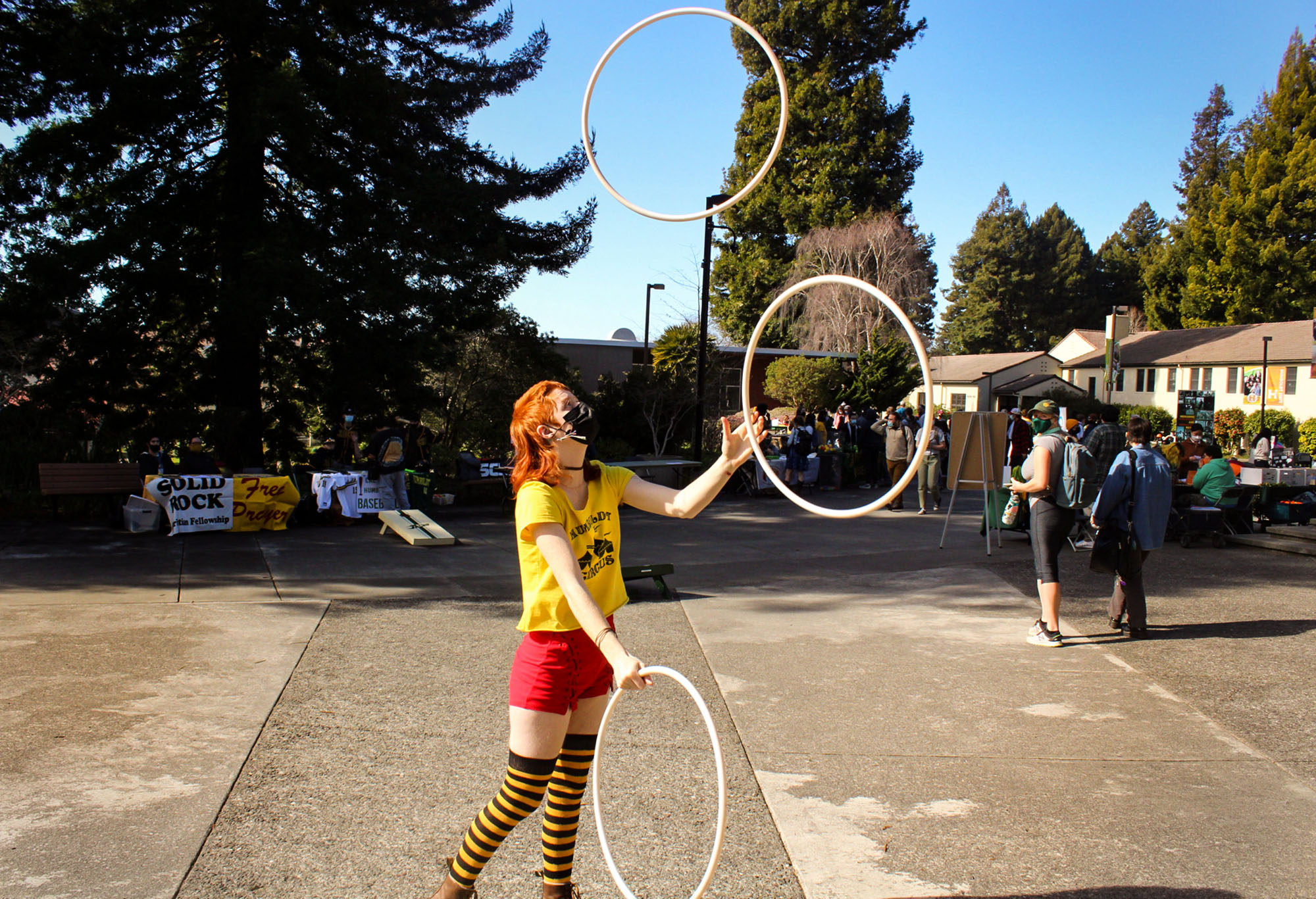
As his staff flew around his body. It became an extension of himself, twirling over the pavement. Man and tool became one through dance. Liam Boyd, a transfer student, and part-time circus performer ran up to the booth with a clown nose and a staff in hand. He had no idea Humboldt had a circus club and was overjoyed to meet everyone. Boyd started to perform with his staff and soon was joined by others, slowly growing into a full-grown performance.
The Humboldt Circus is one of many student-led Cal Poly Humboldt clubs. These clubs give students a safe place to meet like-minded individuals and learn new skills.
Photo by Gabriel Zucker | Louis Parr and Isla Marten sit behind the Circus Club banner, calling people over to check them out. Feb. 11.
On Wednesday, Feb. 10, student clubs set up booths around the Quad. This gave new students a chance to learn about and join these clubs, opening the door for new friendships and experiences.
Louis Parr, President of Humboldt Circus, brought a box full of circus props to their booth. Immediately the traffic in front of the booth increased.
“Circus is a magical place, full of fun and free creativity,” Parr said. “You are allowed to do whatever you want to, within the circus.”
Every week Circus hosts “Play Time” Monday from 5-8 pm at the West Gym. There they give students a chance to let their inner freak out in an artistically unique way. In this space, students are given complete freedom to explore and experiment to their heart’s content, trying new things every time, or perfecting one act over the course of the year.
Isla Merten, a longtime member of Humboldt Circus, walked around the Club Fair. They juggled everything from bowling pins to thin disks. Soon they were joined by more and more interested students, all signing up for the club and trying out some of the cool props. By the end of the club fair, multiple students had stopped what they were doing and taken a couple of minutes to try out different props and write down their emails.
Photo by Gabriel Zucker | Louis Parr, President of Circus Club, does bike tricks around the quad, during the Club Fair on Feb. 11.
Humboldt Circus gives its members endless possibilities for what they can perform and act out. Character acting and improv also have a place in Humboldt Circus. Props are used for tricks, laughs, and skits, adding a new layer to the performance. This year Merten moved away from the props and instead focused on improv and clowning.
“A clown means being creative and open to work with what you are given,” Merten said. “The spirit of play and creation.”
Embodying the clown, they act out scenes by themselves and with others. Merten uses improv to expand and perfect their character. Humboldt Circus, like all the other student clubs, gives a social place for students to bond with one another. When asked about who usually joins the club, Merten didn’t miss a beat.
“It’s a club for introverted weirdos,” Merten said with a laugh. “We have extroverted weirdos too.”
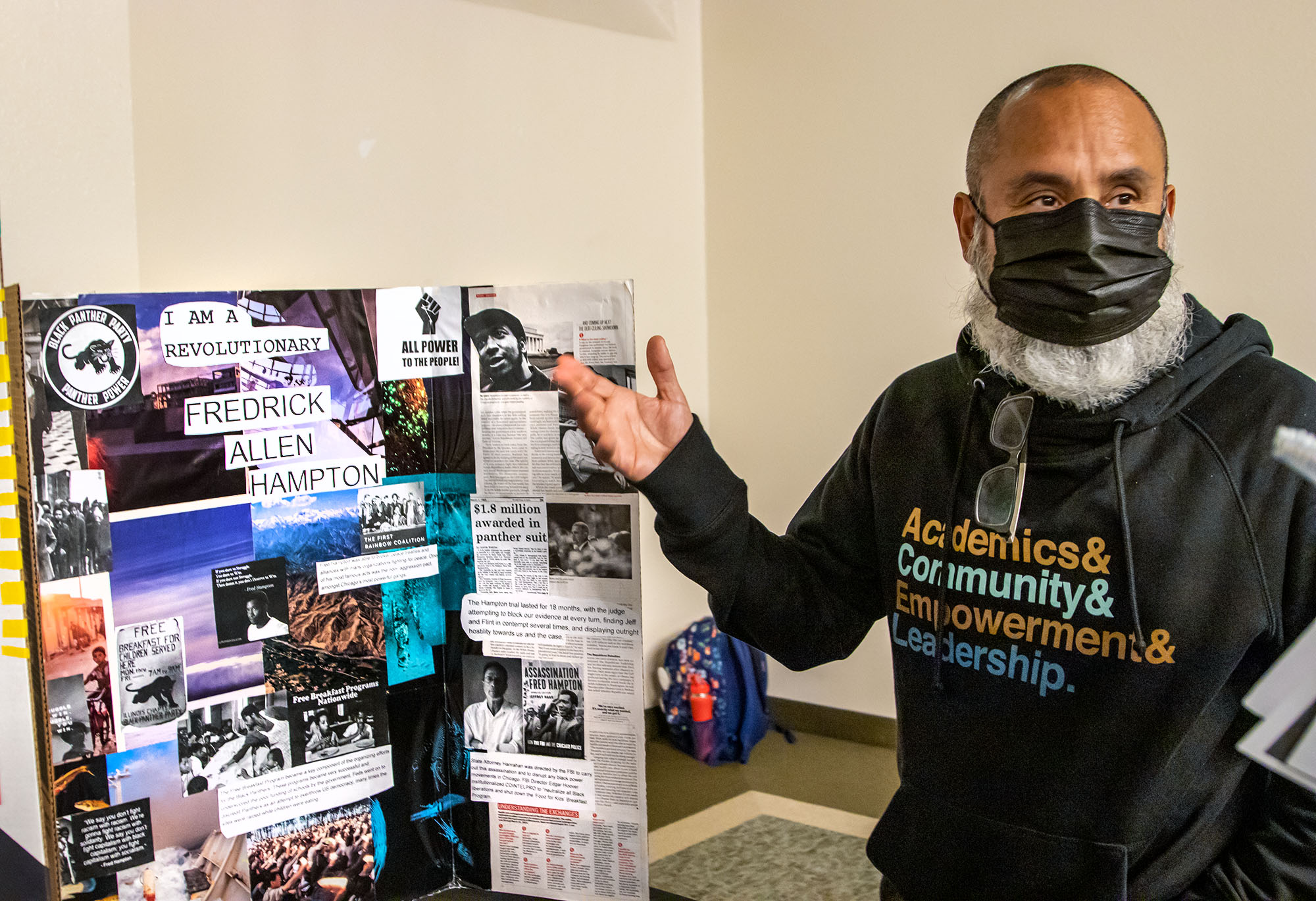
Student-made poster boards detailing the lives and legacies of Black artists and activists filled the Gold and Green Room in Founders Hall during the Black History Month Art Exhibit hosted by the Umoja Center on Feb. 17.
The exhibit was an opportunity for Cal Poly Humboldt’s Black students to express themselves and celebrate their African heritage, much as their forebears did before them in a self-determined push to resist the injustices of slavery, segregation and ongoing oppression.
“It is a creative way to show our unity and stand for everyone who identifies as Black,” said Demi Ogunwo, a Masters student at Cal Poly Humboldt and Charter President of the National Society of Black Engineers. “It’s a lot of activists, a lot of people who broke out of the norm of oppression to make a name for themselves.”
Photo by Abraham Navarro | Asia Anderson, a Cal Poly Humboldt chemistry senior stands next to a photo of her great aunt Marion Anderson.
Biochemistry senior Asia Anderson comes from a line of radical Black women who defied the norm during their lifetimes. She made a poster board about her late great aunt Marian Anderson, a renowned Black opera singer. It was a popular exhibit among the attending students.
“I don’t sing worth beans, but I do chemistry,” Anderson said. “I still think about her strength and not letting a ‘no’ close doors. That was passed down through the line of women in my family.”
Jovie Garcia-Diaz, a senior majoring in Environmental Engineering, was a student attendee at the exhibit. Her favorite poster board detailed the appropriation of Black culture in popular social media culture.
“That’s something that I see a lot on social media that stands out to me,” Garcia-Diaz said. “People who aren’t Black get praised and get popular for [appropriated elements from Black culture.]”
Cal Poly Humboldt students and faculty alike visited the exhibit as the evening went on. Frank Herrera happens to be both. He is a student pursuing a Masters degree in Business Administration and the Coordinator of the Social Justice, Equity, and Inclusion Center on campus.
A collage poster board about the life of Fredrick Allen Hampton, former Chairman of the Black Panthers, stood out to Herrera. Herrera was alive in the final years of the Black Panthers’ existence before it dissolved.
“I had met folks who were involved, I just remember the guys in leather jackets and the energy,” Herrera said. ”It’s amazing what they were doing, the bravery and courage they had during the time.”
Photo by Abraham Navarro | Students look at posters of black leaders and events in history during the Black History Expo in the Green and Gold room in Founder’s Hall on Feb. 17.
According to Ogunwo, the art exhibit in general characterized three of the seven guiding principles of the Nguzu Saba, or African heritage, that the Umoja Center stands They are Kuumba (creativity), Umoja (unity) and Kujichagulia (self-determination).
“The pillars reinforce what we stand for and how we want people to see us,” Ogunwo said.
Anderson feels a deep connection to her great aunt and to her heritage that empowers her. To her, the exhibit was a chance for Black students to see themselves in the trailblazers before them.
“They weren’t the first,” Anderson said. “You’re not going to be the last. It feels good because one day, those boards are going to be about you.”
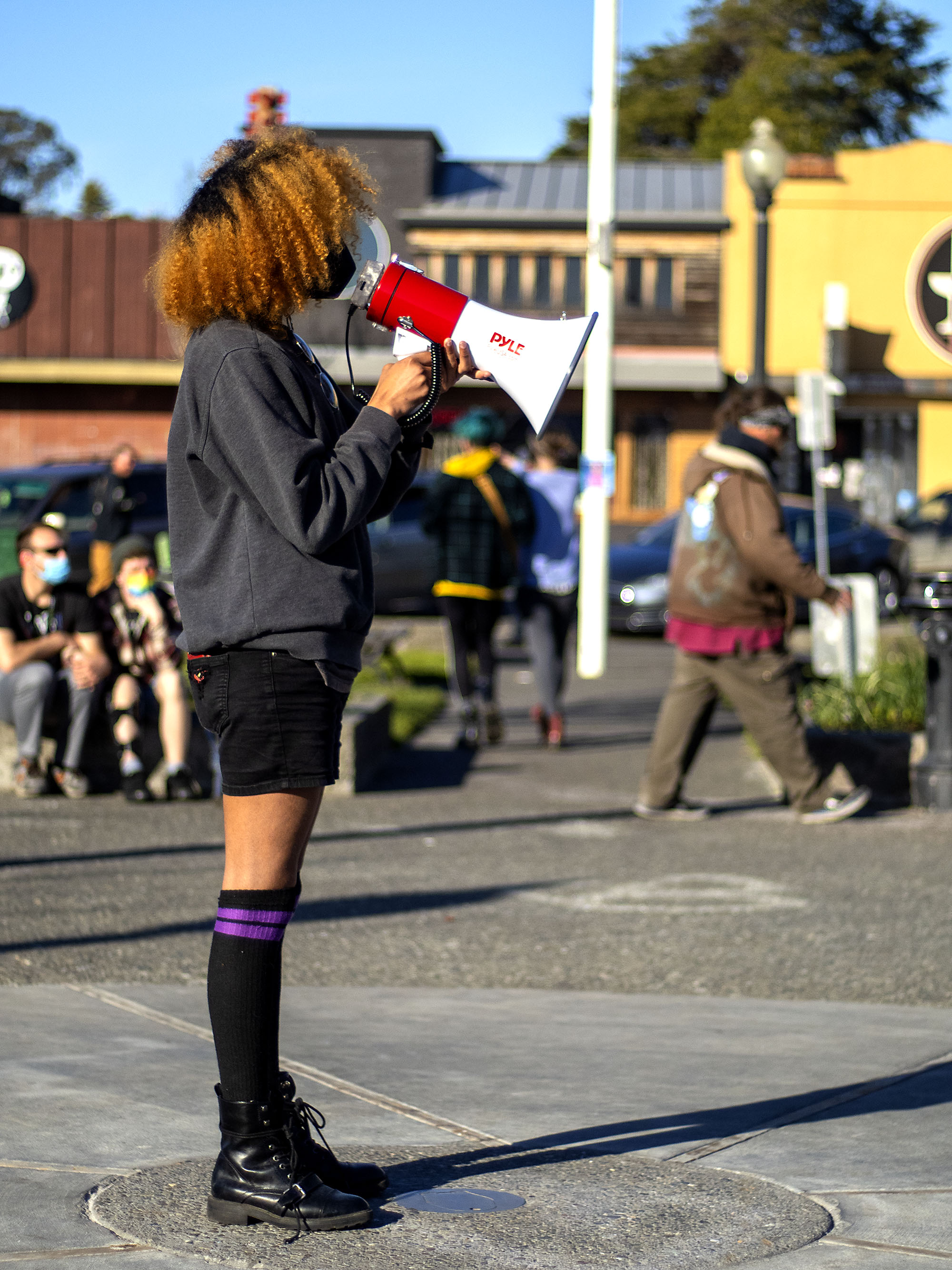
35 to 40 community members gathered in the Arcata Plaza to speak about Black History Month on Feb. 17. A flyer, created by community organizer and artist Nikki Valencia, urged people to come out and show that their allyship wasn’t seasonal or conditional. When Valencia spoke in the plaza, they noted they did not feel that support.
“This is the perfect time to center Black marginalized folks, but that energy is not here,” Valencia said. “Black History Month is about more than educating. It means nothing if you know Black people are struggling and do nothing about it.”
Photo by Morgan Hancock | Steve Bell leads protesters in a chant at the Black History Month protest on the Arcata Plaza Feb. 17.
Marlon Andrew Jones II, who works at Cal Poly Humboldt, spoke at the gathering. He said the voices supporting Black communities are never loud enough. Jones said that students, faculty, and admin need to listen to their communities if they want to support Black people.
“If you’re a white person and you’re listening to this and it’s making you uncomfortable, it’s supposed to,” Jones said. “You’re not supposed to be comfortable, because there is a community that has lived in discomfort for so long.”
In Jones’ speech, he urged empathy from white members of the community. The lived experience of Black Americans can be traumatic. Jones believes that white people need to do more than be accountable, they need to love their Black neighbors.
“Love is an action, and that’s what the Black community needs,” Jones said. “We need people to love us enough to take action and make a difference. Sometimes you don’t know what someone is going through, but you can hold their hand through it.”
Photo by Morgan Hancock | Raquel Bell speaks about the importance of valuing Black women at the Black History Month protest held on Feb. 17 in the Arcata, Ca. plaza.
Raquel Bell is a local student who spoke on the importance of valuing Black women. Black women exist at intersections of systemic struggles and deserve love and support. Bell said that when Black women are uplifted, so is the society around them.
“If you want change, first you need to love the Black woman,” Bell said. “Once her needs are met, you know everyone’s needs are met. Once you love a Black woman you change the world. The Black woman is strong, she is beautiful, she is me.”
Former A.S. President Jeremiah Finley was impeached Sunday, Feb. 20, after an almost seven hour trial. All members of the Board were present, many providing their testimonies and evidence against Finley. Impeachment was under the violations of A.S Government Codes Section 9, subsections F, J, L, M, and O. He was voted guilty on four of these five charges.
Photo by Abraham Navarro | Social Justice and Equity Officer Lizbeth Cano Sanchez crying at the Associated Students meeting in Siemens Hall on Feb. 5.
“In order to effectively serve students, we must eliminate fear,” said Social Justice and Equity Officer Sachez, the opening speaker for the trial. “Fear that we will not be allowed to speak our minds without retaliation and fear that, despite mediation, nothing will change.”
Under subsection F, overstepping the bounds of their office without the advice or consent of the Board of Directors, Finley was found guilty of unilateral decision-making, violation of California Law AB 361, and violation of the Gloria Romero Open Meeting Act of 2000.
College of Natural Resources & Sciences Representative Tashenae Burns-Young gave testimony towards these violations. She stated that President Finley refused to give her Zoom access to Feb. 4’s meeting unless she divulged personal reasons to her non in-person attendance. At the time, only Parliamentarian Kate Bourne was given Zoom access by President Finley.
“I would like to start as being a black woman on Associated Students,” Burns-Young said. “I have never felt [more] oppressed by my former BIPOC peers, than by our current president.”
While Burns-Young was able to attend the meeting thanks to Bourne’s own decision to give the Zoom link to all other members, Finley did not count her as quorum and ignored any votes she made during that meeting.
Under subsection L and M, President Finley was found guilty of conduct that was deemed to be causing distress to the Board as a collective whole and continuous displays of disrespect aimed at students of the association. Resigned A.S. member Malluli Cuellar gave testimony to this section.
She gave examples of her many conflicts with President Finley as an A.S. member. In the summer prior to fall 2021, during an agenda prep meeting, Finley had requested that she include a talking point within the agenda that he wished to speak on. She expressed discomfort in allowing this agenda item to be added purely in its state as it wouldn’t allow for a debate between the Board, instead she offered similar alternatives.
“He expressed to me that if the chair was unwilling to work with him,” Cuellar said. “He would simply amend it on to the agenda [in the state he wanted it in].”
This incident caused her immense embarrassment and a growing panic towards speaking with President Finley. While she explained that they later spoke one-on-one and he apologized for his actions, his disrespectful words and actions continued up again not long after.
Lastly, the violation of subsection o. negligence to thoroughly communicate with fellow board members, was testified by both Executive Director Jenessa Lund and College of Natural Resources & Sciences Representative Mark Bulgara.
“When I would support the President in putting agendas together,” Lund said. “I always encourage, like ‘hey can we link it here it’s always best to provide things ahead of time, so people have time to review it and digest it.’ I always got denied.”
Bulgara stated that Finley had neglected to properly educate him on important legislation and his voting rights when he appointed him to his current position. In the end, this ignorance often led him to blindly follow President Finley’s own words on any matter.
“Seeing [this] now, I regret every second that I voted yes for him,” Bulgara said. “Because he has done nothing but betray our trust and he abused my ignorance in being a new member.”
Photo by Abraham Navarro | Student Affairs Vice President Chase Marcum and Social Justice and Equity Officer Lizbeth Cano Sanchez speak to President Jeremiah Finley at the Associated Students meeting in Siemens Hall on Feb. 5.
Throughout the entire trial President Finley expressed that all accusations against him were refutable and that he never did anything to break any legal laws nor did he mean to hurt any member with purposeful intent. While he did extend apologies when explicitly asked to by Bulgara, he also expressed himself as a victim to these accusations. He believed many of these accusations to actually stem from personal disagreements and opinions to his own past decisions.
“I don’t see anything in here that results in the punishment that this board is wanting to pursue,” Finley said. “In fact, I feel as though I am being retaliated against for a lot of the ways that I’ve advocated for our students.”
The impeachment trial ended with a unanimous vote by all Board members to impeach Jeremiah Finley from his role as A.S. president.
Associated Students do not stand nor condone any kind of disrespect. We value everyone’s thoughts, opinions, and presence within AS.
We are aware of an unsettling situation that occurred during our Executive cabinet meeting on Feb. 4 concerning members of the Associated Students and members of AS Core Programs at Cal Poly Humboldt.
During the meeting, President Jeremiah Finley was uncooperative with fellow board members and had cut the meeting short. During this meeting, the WRRAP’s R.O.S.E branch team was expecting a response from the board, but would not move forward due to solely wanting in-person attendance.
In addition to this, President Finley neglected his team by failing to acknowledge the presence of appointed members who joined through Zoom, assuming that, “they only joined through Zoom simply because they didn’t want to be in attendance in person,” though this was not the case.
First and foremost, we, the Associated Students do not accept or tolerate the sort of behavior that was presented on that evening. We understand the concern, the anger, and the feelings of disrespect. You are heard and your feelings matter.
Next, we find it critical, to be honest with our student body and with each other. Unfortunately, there has been an unhealthy power dynamic within AS. There have been many issues regarding communication, equality, and access to opportunities. These are issues AS members have been dealing with but have managed to persevere through while keeping our student body and AS Core Programs at the top of their priority list. We are actively working towards community building and furthering our relationships with our staff and student leaders.
Due to the continuous amounts of disrespect and unacceptable behavior, AS will be moving forward with the impeachment process.
Associated Students stands for the purpose to educate, empower, and most importantly elevate all student voices.
Signed,
Associated Students of Cal Poly Humboldt
This website uses cookies to improve your experience. We'll assume you're ok with this, but you can opt-out if you wish. Cookie settingsACCEPT
Privacy & Cookies Policy
Privacy Overview
This website uses cookies to improve your experience while you navigate through the website. Out of these cookies, the cookies that are categorized as necessary are stored on your browser as they are essential for the working of basic functionalities of the website. We also use third-party cookies that help us analyze and understand how you use this website. These cookies will be stored in your browser only with your consent. You also have the option to opt-out of these cookies. But opting out of some of these cookies may have an effect on your browsing experience.
Necessary cookies are absolutely essential for the website to function properly. This category only includes cookies that ensures basic functionalities and security features of the website. These cookies do not store any personal information.
Any cookies that may not be particularly necessary for the website to function and is used specifically to collect user personal data via analytics, ads, other embedded contents are termed as non-necessary cookies. It is mandatory to procure user consent prior to running these cookies on your website.