By Sadie Shields
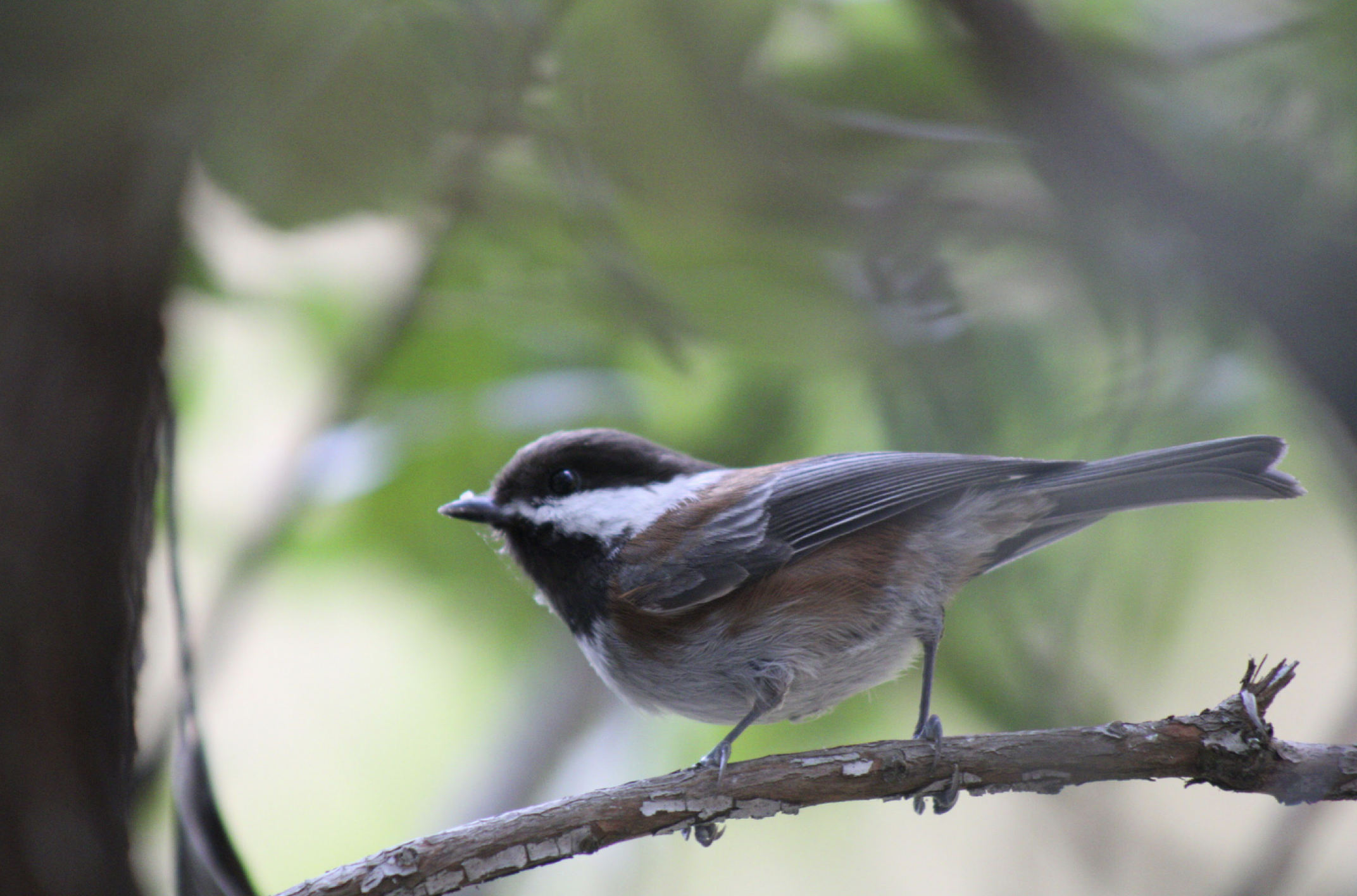
The chestnut backed chickadee is a small songbird distinguished by its striking coloration and energetic behavior. According to the Audubon field guide, it measures about 12.5 centimeters in length, with a large tail that seems bigger than its body. Unlike other chickadee species, it displays a rich chestnut-brown back and flanks that contrasts with its black head feathers and bib as well as its white feathered cheeks. It is considered one of the most colorful members of the chickadee family and easy to identify.
Native to the Pacific Northwest, it can be found in Alaska, British Columbia, Oregon, Washington and parts of Northern California. It usually lives in coniferous forests, but has adapted to living in suburban neighborhoods, parks and college campuses. In fact, it can be seen on the grounds of Cal Poly Humboldt where the larger and older trees, as well as bushes provide food and shelter. This is a very common bird and there are no significant conservation efforts for this species at this time.
The chestnut backed chickadee is a cavity nester, often excavating their own holes for nests in decaying wood or using abandoned woodpecker cavities. It lines its nest with softer materials such as animal fur, feathers, moss and other items found in the forests. This helps to create well insulated environments for the eggs and nestlings. During this season the chickadee forms strong bonds with its partner and actively protects and defends their nesting territories. Its diet consists of insects, caterpillars and spiders. They also eat seeds and have been seen storing food in crevices for later. These birds tend to be curious and have been seen flying with other foraging flocks. Just head down to the marketplace and you are bound to hear its small chirps along with a few crows judging caws.
Sadie is a junior communications major, journalism minor at Cal Poly Humboldt who has an interest in covering and taking photos for sports and wildlife journalism, and a slight interest in breaking news. She can be reached at sls331@humboldt.edu.
Leave a Reply