The Lumberjack


Students Serving The Cal Poly Humboldt Campus and Community Since 1929

Category: Editorial

  • We Need the Wisdom of Wikipedia

    We Need the Wisdom of Wikipedia

    Wikipedia shows collaboration is crucial for accuracy

    We’ve all been there. You’re sitting in a class. Your professor wants you to write a paper on the different types of asexual reproduction of the Sanderia malayensis jellyfish or some other arcane drivel. Your first reaction is to hit up Wikipedia. Then comes the kicker. You can’t cite Wikipedia. You scowl and snarl under your breath.

    Wikipedia deserves more credit than we give it. Turning a blind eye to Wikipedia as a reliable source is shortsighted and has implications beyond the realm of encyclopedias. Distrusting Wikipedia represents academia’s unwillingness to open the gates of collaborative truth-seeking.

    Scientific papers, meanwhile, are far from perfect.

    Contrary to what your professors may tell you, Wikipedia, as a source, is statistically just as accurate as published encyclopedias for most of its content. A 2005 study by the Nature research journal, “Internet encyclopaedias go head to head,” found errors in both encyclopedias, but among the entries tested, the difference in accuracy was small.

    Wikipedia, in their signature self-aware style, has reported on their own reliability as well. Wikipedia does not guarantee validity, but it is an invaluable research resource.

    Inaccurate information on Wikipedia is usually corrected quickly. Hyperlinked citations back up nearly every claim made on an entry. The Sanderia malayensis jellyfish’s page hosts six sources from international professionals, biologists and a handbook on poisonous jellies.

    Scientific papers, meanwhile, are far from perfect. Soft sciences have suggested cures to unhappiness or boosts to confidence through simple behavioral change, but as other researchers try to replicate the experiments, their conclusions are significantly different. This indicates a serious error in the scientific method. If science isn’t replicable, science is null.

    In the last few years, a plethora of papers have fallen under criticism after researchers have failed to reproduce their results—it’s been called the replication crisis. The crisis may have a few sources.

    Mistakes happen on Wikipedia too and it is always essential to be critical of anything read.

    First, it’s not hard to get published. The University of World News said in 2018 that too much scientific research is being published. It estimated nearly 30,000 scientific journals are in circulation, publishing approximately two million articles each year. They said the volume burdens the peer review system and makes it dysfunctional.

    Second, the media likes to be the first to report on news, including science news. Journalists can be wrong and often are when it comes to reporting on science, especially when they’re grasping to be the first to report on new findings. These bad practices report inaccurate, unconfirmed, flawed science to their audience before the study can be replicated.

    Mistakes happen on Wikipedia too and it is always essential to be critical of anything read. Search around, find supporting articles for any claim made and be aware that there may be flaws. But be able to recognize valid and sound knowledge.

    Critical review by the editors of Wikipedia—who can be any person—is what makes Wikipedia so powerful and so accurate. It’s the world’s largest encyclopedia—about 50 times larger than Britannica—with over six million entries and over 200,000 contributors. Wikipedia should serve as a banner for collaboration—especially between diverse groups.

    In “The wisdom of polarized crowds,” a 2019 study from Nature Human Behavior, researchers found politically-diverse teams created more accurate entries than teams with less political diversity.

    Wikipedia comes in clutch, often. Using it as a source may be frowned upon by professors, but a short chat with most of them and they’ll say Wikipedia is an excellent place to start. The website is a tool, not a cheat code. It would be ignorant to ignore it, but if it’s used appropriately, maybe, just maybe, we could learn something about jellyfish.


  • Let’s Make Media Coverage Equal, Always

    Let’s Make Media Coverage Equal, Always

    Emphasizing equity and integrity in the media February and beyond

    Humboldt State University celebrates Black Liberation Month, which promotes black excellence and achievement, every February.

    People of color are often covered by the media for achievement in athletics and entertainment, but rarely for academia, volunteer work or simple successes unless they’re a trailblazer in their field. More often than not, Blacks face the most discrimination in media.

    At HSU, Black Liberation month emphasizes the great achievements and progress in the Black community—but these often fall out of the public eye once February is over. This is a failure—the celebration of the Black community should extend through the year and into perpetuity. At The Lumberjack, we acknowledge the lack of representation blighting the mainstream media and our own newsroom. We strive to break the toxic cycle of misinformation and misinterpretation and promote the achievements of the Black community at HSU.

    “Blacks represent 37 percent of criminals shown in the news, but constitute 26 percent of those arrested on criminal charges. In contrast, news media portray whites as criminals 28 percent of the time, when FBI crime reports show they make up 77 percent of crime suspects.”

    Travis L. Dixon

    Modern media organizations filter the truths of the world, a behavior that has a significant impact on their audience. The way we absorb news depends on the way it’s delivered. Emphasizing equity and integrity in the media February and beyond

    The study, “A Dangerous Distortion of our Families,” by Travis L. Dixon, Ph.D from the University of Illinois, looked into media coverage from local and national media outlets and found they often warped the reality of Black families to fit the narrative of the big screen.

    “Blacks represent 37 percent of criminals shown in the news, but constitute 26 percent of those arrested on criminal charges,” Dixon wrote. “In contrast, news media portray whites as criminals 28 percent of the time, when FBI crime reports show they make up 77 percent of crime suspects.”

    The study, sponsored by The Washington Post, found that at best, media outlets promoted racially biased portrayals and myths that pathologize black families and idealize white families with respect to poverty and crime.

    At worst, the study found that media outlets amplified those inaccurate depictions for political and financial gain. They said such reporting reinforces debunked narratives that justify police brutality or promote economic policies that hurt not just Black families, but all families.

    Throughout February, throughout the year, into the next decade and into forever, we shall strive to accurately report on and represent the lives and achievements of the Black community at HSU. We commit ourselves to journalistic accuracy and integrity. We commit ourselves to the celebration of the liberation of our oppressed communities and we commit to support them on their path to self-realization.

  • Parody is Protected Speech

    Parody is Protected Speech

    HSU administration cannot tell student media what to publish

    Press at any capacity in the United States is protected by the First Amendment against federal censorship of speech. The government cannot make editorial decisions, retractions or content suggestions. Student press publications in California are protected not just by the First Amendment, but also by the California Student Free Expression Law of 1977, or California Education Code 48907.

    When a government entity such as a state university interferes with the press by policing publications on what is appropriate to publish, it inhibits the independence of the press.

    Recently, Humboldt State University administration sent out a school-wide email regarding material printed in a student parody newspaper, called The Dumberjack, found in an insert in the Nov. 20 issue of The Lumberjack.

    The public announcement accused the students in the parody news class that produced The Dumberjack of reinforcing rape culture and gender-based discrimination through a photo that depicted a “sexist ‘riddle’” which was displayed on a sign in a window of an all-female room at the College Creek Apartments.

    The school administration held The Dumberjack staff responsible for a joke on a sign they did not create nor stage. A student-journalist outside of the parody news class observed and documented campus culture with this photograph. The parody news class simply featured it in the paper and in no way amplified any perceived gender-based discrimination with the story that ran alongside the photo.

    Parody facilitates the palatability of relevant information through comedy.

    No one in The Dumberjack class or on The Lumberjack staff supports gender-based discrimination or wants to reinforce rape culture. But journalism, of any kind, is not public relations. The publication of a photo of a sign on campus does not represent endorsement of what the sign says. Journalism draws attention to troublesome realities by documenting them and showing them to the public. When a publication reveals a sign that a university finds offensive, the university’s focus ought to be on the sign, not on the journalists who documented it.

    Administration officials invited the class to have a conversation to “discuss the impact and implications of the cover photo.” The meeting was intended to be an open dialogue surrounding the development of “critical lenses.”

    Instead, on Thursday, Dec. 5, the class became the site of a direct act of administration intimidation.

    Two school officials—only one of whom had been momentarily invited—came to the class and lectured journalism students on how to make editorial decisions. Chair of the Sexual Assault Prevention Committee Kim Berry and Dean of Students Eboni Turnbow, both of whom are government employees, reprimanded a class of students educated in journalism ethics.

    The administration is demonstrating unprofessional behavior of questionable legality by attempting to contain this incident and filter what student press can and cannot print. The administration cannot tell student media what to publish.

    Parody writers take real world situations and use a critical lens to highlight a topic in a juxtaposed way. These satirical pieces can sometimes be offensive, but the key is that the subject matter is still being discussed.

    The goal of parody is to create a dialogue on topics that are either overshadowed or too controversial to be discussed openly. Parody facilitates the palatability of relevant information through comedy.

    The First Amendment protects speech, including satire and parody. Satire and parody are used as impressionistic language that aim to create commentary on sensitive issues through the use of humor, absurdity and exaggeration. Utilizing these writing tactics serves as a more approachable way of tackling uncomfortable yet prominent issues.

    Journalists aim to relay information in the most accurate and concise manner as possible. Censorship defeats that purpose. The government censoring the media is illegal and obstructs the transparency of journalism. It creates bias and subjectivity, as journalists become fearful of backlash for what they print.

    When censorship appeases a specific group of people, it’s a domino effect. Censoring one thing for a single group leads to censoring all material to please everyone. That defeats the purpose of journalism as an independent eye intended to expose overlooked issues.

    In today’s political climate, journalists are constantly under fire. The fourth estate, journalism, is as vital to uphold as the fifth estate, non-traditional media like parody news. When federal figures undermine the editorial freedom of a publication, even a parody news publication, a slippery slope follows in which government infringes upon the freedom of the press.

  • ‘OK Boomer,’ Let’s Set the Record Straight

    ‘OK Boomer,’ Let’s Set the Record Straight

    Millennials and Zoomers may be fed up, but ‘OK Boomer’ is not equivalent to a racial slur

    If you’re present on social media –or even if you read any of the major news organizations– you’ve probably heard of the latest linguistic controversy, “OK Boomer.”

    Memes have become a fundamental aspect of younger generations’ humor. They are used to convey vast amounts of information within a simple image or text post. Google defines memes as laughable images, text or videos that are replicated and spread quickly around the Internet.

    The “OK Boomer” trend started as just that, a meme. Unfortunately it has taken a new life and those outside of meme culture fail to realize the actual meaning behind the phrase.

    Boomers are those from the post-WWII baby boom era who were born from 1946 to 1964. Millennials are young adults born from 1981 to 1996. Generation Z, or zoomers, were born from 1997 to the present day.

    “OK Boomer” is used to dismiss the disdain older generations have against millennials and zoomers. The phrase can be used as an insult, but it’s often used to blatantly point out double standards that many boomer generation individuals subject younger generations to.

    Don’t worry, Boomer. It’s just a meme.

    The meme began as a way to passive aggressively, and humorously, let loose the frustrations that younger people have at the current state of the world–a world that was created and subsequently tarnished by the boomer generation.

    This comical phrase is by no means equivalent to a racial slur, as some people have insinuated.

    While “OK Boomer” can be misconstrued as a derogatory term against the older generations, it’s not meant to be hateful. Millennials and Zoomers simply found a way to comment on the older generation’s biases. This term isn’t even specifically about age, it’s about issues.

    Nevertheless, this phrase has hit the mainstream with news station stories and business marketing campaigns. Companies like Natural Light and Netflix are jumping on the bandwagon and are trying to appeal to today’s youth by using this meme slogan for marketing.

    Millennials and zoomers are fed up with the boomer generation feeding us disdainful comments on how to lead our lives.

    Boomers often look down upon younger generations and you can commonly hear boomer individuals using phrases that start with, “Back in my day,” or “When I was your age,” which are typically followed by an array of rhetoric that aim to condemn the lifestyles and decisions of younger generations.

    The majority of us zoomers and millennials are not entitled and arrogant as we are so often portrayed. In a general sense, we see and experience the injustices created by an inconsiderate generation, and feel a need to retaliate against the judgement that boomers perpetuate in a creative yet harmless way. We are trying to make them see their own corruption.

    Memes, and “OK Boomer” in particular, can confuse older generations because they don’t have the contextual knowledge that we’ve absorbed through the saturation of media messages surrounding us that help us able to understand pop culture or meme culture references.

    Any older generation will inherently look down upon its successors because as humans we are resistant to change. The fact that older generations now are offended by what the young people have to say just solidifies that they don’t understand what younger generations are expressing, so they react with scorn.

    The older generations fail to realize that we are fed up with how we’ve been viewed and treated by them. Our use of ‘OK Boomer’ is solely used to highlight this mistreatment.

    Overall, the use of this comical phrase isn’t meant to upset the older generations. It’s meant to inform them about the concerns younger generations have which don’t seem to be taken seriously by boomers. Don’t get offended, it’s just a meme.

  • Double Down on Double Standards

    Double Down on Double Standards

    Katie Hill’s resignation highlights sexual misconduct double standards in politics

    At least 25 women have come forward with allegations against President of the United States Donald Trump, some from as far back as 1970.

    Allegations of at least two improper relationships with former staff were made against Congresswoman Katie Hill.

    Trump remains in office. Meanwhile, conservative media ran explicit photos they received from Hill’s previous competition as part of a smear campaign, resulting in Hill’s resignation on Oct. 27.

    We don’t believe Hill to be a perpetrator. We believe Hill to be a victim of revenge porn and of the double standards of our current political and social climate.

    We are entering an era where the up and coming generation are products of a technologically advanced world. This generation will be the next to represent us in politics.

    The men who remain in office despite their sexual misconduct must step down. The justice system must not fail to reprimand those who spread revenge porn the way they’ve failed the women who have spoken up against them.

    There are men who have been removed from their positions or missed out on opportunities because of actual sexual misconduct.

    The difference between these men and Katie Hill is that they were removed because they were sexual predators. They played an active hand in sexual behavior that was not consensual, legal or both.

    Roy Moore, a republican who wanted to fill the Alabama Senate seat left open by Jeff Sessions, lost to democrat Doug Jones in a 2017 special election.

    Moore had four sexual misconduct allegations against him for soliciting sex from minors per Alabama state law and voters were still conflicted on which way to vote.

    This behavior is worth the lost seat. Moore was not fit to be in a position of power as a predator.

    Hill is dealing with allegations of affairs but not of sexual harassment. Though you might be able to identify those affairs as an act of misconduct, the difference between these actions is the severity of the issue and the difference between a malicious act and impropriety.

    Last year Congress passed a law that prohibits sexual relationships between lawmakers and their employees, putting Capitol Hill on par with the military and the private sector.

    Hill’s resignation is about much more than the potential of affairs. She was forced to leave because a couple disgusting men with malicious intentions decided to air her dirty laundry.

    Hill is 32 and therefore a part of the millennial generation. The generation that grew up with the world at their fingertips in the form of the internet and smartphones.

    Sending a risqué photo to someone you trust does come with consequences. Though you place trust in the person you are sending photos to, they still possess the ability to betray that trust and expose something you sent in an understandable private conversation.

    What it does not mean is that you should be ostracized for sending them. Those who stooped low enough to disrespect someone by leaking nudes should be the ones who are ostracized instead.

    The congressional responsibility of making vital decisions regarding people’s lives and welfare from anything to health care, taxes and governing laws are placed in the hands of simple people.

    Because they are representatives of the people, we expect the individuals voted into office to uphold moral and ethical values and decision making.

    Hill has broken no moral code or ethical principle by privately sending photos to someone. The only thing Hill is guilty of is feeling comfortable enough in her sexuality and her relationship at the time to send provocative photos.

    To treat her as if she has made some treacherous decision that suddenly makes her ill fit to hold office, is ludicrous and childish.

    It’s time to grow up and move past the double standards we place on women in politics.

  • Miscommunications and Misdirection

    Miscommunications and Misdirection

    Hold PG&E accountable for its reckless and unprofessional behavior

    During the most recent Public Safety Power Shutoffs, the Pacific Gas & Electric Company’s communication with its customers was awful.

    The first time the utility shutoff power in Humboldt County was on Oct. 9. The county had less than 12 hours of notice for residents to prepare for a possible four-day outage. Humboldt was the only county in California to lose all power and initially wasn’t even on the list of affected counties.

    After the outage, Michael Lewis, PG&E’s senior vice president of electric operations, said that Humboldt County shouldn’t have lost power in the first place. Although extreme weather and fire risk were at play in other counties’ outages, Humboldt went dark because of scheduled maintenance on one of the transmission lines coming into the county.

    On Saturday, Oct. 26, reports from PG&E said only about 2,000 customers in Humboldt would be affected. Several hours later, PG&E corrected itself and acknowledged that all Humboldt residents would be hit with the outage.

    During the most recent PSPS, the utility released news that another outage would likely hit Humboldt early Tuesday morning. Additional updates said that while many residents would regain power, it was possible that residents still without it may continue to be in the dark through to Tuesday’s outage.

    When Tuesday morning came and went, locals wondered when the outage would hit. Those who regained power the day previous still had it, and conflicting reports from PG&E, the Redwood Coast Energy Authority and the Humboldt County Office of Emergency Services led to mass uncertainty about when –and if– the power would go out again.

    For those PG&E customers who tuned in to one of the company’s many streamed press conferences, they were forced to wade through jargon including “operational event,” “incident commander,” and the terribly-named “Public Safety Power Shutoffs.”

    Late Monday night, the Redwood Coast Energy Authority posted on Facebook that PG&E said that power in Northern Humboldt wouldn’t go out until 9 p.m. That same night, OES made its own Facebook post stating that PG&E said power was still planned to go out early in the morning.

    On Tuesday morning, OES continued to stand by what it had learned from PG&E.

    PG&E’s own updates from Tuesday morning listed the outage time for Northern Humboldt as 9 p.m., and as the day went on, that seemed to be likely.

    Humboldt State University had no better idea of when the power would go out, as it noted in its update on Tuesday morning.

    “HSU is seeking clarity from PG&E regarding the timing of a possible power shutdown,” HSU’s update said. “There has been conflicting information from the company, and in local news reports, over the last 24 hours.”

    PG&E later updated its estimated timing to 7 p.m., and then, around 5 p.m., it called off any PSPS for Humboldt at all. On Facebook, OES said PG&E had given it inaccurate information.

    “PG&E has provided the Humboldt County Office of Emergency Services (OES) inaccurate information regarding times of de-energization in our County,” OES said.

    Communication is everything. PG&E changing times of planned outages makes sense, especially since the outages are primarily based around weather patterns. But failing to provide accurate information to emergency services and county officials is ludicrous. The company’s communication strategies are unacceptable.

    As a community and state we need to hold PG&E accountable and remove ourselves from its firm corporate grip. These blackouts should be the push California needs to turn toward alternative energy and municipal utility boards, ridding the state of monopolized power once and for all.

  • Perpetuating Stereotypes Ain’t Cute

    Perpetuating Stereotypes Ain’t Cute

    Costumes that perpetuate stereotypes of cultures and minorities aren’t funny, they’re problematic

    The Halloween season provokes the competitive nature of costume shopping, but costumes that display a person’s culture, religion and tradition should remain off-limits.

    Costumes based off of Native American, Latinx, Asian, Middle Eastern and African cultures are appropriation, plain and simple. Feathered headdresses, beads and tassels don’t adequately reflect the entirety of Native American culture. Just as Egyptian culture is more than gold jewelry and eyeliner. These costumes are tasteless, especially if you aren’t from the cultures you’re dressing up as.

    While these are the obvious examples of appropriation, other costumes can still be offensive even if they aren’t directly ripping off a culture.

    Other costumes that take advantage of different lifestyles, religions and customs include nuns, priests, inmates and military personnel.

    The intentions behind a costume should be highly considered. You need to remain mindful of how you choose to display an idea to ensure you aren’t being offensive to any culture.

    Cultures can’t be boiled down to a single costume, accessory or prop, so don’t wear anything that diminishes a significant part of someone’s life just for some laughs or notoriety.

    The appropriation of cultures are so often portrayed in an ignorant and blind fashion that fail to value the importance and significance behind an item being used purely as an accessory. By appropriating a culture or religion with a costume you’re perpetuating ignorance and preventing the education of how to accurately respect and represent people.

    Costumes that appropriate heritage and traditions pick and choose aspects of a culture purely for entertainment purposes. These ultimately cast a stereotypical image that fails to accurately reflect reality.

    The transition from culture into costume disregards past movements, practices and emotions experienced by those who are being appropriated. Costumes often fail to reflect the original garments through the commercializing process, furthermore disrespecting the authenticity.

    You should be able to decipher which outfits are appropriate and which are inappropriate. If not, you shouldn’t consider these ideas as viable costume options.

    If you’re questioning whether or not your costume choice is offensive, put yourself into the shoes of someone who genuinely practices what you’re posing in.

    Be a critical thinker. Before attending a Halloween party or heading out, check the fit. Examine your decisions, and if it feels unethical or immoral, don’t wear it. That’s it.

  • Blackout Preparation

    Blackout Preparation

    Our first PSPS was a wakeup call, now it’s time to go into the next blackout more ready than ever

    In early October, Humboldt County residents trailed around the block at gas stations hoping to fill up their tanks and stripped local grocery stores of food, water and battery operated lights. The Public Safety Power Shutoff made us realize how often we take electricity for granted, and how we use power for most of our daily activities. Simple tasks like cooking, cleaning, eating, working and watching television all require some form of electricity.

    Some locals were fortunate enough to have gas-operated stoves to make and warm food, but most of the LJ staff didn’t. Many of us rent apartments or live on campus and have electric stoves, so something as simple as warming a can of beans was nearly impossible.

    With the lights out, it felt like we time traveled back to the 1800s. The usual ways of entertainment were off the table, and when we went shopping in preparation most of us didn’t consider buying board games or downloading movies to a laptop. When it came down to sitting in a dark room with nothing to do we made a pact that the next time we would be better prepared.

    Having a bag prepped for extreme situations could be lifesaving, and with a little forward thinking, your bag could be ready in minutes.

    Here some items we think you should grab from the store or make sure you have before the power outage:

    • Flashlights and batteries. An obvious choice, but oil or battery-operated lanterns work great, too.
    • Candles and matches/lighters. This is Humboldt, so we wouldn’t be surprised if most people had a lighter on hand or nearby, but if you don’t you should look into easy means of lighting candles (or that oil lamp) to have some light once the sun goes down.
    • Cash and gasoline. When the electricity is down, systems are down. This generally means that stores –if open– can’t take cards because they have no way of charging them. This can also include gas stations. We recommend filling up and taking out some cash just in case you need to buy something or drive during the blackout.
    • Water. You need a minimum of one gallon of water per day per person. We recommend having even more and making an effort to conserve. During the initial PSPS, the City of Arcata urged residents to minimize sewer use and conserve water to the best of their ability. That’s a good rule of thumb, and especially smart if the power outage last longer than before. 
    • Ice. You’ll need lots of ice if you’re interested in trying to save any of the food that was already in your fridge or freezer. We also recommend moving expensive perishables to the freezer and using gallon baggies filled with water as makeshift ice packs to help keep food cold. A cooler filled with ice is also a great option. If you have the money and the storage space, buying a cooler for emergencies like these and any future camping trips could really come in handy.
    • First Aid kit. You may already have one hanging around. If so, check the the kit to make sure it’s well-stocked and move it to a central place in your home. Communicate the new location with any family or roommates so it’s accessible for any who may need it.
    • Canned goods. Think of foods you wouldn’t mind eating cold. There’s no need to buy something that will make you gag when you’re trying to stay fed.
    • Fruit. Apples, bananas and oranges are just a few options. Fruit doesn’t need to be refrigerated and it can help keep your blood sugar up as well as making sure you have some daily fiber, potassium and vitamin C.
    • Non-perishable snacks. Crackers and chips make an easy snacks but they don’t replace an actual meal. If you have means of warming up water, we recommend grabbing some potato flakes and pasta to keep that stomach from grumbling.
    • A French press and some pre-ground coffee. If you’re a coffee drinker then we would highly recommend grinding some coffee today. Your future self will thank you. Thankfully a French press doesn’t require electricity, but it does require hot water. If you have an electric stove, instant coffee may be your best bet to get that caffeine fix.
    • Beef jerky and granola bars. For all you meat eaters, jerky is a great way to keep your protein levels up if you despise cold beans. Granola bars are also great. They’re convenient and versatile, and depending on the bar, they can be a good source of fiber and protein.
    • Applesauce, puddings and fruit cups. Your pick. But if the power’s out for a while you might get sick of Saltines and canned corn. To keep your mood up, give yourself a treat with a chocolate pudding, or enjoy a sweet, but semi-healthy snack with an applesauce or fruit cup.
    • Playing cards and boardgames. Whether it’s just you or a group, a deck of cards could most definitely come in handy. Playing cards or boardgames is a great way to pass the time. We recommend a regular deck of cards to start before moving into heavier, emotional games like Uno or Monopoly that could take a toll on your relationships.
    • Sleeping bags and blankets. It may not be the coldest time of the year, but if you’re used to having your electric heat on, then you’re in for a wake up call. Sleeping bags and blankets, as well as sweats, long socks, hoodies and beanies will help you stay warm while your heater can’t. It’s also good practice if you’re looking for ways to lower that pesky PG&E bill.
    • An emergency radio. If you’re lucky, you’ll never need to use one, but having a weather radio on hand can be lifesaving. Radios can help you find hot coffee, hot food, shelter or even a place to charge your phone. Some weather radios even double-up as lights and backup chargers.
    • Portable chargers. These are a great investment. We recommend having one fully charged at all times. If anything happens you can make sure your phone doesn’t lose its battery. If cell towers are active or have backup generators during a blackout, having enough phone battery to call family or friends to keep them updated or ask for updates can be essential.

    While all of these items are helpful and important, it’s vital to try and stay calm when the outage hits. Extreme situations can cause mass chaos, and it often becomes more dangerous and stressful than it needs to be. Check our website for updates, sign up for Humboldt County alerts to stay in the know and remember to only call 9-1-1 in emergency situations.

  • Marijuana Legalization is a Race Issue

    Marijuana Legalization is a Race Issue

    Marijuana laws are enforced unequally and minority communities bear the brunt of the consequences

    Many states have voted on the legalization of marijuana, a schedule one drug, and 11 states have legalized recreational cannabis. Weed is now a large source of legal income in the U.S.

    Forbes shows that the top three states where recreational marijuana is legal profited over $4 billion in 2018 on cannabis sales. But according to a 2010 study by the American Civil Liberties Union, states waste over $3 billion a year in weed-related arrests.

    We believe states waste more time and taxpayer money by not legalizing and decriminalizing weed. Law enforcement often enforce weed laws unequally, with more arrests in underprivileged neighborhoods, which are often filled with people of color. According to the ACLU, black people are four times as likely than white people to be arrested for marijuana possession despite similar usage rates.

    We are fed up with blatant inequality and discrimination.

    In July 2016, a Minnesota police officer shot and killed black 32-year-old Philando Castile in his vehicle. The Minnesota Bureau of Criminal Apprehension investigated the case, and was told by the officer that he “feared for his life” due to the smell of marijuana and Castile’s lack of concern for the child in the vehicle. This ended in the officer’s acquittal.

    While most states don’t keep data for marijuana possession by Latinx individuals, New York City’s data shows that the Latinx community has the same rate of use as black and white individuals, but recent data shows that marijuana possession is the fourth most common cause of deportation.

    It’s obvious that many of those affected by these ludicrous laws are from black and brown communities. And it may be relevant to note that there is political gain to keep it this way, as many people who have been arrested for marijuana can no longer vote.

    This war on drugs, specifically the war on marijuana, is a war on communities of color. Children are left without parents and people are locked up for years on minor counts. And yet, even when white people commit similar crimes the punishments are all too different.

    Opioid addiction is at an all time highs in the states. It has largely affected white communities, but the amount of arrests is no where near that of other cultural communities when marijuana is involved.

    If treatment and repercussions are unequal, we need to understand that the system is flawed. When one group is given more freedom to make mistakes than another, it seems that there is a hidden agenda at work to keep white communities more prosperous.

    Drug laws are just one example of discriminatory regulations within the United States. Data shows that law enforcement agencies often treat people of color differently, our laws only add tension to the problem.

    As of now, 10 states plus Washington D.C. have legalized recreation marijuana and an additional 20 allow medicinal use. These states should quickly look into decriminalizing the drug fully. If we take steps to free individuals locked up for minor drug possession charges and use the money saved to focus on bigger issues, then we take one major step toward reforming the country’s unjust system.

    It may be a slow process, but it’s one that needs to happen now.

  • Editorial: College Athletes Deserve Compensation

    Editorial: College Athletes Deserve Compensation

    Playing collegiate sports and taking a full-time schedule is the equivalent of having two full-time jobs

    During an online-only episode of “The Shop,” California Governor Gavin Newsom signed Senate Bill 206, or the Fair Pay to Play Act on Sept. 30.

    Along with several other former college athletes, Newsom believes college athletes, especially Division I athletes, deserve compensation for their hard work and dedication to the game that makes their “bosses” rich.

    “Colleges reap billions from student athletes but block them from earning a single dollar,” Newsom tweeted. “That’s a bankrupt model.”

    Despite Humboldt State being a NCAA Division II program, we still agree that our athletes deserve some type of compensation based on the amount of revenue our athletic program brings in.

    “The Shop” is a HBO talk show owned under the digital sports media company Uninterpreted. During the episode, Newsom was accompanied by NBA star LeBron James and they both shared the news on Twitter by posting a video snippet.

    In a world that is so divided, sports can bring people together. Whether an athlete plays for a professional team or a college team, the support and compassion they receive from fans remains loyal.

    In professional sports, athletes sign contracts with a team or an organization. When they sign, they are agreeing to the specific payment details they were offered or that they negotiated with their organization. For collegiate sports, college athletes are offered a scholarship breakdown and have the decision of accepting it or not.

    However, anyone who is up to date with our budget crisis around campus knows that our athletic program probably receives close to no money to provide to our athletes. Especially considering that we still have athletes attending HSU out of pocket to participate in an intercollegiate sports.

    HSU may not seem like a great example when pushing the idea that college athletes deserve compensation, but the Fair Pay to Play Act doesn’t allow athletes to be paid by their university, it just gives them the leeway to find sponsorship and make money off their hard work.

    When we consider professional athletes, endorsement deals are contracted regularly. These deals allow companies to use athletes’ names, numbers and any other marketing facet that’s agreed upon, in exchange for money paid to the athlete. College athletes do not receive endorsement offers, but they still partake in similar marketing techniques that bring in revenue for their college and coaches.

    The counterargument to this case states that college athletes are provided a scholarship that pays their tuition and resources that help them get through the academic portion of school.

    Although this is true, many fail to realize the dedication and time commitment it takes to be a successful student-athlete. Being a student-athlete is essentially equivalent to holding two full-time jobs: studying and playing. This doesn’t leave time for a job off-campus to provide a steady source of income.

    The fact that colleges and head coaches make money off their players’ successes is ludicrous, especially when the players themselves aren’t receiving any portion of that revenue. It is this exact argument that Newsom brought to light.

    The proposed bill allows college athletes to receive a portion of the revenue that their college receives and sign endorsement deals like the pro athletes they aspire to be. Although the NCAA fought against the signing of this bill, Newsom stuck to his belief. He proposed providing the NCAA with a grace period to narrow down rules and regulations in hopes of making the transition smooth and effective. Therefore, the bill does not play any effect on college sports in California until Jan. 1, 2023.

  • Editorial: Impeachment Should Be Mandatory

    Editorial: Impeachment Should Be Mandatory

    Senate requires 2/3 majority to fully impeach and we hope they get it

    Speaker of the House Nancy Pelosi announced a formal impeachment investigation against President of the United States Donald Trump on Sept. 24. The motion to charge the president is long overdue and the Senate must not fail us when the time comes to remove Trump from office.

    The U.S. has been teased with impeachment since the Mueller report and the investigation into Russia’s interference with the 2016 presidential election, however, it took until now to initiate the formal process.

    This time, the abuse of power that pushed the democrats and Pelosi to act was a whistleblower complaint regarding a controversial phone call between Trump and Ukrianian President Volodymyr Zelensky from July.

    The White House released a manuscript on Sept. 25, laying out how Trump abused his position of presidential power by asking Zelensky to investigate former Vice President Joe Biden and his son Hunter Biden. At the time of the call, Trump was withholding millions of dollars worth of military assistance from Ukraine.

    This is a clear act of bribery; and asking a foreign power to dig up dirt for the sake of reelection is a clear abuse of power. But does it matter?

    In order to be impeached from office, according to Article 2 Section 4 of the constitution, “the president, vice president and all civil Officers of the United States, shall be removed from Office on Impeachment for, and Conviction of, Treason, Bribery, or other high Crimes and Misdemeanors.”

    The impeachment of a president is rare and has only happened twice in U.S. history. It’s important to understand that impeachment does not mean removal.

    The 17th President of the United States Andrew Johnson was impeached for removing an appointed official without the consent of Congress in Feb. 24, 1868. Johnson was acquitted based on a Senate vote.

    The 37th President of the United States Richard Nixon faced imminent impeachment but became the first president to resign in August 8, 1974. In a “you can’t fire me because I quit” fashion, Nixon left office before he could forcibly booted after the infamous Watergate Scandal where he facilitated political spying to aid with reelection.

    The 42nd President of the United States Bill Clinton was “impeached” but not necessarily removed. The House of Representatives impeached Clinton but just as with Johnson, the senate did not come to the necessary 2/3 majority agreement.

    Fast forward to 2019 and the recently exposed phone call.

    “…There’s a lot of talk about Biden’s son, that Biden stopped the persecution and a lot of people want to find out about that so whatever you can do with the Attorney General would be great,” Trump said in the phone call. “Biden went around bragging that he stopped the prosecution so if you can look into it… It sounds horrible to me.”

    This refers to Hunter Biden’s employment with Burisma Holdings, a Ukrianian gas company, back in May 2014. Trump states Joe Biden used his influence and wealth to persuade Ukraine to remove the prosecutor investigating Burisma and Biden’s son. Trump then says the prosecutor was replaced within hours of the request.

    The House of Representatives claims the phone call was a turning point for many Democrats, who, after reading the transcript, began to consider impeachment seriously.

    The House initially bet on the Mueller report to initiate an impeachment inquiry, but the report failed to surface any firm presidential wrongdoings. Additionally, Pelosi wanted to be mindful of the approaching 2020 election, making an effort to not popularize Trump’s platform or sway voters.

    The process seems to be moving along quickly, but the trial is postponed until security surrounding the whistleblower’s identity and safety is finalized.

    House Intelligence Committee Chairman Adam Shiff announced the whistleblower will testify “very soon.” Meanwhile, Schiff, House Foreign Affairs Chairman Eliot Engel and House Oversight Chairman Elijah Cummings issued Rudy Giuliani, Trump’s lawyer, a subpoena.

    “You [Giuliani] acted as an agent of the President in a scheme to advance his personal political interests by abusing the power of the Office of the President…” the subpoena said.

    The subpoena requires that Giuliani present “…communications, and other related documents, to the Committees in order to determine the full extent of this effort by the President and his Administration to press Ukraine to interfere in our 2020 presidential election” by Oct. 15.

    We can only hope the Senate will pull through this time and formally remove the 45th President of the United States from office.

  • Editorial: Follow the Money

    Editorial: Follow the Money

    Companies outed on social media for funding political advocacy groups

    A long list of companies that use profits to fund pro-Trump advocacy groups was recently published to several social media sites.

    This scandal begs an important question, are our purchases worth it if they support a larger cause, or person, we might not necessarily support ourselves?

    Companies including SoulCycle, Equinox, CVS and Taco Bell were just a few of those exposed on Twitter and Instagram.

    SoulCycle and Equinox were the first two companies to feel the heat. Equinox was quickly trending on Twitter but for all the wrong reasons. With hashtags such as: “#BoycottEquinox” and “#BoycottSoulCycle,” both companies went under fire from paying subscribers.

    The social media frenzy didn’t go without notice for long, as both gym facilities soon released a public disclaimer on social media. Both claimed that the day-to-day operations are in no way affected or influenced by the owner, Stephen Ross, and his political affiliations.

    The boycott continues as news of Ross hosting a fundraiser for Trump in the Hamptons surfaced with tickets costing as much as $250,000.

    SoulCycle and Equinox were not the only major players under scrutiny.

    The boycott hashtag trend lives on with CVS. “#BoycottCVS” was created as the company donated $35,000 to the Trump Victory PAC (Political Action Committee), becoming one of four biggest donors involved in the reelection campaign. Additionally, they donated $500,000 to America First Policies in 2018.

    America First Policies, is a “non-profit organization supporting key policy initiatives that will work for all citizens in our country and put America first,” however, Mike Pence’s face is the first thing you see upon opening the homepage of the website; giving a strong indication of who is involved and what political beliefs are represented.

    Recently, the organization has been accused of being racist, homophobic, sexist and anti-Muslim after several outbursts containing these sentiments from the advocacy director were found online.

    Taco Bell, specifically the Taco PAC, is reportedly one of four companies to donate the most to the Trump election campaign in 2016. In regards to the 2020 election, however, no donations have currently been made to the Trump PAC.

    There are larger consequences to the spending decisions we make. This new information should make us challenge our mindfulness behind the actual value behind a purchase, knowing our money, in a way, is going toward supporting a larger cause. Ultimately, losing leverage and control over our money and what it is funding is an uncomfortable reality.

    However, between public disapproval and social media boycotts, the power in being a consumer is important to remember. Consumers have the power to persuade companies. All the recent public outcry towards Taco Bell has coincided with the withholding of any 2020 campaign donations from them and that is no coincidence.

    Regardless, the power of being a consumer is something we often forget and take for granted. The next time you find yourself in a Taco Bell drive-thru, ask yourself: is the taco really worth the dollar?

  • To the journalist from Yonkers

    To the journalist from Yonkers

    Lumberjack staff and editors bid farewell to their favorite adviser, knowing full-well she’ll be back in a few years

    After 14 years of hard work and dedication, Lumberjack Adviser Marcy Burstiner plans to take a step back from the paper and give other professors a chance to hold the reigns. As students and journalists we want to show our appreciation for Marcy the only way we know how: through words. This is for all those years, laughs and hair-pulling moments.

    “Thank you Marcy for believing in me when I didn’t believe in myself. If it wasn’t for you I don’t know where I would be at this point in my life. You’ve been the best hype woman/professor/adviser I could ask for. I couldn’t be more proud to serve as Lumberjack’s EIC with you as my adviser.” – Dajonea Robinson

    “Marcy Burstiner is someone who irritates you to no end, shows you that you’re loved and accepted and makes sure that you strive to be better in one fell swoop. Her attitude and her (hilarious) grace are inspiring and I’m more than grateful I was around while she advised the Lumberjack. Now we both deserve a drink.” – Deija Zavala

    “I will never forget my semesters working with you as my advisor. You know you have a good adviser above you when you’re equal parts ready to quit but working even harder than before. I’ll forever hear ‘You know what your problem is…’ in the back of my head when I’m overthinking things. You’ll be greatly missed.” – Megan Bender

    “Marcy’s enthusiasm for teaching always makes for an engaging class and an uplifting environment.” – Chelsea Wood

    “Marcy has given me the confidence to be the reporter I never thought I could be. She has always made Lumberjack a little more exciting than other classes by lighting up the room with her bubbly personality! Thank you for everything you have done for us, Marcy!” – Amanda Schultz

    “Thank you, Marcy! You are the best!” – Braeden Delome

    “You have been an amazing source of inspiration and courage as a reporter and person, thank you for being you, Marcy!” – Benji Goodale

    “Thank you for believing in me even when I don’t believe in myself.” – Liam Warner

    “I’d like to thank Marcy for opening the doors of organization, sticky notes and spread sheets. I’d also like to thank her for reminding me as a journalist that my flaws are my assets.” – T. William Wallin

    “Thank you so much Marcy for your wisdom and your guidance through my two semesters with you and the Lumberjack!” – Sebastian Lindner

    “Marcy tells you what you don’t want to hear sometimes but it ultimately benefits you in the long run. She’s supportive and amazing when you get to know her more.” – Silvia Alfonso

    “Thank you Marcy for inspiring me and showing me what it takes to be a journalist. You’ve taught me so much in the past nine months that have already been put to use. My only regret is that I have only one more year under your guidance.” – Freddy Brewster

    “Marcy taught us a lot and sees the potential in people, even in people who are quiet like me. She knows when she sees someone who can make their mark in the field of journalism. I’ve never heard of Yonkers before I met Marcy, but if people from there are like her, then it must be a pretty cool place.” – Luis E. Lopez Jr.

    “Marcy Burstiner has always inspired me to work my hardest, improve myself and find my passion.” – Cosette McCave

    “I would like to send a huge thank you to Marcy for inspiring me to join the journalism field; she has given me the confidence to keep questioning people and the world around me. The Lumberjack will truly miss her spunky energy.” – Christina Samoy

    “Marcy was always there to support everyone in the Lumberjack, she gave me great advice about being a reporter, writer and an overall journalist. For my first time reporting for the Lumberjack I was happy to have Marcy guide me through it.” – Skylar Gaven

    “Marcy can make a captivating story out of almost anything.” – Weston Lazarus

    “Marcy is a badass. I idolize her confidence and determination. Honestly, her entire persona. She genuinely has everyone’s best interest at heart and radiates positivity and good vibes, even her criticism leaves you feeling inspired and confident in your direction. Beyond journalism, Marcy cares and makes that apparent in every interaction you have with her.” – Grace Caswell

    “Thank you for making me a way better reporter and always keeping it real. The LJ won’t be the same without your crazy ass. Much love.” – Gabe Rivera

    “Marcy’s ability to balance energy and patience brought out the best reporter in me.” – Matt Shiffler

    “Even though Marcy thinks I have rejoined The Lumberjack because she is leaving, that is not completely the case. I want her to know that I so utterly appreciate her topsy-turvy teaching style as well as her push to help me pursue things I have once felt were unrealistic.” – Skye Kimya

    “Marcy taught me that no one cares if you just do what the job asks for, but you’ll also never get anywhere. The only way to keep moving forward is to consistently go above the bar that’s been set.” – Jett Williams

    “I don’t remember the exact moment, but I can always feel the passion behind what Marcy believes in. And that is something you cannot teach. Passion.” – Emily Osthimer

    “Thank you so much for making delicious bread and helping me recognize leads!” –Delaney Duarte

    “Thank you for dedicating your life to not only teaching us how to be better story tellers, but how to be better workers, motivators and hustlers. You are truly are of my favorite educators I have had in my schooling career. You have taught me more than just how to write a catchy lead, you have taught me how to navigate in a nothing-is-promised career. Thank you for being a BOSS!” – Maia Wood

    Even with all these true words of kindness nothing can describe or express the gratitude we all have for Marcy Burstiner. Thank you, Marcy. We love you. The Lumberjack misses you already.

  • Hold Those in Power Accountable

    Hold Those in Power Accountable

    We all need to be aware of the consequences of our mistakes. And that means owning up to them, too. 

    You learn by your mistakes. This doesn’t mean you intentionally make mistakes in your everyday life, but it means that you learn from them and try your best to own up and do better the next time around. We must take responsibility for our actions and hold ourselves and others accountable.

    The Mueller Report was recently released, detailing Donald Trump’s campaign involvement with Russia. But instead of holding himself accountable to his actions, he has instead chosen to go back to his original tactic of tweeting and vocally voicing his denial of the report and the related evidence. Trump has intentionally diverted attention away from the Mueller report by calling it “politically motivated,” and painting himself as the victim.

    Despite the years of investigation that went into the report, many are in denial of its authenticity. Some supporters have gone as far as writing the report off as “written by Angry Democrats and Trump Haters” while they downplay the damning evidence that says otherwise.

    It’s important to acknowledge those who are in denial of the mounting evidence and to acknowledge those who claim the report is incorrect or untrue despite the evidence proving the opposite.

    With Lisa Rossbacher’s departure looming and the announcement of the next Humboldt State University president, we want to highlight some of the issues brought up when it comes to those not taking into account the effects of their actions. On the president’s webpage, it claims that she wants to focus on key areas, “supporting student success, providing a welcoming environment for our diverse community, ensuring we have the resources needed to fulfill our mission and expanding partnerships, both on- and off- campus”.

    While that may be the case, there are multiple things that President Rossbacher has done that show otherwise. She had significant involvement in shutting down the football program, there has been a complete lack of acknowledgement of the racism in the school and campus community and the majority of anti-immigrant rhetoric on campus. To top it off, Rossbacher and the committee decided to gut KHSU without warning and the Arcata community isn’t too happy either.

    We are all human. Every day we make decisions and their consequences may not be immediately known to us or others. There can be immense pressure on an individual to make a decision in the heat of the moment, but when the consequences of that decision come to reality, it is important to acknowledge any mistakes, own up to them and work to rectify the issues.

    A bit of modesty can go a long way, because mistakes and failures are a natural part of life. As editors, we see and make plenty of small, seemingly irrelevant mistakes: misplaced commas, poor grammar and spelling errors. When a writer at the Lumberjack hands in an article, they have tried their best to catch their own mistakes but it is a show of modesty to allow us editors to mark up their work so the final presentation is handsome and polished. Even then, mistakes slip through the cracks and we try our best to see to them all.

    We should hold those in power to the same standards. If we at the Lumberjack expect our writers and editors to edit their work and try their best to catch their mistakes, then the Humboldt State community needs to hold Lisa Rossbacher accountable for her inaction just as much as the country needs to hold Donald Trump accountable for his. People in power should not get a pass simply because of their position.

  • Editorial: Thank u, next

    Editorial: Thank u, next

    Who will be the next HSU president?

    When President Lisa Rossbacher announced in October that this spring will be her last year serving as president of HSU many wondered who will be the one to take her place.

    We’re already reaching our end of the school semester and there is still no word as to who will serve as HSU’s president. The last we’ve heard of the search publicly was back in February when there was an open forum for the search for the next HSU president, but there was still no announcement on who’s next.

    However, what’s more convenient is that the announcement of HSU’s next president will be after spring graduation. You know, when most students will not be in campus until their summer or fall semester starts. It’s convenient since there won’t be many students at that point voicing their opinions of the new president.

    President Rossbacher has been a controversial president, with the cutting of the football program, the administration’s lack of acknowledgment when it comes to racism around the community and the closing of the third street art gallery and KHSU’s shut down just to name a few things that don’t paint a positive picture for Rossbacher’s image. Many students, community members and faculty have spoken out against President Rossbacher’s actions and lack of taking action.

    While we’re happy to finally see an end to Rossbacher’s leadership there needs to be more transparency as to who will take on her role next. We don’t know if the next president will improve upon HSU’s issues and demands, resume the same leadership tactics as Rossbacher or be an even worse president than Rossbacher.

    With that in mind we should know who HSU’s next president is going to be at this point in our semester. We should know if our next president will stand with their students, faculty and community.

    We don’t want a president who will just stay quiet from the students’ and the community’s demands while cutting programs that meant a lot to the community and former alumni. Thank you Rossbacher for not completely burning HSU down to a crisp but, who’s next?

  • EDITORIAL: Warn us faster HSU

    EDITORIAL: Warn us faster HSU

    Our safety lies in the university’s hands, we want to know what’s going on

    As college students who pay thousands and put our safety in the university’s hands, we live on campus expecting to be safe. But that’s not what’s been happening.

    Last weekend a student assaulted another student on campus. This assault went unnoticed until nearly 24 hours later when the school sent out a mass text and email stating what had taken place.

    In our staff we have editors who have attended various colleges before HSU and recounted stories of students who weren’t alerted of crimes on time. Notices were given out days later if at all.

    There were some instances where students would hear about assaults and harmful events on campus from fellow students rather than the school themselves.

    When you’re a senior in high school looking for schools to attend, one thing that you’re not told to look out for are schools that fail to alert you if there is a dangerous person on campus. You’re not told to look out for schools that fail to alert their students about assaults, rapes, etc.

    In the past academic year at HSU we have received a lot of big news via mass emails and texts within hours of it occurring. We think that no matter how small or big the event, we should be alerted as soon as possible.

    We want to be told of everything that goes on on our campus. We do not pay for the school to decide what is worthy of being sent out in mass messages. We are tired of these messages being inconsistent with their timing.

    The amount of time between when an assault happens on campus or a student goes missing and when the school sends a message should be the same amount of time. One shouldn’t be told to students faster than the other. They are both serious events and they both should be treated as such.

    We want to feel safe on our school campus.

  • EDITORIAL: We stand with KHSU

    EDITORIAL: We stand with KHSU

    There is no excuse for the HSU administration to gut KHSU

    We at the Lumberjack newspaper stand behind KHSU. We stand behind the staff members and all the volunteers. We do not stand with HSU administration, Lisa Rossbacher, Craig Wruck or Peter Fretwell in their decision to dismantle our beloved local community radio station.

    There is no excuse they can give that will ever justify how they decided to gut an entire radio station. Lisa Rossbacher was given the audit report a couple days before the firing of all but two paid staff members at KHSU.

    If this was not a premeditated decision, then we would like some explanation as to how a decision as destructive and community-shattering as this one could be made in just 48 hours.

    To make matters even shadier, a week before this decision KHSU was having their annual spring pledge drive. Where does all the money go?

    Major underwriters and community members have stopped their monthly donations and are no longer supporting whatever KHSU will become. This shows HSU’s lack of respect for transparency and community relationships. What does this mean for us at the Lumberjack as journalists? Are we next to go?

    KHSU has been here for over 50 years with a slogan of “diverse public radio.” It appears HSU would like to keep the radio waves less diverse and fill it with non-local syndicated programs.

    Since the beginning KHSU has been talking about major issues like student housing shortages (still a problem today) and soothing the towns of Humboldt with jazz and folk music.

    Volunteers have always been a part of KHSU, building a bridge between the school and the community. By 2010 over 80 volunteers accounted for over 68 hours of day-to-day programming as well as over 63 hours of music production.

    There was a connection between the community and KHSU because the community had a part in the content being produced.

    Today more than ever we need more local involvement with the day-to-day occurrences of where we live. Throughout the country we are losing local media and getting our news and music replaced with syndicated programs that are no longer sourced in our towns.

    In Noam Chomsky and Edward Herman’s book “Manufacturing Consent” they criticize the consolidation and commodification of media. Large corporations must bend over backwards for their shareholders and financial interests, which trickles down to what they publish or produce. This in turn influences what gets to the public and what gets omitted.

    Local involvement means getting our news from our community, not a giant corporation intent on capitalist domination. HSU’s decision to gut KHSU can only mean they’re putting profit over people.

    HSU doesn’t care what’s being broadcasted on the airwaves as long as it makes them money, but they’ve just thrown themselves into a pit of controversy. With the loss of all staff and volunteers at KHSU, we are losing a piece of what makes this school special.

    As a community member at the recent KHSU protest during the Arcata plaza farmer’s market said, “we are losing a family member.”

  • EDITORIAL: Joe needs to start a-Biden by the law

    EDITORIAL: Joe needs to start a-Biden by the law

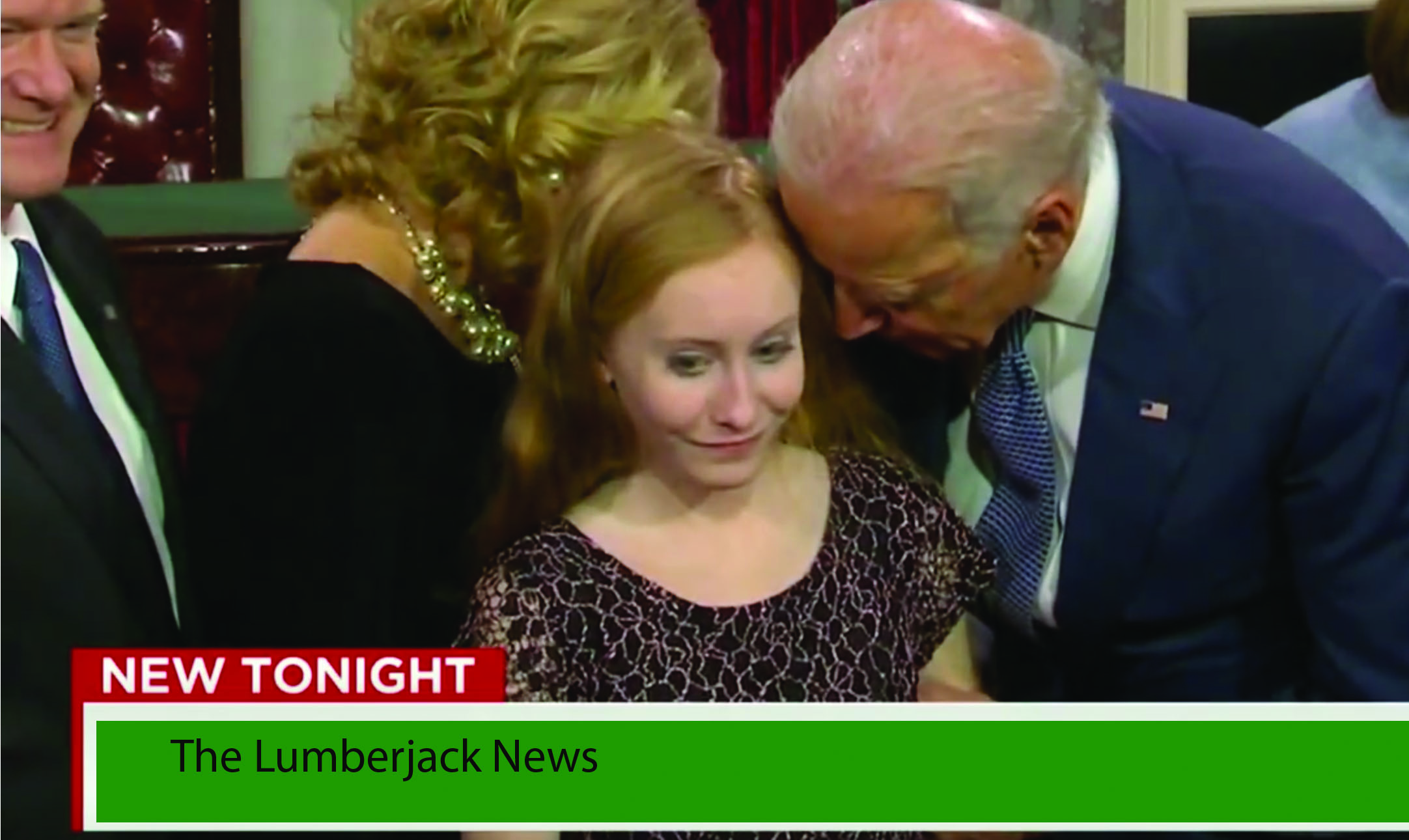
    Joe Biden is being a creepy old white man, and he needs to stop

    There’s something we need to talk about…Joe Biden being a creepy old white man. Some old men are for some reason allowed to be handsy or touchy with women and little kids and they get away with it. Is this okay?

    This is something that we definitely need to talk about. Growing up we are around elderly people of different genders and races. But, it’s sad to say that some elderly men have exhibited inappropriate behavior in the past, present and may do so in the future.

    We as editors stand with those who have experienced uncomfortable touching of the shoulders or inappropriate conversation from old men and women. However, being as they are elderly and they are supposed to have the respect of the community, it is a struggle when dealing with whether or not one should share how they feel about the situation.

    Now with the whole Joe Biden situation we have to decide whether or not we believe that his actions are appropriate. We have to look at the context of the situation. If there was a family event, then it may be okay for hugs and maybe kisses on the cheek. However, if you are at a professional or political event then you should probably stick to handshakes.

    In some videos posted on YouTube Joe Biden is seen taking pictures with senators and their families. When the families would pose to take pictures with Biden, he would specifically ask for the young girls in the family to come and stand next to him in the photo.

    While they were getting ready for the photo Biden is seen time and time again touching their hair and sometimes he is seen whispering something in their ear. It is clear that these little girls in the video are uncomfortable.

    In another video while somebody is giving a speech Joe Biden is standing behind the man’s wife with his hands on her shoulders and whispering something in her ear. Once again inappropriate… Not to mention, when the husband turns around to acknowledge his wife in the speech, Biden quickly puts his hands behind his back and steps away as if he knows that he is overstepping his boundaries.

    Whether or not these situations were all intentional or not, there needs to be a standard for situations like these. On behalf of The Lumberjack’s Editorial Staff, we believe that personal space is important and should be respected. If you ever find yourself questioning whether or not something is appropriate just play it safe! Be professional and respect their space.

  • EDITORIAL: Expand those taste buds

    EDITORIAL: Expand those taste buds

    The LJ editorial board encourages everyone to try alternative foods (at least once)

    When it comes to our diet as college students, we tend to stick with the same routine. Either cooking some ramen noodles, or grabbing a bite to eat at the various food courts or restaurants around HSU. Sometimes we don’t have the time to cook for ourselves but that shouldn’t hinder our chances of trying something new every once in a while.

    Let’s talk about cockroach milk. Cockroaches are without a doubt to some people disgusting and a pest to have running around at home or in public. A trend that has been going on recently is cockroach milk. The milk itself comes from the gut of one cockroach species, and is actually produced in crystalline form.

    While it may come in small amounts, scientists at the Institute for Stem Cell Biology and Regenerative Medicine in Bangalore, India discovered that cockroach milk is very nutritious and has three times the calories of buffalo milk. However, it should be noted that more studies on cockroach milk need to be done before it’s deemed safe for consumption.

    Cockroach milk is not the first insect food involving dairy. Casu marzu is a well known meal in Italy and France, consisting of a block of pecorino cheese that is left outside so Cheese Flies (Piophila Casei) can lay eggs inside the cheese. The cheese is then eaten with the larva inside. People who’ve eaten it have described the taste as a strong Gorgonzola.

    While it’s considered a delicacy in parts of Europe, Casu marzu is considered a dangerous food to eat, and illegal to produce. According to All Things Interesting, it’s important correctly chew and kill the maggots before swallowing.

    “Otherwise, they can live in the body and rip holes through the intestines. No biggie. But kind of a biggie.”

    If you are interested in eating insects safely, grasshoppers are considered to be rich in protein. Coming in a variety of flavors and varieties from chocolate-covered grasshoppers to toasted grasshoppers with salt and lime.

    In Thailand, it’s very common to walk through a market and find vendors selling stir-fried insects, ranging from giant water bugs to Bamboo worms.

    So if you’re a picky eater, try something new. Just be informed on what you eat, and be sure to chew hard if what you’re eating is still alive.

  • EDITORIAL: Education can be bought

    EDITORIAL: Education can be bought

    They say you can’t buy happiness, but it seems you can buy a college education

    On March 12, wealthy families were found to have paid thousands of dollars for their children to attend prestigious colleges. This includes the University of Southern California, Harvard University, Yale University, Stanford University and many more. This was revealed after U.S. federal prosecutors found that the college admission recruiters and coaches were taking bribes since 2011. Those who are involved in the scandal include Felicity Huffman, Lori Loughlin, Mossimo Giannulli and various CEOs.

    For some this comes as no surprise that this was uncovered. The old adage of ‘happiness can’t be bought’ is a true statement. Sure, money can make life convenient, but it doesn’t necessarily solve all our issues in life. However, an education can be easily bought if you have enough capital for a degree.

    This is not an uncommon occurrence. In 2013 Buzzfeed published an article by a college recruiter that details their experience of parents bribing recruiters. Even this year in January, an assistant coach from Oklahoma State University was found guilty for taking bribes since 2017.

    Some of the methods used by wealthy families are totally legal. The New York Times highlighted the use of college consultants, where families can pay as high as $1.5 million directly to college consultant companies in order to have their kids steered to certain prestigious colleges from as far back as the start of their eighth grade education. There is even something known as ‘legacy admissions’ where alumni of certain schools like Harvard or Columbia are likely to accept their alumni’s kids to their respective university. Harvard University is known to practice legacy admission, even going so far as to defend the practice.

    Anthony Abraham Jack, an alumni and professor from Harvard University wrote a book called The Privilege of Poor. It focuses on impoverished students who attend prestigious colleges and how they still struggle in private colleges from policies that impact them negatively. Jack also discovered how little the racial diversity was in Harvard, even asking himself when he was there, “Am I the only poor black person here?”

    It’s unfair for disadvantaged students who work hard to attend prestigious colleges only to not be accepted because of their financial status. For these colleges it’s not about how good you were in school, but how deep pocketed your families are.

  • EDITORIAL: Badass womxn exist

    EDITORIAL: Badass womxn exist

    Represent the badass women in history

    It’s Women’s History Month and we want to talk about something that has been bothering us in the Lumberjack Newsroom: the lack of badass female representation in media.

    When there are badass female characters in a film or tv show, they’re usually relegated to the side for a male lead. Even when it comes to video game box art, you have publishers being pressured to not have a female on the front cover.

    With a surge of films and tv shows with female leads like “Wonder Woman” (2017), “Jessica Jones” and “Glow” we’re slowly getting more badass female representation. We would like to highlight some women in history that fall under this title.

    In 1941, Lyudmila Pavlichenko was 24 when she joined Russia’s Red Army to fight the Nazis. She joined the Red Army’s 25th rifle division as one of 2,000 female snipers. She rose to the rank of lieutenant in her division and killed 309 people, most of them Nazis.

    In June 1942 Pavlichenko met with President Roosevelt and First Lady Eleanor Roosevelt in an effort to convince the U.S. to support the European front of WWII. Pavlichenko and Eleanor Roosevelt got along well and developed a friendship with one another. When Reporters spoke with her, many of them criticized Pavlichenko for not looking ‘pretty enough.’ She was quoted as saying, “I wear my uniform with honor, it has the Order of Lenin on it. It has been covered with blood in battle.”

    In ’60s and ’70s Japan there was a gang known as the Sukeban girl gang that grew popular among high school girls. They were known to wear longer skirts and/or pants as a protest against the sexualization of young teens, and to give the middle finger to the traditional shorter skirts that girls were required to wear.

    They functioned similarly to the Yakuza gangs at the time with a strict code of honor, but focused on petty crimes like shoplifting and beating people up. Because of their popularity more films were made with a focus on all-female gangs like “Girl Boss Guerilla” and “The Pinky Violence.”

    When the Black Panther Party grew in Oakland in the 1960s, many young African Americans joined the group. One of them was 18-year-old Fredrika Newton. Newton disagreed with the image of how society portrayed the Black Panther Party as young African Americans carrying guns. Newton saw them as a group that helped African American communities by feeding them and getting them involved in local government.

    Newton married Huey Newton, co-founder of the Black Panther Party, and founded the Huey P. Newton Foundation after his death. The foundation serves to carry on the Black Panther Party’s efforts in helping predominantly black communities while archiving the history of the Black Panther Party.

    This is just a small selection of badass women in history. There are many more out there who’re ultimate badasses. Maybe there’s even a badass woman in your life who doesn’t have as much recognition.

    Whether it’s your mom who took you to your first football game, or a friend who gave you the best advice to make you feel better, give the woman in your life thanks for being a badass.

  • EDITORIAL: Our code of ethics

    EDITORIAL: Our code of ethics

    Students serving the Humboldt State campus and community since 1929

    The Journalism Code of Ethics is what every journalist follows, whether they are a writer from a multi-media conglomerate or a student run newspaper. We of the Lumberjack newspaper hold these code of ethics to heart, as it helps us navigate the world of becoming a journalist and presenting our stories to readers or viewers.

    One of the most vital rules we follow is to never show our work to the sources. We strive to make our stories as accurate as possible, and when we are asked by sources to preview a story before it’s publish, it will most likely not happen. We follow this rule because it takes away the independence of a journalist from gathering, writing and editing their story. If we were to share the story it would no longer belong to the writer, it instead implies that it belongs to the source. Our job as journalists is to seek the truth to a story and report it. Allowing someone to preview the story takes that away from us.

    Previewing a story for a source also sets a precedent of having to allow every source in the Lumberjack newspaper to preview a story. Hypothetically speaking, say we allow a story to be previewed by source. But because a minimum amount of sources for a story is three, that means having to allow those sources to preview the story as well. Not only that, but other stories have to follow the same thing as well. It not only takes away the story from the writer, but it takes time needed for the news to be published.

    The only time a journalist is allowed to share what they wrote for a story, is if they are talking about something complex like quantum physics. In this case, an expert can be consulted for accuracy.

    We understand the concern of a source wanting to preview a story is for accuracy purposes, but it’s up to us as journalists to be accurate in our story. If more clarity is needed in a story, the journalists will most likely ask for it.

    Student journalism can be an unpaid profession. Some students have to juggle running the news, while also attending classes. We have a rare luxury of making mistakes in the Lumberjack, but we learn from them.

    Mistakes are bound to be made. When we make mistakes, we answer questions of accuracy and make necessary correction as soon as possible. For us it’s a learning experience to run the Lumberjack. We are held to a high standard for delivering an accurate and fair story to our readers, so much so that we’ve won awards for our excellence. We pride ourselves in delivering stories for our readers.

  • EDITORIAL: A chance to highlight pivotal African Americans

    EDITORIAL: A chance to highlight pivotal African Americans

    Don’t let Jussie Smollet’s actions ruin what Black History Month can accomplish

    Jussie Smollett is an American actor on the popular tv show “Empire” who staged a racially and homophobic attack on himself to boost his career. Smollett alleged attack has mountains of evidence that it was staged.

    The case has left Smollett’s fans and colleagues stunned. This scandal comes out on the tail end of Black History Month, which hurts more. We should not leave Black History Month on a bad note, so we want to highlight some black individuals who left their mark in history.

    Claudette Colvin was a teen in 1955 living in Montgomery, Alabama as an African American. While inside a bus, she refused to move from her seat for a white passenger, saying that it was a violation of her constitutional rights. She was arrested for the action and labeled a troublemaker by her community, leading her to drop out of school. Despite Colvin’s actions preceding Rosa Parks by nine months, little is known about what she did. She went on to be part of one of the four plaintiffs in Browder v. Gayle, where Montgomery’s segregation laws were found to be unconstitutional.

    Henrietta Lacks was an African American woman who passed away due to cervical cancer. Her cells were collected, and in a rare case they doubled every 24 hours. The aptly named HeLa cells are now used to study the effects of radiation and poisons without using human subjects, and were used for the development of the polio virus. Although there is controversy in the use of the HeLa cells, as Lacks’ family never received any recognition or compensation for the discovery. Despite this, the HeLa cells were pivotal in their medical uses.

    Bessie Coleman was the first African American woman to stage a public flight in America. Coleman lived in Atlanta, Texas in 1892 until moving to Chicago at age 23. She wanted to explore aviation, but due to being black and a woman she faced racial and gender discrimination. Despite challenges, she broke through those barriers and received her pilot’s license after moving to France. She had a dream of starting an African American flight school in the US, but tragically died during an aerial flight rehearsal at the age of 34. Coleman was a pioneer for other African Americans who aspired to become a pilot, and was inducted in the National Aviation Hall of Fame in 2006.

    The Harlem Hellfighters were the 369th Infantry Regiment and mainly consisted of African Americans. The Harlem Hellfighters fought in the trenches of Germany during World War I for six months, the longest any American infantry regiment fought during World War I. Two of their bravest soldiers were privates Henry Johnson and Needham Roberts, who fought off 24 German soldiers killing four during a surprise attack. Both Johnson and Roberts were awarded the French Croix de Guerre and were the first Americans ever to receive the award. This is one of many awards that the Harlem Hellfighters received.

    We wanted to move away from the negativity that came from this year’s Black History Month. Instead we want to highlight these African American individuals that had a pivotal role in shaping history and inspiring others.