The Lumberjack


Students Serving The Cal Poly Humboldt Campus and Community Since 1929

Tag: Arcata

  • Homemade cupcakes too good to eat

    Homemade cupcakes too good to eat

    by Maranda Vargas

    Cal Poly Humboldt Biology Major Amelia Francis uses frosting and food coloring as an artist uses pigments, paints and glazes to create works of art. Her love of science and art has transformed into a home-based business selling delicious, mouth-watering cupcakes. Every cupcake is skillfully frosted to create a near-accurate representation of a flower. The artistic details offer far more than just a beautiful cupcake adorned with a frosting flower. The cupcakes and cakes at Barn Owl Bakery are delicious and that is not by chance, every recipe has been diligently planned and taste-tested to create a delectable treat. 

    Barn Owl Bakery is an approved California Cottage Food Operation, which means it sells home-made food prepared outside of an industrial kitchen. The California Homemade Food Act (AB 1616) allows for home-based culinary businesses to sell certain non-perishable homemade food products, so long as they register with the county, follow the approved Cottage Food Operations application process and are in line with procedures. 

    “I looked at all of the different rules that followed a cottage food operation and went: could I make that work? Yes. Could I make this work? Yes. Could I pay that much for permitting? Yes,” said Francis. “The more I mentally said ‘yes’ to the different aspects, the more I committed to doing it.”

    The idea of creating a home-based business appealed to Francis for many reasons, a couple being that it offered the freedom to work for herself and have quality control over the product, while still allowing less financial risk than having a brick-and-mortar restaurant. Francis was finishing up her associate degree when she began the application process and testing recipes last fall. Barn Owl Bakery has been open for business, busting out delectable cupcakes and cakes since it was licensed as a Cottage Food Operation in May 2023. 

    “It’s very risky to be a business owner,” said Francis. “I did it as a Cottage Food Operation intentionally because you don’t have to pay for rent and utilities, all that stuff. It’s a lower risk, but it’s still risky.”

    The Cottage Food Operation application process requires each recipe to be carefully written out with all the ingredients listed along with their precise weight. Next, the labels and information are mailed to the Department of Health to check and approve for licensing. Francis says the paperwork was fast; it was the process of creating the recipes and labels that required the most time. Once all the labels were submitted, they were approved quickly, and Barn Owl Bakery was open for business. She’s created recipes for products beyond cakes and frosting that she submitted for approval, but customer demands have kept her focused-on baking floral cupcakes and cakes.

    “I thought that at most, I would sell like a dozen cupcakes every month or so,” said Francis. “I didn’t anticipate finding a niche in our community. I would rather bake myself than buy something that wasn’t as good as homemade! I had the thought, maybe there are other people in the community who like their baked goods to taste how I like them too.”

    Francis has got the baking down to a science. Francis says the Food Network show “America’s Test Kitchen” was influential to her success as a baker. The educational cooking show explains the chemistry processes behind baking. She accredits having an understanding of the sciences to successfully adapting her recipes without wasting ingredients.

    “I’d say understanding the science behind the ‘why’ in baking is vital if you are going to sell baked goods, because problems arise that you need to troubleshoot all the time,” said Francis. 

    Francis practiced diligently on frosting cupcakes as well as thoughtfully creating flavors for her recipes before opening for business. Of all the recipes she perfected, Francis says perfecting a frosting recipe that will please a wide range of tastes was the most challenging. A mixture of chemistry and personal creativity, Francis homed in on what makes a perfect cupcake with perfect icing on top. 

    “My favorite part is mixing in wet ingredients and seeing them all come together in one homogenous mixture, which sounds weird, but it’s very satisfying,” said Francis. “Yeah, it all becomes smooth with the correct temperature, and I know that it’s all on the right track and going to be perfect.”

    Balancing the demands of running Barn Owl Bakery and being a full-time student takes structure and determination.  Education has always been a top priority and focus for Amelia. That is one of the reasons why she embraced the idea of a Cottage Food Operation over a full-time business that would require her to take time away from school. 

    Before starting Barn Owl Bakery, baking was an outlet for creativity and a way to relieve stress. Francis had always felt a calling towards science and art. The flowers that adorn the cakes are little works of art themselves. Before baking as a creative outlet, Francis had taken several ceramics classes as well as a color and design class. Customers are spreading the word about her cakes and orders are filling up.

       “I like to do all kinds of art,” said Francis. “If I feel stressed, I usually turn to baking. Baking has been my creative outlet to release stress, but now it’s also my work.”   

     Barn Owl Bakery has now taken on wedding cake orders and is booked out until the New Year. Perhaps the last chance this year to try some of Barn Owl Bakery’s delectable desserts will be on Saturday, Oct. 21, at the Harvest Artisan Faire held at the Eureka Veterans Hall. Barn Owl Bakery will have a table set up selling cupcakes, as well as several other treats that she hopes to offer in the future. There will be cake pops and cake slices, cocoa bombs and free samples at the event. New cake flavors such as vanilla latte and angostura orange will also be available. Appetizing flavors and nuances, as well as every visual detail has been artfully thought of in creating each treat that Barn Owl Bakery offers.

    “It’s been amazing, and I’m so thankful for everyone that has supported me so far,” said Francis. “I love this community so much.” 
  • Skate park opens after 23 years of activism

    by Brad Butterfield

    Buttery coping, tight transitions, steep mini-bowl, rad manny pad – they may sound like code names for undercover pornstars, but they are in fact fitting descriptions of a project 23 years in the making. An impressive 5,000 square foot concrete wonderland of ramps, rails and ledges, now stands at 1621 Gwin Road in Mckinleyville thanks to the dedicated efforts of a handful of Humboldt county residents – and there is much more to come.

    The Mckinleyville skatepark’s initial spark came in 2000, when Humboldt resident Pat Hanson’s grandsons had the police hassle them for skating in a Safeway parking lot. 

    “My grandma got really upset because she was like, ‘where were they supposed to skate?,’” said Ciara Torres, Pat Hanson’s granddaughter. “That kind of inspired her to get a skatepark going for her grandsons.” 

    Those police ignited what would become a decades-long effort for a local skatepark that began with home baked treats.

    “She started hosting fundraising out of her house with baked cookies and we started selling shirts and stickers at local events like Pony Express, and even the kinetic sculpture race,” said Torres, who used to help her grandma in fundraising for the skatepark. 

    In 2011, Hanson passed on, but the cause that she spearheaded had gained traction and blossomed into a full-fledged community initiative. If all goes as planned, another 15,000 square feet of concrete will be poured next summer. On Oct. 7, the celebration was squarely focused on enjoying the immense achievement that was getting the first 25% of the park built, thanks to the dogged efforts of many locals who pushed through roadblocks for decades. 

    “This is huge because people in the community have been trying to get this statepark built for over 20 years,” said Lesley Frisbee Parks & Recreation Director for the Mckinleyville Community Services District (MCSD). “I’ve worked in the district and the Parks and Rec Department for 20 years, so I’ve been aware of this project for a long time.” 

    Among the many involved, and first to take the mic during the long-awaited ribbon cutting, was Charlie Caldwell, a lifelong skateboarder and director of the Humboldt Skatepark Collective. Caldwell spoke candidly about the multi-pronged effort to raise funds for the skatepark.

    “We got a quarter of our skatepark built with the money that’s all been reissued community grants,” Caldwell said. “Community grants, community fundraising, like we’re doing over there at the table right now. It’s about years of selling shirts and being out in the public and trying to raise funds.” 

    The price tag to build the planned 15,000 square foot addition to the skatepark is pegged around $1 million. Just as with the first 5,000 square feet of concrete, the completion date for the addition is dependent upon funding. Currently, the collective is hoping a grant will be awarded and the addition will be complete late next year. 

    “I have written [to] three different grants and we’re waiting to hear if the latest grant application gets awarded to complete the project, so it’s a really big deal,” said Frisbee. “It’s very exciting to have opportunities to create in our community.” 

    In the event that the grant is not awarded, fundraising will return to the grassroots precedent that Hanson started 23 years ago.

    “We’ll be doing events like this on a regular basis if we don’t get the state grant,”  said Caldwell. “You’ll see us out here probably every month all summer long doing fundraisers.”

    The difficulty in raising funds for the skatepark essentially forced the collective’s hand. Decades of fundraising meant the collective had about $200,000 in the bank. A substantial chunk of change, but not enough to complete the planned 20,000 square foot skatepark in one go. 

    “One of the things that we decided to do is figure out what we could do with the money we already had,” said Torres. “And we decided that doing it in phases would be the best approach because the community had really lost faith in supporting us and donating money because they hadn’t seen anything in 20 years. This is basically our way of showing the community that we are doing something and we need to continue to raise money for the rest of the park.” 

    If the state grant is awarded, building will commence next summer. No matter the timeline for the addition, Saturday, Oct. 7, was reserved for enjoyment of the long awaited concrete, an emotional achievement for those most closely involved. 

    “It’s definitely emotional for me because my grandmother was my best friend,” Torres said. “It’s very emotional for me to feel like this is actually real. It’s almost hard for me to even think about, because I just get too emotional.”

    The skatepark, having been made possible through donations small and big, grants and volunteers, needed to provide a tangible service to the community at large – a fact not lost on Frisbee.

    “We are in service to this community. So we have to be really responsible for how we spend the money that people give us through tax dollars,” said Frisbee. “Not just funding for these projects to be developed, but also being mindful of what it’s going to cost us to maintain perpetuity.”

    One of the many benefits to a skatepark is the eclectic and uncategorizable cast of characters it draws in. It provides a safe space for creation, growth, and adrenaline.

     “We want our community to be a place that everyone feels welcome, that businesses can thrive in. Something like a skate park brings people to the area,” said Jesse Miles, executive director for the Mckinleyville Chamber of Commerce.

    Where some activities and sports attract a narrow segment of the population, skateboarding, by its very nature, tends to attract just about every type of person at all stages of life.

    “You see all ages, and I mean all ages – guys in their 60s, like me, out here skating with little kids on their scooters. There’s skateboards, there’s bikes, there’s rollerblades or quad skates… they are all out here riding,” said Caldwell.

    Importantly, for Mckinelyville, the skatepark will be a springboard for the local economy.

    “While they’re here, they’re going to our businesses, they’re going to our restaurants, getting coffee,” said Miles. “And for the residents, it just makes it more of a reason to want to stay here because there’s opportunities for all ages.” 

    In addition to boosting the economy, providing an enriching environment for kids, adults, and seniors alike, the word on the street is that the skatepark park may also have anti-aging qualities. 

    “It keeps us young. You know, I will always be young at heart.” said Caldwell, who has been skating for over 50 years.

    The ribbon ceremony occurred at 11 am, then, the day’s festivities kicked into gear. In addition to live music, beer on tap, and food trucks, there were several contests being held throughout the afternoon. Quad-blader Noelani Araujo praised the inclusion of a quad-skate contest alongside the many skateboarding contest categories. 

    “We love this skatepark and I love the community and I think it’s nice for us all to be a part – like one with each other,”  said Araujo. “I think it’s really cool that we’re included. We’re not usually super on the front lines for this, so it’s really nice to be included.”

    In an effort to build a skatepark that the community would be proud of, the planners spoke with local skaters and canvassed local DIY parks to ensure that the money was spent wisely. These efforts did not go unnoticed by the skating community.

    “This is like a southern California park. This is a professional park. The concrete is nice and slippery, the transition is super proper, the coping is really mellow. I think everything is built really well,” said Cal Poly Humboldt student and dank skateboarder Jaikyn Russell.

    Perhaps most critically, not only was the skatepark well-built, it has also been well waxed, as confirmed by Araujo.

    “The coping is so buttery,” said Araujo.

  • Weeding out the OG’s

    by Monica Robinson

    Authentic champagne is created in France, highly acclaimed wine comes from Napa and Humboldt County stands as the central hub for premium cannabis. 

    Measure A, also known as the Humboldt Cannabis Reform Initiative (HCRI), is a voter initiative scheduled to appear on the March 5, 2024 ballot in Humboldt County. If approved by voters, this measure would introduce 38 pages of new rules and restrictions to all existing cannabis farmers operating legally in Humboldt.

    Origins of HCRI

    The HCRI spawned from a conflict between Kneeland residents and a neighboring cannabis farm concerning water resources and traffic. Mark Thurmond and Cal Poly Professor Emerita Betsy Watson took charge as proponents, collaborating with people in other areas of the county. 

    A petition circulated, highlighting the protection of the environment and small cannabis farmers, along with preventing large scale cannabis farms. After reaching 7,000 signatures, the measure qualified for the ballot. 

    Notably, the 38-page initiative was drafted by a San Francisco law firm, Shute Mihaly & Weinberger, which was submitted on March 4, 2022, and did not undergo public review or receive public input. If passed, Measure A cannot be altered or amended from its original form, requiring a ballot initiative for the next elections. 

    Current legislation

    Due to the impact of changing market dynamics and statewide legalization of cannabis, Humboldt County revamped its legal framework. The Humboldt Board of Supervisors (BOS) enacted two land use ordinances, starting with the Commercial Medical Marijuana Land Use Ordinance in 2016 and the Commercial Cannabis Land Use Ordinance in 2018. 

    Both followed public scrutiny with many stakeholders including cannabis cultivators, environmental groups, neighborhood organizations, as well as county and state officials for implementation. Further refinements were made in 2020 to enhance the framework’s efficacy. 

    “These changes have successfully reduced the overall environmental footprint of the industry and strategically relocated many [cannabis] farms to agricultural land,” said Executive Director of the Humboldt County Growers Alliance (HCGA), Natalynne Delapp. 

    Delapp explained how the county has experienced an 89% decline in cannabis farms since 2015, decreasing from 15,000 illegal grows to 775 legal permitted farms, with an estimated 1,000 illegally still operating.To obtain cultivation permits, applicants must display the serviceability of their farms’ access roads, reduce neighborhood impacts and ensure water sourcing methods are environmentally sustainable. 

    At a BOS meeting on June 27, 2023, the Director of Planning, John Ford, explained the agencies subject to review include the county Department of Public Works, Department of Environmental Health, along with state and federal agencies owning public land, California Department of Fish and Wildlife, Regional Water Quality Control Board and often surrounding tribes.

    Foggy fine print

    The initiative would modify the county’s General Plan, which serves as the primary guide for land use planning in Humboldt. Delapp said this revision would replace a significant portion of the existing county cannabis regulations, which took eight years of robust public process.

    The initiative is “unworkable and would be devastating to the [local] cannabis industry,” said Attorney Paul Hagen from the North Coast Environmental Law Office.

    A restriction of one active permit per cultivator could leave additional permits for activities void. 

    “If Measure A passes, the seed of [Humboldt] cannabis tourism will die before it has a chance to root,” said Founder of Humboldt Cannabis Tours, Matt Kurth. 

    Annual expiration of cultivation permits would make reapplication necessary. The vagueness of the renewal process creates ambiguity regarding public hearings for renewal applications. Ford explains in the Amended Analysis that conducting public hearings annually for permit renewals is inconceivable. Furthermore, renewal on any outstanding complaints would be prohibited regardless of validation. 

      The HCRI broadly defines expansion as “any increase in the number or size of structures connected to cultivation,” including environmental improvements. In relation, farms must be located on two-lane paved roads, challenging the hundreds of farms currently operating on dirt roads. According to a technical memorandum provided by LACO Technologies engineering department for the county in 2020, upgrades would range from $170,000 to $280,000 per mile.

    Cultivation of cannabis includes drying, curing, grading and trimming, requiring a ‘processing’ license which would also be prohibited. 

    Additionally, farms would be capped at 10,000 square feet, including a discretionary review for  any expansion over 3,000 square feet. 

    Out of sight, out of mind

    In an effort to explain why class II whitewater rapids rivers are being de-watered, Watson provided a map of permitted cannabis farms. She said there were 1200 active cannabis permits with an estimated 300 non-operational due to the overproduction of cannabis statewide from price drops. 

    “In 2022, the south fork of the Eel [river] ran dry, and Freshwater Creek did not have enough water for the park to have its annual swimming hole,”said Watson.“The ordinance in place now calls for 2400 more [permits], for a total of 3600.” 

    Watson added that the initiative would cap the number of permits at 1200. 

    According to the HCRI Amended Analysis by the Humboldt County Planning and Building Department on June 27, 2023, there are 1,027 active permits, with 210 of them being newly approved. Areas with prime agricultural land are concentrated with retirement, remediation and relocation permits, which were redirected from environmentally sensitive areas.

    “This is prohibition masquerading as environmentalism,” Delapp said. 

    A controversial summary, due to letters filed back and forth between HCRI’s attorney and the county’s Planning Department of the HCRI analysis, refers to geological studies, stating “the initiative’s groundwater protection measures are unnecessary because average per-acre groundwater recharge in Humboldt County is high, even during drought years.”  

    Currently, there are no environmental groups in the county endorsing the initiative or taking sides. 

    “The current ordinance is the best in the country, maybe even the world,” a confidential source from a local environmental group said.

    Lawsuit

    As of  Oct. 11, 2023, the HCGA and seven cannabis farmers filed a lawsuit at the Humboldt County Court, alleging the petition of the HCRI did not include the complete initiative text, as required by law. It also contests false and misleading information in the petition. As a result, the lawsuit seeks the removal of the initiative from the ballot to protect the integrity of the election process.

    If you are not a registered voter and want to participate, go to http://registertovote.ca.gov. The last day to register is Oct. 23, 2023.

  • Green and gold goes pink

    Green and gold goes pink

    by Vanessa Saltos

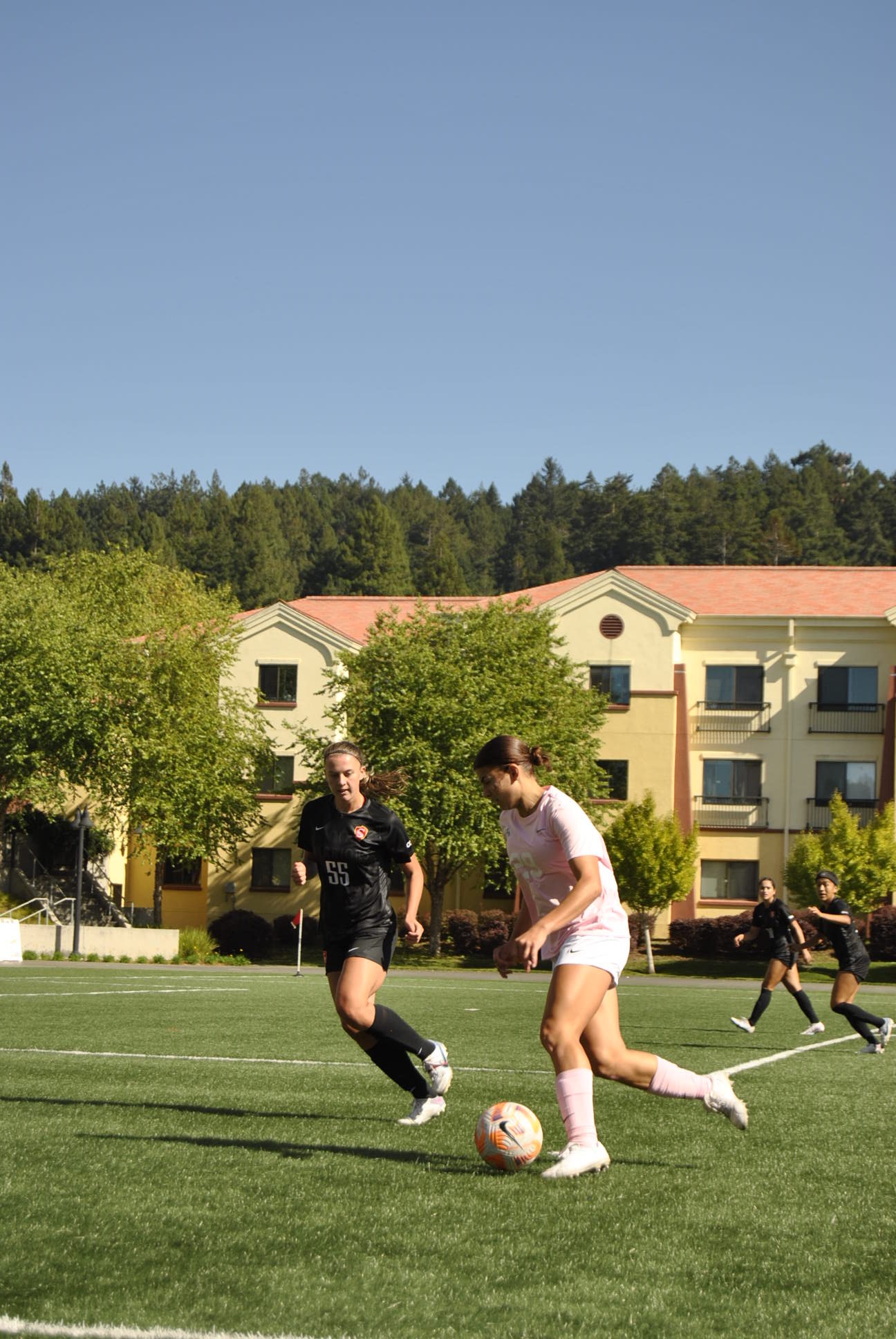
    On Oct. 12 women’s soccer had their annual Pink Out game at College Creek Field where they played against Stanislaus State. October is Breast Cancer Awareness month, and to honor this the Lumberjacks wore pink jerseys sponsored by the Heather Janikowski Foundation. This foundation was started by women’s soccer player Megan Janikowski and her family to honor her mother Heather Janikowski after she passed away from her hard fought battle with cancer. 

    When Megan Janikowski was 10 years old her mother Heather Janikowski was diagnosed with breast cancer in 2012. Heather Janikowski would move to remission around 2013-2014 but later would find that the cancer spread to her brain in 2018. Sadly in 2021 it spread to her entire body and she passed away Jan. 19, 2022. 

    During her lifespan Heather Janikowski was a mother, physical therapist, P.E. teacher, and preschool teacher. 

    According to the foundation’s website, “Heather loved to support the local farmers markets and small shops as well as advocating for children and animals through a variety of non profit organizations and events.” Megan Janikowski didn’t want her mother to be another name that cancer took so the foundation was born. 

    Photo by Kae Dennert. Breast Cancer awareness table set up outside of the Pinkout game.

    “My mom recently died from brain cancer and she had just been fighting it for a very long time and after she passed away I felt like she left too big of an impact in her community to just be another name that cancer took,” Janikowski said. “So I wanted to make something where she still had an impact and I could help families that were going through what I [had] already been through or [in] need [of] any kind of extra help.”

    Since starting this foundation, they’ve hosted events like a memorial hike, a 5K, and a bowling tournament. Megan Janikowski’s brother Dean Janikowski, a kicker for Washington State football, has also created a ‘pledge it’. A pledge it is when donors pledge a certain amount of money to be donated every time he makes a field goal or point after touchdown. With all these fundraising events they have already impacted lives as well. 

    “The first year we had a hike and the money there went towards a family who could not afford to pay for their daughters college tuition and it was kind of full circle because the girl that we picked she was actually one of my mom’s preschool students, so it was like full circle,” Janikowski said. 

    In January they hosted a 5 and they were able to help a 9-year-old boy named Mateo Yanez who was diagnosed with cancer. His family vehicle and washing machine had broken down. He wasn’t able to get to his doctors appointments and have basic needs but with the help of the Heather Janikowski Foundation, Yanez was able to go to more of his appointments and was accepted into a research development program for his own cancer. Yanez sadly passed away three days after his tenth birthday. 

    Loss is a very real reality when it comes to cancer and Megan Janikowski attributes her strong faith to the reason behind her being here today. What keeps her motivated on the field is her motto “do it for her”; her mother is now her reason why. Megan Janikowski takes her mom on the field with her by wrapping tape on her left wrist and writing “do it for her” on the front and “mom” on the inside. She also has “do it for her” on the tops of her cleats and “fly high” on the back.  

    “On the tops of both my cleats it says ‘do it for her’ and then on the back it says ‘fly high’ because I just think having that constant reminder that life is short and life is fragile, it helps me to appreciate the good and especially the bad times,” Janikowski said.  

    Having visual reminders is something that is needed and third year biology student Jonathan Sweeney appreciates the team for hosting an event like this. 

    “It’s important to have games like this so we can see something visual like the pink jerseys and have a conversation about it…I like that our teams are bringing awareness to stories like mine,” Sweeney said. 

    Sweeney lost his grandmother to lung cancer and has also had family members diagnosed with skin cancer. Third year business administration major Harry Singh has also lost a family member to lung cancer. His older cousin was just 10 years old when he passed away and it was hard for Singh to accept. Singh, being a student-athlete on the track and field team, understands the importance of bringing topics like this into the sports world. 

    “I think it is important that we bring up these topics to games because they allow us to compete for something bigger,” Singh said. 

    The proceeds from this game will be set aside for the women’s soccer team to choose who they want the money from the Heather Janikowski foundation to go to locally. Megan Janikowski is currently double majoring in biology and special education and wants to pursue a masters in the research and development of brain cancer. 

    “I just want to help as many families as I can and my master’s program will be in the research and development of brain cancer so I’m hoping I can aid in something research wise or anything to make an advancement to help find a cure,” Janikowski said.

    Graphic by Vanessa Saltos.
  • Students find financial freedom in vanlife

    Students find financial freedom in vanlife

    by Jillian Wells

    Amidst housing shortages and the increasing cost of everyday living in recent years, students are looking to an alternative way of living: vanlife. The term “vanlife” means exactly like what it sounds like, living in a van, but the term encompasses various mobile living options such as trailers, campers, motorhomes and RVs. 

    For students seeking a more affordable lifestyle, vanlife is a compelling solution. According to Maddy Montiel, a senior environmental science major with five years of vanlife experience, this choice has allowed them to avoid the cost of traditional housing. Ultimately, Montiel hopes to never pay rent through college. On-campus housing, depending on the type and meal plan, can range from $5,000 to $15,000 per year. In contrast, by parking their motorhome on campus (with a general parking pass) Montiel saves about $500 on gas per month and their monthly living expenses can be as low as $300 for essentials, making it a financially sensible choice. 

    “I’m choosing to do this instead of putting myself into an insane amount of debt in order to pay rent somewhere,” said Montiel. “I’ve always wanted to do it and can’t see myself living another way.”

    Similarly, student van-lifer Steven Childs, a senior wildlife major, explained that while it may not be his preferred lifestyle, it aligns with his financial priorities.

    “If you think about it, the whole point of me being here is to study and go to school and learn. At the end of the day, your room generally is a place for you to put your head and sleep,” said Childs.

    Students are also being drawn to vanlife because of the freedom and independence it offers. When living on wheels, the world becomes your front porch.

    “It’s definitely a pro to be able to wake up on the beach, and pretty much wherever you want to wake up”, said Bohdi Haugen, a freshman doing vanlife. 

    Haugen also added some of the advantages that come with owning a van, including that it really feels like your own; a feeling you may not necessarily have when you’re renting someone else’s space. Jaikyn Russel, a freshman studying forestry, who shares a van with Sierra Cole and their dog Indy, believes vanlife is a lot more doable than people think it is. Cole added that one of the draws of vanlife is being able to travel and always have your home with you. 

    Even with all of the benefits of vanlife, it doesn’t come without its challenges, notably not having a bathroom.

    “I’ve grown pretty familiar with public restrooms nowadays,” said Haugen.

    Montiel added that vanlife often gets glorified, and that there are some harsh realities that come along with it, including dealing with every aspect of your consumption because resources are limited. For instance, Montiel mentioned that they have to always have propane or else they won’t have a way to cook food, boil water or keep their appliances running. Montiel also noted the less-than-glamorous aspects of vanlife.

    “You have to deal with your own shit – literally in every regard, you have to deal with your own shit,” said Montiel.

    But despite this challenge, they believe it forces you to have a shift in mindset and become more sustainable. 

    Students embracing this lifestyle feel that there is a sense of community among vanlifers. Haugen has met many other like-minded people who are in the same situation as him. Montiel further elaborated that they and other vanlifers have formed close-knit bonds, organizing events such as cookouts and beach bonfires together. These connections provide a support system for those navigating the challenges of this lifestyle.

    While this lifestyle isn’t for everyone, it can be cost effective, rewarding, and freeing for those who do it. If you’re interested in embracing this lifestyle, Montiel noted that an alternative living club is underway. The club’s first meeting will be Friday, Oct. 27 at 3:30 p.m. in Library room 114. 

    “We’re hoping to use that to create a space for students who live like this and students who are interested in living like this, to come and talk about it and learn about it and advocate for more resources,” said Montiel.

  • New science major is absolutely fire

    New science major is absolutely fire

    By: Griffin Mancuso and Emma Wilson 

    Anti-fire policies and climate change have resulted in wildfires running widespread in Northern California. Forests are in need of experts who can understand the power of fire and its beneficial effects, and channel them into sustainable practices. Cal Poly Humboldt’s polytechnic transformation has resulted in a new addition to the Forestry, Fire and Rangeland Department to meet this need: applied fire science and management, B.S.

    The major explores multiple disciplines and perspectives of fire management, including local Indigenous knowledge and practices. Students will learn about prescribed burnings, how fire exclusion policies have impacted forests and how to use fire to promote biodiversity. 

    This major can lead to careers in fire ecology, fire departments, prescribed burning organizations and more. Students in fire science can also expect a plethora of summer jobs and internships to be available to them.

    However, students who are applied fire science majors do not qualify to take the Registered Professional Forester exam in the state of California. 

    Erin Kelly has been the department chair of Cal Poly Humboldt’s Forestry Fire and Range Land Management since the start of the 2023 fall semester. She emphasized the high demand for foresters and fire ecologists in California.

    “Employers are looking for natural resource managers, people who can apply their scientific knowledge to the ground and also people who can educate others about things like fire management,” Kelly said. “So, we are really in the position of meeting California’s needs in terms of land management, and I think that’s a really cool thing.”

    Fundamentals of Fuel and Fire and Fire Ecology existed prior to the new fire science major, but Fire Behavior and Effects and Fire Weather have been made into their own classes this semester. Additionally, an applied fire internship class will be available.

    Jeffery Kane is a faculty member in the forestry department and has been working as a professor at Cal Poly Humboldt for 12 years. He described the possible careers students can explore with the internship program.

    “Most folks will work for the Forest Service, either fighting fires or doing prescribed burning fuels management stuff, or some will work for CalFire,” Kane said. “Others have worked for nonprofit organizations that are involved with fuels management or prescribed burning…it’s basically, ‘Go out, get experience.’” 

    David Greene, a professor who has researched plant regeneration for several decades, teaches the fire ecology class. Students in fire science classes can expect to go on field trips that allow for hands-on learning and explore the different aspects of the field. Students in Applied Fire Use and Policy will have the opportunity to participate in prescribed burnings.

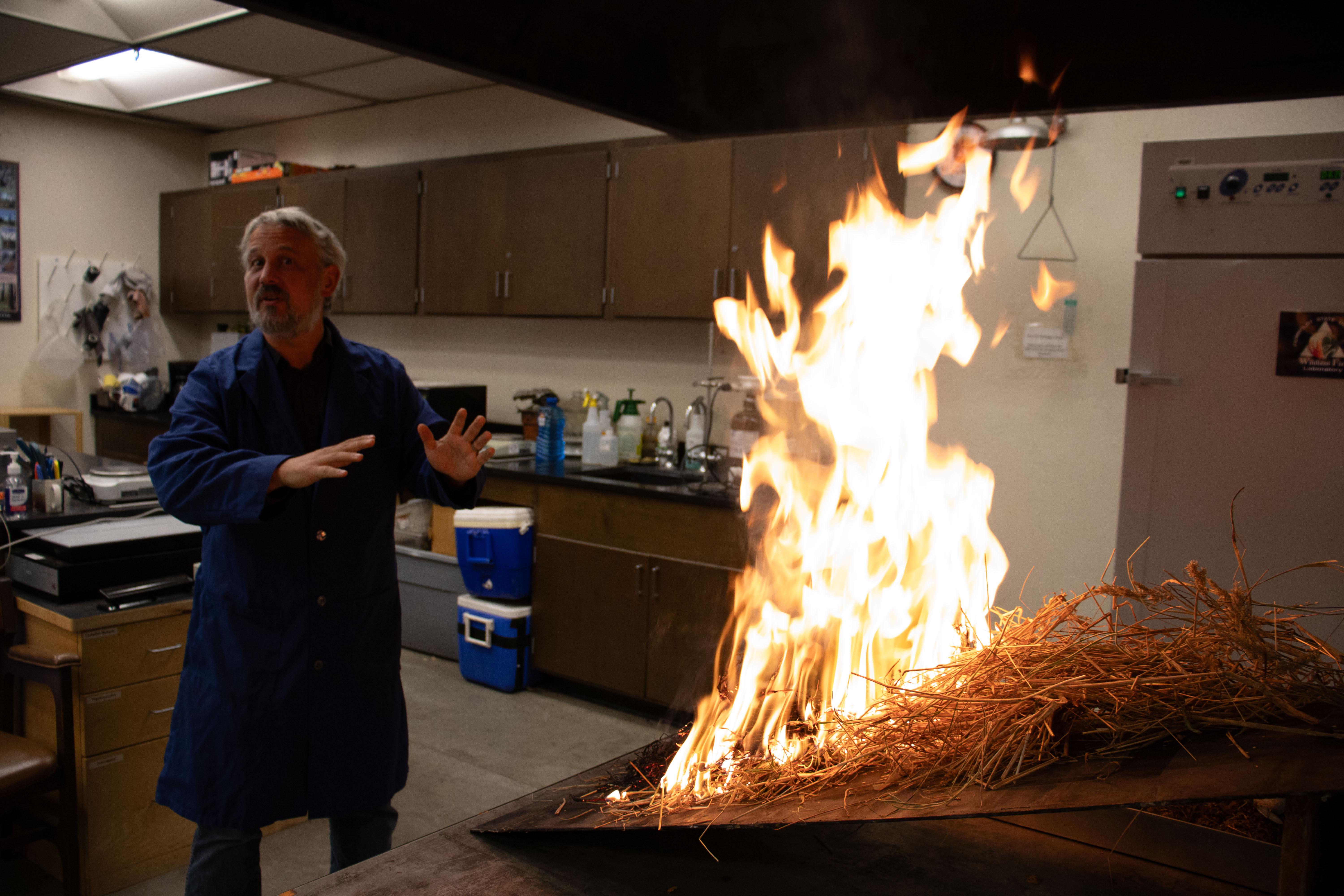
    Photo by Griffin Mancuso. David Greene describing an oak germinate’s ability to reach mineral soil beneath layers of leaves.

    “There’s lots of tribes around here that don’t have the capacity to run their own burn. Some like the Karuk and the Yurok can, but others like Bear River – they just don’t have anybody, so they’re often inviting us to go up and do one for them,” Greene said. “Jeff [Kane’s] happy to go do it because he wants the students to get as much training as possible, because California’s embarking on a prescribed burning campaign.”

    Mykie Root, a freshman and forestry major with a concentration in wildland fire management, has enjoyed the practical learning approach and field trips in their fire science courses, compared to reading textbooks in high school.

    “Coming out here and being able to go on these field trips and be able to actually, you know, get into the stuff and be hands on and actually be able to see the trees, you know, take the bark apart, be able to look at all of the rings individually and count them,” Root said. “It’s a lot easier to learn when you’re actually out in it than in a classroom, which is what I prefer. I don’t like being in a classroom. It makes me antsy.”

    Recently, students in Fire Ecology visited the 2022 Six Rivers Forest fire site to document conifer germinates and pine cones in the area that had appeared since the fire. Grayson Voorhees, a freshman majoring in forestry with a minor in fire ecology, took on the task of climbing a steep slope to gather data.

    “Initially we were trying to document the distance from the road to the first green tree to measure the density of the fire, like how far it spread uphill, and that was roughly 150 meters,” Voorhees said. “And that also spread along a transect line, and along the transect we were counting germinate gray pine species.”

    Faculty and students in applied fire science are hoping to destigmatize fire, promote sustainable fire management practices, and combat anti-fire sentiments and policies.

    Root explained how banning prescribed burns entirely allows for leaves to build up and ruin seed beds, resulting in deforestation.

    “When fires come through and actively get rid of all the bad, dead leaves and things that just pile and pile up, leaving for, you know, plants to be able to grow,” Root said. “The fires will come through, burn everything and there’ll be wonderful plant beds for seeds to just be able to pop up and come back. So, fires are really good for us. They’re actually, they’re really good for the forests, and we need them.”

  • Put your dog in sports

    Put your dog in sports

    by Griffin Mancuso

    When parents have an especially energetic child, they often put them in some kind of extracurricular to provide them with an outlet and give themselves an afternoon of peace. That child may take to a certain activity, like karate, swimming, baseball or chess. Dogs are pretty much the same.

    My beloved, hyper Oscar Meyer and I joined Humboldt Disc Dogs back in September after I discovered them on Facebook. My main concern was the stories I heard of dog sport groups being very exclusive and impatient with newcomers, but that was thankfully not the case. We were fully embraced and offered tips for frisbee throwing and game strategy, and Oscar had a blast.

    Little did I know, disc sports was just a gateway drug. We now participate in disc sports, Fast CAT, rally and are hoping to start barn-hunting in the spring.

    Many dog breeds were originally created for a certain job. Border collies herd cows and sheep, bloodhounds use their sharp sense of smell to hunt and cane corsos protect their family and home. Most dog owners don’t have a need for a working dog, but their dog still needs an outlet for their energy and drive. Unfulfilled dogs often become restless, develop neurotic habits or resort to destructive chewing.

    Even if your dog isn’t a purebred working breed, they can still find joy in dog sports. I have witnessed a 14-year-old chihuahua crush everyone in disc sports and a poodle-mix run in Fast CAT.

    There are several dog sports to choose from, with most of them being created by the American Kennel Club. The “CAT” in Fast CAT stands for coursing ability test. A 100 yard course is set up with a motorized lure that runs down the middle to encourage the dogs to run. Despite the lure only being a plastic bag, dogs love it. Dogs, especially hunting breeds, are triggered by movement and will gladly take off after it. This sport is great for beginners since it involves minimal work from the owner.

    Dock diving entails your dog running off of a 40-foot-long dock, catching a toy in the air and making a grand leap into a pool. Depending on the game, the goal can be for them to jump as far as possible or swim as fast as possible to the end and back. 

    Obedience and rally are two sides of the same coin and provide mental exercise for your dog. Obedience involves multiple different trials of demonstrating your dog’s ability to follow basic commands like sit, stay, on and off-leash walking, and so on. 

    Rally has you take your dog through a course of signs with different maneuvers and commands that your dog must be able to follow. The course is different every time, and the 322 available signs allow for infinite combinations. Rally is also a mental exercise for the owner, as it involves memorization and fast thinking in the ring.

    Agility is one of the more well-known dog sports. You take your dog through a course of hurdles, hoops, tunnels and other obstacles as fast as possible. Herding breeds like border collies and Australian shepherds excel at this sport due to their speed and biddability, but any breed can enjoy agility.

    Disc sports are newer and not involved with the AKC, instead created by an organization called UpDog. These games can involve some agility, catching the frisbee in different zones or a combination of the two. If you want to get into disc sports, practice your frisbee throwing. You’re gonna need it.

    Most of these clubs can only be found through obscure Facebook groups, the occasional poster at a vet clinic, or word of mouth. Thankfully, I am benevolent and will share my wealth of knowledge with you.

    Up in Humboldt, there are a few groups who do dog sports. Humboldt Dash and Splash hosts dock diving and the Lost Coast Kennel Club hosts agility, rally, Fast CAT (racing), and barn hunt. Humboldt Disc Dogs is in charge of disc sports.

    One of the reasons younger people don’t participate in dog sports is the cost, but these sports don’t have to be expensive if you don’t want them to be. A Lost Coast Kennel Club membership is $15 and they only request a 5$ donation for Fast CAT practices. A Humboldt Disc Dogs membership is $10, and each practice and trial run costs $10. You can either buy your own supplies or borrow them at practices and trials.

    The most fulfilling part of dog sports is getting to watch your dog have the time of their life. It’s a great opportunity to increase your bond with them and get them de-wiggled. There’s a unique joy in watching your dog get increasingly excited as they realize where you’re driving them and seeing their tail violently wag after a great run. For the rest of the day, they sleep like a rock.

    If you have the means, I strongly recommend dropping in on a practice and seeing how your dog likes it. It may become your next addiction.

  • Finalized census shows only 2% growth this fall, yet administration remains confident

    by Brad Butterfield

    Cal Poly Humboldt’s official census has been finalized and shows a one year increase of 118 students, or a 2% growth compared to last fall. The increase is important for the new polytechnic, which hasn’t seen consecutive growth in over seven years. The university is far below the projected 2,000 more students that were expected this fall semester. Because of the far-off prediction, over half a million dollars in Associated Student funded programs has been cut and millions dollars of funding may be withheld by the CSU for the next school year. What caused this gross over-prediction? What is the administration planning to do about it? And, maybe most critically, why does the school need to grow anyway?

    The projection for 2,000 additional students this fall arose primarily due to a record 86% surge in freshman applications. 

    “It really did look like it could be possible,” said Chrissy Holliday, Vice President for Enrollment Management and Student Success, regarding the expected inflow of students this fall. “What’s less known is how serious students are in the very beginning about an institution that’s just changed its identity,” Holliday added. 

    Cal Poly’s Humbodt’s recent transformation to become California’s third polytechnic has rendered the historical data typically used to predict enrollment, unuseful. As the school is changing, so are students’ behavior in response to it. In understanding how the university operates, it is useful to compare it to the way businesses function.

    “Think about companies that shift their identity or create something completely different that they’re putting into the marketplace, whether it’s a new brand or a new product,” said Holliday. “You never know right in the beginning exactly what reaction is going to be and then you start setting new baselines and adjusting to that.” 

    2,000 new students was both a worst and best case scenario for the university, which has promised to grow, but has not yet completed the planned infrastructure projects to support such an influx of new students. 

    “We planned for everything on the continuum. The worst possible thing would be to have growth like that and not be prepared for it right. You can imagine the chaos that would have ensued,” said Holliday.

    Cal Poly Humboldt is 2,473 students under their target for this fall, which could lead to 3.4 million dollars in funding being withheld by the CSU.

    “It’s a budget challenge we’re planning for. We knew that that was a possibility,” said Holliday.

    Additionally, the school spent over a million dollars on a contract with the Comfort Inn to house students, with hundreds of bed spaces on campus vacant. Further, the inaccurate enrollment estimation means that Associated Student funded programs have been cut by $528,717. This includes major cuts to the children’s center, government and even the university’s pool. 

    Still Cal Poly Humboldt is faring much better than most other schools in the CSU system.

    “If you look at all the CSU for this fall, headcount is actually down across the CSU and their full time enrollment, the resident ‘FTES,’ grew by about 1%, where for us that was 3.4%,” said Holliday. 

    In an effort to spread the word about the new polytechnic in northern California, the university has ramped up its advertising efforts. This includes the deployment of recruiting staff across California, digital advertising, improving communications and increasing engagement with prospective students, allowing ‘instant admissions’ for eligible students, enhancing the community college to Cal Poly Humboldt pipeline, increased presence at college fairs and streamlining the admission process.

    It appears that two statements are congruently accurate. The university will grow because it is now a polytechnic, and the school must grow because it is now a polytechnic. In fact, Governor Gavin Newsom and the state legislature approved $433 million in initial funding for polytechnic transition and $25 million per year thereafter. The pressure to grow is evident.

    “There’s definitely pressure because we put forth this polytechnic transformation, right, and said, ‘This is what we’re going to do,’” said Holliday. “There’s definitely a responsibility to follow through on what we promised.” 

    In spite of the low enrollment numbers this fall, Holliday remains confident that the school will achieve their overarching goal of 11,000 students by 2028.

    “I have zero doubt that we’re going to meet the targets that we have in the out years,” said Holliday.

    Holliday went on to explain that gradual growth will allow for changes to be done in a way that doesn’t take away the aspects of Humboldt county and campus life that separate the Lumberjack’s campus from any other. 

    “The more steady growth that we’re seeing currently gives us that time to make sure we don’t lose those things that helped make us special,” said Holliday.

  • Jewish Student Group is stronger than hate

    Jewish Student Group is stronger than hate

    by Valen Lambert and Dezmond Remington

    In the lonely strip of land that is the North Coast, Arcata is famed for being a haven for tolerance and relative diversity. Cal Poly Humboldt in particular is a shelter for people of all creeds and beliefs. However, it isn’t immune to hatred. 

    According to the University Police Department, an unidentified suspect vandalized the sukkah set up on the UC quad with an anti-semitic message at around 1:30 pm on Oct. 9. The sukkah, set up for eight days during the Jewish holiday of Sukkot, symbolizes the Jewish people’s dependence on God. No update on the suspect has been reported.

    Student response was immediate. The rabbi for the Jewish Student Group, Chabad took the sukkah down immediately when they realized what had happened. Members of the club were disappointed. President Noach Guttman, who had attended a Jewish private school his whole life, said it was his first time experiencing anti-semitic hate speech ever. 

    “I’ve only found interested people,” Guttman said. “They [say things] like, ‘Hey man, I like your yarmulke.’ I’m like, sweet… I was just disappointed that this happened the day after the largest Jewish massacre since the Holocaust [referring to the Oct. 7 bombing of Israel by Hamas]. That’s what upsets me the most.”

    Despite the act of hatred, Guttman does not have plans to return the favor.

    “I hold no hate for this person whatsoever,” Guttman said. “I truly believe they’re just misinformed… the sukkah has no connection to the state of Israel. It’s a solely Jewish structure… if they understood the gravity of Hamas murdering [about] 1,400 people, I feel like they would have the respect to not say a message like this.”

    Guttman believes that the university has done a good job at supporting the Jewish Student Group through this time, with staff reaching out to Guttman and other Jewish students. Administrators worked with the rabbi to craft the email sent out on Oct. 10. 

    “In keeping with Cal Poly Humboldt’s commitment to maintaining the safety of our campus community, the University has a zero tolerance policy for acts of hate or discrimination against anyone, no matter who you are and where you come from,” said Associate Vice President of Student Success and Dean of Students, Mitch Mitchell. “The incident is an unfortunate reminder that world events often impact our students. We are fully committed to supporting them in any way we can and I want to encourage all students who may need additional support to use the resources that are available to them on campus.”

    Despite repeated efforts to contact other members of the group, no other members would respond to requests for comment. However, Guttman said all other members of the club he’s talked to feel similarly disappointed, but appreciative of the community’s support. 

    “I’ve always been very active about my Judaism,” Guttman said. “I’m very vocal about it. And this is definitely not going to stop. If anything, it’s going to make me louder. You know, I’m still always going to wear my yarmulke. We’re still going to hold our Jewish events. We’re hoping to do a candlelight vigil within the next week or so. This is not going to [distract] us at all. We’re strong people. If anything, I’m hoping it’ll make us stronger.”

  • Indigenous Peoples Week embraces rich cultures and honors resilience

    Indigenous Peoples Week embraces rich cultures and honors resilience

    by Christina Mehr

    Indigenous Peoples Week kicked off on the Cal Poly Humboldt Quad Oct. 9 with a drum circle and mesmerizing rhythms echoing through the crowd. Participants of the drum circle beat their non-traditional drums and sang together, creating harmonies connected with the spirit. The beating of the drums mimicked the heartbeat of Mother Earth as it began to rain. According to the people in celebration, the sounds of the drums and vocals are used to heal, restore balance and improve people’s mood. The goal of the week is to embrace the rich cultures of Indigenous people and to honor the resilience, tradition and history. 

    Throughout the week, a variety of events and discussions for both staff and students to participate in were hosted by the The Indian Tribal & Education Personnel Program (ITEPP). ITEPP has been supporting students for more than 50 years. 

    The celebration included traditional card game demos, an Inuit film “Slash/Back” showing and more. These activities offer not only a way for native people to connect with each other, but with the earth, and with their ancestors. The celebration included speakers such as Dr. Kaitlin Reed, who discussed decolonization and her new book, “Settler Cannabis, From Gold Rush to Green Rush in Indigenous Northern California.”

    Photos by Andrés Felix Romero. ITEPP leadership addresses the crowd towards the end of the Oct. 9 drum circle in the Quad.

    Indigenous Peoples Day is held in high esteem for those on campus and in the Humboldt community. The ITEPP program at Cal Poly Humboldt provides Native American students a sense of belonging that’s centered around cultural values, beliefs and traditions. The program also assists students in navigating higher education with confidence and a sense of independence.

    “I want you all to erase a couple words from your vocabulary,” said Vincent Feliz, a lecturer in the department of social work. “Stop using them. Words like discovered, founded and settled. Indigenous people never needed to be discovered, we never needed to be founded, we never needed to be settled. A lot of us already had government systems set up, languages, structures and ceremonial rites of passage that were established.” 

    The week brought community members a chance to raise awareness and encourage understanding about Indigenous history.

    Ted Hernandez, the Cultural Director and Chairman for the Wiyot Tribe, spoke at the drum circle in the Quad at the beginning of the week. 

    “There was a lot of damage done to our tribes that are in this area, not just this area, but all over the United States,”  Hernandez said. “And it’s time that we start telling each other the true history. Its time for us to start talking about the genocide that happened to our people. It’s time for us to let the world know what happened.” 

  • The Journal Entries: how to not lose yourself in work

    by Kianna Znika

    “I really need to get my shit together. This is getting my shit together, though.” – my last journal entry

    Is a person just the things that they do? I really hope not, because lately I feel like being busy is my only personality trait. 

    I miss the things I never have time for anymore; the walks in the forest, the intentional journaling and spellwork time, the acoustic guitar I haven’t touched in weeks. If it weren’t for the fact that I’m in music classes and a local punk band, not even I would know that I’m a musician, or that I once wrote songs and created art that inspired me to come to Humboldt in the first place. 

    I miss feeling fun and interesting. I miss not being so stressed and overworked all the time. I miss having more free time to spend with friends. I constantly worry about how I’m perceived by them: do they only get to see me as this constantly-busy, burnt-out person now? Do they even like me anymore? I have to remind myself not to think about that last question too much – it’ll only make things worse.

    In moments like this, it’s usually good to look at the big picture. One day, all this hard work will be worth it. I’d like to argue that going to college is significantly harder than working in your desired career field, because at least at work you’re focused on one thing and there’s an opportunity to “clock out.” When going to school, you’re juggling multiple classes, extracurriculars and jobs. Doing everything you can in the hopes that you’ll one day land that dream job that opens up the next chapter of your life where you can plop down in a home of your own, let out a sigh of relief and say, “I made it.” You’ll have finally made it. Taking 8 classes a semester while working and managing extracurricular activities will have all been worth it. 

    Right? I really need that to be true. 

    I’m holding on to the aspirations and hope that a past version of myself had, the one who was filled with so much excitement and motivation. She planned out the last two years of our undergraduate career, saying you’re going to do this, this and that, and it’ll all be worth it.

    I want to say that I’m doing this all for her. It’s easy to say that when looking at the big picture, the eagle-eye view of my life. But right now, I’m living in the reality of those aspirations and I don’t feel like I’m that person anymore. Maybe losing myself to my work and studies is a necessary part of the process, but it makes me sad. Should losing yourself be a necessary part of anything?

    And who am I now? Am I just the things that I’m constantly busy with? I really hope not.

  • Women on two wheels

    Women on two wheels

    by Savana Robinson

    As far as I’m aware, there are only two women on motorcycles that regularly park on the Cal Poly Humboldt campus. I am one, and the other is Marilyn Koch, a jewelry and small metals instructor at Cal Poly Humboldt. She rides a 2014 Kawasaki Ninja 250 named Trixie and has been riding for 13 years. 

    I think it’s a shame that only two women on this campus ride, mopeds aside. We’re talking highway-legal bikes. A lifelong goal of mine is to inspire other women to ride and claim their freedom. Koch is also in favor of other women riding.

    “I’m so pro-women riders because I don’t understand why it’s such a male-dominated activity,” Koch said. “This is an activity that should be void of gender. Everyone should be on a bike.”

    Koch has always had an affinity for two-wheeled machines.

    “I’ve always thought motorcycles were just really badass,” Koch said.

    Prior to riding, her taste in men was the more rebellious type, especially those with motorcycles.

    “I realized instead of looking for a guy on a bike, why couldn’t I just be that badass person myself?” Koch said.

    Koch decided to take a motorcycle safety course and get her license.  California Highway Patrol and other riding schools offer the California motorcyclists safety program all over the state. Koch spoke well of the program because it not only provides everything needed to learn, including a motorcycle, but it also gives riders the knowledge and confidence they need to ride safely.

    “I highly encourage anyone that’s even interested in riding a motorcycle to take one of those courses,” Koch said.

    Koch spoke of how the course is a great option for women especially.

    “Generally, if you’re a guy, you maybe know somebody that has a bike or you’re a little bit more interconnected with the riding circle,” Koch said. “A lot of the female riders I’ve noticed are just so disengaged from that community.”

    Koch noted that the exception to this stereotype is women who find groups such as The Litas Humboldt, who are only one part of a worldwide collective of women riders. They allow women of any riding level to join. Being part of a riding group is a great way to learn and become more comfortable riding and having fellow women to ride with can boost confidence.

    I joined The Litas Humboldt in Dec. 2022, fulfilling my dream of several years. Part of the reason I came to Cal Poly Humboldt was because of The Litas. Being part of an all-ladies collective makes my heart soar; it’s like having a bunch of sisters to ride with. Erin Taylor, cofounder of The Litas Humboldt, once referred to that experience as ‘wind sisterhood’. There’s no other feeling like it.

    Sometimes, men come up to me on my bike and say that I’m a badass. It feels good to hear it, but I can’t help but wonder if they would say that to another man. Koch shared a similar sentiment.

    “When I get on my bike and I see people sort of staring at the bike… wondering who the owner is, and then realizing that the owner is a lady, they’re always somehow mystified as though it is even cooler that it’s a lady and not a guy,” Koch said. “It tickles me, but it also disappoints me. Why is it so astonishing for a lady to have a motorcycle?”

    My dream is to have a bunch of girls on motorcycles riding to school. It would be so cool to see other motorcycles with scrunchies and pink bandanas on their mirror stems in any of the many Cal Poly Humboldt motorbike parking areas. I could talk all day about yass-ifying Harleys and other makes, but I digress, we need more women on two wheels. 

    I would greatly encourage anyone that’s thinking about getting a motorcycle to take the motorcycle safety course, and for any woman that rides to join The Litas Humboldt at thelitas.co/humboldt and on their Facebook page.

  • The attendance trap: time to set grades free

    The attendance trap: time to set grades free

    by Jake Hyslop

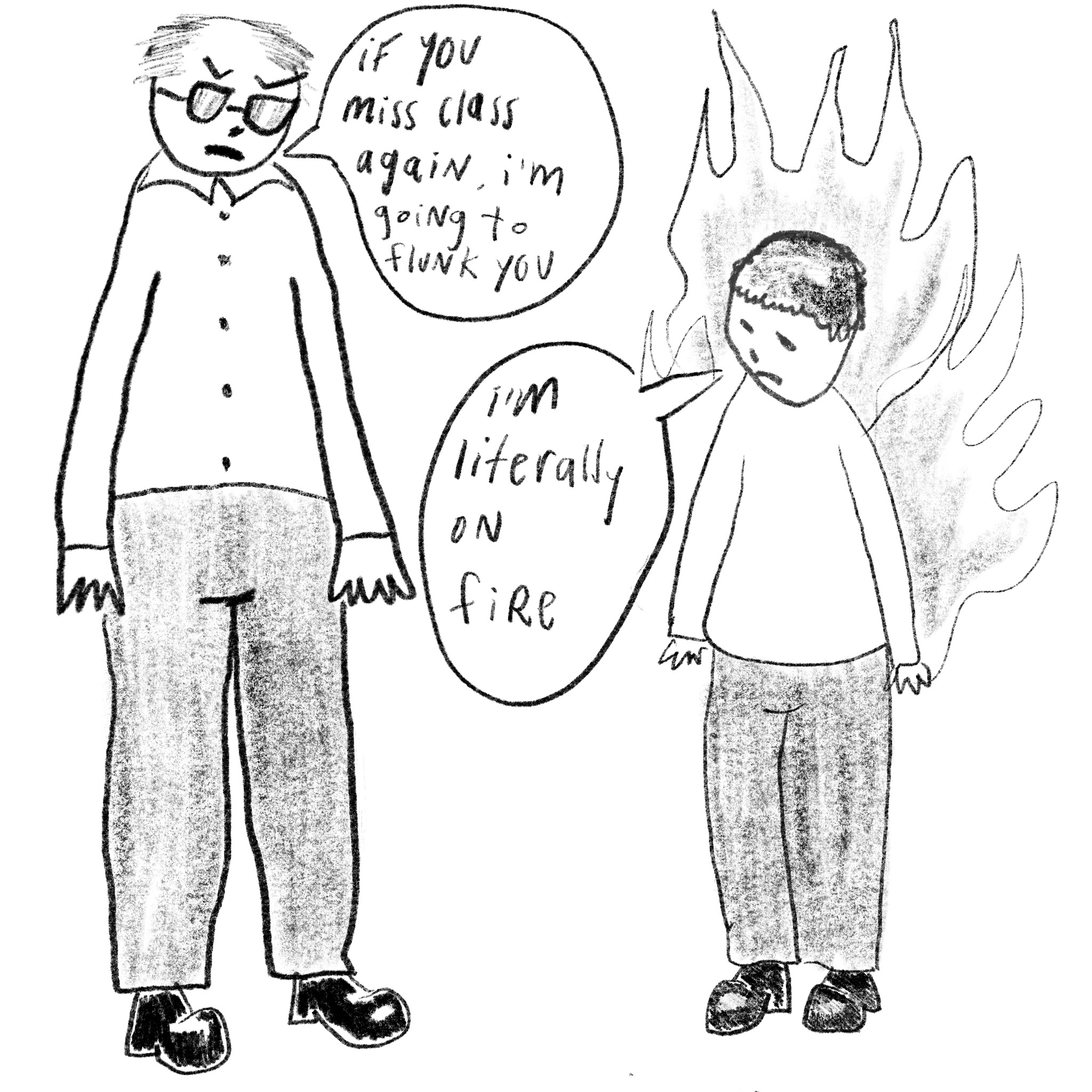
    Over a month into the semester, most of you are probably familiar with your professors and their grading policies by this point. Some require you to show up to every class to get a decent grade, while there are others who simply don’t care if you show up to class (spoiler alert: these are the cool professors).

    I stand very firmly in the belief that attendance should not factor into a student’s grades. They should be graded on their performance instead. 

    Maybe this is crazy, but if I miss two or three classes, yet demonstrate knowledge of the course materials by performing well on exams/essays/projects/you-name-it, I shouldn’t be punished. That A grade should stay an A. 

    Too often a class I’ve had has spent a week or two teaching something I already know fairly well (especially those classes that teach a broad range of practical skills in a major), but I am forced to sit through lectures bored to tears. I often think about the tens of things I could be doing instead, which are more often than not, assignments for other classes I could be using this valuable time for. 

    Allow me to introduce the concept of life. Life has this crazy habit of happening. It happens to you, to me, even to the professors here. When a professor has a wedding they plan to attend, or are feeling a little sick, they call off class. 

    Tell me then, why when I missed a class due to a personal loss, I was emailed a “sorry for your loss,” followed by a Canvas notification of my attendance grade being lowered by 7%? When I’m paying for my college credits, what valid reason is there for attendance affecting my grade? Professors don’t get paid based on class attendance, so the only person negatively affected when a student misses class is the student. 

    Let’s dig into how the supposed function of classroom attendance is to motivate students. I’m willing to bet money that mandatory attendance doesn’t motivate any student to do better in class. It sure doesn’t motivate me to do better in class. 

    A student should want to attend class. If a student is paying to take a class, they should be engaged by and with the course material, and that interest will intrinsically motivate the student to keep attending and learning. Requiring the student’s presence, and actively lowering the grade if not graced with their presence will extrinsically motivate the student to attend class. It will not motivate the student to learn. 

    Extrinsic motivation, like keeping a seat warm to satisfy an arbitrary requirement, doesn’t hold a candle to the intrinsic motivation of actually being interested in what’s being taught. Otherwise, self-motivation is taken away from the student and butchered in the slaughterhouse of butts-in-seats and vacant stares. 

    According to a 2010 report by the American Educational Research Association, while attending class can assist in getting better grades, mandatory attendance has a very small impact on how the students perform. 

    For all of you professors out there balking at the idea, slow down and take a deep breath. I promise you that most of us would attend the majority of our classes, just like usual. After all, it’s our money on the line. If you think that nobody will attend your class without graded attendance, chances are your class sucks and you should step it up. Make us want to come to class. If I’m able to accomplish the majority of your coursework well without paying a lick of attention to your lectures, they’re probably not all that engaging. 

    Oh, and participation grading is fine. After all, the professor has to keep track of students contributing. In the case of discussion-based classes, maybe offer students who miss class a discussion board on Canvas to post things on. 
    Stopping mandatory attendance puts the power and capacity to learn into the hands of the student. It restores that joie-de-vivre that graded attendance robs us of and allows us to feel like students, eager to learn instead of prisoners chained to our degrees.

  • Straight people look gay

    Straight people look gay

    by Zack Mink

    Dating in Arcata can be rough. As a visibly queer person, I find that I attract all kinds of different people. The most frustrating breed is the queer-passing straight men.

    This is the man who is either being friendly or flirting – you’re always questioning if they’re into you or if you’re just being delusional.

    In the past, it has been super tricky because I wasn’t the only one convinced these queer-passing straight men were into me. What made it so difficult was my friends being able to corroborate my beliefs as audience members of my disastrous love life. For the two most impactful love interests of mine, my besties were right by my side, able to witness the main events, the flirting, the looks, the attention, etc. So after multiple experiences discovering one of my interests is actually straight, I have to ask myself… what made me think they weren’t? 

    Aside from a basic level of human connection, and the undeniably flirtatious energy I could feel whenever we would talk, my confusion about a guy’s sexuality ultimately would come down to two things: their emotional intelligence and their sense of style.

    Apparently the bar is on the floor when it comes to the emotional intelligence of a straight man (no offense to straight men), because when a guy is comfortable with himself, confident and generally aware of others and his surroundings, I’m absolutely convinced he is queer. There’s just a certain depth that I find straight men don’t have because of their privileges.

    When taking a step back, I also realize that I definitely don’t associate a good sense of style with straight men (no offense again). I did notice however that I was stereotyping clothes. When I saw something I believed was not traditionally masculine, it would lead me to make assumptions about people’s sexuality. As a breaker of many stereotypes myself, believing them is something I want to avoid. 

    With this goal in mind, I learned a few things about myself and this genre of man. The first thing I reminded myself of is that anyone can have a good sense of style because clothing is for everyone. I can’t gatekeep dangly earrings and head scarfs for the girls, gays and theys. The second thing was that by having a sense of style, trying new accessories and having fun with clothes, a man is fighting society’s standards of masculinity. This was my “A-ha” moment as Oprah would say, because as someone who partially identifies as a guy, I have never fit in with the standards of masculinity. I actually think that not fitting in and being treated differently encouraged me to not accept societes standards for myself. Yes, I’ll blame the conservative people from my childhood for me being queer. 

    So despite my struggles differentiating a straight guy with style from a queer person, and despite the time I’ve wasted on people who aren’t interested in me, I will show my appreciation for the authenticity of the ambiguous straight men.

  • Bottoms Review: A raucously punchy queer teen comedy

    Bottoms Review: A raucously punchy queer teen comedy

    by Jake Hyslop

    If I had a nickel for every new movie in 2023 that was an eccentric, campy satire about feminism and gender roles, mocking the blatantly evil patriarchy and boasting a giant choreographed fight scene, I would have two nickels – which, to quote Dr. Doofenshmirtz, isn’t a lot, but it’s weird that it happened twice. 

    Bottoms is the sophomore feature from writer-director Emma Seligman, reuniting with star (and writer) Rachel Sennott (“Bodies Bodies Bodies”) from their previous collaboration, the stressful and hilarious Shiva Baby. Opposite Sennott is Ayo Edibiri, perhaps best known for her voicework in Big Mouth and her performance as Sydney in the hit Hulu show The Bear (watch it if you haven’t). 

    Sennott and Edibiri star as PJ and Josie respectively, two teens at the bottom of their high school’s social ladder. Not only are they losers and gay, but they attend a high school that literally worships its straight himbo star-athlete (there is a giant mural depicting him as the biblical Adam in the cafeteria). Even the principal calls them the “ugly, untalented gays” over the intercom. Through a series of plot contrivances, the two unpopular teens start an all-female fight club in order to have sex before they graduate. 

    If the above doesn’t alert you to the surrealness of the world of Bottoms, allow me to inform you that Jeff (the aforementioned himbo) and his teammates are depicted sitting in the cafeteria like Jesus and his apostles in Da Vinci’s The Last Supper. It’s a comical sight to say the least. Oh, and murder is just shrugged off as a normal occurrence. 

    The teen sex comedy isn’t exactly a new genre, but to have a brief resurgence put a queer spin on the genre keeps it fresh and subversive. It brings the tone of movies like Wet Hot American Summer and Superbad to the Gen Z crowd, borrowing the campy tone of “But I’m a Cheerleader,” a queer cult classic in its own right (it even paid homage in a scene at a diner named “But I’m A Diner”). Bottoms is unapologetically and explicitly gay at nearly all times. We’ve come a long way from the woeful and tokenistic “gay best friend” trope in comedies.  

    I was particularly delighted at the film’s parallels and references to Fight Club, a film famous for its satirical portrayal of toxic masculinity. It’s unfortunate that many men read the film’s message completely wrong, idolizing the dangerous men at the center of the narrative. How refreshing that this movie completely upends and pokes fun at those notions. The football players here are utterly moronic, and actors Nicholas Galitzine and Miles Fowler channel their Ken-ergy into their diva performances. 

    Despite a plot that can be convoluted and predictable at times, the cast and writing carry this movie to victory. Sennott and Edebiri’s palpable chemistry provides the groundwork for some truly impressive improv sequences, interwoven so well with the hilarious script that it’s hard to tell what is improv and what is written. Marshawn Lynch nearly steals the film as the divorced teacher who sponsors their club, misguided in his attempts to embrace feminism (fair weather allies are the worst). In fact, the entire ensemble here puts in the work, and I found my chest hurting from all the funny bits, as there’s hardly a minute that goes by without one. To address the Margot Robbie-sized elephant  in the room: yes, there are a lot of similarities to Barbie, the hit blockbuster of the year. I liked Barbie a lot, but my biggest issue was just how commercial it was, and how I wished every minute of its runtime was as campy as Barbieland; Bottoms scratched that itch for me. It’s acerbic and surreal the entire time, but it’s also surprisingly dark and bloody. Bottoms never compromises its weirdness for even a second to please anyone. It’s brash and unapologetic, and also the funniest movie I’ve seen all year.

  • Student spreads joy through public singing

    by Savana Robinson and Alina Ferguson

    Walking through the Cal Poly Humboldt Student Activity Center quad, one might hear a voice singing spiritual hymns. Echoing up the stair of Founder’s Hall, the voice carries a sense of warmth. The singer Fred Bossman can be heard a couple times a week, usually in the mornings.

     47-year-old Bossman studies physics at Cal Poly Humboldt with a focus in astronomy. He sings in public because he believes God told him if he sacrifices himself for the good of man, He will grant him unlimited power. Bossman wants to use this power to heal the world through singing. 

    He started singing at College of the Redwoods, but his favorite place to sing is the Arcata Plaza. He thinks it has a nice echo. Though he has no formal training, Bossman has traveled in states all over the west singing in public trying to spread warmth and joy. 

    “I have been singing for many years,” said Bossman. “It’s been a long time.”

    Bossman has received mixed reactions from people about his singing.

    “People have said that I sound beautiful,” said Bossman. “Other people have told me to be quiet.”

     One day, he was singing in the quad at Cal Poly Humboldt and thought that a lady who was studying was irritated with his singing. 

    “I went up to her and told her I was sorry and she said, ‘No it was beautiful. Thank you,’” said Bossman.

    Bossman said that he’s not trying to create problems.

    “I’m just trying to do what I believe I’m supposed to do,” stated Bossman.

    Bossman can get nervous when singing in public. 

    “It’s sometimes nerve-wracking because I don’t know what to expect,” said Bossman

    Bossman used to wear sunglasses to help ease his anxiety, then, when the pandemic hit, he would wear a mask.

    “Sometimes people would look around and not know who was singing until they got close to me,” said Bossman. “This was when I didn’t sound that good.”

    “I used to scream,” said Bossman. “Over many years it turned into a harmony. At first, I didn’t know how to sing but I was just getting it out there.”

    Now, Bossman takes the mask off so that his voice doesn’t sound muffled.

    After struggling with a meth addiction, he found God at a low point in his life. He had woken up from being in a coma for seven days and was given a copy of the New Testament. It was just the sign he needed.

    “The Lord has delivered me from methamphetamine, marijuana, tobacco, alcohol and gambling for over four and a half years,” said Bossman.

    Growing up in an agnostic household, he does not belong to any specific denomination. He simply follows Jesus. He receives messages from God through prayer, visions and dreams.

    Bossman said God showed him a vision of him winning a Nobel prize and becoming an astrophysicist, and he knows this is something he will do. 

    His favorite passage is the 91st psalm of the Book of Psalms: “He is my refuge and my fortress, my God, in whom I trust.”

    Bossman has 38 songs in his repertoire. All of the songs that he sings, he hears on K-Love, a Christian radio station based in Sacramento, California.

    “I would hear a song and go home, look it up on the internet, learn the words and put it in my repertoire,” said Bossman.

    Bossman’s favorite song to sing is “Glorious Unfolding” by Steven Curtis Chapman.

  • Associated Students cuts $500,000 out of student programs: resource centers struggle

    Associated Students cuts $500,000 out of student programs: resource centers struggle

    by Angel Barker

    This is an extended version of the story that was published Friday, September 29. This version was printed on Wednesday, October 4.

    It was a misty Friday morning in Arcata. Fewer than 20 people met in person to discuss the budget reform for funded student groups on campus. Tensions were high and budget cuts were higher.

    Faced with a deficit of more than $500,000, the Associated Students (A.S.) met to make huge cuts to student programs. There were over 20 funded program cuts that were approved.

    A $500,000 deficit heightened the tensions between A.S. and core funded student groups on campus. With thousands lower in enrollment numbers than originally projected by the university, it left a sour taste in the mouths of everyone whose budget was about to be cut by thousands of dollars.

    Associated Students Administrative Vice President (AVP) Andres Olmos facilitated the discussion for the necessary cuts of the budget. According to Olmos, because of lack of funds, they are essentially starting from the ground up with the bare minimum of only wages for student workers. That still leaves them over budget. The revenue is much less than predicted in the spring due to the high enrollment projections made by the university.

    The original revenue number was $786,000. Using A.S. reserve funds, the number would have been $865,000. According to Olmos, the financial office told A.S. to get to $750,000, meaning the total number of funds cut were $528,717 because the approved budget when the university thought enrollment would be much higher, a whole $1.2 million.

    A screenshot of the finalized budget of the funded student programs. The left column is the original budget approved in spring and the right column is where the budget is now.

    Olmos acknowledged that it was important to A.S. that student workers were able to keep their jobs, and that the main priority was keeping each budget at least at their current wages, only so students could continue to survive.

    Over 20 student groups like cultural centers, service organizations and more, saw cuts that ranged anywhere from $2,500 (Drop-In Rec Open Gym) to $186,498 (A.S. General Operations). 

    Some individual budgets were getting cut entirely because they have trust funds that they can survive on for the year; others were biting their nails to try and get more than just enough to pay student workers.

    “The money that is now allocated to us is strictly for wages,” Isabela Acosta, the Fiscal Coordinator for the Women’s Resource Center said in an interview after the A.S. meeting. “Not for supplies and hospitality or events.”

    A.S. President Samuel Parker said that the university told A.S. in the beginning of September that they would need to cut the budget. With less than a month to make the adjustments, it was difficult.

    “It was pretty difficult to have to deal with in such a tight time frame,” Parker said. “Also we have a very limited amount of people at the moment, so it is hard to get the adequate amount of communication out to everyone to let everyone know and have them chime in with their perspectives.”

    Marketing and Communications Director of News and Information Aileen Yoo said in an email statement that the budget office had informed A.S. about the budget shortfall on Aug. 30. 

    “One of the reasons for the budget deficit had to do with fee revenue estimates being lower than anticipated due to enrollment growth being more modest than initially anticipated during budget planning last spring,” Yoo said. “This led to needed adjustments to many of our budgeted operations across campus, including our main Operating Fund as well as our fee supported areas, such as AS.”

    The Eric Rofes Queer Multicultural Resource Center (ERC) approved budget for the 2023-2024 school year was $42,500. It was cut to $30,000 after Ascher Marks, the fiscal director for the ERC, and AVP Olmos talked. Olmos told Marks that the ERC employees might not be able to work over summer and winter breaks.

    “We cannot really consider that because our bills don’t stop during winter and summer break,” Marks responded. “We need to be working over the breaks because this is our job and how we make money.”

    Other organizations like the Women’s Resource Center are struggling to do anything except pay their employees.

    “We can’t buy menstrual products,” Acosta said. “Our sole responsibility as a resource center is to provide menstrual products for campus.”

    Acosta explained that due to a law passed in California in 2021, that the university should be stocking the bathrooms with menstrual products, but they have not been.

    “Our school should be [providing] menstrual products because of California Bill 367, which makes California public institutions required to have free and accessible menstrual products, and the school has not instilled this bill,” Acosta said. “So we have basically been taking out large portions of our yearly budget to provide menstrual products for campus when it is not even our responsibility to do so.”

    Yoo responded to this in an email statement.

    Photo by Kae Dennert. Ella Moore, Rose Co-Director, raises her hand during the A.S. meeting on Friday.

    “This [law] has been funded previously by the university, through Student Health & Wellbeing Services and other institutional resources, with staffing resupply support through the Office of Student Life and other university departments. The Women’s Resource Center provided additional supplies and locations and has done so since before the bill was passed. A group of those folks plus Facilities Management are now meeting to streamline the process and ensure funding and coordination of effort.”

    When asked about the backstock of menstrual products and when the center could possibly run out, she said that if they were to stock every bathroom regularly they would run out by next week. With the stock they have (about 20 boxes of pads, 100 menstrual cups and 18 boxes of tampons), she is hoping they will make it to the end of the semester. 

    Some organizations still have enough to sustain for the year, like the Waste Reduction Resource Awareness Program (WRAPP). The Program was cut by $9,200 leaving them below the A.S. recommendation of only wages, yet they remain optimistic.

    “We are so excited to have $44,000,” Ella Moore, Rose Co-Director said. “It means we are going to be able to pay our employees and [have] a little wiggle room for basic operations.”

    The Social Justice, Equity and Inclusion Center will still be open after their $16,500 cut. Frank Herrera, the Center’s Coordinator, is optimistic despite the small funds. Herrera said that the primary goal is to keep student staff, the secondary is to have high impact events. He understands that budgets change and the Center just needs to be more intentional with events.

    Aside from the difficulties cutting a budget by this much, Parker is proud and optimistic, particularly of AVP Olmos.

    “There were a lot of factors that made it pretty difficult for everyone. I am very proud of everyone for managing to pull it off.”

  • Old soul, young at heart

    Old soul, young at heart

    by Dezmond Remington

    It’s midnight on a Saturday, and the rafters are clapping. Spines vibrate and teeth wiggle. Faces pose in macabre grimaces, writhing like they have a car battery clamped to their tongues. Above it all is the light, heavenly light, that dips and dodges and fills up the warehouse. It spells names, makes rainbows and does anything the god that controls it wants to do. The deity is named Nathan Ray King and this is his office.

    His office that night was an EDM show at Ramparts Skate Park. King has been doing laser work for gigs as diverse as raves in the forest to a dance at Eureka High School for about two years now. After winning four jackpots in a row playing keno at the Blue Lake Casino, he bought his first laser. Although the pay in Humboldt is often bad and the grind painful, he hasn’t looked back since. Seeing hundreds of people feeding off of the energy of his lasers and the music he plays makes it worth it. 

    Photos by Dezmond Remington. A performer dances amidst King’s kaleidoscope laser arrangements.

    “The amount of love you get for creating that vibe [is great],” King said. “The laser is so powerful. It has such an impact on what people are going to remember. It’s those memories that are some of my favorite type of things. It’s hard to explain the gratification you get from all those smiles from people who are mind blown.”

    King didn’t come by his profession out of the blue. In the early 2000s, he attended a festival in Phoenix and was inspired to start his career with lasers when he walked behind a stage and saw all the wiring. He and the group he was working with performed at shows in the area for about six years, using illegal equipment owned by someone else until they were shut down by the local laser commissioner. He spent most of the next 10 years working as a household appliance repairman before his roommates stole his tools. When he had his stroke of fate at the Blue Lake Casino, he decided it was time to invest in himself. 

    He bought one laser and messed around with it in his apartment for six months, eventually buying more lasers when he outgrew his setup. He reached out to promoters for a while to get some work and got a gig performing at the Jam in Arcata. He offered to do it for free just for the exposure, but the promoters liked it so much they ended up paying him. He’s been booked full almost every weekend since. 

    “I’ve been doing a lot of shows for next to nothing, just to get seated in the industry and get more experience,” King said. “It’s worked fairly well. I’m still struggling financially, but it’s coming along.”

    King is a staple at just about any event in Humboldt that a laser might make a little better. He has somewhat of a monopoly on laser shows here, being pretty much the only local to offer his services. His marketing techniques can be aggressive. Occasionally, he sets up lasers at Moonstone beach, projecting shapes on the cliff sides, as well as his Instagram handle. He has a bus with his name on it and rigged it so his lasers could attach. It’s the dream machine for King, a portable slice of his talents. It makes it much easier to travel south for the big festivals, where the real money can be made – a couple thousand for a weekend of work. 

    King would like to branch out into other areas he could use his lasers, such as large, billboard-style effects. One of the things that fascinates him about the lasers is simply how many things can be done with them; the ceiling for innovation is practically limitless. The program King uses to make his lasers function has hundreds of preset designs. Any image file can be projected. Dancers made out of nothing but pure light and shadow. The only boundary is what King can think of, as well as his budget.

    “The possibilities are limitless,” King said. “I can play with it for days and never do the same thing twice.”

    Despite what his club reputation may bring to mind, King is far from the glowstick and neon aesthetic of many festival goers. He’s 44, with salt and pepper stubble, clad in athleisure khakis and Adidas running shoes. However, one of the things he loves most about the events he works is that they don’t put him all that outside the norm. 

    “I see people way older than me,” King said. “I’ve always been an old soul but young at heart at the same time. I feel right at home…I feel like a kid again, almost. I’m just a free-spirited kind of kid. I like to have a good time.”

    The people in the crowd are what compensate for the oftentimes bad pay and wacky working hours. King said he often has trouble talking with people, but lasers are the great equalizer.

    “I don’t really care about the size of the event,” King said. “Just being able to connect with people [is why I do it]. Doing lasers allows me to speak with people without having to interact with people.”

    One of the finest moments of his career was at the Stilldream Festival in eastern California. A technician took King’s chair, which he was mad about until he learned it was for a DJ by the name of Dreamweaver. He had been in a car wreck several years prior and needed it a lot more than Nathan did. 

    “He was just crushing it,” King said. “Everything was going great… I got this epiphany in my head like halfway through his set, ‘You know what? I’m standing for this man right now!’ We’re on opposite sides of the crowd, kind of having our dance amongst ourselves. ‘I’m his legs right now!’”

    However, King said that after the highs of working the crowd can often come the lows. However, the solution there is often also people. 

    “You get probably a ‘Musician’s Gloom’ where, when you’re performing, you get this rush of endorphins — and, of course, the extracurricular activities that get you there — and then when it’s over, it goes [airplane crashing noise],” King said. “So the next night, it’s quiet, you’re by yourself, you get this super low… I like to just talk to friends… have a chill one-on-one.”

    King has met hundreds of different people during his years as a laser performer, one of them being HSU alumni Joseph Ostini. Ostini is the founder of artist’s collective Arcane Artists, started two years ago to give local performers an outlet during the pandemic. Ostini met King at a show at the Jam about a year ago, and was impressed by the laser effects, something he said had never been seen before in Arcata. Ostini likes the lasers as a way to enhance the experience of attending a music show.

    “[King’s] artwork does a good job of translating music to visual space,” Ostini said. “…His growth has been apparent to me as a promoter.”

    King’s connections are what he hopes will allow him to finally become a successful, happy performer.

    “Lasers are fucking cool,” King said. “That’s all I want to do — be sustainable and comfortable and just be able to shine my lasers for people.”

  • College night: flop or bop?

    College night: flop or bop?

    by Jillian Wells

    Sweaty students, creepy men, and lots of crappy EDM-remix music. That’s how I would describe the “College Night” hosted by the Arcata Theater Lounge (ATL). College Night, a fairly frequent event, is popular because it’s one of the few places in Humboldt County where people who are over 18 but not yet 21 can go to have a nightclub-like experience.

    You may be wondering what my qualifications are. I’ve been to College Night at least seven times at this point. I have also been to several nightclubs in South Korea and a few in Europe, so this isn’t my first rodeo. I know it’s not quite fair to compare these foreign nightclubs with the ATL, but this does give me a good perspective about what makes a nightclub, well, fun. 

    So let’s address the elephant in the room – the music. While the ATL does feature some great songs, the experience often gets soured by the sheer amount of EDM remix tracks they play. It feels as though the remixes really drown out the best parts of the song that make you want to dance and let loose. It’s frustrating when I’m really enjoying a song then they completely gloss over the song with an awful EDM remix version. It’s important to note that music is a key element in any nightclub setting, and the ATL could significantly enhance the overall experience by having a more diverse playlist, with less remixes. After all, music has the power to elevate the atmosphere and make a night out all the more enjoyable. 

    I respect the concept of College Night. It gives the poor souls who aren’t 21 the chance to have a nightclub experience which, in Humboldt County, is extremely hard to find. Despite the issues I have with the music, I will continue to attend College Night (with a fair amount of liquid courage) because it holds a special place in the hearts of many, including myself. In fact, it was at College Night where I first met my current boyfriend over nine months ago, so even though these nights have very questionable music, I have some great memories associated with them. Is the music often questionable? Yes. Will I keep going back? Absolutely.

    So, my advice is if you’re looking to go to College Night at the ATL, pregame (drinks are expensive), go with people you trust and know you’ll have a good time with, and make some unforgettable college memories. 

  • Music meets anime at Thundercat show

    Music meets anime at Thundercat show

    by Carlina Grillo

    On a typical cold and rainy night in Arcata, students gathered into the John Van Duzer Theatre where Grammy award-winning bassist, Stephen Lee Bruner, known as Thundercat, brought the heat to campus. With a mix of funk, jazz, R&B and psychedelic bass noodling – eccentric doesn’t begin to describe the night. 

    Tickets for the show sold out within two hours of going on sale to the public, and to people’s surprise, last minute tickets were sold the evening of the performance. For Thundercat’s third time back to the Van Duzer, Cal Poly Humboldt’s Center Arts expected a full house with a seated capacity of 862.

    Eager for the show, the crowd began gathering in the lobby half an hour before the doors opened at 8:30 p.m. Upon entry, people were greeted by a vivid blue light and fog in the air. Behind the haze stood a giant blown up medieval style tower with a cat head. Known as “Cats Lair,” this stage set up was a reference to the 1985 anime, “ThunderCats.”

    The concert was promoted as a seated show, but as soon as the band took the stage, some people stood in front of their seats while others raced to the front. Most people on the balcony remained seated until the very end of the night when the entire house gave Thundercat a standing ovation. The energy was high, but not enough to solicit a mosh pit. Folks mostly swayed throughout the night.

    Thundercat took the stage around 9 p.m. with his iconic six string Ibanez bass guitar, and was backed up by Dennis Hamm on the keys, with Justin Brown on drums. Between songs, Thundercat entertained the crowd with relatable banter and even attempted to kickflip a Tech Deck from the crowd. While he talked to the crowd, fans could be heard meowing around the room.

    Photo by Carlina Grillo. Thundercat playing in front of the “Cats Lair”, a giant blowup tower referencing the 1985 anime “ThunderCats”.

    It was quickly made apparent that anime has a grip on Thundercat and has influenced many aspects of his life. During the first half of the show, he asked the audience how they felt about anime. As the question was followed by loud cheers, he decided to play the song “Tokyo.”

    “I’m gonna slow this one down too,” said Thundercat. “I’m gonna sing this one real slow, so you can understand what it was to be me at 18 years old in Japan.”

    The song described Thundercat’s time in Tokyo with an ode to his lifelong love for anime.

    “I went to the dentist and he gave me a toy / it was Dragon Ball-Z, a wrist-slap bracelet / Goku fucking ruined me,” sang Thundercat. 

    Afterwards, he followed it with his song “Dragonball Durag.” He mentioned that it was his first time playing those songs back to back, and even exclaimed to Hamm, “Write that down!”

    “You don’t have to like my video games or my comic books / But baby girl, how do I look in my durag?” sang Thundercat.

    During the second half of the performance, Thundercat took a moment to honor musicians he’s proud to have worked with who have passed away. He specifically mentioned rapper Mac Miller, Japanese composer Ryuichi Sakamoto and concert promoter Meghan Stabile.

    “To know Meghan was to love her,” Thundercat said.

    Whether an anime lover or not, concert-goers left the Van Duzer feeling electric. Tobin Thornton, a freshman studying chemistry at Cal Poly Humboldt, had never been to the Van Duzer before and had zero expectations for the night. 

    “I don’t really know what I was expecting, but I had a very good time. I do feel like I got put in a microwave, but in a good way,” Thornton said before rating the show a solid nine out of ten. 

    Sam Schulman, a music lover and community member, expressed his gratitude for Thundercat coming to Arcata to share his music.

    “I was mind blown by his artistry and how good he is at playing the bass. It was so cool,” Schulman said. “I didn’t really know what to expect going into it and I know he has regular-amount-of-time songs, but he was extending a lot of them and jamming a lot. Which was really cool to see.”

    Lexi Takaki, a graduate student in the social work program, described her night as awesome, and felt very lucky to get one of the last minute tickets. 

    “Thundercat is a world renowned musician that is like none other, so it was kind of surreal to see him on stage,” Takaki said. “I feel like at a lot of shows at the Van Duzer, it can be really mellow or people are kind of awkward, and I feel like tonight everyone was really feeling it.”

  • University releases annual security report

    by Jake Hyslop

    Cal Poly Humboldt made its annual Security Report under The Jeanne Clery Disclosure of Campus Security Policy and Campus Crime Statistics Act public. The report details crime statistics that have occurred during the past three years, from 2020 to 2022. 

    The Jeanne Clery Act was signed into law in 1990. The act is a consumer protection law meant to provide transparency to the public around campus crime policy and statistics. Nicki Viso became the Clery Director in February 2022, heading up the Clery Compliance Team which is composed of representatives from many Cal Poly Humboldt departments. 

    The crimes reported are sorted into four categories based on where they happened. These include reported incidents on the general campus, on campus residencies, non-campus locations affiliated with the school, and public property near or adjacent to the campus. 

    There were no hate crimes reported during the three year stretch of 2020 to 2022 in the report. While there were no reports of murder or non-negligent and negligent manslaughter, there was a large increase in rape cases, from two incidents in 2021 to 11 in 2022. There were also increases in incidences of fondling, robbery, aggravated assault, burglary, arson, and other crimes. Some were small increases (like robbery from zero to one case) and some were larger (like weapons law violations from three to seven). 

    The Clery Compliance Team noted these increases in the report. August 2022 was the point that campus opened fully, with an increase of people on campus and returning to in-person classes as the reasons. Another change the team cited was that Comfort Inn in Arcata, currently housing students, was included and classified under “Non-campus Property.”  

    It’s important to clarify that any allegation that fits the criteria of a specific crime and occurs within the geographical locations specified by the Clery report are included. Not every crime statistic included in the report is proof that a crime definitively happened. Furthermore, crimes are recorded under the year they’re reported, even if they occurred a previous year. 

    The Clery Act Report is available on Cal Poly Humboldt’s Clery Act Compliance webpage, as well as information to help understand it.

  • Data science makes its debut as one of Cal Poly Humboldt’s new science majors

    Data science makes its debut as one of Cal Poly Humboldt’s new science majors

    by Emma Wilson and Griffin Mancuso

    Data science debuted as one of the eight new science majors that Cal Poly Humboldt is offering this semester.

    Data science is the blend of math, statistics and coding where data scientists examine which questions need to be answered and where to find the related data. Data science is a major with many career opportunities in a variety of fields including mathematics, computer science, coding and research. This major is ideal for students who want to apply their talents in different areas and want to have a practical use for their math skills.

    Currently, one data science class is being offered this semester: Data 111, Intro to Programming and Computational Thinking for DS. In the spring, Data 271, Data Wrangling and Visualization, will be available.

    Kamila Larripa is an associate professor and is currently leading the new data science major. Larripa has been working at Cal Poly Humboldt since 2008 and is currently doing a research project with her students on a type of immune cell in the brain called microglia. She is interested in looking at cells; how they integrate and make decisions in the human body. 

    Larripa previously did some training and started offering her students workshops in data science in 2017, like machine learning and methods or how to clean a data set. 

    “People were really interested, and I just feel like there was kind of this need that students were wanting this,” Larripa said. “And then over time, with a bunch of other people on campus and then the transition to polytech, now we have this new major in the math department.”

    Photo by Griffin Mancuso. Bethany Johnson, an associate professor, describes the first project students are working on in Data 111.

    Bethany Johnson, an associate professor, is teaching the first available data science class this semester. Students taking her class learn the definition of data science, its fundamentals and the skills needed to succeed in their industry of choice.

    “We spent the first part of the class basically learning how to program in Python, so this is kind of like basic programming stuff including how to write a for loop, how to do conditional statements, if-else statements and how to simulate some things,” Johnson said. “And then we start moving into statistics, where we’re trying to figure out, like, how can we use data to make a conclusion about the population. And then toward the end of the class, we’re going to get into a little bit of prediction.”

    Johnson also emphasized data science as a broad spectrum of skills that anyone can benefit from.

    “I think that it’s important for people to view data science as, as not like a strict scientific discipline. You don’t have to be a computer whiz or something like that,” Johnson said. “I think that sometimes when people hear data science, they maybe don’t even know exactly what it entails… I would think about it as just like, sort of a discipline to help you solve problems and make decisions, work with the data and the information that’s out there.”

    Elio Piccagli is pursuing a major in computer science and data science along with two minors in biology and art. Currently, Piccagli is in the Data 111 class doing a project on the world population’s relationship to poverty levels. He explained the commonalities and differences between computer science and data science. 

    “Computer science deals with like a lot of, ‘how do we code this,’” Piccagli said. “And data science is like, ‘we have this data, how do we make a table visualizing that data?’ So it’s just like the application of computer science.”

    Emad Syed is a junior majoring in data science who pursued the major out of an interest in manipulating data rather than creating it. He also emphasized the flexibility of possible career paths students can pursue with a data science major.

    “I’m looking for something that can be applied in all, in all parts of life,” Syed said, “Be it forestry, economics, statistics, computers, anywhere where the skill set can be used. I don’t want to necessarily choose a specialized field.”

    Larripa has hope for the future of the data science program at Cal Poly Humboldt

    “So the overall theme of our program is really data for good. Like how can we, you know, capture, analyze data and make decisions so that we’re making the world a better place?” Larripa said. “And I mean, I think that really is in line with the Cal Poly vision. And we’re really excited about that.”

  • One pole, seven strippers

    One pole, seven strippers

    by Zack Mink

    “I love stripper bitches!” the crowd yelled. This one-of-a-kind call and response was very much appropriate.

    On Sunday, Sept. 24, Clubussy broke down barriers by being the first-ever pop-up strip club event in all of Humboldt County. The event was hosted at the queer-owned thrift store Krave in Arcata, continuing the theme of providing a safe space for all.

    With help from volunteers, the store was transformed into an intimate and safe setting, with one pole centered in the room highlighting the seven talented performers throughout the night. 

    Setting the mood with what one performer described as bisexual lighting, casting blue, pink, and purple shadows across the room. 

    The excitement was building as the performers changed in the back room. Everyone reflected joy and felt proud to be in a space where they could be their authentic selves. 

    “As someone who felt bullied out of sex work, this space is super important to me,” said Baby Fontaine.

    Fontaine, aka the “Dollar Daddy,” was a volunteer responsible for exchanging dollar bills with the crowd making sure everyone had cash to tip the performers. 

    Orange haired-diva Big Billy, a co-founder of the Humboldt based pole dancing group, LXIX Crew, began with an emotional and entrancing number, paired with a mix of opera and club beats. Next up was Felix Void, who was serving punk, with loud clacks from the stomping of their tall black heels. Dahlia was after, delivering androgyny in their performance to “But It’s Better If You Do” by Panic! at the Disco. Their splits and unbelievable spins continued to get hoots and tips from the audience. Big Billy took the stage again with their “Shreksual” performance of “All Star” by Smash Mouth, garnering laughs and cheers from the audience. Felix Void and Dahlia did one last number each before the group birthday dance in celebration of Kai Flores, the owner of Krave. 

    Krave’s owner, Kai Flores, even got a birthday treat. Six strippers danced on Flores’ lap, did handstands while shaking ass, and enveloped their face with their breasts, leaving Flores laughing with tears falling down their cheeks. It was their first strip club experience and they got the whole shabang.

    The second half of the show started with Boofy the Clown. Boofy, a co-founder of the Foolish Kinks,performed their comedic version of “Oops I Did It Again” by Britney Spears. Channeling her inner bimbo, Boofy trotted on stage, fluffy nose first and ended by revealing a miniature pink rubber chicken from her bikini bottom. Following Boofy, Karma dropped it low at the audience’s feet before climbing back onto the pole to impress with their acrobatic spins. After Karma’s performance came Bunny with a flamenco inspired set. Once everyone performed twice, GUTTERPUKE, the organizer and MC of the event, surprised the audience with a last minute pole performance coming back from their extended hiatus. 

    The grand finale involved a sheet cake and balloon-boobs. Everyone cheered as Boofy and Dahlia dropped from the pole into the splits on top of the sheet cake, proceeding to lick the frosting off of each other and feed each other chunks of cake, eventually popping the balloon-boobs with Dahlia’s long black acrylics in honor of Flores’ birthday. 

    The performance left an impact on the crowd, leaving them curious what the event might mean for the future of Humboldt County. 

    “It’s going to inspire others… change the future of pole dancing in Humboldt,” said Patrick Shannon, an audience member supporting one of their performer friends.

    “There’s so many people here who know people who dance at clubs and have wanted to support them, but are too afraid to go into the club because of violent homophobia and because of the transphobia we are seeing in our nation,” said GUTTERPUKE. “Not only is this radical and reseizing the means of our production, it’s also radical in a way of creating space for queer people to feel comfortable accessing sex workers.”

    GUTTERPUKE has six years of experience performing, as well as experience fighting the constrictive systems that make being a stripper and/or sex worker difficult. This passion for creating a safe and equitable environment for sex workers and strippers stems from GUTTERPUKE’s own traumatic past. At one of the previous clubs he worked at, he was illegally fired. From that experience, he discovered Strippers United, an organization striving to dismantle whorephobia and decriminalize sex work. This organization provides financial and legal support for strippers and helped GUTTERPUKE win his case against the club. They were forced to hire him back and pay him for the days he wasn’t allowed to work because of the illegal termination.

    Clubussy was created as the solution to this problem and the other issues strippers regularly face. 

    “Let’s do some problem-solving. Let’s make an event where sex workers are platformed and invited. Let’s make a space that celebrates us in a really joyous manner and it’s not degrading, it’s not fetishization or tokenization,” said GUTTERPUKE.

    Along with the mistreatment of performers, the financial aspect of running a strip club is something GUTTERPUKE is passionate about improving.

    “When you are a stripper, you have to pay the club to work. Part of Clubussy is that strippers keep 100% of their fucking money. Often performers are told ‘you will get a percentage of ticket sales,’ but they’re never transparent with their finances so you have no idea how much the event organizers are paying themselves, you have no idea how much the event actually made. So, as part of my ideals to be transparent and community-based with all of the performers and volunteers, the financial records will be made available,” GUTTERPUKE said to the audience.

    The event followed the intentions of being transparent, encouraging and safe for everyone. It also was a chance for these local strippers and sex workers to represent themselves, share their art, and give credit where credit is due. 

    “Oftentimes, pole hobbyists get more opportunities to be performers, get more opportunities to go on tour, get more opportunities to do so much when pole is a craft that was shared by strippers with non-strippers because it’s something that brings us joy,” said GUTTERPUKE. “Being on the stage, doing your thing, it is positive for your body, it is positive for your mental health and we shared that gift.