The Lumberjack


Students Serving The Cal Poly Humboldt Campus and Community Since 1929

Tag: HSU

  • OPINION: 90 years and a slap in the face

    OPINION: 90 years and a slap in the face

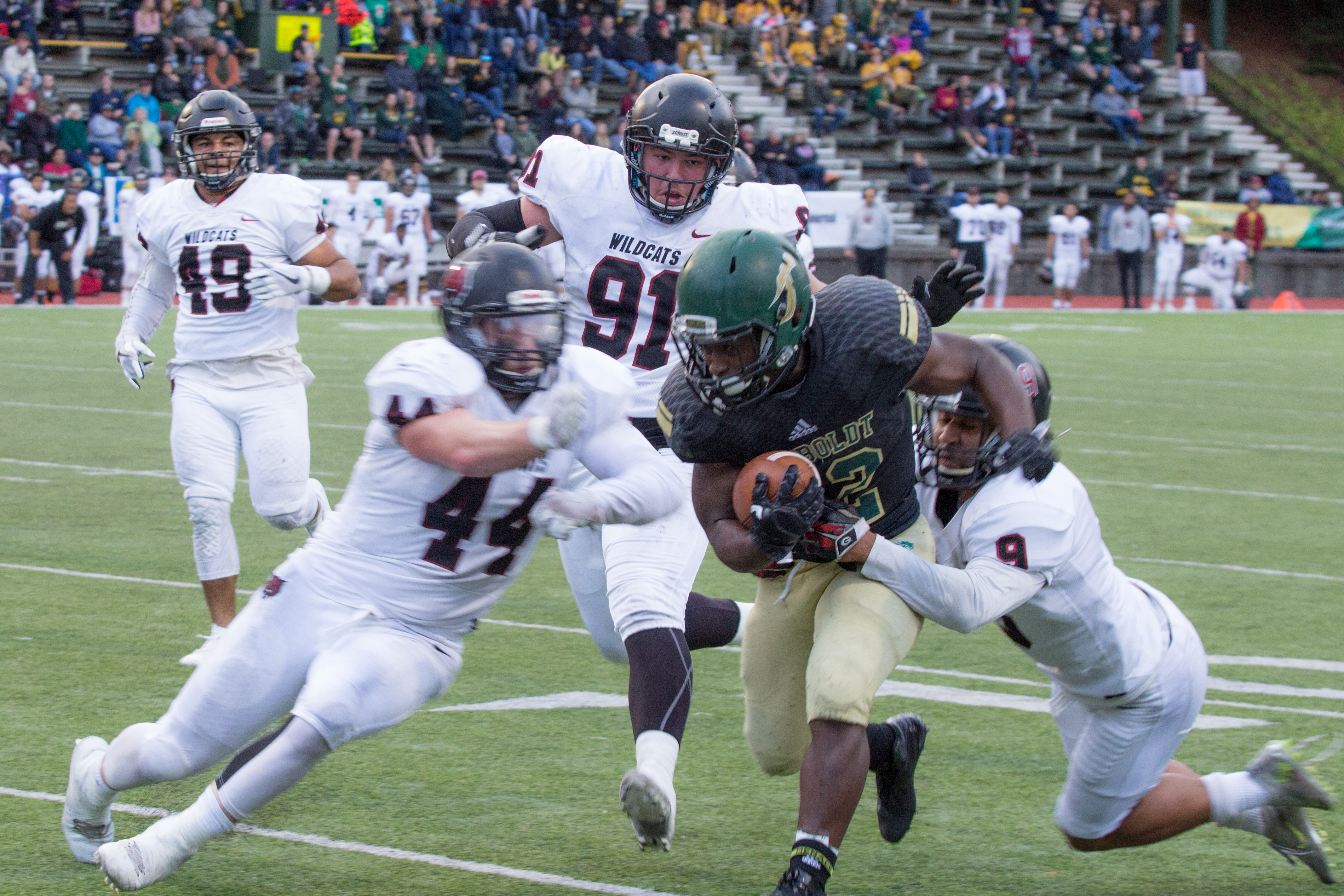
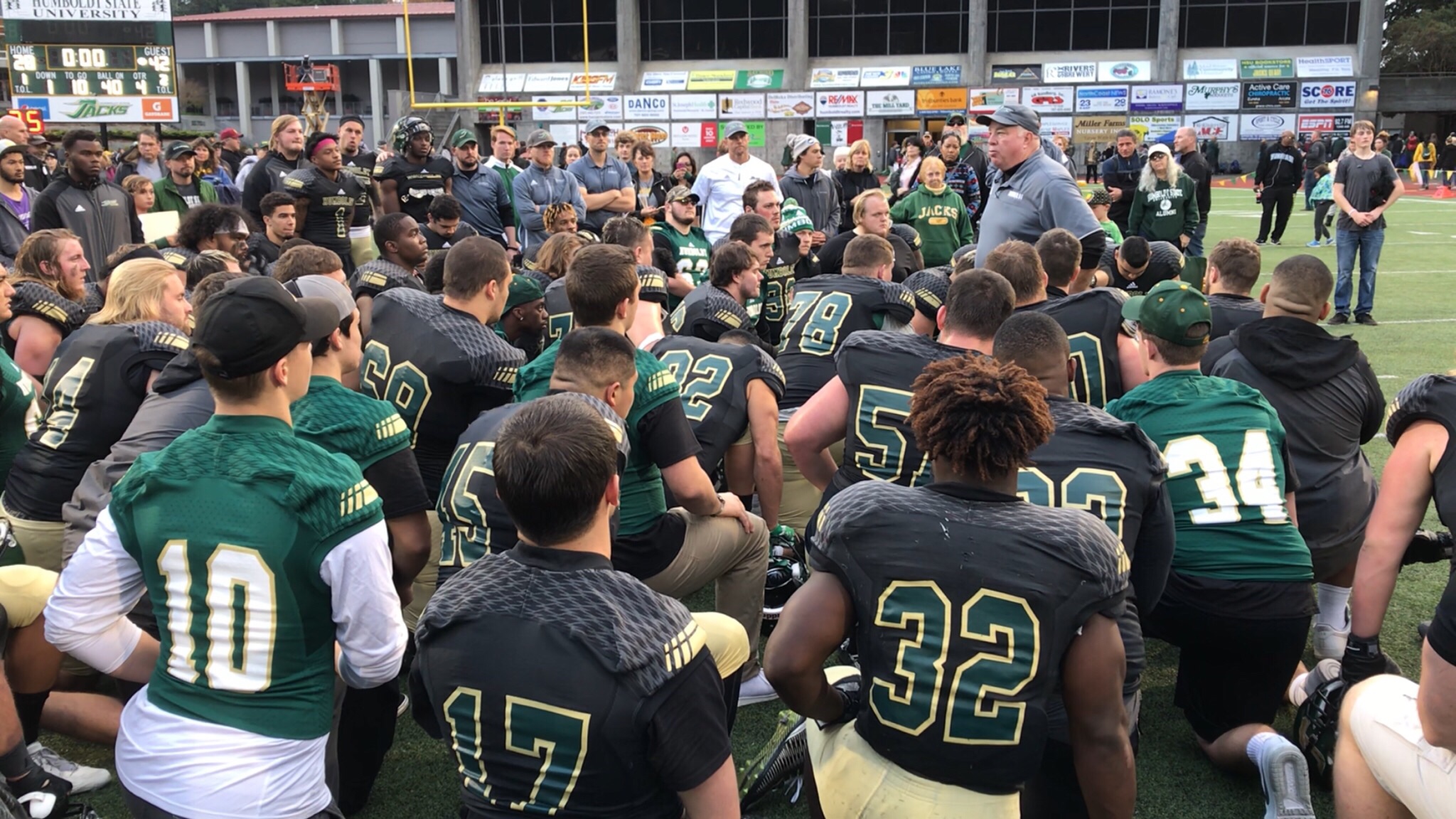
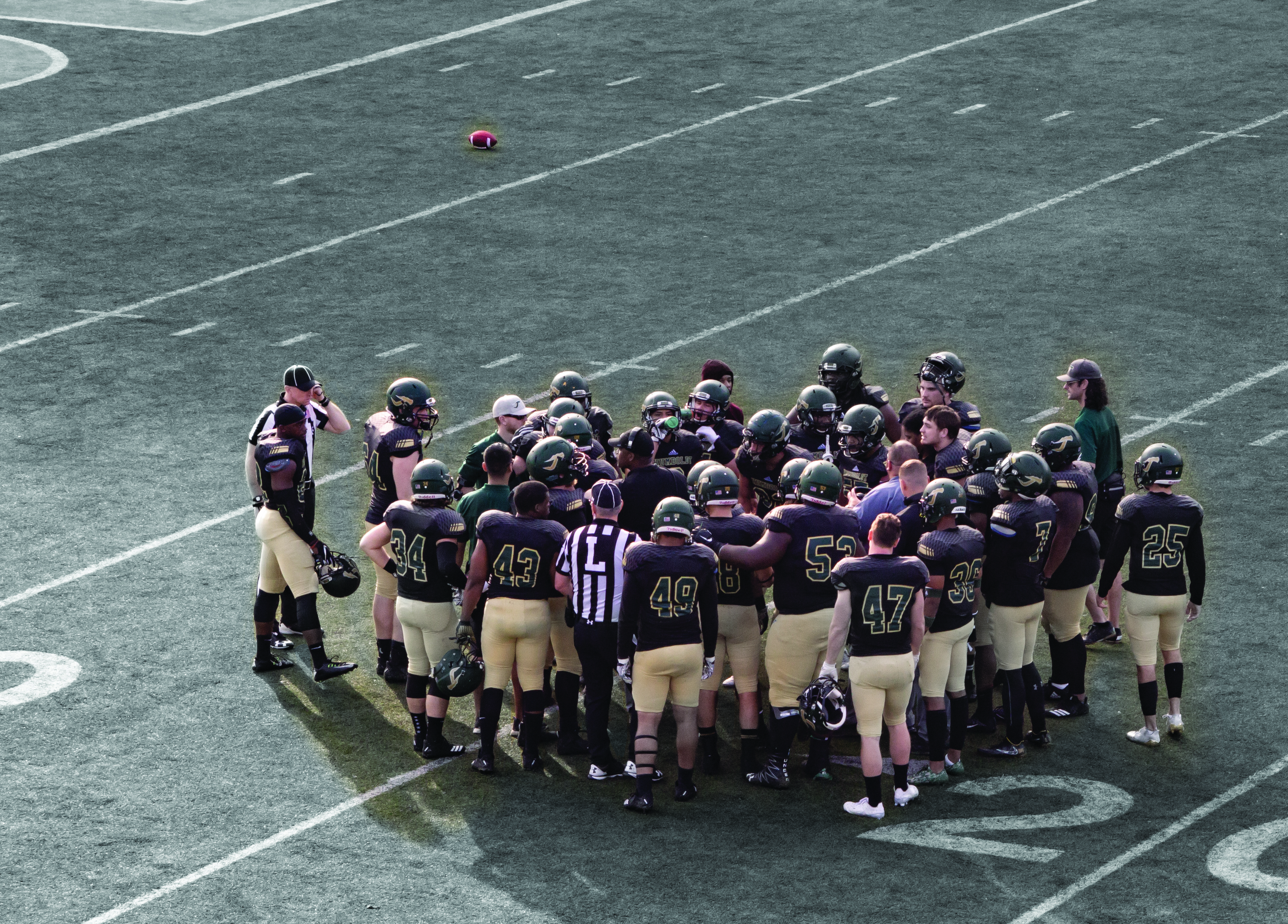
    The Azusa Pacific field goal that beat the Lumberjacks on Nov. 3 sailed through the uprights. At this moment it dawned on me that this was the final play of HSU football. The empty feeling in my gut is all too familiar.

    Born and raised in San Diego, I could never tell local Jacks fans how to feel or how they should feel. However, after over 30 years of cheering for the San Diego Chargers, I have a pretty good idea.

    Year after year, heartache after heartache, I remained loyal to the Chargers. When they went 1-15 after using the second pick in the draft on University of Washington Cougars quarterback Ryan Leaf (the biggest flop in professional sports history), I stuck with it. When management fired head coach Marty Schottenheimer after going 14-2, I stayed true to my team. Get rid of L.T? Why not? There was no quit in me.

    Then, Chargers owner Dean Spanos made the decision to move the Chargers to Los Angeles in Jan. 2017 because he felt it couldn’t compete with the rest of the league financially at his old stadium in San Diego. Loyalty was never on the menu for ownership and I no longer have a team.

    The same can be said for HSU administration. People are pointing the finger at HSU president Lisa Rossbacher and rightfully so. This is the second football program to be eliminated under Rossbacher’s watch.

    Many locals will be getting their wish. Rossbacher’s announced retirement begins at the end of the Spring 2019 semester. One must wonder if future university presidencies are in her future and which team will be on the chopping block next.

    After playing the blame game, the reality of the loss begins to set in. For me, it was the fact that my home team that I had literally bled for was going to leave my city for our rival city to the North. Watching them be successful in Los Angeles this season has been hard to watch to say the least.

    There’s no more cheering for Lumberjacks football even if you wanted to. The game against Azusa was the last game to ever be played at the Redwood Bowl. That is the reality.

    Never again will locals be able to come down early on a Saturday to tailgate before a big game. There won’t be any more Lumberjacks moving on to the NFL, like Jacks All-American offensive lineman Alex Cappa in this year’s draft. At least not in the near future.

    The people with the most to lose in this situation are the players. Many of whom moved up to Humboldt County away from their comfort zones just to play the game of football. For some, HSU was the only offer received. For others this university was their choice.

    Even though HSU won’t fully admit to having a diversity problem, many students would agree that there is one. Losing Jacks football will have a negative effect on the diversity that HSU tries so much to promote.

    90 years of Jacks football apparently means nothing to HSU administration.

    The program is over and the lights at the Redwood Bowl are off. It’s a slap in the face and the feeling will never go away.

  • Like father like son

    Like father like son

    Football player keeps legacy alive

    Humboldt State sophomore linebacker and Lumberjacks team captain Demetrick Watts II was named Great Northwest Athletic Conference defensive player of the week, Oct. 8, for his performance against Simon Fraser.

    The six-foot 225-pound run stopper and pass protector stifled the Simon Fraser offense, with 8 tackles, 1 for a loss, a sack, and the eventual game-winning fumble recovery in the end zone for a touchdown.

    “It brought me back to high school,” Watts said. “It was a beautiful feeling and getting GNAC defensive player means everything to me.”

    Watts’ touchdown against Simon Fraser wasn’t the first of his career. A young Watts always wanted to be an NFL star.

    “He had passion as a seven-year-old,” Watts’ grandmother, Barbera Numan said. “He needs to keep swinging those doors open and stay motivated like he is and I believe it’s possible.”

    At Hillcrest High School in Riverside, California, Watts stood out as a two-way player. His running back strength and quickness showed through his original offensive position. On defense, he was the best linebacker in the league winning MVP twice. Watts also earned All-River Valley League Honors and the Athlete of the Year Award for the Citrus Belt League in 2015.

    Like the love for football, Watts shares many things with his father, including his name. Watts’ father passed away when he was a freshman at Hillcrest High. His passing was due to a blood clot in his leg. Watts moved in with his grandmother who lived down the street and continued at Hillcrest for the remainder of high school.

    “His dad was also an athlete,” Numan said. “He played football at Sonoma State. But you know, he had a family and he lost the vision. He was a family man now.”

    Watts’ father worked with him on drills, conditioning, and different aspects of what it meant to be an athlete, let alone a football player. They were very close, his father helped mold Watts both on and off the field.

    “Demetrick won many awards but he was always so humble,” Numan said. “That made me happy. He was a positive child, and became a respectful adult.”

    Coming into Humboldt State, Watts redshirted his freshman year but was always at practice and his favorite spot, the weight room. The recreation administration major would routinely be in the gym for two-a-days. Coaches talk about the discipline and work ethic behind Watts, and how much time he puts in off the clock.

    “Monday is my ideal day, I get my big lifts in,” Watts said. “Getting my legs under me and grounded makes me feel great.”

    Samuel Barfield, Watts’ cousin, was an incoming freshman this year and plays tight end for the Jacks. Sam is new to football, playing mostly basketball, but he still loves the sport.

    Barfield gets to witness the daily grind of Watts’ work ethic and looks up to him as his older cousin. Football became an avenue to help Barfield get out of the crime area of Riverside that they both call home. He thanks his older cousin for this.

    “I’ve always wanted to play aside my cousin,” Barfield said. “Whatever he does I want to copy. I know I’ll be good if I follow him. Our city is bad right now. People don’t get out and football is all we got.”

    Just like Watts, Barfield plans to continue his football career at another university considering Humboldt State recently decided to cut the program due to financial issues.

    “I love football and I put my everything into this,” Watts said.

    The Humboldt State Lumberjacks will play their very last football game Saturday, Nov. 3 at the Redwood Bowl against rival Azusa Pacific at 1 p.m. The seniors will be honored in remembrance of their journey here as a Jack.

  • Week of Remembering Josiah

    Week of Remembering Josiah

    Charmaine Lawson travels to CSU campuses with SQE and CFA

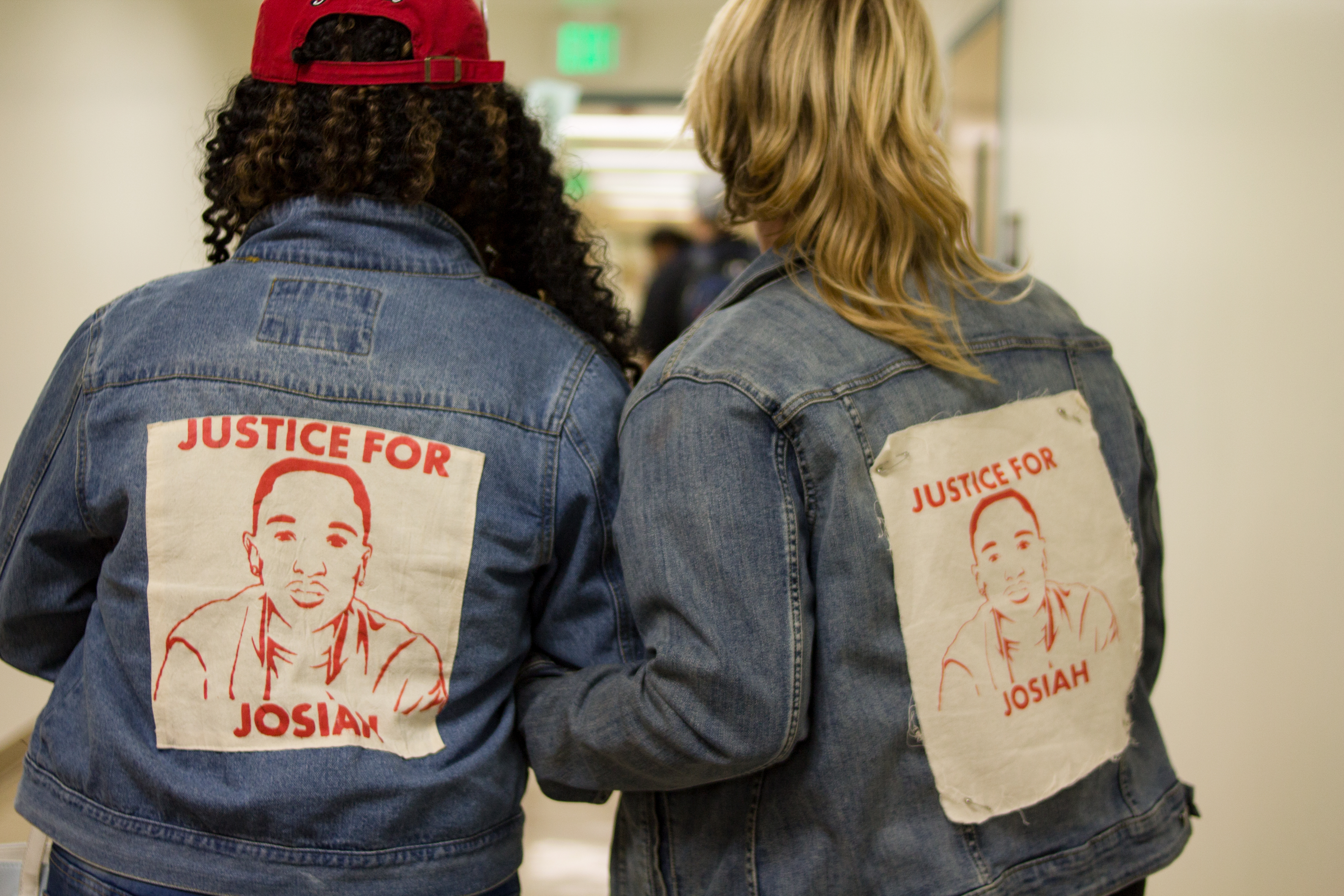
    It has been 18 months since the death of Humboldt State University student David Josiah Lawson. His murderer still walks free and case remains open.

    Charmaine Lawson, Josiah Lawson’s mother, spoke at Sacramento State on Oct. 15 on a panel with Justice for Josiah committee member Jill Larrabee, and Courtney Wagner, the director and editor of “Unsolved Hate,” a documentary of Josiah Lawson’s murder.

    Sacramento State was one of many campus stops for Charmaine Lawson during “Week of Action,” an event put together by Students for Quality Education to remember Josiah and discuss safety and the CSU’s accountability of Josiah Lawson’s murder.

    Twenty-one of the 23 California State University campuses participated in “Week of Action.” Lawson was invited to CSU San Francisco, Sacramento, Pomona and Fullerton.

    “I never thought I’d be sitting here right now,” Charmaine Lawson said, “We have gotten so much attention because of students.”

    Charmaine Lawson has also gained support of the California Faculty Administration. Charmaine Lawson said CFA has been amazing in the effort to hold the CSU accountable for Josiah Lawson’s murder and to better protect students.

    TW.charmaine.IMG_8408
    Charmaine Lawson (center) said she has been greatly supported by students and CFA in trying to hold CSU accountable for the murder of her son, David Josiah Lawson, who was a HSU student. Charmaine was in Sacramento on Oct. 18, 2018 and has travelled to four other campuses during Weeek of Action. | Photo by Tony Wallin

    Charmaine Lawson said that the CFA is helping by making postcards for people to sign, asking Humboldt County DA Maggie Fleming to excuse herself from the case.

    “CFA has been instrumental in their action plan and their resources,” Charmaine Lawson said.

    Charmaine Lawson told the crowd of CSU faculty, students and parents that she has had resistance from city officials, law enforcement and HSU administration since the beginning of the case.

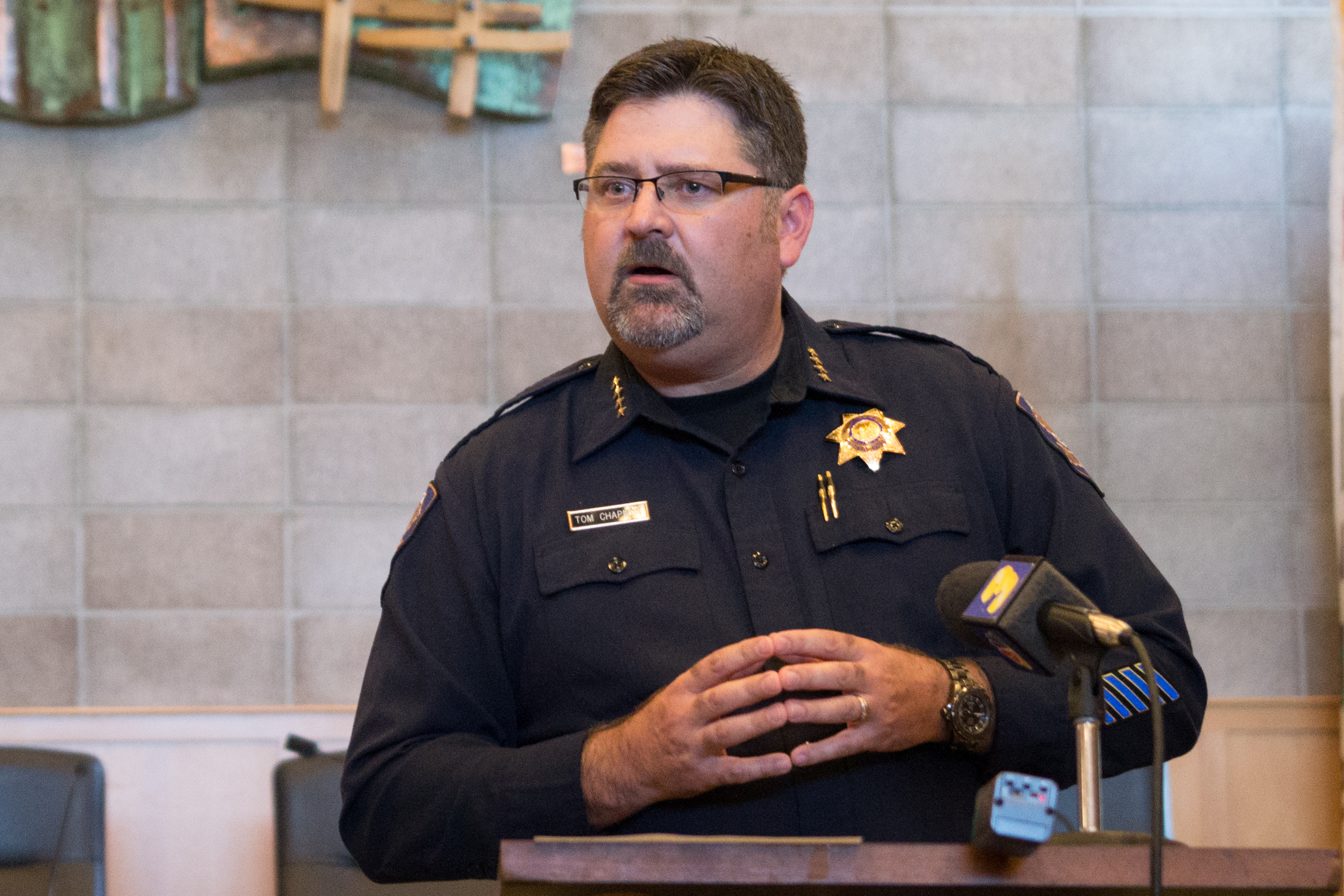
    For months, when the case was being first investigated, Charmaine Lawson said Lt. Todd Dokweiler told her she could only speak with police chief Tom Chapman. Charmaine Lawson said that Chapman was telling her false information and has since resigned from the police force.

    “Chapman lied by saying San Jose and Eureka were helping with the case, but none of that was true,” Charmaine Lawson said.

    Charmaine Lawson said Arcata City Manager Karen Diemer, defended Chapman when she confronted her about Chapman’s lies.

    “She defended the presence of the city instead of exposing the city for what it really stands for,” Charmaine Lawson said. She said Diemer needs to go next.

    When she tried to contact HSU President Lisa Rossbacher about her son’s murder, Charmaine Lawson said she never got a response. She said she called her twice and has yet to get a call back. Rossbacher’s resignation as HSU’s president is effective June 30, 2019.

    “Lisa Rossbacher hasn’t even called me to offer her condolences,” Charmaine Lawson said.

    TW.charmaine.IMG_8415
    Jill Larrabee, Justice for Josiah committee member, Margarita Berta-Avila, CFA president at Sac State, Charmaine Lawson, mother of Josiah Lawson, and Raul Tadle, faculty at Sacramento State University on Oct. 18. | Photo by Tony Wallin

    Sacramento State CFA president Margarita Berta-Avila said one of the problems with the CSU system is recruiting potential students of color without informing them all the details of their possible future environment. The details that aren’t shared include the amount of students of color admitted and how isolated the area may be. Berta-Avila said there should be institutional policy guaranteeing new students will graduate and be safe.

    “It shouldn’t be when someone is killed that change occurs,” Berta-Avila said.

    Berta-Avila said the CFA got involved when Charmaine Lawson met with CSU Chancellor Timothy White. Berta-Avila said that when Charmaine Lawson stood in front of CSU administration to speak of her son’s murder, a police officer walked behind her and put his hand on his gun. Berta-Avila said that was the moment when CFA had to pursue action.

    “The violation doesn’t stop — it continues off campus,” Berta-Avila said.

    Jorge Quintana, a leader of Students for Quality Education at Sacramento State, said there is a difference between recruiting and having available space. Quintana said CSUs don’t hold safe spaces for students of color. Quintana said moving forward means addressing the shortcomings of the university regarding safety and to make sure protocol is followed.

    “It is CSU’s responsibility to keep us safe,” Quintana said.

    Quintana said if the HSU president didn’t call Lawson and CSU hasn’t done anything to help, then this is clearly an issue for students of color. Quintana said CSU hands are tied now that a student has died. Quintana said this is when educating students is needed.

    “Whats most important is to remember Josiah,” Quintana said.

    Quintana said CSU only cares when students are only doing good, but once they’re off campus or even struggling they stop caring. He said they have a choice on who gets admitted and who stays, but don’t have a choice of being students of color.

    “Systemic racism and micro aggressions are happening all over CSU campuses,” Quintana said, “There are more police officers than counselors.”


  • Community still demands ‘Justice for Josiah’

    Community still demands ‘Justice for Josiah’

    Police are past their estimated time for solving the more than one-year-old crime

    He was smart. He had goals. He came to Humboldt to avoid the challenges of South L.A.

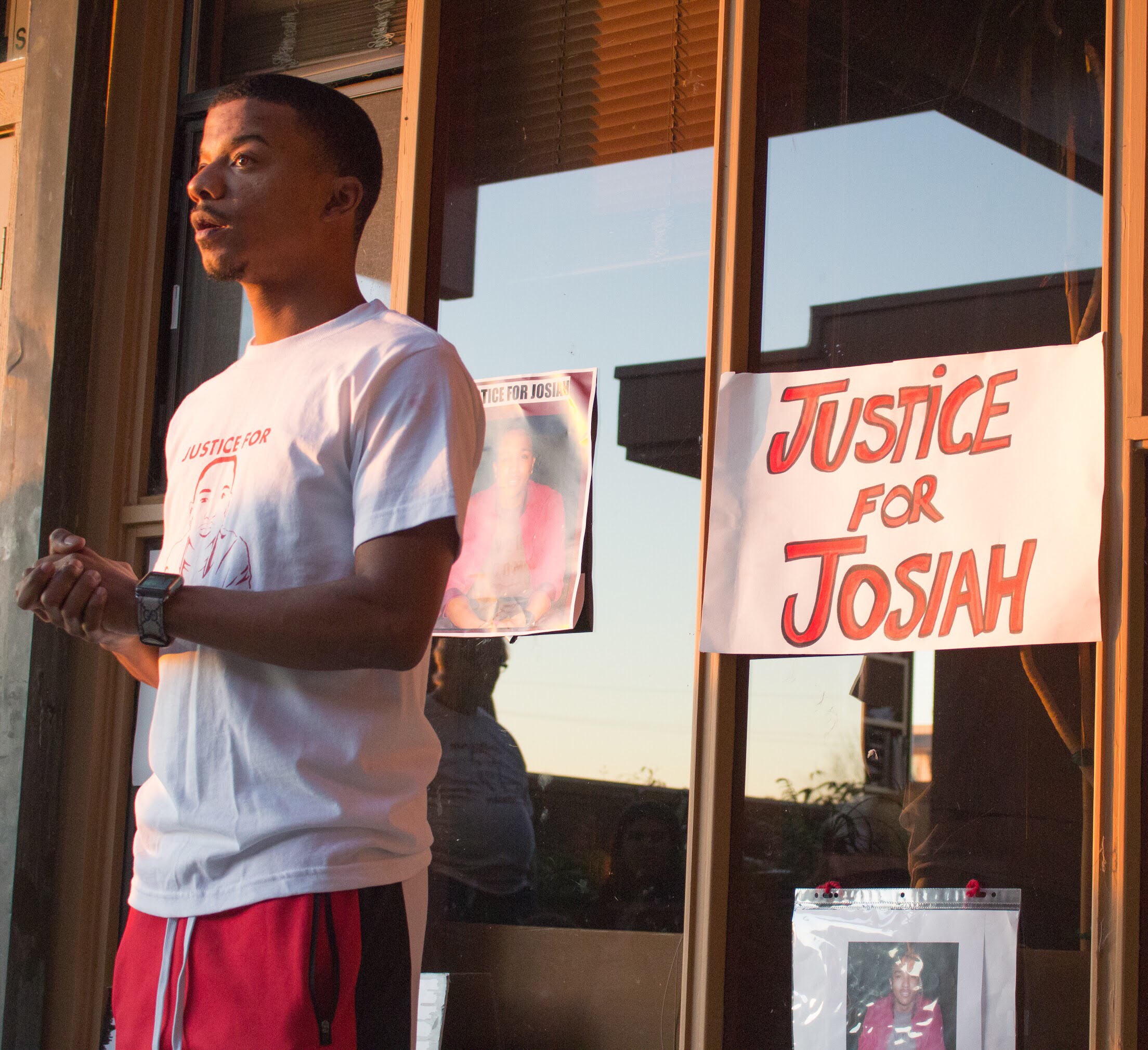
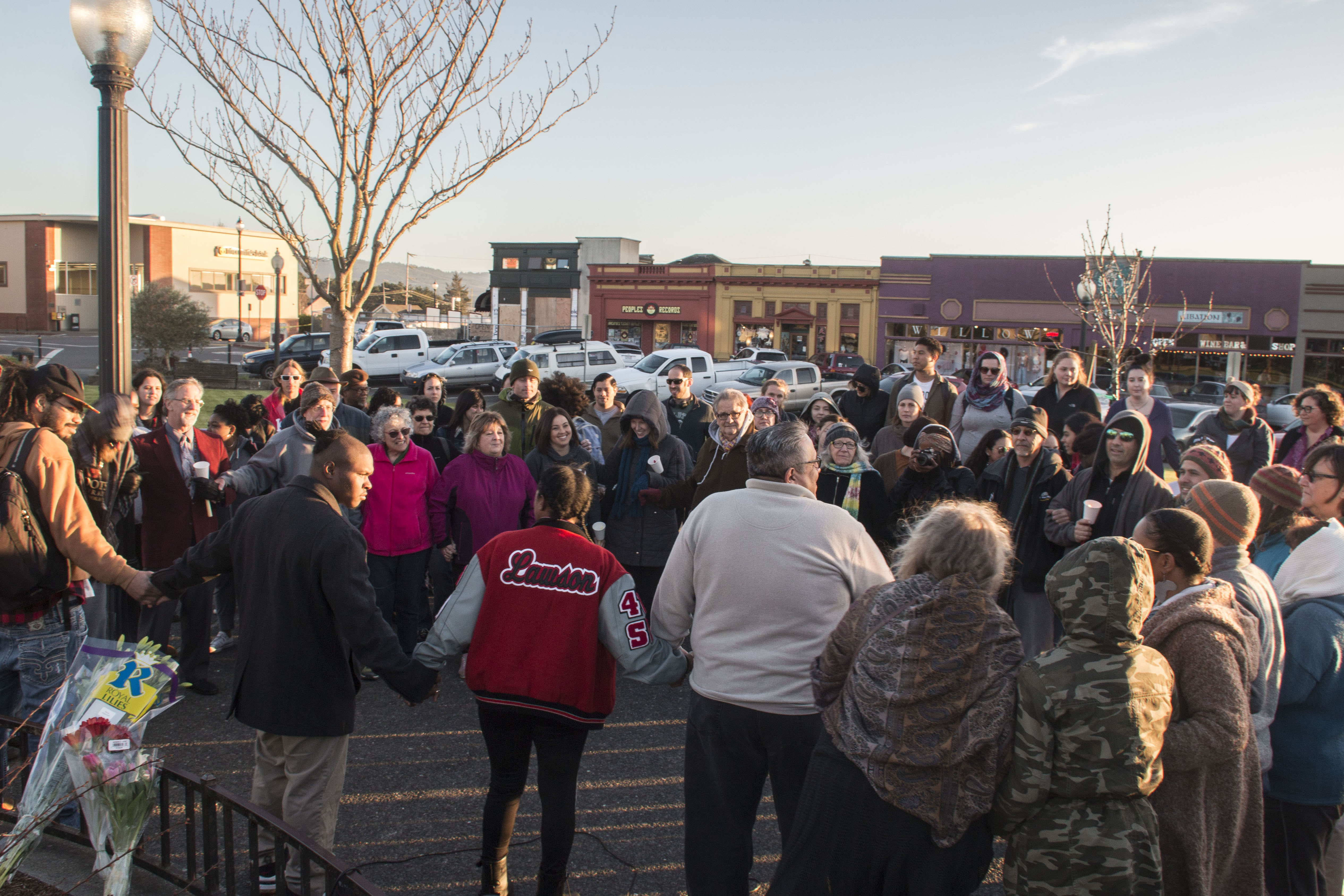
    These words were spoken outside of Arcata City Hall by Karim Muhammed, a friend of David Josiah Lawson. Lawson was murdered on April 15 2017 and his case still remains unsolved.

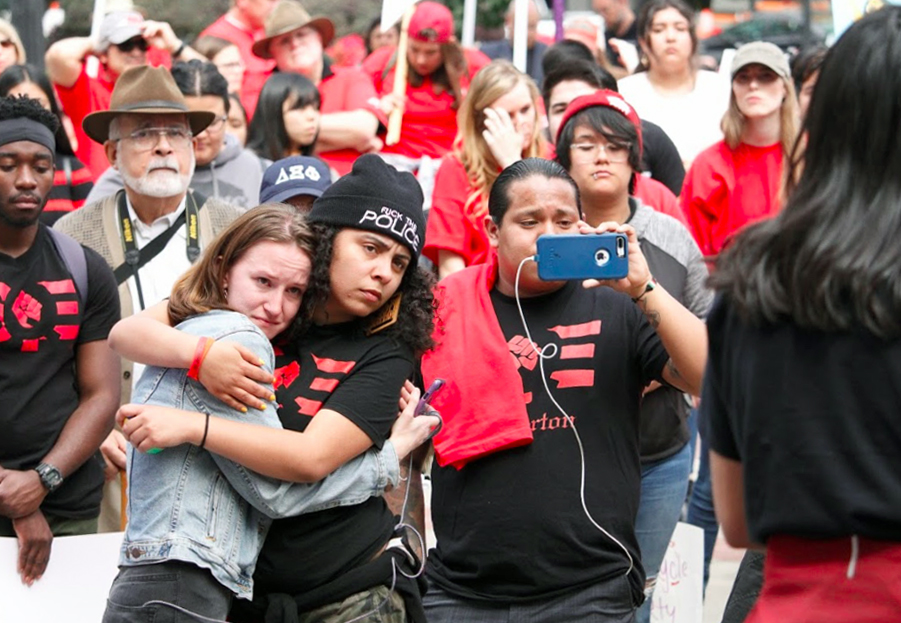
    Discussion on race and safety in the community were the main subjects amongst community members on Oct. 15. Tears streamed down faces as homemade posters of Lawson were hung on the walls in front of Arcata City Hall.

    Muhammed met Lawson their freshman year in the dorms at HSU. He said he misses Lawson and was at his dorm everyday.

    “He was one of the first people I met when I moved to Humboldt,” Muhammed said.

    Muhammed said he thought Arcata was safe compared to south L.A but that isn’t his experience. How to keep moving forward he said is to bring awareness and continue to inform incoming students about Lawson’s murder.

    “We need to get it solved, get new people in power, get people informed and vote,” Muhammed said.

    Muhammed said the goal is to make the community safer but many people in the community are still oblivious to the death of Lawson or they just don’t care. When he learned of the roster release of the HSU’s predominantly African American student clubs to the Arcata Police Department, Muhammed said that was a big red flag. He said this shows where they stand with the situation and further proves their indifference.

    “People choose what they want to believe or they just don’t want to believe,” Muhammed said.

    Meg Stofvsky, a retired school psychologist, said the vigil’s are held to continue remembering Lawson as well as inform people who are new in the area. Stofvsky was representing Charmaine, Lawson’s mother, and said Charmaine has caught the interest of the California State University system about her son’s murder. She said Charmaine has been travelling to other CSU’s to talk about safety on campus and will be in Sacramento later this week.

    “We need a firm insistence we are not going to continue to let this happen,” Stofvsky said.

    It has been 18 months since Lawson’s murder and Stofvsky said the county seems to be sliding backwards. She said we need to continue having resilience and hope and to keep the Arcata Police Department accountable. Stofvsky said the APD recently gave a six to eight week time limit to solve the case and that limit is up.

    “We hear a lot of talk about progress from the APD but we haven’t seen any,” Stofvsky said.

    When Charmaine Lawson comes into town for court hearings or monthly vigils she stays at Sharon and Michael Fennell’s house. Both are HSU alumni and have been proponents seeking justice for Lawson. Sharon Fennell, was a KHSU DJ under the name Sista Soul and said she met Charmaine at the second vigil held for Lawson.

    “We show up once a month. This is a beautiful thing and Charmaine knows,” Fennell said.

    Fennell offered ideas to start selling “Justice for Josiah” shirts at the HSU bookstore to continue to bring awareness of his murder. She said that way Lawson would be seen more on campus and students would be reminded of what happened. A conflict Fennell has is that students come to HSU but then leave after they graduate, which keeps Humboldt from changing.

    “People need to come, stay, build businesses and change the community,” Fennell said. “If not we stay 80 percent white. Boring.”

    A member of the “Justice for Josiah” movement, Jill Larrabee, said actions by CSU and California Faculty Association are starting to take hold regarding safety on campuses but society needs to change. Larrabee said we need to learn, educate, heal and grow and get more people in office.

    “Humboldt County has the good ol’ boys club in power,” Larrabee said.

    To move forward Larrabee said white people need to converse with other white people about racism. Larrabee said racism is still a big problem here in Arcata but more and more people are coming out and acknowledging their privilege.

    “When we hear white people say we can’t guarantee safety, then we are going to demand it,” Larrabee said.

  • Q&A Meet the Athlete: Lauren Reid

    Q&A Meet the Athlete: Lauren Reid

    The Lumberjack catches up with Women’s Volleyball star Lauren Reid

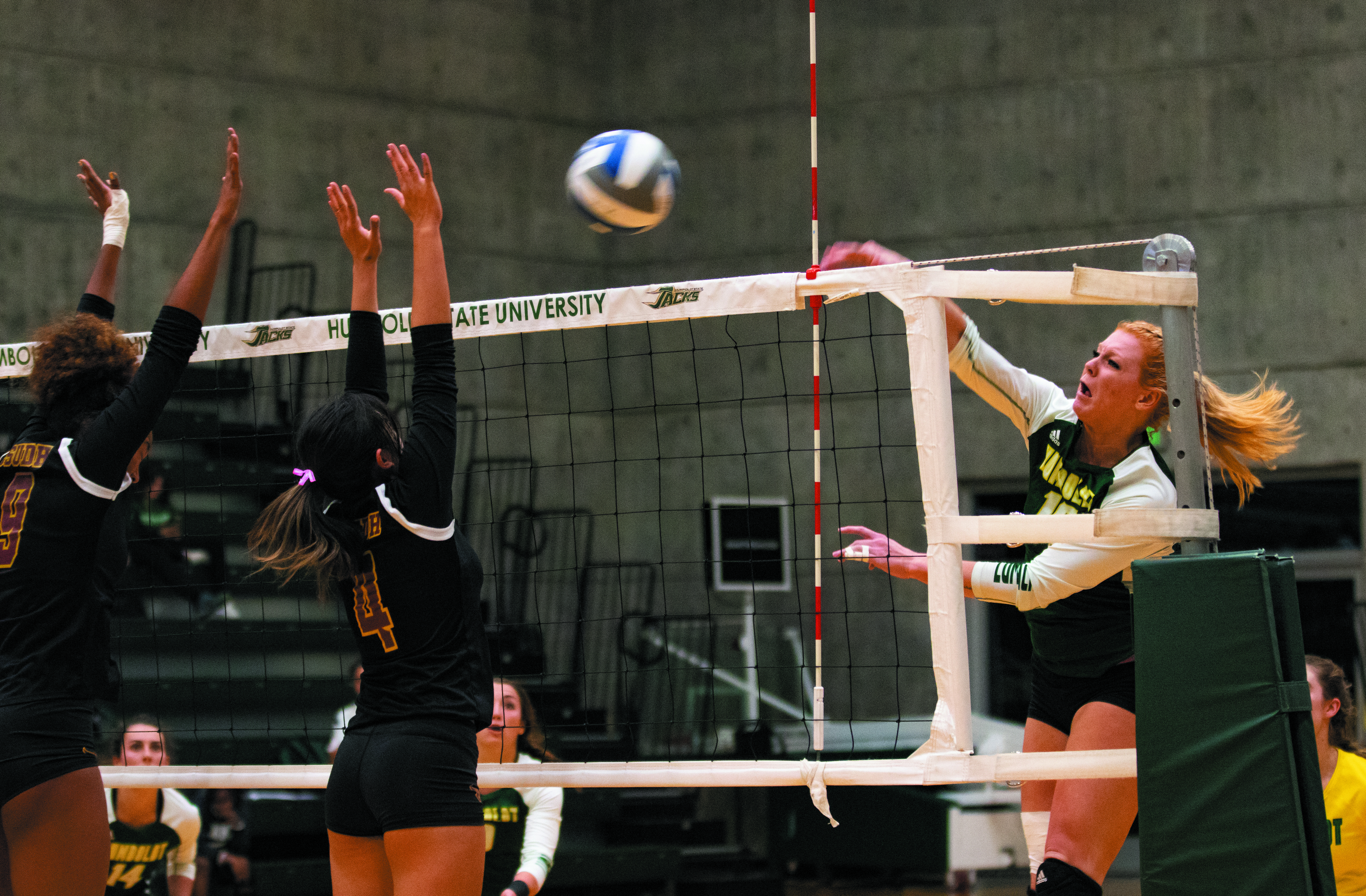
    Lauren Reid is a 20 year old, third year volleyball player leading the Lady Jacks in kills this season. She is from Riverside, California and is majoring in Elementary Education here at Humboldt State.

    Q: Why did you choose that major?

    A: I was kind of torn actually between that and kinesiology, but I’ve been surrounded by kids my whole life. My mom runs her own daycare out of our home and she’s been doing that my whole life. I grew up around kids and I coached over the summer. Helping and learning is what I love to do, so I just took that into teaching in the classroom.

    Q: What grade would you teach?

    A: I wanted to do younger kids until last summer when some of the kids I was coaching had a little impact on that! It’s the attention span. I want to be able to get to know their personalities. It was kindergarten. But now it’s fourth grade, fifth grade, but for sure elementary.

    Q: What do you miss most about home?

    A: I miss the sun. I’ll take any sunny day any chance I get up here. I miss feeling like I’m at home. I miss the smell of pollution to be honest, and the sun. I know that sounds crazy, but it’s true. I miss my family for sure.

    Q: What restaurant would you bring up here to Humboldt from home?

    A: Ohhhh, only one? “B-Dubs,” I miss “B-Dubs” a lot. I could go “hammy” on some wings at Buffalo Wild Wings.

    Q: Is it just the wings? Or do you like hanging out with your friends?

    A: It was always just fun to eat there and we’ve had a few parties there too. It’s just an overall good place to have fun and get good food especially if you like sports. I would bring the whole environment up here to NorCal and bless them.

    Q: What do you like most about being here in Humboldt?

    A: I like that I can be independent. Granted, I love my family to death and love all my friends but I like living under my own roof and having my own rules has been a real go-taker for me. One of the reasons I wanted to move away from home was because I wanted to grow up and learn to do things on my own. Grocery shopping for yourself and paying bills or whatever it may be.

    Q: What do you dislike most about Humboldt?

    A: I dislike the weather. Extremely. It gets really, I don’t want to be dramatic, but it gets really depressing. When it gets cloudy and rainy for weeks at a time I get so depressed. The sun literally brings me joy. That and the distance. We’re kind of by ourselves and lonesome up here. I want to get out of here but I don’t want to have to drive five hours to do that. We’re on an island! We’re trapped!

    Q: What position do you play in volleyball?

    A: I’ve played right side for the last two years. I originally played left side in high school. But this year I finally get to play left side again and I’m really happy about that!

    Q: Did you come here to play volleyball?

    A: Yes, I did. I wouldn’t be here without volleyball. I actually didn’t even know Humboldt was a school until I heard that a Humboldt coach was recruiting me. In these last three years it’s taught me more than anything did in high school. I’m grateful that it brought me up here because I’ve met some of my best friends that will last a lifetime.

    Q: Are you a competitive player or an emotional player?

    A: People actually think I look really pissed off when I’m playing or unmotivated, but I’m actually very, very competitive. I just stay to myself and stay very focused.

    Q: You’re killing it on the court, but the team hasn’t won a game yet this season. How do you deal with personal success when the team isn’t excelling in the same ways?

    A: It’s tough when you’re doing your job and doing really well, but your team isn’t winning. You get to the end of the game and you’re like, damn, the team lost but I got this many kills or whatever. I guess I’ve been torn a few times this season. If we can get a couple people getting 10 to 15 kills per game, then we’ll be winning. It would be a game changer.

    Q: Where do you see yourself in five years?

    A: I see myself done with college. I better be! Back home, for sure. And honestly hopefully teaching at the elementary school that I went to. I live half a mile from my elementary school. I mean, I won’t be living there anymore, hopefully I’ll be moved out by then! But I do love kids. So I hope that I can have a little baby bump or something, ya know? I really love kids and want to have them myself.

    Q: It’s time for my favorite question, who is your celebrity crush?

    A: I feel like I can’t just have one, but every time I see him on TV and in his music videos, I’m like, yeah, that’s the one. Maybe Drake!

    Q: Who is his competition?

    A: I only know their names in the show. Stefan and Damon from Vampire Diaries. But I don’t know their names, so I guess it goes to Drake!


  • Students seek justice for all

    Students seek justice for all

    The HSU community was burdened with the loss and murders of David Josiah Lawson in Arcata, California April 15, 2017 and Corey S. Clark in Eureka, California Oct. 6, 2001.

    The justice movement for Lawson and Clark has continued to gather students in efforts to raise awareness to other students and the community they live in.

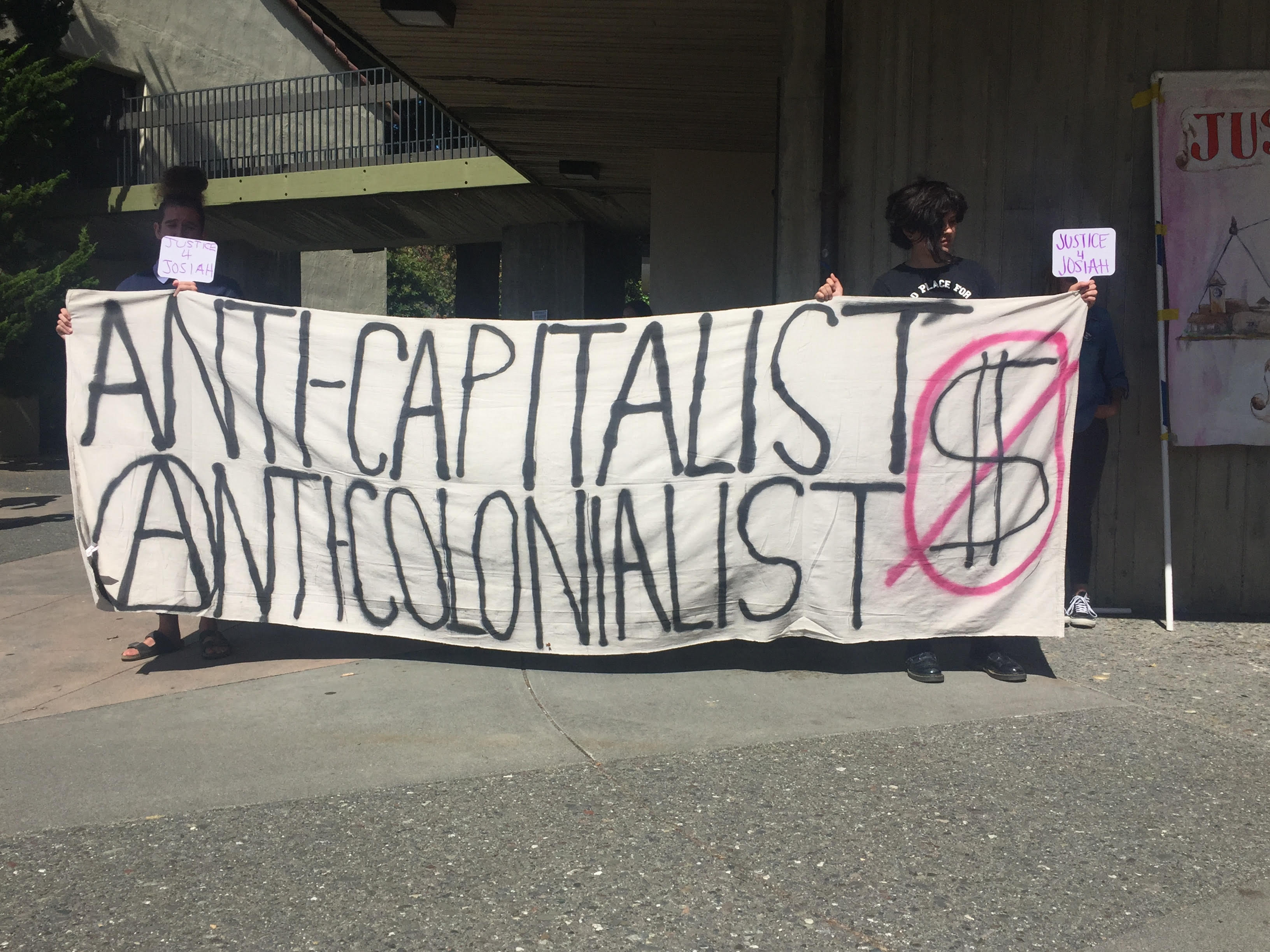
    ‘The Diversity Is Not Inclusion Rally’ brought students together at the HSU quad on Sept. 12, to further inform students about the loss of Lawson and Clark, and speak about universities who should be held accountable for failing to protect and support students of color.

    Vice President of the Black Student Union, Barbara Singleton lead the rally held at the quad, and voiced her concerns about HSU and the handling of students of color.

    “At Humboldt State, students here are viewed as economical commodities. If they (Humboldt State University) bring us up here, they have to know we are bringing in black and Hispanic culture. If they can’t respect us, then don’t bring us up here,” Singleton said.

    Hot topic issues such as student homelessness and budget cuts to the universities institutions were also some of the issues brought to the students attention in attendance. The focus of the rally was to reiterate the issue of the two unsolved murders of HSU students, Lawson and Clark, and to raise awareness for students that there lays a capitalistic mentality towards students on and off campus.

    Senior Nathaniel McGuigan, part of the Justice for Josiah movement, first came to HSU as a freshman completely unaware of any racism,

    “Like many other new students, I was unaware of what happened in the community, I did not learn about many of these issues until my second year,” McGuigan said.

    The rally further voiced more awareness to future HSU students, in order to keep them informed of a divide that seems apparent between students on and off campus.

    “We want the Humboldt State Administration, to get involved in the case, to actually put pressure on the Arcata City Council and helping us seek justice for Josiah,” McGuigan said.

    Meg Stofsky, one of the speakers at the rally, spoke about her view of the racism she feels that is present in Arcata.

    “I came here and found…really a ghetto. HSU feels like a ghetto to me, and so does Arcata, where the systemic and historic racism means that you can kill people and get away with it, and it does not matter,” Stofsky said.


  • EDITORIAL: Football program cut will create ripple effect

    EDITORIAL: Football program cut will create ripple effect

    Loss of football program also means loss of diversity, opportunity

    Lumberjacks football has been a staple of Humboldt for over 90 years. But this season will be the last for the foreseeable future and this community is losing more than just a team.

    Football brings more to the table than just sports. Student-athletes chose this school to pursue their education and to chase their dream of playing college football.

    Terminating Jacks football will be the conclusion of a program that has been a part of Humboldt since 1924, not long after HSU’s founding. The program has seen some standout stars and big-time players along the way. Lumberjacks 2017 All-American offensive lineman Alex Cappa was selected 94th overall by the Tampa Bay Buccaneers in this year’s NFL draft.

    HSU says they do their due diligence to remain somewhat ethnically balanced while bringing in students from all over California. This practice is misleading as the university’s surrounding areas have many racial undertones. The football team is one part of the school that was true to HSU’s message of inclusivity.

    Where there were once young men of all races working diligently towards the same goal, there will no longer be. The locker room that once brought men together will be empty.

    HSU will honor scholarships for eligible players through the 2018-19 academic year, and coaches and staff will also help players contact other programs. At the end of the season, players will get a full release, which means they could choose to play at another institution.

    President Lisa Rossbacher called it an unfortunate but necessary step in addressing the University’s structural deficit and protecting the school’s core academic mission. In her “mission” she has neglected a big part of what is supposed to make this university great.

    The closing statement of our mission states: “We help individuals prepare to be responsible members of diverse societies.”

    Less than four percent of HSU’s student population is African American and less than two percent of faculty are African American. Where is the diversity? Where is the care for the individual student?

    HSU has experienced lower enrollment over the last two years. Fall enrollment has dropped by more than 400 students. This dip has had a measurable impact on the budget and the loss of football will expectedly lead to an additional decline in enrollment, which in turn will bring less people of color.

    While getting rid of the football program could possibly be the right decision fiscally, the loss will be felt by many. People may not have ever met, had it not been for the football team. Familiar faces will change into strangers faces. What once brought a sense of camaraderie to this campus will now no longer exist.

    HSU hopes that contributors and boosters will continue to support HSU athletics but the $200,000 or more increase in contributions last year was for football. Loss of the football program will have a long-term ripple effect. Where and what gets hit the hardest remains to be seen.

  • Football gets the boot

    Football gets the boot

    Early this afternoon, Humboldt State University announced that after this 2018 season the football program will be cut.

    “This [decision] is due to ongoing financial challenges within athletics and at the university as a whole,” Humboldt State University President Lisa Rossbacher said. “We cannot allow the budget deficit in athletics to continue or to deepen further.”

    This April, Rossbacher announced the two-year budget plan in reducing costs by at least $9 million and many hoped that the football program would not be a part of this cut. However, according to the HSU Athletic Department, the net cost of about $1 million annually became too expensive for the University to support and subsidize indefinitely.

    “It is the only realistic path for us to take,” Rossbacher said.

    Redshirt Sophomore Kyle Martorella called home as soon as he received the news. He said he was very surprised and upset after hearing the program would be cut.

    “I can really only see myself playing at Humboldt so it sucks,” Martorella said. “I thought we were guaranteed another five years and that was what the money was raised for.”

    Since December 2017, HSU boosters, alumni and community members put forth their utmost effort in reaching a goal of $500,000 that would have ensured another solid year of football at the Redwood Bowl. During that time Rossbacher announced if $500,000 was collected by January of each year, for the next five years, the University would match it with another $500,000 to keep the program.

    Although SaveHSUAthletics confirmed nearly $511,000 in pledges last fall, only $329,000 in cash donations were collected in June, according to Rossbacher.

    However, SaveHSUAthletics Co-Founder and HSU alum Jim Redd shared that in fact, a total of $410,000 was collected.

    “I know that a payment of $80,000 was scheduled to come in, and received on July 15th,” said Redd.

    The total amount of donations that were collected will be used for this last football season at HSU and all of the scholarships awarded will be honored to eligible players through the 2018-2019 academic year.

    “We are going to be very supportive of the current players and coaches this year,” Redd said. “The support is going to drop way off for HSU athletics as a whole.”

    Although several boosters donate to other HSU athletic programs as well, Redd and his fellow boosters believe cutting the program was all a part of Athletic Director Duncan Robins’ plan and because of that, many supporters no longer want to give money to HSU athletics at all.

    “There are a lot of donors upset and wanting their money back,” said Redd. “I just feel like Robins was hired to get rid of the program. It took him seven months longer than he would have liked but he succeeded.”

    HSU’s athletic department said it plans on providing as much support as needed for current players, whether they choose to complete their academic years at HSU or to transfer to another school and continue playing football.

    HSU junior and 2018 captain Isaiah Hall said he plans on “riding out” with a strong team for this last HSU football season and hopes to ensure his team that this decision should not interrupt what they have accomplished for the success of this season so far.

    “I always had a feeling that this was bound to happen,” Hall said. “When [Rossbacher] was on the podium talking about keeping the program, her words felt untruthful.”

    After this season, Hall is eligible to play two more collegiate years of football and after speaking with his family he plans to have a successful season and transfer to play at another university come spring.

    As for new recruits, Chris Quirarte from Buhach Colony High School and Braden Gordon from Independence High School, new beginnings have already come to an end. Both of the newly announced Jacks from Southern California said they were not sure what to think about the news and immediately contacted family for support.

    “I am stuck on whether I want to redshirt or play this year,” Quirarte said. “The decision changes my outlook on the season a little but I am not trying to pull the trigger on my decision too early.”

    Last year, HSU athletics held a deficit of about $750,000 in which the university covered; and three years ago that deficit was at $250,000. The rate of cost increases in the athletics department at HSU has been roughly double of the university costs in whole.

    Rossbacher said she still plans on maintaining a Division II athletics program at HSU and in order to remain eligible for NCAA Division II competition, the University is required to have 10 sports. According to the HSU Athletic Department To remain in the California Collegiate Athletic Association, HSU’s primary conference, the 10 sports are required to be chosen from a specified list, and football is not included on that list.

    After this 2018 football season, HSU will sponsor 11 sports: men’s and women’s basketball, men’s and women’s soccer, men’s and women’s cross country, men’s and women’s track & field, crew, softball and volleyball.

    “At this point we just have to come together as a team,” Martorella said. “We still have 10 games like any other season and we can still win a ring like any other season.”

  • We still don’t feel safe

    We still don’t feel safe

    Racial discrimination on campus is rampant

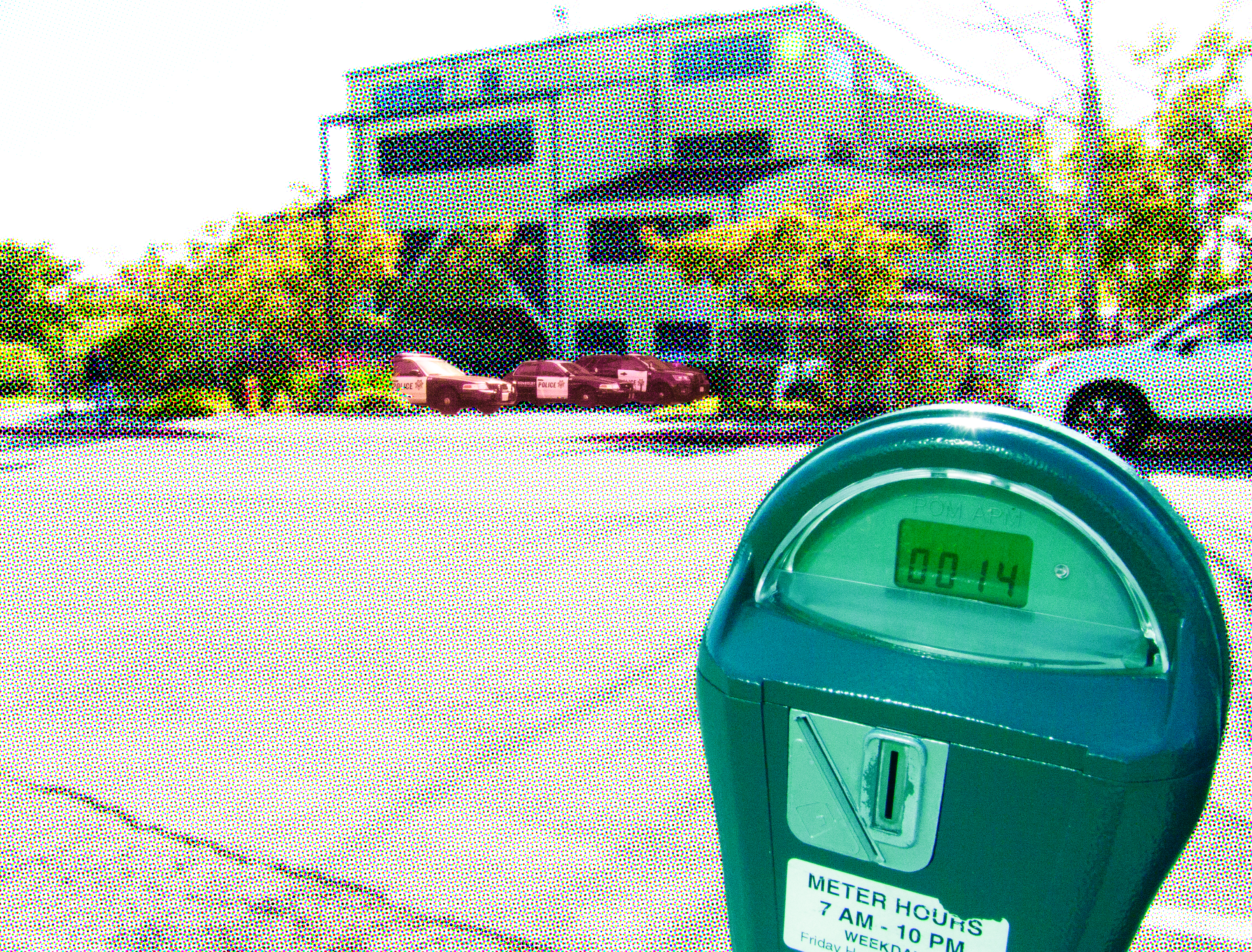
    I, Skye Kimya, believe I was detained on Feb. 14 over a $40 on-campus parking ticket because of the color of my skin.

    Around 8 a.m. that morning, I walked out of a building on the northeast side of campus to find two parking officers giving me a ticket for where my car was parked.

    After getting into a small verbal altercation with these parking officers, I realized it wasn’t worth the argument. I asked them to give me the ticket and let me go about my day.

    The parking officers were not happy with me driving off while they were still giving me my ticket, and before I knew it, Humboldt State police Chief Donn G. Peterson was pulling me over in an undercover vehicle.

    Within minutes, another University Police Department vehicle arrived to the scene. I was interrogated for approximately 10 minutes by two officers on each side of my car about the incident that had just occurred. After the officers spoke with each other for a few minutes, another cop car pulled up, and UPD officer Delmar Tompkins made his way to my driver side.

    “Please step out of your vehicle and put your hands behind your back,” Tompkins said.

    “Excuse me? I don’t understand,” I said.

    I was told I was being detained under suspicion of assault with law enforcement. After questioning this accusation, I was told I was a threat at that time and needed to be detained for the safety of the officers because they did not know the full story yet.

    Confused and scared, I got out of the car, did what Tompkins asked me to do and began to cry like a baby as he placed me in the back of his cop car.

    Imagine being detained and told you are a threat, under suspicion of assault, by a white officer twice your size. Imagine feeling confused and alone. Imagine questioning what could possibly happen next.

    When you grow up trying to understand the purpose behind discrimination, you begin to notice how common it is and wonder if it will ever go away.

    At times, you lose hope for your children’s generation. Yet other times, you want to become the greatest activist that has ever walked this planet, in order to actually make things right for those future generations.

    Students at HSU don’t feel at home. We don’t feel as though there are people by our side, and we don’t see the amount of people of color around campus that the HSU pamphlets and website photos presented to us when we were deciding which university to attend.

    According to HSU’s “fast facts,” the incoming class of fall 2016 consisted of 549 Hispanic/Latino students, 51 African American students, 31 Asian students, 11 American Indian students and four Pacific Islander students.

    Additionally, the entire fall 2016 student body consisted of 2,869 Hispanic/Latino students, 271 African American students, 279 Asian students, 89 American Indian students and 20 Pacific Islander students.

    With a student body total of 8,503, you can imagine what it is like to see only 270 other faces similar to yours on one side, and only 88 other faces similar to yours on the other side.

    Hispanic and Latino students made up almost 35 percent of the entire student body that same year. Seems like a reasonable amount, right?

    HSU actually receives funds from the U.S Department of Education ever since they became a Hispanic-Serving Institution at the start of the fall 2013 semester.

    To become a Hispanic-Serving Institution, the university has to have an undergraduate full-time equivalent enrollment of at least 25 percent Hispanic students, and HSU was at 26.6 percent for the fall 2013 semester.

    HSU continues to flaunt a great amount of diversity that it does not have. These incoming students, like many of us who were once in their shoes, attend HSU and slowly begin to witness and experience how diverse this campus and community is truly NOT.

    Just the other day, the NAACP Eureka Branch called out HSU and asked them to stop recruiting students from minority-majority neighborhoods until changes are made around campus and within the community.

    A majority of the students of color who have attended HSU for at least two academic years have experienced some type of discrimination, whether it was verbal, physical or emotional.

    In 2013, Tompkins had a civil lawsuit filed against him by a Fieldbrook man who alleged he was the victim of a brutal assault back in January 2012. It turns out the Fieldbrook man wasn’t lying and the Cal State University system paid him $135,000 to keep him quiet.

    As students of color at this university, how are we supposed to feel safe if our own UPD officers don’t do things the right way and have our back?

    Cases like the murders of HSU African American students Corey Clark (2001) and David Josiah Lawson (2017) are still unsolved to this day, and we as students have not seen enough action taken by our president, UPD and even the Arcata Police Department.

    Students of color do not feel safe, nor protected here. The NAACP Eureka Branch is right and something has to change before HSU tries to drag more students of color to this campus.

  • Upset mothers march to Arcata City Hall

    Upset mothers march to Arcata City Hall

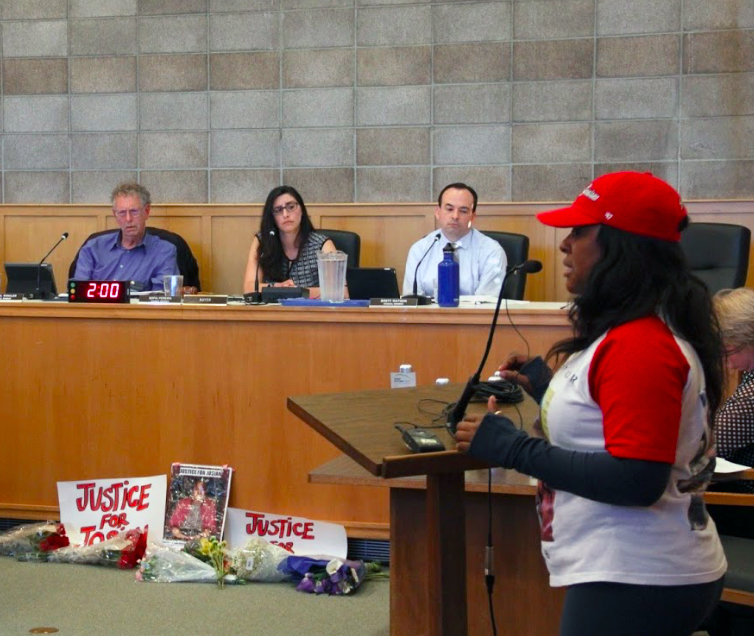
    Angry mothers, students and community members all marched in solidarity with Charmaine Lawson from Humboldt State’s Library Circle to Arcata City Hall demanding Justice for Josiah on April 18.

    Just a few days after the one-year anniversary of the death of HSU student David Josiah Lawson, who was fatally stabbed at an off-campus party on April 15, 2017, people are impatient for answers.

    “We demand justice for Josiah and we want Tom Parker back,” Charmaine Lawson said.

    Tom Parker is a retired FBI agent who was brought up to privately inspect the case for the last eight months. He resigned last week.

    The march made its way from HSU to City Hall through F Street. The city council was meeting that day and the shock could be seen on their faces when up to 100 people marched into the hall chanting, “Justice for Josiah!”

    The mayor of Arcata, Sofia Perreira, was in attendance, as well as city council members Brett Watson, Paul Pitino and Michael Winkler.

    The forum opened up for members of the public to address the board and a line started to form.

    “There is a killer on the loose and if I feel unsafe as an old white lady, how are these students of color supposed to feel safe?” Arcata resident Denny Dorsett said.

    As many other people came up to speak their minds, the energy in the room began to grow more charged.

    “I grew up in this place and I don’t feel safe anymore. Why are you not trying to protect me?” Faith Shaineider, an Arcata High School student who came to show her support said.

    Shaineder’s mother, Zera Starchild, was also in attendance and had some heavy words to deliver.

    “This town has already changed because of this,” Starchild said. “Arcata will never be the same again.”

    While many brought up concern for their own safety, others brought up different reasons justice needs to be served.

    Leslie Rodelander is a grant analyst at the Sponsored Programs Foundation at HSU.

    “If compassion doesn’t move you, hopefully economics will,” Rodelander said. “I see the sheets, and the number of students coming to HSU is dropping and will continue to drop if this does not get fixed.”

    After every other person spoke their mind, it was Charmaine Lawson’s turn. Mayor Perreira did not impose a time restriction on Charmaine Lawson as she had on everybody else, so she was able to deliver a powerful message.

    “I demand Tom Parker back. Call him in the morning Sofia,” Charmaine Lawson said. “If the roles were reversed, I know my son would be sentenced already. I need to know what happened to my son!”

    Cheers and applause could be heard around as people shared their support.

    After hearing from everybody who wanted to speak, Mayor Perreira motioned for a 10-minute recess, during which she approached certain members of the audience. In a strange turn of events, Perreira returned from the recess and adjourned the meeting. People tried to figure out why, but were given no answers.

    It has been over a year since Charmaine Lawson lost her son and the case is still wide open.


  • Records rule again

    Records rule again

    The tables have turned in favor of vinyl records. While CDs and cassettes reigned king in the 1980s and 1990s, it was the rise of digital downloads and online streaming services in the 2000s that inexplicably aided in the resurgence of records. Today, records are outselling digital downloads for the first time since 2011.

    “Vinyl sales were up 10 percent to $395 million — a ‘bright spot among physical formats,’ the [Recording Industry Association of America] noted [in a 2017 year-end revenue report],” Derek Hawkins of The Washington Post said. “The outlook for digital downloads is bleak. This is the third year in a row they’ve posted double-digit declines, according to the RIAA.”

    As Apple commercialized MP3 downloads in the early 2000s, CD sales began to drop. Though cassettes are making a comeback in some areas now, thanks to record labels like Burger Records, they lost their popularity more significantly by that time as well.

    Making our way into the 2010s, millennials caught on to the joys of listening to records as download and streaming services continued to revitalize the music industry. In fact, a great deal of new records these days include free download cards — a good incentive to get the best of both worlds, that is, a tangible medium and a digital download of an album.

    Record Store Day is a global event that has happened every April since 2008. Independent record shops from all over the world participate by selling limited edition records made exclusively for Record Store Day.

    “This is a day for the people who make up the world of the record store—the staff, the customers and the artists—to come together and celebrate the unique culture of a record store and the special role these independently owned stores play in their communities,” the Record Store Day website wrote.

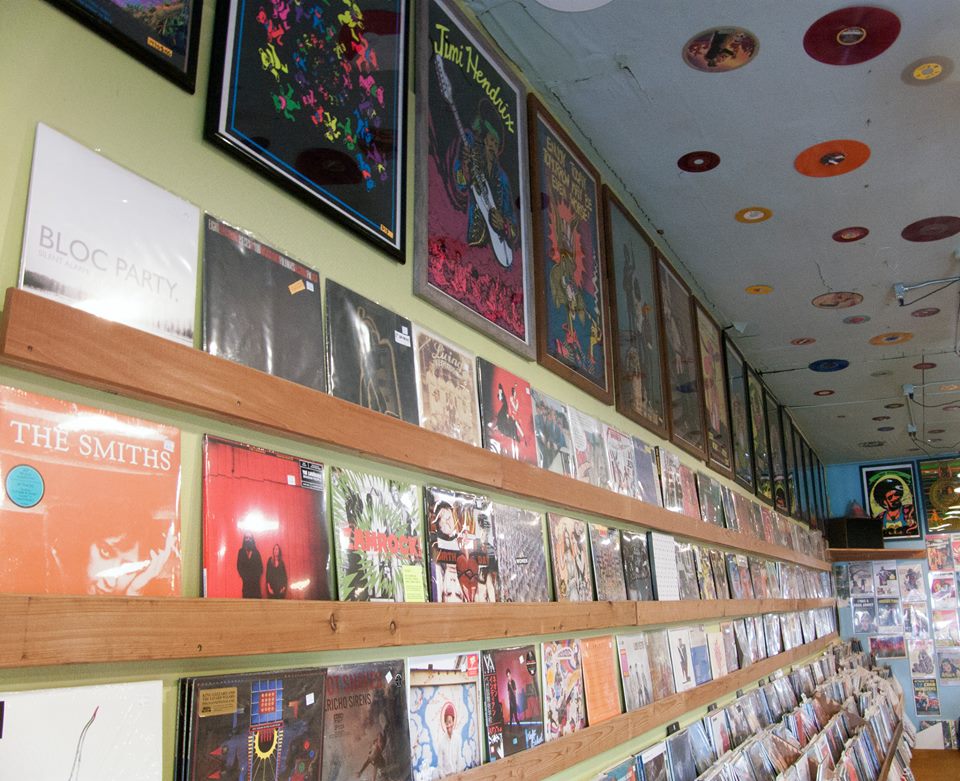
    While it’s slim pickings in Humboldt County, People’s Records in Arcata carries a wide selection of outstanding records year-round. From 11 a.m. to 6 p.m. on Saturday, April 21, People’s Records will offer this year’s exclusive Record Store Day selections, and they’ve made extra room for more records.

    “We will have many of the limited edition Record Store Day items, plus we have expanded and knocked down a couple walls in the store to accommodate 1,000 new records in our stacks,” People’s Records wrote on their Facebook page.

    People’s Records in Arcata. Photo by Matthew Hable.

    Generally speaking, there is nothing wrong with digitalized music. The average human ear can’t detect the sample rates of professionally processed digital audio, nor can they make out the subtle differences in sound of analog waves, aside from the record’s “warmth” people commonly claim to hear in contrast to MP3s or WAV format.

    However, what sets records apart from other formats is their level of interactivity and the way they appeal to the senses. The process of taking a record out from its sleeve, placing it on a turntable, carefully dropping the needle on the record and even the smell of records makes it that more special.

  • International festival reels universal film into Humboldt

    International festival reels universal film into Humboldt

    Student-run Humboldt International Film Festival hosts film from across the globe for 51 years.

    The longest running film festival entirely managed by students is hosted in the heart of Humboldt every spring.

    Humboldt International Film Fest is open to any film submissions from around the world and combines international film with local film lovers and artists.

    Screenings will begin Wednesday, April 18 and will continue for four days with the Best of the Fest screening on Saturday, April 21. Four final categories include experimental, narrative, documentary and animation.

    A reappearing character in the animation category has been The Bum Collective’s 10-foot, one-eyed, orange monster, Lilly. Lilly Monster was originally drawn up in Calgary, Canada by Xstine Cook’s kids and has developed into a family-run series.

    Cook’s three children, along with her sister’s three daughters, have been making animated shorts since 2010 and have participated in the festival for seven years. The first animated short of the series, Lilly’s Big Day, was drawn and voiced by Cook’s 3-year-old at the time.

    This year, they submitted the film Lilly and the Baby, the most recent adventure of the monster babysitting a human child.

    Cook said she was pleased by the reaction to the previous films by the Humboldt audience.

    “There were all these stoned people and they all got the jokes,” Cook said. “It’s for kids, but they all were laughing.”

    Aside from a class in the film department at Humboldt State, the festival is a campus club that anyone can join and contribute to. Students in the FILM 260 class and club participate in pre-screenings of festival submissions, judge each one and decide on which ones make the final cut.

    Over its 51 years, the Humboldt International Film Festival has moved venues. Held for the first time in 1967 at the Sequoia Theater (currently the John Van Duzer Theatre), the festival has expanded to a yearly, four-day celebration of international film at Minor Theatre.

    Maddy Harvey is a senior film major at HSU. Harvey has been involved in the International Film Fest since 2016 and this year, she is the co-director of entries.

    Harvey says this year, the festival received more than 195 films from 22 countries around the globe.

    “It’s really interesting to see how different countries and cultures express themselves through film, how different stories are told,” Harvey said.

    French exchange student Joanna Cottel is part of the film class at Humboldt State and has loved her experience planning the festival.

    “I have been part of organizing other film festivals in France, so I when I saw this one, I was like, hell yeah!” Cottel said.

    Cottel says as an exchange student, she is proud to be participating in the festival.

    Screenings will be divided into four days based on categories, and will begin at 5 p.m. and again at 7:30 p.m. Tickets are $5 for each day and $10 for the Best of the Fest screening on Saturday, April 21.

    “Even though the festival is international, the heart of it is in the Humboldt community,” Harvey said.

  • “Divergence” dancers amaze audience

    “Divergence” dancers amaze audience

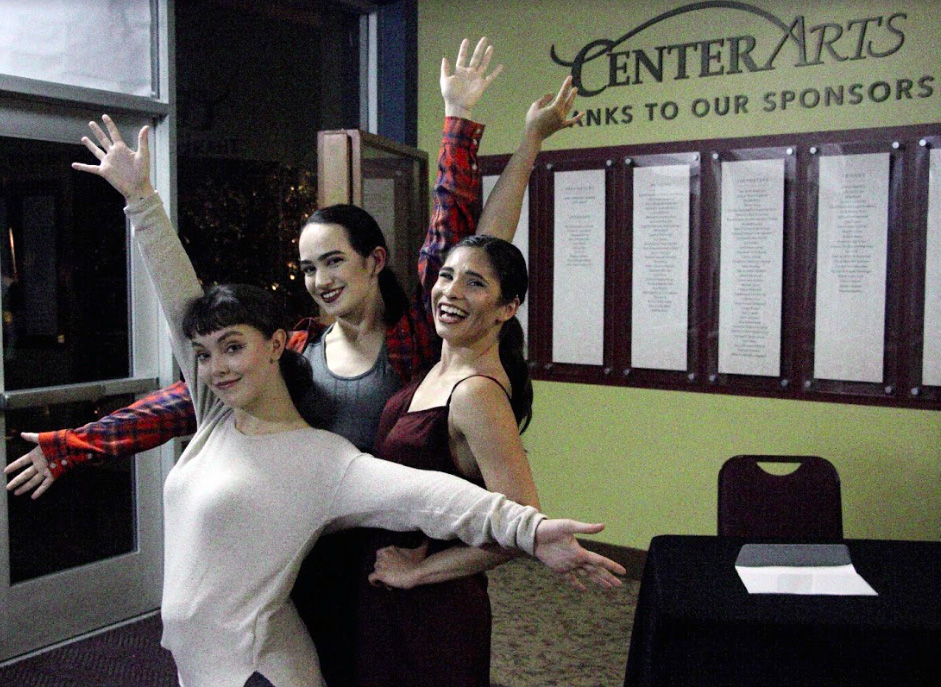
    The audience at the John Van Duzer Theatre were fortunate enough to witness a cacophony of kinetic expression in the form of HSU’s annual spring dance concert on April 15, this year titled “Divergence.”

    Students of intermediate and advanced levels were given an opportunity to work in tandem with other students and alum choreographers. They chose music and themes to collaborate in the creation of 10 beautifully executed dances.

    The performances were varied both thematically and visually, yet all seemed to perfectly complement each other. While some dances were more lighthearted and obviously purely for fun, other performances emphasized the many social issues we as college students and young people have, and may experience in our communities.

    One of the more poignant pieces in the performance was titled “1 in 4. It’s been 5,” a dance deriving some inspiration from the recent #MeToo movement and personal experience, and was choreographed by HSU dance professor and choreographer Kyleigh Carlson.

    Carlson derived much of the performance inspired by her own experiences, and wanted the piece to be as empowering as it was a reflection of the horrible abuse and oppression many women experience in their lives, particularly on college campuses.

    “One in four women on every college campus has been sexually assaulted and it has been five years since my attack,” Carlson said, discussing her title choice for the piece. “I believe in dance as a tool for advocacy and as a healing art form. When combining both of these motivators, I believe it can create real change and that is what inspired me to create this work.”

    The audience was initially confronted by the 12 female dancers walking in unison, illuminated by low-level stage lighting until they reached a spot so far downstage that they seemed nearly atop the front row of the audience.

    They spent a good amount of time there just waiting and looking directly at audience members before delving into more movement. Even throughout their choreography, the dancers continually glared in synchronized confrontation toward the audience, forcing us to pay attention, to watch and to be cognizant of them.

    It was intentional to cast solely female dancers as well, as Carlson wanted to reflect her own experiences and was reflective of them, yet still inclusive of every survivor and their own experiences.

    “It was important to me that while I was creating this piece that it be reflective of my story, and yet give room to allow my dancers to grow and develop their stories and experiences too,” Carlson said. “We opened up to each other during our twice-a- week rehearsals and shared our experiences, creating a safe space and community. The bond was important for performing this piece together as a group of strong unified women on stage.”

    Following “1 in 4. It’s been 5,” was a far more lighthearted piece with dance collective “The Dizzy Delightful Dazzling Dancers,” presenting “Friends on Fire,” a piece inspired by “inspiration itself,” according to choreographer Serena Mann, and all set to the iconic power bop “I Will Survive” by Gloria Gaynor.

    Dancers whizzed around stage in jazzercise-themed choreography, all while clad in outrageously fabulous multi-colored unitards and leotards.

    After intermission, the audience was entertained by the amazing choreography and dance, both executed by HSU dance major, Austin Silavong. Both of Silavong’s pieces in “Divergence” were selected to represent HSU at the western conference of the American College Dance Association that occurred March 14-17 this year.

    Silavong’s solo performance “Asunder” was inspired by the “forced conformity so many of us adhere to,” Silavong said, and he encouraged viewers to “break free” of these conformities.

    In preparation for both “Divergence” and showcasing his two pieces in the western conference, Silavong had to extensively rehearse for nearly five hours a week with HSU dance professors and “Divergence” faculty advisor, Sharon Butcher.

    “Dance is a discipline,” Silavong said. “Talent is always a bonus, but to really connect, you need to show up and practice.”

  • Goodbye to last round of Intensive English students

    Goodbye to last round of Intensive English students

    One staff member was let go from their position, two more members soon to follow.

    Kotaro Kawakubo​ is an international student from Tokyo, Japan who will lose his friend when a second language program shuts down in July.

    “A friend I met here from China is leaving and going to a university in Seattle to study English. I will miss him,” Kawakubo said.

    The International English Language Institute has been open for 30 years. The Center for International Programs that houses the IELI program is downsizing, resulting in a lack of funds. Humboldt State’s financial crisis is the cause.

    “Without this program I will lose my friends I made here that came from other countries to learn English,” Kawakubo said. “They want to stay here, and keep studying English, but they have to go to other universities where there are English language programs.”

    This year Kawakubo returned to the IELI program for a second round. He returned to Humboldt County on March 9.

    Kawakubo plans to go to College of the Redwoods to study English after the program ends, and then transfer back to Humboldt State University.

    He heard about the program closing from his host mother who works at the center.

    “One day, she looked so sad,” Kawakubo said. “She told me the program is closing. Her coworker can’t get next year’s job at the office. She had to move to a different job because of the budget cuts.”

    Tyl​er Bradbury​, academic program coordinator of IELI, emailed host families on April 3 to inform them about the program closing.

    “This was a somewhat sudden and surprising decision I was informed of late last week. I cannot thank you enough for opening your homes and your hearts to the students,” Bradbury said in an email. “It breaks my heart to have to deliver this news.”

    ​Mikayla Kia is an international studies major who ​works closely with the IELI students. Kia is also vice president of the Global Connections Club.

    “Not having the international students would leave an empty space, because when the IELI students come to the club meetings, that is like half the room,” Kia said. “I don’t know what it’s going to be like without them.”

    An employee at the center connects the IELI students to the club. At the club IELI, students play board games, sports and go on sightseeing trips around Humboldt.

    “I’m sad and confused. They bring such joy here. It’s crazy to know they won’t be here,” Kia said. “I feel like they pay so much to come to this school. It doesn’t make sense to me how cutting the program can save money?”

    Angelica Huerta is a chemistry major who works at the center. She is a coordinator for Takachiho University, a Japanese school in Tokyo.

    Huerta plans activities every day for three weeks for the students, and helps integrate the students into American life.

    “A lot of the IELI student recommend the program to other student in their country,” Huerta said. “The students make a presentation in their school about their experiences, and what they learned. They promote for us.”

    Ge-Yao Liu, director of the center, lost his job. A second staff member accepted a job at a different department on campus. A third staff member will transfer to another department when IELI closes.

    Huerta said that Ge-Yao Liu made the students a priority.

    “Ge-Yao Liu was super nice. He would constantly say hi to students. He would ask the students their name, ask where they were from and why they came here. He was like a cheerleader,” Huerta said.

    Carl Hansen, the dean of Extended Education, met with the provost Alexander Enyedi last month.

    “When I looked at the numbers, it was very clear that they did not have the student population to support the program,” Hansen said. “I made a recommendation to the provost looking at the financial report. Once I laid things out for the provost, we had conversations and he agreed that this would be the best thing to do.”

    Hansen said he struggled with creating a sustainable program. A large part of the budget was strictly for recruiting, which meant sending staff abroad to visit partners.

    “We eliminated positions that the general fund was paying for,” Hansen said. “In some ways, it made the budget situation worse because the recruitment effort had not delivered. The budget gave us the incentive to make the program changes.”

    The center is relocating from the Feuerwerker House to the Student and Business Services building. The center will be inside the office of the College of Extended Education.

    “We are still interested in attracting international students, particularly exchange students,” Hansen said. “The difference is those students have the language skills. They would take English in their home university where they are at a level to speak, and then come here.”

  • Trust in police weakens as Chapman resigns

    Trust in police weakens as Chapman resigns

    As students, we have reasonable expectations of safety so we can focus on academic success without fear. This is not the reality for Humboldt State University students of color, both on campus and in the community. Both the Arcata Police Department and HSU have a long way to go to gain the trust of students of color.

    The recent resignation of APD police chief Tom Chapman only worsens public confidence in local law enforcement.

    A good deal of community members, including HSU students, are aware that 19-year-old HSU student David Josiah Lawson was murdered at an off-campus party in Arcata on April 15, 2017.

    McKinleyville resident Kyle Zoellner was arrested at the scene of the crime, but released on May 5, 2017, due to lack of evidence connecting him to the murder.

    There is a clear and serious disconnect within our community regarding racial diversity. Because Lawson is black and Zoellner is white, racial tensions tightened in the community. And as one group tries to engage with the community about race and public safety, others view such meetings as a way to promote white guilt.

    To this day, no one is in custody of Lawson’s open homicide case.

    Former FBI agent Tom Parker, who offered his investigative services on the Lawson case for free, resigned on April 9. According to the North Coast Journal, Parker said a lack of trust and cooperation by the APD led to his decision to resign.

    “It was clear they were holding back things and not telling me the truth,” Parker said. “They had things going on and they wouldn’t tell me what they were.”

    Chapman announced his resignation the following day without reason.

    Following a press release by the City of Arcata announcing Chapman’s resignation, Arcata City manager Karen Diemer followed up with local media concerning both departures.

    “[Chapman’s] decision does not stem from any one single thing,” Diemer said. “It is a combination of personal reasons and professional judgement on what he believes is best for the department and himself.”

    In regards to the Lawson case, Diemer said the APD continues the investigation without Chapman.

    “The investigative team for the David Josiah Lawson case is solidified with members of both the Arcata Police Department and District Attorney Investigators office,” Diemer said. “This team will stay in place and focused on the case through its completion.”

    Parker’s claim that the APD withheld information raises major concerns. While it’s reasonable to conceal information from the public during an open investigation, why wasn’t the APD willing to cooperate with Parker?

    Also suspicious is the timing of Chapman’s resignation. Why did Chapman resign the day after Parker terminated his contract with the APD and just five days before the one-year mark of Lawson’s death? Coincidence would be an unbelievable excuse.

    While there’s only so much we can do in a case like this, we can demand more from from our law enforcement and other officials. Check with the City of Arcata, the Arcata Police Department and the Division of Student Affairs at HSU about the investigation. Don’t just do it once, but follow up as well.

    We must stand in solidarity of not just the Lawson case, but for students of color. By remaining quiet, local law enforcement will prioritize less pressing issues and no progress will be made. We need to stand up for ourselves because the ones who should protect and serve us are stepping down.

  • Out of the darkness comes light

    Out of the darkness comes light

    Survivors of sexual violence share their experiences through the events of Take Back the Night

    Take Back the Night delivers the message that domestic partner violence, intimate partner violence and other types of violence will not be tolerated.

    Xochitl Cabrera runs the Humboldt State’s Women’s Resource Center, which hosts Take Back the Night every year.

    “Sometimes people don’t need you to help them, you may need to take a step back. Some people just need to heal themselves,” Cabrera said.

    The Women’s Resource Center is a campus resource for people who need a safe place to study or find the help you need for survivors of sexual violence experiences.

    “The Women’s Resource Center knows that sexual violence and domestic violence happen all of the time, but it is up to the survivor to reach out to the Women’s Resource Center,” Cabrera said. “Take Back the Night is not for everyone. People tend to avoid the trauma it brings up.”

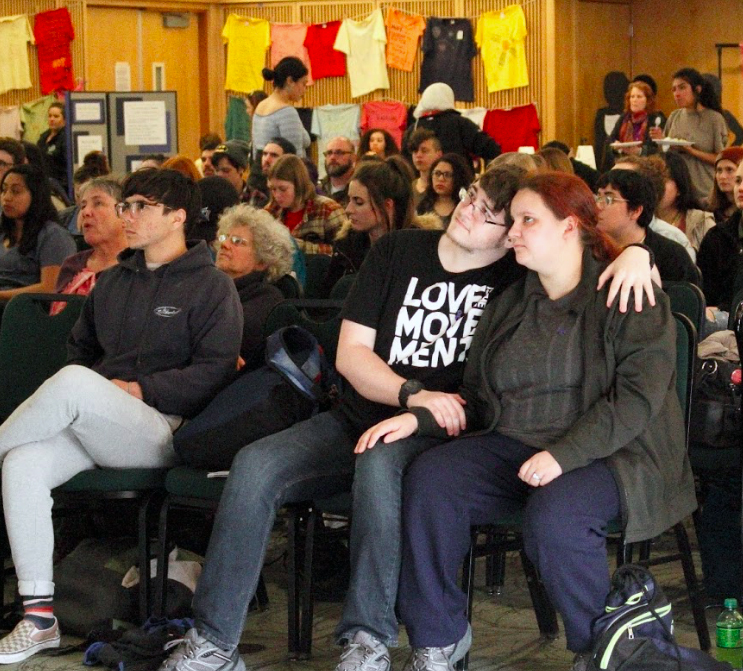
    Hanging on the walls of the Kate Buchanan Room are T-shirts from survivors of sexualized violence and friends of people who died from sexualized or domestic violence. The T-shirts had messages written telling of horrible acts of sexualized violence from family members, friends and others.

    “The T-shirts are difficult to look at, but their story needs to be heard. They are not nice. It is painful but necessary,” Jodie Huerta, HSU sociology major, said.

    Messages written on T-shirts decorating the walls of the KBR. Photo by Ahmed Al-Sakkaf.

    Assistant professor of Native American studies Cutcha Risling-Baldy was the guest speaker for Take Back the Night. Risling-Baldy’s talk was based on systemic violence toward people of color. Before her talk on missing and murdered indigenous women, Risling-Baldy acknowledged the death of HSU student David Josiah Lawson.

    “If David Josiah Lawson were not a person of color, his death would be on the news every day,” Risling-Baldy said.

    The Native Americans view domestic violence differently.

    “In an interview with a Wiyot woman, the anthropologist asks what happens if a man rapes a woman,” Risling-Baldy said. “The Wiyot woman replies, ‘That never happens.’ Asked why it never happens, the Wiyot woman said, ‘Because that person would be killed.’”

    Speaking out can trigger traumatic experiences for people.

    “People choose to come if they feel comfortable speaking on their testimony, and they choose not to come because they don’t feel comfortable speaking on their testimony,” Cabrera said.

    Some of the speak-out testimonies were about sexual violence that occurred during childhood and adolescence, while some of the testimonies were about sexual violence that happened at HSU. Sexual violence happens to HSU students, for which most of us are unaware.

    “Everybody knows that sexual violence is happening, but nobody is doing anything about it. It is just getting swept under the rug,” Grace Lamanna, HSU recreation major, said.

    People tend to restrain themselves from being in these spaces, because of the trauma it brings to them.

    “Some folks don’t feel safe in this space, because they don’t identify with domestic violence and sexual assault. People feel like they are taking up space and say, maybe this isn’t the space for me, I’ll take a step back,” Cabrera said. “That’s totally fine, because we want to prioritize those individuals that have experienced sexual assault and sexual violence at some point in their lives. That is what this space is mainly for.”

    Students hold hands in a circle behind the McKinley statue on the Plaza. Photo by Ahmed Al-Sakkaf.

    HSU sociology major Omar Miranda helped as a monitor for the Take Back the Night march as part of his class.

    “I feel like I made a difference. Big or small. Something small to me could make the biggest difference to the survivors,” Miranda said.

    The survivors gathered after the speak-out for the Take Back the Night march. Marchers wore orange safety vests, gathered in groups of five and were assigned a monitor. Monitors had received tactical training for this march and could protect the group if some danger presented itself.

    The marchers left school chanting, “Hey! Ho! The patriarchy has got to go!”

    The marchers went from school to the plaza downtown and were heckled by a few passersby in cars, as well as people along the route.

    On the plaza, the Take Back the Night members and public in attendance gathered in a memorial for the people who have died from sexualized and domestic violence. In silence, the less fortunate victims of this violence were honored.

    As the Take Back the Night march left the plaza, the declarative chanting could be heard echoing off buildings and down alleyways.

    “Take back the moon, take back the stars, take back the night because the night is ours!”

  • Salmon and us, tied to the health of the Klamath River

    Salmon and us, tied to the health of the Klamath River

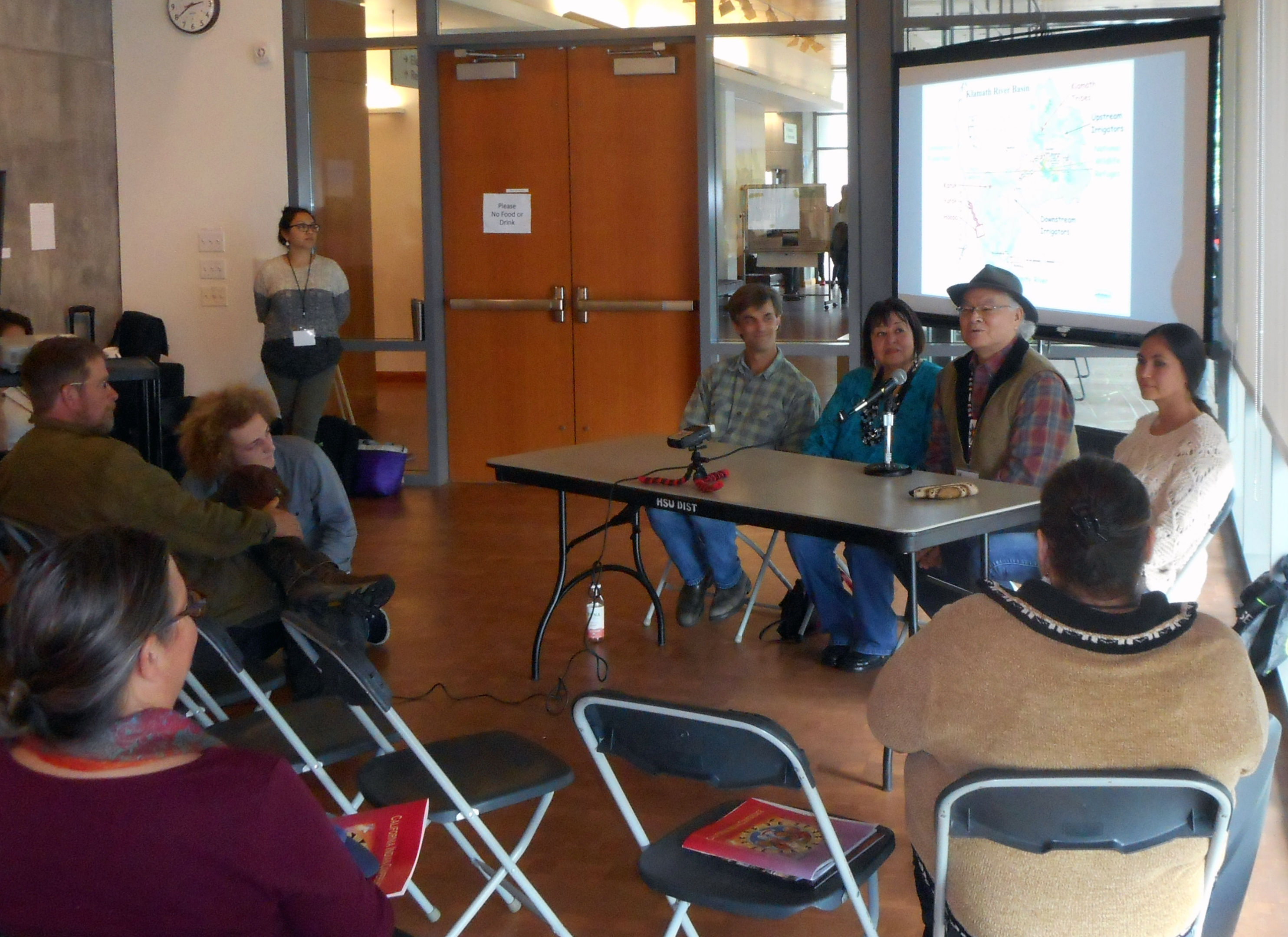
    The We Are the River: Connecting River Health to Community Health panel met to discuss the state of the Klamath River, and the communities whose lives are tied to the health of the river.

    The discussion was held in the Goudi’ni Gallery at Humboldt State during the 32nd Annual California Indian Conference on April 6.

    Dale Ann Sherman, a Yurok Tribe member and retired HSU professor of Native American Studies, was one of the four panelists.

    “I come from the Klamath and Smith Rivers. I belong to those rivers,” Dale Ann Sherman said. “In our blood runs the rivers and with that blood runs the salmon. We were born to go through time together. The salmon and us.”

    There were four panelists for the We Are the River: Connecting River Health to Community Health discussion: Dale Ann Sherman, Louise McCovey, Marlon Sherman and Konrad Fisher.

    Marlon Sherman is a Lakota tribal member, as well as the HSU department chair of Native American Studies.

    “The people on the Klamath River depend upon the salmon, and other fish,” Marlon Sherman said. “That’s their sustenance and their livelihood. That’s their spirituality. It is what their ceremonies are based on. Everything flows around the salmon, and if those salmon don’t have sufficient water, they will not come back any more. It is fairly obvious.”

    The salmon are at their lowest all time in returns due to problems with the river itself.

    “Dams, diversions and pollution sums up what is wrong with the river,” Fisher said.

    Fisher is a water protector who described the factors plaguing the Klamath River.

    “Dams are the biggest source of blue-green toxic algae build up, nasty stuff that will make humans very sick,” Fisher said. “Naturally occurring toxic blue-green algae production is dramatically elevated by dam water restriction. Some of the highest levels [of blue-green algae toxicity] ever recorded on Earth were collected behind the dams on the Klamath River.”

    A few years ago, a decades-long lawsuit by the Klamath tribes of the upper Klamath River went to the United States Supreme Court.

    “They finally were able to get the U.S. Supreme Court to realize that they had water rights to the Klamath River based on as far back as what they called time immemorial,” Marlon Sherman said.

    “Something exciting is happening very soon,” Fisher said. “We are on track for dam removal. Maybe not quite 2020, but 2021. Let’s continue to be hopeful.”

    “The [Klamath River Renewal Corporation] is the entity that will essentially take ownership of the dams, and take them out. Go to one of their meetings if you can. It is on their website,” Fisher said.

    “The salmon right now are at their bottom ebb. What they need now is plenty of clean, cold water,” Marlon Sherman said. “Water allocation is what the salmon need right now. This needs to be approached right now before the salmon are all gone. When the salmon go, who knows what’s next?”

    Water allocation rights and diversions are Fisher’s specialty, and water in the Trinity River that would run into the Klamath River is currently being diverted.

    “Water laws say there is a certain amount of water that should be left in the streams to meet certain needs,” Fisher said. “By and large they [the government] don’t [do their job] unless they are being forced, especially when it comes to telling people to use less water,” Fisher said.

    The needs of the communities most affected by the destruction of the Klamath have gone unheard.

    “The local laws of the people who have always lived there, and know the river, are never acknowledged,” Marlon Sherman said.

    “Ceremony is law. Culture is law. Very few people recognize that fact,” Marlon Sherman said. “The tribal attorneys need to be paying more attention to the tribal imperatives of spirituality, culture and tribal knowledges of their indigenous localities.”

    “Our people are fix-the-world people, that is what we do in our ceremonies,” McCovey said.

    McCovey is the Yurok Tribe environmental director and HSU environmental science alumnus who was on the panel.

    “There has been a rash of suicides in our community,” McCovey said. “For me in my job, I try to eliminate the environmental threats so that people can maintain their identity as river people, and feel safe in it.”

  • Big Time inspires youth in big ways

    Big Time inspires youth in big ways

    The Indian Tribal and Educational Personnel Program (ITEPP) hosted their 11th Annual California Indian Big Time and Social Gathering event on April 7.

    Hundreds of people gathered from across California to celebrate and express their cultural heritage inside Humboldt State University’s West Gym.

    Out of those hundreds of people, in particular, were a lot of youth in attendance.

    One of the youth who attended the event was Harmony Taylor. Taylor is 8 years old, and has been dancing for four years.

    Taylor looks forward to attending Big Time every year.

    “I like to dance with the girls I grew up with,” Taylor said. “I only get to see those friends about two or three times a year.”

    Harmony Taylor smiles near the West gym at Humboldt State on April 7. Photo by Garrett Goodnight.

    Cutcha Risling Baldy, Ph.D. is an assistant professor of Native American Studies at HSU, and discussed how Big Time helps inform and empower the youth.

    “It is important because we get to show our next generations that their culture is real and a part of their everyday lives,” Risling Baldy said.

    Arya Mettier, Ph.D., Risling Baldy’s daughter, was also in attendance, and partook in the Women’s Coming of Age demonstration that her mom and many others have been working to revitalize.

    “There’s a lot of people, and you can get a lot of stuff,” Mettier said. “I get to see a lot of different cultures.”

    Sammy and Jon Luke Gensaw are two brothers who have also been inspired by this event ever since they can remember.

    “When I was younger, this was a go-to thing,” Jon Luke said. “I would see people that I haven’t seen all year.”

    The Gensaw brothers created their own non-profit organization, the Ancestral Guard. Through the Ancestral Guard, the Gensaw brothers are able to make direct action on a local and global scale. They recently returned from visiting and speaking at Yale University.

    There were over 60 vendors in attendance along with live demonstrations, a food stand and a catering food truck Los Giles.

    One of the highlights was by far the food. The popular choices were fry bread and Indian tacos, with a line wrapping around the building all day long.

    A restorative vendor at the event was the Indigenous California Language Survival booth. One of the organizers of this booth was HSU assistant professor in Native American Studies, Kayla Begay, Ph.D.

    At this booth, kids were encouraged to share a word in a native language to win a prize.

    “Even if you’ve never heard a native language before, we encourage the children to learn today,” Begay said.

    Humboldt State ITEPP alum Briannon Fraley explained that Big Time gives her children the opportunity to see other cultural representations.

    “Living in a multicultural society, your identity gets lost, and it’s hard to engage,” Fraley said. “This event instills pride and promotes cultural identity.”


  • Rallies at the State Capitol for sufficient CSU funding

    Rallies at the State Capitol for sufficient CSU funding

    Students, faculty and allies of the California State University system from all 23 campuses made the journey to the State Capitol to send Gov. Jerry Brown a message, it is time to fully fund the CSU.

    Video by Dajonea Robinson.

    Allison Rafferty is a biology major and was one of many students who came down on a bus from Humboldt State to join the demonstrations on April 4. Rafferty rode down to represent HSU and to call for funding for the CSU system.

    “I request Gov. Brown to consider opening the fund that he’s allocated for CSU,” Rafferty said. “The CSU requested money and Gov. Jerry Brown approved a third of that. Right now, they’re in revisions. In May, they’re going to post their revisions and in June, they’re going to propose the final budget that goes to a vote.”

    Rafferty hopes more funding will come through so people in her major and others will be able to get classes and graduate on time.

    HSU student warns others of the potential outcome of funding crisis. Photo by Dajonea Robinson.

    Jacqueline Delgado is also an HSU student. Delgado decided to come to the Capitol to stand in solidarity with everyone and to get justice for Josiah Lawson.

    “I’m also here to get [Justice for Josiah] and this unsolved murder to be recognized. It is an unsolved murder of a fellow student that was murdered a year ago in Humboldt County,” Delgado said. “The school and the county does not recognize that this happened. It has been an entire year that nothing has been happening and we’re trying to get this movement to be heard. We will no longer be silenced.”

    David Bradfield is the California Faculty Association representation chair and board of directors member who now lives in Humboldt County. Bradfield spent 34 years teaching music and digital media arts at CSU Dominguez Hills. Bradfield decided to take the trip down to the Capitol.

    “I care very deeply. I spent 34 years teaching at Dominguez Hills and I care very deeply about the mission that we do, the people that do that mission and the people that we serve,” Bradfield said.

    Reza Sadeghzadeh is a communications major at HSU. Sadeghzadeh traveled with his peers to the Capitol from HSU to express concern of the insufficient funds of the budget.

    “Since they cut the whole CSU budget, we’re going to see a tremendous negative effect on our campus. A lot of professors are being laid off, activities and cultural centers are being defunded, so it’s a very serious issue,” Sadeghzadeh said. “The governor really needs to understand that the students here and the students in the CSU are the future of the welfare of California. In order to thrive as a state, we need to take care of the foundation, which is the students.”

    HSU students not only stand in solidarity with fellow CSU peers during the rally, but demand justice for their fellow student. Photo by Dajonea Robinson.

    Elizabeth Phillips is a student on campus who also came down on the bus from HSU.

    “Students like me who need an education are about to be priced out of our education. Education is not for the people, it’s not supposed to be free. They don’t want us to get an education so we’re stuck working the remedial jobs,” Phillips said. “We need to see more people of color being a part of the faculty. The only way we’re going to get there is if we can afford to get in the door. I’m $25,000 in debt just from two years at HSU. That’s a lot of money, and for other students, I don’t want them to take on that burden. So I’m here for the future, and I’m here for me, now.”

    Phillips works for the Multicultural Center as the social justice summit co-coordinator. Phillips is also a part of a loose coalition of students who started the walkout for WASC to protest the budget cuts.

    “I worry that if we give the CSU full funding for free tuition, the students will get it for the first couple of years, but then after, people get greedy and start skimming the surfaces,” Phillips said. “I’m happy that we’re here, but I want people to keep a watch and understand we don’t need as many administrators as we have. We need more students and faculty, counselors–there’s other stuff that we need that we’re just not allocating our resources correctly. Everyone needs to watch out for the future.”

  • “If you can’t be rational, at least be real”

    “If you can’t be rational, at least be real”

    A conversation with science and beer.

    Pythagoras, the Greek philosopher and mathematician, died from an angry mob because he refused to cross a field of beans.

    Followers of his cult, the Pythagoraeans, believed all numbers were either whole or ratios of whole numbers, which means they have either terminating or repeating decimals. To a Pythagorean, a number such as 1.1234567891011… did not exist. The Pythagoreans believed this so strongly that they killed Hippasus, a fellow Pythagorean, by throwing him into the ocean when he proved the square root of two is an irrational number.

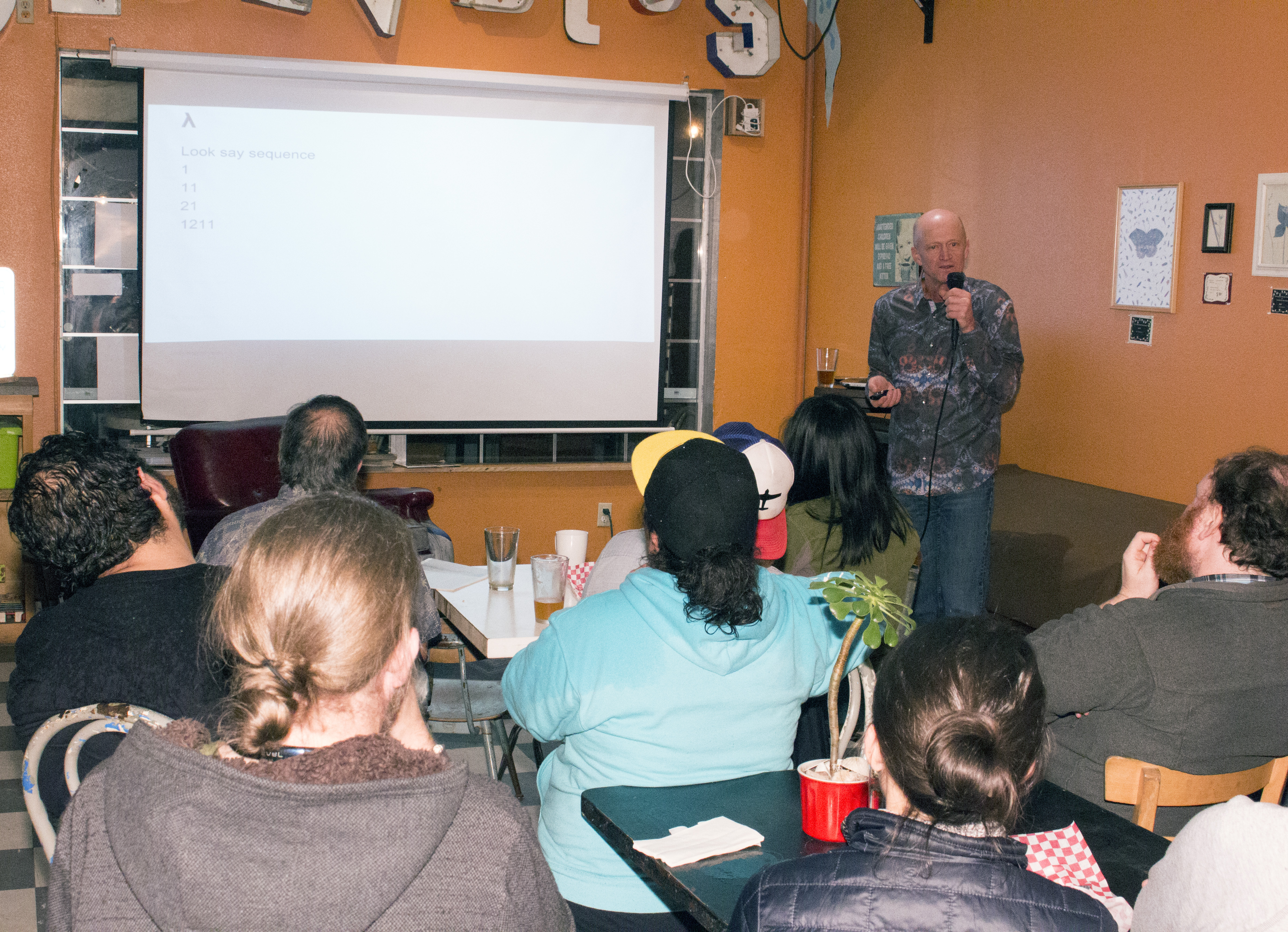
    The square root of two’s origin story was presented by Jeff Haag, a professor from the math department, as part of his talk, “If You Can’t Be Rational, At Least Be Real,” at Blondie’s Science on Tap event on March 7 in Arcata. This is Haag’s second time presenting at Science on Tap.

    ”My primary goal for coming back is to spread the joy of mathematics,” Haag said. “I want to take every opportunity to help people understand simple things deeply. I also enjoy coming back for the free beer!”

    Science on Tap is a monthly public science talk hosted at Blondies. Attendants can be found drinking beer and munching on snacks while learning about a new science-related topic. C.D. Hoyle from the physics and astronomy department brought Science on Tap to Humboldt State.

    “I first got into Science on Tap because there was one at University of Washington where I went to graduate school,” Hoyle said. “I started the first Science on Tap at HSU in Dec. 2011. There was a huge turnout for the first one. Someone from NOVA the TV show came up to help us promote the event as part of their Cosmic Cafe program.”

    Chris Harmon, a professor from the chemistry department, was fascinated with Science on Tap when he first arrived at HSU.

    “I really thought that Science on Tap is what science [communication] should be — having fun with a broad audience about science topics, and not just learning about these topics in class,” Harmon said. “When [Hoyle] went on sabbatical, I took over with organizing the talks and I enjoyed being involved.”

    Harmon and Hoyle, now co-organizers of these talks, credited Johanna Nagan, the owner of Blondies, for providing the means necessary to make Science on Tap happen.

    “Blondies helped to promote our event on their websites,” Hoyle said. “Johanna installed a projector screen system so we don’t have to bring our equipment over for the talks anymore.”

    Now in its seventh year, Science on Tap continues to receive strong support from students, faculty and community members.

    “Blondies would often get calls from community members who want to know when the next Science on Tap is scheduled. We usually have a full room at every event,” Hoyle said. “When I send out talk invitations to faculty, I get volunteers pretty quickly.”

    Harmon is one of the faculty who has given a few talks at Science on Tap.

    “I think that preparing for a Science on Tap talk is more difficult than preparing for a seminar at a conference or for class,” Harmon said. “I have to engage a broad audience without leaving out the experts in the audience. Even though this is challenging, I find it to be really fun as well.”

    John Rosa, a HSU biology alumnus (‘79) and community member, has regularly attended Science on Tap for the past three years.

    “The talks at Science on Tap do make sense to me, and I feel that I actually learn more when I don’t know anything about the topic to start,” Rosa said. “There was a talk about stem cell biology by Dr. Amy Sprowles that I found really interesting. There was also a political science talk on how science is having a tough time in the current politics that I enjoyed.”

    Hoyle believes public science communication avenues such as Science on Tap are important in today’s political climate.

    “In the past couple years, science has been under attack by politicians,” Hoyle said. “Public exposure to how evidence-based science works and the confidence limits in science will lead to more sound decision-making.”

  • HSU softball splits series against UC San Diego

    HSU softball splits series against UC San Diego

    Softball stays undefeated on Saturdays.

    Danica Grier sent a pitch into shallow center field that allowed Illa Haley to round third base and slide home for the game-winning run in extra innings for the first of two wins against University of California, San Diego on Feb. 17.

    “It was good competition, but we came back and performed the way we should every game. We’re strong and we work together,” Haley said.

    The Humboldt State University softball team went 2-2 in a four-game series against UCSD that started on Feb. 16 in the softball field. HSU lost the first two games on Friday, then turned around and came away with two wins on Saturday.

    HSU is now 0-4 on Fridays and 4-0 on Saturdays since starting play against California Collegiate Athletic Association opponents on Feb. 9.

    Shelli Sarchett, head coach of the HSU softball team, said that good things come when the players trust in themselves and their teammates.

    “Our Fridays are rough, but it shows the fortitude that these ladies have. Just because we’re beat and facing adversity–they’re going out there and not quitting,” Sarchett said. “They’re showing they can play the game of softball.”

    Jasmine Hill pitched seven scoreless innings in relief work for HSU throughout the games on Saturday, picking up the wins in both contests.

    “I saw a lot of team effort. I saw us come together as a family, finally gel and find that connection,” Hill said after the first win. “It was great. It was a great moment, a great experience.”

    UC San Diego head coach Patti Gerckens said that due to a couple missed spots by their pitchers, Humboldt had some hard hits on Saturday.

    “It was very disappointing,” Gerckens said. “I thought we would come away with one game today, if not two.”

    The HSU and UCSD softball teams now have a 4-4 record in the CCAA after the weekend. The same as two other teams, California State University, East Bay and San Francisco State University.

    On Feb. 23 and Feb. 24 the softball team will host a four-game series against California State University, Stanislaus.

  • Community gathers for David Josiah Lawson vigil

    Community gathers for David Josiah Lawson vigil

    Lawson’s homicide case is still open.

    Mother of David Josiah Lawson, Charmaine Lawson, drove eight hours to the Arcata Plaza to speak at her son’s vigil to remember, honor and celebrate his life. The African American Center for Academic Excellence organized Lawson’s vigil on Feb. 15.

    “For those of you who are mothers, I drove my baby to school and he came back in a box,” Charmaine said. “It’s not okay, I am not going to apologize for my tears. I am trying to be strong, but it’s hard.”

    Josiah’s homicide case remains open and active. The investigation interviewed 46 individuals that are believed to include all the witnesses who could have seen the fight and events leading up to the homicide.

    The initial review of all the evidence has been finalized with assistance from a retired FBI investigator, Tom Parker.

    Majority of forensic evidence has come back from the Department of Justice. Police are now awaiting a completion of DNA and specialty evidence testing.

    Humboldt State University student Erianna Blackwell said it’s important to come out for support.

    “Not only your people, but the cause,” Blackwell said. “Especially since they still haven’t found the killer.”

    Josiah was murdered 10 months ago at an off-campus house party. The city council held four meetings in 2017 to update the community on the investigation and present strategies on how to improve student safety.

    Michael Fennell, a Lawson supporter, said he’s been wearing his “Justice for Josiah” button for almost 10 months.

    “I didn’t think I would be wearing it for this long,” Fennell said. “I thought it would be solved long ago.”

    With two other children at home, Josiah’s mother told the crowd she was willing to move to Humboldt County to seek justice for her son.

    “If it takes me moving for the police to do their job, I will,” Lawson said. “I don’t care about materialistic things if I have to sell my car [or] my house. I’ll do it for my son.”

    Chairman of the Wiyot tribe, Ted Hernandez, showed up for the vigil and extended a prayer even though he had never met Josiah’s mother.

    “I came to support Charmaine as a parent. I have five children and some have gone to HSU,” Hernandez said. “It is all about the community and supporting the mother. It is a healing process.”

    Each month since Josiah’s death, a vigil has been organized in order to remember his memory and to put pressure on the ongoing investigation to find the murderer.

    HSU journalism major Angel Sylva said she comes every month.

    “I feel tired of having to come out every month,” Sylva said. “I feel like I’m coming out and nothing is being done. I come out regardless.”

    A reward of $40,000 has been offered to anyone with new information leading to the arrest and conviction of Josiah’s murderer.

    Mayor of the City of Arcata, Sofia Pereira, said when the AACAE asked her to come speak at the vigil, she agreed. But Pereira was uncertain on what she was going to say.

    Pereira said to Josiah’s mother, “You have given so much to the community. This is a community you owe nothing to.”

    “As a leader, I am going to fall short at times. I’d rather show up and fall short than to not show up at all,” Pereira said. “If we want true peace, we have to listen to our neighbors and take the situations seriously. I am engaging even though I feel uncomfortable.”

    Pereira has been mayor of Arcata for two months. Her first meeting as mayor was on Dec. 20. The council alternates the position on an annual basis.

    “I felt the gravity of the situation,” Pereira said. “It is not easy to speak in front of people who are grieving and want answers.”

    After the last meeting in October, students requested investigation updates be separated from the student safety discussion and that student safety meetings be held on campus following the October meeting.

    Student safety meetings in November and December were facilitated by students and held on campus. Meetings will continue to be held through the Student Diversity Committee with support from many campus club leaders.

    “My life will never be the same,” Charmaine said. “I can’t even mourn my child, because I have to fight for him. It is taking too long to get results.”

  • Lumberjacks of today meet Jacks of the past

    Lumberjacks of today meet Jacks of the past

    Humboldt State University’s track and field team will kick off their season Feb. 17 with the Green & Gold Open, otherwise known as Alumni Weekend.

    Both cross country and track & field will participate in this intrasquad scrimmage that is intended to prepare athletes for what is to come this season.

    A special effort has been made to make this weekend more than just an open. Alumni are being welcomed back to participate in events such as a 60-meter dash, 4×400 meter relay and a pace-predicted mile.

    “We have had a strong alumni base in the past,” head coach Sarah Ingram said. “So, we are trying to reconnect with those athletes now, and hopefully have them talk with our current athletes.”

    The open will begin with a recognition announcement for the attending alumni and the five All-American award winners that graduated last year. The throwing events begin at 9 a.m. and the running events begin at 12:30 p.m. accordingly.

    As part of the 2018 Alumni Weekend, activities off the track will be held around town as well. There will be a mingle mixer Friday night, an alumni-only bonfire Saturday evening after the meet and a breakfast at the Samoa Cookhouse Sunday morning.

    Freshman Malachi Arthur is ready to get back on the track after his missed season from a knee injury during his senior year of high school.

    “I’m pretty nervous,” Arthur said. “I haven’t ran a full competitive 400 (meter) in a long time, but I am also excited because I think I will do really well.”

    Initially, this intrasquad scrimmage is meant to warm up and prepare the athletes as much as possible before their multi-event meet in Chico on Feb. 22 and 23. The following weekend, the whole team will travel to Turlock to compete in the Kim Duyst Invite hosted by California State University, Stanislaus.

    Junior Brianna Simon is ready to achieve her goals this season after a redshirt year full of training and conditioning. Simon’s main event is the hammer throw, therefore she has been focusing on getting stronger with plenty of power lifting.

    “Last year was a building season,” Simon said. “It’s like I came out of retirement, and I am definitely ready to get back out there and beat my personal record.”

    Brianna Simon goes through technique during the Humboldt State track and field team practice on Feb. 12. Photo by Diego Linares.

    Ingram and her athletes are excited to kick off this 2018 season and hope to achieve record breaking goals as well as receive more All-American awards this year.

    “I am really excited that track season is almost here,” Ingram said. “When you actually get to compete on the track, it becomes a lot of fun. I think our athletes are really looking forward to that.”