The Lumberjack


Students Serving The Cal Poly Humboldt Campus and Community Since 1929

Tag: Students

  • Word on the Street: Spring Break

    Word on the Street: Spring Break

    By Curran Daly

    Humboldt State will be going on spring break next week. Spring break is an opportunity for students to travel, relax, and take a break from studies. We hit the streets to ask some fellow Lumberjacks what they are going to be up to next week.

    Photo | Curran Daly

    I’m heading to Red Rock Canyon right outside Las Vegas to go rock climbing. The rock climbing there is world class.

    -Max Kittel, senior, environmental management and protection major

    Photo | Curran Daly

    I’m gonna travel down to Santa Barbara to visit a friend, then I’m going to visit my awesome roommate in Pasadena and visit Joshua Tree and then I’m going home to celebrate my mother’s birthday.

    -Melissa Lozano, freshman, environmental science major

    Photo | Curran Daly

    I’m doing absolutely nothing, I’ll be staying in my dorm. My friend might be coming up from Southern California so we might do some hiking.

    -Kelsey Meusburger, junior, psychology major

    Photo | Curran Daly

    I am going to be staying on campus and researching for a class. I’m going to be researching Tibet and the Himalayas.

    -Quint Migliardi, junior, geography major

    Whatever you’re doing over spring break, have a fun and safe time.

    Going somewhere cool for Spring Break? Or just staying home? Take a selfie of yourself and tag #LJSpringBreak in the caption for a chance for it to be in the next issue of The Lumberjack.

  • Former HSU athlete comes to U.S. From Mali for education

    Former HSU athlete comes to U.S. From Mali for education

    By | Danny Dunn

    Moussa Sy is a 21-year-old junior at HSU, majoring in environmental science. Sy moved from the country Mali, located in West Africa, to Ojai, California in 2011 at the age of 16.
    Every year scholarships are given to African students, to give them the opportunity to come to America and study. The scholarship is good for three years.

    Sy was awarded this scholarship and began attending a boarding school in Ojai, where he was determined to learn English.

    One of the toughest things for Sy was learning English once he came to the United States. Back home in Mali, he grew up speaking French and a mix of other African dialects.

    It took Sy about a year to learn the language, he would study night and day trying to master it, while taking an English as a Second Language course at his boarding school.

    Humboldt State was not Sy’s first choice when he thought about college. Sy had hopes of playing Division two, or Division three basketball before an injury hindered his plans. Sy broke his leg during his senior year of high school, which lead him to start considering other options in college besides playing basketball.

    Humboldt State’s Environmental Science program caught Sy’s attention, and with a combination of the program and the Humboldt scenery Sy chose to attend HSU.

    Upon arrival at HSU Sy attempted to join the Humboldt basketball team, however lingering injuries prevented him from playing.

    This did not deter Sy from playing sports. In the fall of 2016 Sy joined the HSU soccer team and played the position of center guard. Sy felt welcomed by the guys on the squad from the very first day of practice. Sy admitted it was a little strange being the new guy, but his teammates helped him make an easy transition to team.

    Sy was forced to stop playing after only one semester do to a heavy school and work load. Sy is currently enrolled in 15 units and works 20 hours per week on campus.

    “I would wake up at 5 a.m. every day to get to the 6 a.m. soccer practice. I would not get home until 10 p.m. which left no time for studying or doing homework, just go straight to bed to wake up for practice the next morning,” Sy said. “ It was just too much to handle.”  

    Thinking back on his first week at HSU, Sy recalled it being an interesting environment.

    “The smell, and people were so different here at HSU, it was a little overwhelming seeing all the people,” Sy said. “The redwood forest stuck out the most though, that and the air was more pure than city air.”

    Due to financial issues Sy has been unable to return to his home in Mali to see his family, specifically his mother who was Sy’s hero growing up. Sy’s father would travel a lot for work while Sy was growing up, so his mother acted as head of the household.

    Back home Sy would play or watch soccer every day, his favorite team is Manchester United. Sy knew that in America soccer was not the most popular sport, but had to admit he was still shocked that people here really do not follow as much as back home in Mali.

    Sy’s plan for after graduation is to stay in America for awhile, perhaps around Santa Barbara, California, and gain some experience in the working world. Once he returns home, Sy hopes to help the underprivileged children of Africa.

    “Children are the future, and I would like to one day build my own orphanage to help the children of Africa,” Sy said.

  • Humboldt State Men’s Rugby beats Sonoma State on Freshman’s first try.

    Humboldt State Men’s Rugby beats Sonoma State on Freshman’s first try.

    By Curran Daly

    On a wet and windy March 4, the Humboldt State Men’s Rugby team defeated Sonoma State 24-17.

    From the beginning of the game, Humboldt State was pressing Sonoma. For much of the first half it looked like the Lumberjacks would score the first points of the game. However, a number of defensive stands by Sonoma at their own try zone, rugby’s end zone, kept the game deadlocked at zeros.

    Sonoma’s biggest stand came with seven minutes left in the first half. Soon after, Sonoma was able to break through the Lumberjack line to score the opening try. After a successful conversion Sonoma led 7-0. Justin Herrera, a senior in the lock position, admitted that getting scored on was a bit of a shock to the Lumberjacks.

    “We were kinda a little bit lost at first, we got scored on, then we focused up and got it together,” Herrera said.

    Humboldt came right back and was pushing deep into Sonoma’s end, but were unable to score. The half ended with Sonoma leading 7-0.

    As halftime the weather began to turn. What had been a drizzle in the first half, turned into a full on onslaught of rain. According to Ricky Gomero, a junior scrum half, the shift in the weather caused the Lumberjacks to shift their approach to the game.

    “It started to rain, we know our game has to be a lot different,” Gomero said. “After the first half, we started seeing our guys focusing down, nailing it, and running like good rugby players.”

    The Lumberjacks came out fast in the second half scoring a try after only three minutes of play. A missed conversion left Sonoma in the lead 7-5.

    The game was back and forth, until Humboldt scored again 10 minutes later to take a 10-7 lead. Then, Sonoma scored and missed the conversion to lead 12-10 with 20 minutes remaining.

    The Lumberjacks kept pushing, but could not find a way to put points on the board. At one point the Jacks celebrated a try only to have it called off by the ref. With five and a half minutes remaining the Lumberjacks would not be denied anymore. Freshman winger Cameron Arnold, picked up the ball off of a Sonoma kick and ran through the line to give the Jacks a 15-12 lead. After a successful conversion the Jacks lead 17-12.

    “The turning point of the game was when Cameron scored a try, because that just really put us over,” Herrera said. “He ran it all the way back from the 22, that was the uplifting point, we were like ya we can do this and we had it on lock down.”

    Arnold’s go ahead try was his first try for the rugby team.

    “It was a great feeling, scoring my first try for the team,” Arnold said. “It got the team pumped up.”

    Humboldt went on to score another try pushing the score to 24-12. Sonoma scored on what was the last play of the game and the game finished 24-17.

  • Dreams of American baseball

    Dreams of American baseball

    By | Danny Dunn

    Miki Fukasawa’s journeyed from Sagamihara City, Japan, to Arcata, Calif. in his pursuit of playing baseball in America.

    “My lifelong dream was to play baseball in America and now I am,” Fukasawa said.

    Fukasawa is a catcher on the Humboldt State Intramural Baseball team. Fukasawa came to HSU in a study abroad program. He previously attended J.F. Oberlin University, located about an hour outside of Tokyo, Japan. There, Fukasawa was studying English. Fukasawa was also a catcher on the J.F. Oberlin baseball team and hopes to rejoin the his former team after his semester at HSU.

    “When I move back to Japan, I want to learn more English, and play baseball as long as possible,” Fukasawa said. “The dream would be to become a professional baseball player either in Japan, or even for Major League Baseball.”

    Fukasawa found out about the study abroad program, from some friends at his university back home.

    Fukasawa said that so far he cannot complain about the Humboldt life. His favorite food since arriving at HSU has been the pizza from The Depot on campus. Fukasawa said that he feels no added pressure to perform on the baseball team, and that he enjoys his teammates very much

    Fukasawa found housing in Arcata with fellow intramural teammate and HSU student Christian Clouthier. Clouthier is a second year transfer student from Sacramento. This is Clouthier’s second season with the team, while also acting as the team treasurer. These duties include getting people reimbursed for away games, collecting the dues of the players, and estimating the total cost of the season expenses.

    Clouthier has done more than that, he has opened his apartment to Fukasawa for the semester. Clouthier lives in the same complex with an international student coordinator at Humboldt State, who told him about Fukasawa.

    “It was just me and my girlfriend in the apartment, she is half Japanese and thought it would be a good idea,” Clouthier said. “We had an extra room, so we thought it would be a good thing to do.”

    Fukasawa is not the only Japanese ball player on the HSU intramural squad, Shinya Arai is from Kanazawa, the capital city of Ishikawa, Japan. He also plays catcher and a little bit of third base for the intramural team.

    “I have always wanted to attend an American university. I chose HSU because I like the California climate,” Arai said.

    Arai started playing ball around when he was around 9 years old, but stopped around junior high school. He was fortunate to have the opportunity to contribute to the HSU team.

    Arai has enjoyed his time in Humboldt County, he is staying in an apartment in McKinleyville. His favorite food so far has been from the Chinese restaurants around town.

    Arai likes playing on the baseball team, but says at times there can be confusion on the field with the language barrier.

    When Arai returns home he will continue with school, and learn more about travel and english, in hopes of one day becoming a sightseeing organizer.

  • Check it! Anniversary party

    Check it! Anniversary party

    By | Ali Osgood

    The highly successful student created program about preventing and responding to sexual assault at Humboldt State University celebrates it’s third year.

  • Housing sees more open beds

    Housing sees more open beds

    By Charlotte Rutigliano

    Because enrollment decreased this past term, less students struggled to find openings in campus housing. Senior psychology major Victor Perez was able to change dorms from the campus apartments to the College Creek complex because there was the space available for the upgrade.

    Stephen St. Onge, director of Housing and Residence Life, said housing normally starts off the fall semester with around 104 percent occupancy and drop a little in the spring.

    Currently housing is at 96.5 percent occupancy, having more open spaces for female students than male students. This has been a trend over the past few years.

    Twenty-four-year old transfer student Kimberly Encio said when she lived in the College Creek housing complex it was a little overcrowded. The only reason she decided to move off campus was the high cost of living on campus.

    “If it wasn’t so expensive I would have stayed on campus,” Encio said. “I loved the convenience of it all, being able to come home between breaks, close to the library and class, all of it.”

    According to St. Onge, one goal the housing department has is to provide a reasonable cost for on campus housing.

    “One of the strongest factors in student retention is living on campus for at least one year,” St. Onge said.

    Housing is not just focusing on the cost, they are also very focused on opening up more spacing for both new and returning students. St. Onge said they have increased the number of lottery seats for returning students by 100.

    With the university getting larger there is more demand for housing both on and off campus for students. Both Perez and Encio agreed that the university should have another dorm complex on campus to help with overcrowding and so they could provide more spaces to new and returning students.

    St. Onge said that the housing department is always open to suggestions and feedback from students and said they have an open forum on March 2 from 3:30 to 4:30 p.m. in the Jolly Giant Commons to discuss the potential for adding new housing on and off campus.

  • International Education Week at HSU

    International Education Week at HSU

    • Free food, films, and lectures from professors working internationally.

    By Morgan Brizee

    International Education Week is back at HSU. During International Education Week students, staff, and the community can listen to speakers address what is going on around the world from those doing research and work across the globe.

    The International Education Week events are being held Feb. 13 through 17 from 9 a.m. till 9 p.m. in room 209 in the library fishbowl (unless otherwise noted on the schedule).

    Ariana Hendren, a 22-year-old HSU International Studies major, is the president of the Global Connections Club at HSU and is responsible for managing the volunteers that work at each event.

    The lectures of International Education Week are both motivational and helpful for those who are interested in gaining more information about traveling and working abroad or studying international issues,” Hendren said.

    Most of the speakers of the event are professors who work at HSU and do international research. Other speakers who are not HSU professors are the key note speaker which is Dr. Marga Gual Soler who is the project director at the Center for Science Diplomacy at the American Association for the Advancement of Science, Dorothy Ngutter who is a diplomat in residence, Erik Jens who is an instructor at the Department of Defense, and Sarah Sedlack who is an HSU alum and founder of a sex education program in Kenya called “What’s Not Said”.

    Dr. Alison Holmes, HSU assistant professor of politics and program leader of the international studies department, said that school usually gets the guest speakers by anyone who is interested usually because it is hard to get people who are available to come up to HSU.

    “Who we can get is often the first criteria,” Holmes said. “I’ve been working hard in the last two or three years to ensure CPS [College of Professional Studies] and CNRS[College of Natural Resources ] also have speakers and are engaged and having the keynote seemed like a good way to make sure that our colleagues in CNRS were also really involved in International Education Week.”

    Holmes is also speaking during International Education Week on Feb. 15 at 9 a.m. in room 209 in the library fishbowl. Her lecture is called Global Diplomacy: Upside Down and Backwards.

    International Education Week this year will have a different impact than past years because of President Donald Trump’s “Muslim” ban.

    Mathew Derrick, HSU assistant professor of geography and co-organizer of the International Education week, said that international education is of most importance now because of what is going on politically.

    ““International education is always important, but it is especially important at this point in time,” Derrick said. “In short, it is critical that HSU students–and the broader citizenry–develop higher levels of geographic-global literacy.”

    The definition of geographic-global literacy from National Geographic is the ability to use geographic and global understanding and reasoning to understand far-reaching decisions.

    During International Education Week students can enjoy food, music, and films from around the world to fully submerse themselves into learning about the different cultures.

    Celicia McLean, a 22-year-old HSU International Studies major, said that she is going to go abroad for work after she graduates in May so she is excited to listen to related speeches.

    “International Education Week has a wide variety of discussions on issues and other aspects about our world presented by incredibly knowledgeable and experienced scholars,” McLean said. “The evening events are especially great locations for cultural exchanges through food, film, and music and are a must for a culture enthusiast, like myself.”

    Even after graduating HSU, some students still feel connected and feel a want and need to give back to the school in some way. Sarah Sedlack graduated from HSU in 2013 with a BA in Psychology and was excited to be able to share her progress of the campaign, What’s Not Said, with the school during International Education Week. She will be giving her lecture on Feb. 15 at 10 a.m. in room 209 in the library fishbowl. Her lecture is called Let’s Talk Sex (In Kenya). Her lecture is talking about her campaign with teaching people to normalize talking about relationships and sexual health.

    “It also feels amazing to be sharing a passion project and receive so much positive feedback from the community here, both on and off campus,” Sedlack said. “Because when communities benefit from international prevention efforts in the face of major sexualized violence and public health issues, all communities everywhere, benefit because we are all connected.”

    Whether students are wanting to travel abroad for fun, work, school or just want to learn about what is going on around the globe, International Education Week will go over all of these and more.

    Christiana Frye, HSU coordinator at the International Center, said that students should choose a couple of interesting lectures that are being given whether it be educational or just for fun.

    “There’s all different kinds of things from all over the world, information about Africa, information about food justice, teaching abroad,” Frye said. “I also encourage people to attend one of the fun things in the evening because there is free food, on Monday night, there is good international food.”

  • HSU looks at the big picture for enrollment

    HSU looks at the big picture for enrollment

    By Charlotte Rutigliano

    The days of generalizations may be in the university’s rear view as various department’s throughout Humboldt State aim to start writing personalized letters to prospective students due to a drop in enrollment this past term.

    This is part of a plan the university has created to start focusing more on prospective students who applied and turning them into current students. Director of Admissions Steven Ladwig said every student needs to have a relationship with someone on campus before attending to make them feel more comfortable once they’re here.

    This plan has been put into place with the hope that it will boost enrollment for the 2017-2018 school year. According to Nicholas Conlin, coordinator for Orientation and New Student Programs, enrollment only dropped this last year. There were about 200 to 250 fewer students than the university was hoping for.

    Graphic by | Charlotte Rutigliano

    The drop in enrollment was not a drastic one, and HSU was not the only California State University to see this drop.

    “There were six CSU’s who didn’t meet enrollment numbers this term,” said Ladwig. “Chico, Fresno, Monterey Bay, San Bernadino, San Francisco, and Sonoma.”

    The slight drop in enrollment last term didn’t affect the number of impacted majors [majors that have more students than the program accepts.] Additionally, the number of visitors to campus was not impacted.

    HSU is known for its science programs with the most sought after majors being biology, botany, environmental resources engineering, wildlife and zoology. This past year however, both the social work and environmental management & protection departments became impacted as well.

    John Panting, lead admissions counselor, said that there hasn’t been a decline in the number of tours given but the number of visitors does depend on the time of year, saying that November through January typically have less visits.

    “In the beginning of February is when the number of visitors really starts to ramp up,” Panting said.

    HSU, in an attempt to identify the contributing factors hired John Capaccio as Associate Vice President of Enrollment Management. Carpaccio’s role is simple —  to increase enrollment without lowering admissions standards.

    Graphic by | Charlotte Rutigliano
  • HSU’s Waste Reduction and Resource Awareness Program offers services to students

    HSU’s Waste Reduction and Resource Awareness Program offers services to students

    By | Kelly Bessem

    School can be a mental and financial struggle, but doing your part to reduce waste on campus doesn’t have to be.  Humboldt State’s student-run Waste Reduction and Resource Awareness Program, also known as WRRAP, has been in operation for almost 30 years.

    The campus services they maintain are free to all students. These services include campus compost bins, water refill stations, zero waste supplies, events such as the clothing swap. Additionally, students can visit the Reuseable Office Supply Exchange House, where students can find free school supplies such as notebooks and writing utensils.

    Environmental science major Crystal Singletari was glad to find out that the ROSE House was there to provide an option other than paying expensive prices for new school supplies. 

    “The first two weeks of school I didn’t have enough binders to reuse and was super unorganized so I went to the bookstore, but they’re so expensive,” Singletari said.

    Rangeland resources major Ishmael Guerrero believes helping to reduce waste is good, but it is often difficult to keep track of waste reduction programs on campus.

    “I’m usually focused on school, work, or sports,” Guerrero said.

    WRRAP is set up to direct students toward reducing waste on campus and in the rest of their lives in simple ways rather than having to figure it out alone. Isabel Sanchez, a business major and natural resources minor has been working for WRRAP for more than two years. Sanchez explained how WRRAP can make waste reduction easier for students to understand.

    “It’s a network that allows for exchanges of waste reduction methods,” Sanchez said.

    Need some encouragement to live a less wasteful campus lifestyle? According to a 2015 estimation, Humboldt State University students collectively dispose of 266,314 pounds of waste on campus each year. That’s about the mass of four humpback whales. Though HSU students always seem to strive for improvement, there is still a whale of a problem.

    Check out WRRAP’s website at http://www.humboldt.edu/wrrap or email their student staff at wrrap@humboldt.edu. The program is there so that reducing waste doesn’t become another daunting school task on your checklist.

  • Mellow out with meditation

    Mellow out with meditation

    By  Morgan Brizee

    Learn to de-stress with the One Breath meditation group class

    HSU staff psychologist with a residential life focus, facilitating the One Breath meditation with students. Photo by Morgan Brizee

    A long light grey table split the Recreation and Wellness Center room in half. Students and a staff member were on one side and the facilitator on the other during the One Breath meditation group class on Feb. 1.

    Every Wednesday at 5 p.m., Craig Beeson teaches those who want to learn to destress and wind down. The group is run by Counseling And Psychological Services and is open to the HSU community including students, staff and faculty.

    Beeson is a staff psychologist with a residential life focus and does workshops like One Breath in the resident halls on HSU campus.

    “I noticed when this [One Breath Meditation workshop] was on my mind, preparing for it, I was getting stressed about it,” Beeson said. “This is counterproductive, I’m getting really stressed about a mindfulness presentation.”

    With a new semester starting up again, and most students being far from home, it can be easy to get overwhelmed.

    Karen Zurdta, a 23-year-old English grad student, talked about how coming to this class has taught her to love herself more.

    “I was going through a tough time with school last semester and I got really sad and emotional,” Zurdta said. “I was having problems showing myself love and that I am worthy of good things.”

    Beeson is using the book, “The Mindful Path to Self-Compassion” by Christopher Gerner, to teach the class about not fighting the feelings you have but instead accepting them. The class goes over how to cope with issues from anxiety to insomnia that many students can relate to.

    Matt Cunningham, a 25-year-old senior English major, has been meditating for five years and even went to the City of Ten Thousand Buddhas in Ukiah, Calif. last spring to help with his practice of mindfulness.

    “It’s kind of taught me to think of my thoughts and feelings as senses and to react to them like I would to any other sort of negative stimuli,” Cunningham said. “Mindfulness has helped me address those things more directly in a lot of ways.”

    The class begins with a group discussion of feelings and how to address them in a positive way. After about 30 minutes, Besson directs the group to close their eyes and focus on their individual breathing. He then moves on to telling the group to focus on one body part at a time, relaxing each body part individually, until the group feels their body and mind is calm. Beeson ends class by checking in with each member of the group on how they feel afterwards.

    “We talk about things like how to connect to yourself and live a more present, relaxed life,” Beeson said.

  • Word on the Street: Valentine’s Day

    By | Liam Olson

    Valentine’s Day is the perfect time to show your significant other how much you love them. You can get them chocolates, watch their favorite movie, or make them a nice dinner. However, there are some people who don’t care about Valentine’s Day and think that it is not important enough to celebrate. This day has different meanings depending on the people you talk to. Here are some opinions on Valentine’s Day from  Humboldt State students.

    Why do you celebrate or not celebrate Valentine’s Day?

    Photo by Liam Olson

    Left: “I celebrate Valentine’s Day because it’s a day to remind myself and others of the love that is important in my life.” -Simone Rani McGowan, Freshman, Environmental Science

    Right: “It doesn’t make sense to make a national day for love when love should be celebrated everyday.” -Nicholas Lara, Junior, Social Work

    Photo by Liam Olson

    “I like to celebrate Valentine’s Day because it is the one time a year I get to go out to a nice restaurant.” -Cassady McLaughlin, Junior, Psychology

    Photo by Liam Olson

    “Me and my partner have been together for six years and at this point it has become just another day for us.” -Alleigh Sullivan, Senior, Art History

    Photo by Liam Olson

    “I celebrate Valentine’s Day because it is a day dedicated to love, which I think is pretty neat.” -Alex Ballesteros, Junior, Environmental Science

  • Who Knew? At HSU: OhSnap!

    Who Knew? At HSU: OhSnap!

    In this installment of Who Knew? At HSU, we take a look at OhSnap!. This program offers free food and cooking classes to students as well as other services. Find out about all the hidden gems Humboldt State has offer by watching Who Knew? At HSU every week.

    Video by: Alexandria Hasenstab

  • Jacked up

    Jacked up

    Losing Headphones and the Headphone Jack

    By | Liam Olson

    Graphic by Joe DeVoogd

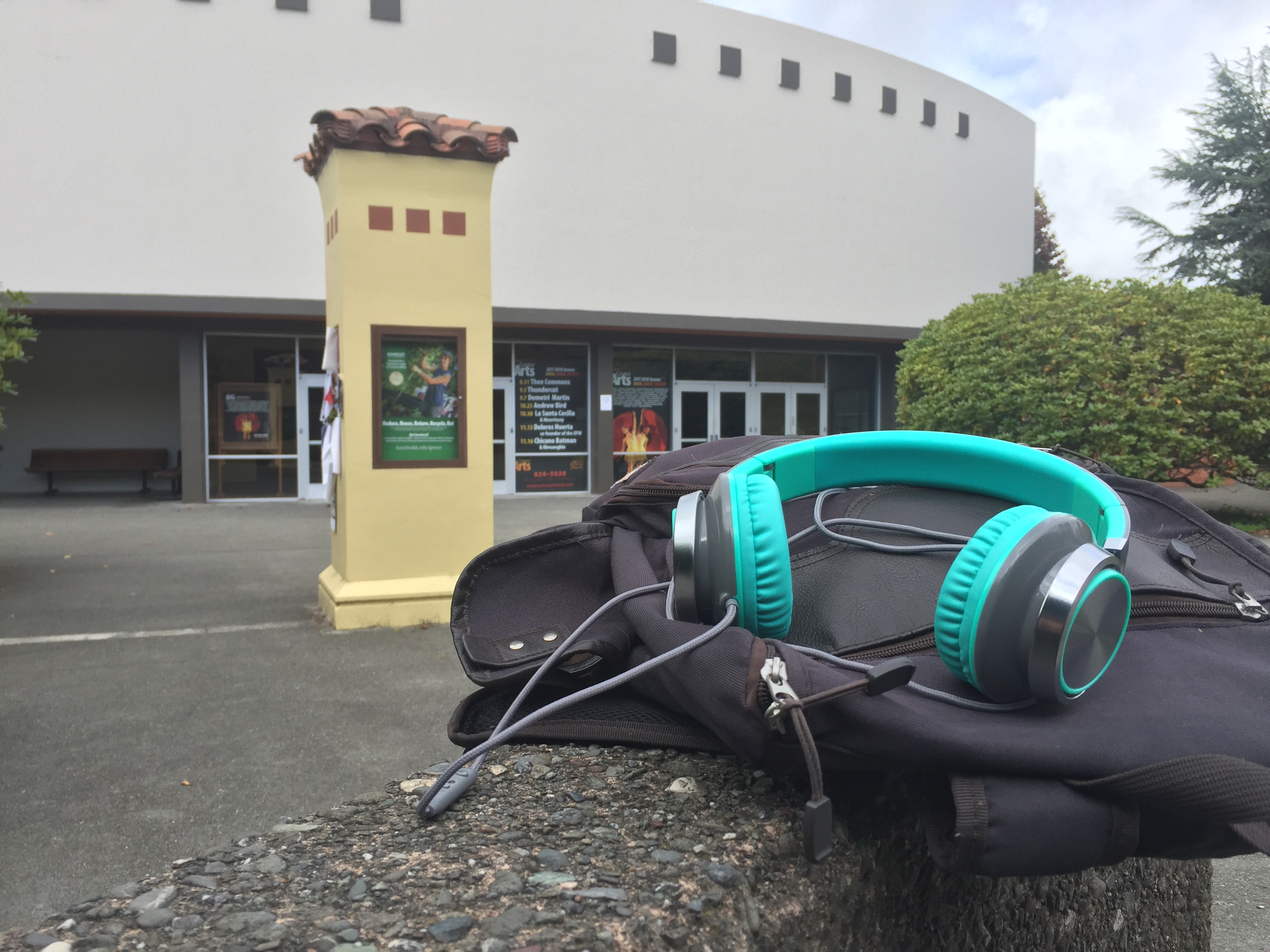
    Headphones are an essential for every college student, and it is the worst when you lose them. Without them, you would not be able to listen to music while doing your homework or watch a video without annoying the people next to you.

    You could leave them at home to only forget where they are or leave them at the library on accident.

    But you’re not alone, many others lose their headphones all the time.

    Library Circulation and Student Assistant Sineva Hosea, is an environmental science major in her junior year. She finds lost objects all the time around the library while she is working, but headphones seem to be the most common.

    Earlier in the week, she even found a pair of earbuds along with the iphone that they were attached to. Luckily, the owner was able to retrieve their phone and earbuds from the lost and found. But others are not so lucky and have to go buy a new pair of earbuds. “Some don’t get returned, but when I do my rounds, I mostly find earphones,” said Hosea.

    In the near future, wired earbuds and headphones could be a thing of the past. Apple removed the standard 3.5mm headphone jack on the iPhone 7 and soon other companies, such as Samsung, may follow this model.

    This change forces customers to switch to small, wireless earbuds. The new design could lead to more earbuds getting lost since there are no wires to keep it from slipping out of your pocket.

    When asked about this new design, students are not fond of the idea that would have to change to wireless earbuds and headphones.

    Brittany Heller, an international studies major in her senior year, is used to the normal wired earbuds. She finds that it is easier to keep track of wired earbuds over wireless earbuds since the wires help her hold on to her earbuds so she would not lose them.

    “I wouldn’t know where to put them,” she said.

    Amber Norwood, a zoology major in her junior year, keeps track of her earbuds, but her friends seem to lose theirs often. She says they have to go buy new a new pair about every month. She thinks that  wireless earbuds would be easier to lose with their small design. It would also become expensive to replace them often.

    The thought of having two separate earbuds makes you appreciate how they have always been connected by a wire, so that one earbud is never lost. “It would suck to lose one and still have the other,” Norwood said.

  • Getting swol in style

    Getting swol in style

    HSU students sport fashionable workout gear

    By | Alexandria Hasenstab

    Humboldt State is not known as one of the most fashion-forward universities out there. However, if you’re looking for current fashion trends around campus, you might want to check out the gym. Students head to the Student Recreation Center to hit the weights, but with current athletic clothing available in endless colors and styles, they look ready to hit the runway.

    Junior environmental science major Andie White is one of the students who regularly goes to the gym in stylish attire. She choose to wear blue patterned leggings with a blue athletic long sleeve top to work out in.

    “I prefer to wear things that motivate me,” White said. “I like to wear bright colors because it makes me feel good.”

    The cliché, look good, feel good, is certainly applicable to the gym.

    Senior psychology major Miranda Beach, works out in style at the Student Recreation Center on campus. | Alexandria Hasenstab

    Psychology professor Mary Bockover believes our outward appearance can affect our confidence.

    “When people feel like they look good, then on psychological grounds, they may believe others see them in a more favorable light,” Bockover said. “Conversely, when we feel like we don’t look good, it can negatively affect our self esteem and the willingness to be in front of others.”

    Indeed, working out in such a public space requires a certain level of comfort. For students like Andie White, a choice of clothing means the power to be comfortable and motivated to work out in front of others.

    White says some of her favorite brands are Nike and Adidas. B oth of these brands are sported by many students in the gym.

    Marjani Ellison is a junior environmental engineering major who can be seen wearing bright green Nikes while working out.

    “They’re a little brighter than the green of Humboldt,” Ellison said. “But as a player of the football team I feel like I should come out and represent Humboldt State every day.”

    Junior environmental engineering major Marjani Ellison sports green nikes while working out at the Student Recreation Center. | Alexandria Hasenstab

    Athletic clothing has become so fashionable that many people wear it as normal street clothing. However, many students don’t feel the need to pay the high prices that are common with popular athletic brands.

    Senior psychology major Miranda Beach says she doesn’t usually dress stylish when she works out.

    “You caught me on a good day, this is what was clean,” Beach said of what was she was wearing. “I think it does give you a confidence boost when you think you look good, but most of the time I’m pretty in the zone.”

  • The textbook hustle

    The textbook hustle

    Saving money on pricey textbooks

    By: Domanique Crawford

    The study, “Student Watch: Attitudes and Behaviors toward Course Materials: 2015-2016 Report,” reports that campus stores remain the top source for course materials purchases, with 80 percent of students in the fall and 73 percent in the spring acquiring units from the on-campus retailer.

    Students are willing to pay the exuberant bookstore prices for the sake of convenience of a one stop shop for all scholastic supplies and saving time on receiving the text.

    According to HSU’s cost calculator the average cost for books and supplies is $1,660. With a little bit of extra planning these alternative methods of purchasing scholastic texts are just as convenient as ordering from the Bookstore and offer more affordable prices.  

    1. Online Rentals- Renting a book online textbook providers are often cheaper than bookstore prices. You might be cautious about the cost of shipping, but most sites provide free return shipping. An added benefit for online rentals are that some of these websites offer access to e-book version while you’re hard copy is being delivered. Websites like Bigwords.com let you enter the text’s ISBN number and generates a comparative price list with various online sellers. Some of the most popular textbook ordering sites include: Amazon.com, Chegg.com, and Half.com.
    2. Book Swaps- HSU is a small community and you will inevitably share classes with the people in your major. Form a bookswap. Maybe a friend already has the textbook that you need just collecting dust. Offer a trade off.
    3. Ask your professor-  Professors understand that students can’t always afford the high cost of the required text and will sometimes have extra copies they can loan. Also, be sure to ask your professor if the most current issue of the text is necessary. You can save a lot of money buying an earlier model of the book.
    4. Info Boards- Check the info boards near the class in which the text is required. Students who no longer need their book might post flyers selling their old copies for reasonable prices.
    5. Check the Library- If you are really pinching pennies you might just want to check if the library has a copy of the text and photocopy the sections you need. As the cost of the copies can get expensive depending on the number of pages, you might want to try scanning the book and emailing the pages to yourself. Mind copyright laws!
  • Making a New Year’s Eve resolution

    Making a New Year’s Eve resolution

    By Domanique Crawford

    This sounds familiar, right?

    You wake up and smell the fresh air. It’s a new day, a new year, and there’s definitely going to be a new you. You whip out a pen and paper to jot down your master list of improvements. When you’ve completed the list, you feel that just by writing it down that you are a champion and have already accomplished something.

    You post the list on the fridge to remind you of your goals. One week passes. Two. Finally three. The list has fallen to the ground and been trampled so much, its only refuge is the crevice that divides the countertop and refrigerator.

    Following through with resolutions is harder than actually making them, and though the first month might be hard going, there are 11 more months that you are still able to work with.

    Lorenz Hernandez, Humboldt State environmental resources engineering major, said alternatively to creating a list of things to start on, she makes a list of things that can be improved.

    “I start a new journal,” Hernandez said, “and January first, I actually write a note to myself and actually say what I want to do that year.”

    Hernandez uses the journal to monitor the negative and positive experiences when working toward achieving her resolutions throughout the entire year.

    What is the point of New Year’s resolutions if we seldom take the time to fulfill them?

    New Year’s resolutions today are a way of self-motivation to stimulate personal improvement. Ironically, statistics show only 45 percent of Americans say they will make a resolution, while 8 percent of people will keep them. Considering that New Year’s resolutions are self-imposed, it makes me think our resolution should be something we will actually accomplish.

    Marc Ornear, a student in the teaching credential program, suggests reaching for smaller, very specific goals that are easier to achieve.  This way, he doesn’t feel the pressure of failure.

    “I come up with very vague [goals] that are not very solidified,” Ornear said. “Like, try to get more exercise time in or try to get more relaxation time in.”

    Rather than losing exactly 20 pounds, promise yourself that you are going to simply start exercising. Now don’t get crazy and plan to work out 10 hours a week/five times a day. Again keep, it simple; maybe 30 minutes, three days a week.

    When choosing your resolutions, we must remember that change is a long and ever-evolving process. It can’t be completed overnight. Sometimes we fail on the first try but don’t give up. Or give in.

    Rachel Bowkley is another HSU student in the teaching credential program.

    “I got disenchanted because it doesn’t feel like it’s new,” Bowkley said. “It’s just sort of the same stuff. I try to improve throughout every year and just use the new year as, what could I do better this year instead of continuing what I did last year.”

  • Word on the street

    Word on the street

    Photos & Story by: Alex Hasenstab

    Going home for the holidays is a nice break after a long semester. There is no school, we get time off and we get to be around our families. Still, as nice as it is to be around our families, they definitely do some things that get under our skin. Here is what a few Humboldt State students said annoys them most about their families when they go home for the holidays.

    What annoys you the most about your family when you visit home for the holidays?

    mos-carolina-herrera

    “All of the questions they ask about up here.” – Carolina Herrera, junior, Tulare, CA

    mos-alex-grey

    “Fighting with them about the amount of cats that they have. I think it’s too little.” – Alex Grey, senior, San Francisco

    mos-luis-melendez

    “Having to stay at home and not be outdoors, and abiding by the rules of my parents.”- Luis Melendez, freshman, Santa Ana

    mos-tracy-gatumu

    “When we disagree on our opinions and facts and then they want to persuade on thinking the way that they do when they should appreciate that I think differently than them.” – Tracy Gatumu, senior, Anaheim

    mos-jose-chaidez

    “They are really loud, and they always want to dress up the same.” – Jose Chaidez, freshman, Los Angeles

    mos-killion-newsome

    “That I always feel bad when I don’t hang out with them. I wake up at 2 p.m. like everyday and my dad would go to bed at like 6 p.m. or 7 p.m. so we never hung out.” – Killion Newsome, freshman, Sacramento

  • Day of solidarity for the greater HSU community

    Day of solidarity for the greater HSU community

    Staff and students invited to a day of healing

    By: Andrew George Butler

    Waking up on the first day of the semester with a hundred tasks and no answers, many miles from home in small town Arcata, can make the most sturdy of students anxious. If that’s not enough, there’s a change of presidency Friday, Jan. 20. 

    While the inauguration marks the end of an election process that divided many Americans, Humboldt State is using the day as an opportunity to bring the community together. This “Day of Solidarity” event will be held throughout Friday in several different campus locations.

    HSU’s Educational Opportunities Program will be facilitating a host of campus-wide and day long events geared toward ensuring students continue to feel safe and respected during the inaugural process. 

    When the Obamas leave and the Trumps set up shop, many HSU students may feel some sort of a bowling ball-like mass in the top of their chest and then squint blurry-eyed as it drops all the way down during Trumps procession through the D.C. streets.

    Whether your chest hurts because Obama is leaving or because you feel misunderstood as a Trump supporter, Friday is bound to be a day full of emotion and two-ply tissue. 

    Starting in the Kate Buchanan room at 1 p.m., students will be invited to enjoy free massages, food, meditation and other relaxation methods. Later in the day, students and staff of HSU are invited to the Great Hall for an open mic event. Students are urged to respectfully talk about their feelings and thoughts going into the new presidency.