The Lumberjack


Students Serving The Cal Poly Humboldt Campus and Community Since 1929

Tag: The Lumberjack

  • Being a part of the fourth estate: The Lumberjack attends the ACP conference in La Jolla

    Being a part of the fourth estate: The Lumberjack attends the ACP conference in La Jolla

    By Griffin Mancuso

    One of the distinctive qualities of a journalist is that they never truly stop working. They may finish working on a story or taking photos, but they are always thinking of their next story, their next assignment, their next grand idea to pitch to their editor. A great journalist can make a story out of almost anything.

    One of my greatest qualities (and downfalls) is my ability to turn what was supposed to be my vacation into another article.

    Every March, just before spring break, a handful of journalism students at Cal Poly Humboldt get the chance to attend the Associated Collegiate Press Conference (ACP), where we get to attend panels on journalistic practices, connect with companies and other students, and submit our work for the chance to win awards. It takes place in a different city in California every year, which gives us the opportunity to travel to new places and see all the local sights.

    This year, the ACP conference was held in La Jolla, a sunny beachside town populated by rich people and entitled seagulls. Journalists travel from all over the country to attend this conference and, hopefully, win some awards for their student media. Apparently, this year had the most attending journalism students out of any ACP conference, according to a fellow journalist who interviewed me for an article. Even with the large number of attendees, there was an unspoken sense of comradery and understanding among us, even if we had never met each other.

    One of the appeals of the conference, besides the opportunity to network and learn new skills at the dozens of panels, is getting to explore the city as a group. I didn’t have the opportunity to stick around and enjoy the city at last year’s conference, so I’m happy I had the chance to spend time with the rest of the Lumberjack team. We had a group breakfast of homemade eggs and potatoes made by our editors. We visited the Birch Aquarium where I stared at the leopard shark tank for a good ten minutes. We browsed downtown La Jolla and I made everyone visit my mother’s yoga teacher’s deli shop. I got to swim at the beach for the first time since high school.

    I make an effort to attend panels with differing topics to broaden my knowledge and gain an appreciation for the other jobs in the newsroom. I learned about the particular but important art of typography, I got a refresher on inclusive design for newspapers and websites, I learned about covering LGBTQ+ communities in San Diego County, and I attended the panel on satire news hosted by our amazing adviser and one of our editors-in-chief. Everyone was laughing for a good half of the presentation, so I consider that a success. I smiled as journalists from other schools ecstatically told me how they planned to pitch a satire issue to their publications. Holding figures of authority accountable is much more fun when you get to be funny about it.

    The biggest part of the conference for our newspaper is the awards. The ACP hosts its own award show, and a separate group called the California College Media Association (CCMA) has its own awards on the last night of the conference. ACP is a national organization, and out of all the schools with less than 15,000 students, we still won 5th place in Best in Show for one of our papers. Not too shabby for a staff of less than 30.

    The CCMAs focuses more on awards for individual journalists and is where we get most of our recognition. We all watch with anticipation as the announcer reads off each category, waiting for our school’s name to appear on the projector.

    Being unable to take a break ever, I took it upon myself to film all of our announced awards for social media. As the announcer read off the top three winners for Best Headline Portfolio, I narrowed my eyes as three familiar headlines rolled across the screen. I soon realized they were my headlines and I had won second place out of all California schools with under 15,000 students. I can now proudly put on my resume that I have the second best headlines in the state, and I have the piece of paper to prove it.

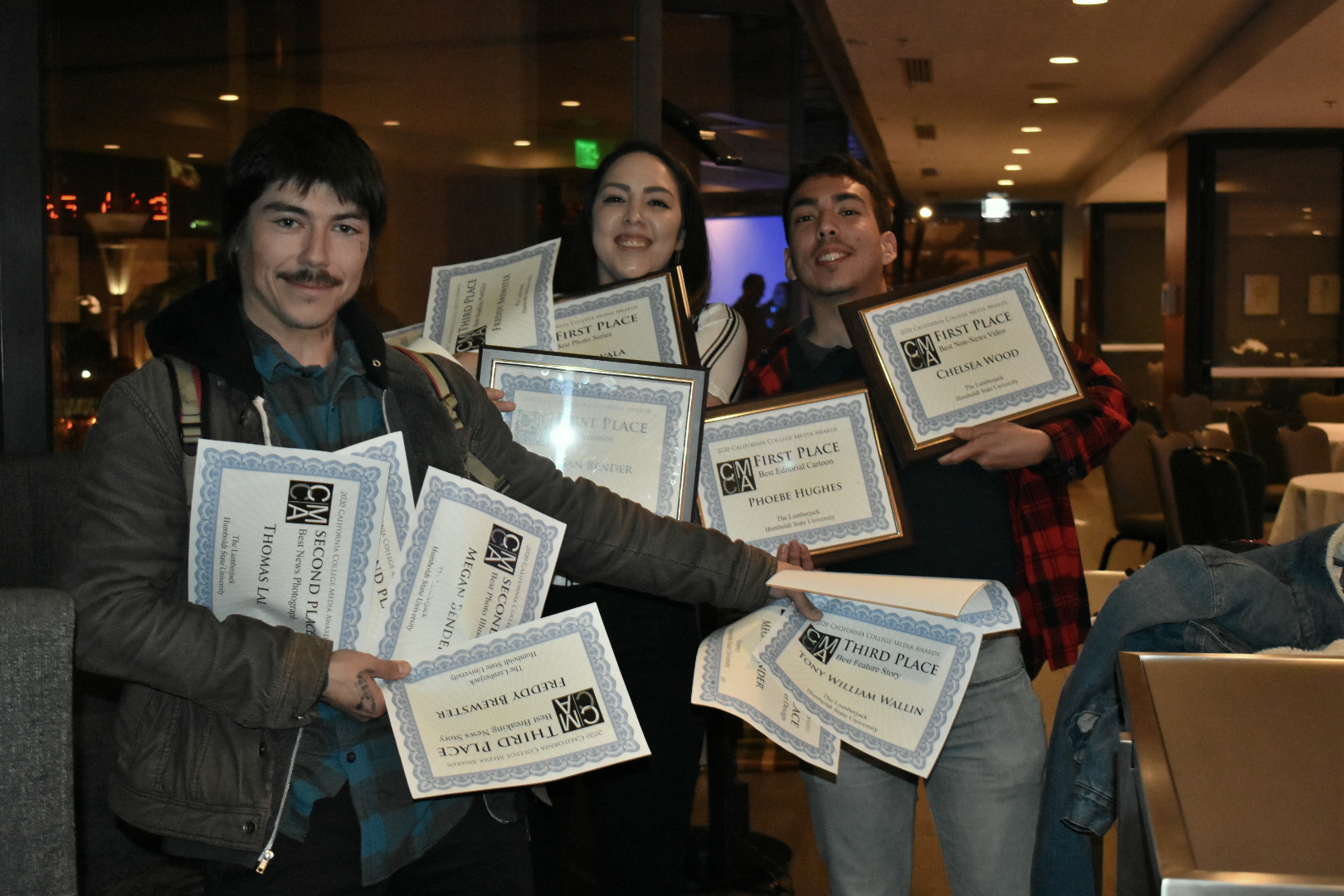
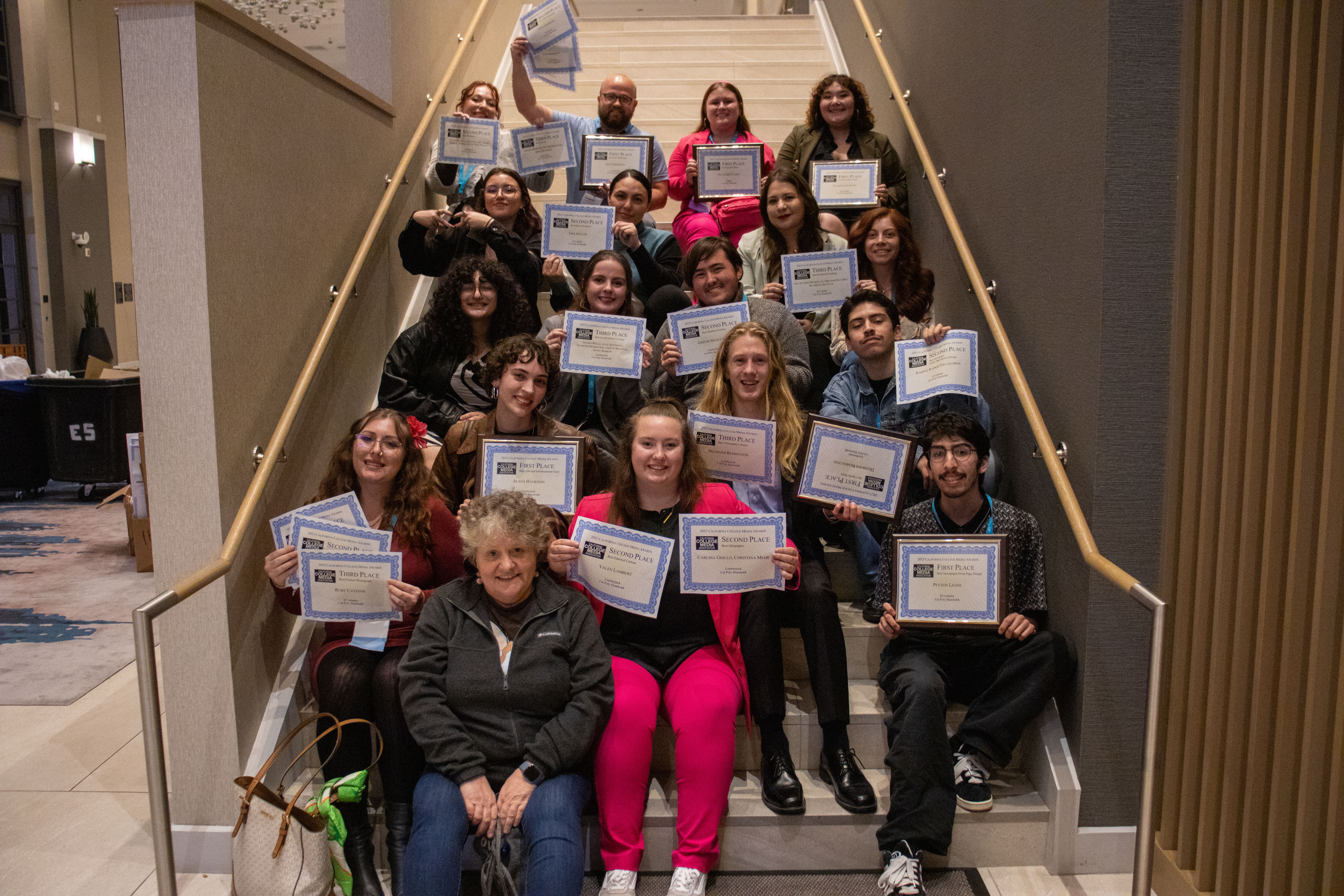
    We embraced one another and cheered as we collected a total of 14 awards for the Lumberjack. We placed in categories like Best Social Justice Coverage, Best Feature Photo, Best Arts and Entertainment Story, and Best in Show. We were struggling to get a photo with all of our awards together on the table, even when I stood on a chair and raised my camera in the air. Our advisor soon approached each of us to get a snippet of our reactions for social media. At the time, I was so overwhelmed with excitement and pride in my team that I couldn’t give the groundbreaking, heartfelt speech I wanted. I can at least give that speech in writing.

    I didn’t originally come to Cal Poly Humboldt as a journalist. I was an English major and I wanted to write novels. I joined the student magazine, Osprey, during my first semester and fell in love with it. I loved learning from people and giving that knowledge to the public. I knew I wanted to write. When I took the Lumberjack workshop, I didn’t expect to be writing for an award-winning paper. I’m grateful to be a part of the process and I am honored that our hard work gets to be recognized on a state and national level. The pressure of working on The Lumberjack is intense, but you take on that pressure as a team. No matter what else is going on in our lives, we get together every Tuesday, hunker down in the newsroom, and make a newspaper for our campus.


  • It’s time to axe the Lumberjack

    It’s time to axe the Lumberjack

    by Oden Taylor

    Pioneer, prospector, lumberjack— what do they all have in common? A significant role in the colonization of North America and a place as a California State University mascot. CSU mascots are rife with cultural insensitivity and, at times, blatant racism— if you don’t believe me, just google the San Diego State University Aztec Warrior

    The names of CSU campus newspapers also nearly always correspond with the school mascot. For example, CSU East Bay’s mascot is Pioneer Pete and the school paper, “The Pioneer.”   

    At Cal Poly Humboldt, “The Lumberjack,” both as a mascot and the name of our paper, symbolizes white supremacy and colonization. It is time for a change, starting with us. The Lumberjack must change its name to continue the removal of white power structures and symbols from indigenous land.

    Lumberjacks worked alongside prospectors during the gold rush, making way for new settlers to build towns and ravage the land for its resources. After the gold rush ended, lumberjacks cleared old-growth redwood forests well into the twentieth century.  

    In fact, only 5% of the original old-growth redwood forest stands from Southern Oregon to Central California, according to the Save the Redwoods League

    There have been many name changes taking place across Humboldt county, from the Gutswurrak Student Activity Center here on campus to the name restoration of Sue-meg State Park. This change comes after nearly 170 years of being called “Patrick’s Point” for Patrick Beegan, a private land owner and accused murderer of Indigenous people, including a Yurok boy. 

    As of 2018, CSU Long Beach abandoned its longtime mascot, Prospector Pete, for Elbee the Shark. Shortly after CSU East Bay claimed to do the same, saying goodbye to Pioneer Pete. Four years later they have yet to choose a new mascot, according to their website

    Unfortunately, despite the example set by other schools and the opportunity presented by an expensive rebrand, Cal Poly Humboldt did not find it necessary to retire the Lumberjack, telling El Leñador in March that there are no current plans to change the mascot.

    Though Long Beach has chosen a new mascot, neither campus changed the name of their newspaper. They remain Long Beach’s Daily Forty-Niner and East Bay’s The Pioneer. This lack of meaningful change promotes white supremacy in newsrooms, including ours. 

    We must move beyond just acknowledging the land we occupy and think critically about the messages we distribute and the symbols we use on it. 

    All CSU campus newspapers should reconsider what they call themselves and why. Does your publication’s name honor and represent your campus community? 

    It’s time we axed the Lumberjack. If the administration isn’t willing to do it, the change must start with us

  • Letter to the Editor: This Bus Driver Misses Students and Faculty

    Letter to the Editor: This Bus Driver Misses Students and Faculty

    A note from a local bus driver longing for a crowded bus again


    This is a letter to The Lumberjack from local bus driver Mark Condes. The letter has been edited only for grammar and punctuation.

    I drive a bus around Arcata, California. I frequent the Library Circle and the 14th Street & B intersection. Lately, on very infrequent occasions, I drop off an HSU student at one or the other. But this has been dwindling down to rare moments. I’m writing this because I just wanted to say that I miss all the students and faculty who have been my passengers for over a year now.
    .
    I miss making the rounds on LK Wood down to Camp Curtis, rolling out to Sunny Brae for my three stops there, the long drive down to Greenview Market to pick up the handful of students and a professor in that little corner of Arcata, and out to the Valley West loop where we scoop up the largest busload of students along Alliance and Foster streets, packing them in like sardines, as we like to say, with a call out to the back of the bus, “Do we have room for just ONE more?”
    .
    I’m a lucky person lately because I’m still working, still driving all over town. During these times, we only run what’s called the ‘Orange’ route. No more Red, no more Gold, just a mashup of both.
    .
    Truth be told, I feel a bit unlucky also. While we still pickup a handful of Townies going about their ‘Essential Needs’ business, nothing replaces all the bustling energy, the fantastic smiles, the mix of voices of my student riders.
    .
    I suppose I’m getting to the point, or heart, of the matter… ‘My’ student riders.
    Maybe I’m just a softie. I know I’m not some old lonely guy grasping at any human interaction, desperate for some validity that I still exist and matter. But yeah, I suppose I’ve formed an attachment at some level. Perhaps it’s a mix of all things that make me who I am, that have allowed me to feel some level of connection with the younger people heading off to HSU and their open road to the future.
    I have had the pleasure of watching my own kid go through the same process and life experience of college, and that was just a few years ago. I’m sure there’s a relationship here also.
    .
    While I ride around, one large circle each hour… hour-after-hour, I will often feel that tinge of loss, that nudge of sadness as I reflect on how alive this lumbering conveyance once felt, and now how hollow and empty it’s become.
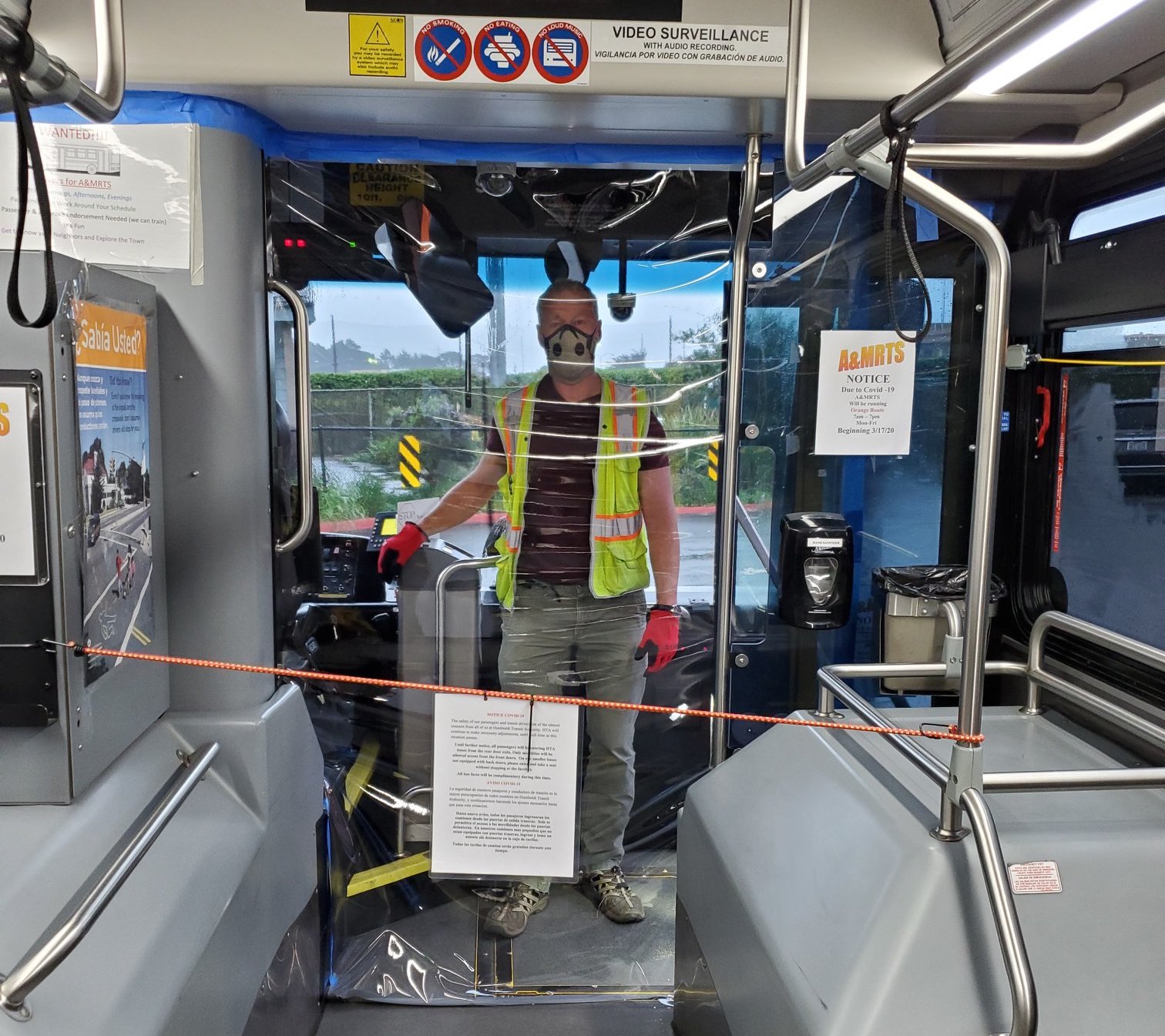
    And then there’s that other factor, an anomaly I hope… the separation of driver from passengers via a vinyl wall. So impersonal, a clear Berlin Wall, if I may.
    .
    As I arrive at each stop, in particular the ones where I would pick up students, I still pause while glancing out in the distance. I find myself looking for those waving arms, that transition from a walk to a full-bore run, as a student realizes they may miss their bus ride to school. I grew to know a number of them well enough that I could only grin and patiently wait for them to arrive, panting, fumbling for their student ID to swipe once they clambered up inside. 
    .
    I realize school will return to business in the future, and students will once again ride the bus. Yet, as with so many derailed aspects of our lives currently, there’s no firm date on when that will take place.
    .
    So I drive. I still take in those sweeping views as I top Union Street on my way to the Parkway Apartments, coax the bus up steep grades, and round the circle at the HSU Library. And when I pick up a familiar student, I still take off my sunglasses, pull down my mask, and with a smile call out through my plastic membrane, “Good Morning!”
    .
    From time-to-time as I roll through town, I catch a glimpse of a former, frequent student rider or professor, who no longer rides the bus. 
    In those transitory moments, we may glance each other’s way at just the right instant. As recognition unfolds, so do the smiles, the nods, the waving of the hands, and I am granted a brief respite from the isolation imposed upon me by this COVID-19 experience.
    .
    While I am grateful to still be working, still driving, I am even more grateful for all the friendly smiles, the greetings, the eye-rolls, headshakes, and laughter over my bad jokes and puns, that I experienced these past semesters. I wonder how ‘My’ students are doing, how they are faring during these trying times… I care.
    .
    I look forward to life resuming in a more normal manner, and the days of a busload of students once again bringing their energy, excitement, and friendliness through the doors.
    I honk and wave whenever I see students in graduation caps and gowns getting their pictures taken by the gates of the university. I shake off that bit of sadness and drive on.

  • HSU Wraps Up Faculty Sex Solicitation Investigation

    HSU Wraps Up Faculty Sex Solicitation Investigation

    Faculty member no longer employed by HSU

    Humboldt State issued a press release today notifying the campus community that it had finished its investigation into a faculty member soliciting students for sex. According to the release, HSU no longer employs the faculty member, but since no formal criminal charges have been filed, the University Police Department is not able to bring charges.

    Read the full release below:

    HSU Concludes Faculty Misconduct Investigation

    Humboldt State University has concluded an administrative investigation into anonymous allegations of faculty misconduct, in which a faculty member was accused of soliciting students for paid sex.

    Upon discovery of the allegation, the University took immediate steps to protect students from harm, and the employee subject to the investigation is no longer employed at Humboldt State. Because this is a personnel matter, the University is not able to provide details of the investigation or the outcome. However, the University is confident that it responded strongly and appropriately, and that it reached a resolution that ensures the safety and well-being of our students, faculty, and staff.

    The University Police Department has also been investigating the incident for any potential criminal violations and charges. Because no formal criminal complaints have been filed, University Police is not able to bring criminal charges at this time. However, the University Police Department’s investigation remains open. 

    The University encourages anyone who may have been harmed to seek assistance through the following campus support services.

    • Counseling & Psychological Services (CAPS) provides a variety of support services. You may make an appointment by calling (707) 826-3236. If you are having a crisis, you may reach a CAPS therapist 24 hours a day at the same number (707) 826-3236.
    • The Campus Advocate Team (CAT) is an on-campus resource for students, staff, and faculty at HSU. CAT is a program of the North Coast Rape Crisis Team, a private nonprofit organization that has been contracted by HSU to provide specialized services to the HSU community. CAT provides 24-hour, confidential support to any HSU student, staff, or faculty who wants to talk about harm they’ve survived (sexual harassment, sexual assault, dating/domestic violence, stalking), or explore their options for support and/or holding accountable the person who harmed them. CAT can be reached at (707) 445-2881, 24 hours a day. On-campus appointments are available.
    • The Dean of Students Office can help students navigate the steps of any reporting process and provide support and advocacy while navigating a formal complaint, as well as helping students find resources on- and off-campus to best meet their needs. You can reach the office at (707) 826-3504.
    • Human Resources handles staff employment as well as Title IX matters and can be reached at (707) 826-3626. Academic Personnel Services handles employment and related responsibilities for faculty, and can be reached at (707) 826-5086.

    The University also requests that anyone with information report it to one of the offices listed below. The Title IX Office helps students navigate accountability and accommodation for incidents of harm. The University Police Department, which operates from a trauma-informed perspective, assists with accountability and responds to reports of criminal activity.

    • Title IX Office, David Hickcox at office (707) 826-5177, cell (707) 296-4032, or david.hickcox@humboldt.edu.
    • University Police Department at (707) 826-5555.

  • Letter to the Editor: HSU Did Not Violate California Law

    Letter to the Editor: HSU Did Not Violate California Law

    A letter from HSU’s vice president of Enrollment Management

    A letter from Humboldt State University Vice President of Enrollment Management Jason Meriwether follows:

    Wednesday, April 22, 2020

    James Wilde, Editor & Reporter
    Grace Caswell, Editor & Reporter
    The Lumberjack Newspaper
    Humboldt State University 

    Dear James and Grace,

    Please accept this letter (also enclosed) in response to the Lumberjack Article titled, Humboldt State Violated California Law by Requiring Registration for a Public Meeting, which was published on April 16, 2020.  

    While you were copied on a series of emails to me, and thus, on my responses, there are still a few important facts that I believe you will find useful in the wake of the April 16thstory.  Since my email was the source of the quotes by me in the article, I never had an opportunity to answer a couple of fundamental questions as you prepared for your story.  As such, I ask you to please consider the following:

    The University did not violate California Law.  

    When I received the original email, which copied numerous parties, Vice President Dawes and I took immediate action to verify that HSU was not in violation of the law.  This included going into consultation with other university stakeholders, including legal counsel.  This consultation reassured us that no violation of policy or law was taking place.  

    In particular, I urge you to please review the actual requirements of the Bagley-Keene Act.  First, please review a guidance document provided by the State’s Attorney General which outlines the scope of Bagley-Keene.  Most pertinent to this issue, the Bagley-Keene requirements at issue apply only to meetings of a statutorily defined “state body” (Section 11121) that do not apply to the informal meetings hosted by VP Dawes and me.  As explained in Section 11121 and in the guide from the State’s Attorney General, the sessions that were hosted do not fall within the scope of Bagley-Keene, which, based on guidance from legal counsel, means this law does not apply and was not broken.  

    With respect to the Brown Act, which was also referred to in the series of emails and in your article, this statute applies to local government agencies and essentially stands as a counterpart to Bagley-Keene, so to speak.  The California State University, in particular Humboldt State, is a state agency, which does not fall under the Brown Act.  Because Humboldt State, as a part of the CSU, is not subject to the Brown Act, legal counsel has advised us that the law was not broken.  

    Why did we add a public link to the originally scheduled presentations?

    We did so to eliminate any perceived barriers to participation.  As quoted in the story from one of my emails, “the entire point of the meetings was to be transparent.”  

    While we were fully aware that we were compliant with the law and that no persons were being barred from the meeting, the very notion that we were trying to keep people out, even though it was false and based on an incorrect interpretation of the law, compelled us to add an extra way to view the meeting.  In our perspective, if any person felt uncomfortable or interpreted the registration function as a barrier, then adding the extra link made sense.   In total, over 300 members of the university, media, and local community attended both meetings, and not a single person was excluded.  The zoom webinar function was not sought out as a barrier, but as the best way to allow so many people to receive the information at hand.  Registration for this meeting was not like a conference presentation or an event with limited access or hidden behind a paid wall.  Many instructors and students are using zoom for class and the majority, if not all, meetings and presentations are held over zoom.  We sent the information out to the entire campus, it was posted on the public events website, and we did not deny access to anyone.  Simply stated, because we could not have a meeting in the Great Hall or KBR, a zoom meeting appeared to be the best option to make sure that this important information was shared with the campus.   

    To be candid, the public webinars were not an attempt at secrecy.  Any notion to the contrary is simply false.  In our belief, these sessions were about being honest with the campus and sharing data that impacts everyone.  Making the report and data available online and readily sharing it with the media, students, faculty, and all interested parties was also necessary.  Personally, I can assure you that it would have been easier to not conduct public presentations about such a negative set of projections, but in fact, the public presentations were the right thing to do.   

    The first person to receive a copy of my report was a journalist from the Lumberjack who received the report even before my first public presentation to the University Senate.  The Senate presentation was also via zoom and on the same day I met with the student journalist.  This information has been presented to Associated Students, the University Senate, the University Planning and Resource Committee, and in two public meetings.  The report has also been cited by the media and directly provided to reporters who requested it.  These actions do not align with any intention to violate the law or fail in transparency.  

    In conclusion, I am committed to the voice of students through journalism, which I believe has been demonstrated during my first year at Humboldt State.  That commitment will not change.  To that end, my commitment to providing facts, information, and access to student journalists has also been demonstrated.  Accordingly, I ask that you please review the information and facts above and please weigh against the information that was provided to you and the information that was published in the article.   

    Thank you for your consideration.  

    Sincerely Yours,

    Dr. Jason L. Meriwether

    Vice President of Enrollment Management

    Humboldt State University

    Ralph M. Brown Act
    https://leginfo.legislature.ca.gov/faces/codes_displayText.xhtml?lawCode=GOV&division=2.&title=5.&part=1.&chapter=9

    Bagley-Keene Act’s Section 11121 https://leginfo.legislature.ca.gov/faces/codes_displayText.xhtml?lawCode=GOV&division=3.&title=2.&part=1.&chapter=1.&article=9.

    Attorney General’s Bagley-Keene Act Fact Sheet

    https://oag.ca.gov/sites/all/files/agweb/pdfs/publications/bagleykeene2004_ada.pdf

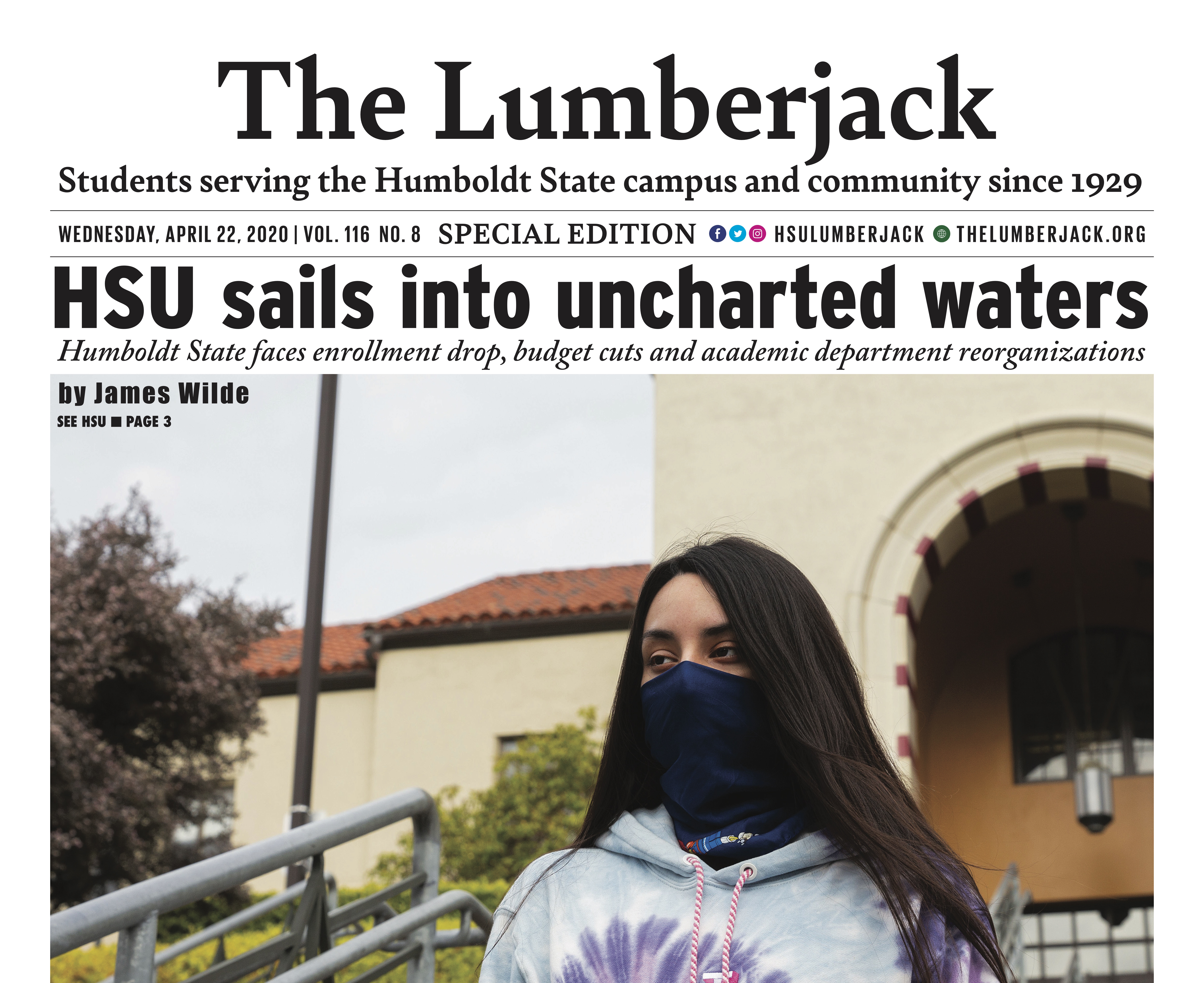
  • The Lumberjack in Print: April 22, 2020

    The Lumberjack in Print: April 22, 2020

    The eighth issue of The Lumberjack for the spring 2020 semester, a special edition mailed to over 6,000 students

  • HSU is Holding Administrative Meetings Online and You Can Attend Them

    HSU is Holding Administrative Meetings Online and You Can Attend Them

    How and when to watch HSU administrators make big decisions

    University Senate Meetings: 

    Meetings are available online via Zoom from 3-5 p.m. Email senate@humboldt.edu to receive a Zoom link.

    Senate meetings will be held Tuesdays on April 21, May 5 and May 19 (if needed—undecided at the moment).

    University Senate Meetings are open to the public. If members of the campus wish to speak during the senate’s open forum period from 3:15-3:30 p.m., sign-ups are available on their website. 

    University Senate Executive Committee Meetings:

    Meetings are available online via Zoom from 3-5 p.m. Email senate@humboldt.edu to receive a Zoom link.

    Executive Committee meetings will be held on alternate Tuesdays from regular University Senate meetings on April 28 and May 12 (if needed—undecided at the moment).

    Associated Students Board of Finance Meetings:

    Meetings are available online via Zoom from 2:30-3:30 p.m. Zoom link (unless changed).

    Thursdays on April 23, April 30 and May 7.

    Weekly schedule of administrative meetings:

    MondaysTuesdaysWednesdaysThursdaysFridays
    4/21: University Senate Meeting
    3-5 p.m.
    4/23: CAHSS Council of Chairs Meeting
    TBD
    AS Board of Finance Meeting
    2:30-3:30 p.m.
    4/28: Executive Committee Meeting
    3-5 p.m.
    4/30: CAHSS Council of Chairs Meeting
    9-11 a.m. 
    AS Board of Finance Meeting
    2:30-3:30 p.m.
    5/5: Associated- Residential-Athletic Council
    1-2:30 p.m.
    University Senate Meeting
    3-5 p.m.
    5/7: CAHSS Council of Chairs Meeting
    9-11 a.m.
    A.S. Board of Finance Meeting
    2:30-3:30 p.m.
    5/12: Executive Committee Meeting (“if needed” – undecided at moment)
    3-5 p.m.
    5/14: CAHSS Council of Chairs Meeting
    9-11 a.m.
    5/19: University Senate Meeting (“if needed” – undecided at moment)
    3-5 p.m.
  • Humboldt State Violated California Law by Requiring Registration for a Public Meeting

    Humboldt State Violated California Law by Requiring Registration for a Public Meeting

    HSU briefly required registration for two public webinars as a security measure

    Update, April 22: Humboldt State Vice President of Enrollment Management Jason Meriwether penned a letter to The Lumberjack, making the case that HSU did not violate California law. Read it here.

    Editor’s note: Grace Caswell is a student in Journalism Department Chair Vicky Sama’s media law course. Almost the entire staff of The Lumberjack has also had Sama as an instructor in journalism courses.

    Humboldt State University hosted public meetings via Zoom to inform the public about its projected enrollment decline and budget cuts April 13 and 15. However, as a security measure protecting the university from “Zoom bombings,” HSU enacted mandatory registration requirements prior to entering the meetings in violation of California state law.

    “Zoom bombings” describe a new term for an infiltration or hijacking of a Zoom session with the intent to harass and disrupt the session. With an increase in Zoom users, from 10 million in December 2019 to more than 200 million in March of 2020, Zoom CEO Eric S. Yuan released a statement April 1 detailing additional measures being taken to enhance Zoom security over the next 90 days.

    HSU Vice President of Enrollment Jason Meriwether claimed HSU has experienced Zoom bombings and enacted the registration as an additional security measure. The additional measures required the public to respond twice via Google forms before being sent the Zoom meeting invitations, basically giving the administration, a government body, the power to sift through and deny public access.

    An approved registration screen for one of HSU’s enrollment and budget webinars held April 13 and 15.

    HSU Chair of the Department of Journalism and Mass Communication and media law professor Vicky Sama alerted and engaged with HSU administration, specifically Meriwether, on the violations being committed.

    “Using ‘security’ reasons to require the public additional registration to access a public meeting on the people’s business does not satisfy the openness and liberties that our Constitution provides,” Sama said in an email. “In addition to violating state law that I explained in my earlier email.”

    “The unintentional message is that some people are not welcome and/or we at HSU don’t want the public to know what is going on.”

    Vicky Sama, HSU journalism chair

    Sama said the additional requirement for the public to register prior to receiving an invitation was tantamount to reviewing their qualifications.

    “The email did not justify the registration nor did it outline its purpose, raising suspicions that the university doesn’t want certain people to attend or know what is going on,” Sama wrote. “The unintentional message is that some people are not welcome and/or we at HSU don’t want the public to know what is going on.”

    Specifically, HSU’s actions against the public violated the Brown Act and Bagley-Keene Act. Both California state acts provide assurance of rights to the public. Sommer Ingram Dean, staff attorney for the Student Press Law Center, explained how these security measures directly conflict with both acts.

    “Section 54953.3 of Brown says ‘A member of the public shall not be required, as a condition to attendance at a meeting of a legislative body of a local agency, to register his or her name, to provide other information, to complete a questionnaire, or otherwise to fulfill any condition precedent to his or her attendance,’” Dean explained in an email.

    “Section 11124 of Bagley Keene says ‘No person shall be required, as a condition to attendance at a meeting of a state body, to register his or her name, to provide other information, to complete a questionnaire, or otherwise to fulfill any condition precedent to his or her attendance.’”

    Sommer Ingram Dean, staff attorney for Student Press Law Center

    Additionally, Dean cited the Bagley-Keene Act and the measures it provides ensuring the public’s rights.

    “Section 11124 of Bagley Keene says ‘No person shall be required, as a condition to attendance at a meeting of a state body, to register his or her name, to provide other information, to complete a questionnaire, or otherwise to fulfill any condition precedent to his or her attendance,’” Dean wrote.

    Sama informed Meriwether of the illegal activity violating both the Brown and Bagley-Keene Acts April 13, citing the specific sections mentioned above. In response, Meriwether continued with the registration in place and adjusted the meetings by offering public links.

    “Since this issue was just raised today, it appears to me that the best thing to do is to move forward with today as planned,” Meriwether said in an email. “We will also explore hosting a third event. We will provide both the option for registration and the public link for the already scheduled event on Wednesday. The entire point of having these events was to be transparent.”

    Since then, the links to the April 13 and 15 meetings went public. However, the concern more surrounds HSU’s decision to filter through the public’s right to access a public meeting regarding matters directly impacting them.

    The registration requirement, Sama wrote, amounts to intimidation and goes against the spirit of openness and transparency, and “reeks of sneakiness.” In a time of crisis, government bodies can use the mirage of security to deny the public their right to voice their opinions. Ultimately, it can amount to an abuse of power against the public.

  • Humboldt State Has Trees Grown from Seeds That Went to the Moon

    Humboldt State Has Trees Grown from Seeds That Went to the Moon

    Here’s how HSU received the trees and where you can find them

    Humboldt State University has a handful of redwood trees grown from seeds that went to the moon.

    In 1971, astronaut Stuart Roosa brought around 500 tree seeds with his personal items on the Apollo 14 NASA mission to the moon. Roosa intended to test the seeds to see if space radiation would affect their germination. While he never set foot on the moon, he orbited the moon 34 times while his colleagues walked the lunar surface.

    When Roosa returned, he sprouted most of the seeds. NASA then sent the seedlings around the world. Around 1976, HSU received a handful of redwood seedlings and planted them around campus. Some of those trees remain near the theatre arts and natural resources buildings and near the Campus Center for Appropriate Technology and Facilities Management.

  • Here’s What The Lumberjack is Watching, Reading, Playing and Doing

    Here’s What The Lumberjack is Watching, Reading, Playing and Doing

    Some unedited recommendations and brief reviews from some of our staff


    Life and Arts Editor Grace Caswell

    What I’m watching:

    Just finished “Tiger King.” It’s the most ridiculous and unbelievable show I’ve seen yet with a surprising amount of depth.

    What I’m reading:

    “Noam Chomsky” by John Lyons.

    What I’m playing:

    None :/

    What I’m listening to:

    Lots of new music is being released but right now Toro y Moi and Jhene Aiko.

    What else I’m doing:

    Yoga and meditation has been a go to as well as cooking healthy foods. Anything to keep my mind at ease and health immunity high.


    Managing Editor Chelsea Wood

    What I’m watching:

    I’ve been watching the final season of “Schitt’s Creek” which has been a bittersweet reflection of the last five seasons.

    What I’m reading:

    I’ve been reading more of a book I started last summer. It’s called “The Spaceship Next Door” and it about a teenager who grew up in a small town where a spacecraft crashed years ago but never left.

    What I’m playing:

    Minecraft. I trash talked this game as a teen, but it’s amazing and I love creating things on it. It’s extremely entertaining and relaxing.

    What I’m listening to:

    I’m listening to lots of downbeat songs—music that soothes the soul with catchy beats. Just stuff to satisfy this melancholy phase I’m swimming through.

    What else I’m doing:

    I picked up an old hobby, basket weaving. It’s a relaxing and simple task that yields a useful item. And no that’s not a BS excuse, basket weaving is the shit.


    Editor-in-Chief James Wilde

    What I’m watching:

    I just finished season three of “Ozark.” It’s a crime drama with superb characters and writing that had an unexpected depiction of mental illness that probably hit a little too close to home and (full disclosure) made me tear up.

    What I’m reading:

    I just finished “Why Time Flies,” by Alan Burdick, a fun little foray into the way we think about time. Next up: “The Glass Hotel,” by Emily St. John Mandel.

    What I’m playing:

    Call of Duty: Warzone with my brother and some friends. I hate the premise of Call of Duty and, you know, shooting people, but as long as I ignore that it’s lots of fun.

    What I’m listening to:

    Kind of all over the place, which isn’t out of the ordinary. Indie stuff to hip hop to alt rock to electronic stuff to jazz to whatever else. Oh, and random Tiny Desk Concerts.

    What else I’m doing:

    Walking or going on runs to get out of the house. Drowning in schoolwork. Lying on the floor.


    Opinion Editor Alexis Parra

    What I’m watching:

    “Gentrified”- A show that hits home for people of color. “Tiger King”- A cult war in the world of big cats.

    What I’m reading:

    “Z: The Beginning of Everything”- the untold story of Zelda Fitzgerald and beautifying her life.

    What I’m playing:

    None.

    What I’m listening to:

    My playlist on LJ- All of my favorites songs and energy that I carry into one playlist. “La Platica”- A bilingual podcast where the host is funny and talks about dumb shit and real shit.

    What else I’m doing:

    Painting. Make-up. Face masks. Talking to my family. Getting creative while also taking care of my skin and keeping in touch with my loved ones.


    Sports Editor Thomas Lal

    What I’m watching:

    “Drive To Survive,” a super fun look into the 2019 F1 season with the dramatic thrills and spills to match!

    What I’m reading:

    “Permanent Record” by Edward Snowden. An intriguing and somewhat terrifying read.

    What I’m playing:

    The Witcher 3. This game has consumed my life. Loving the story and exploring the world.

    What I’m listening to:

    So much music, mostly ska, punk and jazz along with the “Every Little Thing” podcast.

    What else I’m doing:

    Being sad without any sports to watch.


    Web Editor Seth Finnegan

    What I’m watching:

    “Community.” The always funny comedy about students at a community college.

    What I’m reading:

    None.

    What I’m playing:

    Dead Rising and MLB The Show 19. Filling the sports void with hitting baseballs and zombies with baseball bats.

    What I’m listening to:

    The “Adventure Zone” podcast. Three brothers and their dad play D&D together.

    What else I’m doing:

    Learning to play darts. It’s very frustrating but very fun!


    Video Editor Benjamin Zawilski

    What I’m watching:

    The filmography of David Fincher and Hayao Miyazaki, and “The Good Place” on Netflix.

    What I’m reading:

    Rereading “Peter and the Starcatchers” by Dave Barry and Ridley Pearson, which was one of my favorite book series as a child

    What I’m playing:

    Overhearing my sister play Animal Crossing.

    What I’m listening to:

    The film scores of Mark Mancina, Alexandre Desplat, and James Newton Howard.

    What else I’m doing:

    Hiking at least five miles a day, sometimes up to seven, and have done a considerable amount of housecleaning.


    Reporter Deion Alston

    What I’m watching:

    “Coffee & Kareem.” Cop dates kid’s mother and him and kid (Kareem) uncover a conspiracy of dirty cops.

    What I’m reading:

    Haven’t been reading books tbh, but a lot of news article pertinent to sports, COVID-19, crimes etc.

    What I’m playing:

    Fortnite and NBA 2K 20. Fortnite is a shooting game and 2K is professional basketball at your finger tips.

    What I’m listening to:

    For podcasts, I listen to “Up in Smoke” hosted by two former NBA players, Matt Barnes and Stephen Jackson. It’s very interesting—great interviews and guests as well. For music I’m listening to a lot of Lil Uzi, G Herbo, Tory Lanez. So basically rap, hip-hop and R&B.

    What else I’m doing:

    I’m cooking a lot more—takes time up in the day. Do my 250 push-ups everyday and step-ups for some cardio. And occasionally throw the football in the drive way.


    Reporter Dakota Cox

    What I’m watching:

    “Seinfeld” & “Empire.” “Seinfeld” is a wonderful waste of time. “Empire” is a must-binge, cutthroat musical.

    What I’m reading:

    “Hurricanes” by Rick Ross is a fairly generic success story in terms of rapper autobiographies. “The Alchemist” is an extraordinary journey of the body, mind and soul.

    What I’m playing:

    Animal Crossing; don’t ask questions, go pick up the game!

    What I’m listening to:

    Going back and forth between oldies and hip-hop, gotta keep the serotonin up. Michael Jackson, Bob Marley and The Beatles are timeless, go listen! Gambino got the best album of 2020, @ me!

    What else I’m doing:

    Slipping out of sanity; would not recommend. Get a mask-on walk in when the sun shows it’s face; I like to play a little game called guess the gang members.


    Reporter Sarah Blunt

    What I’m watching:

    I just finished “I am not okay with this.” It was a really good show with short episodes that have a lot going on in them. 10/10. I also just recently watched “Freedom Writers.” That one was really good and empowering, also took place in Long Beach (where I’m from) so that was relatable (kind of).

    What I’m reading:

    “Looking for Alaska.” I’ve already seen the show on Hulu but I realized I had the book. So far it’s really good and John Green (the author) writes really descriptively so I never feel bored when I’m reading it.

    What I’m playing:

    None.

    What I’m listening to:

    Tons of music. Nothing in particular just going through my music apps and looking for things I haven’t heard before, or even music from shows i’ve watched that I liked the soundtrack. That’s most of what I spend my free time doing.

    What else I’m doing:

    Lately I’ve been taking bike rides alone just to get fresh air and not be stuck in the same surroundings. I never ride bikes but lately it’s just been a really nice way to get out the house but also keep my social distance from others. 10/10


    Reporter Ivan Ramirez

    What I’m watching:

    “Castlevania,” the show. “Mewtwo Strikes Back: EVOLUTION,” the movie.

    What I’m reading:

    Marcy Burstiner’s Investigative Reporting Book.

    What I’m playing:

    None.

    What I’m listening to:

    Psytrance, Electronic Dance Music, Drum & Bass, Electronic Rock.

    What else I’m doing:

    Meditating, talking to people on Discord, Instagram.


    Reporter Alberto Muro

    What I’m watching:

    I have started watching the Amazon Prime series “The Boys.” It has an interesting take on superheroes proving that not all of them are super. It’s a world where super heroes exist, now imagine their lack of empathy for saving people.

    What I’m reading:

    Currently reading through my textbooks so that I don’t fall behind on homework.

    What I’m playing:

    I am currently playing the remake of Resident Evil 3 which has updated graphics and character development.

    What I’m listening to:

    I am listening to the “Tinfoil Hat” podcasts since conspiracies take my mind on a wild ride

    What else I’m doing:

    I have transitioned from a student using critical thinking to an essential asset during a global pandemic thus turning me into a critical drinker.

  • With Future Unknown Amid Pandemic, HSU Plans for Enrollment Drops and Budget Cuts

    With Future Unknown Amid Pandemic, HSU Plans for Enrollment Drops and Budget Cuts

    HSU, like all colleges, prepares for tough times and serious measures

    Humboldt State University is preparing for an enrollment drop of around 20% for the fall and a budget cut of around $20 million by the 2022 fiscal year, according to a joint press release from HSU and College of the Redwoods.

    Before the COVID-19 pandemic, HSU projected an enrollment drop for total students of around 14% for the fall and had proposed a budget cut of around $5.4 million by the 2022 fiscal year. 

    Given the uncertainty of the next year, HSU is planning for an even larger enrollment decline and budget cut. HSU currently projects new student enrollment to drop by 30%. The specifics of what the budget cuts will mean are still being worked out.

    “Many options are being looked at, including combinations of a hiring chill, spending freeze, operational changes, incentives for retirements, travel reductions, and more,” the press release said.

    In a Zoom interview, HSU Vice President of Enrollment Management Jason Meriwether said a worst case scenario projection might be only 500 new students and 500 transfer students admitted to HSU in the fall. 

    These numbers, to be clear, are projections. No one knows exactly how the next year will play out. Meriwether hoped HSU could keep enrollment and retention as high as possible.

    “The sad part is, I don’t know,” Meriwether said. “There’s no benchmark. There’s nothing to project against. We could be doing all this and, you know, 1400 students show up—which would be wonderful.”

    HSU is not alone. As noted in Meriwether’s Tuesday enrollment management report to the HSU Senate, colleges everywhere are facing enrollment drops amid the pandemic. The report cited articles from Forbes and the Associated Press along with some early data suggesting one out of every six college-bound students won’t attend college in the fall.

    With education expected to shift to a more local focus, Meriwether pointed out that HSU already shifted to local recruitment in the last year with measures like the Humboldt First Scholarship.

    Compared to an average of about 32 local students attending HSU per year in the last three years, HSU currently has 208 local students confirmed to attend HSU in the fall with the Humboldt First Scholarship. 

    “The good news is we’re not starting local recruitment today because there’s a problem,” Meriwether said. “That’s the best part of all this—is that we already have a really solid foundation that we built in the community over the last eight or nine months.” 

    The enrollment management report includes a graph of enrollment scenarios, with red lines for lower enrollment scenarios and a blue line for a growth scenario. Meriwether hoped for HSU to remain close to the blue line.

    “Essentially, pray we get as close to the blue line as possible,” he said. 

    Meriwether pointed out that, since COVID-19 has hit everywhere, current students might not have much reason to transfer. If classes are still online in the fall at HSU, they will presumably be online everywhere. 

    “Let’s say a student says, ‘OK, well, you know, I want to transfer because I didn’t want this experience,’” he said. “OK. Well, the question will be, ‘What school are you going to transfer to?’ Because every school is stuck in this scenario right now.”

    Nevertheless, the pandemic will likely temporarily derail HSU’s efforts to improve enrollment. 

    “Long term, you know, prior to COVID-19, prior to this hit, we had a plan of getting to an FTE of 7600 students [full-time students] in about four years,” he said. “So now, what if the COVID-19 environment says, well, gosh, it can make us take eight years to get there.”

    Meriwether was optimistic that eventually, HSU would get through this.

    “I believe that we will bounce back, and I believe we will bounce back strong if the hit is really bad,” he said. “This is a marathon. Enrollment is a marathon.”

  • HSU Projecting Grave Hit to Enrollment for Fall Semester

    HSU Projecting Grave Hit to Enrollment for Fall Semester

    Freshman class projected to shrink, number of academic departments to be reduced

    For the latest information, see our story here.

    Update 11:10 a.m.: a second email sent yesterday from College of Natural Resources Dean Dale Oliver and obtained by The Lumberjack makes similar points but does not give a specific number to the expected enrollment drop for fall beyond noting that a 15-20% drop was expected prior to the COVID-19 outbreak. We will update this story when we have confirmed the numbers below. The second email is pasted below.

    Humboldt State University has issued a budget directive to take immediate action to prepare for the fall semester, including the freezing of open staff positions and the reduction of the number of academic departments, according to an email sent to faculty and staff of the College of Arts, Humanities and Social Sciences Tuesday morning.

    The email, sent by Interim Dean of CAHSS Rosamel Benavides-Garb, projected a freshmen class for fall 2020 of around 500 students, down from around 1,400 students five years ago and down from around 1,000 students for fall 2019.

    “The scale and impact of our current predicament is grave and as a result our budgetary practice has to be reconsidered and reformulated based on the simple equation of demand and resources,” the email said. “We have become, de facto, a much smaller institution, which compels us to undertake a comprehensive reset at HSU.”

    The email listed six directives, including requests to freeze all vacant staff positions, reduce the number of academic departments and develop online programs for current and transfer students to complete their degrees.

    The email promised to make the process consultative and sustainable.

    “We remain committed to “the student first” approach,” the email said, “and are extremely aware of the critical importance, now more than ever, of issues of social justice, equity, and inclusion in all we do.”


    The full email is copied below:

    Dear CAHSS Colleagues,

    On April 2, the deans of all three academic colleges received new administrative directives from Interim Provost Lisa Bond-Maupin regarding the coming academic year. The directives are a call to action, issued in response to the budget and recruitment/retention reality at HSU. The Interim Provost reiterated these directives yesterday, Monday, April 6 in her Provost/VPAA Report to the senate.

    As we all know, our student enrollment has been declining for several years and the institutional budget has been negatively impacted. The administration’s efforts to address the problem must now be reframed in light of new and profound challenges the current COVID-19 pandemic poses for HSU, and the CSU system in general.

    We are projecting a freshmen class of 500~ students across all three colleges. Five years ago, the freshmen class numbered 1,400+ students. The scale and impact of our current predicament is grave and as a result our budgetary practice has to be reconsidered and reformulated based on the simple equation of demand and resources. We have become, de facto, a much smaller institution, which compels us to undertake a comprehensive reset at HSU.

    The Interim Provost has directed the three academic deans to reduce spending and grow retention/recruitment. Her directives require our college to implement the following action areas immediately:

    1. Freeze all vacant staff positions: This is indefinite or until each college develops a plan to organize staff support within colleges and across colleges.

    2. Reduce the number of academic administrative units (departments): This needs to be planned immediately and be in place for this next fiscal year so we are reorganized starting fall 2020.

    3. Develop online degree completion opportunities for certain existing majors in the last two semesters of their programs.

    4. Develop two-year degree online completion opportunities for transfer students of certain majors beginning fall 2020.

    5. Develop a partnership with CEEGE related to workforce development, responding particularly to a post COVID-19 context.

    6. Integrate the Center for Teaching and Learning (CTL) in the development and implementation of new teaching capacity.The Interim Provost has also indicated that she expects this process to be:

    The Interim Provost has also indicated that she expects this process to be:

    · Consultative with unit leadership.

    · Consultative and collaborative across colleges.

    · Sustainable by creating new retention and recruitment opportunities.

    The deans of the three colleges have already begun discussing the directives. I have also initiated planning within CAHSS, in collaboration with the three associate dean fellows, and will continue to discuss budget with the chairs. We will move forward together, exploring multiple budget management opportunities to make our colleges strong and resilient in the face of present and future challenges. We can also regard these adjustments as unique opportunities to explore new and exciting programs to attract and serve our ever-diverse student population in a shifting and challenging workforce environment. We remain committed to “the student first” approach and are extremely aware of the critical importance, now more than ever, of issues of social justice, equity, and inclusion in all we do.

    Sincerely and in solidarity,

    Rosamel


    Email from CNRS Dean Dale Oliver:

    April 6, 2020

    CNRS Faculty and Staff

    Dear Colleagues,

    Earlier today Interim Provost Lisa Bond-Maupin sent out her report to the HSU University Senate in preparation for Tuesday’s meeting.  Included in her report was a call for collective action to prepare for fewer students and fewer resources in the next academic year.  I’ve pasted the relevant section of the Provost’s report below my signature.

    Current estimates indicate we could have 20% fewer students in Fall 2020 that we had in Fall 2019.  This reduction is significant, and we must plan over the next weeks and months so that those students who start or continue with us in the fall experience high quality, engaged learning that will prepare them well for STEM professions and advanced study.

    Three items from the Provost’s report that I want to highlight are personnel, administrative re-structuring, and online education.

    Personnel: Although we will be finishing out the two faculty searches currently underway, and ensuring we have sufficient temporary faculty to deliver our curriculum, all other hiring is frozen for the moment, including those which are currently vacant and those which will soon be vacant due to expected retirements. Through improving business processes, realigning and reorganizing staff positions, and targeting professional development we will find a way to support our educational enterprise without hiring additional personnel.  This work will be both necessary and challenging, and require collaboration with relevant unions and careful consideration of multiple factors.

    Administrative restructuring: At the Dean’s level we were already planning a partial re-assignment for Associate Dean Rick Zechman to manage the marine lab while marine lab director Brian Tissot transitions from full-time director to FERP faculty.  We are also being asked to reduce the number of administrative units in the college, meaning that some departments will be merged or reformed.  This work will be done in close collaboration with the CNRS Council of Chairs and the other two academic deans.

    Online Education: There are some programs in CNRS for which one of the following scenarios might make sense:  provide an online degree-completion option for a group of students who have a year or less left to complete their degree; provide a degree-starter program for a group of first year (or transfer) students to get started with HSU from home during the fall 2020 semester, and then begin on campus in Spring 2021; provide more online sections of general education courses for undeclared students or majors from outside CNRS.  For the moment, I recommend that faculty discuss within their departments whether one or more of these scenarios might be appropriate for their program.

    For this week I am collaborating with the Provost’s office, with the other academic deans, and with a working group of CNRS Chairs to create possible models for administrative restructuring that can then be discussed among all of the CNRS chairs the following week.  Relatively soon I will also set up a mechanism by which input can be given from across the college.

    We face a significant challenge as a college and university over the next few months and years, but I am confident that we will find solutions that serve our students and the citizens of California well.  My confidence rests solidly on the incredible talent, dedication, and creativity of our faculty and staff, whom I am proud to serve.

    Best wishes, safety, and health to you and your families,

    Dale R. Oliver, Dean

    College of Natural Resources and Sciences

    From Interim Provost Lisa Bond-Maupin’s report to HSU’s University Senate, April 6, 2020

    Realignment of Spending with Reduced Revenue

    In addition to supporting instructional continuity and Academic Master Planning, our division leadership is turning our attention to budget planning for next fiscal year and beyond. Prior to COVID-19, our enrollment picture for next academic year was apparently trending toward a 15-20% fall-to-fall (one year) student headcount decline. We were likely headed toward a reduction to the HSU budget for next fiscal year that was double that anticipated when the URPC created its annual budget recommendations to President Jackson.  While the college-going enrollment impact of the pandemic is unknown for all in higher education across the nation, it is clear that the CSU and HSU will experience further decline in student enrollment. Given the enrollment challenges felt across the state, it is likely that impaction at our southern campuses will be lifted. It is highly likely that more students will choose for financial and other reasons, in the shorter term at least, to remain at home or closer to home to study. 

    While we await the release of up-to-date enrollment projections and budget information, Academic Affairs is implementing a few immediate strategies toward student retention and recruitment on the heels of the pandemic and toward further reducing our spending. As we do so, we are guided by the URPC principles and our own commitments to meeting the instructional needs of our students and protecting employment. In addition to continuing to adjust our academic offerings for Fall, immediate strategies also include: 

    • Working with each dean and director to reduce budget allocations for FY 21 

    • Freezing hiring in all open staff positions for now and planning to absorb staff attrition

    • Working collaboratively with staff within and across colleges and budget units in Academic Affairs to reimagine and reorganize our staff support 

    • Working collaboratively with department chairs and faculty to condense the number of separate academic administrative units in the colleges 

    • Working within the Office of the Provost to realign and reorganize staffing

    • Identifying academic programs ready to continue to offer upper division major courses online into next year and beyond to: a) help students in their final semesters to study from home and complete their degrees, and b) offer new transfer students an opportunity to complete their degrees online 

    • Identifying a COVID-era retention specialist in Academic Affairs who will support the continued offering of all existing retention efforts in a virtual format and will work in collaboration with ODEI to implement inclusive retention practices at a distance. 

    Each one of us will be implicated in and needed for this work. It is tough and unavoidable at this time. Each one of us has a very important role to play, now, more than ever in maintaining close connections with our students, helping them to problem-solve their educational needs and connect to resources and to stay connected to HSU. We need our students. And I think we are finding in their response to our transformed instruction – they need us. This powerful connection will ultimately move HSU through and beyond this tough moment in our collective history to the future we envision. Thank you.

  • Learning from These Sudden Senior Year Goodbyes

    Learning from These Sudden Senior Year Goodbyes

    I wasn’t prepared for the school year to end so abruptly

    I’m no good at saying goodbye. Give me no time to prepare, and I think I’m even worse. Amidst the COVID-19 pandemic and the sudden end of the rest of my in-person senior year in college, I’ve had to say goodbye to several friends and colleagues with little warning.

    This abrupt ending has thrown me off. I hate to whine, but I wasn’t ready to part ways with so many people. It takes time to reflect on others and consider what I want to say when I might never see them again.

    No goodbye is easy, and no goodbye ever feels adequate. But it takes a while for the reality of a goodbye to settle in. The natural buildup of expectation over the course of the last semester of college, which Dan Chiasson wrote about for The New Yorker, helps to ease the transition between college life and post-college life.

    Of course, not getting to say a proper goodbye is small potatoes compared to more serious issues people are facing right now, like losing jobs, homes or loved ones. Those things are awful, but they don’t make the little things suck any less.

    Of course, not getting to say a proper goodbye is small potatoes compared to more serious issues people are facing right now, like losing jobs, homes or loved ones. Those things are awful, but they don’t make the little things suck any less.

    In day-to-day life, it’s easy to let the specifics of what you appreciate about someone go unnoticed. Saying goodbye, for me, requires a bit of excavation into those little things. With some time, I can at least have a couple words to say. Even if what I say is inadequate, something is better than nothing. A couple words can signal a greater appreciation I might be trying to articulate.

    In my most recent goodbyes, I’ve tried to give thanks to the person for whatever they’ve done that has made them worth a goodbye in the first place. I try to let them know what I think of them. Then I probably wish them luck. And finally, I might just say “bye,” which is too small a word to encompass all the emotion in a parting of ways.

    There’s nothing wrong with any of that. It just hasn’t felt adequate. And it hasn’t helped that we’re supposed to be avoiding getting too close to anyone. Hugs or anything like them are off the table.

    Maybe all I’m really getting at is that saying goodbye is one hell of a difficult task, and doing so right now almost feels cruel. Being a true digital age child, I browsed the internet for tips on saying goodbye and got some vague ideas and a suggestion to give the person a memento—which, again, doesn’t seem smart right now.

    But no matter how much you prepare, goodbyes are always going to hurt.

    If you’ve made it this far, congratulations, you get my cliché takeways: if you have the chance, make your goodbyes worthwhile. Take time. And if you don’t have to say goodbye to someone yet, treasure them, and let them know how much you appreciate them as a friend or colleague or whatever else.

    You never know when the world might be struck by a pandemic and you have to say goodbye without warning. Be grateful and appreciative and let those that matter know it. Oh, and wash your hands and stay the hell home as much as possible.

  • The Lumberjack Takes Home 14 Media Awards

    The Lumberjack Takes Home 14 Media Awards

    Humboldt State student newspaper wins four first place California College Media Association awards

    The Lumberjack won 14 California College Media Association Excellence in Student Media awards for a variety of work in 2019. The Lumberjack took home four first place awards, seven second place awards and three third place awards at the CCMA awards banquet Feb. 29 in San Francisco.

    Deija Zavala won Best Photo Series, Phoebe Hughes won Best Cartoon Illustration, Megan Bender won Best Illustration and Chelsea Wood won Best Non-News Video.

    Megan Bender took second in Best Newspaper Front Page Design and Best Photo Illustration, Jose Herrera took second in Best Arts and Entertainment Story, Jett Williams took second in Best Newspaper Column, Liam Warner took second in Best Sports Story and Thomas Lal took second in Best News Photograph. James Wilde, Chelsea Wood and Collin Slavey took second in Best News Video.

    Freddy Brewster came third in Best Headline Portfolio for three different headlines and third in Best Breaking News Story, while Tony Wallin took third in Best Feature Story.

    HSU’s bilingual, monthly student-run newspaper, El Leñador, won 12 awards, including three first place awards. HSU’s student-run semesterly magazine, Osprey, won three awards, with a first place award to Megan Bender for Best Magazine Inside Page/Spread Design.

    The Lumberjack is the independent, student-run online media publication and newspaper established in 1929 at Humboldt State University.


    View the full list of HSU student award winners below:

    CCMA Winners 2020:
    FIRST PLACEPUBLICATIONSTUDENT(S)
    Best Photo SeriesThe LumberjackDeija Zavala
    Best Editorial CartoonThe LumberjackPhoebe Hughes
    Best IllustrationThe LumberjackMegan Bender
    Best Non-News VideoThe LumberjackChelsea Wood
    Best Newspaper Inside Page/Spread DesignEl Leñador Celeste Alvarez, Jose Herrera
    Best Newspaper Front Page DesignEl Leñador Kylee Conriquez, Jose Herrera
    Best Non-Breaking News StoryEl Leñador Jose Herrera
    Best Magazine Inside Page/Spread DesignOspreyMegan Bender
    SECOND PLACE
    Best Newspaper Front Page DesignThe LumberjackMegan Bender
    Best Arts and Entertainment StoryThe LumberjackJose Herrera
    Best Photo IllustrationThe LumberjackMegan Bender
    Best News VideoThe LumberjackJames Wilde, Chelsea Wood, Collin Slavey
    Best Newspaper ColumnThe LumberjackJett Williams
    Best Sports StoryThe LumberjackLiam Warner
    Best News PhotographThe LumberjackThomas Lal
    Best IllustrationEl LeñadorKylee Conriquez
    Best EditorialEl LeñadorBrenda Estrella
    Best Special Issue/SectionEl LeñadorJose Herrera, Vanessa Flores
    Best Overall Newspaper DesignEl LeñadorJose Herrera, Celeste Alvarez, Cara Peters, Ash Ramirez
    Best Social Media ReportingEl LeñadorVanessa Flores
    Best Magazine Cover DesignOspreyMegan Bender
    THIRD PLACE
    Best Headline PortfolioThe LumberjackFreddy Brewster
    Best Feature StoryThe LumberjackTony William Wallin
    Best Breaking News StoryThe LumberjackFreddy Brewster
    Best NewspaperEl LeñadorStaff
    Best Interactive GraphicEl LeñadorCeleste Alvarez
    Best InfographicEl LeñadorCara Peters
    Best Arts and Entertainment StoryEl LeñadorLora Neshovska
    Best Magazine Photo SeriesOspreyJett Williams, Megan Bender
  • Myths and Truths of Surgical Face Masks

    Myths and Truths of Surgical Face Masks

    Mirage of safety causes mask supply to plummet and xenophobia to reemerge

    The emergence of everyday people using surgical masks amidst the COVID-19 pandemic has caused mass misinformation and the perpetuation of xenophobic ideas.

    Myth: Surgical masks make you immune to COVID-19

    Typically found on hospital workers and sick personnel as a safety barrier, surgical masks are almost regarded as invincibility devices, protecting the body from outside pollutants and threats. The implied purpose of surgical masks is to protect patients from the secretions of a doctor’s mouth or nose during surgical procedures or to protect doctors and nurses from infected patients. Either way, a basic surgical mask prevents the exchange of bodily fluids, not air particles. Surgical masks are often mistaken as invincible shields against all viruses and bacteria.

    Surgical masks show no evidence of prohibiting the inhalation or contraction of the virus that causes COVID-19. The COVID-19 virus particles are too minuscule to be stopped by a surgical mask barrier. According to the Centers for Disease Control and Prevention, “most facemasks do not effectively filter small particles from the air and do not prevent leakage around the edge of the mask when the user inhales.” In no way do surgical masks prevent or obstruct contaminated air.

    While surgical face masks are virtually pointless against COVID-19, N95 filtering facepiece respirators are different. These masks are personally fitted to the face and “filter out at least 95% of very small (0.3 micron) particles, capable of filtering out bacteria and virus particles,” according to the CDC. These masks are typically worn by hospital and treatment personnel that come in direct contact with infected patients. N95 masks prevent the inhalation of micro-particles.

    Truth: Surgical and N95 masks are running low

    Due to the personal fitting of each N95 mask, they begin to degrade overtime depending on their usage, storage and environment. The assigned expiration date and high demand due to the current pandemic has resulted in an unexpected shortage in supply. Doctors are now reusing their masks, but they risk contamination due to degrading components affecting the protection and performance of the mask. Government administrations are requesting N95 donations as well as demanding some occupations to give up their assigned mask for medical workers.

    While N95 masks are needed most, surgical masks are running low as well. Infected patients wearing masks benefit surrounding parties by limiting exposure of emitted particles into the air. The pandemic panic has misinformed the public to go buy surgical masks when patients and medical workers need them most.

    Myth: DIY masks provide reliable protection

    YouTube and social media platforms are advertising do-it-yourself face mask tutorials in response to the shortage in surgical mask supply. The misinformation has continued as people attempt to protect themselves with faulty protection materials. Bras and bonnets to sandals and plain cloths are being cut and trimmed to replicate surgical face masks. But, as previously mentioned, surgical face masks provide no protection against COVID-19 virus particles. Any alteration of store-bought or recycled material will have the same, if not less, protection against COVID-19 than a surgical mask.

    Truth: Mask usage has reignited xenophobic ideas

    Surgical masks provide zero protection from contracting COVID-19, but they have effectively reignited xenophobia. It’s completely normal for the mind to want to assign a face to an infected COVID-19 individual or picture what a threat would look like out of caution. Assuming someone wearing a face mask has the virus and extending that assumption past the mask, to their race or ethnicity, is disgusting, racist profiling. In a time of crisis, people should be exercising neighborly behavior and picking one another up, not perpetuating racist, profile-based assumptions on others in an attempt to accuse others of the chaos. It’s unproductive and invasive.

  • Updated: Summarizing HSU’s COVID-19 Updates

    Updated: Summarizing HSU’s COVID-19 Updates

    All classes to go online for the rest of the semester and other plans, plus a translation

    Humboldt State University informed its students March 12 through email that classes would be going online following spring break. Concerns of spreading COVID-19 led the California State University system to suspend face-to-face instruction. HSU initially said it would be shifting to online classes March 26 until at least April 17. But in a March 17 message from President Tom Jackson, HSU announced classes would be taught online for the rest of the semester.

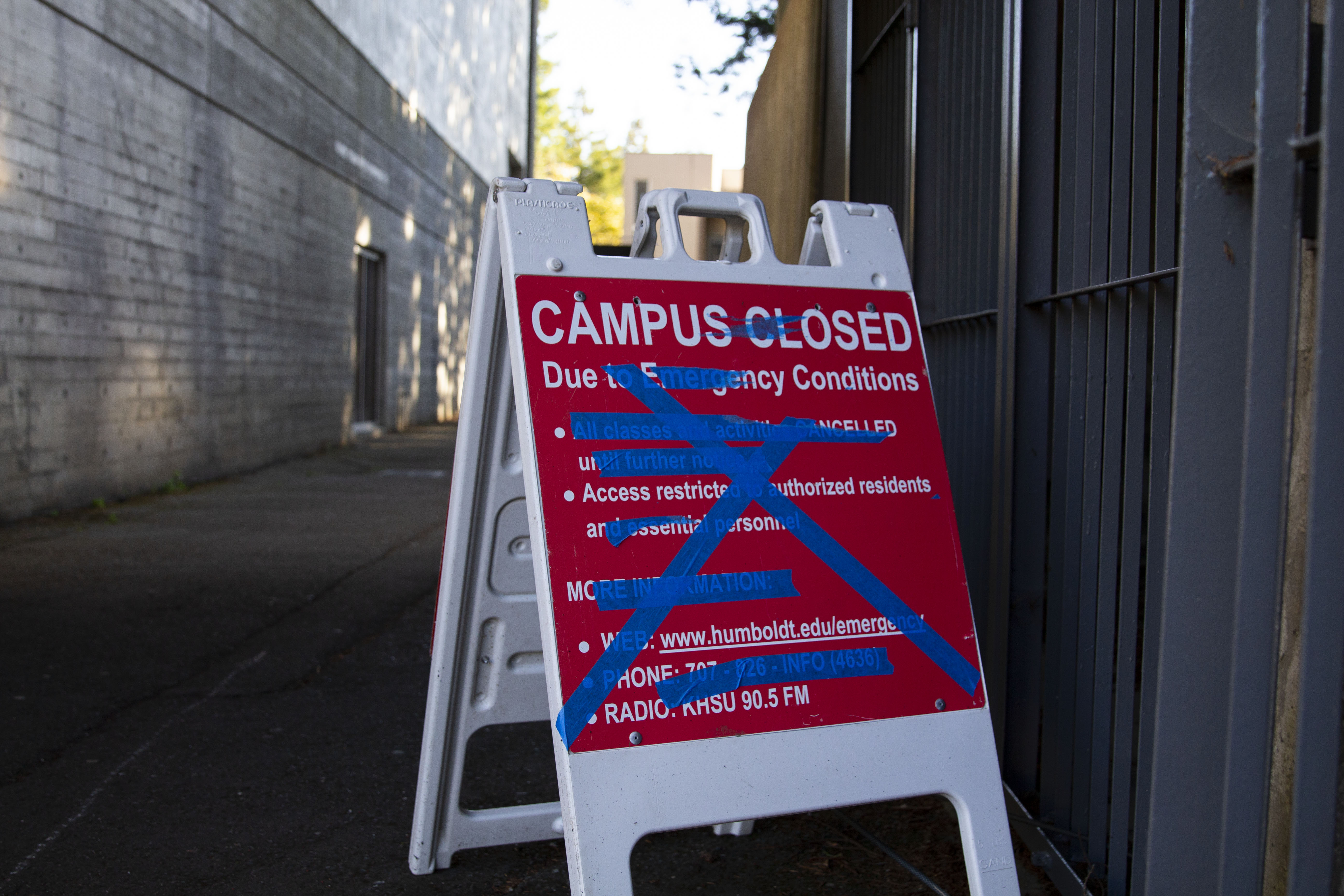
    Jackson’s message said all exams, labs, field trips and in-person meetings are canceled. HSU encouraged students living on-campus to return home if possible. However, HSU promised it would not displace students living on campus.

    Other notes from Jackson’s message included: non-essential student employees will work from home. Campus will close to the general public. Most of campus will close, with the exception of the Student Health Center, the University Center and the library, all of which will remain open with reduced staff. Finally, HSU said it will review alternatives to celebrate commencement.

    HSU has also launched a web page with resources for working from home. HSU plans to provide laptops for students without computers and internet hotspots for students with no internet at home. Programs like the Adobe Creative Cloud Suite and SPSS are expected to be available on HSU’s remotely accessible virtual lab and for downloads to personal computers. Multiple phone and internet companies have also agreed to waive late fees, not cutoff service and open up internet hotspots.

    HSU began updating students and staff through emails starting Feb. 24, when it informed them of the single case of COVID-19 confirmed in Humboldt County. They continued to provide updates weekly on how HSU would be handling a potential pandemic. The week before students were meant to head home or hunker down in Humboldt, HSU ramped up its online communications.

    HSU suspended all international and non-essential domestic travel March 10 for the remainder of the spring semester. In a March 11 email, they defined essential domestic travel as travel for academic credits that are necessary for graduation and cannot be postponed or substituted.

    Through several emails on March 11 and March 12, HSU canceled all instruction from March 23-25 to allow faculty to prepare for online classes. HSU then canceled all intercollegiate and club sports.

    HSU canceled non-essential events on and off campus March 13. Essential events—following HSU’s previous definition of essential—are any events done for academic credit necessary to meet a graduation requirement that cannot be postponed or substituted.

    On March 15, HSU noted the closure of local K-12 schools, and how that may affect staff and faculty. HSU later advised faculty aged 65 and older, or those with underlying health issues that make them more vulnerable to COVID-19, do not come to campus. HSU will arrange telecommuting for adaptable positions, but anyone not able to work remotely will be placed on administrative leave at their current rate of pay and for their normally scheduled work hours.

    Find all HSU COVID-19 updates here.


    Humboldt State University President Tom Jackson’s March 17 Message to Campus:

    Message from President Tom Jackson on Plans for the Semester

    Dear Campus Community: Over the last week, I have had the privilege of observing the amazing work of so many people in their efforts to assist others. The work by all of you to not only protect yourself, but to care for your family and our students is beyond remarkable. We are a very caring Lumberjack Family and I thank you.

    Things are changing rapidly and these updates are subject to change based on the fluidity of this situation. Every day, nearly every hour it seems, we are asked to pivot and address a new challenge in our efforts to reduce the spread of COVID-19. Our guiding light remains the health and safety of our Lumberjack Family while also helping our students to progress in their education. At times these efforts may appear in conflict, but they are not. At the root of all we do is our humanity and our underlying willingness to do what must be done.

    The time has come for HSU to implement a number of additional contingency plans and bolster our COVID-19 precautions. While there are no known active COVID-19 cases in our County at this time, and there have been none on campus, these additional precautions are consistent with recent federal and state health directives. In short, we must now do more to protect the health and safety of our campus and local communities.

    HSU will operate virtually through the end of the semester.

    1. Beginning today, we will shift as quickly as possible to virtual operations. Non-essential employees, including student staff, are to work remotely (telecommute) once they have received direction from their supervisor. Please continue to work with your supervisor on your work assignments and technology support needs.
    2. It is important we reduce the number of people on campus. We encourage students who can return to a home off-campus to do so. We will not displace students who are facing housing insecurities or homelessness. More information will follow.
    3. From Monday to Wednesday, March 23-25, the faculty will prepare for a complete shift to virtual instruction by Thursday, March 26. All professional development and preparation activities will now occur remotely. For the remainder of Spring 2020, all instruction is to be virtual and the primary operational state of campus is to be virtual. There will be no face to face meetings, events, instruction, exams, instructional labs, field trips, live performances, or small group seminars.
    4. We have closed all access to campus facilities to the general public.
    5. Most campus facilities will be closed to the campus community, including all sports and recreation facilities. We have also suspended all intramural and recreational activities for students. Any services remaining open for students – such as the library, student health center, and university center – will be operating with reduced staffing and must implement social distancing.
    6. As a campus we must continue to carefully practice social distancing techniques for those essential individuals who remain on campus, including students in our residence halls who truly have no other place to reside, and the food services and other staff who are supporting those students.
    7. Lastly, and sadly, we must review other ways to celebrate degree recipients instead of the traditional Commencement. We are a very creative campus and we will find alternative ways to celebrate our students’ success.

    There are many questions to be answered, and we will do our best to answer them in a timely way. We will share more information soon as we prepare campus to shift to virtual operations.

    We are resilient. From the Marching Lumberjacks doing what they do, to alumni making a difference in the world, to hiking in the Redwoods, to kayaking in the great Pacific ocean, we are Humboldt. This pandemic is challenging us but it will not break us. We are Humboldt, and while we may be socially distant for now we remain close at heart.

    Thank you for all that you are doing. I ask you to be flexible and understanding as we work together to protect the health and safety of the campus community. You are appreciated.

    Respectfully,

    Tom Jackson, Jr.
    President


    El Mensaje en Español:

    Mensaje del Rector Tom Jackson sobre los planes para el semestre

    Estimada comunidad universitaria, durante la última semana he tenido el privilegio de observar el increíble trabajo y esfuerzo de tantas personas que quieren ayudar a otros. El trabajo de todos ustedes, no sólo para protegerse, sino que también para cuidar a su familia y a nuestros estudiantes es notable. Somos una familia muy cariñosa de leñadores y se los agradezco.

    Las cosas están cambiando rápidamente debido a la fluidez de la situación. Todos los días, parece que casi cada hora, se nos pide que viremos y abordemos un nuevo desafío en nuestros esfuerzos para reducir la propagación del COVID-19. Nuestra luz guía sigue siendo la salud y seguridad de nuestra familia de leñadores y, al mismo tiempo, el apoyo necesario para que nuestros estudiantes progresen en su educación. A veces, estos esfuerzos pueden aparecer en conflicto, pero no lo están. La raíz de todo lo que hacemos está nuestra humanidad y en nuestra voluntad fundamental de hacer lo que sea necesario.

    Ha llegado el momento de implementar en HSU una serie de planes de contingencia adicionales para reforzar nuestras precauciones acerca del COVID-19. Si bien no hay casos activos conocidos del COVID-19 en nuestro Condado en este momento, y no ha habido ninguno en el campus, estas precauciones adicionales son consistentes con las recientes políticas de salud de nivel federal y estatal. En resumen, ahora debemos profundizar nuestros esfuerzos para proteger la salud y seguridad de nuestro campus y comunidades locales.

    HSU va a funcionar virtualmente hasta el fin del semestre.

    1. A partir de hoy, pasaremos lo más rápido posible a operar virtualmente. Los empleados no esenciales, incluyendo el personal estudiantil, deben trabajar de forma remota (teletrabajo) una vez que hayan recibido instrucciones de sus supervisores. Por favor continuar trabajando con su supervisor en sus tareas de trabajo y apoyo técnico.
    • Es importante que reduzcamos la cantidad de personas en el campus. Alentamos a los estudiantes que puedan regresar a sus hogares fuera del campus que lo hagan. No desplazaremos a los estudiantes con inseguridad de vivienda o falta de vivienda. Proveeremos más información sobre este tema.
    • Del lunes 23 al miércoles 25 de marzo, los profesores se prepararán para un cambio completo a la instrucción virtual, a comenzar el jueves 26 de marzo. Ahora todas las actividades de capacitación profesional y preparación se realizarán de forma remota. Durante el resto de la primavera del 2020, toda la instrucción será virtual y todo el campus funcionará de forma virtual. No habrá reuniones presenciales, eventos, instrucción, exámenes, laboratorios, excursiones, presentaciones en vivo, o seminarios de grupos pequeños.
    • Hemos suspendido todo acceso público a las instalaciones del campus.
    • La mayoría de las instalaciones del campus estarán cerradas a la comunidad del campus, incluyendo todas las instalaciones deportivas y recreativas. También hemos suspendido todas las actividades extracurriculares y recreativas de los estudiantes. Cualquier servicio que permanezca abierto para los estudiantes, como la biblioteca, el Centro de Salud Estudiantil y el Centro Universitario, funcionará con un personal reducido y se deben implementar distanciamiento social.
    • Como campus, debemos continuar practicando cuidadosamente técnicas de distanciamiento social. Esto se aplica a aquellas personas en roles esenciales que permanecen en el campus, incluyendo a los estudiantes en las residencias universitarias que realmente no tienen otro lugar donde ir, y proveedores de servicios de comida y otro personal que apoya a estos estudiantes.
    • Por último, y lamentablemente, debemos explorar otras formas de celebrar a los nuevos licenciados ya que no podrán tener una ceremonia de graduación tradicional. Somos un campus muy creativo y encontraremos formas alternativas de celebrar el éxito de nuestros estudiantes.

    Hay muchas preguntas por responder y haremos todo lo posible para responderlas de manera oportuna. Compartiremos más información pronto, a medida que preparemos el campus para cambiar a operaciones virtuales.

    Somos resistentes. Desde la banda de los “Marching Lumberjacks” que hacen lo que saben hacer, y los egresados que hacen una diferencia en el mundo, y las caminatas en los bosques de los gigantes rojos, hasta el paseo en kayak en el gran océano Pacífico, somos Humboldt. Esta pandemia nos desafía, pero no nos romperá. Somos Humboldt y aunque es posible que estemos socialmente distantes por ahora, seguimos estando cerca en el corazón.

    Gracias por todo lo que están haciendo. Les pido que sean flexible y comprensivas/os mientras trabajamos juntos para proteger la salud y seguridad de nuestra comunidad universitaria. Todos son apreciados. 

    Respetuosamente,

    Tom Jackson, Jr.
    Rector

  • Ask Evergreen: Concerned Citizen

    Ask Evergreen: Concerned Citizen

    How to live through a pandemic

    Ask Evergreen is an advice column by the students of The Lumberjack


    Dear Evergreen,

    How do I live in this pandemic?

    Dear Concerned Citizen,

    We’re living through history right now amidst the COVID-19 pandemic. There are many ways you can prevent potential exposure while still leading a balanced life.

    Educate yourself. Learn about the causes, symptoms and preventative measures of this respiratory virus. The California Department of Public Health has pertinent information you should read up on. While Humboldt County is not on the list for community transmissions, it is offering lab testing for suspected cases of the illness. The CDPH news updates page offers consistent updates.

    Isolate yourself. Don’t go out unless it’s necessary. While you may want to see your friends during spring break, don’t expose yourself to others who may not be practicing precautionary measures.

    If you’ve traveled home for break, be mindful of where you go out. It’s OK to not do normal spring break activities. Avoid going to clubs, restaurants, bars and breweries. It’s unlikely someone diagnosed with COVID-19 will be out in these places, but for the benefit of the doubt, you never know if they’ve been in contact with someone who has.

    Protect others. You may not realize how vulnerable certain age groups are to infectious diseases. Young children, the elderly and those with weakened immune systems are more susceptible to become ill. These groups are also less likely to be able to fend off illnesses, so limit interactions with the outside world for the sake of those near you in these populations.

    Prepare yourself. It’s going to get worse before it gets better. Practicing all of the former will help you better understand this illness and prevent further spreading. Just like after any natural disaster, awareness is heightened and preparedness begins for the next event. We shouldn’t wait for something to happen to be prepared for it the next time.

    Instead, we should always be ready for anything—cautious, but not panicked. Take this time to assess your emergency plans and supplies. Don’t stock up on unnecessary items like toilet paper. Do gather important survival gear to assemble a go-bag if you haven’t already. Ensure you have enough non-perishable food to last a potential quarantine or even a self-isolation period. Make sure you have your prescriptions filled, disinfectant stocked and all other daily necessities.

    Advocate for yourself. Perhaps your work has shuttered its doors and you’re worried about your next paycheck. Speak to your boss about what this pandemic means for your employment. Conserve your finances. With the stock market as unstable as it is right now, it’s wise to curb your spending. Don’t waste money on another bottle of hand sanitizer—instead, invest in the necessities.

    Relieve yourself. Don’t forget to take your mental health into account during this chaotic time. Reach out to loved ones and check on their well-being while updating them about yours. Find some stress relieving activities for you to do as you practice social distancing. Paint something, start meditating, study a new language or even do your taxes. There are plenty of things to occupy yourself with that are both peaceful and productive.

    We’re in this together.

    Sincerely,

    Evergreen


    If you have any questions you’d like to send in, email us at contactthejack@gmail.com. We won’t publish any names and you don’t need to use one.

  • Students Stressed and Frustrated Going into Somber Spring Break

    Students Stressed and Frustrated Going into Somber Spring Break

    Students react to in-person class cancellations due to global pandemic

    As spring break arrived and the COVID-19 pandemic continued its tear across the globe, many Humboldt State University students wondered what to do as HSU canceled face-to-face instruction until at least April 17. Some students stuck around while others went home. The pandemic, directly or not, has affected all students.

    “I feel like it’s a very serious outbreak and people need to take it seriously. I do think it’s getting blown out of proportion in some ways and people are panicking before they need to, but it’s just something I’m kind of trying to roll with, essentially.”

    Ashley Bailey, molecular biology major

    Ashley Bailey, a junior molecular biology major, planned to travel home. She admitted feeling stressed.

    “I feel like it’s a very serious outbreak and people need to take it seriously,” Bailey said. “I do think it’s getting blown out of proportion in some ways and people are panicking before they need to, but it’s just something I’m kind of trying to roll with, essentially.”

    Kiera Price, a junior journalism major, also said she would travel home. She thought both academic and national leaders should be more vigilant.

    “I feel like instead of limiting social interaction, they should do more to prepare for it,” Price said. “Like, for example, the fact that there isn’t more of a stricter way to limit survivors from coming in.”

    Price recognized there isn’t a lot to be done, but still expressed a longing for something more.

    Tim Arceneaux, a senior English major, looked forward to staying in Humboldt. With a sigh, Arceneaux said he understood the measures taken by HSU.

    “I think the precautions that the University is taking here and all around the country make sense, but at the same time, I find them to be really frustrating,” Arceneaux said. “I hope that this issue will bring the global community together and allow people to realize the importance of universal healthcare.”

    Arceneaux said there was one key thing HSU could do to mitigate the spread of the novel coronavirus.

    “They could try to alert students more about the health resources on campus,” Arceneaux said. “Because I feel like at this point, it’s almost an inevitability that someone is going to contract the coronavirus, and I’m not sure exactly what health resources are going to be available to students that contract the disease.”

    Norbert Rodriguez, a junior film major, had planned to travel to Southern California to visit family, but decided to stick around once the coronavirus broke out. He said he thought HSU took too long to respond to the pandemic compared to other universities.

    “At the moment, there aren’t any test kits [in Humboldt], so there’s really no way of knowing that there are any confirmed cases,” Rodriguez said. “I feel like it should’ve been a bit more proactive.”

    Editor’s note: St. Joseph and Redwood Memorial Hospitals have set up screening tents for patients with COVID-19 symptoms.

  • Updated: HSU Suspends Classes After Spring Break, Also Cancels Sports and Large Events

    Updated: HSU Suspends Classes After Spring Break, Also Cancels Sports and Large Events

    Classes will be taught remotely starting March 26

    Latest press release from HSU:

    • All classes are canceled on March 23-25.
    • Classes will be taught in alternative modes starting March 26 to April 17.
    • The campus will remain open and all student services will be available.

    Humboldt State University will suspend face-to-face instruction and move to alternative modes of instruction on March 26. This will follow the regularly scheduled Spring Break and an extended three-day faculty preparation and development period (March 23-25) during which instruction is canceled. Based on the parameters set forth by the CSU system, this suspension of face-to-face instruction is temporary and currently scheduled to remain in place through April 17. 

    The schedule and agendas for three days (March 23-25) of mandatory faculty preparation and development is forthcoming. Lecturer faculty will receive a stipend for participation. 

    The schedule and agendas for three days (March 23-25) of mandatory faculty preparation and development is forthcoming. Lecturer faculty will receive a stipend for participation. 

    Alternative modes of instruction will include use of Canvas, Zoom, and other instructional technologies. For more information on preparing to use alternative modes of instruction please see the Keep Teaching website

    Students: Please look for email and Canvas-based communications from your instructors about plans for individual courses. Please also see the FAQ page on the HSU COVID-19 web page: https://covid19.humboldt.edu/faqs for general information. 

    The decision is intended to mitigate spread of coronavirus (COVID-19), and is based on current guidelines from the CSU system, Office of the Governor, as well as local and state health officials. It was made following consultation and meetings of the academic department Chairs, Deans, Provost and Chair of the University Senate. 

    The decision was not made lightly. The goal of these changes is to minimize the need to gather in large groups or spend prolonged time in close proximity in spaces such as classrooms.

    The University remains open. Residence halls, dining, student support services, health, counseling, disability services and other related offices remain fully available in support of all students. Students who need computers, Wi-Fi, or other technological support can continue to use the Library and computer lab spaces on campus. A social distancing policy is likely to be in place on campus following Spring Break. More information on HSU’s social distancing policy is forthcoming. All staff are expected to report to work. Student employees should return to their normal work as scheduled following Spring Break unless alternative arrangements are made with their supervisors.

    There is currently no community spread of COVID-19 in Humboldt County. There have been no cases of COVID-19 on campus. Because information about the virus is changing rapidly, please check your humboldt.edu email and HSU’s COVID-19 websitefrequently during the break for announcements from HSU and California State University system.

    Don’t forget there are basic steps you can take to protect yourself and help prevent the spread of COVID-19

    • Stay home if you are sick or have a fever. 
    • Wash your hands frequently and avoid touching your face and eyes, nose, mouth.
    • Routinely clean your home, particularly high touch surfaces like doorknobs.
    • Consider limiting attendance at optional large gatherings because this is where colds, flu, and other respiratory viral infections are spread.

    It’s important to remember to treat each other with care, respect, and empathy as the virus continues to disrupt daily life. 

    Please know that support and health and wellbeing services are available on campus. Students who would like to talk with a counselor can contact Counseling & Psychological Services in Student Health & Counseling at 707.826.3236 anytime. Staff or faculty seeking additional support may call the Employee Assistance Program at 707.443.7358.

    Old press release:

    Humboldt State University acknowledges its important role in the North Coast in bringing thought-leaders, visitors, artists, musicians, and entertainers to campus and the local community. In an effort to mitigate the possible spread of COVID-19, HSU continues to assess the impact of hosting large events on campus.

    There is no one response that works for all events. HSU understands that each event is different.

    HSU leadership, consistent with CSU guidelines and guidance from local health officials, continues to assess events and their relationship to HSU’s core mission. This ongoing assessment looks at event outcomes and whether postponement or other alternative modalities (such as virtual) can be used, participants’ ability to travel, participants’ relationship to high-risk areas or populations, local health standards, size of the event, fiscal and opportunity costs related to the event, and any other unique campus contexts that warrant consideration.

    Subject to change, effective Saturday, March 14 until Friday, April 17 all on-campus large events (greater than 150 attendees) are suspended. Event planners will be asked to cancel, postpone, or use an alternative modality (virtual). Events after April 17 will continue to be assessed on a case-by-case basis, with additional information and campus decisions made as more information becomes available. 

    All HSU-sponsored athletic events are scheduled to continue. However, based on strong guidance from CCAA, events will now be “fan-less,” meaning there should be no fans at the events and only essential personnel are permitted for the event.

    The campus continues to assess the most appropriate guidelines for smaller events, and will communicate new guidelines when available.

    This is a difficult decision, but the University asks the community and event planners to support these efforts in trying to reduce the spread of COVID-19.

    • Please consider staying in Humboldt during Spring Break.
    • If you leave during Spring Break, plan carefully about where you travel.
    • After Spring Break, classes, assignments, and exams are cancelled on March 23-24.
    • Instruction resumes as normal on March 25.
    • Stay home if you are sick or have a fever. 
    • Wash your hands frequently and avoid touching your face and eyes, nose, mouth.
    • Routinely clean your home, particularly high touch surfaces like doorknobs.
    • Consider limiting attendance at optional large gatherings because this is where colds, flu, and other respiratory viral infections are spread.

  • The Lumberjack in Print: March 11, 2020

    The Lumberjack in Print: March 11, 2020

    The seventh issue of The Lumberjack for the spring 2020 semester

  • The Lumberjack in Print: March 4, 2020

    The Lumberjack in Print: March 4, 2020

    The sixth issue of The Lumberjack for the spring 2020 semester

  • Final Fantasy Music Rendition Fills Fulkerson

    Final Fantasy Music Rendition Fills Fulkerson

    Pianist Ryan McGaughey performs fan-favorite tunes from Final Fantasy VII

    In the intimate waiting area of Fulkerson Recital Hall, long-time fans of the Final Fantasy games and their parents or children milled around Feb. 21 waiting to hear piano renditions of the iconic music of “Final Fantasy VII” performed by pianist Ryan McGaughey. The game’s original music was written by Nobuo Uematsu, but the particular arrangements for piano were written by Shiro Hamaguchi.

    Mark Castro, an archaeologist for the Cultural Research Center at Humboldt State University, made a habit of attending orchestral concerts at Sonoma State University while he was working on his master’s degree. Castro said he hadn’t played Final Fantasy VII since high school, but he was excited to go to the concert and reminisce on forgotten songs.

    “Those are always the ones I gravitate towards,” Castro said. “The ones with a story.”

    Ushers collected raffle tickets for a giveaway of the new Final Fantasy VII remake set to come out in April. As everyone found their seats, the lights dimmed and silence fell upon the room like a blanket.

    “It’s like watching a really good film or reading a really good book, but you’re actually able to interact in it.”

    Ryan McGaughey

    McGaughey took the stage and dove into the familiar runs of “Prelude,” a song that begins almost every Final Fantasy game. A projector screen beside his piano ran through a compilation of footage from the Final Fantasy games as well as the 2005 animated movie.

    The projector depicted a depressing, industrialized world with pollution and machinery as the piano fluttered along with the hopeful brightness of “Prelude.” “Main Theme” was a more intense, swelling piece accented by intense battle sequences between vigilantes and armed guards of this alternative future city.

    In between songs, McGaughey took to the microphone with a charming, slight stutter, thanking everyone for coming out to see him perform. Using an online survey he created and his own powerpoint slides, he had audience members participate in a contest that mirrored the game’s turn-based combat system.

    McGaughey brought the event to a close with a fan-favorite, “One Winged Angel,” a song accompanied by a battle with the main antagonist played at the end of Final Fantasy VII. It is a technical, epic and anxiety-inducing battle march with twinkling runs interspersed throughout.

    In an exclusive interview with The Lumberjack, McGaughey talked about why he enjoys playing video games and their music.

    “It’s like watching a really good film or reading a really good book, but you’re actually able to interact in it,” McGaughey said.

    Before he left the stage, McGaughey picked out a winner of the raffle for the Final Fantasy VII remake.

    Psalms Palmer, a music major at HSU and longtime fan of the Final Fantasy games, won. She remembered loving the music from the moment she heard it. Throughout the performance, Palmer reflected on playing the game with her sisters when she was a kid.

    “If you can tell the story through music,” Palmer said, “you don’t have to do anything else.”

  • My Hair is Not a Dress Code Violation

    My Hair is Not a Dress Code Violation

    Natural hairstyles are often shunned, but these hairstyles keep hair healthy while representing cultures

    “You would look so pretty if you straightened your hair,” is something I heard a lot growing up. So much so that for two years I straightened my hair everyday. It took three years of haircuts and deep conditioning treatments to get my hair back to normal.

    That comment along with others like, “Your hair gets in the way,” seem small but take a toll on an individual’s self esteem. A lot of care goes into textured hair. Someone tearing it down hurts.

    “It’s discouraging to know that there are not a lot of people that like or can handle your hair,” Humboldt State University student Dimitri Mark said.

    There are still some schools in the United States that ban natural hairstyles such as braids or dreadlocks because they violate dress codes. I’m not sure how they violate dress codes—these hairstyles keep your hair back and can even keep your hair healthy.

    In 2018, a video surfaced on the internet of a 16-year-old boy crying as his dreadlocks were cut off for him to participate in his wrestling match—it was either that or forfeit.

    Hair comes in many different textures, lengths and colors, and should always be taken care of and accepted. Hair doesn’t get in the way. Get over it and stop trying to pick on people of color.

    Girls have also been suspended, sent home or given detention in Boston, Atlanta and Terrytown, Louisiana for their hairstyles.

    At the 2015 Oscars, Zendaya sported dreadlocks to go with her hairstyle. Giuliana Rancic, a host on “Fashion Police,” wasn’t a fan of Zendaya’s locks, which she said smelled “like patchouli oil and weed.” This comment almost led to the end of Rancic’s career. Rancic’s prejudiced words hurt, and they caused a riot against her.

    The reason natural hairstyles such as big curly hair, afros, dreadlocks, braids and twists are a problem is because they’re considered dirty. Things like accents are considered dirty too, unless they’re coming from a blue-eyed, white boy. Many places in Africa, Italy, and Greece once considered braids to be a sign of wealth. Braid-making hairdressers were worshiped and highly trusted.

    It’s understandable why schools have certain dress codes, but hair shouldn’t be part of them. If a school said I had to have my hair in a ponytail everyday, I’d probably fight it everyday and then get kicked out. Hair comes in many different textures, lengths and colors, and should always be taken care of and accepted. Hair doesn’t get in the way. Get over it and stop trying to pick on people of color.