Cellular and molecular biology major, Tanae Nichols, shows other black girls, anything is possible
Sacramento California native, Tanae Nichols has a plan to prove to other black girls, anything is possible. Nichols is a third year at Humboldt State and is studying cellular molecular biology.
“Dealing with genetics on a molecular level, I’m able to break down how things work and function on the most basic level,” Nichols said.
Cellular molecular biology major, Tanae Nichols sits behind Bret Hart house on Feb. 19. | Photo by Dajonea Robinson
Nichols takes this goal and brings it to life with her hands-on work as a caregiver. Growing up she had many family members with disabilities and was inspired to find out how she could help. Her love for knowledge and caring for others is what drew her to work in the field. She was also interested in internal medicine dealing with black people.
“I wanted to learn more on a developmental level, I can fix things in the body,” Nichols said.
When a Humboldt State recruiter came to her advanced placement class in high school, she became drawn to the beautiful location and the sense of community. These factors are what pushed her to attend school here.
“I’ve always been into hiking, camping and just being an outdoors girl,” Nichols said. “I am an adventurer.”
HSU student Tanae Nichols | Photo by Dajonea Robinson
Nichols moved to Humboldt straight out of high school. She came with intentions to join the pre-med program. She also enjoyed how the school pushed a biology centered curriculum. She tried many different majors before finding a fit.
“I changed my major from general biology to environmental biology to psychology and then back to pre-med,” Nichols said.
[perfectpullquote align=”right” bordertop=”false” cite=”Tanae Nichols” link=”” color=”” class=”” size=””]”Continue your studies and trust in your dreams.”[/perfectpullquote]
Being the first person to go to college in her family, and a black woman in science, she has felt the pressure to succeed.
“I have professors that really believe in me and tell me ‘Don’t let anyone tell you, you can’t do it,’” Nichols said.
She takes this advice and strives forward to be a positive role model for her family back home.
With three brothers and four sisters, Nichols finds herself in the middle. Raised by two hard working parents who did not go to college, education was always important.
“My parents made sure I was put into schools that were college oriented,” Nichols said.
The charter school she attended really promoted children of color to go to college.
HSU student Tanae Nichols | Photo by Dajonea Robinson
She is involved with the Humboldt State’s club/sisterhood, The Legacy. This group of women aim to be a home away from home for all women and a platform to connect with the Humboldt community. They do different community service events like canned food drives, beach clean-ups and mentoring girls. Nichols believes it is important to be involved with the community to be an effective doctor.
“When going into medicine, you have to learn the community you are serving,” Nichols said.
Nichols has about two more years to go until graduation. Her next steps after college are to go to medical school, do a two-year residency and eventually become a doctor. Nichols encourages other young black girls who aspire to go into the science field.
“Continue your studies and trust in your dreams,” Nichols said.
HSU softball swept by Chico State Tuesday afternoon
The Humboldt State softball team knew they were in for a challenge when they faced the #7 ranked Chico State Wildcats, as they dropped both games on Feb. 19 by scores of 8-3 and 4-2. Originally the two doubleheaders were scheduled on Friday and Saturday afternoons, but due to rain in Chico, the games were moved up to Monday and Tuesday.
Head coach Shelli Sarchett spoke at the HSU Athletics press conference on Feb. 12.
“We’re frothing at the mouths to get out there,” Sarchett said. “Especially with Chico being a rivalry weekend, we want to get out there and play them and if it means suffering through some weather then so be it.”
The Wildcats brought the offense in the first game, scoring eight runs on eight hits throughout the game. The Lumberjacks were held to three runs on six hits, with second baseman Danica Grier knocking in one run on two hits, including an RBI to open the game on a double to right center field in the first inning.
Unfortunately for the Lumberjacks, the 1-0 lead would not hold for long as Chico State Right Fielder Ari Marsh would tie the game on a single into center field and the Jacks would not lead for the rest of the game.
The Wildcat offense would not finish there as the Wildcats would score seven more unanswered runs to eventually make the score 8-1 in the fourth inning. In the sixth inning, the Jacks would inch a little bit closer as shortstop Joanna Mullins hit an RBI single into center field to make the score 8-2. The comeback attempt ensued in the seventh and final frame as Third Baseman Rylie Carlier reached on an error to make the score 8-3. Unfortunately, the comeback attempt ended there and that would be the final score of the first game.
Pitching was the name of the game in the back end of the doubleheader as Chico State pitcher Sam Mulock pitched a complete game, allowing only two runs on six hits. Opposing her was Jacks pitcher Megan Holt who allowed eight hits but only allowed four runs to score. Chico State first baseman Reilani Peleti was the standout player for the Wildcats on offense, getting an RBI single in the fourth inning and an RBI double in the sixth inning to jumpstart the Chico offense. The Jacks were only able to muster two runs on the scoreboard via a Rylie Carlier single and Illa Haley sacrifice bunt against the standout pitching performance by Sam Mulock.
The sweep by the Chico State over HSU puts the Jacks at a record of three wins and four losses to start conference play, after splitting the doubleheader on Monday. The next home series will be a doubleheader on Friday starting at 12 p.m. and a doubleheader on Saturday starting at 11 a.m. at the HSU softball field in Arcata, weather permitting.
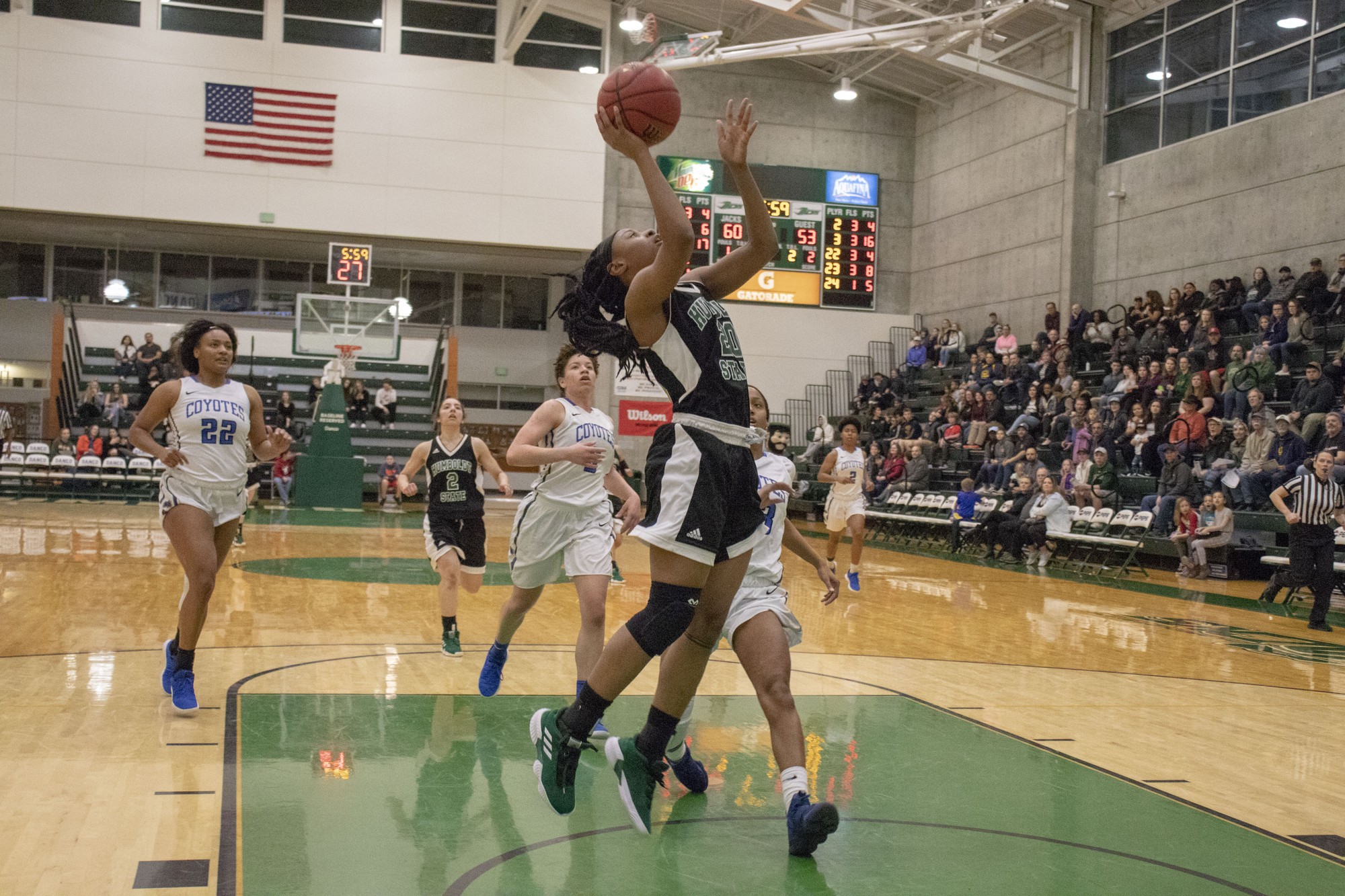
Alexia Thrower’s physicality was unmatched as she accounted for twenty-four points and tied a season-high sixteen rebounds. Humboldt State secured their fifteenth win on the season against the California State University of San Bernardino on Saturday night. HSU got its fourth straight win, and Thrower earned CCAA player of the week honors.
“I think we started as a team pretty slow,” said Thrower. “I was just trying to pick up the energy and get everybody going and just try to play my hardest regardless of the situation.”
Senior Jovanah Arrington gets the Coyote defender to bite on the pump fake in front of the Lumberjack Arena crowd. | Photo by Braedon Delome
The game went back and forth, with CSUSB getting off to a fast start leading by nine in the first. Jovanah Arrington made a big time jump shot to end an early San Bernardino run at the beginning of the first quarter.
[perfectpullquote align=”right” bordertop=”false” cite=”Head Coach Michelle Bento-Jackson” link=”” color=”” class=”” size=”17″]”[Alexia Thrower] plays with such a motor in particular when she’s around the basket… Both offensive and defensively she’s going to be on those boards, and she creates problems for our opponents.”[/perfectpullquote]
Just as San Bernardino was starting to make a strong push late in the quarter, Thrower drained a three and got the crowd into the game. Gabrielle Carbajal added to the early comeback with a three of her own as CSUSB headed to the second quarter with a five point lead.
The game was extremely physical throughout, with Thrower driving to the basket and drawing hard fouls. She went 10-13 from the free throw line, and shot 50 percent from the field. CSUSB continued to push back whenever HSU would go on a run. Thrower set up a big screen for Arrington late in the second, as she drove to two points.
Thrower’s ability to grab offensive rebounds and give HSU a second opportunity was pivotal. Teammate Isamar Conde showed how much fight was left in the Jacks, grabbing an offensive rebound between two coyotes under the basket. Conde also piled in a nice driving layup in the second as HSU went to the half with a 37-35 lead.
“[Thrower] plays with such a motor in particular when she’s around the basket,” HSU Head Coach Michelle Bento-Jackson said. “Both offensive and defensively she’s going to be on those boards, and she creates problems for our opponents. Those were high energy type moments when she was going up and securing rebounds.”
UCSB took a five point lead to begin the third, but Thrower would continue on the second effort shots. Her ability to draw the foul continued down the stretch. A giant three pointer from Carbajal got the crowd back into it and put HSU up one heading to the fourth.
Junior Guard Madeline Hatch retakes the lead with a jumper from outside the paint. | Photo by Braedon Delome
Costly turnovers from the Coyotes continued into the fourth, led by a Carbajal steal and assist to Thrower. Thrower would end up hitting a crucial shot that put the Jacks up nine and forced the timeout from CSUSB. She continued to make big play after big play in crunch time. The Coyotes tried but could not put it together, falling short by three points in the end.
Thrower’s 24 points were a game-high as she put the team on her back down the stretch. Jovanah Arrington added 15 points and two rebounds, Isamar Conde finished with 13 points four rebounds, Carbajal and Tyra Turner scored six points each and Madeline Hatch had five points and six rebounds.
“We didn’t get into any flow, but I thought Jovanah Arrington was aggressive in the second half and gave us some big buckets,”Bento-Jackson said. “Along with Lexi Thrower, we did enough just to grind out the win.”
An excellent performance by HSU puts them into position to potentially host a playoff game. They play this Thursday in Carson against California State University Dominguez Hills.
“We have an excellent home crowd, they get really into the game,” Thrower said. “So if we get to host a game here that would be pretty awesome.”
Humboldt States new environmental science honor society, Pi Epsilon, offers career building experience
The National Environmental Science Honor Society, also known as Pi Epsilon, had its first meeting on Feb. 15. President Rosey Ines and Vice President Ethan Reibsome invite qualified environmental science majors to join.
The Pi Epsilon constitution mission statement is to promote the study of environmental sciences through recognition of exemplary scholarly and professional activity. Environmental science is understood to be the study of our environment and all stressors acting on it. The society seeks to promote interdisciplinary studies and interactions between industry and academia to further the study of environmental science.
“We hope to establish ourselves and exchange ideas with students, employers and educators,” Reibsome said. “We will coordinate and collaborate with the campus community.”
Rosie Ines and Ethan Reibsome, president and vice president of Pi Epsilon. | Photo by Collin Slavey
To qualify to be a member of the honor society, an applicant must meet certain academic requirements. First, they must have a cumulative 3.3 GPA. Second, they must have completed 36 units of a Natural Science. They must also be in junior standing.
Reibsome said Pi Epsilon would be meeting once or twice a month. They are currently looking for members to fill out their club charter. Anyone who is interested is encouraged to contact Ines or Reisbome over email. They will fill you in on how to get involved.
Ines and Reibsome talked about the advantages of joining. They said Pi Epsilon offers career building experience, recognition for student achievements and volunteer opportunities. One of the first projects Reibsome hopes to accomplish with the club is an update to the Natural Resources Building lounge. This would show Pi Epsilon’s commitment to the College of Natural Resources.
Pi Epsilon has enthusiastic support from faculty. Kerry Byrne is the honor society faculty advisor. Byrne is a professor of ecology in the College of Natural Resources. She looks forward to helping the honor society thrive.
“I’m the faculty advisor for the society,” Byrne said. “I’m here to help you in as many ways as I can.”
[perfectpullquote align=”right” bordertop=”false” cite=”NESHS Vice President Ethan Reibsome” link=”” color=”” class=”” size=”18″]“We hope to establish ourselves and exchange ideas with students, employers and educators…”[/perfectpullquote]
The meeting was an opportunity to get potential members in a room together to discuss a vision for the future of Pi Epsilon. Being part of an honor society offers a lot of networking opportunities, including access to conventions. Ines and Reisbome said they would begin looking into professional partners like the American Association for the Advancement of Science.
There were fourteen people at the event. Many of the students who showed up are peers in the Department of Environmental Science. Their specialties included education and interpretation, policy and planning, ecological restoration and recreation. A diverse set of interests should be a boon to the club.
“They were really excited,” Byrne said. “Students who are excited, I want to help them.”
Emily Hunter is learning about environmental education and interpretation. Pi Epsilon plans on tutoring students in the environmental science and management program. Hunter said the honor society will hold people accountable, motivating them to do their best. She looks forward to contributing to Pi Epsilon.
“I hope to offer a fresh perspective to the club,” Hunter said. “As well as providing a positive attitude, volunteer connections, and be helpful in any way that is needed.”
Tony Platt discusses the truth behind the American criminal justice system
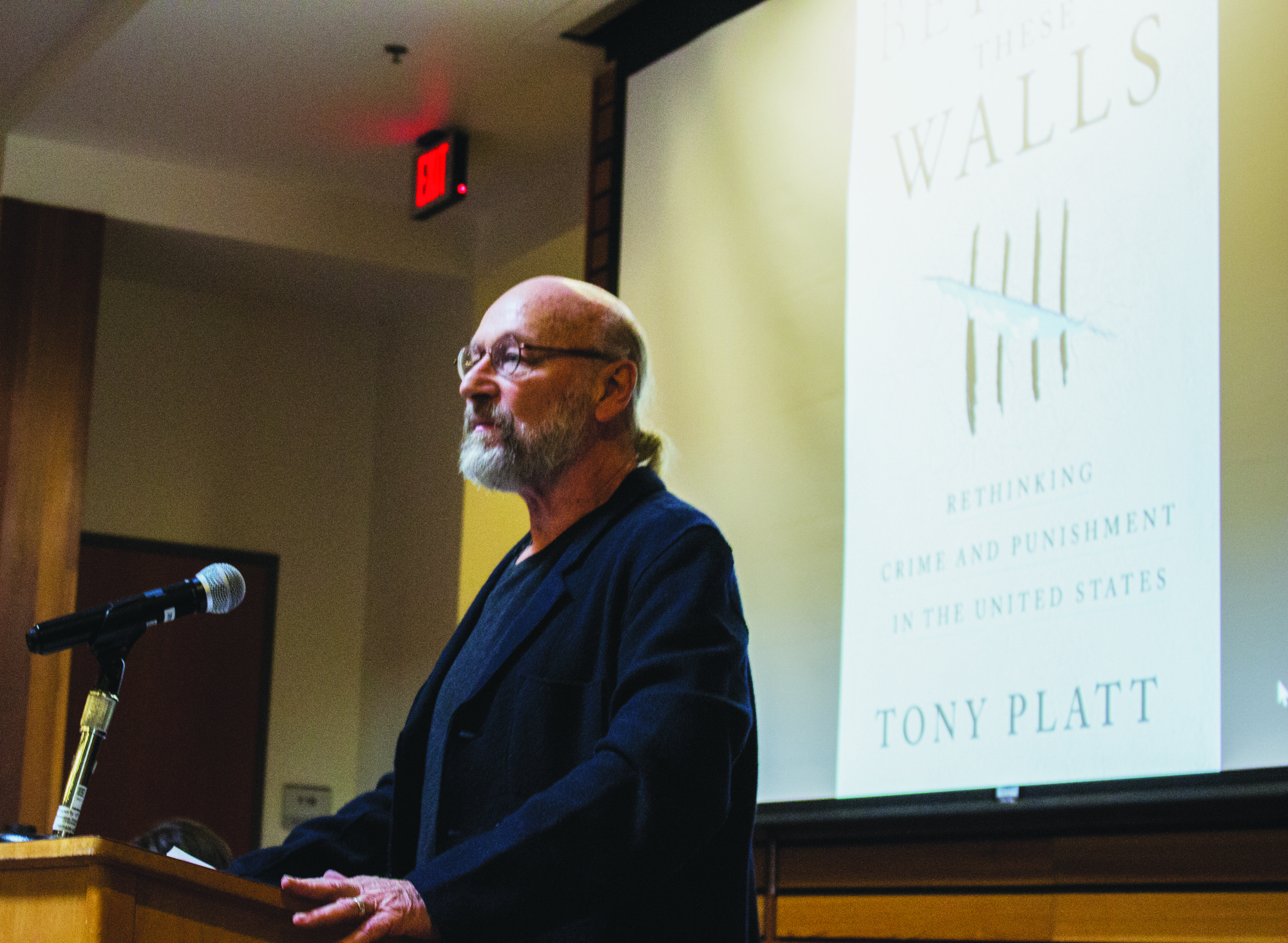
Criminal justice author Tony Platt visited Humboldt State on Feb. 14 to discuss with a panel his new book, “Beyond These Walls: Rethinking Crime and Punishment in the United States.” Students, professors and community members filled the Native American Forum where the event took place.
Renee Byrd, sociology professor, introduced author Tony Platt, whose work changed her life. | Photo by T. William Wallin
Nancy Perez, critical race, gender and sexuality studies professor at HSU and Stephanie Lumsden, scholar and teacher finishing her Ph.D. in gender studies at UCLA, completed the panel. Dr. Renee Byrd, professor of sociology, introduced Platt and said reading his work as an undergraduate in Oakland changed her life forever.
“Platt is a co-author of my favorite text, ‘The Iron Fist and The Velvet Glove,’” Byrd said. “There were few books at the time that really took a radical approach that looked to the causes of state violence and corrupt criminal activity.”
Platt is a distinguished affiliated scholar at the Center for the Study of Law & Society, University of California, Berkeley and is familiar with Humboldt county. He resides both in Berkeley and Big Lagoon. Platt said he has been visiting Humboldt county since 1975 and it feels like coming home since he’s done a lot of research here.
Tony Platt, author of ‘Beyond These Walls: Rethinking Crime and Punishment in the United States, speaks to students, professors, and community memebrs in The Native American Forum on Feb. 14. | Photo by T.William Wallin
Platt began his talk with the four main themes of his new book: We’re too weak for the fight for social justice within our own movement. Public police and prison guards are just a small portion of how coercive power and social control are executed. The problems now are not products of Trump nor the leftover issues of the past. We have to learn from our forgotten history and bridge activists ranging from high school kids marching for gun control to Black Lives Matter.
[perfectpullquote align=”left” bordertop=”false” cite=”Tony Platt” link=”” color=”” class=”” size=””]”We have the highest incarceration rate of any other country.”[/perfectpullquote]
“We have the highest incarceration rate of any other country,” Platt said. “Our solitary confinement violates U.N rules and regulations. The 99 percent of those incarcerated are poor and dis-proportionally African American. We have 30 percent of all women incarcerated in the world.”
Platt is the author of ten books and 150 essays and articles dealing with issues of race, inequality and social justice in American history. Platt said currently we are too often left picking a choice at the detriment of another group.
“We’re in an in-between moment in history where were deciding what do we want to look like,” Pratt said. “We know what we don’t want. For the next generation it’s up to them to decide what they want and who it will help.”
Nancy Perez, CRGS professor, Stephanie Lumsden, scholar and teacher finishing her Ph.D in Gender Studies at UCLA, and Tony Pratt, author of ‘Beyond These Walls: Rethinking Crime and Punishment in the United States, in The Native American Forum on February 14 2019. | Photo by T.William Wallin
Panelist and abolitionist Stephanie Lumsden agreed and said although it’s negative that there’s so much violence occurring right now this is also the moment of opportunity for us to organize and do something about it.
[perfectpullquote align=”right” bordertop=”false” cite=”Stephanie Lumsden” link=”” color=”” class=”” size=”17″]”I am not a reformist, I am an abolitionist… I don’t think we should lock people away in cages which for some reason is a radical idea to some people.”[/perfectpullquote]
“What do we do about justice?” Lumsden said. “Prisons aren’t solving crime. Police aren’t solving crime. Racial capitalism is what we’re working with. Abolitionist politics is overtaking this order. It is taking apart this system.”
Lumsden said she valued Pratt’s new book for its thorough research. She said the main thing she reflected on was the critique it had on reform work and the reformist attitudes that build the state.
“I am not a reformist, I am an abolitionist,” Lumsden said. “I don’t think we should lock people away in cages which for some reason is a radical idea to some people.”
Javon Patterson, a junior in computer science, came to the discussion with his altruism and compassion class to hear the panel talk on how we deal with prisoners when they integrate back into the world.
“I think this is important because prisoners are not treated very well when coming back into society,” Patterson said. “Even if they try their best to change society makes it difficult. It’s important to talk about this and how we can change.”
Educated Landlord and Tenant Program aims to educate both parties on mutually beneficial renting practices
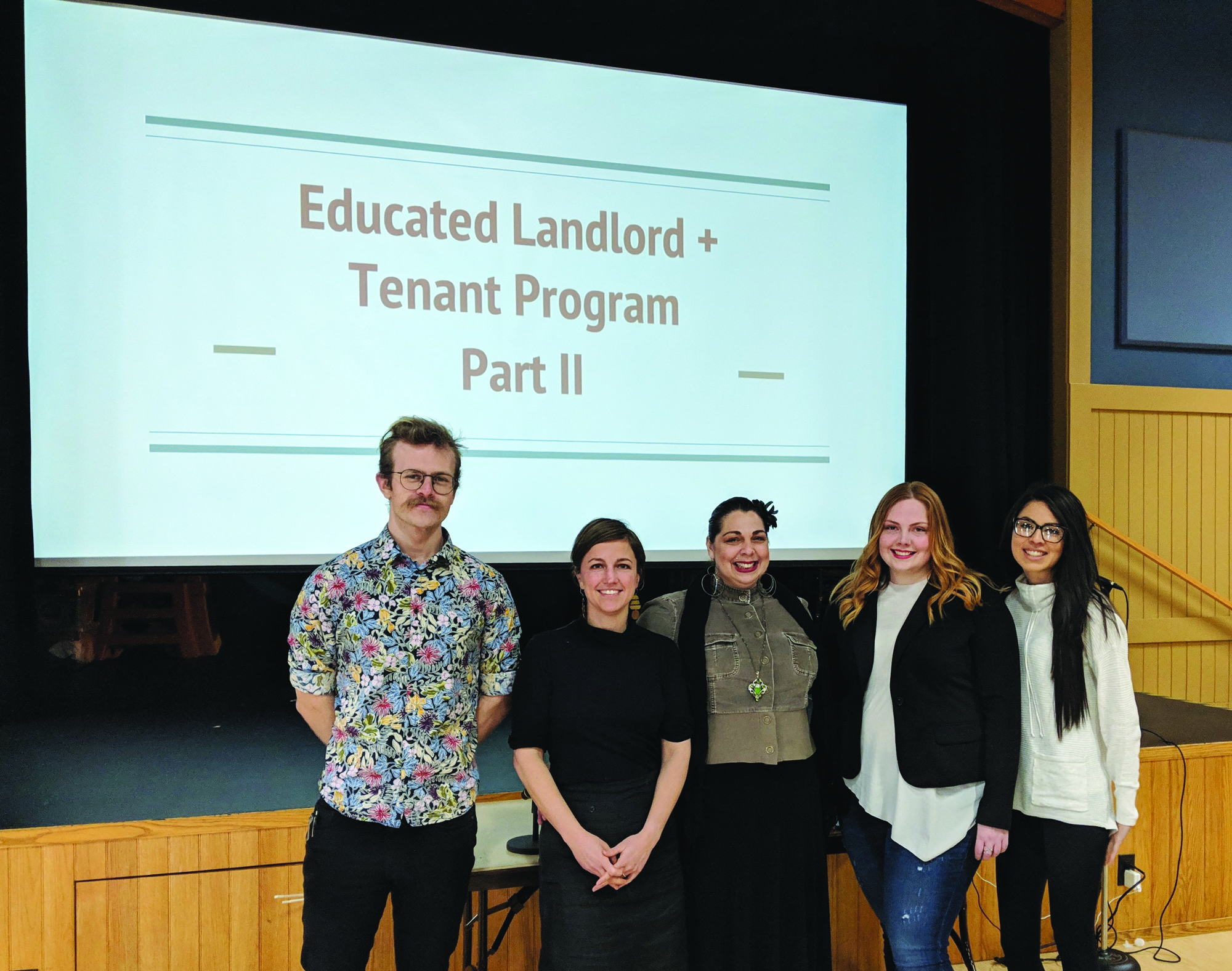
One of the most daunting prospects of ‘adulting’ is moving into your own space. Soon Humboldt State will offer a program to make that transition easier. Students and faculty presented information on a proposed landlord-tenant certification program, tentatively called the Educated Landlord and Tenant Program, on Feb. 15, at the D Street Community Center.
The intent of ELTP is to create an equity-based program that educates both tenants and landlords on life skills, their rights and responsibilities and the best practices to follow when renting. Chant’e Catt, who is the off-campus housing director and project leader, said the idea came from a meeting she attended three years ago where students complained about the lack of tenant education programs offered by HSU. The concept stuck in her head until she began collecting input from the community with a team of students eight months ago.
“What we started hearing was that landlords were interested as well,” Catt said. “The student tenants were being treated poorly, but some landlords could say the same.”
With this knowledge, the project blossomed into a grassroots community effort to include both landlords and tenants in the discussion, and create a program that could benefit both parties equitably. The team held three town hall meetings to gather information from the community on what the structure of the class would look like, and what specific curriculum would be covered.
“We felt it was important that all voices came into the planning of this education program,” Catt said. “There’s no way people in the community can say they didn’t have input.”
Chant’e Catt, the driving force behind ELTP, describes where she plans to take the program in the coming months. | Photo by Jett Williams
The proposed two to three hour free class session would allow landlords and tenants to learn cooperatively and earn ‘gold star certifications’ upon completion of the program. The certification would be a sign that the tenant or landlord is educated on all aspects of renting a room or apartment. The program is expected to be implemented early next semester.
One of the landlords attending the town hall meeting was Simone Wyche. Wyche is the office manager of Strombeck Properties and said she is excited to see the execution of this program.
“I’ve never seen anything like it,” Wyche said. “We won’t just pick tenants with the certification, but it would definitely be enticing.”
A blend of students, landlords and interested community members gathered to hear the details behind ELTP and provide vital community feedback. | Photo by Jett Williams
[perfectpullquote align=”right” bordertop=”false” cite=”Jesse Richards” link=”” color=”” class=”” size=”18″]“Waking up and going to the bathroom sounds simple, but for a homeless person it’s never that easy.”[/perfectpullquote]
Forestry major and ELTP Research Collaborator Jesse Richards’ struggles with housing motivated him to help build the program. He survived living out of the trunk of his car and sleeping in the community forest before buying a van and outfitting it into a livable space.
“Being homeless adds stress to your day, because so much of your time is spent dealing with simple tasks that become much harder when you don’t have a place to stay,” Richards said. “Waking up and going to the bathroom sounds simple, but for a homeless person it’s never that easy.”
If this program had been in place when he first came to campus, Richards said he absolutely would have utilized it.
“This program is designed partly as a buffer to help students with insecure housing, to prevent them from becoming homeless,” Richards said. “Knowing that there’s someone on your side, advocating for you sometimes is all you need to go to school and do things in your daily life.”
At the 22nd vigil, Josiah Lawson is remembered through Cool Runnings
Honoring Josiah Lawson and black history month, the 22nd vigil of his passing was held on Feb. 15 at the Arcata United Methodist Church. The community of Justice for Josiah hosted a movie, Cool Runnings, which was based off of a true story of the first Jamaican bobsledding team.
Jazmin Sandoval, president of Associated Students, joined the Justice For Josiah committee a year and a half ago to help bring justice.
“I think this is a way to show solidarity and bring the community to have a safe space where people can really remember Josiah, and that could have been me or any other student,” Sandoval said.
Community come together to watch a movie in support of Josiah Lawson and black history month. | Photo by Delaney Duarte
Sandoval said she wants to make sure that not only are they wanting justice for Josiah, but justice for any students that deserve to be treated equally.
[perfectpullquote align=”right” bordertop=”false” cite=”Xiomara Fambrough” link=”” color=”” class=”” size=”17″]“I come to events like these because I want to support my community no matter what community that is…It is really important to me because I know that’s the real way the world is going to change.”[/perfectpullquote]
“I just like to come in solidarity to show support for Michelle-Charmaine and try to pressure the law enforcement to push his case forward and demand justice for Charmaine,” Sandoval said.
Students received free pizza from J4J members to go along with their movie. The committee was also selling shirts and pins that said Justice for Josiah, and let students borrow blankets for the cold.
The Justice for Josiah committee give pizza out to the community. | Photo by Delaney Duarte
Xiomara Fambrough, a 25-year-old who recently moved to Arcata, joined the community and took part in her first vigil for David Josiah.
“I come to events like these because I want to support my community no matter what community that is, no matter how new I am to the community,” Fambrough said. “It is really important to me because I know that’s the real way the world is going to change.”
Justice for Josiah has been communicated throughout the community, dispersing the story multiple times. Fambrough heard of Justice for Josiah as soon as she stepped foot into Arcata.
“I heard about Justice for Josiah and the unfortunates of the event leading up to what happened to him,” Fambrough said. “Everyone I have talked to has so much details about it because there are flyers everywhere, people talking about it and not letting his name fall.”
The remembrance of Josiah Lawson. | Photo by Delaney Duarte
Jill Larrabee organizes all of the Justice for Josiah vigils, was present at the event and everyone feel welcomed. Larrabee organizes the vigils every 15th of the month.
“We wanted to bring families together and eat food together while watching a movie that relates to both black history month and the background of Josiah’s heritage of being Jamaican,” Larrabee said.
Like many other people who want justice for students like Josiah, Larrabee had words of wisdom of her own for HSU students.
“It is extremely important to be vocal, not be silenced and keep going forward,” Larrabee said. “In any of these issues going on, there is so much injustice and evil in the world, we need to get together, and as a community come together to fight for justice. We have to fight, just fight for what we want until we get it.”
Alright, alright, this week had some activity! No one was charged—which is dope. However, some folks got in trouble…metaphorically speaking. Or maybe not; the report is ambiguous. Hemlock, Alder, Tan Oak and even the parking lot at Forbes Gym all saw some action.
Possession charges = 4
Contraband/paraphernalia seizures = 2
Monday Feb. 11
· Mental health awareness—The past week had a number of welfare checks, which are enacted if someone is concerned about another’s wellbeing. With that said, if you are experiencing a tough time and need someone to talk to, you can access counseling and other mental health services at the Student Health Center. Check out their website.
· Good guy alert—Someone got an escort to their vehicle late at night from UPD. Give a cop a high-five next time you see one!
· Three Butt dials!—UPD was called three times with no one answering from the other end. Guys, airplane mode is a thing. So is not calling 911 on accident. Come on, you’re better than that.
· A problem worth addressing—Someone was warned for camping on HSU property near the Kinesiology and Athletics buildings. Those in power need to help our more vulnerable counterparts…not everyone has the luxury of a home.
Tuesday Feb. 12
· Art Heist—It looks like we have an art burglar in the Pepperwood Residence Hall. Stealing art in the movies looks cool, but in real life it’s not. So, don’t do it. M’kay?
· Petty Theft x2—A backpack and other items were stolen from the Kinesiology building. Please don’t steal.
· Smokin’ in the boys’ room—Drug activity at Hemlock Residence Hall! Two people were caught with marijuana. They only received an “incident memo,” so that’s cool.
Wednesday Feb. 13
· Buzzkill—“A campus parking officer found three rolled marijuana joints on the ground and turned them in for destruction.” Destruction? I bet the guy in the evidence room smoked them.
· Good guy alert—UPD helped someone get into a locked car. Now, that’s pretty cool.
· Let’s Mötley Crüe this place—Someone punched a whole bunch of holes in their walls in Laurel Residence Hall. Don’t worry though, “he is code four, negative crime.” Whatever that means.
· Buzzkill part deux—“Housing out with a resident in the kitchen in possession of marijuana.” The wording of that sentence sounds like a bad Bob Dylan song.
· Stop! (in the name of love) x4—The cops were on a mission this day. Four people were stopped for blowing through stop signs on a bike. Bikers, ya gotta stop. Sometimes it’s in the name of love. Other times it’s in the name of the law.
Thursday Feb. 14
· Good guy alert x3—UPD helped with a jumpstart, locked car doors and a late-night escort…on valentine’s day. Aren’t they sweethearts?
· Trespass—A “transient female has been in the restroom for at least 30 minutes.” It breaks my heart that our homeless counterparts routinely have the police called on them for pejorative actions. The woman was warned about her “recent trespass.” On public property…
· Smokin’ ciggies—“Several subjects [were] smoking in the stairwell area” at the Hagopian House. Although UPD didn’t see them smoking, they admitted to it…amateurs.
Friday Feb. 15
· “Making a scene”—Someone refused to take their backpack off when entering the College Creek Marketplace and threw a fit. Not gonna lie, this backpack policy is the stupidest effing policy on campus. Those who enacted it assume that students are thieves. A former LJ editorial team wrote a piece about this and the ridiculous prices.
Saturday Feb. 16
· Momma’s boy—A Lyft driver called someone’s mom after he left his cell phone in the car. Like a good mother, she called the police to check in on the situation. The phone was returned and the owner was “advised to contact his mother.” Aww, that’s sweet.
· Fallen soldier—An RA in the Alder Residence Hall seized someone’s pipe and turned it into UPD. Now I’m not one to glorify military stuff, but let’s salute this fallen soldier. Cue “Taps.”
Sunday Feb. 17
· Someone barfed—“Someone vomited in the Fieldhouse and the game is unable to resume until it is cleaned up…” Oh man, that is something there, imagine the smell. Seriously think about…taste it… smell it….Okay see ya next week!
Not every high will mellow you out, sometimes you might get chased by a raccoon. We asked Humboldt State University students their worst high experiences. Share your horror stories in the comments to be featured in future videos.
The men’s and women’s track team competed against it’s neighbors the College of the Redwoods on Feb. 16. National Championship qualifiers and alumni from last season were also honored at the meet.
Michel-Ange Siaba is a sophomore majoring in criminology and social justice at HSU. Siaba is a jumper and thrower looking to build upon his success of last season. Michel placed in second after HSU alumni Teigan Eilers (6.41m).
“For the first meet of the season, it was better than what I jumped last year so I can see my improvements,” Siaba said. “Especially because the mark I got today was pretty close to my personal best record. It’s rewarding when I see my teammates gain confidence and we mature as a strong team.”
Sophomore Michel-Ange Siaba competed in different events throughout the day and finished with a strong 6.41 meter long jump earning him second place. | Photo by Matt Shiffler
Junior Brailee Vandenboom majors in business administration with an emphasis in marketing. Vandenboom sprints and also jumps placing in three separate events. First in 100 meters, 400 meters, and high jump. The 100 meter dash, Vandenboom came in at 13.34 seconds. She finished The 400-meter dash at 1:01.88, and the high jump at (1.62 m).
“I haven’t been practicing at my best, and it was a real big surprise,” Vandenboom said. “I think it’s setting me up for the entire season. We’re going to have a solid team this year, we’ve always had like a young team in the past, and now we’re all maturing.”
Junior Brailee Vandenbroom gets first place in all three of her events, the 100-meter, 400-meter, and women’s high jump at Saturdays Green and Gold Open. Photo credit: Matt Shiffler
Chee Shorty is an undecided student at the College of the Redwoods. Before trying out track Shorty played football, baseball, and tennis. Chee is being recruited by HSU track and field. Although it was his first time throwing the javelin, he never gave up. On his first and second throw posted a scratch. However, on his very last chance, he got the job done placing first, by throwing 34.79 meters which is about 114 feet.
“I felt surprised honestly,” Shorty said. “This is my first time. I didn’t even know the rules. I liked how everyone around me was encouraging and reminded me not to pass the line.”
The down pour didn’t stop sophomores Kaylee Thompson and Cessair McKinney during Saturday’s Green and Gold Open. | Photo by Thomas Lal
Sophomore physical therapy major Jared Del Real throws shot put and discus. Del Real earned a first place finish in shot put with a 14.14. Breaking the 14 meter mark is encouraging and an impressive feat for a sophomore.
“I scratched on my second throw,” Del Real said. “I tried to stay focused, I felt like I had some more left in me but I’m super excited and we’ve been working really hard this offseason. We’ll be changing people’s minds about the Humboldt State men’s track and field. We have a competition mindset and limit the number of throws to get the best outcome possible.”
Junior Jaye Washington finished first in men’s triple jump and placed second in the long jump on Feb. 16 inside the rain filled Redwood Bowl. | Photo by Matt Shiffler
Humboldt State track & field hit the road against Chico State Feb 28 and March 1. The calendar also opens up to tough division one competition during the Stanford Invitational in Palo Alto, CA on March 29 and 30.
Humboldt State Career and Volunteer Expo hosts 95 organizations
Nearly 100 organizations made the journey through sideways rain for the Humboldt State Career and Volunteer Expo. The event was held in the west gym on Feb. 14 from 12 p.m. to 4p.m. and included prospecting volunteers and job recruiters that ranged from California Conservation Corps to Companion Animal Foundation.
HSU’s career advisor Joy Soll, said that 70 percent are received because of networking.
“This gives students an opportunity to actually meet employees and to actually talk to people,” Soll said.
This year professors and chamber of commerce members donated professional clothing for students during The Career and Volunteer Expo on February 14, 2019. | Photo by T.William Wallin
This year Soll said they wanted students to look as professional as possible. Professors, faculty and chamber of commerce members donated clothing for the event so students could grab a blazer or a button up shirt before introducing themselves. Because of the government shutdown Soll said there were a few less organizations but they still expected a similar turn out at last year, around 800 students.
“Because of the government shutdown we had to actually extend our deadline,” Soll said. “We work with a lot of professors to encourage their students to attend the event since they don’t always know the opportunities that are here for them.”
Kyle Barney, senior in enironmental studies, gets a free professional portrait from Kelli Jo Brown, photographer for MarComm at HSU, during The Career and Volunteer Expo on Feb. 14. | Photo by T.William Wallin
Kyle Barney, senior in environmental studies, was one of those students. He said his professor made him come for his Capstone class but was taking the opportunity to get more knowledge on the jobs that are available. Barney, along with every other student attending, was even able to get free professional portraits from Kellie Jo Brown of MarCom.
“Today will just to be figuring out what I might want to do,” Barney said. “I’m sticking around till next summer so I’m just going to see what comes up.”
Trena Neel, general biology junior, was at the event with Companion Animal Foundation. Neel has been volunteering with the organization since May of 2018.
“I walked into Companion Animal Foundation’s thrift store looking for a job but they didn’t have any openings,” Need said. “I applied as a volunteer instead because I want to be a vet tech.”
Jacks, of Companion Animal Foundation, which supports animal adoptions and community outreach services during The Career and Volunteer Expo on Feb. 14. | Photo by T.William Wallin
Neel said she grew up with animals all her life and so volunteering with Companion Animal Foundation fulfills that.
“I just want to be around animals and help them when their sick,” Neel said. “If you love your job then it’s not really work.”
Shanna Gunn, lead animal technician for Companion Animal Foundation, said they use their thrift store to support their animal adoptions and they take part community outreach in Arcata. They also help those with financial difficulty to spray and neuter their animals.
“We’re here because we want to get more people volunteering and involved,” Gunn said. “There has been a lot of people coming and showing interest. That’s why we are here.”
Humboldt is a beautiful place for someone who is used to an urban area like myself. Being from Los Angeles, seeing the huge redwood forest for the first time was inspiring. I do think it’s a great school to go to for people like me who lived in the city all their life. I just wish it was easier to get here and to get out.
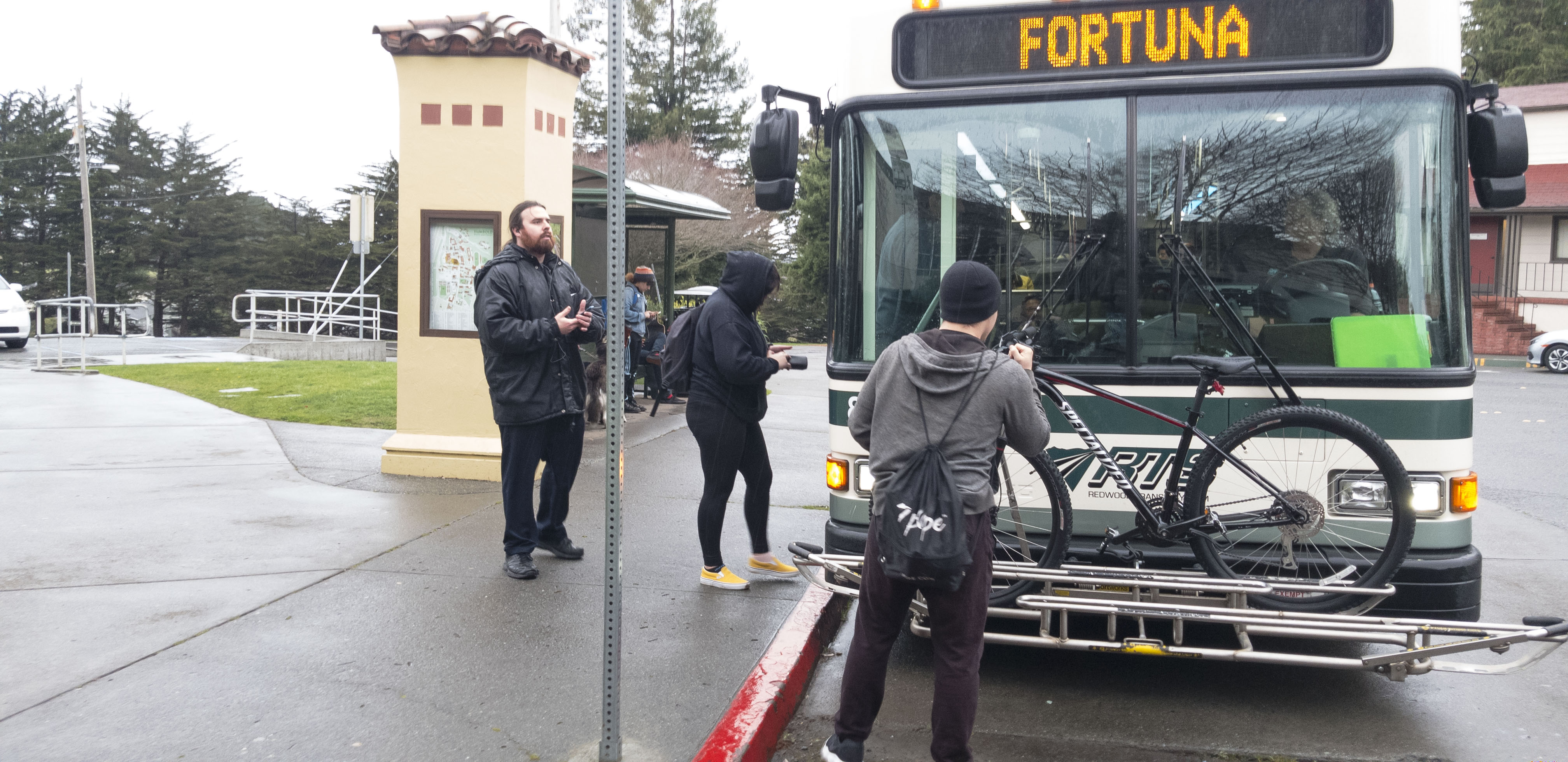
For starters, the only airport that students can utilize is California Redwood Coast-Humboldt County Airport. It is not considered a major airport like San Francisco International Airport or the Oakland International Airport. ACV is pretty small and limits you to United being the only airline options for getting here by plane. More options for airlines would be great for travelers. SFO and OIA may be an option but those airports are five or more hours to get to from Humboldt.
While there are shuttles like the Homeward Bound bus service offered by HSU, good luck getting a spot on time. The fall break bus shuttle sold out in a little over an hour of being sold in November 2018.
A lack of train shuttles is disheartening especially after hearing of the bullet train going from Los Angeles to San Francisco.
Greyhound and Amtrak shuttles are also here but people who have used those types of shuttles to get to Humboldt (or get out), know that sitting on a bus for hours with “interesting” people can be an unpleasant experience. I’ve personally had a very negative experience taking the Greyhound.
While I do think that HSU has issues with traveling options, some options do exist for students who want to travel.
As mentioned, the Homeward Bound bus service is a step in the right direction in combating this issue but I do think there should be more buses available instead of the two buses for students to take to San Francisco or Los Angeles. If there were more buses, there could be a potential to drop off students at other locations like Sacramento, Riverside or San Diego. It would open more options for students.
HSU also has a service called Zimride, where students can offer a carpool for students who need to get around or they can post that they need a driver to get somewhere. Nelson Hall also has a board on the second floor hallway for students to post carpool services or post that they need to get somewhere.
There are some solutions to the issue of getting to and from Humboldt but there is still a ton of work that needs to be done to better transportation for homesick students.
Professor James Floss shares his long theatrical history here at HSU as he gets ready retire
At a young age James Floss had an incredible journey, following his courageous instinct and natural talent for the performing arts. After failing his pre-med class at the University of Buffalo, Floss decided to drop out and journey on to a new path.
“I had failed the class and I have never failed anything in my life, it just rocked my world,” Floss said.
With the help of a friend from Stanford and a couch to crash on; Floss was already on the path to what would soon become his career. When he heard that his friend’s girlfriend was attending Humboldt State at the time, Floss decided to visit and immediately was mesmerized with the school.
“I just fell in love with it; the natural beauty of it,” Floss said.
Floss (right) pictured in the Lumberjack Newspaper back in 1982. Demonstrating a duel during a “combat” class. | Photo courtesy James Floss
A new beginning formed for Floss, and even though he transitioned to a town he wasn’t familiar with, it didn’t seem like he had trouble adjusting to the new environment. He eventually had to find a place of his own, but because he was by himself, he thought of something clever.
“After dropping out of ‘pre med’ I was on my own, I learned how to live cheap,” Floss said.
Living cheap meant living in a treehouse behind the school. Some may say that living in a treehouse is bizarre, and they might as well be right, but Floss made it work. He built it with another close friend of his and lived in it for quite some time. It seemed to be a comfortable way to live, and most importantly he saved money without having to worry about other living expenses.
“I didn’t consider myself homeless, I was trying to live cheap,” Floss said.
Floss adapted to the HSU community quickly; he found himself participating in many theatrical activities and became a part of a few performative groups. One group in particular was the Humboldt “Chamber Readers.” They are an organization that tours around the schools of Humboldt, delivering creative performances to students ranging from kindergarten to high school. This also happened to be his main source of income that helped him pay through college.
Another group that Floss joined back in the day were the “Sweet Georgia Brown Clowns.” The group of clowns were introduced to each other by performing arts professor, Gale Mcneeley. Mcneeley taught “clowning” and “advanced clowning” while Floss attended HSU. Floss juggled, mimed and occasionally dressed as a clown with other members. They were active for only six years but Floss became wonderful friends with the group and is still in contact.
“He (Mcneeley) got us our first tour going and we stayed together as a clown troupe,” Floss said.
With a wide variety of organizations and clubs that he took part of, Floss truly found his inspiration for the performing arts here at Humboldt State. At the time, guest artists from Dell’Arte which is the International School of Physical Theatre, located in Blue Lake, would come to HSU and teach special skills to students such as clowning, stage combat, and mime. He received an education basically equivalent to those who attended Dell’Arte.
[perfectpullquote align=”right” bordertop=”false” cite=”James Floss” link=”” color=”” class=”” size=”18″]”It was an accidental career, it was not what I intended to set out to do.”[/perfectpullquote]
Floss had an outstanding time in college with the theatre department. He kept falling towards more roles, more concepts and more projects; it all came to him naturally.
“I call them my golden years, I was just having fun, I was really enjoying my experience as an undergrad at Humboldt State University,” Floss said. “I got the letter six years in that said ‘you must graduate,’ they kicked me out. I was just enjoying taking classes.”
After graduating HSU in 1985, Floss was hoping to become a professional actor, but Humboldt had other plans for him. Later he developed an interest in directing, but as he continued to be an active member in the “Chamber Readers,” Floss realized that he also enjoyed teaching. A job opening for a teaching position back at HSU was brought to his attention, accidentally landing him the role of a full-time professor.
“They needed somebody to teach a one unit class in oral interpretation as part of the ‘Teacher Preparation Program,’ so that was my foot in the door,” Floss said. “It was an accidental career, it was not what I intended to set out to do.”
Although it was not the career Floss anticipated; he didn’t regret teaching at all. Floss has absolutely loved his time working here as a professor and sharing different experiences with students throughout the 34 years that he has been teaching. He is known for his vivid ways of teaching, making each class fun and exciting.
“For me it’s a performance thrill; I’m using my theatre skills everyday in the classroom,” Floss said. “My lectures are my performances.”
Students who have already taken a communications class with professor Floss, like Bryan Taylor and Jesse Morales, find Floss’ methods of teaching to be very engaging.
Morales said that having Floss as his professor is always entering and super fun.
[perfectpullquote align=”left” bordertop=”false” cite=”Bryan Taylor” link=”” color=”” class=”” size=”18″]”I’m sad to see him go…I’ve never had somebody who brings so much of theatrics to communications.”[/perfectpullquote]
“I like it, compared to other teachers it keeps me awake, cause a lot of teachers just kind of sit there and lecture, it’s very difficult to stay focused,” Morales said.
Taylor said that Floss is the more interesting professor he’s ever experienced.
“He’s theatrical than any teacher that I’ve had in the communications kind of world,” Taylor said.
Floss brings creativity and individuality into his classes. He is a wonderful professor that encourages students to be more active in class, building a positive environment for all who enter his space. Seeing him leave the HSU community for retirement at the end of the school year will surely be bitter.
“I’m sad to see him go, you know? He’s just a very different teacher, I’ve never had somebody who brings so much of theatrics to communications,” Taylor said.
As for plans after retirement, Floss is wanting to travel with his wife. He will be exploring more cultures as he is in the process of adapting a new project called “Immigrant Voices” into a stage show, this show will include real stories of real people and their take on immigration.
“These are the real words of real people, I just want to make a theatrical show out of it,” Floss said.
Aside from that, he is looking forward to what his retirement has in store for him. The renowned actor and proud “Excellence in Teaching” award recipient will soon bid farewell to HSU, a school that has treated James Floss to a great deal of fantastic experiences that he can hold on to as lasting memories.
Arcata provides a safe space for people to comprehend the concept of death
Dr. Gina Belton has been working for years as an end of life educator and consultant; the idea of a “death cafe” came to her because she felt that it could offer something different to the small town of Arcata, and also provide people a space where they can further understand this taboo subject in a creative way.
“It wasn’t being talked about,” Belton said. “Nobody was talking about it in the way I wanted to…with heart.”
Belton was inspired by the death cafes that originated in the UK. The first cafe event was held in 2011 in the home of former council worker Jon Underwood. Underwood came across an article one day about Swiss sociologist Bernard Crettaz, who created the concept of “cafe mortels” or death cafes.
[perfectpullquote align=”right” bordertop=”false” cite=”Dr. Gina Belton” link=”” color=”” class=”” size=”19″]“Nobody was talking about [death] in the way I wanted to- with heart.”[/perfectpullquote]
Crettaz thought that death was being pushed to the side, it needed to be recognized rather than being hidden, and Underwood agreed. He was fascinated by the idea of bringing people together to receive a deeper meaning of death. When he opened up his home to a few strangers, he didn’t realize that it was going to be such a huge success. A small get together soon spread out around the world, with at least 4800 death cafes held in 51 countries since the first meeting.
Death cafes are often hosted at a home or other temporary settings. The main goal of these unique cafes is to raise awareness of death and to help show others a different outlook on death so that they can make the most out of their lives.
In order to host a death cafe, some agreements must be made; cafes should always be nonprofit, they cannot have any agenda hidden behind them and, most importantly, they must serve a nice cup of tea, cake or other treats for guests to enjoy.
Tea provided for all guests who enter the room at the Death Cafe in Arcata. | Feb. 7. | Photo by Skylar Gaven
Belton’s cafe takes place on the second week of every month. Many showed their interest on Thursday Feb. 7, as ten locals expressed their take on the strange matter, making it Beltons’ biggest turn out that she has had in a while.
Death can be seen as a compelling topic to talk about for some, but it can obviously prove to be a touchy subject for others. Belton knows that this topic will lead to vulnerability as people share their thoughts and experiences, which is why she makes sure that the environment is supportive and each individual is respected.
“It feels supportive, but it is not a support group, you can just be here,” Belton said. “If anything you can cry buckets of tears here.”
Even though death is the main focus for this event, Belton also tries to highlight the beauty of life. To be clear, a death cafe does not encourage acts toward death itself, instead it simply explains to others what death is to better understand the mystery of death.
“That is why we come here, because we don’t know,” Belton said.
Belton has witnessed many forms of both loss and the grieving of others; being a nurse and educator for over 20 years influenced her to continue working with the concepts of life and death. Belton finds joy in preparing her room for events such as these because she also finds joy in hearing what others have to say about this unpopular topic.
HSU has received lectures from her before, and Belton is more than happy with an idea to facilitate a cafe like this just for college students. Students are out on their own, and with unfortunate incidents regarding other students, Belton believes that having an open space to discuss confusing and/or deep subjects with students is a great way for them to learn and accept loss and life.
Dr. Gina Belton talking to guests in her office before they left to express their thoughts on how the meeting went, Feb. 7. | Photo by Skylar Gaven
Having a group of students that share the same confusion about death could serve as a dependable resource during difficult times. Students like Shelby Geilfuss and Cita Hunter express their thoughts about having a death cafe for students; although they believe it would be a good idea to have, they still have mixed feelings because of the sensitive topic.
“Honestly, I have really bad anxiety when it comes to death,” Hunter said. “It’s important to know that people die everyday, you have to understand that things happen although it’s sad you have to accept that type of stuff.”
Geilfuss said that she thinks grief is a personal thing and it should be handled on the individuals own time and in their own way.
“I probably wouldn’t go,” Geilfuss said. “But I do think it’s a good resource for other people to have because many people deal with grief in different ways.”
Belton further explained that death is a part of life, and though at times it seems like an impossible thing to accept, it also helps us value life itself. Belton has acknowledged that “death” is unpredictable, and because of that, life is something to look forward to. She hopes that all who enter her space can realize that as well.
“I’m tasting the world, I’m tasting every bit of it before I go,” Belton said.
Let’s get ready for the inevitable disaster that will be Olympic surfing
Surfing is set to make it’s debut as an Olympic sport in the 2020 Tokyo summer games. Many are excited, but what I’m anticipating is a failure that compares to past Olympic blunders like Tug Of War (1900-1920) and Hot Air Ballooning (1900). Why, you ask? Because surfing is a hobby. Not a sport, and certainly not an Olympic sport.
In Sep. 2015 the IOC (International Olympic Committee) received a proposal to add a number of events, including surfing to the 2020 Tokyo Olympics. A year later during the 129th session of the IOC a unanimous decision was reached to include surfing. With four years to spare the IOC was confident. Now, with a year remaining and the format still not finalized, it shows only surfers should hold surfing competitions.
I present one question to the 90 IOC members. Have you ever watched a surfing competition? Because if one of the IOC members had, they’d know that surfing is one of, if not the most boring sport to watch live. Twenty minute videos of epic, mesmerizing surfing is filmed over months and doesn’t show the thousands of other waves surfed. That surfing can’t, and won’t be produced in Tokyo because the geniuses at the IOC are expecting video worthy, once in a lifetime waves to be produced twice in a matter of 25 minutes. Absurd.
The event will include just 20 men, and 20 women competing respectively. Begging the question, who from the 32 men and 22 women on World Surf League (WSL) will be selected? Well, the all-respected IOC has decided to cherry pick the top 10 men, and top eight women at the end of the 2019 season and gift them a spot in Tokyo. Guess what IOC, all you’re doing is helping out America, Australia and Brazil. If 2019 is like 2018, those will be the only countries represented.
HSU junior and surfer Aaron Friedley plans on watching the 2020 Olympics.
“[I’m] excited to watch surfing in the Olympics, but if some countries aren’t represented that’s not fair,” Friedley said.
Here’s a solution, just hold a competition between those three countries and call it a day. The final 20 Olympians will be decided in sub-par surf at the Pan-Am Surfing games, and at two ISA Surfing events this year to decide who will compete against the top ten men, top eight women and two Japanese representatives.
The two day Olympic competition has been given a 16-day window to wait for the best surf, but what if good surf never comes?
HSU senior and Surfrider Club president, Jeff Knapp also confirmed that surfing competitions are almost always held at crappy beach breaks.
“You can’t rely on the ocean for good conditions,” Knapp said.
This forces surfers to paddle for every wave, and surf like they’re stomping out a fire. The competition format has never represented true surfing, showing that it’s a hobby. To enforce this, the Olympic competition will be held at Shidashita Beach because of its “consistent summer trend.” Keyword trend, because it’s impossible to predict surf four years in the future. Shidashita, located 40 miles outside of Tokyo, is a shifty sand bottom beach break. Shifty because sand moves into unpredictable bars. These bars, when organized, produce great surf, but when unorganized are board-breaking machines. Go Shidashita!!!
The IOC began disaster preparation in 2016 when partnering with the WSL and Kelly Slater to create a wave pool in Japan. This precautionary pool has remained a secret, will be done by 2020, and is supposedly not seeing any Olympic surfing. Side note, the cost of constructing a wave pool is upward of $30 million dollars, a pricey precaution for an event based off an ocean that’s free.
HSU graduate student Taylor Team addressed wave pools, said that surfing isn’t for controlled environments.
“You need to be at the mercy of the elements, not a pool,” Team said.
But I’ll spare you the wave pool rant, because it requires elaboration and critical focus to see past the roller coaster bullshit. Bottom line is the IOC has no idea what they are doing when it comes to surfing.
For consideration: I surf, and I believe that surfing is a hobby. There are numerous types of surfboards that all pertain to different wave shapes and speeds. To say you can only be judged if you ride one type of surfboard, on one type of wave, in one style, doesn’t make any sense. The IOC is putting surfing in a box by promoting an inaccurate representation of surfing that only a handful of people can do, and don’t realize that surfing can’t be judged over 25 minutes.
Valentine’s Day is a mixed bag bringing love to some and heartbreak to others. We asked Humboldt State University students their worst Valentine’s Day experience. Share your horror stories in the comments to be featured in future videos.
This week in drug-related activity was pretty chill. Nobody was charged with possession and nobody was caught in the act of smoking weed. However, we do have to salute a fallen soldier. On Wednesday Feb. 6 in the Alder residence hall, “marijuana related contraband located during a fire drill was seized for destruction,” according to a police report. It is unfortunate that the individual lost their bong, bowl, pipe, vape or whatever; but let’s look on the brightside—nobody caught a charge! And that my friend is dope a.f.
Possession charges = 4
Contraband/Paraphernalia= 1 (no one was charged but someone did lose a piece, so I’m counting it)
Hootie Hoo!—what the cops are up to:
Monday Feb. 4
STOP! (in the name of love)—A cyclist ran a stop sign at 17th and Wildlife Lane. They were just warned, but everyone should know that bikes must obey the same traffic laws as vehicles.
Petty Theft—Someone stole a purse from the Student Health Center and that is lameeeee.
Tuesday Feb. 5
LOUD NOISES! —Multiple burglary alarms went off on Tuesday. One of them was due to a broken window at Room 142 of the Wildlife building.
I swear this isn’t cocaine—Someone spilled a whole bunch of flour near the Pedestrian Underpass near LK Wood Blvd. The subject helped clean up the white powder and then went along with his day.
Serving the community—UPD helped with a flat tire, a locked car door and two dead batteries, all in one day. If the cops help you, make sure to give them a hug, handshake, or a “thank you.”
Vandalism—Someone drew something on something somewhere (Gist Hall). Freakin’ yawnnn. Who cares about vandalism anymore, I got student loan debt to worry about.
An issue worth addressing—A “male non-student was warned for…camping/sleeping on campus property…” Arcata’s new mayor Brett Watson said he wants to focus on helping our fellow citizens-in-need during his first term as mayor. Let’s hope he can succeed in helping those who call our streets home.
Whoa bro!—Somebody got warned for skateboarding on campus where they shouldn’t be. Next!
Help I’m stuck!—Around 1 p.m. someone got stuck in the elevator in Founder’s Hall. Talk about a nightmare.
Wednesday Feb. 6
Someone literally lost their car—Someone thought they parked their car at the Children’s Center when they actually parked it in the Jolly Giant lot. That is literally on the other side of campus ya silly goose!
Annoying neighbor—Someone called the cops because a car was parked on B Street “for the last two days and has not moved.” Come on! You live in a college town. This person probably opposes new housing projects too. Lame!
Good Guys—The cops jumpstarted someone’s car. That’s pretty cool, right?
Drug Activity! (it’s weed again)—It’s the same thing I told you about in the Rolling Count. Next!
Those dang skateboarders are at it again—Skateboarding is not a crime, until they cite you for doing it on campus. This person was skating near B Street in someplace they shouldn’t be. I once heard that heaven is a halfpipe, so you got that to look forward to.
Grand Theft Laptop—Someone stole a laptop, which can be devastating. I mean if someone stole mine, I would probably cry and freak out and have a panic attack, because all of my school work is on here. Don’t steal laptops, or in general. Stealing’s bad, mkay?
Thursday Feb. 7
Burglary—The Pacific Southwest Research Lab on Bayview Street was broken into around 11 p.m. A 37-year-old man was arrested. No details were listed about what he tried to take.
Smokin’ ciggies—An “anonymous crime tip email of two females smoking cigarettes” near the Student Health Center was reported around 2:30 p.m.
Paranormal activity—There were five calls to UPD from the Library elevator. The report says it was due to an “equipment malfunction,” but I think it is ghosts so that’s what’s going into the public record.
Good guy alert—Someone got an escort to their car from UPD at 1:39 a.m.
Friday Feb. 8
Petty Theft—Someone stole a bike chain… but not the bike… hmm
9:08 a.m.—“Officer contacted a subject who appeared to have a bulge in their waistband under a coat. It was not a weapon.” This occurred at the intersection of Union and 10th.
Saturday Feb. 9
IT SNOWED!!!!
Paranormal activity 2 (ghosts are real)—There was a report of a tarp and other items left in front of the Natural History Museum on G Street. But when the cops showed up…it was gone! Ghosts came and cleaned up the mess, definitely not a person, but ghosts.
Sunday Feb. 10
Paranormal activity 3—Four times throughout the day 911 was dialed and “voices were heard.” Ghosts, guys, freakin’ ghosts.
Heroes!—A “male non-student was transport to Mad River Community Hospital due to possible hypothermia.” Our counterparts that call our streets and wooded areas home are always in need of warm clothes and food donations. Donations can be dropped off at the Arcata House at 501 9th Street. Bedding, socks and raincoats are always in need.
There is stuff everywhere—Downed tree limbs, power lines and other stuff in the street were reported on Sunday. Probs due to that dang snow! Send me to L.A. I’m over this rain/snow stuff! (JK there’s too many people there).
HELP WE’RE STUCK!—Eight people were stuck in elevators on Sunday due to power outages (or ghosts). Eight! I’m taking the stairs from now on.
Football and classical romantic music, an unlikely pair of passions
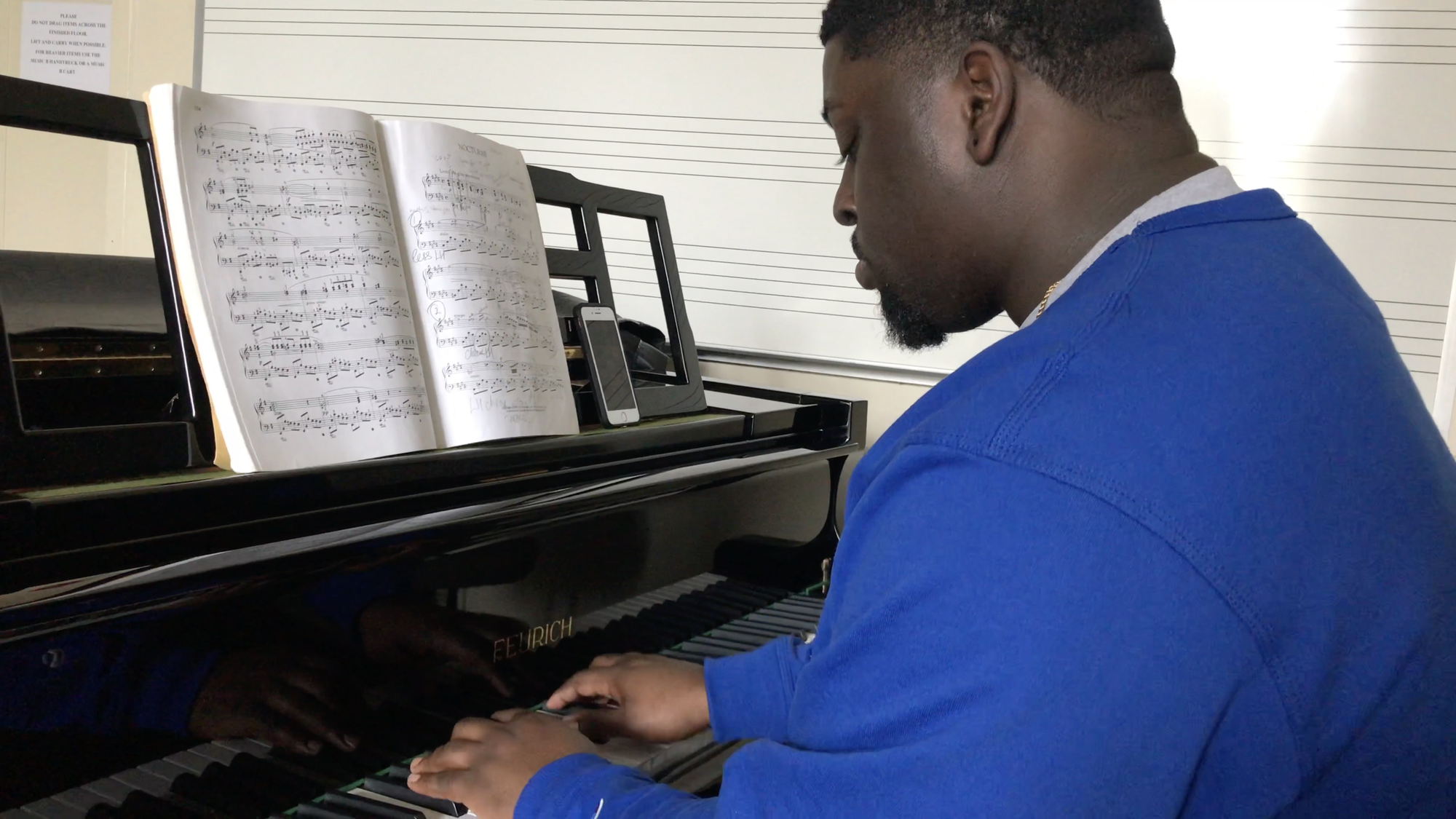
Born into a family of musical influence, Job René, grew up touring the country with his dad’s reggae band, Phase 2. Continuing the family’s musical legacy, René plays both the piano, and cello skillfully as well as pursuing a music major at HSU.
“Music has been a part of me since childhood,” René said. “I started piano when I was six or seven and my dad’s a musician. He kind of said you’re playing music, I don’t care what you say, you’re playing.”
René continued playing the piano up until high school, deciding a break was best for himself.
“That’s when I said, I’m done with the piano for now,” René said. “I want to play sports, I want to do high school things.”
After quitting music, René played basketball and a year of football. With a lack of funding, the football program closed and René was pulled back into the world of music, where he decided this time he would learn a new instrument.
“I always wanted to continue to play music, that never went away,” René said. “What jump started it was in high school, around 10th grade I started playing the cello. A music program came to the school and I thought, I have to get back on this, this is a calling. I told myself I’m doing this and I’m learning a new instrument.”
Even though René went back to music and started learning a new instrument, he felt discouraged to pursue music as a major.
“There’s no money in music, I was set on broadening my horizons,” René said. “I did settle for a minor in piano because I knew I had to do something with music.”
René explored departments and opportunities outside of music to see what else he was interested in.
“I was undeclared for a good two and a half years,” René said. “At the end of that semester I changed my major to music and started that spring.”
René decided to embrace the musical aspect of his life and pursue it as a career.
“I am very happy with my music major,” René said. “I mainly play classical music, it’s what I was brought up on since I was seven. It’s really what I lean towards and I actually like it!”
René takes pride in his passion for romantic classical music, having dealt with judgements and push back over his preferred music choice in the past.
[perfectpullquote align=”right” bordertop=”false” cite=”Job René” link=”” color=”” class=”” size=”16″]“My mom is my biggest supporter. She was really proud I was learning piano… It was the fact that she could see a future in it.”[/perfectpullquote]
“Me being a black person, I get it all the time,” René said. “Like, bruh, why are you listening to classical music? “I connect with it, it was destined for me to like [classical music].”
Regardless of the judgement, René continues. He said his biggest supporter keeps him motivated.
“My mom is my biggest supporter,” René said. “She was really proud I was learning piano. I was doing something that a lot of other kids weren’t really doing. It was the fact that she could see a future in it.”
Mae René, lives 13 hours south of her son in Los Angeles, but still takes time off work and drives to see every recital.
“I try to be a supportive parent in the audience,” Mae René said. “To me, it’s not a 13 hour drive, it’s me seeing my child.”
Mae René has trusted her son’s music abilities since a young age and saw a future for him in it early.
“He picked up music right away,” Mae René said. “To be honest, I wanted him to be a music major from the beginning but I allowed him to step out, and now he knows, mom knows best!”
Mae René isn’t the only supporter in the audience, fellow Brothers United members also strive to support René.
Brandin Thomas (left) and Ronald Taylor (right) stand in front of Brothers United table in the HSU quad. | Photo by Grace Caswell
Ronald Taylor, a third year kinesiology major, and fellow member of BU, described his first experience watching René perform.
“I went to one recital at the end of last year,” Taylor said. “It was really nice, he did well, no mess ups.”
Bradin Thomas, a fourth year kinesiology major and member of BU, is a fan of René’s romantic classical music interest.
“It’s nice,” Thomas said. “I like his music, it soothes you.”
With support from friends and family, René embraces his musical interest more seriously, and is considering sharing his interest with young kids.
[perfectpullquote align=”left” bordertop=”false” cite=”Job René” link=”” color=”” class=”” size=”19″]”If I have to stop music, it’d be like taking a piece of my soul.”[/perfectpullquote]
“Right now, I’m taking a pedagogy class that teaches you how to start your own business,” René said. “Like how to start your piano studio and teach students how to play piano.”
Wanting to share his musical interest, René emphasizes the impact music has had on his life.
“If I have to stop music, it’d be like taking a piece of my soul,” René said.
David Gwenzi is this month’s professor profile. We talk about his culture, his academic achievements and his contribution at Humboldt State
David Gwenzi is an assistant professor of environmental science and management at Humboldt State University. He teaches remote sensing classes and geospatial science classes.Gwenzi is the content committee chairman for the geospatial science program, a program that floats between three departments and two colleges. Born and raised in Mutare, Zimbabwe, his values encourage him to be a role model for younger generations and to inspire success.
[perfectpullquote align=”left” bordertop=”false” cite=”David Gwenzi” link=”” color=”” class=”” size=””]“Whatever you do as an adult, think of how it reflects on younger generations.”[/perfectpullquote]
“Whatever you do as an adult, think of how it reflects on younger generations,” Gwenzi said.
Gwenzi was raised in the Bantu culture, a culture made up of several hundred indigenous ethnic groups in sub-Saharan Africa, spread over a vast area from Central Africa across the African Great Lakes to Southern Africa. The culture encourages responsibility to the society rather than just the individual. Gwenzi became an educated man to prove to the people in his community that if they put in similar effort, they would be able to meet their goals and gain achievements as well.
Gwenzi began his college education at Bindura State University in Zimbabwe, where he researched environmental sciences to help the people of his home country better understand their landscape.
After two years of classroom education, Gwenzi spent a year researching local pine plantations. This was Gwenzi’s first opportunity to use spatial data for his plantation baboon bark stripping research project in July 2006.
“I researched baboons on pine plantations in Zimbabwe,”Gwenzi said. “The baboons stripped pine trees of their cambium layer and they chewed on it. There was sugar or sweet in that layer. It was a treat, but it would girdle the trees.”
Professor Gwenzi rendering a map using interpolation, a process which estimates data obscured by clouds or corrupted data bands. | Photo by Colin Slavey
The nature of the project had Gwenzi surveying the movements of baboon troops on plantations in the eastern highlands using spotting scopes and topographic maps. Gwenzi would record the locations of stripped pine trees in pencil on topographic maps. He compiled the data by hand. His data gave him some idea of the range of each baboon troop on the plantation. It was a tedious process.
“When I was done with that, that was when I talked with the guy who was a GIS technician,” Gwenzi said. “He showed me you could make cool maps out of all these topo maps. Then the guy told me about how easy it could be digitize. I didn’t have to do it with pen and paper in the end.”
Gwenzi fell in love with the GIS process. He became familiar with the tools of the trade and focused his education around Geospatial Sciences. After receiving his bachelor’s in environmental sciences with a focus in forestry, Gwenzi moved to the Netherlands to receive his master’s in geoinformation science and earth observation from the University of Twente. He finally completed his education with a doctorate in spatial ecology from the University of Colorado.
At HSU, Gwenzi shares his passion with many students in the environmental sciences and management department, the forestry department and the geography department. He is renowned through the student body as a high quality professor.
Bente Jansen is a HSU junior ESM policy and planning major. He said that Gwenzi is a good teacher.
“He was always willing to work with me,” Jansen said.
Melanie Stephenson is a senior geospatial science and geology major who has taken some of Gwenzi’s classes.
“Gwenzi is such a ‘G.’ ‘G’ for Gwenzi,” Stephenson said.
Sam Wood is a HSU alumni of the geography program.
“Gwenzi is the best,” Wood said. “He is a genius. I wish he was here now hanging out with us.”
The Arcata plaza is a quirky place. The stores that surround it each have their own flare, and no two are alike. Of those stores on the plaza, that definitely screams the image of Humboldt is “Solutions.” Solutions is an eco-store that has been there since 1990 and is owned and operated by Kevin Johnson.
“Everything we have here is the more eco version of a toxic version [of a product],” Johnson said. “Whatever can be made with CBD, we’re trying to have.”
Cannabis has been the talk of the town, especially after legalization, more specifically is cannabidiol, also known as CBD. CBD oils have been proven to be a natural remedy that has started to become more popular. To put it simply, CBD and tetrahydrocannabinol or THC are different from each other but come from the same plant. THC is the psychoactive, mind-altering compound of cannabis, but CBD is an extraction from hemp and is anti-inflammatory. According to healthline.com, CBD has been proven to help with inflammation (especially in seniors), controlling pain, nausea and mental disorders.
“What people are doing now is they are taking hemp plant varieties, crossing it with the cannabis and breeding the CBD up and the THC down,” Johnson said.
Because CBD is gaining popularity, the people that grow to make these different products have altered the way they grow the marijuana plant, knowing that many people prefer the non-psychoactive part of the plant.
HSU art history major Sam Oetinger, said he has never personally bought CBD oil but has used it in the past with his lacrosse teammates after games.
“We felt that it helped with muscle soreness and recovery,” Oetinger said.
However, the repeating argument that goes into CBD is that the success stories outnumber the actual scientific evidence. There are many people that swear by CBD and cannabis as a whole, but because it is still so unknown there are yet to be studies done that weigh out the benefits and the drawbacks.
Miles Kinman is an environmental studies major at HSU. Kinman said that his family uses CBD oil as a less expensive alternative medication to help with his sister’s arthritis.
“My sister had side effects from arthritis medication combined with other meds which she doesn’t have to deal with when using CBD,” Kinman said.
CBD comes in many variations; Kevin Johnson explained that Solutions carries lotions, cosmetics, chocolates and some fabrics made from hemp. Despite CBD being a controversy, the plant itself is a more sustainable form of creating these products as opposed to unsustainable factories.
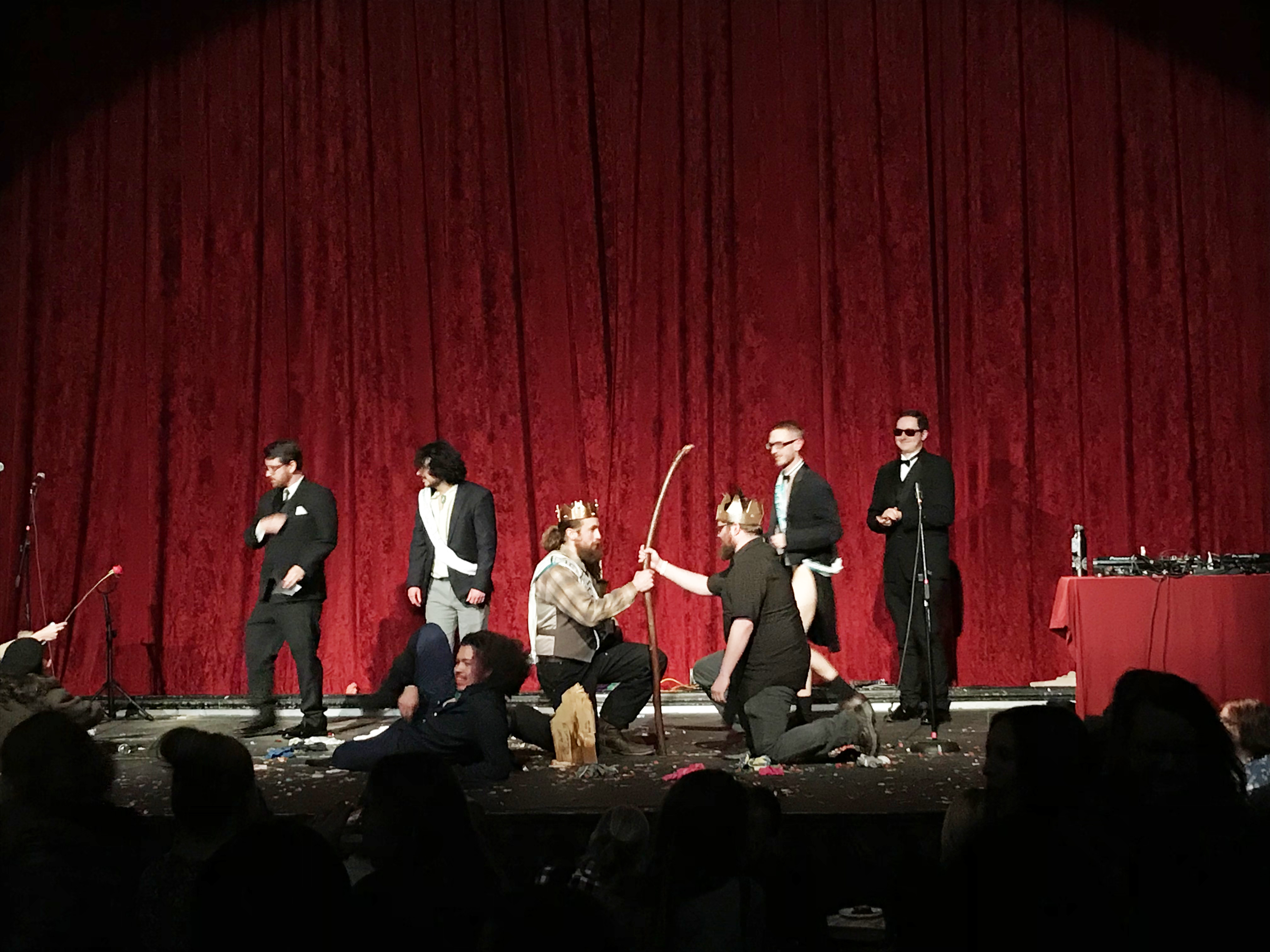
It was a crisp, clear night. The Arcata square was full of hustle and bustle as it would be on a Saturday night. At the Arcata Theater Lounge, a crowd lined up with enough people to wrap around the corner of G and 11th St. The crowd was filled with people ranging from young college women to middle-aged men, all anticipating the Mr. Humboldt beauty pageant.
“It’s glorious,” Nad Molloy said, otherwise known as Mr. Who Now. “I’m more than happy to be here.”
Molloy was a contestant in the 2014 pageant and was sporting the same tux that he wore during his run for Mr. Humboldt. The crowd was dotted with crowned men of past years; among them was Jeff Mason, the Mr. Humboldt winner of 2015.
“I expect partial male nudity and lots of enthusiasm,” Mason said, as a group of young women waiting to talk to him hollered at his comment.
The contest consisted of four main events: question and answer, swimwear, talent, and formal wear. In the mix, there were two award sections as well, the Mr. Congeniality Award and the Cougar award. As for the seven contestants themselves, there was Mr. Boujee, Mr. Heavy D, Mr. Buck 25, Mr. Queer, Mr. Lumberjack, Mr. Dig and Mr. Bigfoot.
The whole function of the Mr. Humboldt pageant to raise money for a charity that is chosen by the winner every year. This year, the charities that were chosen were Food for People, Planned Parenthood, Family Resource Center for ACE Prevention and the North Coast Rape Crisis Team. This year the total amount that was raised was six thousand dollars.
Throughout the event, people were encouraged to donate anytime they could. Undergarments could be purchased to throw onstage and there was a popularity contest at intermission where the eliminated contestants could be voted back in.
Audience member Marisa Parish said that this was her first year attending a Mr. Humboldt pageant.
“Just good, relaxed fun, and freedom to explore your comfort and sexuality is a good experience to have for everyone,” Parish said.
Parish came with a group of women wearing clips in their hair designed to look like vaginas and breasts in support of Planned Parenthood. The entirety of the pageant was to come out, have fun and support each other, making the event all the more enjoyable.
“As long as the charity gets the money, and the people in the audience have a good time, that’s all that matters, that’s what tonight’s about,” contestant Mr. Heavy D said.
The night was full of plenty of sexual innuendos and enough wood jokes to last a lifetime. Ladies in the audience whooped and hollered as the men danced around onstage wearing minimal clothing. The crowd favorite was definitely Mr. Lumberjack, who is also an HSU student. Mr. Lumberjack was the one to take the win at the end of the night.
“You know, we played really hard, we had a good game,” Mr. Lumberjack said, sporting his new crown. “You gotta just hang it out there, whether it’s all you got or literally all you got in your skivvies. You’ve gotta just put it out there on the line.”
It’s time for the Humboldt community to start supporting black-owned businesses
Humboldt County is a predominantly white community. According to Data USA 75.4 percent of the population is made up of white residents. When it comes to the business ownership aspect the numbers are even lower. While they exist, there is a lack of black-owned businesses. According to the United States Census Bureau, as of 2012 only 1,853 minority owned businesses around Humboldt County, meanwhile non-minority businesses make up 10,333 in Humboldt County.
It’s important for us as students to highlight a lack of diverse groups around the Arcata community, as we strive to be a university that prides itself in having a diverse group of students.
There are some black-owned businesses that are around Humboldt County. Over at Eureka there is Dewy’s Beauty Boutique that stocks ethnic hair care products. However, their products are on the expensive side for students who are already on a tight budget. If there were more business that provided this need, it’d be a different reality for many students.
Last month, the Eureka NAACP chapter spoke about how important it is to support black businesses around Humboldt County, as it shows love and support to the black Humboldt communities. There are black-owned businesses like A Taste of Bim, Sistah’s Vegan and Shine Aesthetic just to name a few.
In the first episode of Michael Santiago Render’s Netflix series “Killer Mike’s Trigger Warning,” Render lives three days supporting only black businesses in Atlanta, Georgia. However this proves to be difficult for Render, as there are no black-owned hotels or even foods in some cases, leaving him hungry and sleeping on public benches. The take-away from this episode is to highlight how sparse black businesses are in the USA.
Luckily, there are some clubs, organizations and events to help with diversifying our community. The Multicultural Center at HSU is a student-led organization that helps the diverse student population, while also being open to everyone who is interested. They work closely with the D street community center to hold their events, such as the Home Away From Home Potluck. Also, there’s the African American Center, the Latinx center and the Native American center (ITEPP). All these organizations offer services and plan events for students and the community.
The next locally black-owned businesses coming to campus is Shine Aesthetic and Dewy’s Pop Up. They’ll be on campus Wednesday Feb.13 from 2-5 p.m. at the African American Center for Academic Excellence in Nelson Hall 206. It’s up to us as a community to support them and other black-owned businesses as they come to Humboldt.
Men’s rugby handled the cold, rain, and hail and still beat Cal State Monterey Bay 24-22
Players, coaches, and fans braved the bitter cold, rain and even a little hail as the Humboldt State men’s rugby team pulled out a close victory over the Otters of Cal State Monterey Bay, 24-22.
Jacks rugby alumni Dallas Hamilton goes full savage superfan as he watches former teammates get the win at College Creek Field. | Photo by Matt Shiffler
It was a tough and physical game at the College Creek Field as HSU dominated their share of possession and won the majority of the scrums, where the players lock arms with their opponent and try to get the ball to their side of the formation.
The weather made for tough conditions throughout the day as passing and ball movement for both teams seemed sloppy.
“The weather was a big factor in the game,” HSU coach Vince Celotto said. “It was an ugly looking game, if I was a fan, I wouldn’t have enjoyed it at all.”
The Otters try and contain Adonis Johnson from breaking off another run long run Saturday at College Creek Field. | Photo by Matt Shiffler
Scoring was hard to come by for the majority of the first half but finally, HSU was able to put a try on the board and add the extra conversion by sending the ball through the uprights to make the score 7-0.
A turnover near their own try line for the Lumberjacks resulted in a breakaway try for the Otters later in the first half cutting the Jacks lead to 7-5. HSU was able to get to the try zone a couple more times late in the first half, making the score 19-5 heading into halftime.
Former football player Tumanako Te’i deciding on which play to make during the second half of Feb. 9 game at College Creek Field. | Photo by Matt Shiffler
The sloppy play continued for the Lumberjacks in the second half as they were outscored by the Otters 17-5, including a late score from a turnover by the Lumberjacks. This led to a late Otter try right before the final buzzer sounded, making the final score 24-22 in favor of the north coast squad.
Teammate and club Vice President, Andre Hascall said that there are issues that the team needs to work on together.
“We didn’t pass the ball when we should’ve, and a lot of selfish ball was played,” Hascall said.
Photo by Matt Shiffler
Even though the Jacks ended up winning the game, the mood among the team was anything but celebratory as the team felt like they let the game slip away.
HSU’s forward, Latu Kolopeaua said that as a team the men’s rugby needs to work on their fitness.
“We felt like we were getting too tired too early in the game,” Kolopeaua said.
In the postgame huddle the HSU coaches stressed teamwork and taking care of the ball has HSU finished the game with 36 turnovers.
“As coaches, we felt that we performed poorly as a team,” Celotto said. “We felt like we should’ve beaten this team by a lot more than what we did.”
Celotto also stressed the importance of re-evaluating and refocusing the team heading into next weekend as the Lumberjacks head down to Moraga, California with a 2-0 record in conference play to take on a strong St. Mary’s squad.
The next home game for the Lumberjacks is March 2, at 1 p.m. where they take on Sonoma State with a berth in the playoffs on the line.
Adonis Johnson and the rest of the Jacks push CSUMB back trying to gain possession during the scrum. | Photo by Matt Shiffler
This website uses cookies to improve your experience. We'll assume you're ok with this, but you can opt-out if you wish. Cookie settingsACCEPT
Privacy & Cookies Policy
Privacy Overview
This website uses cookies to improve your experience while you navigate through the website. Out of these cookies, the cookies that are categorized as necessary are stored on your browser as they are essential for the working of basic functionalities of the website. We also use third-party cookies that help us analyze and understand how you use this website. These cookies will be stored in your browser only with your consent. You also have the option to opt-out of these cookies. But opting out of some of these cookies may have an effect on your browsing experience.
Necessary cookies are absolutely essential for the website to function properly. This category only includes cookies that ensures basic functionalities and security features of the website. These cookies do not store any personal information.
Any cookies that may not be particularly necessary for the website to function and is used specifically to collect user personal data via analytics, ads, other embedded contents are termed as non-necessary cookies. It is mandatory to procure user consent prior to running these cookies on your website.