The Lumberjack


Students Serving The Cal Poly Humboldt Campus and Community Since 1929

Category: News

  • BIPOC voices in Humboldt County

    BIPOC voices in Humboldt County

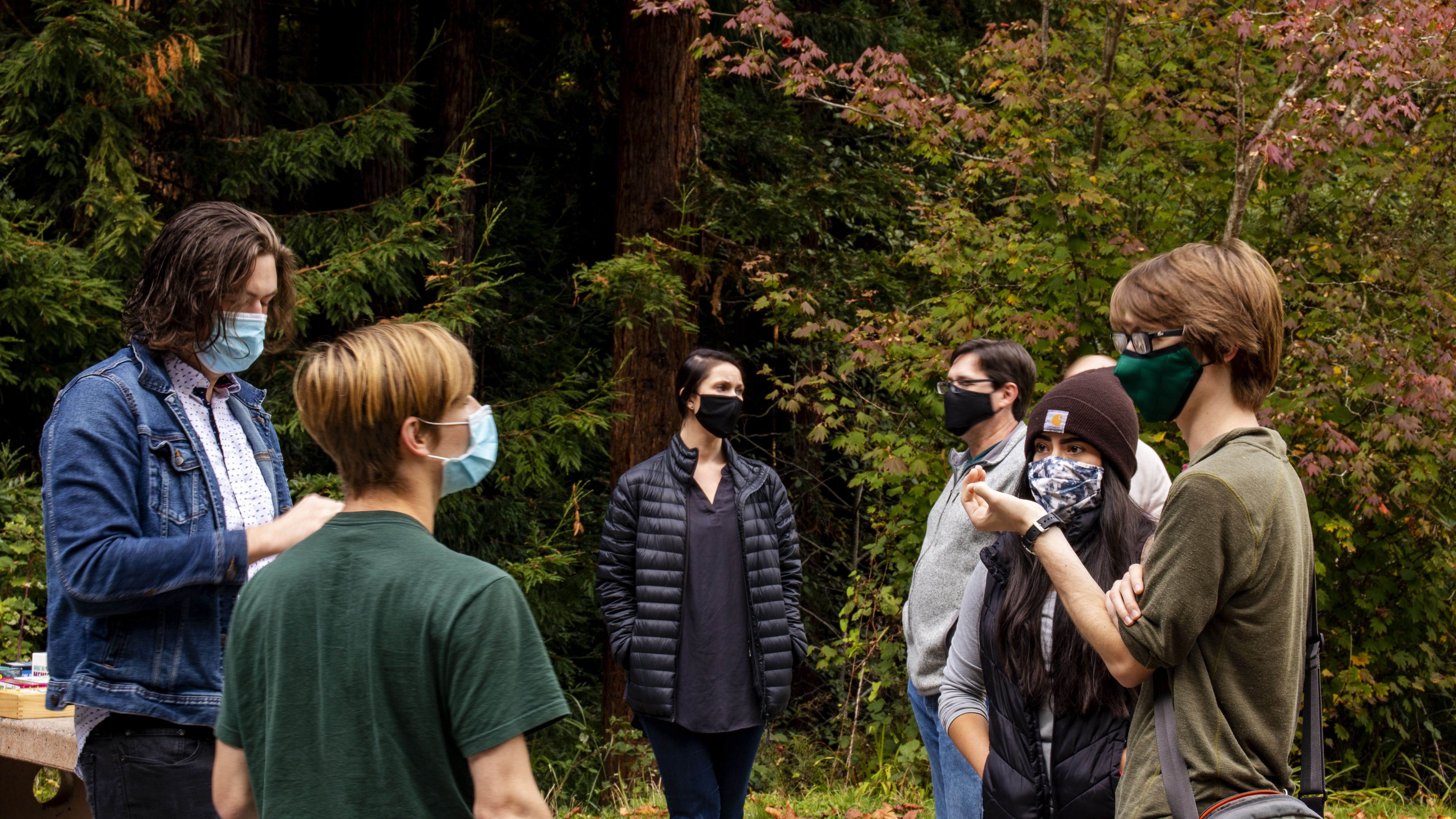
    A gathering was held in the Plaza to support BIPOC community members and listen to their experiences. Students and community members listened to the challenges that BIPOC folks in Humboldt County face today. Nikki Valencia organizes these forums for people of color to voice their concerns. The main theme was calling out the lukewarm allyship in the Humboldt community. They want to call out an illusion of progressiveness that often fails to enact real action and support for people of color.

    “So many people showed up in support, even in a short time frame,” Valencia said. “I feel proud and appreciative of the strong speakers. People were brave enough to get up there”.

    One student speaker, Jesse Beacham Grijalva Prieto, feels that HSU is not a safe environment and does not meet the inclusivity standards that it preaches. Beacham Grijalva Prieto feels the support they need isn’t there in the resources that HSU provides, and came to the plaza to voice those issues.

    “This is a space for people to listen to BIPOC voices,” Beacham Grijalva Prieto said in a speech directed towards white liberals. “It’s an opportunity for people to get that wake-up call and to be able to see who your community is.”

    Joy Mehn is a junior at HSU who wants to see students turn out to more events like this and came to meet like-minded members of the community. She encourages people to act on their words.

    “We talk about activism online, it’s important to actually go out and do the things we’re talking about,” Mehn said. Too many people get caught up in online “slacktivism” without actually bringing tangible support to their communities.

    This was a space of gathering and voice. Tents offered first aid, cookies, BIPOC art, and community resources. The event took a confrontational turn as some folks insisted on being in the space without masks. Two white men unaffiliated with anyone else there had a confrontation in which a camera was thrown and the police were called, which had nothing to do with the organizers or speakers there. This just goes to show the obstacles that people of color face just trying to be heard in their community.

    “It’s very frustrating to have these white people very clearly inserting themselves,” Beacham Grijalva Prieto said. The two men yelling drew attention away from the real reason people were there, to listen to people of color speak. It represents the challenges BIPOC communities are facing in voicing their experiences- white people trying to fit into a space that is not made for them.

  • Oh the times, they are a-changin’

    Oh the times, they are a-changin’

    Many a blue moon hath passed since the old days of HSU students coexisting with millionaire weed criminals and attending psychedelic-themed harvest parties in the forest on the full moon.

    The Arcata plaza, once a bustling mecca of culture and community, is now a shadowy remnant of its former self. Whether from COVID-19, cannabis legalization, changing of the tides or a hellish concoction of all three, the Humboldt County community has regressed from happy hippie haven to sullen farm town and in not much more time than it just took me to describe.

    I began attending Humboldt State University in the fall of 2015, about a year before marijuana was legalized for recreational use in California. When I arrived in town for the first time, it filled me with the warmest feeling of togetherness and glee, comparable only to falling head over heels in love.

    My first time attending the Arcata Farmers Market, I witnessed children laughing and playing in the sunshine, street performers and fire spinners entertaining the crowds with a huge smile on their face. There were vagabond travelers smoking six-inch-long joints right in the middle of the square. Live music and block parties could be found in every neighborhood on every weekend. Obama was president. Nobody had a care in the world.

    “If I’m ever describing Arcata I say it’s like a golden vein. A little golden vein of music right in the middle of California,” said Nick Flores in a 2015 interview. At the time, Flores was in a popular local band called the Smooth Weirdos with two HSU students. All three have since left the area.

    Fast-forward 2016 California legalized cannabis for recreational use. About two years later the price of a pound of weed plummeted overnight. Generally speaking, a large portion of Humboldt County’s population had their income cut in half. People got desperate. A lot of people got robbed or killed. That did not just apply to farmers either. Trimmers making $200 per pound one day made $100 per pound the next day, which made several of them hang up their scissors.

    Many trimmers and farm hands were from other countries, colloquially referred to as “trimmigrants,” and were deterred from ever returning once the jobs did not pay as well. Suddenly, there were no more foreigners coming into town on the weekends with five grand in cash in their pocket to blow at the local shops, bars and restaurants.

    All the people holding cardboard signs with crude drawings of scissors on them could no longer be seen lining Highway 299 near Willow Creek. Barkeeps and smoke shop owners could be seen for miles around scratching their heads, wondering when, if ever, their customers would return.

    At that point, it was starting to become pretty clear the economy was struggling. Even with legal marijuana companies popping up, the jobs were not nearly as available and the ones that were usually paid no more than a restaurant job. Processing cannabis is, unfortunately, not difficult enough to justify the exorbitant salaries people were getting during the heyday of cannabis illegality.

    Fast-forward to the onset of the COVID-19 pandemic and now the students were gone too. This is one of the few college towns rural enough that even one semester of remote learning sending students back to their family homes was enough to cause irrevocable damage in a community that is already half-impossible to access, lacking terribly in basic infrastructure and severely inundated with homeless students.

    HSU’s enrollment was in steep decline even before the pandemic, down almost 50% since 2016 according to data recently released by the school. I have to wonder if those numbers will ever reverse even with a polytechnic designation, which the school has predicted will double the student population in seven years. Even if the school’s prediction is correct, there is not enough housing for the students we already have.

    Maybe I was just a bit more of an idealist in 2015. Maybe I’m too old and too grouchy. Maybe Humboldt used to be a mecca for illegal activity and these are all just necessary growing pains on the way to a healthier community. Or maybe the magic is just kind of gone. It seems like people are not quite as happy as they used to be.

    I know COVID-19 made everybody anti-social, but I would challenge everybody to just be a little more kind. Let’s bring back a little bit of that classic, happy-go-lucky hippie vibe that Humboldt was built on. Otherwise, I cannot envision a future that does not end in the locals getting priced out of living here when the area becomes nothing more than a small-town tourist destination filled with vacation homes and cannabis-themed gift shops.

  • 93 Deaths and Counting: Why HSU Shouldn’t Reopen

    93 Deaths and Counting: Why HSU Shouldn’t Reopen

    HSU is not ready for in-person learning. Currently people all across the country are itching to leave COVID-19 behind and the university is no exception to this. Many are holding the sentiment of, “I did my time and got my vaccine, now where is my reward?” That is not the way the world works.

    Humboldt State University, willing a situation to be one way does not change the reality that it is actually another. The reality is that the county in which this university functions has an extremely concerning COVID-19 positivity rate and the death rates are going up as we speak.

    As of writing this piece, according to data released by the Humboldt County Department of Health & Human Services, we have a COVID-19 positivity rate that bounces between 10 to over 20% and a death count of 93. Almost half of those deaths came from the last two months.

    Prior to the introduction of the Delta variant in July, COVID-19 only had a local death count of 22 by the end of 2020 and an additional 28 deaths by June of 2021. Aside from this alarming increase in deaths due to the Delta variant, by allowing things to go “back to normal” we continue to open the floodgates of more types of mutations which could hold worse consequences than just an increased susceptibility.

    That begs the question, though. What about this hybrid or HyFlex learning that HSU has been attempting? Is that not the middle ground answer to this problem? No, it is not. Even if only vaccinated students were allowed on campus, with masks on, social distancing to the strictest sense, mutation would and does still occur.

    There is substantial evidence, as expressed by disease specialists such as Dr. Peter Chin-Hong and Dr. Ashish Jha, that more common forms of masks, such as the cloth masks we often see across campus, are not as effective at preventing the spread of Delta as it is with previous variants. This is absolutely not to say cloth masks do nothing at all or that they are equal to not masking up at all, just that the likelihood of passing COVID-19 around while wearing one is still very much there.

    This whole argument, however, relies heavily on the idea that both students and faculty alike will and do follow the university’s pandemic guidelines to the strictest degree. Whether due to purposeful negligence or simple human error, there is no doubt in my mind and many others, that not only will vaccinated people break these rules, but unvaccinated people who come on campus will too.

    Lastly, HyFlex learning is not as efficient or accessible as full in-person learning or full online learning. In many ways, it takes the worst of each form without taking any of the positives. Many students have already begun to struggle academically as professors attempt to learn to use the technology necessary for HyFlex learning on the job, inevitably failing to do so at times.

    This situation has left many fully online students feeling left behind compared to their fully in-person peers. We feel cheated, promised the choice of a full online semester that the university in practice didn’t actually put into consideration in their attempts to push in-person learning back onto the masses.

  • Researchers search for collaboration at STEM-NET Virtual Cafe

    The STEM-NET Virtual Cafe is a monthly event that brings together researchers from different CSU schools and helps them find the collaborations that will help them to progress in their work. This month the speakers included professor of chemical and material engineering Dr. Santosh KC from CSU San Jose, psychology professor Dr. Liz Kyonka from CSU East Bay, and experimental particle physicist from CSU Stanislaus Dr. Wing To.

    The first presenters were Dr. KC and Dr. Kyonka. KC’s research focused on 2D material interactions and how they interact with technology, and how to change the way that they interact with one another. The method used was called Twistronics, and involves altering the angle of materials to change their molecular structure and change their interactions with other materials. Research like this can have huge implications when it comes to technology, and Dr. KC was searching for collaboration with experimental and theoretical groups.

    Dr. Kyonka’s research was focused on the experimental analysis of behavior, specifically in the field of gambling and technology interaction. Her main research utilized pigeons to test their reasoning around different reward systems with different near wins and near losses, similar to a slot machine. Her hopes were to see how the pigeons, and later mice and human psych students, made decisions when it came to gambling behavior.

    This connects to her other research around human behavior with technology, specifically how to break people away from constant attention to technology.

    “The other project i’m focusing on is modifying technology use, the plan was to do a direct observation and play naturalist to build ethograms that study gaming and internet use,” Kyonka said. “With the idea that their answers would provide answers to change their behavior.”

    The research that affects Humboldt the most however is Dr. To’s research into the effects of wildfires and using satellite imagery to predict where they may go. By following the atmospheric effects of wildfires and using satellite imagery to take constant pictures of places susceptible to them, To intends to plot out the locations of things like dry grass and dead foliage. At the present, Dr. To’s research team is plotting out the topography of wildfire zones themselves, but he hopes to work with AI and machine learning researchers to do it automatically.

    Wildfires, of course, have become much more common in recent years, and Humboldt county is no different from the rest of California. According to California’s Fourth Climate Change Assessment, wildfires are already increasing in quantity in the north coast region.

    “A changing climate combined with anthropogenic factors have already contributed to more frequent and more severe forest fires in the western US as a whole. Westerling et al predicts that increases in area burned in northern California forests will exceed 100% in both lower and higher emissions scenarios,” To said.

    While they can predict that wildfires will increase, Dr. To says the long term effects of what this means are still unknown.

    “The wildfires burn down forests which are hundreds and some thousands of years old. So if they are left alone, it might return to normal after hundreds of years,” To said. “But due to climate change, these forests will have to evolve differently than before. So we actually don’t know what they will become in the future.”

  • Back to impress: HSU’s printmaking classes are back in person

    Back to impress: HSU’s printmaking classes are back in person

    Humboldt State students are back to filling up the art studios around campus for in-person art classes, an opportunity that hasn’t been possible since the onset of the COVID-19 pandemic. Beginning and advanced printmaking classes have been back in the studio etching, engraving, rolling, and carving their creative designs for their first in-class critiques in over a year.

    Sarah Whorf has been the printmaking professor here at HSU since 2005 and taught printmaking classes online last year in the fall and spring semesters. Whorf mentioned how she struggled to bring her classroom curriculum to the online scene amidst the pandemic, and how many obstacles like delays in mailing supplies to students and being unable to give advice and critiques to the student’s projects until a final photo was submitted really put a strain on her teaching methods.

    “Everything we’re doing [in-person] we couldn’t do online,” said Whorf. “We’re basically back to pretty much doing what I used to always do in terms of my curriculum.”

    Jackson Hake, a second-year HSU student, took Whorf’s online beginning printmaking class in the fall of 2020. Hake explains that printmaking sparked his interest as an art class option but he struggled with setting up his own printmaking studio remotely in his single dorm room.

    “I was doing it [the class] in a dorm room,” said Hake. “Especially with printmaking in particular I feel you really need a specific place to do it.”

    Whorf is very excited to see students’ faces back in the studio weekly for in-person classes and plans to have more interactive critiques and technique-focused lessons for her beginning printmaking class, ART 107.

    “I’m thrilled to be back face to face,” said Whorf. “I’m thrilled to see students in here and interested in learning.”

    Whorf also teaches a weekly advanced printmaking class on campus as well, with open studio time for her more experienced students.

    Logan Schuman, a senior studio art major, took her first printmaking class following her transfer to HSU during the 2019-2020 school year. Schuman has taken printmaking in person as well as online and is excited to be back in person for a more rewarding critique experience with fellow classmates.

    “The critique process was very different and not as rewarding online,” said Schuman. “ In the studio, everyone is looking at each other’s work and sharing their unedited thoughts, and that genuine nature of criticism is somewhat lost over the internet.”

    Schuman hopes to step out of her comfort zone this year in her in-person printmaking classes by trialing different methods of etching and hopes to make good enough prints to sell online or to send to family and friends. Schuman encourages everyone to take a try at a printmaking class as there are so many different methods you’re bound to enjoy one of them.

    “I am absolutely thrilled to be back in the studio,” said Schuman. “I love creating with other people, and learning about their artistic processes and creative thoughts.”

    There is no current news on future art galleries on campus for printmaking students to exhibit their work, but hopefully, the graduates this year have the opportunity to share their work in person.

    “To look up and see a room full of people printing, my eyes were welling up,” said Whorf. “I keep thinking, this is what was missing, this is what we were missing.”

  • Checking in with CHECK IT

    Although they’ve gone virtual, CHECK IT is continuing its work to create a more consent-centered culture and empowering others to step in when they see potential moments of sexual assault, dating violence, and stalking.

    CHECK IT will be launching their Love Knows Boundaries campaign in October featuring some workshops and a photo campaign.

    Giselle Salazar, a CHECK IT peer educator, said that the Love Knows Boundaries Campaign will focus on promoting healthy relationships and giving the campus community tools to create those relationships.

    “We also go a little bit into discussing the intersections of unhealthy relationships as well as intimate partner violence and domestic violence,” Salazar said.

    Also during the month of October, appropriately dubbed CHECKITOBER, CHECK IT will be doing some Halloween-themed outreach and merch. They’ll have consent-related Halloween art prompts on their Instagram. Submissions can be shared with them or you can post them to your story and tag CHECK IT.

    According to Salazar, they’re planning to have a Lotería night in November and December will be focused on self-care.

    Like many other organizations and clubs, CHECK IT has moved online due to the pandemic but Sophia Effa, the students for violence prevention coordinator, believes that they’re now better adapted.

    “The virtual world has been an interesting one to navigate, but since we did it all of last year, we have a pretty good handle on it,” Effa said.

    CHECK IT is hoping to move their Friday volunteer meetings and other events to in-person once it’s safe to do so. Jazmin Borrayo, the graphics design coordinator, said that she’s looking forward to upcoming events and projects.

    “I’m hoping that as things transition to become more in-person, we can get more of our stuff out there like stickers, buttons, t-shirts, posters, etc. as we had done before COVID,” Borrayo said.

    If you’d like to get involved with CHECK IT, you can drop into their volunteer hours every Friday on Zoom at 2 pm. Depending on their interests, volunteers can help with a variety of things.

    To stay updated on CHECK IT events and news, you can follow them on Instagram @checkithsu, and you can also contact a CHECK IT peer educator to be added to their email list.

    “CHECK IT has offered me so many opportunities to learn, grow, and get involved, and I couldn’t be more grateful,” Effa said. “I encourage anyone who’s interested to get involved in whatever ways they can, whether that be applying to be a part of the team or volunteering with us.”

  • All aboard the HSU express

    HSU now offers a free shopping shuttle for students. All you need is your student ID number, shopping destination, and a release of liability and you are set to ride. This free service, provided by HSU’s Student Life Center, runs every first and third Saturday from 10am to 5pm with potential to expand based on student feedback. Students are picked up from The J or College Creek Marketplace and can ride to Target, Old Town Eureka, the Bayshore Mall, Winco, or Henderson Center. This service allows students to explore the greater Humboldt area while reducing their carbon footprint.

    Molly Kresl, Student Life Coordinator at the Office of Student Life, has helped spearhead this program and hopes the shuttle service will help students meet their shopping needs.

    “It’s our way of trying to help students explore new areas outside of Arcata proper and see all that Humboldt County has to offer, while also offering more accessible shopping for our students,” Kresl said. “Also sustainably, we’re encouraging our students to not bring cars up here in part because we don’t have a ton of parking but also because there’s other ways to get around.”

    The student shopping service is actually a relaunch from an idea that spawned just before COVID-19 hit the brakes on much of student life in early 2020. The shuttle ran just once before COVID restrictions stifled the program’s efforts. Presently, as pandemic restrictions loosen, the shuttle is running, employs student drivers, and is helping rebuild our student community.

    As mandated by the CSU system, students must have vaccination information or a medical exemption in order to ride. When getting on board, students must sign a release of liability, which includes a wellness check, to make sure they are free of COVID-19 symptoms. The six foot social distancing guideline has been lifted for campus, as long as people are masked. The shuttle provides masks, hand sanitizers and wipes for students that need a ride.

    For Kresl, the shuttle is a way to support and provide resources for students. Students can also request services through the Student Life Center if they see an unmet campus need.

    “The only way we are able to make change is by knowing what change wants to be made.” Kresl said.

    Sophia Bernardino, a senior from SoCal, rode the shuttle and was pleased with the opportunity.

    “I don’t drive and using the shuttle service was very helpful,” Bernardino said. Bernardino went on to say she hopes the shuttle expands its services so other students can utilize the program.

    Chase Markham, residential advisor for Cypress dorms and Student Affairs Vice President also tried the shuttle service on its inaugural run. For Markham, this service is practical and helpful for his success.

    “I don’t have a vehicle so I’m either hoofin’ it or I’m on public transportation, and this shuttle program for students is absolutely fabulous,” Markham said.

    Although there are other affordable transportation opportunities such as the student bus pass, the student shopping shuttle is helpful because it’s only for students.

    “It gives us a great avenue to get out there and get the stuff that we need without having to go through more hassle or risk to COVID exposure,” Markham said.

  • Yippee for the GWPE

    The GWPE has been around since the late 1970s at HSU and all other CSU’s to demonstrate writing proficiency at a higher level. GWPE was put in place as a solution to the lack of adequate writing skills.

    Each campus has to come up with its own requirements to fulfill the GWPE standards. Currently, HSU is using an honor system for students that are taking the GWPE since it is online only. You have one week to complete the 100 minute exam with two mystery questions, one personal and one analytical.

    To become eligible for the GWPE, you need to have completed at least 60 units and the General Education Area A requirements. It is strongly advised that you take the GWPE during your junior year. If the GWPE is not completed by your graduating semester, you cannot receive your degree until the end of the next semester that you pass the GWPE.

    Online you can find sample essays and preparation workshops to help strategize and practice for the GWPE. GWPE coordinators stress to not worry about how much you write, to just focus on how well you can articulate your thoughts on the questions, and to try not to stray too far from the questions.

  • Hyflex in Hyflux

    Hyflex in Hyflux

    Faculty are just as frustrated as students when it comes to adapting to the new HyFlex reality. To put it plainly, some classes don’t translate to Zoom formats. The format can leave professors worried that some students are left behind and students missing out on vital learning interactions.

    Gina Tuzzi, a painting professor of eight years, has adapted her style to ensure all of her students receive the same quality of teaching. Tuzzi is trying to find equitable ways for students to interact with one another.

    “I have this room of 4-foot by 5-foot paintings, and the students are not painting in a way that’s visible to the camera because of the way we are distanced from one another,” Tuzzi said.

    There are also some challenges digitally communicating a visual medium. Tuzzi believes that it’s something that should be taught and understood in person. The experience of a 20 foot painting doesn’t translate through a little screen. That doesn’t deter Tuzzi from creating a new adaptable learning experience.

    Many professors are trying their own unique adaptations of HyFlex classrooms. Tuzzi found the best way around it has been to split time between students in person and online. Trying to teach both at the same time is not viable for all classroom settings. Students in different learning settings communicate differently, and it takes planning to facilitate that communication gap.

    “I’m really spread thin,” Tuzzi said. “The thing I worry about is the experience the students are having. I stress about being face to face in a pandemic and worried about exposure.”

    The pandemic has challenged students and instructors to learn in new ways. Tuzzi was grateful for the support she found within her department to adapt.

    HyFlex has its glitches, but there are new paths of access and learning on HSU campus. Tuzzi has found that her students use many different modalities to learn. For some students, HyFlex is really working. It allows accessibility in ways that weren’t accounted for in pre-pandemic classrooms. It can give a voice to students who otherwise would not feel confident in sharing.

    Robert Yunker is the Labs and Classrooms Support Lead and hero of HyFlex. He’s been here to help instructors troubleshoot since before the start of the semester. Yunker sees HyFlex as a new extension of learning that wasn’t available before.

    “Different instructors are adapting differently. Some are embracing it and some are a little more hesitant. Most realize what we gotta do and that we’re all trying,” Yunker said.

    He noted that a lot of instructors are making it their own. Some teach from the Redwood Bowl, use creative camera angles to view art projects, or even fix a camera under a fume hood to give a safe but clear view of chemical reactions.

    Other professors find themselves in a virtual abyss talking only to blank squares on their screen. They are having a hard time with students who have their cameras turned off. Forming relationships with students has become a difficult task for professors. Engagement and interaction can be a vital part of learning, but engaging and forming relationships hasn’t yet adapted to the world of Zoom. Knowing what their students comprehend and what is falling through the cracks is more of a challenge.

    Many assume a combination of classroom, online, and Zoom would prepare students and faculty for HyFlex, but HyFlex isn’t a combination of all of those methods. HyFlex is a new method of teaching. Today’s students find themselves the guinea pigs of a new era in education. Everyone is relearning how to learn.

    This tool of learning has offered new avenues of accessibility for many students. Using HyFlex can prevent colds from spreading in classrooms. It enables mobility restricted students to learn in the comfort of their own space or even allow student athletes to learn while on the road. No one enjoys being restricted, but HyFlex can be a tool of empathy and accessibility. So next time you’re waiting out a laggy screen or those awkward Zoom interruptions, stop to take a breath and practice patience. Next time you see your professor online or in person, say thanks.

  • Propagating In Place

    Let’s be honest, who here has never killed a plant? Maybe you overwatered it or maybe you’re one of those people who walk by your thirst craved, desiccating plant with a glass of water and think, “hmm…. wonder what I should do.” Maybe you even did your research and talked to your friends, and still, your plant croaked.

    Whatever your affliction may be, you’re not alone. We’ve all killed a plant. Seems to be the ones you love the most are the most susceptible to an untimely death. I attribute this to over-care. I, for one, tend to put most of my attention to my most loved plants. This somewhat obsessive attention seems to fuel their tendency to die. I’ve found that in doubt, err on the side of neglect. Container plants do not require as much water as those planted in the ground. Of course, this all depends on temperature, placement and variety of plant. One type of plant that seems to be especially evasive are succulents. Something about these drought-tolerant plants just makes people want to water them, causing them to become over-saturated and die.

    If you fear your succulent is on the verge of dying, do not, I REPEAT, do NOT throw it out and give up. Succulents are very easy to propagate and require very little care. These geometric beauties come in all forms, shapes, and sizes and are native to almost every continent. From the high desert to cool, wet shores these appealing plants are amazing additions to a plant collection, easy on the eyes and a lot of fun to grow. Just have patience, everything takes time.

    You can propagate a succulent in many ways. You can pluck leaves and propagate from a single leaf, take a pup – a baby rosette that has grown from the mother plant – and if you’ve found that you did, in fact, overwater it, you can break your plant from its original root mass and plant it in dry dirt to revitalize it. This last method can take more time for your plant to resituate itself, but it still works.

    The propagation method for all of these ways is essentially the same. I have had success propagating succulents in all the aforementioned ways but found the most successful and gratifying way to propagate succulents is to pluck a pup from a healthy mother plant and start a new plant. Although the other ways still produce a healthy plant, they take more time, which is always a hard pill to swallow. Again, be patient, waiting will serve you.

    To propagate a pup from your mother plant take sharp scissors and cut the pup as close to the base of the mother plant as you can. Leave a couple inches of stem so that roots can grow from the stem area. Once you have separated your pup, place it into some well draining soil and let it sit completely dry for a while. The trick for propagating succulents is to keep the soil completely dry. You will drown developing roots if you water your new cutting. Depending on temperature, wait at least a week to water your succulent, probably two. When you finally decide your plant needs water, be sparing. These plants are very resilient and will grow faster if their roots are not saturated.

    Lastly, and not to harp on this, but be patient! Growth takes time. Your plant won’t grow any faster if you obsess over it. Happy succulenting!

  • Whiteness: a continuation

    I was asked why I decided to write about whiteness and uncomfortable conversations. And I had a few reasons.

    Seeing my white classmates shut down when someone speaks on their experience as a person of color (POC) that challenges a white person’s perception of such experience is a bewildering thing to see. Yet, I often see it that a white person could have more knowledge and experience over a POC’s experience of living as a person of color. Talking about race used to feel like I was doing something wrong, and it wasn’t until I left my bubble and went to college that I realized, “damn, I am an idiot.”

    I might seem like a white savior or even like someone turning their back on fellow white people, but that’s not what I’m doing – at least I hope that’s not what’s happening. In my last piece, I got a few fun comments from other white people. One person was really upset about melatonin and people that have a lot of it. I hope they can find the sleep aid that they need. But I also got comments that immediately went on the defense. And to them, I say, no one is shaming you for your skin color or ancestors and I know how sad that must be to be criticized for your skin color constantly. No one said anything about your ancestors. You brought it up. We know that wasn’t you, yet you are, holding on to it like it’s a fun statement piece.

    I’m a loud and outspoken person. Anyone who has ever even been in the same room as me would know that. When I see things, I call them out. I jump to people’s defense without even thinking about it. But I had to learn not to do that sometimes. That people can take care of the situation on their own. That speaking over the voices that are being suppressed or ignored isn’t okay, and I don’t need to jump in front and start yelling. I needed to learn to stand back and let people speak for themselves and listen.

    A few years ago was talking to a friend of mine about a band that I used to listen to all the time when I was younger, a South African band called Die Antwoord. I showed her one of their music videos because it was so crazy, and she turned to me and said, “they’re doing blackface.” I was mortified that I never even realized. Something as obvious as blackface, yet I didn’t even notice. I looked them up after she pointed them out, and there was article after article about how problematic they are. I used to listen to and watch their music videos, and I never noticed the blatant racism.

    Many white people are open to difference and exploring different ideas but afraid of being ostracized for being white. Tapping into the deep fear many white people have not just dissing whiteness but criticizing while inhabiting. But even the whites that want to do better aren’t. I’ve seen countless comments asking, “Can I wear this? Is it okay if I do this? Is it bad to buy from a black-owned store?” on a video of someone doing a TikTok dance. While I don’t want what I’m saying to shame you or deter you from learning, there are so many better ways of getting your questions answered in the correct space.

    As a white person, the moment you enter a conversation between people your group generally dominates, you ask for accommodation. Social media allows us to listen and learn without butting in. Not every conversation is for me or about my whiteness. But those conversations are so important to listen to and understand, to see other people’s experiences and perspectives on something that I am not a part of.

  • Loss and regrets

    My family and I now sit in a confusing state of grief and anger. Last week we got the earth-shattering news that a family friend of over 30 years had passed away due to COVID-19.

    In early August, he was admitted into the hospital and shortly after put on a ventilator. Before being put under, he confessed that he wished he would have gotten the vaccine. I think about his last conscious seconds before being put on the ventilator and I can’t imagine what was going through his mind.

    We have all been getting vaccines since we were born. To me, I see this vaccine as no different than the rest. Many people worry about the efficacy of the drug since it was produced at such a fast rate. What most people fail to realize is the astronomical funding that went behind this. This vaccine shows what happens when people band together and contribute to public health.

    Nearly every person on the planet has been affected by this terrible virus in one way or another, whether they have simply had to change the pace of their everyday life or lost a loved one to COVID-19. I truly never thought I would be the second of those two options.

    The events that occurred on September 11, 2001 are horrific and never forgotten, killing nearly 3,000 people in a single day. After that, the United States severely beefed up security and started a twenty year war in the Middle East.

    At its peak, COVID was killing over 15,000 people a day around the globe. What has changed in the year since we embarked on this journey of a global pandemic? Not too much. There is virtually no “lockdown” anymore, with festival season beginning and nightclubs being packed to the brim, as if the pandemic is a distant memory.

    Masks, you ask? Mandates widely vary by your geographical location. I can go to a supermarket in my city and everyone is abiding by the rules. But if I grab dinner at a restaurant in the next town, not a mask in sight.

    Too little is being done in efforts to combat this disastrous virus. As of this past week, the United States hit a dreadful milestone. 1 in 500 US citizens have died from COVID-19. If you don’t want to get the vaccine for yourself, please do it for the safety of those around you.

    In the final hours of my family friend’s life, his fiancée was allowed to say her goodbyes in a hazmat suit. I could not think of a worse way to spend your loved ones’ last seconds on earth. No one wants to deal with that and no one should have to.

    The hardest part about this situation is that it could have been avoided. Hundreds of thousands of dollars were spent and his life was lost because he didn’t want to get a free shot. Even though he was a right-winged lunatic at times, he did not deserve this in any capacity. He had so much more life to live. He was supposed to get married, watch his children start a family, and travel the world. He should not have been another statistic.

  • The Humboldt Hags Are Back To Hucking

    The Humboldt Hags Are Back To Hucking

    The Humboldt State women’s ultimate frisbee club team is back on campus after nearly a three-semester hiatus.

    The team has been practicing three times a week to prepare for their upcoming home tournament, HUCK, on September 25th and 26th with Sonoma State’s women’s ultimate team at the Arcata Community Center softball field.

    The Humboldt State Hags 2020 season got cut following the onset of the COVID-19 pandemic. Usually, the spring semester is the competitive season for the team while the fall semester is recreational. However, the USA Ultimate Association decided to extend the team’s competitive season to fall this year to make up for their lost spring season of 2020.

    Emily “Eddie” Dryer is a senior environmental studies major who has been a part of the Hags since her freshman year, after an injury prevented her from continuing her collegiate softball career. Dyer was also the team captain and vice-president of the Hags before the pandemic.

    “It really affected us,“ Dryer said, referring to the COVID-19 pandemic. “It was really challenging ’cause we were trying to get everyone on Zoom and keep everyone involved but it was just so hard to keep everyone motivated, I’m really happy and really excited about our numbers this year.”

    According to team president Helinna Leone, the Hags had a higher turnout of recruits this year than past seasons, which led to more opportunities to compete and go out into the local community. The team is all walk-ons and recruits anyone from any experience level. In past years the Hags have participated in local invasive plant pulls and trash pickups throughout Humboldt county to stay active in the community, where they work side-by-side with Hags alumni.

    Leone, a third-year kinesiology and dance studies major, has big plans for the Hags this year after being appointed as team president. Leone has been playing with the Hags since her first year at HSU. She is planning for an alumni game as well as incorporating injury prevention into the team’s practices and tournaments to build a healthy team foundation.

    “Definitely right now the emphasis is still on rebuilding and remembering that we are working to go to regionals or maybe even nationals as a solid team of burly, burly Hags,” Leone said.

    The Hags are a close-knit family, evident from just a few seconds of watching them scrimmage together in the stands. The team consists of members with years of ultimate experience and others who are brand-new to the game.

    Ella Feick is a third-year environmental science and management student who joined the Hags for the first time this semester. Feick enjoys the team aspect of Hags as well as the opportunity to meet other people she would have never met before joining the team.

    “It is nice to be seeing people I would have never known before without doing this and now I see them around Arcata,” Feick said. “It is really cool to have these connections outside of the game but also a time where I get to see everybody every week.”

    Team members said they rely on each other for advice, school work accountability, confidence-building, and getting their numbers up for the future seasons. Many Hags members consider joining Hags as a foundational block to enjoying their student experience here at Humboldt State.

    “I came to college having spent all of my extracurricular time on dance and so at this new start I was sort of moving away from that life and the rocky relationship I had with my body and the dance community as a whole, frisbee helped me step away from that and find power in myself again,” Leone said. “The camaraderie built from late-night practices, long tournament weekends, and just juggling life together is unparalleled.”

    Samantha Castro is a senior returning to the Hags for her third season and said joining the team allowed her to find a community on campus after feeling somewhat lost her first year at HSU.

    “We’re like a family out there on the field,” Castro said. “Since day one it’s all been about the girls and how close and tight-knit we are, I really enjoy that aspect.”

    The Hags will be hosting the first tournament of the fall club season this weekend and are hoping to use it as a warmup for new players before their sectionals in October. The team is always looking for more burly Hags to join the group, no matter the experience level.

  • See what they saw: HSU timbersports team in action

    See what they saw: HSU timbersports team in action

    Chainsaws buzz as the rain pours down in the redwoods. Timbersports athletes can be found clambering up trees, throwing axes, attempting some extreme balance beam act with saws in hand – just an average Saturday for the HSU Timbersports team. They are determined to keep alive practices which once defined the timber industry.

    According to Alex Beauchene, a forestry restoration major, “Logging sports events are rooted in tradition and competition, and can be applied to working in the woods whether that’s in the past or adapted to present day.”

    Clinton Kafka, the team president, cheers on his team even in the gloomiest of weather. He chops wood and runs a chainsaw every Saturday practice as a way to destress from a week full of classes. Kafka gave a lay out of all the events that our lumberjacks love.

    “As a team, we compete in all of the events at the competitions,” Kafka said. “There’s tree climbing, power saw, obstacle pole, choker setting, cross cut, double buck, horizontal chop, vertical chop, axe throwing, pulp toss, caber toss. And then, some more academic events that we have are timber cruising, plant identification, and traversing.”

    Beauchene’s favorite discipline is climbing. It involves athletes climbing up a tree using gaffs (leg braces with a spike to stab into the bark) and a rope around the tree. In competition, climbing is a timed event to see who can reach the 50 foot mark the fastest. In his opinion, the hardest event is the single buck also known as the misery whip.

    “The misery whip got its name from loggers felling large trees historically with a crosscut saw running it back and forth and back and forth,” Beauchene said. “In logging sports it has been adapted to single or double buck, where one or two people run a crosscut saw and race for the best time to cut a cookie (a cross section of log in the shape of a disk) from a log.”

    Others pin the vertical chop as the toughest event, where athletes must chop through 14 inches of an upright vertical log in the quickest time possible.

    One of the most visually-interesting events is the obstacle pole. In this event, athletes balance as they run up an inclined log with saw in hand, and once at the end they saw through the end producing a cookie before running back down. According to the team president it is hard to even get a qualifying time, let alone a fast one.

    The skills learned here are often applicable career skills for quite a few majors, but that does not mean the team is limited to just forestry or management majors. The team welcomes everyone to try their hand at being a lumberjack, and students of all skill levels or majors can join the club or the class. The program is looking to build up their numbers since obstacles in the pandemic have impacted campus life.

    Kyle Mantzouranis is a forestry operations major who found community in the logging sports team.

    “My favorite thing about logging sports is the broad variety of events and how friendly and helpful the team is. They encourage everyone to try the events and are very supportive regardless of your skill level,” Mantzouranis said.

    Cassandra Renteria, a junior on the team, thinks there is something special about practicing logging sports in Humboldt County which has so much history in the timber industry. She also believes there is something special about her team.

    “I’m proud that as a team we still come out here rain or shine ready to put in work at practice every Saturday while being safe about it. I also love how the team makes me feel like I’m a part of something special,” Renteria said.

    The team hopes to compete against other collegiate teams from around the West this season. Students may consider taking the logging sports class next semester to help support the Lumberjacks at Logtoberfest competition.

  • Lumberjack soccer star shines in early season tests

    Lumberjack soccer star shines in early season tests

    “There’s not a prize until the end”

    Christian Gonzalez center back in his second year on the Humboldt State men’s soccer team, is settling in.

    A junior born and raised in Bakersfield, California, Gonzalez has loved the game since he was just five years old. He has four years of college soccer experience under his belt, evident in his playing this season.

    “The further you get into soccer, you’re just grateful that you get into it with a group of guys that are just as determined to keep pushing as you are,” Gonzalez said.

    Gonzalez enjoys the grind of soccer and talked a lot about how it keeps him engaged after the HSU versus Simpson game on Friday.

    “There’s not a prize until the end. You’re just grinding games, running several miles each game,” Gonzalez said. “That’s something that’s great to appreciate towards the end of the season. Early in the season, we know we’re 5-0, but that’s not what we’re seeing right now. We’re taking it one game at a time.”

    Gonzalez said his winning mindset has come from training constantly for years. He learned to practice the way he would play in a real soccer game by having the determination to win all the competitions, not just limited to games, but small sided challenges in practice as well.

    “Even something as simple as a passing drill,” Gonzalez said.

    On the field, Gonzalez plays with his head. He maintains confidence that he can win a ball in the air, offensively or defensively.

    Gonzalez also mentioned that he has been heavily influenced by Italian defenders and the way they play.

    “Defending has been my passion ever since I was little and if I had to pick out several influences it’d just be the classic Italian defender,” Gonzalez said. “If you can score a goal, that’s great, but first thing is defending.”

    This mindset explains how the men’s soccer team defense has been so successful this season. They back up their offense and make things easier for them. They simply allow fewer goals.

    The team has had a very successful season so far, undefeated with a 5-0 record currently. They managed to sneak away with a 1-0 win against Simpson Friday where a goal from Marco Silveira late in the game snatched the victory for the Lumberjacks.

    The previous weekend, the Jacks won two away games against different non-conference opponents in Hayward, California by scores of 4-0 and 3-0. The team’s next game is at College Creek Field this coming Saturday, September 25th. They will face their first conference opponent, Chico State, in a rivalry game.

  • Why waste when WRRAP’s got you covered

    Why waste when WRRAP’s got you covered

    Food waste is an environmental issue that impacts all of us. Good food thrown away today will be greenhouse gases impacting our community tomorrow. This is all preventable.

    Food waste comes in several forms: it can be spoiled food that never made it on a plate, or overstock from a grocery store that never made it to a cart. A food system filled with inefficiency leaves us with extra waste that impacts us all. Lucky for communities around Humboldt County, there are solutions and resources that can reduce the emissions that you are responsible for.

    There are several issues that make food waste’s impact so negative. For one, it is a huge source of greenhouse gas emissions. Food that is wasted in landfills never properly decomposes as it is trapped between other refuse like plastic. It is a waste of the resources put into growing, processing, and transporting food products too. In addition, it is unethical to dispose of so much food in the face of food scarcity.

    Many sources of food waste come in the pre-consumer stage, where food fit for consumption is tossed out before making it to market. This can be due to such trivial things as appearance of produce, improper storing techniques, or often, grocery stores throw out food that was never sold.

    Alexis Diaz, a remote Environmental Studies student at HSU, is doing her part to combat food waste by dumpster diving. Diaz looked into the legality and found that dumpster diving was permitted under California v. Greenwood (1988), as long as there were no local ordinances prohibiting it. She began frequenting grocery store dumpsters and found her own method of modern foraging. Diaz found herself shopping less and always stocked on produce.

    “I went to the dumpster and I just found large amounts of potatoes, onions and apples consistently, I just have so much food to eat” Diaz said.

    Zero Waste Humboldt, a local non profit, is doing their part to ensure that food waste never reaches landfills by supporting food security efforts in Humboldt County communities. Their model follows the food recovery hierarchy supported by the Environmental Protection Agency (EPA).

    The model starts by reducing production to account for our surplus of food that is thrown away, then feeding people with edible products that would otherwise go to waste. Food unfit for humans and scraps go to farms to feed livestock. Food byproducts like oils go towards industrial uses. Anything unaccounted for in those steps is to be composted and returns nutrients to soils. Their efforts help to propel bills like SB1383, which will hold food industries accountable for their organic waste materials. SB1383 will take effect Jan. 1 2022.

    So what can HSU students do about it? Fortunately, the university has several programs to help educate students on waste reduction and mitigate food waste impacts. Waste Reduction Resource Awareness Program (WRRAP) is home of the Earth Tub, an industrial sized composter for student scrap needs.

    The Compost Squad puts out five gallon buckets to collect compostable material weekly. Using an e-bike, they deliver it to the Earth Tub to turn into nutrient rich finished compost. The finished product is available for free pickup to use in your own garden.

    The Compost Squad is here to help! Krissi Fiebig serves as the Compost Director and is an Environmental Engineering major at HSU.

    “Before COVID, the Earth Tub was diverting around 500 pounds of waste every week, but now it is only diverting about 40 pounds,” Fiebig said.

    You can change that. Ella Moore, the other member of the Compost Squad, encourages students to get back into eco-friendly habits as student life returns to campus.

    “All the students have to do is put their waste into the WRRAP provided buckets that are in dorm kitchens and around campus and you can actually request your own bucket for classrooms on campus as well,” Moore said. “That will be collected on Thursdays after 4 pm.”

    As for students off campus, there are options too.

    “Students off campus can bring their compost in a brown paper bag or a bin that they can dump to CCAT, the Campus Center for Appropriate Technology, and put it into their compost or any other bins around campus,” Moore said.

    The Compost Squad misses their loyal bucket holders that did their part to keep the hungry earth tub fed. Please do your part to reduce emissions and mitigate needless waste. For more resources or to answer questions, check out WRRAPs website.

  • HSU counts down for Library’s return

    HSU counts down for Library’s return

    Anticipated to complete in the fall of 2019, HSU’s library construction has continued on far past its originally intended end date. A simple seismic retrofit intended to keep the building up to newly updated safety codes has turned into a full blown reimagining of the university’s library.

    “When it first started, it started with the roof replacement and exterior painting,” Cyril Oberlander, dean of the university’s library, said. “What ended up happening is while we were waiting to do the second bid, the seismic coefficient changed in standards… [forcing] a redesign of our original plans.”

    This sudden change in plans inspired the much larger update currently taking place at the campus library. This newly updated library will follow a more open floor design plan, allowing for the ability to create new spaces geared towards collaborative learning.

    Oberlander listed changes ranging from whole new sets of LED lights with a focus on power consumption reduction, improvements in overall safety, and even a possible future virtual dissection table that would not only allow students to examine the human body through an interactive 3D model but also allow for the examining of wildlife and marine life too.

    Jason Baugh, head construction project manager, added that along with the new LED light installations there will be new mechanical grills, mechanical ducting, improved air quality, and a total repainting and new flooring.

    “We’re going more towards a green, more school color [theme],” Baugh said.

    The library will also be added into the campus-wide system lockdown update, which will allow for the remote locking of any doors on campus at a moment’s notice. Baugh lastly teased that the library may see the addition of solar panels to it within the next few years as part of the university’s microgrid project.

    Aside from the physical changes coming to the library, Oberlander and the faculty are working on making the library a hub for more important student resources.

    “The YES House, Youth Education Service, and Academic Career Advising [are] now moving into the library,” Oberlander said. “And should be opening [with] the [re-opening] of the library.”

    It’s easy to see now how such an originally small project wasn’t able to hit its intended end date. All these additions to the construction weren’t the only obstacles that Baugh and Oberlander hit along the way.

    “It was like, how many curveballs can you get,” Oberlander said, sharing a laugh with Baugh. “Well…we had a few”

    Due to the university’s location, many contractors have been hesitant to take on this huge project in such a secluded area, thus efforts had to be made to rein in the project’s budget. This largely entailed figuring out the best ways to cut corners financially without sacrificing imperative safety measures and features.

    “We did end up having to get rid of our general contractor. They weren’t doing what they were supposed to and they weren’t going to hit our original milestones,” Baugh said. “But it’s fine. We’re getting there. I’m just happy to say we’re making the progress we have.”

    Currently, they are on track to get the first floor open by November, with a full reopening of all floors by the beginning of next year’s spring semester. Prior to the pandemic, the library itself had on average 4,000 people visiting a single day and hosted over 2,100 events in 2018 alone, making its speedy return vitally important to student life.

    Oberlander and Baugh both recognized the strain this project has brought to many students’ academic lives. Both felt a mutual sense of frustration about the whole situation.

    “It was tough on people… I recognize that and I’m pushing as hard as I can to get them back into a space that they should have and rightfully so,” Baugh said.

    For students looking to currently access library resources you can visit HSU’s official library website at https://library.humboldt.edu/ or visit the lowest level of the library in room 28 located at the building’s south entrance, open Mondays through Fridays from 8 am to 7 pm and Sundays from 11 am to 6 pm.

  • HSU’s new app is in the works

    A new app is currently in development for Humboldt State students. Its primary focus would be to connect students better with the AS board and campus life. The app would also offer exclusive local deals and give students a place to easily find and join clubs.

    Bruce Twersky, the lead developer for a company called App Builder U, pitched the new HSU app during an AS board meeting last Friday. Twersky had already developed a demo app for his sales pitch that he made available to members of the board. App Builder U’s application would cost the school a one-time fee of $5,000 and a monthly maintenance fee of $500.

    “We’re basically going to put all of the Associated Student’s information [on the App] and combine that with a bunch of student discounts – pretty simple right? Kind of revolutionary. No one’s ever done this before,” said Twersky.

    Twersky’s demo for the HSU app had multiple functions. For one, it acted as a way for the AS board to directly communicate with students about upcoming events through push notifications. The app also included an interactive campus map that allowed students to find specific locations through a search function.

    As a part of the deal, App Builder U employees would set up exclusive deals with local and national businesses that would be accessible through the app. App Builder U has already developed several other apps for different campuses. To see how useful these deals could actually be, you can download the app they developed for Riverside City College.

    The RCC app has quite a few deals available. However, the deals aren’t all exclusive to the app, many of which are already available to students. Quite a few of the deals are only available through the first-time download of apps from other establishments.

    One function that looks particularly useful is the club page. Here, students can browse the different clubs available on campus and find contact information to join the clubs.

    Overall, the app is simple and easy to navigate with several features that could be mildly helpful. Nothing about it is necessary or groundbreaking, yet the app could still be beneficial in raising student participation.

    Now the question remains, will this app make it through the review process? For the most part, the AS board seems receptive to the idea.

    External Affairs Representative, Rosa Granados was enthusiastic about the idea for a new app, citing back to when she was a freshman moving from Southern California and how this app offers resources that could have helped her as a new student.

    “I really would love to see this expand through, you know, adding wellness services groups as well,” said Granados.

    She explained how the app could be useful in connecting different groups and resources to students who are unaware of what’s available.

    The app still faces approval by the Student Disability Resource Center before it’s released. Dr. Eboni Ford Turnbow reminded the board of the process an app has to go through before publication.

    “Institutionally, before you would decide, this would need to go through an accessibility review through the accessibility department on campus,” said Dr. Turnbow.

    Twersky was confident that his app would be able to successfully go through this process but the board cannot make a decision until the app passes through the accessibility department’s review process.

  • Stop speculating on John Mulaney’s personal life

    Comedian John Mulaney has certainly been having a rough year. This past December, he was admitted to rehab after a relapse in alcoholism and cocaine use, and upon his release he announced his separation from his wife of six years, lampshade artist Annamarie Tendler. Within a week of the news going public, rumors began to circulate that Mulaney was already in a relationship with actress Olivia Munn. In his first interview of 2021, Mulaney confirmed on The Late Show with Seth Meyers that he is in a relationship with Munn and that the couple is expecting a child.

    This was definitely surprising information for me to read. I’m a long-time fan of Mulaney, and some of my favorite material were the bits he did about his relationship with his wife. However, the fact remains that I do not know this man. I have never met him, and I likely never will. Although I have watched his comedy specials almost to the point of memorization, John Mulaney is not my friend and never will be. I know nothing about his life and experiences. He may have a confessional, personal style of comedy, but that does not make me anything beyond a stranger, or him anything other than a face on my screen. I only know what he tells an audience.

    Many fans of Mulaney, myself included, were anxiously hanging on for news during his stint in rehab. It’s natural enough to want to know someone is doing okay, but the more personal news coming out about him became, the stranger the fixation got, and the more concerned I was about myself and my own interest. Reading articles speculating on the nature of his relationships honestly began to feel gross, like I was looking at something that I wasn’t supposed to see. The news of Mulaney’s divorce had some on social media going so far as to compare it to the separation of their own parents. When the news came of him dating Munn so soon after the split, people quickly accused him of moving on too fast and her of being a homewrecker. From the way people talked about her, you would think Munn had seduced their actual dad.

    The term “parasocial relationship” is thrown around a lot online and it is largely misunderstood. Essentially, the term refers to a psychological phenomenon where people form imaginary friendships with media personalities. People see a person on television or social media often enough, and come to see them as a friend despite the lack of real connection. Our monkey brains are not evolved to recognize a difference between a Netflix comedian and a fellow hunter-gatherer tribesman. We have to put in mental effort to acknowledge that celebrities are just strangers we know a disproportionate amount of information about.

    Please note that an interest in celebrity gossip or having a favorite celebrity is not inherently bad or parasocial. If you’re a fan of someone, that’s great! There is nothing wrong with enjoying content. Following your favorite singer or actor on social media is completely normal. However, the most important thing to keep in mind is that whatever connection you feel with your icon, this is not mutual.

    Of course he’s going through something. Of course this man is having some sort of rough patch. That much is obvious. The polite thing to do here is to simply stop feeding into the obsession with a random man’s life. You don’t know John Mulaney. His personal life is not your business.

  • Black Trucks and Bleeding Ears

    I was in the market for a gas mask last summer. I had no time to order it. There was nothing good at the Ace Hardware in Arcata. Nothing at the local auto shops or paint stores. I knew I needed to check the Ace Hardware in McKinleyville. It was unfortunate, but no matter what went on in the McKinleyville Ace, it was better than being tear-gassed.

    I braved the store. I found some useful tat, but no gas mask. The man in front of me in line wore a thin-blue-line face mask, but I supposed it was better than no mask. One of the worst songs I have ever endured assaulted me from the radio. It was a country piece about the singer’s “big black jacked up truck.” I left the hardware store with no protection against tear gas but a few new truck descriptors.

    I am honestly unsure if the tear gas ended up being worse.

    “I listen to everything except for country” goes the common refrain. I get it.

    At a protest last September, I saw someone in a large black truck run over a protestor. Any of the protestors at the scene could have been the one hit. It was just their luck. The protester went under the truck, but they suffered only minor injuries, largely because of how jacked the big black truck was.

    I pulled into a McKinleyville gas station a few days later. I cringed as I parked by a large, lifted black truck. I left my car and eyed the back of the truck, noting a punisher symbol with a thin-blue-line worked into the skull. I bought a cup of burnt coffee from the gas station market and walked back out toward my car. Now there were two additional large black trucks. One truck bore a small confederate battle flag sticker.

    I left the gas station with a sick feeling in my stomach. I could hear the song again, exalting these ridiculous trucks. They weren’t even good at killing people.

    Country music feels like tear gas. Like the thud of a body meeting black painted sheet metal. It smells like gasoline fumes and tastes like burnt coffee.

    “I listen to everything except for country” makes sense. But I still listen to it.

    I can’t help that country music also sounds like home. It feels like grease between my fingers and dust beneath my nails. Like the crunch of gravel beneath the tires of my dad’s old truck.

    Months later, I went back to an old playlist cleverly named “I Don’t Like Country” sitting in my Spotify library. The playlist holds all the songs that used to sound like home. None of it carries overt authoritarian themes or culture-war messaging. The artists are diverse, and the sounds range from modern americana to gospel.

    Now the music sounds like everything my home is not. It sounds like a home I could have had if the people on the wrong end of a big black jacked up truck had what they wanted.

    Everyone who says they “listen to everything but country” might want to try again. You don’t have to enjoy it. It’s a hard genre to navigate, but for me, it’s worth digging. Much of it describes the pain and joy of working-class experiences. It talks about the gruesome consequences of American Protestant ideology. It digs into American sickness and finds a version of America I could abide.

    It feels like my home and tear gas at the same time. These days home may as well be where the tear gas is. Country music is both the weapon used against protesters and the protest song. It’s complex and deeply American. Authoritarian and populist. It’s a map of the American condition. It contains a path to a better home that I wish more people like me could see.

  • IPCC climate report

    The Intergovernmental Panel on Climate Change, or IPCC, released the first installment of the Sixth Assessment Report in August that pointed towards a particular threat to Humboldt county, the disruption of ocean currents. Just off the Humboldt coast flows the California current, which brings cold water down from the North Pacific, and the Davidson current that brings warm water up from the south. The circulation of this sea water is not only the driving force behind Humboldt’s wetter weather and lower temperatures, but they also bring in zooplankton that fish and birds prey on.

    Christine Cass, associate professor and chair of Humboldt State’s oceanography department, said the weakening of the California current will have an effect on the offshore salmon populations who rely on the larger and more calorie dense plankton brought down from the north over the smaller plankton coming up from the south.

    “If we have weaker CA current circulation, we are likely to see fewer of those northern plankton. This can have important implications for plankton predators, including birds and fish,” Cass said. “For instance, young salmon tend to be more successful if they enter the ocean at a time when northern zooplankton are more abundant. When we have fewer northern plankton and more of the southern plankton, the young salmon tend to have lower survival rates. In sum, changing the intensity of the CA current will impact the local plankton present, and could also impact the success of plankton predators.”

    The arctic regions that the northern cold water originates from is poised to get hotter faster than most other regions, meaning that the cold water coming south will be heating up much faster than anticipated. This will mean the salmon will have less nutrient rich food during their mating season. With higher amounts of CO2 entering the atmosphere, the sea’s ability to absorb it and absorb heat gets strained. If ocean waters reach their maximum level of captured CO2, they will begin bouncing more CO2 and heat from the sun back into the atmosphere, compounding the effects of climate change and causing its worse effects to begin faster.

    According to the IPCC report in August, all of the projections for more unprecedented weather patterns hinge largely on human activity.

    “The magnitude of feedback between climate change and the carbon cycle becomes larger but also more uncertain in high CO2 emissions scenarios,” the report said. “However, climate model projections show the uncertainties of atmospheric CO2 concentrations by 2100 are dominated by the difference between emissions scenarios.”

    The most important factor in reducing climate change is reaching net zero emissions as soon as possible. CO2 and greenhouse gas emissions are the largest contributors to the increase in unpredictable weather patterns.

    According to IPCC working Group One chair Panmao Zhai in the August 9th press release, the only effective way to tackle climate change is for world leaders to reduce CO2 emissions as quickly as possible.

    “Stabilizing the climate will require strong, rapid, and sustained reductions in greenhouse gas emissions, and reaching net zero CO2 emissions,” Zhai said. “Limiting other greenhouse gases and air pollutants, especially methane, could have benefits both for health and the climate.”

  • Cajun Cheesy Potatoes with Sausages

    Do you ever crave a meal that may remind you of home or is just very comforting? Well, this meal is it!

    You can have it as a side or main dish. You can serve it with meat or not. Some really great meat suggestions are chicken and shrimp, but for the non-meat eaters, you can add broccoli and mushrooms. This savory dish is truly a statement meal and great for any occasion. Not only that, but it’s a little under 15 dollars in cost and only takes about 25 minutes to cook.

    Ingredients:

    3 red skin potatoes, sliced thickly

    1/2 red onion, chopped

    1/2 red bell pepper, chopped

    1/2 green bell pepper, chopped

    2 tbsps chopped garlic

    splash of olive oil

    2 cups of cheddar cheese, shredded

    1 cup of parmesan cheese

    1 tbsp paprika

    1 tbsp garlic powder

    1 tbsp onion powder

    1 tbsp Old Bay seasoning

    1 tbsp cayenne seasoning

    Louisiana’s Cajun seasoning

    1 tbsp McCormick garlic and herb seasoning

    Parsley flakes, for color

    Salt and pepper to taste

    Cooking instructions:

    Add chopped potatoes, garlic, onions, and peppers to a pot of rolling hot water.

    cut the sausages however you’d like. Place them in a pan and let them brown up on each side, you could also add them to the boiling potatoes.

    Add oil and a dash of salt. Add protein of your choice. Let that boil for about 15- 20 mins or until you can stick a fork through one of the potatoes smoothly. Do not overcook, potatoes should keep their shape.

    Once they are fork-tender, drain a good majority of the water and add the seasonings. Fold the potatoes and the seasonings very gently.

    Top with your cheeses and let it melt.

    Side note: It’s totally okay to cook your meats separate from the potatoes as well as the veggies of your choice. Mushy is not pleasing.

  • Get Thrifty

    Get Thrifty

    As social media influencers take over fast-fashion brands, those over by the Lost Coast may prefer to sift through bins to curate their closets. Thrifting, upcycling, and donating gently or rarely worn clothing and goods is one way to reduce your footprint and stick it to capitalism.

    The owner of Brainwash Thrift, Kiki Angus, is building a community around fashion and inclusivity. Brainwash Thrift has been open on the corner of 40 Sunnybrae Center in Arcata since June of this year, and they are just getting started.

    “Self-worth is stemmed from how you express yourself, so fashionable clothing should be accessible,” Angus said.

    Psychology major Clara Lenihan found Brainwash Thrift through HSU.

    “I discovered Brainwash from my sex diversity class. My professor had invited them to be a guest speaker in our class and I loved everything they stood for,” said Lenihan.

    The donation-based thrift store is composed of two locations side by side and plans to open another one a few doors down for a queer-inclusive event space. If you are looking for more than a thrift store, Brainwash is here to bring you a sense of community. As an Indigenous woman herself, Angus is aware of her role as a business owner.

    “On a macro scale to me [Brainwash Thrift] is representative of my personal life philosophy,” Angus said. “The idea of challenging your perspective, decolonizing the mind, freeing yourself of these shackles inflicted on us via settler colonialism.”

    Angus, a transplant from the Bay Area, says when she moved up here she was surprised by the lack of queer bars and other queer spaces. Angus hopes to bring some much needed representation into the area. The walls of Brainwash are filled with photographs Angus takes including women of color, queer motifs, and inspirational quotes.

    Brainwash Thrift is currently only donation-based because Angus wants to keep the inventory accessible and size-inclusive. On top of donations, Angus also travels for inventory.

    I always make sure we have a diverse array of clothing and make sure we have plus size clothing,” said Angus.

    When you donate your clothing or goods, the process becomes what Angus calls a “community trade.” In the future, the store has plans to move into a buy/sale/trade system.

    But Brainwash Thrift is not only taking donations for themselves. Angus is incorporating Brainwash into the community by doing work with non-profits and local artists. Brainwash works with organizations like Queer Humboldt, Justice for Josiah, and Arcata Mutual Aid to help with donations, fundraisers, and food drives. Local artists that utilize the space to create their work, can expect a 20/80 split as opposed to the typical 40/60 split that many consignment artists are used to.

    HSU students can look forward to upcoming college student promotions, skate nights, brown bags sales, and the expansion of the event space. Keep up with Brainwash Thrift on Instagram @brainwashthrift.

    Angus, an Indigenous creative herself, has created a safe haven for herself that she is extending to other like-minded individuals in the area. When you enter Brainwash Thrift you can expect to feel welcomed and inspired. Her aim is to create a space where people can express themselves and love themselves.

    “Those are the things we should value the most because they bring the most joy and love to our lives,” said Angus.