The coronavirus continues to spread across the globe
What is it?
A new coronavirus strain has afflicted over 20,000 people across the globe, according to data from Johns Hopkins University. A coronavirus is a type of virus found in mammals and birds. Most coronaviruses are mild, but certain strains can be severe and potentially fatal. Previous notable strains include SARS (severe acute respiratory syndrome) and MERS (Middle East respiratory syndrome).
The new strain, scientifically called 2019-nCoV, has symptoms including fever, cough and shortness of breath. As of Feb. 4, over 400 people have died from the virus in China, with one reported death in the Philippines and one reported death in Hong Kong.
Where is it?
The virus strain began in Wuhan in China’s Hubei province. Eleven people have been confirmed with the coronavirus in the United States, with hundreds being screened. A case has been confirmed in the Bay Area, but no cases are known in Humboldt County.
Should I be concerned?
Thus far, those who have died from the disease have had other illnesses that limited their immune system, according to the World Health Organization. The disease is mainly spread through coughing or sneezing. The virus can cause pneumonia.
The United States State Department raised the threat level of the virus to level four, the highest level, on Jan. 31, meaning that travel to China is no longer advised. Many airlines have since canceled or reduced flights to China.
The World Health Organization determined coronavirus to be a Public Health Emergency of International Concern on Jan. 30. The virus has spread to at least 27 countries.
According to a report by The Guardian, the current estimated mortality rate for the coronavirus is around 2% (though this is likely high, as many people without severe symptoms may not have gone to hospitals). Seasonal flus typically have around 1% mortality rates, while SARS has a mortality rate of 10%. Given current evidence, panic doesn’t appear warranted.
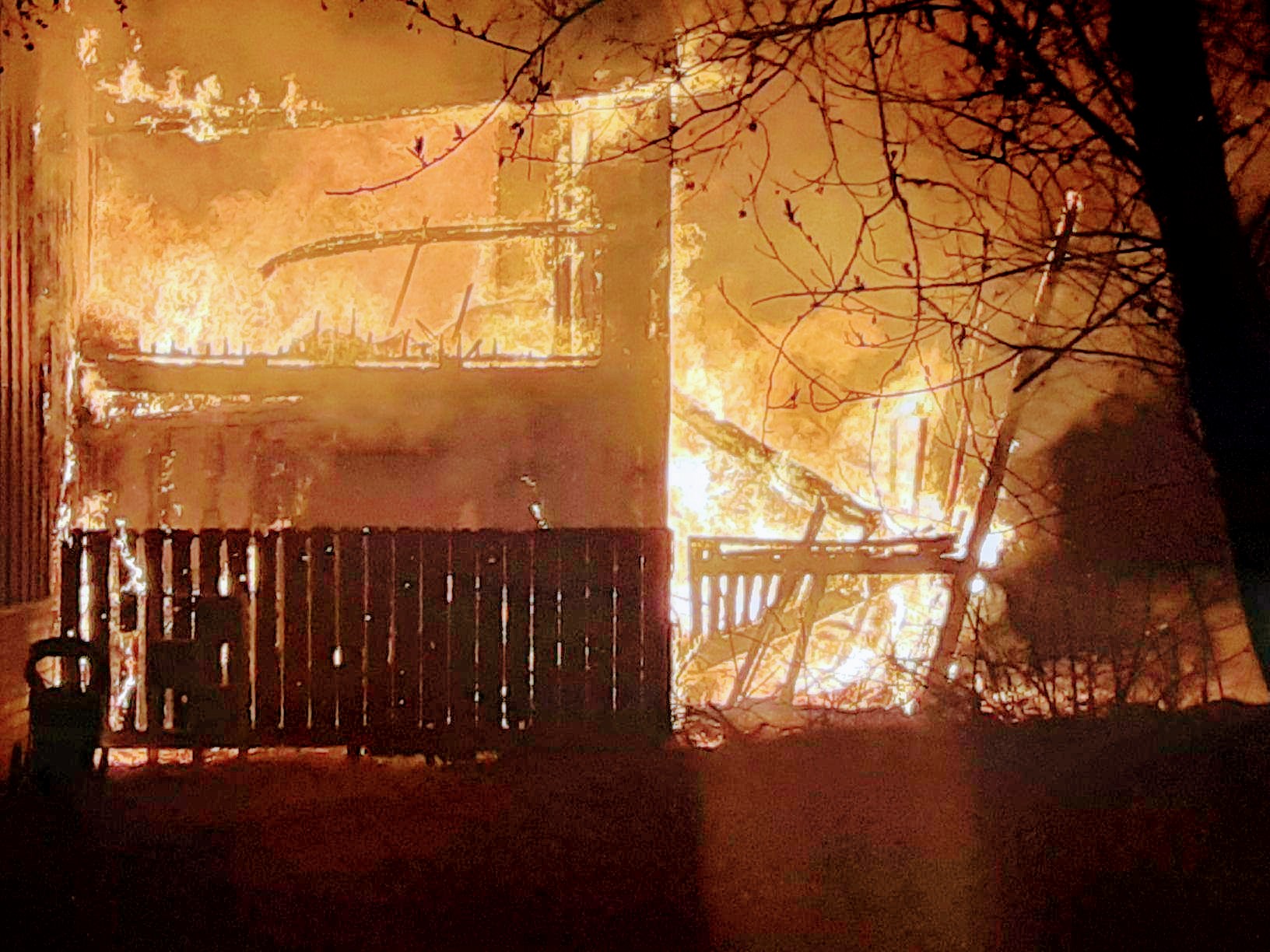
A fire at an Arcata apartment complex on Sunday, Feb. 2, left one resident hospitalized and another dead.
Eyewitness Jalen Zerkel-Loomis was woken up by the fire and recounted what he saw.
“You could see, like, directly into the inside of the building,” Zerkel-Loomis said. “It was like in The Sims where you can just remove one of the walls and perfectly see everything going on inside. The second story didn’t so much collapse into the first—it was like the floor inside the frame fell out under it.”
“It was a pretty crazy sight.”
Jalen Zerkel-Loomis
The Arcata Fire District responded to calls reporting a heavy structure fire and at least one resident that had jumped from a second-story window around 5:30 a.m. Four units of the Meadowbrook Apartment Complex and a nearby car were engulfed in the flames.
Zerkel-Loomis also noted several nearby gas tanks, which did not catch fire. He also said he heard several loud bangs.
“It was a pretty crazy sight,” Zerkel-Loomis said.
AFD said police provided aid to the injured resident until paramedics arrived. Firefighters contained the fire and searched the apartments for trapped residents. After the fire was extinguished, the remains of one resident were found on the first floor. The identity of the victim has not been released.
The cause of the fire remains under investigation. Arcata Police Chief Brian Ahearn has not yet named any suspicions.
What students think of the 2020 presidential candidates on offer
The 2020 presidential campaign season has been in full swing for months. Candidates have risen and fallen. Media coverage of the race has been pervasive. Scandals, conspiracy theories and online warfare have all grabbed media attention. Headlines are filled with heart attacks, race-faking and corruption allegations. Voting begins in earnest this February with the Iowa caucuses. So, who will Humboldt State University students support going into election season?
“I really have no idea what’s going on right now,” HSU student and competitive rower Travis Wills-Pendley said.
The Lumberjack’s presidential poll from Oct. 2019.
Wills-Pendley is one of the many students choosing to let the dust settle before making any decisions. Californians don’t vote until March 3, so students will have a chance to see how candidates perform in other states before voting.
Although most students stayed away from the chaotic primary coverage, the majority said they would likely vote for the more left-wing candidates. Vermont Senator Bernie Sanders was frequently mentioned, along with Massachusetts Senator Elizabeth Warren and Hawaii Rep. Tulsi Gabbard.
“I care a lot about education. I have a bunch of younger cousins and I really want to make sure they get a good education.”
Elise Guerrero
Elise Guerrero is a wildlife major who focuses on climate change policy and progressive advancement in education.
“Currently I’m definitely voting for either Bernie Sanders or Elizabeth Warren,” Guerrero said. “I care a lot about education. I have a bunch of younger cousins and I really want to make sure they get a good education.”
Meanwhile, biology major Nathan Johle thinks there is a lack of effective climate policy among the democratic candidates.
“I care a lot about environmental policies,” Johle said.
“This will be the first time I can vote in a presidential election, so I might as well use my right.”
Nathan Johle
Johle previously supported the climate action-focused campaign of Washington Gov. Jay Inslee. However, Inslee dropped out of the race in August 2019.
“If I’m going to support a politician it’ll be Tulsi Gabbard,” Johle said. “This will be the first time I can vote in a presidential election, so I might as well use my right.”
Johle doesn’t identify with a certain political party. Instead, he chooses candidates based on their individual positions.
“I have beliefs,” Johle said. “I don’t like to put them between two labels.”
He expressed concern that students vote for candidates without doing their research, a sentiment echoed by fellow student Kitty Quintrell.
“I don’t like making a conclusion until I’ve got my own research,” Quintrell said. “That’s one of the main things I’m going to be doing before I submit my vote.”
In the short time before California votes, some states will have already decided. The popularity of the candidates will be much clearer. Momentum will be gained by some and lost by others. Due to the shifting field of the democratic primary, students are resorting to a tried and true method—waiting until the last minute to cram.
Several administrative changes at HSU suggest high turnover
In the last three months, three Humboldt State University administrators jumped ship. A game of musical chairs has since taken place as staff have shuffled around to fill the gaps.
Since November, HSU has appointed a new interim provost, interim college dean, Title IX coordinator, Student Health Center director and Human Resources staff recruitment manager.
While it’s unclear how the changes will affect HSU, the shifts appear in line with data suggesting high turnover rates among college administrators.
The changes began in November, when Provost and Vice President for Academic Affairs Alex Enyedi left HSU to become the 11th president of the State University of New York, Plattsburgh.
Enyedi served as HSU’s provost and vice president of academic affairs since 2015 after leaving Western Michigan University, where he served as a biology professor and dean of the College of Arts and Sciences.
Enyedi left WMU amid controversy as his contract expired despite a petition of support with 1,300 signatures, according to reporting from the North Coast Journal. Enyedi said he believed his contract was not renewed due to his requests for raises for female college employees. WMU pointed to enrollment declines and budget adjustments—familiar phrases for HSU—as the cause of his departure.
“The turnover rate for deans or directors of education topped the list at 22%, while the rate for provosts sat second-highest, at 21%, according to the analysis. Presidents or chancellors came in third, at 18%.”
Data from Higher Education Publications
HSU announced Dean of the College of the Arts, Humanities and Social Sciences Lisa Bond-Maupin as interim provost on Nov. 26. While Bond-Maupin serves, HSU said it would search for the next provost.
“There will be a national search for a new Provost, with opportunity for input and participation from individuals across campus,” the Nov. 26 announcement said. “Details of the search plan will be shared when they are finalized.”
HSU then appointed Spanish Professor Rosamel Benavides-Garb to take Bond-Maupin’s place. Benavides-Garb previously served as associate dean of CAHSS and chair of the World Languages and Cultures program.
On the same day as the Enyedi announcement, Nov. 20, HSU announced Executive Director of Student Health and Wellbeing Services Dr. Brian Mistler had resigned and taken the job as Chief Operating Officer of Resolution Care in Eureka.
In Mistler’s place, Associate Vice President of Student Success Stephen St. Onge now leads the Student Health Center alongside Dr. Karen Selin and Dr. Jen Sanford. The Nov. 20 press release noted that the plans for the future of the SHC’s leadership would be revealed in January. In the meantime, the release made a promise to students.
“In honoring HSU’s commitment to our students, we are looking into opportunities to expand hours and services for students starting the Spring 2020 semester,” the release said.
“Marcus has been an invaluable team member and has served HSU, with his many years of experience, during a time of great change and uncertainty for Title IX departments across the country,” the release said.
Taking Winder’s place is Human Resources Staff Recruitment Manager David Hickcox. Hickcox worked for HR and as an investigation officer for the Title IX Office for the last two and a half years, according to the release.
Recruitment Manager Nicole Log, who, according to the release, has served HSU for five and a half years in the HR department, then took Hickcox’s place.
Finally, Interim Director of Academic Resources Holly Martel got to remove the “interim” from her title on Nov. 18. Martel, who served as the interim director since 2017, has worked at HSU for 24 years in a variety of roles, from financial planning to personnel management.
According to 2016 data from Higher Education Publications, a company that publishes college data in its online Higher Education Directory, college administrators experience high rates of turnover compared to other administrators.
The turnover rate for deans or directors of education topped the list at 22%, while the rate for provosts sat second-highest, at 21%, according to the analysis. Presidents or chancellors came in third, at 18%.
A summary of the analysis gave a variety of possible causes for the high rates.
“When compared to other administrators, the cause for such high-level turnover can be linked to many diverse issues such as growing financial, faculty, Board and political pressures,” the summary said. “Also, traditionally colleges and universities have made leadership selections from within, minimizing risk.”
However, the analysis did not list the administrative turnover rates with which it compared college administrative turnover rates. The Lumberjack has reached out to Higher Education Publications and will update this story online when we receive a response.
The Lumberjack has also reached out to HSU for comment. We received word that HSU Associate Vice President of Human Resources David Montoya and his team are gathering turnover data and will have a comment at a further date. We will update this story online when we receive said comment.
An HSU memo sent out Jan. 21 revealed results from a spring 2019 Great Colleges to Work For survey conducted at HSU. The national survey, intended to inform institutions about workplace culture, sheds some light on the status of the HSU administrative staff.
Across 15 categories, the HSU results came back most positive in the job satisfaction, compensation, pride and supervisors or department chairs categories. The results came back most negative in the senior leadership, policies and faculty, administration and staff relations categories.
HSU will hold two presentations in Goodwin Forum, one on Jan. 24 and one on Feb. 4, to further discuss the findings with faculty and staff, according to the memo.
Living in a community full of love, fear and a growing void of justice
Thirty-three months after a black HSU student was murdered in the city of Arcata, a circle of family, friends, students and community members huddled together, clasped hands and shouted his name.
“Justice for David Josiah Lawson,” the group said loud and clear over and over from the steps of the Arcata City Hall. The sun had set hours ago, and a winter wind was biting at those gathered in attendance, but weather wouldn’t stop the crowd.
“The vibe itself is very upbeat considering the weather,” said attendee Andre Ramos, who wore a heavy winter coat and a beanie pulled over his ears.
Every month since the murder of David Josiah Lawson, a crowd has gathered around Charmaine Lawson, the mother of Josiah Lawson, and together they demand justice for Josiah. Lawson remains steadfast in her belief that justice will happen. She makes the journey all the way up to Humboldt from her home in Southern California to remind those in power that she will make it happen.
“It will happen,” Lawson said. “I serve a mighty god. As long as I have breath in my body I will continue to be here.”
“There are beautiful, amazing, wonderful, compassionate people here. There is love within this community, but there is evil and darkness here.”
Charmaine Lawson
To Lawson, this was an open and shut case. The original suspect, former Mckinleyville resident Kyle Christopher Zoellner, was apprehended the night of the murder. Lawson said the murder weapon was also found. She said DNA evidence should presumably solve this case.
“Why we’re still here? Dumbfounded,” Lawson said.
As the months go by, more and more students move to Humboldt to attend Humboldt State University. Yet Lawson is concerned these students don’t know the situation they’re moving into.
HSU has a much higher population of people of color than the surrounding community. Most HSU students come from Los Angeles or the Bay Area and the small-town culture of Humboldt is different from what they’re used to. Lawson wants to ensure that all students who start the next step of their lives in Humboldt make it out again, but she feels that students of color simply aren’t welcome.
“If you’re a student of color, be careful,” Lawson said. “There are beautiful, amazing, wonderful, compassionate people here. There is love within this community, but there is evil and darkness here.”
Kwame Achebe, a San Diego native, agreed. Achebe has attended every vigil since the murder, but his voice still shook when talking about what happened. He chose his words carefully but spoke with a grim humor when recounting one of his first experiences in Humboldt.
“What’s funny is in San Diego I’m pretty light skinned,” Achebe said with a laugh. “In San Diego I’d have to be convincing people I was black. I didn’t need to convince anybody here. My first day at Arcata High I was greeted as ‘the nigger,’ OK? I was greeted as ‘the nigger.’”
Achebe said his experiences in Humboldt have told him that this isn’t an aberration.
“For us not to have justice 33 months after the murder of a young black man? It’s not out of the norm at all,” Achebe said.
Achebe said the elected leaders of Arcata don’t care about what happened to Josiah Lawson, so it’s up to the people.
“I’ve been out here from the very beginning. I see the look on their faces when they’re addressing us. They have no souls in their eyes,” Achebe said. “They don’t care.”
Part of the goal of the Justice for Josiah movement is justice in the form of political change, not just for Josiah Lawson, but for the whole system. Lawson vowed to keep working to elect people who she thinks will be able to uphold justice.
“I will continue to call people in power out that are elected officials who are not doing their jobs and make sure we get people with integrity and love and compassion in seats,” Lawson said.
Over the course of the almost three-year history of this case, it has faced numerous setbacks. The case against Zoellner was dismissed in 2017. In 2019, a criminal grand jury decided not to indict anyone for the murder of Josiah Lawson, and the California Attorney General declined to take the case.
“Justice for me is having Kyle Christopher Zoellner arrested for the murder of my son David Josiah Lawson and held accountable for his actions,” Lawson said.
The history of the case shows that a system that could bring about the justice that Lawson wants is not the one Humboldt has, but Lawson is convinced it will one day. Until then, Lawson is concerned for the students of color in the here and now.
“Don’t go anywhere alone in this town,” Lawson said. “Stick together so someone can tell your story if you’re not able to.”
Winter storm moving in Wednesday evening may cause power outages
Residents of Humboldt, Mendocino and Lake Counties should prepare for possible power outages during the winter storm rolling in Wednesday evening, according to a press release from Pacific Gas and Electric.
“PG&E meteorologists are expecting the cold front to move into Humboldt County tonight and will work southward into Mendocino and Lake Counties,” PG&E Spokesperson Deanna Contreras said in a press release sent to The Lumberjack. “We are expecting power outages due to wind and rain and also on Thursday due to snow accumulation in the upper elevations.”
The release said PG&E will mobilize crews to remain on-call throughout Wednesday night to respond to any outages. The release also noted that PG&E plans to activate its Operations Emergency Centers.
The release went on to provide a number of safety tips during the storm, which is forecasted to last at least into Thursday, with “unsettled weather” possibly lasting into next week.
Tips included not touching downed wires, avoiding the use of candles and turning off appliances to prevent fire hazards when power is restored. See the press release copied below for the full list of tips.
PG&E Alerts Customers: Have a Plan for Cold, Wet and Windy Weather
Potential Outages Are Possible Due to Approaching Weather
EUREKA / UKIAH / CLEARLAKE, Calif.—With unsettled weather expected to return to its service area this week, PG&E is asking customers to have a plan for inclement weather and be prepared for unexpected power outages.
PG&E meteorologists are forecasting a change in the weather pattern over Northern and Central California later this week. The most impactful storm of this pattern will start on Wednesday afternoon with wind, rain and mountain snow and last into Thursday. Unsettled weather may continue over the weekend and into the following week.
“An impactful winter storm is on the way and we’re asking customers to have a plan to keep themselves and their families safe. Our team of meteorologists is closely tracking the weather system and working with our employees in the field to stage resources and ensure we’re prepared to restore power safely and quickly,” said PG&E senior meteorologist Evan Duffey.
PG&E is closely tracking the weather system and will be mobilizing crews and materials into areas expected to feel the brunt of the storm, so they can get to work and restore service to impacted customers more quickly.
PG&E’s meteorology team has developed a Storm Outage Prediction Model that incorporates real-time weather forecasts, historical data and system knowledge to accurately show where and when storm impacts will be most severe. This model enables the company to pre-stage crews and equipment as storms approach to enable rapid response to outages.
Storm Safety Tips:
Never touch downed wires: If you see a downed power line, assume it is energized and extremely dangerous. Do not touch or try to move it—and keep children and animals away. Report downed power lines immediately by calling 911 and by calling PG&E at 1-800-743-5002.
Use flashlights, not candles: During a power outage, use battery-operated flashlights, and not candles, due to the risk of fire. If you must use candles, please keep them away from drapes, lampshades, pets and small children. Do not leave candles unattended.
Have a backup phone: If you have a telephone system that requires electricity to work, such as a cordless phone or answering machine, plan to have a standard telephone or cellular phone ready as a backup.
Have fresh drinking water, ice: Freeze plastic containers filled with water to make blocks of ice that can be placed in your refrigerator/freezer during an outage to prevent foods from spoiling. Blue Ice from your picnic cooler also works well in the freezer.
Secure outdoor furniture: Deck furniture, lightweight yard structures and decorative lawn items should be secured as they can be blown by high winds and damage overhead power lines or property.
Use generators safely: Customers with standby electric generators should make sure they are properly installed by a licensed electrician in a well-ventilated area. Improperly installed generators pose a significant danger to customers, as well as crews working on power lines. If using portable generators, be sure they are in a well-ventilated area.
Turn off appliances: If you experience an outage, unplug or turn off all electrical appliances to avoid overloading circuits and to prevent fire hazards when power is restored. Simply leave a single lamp on to alert you when power returns. Turn your appliances back on one at a time when conditions return to normal.
Safely clean up: After the storm has passed, be sure to safely clean up. Never touch downed wires and always call 811 or visit 811express.com at least two full business days before digging to have all underground utilities safely marked.
Inside the multi-pronged battle against declining enrollment
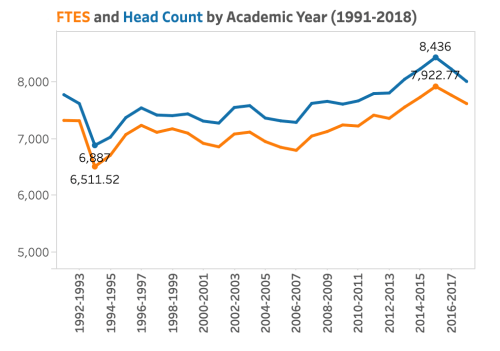
Enrollment numbers are down and Humboldt State University is looking for ways to keep them stable. With just 6,900 students enrolled in 2019, administration and faculty are exploring recruitment strategies and program changes to stimulate growth on campus.
Vice President of Enrollment Management Jason Meriwether is on the front lines of the enrollment situation.
“We’ve lost well over 2,000 students in the last four or five years,” Meriwether said. “It’s a symptom of a few things. We’re graduating larger classes and our graduation rate has gone up. So that does have an impact. Part two is from a recruitment standpoint. There have been a number of things in place that have changed this year to get us to be a viable recruiting option.”
Humboldt State University enrollment has declined to around 6,900 students in 2019. | Graph adapted from HSU Office of Institutional Effectiveness
Meriwether divided the recruitment efforts into three elements. First, the school got rid of barriers to campus visitors like fees for preview day, parking and lunch. Second, the Division of Enrollment Management is focusing its efforts to draw students from local communities to the campus. Third, the school is using data-driven strategies to make enrollment and engagement decisions.
“We’re using data analytics to mine our top feeders and where we’re getting most of our applications,” Meriwether said. “And we’re using that type of data to make decisions about where we put our time and our energy for the maximum benefit for HSU. We want the community to know HSU is a first-choice university.”
“I think that budget component has overshadowed the fact that we still have students here to serve.”
Casey Park Former chair of the University Center Board of Directors
Historically, HSU regarded low enrollment in a more negative light. A decrease in student enrollment was correlated with a decrease in campus revenue, and campus policies reflected the budget deficit. Casey Park, former chair of the University Center Board of Directors, offered some insight.
“I think that budget component has overshadowed the fact that we still have students here to serve,” Park said. “And the narrative for the last two years was that we just didn’t have enough.”
To help staff make decisions based in reality rather than through hypothesis and conjecture, the Office of Institutional Effectiveness provides data and information to faculty and staff. Lisa Castellino, the associate vice president of the Office of Institutional Effectiveness, acknowledged student resources being out-of-date with the current demographic.
“We have a student demographic that has changed over the last five to seven years,” Castellino said. “It has become more diverse. There are more first generation students. It’s more low income. It’s the institution’s responsibility and priority, and it has been the last five to seven years, to help students, because going to college is complicated.”
Thus, on-campus resources are evolving. With low enrollment, Molly Kresl and the Clubs and Activities office said they are being more deliberate and intentional with campus programming by engaging students in a way they prefer.
Meriwether and Enrollment Management said they are promoting HSU’s educational experience to potential students in Humboldt, Siskiyou and Trinity Counties as a first choice rather than a backup. Beyond administration, academic departments are attempting to provide quality education for their students, regardless of enrollment numbers.
“Often during times of change is also our greatest opportunity for growth,” Kresl said. “We stop doing things that really aren’t working that we’ve just done forever because we’ve always done it that way, and we start saying, ‘Okay, then why are we doing this?’”
Mental health grant seeks to address adverse childhood experiences in Humboldt
A new $5 million grant from the U.S. Department of Education will be placing Masters of Social Work students at Humboldt State University in Eureka City Schools and Del Norte County schools as stipend workers.
“The grants themselves are funding positions at Eureka City Schools and also the Del Norte Unified School District,” Director of Field Education at HSU’s Department of Social Work Yvonne Doble said. “It’s actually a full time benefited position that’s being brought on at the school side to support our students.”
Announced Nov. 20, the funds will come from the U.S. Department of Education Mental Health Service Professional Development Program.
Nearly $1 million of the grant will be going to Humboldt State to help support the students and get them prepared for applying for the Pupil Personnel Services Credential, which is necessary for social work students to be hired by schools.
“A large portion of that is coming specifically for the stipends for the students,” Doble said. “We plan to offer a class for stipend recipients, where they will receive faculty guidance and support regarding school social work practice.”
The grant will be placing Masters of Social Work students at HSU in varying levels of schools throughout Del Norte and Humboldt Counties.
“It looks like we are going to have eight students this next fall, maybe more, and that will move up to 13 to 15 students by year four of the grant,” Doble said.
“Our region, for a number of reasons, has California’s highest ACEs rates in Humboldt and Del Norte County,” Jack Bareilles, the Northern Humboldt Union High School District grants administrator and an author of the grant, said. “You’re looking at approximately a third of all kids are being raised in families with four or more of the ten ACEs. So there is just a real need for that here, and I believe that’s one of the reasons we got funded.”
A graph taken from the HSU California Center for Rural Policy Sept. 2017 report on adverse childhood experiences.
ACEs can include things like alcohol and drug use or violence in the home, housing insecurity and food insecurity.
“Locally, there is a real need for support for students and support for families,” Bareilles said. “Social workers are uniquely qualified to provide, and that being said, we actually have a real shortage of social workers in the schools. It’s just something that we haven’t had before.”
Bareilles said the shortage comes from the lack of PPS credentials for students, and also because social workers, which are different from counselors and school psychiatrists, are mainly used in larger cities. Now, the PPS credential will be offered at HSU.
“Kids and schools and families will be helped, and when push comes to shove, that is the most important thing.”
Jack Bareilles
“The role of school social workers is to really help address social and emotional needs of our students,” Doble said. “It’s not just about academic counseling. It’s about providing resources to children and families. It’s about providing opportunities to developers, opportunities to repair harm that’s occurred.”
Bareilles said doing social work in school systems differs greatly from social work in other categories because the public schools operate under different processes than normal organizations.
“Having these interns work two days a week for a whole year working in a high school or middle school or elementary school, they will emerge from their MSW program with a real sense of, ‘Oh this is how schools work,’” Bareilles said. “So whether or not they are employed as a school social worker or some other child-serving social worker, they will really have a better ability of connecting the dots and getting kids what they need.”
Bareilles said the grant is a huge win for mental health support in Humboldt County and will help provide many troubled youths with the resources and personnel that they need.
“Kids and schools and families will be helped, and when push comes to shove, that is the most important thing,” Bareilles said.
AS Administrative Vice President will take over for the spring semester
Associated Students President Yadira Cruz resigned during the AS Board of Directors meeting on Dec. 3, citing personal reasons.
“It was a difficult decision I had to make, but it was the best option academically and personally,” Cruz said a few days later.
Cruz, who fought back tears when interviewed, said the AS Board, composed entirely of Humboldt State students, offered her consolation despite some of them seeming shocked by the decision.
“They were super supportive. Some people teared up, and a few of them apologized, but I didn’t want them to apologize because politics is politics, and it’s challenging,” Cruz said. “They thought they weren’t there for me, but they were always there.”
The AS codes provide that the AS Administrative Vice President takes over if the president resigns. In this case, Lizbeth Cano, a sophomore business administration major, will take the reins for the rest of the school year.
“It’s going to be big shoes to fill in because I got to see how Yadira got everyone involved and was able to always get people to really get their opinion,” Cano said. “One thing I’ll take from her is to make sure to get the whole room involved.”
“I think I’ll always feel a little bit of guilt, because I knew this was a year-long position.”
Yadira Cruz
Cruz was announced as the 2019-2020 academic year AS president last April. A senior criminology and justice studies major, Cruz said she ran despite her lack of political experience to try to do something with her frustration about a lack of support for student needs.
While Cruz said she’s happy with her decision to resign and with her time as president, she acknowledged a feeling of guilt.
“I think I’ll always feel a little bit of guilt, because I knew this was a year-long position,” Cruz said.
As a takeaway message, Cruz urged fellow students to make sure to take care of themselves.
“The transition will help AS become stronger, I think, moving forward.”
Yadira Cruz
“A lot of these students are working and involved and there’s a lot of things that they carry,” Cruz said. “And I think I’m just speaking as first-gen, as a student of color attending here. There’s a lot of things just added to it all, to the whole balance for schedules. But I think my point is just to take care of themselves as well—to find time.”
Cano agreed and supported Cruz in her decision.
“I think it’s time she prioritized herself,” Cano said.
Both Cruz and Cano said they still hoped for more students to get involved on campus with AS or elsewhere.
“Definitely using all of our different hats and letting people know that this is important and this is something that really matters and that they can have a say in it without it being troubling or problematic,” Cano said. “Because I think a lot of people can think that it’s too much work.”
Cruz responded to the implication of her resignation on the image of an AS position being a lot of work by saying that how much people do in AS depends on the individual and their goals. Cano agreed and added on Cruz’s point.
“I think it also has to be kept in mind that the position that’s being resigned is the president position—meaning the top position,” Cano said. “So definitely getting involved as a representative or maybe as an executive like a VP—it can be a different flow. It can really be a learning process.”
As Cano transitions into the the presidential role, Cruz said she thinks AS can learn and grow following her departure.
“The transition will help AS become stronger, I think, moving forward,” Cruz said.
Georgetown study shows HSU graduates receive lowest pay over 40 years
Humboldt State University has the lowest earnings for graduates out of all 23 California State Universities, according to a recent Georgetown study.
The study said the average HSU student makes $752,000 within 40 years after graduating, which makes HSU the lowest earning CSU on the list. The average for other CSUs was around $1 million. For comparison, Chico State students reportedly made $1,018,000, while CSU Los Angeles students averaged $1,019,000.
The study measured the value of a college degree in net present value. According to the study, NPV is how much a sum of money in the future is valued today. According to Telegram.com, “this metric includes costs, future earnings and the length of time it would take to invest and earn a certain amount of money over a fixed horizon.”
“I believe it’s very important to think about the fact that the 30, 40, 50 years of a person’s working life are a lot more satisfying if it’s a job you enjoy and allows you to do the things you are passionate about.”
Alison Holmes
This fixed horizon is split into increments of 10, 15, 20, 30 and 40 years. This number is calculated by subtracting the amount of money a person can make at a minimum-wage job over that same time period, as well as taking into account student loans. This number contrasts against working a job that doesn’t require a degree. The result is the return on one’s investment.
Alison Holmes, associate professor in the Department of International Studies at HSU and a participant in the development of the career curriculum for the arts and humanities, believes the study isn’t taking enough into account.
“The frame of this research is clearly about size of income over the years after graduation,” Holmes said. “And while I would never say that is unimportant, I believe it’s very important to think about the fact that the 30, 40, 50 years of a person’s working life are a lot more satisfying if it’s a job you enjoy and allows you to do the things you are passionate about.”
Gina Kelble, an HSU freshman who sees herself going into environmental law, expects to make a decent living.
“I’ll probably end up going to [University of Colorado] Denver or CU Boulder for grad school,” Kelble said. “I have connections back at home through past internships, so those will be stronger than my Humboldt ones.”
Kelble is confident in her ability to get into grad school and dodge the bullet of making the average income of an HSU graduate.
“The study also makes the point that it’s about knowing yourself or, put another way and as I say to students, choices have consequences,” Holmes said. “There is nothing wrong with wanting money, if that’s lots and lots of money or just basic financial security. But you need to be clear that jobs have a pay scale. As a society we can work to get better pay for people, but for now, it is important to think about jobs with a very clear understanding of the pros and the cons of that choice.”
Holmes said that while money is a necessity, it stands among many others things that should be taken into account.
“As long as we send students into the world prepared to do what they want to do and always striving to fulfill their amazing potential, I am not going to spend too much time worrying about a study based on a scale based on the size of a paycheck,” Holmes said.
Humboldt State has no direct input on chancellor search committees
No one from Humboldt State University sits on the search or advisory committees for the next CSU chancellor, and the closest forum to give feedback to the committee is in Sacramento.
“It’s roughly a dozen people on these committees combined, and unfortunately,” CSU Senior Director of Public Affairs Mike Uhlenkamp said. “Unfortunately we’re not able to get that far north because of the travel considerations.”
The CSU Board of Trustees has appointed a search committee and an advisory committee to select the next chancellor. The search committee includes the Board of Trustees Chairman Adam Day, the vice-chair, current CSU Chancellor Timothy White and eight other trustees.
The stakeholder committee includes two CSU faculty representatives, a staff representative, a student representative, an alumni representative and two campus president representatives. These representatives hail from Sonoma State, San Francisco State, CSU Sacramento, San Diego State, CSU San Marcos, California Polytechnic San Luis Obispo and Cal Poly Pomona.
“There isn’t currently anyone from HSU on those committees,” HSU Communications Specialist Grant Scott-Goforth wrote in an email.
According to CSU data, graduation rates are currently at all-time highs. Four-year graduation rates for first-time college students have risen from 19% in 2015 to 27% in 2019, and six-year graduation rates have risen from 57% in 2015 to 62% in 2019.
The two committees are currently undergoing what they are calling a “listening tour” to gather feedback for the search process.
“It’s a fairly tight group and so they went with, for all intents and purposes, the leaders from those groups,” Uhlenkamp said.
Four public forums at Sacramento State, CSU East Bay, the Chancellor’s Office and Cal Poly Pomona were held on Nov. 12, 13, 20 and 22, respectively. Two more public forums were held on Dec. 3 and 5 at CSU San Marcos and Fresno State.
All of the forums can be streamed or viewed online, where you can also submit feedback.
“We are 23 campuses, one university,” Uhlenkamp said. “So we’re looking for everyone to provide some sort of feedback. And everyone’s going to have different forms of feedback, and one of the great things about the University is that we’re so diverse and so different.”
White announced his plan to retire on Oct. 22. He has served as chancellor since 2012 and will remain chancellor until the end of the 2019-2020 academic year.
White, a first-generation Argentinian-American, most notably launched in 2015 the Graduation Initiative 2025, a CSU-wide push to increase graduation rates.
According to CSU data, graduation rates are currently at all-time highs. Four-year graduation rates for first-time college students have risen from 19% in 2015 to 27% in 2019, and six-year graduation rates have risen from 57% in 2015 to 62% in 2019.
“The Board of Trustees is very pleased with the current direction of the University,” Uhlenkamp said. “And by direction, I refer to the fact that enrollment is close to an all-time high, graduation rates are at all-time highs, the funding from the state of California is at an all-time high. The dollars that we receive from donors is also at an all-time high—so it’s effectively a golden age of being a CSU student. So they want to maintain that trajectory.”
Uhlenkamp said the committees will take the feedback they receive over the next two months to make a position description and then use that to gather a pool of candidates. Following multiple rounds of interviews, the committees will choose a group of finalists to be interviewed by the full 25-person Board of Trustees.
“More than using students as photo opportunities, we need a Chancellor who will do whatever it takes to secure what students need to succeed.”
Uhlenkamp said the committees want someone who can maintain the current CSU trajectory while also bringing their own vision. As for the longevity of the next chancellor, Uhlenkamp said current higher education leaders tend to serve for shorter lengths than in the past.
“While, yes, we do want to have consistency, I don’t think that there is a specific number put on how long they want this individual to serve for,” Uhlenkamp said.
On Nov. 20, the California Faculty Association wrote an open letter to the CSU Board of Trustees detailing its desires for the next chancellor.
The letter began by asking for a chancellor dedicated to student success.
“More than using students as photo opportunities, we need a Chancellor who will do whatever it takes to secure what students need to succeed,” the letter said. “Knowing that success means more than four-year graduation rates, our new Chancellor should be committed to helping students follow their own paths unfettered.”
The letter went on to call out the lack of labor representation in the stakeholder committee, calling it “a serious oversight.”
“We need a leader who will change the toxic culture of disrespect for labor at the CSU, and value the work of all employees who serve the system,” the letter said.
The letter ended with a request for an open search process allowing participation.
“We look forward to working with a new Chancellor who will partner with us in these efforts,” the letter concluded.
The committees expect to select the next chancellor by summer 2020.
Supreme Court set to determine future of over 700,000 people
The Supreme Court of the United States heard oral arguments on Nov. 12 that will determine the future of more than 700,000 immigrants brought to the United States by their parents as children.
The Court’s decision isn’t expected until sometime next year, possibly as early January or as late as the summer. The majority decision will likely depend on Chief Justice John Roberts’ decision, as the remaining four liberal justices and four conservative justices are expected to vote in support of and in opposition to DACA, respectively.
Eighty minutes of oral arguments sustained a packed courtroom on the legality of the rescission of the Deferred Action for Childhood Arrivals policy. Three to four million immigrants that live in the United States arrived illegally as children. DACA protects about 700,000 of those immigrants from deportation and makes them eligible for work permits.
The DACA program, which requires that recipients renew their status every two years, is currently only accepting renewals, not new applications.
Seiri Aragon, a 27-year-old DACA recipient, advises first generation, low-income students for Academic Talent Search at Sonoma State University. Aragon, who was born in Oaxaca de Juárez, México and came to the United States in 1997 at age five, said in a phone interview that she has no choice but to pay close attention to the news surrounding DACA.
“It’s kind of hard not to pay attention,” Aragon said. “Because it’s a real, big part of my life, and so anything that could jeopardize my life here definitely should be of some importance to me.”
Seiri Aragon’s first grade school photo. After Aragon moved to the U.S., she began her first grade year in Petaluma, Calif.
Seiri Aragon, a 27-year-old DACA recipient moved to the United States at five-years-old. | Photo by Deija Zavala
Aragon went to high school in Petaluma before completing undergraduate programs at Santa Rosa Junior College and SSU. She then went to the University of Texas to complete a master’s program.
Aragon signed up for DACA when it first came to be in 2012. While Aragon has doubts about the logistics of how a mass deportation could take place in the event of DACA’s rescission, she acknowledges that individual DACA recipients could easily be targeted and deported.
“For a really long time I thought that because we were kids, we would be given a chance,” Aragon said. “But I feel like both Republicans and Democrats in government pretty much just use students like me, kids like me or folks like me as pawns in their political game. As soon as you realize that, you just get so discouraged that at some point you’re just like, ‘Well, if they want to throw me out, they’ll throw me out.’”
Solicitor General Noel Francisco argued in support of DACA’s rescission in the courtroom. Francisco said DACA “maintained in perpetuity a program that actively facilitated violations of the law by hundreds of thousands of individuals.”
“For a really long time I thought that because we were kids, we would be given a chance.”
Seiri Aragon
Francisco suggested that an executive action ordering the government not to enforce the law had questionable legality. Francisco also reminded the Court that DACA was never intended to be permanent.
“DACA was always meant to be a temporary stopgap measure that could be rescinded at any time, which is why it was only granted in two-year increments,” Francisco said. “So I don’t think anybody could have reasonably assumed that DACA was going to remain in effect in perpetuity.”
Francisco argued that a ruling on DACA’s actual legality would be unnecessary. Instead, Francisco believed that President Donald Trump’s attempted rescission of DACA in 2017 was legal and should be allowed to go forward—thus eliminating any need to rule on DACA itself.
Attorney Theodore Olson argued against the rescission of DACA. Olson said such an impactful rescission necessitated a review by the Court.
“The decision overturned a five-year enforcement policy of deferred action that had enabled DACA recipients under other unchallenged laws and regulations to apply for employment authorization, seek driver’s licenses and other benefits,” Olson said.
While Justice Neil Gorusch acknowledged what he called “sympathetic facts,” Gorsuch and Justice Brett Kavanaugh questioned Olson’s stance.
“What’s the legal limiting principle you’d have this Court adopt?” Gorsuch asked.
Olson returned to his initial point on the significance of DACA.
“All we’re saying is that it should be subject to review in the context of the big picture,” Olson said.
When asked if Olson believed that the executive had the power to rescind DACA, Olson said “yes.” Thus, Olson’s argument rested on doubts of the explanation behind the rescission.
President Barack Obama put DACA in place in 2012 as an executive action after Congress failed to pass the Development, Relief and Education for Alien Minors Act. The DREAM Act offered a path to citizenship for some immigrants brought to the United States as children.
With DACA, Obama intended to give Congress time to come up with permanent immigration legislation. No such legislation has come to fruition, and in 2017, President Donald Trump attempted to rescind DACA.
The Trump administration has called DACA illegal and unconstitutional, but lower courts have disagreed. In June, the Supreme Court agreed to hear the case to determine if the rescission of DACA was legal.
About 11 million total undocumented immigrants lived in the United States in 2017, according to the Pew Research Center, and about 100 undocumented students currently attend Humboldt State University, according to an August press release.
HSU released a statement Nov. 21 detailing its commitment to DACA and undocumented students. The release noted HSU’s resources available for undocumented students, including a clinic scheduled for Dec. 6 and 7 in which the Coalition for Humane Immigrant Rights will cover the DACA renewal fee for the first 20 renewals.
“We would like to firmly reassert our commitment to being an inclusive campus which provides access and support for all students, staff, and faculty members within our HSU community,” the release said.
The future for DACA recipients if the policy is rescinded is uncertain. The Department of Homeland Security website has a list of frequently asked questions regarding DACA’s rescission.
“Current law does not grant any legal status for the class of individuals who are current recipients of DACA,” the site says. “Recipients of DACA are currently unlawfully present in the U.S. with their removal deferred. When their period of deferred action expires or is terminated, their removal will no longer be deferred and they will no longer be eligible for lawful employment.”
The site says that once a DACA recipient’s status expires, their case will not be “proactively” provided to Immigrations and Customs Enforcement unless they receive a notice to appear in immigrations court. According to the site, this policy may change at any time without notice.
In an analysis conducted following Trump’s move to rescind DACA in 2017, the bipartisan political organization FWD.us estimated that removing DACA recipients from the workforce would cost $460 billion in gross domestic product over a decade.
When asked what she will do if DACA gets rescinded, Aragon paused.
“I don’t know,” Aragon said. “I really don’t know. I’m just looking out for allies at this point.”
Aragon said that while having DACA is a privilege compared to other undocumented immigrants, she, like Olson, pointed out that a large part of the program is providing basic citizen privileges like being able to file taxes or apply for driver’s licenses.
“The privilege is to bring equity to essentially what we are, which is American,” Aragon said.
For the next few months, DACA recipients across the United States, including Aragon, will await the word of the nine justices. Aragon said she hopes for DACA’s reinstatement, at the very least.
“I feel like I’m asking for crumbs,” Aragon said. “Because at this point, I’m so disappointed that I’m like, ‘Can you just, one, not take away the program, and two, maybe reopen it to people who qualify?’ That’s it, that’s all I want.”
Investigations have found that many large-scale poultry farms keep their birds intentionally overweight and injected with hormones
Turkey Day is tomorrow, but people don’t always take the time to think about the farm to table process that leads to the birds ending up on our dinner plates.
According to The American Society for the Prevention of Cruelty to Animals, “95% of farm animals in the U.S. are raised in factory farms,” with other sources, such as the Huffington Post, claiming numbers to be up to 99%.
Factory farming has proven to be a profitable business, with the United States Department of Agriculture stating that there are approximately 2 million farms in operation.
Poultry makes up a significant size of the income from animals, second only to calves and cattle.
“Cash receipts for animals and animal products totaled 176.5 billion in 2018,” the USDA’s site says. “Cattle/calf receipts accounted for 38 percent of that total, while poultry/egg receipts accounted for 26 percent and dairy receipts 20 percent.”
Some of the problems associated with factory farming include the health of the animals and their living arrangements.
Investigations have found that many large-scale poultry farms keep their birds intentionally overweight and injected with hormones, only to be forced into tight cages until they are killed.
“Due to selective breeding, commercial male turkeys rapidly grow to a weight 3 times larger than wild male turkeys in only 4 months,” Farm Sanctuary, an animal protections agency formed in 1986, states on their website. “Rapid growth and resulting heavy body weight can lead to heart problems and painful leg issues, which can eventually lead to crippling.”
In 2017, The New York Times’ Editorial Board took a stand against factory-farmed poultry.
“No animals raised on factory farms are kept and killed under worse conditions than turkeys and chickens, which make up most of the animals raised for food in the U.S.,” the editorial said. “Nearly 9 billion chickens are slaughtered each year for food. And because poultry is exempt from the federal Humane Methods of Slaughter Act, which the U.S. Department of Agriculture enforces, there are not even minimum federal standards governing how they live or die.”
The Times continued their editorial, detailing how the “so-called broiler chickens” are genetically bred to grow fast, due to the demand for breast meat. According to the Times, these chickens grow so large that they can barely walk, suffering from painful skeletal disorders and deformities before they are killed.
“The vast majority spend their short lives (about 47 days for chickens) in artificially lit, windowless, barren warehouse barns,” the editorial said. “So that turkeys won’t peck one another in these crowded barns, their beaks are painfully trimmed.”
In Humboldt County, if you’re looking to avoid commercial, warehouse-raised poultry, one option is the Shakefork Community Farm. The farm raises small batches of turkeys every summer and fall.
According to their site, Shakefork’s poultry is raised and slaughtered sustainably; raising their birds in open ranges as opposed to tight cages, believing in a more humane approach to raising animals.
“We provide certified organic laying feed, but our hens provide for much of their own nutrition by foraging for seeds, bugs, and pasture,” the site says. “Our healthy and contented birds make for some of the best eating ever.”
After three meetings, Humboldt County Planning Commission comes to Terra-Gen wind farm conclusion
In a 4-2 vote on Thursday evening, the Humboldt County Planning Commission rejected permitting for the Humboldt Wind Energy Project, a proposed plan to bring 47 Terra-Gen wind turbines to Bear River and Monument Ridges.
The turbines would have been capable of producing half of Humboldt County’s energy needs.
The Planning Commission held two previous meetings this month before reaching a decision. Both previous meetings and Thursday’s meeting saw huge crowds.
The planned wind farm site was located in a sacred Wiyot prayer site and in a pristine wildlife environment home to several endangered species that would be impacted by the turbines.
The opposition to the project cited visual pollution, an incomplete environmental impact report and inadequate mitigations as reasons to reject the plan. Project supporters cited an urgent need to reduce fossil fuel burning and reinforce the county’s energy resiliency.
Only four students attended the first University Resources and Planning Committee’s public budget forum, according to Associated Students President Yadira Cruz.
Around 50 faculty, staff and community members were in attendance as well, according to Art Education Assistant Professor and URPC Co-Chair James Woglom.
Woglom said the URPC’s presentation, which can be found online at budget.humboldt.edu, focused on the URPC’s work toward creating a scalable budget model, or a budget that can be altered periodically to represent changing values.
“It ends up bringing more people into the process of decision-making, and thus hopefully reflecting more people’s feeling of what we want this organism to do,” Woglom said of the URPC’s new model.
James Woglom, art education assistant professor and University Resources and Planning Committee co-chair, checking his laptop in the Humboldt State Univeristy library on Nov. 14. Woglom said the URPC has created a new scalable budget model that allows for more flexibilty and input from the HSU community. | Photo by James Wilde
URPC has been meeting over the course of the semester to form a three-year budget for Humboldt State. Woglom said the first step for deciding where to allocate funds is to clarify which values HSU should prioritize.
Besides the forum, the URPC is taking feedback online through an online submission form, a Google survey designed to scale which campus values are most important and a pie chart budget simulator that allows proposals of how HSU should divide funds. Woglom said he’d also be happy to take suggestions through direct emails.
While Cruz said she appreciated the existence of the online feedback forms, she said they can be obscure due to budgetary jargon.
“Although it’s available, it might not be accessible in that way,” Cruz said.
The Google survey, which is not yet released, lists a series of California State University values and asks the respondent to rate how much they agree with each one.
“It’s not saying that we want to devalue any of them, but it’s trying to get a quantitative sense of where the University’s priorities are in terms of allocation of resources based across a series of ideas,” Woglom said. “And then hopefully with that quantification we can make decisions based on where we can make things happen.”
The URPC’s current projections show a $5.4 million budget gap by the 2021-2022 school year, which reflects the impact of reduced tuition due to declining enrollment. According to the presentation, every 100 students generate about $560,000 in tuition.
The University Resources and Planning Committee pointed to declining tuition numbers as the cause of HSU’s current projected $5.4 million budget gap.
Joseph Reed, a political science and economics double major and a student representative on the URPC, said the key challenge has been ramping down the budget with the declining student body.
“It’s kind of been hard to keep this budget for about 8,000 students when we don’t have 8,000 students anymore,” Reed said.
Cruz said the budget should focus on the students HSU has now, and not the students it had in the past.
“Being in that cutting mindset is potentially jarring for morale. I mean, you’re coming from a space where you’re like, ‘Alright, what do we have to not do this year?’”
James Woglom
“I think every campus goes through these sorts of financial challenges, but I think how we move forward is centering students,” Cruz said.
Reed said the URPC has no plans to cut whole departments. Instead, Reed said cuts are more likely to be smaller and broader across the board.
“Every department is being affected, but each one has its own budget, so each one has its own certain amount that it’s being reduced by,” Reed said.
Over the past three years, URPC reduced the budget by $11.5 million. However, Woglom emphasized a difference between past and future cuts due to the new scalable budget model.
“[In the past] we’ve cut what we’ve determined to be at the fringe of the project of the University—so maybe not in direct agreement with the strategic plan of the University or the general values of the University,” Woglom said. “Being in that cutting mindset is potentially jarring for morale. I mean, you’re coming from a space where you’re like, ‘Alright, what do we have to not do this year?’”
The University Resources and Planning Committee showed three possible enrollment and budget scenarios in its Nov. 7 public forum presentation.
With the new model, Woglom said HSU can start with a specific budget number and then distribute it to the things HSU values most. Woglom said the budget can be continually changed, which allows HSU to scale back up or down if monetary realities change.
“We don’t want to make hurried and necessary decisions every year,” Woglom said.
The URPC uses Financial Information Reporting Management System codes, which are used in higher education to categorize expenses by their function, to compare HSU’s spending to other CSUs.
FIRMS codes break down HSU’s spending into five categories: instruction ($56.6 million in the current budget), institutional support ($21.6 million), operations and maintenance of plant ($16.3 million), academic support ($15.6 million) and student services ($12 million). Each of these categories represent a FIRMS program, and the budget determines what percent of the total amount of funding goes to each category.
Using these categories, the URPC also compares HSU’s spending to other CSUs. According to the presentation, spending at HSU in comparison to similar-sized campuses for the 2017-2018 school year was 17% higher at HSU for instruction, 24% higher for academic support, 3% higher for student services, 10% higher for institutional support and 1% higher for operations and maintenance of plant.
The presentation also showed three possible scenarios for the future of enrollment and its effects on the budget. The best case scenario, called the growth scenario, shows a leveling off of the enrollment decline and a budget gap in the $4 million range by the 2021-2022 school year.
The current scenario, upon which URPC’s projections are based, shows a continued decline that leads to the budget gap of $5.4 million. The worst-case scenario shows further decline and a budget gap of up to $7 million by the 2021-2022 school year.
The URPC’s current budget plans are based on the middle scenario of a $5.4 million gap.
Woglom said the URPC still has to figure out how to allocate its funding to keep current programs intact.
Budget projections from the University Resources and Planning Committee’s Nov. 7 public forum presentation show a $5.4 million budget gap by the 2021-2022 school year.
“It raises interesting questions about where you can move within that,” Woglom said.
Just one day after the URPC’s public forum, HSU released a campus announcement detailing the process for filling staff vacancies during the current enrollment decline and budget deficit. The announcement said that while current staff positions will not be eliminated, positions deemed “non-critical” by the vice president of the relevant division won’t be backfilled when a person leaves that position.
Woglom confirmed that announcement.
“The intention of the University at this point is to work to determine where attrition will happen and backfill positions in that manner,” Woglom said.
This backfiring process does not apply to faculty, according to the announcement.
The URPC’s next and final public forum is scheduled for Dec. 3 at 11:30 a.m. in the Goodwin Forum, during which the public can review the URPC’s draft plan before it is sent to the University president for review. Woglom urges everyone to give their input.
“Any ideas that people have that they’d like to share with us, the better our decision-making process can be,” Woglom said.
“I think [student input is] a challenge in itself,” Cruz said. “But I think that just because it’s challenging doesn’t mean it shouldn’t be pursued.”
Yadira Cruz
Reed and Cruz said they don’t think two public forums are enough to gather sufficient student input.
“I think overall we should be making a stronger effort to connect with students and get their overall opinions,” Reed said.
Reed suggested that the URPC should seek to get input not just from some students, but from the majority of students. Cruz agreed.
“I think that’s a challenge in itself,” Cruz said. “But I think that just because it’s challenging doesn’t mean it shouldn’t be pursued.”
The latest Public Safety Power Shutoff by Pacific Gas and Electric is not expected to hit Humboldt County, as of Tuesday afternoon.
PG&E announced Sunday it was monitoring the weather for a possible PSPS event beginning Wednesday, but it has not included Humboldt County in any of its expected shutoff zones. The latest press release on Tuesday said the PSPS will affect 16 counties across northern California. Six counties initially expected to be impacted were removed from their list.
PG&E said the PSPS is once again caused by high winds through dry areas, leading to a high risk of fire.
“Weather forecasts continue to be dynamic with significant variation across different portions of PG&E’s service area,” the Tuesday release said. “As an example, some parts of PG&E’s territory are under a Red Flag Warning issued by the National Weather Service, while other locations are subject to a Winter Storm Advisory.”
PG&E estimated the PSPS, which ranges from Mendocino to Butte to Sonoma Counties, will affect 181,000 customers. PG&E estimated that each customer account serves three residents, so the PSPS may affect over 540,000 residents.
PG&E said it expects the winds to subside by Thursday morning, and that it hopes to restore power to most customers by the end of Thursday.
“High winds are currently expected to subside Thursday mid-morning,” the Tuesday release said. “PG&E will then inspect the de-energized lines to ensure they were not damaged during the wind event. PG&E will safely restore power in stages as quickly as possible, with the goal of restoring most customers by end of day Thursday, based on the current weather conditions.”
HSU’s Dining Services employees don’t receive a free meal while on shift
While many food service employees receive heavily discounted meals or one free meal per shift, dining services student employees at Humboldt State University get the same meal discounts as anyone who pays with J-points: 25% off.
Abigail Rosales, junior communications major and a floor manager at The Depot, said employees frequently complain about the minimal discount.
“It would be nice to know that our job and our work is valued,” Rosales said. “Because if we’re just getting the same discount as people who already live on campus, then there’s not really an incentive food-wise. Obviously we’re getting paid, but it’s always a nice bonus if you get any benefits while working here.”
Rosales previously worked at the fast-casual restaurant chain, The Habit Burger Grill. Employees received a free burger and fries every shift, and got 50% off everything else.
Rosales said a free or more discounted meal per shift would likely make for a better workplace.
“I think if we did get that, a lot of us would be a little less grumpy,” Rosales said. “Because sometimes we’re tired or hungry, and sometimes we just don’t have money on us, so we get irritated.”
Abigail Rosales, a junior communications major, standing in The Depot at Humboldt State University on Nov. 8. Rosales, a floor manager at The Depot, said student dining employees often feel irritated with the lack of an extra discount, but never feel like they can do anything about it.
William Weinberg, a forestry senior and College of Natural Resources representative and vice chair, said over the phone that he’d be interested in seeing HSU try a pilot program giving free meals to student employees.
“I think it would be cool if it did happen, or if they ran a pilot to see if it would work,” Weinberg said. “Would the costs of that free meal maybe make up for more work ethic, more happier workers?”
Rosales said many student employees bring their own food or have to clock out from work early to go home and eat before their next class to avoid paying for a meal. But according to Rosales, even a cheap meal would be helpful.
“Even just like the fries and a corn dog,” Rosales said. “I think those are the two cheapest things. If we just get that, that’ll probably be enough for a lot of people.”
Director of Dining Services Ron Rudebock pointed to money as the primary issue behind the lack of an extra discount for student employees.
Rudebock, who has been the director of dining services for 15 years, said declining enrollment has reduced dining services income, while increases in minimum wage and insurance prices, alongside efforts to provide more organic and local food options, have increased costs.
“It’s unfortunate, because we’re trying to keep our food costs lower while our costs are going up,” Rudebock said. “So how do you balance those two?”
Dining services at HSU are not run by the university, but instead by the University Center. The UC is a nonprofit auxiliary corporation that works with HSU, but is not owned or operated by the school. The UC operates on-campus entities like dining services, the library, Center Arts and Center Activities.
While student fees provide money for some of the services, Rudebock said dining services runs entirely on the income from student food purchases.
In fact, Rudebock said dining services has to pay HSU rent for their facilities along with utilities, garbage, internet and so on.
“It’s a separate business,” Rudebock said. “And we actually pay the university money.”
All California State University Dining Services are run by auxiliary corporations, according to CSU Public Affairs Manager Hazel Kelly. We have reached out to all CSUs to determine which CSU dining services provide free meals to student employees.
Thus far, only five CSU’s have responded.
Student employees at CSU Bakersfield and CSU Monterey receive free meals during shifts, and according to a representative for Sonoma State, SSU student employees get free meals for shifts longer than four hours and free snacks for shifts shorter than that. San Francisco State gives its student employees a free meal if they work a shift longer than five hours, and CSU Chico gives students meals for $2.50 for shifts longer than four hours. In addition, Chico gives student employees 10% off all food items purchased on campus.
Director of Dining Services Ron Rudebock in his office on Nov. 8. Rudebock said dining services has hit tough times lately due to declining enrollment and increased expenses. | Photo by James Wilde
Any profit that dining services makes goes back into its operations, according to Rudebock. Rudebock pointed to The J’s more than 25-year-old dishwasher as one example of an upcoming expense. Rudebock said the dishwasher will cost around $250,000 to get replaced.
“We need the reserves to be able to pay for everything so we can stay in business,” Rudebock said. “But we don’t have a set of stockholders. We don’t have—you know, like a corporation has a set of stockholders that have got to make money. We don’t have a magic investor.”
Rudebock said the UC lost around $100,000 in each of the last two power outages, during which The J offered free meals to students, faculty and staff. Rudebock said HSU may only partially reimburse dining services for those costs.
In regard to free meals, Rudebock said that dining services doesn’t have any plans to provide a larger discount for student employees. However, Rudebock said the issue is not off the table. HSU could suggest larger discounts for student employees to the UC, and while the UC does not have to follow HSU’s suggestions, Rudebock said it wants to work with the university.
“We need the reserves to be able to pay for everything so we can stay in business. But we don’t have a set of stockholders. We don’t have—you know, like a corporation has a set of stockholders that have got to make money. We don’t have a magic investor.”
Ron Rudebock
HSU Director of News and Information Aileen Yoo said via email that HSU hasn’t suggested the UC adopt free meals due to the impacts it could have on prices.
“We understand that offering free or more heavily discounted meals for student employees would be a financial burden for the UC and likely mean a price increase for all HSU students who may not necessarily have the means to cover those additional expenses,” Yoo said.
At the moment, HSU dining services employs about 350 students and 26 full-time employees, which, according to Rudebock, is the highest proportion of students to full-time employees in the CSU system.
Aileen Dominguez, a senior political science major who works as a student assistant at The Depot, said she sometimes wishes there were more full-time employees because when she started the position she felt she was never properly trained.
“I was just kind of put in with my coworkers who actually just said, ‘Oh, this is what we do, or this is how we do it—or this is how the girl before taught me how to do it,’” Dominguez said.
Dominguez said this has led to confusion and she’s not always sure how to train new employees.
Aileen Dominguez, a political science senior, studying in the library on Nov. 10. Dominguez works as a student assistant at The Depot. Dominguez suggested that a bigger discount for dining service employees might increase sales. | Photo by James Wilde
“I’ll say, ‘This is what you do, I think. At least, this is how I’ve seen the other girls do it,’” Dominguez said.
As for meal discounts, Dominguez echoed Rosales.
“I think we all talk about it,” Dominguez said. “But they probably don’t have enough money to feed us all.”
Dominguez said she only eats at The Depot when she has to—typically on Thursdays, when she is on campus all day. She said that employees frequently go to Oh Snap or elsewhere instead of buying food on campus.
Dominguez suggested that a larger discount might actually help bring in more business, but she doubts that one will be offered.
“I just feel it’s unfair that we kind of have to choose,” Dominguez said. “Like, ‘I don’t want to eat this right now, because I have to buy other things,’ or say, ‘I’m just gonna go eat a cup of noodles at home because this burrito isn’t worth it.’”
Rosales made a similar statement.
“On our end, we kind of pick and choose if we want to pay for something,” Rosales said. “If we’re really that hungry to pay for it or if we’ll just deal with it and not.”
This story will be updated if and when other responses for comments are received.
HSU opts for local scholarships over new residence hall
Humboldt State University originally had plans to build a new residence hall, but with enrollment declining, Vice President of Enrollment Management Jason Meriwether decided to invest in scholarships for students living on campus instead.
“With enrollment down, we are not in a position to build a new building anytime soon using the traditional path,” Meriwether said in an email. “So, instead of sitting on the money, I wanted to reinvest the funds in our students.”
Over the last five years, HSU housing has been saving to put a 10% down payment on a new residence hall, according to Meriwether.
Instead, Meriwether reallocated the savings to the $1,000 a year, four-year scholarships for all HSU students that live on campus, beginning fall 2020. Announced Nov. 3, the scholarship is one part of HSU’s plans to improve enrollment and retention.
In the last month, HSU has announced three different scholarships. Two of them will be funded by donors, while the housing scholarships will be funded with the housing reserves.
“Within the limits and scope of how we may use housing dollars, the best and most strategic and student-first option was to create these scholarships,” Meriwether said.
This is an update for our article “Road to Recruitment and Retention.” For the original story, click here.
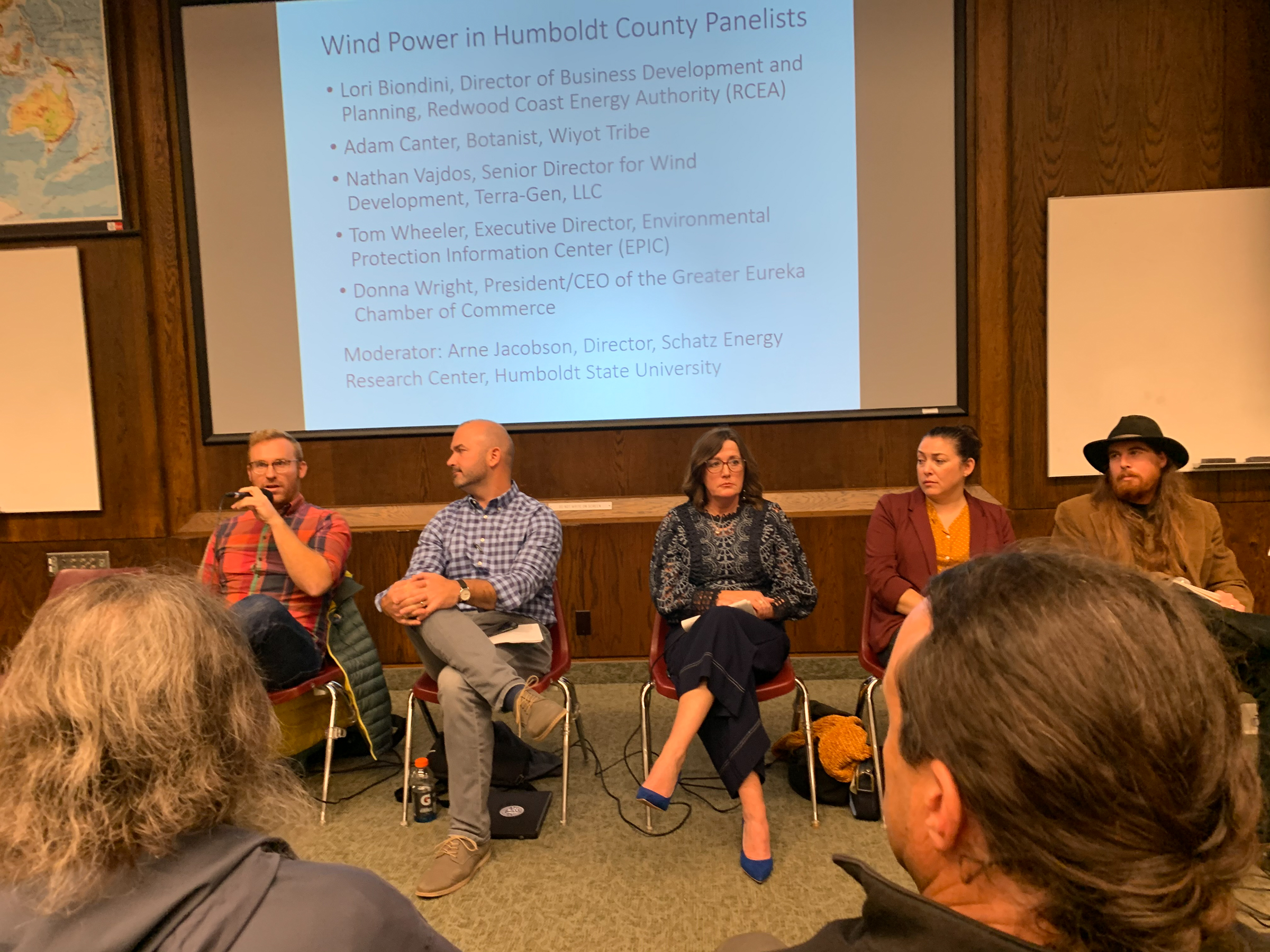
A panel at Humboldt State University’s Sustainable Speakers Series weigh the pros and cons of the Humboldt Wind Energy Project
As the global concern to act against climate change increases, Humboldt County is in a position to capitalize on an opportunity to establish a significant renewable resource.
On Thursday, the Humboldt County Planning Commission votes on the wind energy farm developed by Terra-Gen. Terra-Gen, a Manhattan-based energy company, has proposed a wind farm to be built near Bear River, on Monument Ridge, above the city of Scotia.
The Terra-Gen wind farm carries controversy for numerous reasons. The project will help achieve carbon emission-reduction goals and provide two million dollars in annual tax revenue for the county, but will impact wildlife, forest ecosystems and the Wiyot prayer site Tsakiyuwit.
Arne Jacobson, director for Shatz Energy Research Center, said the proposed turbines will produce about 100 times less CO2 than burning fossil fuels.
“From a climate change perspective, wind looks pretty good,” Jacobson said. “Whatever perspective we have on this particular project, I think one question we should be asking ourselves is what we want to do with that opportunity, because I think it’s there and I think we have the local ethic and the local talent to make that happen.”
Lori Biondini, director of Redwood Coast Energy Authority, said the Terra-Gen wind project could be part of a solution to address RCEA’s goal of 100% renewable electricity in Humboldt County by 2025.
“The Terra-Gen project is part of one scenario to reach our goals,” Biondini. “If it doesn’t get built, then we will come up with another scenario.”
RCEA administers the community choice energy program, a program which allows communities to decide where their electricity comes from. It prioritizes local energy generation and generally more clean energy.
“I think that one of the promises of community choice energy is that we get to make choices that are good to our entire community.” Biondini said. “Not further marginalize those that might not otherwise have had a seat at the table.”
A crowd waits for Sustainable Speakers panel to begin. | Photo by Michael Weber
Adam Canter, a botanist and representative of the Wiyot tribal council, defended the preservation of the land and disapproved of the Terra-Gen project. Canter cites ethnobotanical resources and culturally significant sites as reasons not to move forward with this project.
“When we first heard about this project, there was this big pit that just kind of fell into our stomachs,” Canter said. “We thought when Shell came 10 years ago that no other company would come back and try to build a project here. But we were wrong.”
Canter pointed out the cultural resource report for the site bound in a green, four-inch binder.
“The representation of cultural diversity on this ridge is pretty magnificent,” Canter said. “We’re seeing evidence of Athabaskan peoples and the Wiyot-Algonquin peoples and really it should be listed on the National Register of Historic Places.”
According to Canter, the area is also a high prayer site; a place where a large expanse of Wiyot ancestral territory is visible. Like the turbines obscuring the view, the Wiyot cultural heritage could be obscured too.
Tom Wheeler, director for the Environmental Protection Information Center, said the proposed site is a questionable area to build a wind farm.
“The representation of cultural diversity on this ridge is pretty magnificent. We’re seeing evidence of Athabaskan peoples and the Wiyot-Algonquin peoples and really it should be listed on the National Register of Historic Places.”
Adam Canter
According to guidelines set by the California Energy Commission and the California Department of Fish and Wildlife, the proposed site is “pristine.” Wheeler said the site has several rare and endangered species, including the rare Horay bat.
Wheeler is still hopeful to keep the project, and said there is technology that can reduce some of the wildlife impacts. This, however, is only one mitigation measure to the several unavoidable cultural, environmental and wildlife impacts of the project.
“I want this to be a better project and it’s not there,” Wheeler said. “At least not yet.”
On Thursday, the final vote by Humboldt County’s Planning Commission will weigh impacts to Native American culture and environmental quality to the people’s interest in local, reliable energy.
Aside from the benefit of reducing carbon emissions, allowing Terra-Gen to build the wind farm also comes with an economic and infrastructure benefit.
Senior Director in Wind Development for Terra-Gen Nathan Vajdos said the company would be the second-largest taxpayer in the county, and could fund $14 million to Humboldt’s reliability network upgrades, with $1.3 million to the Humboldt substation.
“As we charge our iPhones, we fill up our cars with gas, we’re having impacts.” Vajdos said. “Whether this project is built or not, we are having an impact in this room.”
Officer John Packer recounts racist remarks from UPD Chief Donn Peterson
In August, nine of 10 University Police Department officers made votes of “no confidence” in Chief Donn Peterson. Now, UPD Sergeant John Packer has released a statement detailing some of the racist remarks made by Peterson to Packer.
In one instance, Packer was in an evaluation meeting with Peterson and UPD Lieutenant Melissa Hanson. Hanson told Packer that she and him weren’t friends and never would be. Packer didn’t know what that had to do with the evaluation, but he agreed.
Then Peterson escalated the situation, according to Packer.
“It went right from the first statement of me saying ‘I agree’ to him saying, ‘You know, John, you’re obligated to work as a slave unto his master,’” Packer said. “’And I’m like, in my head, ‘What the heck?’”
Packer said the next morning, Peterson made another comment to him while walking in the hallway.
“He says to me, ‘Hey John, I can say that because we both read the Bible,’” Packer said. “And now I’m speechless. So now you’re justifying what you said last night?”
John Packer shows his Sergeant’s badge. Packer has been a police officer for 26 years. 16 of which have been with UPD. | Photo by Deija Zavala
Earlier this month, Packer, who is the only African American officer on Peterson’s staff, wrote a statement distributed by the Statewide University Police Association detailing Peterson’s remarks.
However, Packer said before he released his statement, Peterson purposefully moved him to graveyard shift. According to Packer, sergeants have priority pick of shifts, but on Aug. 28 Packer was moved to graveyard under the guise of a Personal Improvement Plan.
Packer told the Lumberjack that the PIP listed two reasons for the shift change: compliance with university procedures and documentation, and maintaining a professional and equitable relationship with all members of the UPD team.
According to Packer, Peterson wrote on the paperwork that he suspected Packer’s “inability to perform” in the first reason was closely tied to the indifference Packer demonstrated in the second.
Packer, an HSU graduate, has lived in Humboldt for nearly 40 years. He served with the Arcata Police Department for 10 years before coming to UPD. He has been with UPD for 16 years.
After serving under seven police chiefs during his 26 years as an officer, Packer said that although he has faced racist comments from people in the workplace and some he has arrested, he has never faced such consistent racism from a superior.
Packer’s statement was released in response to statements made by Peterson in interviews with the North Coast Journal and the Times Standard. According to Packer, Peterson’s claims of misinterpretation of his statements are insulting and do not excuse his actions.
Although he has faced racist comments from people in the workplace and some he has arrested, Packer said he has never faced such consistent racism from a superior.
Packer said six to nine months after the first incident, Peterson, while frustrated, made another comment.
“He said, ‘John, you’re like dealing with the North versus the South,’” Packer said. “And I’m like, okay, I have no idea what you mean by that. I’m not going to get into that.”
Packer wrote that such remarks have only become worse over time.
“Chief Peterson has become more emboldened over the past four years, and moved from making private remarks in our meetings, to demonstrating obvious displays of racism and contempt towards me in whatever audience is available,” Packer wrote.
SUPA’s press release came almost a month after the nearly unanimous vote of no confidence, and Packer’s statement came soon after.
In the statement, UPD Officer Billy Kijsriopas accused Peterson of frequent absenteeism, manipulation of crime statistics and the creation of a hostile work environment that included racial slurs.
The statement also noted that Peterson left his previous job with Florida’s Broward County Sheriff’s Department “amid scandal.”
“Chief Peterson has become more emboldened over the past four years, and moved from making private remarks in our meetings, to demonstrating obvious displays of racism and contempt towards me in whatever audience is available.”
UPD Sergeant John Packer
According to a 2015 article from a Florida news channel, Peterson was involved in a scandal in which multiple department officials used impounded vehicles to avoid toll fees. The Broward Sheriff’s Office was eventually assigned to investigate itself and no arrests appear to have been made.
Peterson denied the recent UPD allegations last month over the phone, but said he supported the investigation as he wanted to strive for transparency.
Peterson declined to comment for this story, and instead referred The Lumberjack to HSU Director of News and Information Aileen Yoo, who then forwarded an email from Vice President for Administration and Finance Douglas Dawes.
In the email, Dawes said HSU has retained the Office of Independent Review, an independent law enforcement firm, to investigate the allegations.
“Out of respect for the process, which could take several months, I have asked Chief Peterson not to comment further until the investigation has concluded,” Dawes said.
SUPA President Jeffrey Solomon said over the phone that it wouldn’t be fair for him to comment on the investigation either, as he called it a local matter. However, Solomon acknowledged what he called “an overwhelming amount of information” that has come forward.
“I have no reason not to believe those officers and their allegations,” Solomon said.
The SUPA Facebook page shared articles from the Times Standard and Lost Coast Outpost on Friday, Nov. 8, about the vote of no confidence and the retention of the OIR.
A Humboldt State University University Police Department vehicle on Nov. 10. UPD Chief Donn Peterson is curently under investigation for the use of racist slurs, frequent absenteeism and the manipulation of crime statistics. | Photo by James Wilde
Despite the events of the last two months, Packer said the UPD office environment does not feel awkward or uncomfortable, as the department already made a vote of no confidence before Packer shared his experiences.
“It’s not awkward right now amongst the officers and dispatchers because we already knew that we had a consensus before I released my statement,” Packer said.
Packer returned to the office, and normal day shifts, after several days off on Nov. 7. It was Packer’s first time since the release of his statement.
Thus far, Packer said no words have been exchanged between him and Peterson.
“I got a nod, and you know, that’s fine,” Packer said. “But no conversations so far. Nothing negative happened.”
Packer said Peterson has always been very professional in public. However, Packer said he has begun to be critiqued through department emails.
“Included in that email will be, you know, ‘We still have divisiveness in the department and you’re still at the center of that and I need you to own the fact that you’re the center of that,’” Packer said.
Packer said Peterson has also berated him to other officers behind his back.
Packer said interviews with the OIR are coming up in a few weeks, and he hopes the investigation will examine and validate the allegations and bring them to HSU.
“They will put together a packet for the University—I assume that will go to the vice president,” Packer said. “These are the things that are inherently prohibiting this police department from functioning professionally.”
Full Statement from Sgt. John Packer:
My name is John Packer and I have served under seven Chiefs during my 26 years as a police officer in this community and currently serve as a sergeant at the University Police Department (UPD). I am the senior police officer in the department and have served under Chief Donn Peterson for approximately five years. I am the only American of African descent serving at University Police Department under Chief Peterson.
I am compelled to share my experiences after reading Chief Peterson’s statements in the October 11, 2019 online issue of the North Coast Journal and the October 14, 2019 online issue of the Times Standard. Chief Peterson claimed that “Anyone who knows me knows I don’t talk politics or religion in a professional setting or during work.”
Chief Peterson’s claim is not true. Chief Peterson claimed that “The racist remarks never happened in the way the officers say.” Chief Peterson’s claim is not true.
I firmly believe that the color of one’s skin, as with all immutable characteristics, is not a predictor of behavior or intelligence or ability, etc. While I have experienced incidents of racism and bigotry during my life, it has been my practice to disregard the ignorance expressed by the person and not carry an angry sentiment with me. I do however clearly remember the times when I have been targeted by racist and bigoted intolerance related to my race and beliefs.
I clearly remember being at a scheduled evaluation meeting with Chief Peterson and Lt Hansen. During that meeting in the Chief’s office, Chief Peterson was extremely upset to the point of using profanity directed at me. The Chief’s frustration and anger stemmed from his opinion that I did not respect Lt Hansen, that I created division at the Department and that I fail as a leader because I am not a “follower.” At the end of the meeting, Lt Hansen stated to me, “We’re not friends and we never will be, admit it.” I agreed with her statement. Chief Peterson followed with, “John you know you’re obligated to work as a slave unto his master.”
At the beginning of my next shift Chief Peterson approached me in the hallway outside the dispatch center and stated, in reference to the slavery comment he made in our meeting, “John I can say that because we both read the Bible.” I was speechless and walked away without responding to the Chief.
Over time Chief Peterson has made additional derogatory statements to me such as, “John you’re like dealing with the North verses the South,” and he excuses himself with follow up statements such as, “I’m just trying to find analogies that work with you.”
Chief Peterson has become more emboldened over the past four years, and moved from making private remarks in our meetings, to demonstrating obvious displays of racism and contempt towards me in whatever audience is available. What once only occurred behind closed doors, has now progressed to belittling statements in department meetings, and to outright derogatory statements at sergeant’s meetings.
Any claim that Chief Peterson’s analogies, historical quotes, nuances or his intent were misinterpreted by me or other officers is insulting and does not excuse the impact or justify Chief Peterson’s actions.
John Packer
Full Statement from Vice President for Administration and Finance Douglas Dawes:
As communicated to the campus community in October, the University has retained the OIR Group (Office of Independent Review) to review the allegations and complaints against Chief Peterson.
The OIR is an independent and respected law enforcement assessment firm. The University has been working with the OIR by providing information the firm needs to conduct a thorough and rigorous investigation. Out of respect for the process, which could take several months, I have asked Chief Peterson not to comment further until the investigation has concluded.
James Lamping, the outreach coordinator at the VETS office and a veteran himself, works to connect veterans by giving them a place to talk, seek therapy and find friends.
“Every vet comes from a different background, and it’s an interesting community,” Lamping said. “Even though there is a lot of diversity between us, we all share a culture tying us together.”
Nov. 11 is the anniversary of the signing of the armistice, which ended World War I. The day honors former and current military service people and is observed as a federal holiday, Veterans Day. HSU students and faculty have the day off.
One way the veterans at HSU connect is through the Outdoor Sports Program facilitated by the VETS office. Year-round, a group of veterans partake in several outdoor sports activities like hiking, kayaking and snowboarding.
James Lamping (left) and John Biggs. | Photo courtesy HSU VETS
John Biggs, a student veteran majoring in marine biology, went on one of the outdoor trips when he moved to Humboldt State in the spring of 2015. He was able to familiarize himself with other students and build relationships.
“We did a big hiking trip up in the Trinities, a rafting trip,” Biggs said. “All the people I met on that trip were my core group of friends when I started here.”
Biggs said that having friends and familiar faces in his classes helps him focus on learning. It had been six years since the last time he took an algebra class.
“I feel like I’m more successful taking classes when I know somebody and have someone to talk to and study with than just myself,” Biggs said. “I’m not someone who asks questions. That’s just my personality.”
Lamping said veterans are one of the more successful populations on campus, partly due to the structured lifestyle that is familiar to military life. Having something to do every day provides a daily purpose.
“Having the structure is nice,” Biggs said. “To have something to do rather than figuring it out on your own.”
The VETS office provides help and academic services for veterans. VETS connected Biggs with the Student Disability Resource Center to help him in the Learning Center.
“I’m not a big test taker, so that was fun,” Biggs said. “That was really helpful.”
Kim Hall, veterans program administrator for HSU, was one of the people who helped Biggs get back into the flow of school. Hall started the outdoors program and also started the North Coast Veterans Stand Down, a three-day event that provides food for homeless veterans at the county fairgrounds in Ferndale.
In celebration, HSU VETS is hosting a dinner event this Friday, Nov. 15 at 6:30 p.m in the Green and Gold Room on HSU’s campus. The Veterans Day Celebration is free for veterans and their families.
Scholarships mark first steps toward tackling enrollment decline
Humboldt State University’s battle against declining enrollment continues.
In the last month, HSU announced three four-year, $1,000-a-year scholarships for local students (‘Humboldt First’), for Fortuna High graduates and for students living on campus.
“‘Humboldt First’ reflects a direct investment in our local service area,” Interim Vice President of Enrollment Management Jason Meriwether said. “As part of our strategy to grow enrollment, we need to dramatically increase the number of students from our local area. In fact, our goal is to triple the number of local students in the next four years.”
The Humboldt First scholarship will be provided to all new HSU students graduating from high schools in Humboldt, Del Norte, Mendocino and Trinity counties. The Dan and Cindy Phillips Fortuna Scholarship will be available to all Fortuna High graduates, even those transferring from the College of the Redwoods. HSU’s scholarship for on-campus residents will be awarded to students as long as they live on campus, up to four years.
All three scholarships begin in Fall 2020.
Meriwether said HSU is in the process of implementing multiple strategies to recruit local students, including educating locals about the programs offered at HSU and introducing ceremonies for Humboldt-area high school students who qualify to attend HSU.
“We sincerely want to compete for students who want to leave Humboldt or don’t want to go to college,” Meriwether said. “So we are working harder to make sure they know that HSU is a real option for them.”
Interim Vice President of Enrollment Jason Meriwether in his office on Oct. 25. Meriwether said the Humboldt First scholarship is one effort among many by HSU to attract more local students. | Photo by James Wilde
Paul Hilton, an HSU political science major, journalism minor and McKinleyville High School graduate, said he liked the sound of the scholarship.
“Contrary to what maybe a lot of people think, there is a want—there is a desire—to go straight to HSU from some of the local schools,” Hilton said.
Hilton went to College of the Redwoods after graduating high school to avoid the higher costs of HSU. Hilton said he probably would’ve gone straight to HSU had the scholarship existed previously.
However, Hilton acknowledged that many local students don’t want to go to HSU regardless of cost.
“I think a lot of it just has to do with opportunities,” Hilton said. “A lot of locals dislike growing up here, and a large part of that is because of a lack of opportunities. But there are a lot of locals, myself included, who love Humboldt but still hate the lack of opportunities.”
After CR, Hilton nearly attended Southern Oregon University, where he thought he saw more certainty in finding a future career path. Yet, in the end, he opted for HSU.
“I came here because of proximity,” Hilton said. “Some people might just call that laziness, but because of the costs and everything I just decided that it would be easiest for me to stay here.”
Hilton attributed HSU’s enrollment decline mainly to a lack of opportunities in the area, but he also noted a lack of support for minorities.
“I think the main common factor between years and semesters has been opportunity in the area,” Hilton said. “But now it’s even more and maybe even a little overlapped by the lack of sense of security for minorities.”
Meriwether said he believes HSU does offer opportunities, but the university doesn’t do enough to let people know they exist.
“I think local students think they know Humboldt, but I don’t think we’ve done the job we need to do of reintroducing them to Humboldt,” Meriwether said.
Eureka High School Principal Jennifer Johnson shared Meriwether’s excitement for the new scholarships. Johnson said she has already seen four to five times the usual number of EHS students going to HSU’s preview day. Johnson said only one EHS student went to HSU in 2018. For context, EHS has 1,230 enrolled students this year.
“We have to also re-recruit our current students. We can’t just take for granted that they’re going to be here. We also have to give them a positive campus experience.”
Jason Meriwether
“We only had one last year,” Johnson said over the phone. “I think it was a real wake-up call for HSU administration when they actually ran the numbers on our school.”
Johnson said local students that want to stay in Humboldt often opt for CR instead of HSU due to the costs—although Johnson said she thinks many students and parents just don’t understand how cheap HSU can be with financial aid.
As for the local students that want to leave Humboldt, Johnson echoed Meriwether by saying that HSU is not like the rest of Humboldt.
“I tell them, ‘Move to Arcata, it’s a whole different world,’” Johnson said.
Meriwether said HSU is currently restructuring its recruitment strategies to include more social media targeting along with more visits to schools. Meriwether also pointed to recent recruitment improvements such as an increase in available tour times and the elimination of tour fees.
Meriwether added that HSU has to not only improve recruitment, but also retention.
“We have to also re-recruit our current students,” Meriwether said. “We can’t just take for granted that they’re going to be here. We also have to give them a positive campus experience.”
Ultimately, Meriwether hopes HSU can begin telling a new story for itself that will attract and retain more students.
“History is important,” Meriwether said. “But we also have to share that there’s a different approach to leadership, there’s a different approach to response and if things happen on campus it’s because we are trying to create a student-first experience. That’s what it’s all about.”
Getting to the bottom of a rumor of an HSU club embezzling money
Student clubs aren’t guilty of embezzling money, but they have misused funds.
A rumor from a recent Humboldt State University clubs meeting said that a student club embezzled money. According to Tay Triggs, the director of the Office of Student Life, that rumor was false.
Triggs said the embezzlement mentioned in the meeting was an illustrative example from another college of how clubs might mishandle money. However, Triggs did acknowledge that some HSU clubs fail to follow proper financial procedures.
Triggs said she has seen students use club funds to pay for necessities, including textbooks, but that she wouldn’t label that as embezzlement. For Triggs, embezzlement is applicable only to long-term, premeditated theft.
“Some clubs can accidentally misuse funds if they didn’t get permission to do something,” Triggs said. “There’s all kind of cash handling rules. If they don’t follow them, that can technically be a misuse of funds.”
Triggs said she tends to take a forgiving stance when a student club is found to have mishandled money.
“When it comes to clubs, I’m more educational than punitive,” Triggs said. “I would rather meet with them and make sure they knew what the policy was—if they didn’t, then I’m going to give them a warning.”
Our students are learning all of this. Managing budgets as if they’re tiny nonprofits—which all of them are—is not easy and so we definitely recognize that, especially understanding that the state is a very bureaucratic system.
Molly Kresl, HSU Clubs and Activities Coordinator
HSU student clubs have seen changes in their financial management in recent years in an effort to comply with the Integrated CSU Administrative Manual for student clubs defined by CSU Executive Order 1068, passed late 2011.
HSU Clubs and Activities Coordinator Molly Kresl said all student club advisors, presidents and treasurers undergo financial management training before handling money. Nevertheless, Kresl said policy violations do happen.
“Mismanagement does occur,” Kresl said. “And sometimes it’s unintentional and sometimes there is mal-intent there. And more often than not that mal-intent is coming from a place of need from an individual, but whatever it is, we have these policies and procedures in place to protect that money, to protect our organizations and to protect our students.”
Kresl said Clubs and Activities promotes proper financial management procedures like the taking of inventory, the use of receipt books and the use of dual-custody, which Kresl elaborated on.
“Dual-custody is important because it ensures accountability that one person’s watching another,” Kresl said. “You’re less likely to mishandle money if there’s someone else there. Also to ensure the safety of the students, so an individual student who’s maybe handling like $100 or $200 dollars, doesn’t get targeted and then potentially attacked—not that I would expect that to happen in our community.”
Kresl said club funds are stored in HSU accounts, so transactions are monitored. A club’s advisor and president, or treasurer, must sign for any withdrawals from the accounts. Clubs and Activities tries to aid student clubs as much as possible to avoid financial mismanagement.
“Our students are learning all of this,” Kresl said. “Managing budgets as if they’re tiny nonprofits—which all of them are—is not easy and so we definitely recognize that, especially understanding that the state is a very bureaucratic system.”
Ryen Cosgro, recreation administration senior and president of the recreation club, said he underwent almost nine hours of training to become a club president. Cosgro agreed that learning to manage a club was difficult.
“There’s kind of a steep learning curve, and that’s something that I could tell the clubs office was trying to provide us resources to avoid,” Cosgro said.
Despite the time and effort Cosgro had to put in, he said he was grateful for the training he received.
“A lot of the educating, I was like, ‘Man, I have to go to a lot of meetings and orientations,’ but coming out of it, okay, I learned a lot,” Cosgro said. “That was very helpful.”
Cosgro had doubts about how anyone at HSU could pull off embezzlement, as he said any large expenses require prior approval.
Ryen Cosgro, recreation administration senior and president of the Humboldt State University recreation club, standing outside the HSU recreation and wellness building on Nov. 1. Cosgro said his only gripe so far as a club president has been a small travel budget. | Photo by James Wilde
“From my point of view, it seems really hard to do that,” Cosgro said. “I don’t really see how you can do that unless you’re making false receipts or something.”
In the event that mishandling does occur, Triggs will typically meet with students, gather information and divide up the responsibility of the mishandling based on what she finds.
If an entire club has benefited from mismanagement, Triggs would likely implement conduct policies upon the whole club.
Otherwise, Associated Dean of Students Roger Wang would oversee conduct procedures for individual students.
Depending on the severity of the mishandling, Triggs said she could put the club on probation or revoke its status as a club. Triggs also said she tries to keep an eye on any mishandling to prevent it from impacting all of Clubs and Activities.
“I’d rather confront and deal with one club to eliminate it happening again than to take the chance of it happening more and more and more and then we get into some kind of trouble,” Triggs said. “I’ve never had an audit finding and I don’t plan on it happening any time soon, because I know they’re not fun to rectify.”
Even for clubs caught mishandling money, both Triggs and Kresl emphasized that they ultimately aim to support and educate students.
“Our goal is ultimately to keep students here whenever we can and to support our students as best as we can,” Kresl said. “The whole reason we exist is as a learning institution and our goal is to help our students learn.”
This website uses cookies to improve your experience. We'll assume you're ok with this, but you can opt-out if you wish. Cookie settingsACCEPT
Privacy & Cookies Policy
Privacy Overview
This website uses cookies to improve your experience while you navigate through the website. Out of these cookies, the cookies that are categorized as necessary are stored on your browser as they are essential for the working of basic functionalities of the website. We also use third-party cookies that help us analyze and understand how you use this website. These cookies will be stored in your browser only with your consent. You also have the option to opt-out of these cookies. But opting out of some of these cookies may have an effect on your browsing experience.
Necessary cookies are absolutely essential for the website to function properly. This category only includes cookies that ensures basic functionalities and security features of the website. These cookies do not store any personal information.
Any cookies that may not be particularly necessary for the website to function and is used specifically to collect user personal data via analytics, ads, other embedded contents are termed as non-necessary cookies. It is mandatory to procure user consent prior to running these cookies on your website.