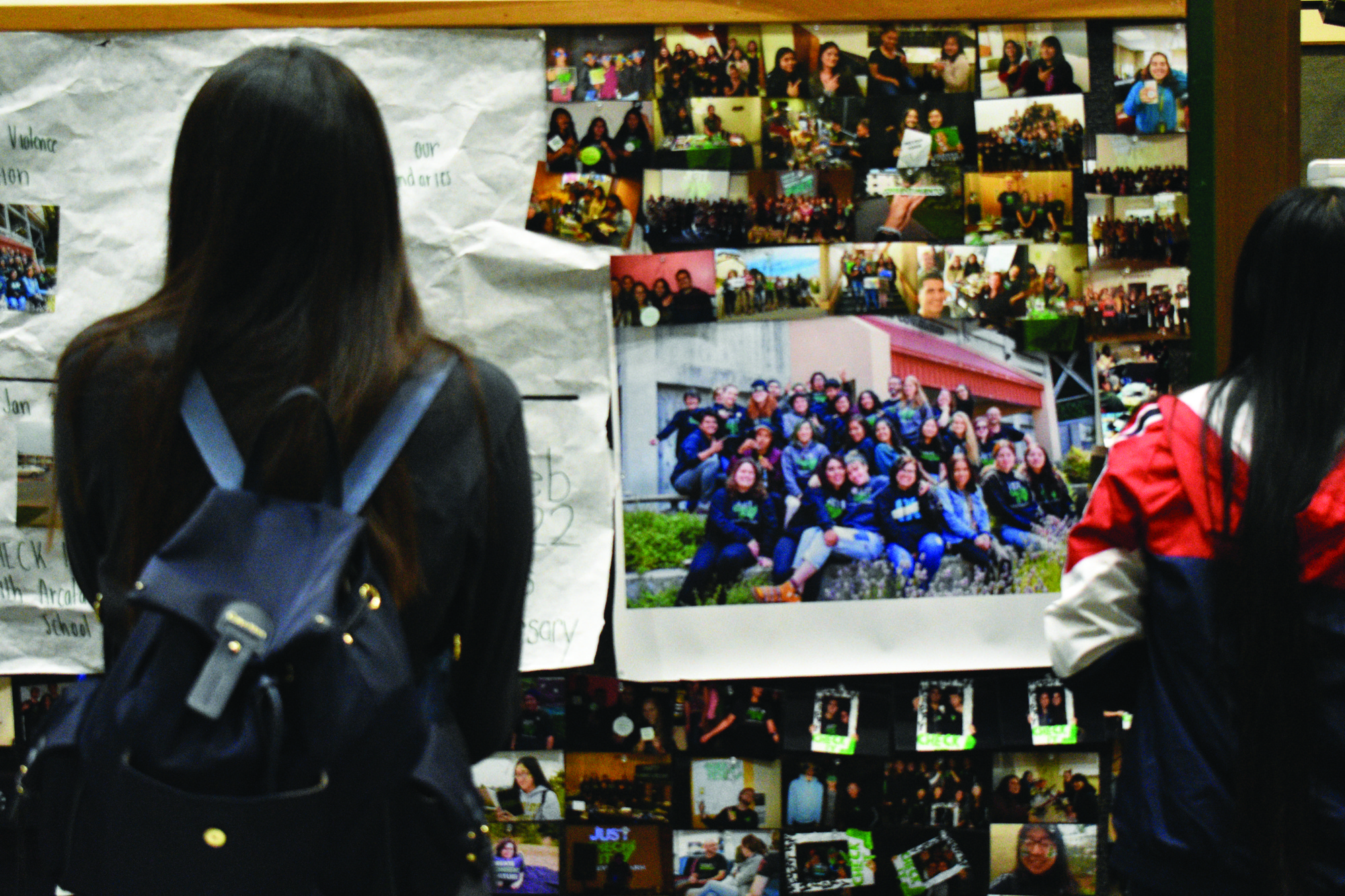
More than 300 HSU students crowded into the Kate Buchanan room to celebrate the fifth anniversary of Check It. For three hours, the Check It party raged on, filled with good food, karaoke fun and positive protecting vibes.
Photo courtesy from Check It
Check It’s head coordinator Mary Sue Savage took the stage early to congratulate the progress made by the organization in its five years of activity. As a HSU alumna herself, Savage has followed not only Check It’s progression, but HSU’s and the community’s as a whole.
“When I was a student, a very small percentage of folks were involved in violence prevention work, it was really just a solid group of social justice activists,” Savage said. “But we weren’t reaching the people we needed to reach or engaging them. But with Check It, I can see how possible it is to engage everyone on campus in violence prevention work.”
Photo courtesy from Check It
As co-founder to Check It, tonight’s celebration meant many things to Savage, as she stood in front of more than 300 supporters of the Check It movement.
“Tonight celebrates the incredible community support and compassion that makes up this movement,” Savage said. “It’s honoring the amazing consent centered activities students have been doing on campus and just celebrating how much progress has been made over the past five years!”
Volunteer students participate in the Karaoke showdown. Singing to Bruno Mars's song "Count on Me". Feb. 23. Photo by: Grace Caswell
With two hours of karaoke, the room filled with performances from student and staff hand-picked classics. Shelby Gilfuss, a second year psychology major, was one among the 300 plus who attended the Check It’s party in support.
“I came to support my friend on the Check It team,” Gilfuss said. “I also enjoy the idea of a safe community and have met so many new people, people I would never have had a conversation with before.”
With free food, hilarious entertainment, and Check It merch, it wasn’t just the guests having a great time. Shelley Magallanesa, a third year psychology major and Check It team member shared her personal relationship to Check It.
“It’s the best,” Magallanesa said. “I spend all my time here and have a lot of fun. People are so devoted to growing the cause and working hard every day. We’ve had so much success and that makes me feel so good!”
Photo courtesy Check It
Back in October, Check It gained the attention of the U.S. Justice Department, which resulted in a $300,000 grant. With new funding, the future of Check It looks bright and promising. Plans to expand and spread the movement, along with upgrade the organizational outreach, displays a promising future for violence prevention.
“This semester we are working with Arcata High School to launch Check It,” Savage said. “We’re also getting ready to launch our “Love Knows Boundaries” campaign later on this semester with specialized access cards. We really just want to continue to embed Check It within our campus culture.”
Members of the Check Item posing for their fifth anniversary. | Photo courtsey of Check It
The first 5 years of Check It can be summarized into a success, with an established office space, tons of students activist volunteers, and a new grant allowing upgraded target outreach. The next 5 years show signs of a promising future to the prevention of violence and the Check It organization as a whole.
Afrocentric yoga that teaches that movements have purpose
Most people think that yoga comes from Asia. Kemetic yoga, however, is one of the original practices of yoga. It originates from ancient Egypt, the proper name being Kemet. What differentiates Kemetic yoga from other types is that it’s a series of geometric postures, almost like there’s math in every movement.
Humboldt State had a Kemetic yoga class taught by Dionna Fletcher as part of Black History Month. This was Fletcher’s first time directing a Kemetic yoga class after completing her training in Jamaica last month.
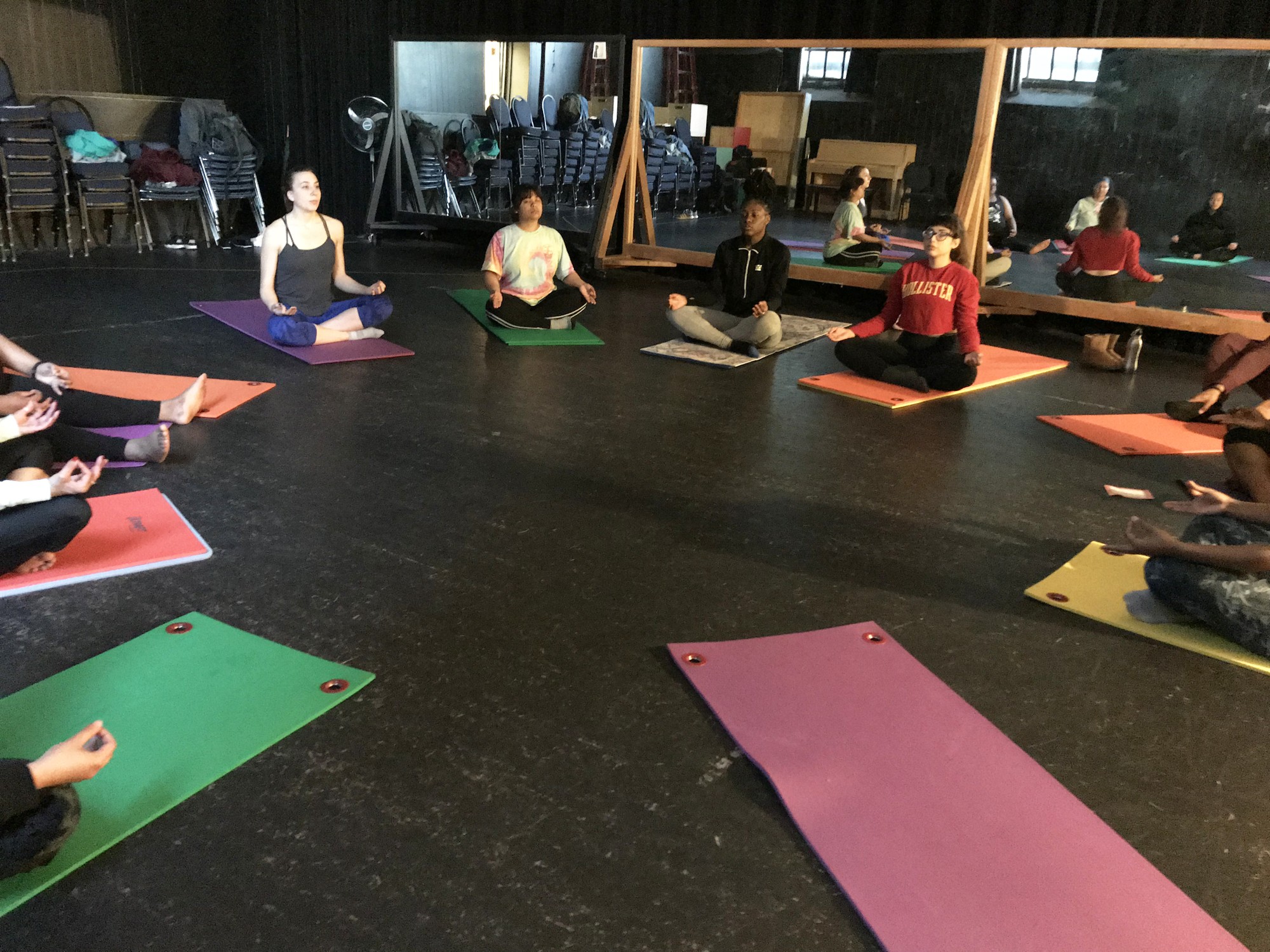
We sat in a circle as she directed us through each posture. All were welcome, and students trickled in and joined the circle. Kemetic yoga has a breathing pattern to implement purposeful breathing: inhale, pause, exhale, pause. Each of the movements were done three times, following the geometric theme of the activity. Many of the names of the poses were slightly different from what we’re used to hearing. For example, the normal sitting pose is called ‘sesh.’
“It’s a black practice that needs to be spread,” Fletcher said. “It offers something to the POC community that Asian or Indian yoga does not.”
Dionna Fletcher directed the class through movement and breathing techniques. | Photo by Silvia Alfonso
Fletcher has been part of a series of fitness sessions going on around campus and town. The series was compiled by Chryste Johnson, interim coordinator for the African American Center of Excellence (AACE). Johnson named the series Soul Fitness as a way of representing people of color during Black History month, and intended to bring in new forms of movement that people haven’t heard of.
[perfectpullquote align=”right” bordertop=”false” cite=”Dionna Fletcher” link=”” color=”” class=”” size=”17″]“It’s a black practice that needs to be spread. It offers something to the POC community that Asian or Indian yoga does not.”[/perfectpullquote]
It is a three-week compilation of different forms of movement. Johnson explained that there’s been hip-hop cardio, there will be a steppin’ class and it’s the same series that made Love Ya’ Self Queen.
HSU student DiOria Woods was one of the students who attended the series.
“I’m a dancer, I’ve never heard of this kind of yoga and I like to try new things,” Woods said. “I’m part of the culture center and I wanted to actually interact with these kinds of events.”
Though it was a small class, it was a relaxing thing to get into after the stress of the day. Fletcher made everyone feel welcomed and comfortable. Even at the intermediate level the people in the class felt comfortable to do the poses no matter how hard it seemed.
Students sat back on their heels, ready for the next movement. | Photo by Silvia Alfonso
Nicole Lamperti was another student that joined in on the Kemetic yoga class.
“I’m in a world cultures class and was curious about this kind of yoga,”Lamperti said.
The lights were off, letting the natural light come in from the sun setting through the windows. This created a more relaxed feel to the class. In the background, Fletcher played music by people of color, supporting the idea of loving yourself and putting yourself first.
Kemetic yoga brings a new form of movement to a common type of activity. Yoga is done all over the world but can be done in different forms. Kemetic yoga reminds us to be purposeful in our movements and reminds us about the different places we come from.
This past week had some serious crime. Someone was caught with a “weapon” while selling weed and a “casing” was found on the soccer field Sunday morning. Someone tried to fight somebody in the library and there may or may not be meth in the water. This week saw some contraband confiscations in the Jolly Giant Commons and a suspicious baby. Check it out!
The Rolling Count:
Possession charges = 5
Contraband/paraphernalia seizures = 4
Blotter bytes
Monday Feb. 18
· BIKERS, YA GOTTA STOP —Five bicyclists were stopped and warned for blowing through stop signs.
· Good guy alert x5—UPD helped five people with jumpstarts. They are here to serve and protect, that’s for sure.
· Suspicious baby—There was a report of a man “[wandering] aimlessly, perhaps lost” with a small child. Must have been a sketchy looking baby.
· A problem worth addressing—UPD warned a “male non-student” for camping on campus. The housing problem here is ridiculous and needs to be addressed. City council meetings are every first and third Wednesday at 6 p.m. Show up and demand change.
Tuesday Feb. 19
· DRUG ACTIVITY—Someone in the Jolly Giant mailroom got their piece seized. Bummer bruh, keep that shish on the D.L. next time.
· GUNS AND DRUGS—Someone was arrested for “possession of a weapon on campus,” and for selling weed around the Rossow and Harpst Street area. That’s some real crime.
· Smokin’ ciggies—Someone was busted smoking in the art quad. Smoking on campus anywhere is against the university tobacco policy. Head off campus or just start chewin’ ‘tabacka’. Dip spit is sexy in some parts of America.
· Good guy alert x4—UPD helped with two jumpstarts, locked car doors and a late-night escort. Thanks fellas!
Wednesday Feb. 20
· I hope you’re alright—“The welfare of a student was checked at the request of faculty.” It is that time of the year when the sun leaves and the clouds drop their emotions upon us in the form of rain. If you’re experiencing tough times and need someone to talk to, check out the mental health services at the Student Health Center.
· That’s gonna hurt—Someone twisted their ankle near the Campus Apartments and requested medical aid. Best wishes for a speedy recovery pal.
· Good guy alert x5—Man UPD has been crushing it this week with helping people out. Two jumpstarts and three late-night escorts!
Thursday Feb. 21
· Fight club—“Second hand information of a fight on the third floor” of the library. This weather is really getting to people. The library is for studying, not fighting.
· That is NOT your spot—Someone parked in a handicap spot without a placard near Redwood Hall. The driver was warned and let go without a ticket. I know parking is tight on campus but youshould not park in a handicap spot!!
· “Any type of contraband”—This just sounds cool. Talk about a cool band name, right?!?! Actually, what happened was some RA requested a pick up of “confiscated marijuana” and UPD collected it “for destruction.” I wonder if the cops smoke weed? Hmm, maybe I should follow this up for a story…
Friday Feb. 22
· Grand theft bicycle—There was a report of a stolen bike near B Street. It is a bummer that it was stolen, but at least it is one less person blowing through stop signs, right?
· “Vehicle investigation”—“Subjects parked and walked down to the duck pond.” That’s literally word for word what the report says. WTF happened? Did they kill a duck? Smoke some weed? Partake in some deviant acts? You’re leaving us hanging here UPD!!
· There’s meth in the water!!—Someone called 911 and reported that they were having a heart attack because “someone put meth in his water.” I’ve never done meth before, but I don’t think that is how it works. I could be wrong. The guy survived the night and doctors told him that there was no meth in his water.
Saturday Feb. 23
· It’s two in the morning… go home—At 2:38 a.m., two people went into a room in Nelson Hall East, “closed the doors and shut off the lights.” “They lit candles and started summoning demons,” officer Joe Schmoe said. “It was dope as hell.”
Sunday Feb. 24
· Suspicious circumstances—A casing was found on the soccer field by a coach around 11 in the morning. What the eff?
· They can track you—Someone called 911 and when the operators called back they just hung up, multiple times. So, they used the cell towers to locate the phone. Creepyyyy.
Everyday ailments and problems often have herbal alternatives
Plants and herbs have been used for centuries to treat different ailments. With big pharmaceutical companies handing opioids out like candy, many are turning to alternative treatments for different problems.
Sophia Laverdiere is a local herbologist at Moonrise Herbs in Arcata. Laverdiere received her education at The Southwest institute of Healing Art in Phoenix, Arizona, she has extensive knowledge of over 140 plants.
“Before pharmaceuticals how did humans survive?” Laverdiere said. “We have all these plants that do everything we need.”
Sophia Laverdiere is a local herbologist at Moonrise Herbs in Arcata. | Photo by Maia Wood
She described what the term ‘disease’ means in her line of work.
“Disease literally is dis-ease in your body,” Laverdiere said.
When you have health problems, that means your body is not in balance with the environment around you.
Pharmaceutical drugs and medicine are often derived from plants. Scientists isolate the chemicals in plants that help treat ailments in humans, so going to plants to treat illness is not so far off. Using the whole plant, instead of part, can provide benefits for illness and disease. Before going to a pill, try some of these herbal alternatives.
Asthma
Mullin:
· Description: “Leaves look like lungs”
· Use: Soothes the bronchioles
· Origination: Used by the Native Americans
· How to Consume: Tincture
Local Organic Honey and Pollen:
· Use/ Benefits: For asthma and allergies
· Builds immune system by exposing you to local allergens
· How to Consume: Eat a spoonful
Anxiety & Stress
Ashwaghanda:
· Use/ Benefits: Sleep and pain
· Origination: Chinese herb, means “strength of a horse.” The medicine comes from the root of the plant.
· Lowers your cortisol levels, which get overloaded during stress.
· How to Consume: Tincture
Holy Basil:
· Use/Benefits: For extreme and severe anxiety and panic attacks.
· Origination: India, used in almost every home in India. Considered to be a sacred plant. The whole plant is used for medicine.
· Lowers your blood pressure and eases your heart muscles.
· How to Consume: Tea and tincture. You can just pick the leaves of the plant to consume.
Oats/Oatmeal:
· Use/ Benefits: Natural nervous system relaxant because there are some many vitamins and nutrients in oatmeal. These factors come together to create a natural calming effect in your body.
· Cheap and accessible at most grocery stores.
· “Food Medicine”
Insomnia
Rubious (Rhobilea, Rosea) In the Rose family:
· Uses/Benefits: This herb gives you a natural boost of energy and vitality.
· Calms down the central nervous system. Helps increase the moods in your brain
· How to Consume: Tea or tincture. A little goes a long way.
Passion Flower/ Passion Fruit:
· Uses/Benefits: When you wake up at any time at night
· Works to help reset the brain cycles
· How to Consume: Eat before bed
California Poppy:
· Uses/ Benefits: For deep sleep and to stay asleep
· Hypnotic herb which means to induce sleep
· How to Consume: Tea or tincture
· Uses the whole plant for medicine
Next time, before you reach for something in your medicine cabinet, pick up a whole plant or herb instead.
“Plants are here to help us, instead of just taking a pill derived from plants. Go the source and use the whole plant,” Laviedere said.
Sociology peer mentors shine with Youth Educational Services and help students
News editor, T. William Wallin sat down with Ashleigh DeFraga and Belen Gutierrez during separate interviews for a Q&A.
DeFraga and Gutierrez are seniors in the criminology and justice studies program at HSU. They are peer mentors for the sociology department and can usually be seen helping out a student in the business of social sciences building. They volunteer with YES and are very involved with the community. They both are pursuing law degrees and want to become lawyers after graduation.
WHAT ARE YOU STUDYING AT HSU?
DeFraga: I am studying Criminology and Justice studies major, with a double minor in psychology and Philosophy
Gutierrez: Criminology and Justice studies with the minor in comparative ethnic studies
WHY DID YOU PICK THE MAJOR AND DOUBLE MINORS?
DeFraga: I love all aspects of the criminal justice system. Our school has a unique program and since day one I knew I wanted to be a lawyer. I chose psychology because I am interested in how the brain works. I am minoring in the philosophy of ethics, which we talk a lot about ethical dilemmas that get brought up in criminal justice such as rape, or voluntary suicide. Taking philosophy will help me with questions that will be on the bar exam and the LSAT.
Gutierrez: I interned at a law firm in high school and I knew I wanted to do law when I graduated but I didn’t want to do the traditional political science. Not that there’s anything wrong with that but I was more interested in the criminal justice aspect of it. I started learning about intersexuality in high school and that drew me in having a minor in comparative ethnic studies.
WHERE DID YOU MOVE FROM?
DeFraga: I came from Sacramento. I came straight from high school and enrolled at HSU in August of 2016. I have been taking 20-22 units each semester to graduate sooner because I don’t get financial aid. I did get some scholarships but I wanted to get done as fast as possible.
Gutierrez: Orange County, Santa Ana, in particular, Southern California. I came straight from high school. I graduated in 2015.
HOW DO YOU JUGGLE THE WORKLOAD AND VOLUNTEER WORK YOU DO?
DeFraga: I go day by day. You can’t go each day and think past that because then it’ll be overwhelming. I have a google calendar, a wall calendar and a million sticky notes everywhere. I’m really organized.
Gutierrez: My mom is really good with time-management and I really just inherited her skills a little bit. I really try to think about what I’m taking on and how that is going to fit in with my schedule. I know my limits and I try to stick to them. But google calendar and a planner is your friend.
WHAT’S THE PLAN AFTER YOU GRADUATE?
DeFraga: Straight to Law School. I’m going to go to Pepperdine in LA. It’s a private school with lots of scholarships and I love the area its in. It’s smaller than Harvard and I think it’s best for me to thrive.
Gutierrez: I’m taking a year off and then going to law school. My top schools right now are Berkeley and I got a full-time offer for Chapman Law. I’m debating that because I want to go to the bay so I’m not sure if I’m willing to relocate to So-Cal but we’ll see. Berkeley is number 1. They have a Ph.D. program on social well-being so you can do a program to get your Ph.D. in social justice and also your law degree which is what I’m really interested in doing.
WHAT ARE YOU MOST PASSIONATE ABOUT?
DeFraga: I am most passionate about juvenile kids. They need help, it’s not their fault when they get in trouble. I want to make a difference in the juvenile justice system. Kids are important and not enough people are making an effort with them.
Gutierrez: I think definitely collaborating with communities that are oppressed and striving for social justice.
WHAT HAS BEEN YOUR FAVORITE EXPERIENCE IN HUMBOLDT?
DeFraga: My favorite experience is all in all the environment. I think the environment has shaped every aspect of my experience. Everyone is super genuine. The JRVP program has been one of my favorite experience up here.
Gutierrez: Definitely volunteering with YES. I started volunteering as a freshman through the step-up program which is HSU’s alternative spring break. That’s where we went to San Francisco to volunteer for spring break, and then when I was a sophomore I directed the program myself and planned the Sacramento trip. My junior trip I applied to be one of the five paid staff positions and I got it. This year I applied to be the lead program consultant and I love it. I love YES and I think if it weren’t for YES I would have transferred out of HSU because it’s so isolated. I think finding a community is really important and I found it at YES. That has definitely been my favorite part so far at HSU.
WHAT ADVICE DO YOU HAVE FOR INCOMING STUDENTS?
DeFraga: Be brave. Don’t be afraid to ask questions. Don’t be scared to not know something, just ask and be comfortable in your own skin.
Gutierrez: Definitely, get involved. Maybe not your first semester if you want to get a taste of college and what classes are like as a full-time student and how you fit in because that’s the time to dip in your toes and see what you want to be involved with.
WHO IS YOUR FAVORITE PROFESSOR AT HSU?
DeFraga: Michihiro Clark Sugata.
Gutierrez: Wow, I’ve had so many. I think so far it’s been Nancy Perez. She just got hired through the CRGS department and I took Chicana/Latinx with her last semester. I really like the structure of the class and how she gave us assignments I never had before and so she was really relaxed with what we could do. One of the assignments was to write a children’s book and what stood out for me was to write a children’s book that you wish you had when growing up. I really liked it and I wrote a book about my experiences growing with a message I would have liked to see growing up. That really stood out for me and that has made her one of my favorite professors. She really thinks outside the box and giving us assignments that were challenging because you think you can write a children’s book no problem but really it’s a lot more than that. It’s a lot deeper than that and there’s a lot of thinking that goes into it like ‘how can I put a message into it in a way that a 5-year-old or whoever is reading it will understand it.’ That’s why she’s my favorite professor.
HOW LONG HAVE YOU WORKED WITH THE JUVENILE CENTER AND WHAT IS IT LIKE? WHAT HAVE YOU GAINED MOST WITH WORKING THERE?
DeFraga: It’s pretty awesome getting to go into the Juvenile hall and work with the kids there. They are honestly just normal kids we have just labeled them as bad or delinquent! I think that the best part is being able to see that they are just kids, not criminals! To be able to just hang out with them and show them a positive example is a small way in which each and every one of us can help them. I’ve been working with them since my freshman year! It also makes you feel like your life isn’t so bad in retrospective to theirs. Putting yourself in their shoes and looking at the intersectionality that goes along with it!
WHAT IS WORKING AT YES LIKE?
Gutierrez: It’s really rewarding in several aspects. It’s not just going out into the community that’s rewarding, it’s also all the skills I have learned that I didn’t even know I had, such as facilitating meetings and learning people’s first language and how there’s a savior complex when volunteering and how YES is striving more towards collaborating with communities instead of really just going in and serving them. It’s more like we’re here if you need us and what is it you would like from us instead of going in and being like we’re here to do this for you. So I think that’s what I really fell in love with YES, there really striving to make those changes.
Accomplished track star, Romel Robinson, is a triple-threat
As a starting sprinter for HSU’s track team, and recipient to over a hundred awarded medals, Romel Robinson, is familiar with identifying himself as a runner. However, beyond the many medals, is a self-taught gymnast and break-dancer.
“I taught myself [to tumble] in middle school,” Robinson said. “My friend knew how to back flip and tried to teach me, we were just messing around.”
Finding a new interest in the gymnastics world, Robinson continued to teach himself new tumbling tricks.
“My favorite is a double back flip,” Robinson said. “It’s a work in progress, I don’t have the right equipment to perform it without hurting myself.”
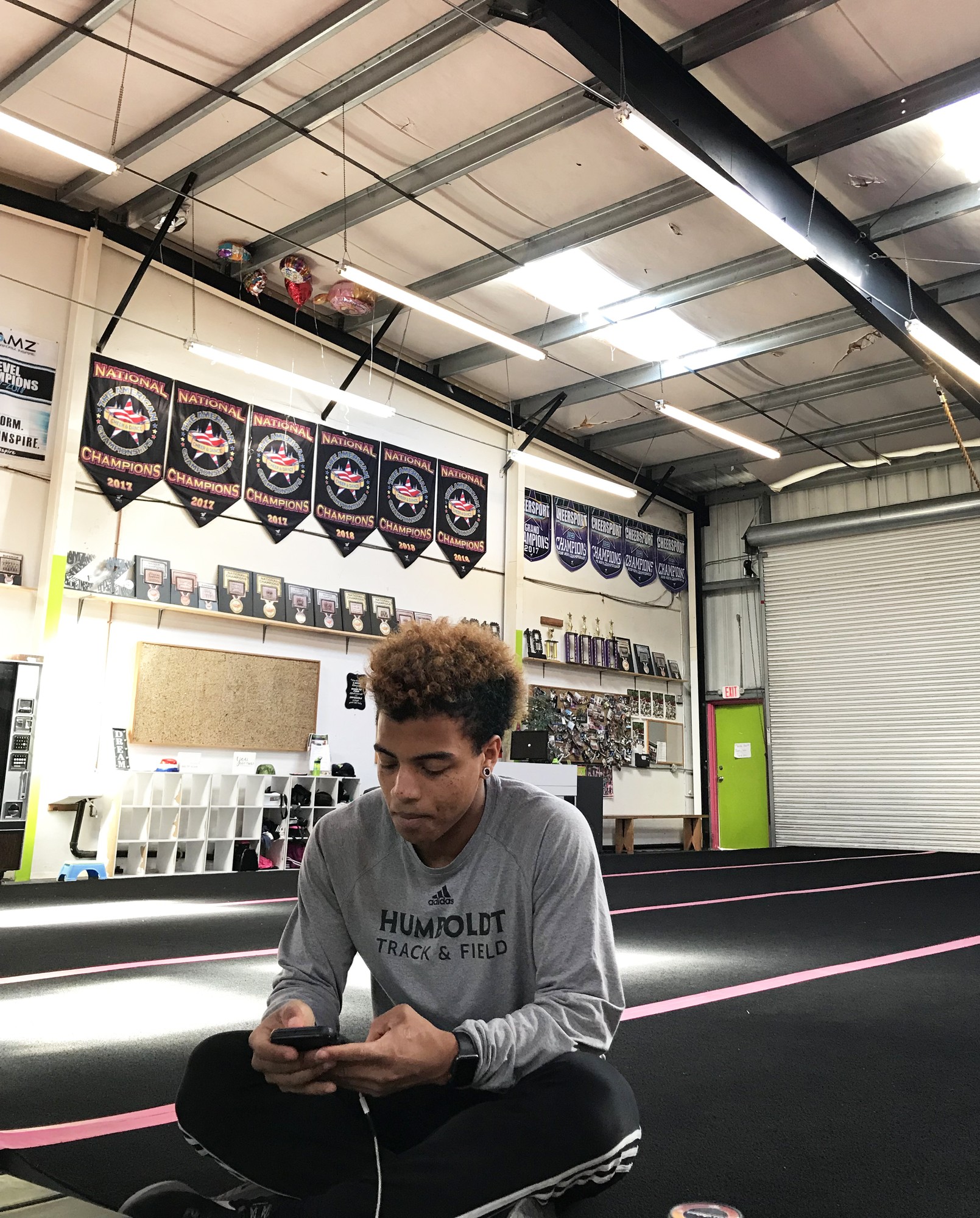
The right side of the Dream Athletics gym is painted with bright, neon colors and lines of championship banners. Feb. 18. | Photo by Grace Caswell
Robinson is extremely careful when practicing tumbling, as he’s already out for the season with two pulled hamstrings.
“It’s a lot of strain, very similar to running,” Robinson said. “You tumble until your body can’t, which is about an hour, to an hour and a half in. After that, you’re sloppy and too weak.”
While finding a commonality between the physical excursions of tumbling and track, Robinson views the two sports very differently.
“Tumbling is just for fun,” Robinson said. “I got pushed into track, it’s more competitive, and I take it seriously. It’s a lifestyle.”
Fellow teammate, roommate, and competitor, Stefan John, supports Robinson both on and off the track.
“We’re straight up family, we gel,” John said. “We have a lot in common, and run the same events. He wants my stride and I want his quickness! We’re great friends and competitors.”
Stefan John, HSU track athlete poses in the library post interview. Feb. 19. | Photo by Grace Caswell
With athletic support, Robinson pursues an environmental engineering major as a first generation college student. Idolizing his first engineering professor, Sintana Vergara, Robinson refers to her as his “Humboldt Mom”.
“She’s always been there to help,” Robinson said. “She helped me through starvation freshman year, buying me groceries. She’s constantly encouraging me in and out of the classroom.”
Sintana Vergara shares a very similar attitude toward Robinson. Vergara said that Robinson was the first student she met at HSU.
“It was a very friendly start,” Vergara said. “I remember he casually mentioned eating one meal a day, it broke my heart, I wanted to advocate for him. It was crazy and exceptionally frustrating. He’s such an amazing athlete and student, full of potential.”
Robinson pursues a masters and doctorate degree, with a goal of becoming the first doctor in his family. Vergara fully supports and believes in Robinson’s dream.
[perfectpullquote align=”left” bordertop=”false” cite=”Romel Robinson” link=”” color=”” class=”” size=”17″]“I grew up in a difficult area. I remember we didn’t always have food and my mom was working multiple jobs. She’s my biggest inspiration and is totally killing it now…”[/perfectpullquote]
“There’s no doubt he can do it,” Vergara said. “Everyone struggles regardless, no matter who you are. It’s a tough major, but, he will be successful.”
Focused on following a strict plan for the next ten years of his life, Robinson has an interesting goal for his more distant future.
“After getting my masters and doctorate degree, I want to change my name,” Robinson said. “Romel Fresh Robinson, so when I’m a professor, I can be called Dr. Fresh or Professor Fresh.”
Coming from the tough area of Visalia, California Robinson emphasizes opportunity and dedication.
“I grew up in a difficult area,” Robinson said. “I remember we didn’t always have food and my mom was working multiple jobs. She’s my biggest inspiration and is totally killing it now, doing accounting at a firm.”
Watching a powerful and successful transition in his family, encourages Robinson to achieve and accomplish more.
“My mom taught me everything I know,” Robison said. “She helps me with whatever I need, even if she doesn’t know how, she’s my favorite.”
With serious goals and aspirations for the future, track becomes nearly invisible on the long list of objectives. However, it gave Robinson an opportunity in the first place, and will remain his life indefinitely.
“I like running, it’s something I will always do, until I die!” Robinson said. “I mean, it got me here.”
Black Humboldt hosted a self love workshop on Feb. 16
Black Humboldt founders Dionna Fletcher and Mo Desir provided a safe space for women of color to join and have fun with each other. “Love Ya’ Self Queen” was an event that allowed guests to enjoy themselves as they took part in yoga practices, dancing lessons, hair care tips, essential oils, music and laughs Saturday night, Feb. 16.
Sangria, chocolate and other treats displayed on a table for guests to have. Feb.16. | Photo by Skylar Gaven.
The night started off with a short yoga practice instructed by Fletcher. Yoga mats were placed in a small circle, inviting all the guests to come together and share the space. Fletcher is an instructor-in-training, with a focus in teaching Afrocentric-based yoga. She led the session beautifully; taking deep breaths and loosening up the muscles proved to be an excellent way to begin the event.
After relaxed guests finished one more deep breath, a workshop with essential oils was next on the list. The air quickly smelled of citrus and peppermint as Rosemary Grady, longtime friend of both Fletcher and Desir, shared the benefits of natural medicines and oils in a short workshop. Grady has had an interest in essential oils for a while. After discovering what different smells can do to a person’s sensory memory, she dove in deeper with her research.
Essential oils scattered around the room for all guests to see and smell the different scents. Feb. 16. | Photo by Skylar Gaven.
Grady said citrus reminds her of the times she would visit the orange trees with her family in Riverside. She also mentioned that lavender has helped her many times with anxiety and stress. Natural resources also help benefit your health, instead of using products that contain harmful chemicals that can affect your body.
Rosemary Grady leading a workshop with essential oils and other natural medicines. Feb. 16. | Photo by Skylar Gaven.
Later, after a choreographed dance lesson uplifted the room with many smiles, Desir and Fletcher shared helpful tips for those struggling with different hair types such as thick, curly hair. As participants created hair masks, they suggested using coconut oil in your hair last rather than first, because it blocks out other products from entering your hair, and, for curls, it’s best to wash it once a week to prevent it from getting dry and brittle.
Desir presented an easy recipe for a hair mask consisting of Mayonnaise (vegan mayonnaise is an option), honey, extra virgin olive oil and coconut oil. An avocado or banana can be added to make it thicker. Everybody was given a sample to use at home along with a homemade sugar scrub.
Ingredients being used to create a homemade hair mask. Feb. 16. | Photo by Skylar Gaven.
After that, the circle opened up about their experiences with their hair and other difficulties that they’ve gone through being women of color.
“I straightened my hair for a really long time throughout middle school and high school,” Grady said. “It wasn’t until I went to college… it was actually black women telling me what to use for my hair; it wasn’t until I lived in that environment where I was supported by women of color, I started to embrace myself and love myself a lot more.”
With an entire county that lacks in diversity, Fletcher and Desir wanted to establish reliable and entertaining spaces for people of color to express themselves without having to feel restricted because of an uncomfortable or unfamiliar environment.
“Every month we try to find new themes and innovative ways to be together,” Fletcher said.
Body High Pole Dance studio sign. “Love Ya’ Self Queen” was held at a POC local owned business. Feb. 16. | Photo by Skylar Gaven.
Black Humboldt normally holds events in black-owned businesses, to promote and give the black community a variety of places to visit and so people of color can explore new spaces and find more diversity in this county. “Love Ya’ Self Queen” was held at the Body High Pole Dance Studio, owned by Naomi Leitu and Natalie Abeja, both women of color.
“We specifically chose this space because it is black-owned,” Fletcher said.
Desir said that they hold events in black-owned businesses to support and display a positive place for people of color to attend.
“This is a POC owned facility,” Desir said. “I think a big emphasis we are trying to do is to create that safe space.”
Mo Desir and other women taking a break in between workshops. Feb. 16. | Photo by Skylar Gaven.
Fletcher and Desir both knew that having a group that works toward building a strong black community in a largely white population would be great for Humboldt. They want to share inviting environments as well as values and support for local people of color.
“We are hoping to create a strong black community, create black economic empowerment for black businesses the most that we can,” Desir said.
Look for more events from Black Humboldt by checking out their official website.
Cellular and molecular biology major, Tanae Nichols, shows other black girls, anything is possible
Sacramento California native, Tanae Nichols has a plan to prove to other black girls, anything is possible. Nichols is a third year at Humboldt State and is studying cellular molecular biology.
“Dealing with genetics on a molecular level, I’m able to break down how things work and function on the most basic level,” Nichols said.
Cellular molecular biology major, Tanae Nichols sits behind Bret Hart house on Feb. 19. | Photo by Dajonea Robinson
Nichols takes this goal and brings it to life with her hands-on work as a caregiver. Growing up she had many family members with disabilities and was inspired to find out how she could help. Her love for knowledge and caring for others is what drew her to work in the field. She was also interested in internal medicine dealing with black people.
“I wanted to learn more on a developmental level, I can fix things in the body,” Nichols said.
When a Humboldt State recruiter came to her advanced placement class in high school, she became drawn to the beautiful location and the sense of community. These factors are what pushed her to attend school here.
“I’ve always been into hiking, camping and just being an outdoors girl,” Nichols said. “I am an adventurer.”
HSU student Tanae Nichols | Photo by Dajonea Robinson
Nichols moved to Humboldt straight out of high school. She came with intentions to join the pre-med program. She also enjoyed how the school pushed a biology centered curriculum. She tried many different majors before finding a fit.
“I changed my major from general biology to environmental biology to psychology and then back to pre-med,” Nichols said.
[perfectpullquote align=”right” bordertop=”false” cite=”Tanae Nichols” link=”” color=”” class=”” size=””]”Continue your studies and trust in your dreams.”[/perfectpullquote]
Being the first person to go to college in her family, and a black woman in science, she has felt the pressure to succeed.
“I have professors that really believe in me and tell me ‘Don’t let anyone tell you, you can’t do it,’” Nichols said.
She takes this advice and strives forward to be a positive role model for her family back home.
With three brothers and four sisters, Nichols finds herself in the middle. Raised by two hard working parents who did not go to college, education was always important.
“My parents made sure I was put into schools that were college oriented,” Nichols said.
The charter school she attended really promoted children of color to go to college.
HSU student Tanae Nichols | Photo by Dajonea Robinson
She is involved with the Humboldt State’s club/sisterhood, The Legacy. This group of women aim to be a home away from home for all women and a platform to connect with the Humboldt community. They do different community service events like canned food drives, beach clean-ups and mentoring girls. Nichols believes it is important to be involved with the community to be an effective doctor.
“When going into medicine, you have to learn the community you are serving,” Nichols said.
Nichols has about two more years to go until graduation. Her next steps after college are to go to medical school, do a two-year residency and eventually become a doctor. Nichols encourages other young black girls who aspire to go into the science field.
“Continue your studies and trust in your dreams,” Nichols said.
Alright, alright, this week had some activity! No one was charged—which is dope. However, some folks got in trouble…metaphorically speaking. Or maybe not; the report is ambiguous. Hemlock, Alder, Tan Oak and even the parking lot at Forbes Gym all saw some action.
Possession charges = 4
Contraband/paraphernalia seizures = 2
Monday Feb. 11
· Mental health awareness—The past week had a number of welfare checks, which are enacted if someone is concerned about another’s wellbeing. With that said, if you are experiencing a tough time and need someone to talk to, you can access counseling and other mental health services at the Student Health Center. Check out their website.
· Good guy alert—Someone got an escort to their vehicle late at night from UPD. Give a cop a high-five next time you see one!
· Three Butt dials!—UPD was called three times with no one answering from the other end. Guys, airplane mode is a thing. So is not calling 911 on accident. Come on, you’re better than that.
· A problem worth addressing—Someone was warned for camping on HSU property near the Kinesiology and Athletics buildings. Those in power need to help our more vulnerable counterparts…not everyone has the luxury of a home.
Tuesday Feb. 12
· Art Heist—It looks like we have an art burglar in the Pepperwood Residence Hall. Stealing art in the movies looks cool, but in real life it’s not. So, don’t do it. M’kay?
· Petty Theft x2—A backpack and other items were stolen from the Kinesiology building. Please don’t steal.
· Smokin’ in the boys’ room—Drug activity at Hemlock Residence Hall! Two people were caught with marijuana. They only received an “incident memo,” so that’s cool.
Wednesday Feb. 13
· Buzzkill—“A campus parking officer found three rolled marijuana joints on the ground and turned them in for destruction.” Destruction? I bet the guy in the evidence room smoked them.
· Good guy alert—UPD helped someone get into a locked car. Now, that’s pretty cool.
· Let’s Mötley Crüe this place—Someone punched a whole bunch of holes in their walls in Laurel Residence Hall. Don’t worry though, “he is code four, negative crime.” Whatever that means.
· Buzzkill part deux—“Housing out with a resident in the kitchen in possession of marijuana.” The wording of that sentence sounds like a bad Bob Dylan song.
· Stop! (in the name of love) x4—The cops were on a mission this day. Four people were stopped for blowing through stop signs on a bike. Bikers, ya gotta stop. Sometimes it’s in the name of love. Other times it’s in the name of the law.
Thursday Feb. 14
· Good guy alert x3—UPD helped with a jumpstart, locked car doors and a late-night escort…on valentine’s day. Aren’t they sweethearts?
· Trespass—A “transient female has been in the restroom for at least 30 minutes.” It breaks my heart that our homeless counterparts routinely have the police called on them for pejorative actions. The woman was warned about her “recent trespass.” On public property…
· Smokin’ ciggies—“Several subjects [were] smoking in the stairwell area” at the Hagopian House. Although UPD didn’t see them smoking, they admitted to it…amateurs.
Friday Feb. 15
· “Making a scene”—Someone refused to take their backpack off when entering the College Creek Marketplace and threw a fit. Not gonna lie, this backpack policy is the stupidest effing policy on campus. Those who enacted it assume that students are thieves. A former LJ editorial team wrote a piece about this and the ridiculous prices.
Saturday Feb. 16
· Momma’s boy—A Lyft driver called someone’s mom after he left his cell phone in the car. Like a good mother, she called the police to check in on the situation. The phone was returned and the owner was “advised to contact his mother.” Aww, that’s sweet.
· Fallen soldier—An RA in the Alder Residence Hall seized someone’s pipe and turned it into UPD. Now I’m not one to glorify military stuff, but let’s salute this fallen soldier. Cue “Taps.”
Sunday Feb. 17
· Someone barfed—“Someone vomited in the Fieldhouse and the game is unable to resume until it is cleaned up…” Oh man, that is something there, imagine the smell. Seriously think about…taste it… smell it….Okay see ya next week!
Humboldt State Career and Volunteer Expo hosts 95 organizations
Nearly 100 organizations made the journey through sideways rain for the Humboldt State Career and Volunteer Expo. The event was held in the west gym on Feb. 14 from 12 p.m. to 4p.m. and included prospecting volunteers and job recruiters that ranged from California Conservation Corps to Companion Animal Foundation.
HSU’s career advisor Joy Soll, said that 70 percent are received because of networking.
“This gives students an opportunity to actually meet employees and to actually talk to people,” Soll said.
This year professors and chamber of commerce members donated professional clothing for students during The Career and Volunteer Expo on February 14, 2019. | Photo by T.William Wallin
This year Soll said they wanted students to look as professional as possible. Professors, faculty and chamber of commerce members donated clothing for the event so students could grab a blazer or a button up shirt before introducing themselves. Because of the government shutdown Soll said there were a few less organizations but they still expected a similar turn out at last year, around 800 students.
“Because of the government shutdown we had to actually extend our deadline,” Soll said. “We work with a lot of professors to encourage their students to attend the event since they don’t always know the opportunities that are here for them.”
Kyle Barney, senior in enironmental studies, gets a free professional portrait from Kelli Jo Brown, photographer for MarComm at HSU, during The Career and Volunteer Expo on Feb. 14. | Photo by T.William Wallin
Kyle Barney, senior in environmental studies, was one of those students. He said his professor made him come for his Capstone class but was taking the opportunity to get more knowledge on the jobs that are available. Barney, along with every other student attending, was even able to get free professional portraits from Kellie Jo Brown of MarCom.
“Today will just to be figuring out what I might want to do,” Barney said. “I’m sticking around till next summer so I’m just going to see what comes up.”
Trena Neel, general biology junior, was at the event with Companion Animal Foundation. Neel has been volunteering with the organization since May of 2018.
“I walked into Companion Animal Foundation’s thrift store looking for a job but they didn’t have any openings,” Need said. “I applied as a volunteer instead because I want to be a vet tech.”
Jacks, of Companion Animal Foundation, which supports animal adoptions and community outreach services during The Career and Volunteer Expo on Feb. 14. | Photo by T.William Wallin
Neel said she grew up with animals all her life and so volunteering with Companion Animal Foundation fulfills that.
“I just want to be around animals and help them when their sick,” Neel said. “If you love your job then it’s not really work.”
Shanna Gunn, lead animal technician for Companion Animal Foundation, said they use their thrift store to support their animal adoptions and they take part community outreach in Arcata. They also help those with financial difficulty to spray and neuter their animals.
“We’re here because we want to get more people volunteering and involved,” Gunn said. “There has been a lot of people coming and showing interest. That’s why we are here.”
Professor James Floss shares his long theatrical history here at HSU as he gets ready retire
At a young age James Floss had an incredible journey, following his courageous instinct and natural talent for the performing arts. After failing his pre-med class at the University of Buffalo, Floss decided to drop out and journey on to a new path.
“I had failed the class and I have never failed anything in my life, it just rocked my world,” Floss said.
With the help of a friend from Stanford and a couch to crash on; Floss was already on the path to what would soon become his career. When he heard that his friend’s girlfriend was attending Humboldt State at the time, Floss decided to visit and immediately was mesmerized with the school.
“I just fell in love with it; the natural beauty of it,” Floss said.
Floss (right) pictured in the Lumberjack Newspaper back in 1982. Demonstrating a duel during a “combat” class. | Photo courtesy James Floss
A new beginning formed for Floss, and even though he transitioned to a town he wasn’t familiar with, it didn’t seem like he had trouble adjusting to the new environment. He eventually had to find a place of his own, but because he was by himself, he thought of something clever.
“After dropping out of ‘pre med’ I was on my own, I learned how to live cheap,” Floss said.
Living cheap meant living in a treehouse behind the school. Some may say that living in a treehouse is bizarre, and they might as well be right, but Floss made it work. He built it with another close friend of his and lived in it for quite some time. It seemed to be a comfortable way to live, and most importantly he saved money without having to worry about other living expenses.
“I didn’t consider myself homeless, I was trying to live cheap,” Floss said.
Floss adapted to the HSU community quickly; he found himself participating in many theatrical activities and became a part of a few performative groups. One group in particular was the Humboldt “Chamber Readers.” They are an organization that tours around the schools of Humboldt, delivering creative performances to students ranging from kindergarten to high school. This also happened to be his main source of income that helped him pay through college.
Another group that Floss joined back in the day were the “Sweet Georgia Brown Clowns.” The group of clowns were introduced to each other by performing arts professor, Gale Mcneeley. Mcneeley taught “clowning” and “advanced clowning” while Floss attended HSU. Floss juggled, mimed and occasionally dressed as a clown with other members. They were active for only six years but Floss became wonderful friends with the group and is still in contact.
“He (Mcneeley) got us our first tour going and we stayed together as a clown troupe,” Floss said.
With a wide variety of organizations and clubs that he took part of, Floss truly found his inspiration for the performing arts here at Humboldt State. At the time, guest artists from Dell’Arte which is the International School of Physical Theatre, located in Blue Lake, would come to HSU and teach special skills to students such as clowning, stage combat, and mime. He received an education basically equivalent to those who attended Dell’Arte.
[perfectpullquote align=”right” bordertop=”false” cite=”James Floss” link=”” color=”” class=”” size=”18″]”It was an accidental career, it was not what I intended to set out to do.”[/perfectpullquote]
Floss had an outstanding time in college with the theatre department. He kept falling towards more roles, more concepts and more projects; it all came to him naturally.
“I call them my golden years, I was just having fun, I was really enjoying my experience as an undergrad at Humboldt State University,” Floss said. “I got the letter six years in that said ‘you must graduate,’ they kicked me out. I was just enjoying taking classes.”
After graduating HSU in 1985, Floss was hoping to become a professional actor, but Humboldt had other plans for him. Later he developed an interest in directing, but as he continued to be an active member in the “Chamber Readers,” Floss realized that he also enjoyed teaching. A job opening for a teaching position back at HSU was brought to his attention, accidentally landing him the role of a full-time professor.
“They needed somebody to teach a one unit class in oral interpretation as part of the ‘Teacher Preparation Program,’ so that was my foot in the door,” Floss said. “It was an accidental career, it was not what I intended to set out to do.”
Although it was not the career Floss anticipated; he didn’t regret teaching at all. Floss has absolutely loved his time working here as a professor and sharing different experiences with students throughout the 34 years that he has been teaching. He is known for his vivid ways of teaching, making each class fun and exciting.
“For me it’s a performance thrill; I’m using my theatre skills everyday in the classroom,” Floss said. “My lectures are my performances.”
Students who have already taken a communications class with professor Floss, like Bryan Taylor and Jesse Morales, find Floss’ methods of teaching to be very engaging.
Morales said that having Floss as his professor is always entering and super fun.
[perfectpullquote align=”left” bordertop=”false” cite=”Bryan Taylor” link=”” color=”” class=”” size=”18″]”I’m sad to see him go…I’ve never had somebody who brings so much of theatrics to communications.”[/perfectpullquote]
“I like it, compared to other teachers it keeps me awake, cause a lot of teachers just kind of sit there and lecture, it’s very difficult to stay focused,” Morales said.
Taylor said that Floss is the more interesting professor he’s ever experienced.
“He’s theatrical than any teacher that I’ve had in the communications kind of world,” Taylor said.
Floss brings creativity and individuality into his classes. He is a wonderful professor that encourages students to be more active in class, building a positive environment for all who enter his space. Seeing him leave the HSU community for retirement at the end of the school year will surely be bitter.
“I’m sad to see him go, you know? He’s just a very different teacher, I’ve never had somebody who brings so much of theatrics to communications,” Taylor said.
As for plans after retirement, Floss is wanting to travel with his wife. He will be exploring more cultures as he is in the process of adapting a new project called “Immigrant Voices” into a stage show, this show will include real stories of real people and their take on immigration.
“These are the real words of real people, I just want to make a theatrical show out of it,” Floss said.
Aside from that, he is looking forward to what his retirement has in store for him. The renowned actor and proud “Excellence in Teaching” award recipient will soon bid farewell to HSU, a school that has treated James Floss to a great deal of fantastic experiences that he can hold on to as lasting memories.
Arcata provides a safe space for people to comprehend the concept of death
Dr. Gina Belton has been working for years as an end of life educator and consultant; the idea of a “death cafe” came to her because she felt that it could offer something different to the small town of Arcata, and also provide people a space where they can further understand this taboo subject in a creative way.
“It wasn’t being talked about,” Belton said. “Nobody was talking about it in the way I wanted to…with heart.”
Belton was inspired by the death cafes that originated in the UK. The first cafe event was held in 2011 in the home of former council worker Jon Underwood. Underwood came across an article one day about Swiss sociologist Bernard Crettaz, who created the concept of “cafe mortels” or death cafes.
[perfectpullquote align=”right” bordertop=”false” cite=”Dr. Gina Belton” link=”” color=”” class=”” size=”19″]“Nobody was talking about [death] in the way I wanted to- with heart.”[/perfectpullquote]
Crettaz thought that death was being pushed to the side, it needed to be recognized rather than being hidden, and Underwood agreed. He was fascinated by the idea of bringing people together to receive a deeper meaning of death. When he opened up his home to a few strangers, he didn’t realize that it was going to be such a huge success. A small get together soon spread out around the world, with at least 4800 death cafes held in 51 countries since the first meeting.
Death cafes are often hosted at a home or other temporary settings. The main goal of these unique cafes is to raise awareness of death and to help show others a different outlook on death so that they can make the most out of their lives.
In order to host a death cafe, some agreements must be made; cafes should always be nonprofit, they cannot have any agenda hidden behind them and, most importantly, they must serve a nice cup of tea, cake or other treats for guests to enjoy.
Tea provided for all guests who enter the room at the Death Cafe in Arcata. | Feb. 7. | Photo by Skylar Gaven
Belton’s cafe takes place on the second week of every month. Many showed their interest on Thursday Feb. 7, as ten locals expressed their take on the strange matter, making it Beltons’ biggest turn out that she has had in a while.
Death can be seen as a compelling topic to talk about for some, but it can obviously prove to be a touchy subject for others. Belton knows that this topic will lead to vulnerability as people share their thoughts and experiences, which is why she makes sure that the environment is supportive and each individual is respected.
“It feels supportive, but it is not a support group, you can just be here,” Belton said. “If anything you can cry buckets of tears here.”
Even though death is the main focus for this event, Belton also tries to highlight the beauty of life. To be clear, a death cafe does not encourage acts toward death itself, instead it simply explains to others what death is to better understand the mystery of death.
“That is why we come here, because we don’t know,” Belton said.
Belton has witnessed many forms of both loss and the grieving of others; being a nurse and educator for over 20 years influenced her to continue working with the concepts of life and death. Belton finds joy in preparing her room for events such as these because she also finds joy in hearing what others have to say about this unpopular topic.
HSU has received lectures from her before, and Belton is more than happy with an idea to facilitate a cafe like this just for college students. Students are out on their own, and with unfortunate incidents regarding other students, Belton believes that having an open space to discuss confusing and/or deep subjects with students is a great way for them to learn and accept loss and life.
Dr. Gina Belton talking to guests in her office before they left to express their thoughts on how the meeting went, Feb. 7. | Photo by Skylar Gaven
Having a group of students that share the same confusion about death could serve as a dependable resource during difficult times. Students like Shelby Geilfuss and Cita Hunter express their thoughts about having a death cafe for students; although they believe it would be a good idea to have, they still have mixed feelings because of the sensitive topic.
“Honestly, I have really bad anxiety when it comes to death,” Hunter said. “It’s important to know that people die everyday, you have to understand that things happen although it’s sad you have to accept that type of stuff.”
Geilfuss said that she thinks grief is a personal thing and it should be handled on the individuals own time and in their own way.
“I probably wouldn’t go,” Geilfuss said. “But I do think it’s a good resource for other people to have because many people deal with grief in different ways.”
Belton further explained that death is a part of life, and though at times it seems like an impossible thing to accept, it also helps us value life itself. Belton has acknowledged that “death” is unpredictable, and because of that, life is something to look forward to. She hopes that all who enter her space can realize that as well.
“I’m tasting the world, I’m tasting every bit of it before I go,” Belton said.
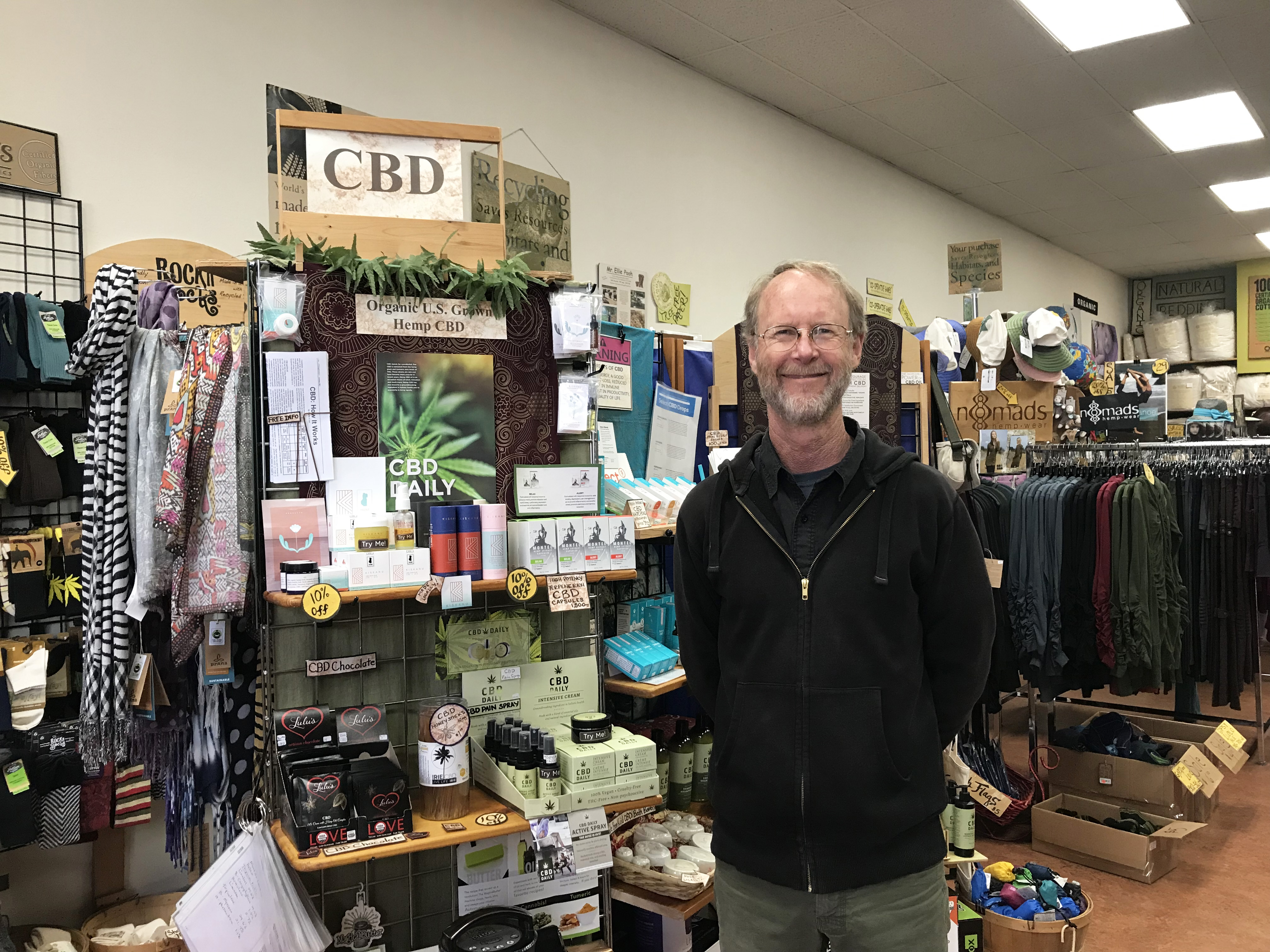
The Arcata plaza is a quirky place. The stores that surround it each have their own flare, and no two are alike. Of those stores on the plaza, that definitely screams the image of Humboldt is “Solutions.” Solutions is an eco-store that has been there since 1990 and is owned and operated by Kevin Johnson.
“Everything we have here is the more eco version of a toxic version [of a product],” Johnson said. “Whatever can be made with CBD, we’re trying to have.”
Cannabis has been the talk of the town, especially after legalization, more specifically is cannabidiol, also known as CBD. CBD oils have been proven to be a natural remedy that has started to become more popular. To put it simply, CBD and tetrahydrocannabinol or THC are different from each other but come from the same plant. THC is the psychoactive, mind-altering compound of cannabis, but CBD is an extraction from hemp and is anti-inflammatory. According to healthline.com, CBD has been proven to help with inflammation (especially in seniors), controlling pain, nausea and mental disorders.
“What people are doing now is they are taking hemp plant varieties, crossing it with the cannabis and breeding the CBD up and the THC down,” Johnson said.
Because CBD is gaining popularity, the people that grow to make these different products have altered the way they grow the marijuana plant, knowing that many people prefer the non-psychoactive part of the plant.
HSU art history major Sam Oetinger, said he has never personally bought CBD oil but has used it in the past with his lacrosse teammates after games.
“We felt that it helped with muscle soreness and recovery,” Oetinger said.
However, the repeating argument that goes into CBD is that the success stories outnumber the actual scientific evidence. There are many people that swear by CBD and cannabis as a whole, but because it is still so unknown there are yet to be studies done that weigh out the benefits and the drawbacks.
Miles Kinman is an environmental studies major at HSU. Kinman said that his family uses CBD oil as a less expensive alternative medication to help with his sister’s arthritis.
“My sister had side effects from arthritis medication combined with other meds which she doesn’t have to deal with when using CBD,” Kinman said.
CBD comes in many variations; Kevin Johnson explained that Solutions carries lotions, cosmetics, chocolates and some fabrics made from hemp. Despite CBD being a controversy, the plant itself is a more sustainable form of creating these products as opposed to unsustainable factories.
David Gwenzi is this month’s professor profile. We talk about his culture, his academic achievements and his contribution at Humboldt State
David Gwenzi is an assistant professor of environmental science and management at Humboldt State University. He teaches remote sensing classes and geospatial science classes.Gwenzi is the content committee chairman for the geospatial science program, a program that floats between three departments and two colleges. Born and raised in Mutare, Zimbabwe, his values encourage him to be a role model for younger generations and to inspire success.
[perfectpullquote align=”left” bordertop=”false” cite=”David Gwenzi” link=”” color=”” class=”” size=””]“Whatever you do as an adult, think of how it reflects on younger generations.”[/perfectpullquote]
“Whatever you do as an adult, think of how it reflects on younger generations,” Gwenzi said.
Gwenzi was raised in the Bantu culture, a culture made up of several hundred indigenous ethnic groups in sub-Saharan Africa, spread over a vast area from Central Africa across the African Great Lakes to Southern Africa. The culture encourages responsibility to the society rather than just the individual. Gwenzi became an educated man to prove to the people in his community that if they put in similar effort, they would be able to meet their goals and gain achievements as well.
Gwenzi began his college education at Bindura State University in Zimbabwe, where he researched environmental sciences to help the people of his home country better understand their landscape.
After two years of classroom education, Gwenzi spent a year researching local pine plantations. This was Gwenzi’s first opportunity to use spatial data for his plantation baboon bark stripping research project in July 2006.
“I researched baboons on pine plantations in Zimbabwe,”Gwenzi said. “The baboons stripped pine trees of their cambium layer and they chewed on it. There was sugar or sweet in that layer. It was a treat, but it would girdle the trees.”
Professor Gwenzi rendering a map using interpolation, a process which estimates data obscured by clouds or corrupted data bands. | Photo by Colin Slavey
The nature of the project had Gwenzi surveying the movements of baboon troops on plantations in the eastern highlands using spotting scopes and topographic maps. Gwenzi would record the locations of stripped pine trees in pencil on topographic maps. He compiled the data by hand. His data gave him some idea of the range of each baboon troop on the plantation. It was a tedious process.
“When I was done with that, that was when I talked with the guy who was a GIS technician,” Gwenzi said. “He showed me you could make cool maps out of all these topo maps. Then the guy told me about how easy it could be digitize. I didn’t have to do it with pen and paper in the end.”
Gwenzi fell in love with the GIS process. He became familiar with the tools of the trade and focused his education around Geospatial Sciences. After receiving his bachelor’s in environmental sciences with a focus in forestry, Gwenzi moved to the Netherlands to receive his master’s in geoinformation science and earth observation from the University of Twente. He finally completed his education with a doctorate in spatial ecology from the University of Colorado.
At HSU, Gwenzi shares his passion with many students in the environmental sciences and management department, the forestry department and the geography department. He is renowned through the student body as a high quality professor.
Bente Jansen is a HSU junior ESM policy and planning major. He said that Gwenzi is a good teacher.
“He was always willing to work with me,” Jansen said.
Melanie Stephenson is a senior geospatial science and geology major who has taken some of Gwenzi’s classes.
“Gwenzi is such a ‘G.’ ‘G’ for Gwenzi,” Stephenson said.
Sam Wood is a HSU alumni of the geography program.
“Gwenzi is the best,” Wood said. “He is a genius. I wish he was here now hanging out with us.”
Football and classical romantic music, an unlikely pair of passions
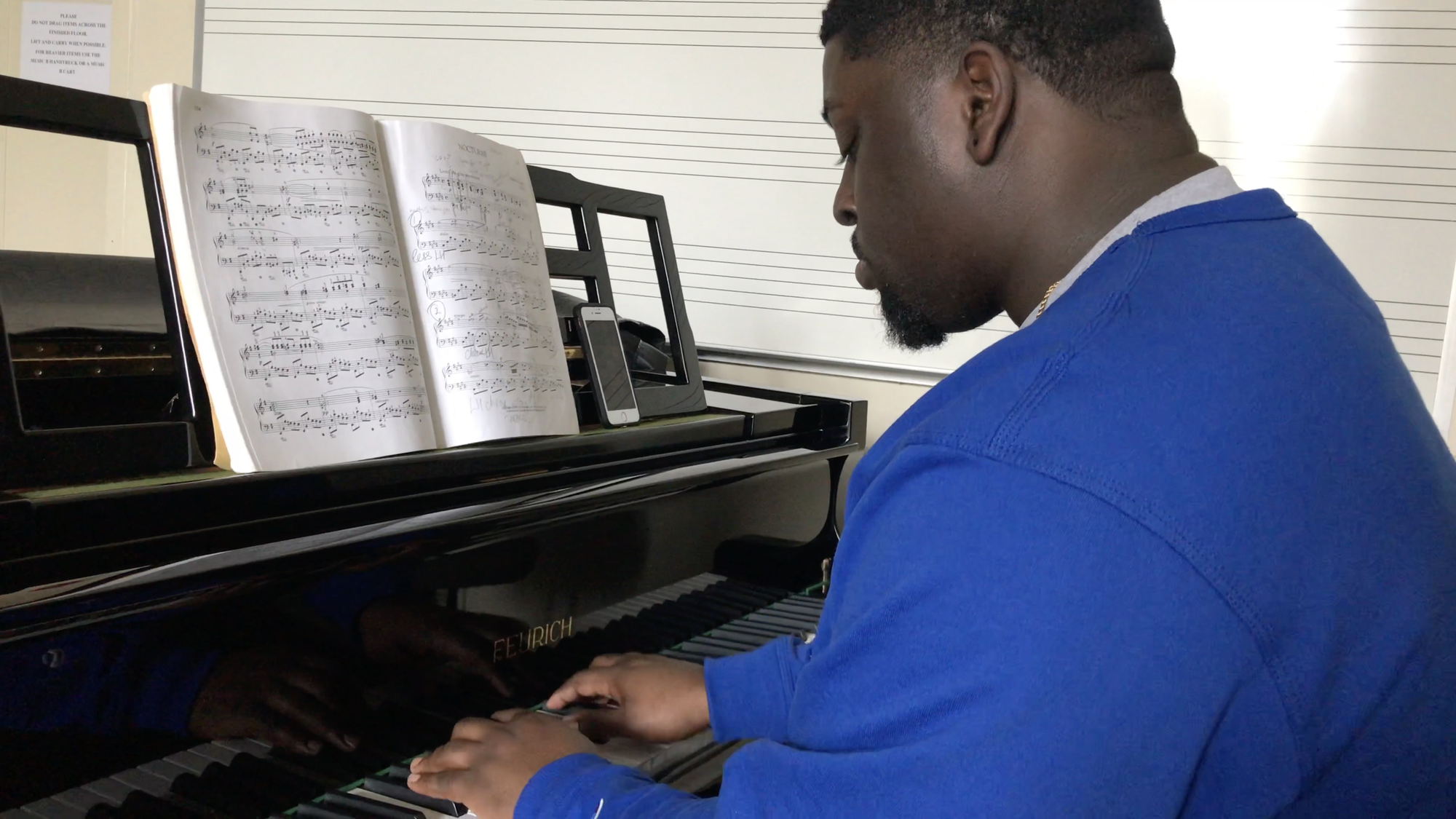
Born into a family of musical influence, Job René, grew up touring the country with his dad’s reggae band, Phase 2. Continuing the family’s musical legacy, René plays both the piano, and cello skillfully as well as pursuing a music major at HSU.
“Music has been a part of me since childhood,” René said. “I started piano when I was six or seven and my dad’s a musician. He kind of said you’re playing music, I don’t care what you say, you’re playing.”
René continued playing the piano up until high school, deciding a break was best for himself.
“That’s when I said, I’m done with the piano for now,” René said. “I want to play sports, I want to do high school things.”
After quitting music, René played basketball and a year of football. With a lack of funding, the football program closed and René was pulled back into the world of music, where he decided this time he would learn a new instrument.
“I always wanted to continue to play music, that never went away,” René said. “What jump started it was in high school, around 10th grade I started playing the cello. A music program came to the school and I thought, I have to get back on this, this is a calling. I told myself I’m doing this and I’m learning a new instrument.”
Even though René went back to music and started learning a new instrument, he felt discouraged to pursue music as a major.
“There’s no money in music, I was set on broadening my horizons,” René said. “I did settle for a minor in piano because I knew I had to do something with music.”
René explored departments and opportunities outside of music to see what else he was interested in.
“I was undeclared for a good two and a half years,” René said. “At the end of that semester I changed my major to music and started that spring.”
René decided to embrace the musical aspect of his life and pursue it as a career.
“I am very happy with my music major,” René said. “I mainly play classical music, it’s what I was brought up on since I was seven. It’s really what I lean towards and I actually like it!”
René takes pride in his passion for romantic classical music, having dealt with judgements and push back over his preferred music choice in the past.
[perfectpullquote align=”right” bordertop=”false” cite=”Job René” link=”” color=”” class=”” size=”16″]“My mom is my biggest supporter. She was really proud I was learning piano… It was the fact that she could see a future in it.”[/perfectpullquote]
“Me being a black person, I get it all the time,” René said. “Like, bruh, why are you listening to classical music? “I connect with it, it was destined for me to like [classical music].”
Regardless of the judgement, René continues. He said his biggest supporter keeps him motivated.
“My mom is my biggest supporter,” René said. “She was really proud I was learning piano. I was doing something that a lot of other kids weren’t really doing. It was the fact that she could see a future in it.”
Mae René, lives 13 hours south of her son in Los Angeles, but still takes time off work and drives to see every recital.
“I try to be a supportive parent in the audience,” Mae René said. “To me, it’s not a 13 hour drive, it’s me seeing my child.”
Mae René has trusted her son’s music abilities since a young age and saw a future for him in it early.
“He picked up music right away,” Mae René said. “To be honest, I wanted him to be a music major from the beginning but I allowed him to step out, and now he knows, mom knows best!”
Mae René isn’t the only supporter in the audience, fellow Brothers United members also strive to support René.
Brandin Thomas (left) and Ronald Taylor (right) stand in front of Brothers United table in the HSU quad. | Photo by Grace Caswell
Ronald Taylor, a third year kinesiology major, and fellow member of BU, described his first experience watching René perform.
“I went to one recital at the end of last year,” Taylor said. “It was really nice, he did well, no mess ups.”
Bradin Thomas, a fourth year kinesiology major and member of BU, is a fan of René’s romantic classical music interest.
“It’s nice,” Thomas said. “I like his music, it soothes you.”
With support from friends and family, René embraces his musical interest more seriously, and is considering sharing his interest with young kids.
[perfectpullquote align=”left” bordertop=”false” cite=”Job René” link=”” color=”” class=”” size=”19″]”If I have to stop music, it’d be like taking a piece of my soul.”[/perfectpullquote]
“Right now, I’m taking a pedagogy class that teaches you how to start your own business,” René said. “Like how to start your piano studio and teach students how to play piano.”
Wanting to share his musical interest, René emphasizes the impact music has had on his life.
“If I have to stop music, it’d be like taking a piece of my soul,” René said.
This week in drug-related activity was pretty chill. Nobody was charged with possession and nobody was caught in the act of smoking weed. However, we do have to salute a fallen soldier. On Wednesday Feb. 6 in the Alder residence hall, “marijuana related contraband located during a fire drill was seized for destruction,” according to a police report. It is unfortunate that the individual lost their bong, bowl, pipe, vape or whatever; but let’s look on the brightside—nobody caught a charge! And that my friend is dope a.f.
Possession charges = 4
Contraband/Paraphernalia= 1 (no one was charged but someone did lose a piece, so I’m counting it)
Hootie Hoo!—what the cops are up to:
Monday Feb. 4
STOP! (in the name of love)—A cyclist ran a stop sign at 17th and Wildlife Lane. They were just warned, but everyone should know that bikes must obey the same traffic laws as vehicles.
Petty Theft—Someone stole a purse from the Student Health Center and that is lameeeee.
Tuesday Feb. 5
LOUD NOISES! —Multiple burglary alarms went off on Tuesday. One of them was due to a broken window at Room 142 of the Wildlife building.
I swear this isn’t cocaine—Someone spilled a whole bunch of flour near the Pedestrian Underpass near LK Wood Blvd. The subject helped clean up the white powder and then went along with his day.
Serving the community—UPD helped with a flat tire, a locked car door and two dead batteries, all in one day. If the cops help you, make sure to give them a hug, handshake, or a “thank you.”
Vandalism—Someone drew something on something somewhere (Gist Hall). Freakin’ yawnnn. Who cares about vandalism anymore, I got student loan debt to worry about.
An issue worth addressing—A “male non-student was warned for…camping/sleeping on campus property…” Arcata’s new mayor Brett Watson said he wants to focus on helping our fellow citizens-in-need during his first term as mayor. Let’s hope he can succeed in helping those who call our streets home.
Whoa bro!—Somebody got warned for skateboarding on campus where they shouldn’t be. Next!
Help I’m stuck!—Around 1 p.m. someone got stuck in the elevator in Founder’s Hall. Talk about a nightmare.
Wednesday Feb. 6
Someone literally lost their car—Someone thought they parked their car at the Children’s Center when they actually parked it in the Jolly Giant lot. That is literally on the other side of campus ya silly goose!
Annoying neighbor—Someone called the cops because a car was parked on B Street “for the last two days and has not moved.” Come on! You live in a college town. This person probably opposes new housing projects too. Lame!
Good Guys—The cops jumpstarted someone’s car. That’s pretty cool, right?
Drug Activity! (it’s weed again)—It’s the same thing I told you about in the Rolling Count. Next!
Those dang skateboarders are at it again—Skateboarding is not a crime, until they cite you for doing it on campus. This person was skating near B Street in someplace they shouldn’t be. I once heard that heaven is a halfpipe, so you got that to look forward to.
Grand Theft Laptop—Someone stole a laptop, which can be devastating. I mean if someone stole mine, I would probably cry and freak out and have a panic attack, because all of my school work is on here. Don’t steal laptops, or in general. Stealing’s bad, mkay?
Thursday Feb. 7
Burglary—The Pacific Southwest Research Lab on Bayview Street was broken into around 11 p.m. A 37-year-old man was arrested. No details were listed about what he tried to take.
Smokin’ ciggies—An “anonymous crime tip email of two females smoking cigarettes” near the Student Health Center was reported around 2:30 p.m.
Paranormal activity—There were five calls to UPD from the Library elevator. The report says it was due to an “equipment malfunction,” but I think it is ghosts so that’s what’s going into the public record.
Good guy alert—Someone got an escort to their car from UPD at 1:39 a.m.
Friday Feb. 8
Petty Theft—Someone stole a bike chain… but not the bike… hmm
9:08 a.m.—“Officer contacted a subject who appeared to have a bulge in their waistband under a coat. It was not a weapon.” This occurred at the intersection of Union and 10th.
Saturday Feb. 9
IT SNOWED!!!!
Paranormal activity 2 (ghosts are real)—There was a report of a tarp and other items left in front of the Natural History Museum on G Street. But when the cops showed up…it was gone! Ghosts came and cleaned up the mess, definitely not a person, but ghosts.
Sunday Feb. 10
Paranormal activity 3—Four times throughout the day 911 was dialed and “voices were heard.” Ghosts, guys, freakin’ ghosts.
Heroes!—A “male non-student was transport to Mad River Community Hospital due to possible hypothermia.” Our counterparts that call our streets and wooded areas home are always in need of warm clothes and food donations. Donations can be dropped off at the Arcata House at 501 9th Street. Bedding, socks and raincoats are always in need.
There is stuff everywhere—Downed tree limbs, power lines and other stuff in the street were reported on Sunday. Probs due to that dang snow! Send me to L.A. I’m over this rain/snow stuff! (JK there’s too many people there).
HELP WE’RE STUCK!—Eight people were stuck in elevators on Sunday due to power outages (or ghosts). Eight! I’m taking the stairs from now on.
It was a crisp, clear night. The Arcata square was full of hustle and bustle as it would be on a Saturday night. At the Arcata Theater Lounge, a crowd lined up with enough people to wrap around the corner of G and 11th St. The crowd was filled with people ranging from young college women to middle-aged men, all anticipating the Mr. Humboldt beauty pageant.
“It’s glorious,” Nad Molloy said, otherwise known as Mr. Who Now. “I’m more than happy to be here.”
Molloy was a contestant in the 2014 pageant and was sporting the same tux that he wore during his run for Mr. Humboldt. The crowd was dotted with crowned men of past years; among them was Jeff Mason, the Mr. Humboldt winner of 2015.
“I expect partial male nudity and lots of enthusiasm,” Mason said, as a group of young women waiting to talk to him hollered at his comment.
The contest consisted of four main events: question and answer, swimwear, talent, and formal wear. In the mix, there were two award sections as well, the Mr. Congeniality Award and the Cougar award. As for the seven contestants themselves, there was Mr. Boujee, Mr. Heavy D, Mr. Buck 25, Mr. Queer, Mr. Lumberjack, Mr. Dig and Mr. Bigfoot.
The whole function of the Mr. Humboldt pageant to raise money for a charity that is chosen by the winner every year. This year, the charities that were chosen were Food for People, Planned Parenthood, Family Resource Center for ACE Prevention and the North Coast Rape Crisis Team. This year the total amount that was raised was six thousand dollars.
Throughout the event, people were encouraged to donate anytime they could. Undergarments could be purchased to throw onstage and there was a popularity contest at intermission where the eliminated contestants could be voted back in.
Audience member Marisa Parish said that this was her first year attending a Mr. Humboldt pageant.
“Just good, relaxed fun, and freedom to explore your comfort and sexuality is a good experience to have for everyone,” Parish said.
Parish came with a group of women wearing clips in their hair designed to look like vaginas and breasts in support of Planned Parenthood. The entirety of the pageant was to come out, have fun and support each other, making the event all the more enjoyable.
“As long as the charity gets the money, and the people in the audience have a good time, that’s all that matters, that’s what tonight’s about,” contestant Mr. Heavy D said.
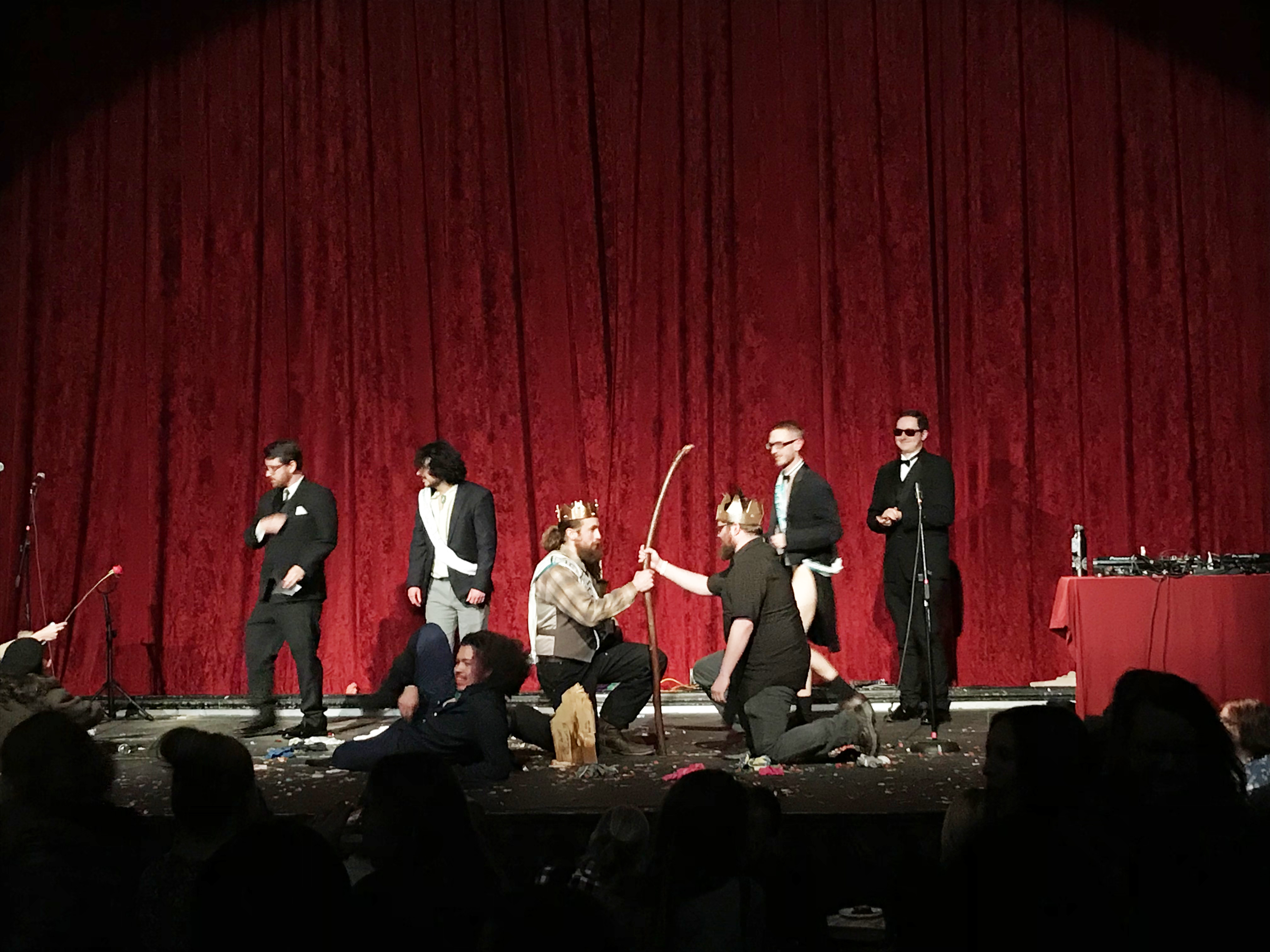
The night was full of plenty of sexual innuendos and enough wood jokes to last a lifetime. Ladies in the audience whooped and hollered as the men danced around onstage wearing minimal clothing. The crowd favorite was definitely Mr. Lumberjack, who is also an HSU student. Mr. Lumberjack was the one to take the win at the end of the night.
“You know, we played really hard, we had a good game,” Mr. Lumberjack said, sporting his new crown. “You gotta just hang it out there, whether it’s all you got or literally all you got in your skivvies. You’ve gotta just put it out there on the line.”
Tattoo guns were whirring and the Blue Lake Casino was jam packed with tattoo artists from around the country attending the 10th annual Inked Hearts tattoo expo. This past weekend they opened up their doors to roughly 50 artists who all specialize in various styles and techniques of their art.
Riley Smith is the owner of two tattoo shops, Lifetime Tattoo and Queen Bee, both located in Oregon. He is no stranger to expos, attending an average of 20 expos per year as well as being the founder of three expos himself. These expos are the Evergreen Tattoo Invitational, Evergreen Tattoo Champions and the 208 Boise Tattoo Fest.
“Actually it was a bit of a fluke, me and my business partner Josh McCarlton, he’s the master of realism tattoos, got together and decided we wanted to make tattoo shows better,” Smith said.
Being tattooed by Jared Glassburn from Vancouver, WA. | Photo by Cassaundra Caudillo
[perfectpullquote align=”left” bordertop=”false” cite=”Riley Smith” link=”” color=”” class=”” size=””]”Of all the shows I do around the world this is my favorite show.”[/perfectpullquote]
Having a long history with expos, he said that the best part of these expos is being able to see artists do what they’re best at, but did mention that expos aren’t the most ideal place to tattoo a person. However, he does have a high appreciation for Inked Hearts.
“I’m honored to be here,” Smith said. “Of all the shows I do around the world this is my favorite show.”
Nico Herring, an artist at Inkfatuation located in Port Hueneme, California, shared a lengthy list of both pros and cons, in which he agrees with Smith on some. Having attended expos in the past and specifically Inked Hearts twice, he had a few things to share.
“You get new clientele, you get to meet new artists from around the world, you get to see artists tattoo that you’ve been wanting to see,” Herring said. “Cons…traveling and having to fish for appointments, but normally there’s a lot of people that come so it’s not too big of a deal.”
Michael Bales, artist from Texas, is tattooing a large quail and flowers in his original style. | Photo by Cassaundra Caudillo
Artists who attend these shows can make anywhere from $1,000 to $12,000 per expo weekend. There are some artists who find that despite making those few thousand it is difficult to break even when you take into consideration the traveling costs. These artists do agree that coming to these expos is worth the hours long drive or various flights.
First timer Ceka Kitami, from Faces in the Dark tattoo shop in Kyle, Texas, said that for her the most grueling part of an expo is the traveling. Her team and her had to fly to Humboldt with all of their supplies and then haul it to Blue Lake via car.
“I always learn something new every expo I go to, but the traveling and having to lug all of your stuff all around the world isn’t very fun,” Kitami said.
Woman gets artwork done on her arm at the expo.
Joe Elliott, who owns Tattoo Joe’s out of Vacaville, California, mentions that he has been coming to Inked Hearts for nine straight years. He only does three shows a year and Inked Hearts is always one of them. He enjoys being able to catch up with old artist friends and see new talent.
Humboldt State alumni gives voice to incarcerated women in play
On an overcast afternoon with lightly peppered rain, the Siren’s Song Tavern in Eureka doubled as a rehearsal stage for the upcoming play “Any One Of Us: Words From Women In Prison.” Humboldt State University alumni and activist for formerly incarcerated rights, Vanessa Vrtiak, will direct Eve Ensler’s production for the second time in Humboldt County. The press release states the play “is a collection of stories from formerly and currently incarcerated women from across the nation moving forward toward healing, understanding and change with the goal of using their writing and voices to impact policy, laws and treatment of incarcerated women.”
“These women are not defined by their crimes, but we hear news of some horrific crime and define someone solely on that,” Vrtiak said. “These issues trickle down and almost make re-entry impossible. We label constantly because it’s so easy to cast stones before we know who they are.”
Caterina Keen, Megan McAllister, Michelle “Chelly” Purnell, Vanessa Vrtiak, Nezzie Wade, and Klark Swan at rehearsal for the play “Any One Of Us” at Sirens Song Tavern. | Photo by T. William Wallin
Vrtiak first directed the play in 2011 with five shows and is excited to be creating it again. After rehearsal she said it feels more intense than before because of where the state of the country is, but believes it’s the right time to be performing.
[perfectpullquote align=”left” bordertop=”false” cite=”Nezzie Wade” link=”” color=”” class=”” size=”18″]“What these women have been subjected to it’s amazing they’re even alive to be incarcerated.”[/perfectpullquote]
“Still after all this time there’s a lack of support and resources for formerly incarcerated individuals in the community,” Vrtiak said. “I know how powerful and poignant this play is. It’s dark but there is hope in this play.”
Community activist and founder of the Affordable Homeless Housing Association (AHHA), Nezzie Wade, has performed with Vrtiak before and said the acting in “Any One Of Us” uses criminal justice dialogue to bring light to all of our systems of court and prosecution. The stories are heavy and link the correlation between women in prison and the violence they have endured.
“Peeling back the layers of these women is very moving,” Wade said. “But what these women have been subjected to it’s amazing they’re even alive to be incarcerated.”
Wade, who works closely with the homeless population in Humboldt County, said we use incarceration as a tool to manage and store people and this play sheds light on our current system.
“It’s become so easy to dehumanize people and detach,” Wade said. “We want a community that cares deeply about the situation.”
Actress and HSU alumni Michelle “Chelly” Purnell agrees with Wade and said she is acting in the play because there aren’t many people of color in Eve Ensler’s plays.
“They aren’t intersexual in Humboldt County,” Purnell said. “There should always be a person of color in those works because there isn’t any.”
For Purnell this play reaffirms how important art and activism is to allow voices to be heard.
[perfectpullquote align=”right” bordertop=”false” cite=”Michelle Purnell” link=”” color=”” class=”” size=””]”Art is activism in every shape and form.”[/perfectpullquote]
“We don’t think about how people get to where they are,” Purnell said. “We need to ask: ‘What has happened to them that we could have changed?’ Art is activism in every shape and form.”
Vrtiak said this play will be a kick-off for a bigger project in the community and is only the beginning. She is starting Humboldt County Re-entry Initiative, a non-profit that will benefit formerly incarcerated individuals in the community.
“The money from the play will go to formerly incarcerated individuals to be reintegrated back into the community,” Vrtiak said. “We have a lot of work to do in the community with incarceration, homeless, people of color and the list going on and on and on.”
Nezzie Wade, Michelle “Chelly” Purnell, Vanessa Vrtiak, Megan McAllister, Caterina Kein, at rehearsal for the play “Any One Of Us” at Sirens Song Tavern. | Photo by T. William Wallin
“What we say on stage helps the community to engage and understand what happens in the criminal justice system,” Wade said.
Performance Dates:
March 23, 7 p.m. at The Sanctuary in Arcata
March 24, 5-9 p.m. at The Sanctuary in Arcata
April 5, 7-9 p.m. at the Siren’s Song Tavern in Eureka
April 19, 6-9 p.m. at the Eureka Women’s Club, the dinner starts at 6 p.m. and the show starts at 7 p.m. *This show includes a dinner*
General Admission: $12, $10 with a valid student ID
The April 19 show is $25, which includes a dinner before the performance.
Tickets on sale: Feb. 1, at Wildberries Marketplace.
As mentioned in a previous article, it is still illegal to possess weed on campus. Since the new year, four people have been charged with marijuana possession on campus, two of them being for individuals between the ages of 18-20. Although it happened last year, it is worth noting that there were 22 cases of either paraphernalia or “contraband” being seized in 2018. “Contraband” can be considered bongs, bowls, pipes, grinders, you know all the things needed to “blow ‘dro”, “puff cheeba”, “blaze up” or whatever else you call it.
As part of this series, The Lumberjack will be keeping track of all marijuana possession charges, as well as paraphernalia and “contraband” charges. So far the “Rolling Count” for possession charges is at four and the the “Rolling Count” for paraphernalia and contraband is at zero.
“Hollerin’ ‘hootie hoo!’ when we see the cops”
Monday Jan. 28
Ew what is that?!?!—Bloody tissues were found along side a blanket near the Rohner Admission Center around 9:00 a.m., however the owner of the bloody tissues and blanket were nowhere to be found.
Someone stole something—A petty theft of an item valued over $50 was taken from the Music B building at around 1:30 p.m. hopefully the item will be returned in the near future.
Tuesday Jan. 29
Someone buttdialed the cops—This happens way too often as you will see in future Blotter Bytes.
You can’t smoke here bro!—UPD was called to respond to multiple reports of someone smoking on campus. Listen up folx, HSU is a no tobacco campus, puff that stuff elsewhere.
A case of mistaken identity (aka fraud)—A camera was previously checked out from the Library using someone else’s ID and was not returned and was reported at 8:19 a.m. as fraud.
A trespassing charge was issued to a man “asking the housing department desk for info regarding a homeless shelter.” It is shameful to think that when a person was asking for help, he was detained and arrested instead. Shame on the powers that be.
Wednesday Jan. 30
The skatepark is that-a-way homie!—Someone called the cops to report “skateboarders creating a hazard to pedestrians.” Skateboarding is not a crime…unless UPD catches you.
Thursday Jan. 31
An issue worth addressing—Some of our more marginalized and needing counterparts call our streets, parking lots, forested areas and underpasses home for the night. UPD was called because of a camping violation under the underpass that leads from campus to G Street. The individual was let go without a ticket.
Another unneeded call to 911—Arcata Police (UPD and APD work together sometimes) responded and the caller said it was an accident.
No Fly Zone—A man was flying a drone around campus at 11:46 p.m. UPD responded and told the individual to land his aircraft, because people thought that aliens were coming. JK JK aliens aren’t coming here, he just didn’t have the proper paperwork.
Friday Feb. 1
Nothing too substantial happened. Just another unneeded 911 call (I told you this happens a lot), someone drew something on a “Telecom box” outside of Maple Residence hall and some people were pulled over for not stopping at a stop sign. I thought Fridays were supposed to wild.
Saturday Feb. 2
Umm excuse me, but you don’t live here—“Two suspicious subjects” were asked to leave the Sunset Residence hall at around 10:00 p.m.
Drug Activity! (calm down it’s just weed)—Someone was cited for 11357 (a)(2) at around 10:15 p.m. 11357 (a)(2) is written out for marijuana possession for adults ages 18-20.
What the eff is that smell?—A burning smell was reported in Fern Residence hall at 3:14 p.m. Turns out nothing was on fire but a fan in one of the bathrooms stopped working.
Sunday Feb 3.
Super Bowl Sunday! Things are going to get lit AF for sure, right?!?! Turns out not really. Just a couple of people got pulled over and someone accidentally went into the wrong room.
Transgender professor identifies how legislation hurts the trans community
Dr. Loren Cannon, an award-winning HSU philosophy professor with numerous published essays, presented a talk focused on trans-directed injustice to a room overflowing with students and community members on Thursday, Feb. 7.
HSU students Elijah Patterson and Summer Gilstrap, who identify as trans, were inspired by Cannon’s experience and wanted to show their support.
“[Cannon’s] a successful, fully transitioned male and it’s a goal [for me],” Patterson said.
Students and community members gather to hear Loren Cannon talk about trans injustice on Thursday, February 7. | Photo by Christina Samoy.
Cannon believes the Obama administration had an understanding of Title IX, a law that protects people from being sexually discriminated against, which he said the Trump administration does not.
“Title IX should be interpreted how the Obama administration did,”Cannon said. “They did it correctly.”
[perfectpullquote align=”left” bordertop=”false” cite=”Summer Gilstrap” link=”” color=”” class=”” size=”18″]”It’s a blatant attack against trans people. They’re not interested in protecting people.”[/perfectpullquote]
Gilstrap, a political science major who identifies as a trans woman, agrees that the Trump administration is silencing trans people, not allowing them to be heard.
“It’s a blatant attack against trans people,” Gilstrap said.. “They’re not interested in protecting people.”
After showing “Keeping Massachusetts Safe,” a commercial made to inflict fear that trans people will assault cisgender people in restrooms, Cannon shared a story where he found himself in a similar situation.
A couple months into transitioning, while teaching at Arizona State University, Cannon went to use the restroom, not knowing two little girls were in the stall next to him. A woman ran out alerting the girl’s fathers that a man, Cannon, was in the restroom. Cannon, gender ambiguous looking at the time, tried to look as womanly as possible, smiling as he exited.
“I preformed femaleness well, so I didn’t get hurt, but the option isn’t always there,” Cannon said.
Some people eventually choose not to go out because they can’t participate in society because they’re prohibited from using restrooms due to their gender identity. Cannon found studies showed trans people are likely to develop PTSD due to fear of bathrooms, which can lead to urinary tract infections.
“A lot of other trans people have debilitating dysphoria around restrooms that can cause real psychological harm,” Gilstrap said.
In response to a student asking how HSU can improve the safety of trans lives, Cannon said gender neutral bathrooms on the BSS side of campus is needed, as well as a LGBTQ+ center funded by professionals as a permanent position so administration can be there to advocate for LGBTQ+ people.
Students and community members gather to hear Loren Cannon talk about trans injustice on Thursday, February 7. | Photo by Christina Samoy.
[perfectpullquote align=”right” bordertop=”false” cite=”Neesh Wells” link=”” color=”” class=”” size=””]”There’s still a lot of things trans folks that are affected by. We just want to be respected as people.”[/perfectpullquote]
While HSU has made improvements like allowing students to change their preferred name and pronouns in their student center, there are still improvements that can be made. Neesh Wells, a non-binary-identifying student, wants others to know that they don’t have to be afraid of trans folks or non-binary people.
“There’s still a lot of things trans folks that are affected by,” Wells said. “We just want to be respected as people.”
Offering classes that bring awareness to the LGBTQ+ community more often in course rotations may help people from outside the community gain more knowledge about people within the community and the struggles they face.
“I personally think it’s super important to continue involving folks who don’t identify as cis gender,” Wells said.
Maral Attallah, who planned the event, pointed out that Lisa Bond-Maupin, the College of Arts and Humanities dean, was the only university administrator to attend the talk. Attallah, like many other supporters, highlighted the importance of representation and support from allies outside of the community to help advocate for issues the LGBTQ+ community faces.
Having representation is important for groups who don’t always feel welcomed. Giving Cannon a platform to share his stories and knowledge allows others to use that safe space to share their own thoughts and experiences.
“It’s inspiring to see someone be successful, who I can relate to,” Patterson said.
Correction Feb. 20 5:25pm: This article previously listed Lisa Bond-Maupin as the only faculty in attendance.
The sport where slacking off and eating is expected and encouraged
Levitating above the ground on a line not much wider than your big toe, slackliners use their arms and core to maintain balance while walking along their line suspended between two trees.
Meet the Slackjacks, a new club devoted to sharing the sport of slacklining, not just to HSU students but to the community at large. Established last fall by club president Amanda McDonald, the young club has already partnered with the Trinidad Coastal Land Trust in an effort to spread environmental awareness and protect their slacklining spots.
“We are all environmental stewards, everyone here loves nature,” McDonald said. “The Trinidad Coastal Land Trust approached us after seeing one of our high lines on their beaches.”
Every Saturday, the Slackjacks have stewardship work day, where they volunteer at the Trinidad State Beach aiding in restoration work.
“They [Trinidad Coastal Land Trust] love what we do and we embody their mission,” McDonald said.
Besides the physical preservation work, the Slackjacks impact and connect to the community through the practice of slacklining. Every Sunday, the club sets up in the Arcata Plaza and opens up their lines to the people.
“Slack Sunday isn’t something I can take credit for as a club,” McDonald said. “The Humboldt Slackers are not associated with the school, but they are a group of friends, maybe alumni now, and they started Slack Sunday. It’s all about the young kids and elders, and just holding their hand.”
The connection created between the Slackjacks and the community is far deeper than the physical linkage of hands. Slackliners can enter a state of mind called “the flow state.” In this state of mind one experiences:
“Heightened awareness, it feels easy, and you totally lose sense of time,”McDonald said.
Liam Murray-DuMond, is the treasurer of the Slackjacks, and describes the insane euphoric feeling associated with the flow state.
“When you find your flow, I’ve had moments where I black out,” Murray-DuMond said. “I literally don’t remember walking. It’s the highest you can be without doing drugs.”
The flow state occurs when one is faced with a challenge that adequately correlates with the level of skill of the slackliner. This perfect balance in challenge and skill causes one to drift and experience the effects of the flow.
“I’ve seen kids in it when they slackline for the first time, they click with it,” McDonald said. “They want to keep trying and you can see they are getting exposure and want to latch onto it. Kids are very profound with wanting to keep slacklining.”
Slacklining is a physically demanding sport. Buddy Mitchell, a transfer student at HSU and member of the Slackjacks, describes the effect it has on the human body.
“Slacklining is definitely a sport,” Mitchell said. “You sweat, your arms get tired, your tummy gets tired and your core is sore the next day, and your back and your legs.”
While slacklining posesses the physical exertion of other athletic sports, it maintains a heavy emphasis on social interaction and connecting with the community.
“Since there can only be one or two people on a line, a lot of it is sitting down in the park and eating,” jokes Mitchell.
The Slackjacks embrace their club as more of a community of friends. Wanting nothing to do with exclusiveness, the club is constantly reaching out to the community and encouraging others to slackline.
[perfectpullquote align=”left” bordertop=”false” cite=”Liam Murray-DuMond” link=”” color=”” class=”” size=”18″]”It’s the highest you can be without doing drugs.”[/perfectpullquote]
“I absolutely wanted a club, it provides this,” McDonald says as she looks around the room of members enjoying their Friday potluck. “Otherwise we don’t have this. By not having a club, it would be restricting us from tapping into the community, and all the resources HSU provides, like the ability to create space, education and community.”
With a goal of integrating slacklining into the normalcy of society, McDonald explains how regardless of their positive presence in Arcata, they still receive pushback.
“It’s hard to break through. When climbing evolved into society, people did not like climbers, it was taboo, same with skateboarding in the 90’s, slacklining is exactly like that,” McDonald said. “We’re stuck in this transitional time period, but we want to keep our wholesome values. We don’t want to be non-welcoming or snobby.”
Regardless of the challenges, the Slackjacks continue to practice and share the benefits of their sport.
“I slackline for the feeling. It’s pretty hard to describe, but once you do it you just want to be in that moment and have that feeling as much as possible,” Murray-DuMond said.
Slacklining is one addictive activity that serves not only the individual but the community at large. With a constant emphasis on welcoming others to practice and preserving the communal values they identify with, why wouldn’t you slackline?
“It’s fun, a great way to spend the afternoon, or morning, or evening,” Buddy said. “I can’t really put it into words, I do it for different reasons. Mostly, it’s very social, probably the most social thing to do, and the easiest way to make friends.”
Between Friday club meetings in Siemens hall, Slack Sundays in the Arcata Plaza and environmental steward work Saturdays, the Slackjacks are hard to miss.
“I know we look crazy but come try!” McDonald jokes.
The Diekmeyer family opens up about farming in Humboldt
Amy and Fred Diekmeyer, owners of Luna Farm, recently moved into their new 26 acre plot of land in Redcrest that provides organic fruit and vegetables for local community members. The Diekmeyers fell in love with the local climate and became inspired to start their own business.
“Everybody was growing weed around here and we didn’t want to grow weed,” Amy Diekmeyer said. “We wanted to grow something because we were into plants so we just got into growing food.”
Fred Diekmeyer handing money back to customer at the Luna Farm stand at the Arcata Farmers Market on Saturday, Feb. 2. | Photo by Christina Samoy
Fred Diekmeyer was offered a farming job in his late 20s. During that time he learned organic growing practices and gained experience in harvesting produce. After years of working various jobs, Diekmeyer found to prefer the hard labor, and came to find that farming was the most worthwhile job he’s ever done.
[perfectpullquote align=”right” bordertop=”false” cite=”Amy Diekmeyer” link=”” color=”” class=”” size=”18″]”Humboldt has this great food thing going on, everyone’s interested in nutrition.”[/perfectpullquote]
“Working with plants is very rewarding,” Fred Diekmeyer said.
Julie Slater North, a social work lecturer at HSU, attends the Arcata farmers’ market every week with her family and frequently shops at the Luna Farm stand. She browses every stand, but makes an effort to visit Diekmeyer’s stand because she knows they have high quality produce.
“[The farmers’ market] is the highlight of our community,” Slater North said.
Ivy Matheny North, Julie Slater North, and their child gather in front of the Luna Farm stand at the Arcata Farmers Market on Saturday, Feb. 2. | Photo by Christina Samoy
Amy Diekmeyer enjoys growing food for her family and community because she loves to cook and knows that she’ll have something good to eat every night.
“Humboldt has this great food thing going on, everyone’s interested in nutrition,” Amy Diekmeyer said.
With students coming to Arcata from all over the country, having a farmers’ market so accessible may feel overwhelming and new. Resources like Oh SNAP can help students apply for CalFresh points that can be used at the Arcata farmers’ market to purchase produce.
“The vast majority of us are thrilled to have students in our community and we want to welcome them here and help them be a part of our community,” Slater North said.
Fred Diekmeyer, owner of Luna Farms at his stand during the Arcata Farmers Market on Saturday, February 2. | Photo by Christina Samoy
While Fred Diekmeyer prefers summer, because he loves hot crops like tomatoes and hot peppers, nothing is more important than connecting with locals.
“I like to be in the cycle of producing food, it’s a nice connection to society,” Diekmeyer said.
This website uses cookies to improve your experience. We'll assume you're ok with this, but you can opt-out if you wish. Cookie settingsACCEPT
Privacy & Cookies Policy
Privacy Overview
This website uses cookies to improve your experience while you navigate through the website. Out of these cookies, the cookies that are categorized as necessary are stored on your browser as they are essential for the working of basic functionalities of the website. We also use third-party cookies that help us analyze and understand how you use this website. These cookies will be stored in your browser only with your consent. You also have the option to opt-out of these cookies. But opting out of some of these cookies may have an effect on your browsing experience.
Necessary cookies are absolutely essential for the website to function properly. This category only includes cookies that ensures basic functionalities and security features of the website. These cookies do not store any personal information.
Any cookies that may not be particularly necessary for the website to function and is used specifically to collect user personal data via analytics, ads, other embedded contents are termed as non-necessary cookies. It is mandatory to procure user consent prior to running these cookies on your website.